
Matthew 6:8

Greek (Tischendorf 8th ed.) Matthew 6:8 appears in the Greek New Testament. The text above is from the Tischendorf 8th edition. Each word links to its Strong’s number and a concise gloss. Click any word for its full Thayer’s Greek Lexicon entry.
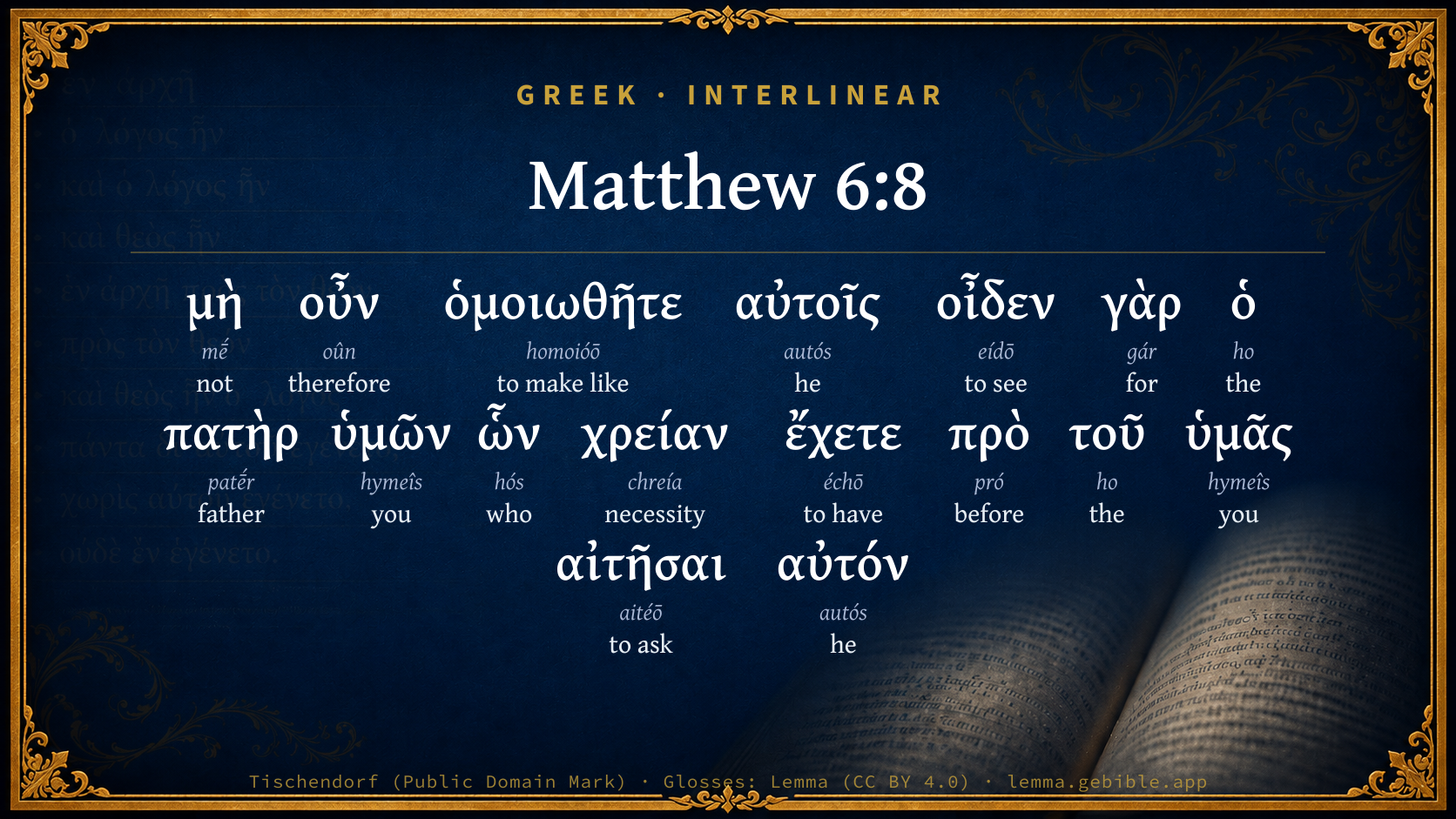
Download image
Cite this verse

Matthew 6:8 (World English Bible). Public Domain. Lemma interlinear Bible study tool, https://lemma.gebible.app/v/matthew/6/8.

Show BibTeX & RIS
BibTeX
RIS
English Translation
Therefore don't be like them, for your Father knows what things you need, before you ask him.
World English Bible · Public Domain
Highlights
  • 2 first appearances in the Greek New Testament
Full analysis ↓
Download a study sheet

One document with this verse’s original text, its word-by-word gloss line, the meaning frame, cross-references with their text, attributed commentary, and full source and license credits — printable, and it pastes into notes with its structure intact.

This verse Autodidact and up

Study sheet (.html) Plain text (.txt)

A passage Seminary Student

Up to 50 verses in one chapter. A passage sheet keeps up to 6 commentary sources and 12 cross-references per verse, in the order this page ranks them, and says so on the sheet whenever that leaves anything out. Ask for a single verse and you get the Autodidact verse sheet above.

Everything on this page stays free to read, with no account — the sheet is a download of what is already on screen, not access to it.

Want to remove ads? Support Godless Engineer
Compare translations 3

The same verse in 3 English versions, stacked beneath the original-language interlinear above. Click any original word for its lexicon entry.

Each is an independent rendering of the whole verse — the interlinear is not word-aligned to these translations.

Highlighted words mark where these versions differ — a whole-verse word diff, not a word-by-word alignment.

  • World English Bible Public Domain
    Therefore don't be like them, for your Father knows what things you need, before you ask him.
  • King James Version Public Domain
    Be not ye therefore like unto them: for your Father knoweth what things ye have need of, before ye ask him.
  • unfoldingWord Literal Text CC BY-SA 4.0
    Therefore, you should not be like them, for your Father knows what need you have before you ask him.

unfoldingWord Literal Text — © unfoldingWord, licensed CC BY-SA 4.0. Word-aligned USFM3 via Door43 (git.door43.org/unfoldingWord/en_ult).

Versions to compare (up to 4)

3 of 4 selected

Show all 19 translations

Every available English version of this verse, each an independent rendering of the whole verse.

  • World English Bible Public Domain
    Therefore don't be like them, for your Father knows what things you need, before you ask him.
  • Berean Standard Bible Public Domain
    Do not be like them, for your Father knows what you need before you ask Him.
  • Majority Standard Bible Public Domain
    Do not be like them, for your Father knows what you need before you ask Him.
  • King James Version Public Domain
    Be not ye therefore like unto them: for your Father knoweth what things ye have need of, before ye ask him.
  • American Standard Version (1901) Public Domain
    Be not therefore like unto them: for your Father knoweth what things ye have need of, before ye ask him.
  • Revised Version (1885) Public Domain
    Be not therefore like unto them: for your Father knoweth what things ye have need of, before ye ask him.
  • Geneva Bible (1599) Public Domain
    Be ye not like them therefore: for your Father knoweth whereof ye haue neede, before ye aske of him.
  • Douay-Rheims (1899) Public Domain
    Be not you therefore like to them, for your Father knoweth what is needful for you, before you ask him.
  • Young's Literal Translation Public Domain
    be ye not therefore like to them, for your Father doth know those things that ye have need of before your asking him;
  • Literal Standard Version CC BY-SA 4.0
    therefore do not be like them, for your Father knows those things that you have need of before your asking Him;
  • Unlocked Literal Bible CC BY-SA 4.0
    Therefore, do not be like them, for your Father knows what things you need before you ask him.
  • unfoldingWord Literal Text CC BY-SA 4.0
    Therefore, you should not be like them, for your Father knows what need you have before you ask him.
  • Darby Bible Public Domain
    Be not ye therefore like them, for your Father knows of what things ye have need before ye beg [anything] of him.
  • World Messianic Bible Public Domain
    Therefore don’t be like them, for your Father knows what things you need before you ask him.
  • Webster's Bible Public Domain
    Therefore be ye not like them: for your Father knoweth what things ye need before ye ask him.
  • Free Bible Version CC BY-SA 4.0
    Don't be like them, for your Father knows what you need even before you ask him.
  • Bible in Basic English Public Domain
    So be not like them; because your Father has knowledge of your needs even before you make your requests to him.
  • Text-Critical English NT CC BY 4.0
    Do not be like them, for your Father knows what you need before you ask him.
  • Tyndale New Testament (1534) Public Domain
    Be ye not lyke them therfore. For youre father knoweth wherof ye haue neade before ye axe of him.

Literal Standard Version (2020), Covenant Press — licensed CC BY-SA 4.0. Text via the HelloAO Bible API (eBible.org). Unlocked Literal Bible (unfoldingWord) — licensed CC BY-SA 4.0. Text via the HelloAO Bible API (eBible.org). unfoldingWord Literal Text — © unfoldingWord, licensed CC BY-SA 4.0. Word-aligned USFM3 via Door43 (git.door43.org/unfoldingWord/en_ult). Free Bible Version, Dr. Jonathan Gallagher — licensed CC BY-SA 4.0. Text via the HelloAO Bible API (eBible.org).

Word by word

More ways to search: Search by grammar → Find every occurrence → Compare this word →

Practice this passage: Drill this verse → Learn its vocabulary →

ὁμοιωθῆτε
homoióō
G3666
“to make like”
Verb, Aorist, Passive, Subjunctive, 2nd person, Plural
Part of Speech
Verb
Tense
Aorist
Voice
Passive
Mood
Subjunctive
Person
2nd person
Number
Plural
Full Thayer's Definition

Origin: from G3664

TDNT: 08:08,7

1. to be made like 2. to liken, compare a. illustrate by comparisons
  1. μὴ mḗ G3361 “not” Particle, Negative
  2. οὖν oûn G3767 “therefore” Conjunction
  3. αὐτοῖς autós G846 “he” Personal pronoun, Dative, Plural, Masculine
  4. οἶδεν eídō G1492 “to see” Verb, Perfect, Active, Indicative, 3rd person, Singular
  5. γὰρ gár G1063 “for” Conjunction
  6. ὁ ho G3588 “the” Article, Nominative, Singular, Masculine
  7. πατὴρ patḗr G3962 “father” Noun, Nominative, Singular, Masculine
  8. ὑμῶν hymeîs G5210 “you” Personal pronoun, 2nd person, Genitive, Plural
  9. ὧν hós G3739 “who” Relative pronoun, Genitive, Plural, Neuter
  10. χρείαν chreía G5532 “necessity” Noun, Accusative, Singular, Feminine
  11. ἔχετε échō G2192 “to have” Verb, Present, Active, Indicative, 2nd person, Plural
  12. πρὸ pró G4253 “before” Preposition
  13. τοῦ ho G3588 “the” Article, Genitive, Singular, Neuter
  14. ὑμᾶς hymeîs G5210 “you” Personal pronoun, 2nd person, Accusative, Plural
  15. αἰτῆσαι aitéō G154 “to ask” Verb, Aorist, Active, Infinitive
  16. αὐτόν autós G846 “he” Personal pronoun, Accusative, Singular, Masculine

About this verse

These counts appear in no published source. They are computed here, from the morphology-tagged text and Lemma’s own curated glosses. What Lemma adds →

17
words
14
distinct lemmas
Gospels
section

Notable vocabulary

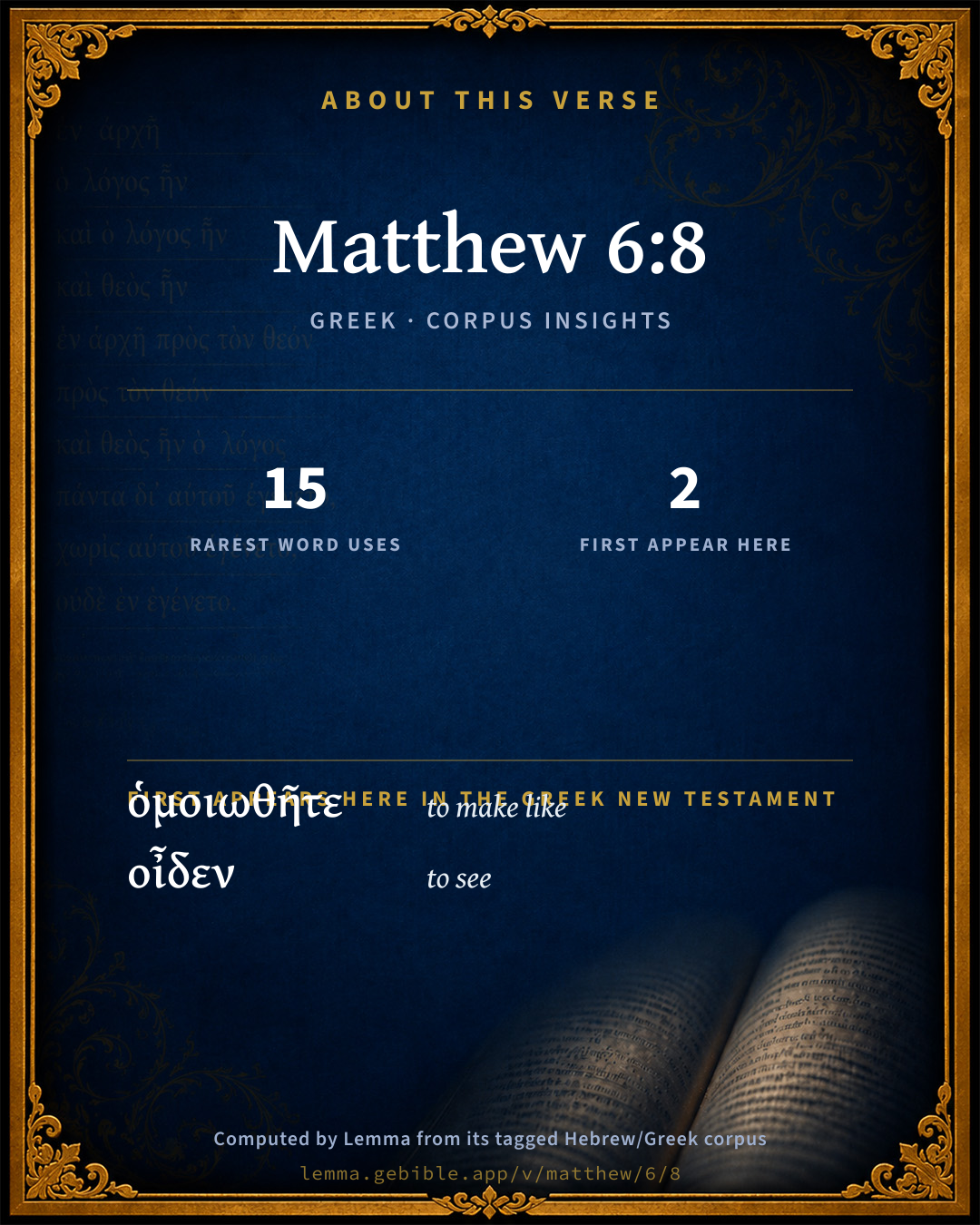
The rarest word here is ὁμοιωθῆτε to make like G3666 — appearing just 15 times in the whole Greek New Testament.

First appearance in Scripture

These words make their first canonical appearance in the Greek New Testament here:

  • ὁμοιωθῆτε to make like G3666
  • οἶδεν to see G1492

Shared distinctive vocabulary

ὁμοιωθῆτε to make like G3666 occurs in 15 verses of the Greek New Testament. Also found in:
Repetition

Words recur within this verse:

  • αὐτοῖς he G846 ×2
  • ὁ the G3588 ×2
  • ὑμῶν you G5210 ×2

Cross-references

6

Topical passages linked to Matthew 6:8 in the Treasury of Scripture Knowledge — connected by theme and wording, ordered by reader-vote popularity; previews shown in the World English Bible.

  • Matthew 6:32 For the Gentiles seek after all these things, for your heavenly Father knows that you need all these things.
  • Luke 12:30 For the nations of the world seek after all of these things, but your Father knows that you need these things.
  • Philippians 4:6 In nothing be anxious, but in everything, by prayer and petition with thanksgiving, let your requests be made known to God.
  • John 16:23–27 "In that day you will ask me no questions. Most assuredly I tell you, whatever you may ask of the Father in my name, he will give it to you.
  • Psalms 38:9 Lord, all my desire is before you. My groaning is not hidden from you.
  • Psalms 69:17–19 Don't hide your face from your servant, For I am in distress. Answer me speedily!

Cross-references courtesy of OpenBible.info (CC BY 4.0).

Where the printed editions differ

1 variant

Places in this verse where the major printed Greek editions disagree on the wording in a way that affects the translation — a comparison of editions, not a manuscript-by-manuscript collation. The editions are the modern critical texts (Nestlé-Aland 28/27, SBL, Westcott-Hort, Tregelles, Tyndale House) and the traditional texts behind the KJV (the Textus Receptus and the Byzantine/Majority text). It is not a claim about which reading is original.

  1. Extra text
    ὁ θεὸς

    “the God”

    In WH Not in NA28NA27TynSBLTregTRByz

    ὁ θεὸς (ho theos) 'the God' is only in a few manuscripts (WH)

Textual data: Translators Amalgamated Greek New Testament (STEPBible TAGNT) · CC BY 4.0.

Commentary

Notes on Matthew 6:8 from classic Christian and Jewish commentators (each source and its license shown beneath its notes). The classic Christian expositions comment on the surrounding passage and are grouped to its opening verse, so a note may address several verses; the Jewish commentaries on the Tanakh (Rashi and others) are per-verse, so they appear only where the commentator wrote on this verse.

Lemma curates 59 commentaries, every one of them public domain or Creative Commons licensed, each selected and text-cleaned for this edition rather than reprinted as found. About our sources →

Bengel's Gnomon

Johann Albrecht Bengel

Mat 6:8. Πρὸ κ.τ.λ., before, etc.) We pray, therefore, not with the view of instructing, but of adoring, the Father.

Bengel's Gnomon of the New Testament — English translation (T&T Clark, Edinburgh, 1860) — public domain. Text from a community e-Sword module.

Meyer's Critical & Exegetical Commentary

Heinrich August Wilhelm Meyer

Mat_6:8. Οὖν] seeing that you are expected to shun heathen error.

οἶδε γὰρ, κ.τ.λ.] so that, this being the case, that βαττολογεῖν is superfluous.

Meyer — Critical and Exegetical Commentary on the New Testament — English translation by Peter Christie, edited by Frederick Crombie (T&T Clark, 1880) — public domain. Text from a community e-Sword module.

Expositor's Greek Testament

ed. W. Robertson Nicoll

Mat 6:8 , οὖν , infers that disciples must not imitate the practice described, because it is Pagan, and because it is absurd. Repetition is, moreover, wholly uncalled for. οἶδεν γὰρ : the God whom Jesus proclaims “your Father” knows beforehand your needs. Why, then, pray at all? Because we cannot receive unless we desire, and if we desire, we will pray; also because things worth getting are worth asking. Only pray always as to a Being well informed and willing, in few words and in faith. With such thoughts in mind, Jesus proceeds to give a sample of suitable prayer.

The Expositor's Greek Testament, edited by W. Robertson Nicoll (1897–1910) — public domain. Text from a community e-Sword module.

Jamieson, Fausset & Brown

Robert Jamieson, A. R. Fausset & David Brown

Be not ye therefore like unto them: for your Father knoweth what things ye have need of before ye ask him--and so needs not to be informed of our wants, any more than to be roused to attend to them by our incessant speaking. What a view of God is here given, in sharp contrast with the gods of the heathen! But let it be carefully noted that it is not as the general Father of mankind that our Lord says, "Your Father" knoweth what ye need before ye ask it; for it is not men, as such, that He is addressing in this discourse, but His own disciples--the poor in spirit, the mourners, the meek, hungry and thirsty souls, the merciful, the pure in heart, the peacemakers, who allow themselves to have all manner of evil said against them for the Son of man's sake--in short, the new-born children of God, who, making their Father's interests their own, are here assured that their Father, in return, makes their interests His, and needs neither to be told nor to be reminded of their wants. Yet He will have His children pray to Him, and links all His promised supplies to their petitions for them; thus encouraging us to draw near and keep near to Him, to talk and walk with Him, to open our every case to Him, and assure ourselves that thus asking we shall receive--thus seeking we shall find--thus knocking it shall be opened to us.

Jamieson, Fausset & Brown — Commentary Critical and Explanatory on the Whole Bible (1871) — public domain (CC PDM 1.0). Text via the HelloAO Bible API.

Adam Clarke's Commentary

Verse 8. Your Father knoweth what things ye have need of] Prayer is not designed to inform God, but to give man a sight of his misery; to humble his heart, to excite his desire, to inflame his faith, to animate his hope, to raise his soul from earth to heaven, and to put him in mind that THERE is his Father, his country, and inheritance.

In the preceding verses we may see three faults, which our Lord commands us to avoid in prayer:-

1st. HYPOCRISY. Be not as the hypocrites. Mt 6:5.

2ndly. DISSIPATION. Enter into thy closet. Mt 6:6.

3rdly. MUCH SPEAKING, or UNMEANING REPETITION, Be not like the heathens. Mt 6:7.

Adam Clarke's Commentary on the Bible (1810–1826) — public domain. Text from a community e-Sword/MySword module.

Ellicott's Commentary for English Readers

(8) Your Father knoweth.—This truth is rightly made the ground of prayer in one of the noblest collects of the Prayer Book of the English Church—“Almighty God, the Fountain of all wisdom, who knowest our necessities before we ask, and our ignorance in asking.” Comp. St. Paul’s “We know not what we should pray for as we ought” (Rom_8:26). But why then, it may be asked, pray at all? Why “make our requests known unto God” (Php_4:6)? Logically, it may be, the question never has been, and never can be, answered. As in the parallel question of foreknowledge and free will, we are brought into a region in which convictions that seem, each of them, axiomatic, appear to contradict each other. All that can be done is to suggest partial solutions of the problem. We bring our wants and desires to God (1) that we may see them as He sees them, judge how far they are selfish or capricious, how far they are in harmony with His will; (2) that we may, in the thought of that Presence and its infinite holiness, feel that all other prayers—those which are but the expression of wishes for earthly good, or deliverance from earthly evil—are of infinitely little moment as compared with deliverance from the penalty and the power of the sin which we have made our own; (3) that, conscious of our weakness, we may gain strength for the work and the conflict of life in communion with the Eternal, who is in very deed a “Power that makes for righteousness.” These are, if we may so speak, the lines upon which the Lord’s Prayer has been constructed, and all other prayers are excellent in proportion as they approach that pattern. Partial deviations from it, as in prayers for fine weather, for plenty, and for victory, are yet legitimate (though they drift in a wrong direction), as the natural utterance of natural wants, which, if repressed, would find expression in superstition or despair. It is better that even these petitions, though not the highest form of prayer, should be purified by their association with the highest, than that they should remain unuttered as passionate cravings or, it may be, murmuring regrets.

A Bible Commentary for English Readers, edited by Charles John Ellicott (1878–1897) — public domain. Text from a community e-Sword module.

The Cambridge Bible for Schools and Colleges

gen. ed. J. J. S. Perowne

8. for your Father knoweth … before ye ask him] Our Father knows our wants, still we are bound to express them. Why? because this is a proof of our faith and dependence upon God, which are the conditions of success in prayer.

The Cambridge Bible for Schools and Colleges (gen. ed. J. J. S. Perowne; Cambridge University Press, 1878–1918) — public domain. Text from a community e-Sword module.

John Gill's Exposition

Be not ye therefore like unto them,..... Do not be imitators of them, and follow their ways, who have only the dim light of nature to guide them; it would be shameful in you to do as they do, when you have a divine revelation for your direction; and especially, because

your Father knoweth what things ye have need of before ye ask him; and therefore have no need to make use of many words, or much speaking, or long prayers. The omniscience of God is a considerable argument, and a great encouragement to prayer; he knows our persons and our wants before hand; and as he is able to help us, we have reason to believe he will; especially since he stands in the relation of a Father to us.

John Gill's Exposition of the Whole Bible (1746–1763) — public domain (CC PDM 1.0). Text via the HelloAO Bible API.

Trapp's Complete Commentary

John Trapp

8 Be not ye therefore like unto them: for your Father knoweth what things ye have need of, before ye ask him.

Ver. 8. Be not ye therefore like unto them] God would not have his Israel conform to the heathens’ customs, nor so much as once name their idols, Exo 23:13; Psa 16:4. No more should Christians (as some are of the opinion). {a} That of Cardinal Bembus is somewhat gross concerning their St Francis, quod in numerum Deorum ab Ecclesia Romana sit relatus. But this is like the rest; for if we may believe Baronius, we may see their lustral water and sprinkling of sepulchres in Juvenal’s sixth satire; lights in sepulchres, in Suetonius’ Octavius; lamps lighted on Saturday, in Seneca’s 96th Epistle; distribution of tapers among the people, in Macrob. Saturnals, &c.

For your heavenly Father knoweth what things ye need, &c.] And therefore answereth many times before we ask, Isa 65:24; as he did David, Psa 32:1-11. He prevents us with many mercies we never sought him for; that our praises may exceed our prayers. "I am found of them that sought me not," saith God; but yet in the same place it is said, "I am sought of them that asked not for me," Isa 65:1. Importing, that we never seek to him for grace till effectually called by his grace. Howbeit, no sooner is any truly called, but he presently prayeth. Say not then, if God know our needs, what need we open them to him? The truth is, we do it not to inform him of that he knows not, {b} or to stir up mercy in him, who is all hearts, and perfectly pitieth us: but, 1. Hereby we acknowledge him as a child doth his father when he runs to him for food, Luk 11:13; Luk 2:1-52. We run that course of getting good things that he hath prescribed us, Jer 29:11-12. Which Moses and Elijah knew, and therefore the former turned God’s predictions, the latter his promises, into prayers, Exo 9:33; 1Ki 18:37; 1Ki 3:1-28. Hereby we prepare ourselves holily to enjoy the things we crave; for prayer both sanctifieth the creature and increaseth our love and thankfulness, Psa 116:1; Psa 4:1-8. Prayer prepareth us, either to go without that we beg, if God see fit, as David when he prayed for the child’s life, and was fitted thereby to bear the loss of it; or else to part with that which we have got by prayer, for the glory of God the giver of it. Those that make their requests known to God with thanksgiving, shall have (at least) the "peace of God that passeth all understanding," to guard their hearts and minds in Christ Jesus. {φρουρησει, Php 4:6-7} They shall have strength in their souls, the joy of the Lord shall be their strength, the glory of the Lord shall be their rereward, Psa 138:3; Neh 8:10; Isa 58:8. In their marching in the wilderness, at the fourth alarm, arose the standard of Dan, Asher, and Naphtali; these were the reguard of the Lord’s host; and to these were committed the care of gathering together the lame, feeble, and sick, and to look that nothing was left behind. Unto this the prophet Isaiah seems (in that text) to allude, and so doth David, Psa 27:10; "When my father and mother forsake me, the Lord will gather me;" and this comfortable assurance was the fruit of his prayer.

{a} Non male dixit Tertullianus, Philosophos esse Haereticorum Patriarchas.

{b} Non sane ut Deus instruatur, sed ut mens nostra construatur.

John Trapp, A Commentary or Exposition upon All the Books of the Old and New Testament (1647–1656) — public domain. Text from a community e-Sword module.

The Pulpit Commentary

Be not ye therefore like. Revised Version omits "ye," as the emphatic personal pronoun is not expressed. The connexion of thought is Seeing you are expected to shun heathen error (Meyer), do not allow yourselves to reproduce heathen practices. By observing these you would be taking a definite way of becoming like (passive, or rather middle, omoiwyhte) those who ordinarily practise them. For; i.e. you stand on a different footing altogether from the heathen; you are intimately related to One above, who knows your wants, even before you express them to him. Your Father; Revised Version margin, "some ancient authorities read God your Father. " So a*, B, sah. (o Yeov is bracketed by Westcott and Hort).

The insertion is at first sight suspicious, but as there is no trace of such an addition in vers. 1, 4, 6, 14. 18 (in ver. 32 only a*), it is hard to see why it should have been interpolated here. Its omission, on the other hand, is easily accounted for by its absence in those passages. The internal evidence, therefore, corroborates the strong external evidence of a*, B. Our Lord here said "God" to emphasize the majesty and power of "your Father." Knoweth; i.e. intuitively (oiden); el. ver. 32.

The Pulpit Commentary (1880–1919), ed. H.D.M. Spence-Jones & Joseph S. Exell — public domain. Text from a community e-Sword module.

John Wesley's Explanatory Notes

Your Father knoweth what things ye have need of - We do not pray to inform God of our wants. Omniscient as he is, he cannot be informed of any thing which he knew not before: and he is always willing to relieve them. The chief thing wanting is, a fit disposition on our part to receive his grace and blessing. Consequently, one great office of prayer is, to produce such a disposition in us: to exercise our dependence on God; to increase our desire of the things we ask for; to us so sensible of our wants, that we may never cease wrestling till we have prevailed for the blessing.

John Wesley, Explanatory Notes Upon the Whole Bible (1754–1765) — public domain. Text via the GEBible commentary corpus.

Kretzmann's Popular Commentary

Paul E. Kretzmann

Warning against such absurd practices:

v. 8. Be not ye therefore like unto them; for your Father knoweth what things ye have need of before ye ask Him.

The Christians should differ from the heathen by a sharp distinction. They shall not be like the heathen; there shall be no point of resemblance between their worship and that of the heathen. Their idea of prayer is essentially unlike that of the Gentiles. "Prayer requires more of the heart than of the tongue. The eloquence of prayer consists in the fervency of desire and the simplicity of faith. The abundance of fine thoughts, studied and vehement motions, and the order and politeness of the expressions, are things which compose a mere human harangue, not a humble and Christian prayer. Our trust and confidence ought to proceed from that which God is able to do in us, and not from that which we can say to Him. " Another point bringing out the absurdity of "babbling prayers: our needs are known to God before we make them known in our prayers. As a true Father He is concerned about the wants and troubles of His children, and gets His information often before they are aware of their lack, Isa 65:24. "God commands us to pray, not indeed that we with our prayer should teach Him what He should give, but rather that we should realize and confess what kind of goods He gives to us, and will and can give much more; so that by our prayer we instruct our

selves more than Him."

Paul E. Kretzmann, Popular Commentary of the Bible (1921–1924) — public domain. Text from a community e-Sword module.

The People's New Testament

B. W. Johnson

8. For your Father knoweth. Here is given abundant reason for short prayers. Many prayers apparently aim to give God information on matters connected with this world.

B. W. Johnson's The People's New Testament with Notes (1889–1891) — public domain. Electronic text from the Christian Classics Ethereal Library (CCEL) ThML edition.

unfoldingWord translationNotes

Door43 World Missions Community

General Information:

Jesus is talking to a group of people about how they as individuals should pray. The words "you" and "your" are plural in the first sentence. Within the prayer, the words "you" and "your" are singular and refer to God, "Our Father in heaven." (See: Forms of You)

Our Father in heaven

This is the beginning of the prayer and how Jesus teaches the people to address God.

Father

This is an important title for God. (See: Translating Son and Father)

may your name be sanctified

Here "your name" refers to God himself. AT: "make everyone honor you" (See: Metonymy)

May your kingdom come

Here "kingdom" refers to God's rule as king. AT: "May you rule over everyone and everything completely" (See: Metonymy)

May your will be done on earth as it is in heaven

This can be stated in active form. AT: "May everything on earth happen in accordance with your will as everything in heaven does" (See: Active or Passive)

translationWords

God the Father

sanctify

kingdom of God

will of God

heaven

earth

unfoldingWord translationNotes — © Distant Shores Media and the Door43 World Missions Community, licensed CC BY-SA 4.0. Source: git.door43.org/Door43/en_tn.

Cambridge Greek Testament for Schools and Colleges

8. οἶδεν γὰρ ὁ πατὴρ κ.τ.λ. Our Father knows our wants, still we are bound to express them. Why? because this is a proof of our faith and dependence upon God, which are the conditions of success in prayer.

Cambridge Greek Testament for Schools and Colleges (Cambridge University Press, 1896; 21 vols, various authors incl. Carr, Maclear, Plummer, Farrar, Lumby, Moule, M. R. James, Simcox) — public domain. Text from a community e-Sword module.

Alford’s Greek Testament

Henry Alford

8. οἶδεν γάρ] εἰ οἶδε, φησίν, ὧν χρείαν ἔχομεν, τίνος ἕνεκεν εὔχεσθαι δεῖ; οὐχ ἵνα διδάξῃς, ἀλλʼ ἵνα ἐπικάμψῃς· ἵνα οἰκειωθῇς τῇ συνεχείᾳ τῆς ἐντεύξεως, ἵνα ταπεινωθῇς, ἵνα ἀναμνησθῇς τῶν ἁμαρτημάτων τῶν σῶν. Chrys. Hom. xix. 4, p. 249. ‘Ipsa orationis intentio cor nostrum serenat et purgat, capaciusque efficit ad accipienda divina munera, quæ spiritualiter nobis infunduntur.’ August. de Serm. Dom. ii. 3 (14).

Henry Alford, The Greek Testament (1849–1861) — public domain. Text from a community e-Sword module.

International Critical Commentary

8. Be not therefore like to them: for your Father knoweth what things ye need, before you ask Him.]

οἶδε γὰρ ὁ πατὴρ ὑμῶν] Cf. v. 32 = Luk 12:30.—αἰτῆσαι] D h have ἀνοῖξαι τὸ στόμα. For “before you ask Him,” cf. Isa 65:24.

International Critical Commentary — older volumes (1896–1929), various authors — public domain. Text from a community e-Sword module.

Lesson kit

Teaching starters — assembled from the data on this page, not authored interpretation. Every prompt links to the verse data it draws on. Edit before teaching.

Matthew, in the Gospels, opens this verse with 17 words (14 distinct Greek lemmas). Its most distinctive word is homoióō (“to make like”). A historical commentator’s framing appears above. Read the whole chapter for the surrounding context.

Discussion questions

  1. The word homoióō carries the sense “to make like.” How does it shape the verse?
  2. 2 words here appear for the first time in Scripture. What is being introduced at this debut?
  3. Matthew 7:24 shares the word «to make like» with this verse. How do the two illuminate each other?
  4. “he” occurs 2× in this one verse. What is the effect of the repetition?
  5. These translations render this verse differently. What is at stake in choosing one wording over another?
  6. Reading how Bengel's Gnomon and Meyer's Critical & Exegetical Commentary read this verse, where do the two commentators agree and where do they part?

Things to notice

  • 2 words make their first canonical appearance in Scripture here.
  • These translations choose different wording for 7 words in this verse.
  • “he” occurs 2× in this single verse.
  • 14 distinct Greek lemmas span 17 words in this verse.

Reading settings

Reading text

Shown beneath each verse's original-language words.

Old Testament
Old Testament edition

Read the OT as the Masoretic Hebrew (MT) or the Greek Septuagint (LXX).

English shown for the Greek Septuagint (in the Hebrew ↔ Greek comparison).

Comparing translations? Open the Compare panel on any verse page to stack up to four side by side.