Mark 13:32

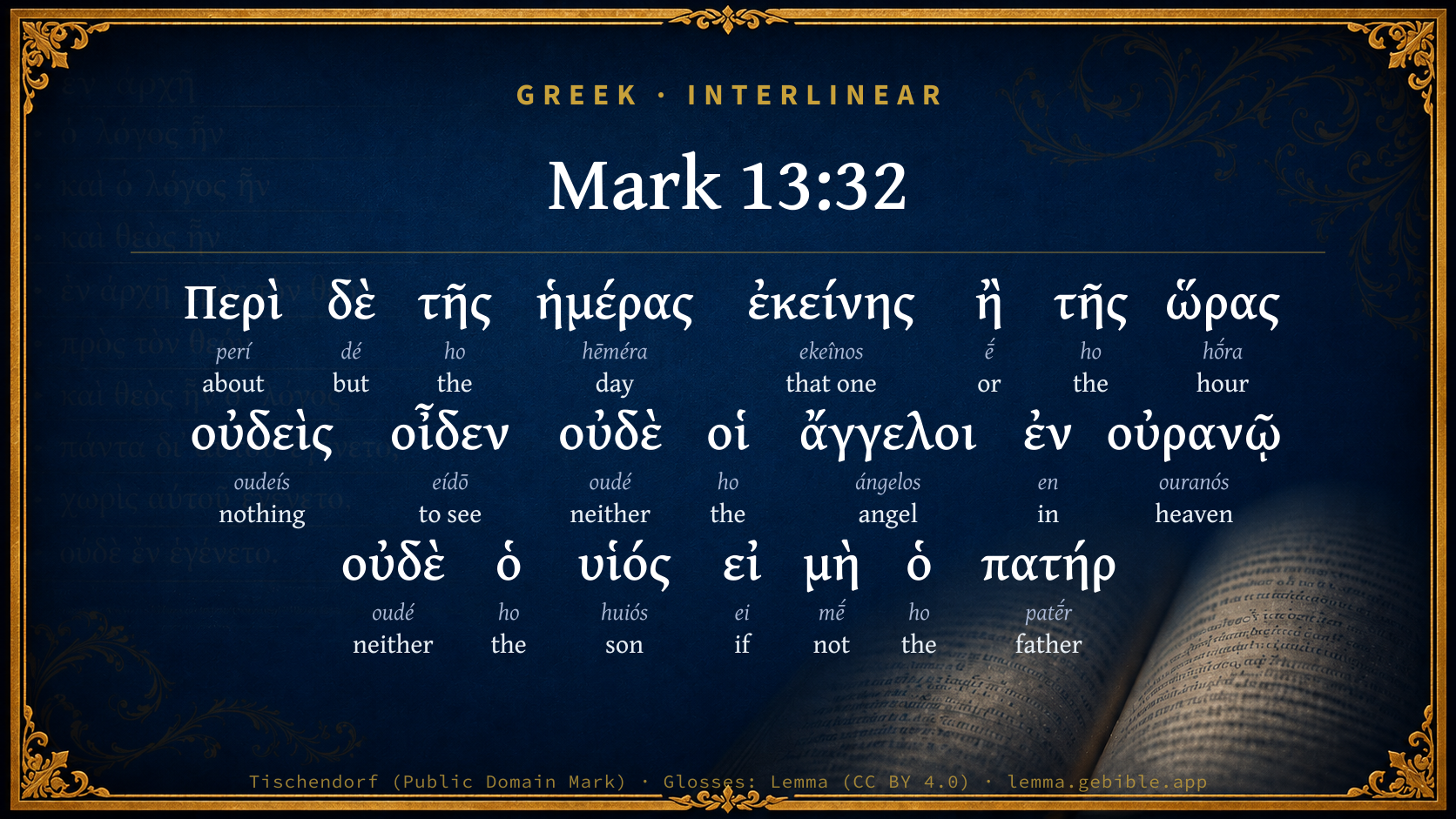
Greek (Tischendorf 8th ed.) Mark 13:32 appears in the Greek New Testament. The text above is from the Tischendorf 8th edition. Each word links to its Strong’s number and a concise gloss. Click any word for its full Thayer’s Greek Lexicon entry.
Download image
Cite this verse

Mark 13:32 (World English Bible). Public Domain. Lemma interlinear Bible study tool, https://lemma.gebible.app/v/mark/13/32.

Show BibTeX & RIS
BibTeX
RIS
English Translation
But of that day or that hour no one knows, not even the angels in heaven, nor the Son, but only the Father.
World English Bible · Public Domain
Download a study sheet

One document with this verse’s original text, its word-by-word gloss line, the meaning frame, cross-references with their text, attributed commentary, and full source and license credits — printable, and it pastes into notes with its structure intact.

This verse Autodidact and up

Study sheet (.html) Plain text (.txt)

A passage Seminary Student

Up to 50 verses in one chapter. A passage sheet keeps up to 6 commentary sources and 12 cross-references per verse, in the order this page ranks them, and says so on the sheet whenever that leaves anything out. Ask for a single verse and you get the Autodidact verse sheet above.

Everything on this page stays free to read, with no account — the sheet is a download of what is already on screen, not access to it.

Want to remove ads? Support Godless Engineer
Compare translations 3

The same verse in 3 English versions, stacked beneath the original-language interlinear above. Click any original word for its lexicon entry.

Each is an independent rendering of the whole verse — the interlinear is not word-aligned to these translations.

Highlighted words mark where these versions differ — a whole-verse word diff, not a word-by-word alignment.

  • World English Bible Public Domain
    But of that day or that hour no one knows, not even the angels in heaven, nor the Son, but only the Father.
  • King James Version Public Domain
    But of that day and that hour knoweth no man, no, not the angels which are in heaven, neither the Son, but the Father.
  • unfoldingWord Literal Text CC BY-SA 4.0
    But concerning that day or the hour, no one knows, neither the angels in heaven, nor the Son, except the Father.

unfoldingWord Literal Text — © unfoldingWord, licensed CC BY-SA 4.0. Word-aligned USFM3 via Door43 (git.door43.org/unfoldingWord/en_ult).

Versions to compare (up to 4)

3 of 4 selected

Show all 19 translations

Every available English version of this verse, each an independent rendering of the whole verse.

  • World English Bible Public Domain
    But of that day or that hour no one knows, not even the angels in heaven, nor the Son, but only the Father.
  • Berean Standard Bible Public Domain
    No one knows about that day or hour, not even the angels in heaven, nor the Son, but only the Father.
  • Majority Standard Bible Public Domain
    No one knows about that day or hour, not even the angels in heaven, nor the Son, but only the Father.
  • King James Version Public Domain
    But of that day and that hour knoweth no man, no, not the angels which are in heaven, neither the Son, but the Father.
  • American Standard Version (1901) Public Domain
    But of that day or that hour knoweth no one, not even the angels in heaven, neither the Son, but the Father.
  • Revised Version (1885) Public Domain
    But of that day or that hour knoweth no one, not even the angels in heaven, neither the Son, but the Father.
  • Geneva Bible (1599) Public Domain
    But of that day and houre knoweth no man, no, not the Angels which are in heauen, neither the Sonne himselfe, but the Father.
  • Douay-Rheims (1899) Public Domain
    But of that day or hour no man knoweth, neither the angels in heaven, nor the Son, but the Father.
  • Young's Literal Translation Public Domain
    `And concerning that day and the hour no one hath known -- not even the messengers who are in the heaven, not even the Son -- except the Father.
  • Literal Standard Version CC BY-SA 4.0
    And concerning that day and the hour no one has known—not even the messengers who are in Heaven, not even the Son—except the Father.
  • Unlocked Literal Bible CC BY-SA 4.0
    But concerning that day or that hour, no one knows, not even the angels in heaven, nor the Son, but the Father.
  • unfoldingWord Literal Text CC BY-SA 4.0
    But concerning that day or the hour, no one knows, neither the angels in heaven, nor the Son, except the Father.
  • Darby Bible Public Domain
    But of that day or of that hour no one knows, neither the angels who are in heaven, nor the Son, but the Father.
  • World Messianic Bible Public Domain
    “But of that day or that hour no one knows—not even the angels in heaven, nor the Son, but only the Father.
  • Webster's Bible Public Domain
    But of that day and that hour knoweth no man, no not the angels which are in heaven, neither the Son, but the Father.
  • Free Bible Version CC BY-SA 4.0
    No one knows the day or hour when this will happen—not even the angels in heaven, not even the Son; only the Father knows.
  • Bible in Basic English Public Domain
    But of that day or that hour no one has knowledge, not even the angels in heaven, or the Son, but the Father.
  • Text-Critical English NT CC BY 4.0
    “No one knows about that day or hour, not even the angels in heaven or the Son, but only the Father.
  • Tyndale New Testament (1534) Public Domain
    But of the daye and the houre knoweth no man: no not the angels which are in heven: nether the sonne him silfe save the father only.

Literal Standard Version (2020), Covenant Press — licensed CC BY-SA 4.0. Text via the HelloAO Bible API (eBible.org). Unlocked Literal Bible (unfoldingWord) — licensed CC BY-SA 4.0. Text via the HelloAO Bible API (eBible.org). unfoldingWord Literal Text — © unfoldingWord, licensed CC BY-SA 4.0. Word-aligned USFM3 via Door43 (git.door43.org/unfoldingWord/en_ult). Free Bible Version, Dr. Jonathan Gallagher — licensed CC BY-SA 4.0. Text via the HelloAO Bible API (eBible.org).

Word by word

More ways to search: Search by grammar → Find every occurrence → Compare this word →

Practice this passage: Drill this verse → Learn its vocabulary →

ὥρας
hṓra
G5610
“hour”
Noun, Genitive, Singular, Feminine
Part of Speech
Noun
Case
Genitive
Number
Singular
Gender
Feminine
Full Thayer's Definition

Origin: apparently a primary word

TDNT: 20:15,1

1. a certain definite time or season fixed by natural law and returning with the revolving year a. of the seasons of the year, spring, summer, autumn, winter 2. the daytime (bounded by the rising and setting of the sun), a day 3. a twelfth part of the day-time, an hour, (the twelve hours of the day are reckoned from the rising to the setting of the sun) 4. any definite time, point of time, moment
  1. Περὶ perí G4012 “about” Preposition
  2. δὲ dé G1161 “but” Conjunction
  3. τῆς ho G3588 “the” Article, Genitive, Singular, Feminine
  4. ἡμέρας hēméra G2250 “day” Noun, Genitive, Singular, Feminine
  5. ἐκείνης ekeînos G1565 “that one” Demonstrative pronoun, Genitive, Singular, Feminine
  6. ἢ ḗ G2228 “or” Particle
  7. τῆς ho G3588 “the” Article, Genitive, Singular, Feminine
  8. οὐδεὶς oudeís G3762 “nothing” Adjective, Nominative, Singular, Masculine, Negative
  9. οἶδεν eídō G1492 “to see” Verb, Perfect, Active, Indicative, 3rd person, Singular
  10. οὐδὲ oudé G3761 “neither” Conjunction, Negative
  11. οἱ ho G3588 “the” Article, Nominative, Plural, Masculine
  12. ἄγγελοι ángelos G32 “angel” Noun, Nominative, Plural, Masculine
  13. ἐν en G1722 “in” Preposition
  14. οὐρανῷ ouranós G3772 “heaven” Noun, Dative, Singular, Masculine
  15. οὐδὲ oudé G3761 “neither” Conjunction, Negative
  16. ὁ ho G3588 “the” Article, Nominative, Singular, Masculine
  17. υἱός huiós G5207 “son” Noun, Nominative, Singular, Masculine
  18. εἰ ei G1487 “if” Conditional
  19. μὴ mḗ G3361 “not” Particle, Negative
  20. ὁ ho G3588 “the” Article, Nominative, Singular, Masculine
  21. πατήρ patḗr G3962 “father” Noun, Nominative, Singular, Masculine

About this verse

These counts appear in no published source. They are computed here, from the morphology-tagged text and Lemma’s own curated glosses. What Lemma adds →

22
words
17
distinct lemmas
Gospels
section

Repetition

Words recur within this verse:

  • οὐδὲ neither G3761 ×2
  • τῆς the G3588 ×5

Cross-references

10

Topical passages linked to Mark 13:32 in the Treasury of Scripture Knowledge — connected by theme and wording, ordered by reader-vote popularity; previews shown in the World English Bible.

  • Matthew 24:36–42 But no one knows of that day and hour, not even the angels of heaven, but my Father only.
  • Acts 1:7 He said to them, "It isn't for you to know times or seasons which the Father has set within His own authority.
  • Matthew 25:13 Watch therefore, for you don't know the day nor the hour in which the Son of Man is coming.
  • Revelation 3:3 Remember therefore how you have received and heard. Keep it, and repent. If therefore you won't watch, I will come as a thief, and you won't know what hour I will come upon you.
  • 1 Thessalonians 5:1–2 But concerning the times and the seasons, brothers, you have no need that anything be written to you.
  • Mark 13:26–27 Then they will see the Son of Man coming in clouds with great power and glory.
  • Matthew 25:6 But at midnight there was a cry, 'Behold! The bridegroom is coming! Come out to meet him!'
  • Matthew 25:19 "Now after a long time the lord of those servants came, and reconciled accounts with them.
  • 2 Peter 3:10 But the day of the Lord will come as a thief in the night; in which the heavens will pass away with a great noise, and the elements will be dissolved with fervent heat, and the earth and the works that are in it will be burned up.
  • Revelation 1:1 This is the Revelation of Jesus Christ, which God gave him to show to his servants the things which must happen soon, which he sent and made known by his angel to his servant, John,

Cross-references courtesy of OpenBible.info (CC BY 4.0).

Commentary

Notes on Mark 13:32 from classic Christian and Jewish commentators (each source and its license shown beneath its notes). The classic Christian expositions comment on the surrounding passage and are grouped to its opening verse, so a note may address several verses; the Jewish commentaries on the Tanakh (Rashi and others) are per-verse, so they appear only where the commentator wrote on this verse.

Lemma curates 59 commentaries, every one of them public domain or Creative Commons licensed, each selected and text-cleaned for this edition rather than reprinted as found. About our sources →

The Biblical Illustrator

Joseph S. Exell

Mar_13:32-33

But of that day and that hour knoweth no man.

The day and the hour

I. The practical importance of conceding the day and hour when the Son of Man shall come from the knowledge of the Church and of all mankind.

1. Were the day and the hour of the Saviours advent specifically and unmistakably stated, it would contradict constantly those passages scattered throughout the whole Word of God which say He shall come as a thief in the night, etc. After the day of Pentecost the apostles received information upon this subject which they did not previously possess.

2. It would be altogether morally without practical good results, and incompatible with other portions of Scripture, if God were to tell us the precise day and the hour. What would be the practical use of telling us either?

3. Were that day made known to us, it would be gratifying a very worthless curiosity. But if there be one feature in this book more striking than another it is its utter refusal to gratify the curiosity of man.

4. Suppose that this day and hour had been made known, there is no proof that it would be believed by the unconverted masses of mankind. If the unconverted and unsanctified multitude believed it, it would do incalculable mischief.

II. On the other hand, it is most profitable and most improving that we should study the predicted signs; nay, our Lord condemned the men of His day, because, while they could predict wet or fine weather, from the sky at evening and at morn, they were not acquainted with the moral signs of the age in which they lived. The Scripture in every page is most explicit in giving us tokens and signs by which we are to infer either that the time is near, or that it is remote. This leads me to the great sign given here, instead of the day and the hour-the sign of Noah.

1. Notice that there is here a distinct recognition of Noah as a historic person, of the flood as a literal fact.

2. Notice here also that human nature is substantially the same in the days of Napoleon and of Queen Victoria, that it was in the days of Noah and the patriarchs before the flood. The antediluvians, or those that were in the days of Noah, when the flood came, were eating and drinking, marrying and giving in marriage. This is not stated as a sin. In the gospel, where our Lord represents the blessings that He purchased under a feast, those that were invited refused; but the ground they assigned was not any one sinful act. Where then was the sin of the antediluvians? So shall it be when the Son of Man cometh. This is not a mere history; but also a solemn prophecy. Just as the ark was the only safety in the days of Noah, so the only safety for us this very day is Christ, the living, the glorious, the indestructible ark. Are you trusting to this ark? Are you cleaving to this Saviour? Now there is salvation for the worst and the guiltiest; but at that day, when grace shall depart like a vision, when the last fire shall cover the round globe with its piercing and its searching flames, not one cry will be heard, not one appeal for mercy will be regarded, not one sin will be forgiven. The very glory of the gospel is its simplicity: Look and live; Believe and thou shalt be saved. (J. Cumming, D. D.)

Uncertainty as to the time demands constant watchfulness

The fact that we cannot know beforehand the time of Christs coming, does not relieve us of the duty of being on the watch for it. It is because we do not know the time, that we must watch for the time. If a man wants to see the meteors which flash across the sky in the nights of August and November, he must be all the more watchful because he cannot know beforehand when they are coming. The lookout on the ocean steamers masthead must be none the less watchful against icebergs, or headlands, or passing vessels, because be cannot know when they are to show themselves; and the denser the fog, the keener his watch must be. The time of Christs second coming is concealed from us. The fact of that coming is foretold to us. The duty of living not only in expectancy of this event, but in prayerful watchfulness for it, is as plainly and as positively enjoined upon us, as is the requirement of any one of the ten commandments.

The solemn day approaching

When it comes we know not. We know simply this-it is a fact in Gods government. Slowly and steadily it is approaching. It encamps every night nearer to the race-to us-to me. We have no human almanacs that can foretell its coming. That it will come seems one of the fundamental thoughts of our mind, admitted everywhere and always. The Egyptians bore decided witness, in their books of the dead, to the coming of that day. Let not that day come upon you sleeping, said Jesus. Duty is ours-that day is Gods. (H. W. Beecher.)

The uncertainty of the Day of Judgment considered and improved

First, our Saviour here declares the uncertainty of the time as to us and all creatures, when the general judgment shall be. And to express this the more emphatically, He tells us-

1. That God only knows it. He excludes from the knowledge of it, those who were most likely to know it, if God had not absolutely reserved it to Himself.

2. That the consideration of the uncertainty of the time should make us very careful to be always prepared for it. First, a general caution, Take ye heed. From whence I shall observe, by the way, the great goodness of God to us, and His singular care of us. God hath acquainted us with whatever is necessary to direct and excite us to our duty; but He hath purposely concealed from us those things which might tend to make us slothful and careless, negligent and remiss in it. Besides this, it is always useful to the world to be kept in awe by the continual danger and terror of an approaching judgment.

And it was no inconvenience at all that the apostles and first Christians had this apprehension of the nearness of that time; for no consideration could be more forcible to keep them steadfast in their profession, and to fortify them against sufferings.

1. We should resolve without delay, to put ourselves into that state and condition, in which we may not be afraid judgment should find us. In the secure and negligent posture that most men live, even the better sort of men, if judgment should overtake them, how few could be saved! So that our first care must be to get out of this dangerous state of sin and insecurity, to break off our sins by repentance, that we may be capable of the mercy of God, and at peace with Him, before He comes to execute judgment upon the world.

2. After this great work of repentance is over, we should be very careful how we contract any new guilt, by returning to our former sins, or by the gross neglect of any part of our duty.

3. Let us neglect no opportunity of doing good, but always be employing ourselves, either in acts of religion and piety towards God, or of righteousness and charity towards men, or in such acts as are subordinate to religion.

4. We should often review our lives and call ourselves to a strict account of our actions, that, judging ourselves, we may not be judged and condemned by the Lord.

5. Another part of our preparation for the coming of our Lord is a humble trust and confidence in the virtue of His death and passion, as the only meritorious cause of the remission of our sins, and the reward of eternal life.

6. And lastly, to awaken and maintain this vigilancy and care, we should often represent to our minds the judgment of the Great Day, which will certainly come though we know not the time of it. This is the first direction our Saviour gives us: continual vigilancy and watchfulness over ourselves in general. The second direction is more particular, and that is, prayer-Take ye heed, watch and pray. And the practice of this duty of prayer will be of great advantage to us upon these two accounts. It is very apt to awaken and excite our care and diligence in the business of religion. Prayer, indeed, supposeth that we stand in need of the Divine help; but it implies, likewise, a resolution on our part to do what we can for ourselves; otherwise we ask in vain.

7. If we use our sincere endeavours for the effecting of what we pray for, prayer is the most effectual means to engage the Divine blessing, and assistance to second our endeavours, and to secure them from miscarriage. I proceed to the third and last part of the text, which is the reason which our Saviour here adds to enforce our care and diligence in a matter of so great concernment, viz., the uncertainty, as to us, of the particular time when this Day of Judgment will be: Ye know not when the time is. (J. Tillotson, D. D.)

Ye know not when the time is

I. The consideration of the uncertainty of life, from which the exhortation is enforced-Ye know not when the time is.

II. The exhortation to circumspection, vigilance, and prayer-Take ye heed, watch and pray. But we proceed to consider what this watchfulness implies.

1. It implies spiritual life.

2. It implies a sense of danger. (W. Bullevant.)

Lifes uncertainty improved

I. The fact of lifes uncertainty. But before I attempt to fix your thoughts on lifes uncertainty, there are two other kindred facts which merit attention-the certainty of death, and the nearness of it. We know not when the time is. Death is an ambush. Hence the force of Take ye heed, watch and pray.

1. Men full of laudable, anxious, active strife of business, have in one moment been called to their higher account, prepared or unprepared.

2. More fearful still is the subject, when we consider that not only are men called away from the midst of worldly business, but are taken in the very act of sin and rebellion against God. The third day Noah entered into the ark, the flood came and took them all away.

3. Let it, however, be clearly understood, that no degree of morality, faith, or holiness, can wholly shield us from the stroke of sudden death.

II. The plain practical duty arising out of it-Take ye heed, etc. A word in season. Many are heedless and unprepared to die. Take ye heed, or you must needs miss heaven. Would we prepare to die-

1. Habitually believe in Christ.

2. Habitually commune with God.

3. Habitually aim at Christian consistency.

Conclusion:

1. Address those who are obviously neither watching nor praying. Are there in the Church lukewarm professors?

2. You who are in the way to a blissful immortality. (B. Carvosso.)

Preparation for death

The true significance of death lies not in its physical pain, in its breaking in upon the plans of life, but in the fact that it brings men into final moral relations with God. Now let us consider, as calm and prudent men, the full effect and the true character of deferring the preparation for death until the dying hour.

1. To thus defer this preparation is to deprive life itself of one of its chief steadying elements.

2. Living without conscious preparation for death is a risk which neither prudence nor self-respect should allow. A man guards himself with a wise providence of the future. No man puts his affections as they are involved in the family to such peril. He is perpetually forethinking; working to provide against evils; making preparation today and this year for tomorrow and next year.

3. There is a view which will have weight with men who are just, and who are honestly seeking to guide themselves by principles of honour. It is the ignoring, the dishonouring of Gods love, His will and His commands, all ones life, and then at death, for fear, or for the sake of interest, rushing into a settlement. A child is reprobate, and breaks away from home, and squanders all he can get, and becomes a wreck and a wretch, and apparently is to be disowned. He hears, at last, after years and years of dissipation, that his father is weakening and drawing near to death; and he scents the opportunity, and rushes home, and professes repentance and reformation, in order that his father may reconstruct his will, and leave him a part of his estate. What would you think of a child that should do that? What would you think of a child that should deliberately calculate upon it, and say in himself, The old man has oftentimes, with tears in his eyes, warned me against my gambling companions; but there is time enough yet. He is rich, and I want a part of his money, and I know his heart, and I mean to come in for a share by and by. I am going to have my pleasure; I am going to eat, drink, and be merry; I am going to have my royal debauch with my companions; and when I see the old man is about pegging out I will go home and reform; because I do not mean to lose that property; I am going to enjoy myself as I please, and have that too? What would you think of a child that should say that, and then keep his eye on his father, and calculate his chances and run scuttling home just in time to get his name put in the will right, in order that he might have the property? What name is there in any language that is adequate to express your feelings, toward such baseness as that? And yet, are there not in my hearing men that are living precisely so with respect to their Father who is in heaven?

4. There are prudential considerations of a very solemn nature which one should employ. Those who think that they shall prepare for death in the last hour of life, ought to consider some of their chances. As a matter of fact, more than half that die in this world die without consciousness. Not alone of those that die by accident, by sudden stroke, but of those that die by disease, more than one half die under a cloud, so that they have no use of their reason. (H. W. Beecher.)

Autumnal life

It is always a sad day in autumn to me, when I see the change that comes over nature. Along in August, the birds are all still, and you would think that there were not any left; but if you go out into the fields you find them feeding in the trees, and hedges, and everywhere. By and by September comes, and they begin to gather together in groups; and anybody that knows what it means knows that they are getting ready to go. And then comes the later days of October-the sad, the sweet, the melancholy, the deep days of October. And the birds are less and less. And in November, high up, you see the sky streaked with waterfowl going southward; and strange noises in the night, of these pilgrims of the sky, they shall hear whose ears are attuned to natural history. Birds in flocks, one after another, wing their way to the south. Summer is gone; and I am left behind; but they are happy. And I think I can hear them singing in all those States clear down to the Gulf. They have found where the sun is never cold. With us are frosts, but not with the bird that has migrated. Oh, mother! my heart breaks with your heart when your cradle is empty; but shall I call back the child? Nay; sooner pluck a star out of heaven than call back that child to this wintry blast. Shall I call back your young and dear and blooming friend? Nay. You are left in some bitterness for a time; but make not a man out of angel again. Let him rejoice. (H. W. Beecher.)

Watch and pray

Two duties.

I. The activity of the eye earthward.

II. The emotion of the heart Godward. Watchfulness is like the hands of the clock that point; prayer is the weight that keeps the machinery in motion. (T. J. Judkin.)

A believers watchfulness like that of a soldier

A sentinel posted on the walls, when he discerns a hostile party advancing, does not attempt to make head against them himself, but informs his commanding officer of the enemys approach, and leaves him to take the proper measures against the foe. So the Christian does not attempt to fight temptation in his own strength; his watchfulness lies in observing its approach, and in telling God of it by prayer. (W. Mason.)

Watching and praying

He that prays and watcheth not, is like him that sows a field with precious seed, but leaves the gate open for hogs to come and root it up; or him that takes great pains to get money, but no care to lay it up safely when he hath it. (W. Gurnall.)

Watch

Wickedness, says Sir Philip Sidney, is like a bottomless pit, into which it is easier for a man to prevent himself falling than, having fallen, to preserve himself from falling infinitely.

The watchfulness of prayer

I often recall, says an old sailor, my first night at sea. A storm had come up, and we had put back under a point of land which broke the wind a little, but still the sea had a rake on us, and we were in danger of drifting. I was on the anchor watch, and it was my duty to give warning in case the ship should drag her anchor. It was a long night to me. I was very anxious whether I should know if the ship really did drift. How could I tell? I found that, going forward and placing my hand on the chain, I could tell by the feeling of it whether the anchor was dragging or not; and how often that night I went forward and placed my hand on that chain! And very often since then I have wondered whether I am drifting away from God, and then I go away and pray. Sometimes during that long stormy night I would be startled by a rumbling sound, and I would put my hand on the chain, and find it was not the anchor dragging, but only the chain grating against the rocks on the bottom. The anchor was still firm. And sometimes now, in temptation and trial, I become afraid, and upon praying I find that away down deep in my heart I do love God, and my hope is in His salvation. And I want just to say a word to my fellow Christians: Keep an anchor watch, lest before you are aware you may be upon the rocks. (Anon.)

The Biblical Illustrator, edited by Joseph S. Exell (c. 1880s–1900s) — public domain. Text from a community e-Sword module.

Joseph Benson's Commentary

Mar 13:32. But of that day and hour knoweth no man — See note on Mat 24:36. Neither the Son, but the Father — It must be observed here, that “the words ουδε ο υιος, neither the Son, have been omitted in some copies of Mark, as they are inserted in some copies of Matthew: but there is no sufficient authority for the omission in Mark, any more than for the insertion in Matthew. Erasmus, and some of the moderns, are of opinion, that the words were omitted in the text of Matthew, lest they should afford a handle to the Arians, for proving the Son to be inferior to the Father: but it was to little purpose to erase them out of Matthew, and to leave them standing in Mark. On the contrary, St. Ambrose, and some of the ancients, assert that they were inserted in the text of Mark by the Arians: but there is as little foundation or pretence for this assertion, as there is for the other. It is much more probable that they were omitted in some copies of Mark by some indiscreet orthodox, who thought them to bear too hard upon our Saviour’s dignity: for all the most ancient copies and translations extant retain them: the most ancient fathers quote them, and comment upon them. Admit the words, therefore, as the genuine words of Mark, we must, and we may, without any prejudice to our Saviour’s divinity. For Christ may be considered in two respects, in his human and divine nature; and what is said with regard only to the former, doth not at all affect the latter. As he was the great teacher and revealer of his Father’s will, he might know more than the angels, and yet he might not know all things. It is said in Luk 2:52, that Jesus increased in wisdom and stature, and in favour with God and man. He increased in wisdom, and consequently in his human nature he was not omniscient. In his human nature, he was the son of David; in his divine nature, he was the Lord of David. In his human nature, he was upon earth; in his divine nature, he was in heaven, Joh 3:13, even while upon earth. In like manner it may be said, that though as God he might know all things, yet he might be ignorant of some things as man. And of this particular the Messiah might be ignorant, because it was no part of his office or commission to reveal it. It is not for you to know the times or the seasons, which the Father hath put in his own power, as our Saviour said, Act 1:7, when a like question was proposed to him. It might be proper for the disciples, and for the Jews too, by their means, to know the signs and circumstances of our Saviour’s coming, and the destruction of Jerusalem; but upon many accounts it might be unfit for them both to know the precise time.” — Bishop Newton. But Dr. Macknight thinks the proper translation of the passage affords a better solution of the difficulty. “The word οιδεν here,” says he, “seems to have the force of the Hebrew conjugation hiphil, which, in verbs denoting action, makes that action, whatever it is, pass to another. Wherefore, ειδεω, which properly signifies, I know, used in the sense of the conjugation hiphil, signifies, I make another to know, I declare. The word has this meaning without dispute, 1Co 2:2, I determined (ειδεναι) to know nothing among you but Jesus Christ and him crucified; that is, I determined to make known, to preach nothing among you, but Jesus Christ. So likewise in the text, But of that day and that hour none maketh you to know, none hath power to make you know it; (just as the phrase, Mat 20:23, is not mine to give, signifies, is not in my power to give;) — no, not the angels, neither the Son, but the Father. — Neither man nor angel, nor even the Son himself, can reveal the day and hour of the destruction of Jerusalem to you; because the Father hath determined that it should not be revealed. The divine wisdom saw fit to conceal from the apostles, and the other disciples of Jesus, the precise period of the destruction of Jerusalem, in order that they might be laid under a necessity of watching continually. And this vigilance was especially proper at that time, because the success of the gospel depended, in a great measure, upon the activity and exemplary lives of those who first professed and published it.” Most commentators, however, prefer the former interpretation. As God, who by his Son revealed to the apostles and first disciples of Jesus the destruction of Jerusalem and the Jewish state, and marked a variety of particulars which were to precede or accompany it, yet did not acquaint them with the day and hour when it should actually take place; so while he has warned us of the certainty of death and a future judgment, and discovered to us many circumstances which will attend, precede, or follow these solemn, and, to us, infinitely interesting events, he has seen fit to conceal from us the exact time when they shall happen, that we may be always expecting and preparing for them. And therefore the subsequent exhortation as much concerns every one of us, as it could possibly concern those to whom it was first given.

Joseph Benson's Commentary on the Old and New Testaments (1811–1818) — public domain. Text from a community e-Sword module.

Tyndale Open Study Notes

Tyndale Open Resources

13:32-37 Just as 13:28-31 seems to pick up the theme of 13:5-23 in speaking of the destruction of Jerusalem, 13:32-37 apparently picks up the theme of 13:24-27 and speaks of the coming of the Son of Man. An introductory warning against speculations concerning the end time (13:32) is followed by a warning to be on guard because one cannot know the time of the end (13:33). A story illustrates the need to be ready for the Lord’s return (13:34), and its application repeats the need to watch lest they be found unprepared (13:35-36); the concluding warning is also for watchfulness (13:37).

13:32 The statement no one knows the day or hour (cp. Acts 1:7) introduces the warning to be watchful (Mark 13:33-37) and discourages speculation. • Jesus refers to himself as the Son, higher than the angels in an ascending hierarchy that begins with no one and ends with only the Father. The authenticity of this saying is assured by the limitation it places on the Son’s knowledge, something the early church would not likely have imagined—in the apocryphal gospels (about AD 150–300), the tendency is to exalt and magnify Jesus’ divine attributes (e.g., see the Infancy Gospel of Thomas). In the miracle of the incarnation, Jesus experienced limitation (Mark 10:40; 13:32). If the Son himself did not know the day or hour, Christians should refrain from seeking such knowledge for themselves.

Tyndale Open Study Notes — © Tyndale Open Resources, licensed CC BY-SA 4.0. Text via the HelloAO Bible API.

Bengel's Gnomon

Johann Albrecht Bengel

Mar 13:32. Οὐδὲ ὁ υἱός, neither the Son) This, which had been omitted in Matthew, has been recorded by Mark, inasmuch as believers being by this time confirmed in the faith, could now more readily bear it [than they could have borne it in Matthew’s early time]. [It is also omitted by Luke, who seems to have softened down several passages of Mark, with which Theophilus, an excellent person, but a νεόφυτος, novice, might have been readily offended.—Harm., p. 481.] Moreover, both in the twelfth year of His age and subsequently, “Jesus increased in wisdom,” [Luk 2:52]: and the accessions of wisdom which He then gained, He had not had before. Since this was not unworthy of Him, it was also not even necessary for Him in teaching to know already at that time the one secret reserved to the Father. Moreover the assertion is not to be taken absolutely (comp. Joh 16:15), but in reference to the human nature of Christ, independently of [as separated from] which, however, He is not denominated, even in this passage, where there is a climax, which sets Him even as man above the angels: it is also to be taken with reference to His state of humiliation, whence the language which He employs subsequently, after the resurrection, is different, see notes, Act 1:7: in fine, both the human nature and the state of humiliation in respect to the office of the Christ being supposed, His words may be understood to mean, without mental reservation, that He knows not, because He had it not among His instructions, to declare that day; as also in order to deter His disciples from requiring to know it. An apostle was able both to know and not to know one and the same thing, according to the different point of view, see note, Php 1:25: how much more Christ? There is an admirable variety in the motions of the soul of Christ. Sometimes He had an elevated feeling, so as hardly to seem to remember that He was a man walking on the earth: sometimes He had a lowly feeling, so that He might almost have seemed to forget that He was the Lord from heaven. And He was wont always to express Himself according to His mental feeling for the time being: at one time as He who was one with the Father: at another time again in such a manner, as if He were only of that condition, in which are all ordinary and human saints. Often these two are blended together in wonderful variety. He speaks most humbly in this passage, and thereby qualifies [modifies] the feeling of His glory, which His discourse concerning the judgment was carrying with it. You may say, Why is He in this passage called the Son, a denomination which is not taken from His human nature? The answer is: In enunciations concerning the Saviour, He is wont to join a lowly Subject with a glorious Predicate: Mat 16:28; Joh 1:51; Joh 3:13; and vice versa, a glorious Subject (as here) with a lowly Predicate: Mat 21:3; 1Co 2:8; moreover, in this passage, the Son is in antithesis to the Father.—εἰ μὴ ὁ Πατὴρ, but the Father) Illustrating the great glory of His omniscience. Comp. Act 1:7.

Bengel's Gnomon of the New Testament — English translation (T&T Clark, Edinburgh, 1860) — public domain. Text from a community e-Sword module.

Expositor's Greek Testament

ed. W. Robertson Nicoll

Mar 13:32-37 . Concluding exhortation (Mat 24:36 ).

Mar 13:32 . The words ὁ υἱὸς are an undoubted reading in Mk., and there can be little doubt they form a part of the true text in Mt. also. As to the import of the solemn declaration of nescience Jesus here makes, I need only refer to what has been said on the corresponding text in Mt. It is not a disclaimer of knowledge as to the precise day, month, or year of what it is certain will happen within the then present generation, but rather an intimation that all statements (that regarding the generation included) as to the time of the parusia must be taken in a qualified sense. Jesus had, I still feel, two ways of speaking on the subject, one for comfort (it will be soon), and one for caution (it may not be so soon as even I think or you expect).

The Expositor's Greek Testament, edited by W. Robertson Nicoll (1897–1910) — public domain. Text from a community e-Sword module.

Geneva Bible (1599)

Geneva Bible translators

The latter day is not curiouly to be searched for which the Father alone knoweth: but let us rather take heed, that it come not upon us unaware.

Geneva Bible (1599) marginal notes — public domain. Text via Bolls.life.

Adam Clarke's Commentary

Verse 32. Neither the Son] This clause is not found either in Matthew or Luke; and Ambrose says it was wanting in some Greek copies in his time. To me it is utterly unaccountable, how Jesus, who knew so correctly all the particulars which he here lays down, and which were to a jot and tittle verified by the event - how he who knew that not one stone should be left on another, should be ignorant of the day and hour when this should be done, though Daniel, Da 9:24, c., could fix the very year, not less than five hundred years before it happened: how he in whom the fulness of the Godhead dwelt bodily, and all the treasures of wisdom and knowledge, should not know this small matter, I cannot comprehend, but on this ground, that the Deity which dwelt in the man Christ Jesus might, at one time, communicate less of the knowledge of futurity to him than at another. However, I strongly suspect that the clause was not originally in this Gospel. Its not being found in the parallel places in the other evangelists is, in my opinion, a strong presumption against it. But Dr. Macknight, and others, solve this difficulty in the following manner. They suppose the verb οιδεν to have the force of the Hebrew conjugation Hiphel, in which verbs are taken in a causative, declarative, or permissive sense and that it means here, make known, or promulge, as it is to be understood in 1Co 2:2. This intimates that this secret was not to be made known, either by men or angels, no, not even by the Son of man himself; but it should be made known by the Father only, in the execution of the purposes of his justice. I am afraid this only cuts the knot, but does not untie it.

Adam Clarke's Commentary on the Bible (1810–1826) — public domain. Text from a community e-Sword/MySword module.

Ellicott's Commentary for English Readers

(32-37) But of that day and that hour.—See Notes on Mat_24:36-41.

Neither the Son.—The addition to St. Matthew’s report is every way remarkable. It indicates the self-imposed limitation of the divine attributes which had belonged to our Lord as the eternal Son, and the acquiescence in a power and knowledge which, like that of the human nature which He assumed, were derived and therefore finite. Such a limitation is implied by St. Paul, when he says that our Lord “being in the form of God . . . made Himself of no reputation” (or better, emptied Himself), “and took upon Him the form of a servant.” (See Note on Php_2:6-7.) It is clear that we cannot consistently take the word “knoweth” as having a different meaning in this clause from that which it bears in the others; and we must therefore reject all interpretations which explain away the force of the words as meaning only that the Son did not declare His knowledge of the time of the far-off event.

A Bible Commentary for English Readers, edited by Charles John Ellicott (1878–1897) — public domain. Text from a community e-Sword module.

The Cambridge Bible for Schools and Colleges

gen. ed. J. J. S. Perowne

32–37. Final Exhortation to Watchfulness

32. neither the Son] As our Lord is said to have “increased in wisdom” as well as “in stature” (Luk_2:52), to have prayed to the Father (Mat_14:23; Mat_26:39; Mat_26:42-44, &c.); to have received commandment from the Father (Joh_14:31), even so it is here said by Himself that His knowledge is limited. But we may believe (i) that it is only as the Son of Man, that anything could be unknown to Him, Who said “I and my Father are one;” and (ii) that as the Eternal Word, the one Messenger of Divine Revelation, He did not know of that day and that hour so as to reveal them to man. “In Patre Filius scit, though it is no part of His office to reveal it a Patre.” St Augustine, quoted by Bp Wordsworth.

The Cambridge Bible for Schools and Colleges (gen. ed. J. J. S. Perowne; Cambridge University Press, 1878–1918) — public domain. Text from a community e-Sword module.

John Gill's Exposition

For the son of man is as a man taking a far journey,.... Or this case of the son of man's coming to take vengeance on the Jewish nation, is like a man that takes a journey into a far country. This puts me in mind of a question asked (m) by the Jews:

"what , "a far journey" from Modiim, and without.''

from Modiim, according to the Gemara (n), and commentators (o) on this passage, was a place fifteen miles from Jerusalem; so that, according to them, fifteen miles were reckoned a far journey (p).

Who left his house; and his goods in it, to the care and management of others during his absence:

and gave authority to his servants; to govern his house, and exercise power one over another, according to their different stations;

and to every man his work; which he was to do, while he was gone, and to give him an account of when he returned:

and commanded the porter to watch; his house, and take care that it was not broke open by thieves, and plundered of the substance that was in it. So Christ, when he ascended on high, went to heaven, the land afar off; left his house, his church, particularly in Judea, and at Jerusalem, to the care of his apostles, and gave authority to govern it, according to the laws, rules, and directions prescribed by him; and assigned every man his particular work, for which he gave him proper gifts and abilities; and ordered the porter to be on his watch, not Peter only, but all the apostles and ministers, whose business it is to watch over themselves, and the souls of men committed to their care.

(m) Misn. Pesachim, c. 9. sect. 2. (n) T. Bab. Pesachim, fol. 93. 2. (o) Maimon. & Bartenora in Misn. ib. (p) Maimon. Hilch. Korban Pesach. c. 5. sect. 9.

John Gill's Exposition of the Whole Bible (1746–1763) — public domain (CC PDM 1.0). Text via the HelloAO Bible API.

Albert Barnes' Notes on the Bible

Neither the Son - This text has always presented serious difficulties. It has been asked, If Jesus had a divine nature, how could he say that he knew not the day and hour of a future event? In reply, it has been said that the passage was missing, according to Ambrose, in some Greek manuscripts; but it is now found in all, and there can be little doubt that the passage is genuine. Others have said that the verb rendered “knoweth” means sometimes to “make” known or to reveal, and that the passage means, “that day and hour none makes known, neither the angels, nor the Son, but the Father.” It is true that the word has sometimes that meaning, as in 1Co 2:2, but then it is natural to ask where has “the Father” made it known? In what place did he reveal it? After all, the passage has no more difficulty than that in Luk 2:52, where it is said that Jesus increased in wisdom and stature. He had a human nature. He grew as a man in knowledge. As a man his knowledge must be finite, for the faculties of the human soul are not infinite. As a man he often spoke, reasoned, inquired, felt, feared, read, learned, ate, drank, and walked. Why are not all these, which imply that he was a “man” - that, “as a man,” he was not infinite - why are not these as difficult as the want of knowledge respecting the particular “time” of a future event, especially when that time must be made known by God, and when he chose that the man Christ Jesus should grow, and think, and speak “as a man?”

Albert Barnes' Notes on the Bible (1834–1885) — public domain. Text from a community e-Sword/MySword module.

Haydock's Catholic Bible Commentary

But how can the Son be ignorant of that last day? Were this the case, we must thence conclude that his nature was imperfect: since he was under the necessity of a second coming, and yet was ignorant when that time should be. But we must remember, that the meaning of this sentence is not, that Christ was really ignorant of this circumstance, but only that it was not then a convenient time to disclose the secret. (St. Augustine) --- Not as if Christ were ignorant himself, as certain Eutychian heretics, called Agnoitæ, held; but because he knew it not as our teacher, to teach it others, as being not expedient. (St. Ambrose, de fide, lib. v. chap. viii.) --- The Son of God is ignorant of this day, not according to his divinity, which sees and knows all things; but according to his humanity, which does not know it of itself, of its own light, but by revelation which is made to it by the divinity, which is intimately united to it. In natura quidem divinitatis novit, says St. Gregory, non ex natura humanitatis. See St. Matthew xxiv. 36.

George Leo Haydock (1774–1849), Haydock's Catholic Family Bible and Commentary, 1859 edition — public domain. Excludes Psalms (Douay-Rheims chapter numbering differs from Protestant) and Deuterocanonical books (Catholic canon only).

Matthew Poole's English Annotations

See Poole on "Mat 24:36". See Poole on "Mat 24:42". Ideo latet ultimus dies ut observentur omnes dies, God hath concealed from us the knowledge of the last day that we might watch all our days. See the notes on Matthew, in what sense Christ saith he did not know the last day and hour. Watching is opposed to sleeping. There is a natural sleep, and a spiritual sleep, of which the apostle speaks, Rom 13:11; Eph 5:14. The latter is here principally intended, to which the watching here commanded is opposed, and signifies an industrious, diligent care to keep ourselves from sin, upon a prospect of the last judgment, and the consideration of the uncertainty of the particular year or day when it shall be; together with such a bodily watching, as may be subservient unto that end, and fit us for prayer. But the watching principally intended, is a striving against sin, which is the spiritual sleep; and thus it is expounded by Luk 21:36, compared with Mar 13:34,35.

Matthew Poole's English Annotations on the Holy Bible (1683–1685) — public domain. Text from a community e-Sword/MySword module.

Whedon's Commentary on the Bible

Daniel D. Whedon

32. But — This is the turning point of the contrast between these things and that day. Not the angels… neither the Son — This is a most important text to prove the pure humanity of the Son of man. His humanity was neither infinite nor omniscient. In his childhood he grew in stature and in wisdom; at his temptation he struggled with the deceptions of the crafty adversary; at his agony his soul was exceeding sorrowful, and here he knows not the day or the hour of his own second coming. As his human mind was not omniscient, so there were facts to it unknown. This union of the divine and human in Christ is more inexplicable than the union of our soul and body, solely because it occurs but once and has no analogy.

It has, indeed, been argued, that inasmuch as the Son is here named after the angels in the order of ascending climax, we must understand it to be the Son of God and not the Son of man. The result of this would be to prove that our Lord in his highest personality was limited in knowledge. But those who thus argue forget that even as Son of man he was superior to the angels. They are his ministers. It is as Son of man he judges the world attended by HIS holy angels! Surely it is a thousand times more wonderful that the judgment day should be unknown to the judge than to his mere attendant officers. And this expression, neither the Son, stands in striking coincidence with our Lord’s expression: “It is not for you to know the times or the seasons, which the Father hath put in his own power.”

Act_1:7.

Daniel D. Whedon (gen. ed.), Commentary on the Old and New Testaments (1874–1909) — public domain. Text from a community e-Sword module.

The Pulpit Commentary

But of that day or that hour knoweth no one, not even the angels in heaven, neither the Son, but the Father. He who from all eternity has decreed the time when this day is to come, is pleased to hide it in the hidden depths of his own counsels. But the eternal Son, and the Holy Spirit, both alike one with the Father, are of his counsels. They are not excluded from this knowledge; they, equally with the Father, know the day and the hour of the end, since they are of the same substance, power, and majesty. Why; then, does St. Mark here add, "neither the Son"? The answer is surely to be found in the great truth of the hypostatic union. The eternal Son, as God, by his omniscience, and as man, by knowledge imparted to him, knows perfectly the day and the hour of the future judgment. But Christ as man, and as the Messenger from God to men, did not so know it as to be able to reveal it to men. The ambassador, if he is asked concerning the secret counsels of his sovereign, may truly answer that he knows them not so as to communicate them to others. For as an ambassador he only communicates those things which are committed to him by his sovereign to deliver, and not those things which he is bidden to keep secret.

Vers. 32-37. The element of uncertainty in the Christian revelation.

I TO WHAT IT RELATES. "That day or that hour." Proximately and very evidently these words refer to the precise date of the inauguration of Christ"s kingdom, through the destruction of Jerusalem (A.D. 70), about forty years subsequent to their utterance. Through that period it was possible for any of those addressed to continue alive, and consequently they were all admonished with respect to it. But, secondarily, the absolute, final coming of the Son of man is referred to adumbratively, and so also all intermediate advents connective of these two terms of the progress of his coming. That the attention of the hearers was specially or particularly addressed to this secondary coming does not appear. There were other words which more clearly indicated it.

II WHOM IT AFFECTED. That it should affect believers could be understood, although at first to them it must have been an occasion of perplexity; that angels should not know might be explicable on the ground that it was an earthly evolution of events, and that although in a state of blessedness and spiritual illumination their nature is finite; but that the "Son" should be ignorant is a great mystery. Yet there are considerations which throw some light even upon this. "The Father"s absolute omniscience, and his consequent absolute prescience, is assumed by the Savior, even although the object of the prescience is chronologically conditional on millions of intervening free acts on the part of millions of free agents. When absolute prescience, however, is denied by the Son on the part of himself, he is, of course, referring to himself as Son, begotten on a certain day (Psa_2:7 Act_13:33) in the Virgin"s womb. (Luk_1:35) He is, in other words, referring to himself, as he was self-realized in his finite nature, to be for ever distinguished from that infinite essence in which he made the worlds, (Joh_1:3) sustains them, (Col_1:17) sees the end from the beginning, (Joh_6:64) and "knows all things" (Joh_21:17) It is only when we proceed on a "monophysist" hypothesis, and assume that our Savior"s divinity was his only mind, and the soul of his humanity, that overwhelming difficulty is encountered" (Morison). Apart from this, although intimately connected with it, there were moral reasons for Christ"s remaining ignorant. As "Christ"s not knowing rests upon his knowing rightly (in a natural manner), or upon the holy extension of his range of vision (Lange), it follows that this ignorance, referring to a subject of such transcendent consequence in relation to his own work amongst men, must have formed an important element and condition of his moral and spiritual subjection to the Father. He rose through weakness, limitation of knowledge of Divine counsels (although not of Divine principles), and finitude of nature, to the full comprehension of the mind of God, and realization of the perfection of the Divine-human personality, beyond the cross. To the spiritual and perfect Christ, therefore, belongs all power; for he was made perfect through suffering and subjection. His obedience was perfect, and his gradual moral development in act and consciousness because of this limitation of knowledge.

III HOW IT IS TO BE REGARDED BY BELIEVERS. The parabolic form of Christ"s teaching here is very beautiful and striking. Vers. 34, 35 should be translated thus: "As a man away from home, having (or, who has) left his house, and given the authority to his servants, and to each his work, also commanded the porter to watch therefore" (i.e. so say I, "Watch," etc.), " for ye know not when the Master of the house cometh, etc.

(1) With watchfulnsss; that is, sleepless vigilance, which comprehends and leads to

(2) prayer and

(3) diligence. And these duties are of universal obligation (ver. 37). M.

Vers. 32-37. Indefinable truth.

I AN ELEMENT OF UNCERTAINTY MINGLES WITH ALL THAT IS MOST CERTAIN. We know that certain things must happen, certain forces exert themselves, certain laws be executed in the course of things. But where, when, how? "The rest is silence." And this is spiritually profitable. Imagination and faith live and thrive in the clear-obscure of thought.

II THERE WERE THINGS UNKNOWABLE EVEN TO JESUS. It is but a small portion of truth that can be rendered into definite conceptions and expressed in words. "Truth in closest words must fail." But Jesus "received from the Father all desirable knowledge" (Godwin).

III THE MOOD AND HABIT OF MIND IS MORE IMPORTANT THAN DEFINITE KNOWLEDGE. Living is better than any theory of life. Being ready for any emergency is better than being certain about when this or that emergency will arise. "We should be ready every day for what may come any day.

IV A BRIGHT AND QUICK INTELLIGENCE. IS ABOVE ALL NECESSARY FOR THE CONDUCT OF LIFE. We must not dare to "fall behind the times." We must be punctual. It was said of one that he was always "a day too late." Sleepy men and institutions will certainly be shocked out of their lethargy. Christ"s warning has been unheeded. Ecclesiastical Christianity has always been a day too late; has risen later than science, than business energy, than private zeal. We lean on one another too much. It is as if each sentinel should go to sleep, trusting to the vigilance of his comrade. Every Christian worker and watcher should act as if the fate of the host depended on him alone. J.

Vers. 32-37. Parallel passages: Mat_24:36-51 Luk_21:34-36. Preparation for Christ"s coming.

I TRANSITION FROM THE DESTRUCTION OF JERUSALEM TO THE DAY OF JUDGMENT. Again our Lord passes from the typical event to the anti-typical consummation of all things from the destruction of the holy city to the dissolution of things visible. The limitation of our Lord"s knowledge with respect to "that day and that hour" must be understood of his human nature as the Son of man, in which he was subject to such other sinless conditions of humanity as increasing in wisdom, growing in stature, feeling hunger, thirst, lassitude, and the like; or it did not come within the sphere of his prophetic office to reveal it, as it belonged to "the times or the seasons which the Father hath set within his own authority." Our Lord, according to Meyer, knew this kata kthsin , i.e. with respect to possession, of which, however, in his humiliation he had divested himself; not kata crhsin , in regard to use, viz. for revelation.

II THE GREAT EVENTS CONSEQUENT ON HIS COMING. One of these events shall be the resurrection of the dead. "Now," says the apostle, "is Christ risen from the dead, and become the firstfruits of them that slept;" but then shall be this world"s great harvest-day. Then shall a shout be heard, so loud, so piercing, that it will reach the dull, cold ear of death; the voice of the archangel shall re-echo through the dismal recesses of the tomb, and call to life the buried dead; the trump of God shall resound through the caverns of earth and the caves of ocean, till earth and sea shall give up the dead that are in them. Then shall be fulfilled the saying of our Lord elsewhere recorded, that "the hour is coming, in the which all that are in their graves shall hear the voice of the Son of God, and come forth; they that have done good, to the resurrection of life; and they that have done evil, to the resurrection of condemnation." Further, on his coming at the day or hour here spoken of, the Son of man shall judge the world in righteousness. The dead, small and great, shall stand before him; the judgment shall be set, and the books opened. All nations, and kindreds, and tongues, and peoples shall be assembled at that bar of God; "we must all appear before that judgment-seat of Christ, to give an account of the deeds done in the body, whether they be good or evil." The decisions of that day shall be final, allowing no alteration, no appeal, and no reversal. Not only so; based on the unvarying principles of justice and equity, righteousness and truth, they shall commend themselves to the consciences of all concerned. The condemned and justified alike shall acquiesce in them; sinners shall assent to them as just; saints shall approve of them as gracious; angels shall applaud them as worthy of the Judge; and all intelligences shall acknowledge them to be as impartial as irreversible.

III THE FOURTH PRACTICAL DIRECTION. The fourth great moral lesson of the chapter is watchfulness. This lesson our Lord insists on, repeating it with great earnestness, and conjoining with it the duty of prayerfulness: "Take ye heed, watch and pray;" "Watch ye therefore;" and again, "Watch:" The two duties of watchfulness and prayerfulness are frequently associated; thus, "Watch and pray, lest ye enter into temptation." Both together represent Divine and human strength in cooperation with each other. If we watch without prayer, we depend on human strength, and dispense with Divine aid; if we pray without watching, we depend on Divine strength alone, and despise the human means of help which God himself has commanded us to employ. They are the two strong arms of defense against the evil one; and we may not, we cannot, without serious dereliction of duty and gravest danger, part with either of them. This duty of watchfulness is enforced by a beautiful parabolic illustration; though it is not a formal parable, as the words supplied in the Common Version make it. Those words, "For the Son of man is," should be struck out; equally unnatural is it to supply the words, "The kingdom of heaven is;" neither is Kuinoel"s mode of supplying the ellipsis by poiw any better; while Euthymius, who seems to refer the words to Christ and to understand the future of the substantive verb, as though it were, "I shall be as a man setting out on a far journey," is even less satisfactory. In addition to this, apodhmov , said of one already abroad, or an absentee from his people," is confounded with apodhmwn , which signifies "going abroad." Fritzsche rightly explains as follows: ita habet ut die Sache verhalt sich so wie," and compares therewith the Horatian use of ut si in the words, "Ut tibi si sit opus liquidi non amplius urna." So also the Revised Version, correcting both the errors of the Common Version, renders correctly: It is as when a man, sojourning in another country, having left his house, and given authority to his servants, to each one his work, commanded also the porter to watch." This translation helps us much in the right understanding of the illustration. The man is already abroad; but before he went abroad, he, as a matter of course, left his house, having previously to leaving given authority to his servants in general to manage matters for him in his absence, and having appointed to each in particular his special work; and when on the threshold, as it were, he gave a charge to the porter also to watch, and so be prepared for his return.

IV REASONS FOR THE WATCHFULNESS ENJOINED. Though there is no express application of the illustration, a circumstance which adds much to the ease and grace of the narrative, we are at no loss for, and find no difficulty in making, that application. The Master of the house is our Lord; his disciples, in the first place, are the domestics whom he entrusted with the management of the household when he himself took his departure to the goodly land afar off, appointing each believer his own sphere of labor and the special duty he was bound to perform, and leaving a strict charge of watchfulness with the porter who kept the door; that is, either the ministry in general, who are watchmen on the walls of Zion, or Peter in particular, to whom had been entrusted the power of the keys in opening the door of faith to Jew and Gentile. Nor do we thereby concede anything to the Romanist in reference to Peter"s supremacy a rank which the apostle himself never claimed. Be this as it may, however, the duty of watchfulness is enjoined on all,

(1) because the time of the Master"s coming back is unk nown. We know neither the day nor the hour of our Lord"s return. No fellow-creature can tell us; no minister nor man can inform us; no angel can give us any intimation; no messenger from either world can bring us word. "Of that day and of that hour knoweth no man, no, not the angels of God." Now, though the coming of the Son of man is not to be confounded with death for the two events are quite distinct yet for all practical purposes,and as far as our personal interests are concerned, death is the coming of the Son of man to us individually; for whether he come to us or he call us to him, it is virtually the same thing for us, as then our destiny is finally and for ever fixed. We are urged to watchfulness

(2) because this event, which, though not the coming of the Son of man to the Church in its universality, is tantamount to his coming to the Christian in his individuality, is uncertain as to time. This great event may be near at hand while we least expect it. This day may be our last, on earth, and our first in the spirit-world; on this very night the soul may be required. This very day our lamp may lose its oil and go out in darkness; this very day our tabernacle may totter and tumble into dust; this very day our wondrous harp, with its thousand strings, may go out of tune and lose its melody. "What is your life? It is even a vapor, that appeareth for a little time, and then vanisheth away." What is your lease of life? It is the breath in your nostrils, and at any moment that breath may be withdrawn. In any case"Determined are the days that fly Successive o"er thy head; The number"d hour is on the wing That lays thee with the dead.

Further, watchfulness is indispensable, because

(3) at his coming he will deal with us separately and singly. We shall be assembled in the aggregate, but dealt with in detail. The great fact is as prominently stated, as it is positively sure, that we must each stand in his lot at the end of the days. You, reader, and I and all must soon give an account of our stewardship must soon be reckoned with for the talents, whether ten, or five, or one, that God gave us; whether we have buried them in the earth, or brought them forth employed, improved, and augmented; whether we have wasted our Lord"s goods, or used them in his service and for his glory; whether we have occupied till the time of his coming, or loitered out our day of life. We are required to be watchful, for

(4) in the last great day each and all the one and the many shall stand face to face with the Judge of all the earth. If we pause and ponder the vastness of that crowd, we are almost overwhelmed by the thought. Let us think of all the people of a single nation being brought together; what a crowd they would make! Let us think of all the subjects of a great empire being assembled at one place and at one time; what an assembly that would be I Let us then think of all the inhabitants of one of the quarters of the globe being congregated; what an immense mass-meeting would be thus formed! Yet the thought of the great congregation at the coming of the Son of man far outgoes all that. The assemblage which it implies, and which shall one day take place, shall consist, not only of the inhabitants of a province, or a nation, or an empire, or even a quarter of the globe, but shall comprehend the inhabitants of all provinces, nations, empires, and quarters of the globe, down along the ages and throughout all the centuries of time. And yet not one in all that crowd shall be hidden from the eye of him that cometh in that day; not one shall be able to evade his presence, not one escape his sentence, not one shall be so remote as to be unable to catch a glance of him, not one on whom his eye shall not rest. "Every eye shall see him! the eye that contemplated his goodness and his grace; the eye that "beheld his glory, as of the only begotten of the Father, full of grace and truth;" the eye that looked and longed for his appearing; the eye, on the contrary, that looked only on the objects of sense and sin, the pomps and vanities of the world, and the follies of life; the eye that never gazed upon the cross, or never cast more than a passing glance thereat, and then turned away in coldness or carelessness, or perhaps contempt; the eye of friend and follower; the eye of foe and false professor. Oh, what a sight to the unpardoned sinner, to the godless transgressor, to the swearer, to the sabbath-breaker, to the slanderer, to the adulterer, to the murderer, to the drunkard, to the liar, to the lewd and licentious, to the unholy and the unjust, to the impure and impenitent! Gladly would the wicked shut their eyes on that sight; gladly would they sink into the bowels of the earth or the depths of ocean to escape the glance of that searching eye! Earnestly will they pray, who never prayed before, for the mountains and rocks to fall on them and hide them from the face of the Judge. But no, that cannot be; for it is added in another Scripture, "They also that pierced him." We all, whether ministers or members of the Church of Christ, are bound to watchfulness I say unto you I say unto all, Watch! and that lest

(5) we should be found among those that pierced him. This refers to his actual murderers in the first instance the Jews that condemned him, the Romans that crucified him, the scribes and Pharisees that plotted against him, the priests and people that persecuted him, the passers-by that wagged the head, the men that scoffed him, and those that scourged him, and they that spat upon him; the fierce mob that cried, "Away with him! away with him!" the judge that condemned him, the disciple that betrayed him all that imbrued their hands in his precious blood or had aught to do with his death. But we may not stop here. Others have pierced him, too; for we read of those who "crucify Christ afresh, and put him to an open shame." Ah! is there any of ourselves included in that number? Is there any of us who have pierced his heart by our sin, by our disobedience, by our ingratitude, by our backsliding, by our coldness, and by our carelessness? Ah! is there none of us to whom he can say, "See, here are the wounds with which I was wounded in the house of my friends"? "Watch ye therefore!" is repeated once and again and a third time. While one of the terms used signifies to keep awake and remain sleepless, the other means to awake or arouse from sleepiness; and thus the sense seems to be, if the distinction is admitted, to guard against sleep overtaking us at the post of duty; or, if unhappily we have been overtaken by drowsiness, to rouse ourselves at once from our slumber and repent of our sinful somnolence. And all the more as we are left in such entire uncertainty and ignorance of the hour when the Master shall come and reckon with us in our individual capacity, and, if we are found culpable, condemn us with the wicked. That hour may be at any of the four watches of the night nine o"clock, or twelve, or three, or six in the morning. So important is this lesson that our Lord, in St. Matthew"s Gospel, enforces it by two parables that of the virgins and that of the talents; the former inculcating watchfulness over the spirit, and probably implied in ver. 36 of the present chapter; the latter quickening faithfulness in duty, and seemingly epitomized in the two preceding verses of this same chapter.

V OTHER LESSONS OF THE CHAPTER.

1. The truth of Scripture. Besides the lessons already noticed, there are others to which we can only advert. The lessons scattered through this chapter are like flowers in a summer field. Another of these is the truth of Scripture. "Heaven and earth shall pass away." The frame of nature, stable as it now seems, has in it the elements of change. There are changes in the geological strata of the earth beneath us, in the sky above us, in the natural world around us. Great changes have already taken place in earth and sea and sky; great physical changes are daily going on; still greater changes may be expected to occur in time to come. The surest inductions of science point to such changes and collapses. "But my words," said our Lord, "shall not pass away." His words have passed into the spiritual fibre of his people, living in their lives, exhibited in their conduct, illustrated by their character, and consoling them in the hour of dissolution. Statesmen have been guided by them, lawgivers have framed laws by them, philosophers have made more use of them in building up their systems than they have been willing to acknowledge to others, or have even been conscious of, themselves. The words of Christ have for eighteen hundred years or more blended with the inspirations of the poet; they have almost moved in the marble of the statuary, and spoken from the canvas of the painter. Time has not exhausted their fullness; no taint has touched their freshness, nor has aught of their fragrance decayed. Further, the inspiration of Scripture is safely inferred from the statement in ver. 11, "It is not ye that speak, but the Holy Ghost," compared with St. Luke"s parallel statement, "I will give you a mouth," the expression," and wisdom," the matter to be expressed.

2. The publication of the gospel among all nations. The gospel must first be published. Here was the great end to be attained. We have seen how this was virtually accomplished before the fall of Jerusalem; but the world has widened its boundaries since then. Continents and islands have been added to it; navigation and travel have enlarged geography, and geography has added to the dimensions of the globe, or at least has revealed those before unknown. And still the gospel is preached, and shall be. "Jesus shall reign where"er the sun Doth his successive journeys run; His kingdom stretch from shore to shore, Till moons shall wax and wane no more.

3. Watchfulness the lesson of the ages. Scenes similar to those that preceded Christ"s coming at the fall of Jerusalem may be repeated, and repeated over a wider area and on a grander scale. Then, as before, there may be wars some actual, others rumoured great international conflicts, and fatal internecine strife; then, as before, there may be physical catastrophes, providential visitations, as the travail-throes of greater events the travail-pangs in the genesis of the new order of things; then, asbefore, there may be persecutions, prolonged and repeated, and the severance of the nearest ties of kinship, with universal hatred for the Savior"s sake. Yet, through all, men must possess their souls in patience, or rather, according to the corrector reading, gain their souls, their real life, by patience patient endurance, not violent resistance. Men may be worn with watching, pining for peace, and a weary for rest; still the same lesson has to be repeated, the same duty practiced: "What I say unto you I say unto all, Watch!" Watchfulness is still the duty of the Church and of the Christian. "Yet saints their watch are keeping; Their cry goes up, "How long?" And soon the night of weeping Shall be the morn of song. J.J.G.

The Pulpit Commentary (1880–1919), ed. H.D.M. Spence-Jones & Joseph S. Exell — public domain. Text from a community e-Sword module.

John Wesley's Explanatory Notes

Of that day - The day of judgment is often in the Scriptures emphatically called that day. Neither the Son - Not as man: as man he was no more omniscient than omnipresent. But as God he knows all the circumstances of it.

John Wesley, Explanatory Notes Upon the Whole Bible (1754–1765) — public domain. Text via the GEBible commentary corpus.

Kretzmann's Popular Commentary

Paul E. Kretzmann

The time of the last day:

v. 32. But of that day and that hour knoweth no man, no, not the angels which are in heaven, neither the Son, but the Father.

v. 33. Take ye heed, watch and pray; for ye know not when the time is.

v. 34. For the Son of Man is as a man taking a far journey, who left his house, and gave authority to his servants, and to every man his work, and commanded the porter to watch.

v. 35. Watch ye therefore; for ye know not when the Master of the house cometh, at even, or at midnight, or at the cock-crowing, or in the morning,

v. 36. lest, coming suddenly, He find you sleeping.

v. 37. And what I say unto you I say unto all, Watch.

With so much information given them, the disciples might have thought that they ought to know the exact date of Christ’s second advent, for that would greatly simplify matters. But Christ rejects the idea before it has been voiced. Of the day when the final judgment will burst upon the world and of the hour of the day when its first indications will come to pass, no person knows; even the angels are ignorant, though they know many of the secrets and mysteries of God. A what is more, the day is not known to Jesus in His state of humiliation. The Son of God, in His capacity as Savior of men and specifically according to His human nature, has renounced His right to this knowledge, chiefly for the sake of men, lest they be tempted to make inquiries and bother Him with importunate pleadings concerning the day and the hour. Here is a secret which is hidden in the omniscience of the Father. But that fact brings out Christ’s admonition all the more strongly: Be on the lookout, be vigilant, for the exact time is not known upon earth. All the calculations of the various sects as to the exact date of Christ’s coming are utterly unreliable vagaries, and those that follow them are just as foolish. This is brought out in another parable. When the master of a household who has business in a distant part of the country or in a far country is called away he will leave his house in charge of his servants, distributing the work according to the ability of each and giving to everyone some authority and responsibility, each one thus being put on his honor. The porter will be singled out for a special warning, lest he be asleep at his post. Thus Jesus, the Lord of His Church, has given to each one of His believers, His servants, some work to do, some ability, some gifts, with which the individual Christian is to serve Him in His kingdom. The Lord will return some time, soon, almost any minute, and therefore it is necessary for every one of the servants to be about his business with careful vigilance. The Master may come in any of the four watches of the night, and His coming must find no one sleeping in security. The picture reminds us of the custom of watching in the Temple. This was in the hands of a certain number of priests and Levites, whose business was a sleepless vigilance. At any time during the night, no one knew in which watch, the chief of the Temple-service might make his rounds. And woe to him that was caught asleep at that time! Much more important, however, is the necessity which is laid upon all the disciples of Christ not to become drowsy, listless, and negligent in the Master’s work or in constant watching for His coming. Let every Christian write upon the portals of his heart that one word: Watch! It is very true, indeed, that the unbelievers think it a huge joke to ridicule the belief of the Christians about the coming of Judgment Day: Where is the promise of His coming? for since the fathers fell asleep, all things continue as they were from the beginning of creation, 2Pe 3:3-7. At the same time, however, those very scoffers are the first ones, during a storm or at the time of an earthquake, or in the presence of some other extraordinary manifestation of God in nature, to fall upon their knees and implore God’s mercy. It is absolutely safe to stand on God’s word and to heed His warning at all times: Watch!

Summary.Answering several questions of His disciples, Jesus foretells the destruction of Jerusalem and the Temple, predicts the devastation of the Jewish country, mentioning a number of signs that would precede such judgment of God, also prophesies of the end of the world and tells several short parables to impress upon every one the necessity to watch.

Paul E. Kretzmann, Popular Commentary of the Bible (1921–1924) — public domain. Text from a community e-Sword module.

The People's New Testament

B. W. Johnson

32. Of that day … knoweth no one, … neither the Son. When the Son was on earth in the flesh, he voluntarily subjected himself to limitations, among them ignorance of the hour when he would return again to judgment. If he voluntarily knew not, what folly of theologians to fix upon the time.

B. W. Johnson's The People's New Testament with Notes (1889–1891) — public domain. Electronic text from the Christian Classics Ethereal Library (CCEL) ThML edition.

Cambridge Greek Testament for Schools and Colleges

32. περὶ δὲ τῆς ἡμέρας ἐκείνης. This can hardly mean anything else than the great day which will bring to an end αἱ ἡμέραι ἐκεῖναι (Mar 13:17; Mar 13:19; Mar 13:24), the day of the Advent (Mar 14:25; Luk 21:34; 2Th 1:10; 2Ti 1:12; 2Ti 1:18; 2Ti 4:8). If for a moment the downfall of Jerusalem has been treated as representing the End, this verse (to which there is no parallel in Lk.) definitely distinguishes the two. Christ has given signs by which those who are on the alert may recognize the nearness of the downfall. He now, in very clear and emphatic language, tells His disciples that He can give no hint as to the time of His Advent. He Himself does not know. This is a saying which no Christian would have invented and attributed to Christ. Interpolation (Ambrose) is not credible.

οὐδὲ οἱ ἄγγελοι. Not even the Angels; cf. Mar 5:3, Mar 6:31, Mar 8:17, Mar 12:10. Here again Christ solemnly teaches that Angels exist (see on Mar 8:38, Mar 12:25) and He has just stated (Mar 13:27) that Angels will take part in the stupendous events of that Day. Cf. Mat 13:41; Mat 13:49; Mat 25:31; Mat 26:53.

οὐδὲ ὁ υἱός. Nor yet the Son. The other Evangelists represent Christ as speaking of “the Son” in the same absolute manner; Mat 11:27; Luk 10:22; Joh 5:19; Joh 6:40; Joh 17:1. We have οὐ … οὐδὲ … οὐδὲ … Mat 6:26; Mat 12:19 and Rev 5:3; cf. Rev 9:4. It was not for any man, not even the Son of Man Himself, “to know times and seasons, which the Father hath set within His own authority” (Act 1:7). After the Resurrection Christ does not say that He is ignorant; but at this crisis He was not yet glorified, and in this, as in many other things, He condescended to share the ignorance of His disciples; see on Mar 6:5; Mar 6:38, Mar 8:5; Mar 8:22, Mar 9:21, Mar 11:13; Joh 11:34. The meaning would seem to be, “The Father has not revealed this, not even to Me, the Son.” This, of course refers to the Son as He then was, incarnate and not yet glorified. See Gore, Dissertations, pp. 77–88.

εἰ μὴ ὁ πατήρ. This goes back to οὐδεὶς οἶδεν: “no one, except the Father,” to which Mt. adds “alone” (μόνος), which covers οὐδὲ ὁ υἱός, words which in Mt. are omitted in important witnesses, but are probably to be retained. That the Father knows this season and day is stated in O.T. (Zec 14:7) and in Ps. Sol. 17:23, “Behold, O Lord, and raise up unto them their King, the Son of David, in the time which Thou, O God, knowest” (εἰς τὸν καιρὸν ὃν οἶδας σὺ, ὁ Θεός). Dalman, Words, p. 287.

Cambridge Greek Testament for Schools and Colleges (Cambridge University Press, 1896; 21 vols, various authors incl. Carr, Maclear, Plummer, Farrar, Lumby, Moule, M. R. James, Simcox) — public domain. Text from a community e-Sword module.

Alford’s Greek Testament

Henry Alford

32.] This is one of those things which the Father hath put in his own power, Act 1:7, and with which the Son, in his mediatorial office, is not acquainted: see on Matt. We must not deal unfaithfully with a plain and solemn assertion of our Lord (and what can be more so than οὐδὲ ὁ υἱός, in which by the οὐδέ He is not below but above the angels?) by such evasions as “He does not know it so as to reveal it to us,” Wordsw. (“non ita sciebat ut tunc discipulis indicaret.” de Trin. xii. 3 (it should be i. 12 (23), vol. viii.)). Of such a sense there is not a hint in the context: nay, it is altogether alien from it. The account given by the orthodox Lutherans, as represented by Meyer, that our Lord knew this κατὰ κτῆσιν, but not κατὰ χρῆσιν, is right enough if at the same time it is carefully remembered, that it was this κτῆσις of which He emptied Himself when He became man for us, and which it belongs to the very essence of His mediatorial kingdom to hold in subjection to the Father.

Henry Alford, The Greek Testament (1849–1861) — public domain. Text from a community e-Sword module.

International Critical Commentary

32. περὶ δὲ τῆς ἡμέρας ἐκείνης ἢ τῆς ὥρας—Jesus has given them the signs by which they may recognize the event when it comes, and has told them generally that it will be within that generation, but more specifically, the day, or the hour, no one knows. οὐδὲ … οὐδὲ. The use of οὐδέ forbids our translating this neither, nor. The first means not even and the second nor. οὐδέ is disjunctive, whereas neither, nor, is conjunctive. The preceding verses have fixed the time; this declares it to be unknown. And from this an inference has been made favorable to the view that the prophecy is divided into two parts, the fixed and near time being assigned to the near event, and the unknown time to the far event of the general catastrophe. But the conjunction of day and hour in the statement serves to call attention to the exact time, and to the greater or less approximateness of knowledge which Jesus disclaims in regard to it. This is emphasized, rather than a certain period contrasted with another. Moreover, here as elsewhere in the discourse, there is an absence of everything to mark off the two periods from each other.

οὐδὲ ὁ υἱός—This denial of omniscience to the Son has caused all manner of theological tinkering. It means, say some, that he did not know it on his human side; or by a refinement, he did know it as man, but the knowledge was not derived from his human nature, but from the Divine; or he had no knowledge of it that he was authorized to impart, he was not supposed to know it; or the knowledge lay within his reach, but he did not choose to take it up into his consciousness; and some go so far even as to make the passage an Arian interpolation. But the statement need create no surprise in those who accept the statement of our Lord’s humanity, especially when it is accompanied by statements of this particular limitation of his humanity; cf. Luk 2:52, Mar 11:12, Mar 11:13. εἰ μὴ ὁ πατήρ—literally, except the Father. This belongs with οὐδεὶς οἶδεν, and should follow it immediately—no one knows, except the Father. The intervening clauses make an adversative statement more normal. This limitation corresponds to what we know of the nature of inspiration. It increases human knowledge, but does not alter the nature of it. It conveys a knowledge of the future as contained in the present, and so an approximate knowledge of the time, e.g. that the fall of the Jewish nation would come in that generation. But it would not enable a man to predict the exact time, the day, or the hour.

ἢ, instead of καὶ, before τῆς ὥρας, Tisch. Treg. WH. RV. ABCEGHK Lam_2 UVWb X ΓΔΠ mss. Lat. Vet. Vulg. Harcl. Omit οἱ before ἐν οὐρανῷ, Tisch. Treg. WH. RV. א DK* LUW 11, 28, 115, 262, 299, mss. Lat. Vet. Vulg. Memph. Pesh.

International Critical Commentary — older volumes (1896–1929), various authors — public domain. Text from a community e-Sword module.

Lesson kit

Teaching starters — assembled from the data on this page, not authored interpretation. Every prompt links to the verse data it draws on. Edit before teaching.

Mark, in the Gospels, opens this verse with 22 words (17 distinct Greek lemmas). Its most distinctive word is hṓra (“hour”). A historical commentator’s framing appears above. Read the whole chapter for the surrounding context.

Discussion questions

  1. What does “hour” (hṓra) contribute to the verse as a whole?
  2. Matthew 24:36–42 shares this passage’s theme. How do the two illuminate each other?
  3. “neither” occurs 2× in this one verse. What is the effect of the repetition?
  4. These translations render this verse differently; the difference is in the English rendering, not the original. What questions does that raise?
  5. Reading how The Biblical Illustrator and Joseph Benson's Commentary read this verse, where do the two commentators agree and where do they part?

Things to notice

Reading settings

Reading text

Shown beneath each verse's original-language words.

Old Testament
Old Testament edition

Read the OT as the Masoretic Hebrew (MT) or the Greek Septuagint (LXX).

English shown for the Greek Septuagint (in the Hebrew ↔ Greek comparison).

Comparing translations? Open the Compare panel on any verse page to stack up to four side by side.