John 5:43

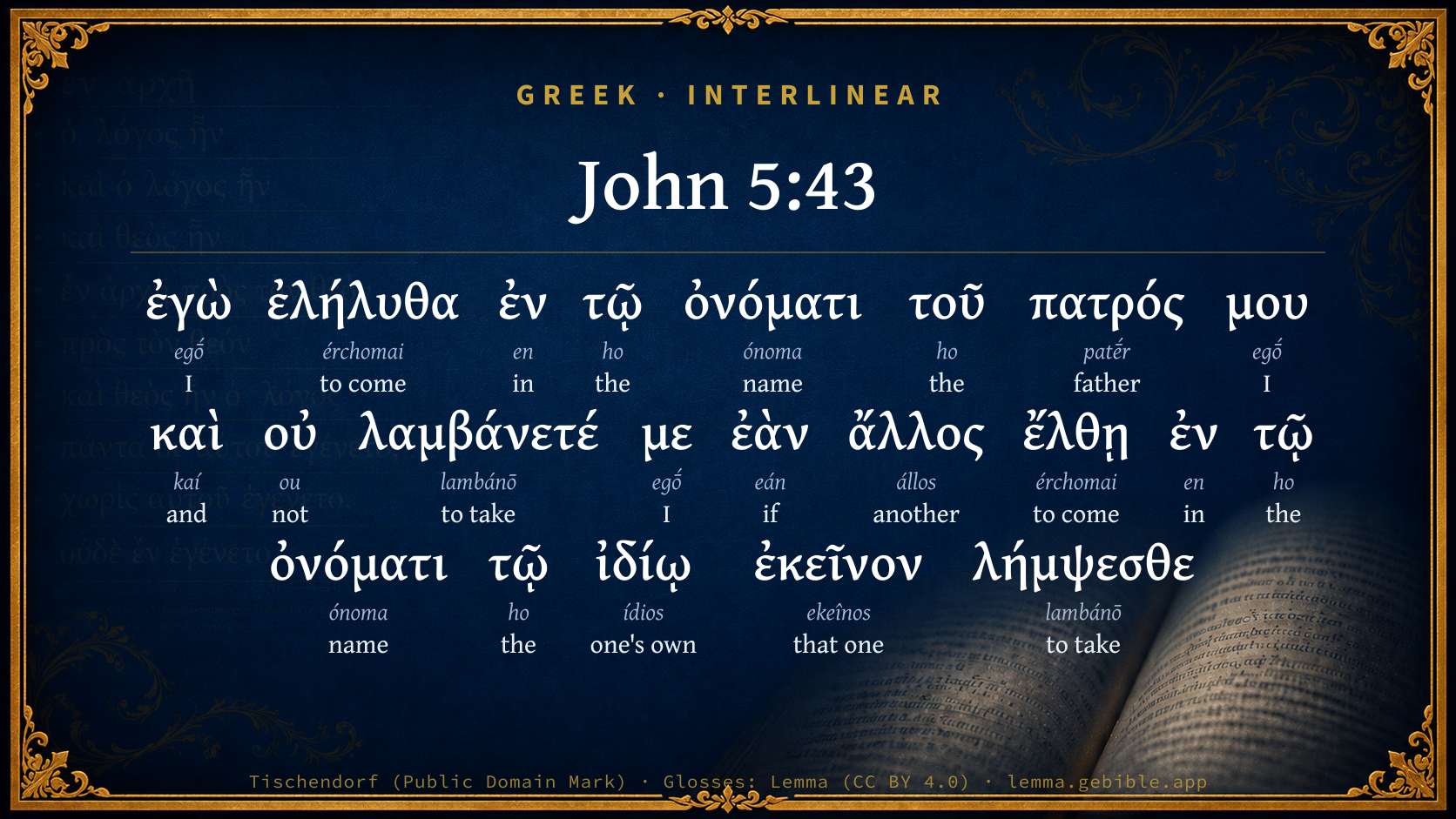
Greek (Tischendorf 8th ed.) John 5:43 appears in the Greek New Testament. The text above is from the Tischendorf 8th edition. Each word links to its Strong’s number and a concise gloss. Click any word for its full Thayer’s Greek Lexicon entry.
Download image
Cite this verse

John 5:43 (World English Bible). Public Domain. Lemma interlinear Bible study tool, https://lemma.gebible.app/v/john/5/43.

Show BibTeX & RIS
BibTeX
RIS
English Translation
I have come in my Father's name, and you don't receive me. If another comes in his own name, you will receive him.
World English Bible · Public Domain
Download a study sheet

One document with this verse’s original text, its word-by-word gloss line, the meaning frame, cross-references with their text, attributed commentary, and full source and license credits — printable, and it pastes into notes with its structure intact.

This verse Autodidact and up

Study sheet (.html) Plain text (.txt)

A passage Seminary Student

Up to 50 verses in one chapter. A passage sheet keeps up to 6 commentary sources and 12 cross-references per verse, in the order this page ranks them, and says so on the sheet whenever that leaves anything out. Ask for a single verse and you get the Autodidact verse sheet above.

Everything on this page stays free to read, with no account — the sheet is a download of what is already on screen, not access to it.

Want to remove ads? Support Godless Engineer
Compare translations 3

The same verse in 3 English versions, stacked beneath the original-language interlinear above. Click any original word for its lexicon entry.

Each is an independent rendering of the whole verse — the interlinear is not word-aligned to these translations.

Highlighted words mark where these versions differ — a whole-verse word diff, not a word-by-word alignment.

  • World English Bible Public Domain
    I have come in my Father's name, and you don't receive me. If another comes in his own name, you will receive him.
  • King James Version Public Domain
    I am come in my Father's name, and ye receive me not: if another shall come in his own name, him ye will receive.
  • unfoldingWord Literal Text CC BY-SA 4.0
    I have come in the name of my Father, and you do not receive me. If another comes in his own name, you receive that one.

unfoldingWord Literal Text — © unfoldingWord, licensed CC BY-SA 4.0. Word-aligned USFM3 via Door43 (git.door43.org/unfoldingWord/en_ult).

Versions to compare (up to 4)

3 of 4 selected

Show all 19 translations

Every available English version of this verse, each an independent rendering of the whole verse.

  • World English Bible Public Domain
    I have come in my Father's name, and you don't receive me. If another comes in his own name, you will receive him.
  • Berean Standard Bible Public Domain
    I have come in My Father’s name, and you have not received Me; but if someone else comes in his own name, you will receive him.
  • Majority Standard Bible Public Domain
    I have come in My Father’s name, and you have not received Me; but if someone else comes in his own name, you will receive him.
  • King James Version Public Domain
    I am come in my Father's name, and ye receive me not: if another shall come in his own name, him ye will receive.
  • American Standard Version (1901) Public Domain
    I am come in my Father's name, and ye receive me not: if another shall come in his own name, him ye will receive.
  • Revised Version (1885) Public Domain
    I am come in my Father’s name, and ye receive me not: if another shall come in his own name, him ye will receive.
  • Geneva Bible (1599) Public Domain
    I am come in my Fathers Name, and ye receiue me not: if another shall come in his owne name, him will ye receiue.
  • Douay-Rheims (1899) Public Domain
    I am come in the name of my Father, and you receive me not: if another shall come in his own name, him you will receive.
  • Young's Literal Translation Public Domain
    `I have come in the name of my Father, and ye do not receive me; if another may come in his own name, him ye will receive;
  • Literal Standard Version CC BY-SA 4.0
    I have come in the Name of My Father, and you do not receive Me; if another may come in his own name, him you will receive;
  • Unlocked Literal Bible CC BY-SA 4.0
    I have come in my Father's name, and you do not receive me. If another should come in his own name, you would receive him.
  • unfoldingWord Literal Text CC BY-SA 4.0
    I have come in the name of my Father, and you do not receive me. If another comes in his own name, you receive that one.
  • Darby Bible Public Domain
    I am come in my Father's name, and ye receive me not; if another come in his own name, him ye will receive.
  • World Messianic Bible Public Domain
    I have come in my Father’s name, and you don’t receive me. If another comes in his own name, you will receive him.
  • Webster's Bible Public Domain
    I am come in my Father's name, and ye receive me not: if another shall come in his own name, him ye will receive.
  • Free Bible Version CC BY-SA 4.0
    For I've come to represent my Father, and you won't accept me; but if someone comes representing themselves, then you accept them!
  • Bible in Basic English Public Domain
    I have come in my Father's name, and your hearts are not open to me. If another comes with no other authority but himself, you will give him your approval.
  • Text-Critical English NT CC BY 4.0
    I have come in the name of my Father, and yet you do not receive me. If another comes in his own name, you will receive him.
  • Tyndale New Testament (1534) Public Domain
    I am come in my fathers name and ye receave me not. Yf another shall come in his awne name him will ye receave.

Literal Standard Version (2020), Covenant Press — licensed CC BY-SA 4.0. Text via the HelloAO Bible API (eBible.org). Unlocked Literal Bible (unfoldingWord) — licensed CC BY-SA 4.0. Text via the HelloAO Bible API (eBible.org). unfoldingWord Literal Text — © unfoldingWord, licensed CC BY-SA 4.0. Word-aligned USFM3 via Door43 (git.door43.org/unfoldingWord/en_ult). Free Bible Version, Dr. Jonathan Gallagher — licensed CC BY-SA 4.0. Text via the HelloAO Bible API (eBible.org).

Word by word

More ways to search: Search by grammar → Find every occurrence → Compare this word →

Practice this passage: Drill this verse → Learn its vocabulary →

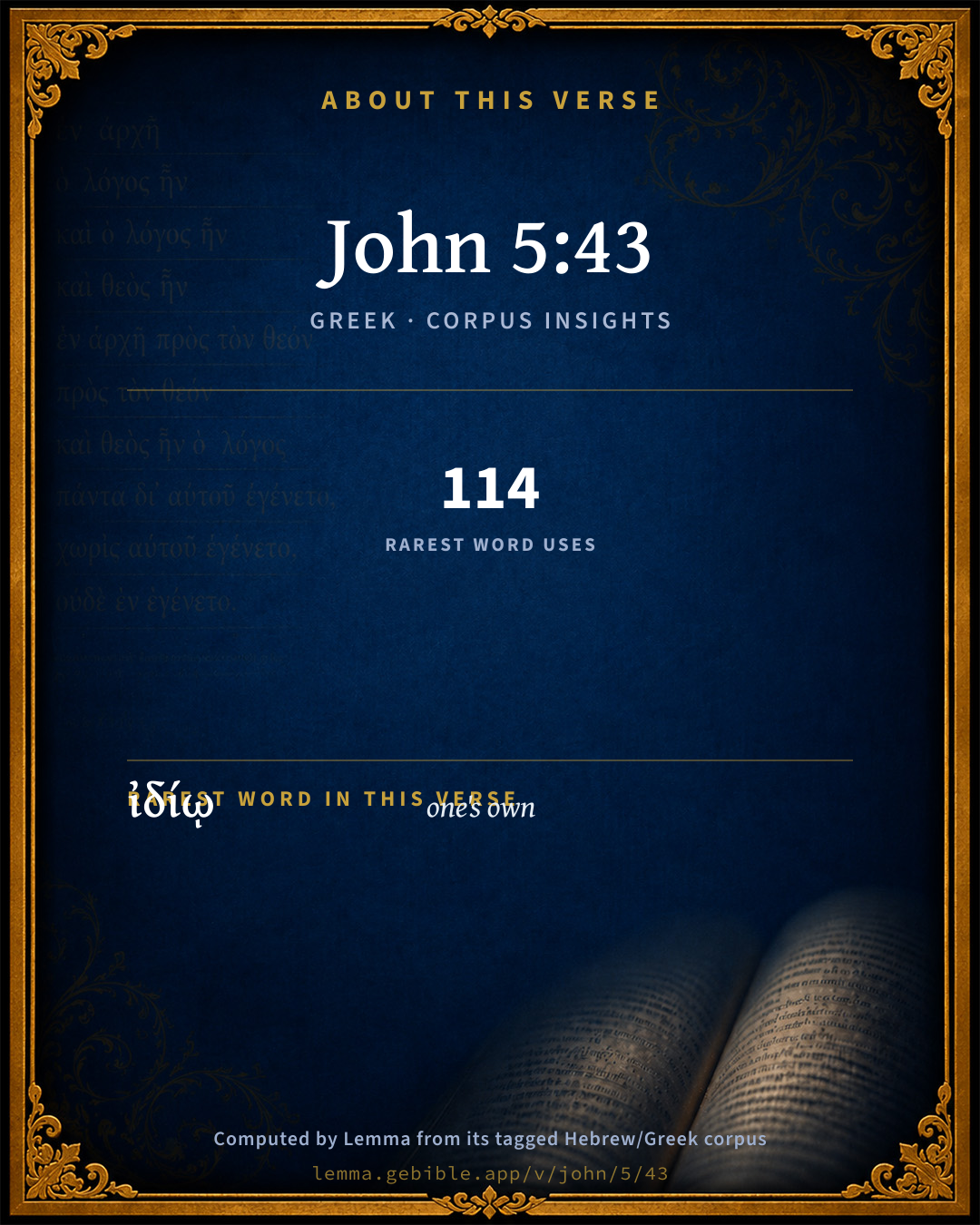
ἰδίῳ
ídios
G2398
“one's own”
Adjective, Dative, Singular, Neuter
Part of Speech
Adjective
Case
Dative
Number
Singular
Gender
Neuter
Full Thayer's Definition

Origin: of uncertain affinity

TDNT: None

1. pertaining to one's self, one's own, belonging to one's self
  1. ἐγὼ egṓ G1473 “I” Personal pronoun, 1st person, Nominative, Singular
  2. ἐλήλυθα érchomai G2064 “to come” Verb, Perfect, Active, Indicative, 1st person, Singular
  3. ἐν en G1722 “in” Preposition
  4. τῷ ho G3588 “the” Article, Dative, Singular, Neuter
  5. ὀνόματι ónoma G3686 “name” Noun, Dative, Singular, Neuter
  6. τοῦ ho G3588 “the” Article, Genitive, Singular, Masculine
  7. πατρός patḗr G3962 “father” Noun, Genitive, Singular, Masculine
  8. μου egṓ G1473 “I” Personal pronoun, 1st person, Genitive, Singular
  9. καὶ kaí G2532 “and” Conjunction
  10. οὐ ou G3756 “not” Particle, Negative
  11. λαμβάνετέ lambánō G2983 “to take” Verb, Present, Active, Indicative, 2nd person, Plural
  12. με egṓ G1473 “I” Personal pronoun, 1st person, Accusative, Singular
  13. ἐὰν eán G1437 “if” Conditional
  14. ἄλλος állos G243 “another” Adjective, Nominative, Singular, Masculine
  15. ἔλθῃ érchomai G2064 “to come” Verb, Aorist, Active, Subjunctive, 3rd person, Singular
  16. ἐν en G1722 “in” Preposition
  17. τῷ ho G3588 “the” Article, Dative, Singular, Neuter
  18. ὀνόματι ónoma G3686 “name” Noun, Dative, Singular, Neuter
  19. τῷ ho G3588 “the” Article, Dative, Singular, Neuter
  20. ἐκεῖνον ekeînos G1565 “that one” Demonstrative pronoun, Accusative, Singular, Masculine
  21. λήμψεσθε lambánō G2983 “to take” Verb, Future, Middle deponent, Indicative, 2nd person, Plural

About this verse

These counts appear in no published source. They are computed here, from the morphology-tagged text and Lemma’s own curated glosses. What Lemma adds →

22
words
13
distinct lemmas
Gospels
section

Repetition

Words recur within this verse:

  • ἐλήλυθα to come G2064 ×2
  • ὀνόματι name G3686 ×2
  • λαμβάνετέ to take G2983 ×2
  • τῷ the G3588 ×4
  • ἐγὼ I G1473 ×3
  • ἐν in G1722 ×2

Cross-references

10

Topical passages linked to John 5:43 in the Treasury of Scripture Knowledge — connected by theme and wording, ordered by reader-vote popularity; previews shown in the World English Bible.

  • Matthew 24:5 For many will come in my name, saying, 'I am the Christ,' and will lead many astray.
  • John 10:25 Jesus answered them, "I told you, and you don't believe. The works that I do in my Father's name, these testify about me.
  • John 17:4–6 I glorified you on the earth. I have accomplished the work which you have given me to do.
  • Hebrews 5:4–5 Nobody takes this honor on himself, but he is called by God, just like Aaron was.
  • John 6:38 For I have come down from heaven, not to do my own will, but the will of him who sent me.
  • John 8:28–29 Jesus therefore said to them, "When you have lifted up the Son of Man, then you will know that I am he, and I do nothing of myself, but as my Father taught me, I say these things.
  • Matthew 24:24 For there will arise false christs, and false prophets, and they will show great signs and wonders, so as to lead astray, if possible, even the chosen ones.
  • John 12:28 Father, glorify your name!" Then there came a voice out of the sky, saying, "I have both glorified it, and will glorify it again."
  • John 3:16 For God so loved the world, that he gave his one and only Son, that whoever believes in him should not perish, but have eternal life.
  • Acts 5:36–37 For before these days Theudas rose up, making himself out to be somebody; to whom a number of men, about four hundred, joined themselves: who was slain; and all, as many as obeyed him, were dispersed, and came to nothing.

Cross-references courtesy of OpenBible.info (CC BY 4.0).

Commentary

Notes on John 5:43 from classic Christian and Jewish commentators (each source and its license shown beneath its notes). The classic Christian expositions comment on the surrounding passage and are grouped to its opening verse, so a note may address several verses; the Jewish commentaries on the Tanakh (Rashi and others) are per-verse, so they appear only where the commentator wrote on this verse.

Lemma curates 59 commentaries, every one of them public domain or Creative Commons licensed, each selected and text-cleaned for this edition rather than reprinted as found. About our sources →

The Biblical Illustrator

Joseph S. Exell

Joh_5:43

I am come in My Fathers name, and ye receive Me not.

Whence learn

I. Albeit Christ be God over all, equal with the Father, and Lord over His own house, and so acts in His own name, yet IT PLEASED HIM TO CONDESCEND as Mediator, not only to purchase life to them that come to Him, but to COME into the world CLOTHED WITH A COMMISSION FROM THE FATHER to make offer of this purchased life, that by His condescendence He might commend His love to His people, and teach them humility, and not to run on a calling unsent, and that we might look on Him as approved of the Father, and that such as come to Him the Father will accept them, for saith He, I am come in My Fathers name (see Php_2:3; Php_2:6-7, etc.; Mat_3:17; Heb_5:4-5).

II. CHRIST thus coming IS TO BE RECEIVED, His doctrine to be heard, Himself to be acknowledged for such in His person, offices, commission, and benefits, as He declareth Himself to be; to be rested on and embraced, to be employed and submitted to as such, for so is imported in that they should receive Him.

III. Albeit Christ be the great Ambassador of the Father, not a servant, but the Son (Mat_21:37). And albeit He was singular in His admiration of His office, mad all tending to the good of sinners, YET SUCH IS THE PERVERSENESS OF THE WORLD AS NOT TO MAKE HIM WELCOME; for it is the peculiar privilege of the elect to be drawn to Him, and others, they neither see His excellency, nor feel their need of Him; therefore saith He, I am come in My Fathers name, and ye receive Me not.

IV. SUCH AS REJECT CHRIST ARE DESTITUTE OF THE LOVE OF GOD, nor have they any evidence of respect to Him, since Christ is the clearest image of the Father, and cometh in His name, and the Father will not be acknowledged but in add through Him. Therefore by this doth He prove that challenge (Joh_5:42).

V. WHEN CHRIST MANIFESTS HIMSELF to the world, IT IS USUAL WITH SATAN TO HOUND OUT SEDUCERS AND FALSE TEACHERS, to study to bear him down, to seduce souls, and by their courses to make the way of truth odious; for so is imported that another shall come, pretending either to be the Christ, or to hold Him out to others (see Mat_24:5; Mat_24:24; Act_5:36-37).

VI. ALBEIT FALSE TEACHERS PRETEND TO COME IN GOD AND CHRISTS NAME (Mat_24:5), YET THEY DO BUT COME IN THEIR OWN, as having no commission when they run, as malting themselves, their reputation and advantage, their chief aim in their undertaking, and as speaking the imaginations of their own heart and brain, without any warrant from God; for another shall come in His own name.

VII. SUCH AS EMBRACE NOT CHRIST MAY TAKE WORSE IN HIS ROOM, and will easily receive and embrace false teachers and seducers. Mens nature is propense to evil courses, and is readiest to be affected with what is wrong. And seducers are more ready to serve mens humours than faithful ministers may be, and withal it is Gods just judgment on the world to give them up to such, since they will not receive the love of the truth (2Th_2:10-12). Therefore saith He, If another come in his own name, him ye will receive. This is the heinous sin of men, to affront Christ, to respect Satan in his messengers, before God in His Son, as to prefer lies to truth. And it is their dreadful punishment to be given up to such delusions, because they will not see the light, or do receive it only as it may serve their turn, or weary of the light, and walk not answerable to it. And men should be ashamed of their errors, as being their plague, and a proclamation that they have not received the love of the truth. (G. Hutcheson.)

He who despises the Dove (Joh_1:42) falls a prey to the frogs Rev_16:13). (R. Berser, D. D.)

There is light for those loving light, and darkness for those loving darkness. (Pascal.)

Robert Owen rejected Christianity, and died a believer in spirit-rapping. (W. H. Van Doren, D. D.)

The Biblical Illustrator, edited by Joseph S. Exell (c. 1880s–1900s) — public domain. Text from a community e-Sword module.

Bengel's Gnomon

Johann Albrecht Bengel

Joh 5:43. Οὐ λαμβάνετέ με) ye receive Me not, through [in] faith.—ἄλλος, another) Any false Christ and Antichrist that may arise. From the time of the true Christ down to our age, sixty-four false Messiahs are reckoned up, by whom the Jews were deceived. See John Jam. Schudt, Jüdische Merkwürdigkeiten, [111]. 6, c. 27, § 30.

[111] Cod. Reg., Paris, of the Gospels: the text akin to that of B: edited by Tisch.

Bengel's Gnomon of the New Testament — English translation (T&T Clark, Edinburgh, 1860) — public domain. Text from a community e-Sword module.

Expositor's Greek Testament

ed. W. Robertson Nicoll

Joh 5:43 . ἐγὼ ἐλήλυθα … It is just because I have come in the Father’s name that you do not receive me. Not really loving God, they could not appreciate and accept Jesus who came in God’s name, that is, who truly represented God. But ἐὰν ἄλλος ἔλθῃ … λήψεσθε , “if another come in his own name,” and therefore seeking only such glory as the Jews could give, him ye will receive; cf. Mat 24:5 ; Mat 24:23-24 . “He did not say, ‘If I had come in my own name,’ because the thing was so inconceivable.” Mason, Conditions of our Lord’s Life , etc., p. 90. Possibly Jesus had here in view Antichrist (see Bousset’s Antichrist , 133); but neither Bar Cochba nor any other definite Pseudo-Christ. Schudt mentions sixty-four.

The Expositor's Greek Testament, edited by W. Robertson Nicoll (1897–1910) — public domain. Text from a community e-Sword module.

International Critical Commentary

43. ἐγὼ ἐλήλυθα ἐν τῷ ὀνόματι τοῦ πατρός μου. Jesus is represented by Jn. as speaking of the “Name” of His Father 7 times (the number 7 probably having no significance; see Introd., p. lxxxix). The “Name” of the Father was given to the Incarnate Son (17:11, 12); “in the Name of His Father” He came (5:43) and performed the “works” which were His witness (10:25). This “Name” He “manifested” (17:6), and “made known” (17:26) to His disciples. He prayed the Father to “glorify” His Name (12:28).

To primitive Hebrew thought the name had an intimate and mysterious connexion with him whose name it was; and this idea lies behind the widely spread practice of reciting the names of foes for magical purposes. The name was the expression of the personality. Thus “the Name of Yahweh” came to signify the revelation of the Being of God, exhibiting itself in Power and Providence,1 and it is frequently used thus in the O.T. (cf. Psa 20:1, Pro 18:10). This usage is carried into the N.T. (Luk 1:49; and see notes on 1:12, 17:11).

Thus “I am come in the Name of my Father” does not only mean “I am come as His representative, having been sent by Him,” although it includes this (see 7:28, 8:42); but it conveys the idea that the Incarnate Son reveals the Father in His character and power. Cf. 14:26.

καὶ οὐ λαμβάνετέ με, “but you do not receive me,” καί being used as an adversative conjunction, where we would expect ἀλλά or καίτοι (see on 1:10). The Fourth Gospel is truly described as in one aspect “the Gospel of the Rejection”; cf. 1:11, 3:11, 32, 12:37.

ἐὰν ἄλλος ἔλθῃ κτλ., “if another shall come in his own name, him you will receive.” Abbott (Diat. 2677) calls attention to the use of ἄλλος rather than ἕτερος: “if another come (professing to be of the same kind as myself), etc.” Cf. 2Co 11:4 ἄλλον Ἰησοῦν. Such a pseudo-Christ would appear only “in his own name,” i.e. not representing or revealing the name and the nature of God, as Jesus did.

Schmiedel2 finds here (so too Hilgenfeld and Pfleiderer) an allusion to the rising of Barcochba about 134 a.d., which led to the extinction of the Jewish State. On this hypothesis, the Fourth Gospel (for there is no sign that this verse is an interpolation) would be later in date than Barcochba. But the words are quite general in their reference, and are comparable with Mar 13:6, Mar 13:22 (cf. Mat 24:5, Mat 24:24): “Many shall come in my Name … there shall arise false Christs and false prophets.” This is one of the few passages in which Jn. reproduces sayings of Jesus comparable with the Synoptic predictions of the last things (see Introd., pp. cxxix, clix). Bousset1 finds an allusion to the coming of Antichrist (cf. 2Th 2:8-12), but the context does not call for any definite reference to the success of false Messiahs, of whom many have appeared.

International Critical Commentary — older volumes (1896–1929), various authors — public domain. Text from a community e-Sword module.

Jamieson, Fausset & Brown

Robert Jamieson, A. R. Fausset & David Brown

if another shall come, &c.--How strikingly has this been verified in the history of the Jews! "From the time of the true Christ to our time, sixty-four false Christs have been reckoned by whom they have been deceived" [BENGEL].

Jamieson, Fausset & Brown — Commentary Critical and Explanatory on the Whole Bible (1871) — public domain (CC PDM 1.0). Text via the HelloAO Bible API.

Adam Clarke's Commentary

Verse 43. I am come in my Father's name] With all his influence and authority. Among the rabbins, it was essential to a teacher's credit that he should be able to support his doctrine by the authority of some eminent persons who had gone before. Hence the form, Coming in the name of another.

If another shall come in his own name] Having no Divine influence, and no other authority than his own, him ye will receive. That this was notoriously the case may appear from Josephus, Antiq. b. xviii. c. 14; Ac 5:36-37; Eusebius, Eccl. Hist. b. iv. c. 6. It is by the just judgment of God, that those who will not believe the truth of God shall be so given up as to believe the most absurd of lies. For an account of these false Christs, See Clarke on Mt 24:5.

Adam Clarke's Commentary on the Bible (1810–1826) — public domain. Text from a community e-Sword/MySword module.

John Calvin's Commentaries

43. I have come in my Father’s name The false prophets do indeed boast of this title, as the Pope, in the present day, boasts with open mouth that he is Christ’s Deputy or Vicar; and under this very disguise has Satan deceived wretched men from the beginning. But Christ here means the reality, and not a hypocritical pretense; for when he testifies that he has come in his Father’s name, he means not only that the Father has sent him, but that he faithfully executes the commission which he has received. By this mark he distinguishes the lawful teachers of the Church from spurious and pretended teachers. This passage, therefore, teaches that we ought boldly to reject all who exalt themselves, and, in their own name, claim authority over souls; for he who is desirous to be reckoned a servant of God ought to have nothing separate from God. Now, if the whole doctrine of the Pope be examined, even the blind will see that he has come in his own name.

If another come in his own name, him you will receive. That the Jews do not love God, and have no reverence for him, Christ proves by this argument, that they will eagerly receive the false prophets, while they refuse to obey God; for he takes for granted, that it is a sign of a wicked and ungodly mind, when men disregard truth and willingly assent to falsehoods. If it be objected that this is generally done rather through ignorance than through malice, the answer is easy. No man is exposed to the impostures of Satan, except so far as, through some wicked disposition, he prefers falsehood to truth. For how comes it that we are deaf when God speaks, and that Satan finds us ready and active, but because we are averse to righteousness, and of our own accord desire iniquity? Though it ought to be observed that here Christ speaks chiefly of those whom God peculiarly enlightened, as he bestowed on the Jews this privilege, that, having been instructed in his Law, they might keep the right way of salvation. It is certain that such persons lend an ear to false teachers for no other reason than because they wish to be deceived. Accordingly, Moses says that, when false prophets arise, this is intended to prove and try the people if they love the Lord their God, (Deuteronomy 13:3.) In many persons, no doubt, there appears to be an innocent and guileless simplicity, but their eyes are undoubtedly blinded by the hypocrisy which lurks within their minds. For it is certain that God never shuts the door to those who knock, (Matthew 7:8,) never disappoints those who sincerely pray to him, (Isaiah 45:19.) Justly, therefore, does Paul ascribe it to the vengeance of God, when the power of deceiving is given to Satan,

that they who have rejected the truth, and taken pleasure in unrighteousness, may believe a lie, and says that they perish who did not receive the love of the truth, that they might be saved, (2 Thessalonians 2:9, 12.)

In this manner is discovered the hypocrisy of many who, devoted to the impostures and wicked superstitions of the Pope, burn with envenomed rage against the Gospel; for if they had hearts disposed to the fear of God, that fear would likewise produce obedience.

John Calvin's Commentaries (1540-1563) — public domain. Text from the Calvin Translation Society English edition (1840s-50s) via the Christian Classics Ethereal Library (ccel.org). Calvin's coverage is partial (roughly two-thirds of the Bible); uncommented books and verses are honest gaps, never fabricated. The 19th-century editor's footnotes and remarks are omitted so the notes are faithfully Calvin's own voice.

Ellicott's Commentary for English Readers

(43) I am come in my Father’s name.—So far from self-assertion or honour-seeking, He came in the name of, as representing, the Father, guided only by His will, doing only His work (Joh_4:34). Had they loved the Father, they must have received and reverenced His Son (Joh_8:42; Mat_21:37 et seq.). The absence of love is at the root of the rejection. The true Israelite became the true Christian (Joh_1:47), but these were not true members of the Old Covenant, and could not therefore pass into the New.

If another shall come in his own name.—Comp. the direct prophecy of false Christs and prophets in Mat_24:24, and see Note there. The word “come” in this clause links the meaning with that of the “come” in the previous clause, and is to be understood of a false Messianic claim in opposition to the true. Sixty-four false Christs have been enumerated as appearing after the true Christ, and these words are often taken as a prophecy of one of the most famous of these, as Bar-Kochba. Not a few of the Fathers have understood the words of Antichrist. Perhaps the only definite reference is to the mental condition of the Jews. They would receive any other who came in his own authority, and seeking his own glory. There would be no higher principle to which everything must yield. The seeker of power would fulfil their carnal interpretation of Messianic hopes. He would flatter and honour them, and therefore they would receive him.

A Bible Commentary for English Readers, edited by Charles John Ellicott (1878–1897) — public domain. Text from a community e-Sword module.

The Cambridge Bible for Schools and Colleges

gen. ed. J. J. S. Perowne

43. and ye receive me not] The tragic tone as in Joh_5:39-40, ‘I come with the highest credentials, as My Father’s representative (comp. Joh_8:42), and ye reject Me.’

come in his own name] As a false Messiah or as Antichrist. Sixty-four pretended Messiahs have been counted. Comp. Mat_24:24.

The Cambridge Bible for Schools and Colleges (gen. ed. J. J. S. Perowne; Cambridge University Press, 1878–1918) — public domain. Text from a community e-Sword module.

John Gill's Exposition

How can ye believe, which receive honour one of another?.... As the Scribes and Pharisees did, who were ambitious of honour and respect from one another, as well as from the common people; doing all they did to be seen of men, and to gain applause among them: choosing the uppermost rooms at feasts, and chief places in the synagogues, and delighting in the pompous title of Rabbi, Rabbi; and were in expectation of the temporal kingdom of the Messiah, when they hoped to be advanced to places of great honour and profit; and all this was an hinderance to them from believing in Christ, who appeared in such an abject form, and made so mean a figure; whose doctrine was so unsuitable to their carnal minds, and whose followers were so poor and contemptible; and besides it was made a law among them, that those who professed him to be the Messiah, should be cast out of the synagogue: hence many who were convinced that he was the Messiah, durst not confess him, lest they should lose their honour and respect among men, which they preferred to the praise of God:

and seek not the honour that cometh from God only; or "from the only God", as the Vulgate Latin; or "from the one God", as the Syriac, Arabic, and Persic versions render it: the honour that comes from him is, that of being born of him; of being a son or daughter of his, having that new name, which is better than that of sons and daughters of the greatest princes on earth; of being made all glorious within, and clothed with gold of Ophir, with raiment of needlework, with the robe of righteousness, and garments of salvation; of being translated into the spiritual kingdom of Christ, and made kings and priests unto God by him; of being set on the same throne with Christ, having on a crown of life and righteousness, and enjoying a kingdom and glory; being heirs of God, and joint heirs with Christ; which honour all the saints have, or shall have, and which these men cared not for.

John Gill's Exposition of the Whole Bible (1746–1763) — public domain (CC PDM 1.0). Text via the HelloAO Bible API.

Trapp's Complete Commentary

John Trapp

43 I am come in my Father’s name, and ye receive me not: if another shall come in his own name, him ye will receive.

Ver. 43. Him will ye receive] As they did Barchochab; and that Pseudo-Moses (the devil he was) that deceived so many of them in Crete, A.D. 434, persuading them to cast themselves after him into the sea, which should part, and make them way into their own country again, whereby many of them perished.

John Trapp, A Commentary or Exposition upon All the Books of the Old and New Testament (1647–1656) — public domain. Text from a community e-Sword module.

Albert Barnes' Notes on the Bible

I am come in my Father’s name - By the authority of God; or giving proof that I am sent by him.

If another shall come in his own name - A false teacher setting up himself, and not even pretending to have a divine commission. The Jews were much accustomed to receive and follow particular teachers. In the time of Christ they were greatly divided between the schools of Hillel and Shammai, two famous teachers.

Ye will receive - You will follow, or obey him as a teacher.

Albert Barnes' Notes on the Bible (1834–1885) — public domain. Text from a community e-Sword/MySword module.

Matthew Poole's English Annotations

I am come clothed with an authority from my Father, sent by him for this very purpose, to reveal his will to men for their salvation; I speak, I do nothing but by the authority of my Father which sent me; nor do I aim at my own glory, but the glory of him that sent me: yet you give no credit to my words, nor embrace me, as him whom God hath sent for the Saviour of man.

If another shall come in his own name, him ye will receive; through the corruption of your hearts, and the just judgment of God, giving you up to strong delusions to believe lies, 2Th 2:11. If any seducers come, without any authority from God, never sent of him, nor speaking his words, nor seeking his glory, or your good, you will readily enough receive them.

Matthew Poole's English Annotations on the Holy Bible (1683–1685) — public domain. Text from a community e-Sword/MySword module.

Whedon's Commentary on the Bible

Daniel D. Whedon

43. In my Father’s name—The truly sent of God.

In… own name—Though pretendedly sent of God. No less than sixty-four false Messiahs have risen to deceive and destroy that deluded race.

Daniel D. Whedon (gen. ed.), Commentary on the Old and New Testaments (1874–1909) — public domain. Text from a community e-Sword module.

The Pulpit Commentary

I have come in the name (i.e. in the power, with the credentials, with the encompassing revelation) of my Father, and ye receive me not. Your idea of the Father"s glory is so profoundly different from the reality, that you do not recognize it when it is offered you and shining over you. Christ did not profess to have come in his own name. He was not a mere evolution of humanity, or of Israel, or of the house of David. He was the Only Begotten of the Father, born from above, sent down from heaven. The language of the world was, "This is not Divine;" "It is too gentle, too gracious, too sympathetic for God!" The religious world listened eagerly for some echo of the trumpet peals of Sinai. It desired a king greater than Solomon, a prophet more terrible than Elijah. When he came with the real glory robes of the love of God, and with the majesty of the Name of the Lord, there was widespread disappointment and cruel rejection of his commission. Should another come in his own (proper, peculiar) name, that is, with no testimony from heaven, seeking "honour (doxa , glory) from men," creating a sovereignty by enlisting the voices of men, compromising with evil, making no warfare against the power of the world, allowing the legitimacy of the throne of the prince of this world; should he come in his own name, alas! him (that one) ye will receive. The eagerness on the part of the Jews to find the Messiah has led them to accept in some sort no fewer than sixty-four false Christs (Schudt, "Judische Merkwurdigkeit," 6:27-30; Bengel and Meyer). Nor must the Christian Church take the flattering unction that it is free from this charge. The teacher that can utilize to the widest extent the fashionable worldliness, and can mingle the pungent human condiment with the princely food of the King"s banqueting house, is he who at the present hour meets with the loudest response and the readiest reception. There is solemn warning here for statesman and author, artist and preacher.

The Pulpit Commentary (1880–1919), ed. H.D.M. Spence-Jones & Joseph S. Exell — public domain. Text from a community e-Sword module.

John Wesley's Explanatory Notes

If another shall come - Any false Christ.

John Wesley, Explanatory Notes Upon the Whole Bible (1754–1765) — public domain. Text via the GEBible commentary corpus.

unfoldingWord translationNotes

Door43 World Missions Community

in my Father's name

Here the word "name" is a metonym that symbolizes God's power and authority. AT: "I have come with my Father's authority" (See: Metonymy)

Father

This is an important title for God. (See: Translating Son and Father)

receive

welcome as a friend

If another should come in his own name

The word "name" is a metonym that represents authority. AT: "If another should come in his own authority" (See: Metonymy)

How can you believe, you who accept praise ... God?

This remark appears in the form of a question in order to add emphasis. AT: "There is no way you can believe because you accept praise ... God!" (See: Rhetorical Question)

believe

This means to trust in Jesus.

translationWords

God the Father

receive

believe

praise

unfoldingWord translationNotes — © Distant Shores Media and the Door43 World Missions Community, licensed CC BY-SA 4.0. Source: git.door43.org/Door43/en_tn.

Cambridge Greek Testament for Schools and Colleges

43. λήμψεσθε for λήψεσθε: Joh 16:14-15; Joh 16:24. Winer, p. 53.

43. καὶ οὐ λαμβ. The καί of tragic contrast, as in Joh 5:40. ‘I come with the highest credentials (Joh 10:25), as My Father’s representative (Joh 8:42), and ye reject Me (see on Joh 1:5).

ἐν τ. ὀν τ. ἰδίῳ. Double article; in the name that is his own, as a false Messiah (Mat 24:5; Mat 24:24). Both the verb, ἔλθῃ, and ἄλλος (not ἕτερος), which implies some kind of likeness, point to a pretended Messiah. Sixty-four such have been counted. On ἐκεῖνον see on Joh 1:18.

Cambridge Greek Testament for Schools and Colleges (Cambridge University Press, 1896; 21 vols, various authors incl. Carr, Maclear, Plummer, Farrar, Lumby, Moule, M. R. James, Simcox) — public domain. Text from a community e-Sword module.

Alford’s Greek Testament

Henry Alford

43.] The first clause is clear. In the latter we have a prophetic declaration regarding the Jews in the latter days. This ἄλλος is in strong contrast with the ἄλλος of ver. 32. ‘The testimony of that Other, who is greater than I, ye will not receive; but if another come in his own name, him ye will receive.’ The words are perhaps spoken primarily of the false or Idol-Messiah, the Antichrist, who shall appear in the latter days (2Th 2:8-12); whose appearance shall be κατʼ ἐνέργειαν τοῦ σατανᾶ (their father, ch. 8:44), ἀποδεικνὺς ἑαυτὸν ὅτι ἐστὶν θεός, 2Th 2:4;—and doubtless, in that their final reference, embrace also all the cases in which the Jews have more or less received those false Messiahs who have been foreshadowers of the great Antichrist, and indeed all the cases in which such a spirit has been shewn by them, even in the absence of false Messiahs.

Henry Alford, The Greek Testament (1849–1861) — public domain. Text from a community e-Sword module.

Godet's Commentaries

Frédéric Louis Godet

Ver. 43. The result of this contrast between His moral tendency and theirs. While they reject Him, the Messiah, whose whole appearance bears the seal of dependence on God, they will receive with eagerness every false Messiah who will act from his own wisdom and his own force, glorifying man in his person. All glorious with the glory of this world will be the one welcomed by these lovers of human glory. In the name of God: coming by His authority and as His delegate. In his own name: representing only himself, his own genius and power. ῎Ελθῃ, comes, in its relation to ἐλήλυθα, I have come, can only denote a pseudo-Messianic appearance. According to the Synoptics also, Jesus expected false Christs (Mat 24:5; Mat 24:24 and the parallels). History has confirmed this prophecy; it speaks of sixty-four false Messiahs, who all succeeded in forming a party among the Jewish people in this way. See Schudt, Judische Merkwurdigkeiten (cited by Meyer). You will receive him; comp. 2Th 2:10-11. The application of this expression; another to the false Messiah Bacochebas (about 132), which some critics have desired to make for the purpose of proving that the composition of our Gospel belongs to the second century (Hilgenfeld, Thoma), is an absolutely gratuitous supposition, which has no authorization in the text.

This vicious tendency with which Jesus reproaches His adversaries went so far as even to destroy in them the faculty, the possibility of believing: Joh 5:44. The pronoun, ὑμεῖς, you, signifies: men such as you are (Joh 5:42-43). In the last words, the adjective μόνου, only, may be connected with the idea of θεοῦ : God who is the only God.Jesus would, in this case, characterize God as having, as only God, the right to bestow the true glory. This is the meaning ordinarily given to this expression. I think that it is more in the spirit of the context to understand, withGrotius and de Wette: the glory which is received from God alone, from God only, and not from men. The idea of these verses is that nothing renders men more unfit for faith than the seeking for human glory. But as necessarily as the current of Pharisaic vainglory bears the rulers of the people far away from faith, so infallibly would the spirit of love for God which inspires the books of Moses have directed them to Jesus and led them to faith.

Frédéric Louis Godet — Commentaries on Luke, John, Romans, and 1 Corinthians — English translation (T&T Clark, Edinburgh, 1870s–1890s) — public domain. Text from a community e-Sword module.

Lesson kit

Teaching starters — assembled from the data on this page, not authored interpretation. Every prompt links to the verse data it draws on. Edit before teaching.

John, in the Gospels, opens this verse with 22 words (13 distinct Greek lemmas). Its most distinctive word is ídios (“one's own”). A historical commentator’s framing appears above. Read the whole chapter for the surrounding context.

Discussion questions

  1. What does “one's own” (ídios) contribute to the verse as a whole?
  2. How does Matthew 24:5, which shares this passage’s theme, read alongside this verse?
  3. What does the repetition of “to come” (2× in this one verse) do in this verse?
  4. These translations render this verse differently; the difference is in the English rendering, not the original. What questions does that raise?
  5. Compare how The Biblical Illustrator and Bengel's Gnomon read this verse. Where do they agree or differ?

Things to notice

Reading settings

Reading text

Shown beneath each verse's original-language words.

Old Testament
Old Testament edition

Read the OT as the Masoretic Hebrew (MT) or the Greek Septuagint (LXX).

English shown for the Greek Septuagint (in the Hebrew ↔ Greek comparison).

Comparing translations? Open the Compare panel on any verse page to stack up to four side by side.