Matthew 18:14

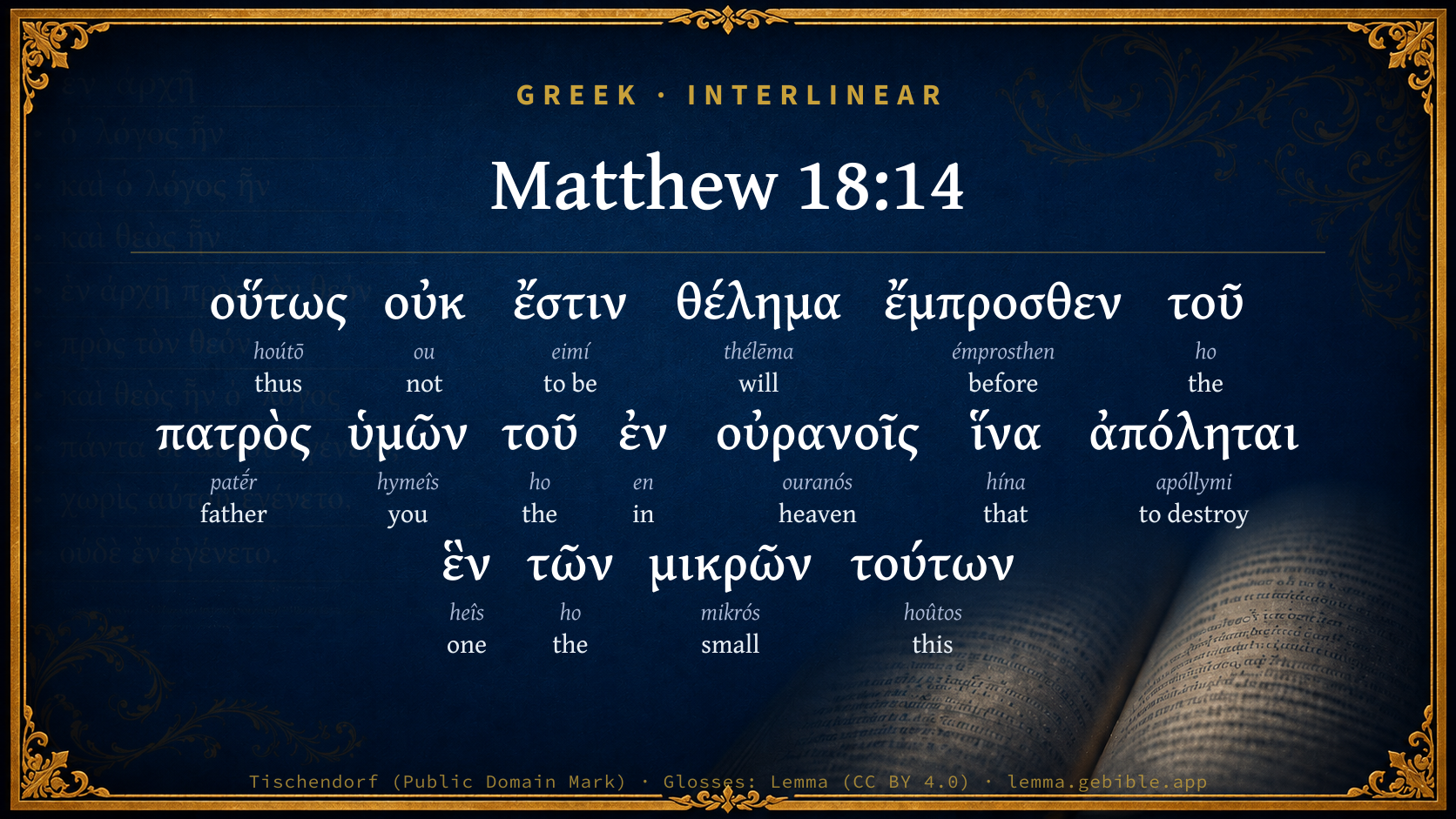
Greek (Tischendorf 8th ed.) Matthew 18:14 appears in the Greek New Testament. The text above is from the Tischendorf 8th edition. Each word links to its Strong’s number and a concise gloss. Click any word for its full Thayer’s Greek Lexicon entry.
Download image
Cite this verse

Matthew 18:14 (World English Bible). Public Domain. Lemma interlinear Bible study tool, https://lemma.gebible.app/v/matthew/18/14.

Show BibTeX & RIS
BibTeX
RIS
English Translation
Even so it is not the will of your Father who is in heaven that one of these little ones should perish.
World English Bible · Public Domain
Download a study sheet

One document with this verse’s original text, its word-by-word gloss line, the meaning frame, cross-references with their text, attributed commentary, and full source and license credits — printable, and it pastes into notes with its structure intact.

This verse Autodidact and up

Study sheet (.html) Plain text (.txt)

A passage Seminary Student

Up to 50 verses in one chapter. A passage sheet keeps up to 6 commentary sources and 12 cross-references per verse, in the order this page ranks them, and says so on the sheet whenever that leaves anything out. Ask for a single verse and you get the Autodidact verse sheet above.

Everything on this page stays free to read, with no account — the sheet is a download of what is already on screen, not access to it.

Want to remove ads? Support Godless Engineer
Compare translations 3

The same verse in 3 English versions, stacked beneath the original-language interlinear above. Click any original word for its lexicon entry.

Each is an independent rendering of the whole verse — the interlinear is not word-aligned to these translations.

Highlighted words mark where these versions differ — a whole-verse word diff, not a word-by-word alignment.

  • World English Bible Public Domain
    Even so it is not the will of your Father who is in heaven that one of these little ones should perish.
  • King James Version Public Domain
    Even so it is not the will of your Father which is in heaven, that one of these little ones should perish.
  • unfoldingWord Literal Text CC BY-SA 4.0
    In the same way, it is not the will before your Father in the heavens that one of these little ones would perish.

unfoldingWord Literal Text — © unfoldingWord, licensed CC BY-SA 4.0. Word-aligned USFM3 via Door43 (git.door43.org/unfoldingWord/en_ult).

Versions to compare (up to 4)

3 of 4 selected

Show all 19 translations

Every available English version of this verse, each an independent rendering of the whole verse.

  • World English Bible Public Domain
    Even so it is not the will of your Father who is in heaven that one of these little ones should perish.
  • Berean Standard Bible Public Domain
    In the same way, your Father in heaven is not willing that any of these little ones should perish.
  • Majority Standard Bible Public Domain
    In the same way, your Father in heaven is not willing that any of these little ones should perish.
  • King James Version Public Domain
    Even so it is not the will of your Father which is in heaven, that one of these little ones should perish.
  • American Standard Version (1901) Public Domain
    Even so it is not the will of your Father who is in heaven, that one of these little ones should perish.
  • Revised Version (1885) Public Domain
    Even so it is not the will of your Father which is in heaven, that one of these little ones should perish.
  • Geneva Bible (1599) Public Domain
    So is it not ye wil of your Father which is in heauen, that one of these litle ones should perish.
  • Douay-Rheims (1899) Public Domain
    Even so it is not the will of your Father, who is in heaven, that one of these little ones should perish.
  • Young's Literal Translation Public Domain
    so it is not will in presence of your Father who is in the heavens, that one of these little ones may perish.
  • Literal Standard Version CC BY-SA 4.0
    so it is not [the] will in [the] presence of your Father who is in the heavens that one of these little ones may perish.
  • Unlocked Literal Bible CC BY-SA 4.0
    In the same way, it is not the will of your Father in heaven that one of these little ones should perish.
  • unfoldingWord Literal Text CC BY-SA 4.0
    In the same way, it is not the will before your Father in the heavens that one of these little ones would perish.
  • Darby Bible Public Domain
    So it is not the will of your Father who is in [the] heavens that one of these little ones should perish.
  • World Messianic Bible Public Domain
    Even so it is not the will of your Father who is in heaven that one of these little ones should perish.
  • Webster's Bible Public Domain
    Even so it is not the will of your Father who is in heaven, that one of these little ones should perish.
  • Free Bible Version CC BY-SA 4.0
    In the same way my heavenly Father does not want any of these little ones to be lost.
  • Bible in Basic English Public Domain
    Even so it is not the pleasure of your Father in heaven for one of these little ones to come to destruction.
  • Text-Critical English NT CC BY 4.0
    In the same way, it is not the will of your Father in heaven that one of these little ones should perish.
  • Tyndale New Testament (1534) Public Domain
    Even so it is not the wyll of youre father in heven that one of these lytelons shulde perishe.

Literal Standard Version (2020), Covenant Press — licensed CC BY-SA 4.0. Text via the HelloAO Bible API (eBible.org). Unlocked Literal Bible (unfoldingWord) — licensed CC BY-SA 4.0. Text via the HelloAO Bible API (eBible.org). unfoldingWord Literal Text — © unfoldingWord, licensed CC BY-SA 4.0. Word-aligned USFM3 via Door43 (git.door43.org/unfoldingWord/en_ult). Free Bible Version, Dr. Jonathan Gallagher — licensed CC BY-SA 4.0. Text via the HelloAO Bible API (eBible.org).

Word by word

More ways to search: Search by grammar → Find every occurrence → Compare this word →

Practice this passage: Drill this verse → Learn its vocabulary →

μικρῶν
mikrós
G3398
“small”
Adjective, Genitive, Plural, Neuter
Part of Speech
Adjective
Case
Genitive
Number
Plural
Gender
Neuter
Full Thayer's Definition

Origin: apparently a primary word

TDNT: 14:48,6

1. small, little a. of size: hence of stature, of length b. of space c. of age: less by birth, younger d. of time: short, brief, a little while, how little! e. of quantity: i.e. number, amount f. of rank or influence
  1. οὕτως hoútō G3779 “thus” Adverb
  2. οὐκ ou G3756 “not” Particle, Negative
  3. ἔστιν eimí G1510 “to be” Verb, Present, Active, Indicative, 3rd person, Singular
  4. θέλημα thélēma G2307 “will” Noun, Nominative, Singular, Neuter
  5. ἔμπροσθεν émprosthen G1715 “before” Preposition
  6. τοῦ ho G3588 “the” Article, Genitive, Singular, Masculine
  7. πατρὸς patḗr G3962 “father” Noun, Genitive, Singular, Masculine
  8. ὑμῶν hymeîs G5210 “you” Personal pronoun, 2nd person, Genitive, Plural
  9. τοῦ ho G3588 “the” Article, Genitive, Singular, Masculine
  10. ἐν en G1722 “in” Preposition
  11. οὐρανοῖς ouranós G3772 “heaven” Noun, Dative, Plural, Masculine
  12. ἵνα hína G2443 “that” Conjunction
  13. ἀπόληται apóllymi G622 “to destroy” Verb, Aorist, Middle, Subjunctive, 3rd person, Singular
  14. ἓν heîs G1520 “one” Adjective, Nominative, Singular, Neuter
  15. τῶν ho G3588 “the” Article, Genitive, Plural, Neuter
  16. τούτων hoûtos G3778 “this” Demonstrative pronoun, Genitive, Plural, Neuter

About this verse

These counts appear in no published source. They are computed here, from the morphology-tagged text and Lemma’s own curated glosses. What Lemma adds →

17
words
15
distinct lemmas
Gospels
section

Shared distinctive vocabulary

μικρῶν small G3398 occurs in 39 verses of the Greek New Testament. Also found in:

Repetition

A word recurs within this verse:

Cross-references

17

Topical passages linked to Matthew 18:14 in the Treasury of Scripture Knowledge — connected by theme and wording, ordered by reader-vote popularity; previews shown in the World English Bible.

  • John 17:12 While I was with them in the world, I kept them in your name. Those whom you have given me I have kept. None of them is lost, except the son of destruction, that the Scripture might be fulfilled.
  • John 6:39–40 This is the will of my Father who sent me, that of all he has given to me I should lose nothing, but should raise him up at the last day.
  • 2 Peter 3:9 The Lord is not slow concerning his promise, as some count slowness; but is patient with us, not wishing that any should perish, but that all should come to repentance.
  • Isaiah 40:11 He will feed his flock like a shepherd, he will gather the lambs in his arm, and carry them in his bosom, [and] will gently lead those who have their young.
  • John 10:27–30 My sheep hear my voice, and I know them, and they follow me.
  • Zechariah 13:7 "Awake, sword, against my shepherd, And against the man who is close to me," says Yahweh of Hosts. Strike the shepherd, and the sheep will be scattered; And I will turn my hand against the little ones.
  • Matthew 5:16 Even so, let your light shine before men; that they may see your good works, and glorify your Father who is in heaven.
  • Matthew 6:9 Pray like this: 'Our Father in heaven, may your name be kept holy.
  • Luke 12:32 Don't be afraid, little flock, for it is your Father's good pleasure to give you the Kingdom.
  • John 21:15 So when they had eaten their breakfast, Jesus said to Simon Peter, "Simon, son of Jonah, do you love me more than these?" He said to him, "Yes, Lord; you know that I have affection for you." He said to him, "Feed my lambs."
  • Matthew 6:32 For the Gentiles seek after all these things, for your heavenly Father knows that you need all these things.
  • Romans 8:28–39 We know that all things work together for good for those who love God, to those who are called according to his purpose.
  • 1 Corinthians 8:11–13 And through your knowledge, he who is weak perishes, the brother for whose sake Christ died.
  • Ephesians 1:5–7 having predestined us for adoption as children through Jesus Christ to himself, according to the good pleasure of his desire,
  • 2 Timothy 2:10 Therefore I endure all things for the chosen ones' sake, that they also may obtain the salvation which is in Christ Jesus with eternal glory.
  • Hebrews 12:13 and make straight paths for your feet, so that which is lame may not be dislocated, but rather be healed.
  • 1 Peter 1:3–5 Blessed be the God and Father of our Lord Jesus Christ, who according to his great mercy became our father again to a living hope through the resurrection of Jesus Christ from the dead,

Cross-references courtesy of OpenBible.info (CC BY 4.0).

Where the printed editions differ

1 variant

Places in this verse where the major printed Greek editions disagree on the wording in a way that affects the translation — a comparison of editions, not a manuscript-by-manuscript collation. The editions are the modern critical texts (Nestlé-Aland 28/27, SBL, Westcott-Hort, Tregelles, Tyndale House) and the traditional texts behind the KJV (the Textus Receptus and the Byzantine/Majority text). It is not a claim about which reading is original.

  1. Different wording
    ὑμῶν

    “of you”

    In NA28NA27TynSBLTRByz Not in WHTreg

    μου (mou) 'of mine' occurs in a few manuscripts (WH+Treg) instead of ὑμῶν (humōn) 'of you' in older manuscripts (NA28+NA27+Tyn+SBL+TR+Byz)

Textual data: Translators Amalgamated Greek New Testament (STEPBible TAGNT) · CC BY 4.0.

Commentary

Notes on Matthew 18:14 from classic Christian and Jewish commentators (each source and its license shown beneath its notes). The classic Christian expositions comment on the surrounding passage and are grouped to its opening verse, so a note may address several verses; the Jewish commentaries on the Tanakh (Rashi and others) are per-verse, so they appear only where the commentator wrote on this verse.

Lemma curates 59 commentaries, every one of them public domain or Creative Commons licensed, each selected and text-cleaned for this edition rather than reprinted as found. About our sources →

The Biblical Illustrator

Joseph S. Exell

Mat_18:14

Even so it is not the will of your Father which is in heaven

The childrens friends

I.

The children around us have friends.

1. They have Divine Friends. God the Father, God the Son, God the Holy Ghost, are these Friends.

2. They have angelic friends.

3. They have human friends. Some in heaven; also on earth.

II. Lessons.

1. These thoughts should encourage anxious parents.

2. These thoughts should encourage despondent teachers.

3. These thoughts should encourage neglected and sorrowing children. (J. Morgan.)

The childrens foes

1. Among the childrens foes may be reckoned physical diseases and ailments.

2. Among the childrens foes must be ranked evil passions.

3. Among the childrens foes are to be found many vile and malicious demons.

4. Among the childrens foes are to be found many foolish and wicked men.

(1) Persons who indulge vicious habits.

(2) The circulators of profane literature. (J. Morgan.)

Hidden force in a child

For they are the men and women of the future, and within them lurk wondrous possibilities and powers which shall be developed and manifested and felt another day. Naturalists tell us that in every single drop of water in the ocean there is electricity enough to generate two thunder-storms. The power is there silent and hidden, nevertheless ready at any moment to leap forth and do terrible execution. So within the soul of every little child in our homes, in our schools, and in our streets, there is a moral force lying hidden on which two utterly opposite eternities hang. (J. Morgan.)

Children in danger of perishing

The children around us are in danger of perishing. What that means none of us can fully describe or imagine. We may have seen a superb mansion perish by a fire, or an extensive mill perish by an explosion, or a magnificent ship perish in a storm, and may have attempted to estimate the loss, and have mourned over the wreck and ruin. But for a child, with a God-given, a God-endowed, and a God-redeemed nature to perish, must be something far more terrible than the loss of any mansion, or mill, or ship that ever was built, however elaborately finished, or expensively furnished. (J. Morgan.)

Gods love for little children

1. It is a love of utter unselfishness.

2. It is the love of delight in them.

3. It is a love of compassion toward them.

4. It is the love of trust in the almost infinite capacities of children. (T. Gasquoine, B. A.)

Destitute children

I. A careful regard should be paid to children. Ii. They are liable to perish.

1. Through lack of food.

2. Through lack of knowledge.

3. In a moral sense they are liable to perish.

III. It is not the will of the parent of good that these little ones should be included in peril and ruin. (D. Ace, M.A.)

I. The dangerous exposure of mankind.

II. The will of the father respecting us.

III. How that will is to make effect. (J. N. Pearson, M. A.)

Gods care for His children

1. The existence of things which put in peril the souls of them that may be the children of God.

2. It is contrary to Gods will that these dangers should be fatal to the salvation of His people.

3. The means which God has provided for the accomplishment of His gracious will in the salvation of the little ones.

4. The encouragement which the text affords to those who are desirous of imparting that knowledge which maketh wise unto salvation. (Bishop Sumner.)

The Father and the little ones

I. The truth asserted. Gods will is for their welfare.

1. Because He is their Creator.

2. Because He is Love.

3. These words apply to the whole realm of childhood. They are not limited to children of the good and wealthy.

II. A sad truth implied. That notwithstanding Gods will children may ripen for evil and be lost. (C. Vivace.)

Not an ideal child

I saw some time ago a great painters representation of this scene. He makes this child so noble-featured, full of brightness and beauty, standing there as a young prince, fetched for the purpose from a fair palace. That is artistic, but it does not answer the purpose. What was done was done on the spot. The Master did not send for and bring the fairest and best-trained child that Galilee contained. No; it was a street loiterer He called to Himself. Some little one busy at play in the market-place, or one looking on wondering at the edge of the crowd-the first little one on which His eyes could rest; and taking him with gentle hands, with all the roughness in which He found him, the Master pointed to him, and said: Do not despise him; deem him not unworthy of your regard, but rather with all yore powers influence him for good. Win his heart for God. Open to him the gates of heaven, and do all you can to smooth his path. Do not despise one of these. (C. Vivace.)

Men must co-operate with the will of God

Still there is room for human labour. What would the earth be without it? Suppose that where we see the corn ripening we saw only a barren waste; if the ground had not been ploughed, or the seed not sown, or the plants not tended, could we look on it and say, Even so, Father, for so it seemeth good in Thy sight? No; we should have to say: It is not according to Gods will; Gods goodness has been defeated, and mans badness crowned with triumph. God in the course of providence ordains that our work and effort should be used to produce that on which He has set His heart. When a house is being built, there are different sets of labourers. On a certain day you see the work standing still, and on inquiry as to the cause you find that one set of men were idlers, they had gone holiday-making, and all the others were baffled and could do nothing. Look into the sluggards garden; the sun is there, and the dew, and they cannot do anything; the showers descend; all Gods celestial workers are there; but they cannot do anything because man is idling, has not dug the earth, has not scattered the seed; therefore Gods means can do nothing. This is one of the great mysteries of the universe. I wonder that God did not determine to do it all Himself, and not wait for our work, and have His purposes baffled, because we do not do our share of the labour. (C. Vivace.)

The Biblical Illustrator, edited by Joseph S. Exell (c. 1880s–1900s) — public domain. Text from a community e-Sword module.

Tyndale Open Study Notes

Tyndale Open Resources

18:14 The shepherd’s joy is also the joy of the Father; the purpose of pastoral care is so God will not lose any of his sheep.

Tyndale Open Study Notes — © Tyndale Open Resources, licensed CC BY-SA 4.0. Text via the HelloAO Bible API.

Bengel's Gnomon

Johann Albrecht Bengel

Mat 18:14. Οὐκ ἔστι θέλημα, it is not a wish)[818] or anything to be desired (cf. Eze 18:23). The article is not added in the present passage; cf. θεληματα, wishes, in Act 13:22.[819] We ought to subserve the Divine will in caring for the salvation of all.—ἔμπροσθεν,[820] in the presence of)[821] The Divine intellect is intimated as discerning what things please His will.[822]—ἵνα, κ.τ.λ., that, etc.) i.e. He wishes most earnestly that all should be saved.—εἷς, one) The disciples had asked in the comparative;[823] our Lord answers specially in the positive degree.

[818] E. V. “It is not the will.” Middleton renders it, “There is no wish.”—(I. B.)

[819] Rendered in E. V. by, “Which shall fulfil all My will.”—(I. B.)

[820] In his own German Version Bengel renders the passage thus:—“Also ist es kein Wille VOR eurem Vater, dass,” etc.—(I. B.)

[821] E. V. renders the passage, “It is not the will of your Father,” etc. Bengel would render it literally, “It is not a wish in the presence of your Father,” etc., and explain it as representing the Divine Intellect as surveying all possible contingencies (rendered by the Divine power visible to the Divine perception), and distinguishing between those which are, and those which are not, agreeable to His Will.—(I. B.)

[822] Bengel has used the word Voluntas four times in this paragraph, and that in two different senses. In the first instance, I have rendered the singular by Wish; in the second, the plural by Wishes; in the third and fourth, the singular by Will.—(I. B.)

[823] i.e. The disciples had asked, “Which is the greatest in the kingdom of Heaven?”—their question therefore referred to the comparative degrees of glory. Our Lord’s reply directs their attention to the simple notion, the positive degree of salvation; the universal requisites on man’s part to attain—the universal desire on God’s part to bestow it.—(I. B.)

Bengel's Gnomon of the New Testament — English translation (T&T Clark, Edinburgh, 1860) — public domain. Text from a community e-Sword module.

Meyer's Critical & Exegetical Commentary

Heinrich August Wilhelm Meyer

Mat_18:14. Accordingly, as it is not the will of that man that one of his sheep should be lost, so it is not the will of God that one of those μικροί should be lost (should fall into eternal perdition). The point of the comparison therefore lies in the unwillingness to let perish; in the parable this is represented by the case of a strayed sheep, for the purpose of teaching the disciples that if a μικρός happens to err from the faith and the Christian life, they should not abandon him, but try to induce him to amend.

What is said in regard to the μικροί is therefore put in the form of a climax: (1) Do not despise them, inasmuch as you would cause them to go astray, and be the occasion of their ruin (Mat_18:6-10); (2) On the contrary, if one does go wrong, rescue him, just as the shepherd rescues his wandering sheep, in order that it may not be lost (Mat_18:12-14).

ἔμπροσθεν] coram (Mat_11:26; Luk_15:10). There is not before God (before the face of God) any determination having as its object that, etc.; consequently, no predestination to condemnation in the divine will. On the idea involved in θέλημα, comp. note on Mat_1:19. For the telic sense of ἵνα, comp. Mat_7:12; Mar_6:25; Mar_10:35, al., and the ἐθέλειν ὄφρα of Homer; Nägelsbachs note on Iliad, i. 133.

ἕν] See critical notes. The idea of the sheep still lingers in the mind.

Meyer — Critical and Exegetical Commentary on the New Testament — English translation by Peter Christie, edited by Frederick Crombie (T&T Clark, 1880) — public domain. Text from a community e-Sword module.

Expositor's Greek Testament

ed. W. Robertson Nicoll

Mat 18:14 , pplication of the parable less emphatic than in Lk. θέλημα , a will, for an object of will. ἔμπροσθεν τ . π . μ .: before the face of = for, etc.

The Expositor's Greek Testament, edited by W. Robertson Nicoll (1897–1910) — public domain. Text from a community e-Sword module.

Jamieson, Fausset & Brown

Robert Jamieson, A. R. Fausset & David Brown

Even so it is not the will of your Father which is in heaven that one of these little ones should perish--How, then, can He but visit for those "offenses" which endanger the souls of these little ones?

Jamieson, Fausset & Brown — Commentary Critical and Explanatory on the Whole Bible (1871) — public domain (CC PDM 1.0). Text via the HelloAO Bible API.

Adam Clarke's Commentary

Verse 14. It is not the will of your Father] If any soul be finally lost, it is not because God's will or counsel was against its salvation, or that a proper provision had not been made for it; but that, though light came into the world, it preferred darkness to light, because of its attachment to its evil deeds.

Adam Clarke's Commentary on the Bible (1810–1826) — public domain. Text from a community e-Sword/MySword module.

Ellicott's Commentary for English Readers

(14) Even so it is not the will . . .—The form of the proposition has all the force that belongs to the rhetorical use of the negative. “It is not the will” suggests the thought that the will of the Father is the very opposite of that, and so the words are identical in their teaching with those of St. Paul, “He will have all men to be saved” (1Ti_2:4). The continued presence of the child is again emphasised in “one of these little ones.”

A Bible Commentary for English Readers, edited by Charles John Ellicott (1878–1897) — public domain. Text from a community e-Sword module.

John Gill's Exposition

But if he will not hear thee,..... But will either deny the fact, or extenuate and excuse it, or defend it, or at least is obstinate and incorrigible, shows no signs of repentance, but is angry, gives hard words, and ill language:

then take with thee one or two more; members of the church, and perhaps of weight, reputation, and character, who either know some thing of the matter, and so can confirm, by their testimony, what has been alleged, in order to bring the person to conviction and acknowledgment; or if they do not, and which seems rather to be the sense, they may, by hearing what is said on both sides, judge where the truth lies, and join with the offended person in the admonition, that it may fall with the greater weight, and become more effectual:

that in the mouth of two or three witnesses every word may be established, referring to Deu 19:15. So that should the matter be brought before the whole church, these witnesses would be able to testify the truth of the case, and report the steps that had been taken, and what effect they had had; so that things being thus prepared, the case would appear plain and easy, and without difficulty. The whole of this is very agreeable to the rules and customs of the Jews, and is founded on the law, in Lev 19:17, upon which they form rules very much like to these. They represent God himself taking such a method as this, with the sons of men (m):

"When the holy blessed God reproves a man, he reproves him in love, privately: if he receives it, it is well; if not, he reproves him among his friends: if he receives it, it is well; if not he reproves him openly before the eyes of all; if he receives it is well; if not, he leaves him, and reproves him no more.''

And this is an instruction to men, how they should reprove their friends. They say (n), "he that sees anything in his friend that is not becoming, he ought to reprove him." And which is elsewhere more (o) largely expressed:

"he that seeth his friend walking in a way that is not good, he is bound to reprove him, even a disciple his master; and this he shall do for his good, and in order to bring him to the life of the world to come, or eternal life; and "if he takes it of him, it is well": but if not, he must reprove again, "a second and a third time"; and so he must reprove him many times, if, or until he hears him.''

And this they require to be done, in the most private manner:

"reproof out of love (they (p) say) is secret from the children of men; whoever reproves his friend in love, seeks to secrete his words from the sons of men, that he may not expose him thereby to shame and reproach.''

That is, as the gloss (q) on it observes,

"he seeks to reprove him in secret, so that he may not be put to shame before many.''

If this way does not succeed, they allow of a public reproof, for so it is said (r);

"thou mayest not reprove him with hard words, till his countenance changes; for whoever causes the face of his friend to turn pale publicly, has no portion in the world to come; but thou mayest reprove in the words of heaven, or God; and if he does not return privately, thou mayest make him ashamed publicly, and expose his sin before him; and reproach and curse him, until he returns to do well; so did all the prophets to Israel.''

They plead also for a second reproof, from the text in Lev 19:17 (s).

"From whence does it appear, that he that sees anything in his friend unbecoming, ought to reprove him? As it is said, "thou shalt in any wise rebuke", &c. if he reproves him, , "and he does not receive it", (he does not take it kindly, or, as here, he does not hear him,) from whence is it manifest, that he must return and reprove him (or repeat the reproof)? from what is said, reproving thou shall reprove.''

The whole of this is very fully expressed in a few words, by one (t) of their best writers, and in great agreement with these rules of Christ:

"He that sees his friend sinning, or going in a way not good, he is commanded to cause him to return to that which is good; and to let him know, that he sins against himself by his evil works; as it is said, "thou shalt in any wise rebuke thy neighbour": he that reproveth his friend, whether for things between him and himself, or whether for things between him and God, "ought to reprove him", , "between him and himself"; and should speak to him mildly, and in tender language; and let him know that he does not speak to, him, but for his good, and to bring him to everlasting life; "and if he receives it of him, it is well, and if not, he must reprove him", "a second and a third time"; and so a man must continually reprove, until the sinner strikes him and says", I will not hear."''

Buxtorf has produced a passage out of one of their writers (u), in the very language in which Christ here delivers himself:

"The wise man says, if thy friend does thee an injury, reprove him between him and thee alone: if he hears thee, thou hast already gained; if he does not hear thee, speak to him before one or two, who may hear the matter, and if he will not hear reckon him a "worthless friend".''

One would almost be ready to think, that this writer should mean Christ by the wise man, were it not for the implacable enmity they bear unto him. The above author has cited also the following passage out of the same (w) writer, pertinent to the present purpose:

"A friend that declares to thee thy faults, "between him and thee", whenever he meets thee, is better to thee than a friend, that whenever he meets thee, gives thee a golden penny.''

(m) Raya Mehimna in Zohar, in Lev. fol. 35. 4. (n) T. Bab. Betacot, fol. 31. 1, 2. (o) Moses Kotsensis Mitzvot Tora pr. Affirm. 11. (p) Zohar. in Lev. fol. 19. 3. (q) Imre Binah in ib. (r) Milzvot Tora, pr. neg. 6. (s) T. Bab. Erachin, fol. 16. 2. (t) Maimon. Hilch. Deyot. c. 6. sect. 7. (u) Mischar happeninim apud Buxtorf. Florileg. Heb. p. 297. (w) Ibid.

John Gill's Exposition of the Whole Bible (1746–1763) — public domain (CC PDM 1.0). Text via the HelloAO Bible API.

Trapp's Complete Commentary

John Trapp

14 Even so it is not the will of your Father which is in heaven, that one of these little ones should perish.

Ver. 14. It is not the will of your Father] Happy for us, that we are kept by the power of God to salvation, 1Pe 1:5, for else it were possible for us to fall away and perish: an intercision there might be, nay, an utter excision from Christ, were not his left hand under us, and his right hand over us, Son 2:6, and both his hands about us, to clasp and hold us fast to himself. But his right hand is our Jachin, and his left hand our Boaz, 1Ki 7:21. Both which pillars in the porch of Solomon’s temple did show, not only by the matter whereof they were made, but also by the names whereby they were called, what stedfastness the elect stand in before God, both for present and future. For present they have strength in themselves; for future, God will so establish them with his grace, that they shall never wholly depart from him. As for reprobates, God saith of them, that that will die, let it die; they shall die in their sins, as the Lord threateneth the Jews; which is a thousand times worse than to die in a ditch or in a dungeon.

John Trapp, A Commentary or Exposition upon All the Books of the Old and New Testament (1647–1656) — public domain. Text from a community e-Sword module.

Haydock's Catholic Bible Commentary

Even so it is not. Here some may perhaps object, that since the Almighty does not wish any of his little ones to perish, he must consequently wish all to be saved, and therefore that all will be saved. Now this is not the case: the will of the Almighty is therefore sometimes frustrated in its effects, which is contrary to Scripture. To this objection, St. John Damascene replies, that in God we must distinguish two distinct wills; the one antecedent, the other consequent. A person wills a thing antecedently, when he wills it merely as considered in itself. For instance, a prince wishes his subjects to live, in as much as they are all his subjects. But a person wills a thing consequently, when he will a thing in consideration of some particular circumstance. Thus, though the king wishes all his subject to live, he nevertheless wills that some should die, if they turn traitors, or disorganize the peace of society. In the same manner, the Almighty wishes none of his little ones to perish, in as much as they are all his creatures, made to his own image, and destined for the kingdom of glory; though it is equally certain that he wills the eternal punishment of many who have turned away from his service, and followed iniquity. If we observe this distinction, it is easy to see what our Saviour meant, when he said that it was not the will of his Father that any of these little ones should perish. (St. John Damascene)

George Leo Haydock (1774–1849), Haydock's Catholic Family Bible and Commentary, 1859 edition — public domain. Excludes Psalms (Douay-Rheims chapter numbering differs from Protestant) and Deuterocanonical books (Catholic canon only).

Whedon's Commentary on the Bible

Daniel D. Whedon

14. One of these little ones should perish — Our Lord through this whole passage intimates that it is possible for those who have become the little ones of Christ, at last to perish. If it were in fact a law of the divine administration that they could not apostatize, much of the language here used is deceptive. It is indeed replied that all those warnings are the means of preventing the apostacies, which are rendered impossible by them. But it is very unnatural to say that God prevents that which he has determined shall never take place, by continually representing it as possible. This would be to make it impossible by continually declaring it possible. MODE OF DEALING WITH OFFENDERS, 15-20.

Daniel D. Whedon (gen. ed.), Commentary on the Old and New Testaments (1874–1909) — public domain. Text from a community e-Sword module.

The Pulpit Commentary

Even so. The teaching of the parable is summed up; the conduct of the earthly shepherd is a figure of that of the heavenly Shepherd. The will of your Father... perish. To scandalize one of these little ones, or lead him into sin (which is to cause to perish), is to fight against God"s will, who would have all men to be saved. (1Ti_2:4) "When the dignity of the little ones was asserted, it was Patrov mou , "my Father;" now that a motive directly acting on the conscience of the Christian is urged, it is Patro , your Father" (Alford). St. Paul teaches that Christ died for the weak brethren. (Rom_14:15 1Co_8:11) With this text (ver. 14) before him, it is inconceivable that any one can hold the doctrine of the eternal reprobation of certain souls. The whole passage is opposed to the theory of irrespective predestination and irresistible grace.

The Pulpit Commentary (1880–1919), ed. H.D.M. Spence-Jones & Joseph S. Exell — public domain. Text from a community e-Sword module.

John Wesley's Explanatory Notes

So it is not the will of your Father - Neither doth my Father despise the least of them. Observe the gradation. The angels, the Son, the Father.

John Wesley, Explanatory Notes Upon the Whole Bible (1754–1765) — public domain. Text via the GEBible commentary corpus.

The People's New Testament

B. W. Johnson

14. Even so it is not the will of your Father, etc. As the shepherd feels a deep and anxious interest in the straying sheep, and seeks to hunt and to save it, so the Father above seeks the salvation of all the humble ones in his kingdom.

B. W. Johnson's The People's New Testament with Notes (1889–1891) — public domain. Electronic text from the Christian Classics Ethereal Library (CCEL) ThML edition.

Alford’s Greek Testament

Henry Alford

14.] This verse sets forth to us the work of the Son as accomplishing the will of the Father;—for it is unquestionably the Son who is the Good Shepherd, searching for the lost, ver. 11. For similar declarations see Eze 18:23; Eze 33:11: 2Pe 3:9.

The inference from this verse is—‘then whoever despises or scandalizes one of these little ones, acts in opposition to the will of your Father in Heaven.’ Observe, when the dignity of the little ones was asserted, it was πατρός μου: now that a motive directly acting on the conscience of the Christian is urged, it is πατρὸς ὑμῶν.

Henry Alford, The Greek Testament (1849–1861) — public domain. Text from a community e-Sword module.

International Critical Commentary

14. So it is not the will of (before) your Father who is in heaven, that one of these little ones should perish.] Vv. 12-14 have probably been added here by the editor as a third saying about τῶν μικρῶν τούτων; cf. vv. 6, 10. Even if vv. 10-14 be interpreted of children in faith, i.e. recent converts, vv. 12-14 can hardly be in an original connection. They presuppose a context such as that in Lk. where they would illustrate the divine love, not for children or for childlike believers, but for sinners who had strayed away from His love. For θἐλημα ἔμπροσθεν cf. 11:26 εὐδοκία ἔμπροσθεν.

International Critical Commentary — older volumes (1896–1929), various authors — public domain. Text from a community e-Sword module.

Vincent's Word Studies in the New Testament

Marvin R. Vincent

The will of your Father [θελημα εμπροσθεν του πατρος υμων] . Though some read my Father [μου] . Lit., There is not a will before your (my) Father. So Wyc., It is not will before your Father. Meyer paraphrases, There is not before the face of God and determination having as its object that one of these, etc.

Marvin R. Vincent, Word Studies in the New Testament (1887–1900) — public domain. Text from a community e-Sword/MySword module.

Lesson kit

Teaching starters — assembled from the data on this page, not authored interpretation. Every prompt links to the verse data it draws on. Edit before teaching.

Matthew, in the Gospels, opens this verse with 17 words (15 distinct Greek lemmas). Its most distinctive word is mikrós (“small”). A historical commentator’s framing appears above. Read the whole chapter for the surrounding context.

Discussion questions

  1. The word mikrós carries the sense “small.” How does it shape the verse?
  2. Matthew 10:42 shares the word «small» with this verse. How do the two illuminate each other?
  3. “the” occurs 3× in this one verse. What is the effect of the repetition?
  4. These translations render this verse differently; the difference is in the English rendering, not the original. What questions does that raise?
  5. Reading how The Biblical Illustrator and Tyndale Open Study Notes read this verse, where do the two commentators agree and where do they part?

Things to notice

Reading settings

Reading text

Shown beneath each verse's original-language words.

Old Testament
Old Testament edition

Read the OT as the Masoretic Hebrew (MT) or the Greek Septuagint (LXX).

English shown for the Greek Septuagint (in the Hebrew ↔ Greek comparison).

Comparing translations? Open the Compare panel on any verse page to stack up to four side by side.