
Matthew 24:36

Greek (Tischendorf 8th ed.) Matthew 24:36 appears in the Greek New Testament. The text above is from the Tischendorf 8th edition. Each word links to its Strong’s number and a concise gloss. Click any word for its full Thayer’s Greek Lexicon entry.
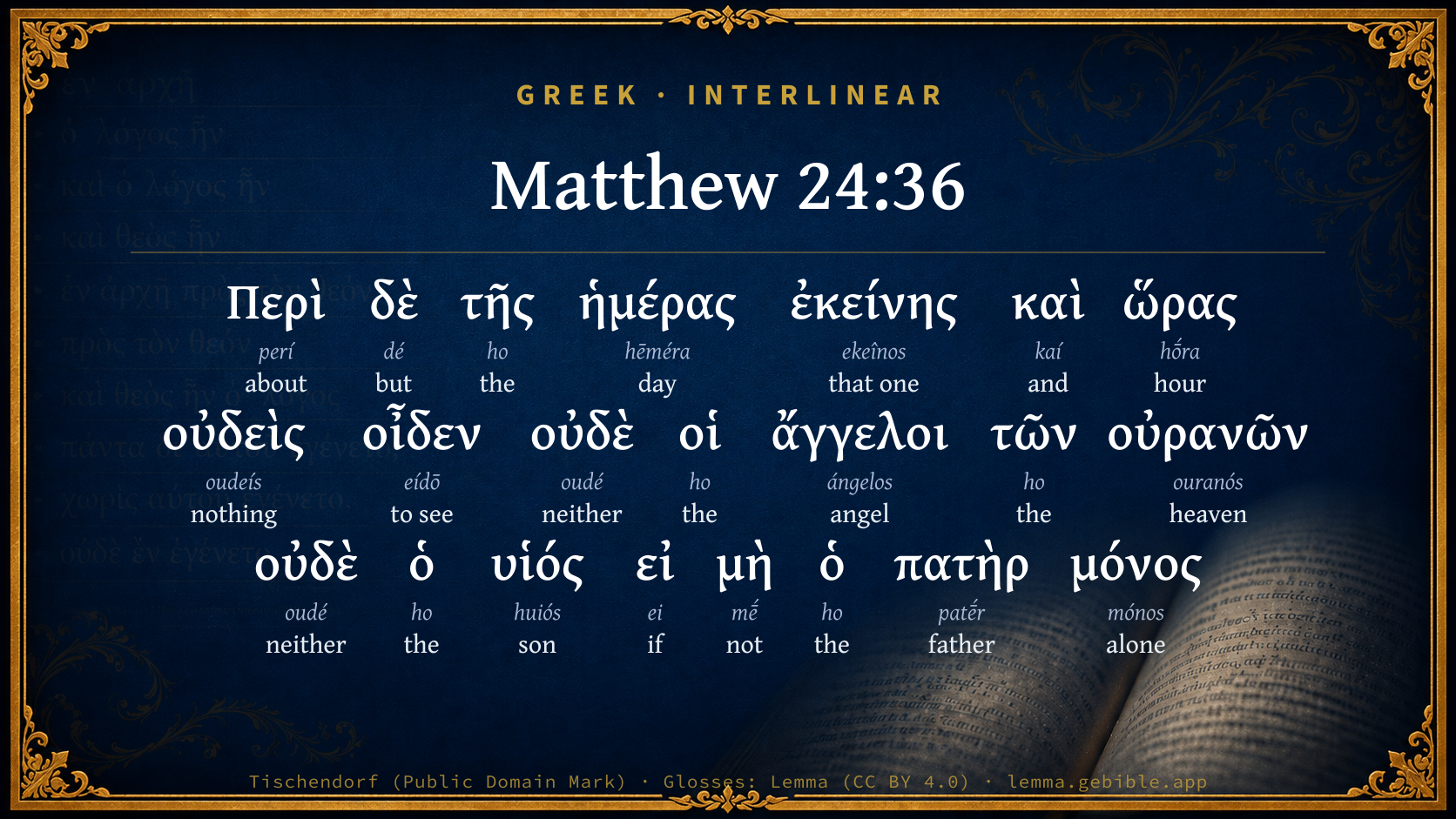
Download image
Cite this verse

Matthew 24:36 (World English Bible). Public Domain. Lemma interlinear Bible study tool, https://lemma.gebible.app/v/matthew/24/36.

Show BibTeX & RIS
BibTeX
RIS
English Translation
But no one knows of that day and hour, not even the angels of heaven, but my Father only.
World English Bible · Public Domain
Download a study sheet

One document with this verse’s original text, its word-by-word gloss line, the meaning frame, cross-references with their text, attributed commentary, and full source and license credits — printable, and it pastes into notes with its structure intact.

This verse Autodidact and up

Study sheet (.html) Plain text (.txt)

A passage Seminary Student

Up to 50 verses in one chapter. A passage sheet keeps up to 6 commentary sources and 12 cross-references per verse, in the order this page ranks them, and says so on the sheet whenever that leaves anything out. Ask for a single verse and you get the Autodidact verse sheet above.

Everything on this page stays free to read, with no account — the sheet is a download of what is already on screen, not access to it.

Want to remove ads? Support Godless Engineer
Compare translations 3

The same verse in 3 English versions, stacked beneath the original-language interlinear above. Click any original word for its lexicon entry.

Each is an independent rendering of the whole verse — the interlinear is not word-aligned to these translations.

Highlighted words mark where these versions differ — a whole-verse word diff, not a word-by-word alignment.

  • World English Bible Public Domain
    But no one knows of that day and hour, not even the angels of heaven, but my Father only.
  • King James Version Public Domain
    But of that day and hour knoweth no man, no, not the angels of heaven, but my Father only.
  • unfoldingWord Literal Text CC BY-SA 4.0
    But concerning that day and hour no one knows, neither the angels of the heavens, nor the Son, except the Father only.

unfoldingWord Literal Text — © unfoldingWord, licensed CC BY-SA 4.0. Word-aligned USFM3 via Door43 (git.door43.org/unfoldingWord/en_ult).

Versions to compare (up to 4)

3 of 4 selected

Show all 19 translations

Every available English version of this verse, each an independent rendering of the whole verse.

  • World English Bible Public Domain
    But no one knows of that day and hour, not even the angels of heaven, but my Father only.
  • Berean Standard Bible Public Domain
    No one knows about that day or hour, not even the angels in heaven, nor the Son, but only the Father.
  • Majority Standard Bible Public Domain
    No one knows about that day or hour, not even the angels in heaven, but only My Father.
  • King James Version Public Domain
    But of that day and hour knoweth no man, no, not the angels of heaven, but my Father only.
  • American Standard Version (1901) Public Domain
    But of that day and hour knoweth no one, not even the angels of heaven, neither the Son, but the Father only.
  • Revised Version (1885) Public Domain
    But of that day and hour knoweth no one, not even the angels of heaven, neither the Son, but the Father only.
  • Geneva Bible (1599) Public Domain
    But of that day and houre knoweth no man, no not the Angels of heauen, but my father only.
  • Douay-Rheims (1899) Public Domain
    But of that day and hour no one knoweth, not the angels of heaven, but the Father alone.
  • Young's Literal Translation Public Domain
    `And concerning that day and the hour no one hath known -- not even the messengers of the heavens -- except my Father only;
  • Literal Standard Version CC BY-SA 4.0
    And concerning that day and the hour no one has known—not even the messengers of the heavens—except My Father only;
  • Unlocked Literal Bible CC BY-SA 4.0
    But concerning that day and hour no one knows, not even the angels of heaven, nor the Son, but only the Father.
  • unfoldingWord Literal Text CC BY-SA 4.0
    But concerning that day and hour no one knows, neither the angels of the heavens, nor the Son, except the Father only.
  • Darby Bible Public Domain
    But of that day and hour no one knows, not even the angels of the heavens, but [my] Father alone.
  • World Messianic Bible Public Domain
    “But no one knows of that day and hour, not even the angels of heaven, but my Father only.
  • Webster's Bible Public Domain
    But of that day and hour knoweth no man, no, not the angels of heaven, but my Father only.
  • Free Bible Version CC BY-SA 4.0
    But no one knows the day or hour when this will take place, not the angels in heaven, nor the Son. Only the Father knows.
  • Bible in Basic English Public Domain
    But of that day and hour no one has knowledge, not even the angels in heaven, or the Son, but the Father only.
  • Text-Critical English NT CC BY 4.0
    “No one knows about that day or hour, not even the angels of heaven, but only my Father.
  • Tyndale New Testament (1534) Public Domain
    But of that daye and houre knowith no man no not the angels of heven but my father only.

Literal Standard Version (2020), Covenant Press — licensed CC BY-SA 4.0. Text via the HelloAO Bible API (eBible.org). Unlocked Literal Bible (unfoldingWord) — licensed CC BY-SA 4.0. Text via the HelloAO Bible API (eBible.org). unfoldingWord Literal Text — © unfoldingWord, licensed CC BY-SA 4.0. Word-aligned USFM3 via Door43 (git.door43.org/unfoldingWord/en_ult). Free Bible Version, Dr. Jonathan Gallagher — licensed CC BY-SA 4.0. Text via the HelloAO Bible API (eBible.org).

Word by word

More ways to search: Search by grammar → Find every occurrence → Compare this word →

Practice this passage: Drill this verse → Learn its vocabulary →

μόνος
mónos
G3441
“alone”
Adjective, Nominative, Singular, Masculine
Part of Speech
Adjective
Case
Nominative
Number
Singular
Gender
Masculine
Full Thayer's Definition

Origin: probably from G3306

TDNT: None

1. alone (without a companion), forsaken, destitute of help, alone, only, merely
  1. Περὶ perí G4012 “about” Preposition
  2. δὲ dé G1161 “but” Conjunction
  3. τῆς ho G3588 “the” Article, Genitive, Singular, Feminine
  4. ἡμέρας hēméra G2250 “day” Noun, Genitive, Singular, Feminine
  5. ἐκείνης ekeînos G1565 “that one” Demonstrative pronoun, Genitive, Singular, Feminine
  6. καὶ kaí G2532 “and” Conjunction
  7. ὥρας hṓra G5610 “hour” Noun, Genitive, Singular, Feminine
  8. οὐδεὶς oudeís G3762 “nothing” Adjective, Nominative, Singular, Masculine, Negative
  9. οἶδεν eídō G1492 “to see” Verb, Perfect, Active, Indicative, 3rd person, Singular
  10. οὐδὲ oudé G3761 “neither” Conjunction, Negative
  11. οἱ ho G3588 “the” Article, Nominative, Plural, Masculine
  12. ἄγγελοι ángelos G32 “angel” Noun, Nominative, Plural, Masculine
  13. τῶν ho G3588 “the” Article, Genitive, Plural, Masculine
  14. οὐρανῶν ouranós G3772 “heaven” Noun, Genitive, Plural, Masculine
  15. οὐδὲ oudé G3761 “neither” Conjunction, Negative
  16. ὁ ho G3588 “the” Article, Nominative, Singular, Masculine
  17. υἱός huiós G5207 “son” Noun, Nominative, Singular, Masculine
  18. εἰ ei G1487 “if” Conditional
  19. μὴ mḗ G3361 “not” Particle, Negative
  20. ὁ ho G3588 “the” Article, Nominative, Singular, Masculine
  21. πατὴρ patḗr G3962 “father” Noun, Nominative, Singular, Masculine

About this verse

These counts appear in no published source. They are computed here, from the morphology-tagged text and Lemma’s own curated glosses. What Lemma adds →

22
words
17
distinct lemmas
Gospels
section

Shared distinctive vocabulary

μόνος alone G3441 occurs in 46 verses of the Greek New Testament. Also found in:
Repetition

Words recur within this verse:

  • οὐδὲ neither G3761 ×2
  • τῆς the G3588 ×5

Cross-references

10

Topical passages linked to Matthew 24:36 in the Treasury of Scripture Knowledge — connected by theme and wording, ordered by reader-vote popularity; previews shown in the World English Bible.

  • Mark 13:32 But of that day or that hour no one knows, not even the angels in heaven, nor the Son, but only the Father.
  • Acts 1:7 He said to them, "It isn't for you to know times or seasons which the Father has set within His own authority.
  • Matthew 24:44 Therefore also be ready, for in an hour that you don't expect, the Son of Man will come.
  • 2 Peter 3:10 But the day of the Lord will come as a thief in the night; in which the heavens will pass away with a great noise, and the elements will be dissolved with fervent heat, and the earth and the works that are in it will be burned up.
  • 1 Thessalonians 5:2 For you yourselves know well that the day of the Lord comes like a thief in the night.
  • Matthew 24:42 Watch therefore, for you don't know in what hour your Lord comes.
  • Revelation 16:15 "Behold, I come like a thief. Blessed is he who watches, and keeps his clothes, so that he doesn't walk naked, and they see his shame."
  • Matthew 25:13 Watch therefore, for you don't know the day nor the hour in which the Son of Man is coming.
  • Zechariah 14:7 It will be a unique day which is known to Yahweh; not day, and not night; but it will come to pass, that at evening time there will be light.
  • Revelation 3:3 Remember therefore how you have received and heard. Keep it, and repent. If therefore you won't watch, I will come as a thief, and you won't know what hour I will come upon you.

Cross-references courtesy of OpenBible.info (CC BY 4.0).

Where the printed editions differ

1 variant

Places in this verse where the major printed Greek editions disagree on the wording in a way that affects the translation — a comparison of editions, not a manuscript-by-manuscript collation. The editions are the modern critical texts (Nestlé-Aland 28/27, SBL, Westcott-Hort, Tregelles, Tyndale House) and the traditional texts behind the KJV (the Textus Receptus and the Byzantine/Majority text). It is not a claim about which reading is original.

  1. Extra text
    οὐδὲ ὁ υἱός,

    “nor the Son,”

    In NA28NA27TynSBLWH Not in TregTRByz

    οὐδὲ ὁ υἱός, (oude ho huios) 'nor the Son,' is only in older manuscripts (NA28+NA27+Tyn+SBL+WH)

Textual data: Translators Amalgamated Greek New Testament (STEPBible TAGNT) · CC BY 4.0.

Commentary

Notes on Matthew 24:36 from classic Christian and Jewish commentators (each source and its license shown beneath its notes). The classic Christian expositions comment on the surrounding passage and are grouped to its opening verse, so a note may address several verses; the Jewish commentaries on the Tanakh (Rashi and others) are per-verse, so they appear only where the commentator wrote on this verse.

Lemma curates 59 commentaries, every one of them public domain or Creative Commons licensed, each selected and text-cleaned for this edition rather than reprinted as found. About our sources →

Joseph Benson's Commentary

Mat 24:36. But of that day and hour knoweth no man, &c. — I consider ωρα, hour, here, says Grotius, as denoting, not a part of a day, but a larger portion of time. So also Bishop Newton, who observes, “It would seem improper to say, Of that day and hour knoweth no man; for if the day was not known, certainly the hour was not, and it was superfluous to make such an addition. I conceive, therefore, that the passage should be rendered, Of that day and season knoweth no man, as the word is frequently used in the best authors, both sacred and profane. It is true, our Saviour declares, ‘All these things shall be fulfilled in this generation;’ it is true also, the Prophet Daniel hath given some intimation of the time in his famous prophecy of the 70 weeks; but though this great revolution was to happen toward the conclusion of 70 weeks, or 490 years, to be computed from a certain date that is not easy to be fixed; yet the particular day, the particular season in which it was to happen, might still remain a secret to men and angels: and our Lord had before, (Mat 24:20,) advised his disciples to pray, that their flight might not be in the winter, nor on the sabbath day; the day not being known, they were to pray that their flight might not be on the sabbath day; the season not being known, they were to pray that it might not be in the winter.”

Joseph Benson's Commentary on the Old and New Testaments (1811–1818) — public domain. Text from a community e-Sword module.

The Preacher's Complete Homiletical Commentary

Joseph S. Exell (gen. ed.)

MAIN HOMILETICS OF THE PARAGRAPH.—Mat_24:36-51

The uncertainty of the end.—We ought to know the season, we cannot know the moment, of the “appearing” of Christ. So the Saviour teaches us here. “Of that day and hour knoweth no one, not even the Son Himself,” in a sense (Mat_24:36). How will the appearing of Christ, in consequence, come on the world? How should the thought of it, meanwhile, tell on the church?

I. How it will come on the world.—It will come on it, first, while men, as a rule, are thinking of everything else. The story of Noah and the deluge is an illustration of this. Coming on men as that did in almost total disbelief of his warnings (we read of no one outside his own family believing in them at all) it found the men of that day thinking of everything else. They were full of engagements which all took for granted that there was nothing to interrupt them at hand (Mat_24:38-39; cf. also Luk_17:28, “they planted, they builded”). And they were doing this to the very verge of the visitation itself. They did not believe in the flood till they found it had come, and never thought of it until it swept them away. Even so would it be, the Saviour declares here, with regard to His “coming.” What had been true of the type would be true of the antitype also. What had happened in Noah’s day would happen also in His. Not till that “door,” also, was being “shut” (Gen_7:16; Mat_25:10) would men see it was open. That day when it comes will find men, also, as they are to remain. Men will be found differing then, as they differ now, about the things of the kingdom. Although as a rule then they will not be thinking of the approaching appearing of Christ, there will be some among them who do. There will be some, then, in short, who “love His appearing,” although most others do not. These differing classes, also, will be found at that time, even as they are now, much mingled together. Just as now, in one “field” there may be “two men,” or, now, at “one mill” there may be “two women,” who are as far asunder in heart on this question of Christ’s appearing as they are near together in person, so will it also be then. But so, on the other hand, on that day of days, it will not continue to be any longer. That day, on the contrary, shall for ever separate these “unequally yoked” ones. And shall separate them also, be it further observed, to wholly separate lots. Those who are “left” are not left to be saved! Only those “taken” are taken to life. There is no intermingling, there is no re-arrangement, after that date!

II. How the knowledge of these things should tell on the church.—How it should tell on them, first, as to what they should do. They should use the information thus given them about the end in order to be prepared for it when it comes. It was even so, of course, that in regard to all things of importance, all men of sense would proceed. No householder, e.g., who had received information as to the time when the housebreaker intended to visit him, would fail to make use of it in getting thoroughly prepared for his visit (Mat_24:43). Even so must they act in regard to that day which was to “come as a thief.” Having been so expressly told this they must make use of this knowledge so as to be “prepared” for that day. And since it might come any day they must be prepared for it every day, as the only way to make sure (Mat_24:44). This same knowledge should show them, next, why they ought to do thus. They ought to do so, on the one hand, as a question of duty. The knowledge thus imparted to them, and the capacity bestowed on them by means of which they were enabled to realise both its importance and truth, were not things given them for their own advantage alone. They were more than a privilege. They were also a trust. And they were bound, therefore, to use these things for the benefit of others as well (Mat_24:45; 1Pe_4:10). And nothing, they might rely on it, would be more pleasing to their Master, and therefore more “blessed” for them, than to be found doing so at the end. Let them be always “ready,” therefore, if they would be ever doing what was best for themselves (Mat_24:46-47). Let them think of this also, on the other hand, even as a question of life. This duty was one which could only be neglected by them at their uttermost peril. Not thus to do was to do the opposite in effect. Not to impart thus to others was in practice to rob them. Not to argue from the uncertainty of the hour of Christ’s coming in the way of obedience was to go in the way of rebellion (Mat_24:48). It were hard to say, therefore, whether there was more of treachery or of presumption in such conduct; or anything more truly deserving the worst doom of which we hear in God’s Word. It would almost seem, in a word, as though not to be hoping for, and so not to be ready for, the appearing of Christ, was to be in a position in which we can expect nothing from it but ill.

How worse than valueless are the predictions of men!—Practically the voice of the antediluvian world was a prophecy in opposition to the preaching of Noah. The like is true of the voice of the world since, in regard to the preaching of Christ. We know what became of that earlier “voice.” We know what is to become of the other. The louder it cries, and the longer it lasts, and the more “prophets” it comes from, only the more manifest, at the last day, will be its falseness and shame. The revelation of this truth is almost as old as our race (Jud_1:14-15; see also Rom_3:4; Rom_3:19).

HOMILIES ON THE VERSES

Mat_24:37-39. The Flood.—

I. How universal the doom.

II. How marvellous the general apathy.

III. Safety only in the ark.

IV. Christ our ark.—J. C. Gray.

Mat_24:40-41. Diversity in character.—The world’s work will be going on then as now; there is also the thought of a real separation in this life beneath an external sameness.—A. Carr, M.A.

Mat_24:42. Christian watching.—I. In Christian watching there is implied a vigorous exercise of a Christian conscience.—

1. When we wish to quicken and increase the power of conscience, we must do so by teaching it to be more and more keen in perception. Conscience must stand before us, as a watcher on a ship stands, guiding the bark of the soul through the wild waves and the thick darkness of this deep night of life, and crying out to us, from moment to moment, in the voice of the great Lord whose echo it is, “What I say unto you I say unto all, Watch.”

2. But conscience requires also to be wide in its range of vision—it must omit nothing. It must not fret over trifles, but it must not leave them out; it must recollect, it must learn increasingly to recollect, that attention to the little things of every day is an element in that attitude of a Christian which the Lord calls watching.

3. You must exercise conscience to assist you in wise decision.

4. Conscience must also, finally and above all things, be peremptory in command. Conscience may be wrong, it may make mistakes, but it must never be disobeyed. To disobey conscience is to commit the last disloyalty—it is to learn to be untrue to yourselves.

5. Conscience needs illumination It needs the illumination that comes from prayer, from the Scripture, from the wise advice of patient and experienced friends.

6. It needs more, it needs reinforcement; it needs the presence of the Lord of conscience; it needs to feed upon the power of Christ.

II. There is another point in Christian watching which I must note. It is not only by the exercise of conscience, it is by a patient practice of thoughtfulness.—To take thought and make it pass into a permanent form; to lay hold upon will and make it act in one definite direction;—to do that is to set the life sweeping onward, like a resistless current, in one direction; it is to place the whole soul in one steady attitude; and this definite directing of the current of life, and this steady fixing of the attitude of soul—this and nothing else is what our blessed Redeemer calls watching.—W. J. Knox-Little, M.A.

Watching for the Lord’s coming.—The idea is, Ye know not whether the day or hour of the Lord’s coming be characterised by the quality of comparative immediacy or of comparative remoteness. And yet the Lord had told His disciples that many events would occur before this glorious appearing. Wherein, then, the consistency of the injunction of this verse? It is found in a combination of two assumptions.

1. That the Lord was speaking, not merely to and for His Apostles, but to and for His disciples in all places and times.

2. That He took a broad view of spiritual realities, and the bearing of the great events connected with His kingdom on individual souls. So far as the soul’s real interests, and its great duties, are concerned, it is of no real moment whether it shall remain incarnate till the coming of the Lord, or be “absent from the body” long before that event. Spiritual watchfulness in either case is equally needed.—J. Morison, D.D.

Mat_24:43-44. The uncertainty of life the great reason for holiness.—

I. The character of the existing dispensation would be altogether changed were we enabled to foresee whatever could happen.—It would no longer be a dispensation of faith, but a dispensation of sight. We find it intensely difficult in our ignorance to submit ourselves to God, in whose hands we are. What would it be if we had acquaintance with the future, and so were in a measure independent; and could make our plans with certainty as to their issue. The wife would be a widow while her husband lived, the child would be an orphan while yet blessed with parents, if the funeral were foreknown and the day of separation clearly revealed.

II. It is practically of very little importance whether we can give satisfactory reasons why the future should be hidden, and for the declaration that the unveiling it would produce far greater preparedness for the termination of life. It might, on the whole, be advantageous, or it might on the whole be disastrous, that the day of death should be known; but the arrangement to which we are to conform is one in which the day is absolutely unknown; and it must be our business rather to labour at acting agreeably to the circumstances in which we are placed, than to determine what effect would be wrought were those circumstances changed.—H. Melvill, B.D.

Mat_24:45-51. The faithful servant and the wicked one.—

I. Their opposite spirit.—The one waits for the coming of the Lord; the other puts no faith in that coming.

II. Their acts.—The one takes care of the household’s nourishment; the other makes himself a despotic lord, who abuses the faithful, and wastes the goods of the house in riotous living.

III. Their recompense.—Blessed and miserable surprise at the advent of the Lord. The one is elevated to the highest dignity, the other is condemned and destroyed on the spot.—J. P. Lange, D.D.

Mat_24:45-47. The Lord’s true steward.—

I. Characteristics.

1. Faithful.—To his Lord. To the end (Mat_24:46).

2. Wise or prudent, for himself, and in relation to those under his care. The “word in the Greek is that which ethical writers had used to express the moral wisdom which adapts means to ends, as contrasted with the wisdom of pure contemplation, on the one hand, or technical skill on the other” (Plumptre).

II. Function.—“To give them meat (their food, R.V.) in due season.” The daily or monthly allowance. “This imagery, drawn from a large Roman estate, has given rise to the oft-recurring thought of the stewardship of the Apostles and ministers of Christ.” 1Co_4:1; Tit_1:7 (Cambridge Bible for Schools). “There is an art, as it were, of spiritual dietetics, which requires tact and discernment as well as faithfulness. The wise servant will seek to discover not only the right kind of food, but the right season for giving it” (Plumptre).

III. Reward.—“He will set him over all that he hath” (R.V.); “thus conferring upon him the highest honour and reward of which he is susceptible” (Morison).—H. M. Booth.

Mat_24:48-51. The unfaithful steward.—

I. His conduct.

1. Presumptuous.—“My Lord delayeth His coming.”

2. Self-assertive.—“Smite his fellow-servants.” More than neglect; “abusing them in the spirit of a petty tyrant” (Morison).

3. Self-indulgent.—“Eat and drink with the drunken.”

II. His punishment.

1. Absolutely certain.—“Shall come.” “Our putting off the thoughts of Christ’s coming will not put off His coming” (M. Henry).

2. Surprisingly sudden.—“In a day when he looketh not for Him.”

3. Terribly severe (Mat_24:51). “Some have felt surprised that our Lord did not shrink from the horror of the word (‘cut him asunder’). Ah! but it was the horror of the thing which He dreaded, and wished to avert. It was the infinite pity of His heart that led Him to use a word which might prove the very strongest deterrent. Besides, how significant it is! Think of whom He is speaking,—servants set over His household to give food in due season, who, instead of doing this, maltreat their fellow-servants and ruin themselves with excess. Think of the duplicity of such conduct. By office in the church, ‘exalted unto heaven’; by practice, ‘brought down to hell’! That unnatural combination cannot last. These monsters with two faces and one black heart cannot be tolerated in the universe of God. They shall be ‘cut asunder’; and then it will appear which of the two faces really belongs to the man” (Expositor’s Bible).—H. M Booth.

The Preacher's Complete Homiletical Commentary (gen. ed. Joseph S. Exell; Funk & Wagnalls, c. 1892) — public domain (pre-1929). A full-Bible homiletical/sermon-outline anthology covering 65 of 66 books (2 John is absent from the source module). Text from a community e-Sword module.

Tyndale Open Study Notes

Tyndale Open Resources

24:36 The day is the day of judgment. • or the Son: Jesus’ limited knowledge is suggested also in Acts 1:7. Because the day is unknown, Jesus’ hearers should be vigilant and faithful (see Matt 24:37–25:46). This statement ought to deter those who attempt to calculate the date of our Lord’s return.

Tyndale Open Study Notes — © Tyndale Open Resources, licensed CC BY-SA 4.0. Text via the HelloAO Bible API.

Bengel's Gnomon

Johann Albrecht Bengel

Mat 24:36. Περὶ δὲ τῆς ἡμέρας ἐκείνης, but of that day) The Lord shows the time of the temple and the city in Mat 24:32-34; He denies in this verse that the day and hour of the world are known. The particle δὲ, but, implies a contrast: the pronouns ταῦτα, these, αὕτη, this, refer to events close at hand; the pronoun ἐκείνης, that, to that which is distant. If, however, the former time is defined with some latitude, THAT DAY and hour is much less definitely indicated here: and yet He does not speak of the day and hour without cause. A day is a whole; an hour is a part. The day is not necessarily unknown because the hour is: the time taken with somewhat greater latitude is not necessarily unknown because the day is. And that which was unknown when this discourse was delivered, might be revealed after the Ascension of the Lord and the Apocalypse given to St John; and as the sand by degrees glides away in the hour-glass of time,[1063] it may be known more nearly. Otherwise, the last day and the last hour would not even then be known when it actually arrives. Our Lord goes on to speak of the day in Mat 24:37-38, of the hour in Mat 24:42-43, and of both in Mat 24:50.—ἄγγελοι, angels) whose knowledge is otherwise great.—τῶν οὐρανῶν, of the heavens) The plural number.

[1063] In the original, “clepsydra sensim elabente.” The ancients measured time in the hour-glass, not by sand, but by water. I have given the corresponding idiom.—(I. B.)

Bengel's Gnomon of the New Testament — English translation (T&T Clark, Edinburgh, 1860) — public domain. Text from a community e-Sword module.

Meyer's Critical & Exegetical Commentary

Heinrich August Wilhelm Meyer

Mat_24:36. The affirmation of Mat_24:34, however, does not exclude the fact that no one knows the day and hour when the second advent, with its accompanying phenomena, is to take place. It is to occur during the lifetime of the generation then existing, but no one knows on what day or at what hours within the period thus indicated. Accordingly it is impossible to tell you anything more precise in regard to this than what is stated at Mat_24:34.

εἰ μὴ ὁ πατ. μου μόνος] This reservation on the part of the Father excludes even the incarnate Son (Mar_13:32). The limitation implied in our passage as regards the human side of our Lords nature is to be viewed in the same light as that implied in Mat_20:23. See, besides, on Mar_13:32.

Meyer — Critical and Exegetical Commentary on the New Testament — English translation by Peter Christie, edited by Frederick Crombie (T&T Clark, 1880) — public domain. Text from a community e-Sword module.

Expositor's Greek Testament

ed. W. Robertson Nicoll

Mat 24:36 . περὶ δὲ τῆς ἡμέρας ἐκείνης καὶ τῆς ὥρας , of that day and hour. The reference is to the coming of the Son of Man, the expression throughout the N. T. having the value of an “indisputable fixed terminus technicus ,” Weiffenbach, Wiederkunftsgedanke , p. 157. οὐδεὶς οἶδεν , no one knows, a statement made more emphatic by application to the angels of heaven, and even to the Son ( οὐδὲ ὁ υἱός ). The meaning is not that Jesus disclaims even for Himself knowledge of the precise day, month, or year of what in Mat 24:34 He has declared will happen within the present generation; whether, e.g. , the crisis of the war would be in 69 or 70 A.D. That is too trivial a matter to be the subject of so solemn a declaration. It is an intimation that all statements as to the time of the παρουσία must be taken in a qualified sense as referring to a subject on which certain knowledge is not attainable or even desirable. It looks like Jesus correcting Himself, or using two ways of speaking, one for comfort (it will be soon), and one for caution (it may not be so soon as even I think or you expect). His whole manner of speaking concerning the second advent seems to have two faces; providing on the one hand for the possibility of a Christian era, and on the other for an accelerated Parusia .

The Expositor's Greek Testament, edited by W. Robertson Nicoll (1897–1910) — public domain. Text from a community e-Sword module.

Geneva Bible (1599)

Geneva Bible translators

It is sufficient for us to know that God hath appointed a latter day for the restoring of all things, but when it shall be, it is hidden from us all, for our profit, that we may be so much the more watchful, that we be not taken as they were in old time in the flood.

Geneva Bible (1599) marginal notes — public domain. Text via Bolls.life.

Adam Clarke's Commentary

Verse 36. But of that day and hour] ωρα, here, is translated season by many eminent critics, and is used in this sense by both sacred and profane authors. As the day was not known, in which Jerusalem should be invested by the Romans, therefore our Lord advised his disciples to pray that it might not be on a Sabbath; and as the season was not known, therefore they were to pray that it might not be in the winter; Mt 24:20. See Clarke on Mr 13:32.

Adam Clarke's Commentary on the Bible (1810–1826) — public domain. Text from a community e-Sword/MySword module.

Ellicott's Commentary for English Readers

(36) No, not the angels of heaven.—St. Mark’s addition (Mar_13:32), “neither the Son”—or better, not even the Son—is every way remarkable. Assuming, what is well-nigh certain (see Introduction to St. Mark), the close connection of that Gospel with St. Peter, it is as if the Apostle who heard the discourse desired, for some special reason, to place on record the ipsissima verba of his Master. And that reason may be found in his own teaching. The over-eager expectations of some, and the inevitable reaction of doubt and scorn in others, both rested on their assumption that the Son of Man had definitely fixed the time of His appearing, and on their consequent forgetfulness of the “long-suffering” which might extend a day into a thousand years (2Pe_3:3-8). It is obviously doing violence to the plain meaning of the words to dilute them into the statement that the Son of Man did, not communicate the knowledge which He possessed as the Son of God. If we are perplexed at the mystery of this confession in One in whom we recosniise the presence of “the fulness of the Godhead bodily” (Col_1:19; Col_2:9), we may find that which may help us at least to wait patiently for the full understanding of the mystery in St. Paul’s teaching, that the eternal Word in becoming flesh, “emptied Himself” (see Note on Php_2:7) of the infinity which belongs to the divine attributes, and took upon Him the limitations necessarily incidental to man’s nature, even when untainted by evil and in fullest fellowship, through the Eternal Spirit, with the Father.

A Bible Commentary for English Readers, edited by Charles John Ellicott (1878–1897) — public domain. Text from a community e-Sword module.

The Cambridge Bible for Schools and Colleges

gen. ed. J. J. S. Perowne

36–End of Ch. 25. Parables and Teachings concerning the Second Advent

36–51. The Coming of Christ; the Need of Watchfulness

More briefly reported in Mar_13:32-37; Luk_21:34-36.

36. But of that day and hour] the Day of Judgment. The discourse turns from the type—the fall of Jerusalem—to the antitype—the Day of Judgment, and continues on this subject to the end of the following chapter.

The Cambridge Bible for Schools and Colleges (gen. ed. J. J. S. Perowne; Cambridge University Press, 1878–1918) — public domain. Text from a community e-Sword module.

John Gill's Exposition

But as the days of Noe were,.... So Noah is usually called Noe by the Septuagint: the sense is, as were the practices of the men of that generation, in which Noah lived, so will be the practices of the men of that age, in which the son of man comes; or as the flood, which happened in the days of Noah, was sudden and unexpected; it came upon men thoughtless about it, though they had warning of it; and was universal, swept them all away, excepting a few that were saved in the ark:

so shall also the coming of the son of man be; to take vengeance on the Jews, on a sudden, at an unawares, when they would be unthoughtful about it; though they were forewarned of it by Christ and his apostles, and their destruction be as universal; all would be involved in it, excepting a few, that were directed a little before, to go out of the city of Jerusalem to Pella; where they were saved, as Noah and his family were in the ark.

John Gill's Exposition of the Whole Bible (1746–1763) — public domain (CC PDM 1.0). Text via the HelloAO Bible API.

Trapp's Complete Commentary

John Trapp

36 But of that day and hour knoweth no man, no, not the angels of heaven, but my Father only.

Ver. 36. But of that day and hour knoweth no man] That the Lord will come it is certo certius, not more sure, than what time he will come is to us most uncertain. Various guesses have been given about it by both ancient and modern writers; most of which time hath already refuted. In the year of grace 1533 there was one that foolishly foretold that the day of judgment should happen in October next ensuing. And this he gathered out of these words, Iesus Nazarenus, Rex Iudaeorum. Likewise out of these, Videbunt in quem transfixerunt; the numerals of the former point to the year 1532, of the latter to 1533. Others there are who place the end of the world upon the year 1657. And for proof they make use of this chronogram, MVnDI Conf Lagrat Io; and further allege that the general deluge occured in the year of the world’s creation, 1657. The end of the world, saith another, will be in the year of Christ 1688, three jubilees and a half (or thereabouts) after the reformation of religion by Luther, &c. Joachimus Abbas had long since set the year 1258; Arnoldus de Villa Novo, the year 1345; Michael Stiphelius, St Luke’s day in the year 1533; Cyprianus Leonitius, the year 1583; Joannes Regiomontanus, the year 1588; Adelbertus Thermopedius, the year 1599, April 3; Nicolaus Cusanus, the year 1700; Cardanus, 1800; Picus Mirandula, 1905, &c. So great hath been the folly and sin of many learned men, who have thus childishly set their wits to play in so serious a business, as one well censureth it.

But my Father only] Ordine videlicet sciendi a se, non ab alio. The Son knoweth it not but from his Father; like as he neither subsisteth nor worketh but from the Father. The set time of the general judgment God hath hid from us: 1. For his own glory, Pro 25:2; Rom 11:36; Rom 2:1-29. For our good, that we may watch always, and not wax secure as we would do with the evil servant, Mat 24:48, till the very day and hour, if we knew it. {a} The harlot in the Proverbs grew bold upon this, that her husband was gone forth for such a time, Pro 7:20.

{a} Ideo latet unus dies ut observentur omnes.

John Trapp, A Commentary or Exposition upon All the Books of the Old and New Testament (1647–1656) — public domain. Text from a community e-Sword module.

Albert Barnes' Notes on the Bible

But of that day and hour - Of the precise time of the fulfillment. The “general signs” of its approach have been given, as the budding of the fig-tree is a certain indication that summer is near; but “the precise time” is not indicated by these things. One part of their inquiry was Mat 24:3 when those things should be. He now replies to them by saying that the precise time would not be foretold. Compare the notes at Act 1:7.

Knoweth no man, no, not the angels - See the notes at Mar 13:32.

Albert Barnes' Notes on the Bible (1834–1885) — public domain. Text from a community e-Sword/MySword module.

Haydock's Catholic Bible Commentary

No man knoweth ... but the Father alone. The words in St. Mark (xiii. 32.) are still harder: neither the angels, nor the Son, but the Father. The Arians objected this place, to shew that Christ being ignorant of the day of judgment, could not be truly God. By the same words, no one knoweth, but the Father alone, (as they expound them) the Holy Ghost must be excluded from being the true God. In answer to this difficulty, when it is said, but the Father alone, it is certain that the eternal Son and the Holy Ghost could never be ignorant of the day of judgment: because, as they are one and the same God, so they must hove one and the same nature, the same substance, wisdom, knowledge, and all absolute perfections. 2. It is also certain that Jesus Christ knew the day of judgment, and all things to come, by a knowledge which he could not but have, because of the union by which his human nature was united to the divine person and nature. See Colossians ii. 3. And so to attribute any ignorance to Christ, was the error of those heretics called Agnoitai. 3. But though Christ, as a man, knew the day of judgment, yet this knowledge was not due to him as he was man, or because he was man, but he only knew the day of judgment, because he was God as well as man. 4. It is the common answer of the fathers, that Christ here speaks to his disciples, only as he was the ambassador of his Father; and so he is only to know what he is to make known to men. He is said not to know, says St. Augustine[5], what he will not make others know, or what he will not reveal to them. (Witham) --- By this Jesus Christ wished to suppress the curiosity of his disciples. In the same manner after his resurrection, he answered the same question: ’Tis not for you to know the times and the moments, which the Father has placed in his own power. This last clause is added, that the apostles might not be discouraged and think their divine Master esteemed them unworthy of knowing these things. Some Greek manuscripts add nor even the Son, as in Mark xiii. 32. The Son is ignorant of it, not according to his divinity, nor even according to his humanity hypostatically united to his divinity, but according to his humanity, considered as separate from his divinity. (Bible de Vence)

===============================

[BIBLIOGRAPHY]

St. Augustine, lib. 83. QQ. quæst. 60. tom. 6, p. 33. Ed. Ben. dicitur nescire filius, quia facit nescire homines, i.e. non prodit eis, quod inutiliter scirent. See the same St. Augustine, lib. 1. de Trin. chap. xii. tom. 8, p. 764 and 765. and lib. de Gen. cont. Manich. chap. xxii. p. 659. tom. 1.

====================

George Leo Haydock (1774–1849), Haydock's Catholic Family Bible and Commentary, 1859 edition — public domain. Excludes Psalms (Douay-Rheims chapter numbering differs from Protestant) and Deuterocanonical books (Catholic canon only).

Matthew Poole's English Annotations

Mark addeth, Mar 13:32, neither the Son, but the Father. Of that day and hour, that is, the particular time when the heavens and the earth shall pass away, as he had before said, or when the end of the world shall be, which was one of the questions propounded to him by his disciples, Mat 24:3.

Knoweth no man, no mere man, nor have men any reason to be troubled at it; for it is a piece of knowledge which the Father hath reserved in his own power, and his own pleasure, from the angels, who continually behold his face. Nay, I myself, as man, know it not. Nor is it more absurd, or derogating from the perfection of Christ, than for to say, that Christ, as man, was not omnipotent, or omniscient, &c. By the way, this gives a great check to the curiosity of men’s inquiries after the particular time or year when the world shall have an end, or the day of judgment begin, or be.

Matthew Poole's English Annotations on the Holy Bible (1683–1685) — public domain. Text from a community e-Sword/MySword module.

Whedon's Commentary on the Bible

Daniel D. Whedon

36. But — In contrast to this approaching and calculable catastrophe. Of that day and hour — The word day is a minutely specified point of time; the word hour is more specific still. Knoweth no man — Our Lord here will indicate even his own ignorance of the time of the judgment day. What wonder, then, that his inspired apostles should confess an equal ignorance! See supplementary note to next chapter. Prof. Owen says that, as man, Jesus might be as ignorant of the day and hour of the destruction of Jerusalem as of the judgment day. But unfortunately there was no day or hour to that destruction which could be ignored. It was a diffusive series. Our Lord, however, could be ignorant of the time of the destruction of Jerusalem only as he was ignorant of every future event; and so it would follow that he was ignorant of the judgment day only as he was ignorant of every future event. But that view stands in positive contradiction to the solemn emphasis with which it is the clear purpose of this verse to affirm that the judgment day is unknown to every being below God the Father Almighty.

For reply to the argument drawn from this passage against the divinity of Christ, see Mar_13:32.

Daniel D. Whedon (gen. ed.), Commentary on the Old and New Testaments (1874–1909) — public domain. Text from a community e-Sword module.

The Pulpit Commentary

The apostles had asked (ver. 3), "When shall these things be?" Christ does not now expressly answer this question; he puts forth strongly the uncertainty in the knowledge of these great events, and how this ignorance is disciplinary. Of that day (de die illa, Vulgate) and hour, viz. when Christ shall appear in judgment, The expression plainly, implies that a definite day and moment are fixed for this great appearing, but known only to God. Knoweth no man, no, not (oude , not even) the angels of heaven. A kind of climax. Man is naturally excluded from the knowledge; but even to the angels it has not been revealed. A further climax is added in St. Mark, and from that Gospel has been introduced by some very good manuscripts into this place, neither the Son (the Revised Version admits the clause). The words have given occasion to some erroneous statements. It is said by Arians and semi-Arians, and modern disputants who have followed in their steps, that the Son cannot be equal to the Father, if he knows not what the Father knows. Alford says boldly, "This matter was hidden from him." But when we consider such passages as "I and my Father are one;" "I am in the Father, and the Father in me", (Joh_10:30 Joh_14:11, etc.) we cannot believe that the time of the great consummation was unknown to him. What is meant, then, by this assertion? How is it true? Doubtless it is to be explained (if capable of explanation) by the hypostatic union of two natures in the Person of Christ, whereby the properties of the two natures are interchangeably predicated. From danger of error on this mysterious subject we are preserved by the precise terms of the Athanasian Creed, according to which we affirm that Christ is "equal to the Father, as touching his Godhead; and inferior to the Father, as touching his manhood...one altogether; not by confusion of substance, but by unity of Person," etc. If, then, Christ asserts that he is ignorant of anything, it must be that in his human nature he hath, willed not to know that which in his Divine nature he was cognizant of. This is a part of that voluntary self-surrender and self-limitation of which the apostle speaks when he says that Christ "emptied himself". (Php_2:7) He condescended to assume all the conditions of humanity, even willing to share the imperfection of our knowledge in some particulars. How the two natures thus interworked we know not, and need not conjecture; nor can we always divine why prominence at one time is given to the Divine, at another to the human. It is enough for us to know that, for reasons which seemed good unto him, he imposed restriction on his omniscience in this matter, and, to enhance the mysteriousness and awfulness of the great day, announced to his disciples his ignorance of the precise moment of its occurrence. This is a safer exposition than to say, with some, that Christ knew not the day so as to reveal it to us, that it was no part of his mission from the Father to divulge it to men, and therefore that he could truly say he knew it not. This seems rather an evasion than an explanation of the difficulty. But my Father only. The best manuscripts have "the Father." "But" is ei mh , except. So Christ said to his inquiring apostles, "It is not for you to know the times or seasons, which the Father hath put in his own power". (Act_1:7) These words do not exclude the Son"s participation in the knowledge, though he willed that it should not extend to his human nature. With this and such-like texts in view, how futile, presumptuous, and indeed profane, it is to attempt to settle the exact date and hour when the present age shall end!

The unknown day and hour.

This is one of the most striking words of our Lord. The record of it shows the veracity of the Gospel writers. No early Christian would have invented such a sentence as this. The words themselves testify to the truthfulness and to the humility of Christ. They are significant also in the light they throw on the limitations of knowledge.

I THE FACT. No one but our Father in heaven knows the whole future. Some parts of it are revealed to all of us, some are within the perception of prophets, more may be specially known to angels, very much must have lain open before the eye of Christ. But God only knows the whole. The final judgment is known only to him. Why is this?

1. Perhaps the date is not fixed. To God, who is independent of time, all our uncertainties and contingencies must be visible and sure. But it is impossible for us to imagine the form of thought that comprehends such things. To us many things are uncertain, in part because they are dependent on changing conditions. Will a particular man be saved or lost? No one can say, because no fixed destiny determines his future. It will be conditioned by his conduct, by the action of his free will. It is open for him to repent at any time. So it may be that the date of the final judgment will be determined according to the conduct of men, according to the course of history. It may be hastened or it may be postponed, as the behaviour of the world changes.

2. Certainly full knowledge would be injurious. It is one of the greatest mercies of life that God hides the future. If any sorcery could reveal it, the depth of folly would belong to those people who resorted to that sorcery. The knowledge of future evil would crush us; the knowledge of future good would take the zest out of our joys and make the blessings of life stale and uninteresting. Moreover, God disciplines us by ignorances. This should not make us indifferent to truth; it must be our duty to learn what God teaches. But it cannot be healthy to attempt to pry into secrets which God means to keep to himself. Calculations of modern prophets about unfulfilled prophecy are here rebuked beforehand by our Lord.

II INFERENCES IN REGARD TO JESUS CHRIST.

1. The distinction between Christ and his Father. Clearly they are here seen as two Persons. Yet it is the fashion of popular theology to "confound the Persons," and to speak of Jesus as if he were just the same as the Father.

2. The comparative subordination of Christ. We dare not say, with Cyril, that the ignorance of Christ was only apparent. That must be to represent him as an unreal Actor. He meant what he said in all honesty. It may be that Athanasius was right in applying all such passages as that before us to the earthly humiliation of our Lord. Still, the statements of Scripture as to the Son being sent by the Father, (e.g. Joh_20:21) applying as they do to the first advent and the very origin of the Incarnation, suggest something like a secondary position even prior to the earthly life, as we shall see if we reverse the phrases, and think of the Son sending the Father a most improper notion. The Sender must be in some way superior to the Sent.

3. The Divinity of Christ. This is apparent even in this passage, where the secondary position is stated:

(1) Because Christ separates himself from all other men, and even places the angels between himself and them.

(2) Because Christ shows Divine knowledge of the fact of the ignorance of angels as well as men, and of the fact of his Father"s unique consciousness. W.F.A.

The Pulpit Commentary (1880–1919), ed. H.D.M. Spence-Jones & Joseph S. Exell — public domain. Text from a community e-Sword module.

John Wesley's Explanatory Notes

But of that day - The day of judgment; Knoweth no man - Not while our Lord was on earth. Yet it might be afterward revealed to St. John consistently with this.

John Wesley, Explanatory Notes Upon the Whole Bible (1754–1765) — public domain. Text via the GEBible commentary corpus.

Scofield Reference Notes

C. I. Scofield

angels

(See Scofield "Heb 1:4")

The Scofield Reference Bible (1917 edition), notes by C. I. Scofield — public domain. Text from a community e-Sword module.

Kretzmann's Popular Commentary

Paul E. Kretzmann

The time of Judgment Day:

v. 36. But of that day and hour knoweth no man, no, not the angels of heaven, but My Father only.

v. 37. But as the days of Noe were, so shall also the coming of the Son of Man be.

v. 38. For as in the days that were before the Flood they were eating and drinking, marrying and giving in marriage, until the day that Noe entered into the ark,

v. 39. and knew not until the Flood came, and took them all away, so shall also the coming of the Son of Man be

v. 40. Then shall two be in the field; the one shall be taken, and the other left.

v. 41. Two women shall be grinding at the mill; the one shall be taken, and the other left.

Here is material for careful pondering, above all for those that make it a practice to predict the exact date of Christ’s coming to judgment, as many sects have been in the habit of doing since the beginning of the Christian Church, but especially since the year 1000 A. D. Neither men nor angels have a knowledge of the exact season and time, day and hour, when the Day of Judgment will break upon the world, not even Jesus according to His humanity, in the lowliness of His human nature only, Mar 13:32. It is a secret which is hidden in the councils of God the Father. The Son of God, according to His humanity, has renounced the right to this knowledge for the sake of men, lest they inquire after the day and the hour and give themselves over to a false security. But so much is sure: there will be a repetition of the confident carelessness which characterized the days before the Flood. As the time of Christ’s coming to Judgment draws near, there will be a continuous round of feasting and pleasure-seeking, without in any way regarding the gravity of the situation. Note: The Lord’s words, "marrying and giving in marriage," are not meant to discountenance the holy estate of matrimony, but they throw a spotlight upon conditions of the present time. For instead of understanding the holiness of the wedded estate, and seeking and entering into it in the fear of the Lord, people in our days have only the gratification of their lusts in mind. The sanctity of the marriage vow has been relegated to the rubbish heap, and while the majority of so-called Christian people do not yet openly profess free love, a great many come dangerously near sanctioning and practicing it. For them, as for the people in the time of Noah, the Day of Judgment will truly be a cataclysm, bringing them sudden, terrible punishment. For the guilty cannot escape, even if he be associated outwardly with the innocent, with the believer. Of two men working together, as partners, in the field or elsewhere, one will be accepted, the other will be left and thus rejected. Of two women busy with their housework, attending to the duties that fall to their lot, one will be accepted as a believer, the other will be rejected as an unbeliever. Christ here, in a single vivid flash, shows the routine of Oriental life—the men in the field, the women in the kitchen. "When the grain was cut, threshed, and winnowed, there were no mills to which it could be taken for grinding. This process had to be done in each home, and the labor of doing it fell to the women of the household. Grain was reduced to flour either by rubbing or by pounding. The process of rubbing or grinding was accomplished either by a flat, saddle-shaped stone over which another was rubbed, or by crushing between two stones, the top one of which was Revolved somewhat as a modern millstone. It required two women, as Jesus said, to grind at such a mill—one to feed it, while the other manipulated the rubbing stone. The upper stone was apparently rotated by twisting the wrist. It could thus be turned half-way round and then back again."

Paul E. Kretzmann, Popular Commentary of the Bible (1921–1924) — public domain. Text from a community e-Sword module.

The People's New Testament

B. W. Johnson

36. Of that day and hour knoweth no one. How foolish then to be figuring out the time of the Lord's coming.

B. W. Johnson's The People's New Testament with Notes (1889–1891) — public domain. Electronic text from the Christian Classics Ethereal Library (CCEL) ThML edition.

unfoldingWord translationNotes

Door43 World Missions Community

that day and hour

Here "day" and "hour" refer to the exact time that the Son of Man will return. (See: Metonymy)

nor the Son

"not even the Son"

Son

This is an important title for Jesus, the Son of God. (See: Translating Son and Father)

Father

This is an important title for God. (See: Translating Son and Father)

translationWords

day

hour, hours

angel

heaven

Son of God

God the Father

unfoldingWord translationNotes — © Distant Shores Media and the Door43 World Missions Community, licensed CC BY-SA 4.0. Source: git.door43.org/Door43/en_tn.

Cambridge Greek Testament for Schools and Colleges

36–51. THE COMING OF CHRIST; THE NEED OF WATCHFULNESS

More briefly reported in Mar 13:32-37; Luk 21:34-36

36. After οὐρανῶν Lachmann and Tischendorf add οὐδὲ ὁ υἱός. The reading is supported by א B D, many cursives and Latin codices, but is probably an insertion from Mark.

36. τῆς ἡμέρας ἐκείνης. The Day of Judgment. The discourse turns from the type—the fall of Jerusalem—to the antitype—the Day of Judgment, and continues on this subject to the end of the following chapter.

Cambridge Greek Testament for Schools and Colleges (Cambridge University Press, 1896; 21 vols, various authors incl. Carr, Maclear, Plummer, Farrar, Lumby, Moule, M. R. James, Simcox) — public domain. Text from a community e-Sword module.

Alford’s Greek Testament

Henry Alford

36.] ἡμ. ἐκ., viz. of heaven and earth passing away; or, perhaps referring to ver. 30 ff.

ἡμ. κ. ὥρ., the exact time—as we say, ‘the hour and minute.’ The very important addition to this verse in Mark, and in some ancient mss. here (but see digest), οὐδὲ ὁ υἱός, is indeed included in εἰ μὴ ὁ πατήρ [μου] μόνος, but could hardly have been inferred from it, had it not been expressly stated: ch. 20:23. All attempts to soften or explain away this weighty truth must be resisted; it will not do to say with some Commentators, ‘nescit ea nobis,’ which, however well meant, is a mere evasion:—in the course of humiliation undertaken by the Son, in which He increased in wisdom (Luk 2:52), learned obedience (Heb 5:8), uttered desires in prayer (Luk 6:12, &c.),—this matter was hidden from Him: and as I have already remarked, this is carefully to be borne in mind, in explaining the prophecy before us.

Henry Alford, The Greek Testament (1849–1861) — public domain. Text from a community e-Sword module.

International Critical Commentary

(M) 36. But concerning that day and hour no one knoweth, not even the angels of the heavens, except the Father alone.] Mk. has “in heaven,” “or hour,” and omits “alone.” In Mk. the “day” and “hour” are synonymous expressions for the period of the coming. Mt. westernizes, by treating “hour” as a nearer specification of time within the “day.”—οὐδὲ ὁ υἱός] is omitted in S1 א c a E F g1 2 al; and its omission would be so consonant with Mt.’s treatment of Mk. in respect of statements about the person of Christ, that it is difficult to think that he would have retained the clause here. See Introduction, p. xxxi. For God’s knowledge of the period of the Messiah, cf. Ps.-Sol. 17:28, Zec 14:7.

Vv.37-41 find a parallel in Luk 17:26-27, Luk 17:30, Luk 17:34, Luk 17:35. Mt. drew them from the Logia, Lk. from an independent source.

36. τῶν οὐρανῶν] א* et cb B D 13 28 86 124 346 a b c e f ff1 2 h l q add οὐδὲ ὁ υἱός. The words are genuine in Mk., but Mt. omitted them; cf. Introduction, p. xxxii. Their insertion here is due to assimilation to Mk. They are rightly omitted here by אc a E F G al g1 2 S1. Mt.’s μόνος is a kind of compensation for the omitted clause.

International Critical Commentary — older volumes (1896–1929), various authors — public domain. Text from a community e-Sword module.

Lesson kit

Teaching starters — assembled from the data on this page, not authored interpretation. Every prompt links to the verse data it draws on. Edit before teaching.

Matthew, in the Gospels, opens this verse with 22 words (17 distinct Greek lemmas). Its most distinctive word is mónos (“alone”). A historical commentator’s framing appears above. Read the whole chapter for the surrounding context.

Discussion questions

  1. What does “alone” (mónos) contribute to the verse as a whole?
  2. How does Matthew 4:4, which shares the word «alone», read alongside this verse?
  3. What does the repetition of “neither” (2× in this one verse) do in this verse?
  4. These translations render this verse differently. What is at stake in choosing one wording over another?
  5. Compare how Joseph Benson's Commentary and The Preacher's Complete Homiletical Commentary read this verse. Where do they agree or differ?

Things to notice

Reading settings

Reading text

Shown beneath each verse's original-language words.

Old Testament
Old Testament edition

Read the OT as the Masoretic Hebrew (MT) or the Greek Septuagint (LXX).

English shown for the Greek Septuagint (in the Hebrew ↔ Greek comparison).

Comparing translations? Open the Compare panel on any verse page to stack up to four side by side.