
Luke 2:33

Greek (Tischendorf 8th ed.) Luke 2:33 appears in the Greek New Testament. The text above is from the Tischendorf 8th edition. Each word links to its Strong’s number and a concise gloss. Click any word for its full Thayer’s Greek Lexicon entry.
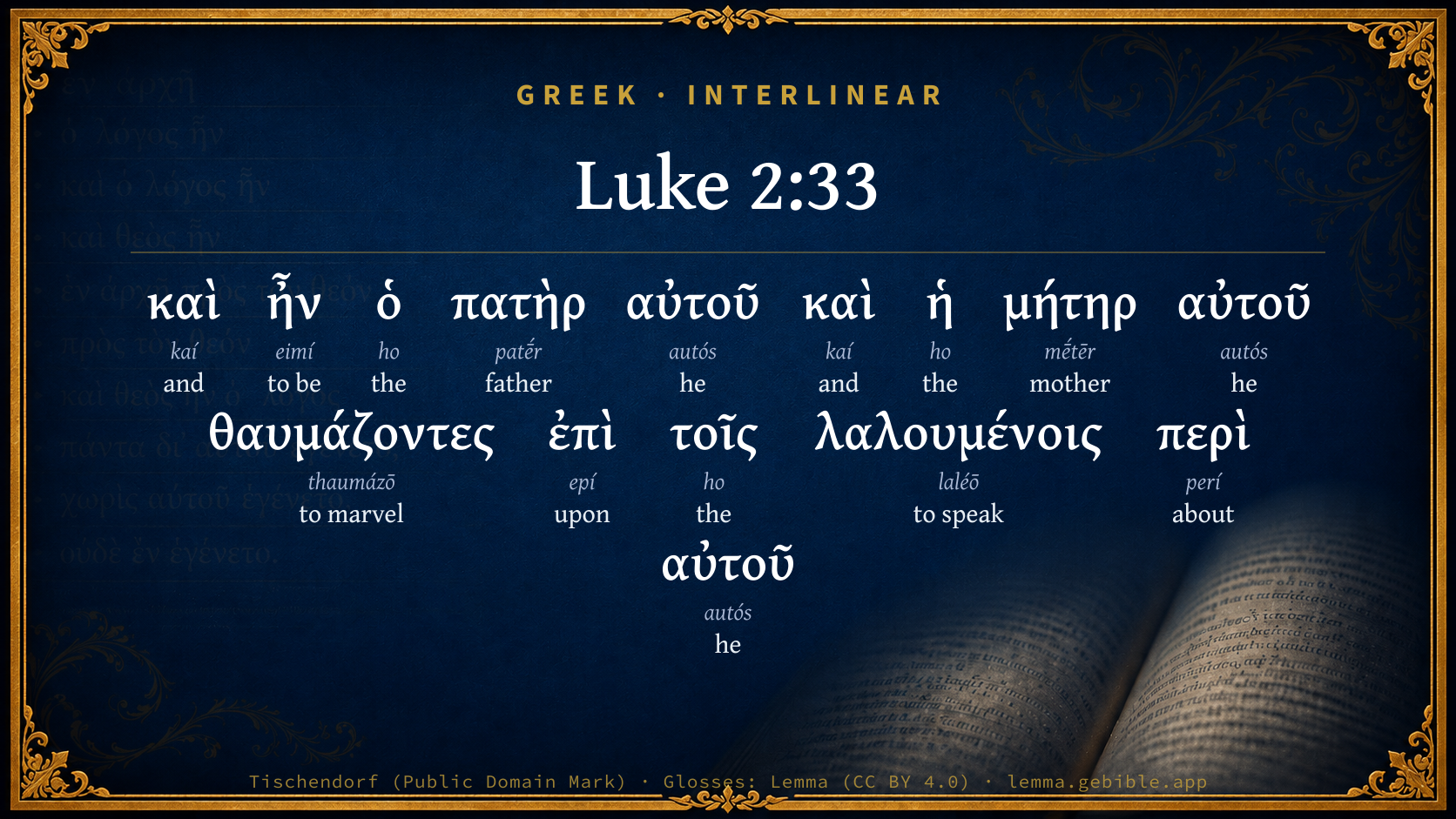
Download image
Cite this verse

Luke 2:33 (World English Bible). Public Domain. Lemma interlinear Bible study tool, https://lemma.gebible.app/v/luke/2/33.

Show BibTeX & RIS
BibTeX
RIS
English Translation
Joseph and his mother were marveling at the things which were spoken concerning him,
World English Bible · Public Domain
Download a study sheet

One document with this verse’s original text, its word-by-word gloss line, the meaning frame, cross-references with their text, attributed commentary, and full source and license credits — printable, and it pastes into notes with its structure intact.

This verse Autodidact and up

Study sheet (.html) Plain text (.txt)

A passage Seminary Student

Up to 50 verses in one chapter. A passage sheet keeps up to 6 commentary sources and 12 cross-references per verse, in the order this page ranks them, and says so on the sheet whenever that leaves anything out. Ask for a single verse and you get the Autodidact verse sheet above.

Everything on this page stays free to read, with no account — the sheet is a download of what is already on screen, not access to it.

Want to remove ads? Support Godless Engineer
Compare translations 3

The same verse in 3 English versions, stacked beneath the original-language interlinear above. Click any original word for its lexicon entry.

Each is an independent rendering of the whole verse — the interlinear is not word-aligned to these translations.

Highlighted words mark where these versions differ — a whole-verse word diff, not a word-by-word alignment.

  • World English Bible Public Domain
    Joseph and his mother were marveling at the things which were spoken concerning him,
  • King James Version Public Domain
    And Joseph and his mother marvelled at those things which were spoken of him.
  • unfoldingWord Literal Text CC BY-SA 4.0
    And his father and mother were amazed at what is being said about him.

unfoldingWord Literal Text — © unfoldingWord, licensed CC BY-SA 4.0. Word-aligned USFM3 via Door43 (git.door43.org/unfoldingWord/en_ult).

Versions to compare (up to 4)

3 of 4 selected

Show all 19 translations

Every available English version of this verse, each an independent rendering of the whole verse.

  • World English Bible Public Domain
    Joseph and his mother were marveling at the things which were spoken concerning him,
  • Berean Standard Bible Public Domain
    The Child’s father and mother were amazed at what was spoken about Him.
  • Majority Standard Bible Public Domain
    And Joseph and the Child’s mother were amazed at what was spoken about Him.
  • King James Version Public Domain
    And Joseph and his mother marvelled at those things which were spoken of him.
  • American Standard Version (1901) Public Domain
    And his father and his mother were marvelling at the things which were spoken concerning him;
  • Revised Version (1885) Public Domain
    And his father and his mother were marveling at the things which were spoken concerning him;
  • Geneva Bible (1599) Public Domain
    And Ioseph and his mother marueiled at those things, which were spoken touching him.
  • Douay-Rheims (1899) Public Domain
    And his father and mother were wondering at those things which were spoken concerning him.
  • Young's Literal Translation Public Domain
    And Joseph and his mother were wondering at the things spoken concerning him,
  • Literal Standard Version CC BY-SA 4.0
    And Joseph and His mother were wondering at the things spoken concerning Him,
  • Unlocked Literal Bible CC BY-SA 4.0
    His father and mother were amazed at what was said about him.
  • unfoldingWord Literal Text CC BY-SA 4.0
    And his father and mother were amazed at what is being said about him.
  • Darby Bible Public Domain
    And his father and mother wondered at the things which were said concerning him.
  • World Messianic Bible Public Domain
    Joseph and his mother were marveling at the things which were spoken concerning him.
  • Webster's Bible Public Domain
    And Joseph and his mother marveled at those things which were spoken concerning him.
  • Free Bible Version CC BY-SA 4.0
    Jesus' father and mother were shocked at what Simeon said about him.
  • Bible in Basic English Public Domain
    And his father and mother were full of wonder at the things which were said about him.
  • Text-Critical English NT CC BY 4.0
    Joseph and the child's mother were amazed at what was being said about him.
  • Tyndale New Testament (1534) Public Domain
    And his father and mother mervelled at those thinges which were spoke of him.

Literal Standard Version (2020), Covenant Press — licensed CC BY-SA 4.0. Text via the HelloAO Bible API (eBible.org). Unlocked Literal Bible (unfoldingWord) — licensed CC BY-SA 4.0. Text via the HelloAO Bible API (eBible.org). unfoldingWord Literal Text — © unfoldingWord, licensed CC BY-SA 4.0. Word-aligned USFM3 via Door43 (git.door43.org/unfoldingWord/en_ult). Free Bible Version, Dr. Jonathan Gallagher — licensed CC BY-SA 4.0. Text via the HelloAO Bible API (eBible.org).

Word by word

More ways to search: Search by grammar → Find every occurrence → Compare this word →

Practice this passage: Drill this verse → Learn its vocabulary →

θαυμάζοντες
thaumázō
G2296
“to marvel”
Verb, Present, Active, Participle, Nominative, Plural, Masculine
Part of Speech
Verb
Tense
Present
Voice
Active
Mood
Participle
Case
Nominative
Number
Plural
Gender
Masculine
Full Thayer's Definition

Origin: from G2295

TDNT: 03:27,3

1. to wonder, wonder at, marvel 2. to be wondered at, to be had in admiration
  1. καὶ kaí G2532 “and” Conjunction
  2. ἦν eimí G1510 “to be” Verb, Imperfect, Active, Indicative, 3rd person, Singular
  3. ὁ ho G3588 “the” Article, Nominative, Singular, Masculine
  4. πατὴρ patḗr G3962 “father” Noun, Nominative, Singular, Masculine
  5. αὐτοῦ autós G846 “he” Personal pronoun, Genitive, Singular, Masculine
  6. καὶ kaí G2532 “and” Conjunction
  7. ἡ ho G3588 “the” Article, Nominative, Singular, Feminine
  8. μήτηρ mḗtēr G3384 “mother” Noun, Nominative, Singular, Feminine
  9. αὐτοῦ autós G846 “he” Personal pronoun, Genitive, Singular, Masculine
  10. ἐπὶ epí G1909 “upon” Preposition
  11. τοῖς ho G3588 “the” Article, Dative, Plural, Neuter
  12. λαλουμένοις laléō G2980 “to speak” Verb, Present, Passive, Participle, Dative, Plural, Neuter
  13. περὶ perí G4012 “about” Preposition
  14. αὐτοῦ autós G846 “he” Personal pronoun, Genitive, Singular, Masculine

About this verse

These counts appear in no published source. They are computed here, from the morphology-tagged text and Lemma’s own curated glosses. What Lemma adds →

15
words
10
distinct lemmas
Gospels
section

Shared distinctive vocabulary

θαυμάζοντες to marvel G2296 occurs in 43 verses of the Greek New Testament. Also found in:
Repetition

Words recur within this verse:

Cross-references

3

Topical passages linked to Luke 2:33 in the Treasury of Scripture Knowledge — connected by theme and wording, ordered by reader-vote popularity; previews shown in the World English Bible.

  • Isaiah 8:18 Behold, I and the children whom Yahweh has given me are for signs and for wonders in Israel from Yahweh of Hosts, who dwells in Mount Zion.
  • Luke 1:65–66 Fear came on all who lived around them, and all these sayings were talked about throughout all the hill country of Judea.
  • Luke 2:48 When they saw him, they were astonished, and his mother said to him, "Son, why have you treated us this way? Behold, your father and I were anxiously looking for you."

Cross-references courtesy of OpenBible.info (CC BY 4.0).

Where the printed editions differ

1 variant

Places in this verse where the major printed Greek editions disagree on the wording in a way that affects the translation — a comparison of editions, not a manuscript-by-manuscript collation. The editions are the modern critical texts (Nestlé-Aland 28/27, SBL, Westcott-Hort, Tregelles, Tyndale House) and the traditional texts behind the KJV (the Textus Receptus and the Byzantine/Majority text). It is not a claim about which reading is original.

  1. Different wording
    πατὴρ

    “father”

    In NA28NA27TynSBLWHTreg Not in TRByz

    Ἰωσὴφ (Iōsēph) 'Joseph' occurs in traditional manuscripts (TR+Byz) instead of πατὴρ (patēr) 'father' in older manuscripts (NA28+NA27+Tyn+SBL+WH+Treg)

Textual data: Translators Amalgamated Greek New Testament (STEPBible TAGNT) · CC BY 4.0.

Commentary

Notes on Luke 2:33 from classic Christian and Jewish commentators (each source and its license shown beneath its notes). The classic Christian expositions comment on the surrounding passage and are grouped to its opening verse, so a note may address several verses; the Jewish commentaries on the Tanakh (Rashi and others) are per-verse, so they appear only where the commentator wrote on this verse.

Lemma curates 59 commentaries, every one of them public domain or Creative Commons licensed, each selected and text-cleaned for this edition rather than reprinted as found. About our sources →

Bengel's Gnomon

Johann Albrecht Bengel

Luk 2:33. Θαυμάζοντες, marvelling) For they began to understand more and more, how glorious things were those which had been spoken concerning Jesus, before He was born: and they were now hearing similar things from Simeon and others, whom they did not suppose as yet to be aware of the fact.

Bengel's Gnomon of the New Testament — English translation (T&T Clark, Edinburgh, 1860) — public domain. Text from a community e-Sword module.

Expositor's Greek Testament

ed. W. Robertson Nicoll

Luk 2:33 . ἦν : the construction is peculiar, the verb singular, and the participle, forming with it a periphrastic imperfect, plural = was the father, and was the mother, together wondering. Vide Winer, § 58, p. 651. The writer thinks of the two parents first as isolated and then as united in their wonder.

The Expositor's Greek Testament, edited by W. Robertson Nicoll (1897–1910) — public domain. Text from a community e-Sword module.

Adam Clarke's Commentary

Verse 33. Joseph and his mother marvelled] For they did not as yet fully know the counsels of God, relative to the salvation which Christ was to procure; nor the way in which the purchase was to be made: but to this Simeon refers in the following verses.

Adam Clarke's Commentary on the Bible (1810–1826) — public domain. Text from a community e-Sword/MySword module.

Ellicott's Commentary for English Readers

(33) And Joseph and his mother.—The better MSS. give, His father and his mother. The present reading has apparently been substituted for this through feelings of reverence, but it has quite sufficient authority in Luk_2:27; Luk_2:48.

A Bible Commentary for English Readers, edited by Charles John Ellicott (1878–1897) — public domain. Text from a community e-Sword module.

The Cambridge Bible for Schools and Colleges

gen. ed. J. J. S. Perowne

33. Joseph] The undoubted reading is “His father,” א, B, D, L, &c.

of him] Rather, about Him.

The Cambridge Bible for Schools and Colleges (gen. ed. J. J. S. Perowne; Cambridge University Press, 1878–1918) — public domain. Text from a community e-Sword module.

John Gill's Exposition

And Simeon blessed them,.... Pronounced them blessed persons, on account of their relation to Christ as man; and more especially, because of their interest in him, as the, Saviour and Redeemer of them; and wished them all happiness and prosperity inward and outward, temporal, spiritual, and eternal; and so the Arabic version renders it, confining it to Joseph and Mary; "and Simeon blessed them both"; though this blessing of his may take in also the young child Jesus; whom he might pronounce blessed, as Elizabeth before had done, Luk 1:42 since he was the promised seed, in whom all nations of the earth should be blessed; and to whom, and to whose undertakings, interest, and kingdom, he might wish all prosperous success. The Persic version reads, "old Simeon: and said unto Mary his mother": he directed his discourse to her, because she was the only real parent of this child he had in his arms, and had said so much of, and was about to say more; and because part of what follows, personally concerned her:

behold, this child is set for the fall and rising again of many in Israel. The word "child", is not in the original text; where it is only, "this is set, &c." Simeon seeming to be, as it were, at a loss, what name to call this great and illustrious person by, and therefore it is left to be supplied. The Persic version supplies it thus, behold, "this Holy One is set, &c." The sense is, that this child, who is the stone of Israel, is set, or put, or lies, both as a stone of stumbling, and rock of offence, for many of the Jews to stumble at, and fail and perish; and as a precious corner and foundation stone, for the erection and elevation of others of them, to the highest honour and dignity, that shall believe on him: for these words are not to be understood of the same, but of different persons among the Jews; though it may be true, that some, who first stumbled at him, might be raised up again, and brought to believe in him; and that many, who for his sake, and the Gospel, fell under great disgrace and reproach, and into great afflictions and persecutions, were raised up to the enjoyment of great comfort and honour: but they are not the same persons that Christ is set for the fall of, that he is set for the rising of; nor the same he is set for the rising of, he is set for the fall of; the one designs the elect of God among the Jews, who became true believers in Christ; and the other, the reprobate, who died in impenitence and unbelief: the words, so far as they concern Christ, "being set for the fall of many of the Jews"; have a manifest reference to Isa 8:14 where the Messiah is spoken of as a stone, and as a stone of stumbling, and rock of offence; at which, many of the Jews should stumble, and fail, and be broken. And so the text is applied in the Talmud (m), where it is said, that "the son of David will not come, until both houses of the fathers, fail out of Israel; and they are these, the head of the captivity in Babylon, and the prince in the land of Israel; as it is said, Isa 8:14 "he shall be for a sanctuary; but for a stone of stumbling and rock of offence", to both the houses of Israel.

Accordingly the Jews did stumble at his birth, parentage, and education; at the meanness of his person, and the obscurity of his kingdom; at the company he kept, and the audience that attended him; at his doctrine and miracles, and at his sufferings and death: they fell, through their unbelief and rejection of him, as the Messiah; and not only from their outward privileges, civil, and religious; the Gospel was taken away from them, the national covenant between God and them was broken, and they ceased to be his people, their temple and city were destroyed, and wrath came upon their nation to the uttermost; but they also fell into everlasting perdition, dying in their sins, through their disbelief of Jesus as the Messiah: this indeed was not the case of all of them; there was a seed, a remnant, according to the election of grace but it was the case of many, and of the far greater part but then this same stone that was laid in Zion, was also

set for the rising again of many of them; meaning not for their resurrection in a literal sense, though this is a truth: for as all God's elect, whether Jews or Gentiles, rose in him representatively, when he rose from the dead; so many of them rose personally after his resurrection, and all of them, at the last day, will rise again, in consequence of their union to him: and indeed, all the wicked will be raised again, by virtue of his power; but not this, but their resurrection in a spiritual sense, is here meant; and it supposes the persons raised to have been in a low estate, as all God's elect by nature are: they are in a hopeless and helpless condition in themselves: they are in a state of thraldom and bondage, to sin, Satan, and the law; they are filled with diseases, nauseous, mortal, and incurable; they are clothed in rags, and are beggars on the dunghill; they are deep in debt, and have nothing to pay; and are dead in trespasses and sins. Christ is now provided and appointed, for the raising them up out of their low estate, and he does do it; he is the resurrection and the life unto them; he raises from the death of sin, to a life of grace and holiness from him, to a life of faith on him, and communion with him here, and to eternal life hereafter: he pays all their debts clothes them with his righteousness, heals all their diseases, redeems them from the slavery of sin, the captivity of Satan, and the bondage and curse of the law; brings them into a hopeful and comfortable condition; raises them to the possession of a large estate, an eternal inheritance; and gives them both a right unto it, and ineptness for it; sets them among princes, makes them kings, places them on a throne of glory, yea, on his own throne, and sets a crown of righteousness, life, and glory, on their heads; and will cause them to reign with him, first on earth, for a thousand years, and then in heaven to all eternity: and this was to be the case of many in Israel, though not of all; for all did not obey the Gospel, some did, three thousand under one sermon; and more will in the latter day, when all Israel shall be saved. This privilege of rising again, in this sense, by Christ, though it is here spoken of with respect to many of the Jews, yet not to the exclusion of the Gentiles; for this honour have all the saints, be they of what nation they will. Now when Christ is said to be "set" for these different things, the meaning is, that he was foreappointed, preordained, and set forth in God's counsel, purposes, and decrees, as a stone at which some should stumble, through their own wickedness and unbelief, and fall and perish, and be eternally lost; and as a foundation stone for others, to build their faith and hope upon, which should be given them, and so rise up to everlasting life; and that he was set forth in the prophecies of the Old Testament, as in that here referred to, for the same ends; and that he was now exhibited in human nature with the same views, and should be held forth in the everlasting Gospel, for the like purposes; and which eventually is the savour of life unto life to some, and the savour of death unto death to others: to all this, a behold is prefixed, as expressing what is wonderful and surprising, and not to be accounted for, but to be resolved into the secret and sovereign will of God: it is added, that he is also set

for a sign which shall be spoken against: referring to Isa 8:18. Christ is the sign of God's everlasting love to his people, the great proof, evidence, and demonstration of it; and in this respect, is spoken against by many: and he is set up in the Gospel, as an ensign of the people to look at, and gather to, for comfort, peace, righteousness, salvation, and eternal life; but is by many contradicted, opposed, and treated with contempt and abhorrence; so that he appears rather to be set as a mark and butt to shoot at: he was spoken against by the Scribes and Pharisees, and the greater part of the people of the Jews, and contradicted, as the Messiah, because of his mean appearance among them; his proper deity was denied, his divine sonship was gainsayed; he was contemned in all his offices, kingly, priestly, and prophetic; his works of mercy, both to the bodies and souls of men, his miracles, and the whole series of his life and actions, were traduced as sinful and criminal: this was the contradiction of sinners against himself, which he endured, Heb 12:3 and for which he was set and appointed; and still the contradiction continues, and will, as long as the Gospel is preached,

(m) T. Bab. Sanhedrin, fol. 33. 1.

John Gill's Exposition of the Whole Bible (1746–1763) — public domain (CC PDM 1.0). Text via the HelloAO Bible API.

Trapp's Complete Commentary

John Trapp

33 And Joseph and his mother marvelled at those things which were spoken of him.

Ver. 33. Marvelled at those things] Saints, the more they see into the mystery of Christ, the more are they transported with admiration. But most of all at the last day, 2Th 1:10.

John Trapp, A Commentary or Exposition upon All the Books of the Old and New Testament (1647–1656) — public domain. Text from a community e-Sword module.

Haydock's Catholic Bible Commentary

In the Greek, Joseph and the mother of Jesus. (Bible de Vence)

George Leo Haydock (1774–1849), Haydock's Catholic Family Bible and Commentary, 1859 edition — public domain. Excludes Psalms (Douay-Rheims chapter numbering differs from Protestant) and Deuterocanonical books (Catholic canon only).

Matthew Poole's English Annotations

Brentius notes on this text, Non admirantur quia non credunt, sed quia credunt ideo admirantur, They did not admire because they did not believe, but because they believed therefore they marvelled. They had revelations what Christ was; the angel had appeared to Joseph, to Mary, to Zacharias, and Elisabeth; the wise men had come from the east (if, as some think, they came so soon); yet they marvelled; they did not contemn and mock at these things, but certainly neither did they fully understand them, but in the general believed the Divine revelation. I do doubt whether, before Christ was declared to be the Son of God with power, by his resurrection from the dead, Rom 1:4, either Mary or Christ’s own disciples did steadily and firmly believe, that Christ was the eternal Son of God; though it was clear that before that time they believed him to be sent of God, and a great Prophet, nay, the promised Messias, the Christ of God, and generally believed that what was spoken of the Messias and the Christ belonged to him, but whether they did rightly understand that the Messiah was to be God man I cannot tell. John Baptist seemeth clearest in the case. Peter also made a famous confession of it, but many things we read of Peter afterward which speak even Peter’s faith in the case rather the embryo of faith than a fixed and perfect faith. But I impose nothing here on my reader, let him judge as he seeth reason; supposing a fixed firm faith in this case, yet they might marvel, for Christ is to be admired of them that believe.

Matthew Poole's English Annotations on the Holy Bible (1683–1685) — public domain. Text from a community e-Sword/MySword module.

The Pulpit Commentary

And Joseph and his mother marvelled. It was not so much that Simeon foretold new things respecting the Child Jesus that they marvelled; their surprise was rather that a stranger, evidently of position and learning, should possess so deep an insight into the lofty destinies of an unknown Infant, brought by evidently poor parents into the temple court. Was their secret then known to others whom they suspected not?

The Pulpit Commentary (1880–1919), ed. H.D.M. Spence-Jones & Joseph S. Exell — public domain. Text from a community e-Sword module.

John Wesley's Explanatory Notes

Joseph and his mother marvelled at those things which were spoken - For they did not thoroughly understand them.

John Wesley, Explanatory Notes Upon the Whole Bible (1754–1765) — public domain. Text via the GEBible commentary corpus.

Kretzmann's Popular Commentary

Paul E. Kretzmann

Simeon blesses Joseph and Mary:

v. 33 And Joseph and His mother marveled at those things which were spoken of Him.

v. 34. And Simeon blessed them, and said unto Mary, His mother, Behold, this Child is set for the fall and rising again of many in Israel; and for a sign which shall be spoken against,

v. 35 (yea, a sword shall pierce through thy own soul also,) that the thoughts of many hearts may be revealed.

Whereas in the story of the shepherds only Mary is mentioned as having taken careful note of the words concerning her Son, both parents are here represented as marveling over the words of Simeon, which revealed the full significance of this Child for the world. Joseph, the foster-father, usually remains in the background. The words which Simeon here spoke filled them both with joyful wonder. They were gradually beginning to have an idea as to the meaning of all the prophecies concerning the Babe in their arms. Simeon now spoke a blessing upon them both and addressed himself to Mary in a significant prophecy. his Child is set up, is established, by the will of God, for a double purpose. In the first place, He serves for the fall and the rising again of many in Israel, the true Israel, the members of God’s kingdom. The natural pride and self-righteousness of every man, which is characteristic of man’s inherited depravity, must fall and be removed entirely, before the resurrection in the faith in Jesus the Savior can take place. In the second place, He serves for a sign which will be opposed, spoken against. Many people, in fact, the majority, refuse to be humbled on account of this Savior, even though the assurance of succeeding glory is held out to them in the faith in Him. They harden their hearts against Him and are thus condemned through their own fault, 2Co 2:15-16; 2Co 4:3-4. But in spite of all that He is a sign before the whole world, just as the serpent in the wilderness was a sign to all the people, even to those that refused to look at it until it was too late. In this manner, the thoughts of men’s hearts are revealed. Many a leading Jew, whose reputation attested his perfect goodness, could not stand the test of this touchstone, Jesus the Christ, and rejected his own salvation. Incidentally, this state of affairs would prove a severe trial for Mary. Her mother’s heart would feel the hatred directed against her Son most keenly. It would often be like a double-edged sword penetrating her soul, as when she was witness of the crucifixion with its attendant tortures.

Paul E. Kretzmann, Popular Commentary of the Bible (1921–1924) — public domain. Text from a community e-Sword module.

The People's New Testament

B. W. Johnson

33. Marvelled. That Simeon should know the child.

B. W. Johnson's The People's New Testament with Notes (1889–1891) — public domain. Electronic text from the Christian Classics Ethereal Library (CCEL) ThML edition.

unfoldingWord translationNotes

Door43 World Missions Community

what was said about him

This can be stated in active form. AT: "the things that Simeon said about him" (See: Active or Passive)

said to Mary his mother

"said to the child's mother, Mary." Make sure it does not sound like Mary is the mother of Simeon.

Behold

Simeon used this expression to tell Mary that what he is about to say is extremely important to her.

this child is appointed for the downfall and rising up of many people in Israel

The words "downfall" and "rising up" express turning away from God and drawing closer to God. AT: "this child will cause many people in Israel to fall away from God or to rise closer to God" (See: Metaphor and Active or Passive)

for a sign that is rejected

"for a message from God that many people will resist"

a sword will pierce your own soul

This metaphor describes the deep sadness that Mary would feel. AT: "your sadness will be painful, as though a sword pierced your heart" (See: Metaphor)

the thoughts of many hearts may be revealed

Here "hearts" is a metonym for people's inner beings. This can be stated in active form. AT: "he may reveal the thoughts of many people" or "he may reveal what many people secretly think" (See: Metonymy and Active or Passive)

translationWords

amazed

bless

sign

sword

soul

heart

unfoldingWord translationNotes — © Distant Shores Media and the Door43 World Missions Community, licensed CC BY-SA 4.0. Source: git.door43.org/Door43/en_tn.

Cambridge Greek Testament for Schools and Colleges

33. ὁ πατὴρ αὐτοῦ καὶ ἡ μήτηρ αὐτοῦ. So אBDL, Vulg[51] and various Fathers. It may have been altered from dogmatic prejudices into Ἰωσὴφ καὶ ἡ μήτηρ αὐτοῦ.

[51] Vulg. Vulgate.

33. ὁ πατὴρ αὐτοῦ. This is the undoubted reading, אBDL, &c.

περὶ αὐτοῦ. ‘About Him.’

Cambridge Greek Testament for Schools and Colleges (Cambridge University Press, 1896; 21 vols, various authors incl. Carr, Maclear, Plummer, Farrar, Lumby, Moule, M. R. James, Simcox) — public domain. Text from a community e-Sword module.

Alford’s Greek Testament

Henry Alford

33. ὁ πατ. αὐτοῦ] In ver. 48 we have Joseph again called by this name. Our Lord Himself would not speak of him thus, see ver. 49; but in the simplicity of the narrative we may read οἱ γονεῖς αὐτοῦ and such expressions, without any danger of forgetting the momentous history of the Conception and Nativity.

Henry Alford, The Greek Testament (1849–1861) — public domain. Text from a community e-Sword module.

International Critical Commentary

33-35. Symeon’s Address to the Virgin. “The foreboding of suffering to Mary, so indefinitely expressed, bears no mark of post actum invention. But the inspired idea of Messiah in the pious old man obviously connected the sufferings which He was to endure in His strife against the corrupt people with those which were foretold of Him in Isa_53.” (Neander, Leben Jesus Christi, § 18, Eng. tr. p. 27). The change from the unmixed joy and glory of the angelic announcements and of the evangelic hymns is very marked. Here for the first time in the narrative we have an intimation of future suffering.

33. ἥν. When the sing. verb was written, only the first of the persons mentioned was in the writer’s mind: such irregularities are common (Mat 17:3, Mat 22:40).—θαυμάζοντες ἐπί. Excepting Mar 12:17, this construction is peculiar in N.T. to Lk. (4:22, 9:43, 20:26; Act 3:12). It is quite class. and freq. in LXX (Judith 10:7, 19, 23, 11:20; Job 41:1; Ecc 5:7; Isa 52:15). The objection of Strauss, that this wonder of the parents is inconsistent with the angelic annunciation, is pointless. Symeon’s declaration about the Gentiles goes far beyond the Angel’s promise, and it was marvellous that Symeon should know anything about the Child’s nature and destiny.

International Critical Commentary — older volumes (1896–1929), various authors — public domain. Text from a community e-Sword module.

Vincent's Word Studies in the New Testament

Marvin R. Vincent

And Joseph. The best texts read oJ pathr aujtou, his father. Marvelled [ην θαυμαζοντες] . The Greek construction is peculiar. His father was and his mother wondering; the finite verb in the singular agreeing with the father, while the plural participle agrees with both. As usual, this combination of finite verb and participle denotes continuance or progression : they were marvelling while Simeon was speaking. So Rev.

Marvin R. Vincent, Word Studies in the New Testament (1887–1900) — public domain. Text from a community e-Sword/MySword module.

Godet's Commentaries

Frédéric Louis Godet

Vers. 33-35. A carnal satisfaction, full of delusive hopes might easily have taken possession of the hearts of these parents, especially of the mother’s, on hearing such words as these. But Simeon infuses into his message the drop of bitterness which no joy, not even holy joy, ever wants in a world of sin.

Instead of Joseph, which is the reading of T. R., the Alex. read: his father. We should have thought that the former of these two readings was a dogmatic correction, but that at Luk 2:27 the T. R. itself reads the word γονεῖς, parents. But the Alexandrian reading is supported by the fact that the ancient translations, the Peschito and Italic, have it.

Strauss finds something strange in the wonder of Joseph and Mary. Did they not already know all this? But in the first place, what Simeon has just said of the part this child would sustain towards the heathen goes beyond all that had hitherto been told them. And then especially, they might well be astonished to hear an unknown person, like Simeon, express himself about this child as a man completely initiated into the secret of His high destiny.

In the expression, he blessed them, Luk 2:34, the word them refers solely to the parents: the child is expressly distinguished from them (this child).

Simeon addresses himself specially to Mary, as if he had discerned that a peculiar tie united her to the child. ᾿Ιδού, behold, announces the revelation of an unexpected truth. In Isa 8:14 the Messiah is represented as a rock on which believers find refuge, but whereon the rebellious are broken. Simeon, whose prophetic gift was developed under the influence of the ancient oracles, simply reproduces here this thought. The words, is set for, make it clear that this sifting, of which the Messiah will be the occasion, forms part of the divine plan. The images of a fall and a rising again are explained by that employed by Isaiah. The expression, signal of contradiction (a sign which shall be spoken against, A. V.), may be understood in two ways: either it is an appearing about which men argue contradictorily, or it is a sign which excites opposition directly it appears. Taken in the first sense, this expression would reproduce the ideas of a fall and a rising again, and would be a simple repetition of that which precedes; in the second sense, it would merely recall the idea of a fall, and would form the transition to what follows. Will not the general unbelief of the nation be the cause of the sad lot of the Messiah, and of the sufferings that will fill the heart of His mother? The second sense is therefore preferable. The gradation καὶ σοῦ δὲ αὐτῆς, thy own also, Luk 2:35, is in this way readily understood. The δέ of the received reading is well suited to the context. “The opposition excited by this child will go so far, that thine own heart will be pierced by it.”

It is natural to refer what follows to the grief of Mary, when she shall behold the rejection and murder of her son. Some such words as those of Isaiah, “He was bruised for our iniquities,” and of Zechariah, “They shall look on me whom they have pierced,” had enlightened Simeon respecting this mystery. Bleek has proposed another explanation, which is less natural, although ingenious: “Thou shalt feel in thine own heart this contradiction in regard to thy son, when thou thy self shalt be seized with doubt in regard to His mission.” But the image of a sword must denote something more violent than simple doubt. Ψυχή, the soul, as the seat of the psychical affections, and consequently of maternal love.

It has been thought that the following proposition, in order that the thoughts of many..., could not be connected with that which immediately precedes; and for this reason some have tried to treat it as a parenthesis, and connect the in order that with the idea, This is set...(Luk 2:34). But this violent construction is altogether unnecessary. The hatred of which Jesus will be the object (Luk 2:34), and which will pierce the heart of Mary with poignant grief (Luk 2:35), will bring out those hostile thoughts towards God which in this people lie hidden under a veil of pharisaical devotion. Simeon discerned, beneath the outward forms of Jewish piety, their love of human glory, their hypocrisy, avarice, and hatred of God; and he perceives that this child will prove the occasion for all this hidden venom being poured forth from the recesses of their hearts. In order that has the same sense as is set for. God does not will the evil; but He wills that the evil, when present, should show itself: this is an indispensable condition to its being either healed or condemned. Πολλῶν, of many, appears to be a pronoun, the complement of καρδιῶν (the hearts of many), rather than an adjective (of many hearts); comp. Rom 5:16.

The term διαλογισμοί, thoughts, has usually an unfavourable signification in the N. T.; it indicates the uneasy working of the understanding in the service of a bad heart. The epithet πονηροί, added by the Sinaiticus, is consequently superfluous. These words of Simeon breathe a concentrated indignation. We feel that this old man knows more about the moral condition of the people and their rulers than he has a mind to tell.

Frédéric Louis Godet — Commentaries on Luke, John, Romans, and 1 Corinthians — English translation (T&T Clark, Edinburgh, 1870s–1890s) — public domain. Text from a community e-Sword module.

Lesson kit

Teaching starters — assembled from the data on this page, not authored interpretation. Every prompt links to the verse data it draws on. Edit before teaching.

Luke, in the Gospels, opens this verse with 15 words (10 distinct Greek lemmas). Its most distinctive word is thaumázō (“to marvel”). A historical commentator’s framing appears above. Read the whole chapter for the surrounding context.

Discussion questions

  1. How does “to marvel” (thaumázō) shape what this verse is saying?
  2. How does Matthew 8:10, which shares the word «to marvel», read alongside this verse?
  3. What does the repetition of “the” (3× in this one verse) do in this verse?
  4. These translations render this verse differently; the difference is in the English rendering, not the original. What questions does that raise?
  5. Compare how Bengel's Gnomon and Expositor's Greek Testament read this verse. Where do they agree or differ?

Things to notice

Reading settings

Reading text

Shown beneath each verse's original-language words.

Old Testament
Old Testament edition

Read the OT as the Masoretic Hebrew (MT) or the Greek Septuagint (LXX).

English shown for the Greek Septuagint (in the Hebrew ↔ Greek comparison).

Comparing translations? Open the Compare panel on any verse page to stack up to four side by side.