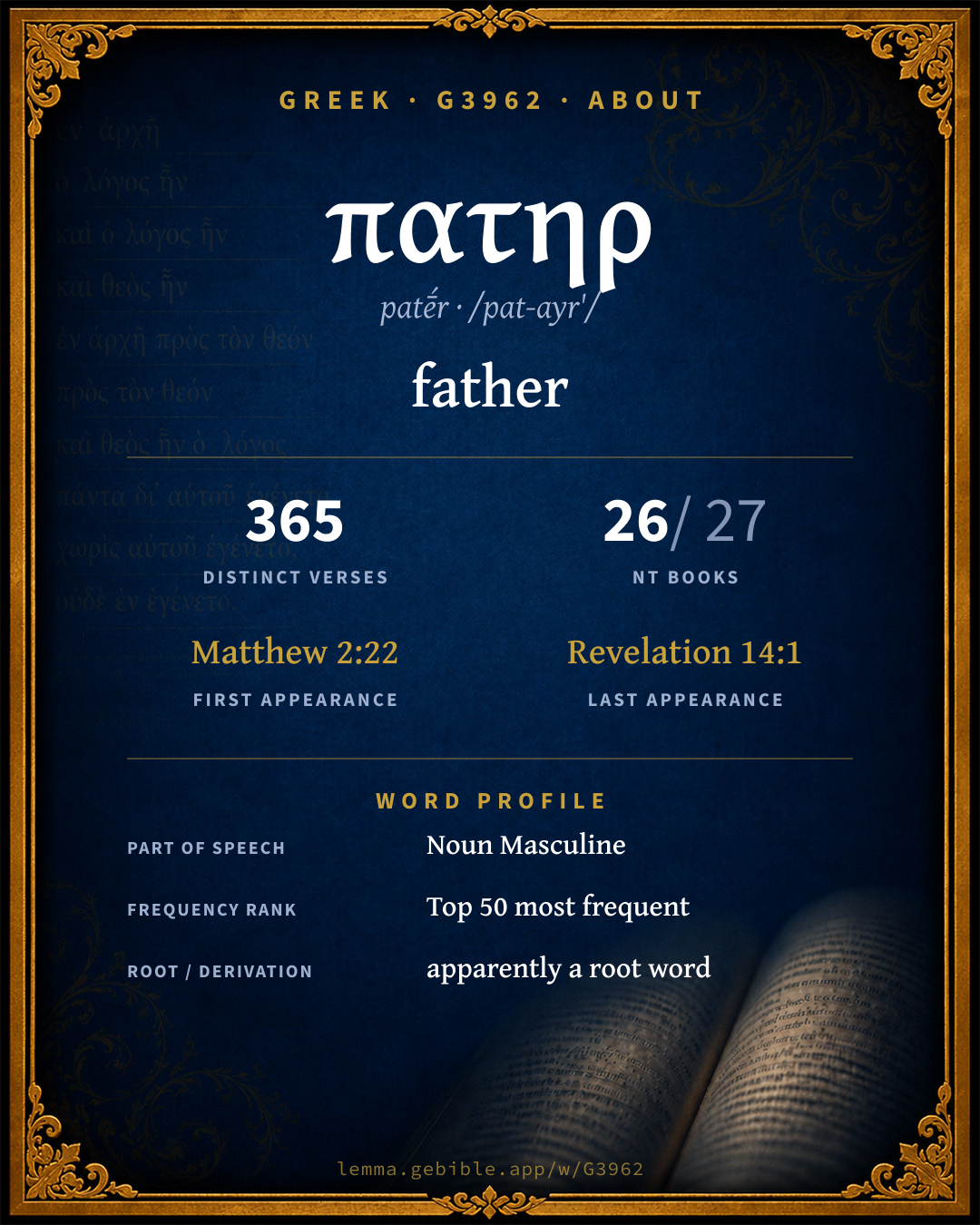
πατήρ
father
‘father’ is one of 3 main senses fuller range ↓
Full lexicon entry — Thayer's Greek Lexicon
From Thayer's Greek Lexicon
Where this word appears
See every Accusative-case word in the Greek New Testament →
Grammar key — what these labels mean
Part of speech
- Noun
- A naming word — a person, place, thing, or idea.
Case
- Nominative
- The case of the subject (and the predicate nominative).
- Genitive
- The case of source, possession, or “of” — answers “whose / from what.”
- Accusative
- The case of the direct object and of extent.
- Dative
- The case of the indirect object, means, or location — “to / for / with / in.”
- Vocative
- The case of direct address (“O Lord”).
Gender
- Masculine
- Grammatically masculine.
Number
- Singular
- One.
- Plural
- More than one.
Every verse where G3962 appears in the Book of 1 Peter — 3 distinct verses. Click any verse to open its interlinear word-by-word view. Verse text shown in the World English Bible for context — . Each verse’s Greek form is shown with its reference; the English is not keyword-highlighted, since the data carries no word-level English alignment. Use “Compare translations” on any verse to read it across multiple English versions. This concordance covers the Greek New Testament; Septuagint (Greek Old Testament) occurrences of this word are not indexed here.
1 Peter
- 1 Peter 1:2 πατρός n gen sg masc according to the foreknowledge of God the Father, in sanctification of the Spirit, that you may obey Jesus Christ and be sprinkled in his blood: Grace to you and peace be multiplied.
- 1 Peter 1:3 πατὴρ n nom sg masc Blessed be the God and Father of our Lord Jesus Christ, who according to his great mercy became our father again to a living hope through the resurrection of Jesus Christ from the dead,
- 1 Peter 1:17 πατέρα n acc sg masc If you call on him as Father, who without respect of persons judges according to each man's work, pass the time of your living as strangers here in reverent fear:
About this entry
At a glance — auto-summarized from this page’s data, not written by a person. Every figure links to its source below. This summary describes the numbers; it doesn’t interpret them.
πατηρ (patḗr) is a Greek noun most often rendered “father.” Scripture first uses it in Matthew 2:22. Spanning 365 verses in 26 books, it ranks among the common words of the Greek New Testament. John dominates its distribution — 111 of 365 verses. Ranging over 3 senses, it is not a single-sense word. The sections below give every sense, occurrence, and version rendering.
Gloss history
Strong's 1890 vs modern scholarship
About this word
Strong's G3962 catalogs a Greek word from the Greek New Testament.
These counts are not copied from any lexicon or concordance. They are computed here, from the morphology-tagged Greek New Testament. What Lemma adds →
- 365
- distinct verses
- The word appears in 365 distinct verses.
- 26 / 27
- NT books
- The word appears in 26 of 27 New Testament books.
- #46
- by frequency
- Top 50 most frequent Greek words (rank 46 of 5,347 Greek words by occurrence).
View all 365 occurrences in the concordance →
By section of the New Testament
By traditional corpus
Conventional, traditional groupings — biblical authorship is debated, so this is a traditional corpus grouping, not an authorship claim. Some books belong to more than one corpus (Luke is in both the Gospels and the Lukan corpus, and so on), so these shares overlap and need not total 100%. Each figure is a share of the word’s 365 distinct verses.
- Gospels 232 verses · 64%
- Johannine 131 verses · 36%
- Lukan (Luke–Acts) 81 verses · 22%
- Pauline corpus 62 verses · 17%
- General (Catholic) Epistles 25 verses · 7%
- Hebrews 8 verses · 2%
- Revelation 5 verses · 1%
How translations render this word
Counts come from each version’s own published word-to-Strong’s tagging or interlinear alignment — an approximate guide to how each version renders this word, not a word-level alignment the data otherwise carries. Because each total is that version’s own tagged count, the per-version totals vary from one another and need not match the appearance or distinct-verse counts above. These counts may also differ from a printed concordance because Lemma counts each distinctly tagged rendering and does not collapse phrase taggings into a single head-word total. This is a fixed set of word-tagged versions (KJV, ASV, BSB, ULT) and does not change with the reading translation you choose elsewhere. Each version’s license is shown beside its name below (and on Sources).
- King James Version: Father 347×, Fathers 49×, Father's 16×
- American Standard Version: Father 339×, Fathers 50×, Of 18×
- Berean Standard Bible: Father 339×, Fathers 46×, Father’s 18×
- unfoldingWord Literal Text: Father 358×, Fathers 51×, Of 38×
King James Version Public Domain
Renders G3962 across 419 tagged occurrences — most commonly:
Plus 7 renderings that appear only once — usually multi-word phrases or single function words the recovered tagging swept in, not distinct renderings.
American Standard Version Public Domain
Renders G3962 across 439 tagged occurrences — most commonly:
Plus 18 renderings that appear only once — usually multi-word phrases or single function words the recovered tagging swept in, not distinct renderings.
Berean Standard Bible Public Domain
Renders G3962 across 411 tagged occurrences — most commonly:
Plus 4 renderings that appear only once — usually multi-word phrases or single function words the recovered tagging swept in, not distinct renderings. Not rendered by a distinct English word in 3 further occurrences.
unfoldingWord Literal Text CC BY-SA 4.0
Renders G3962 across 464 tagged occurrences — most commonly:
Plus 6 renderings that appear only once — usually multi-word phrases or single function words the recovered tagging swept in, not distinct renderings.
Senses in Thayer's
The 3 senses Thayer's distinguishes for this word, in lexicon order (not ranked by frequency or importance). The full entry — with sub-senses — is in the Lexicon Entry tab.
- generator or male ancestor
- metaph.
- God is called the Father
Word origin
Origin: apparently a root word
Apparently a primary word; a father (literally or figuratively near or more remote): - father parent.
— Strong’s Exhaustive Concordance (1890), public domain.
Forms in the corpus
The 13 distinct written forms G3962 takes in the Greek New Testament, most frequent first — each parse links to that case’s occurrences in the concordance.
| Form | Parsing | Example | Uses |
|---|---|---|---|
| πατέρα patéra | Noun, Accusative, Singular, Masculine | Matthew 3:9 | 93 |
| πατὴρ patḕr | Noun, Nominative, Singular, Masculine | Matthew 5:48 | 73 |
| πατρὸς patròs | Noun, Genitive, Singular, Masculine | Matthew 2:22 | 56 |
| πατρός patrós | Noun, Genitive, Singular, Masculine | Matthew 7:21 | 44 |
| πατήρ patḗr | Noun, Nominative, Singular, Masculine | Matthew 6:4 | 38 |
| πατέρες patéres | Noun, Nominative, Plural, Masculine | Luke 6:23 | 24 |
| πατρὶ patrì | Noun, Dative, Singular, Masculine | Matthew 6:1 | 23 |
| πάτερ páter | Noun, Vocative, Singular, Masculine | Matthew 6:9 | 21 |
| πατέρων patérōn | Noun, Genitive, Plural, Masculine | Matthew 23:30 | 14 |
| πατέρας patéras | Noun, Accusative, Plural, Masculine | Luke 1:55 | 12 |
| πατρί patrí | Noun, Dative, Singular, Masculine | Matthew 6:6 | 10 |
| πατράσιν patrásin | Noun, Dative, Plural, Masculine | Acts 7:44 | 3 |
| προπάτορα propátora | Noun, Accusative, Singular, Masculine | Romans 4:1 | 1 |
Same root — word family
Other Thayer's entries built from the same root as G3962, grouped by Strong’s listed origin. These share a root / origin per the lexicon — not necessarily a shared meaning. Each links to that word’s own entry.
Derived from this word
- πατραλωας patralṓias G3964 parricide
- πατρια patriá G3965 family
- πατρικος patrikós G3967 paternal
- πατροπαραδοτος patroparádotos G3970 traditional
- πατρωος patrōios G3971 inherited
Proper names from this root
People and places named from this root — a name, not an additional meaning of the word.
Compare all same-root words → Showing 4 of 7 — not the complete family. 1 of the same-root words is a proper name (a person or place). They share a root, not necessarily a meaning.
Septuagint usage
The same Greek word πατηρ appears 1,106 times in the Greek Old Testament (Septuagint), across 944 verses in 30 books.
- 1,106
- LXX occurrences
- Tagged occurrences of this Greek word in the Septuagint.
- 944
- verses
- Distinct Septuagint verses containing this word.
- 30 / 39
- OT books
- The word appears in 30 of the 39 Old Testament books.
Sample Septuagint occurrences
- Genesis 2:24 πατήρ
- Exodus 1:1 πατήρ
- Leviticus 10:4 πατήρ
- Numbers 3:4 πατήρ
- Deuteronomy 1:8 πατήρ
- Joshua 1:6 πατήρ
- Judges 1:14 πατήρ
- Ruth 2:11 πατήρ
- 1 Samuel 1:25 πατήρ
- 2 Samuel 2:32 πατήρ
- 1 Kings 1:6 πατήρ
- 2 Kings 1:18 πατήρ
Septuagint occurrences (same lexeme)
Every verse where the same Strong’s number (G3962) appears in the Greek Septuagint — showing the first 50 of 944. Verse text shown in the World English Bible for context; the Greek form is the matched word — the English is not keyword-highlighted.
- Genesis 2:24 πατήρ Therefore a man will leave his father and his mother, and will join with his wife, and they will be one flesh.
- Genesis 4:20 πατήρ Adah gave birth to Jabal, who was the father of those who dwell in tents and have cattle.
- Genesis 9:18 πατήρ The sons of Noah who went forth from the ark were Shem, Ham, and Japheth. Ham is the father of Canaan.
- Genesis 9:22 πατήρ Ham, the father of Canaan, saw the nakedness of his father, and told his two brothers outside.
- Genesis 9:23 πατήρ Shem and Japheth took a garment, and laid it on both their shoulders, went in backwards, and covered the nakedness of their father. Their faces were backwards, and they didn't see their father's nakedness.
- Genesis 10:21 πατήρ To Shem, the father of all the children of Eber, the elder brother of Japheth, to him also were children born.
- Genesis 11:28 πατήρ Haran died before his father Terah in the land of his birth, in Ur of the Chaldees.
- Genesis 11:29 πατήρ Abram and Nahor took wives. The name of Abram's wife was Sarai, and the name of Nahor's wife, Milcah, the daughter of Haran who was also the father of Iscah.
- Genesis 12:1 πατήρ Now Yahweh said to Abram, "Get out of your country, and from your relatives, and from your father's house, to the land that I will show you.
- Genesis 15:15 πατήρ But you will go to your fathers in peace. You will be buried in a good old age.
- Genesis 17:4 πατήρ "As for me, behold, my covenant is with you. You will be the father of a multitude of nations.
- Genesis 17:5 πατήρ Neither will your name any more be called Abram, but your name will be Abraham; for the father of a multitude of nations have I made you.
- Genesis 19:31 πατήρ The firstborn said to the younger, "Our father is old, and there is not a man in the earth to come in to us after the manner of all the earth.
- Genesis 19:32 πατήρ Come, let's make our father drink wine, and we will lie with him, that we may preserve our father's seed."
- Genesis 19:33 πατήρ They made their father drink wine that night: and the firstborn went in, and lay with her father. He didn't know when she lay down, nor when she arose.
- Genesis 19:34 πατήρ It came to pass on the next day, that the firstborn said to the younger, "Behold, I lay last night with my father. Let us make him drink wine again, tonight. You go in, and lie with him, that we may preserve our father's seed."
- Genesis 19:35 πατήρ They made their father drink wine that night also. The younger arose, and lay with him. He didn't know when she lay down, nor when she arose.
- Genesis 19:36 πατήρ Thus both of Lot's daughters were with child by their father.
- Genesis 19:37 πατήρ The firstborn bore a son, and named him Moab. The same is the father of the Moabites to this day.
- Genesis 19:38 πατήρ The younger also bore a son, and called his name Ben Ammi. The same is the father of the children of Ammon to this day.
- Genesis 20:12 πατήρ Moreover she is indeed my sister, the daughter of my father, but not the daughter of my mother; and she became my wife.
- Genesis 20:13 πατήρ It happened, when God caused me to wander from my father's house, that I said to her, 'This is your kindness which you shall show to me. Everywhere that we go, say of me, "He is my brother."'"
- Genesis 22:7 πατήρ Isaac spoke to Abraham his father, and said, "My father?" He said, "Here I am, my son." He said, "Here is the fire and the wood, but where is the lamb for a burnt offering?"
- Genesis 22:21 πατήρ Uz his firstborn, Buz his brother, Kemuel the father of Aram,
- Genesis 24:7 πατήρ Yahweh, the God of heaven, who took me from my father's house, and from the land of my birth, who spoke to me, and who swore to me, saying, 'I will give this land to your seed.' He will send his angel before you, and you shall take a wife for my son from there.
- Genesis 24:23 πατήρ and said, "Whose daughter are you? Please tell me. Is there room in your father's house for us to lodge in?"
- Genesis 24:38 πατήρ but you shall go to my father's house, and to my relatives, and take a wife for my son.'
- Genesis 24:40 πατήρ He said to me, 'Yahweh, before whom I walk, will send his angel with you, and prosper your way. You shall take a wife for my son of my relatives, and of my father's house.
- Genesis 26:3 πατήρ Sojourn in this land, and I will be with you, and will bless you. For to you, and to your seed, I will give all these lands, and I will establish the oath which I swore to Abraham your father.
- Genesis 26:5 πατήρ because Abraham obeyed my voice, and kept my charge, my commandments, my statutes, and my laws."
- Genesis 26:15 πατήρ Now all the wells which his father's servants had dug in the days of Abraham his father, the Philistines had stopped, and filled with earth.
- Genesis 26:18 πατήρ Isaac dug again the wells of water, which they had dug in the days of Abraham his father. For the Philistines had stopped them after the death of Abraham. He called their names after the names by which his father had called them.
- Genesis 26:24 πατήρ Yahweh appeared to him the same night, and said, "I am the God of Abraham your father. Don't be afraid, for I am with you, and will bless you, and multiply your seed for my servant Abraham's sake."
- Genesis 27:5 πατήρ Rebekah heard when Isaac spoke to Esau his son. Esau went to the field to hunt for venison, and to bring it.
- Genesis 27:6 πατήρ Rebekah spoke to Jacob her son, saying, "Behold, I heard your father speak to Esau your brother, saying,
- Genesis 27:9 πατήρ Go now to the flock, and get me from there two good kids of the goats. I will make them savory food for your father, such as he loves.
- Genesis 27:10 πατήρ You shall bring it to your father, that he may eat, so that he may bless you before his death."
- Genesis 27:12 πατήρ What if my father touches me? I will seem to him as a deceiver, and I would bring a curse on myself, and not a blessing."
- Genesis 27:14 πατήρ He went, and got them, and brought them to his mother. His mother made savory food, such as his father loved.
- Genesis 27:18 πατήρ He came to his father, and said, "My father?" He said, "Here I am. Who are you, my son?"
- Genesis 27:19 πατήρ Jacob said to his father, "I am Esau your firstborn. I have done what you asked me to do. Please arise, sit and eat of my venison, that your soul may bless me."
- Genesis 27:22 πατήρ Jacob went near to Isaac his father. He felt him, and said, "The voice is Jacob's voice, but the hands are the hands of Esau."
- Genesis 27:26 πατήρ His father Isaac said to him, "Come near now, and kiss me, my son."
- Genesis 27:29 πατήρ Let peoples serve you, Nations bow down to you. Be lord over your brothers, Let your mother's sons bow down to you. Cursed be everyone who curses you, Blessed be everyone who blesses you."
- Genesis 27:30 πατήρ It happened, as soon as Isaac had made an end of blessing Jacob, and Jacob had just gone out from the presence of Isaac his father, that Esau his brother came in from his hunting.
- Genesis 27:31 πατήρ He also made savory food, and brought it to his father. He said to his father, "Let my father arise, and eat of his son's venison, that your soul may bless me."
- Genesis 27:32 πατήρ Isaac his father said to him, "Who are you?" He said, "I am your son, your firstborn, Esau."
- Genesis 27:34 πατήρ When Esau heard the words of his father, he cried with an exceeding great and bitter cry, and said to his father, "Bless me, even me also, my father."
- Genesis 27:36 πατήρ He said, "Isn't he rightly named Jacob? For he has supplanted me these two times. He took away my birthright. See, now he has taken away my blessing." He said, "Haven't you reserved a blessing for me?"
- Genesis 27:38 πατήρ Esau said to his father, "Have you but one blessing, my father? Bless me, even me also, my father." Esau lifted up his voice, and wept.
These are occurrences of the same Greek lexeme (G3962) in the Septuagint — not a translation of any one Hebrew word. The store carries no word-level Hebrew↔Greek alignment, so no Hebrew original is asserted here. Counts come from the recovered LXX Strong's tagging — high-frequency vocabulary is well covered, while rare or late forms may be untagged — so they reflect tagged occurrences and may slightly undercount.