Matthew 16:17

Greek (Tischendorf 8th ed.) Matthew 16:17 appears in the Greek New Testament. The text above is from the Tischendorf 8th edition. Each word links to its Strong’s number and a concise gloss. Click any word for its full Thayer’s Greek Lexicon entry.
Download image
Cite this verse

Matthew 16:17 (World English Bible). Public Domain. Lemma interlinear Bible study tool, https://lemma.gebible.app/v/matthew/16/17.

Show BibTeX & RIS
BibTeX
RIS
English Translation
Jesus answered him, "Blessed are you, Simon Bar Jonah, for flesh and blood has not revealed this to you, but my Father who is in heaven.
World English Bible · Public Domain
Highlights
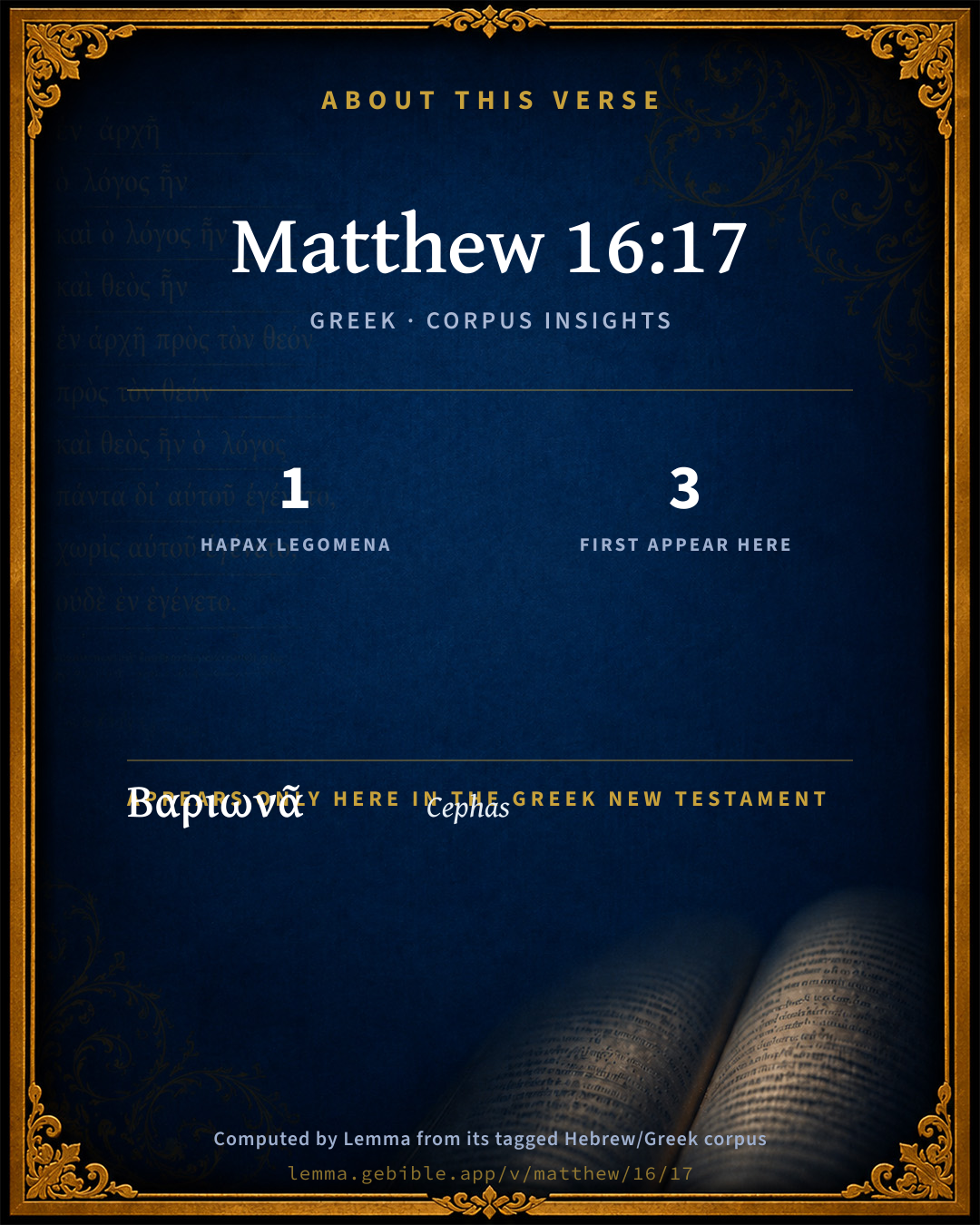
  • 1 hapax legomenon — only here in the Greek New Testament
  • 3 first appearances in the Greek New Testament
Full analysis ↓
Download a study sheet

One document with this verse’s original text, its word-by-word gloss line, the meaning frame, cross-references with their text, attributed commentary, and full source and license credits — printable, and it pastes into notes with its structure intact.

This verse Autodidact and up

Study sheet (.html) Plain text (.txt)

A passage Seminary Student

Up to 50 verses in one chapter. A passage sheet keeps up to 6 commentary sources and 12 cross-references per verse, in the order this page ranks them, and says so on the sheet whenever that leaves anything out. Ask for a single verse and you get the Autodidact verse sheet above.

Everything on this page stays free to read, with no account — the sheet is a download of what is already on screen, not access to it.

Want to remove ads? Support Godless Engineer
Compare translations 3

The same verse in 3 English versions, stacked beneath the original-language interlinear above. Click any original word for its lexicon entry.

Each is an independent rendering of the whole verse — the interlinear is not word-aligned to these translations.

Highlighted words mark where these versions differ — a whole-verse word diff, not a word-by-word alignment.

  • World English Bible Public Domain
    Jesus answered him, "Blessed are you, Simon Bar Jonah, for flesh and blood has not revealed this to you, but my Father who is in heaven.
  • King James Version Public Domain
    And Jesus answered and said unto him, Blessed art thou, Simon Barjona: for flesh and blood hath not revealed it unto thee, but my Father which is in heaven.
  • unfoldingWord Literal Text CC BY-SA 4.0
    Now answering, Jesus said to him, “Blessed are you, Simon Bar Jonah, because flesh and blood did not reveal this to you, but my Father in the heavens.

unfoldingWord Literal Text — © unfoldingWord, licensed CC BY-SA 4.0. Word-aligned USFM3 via Door43 (git.door43.org/unfoldingWord/en_ult).

Versions to compare (up to 4)

3 of 4 selected

Show all 19 translations

Every available English version of this verse, each an independent rendering of the whole verse.

  • World English Bible Public Domain
    Jesus answered him, "Blessed are you, Simon Bar Jonah, for flesh and blood has not revealed this to you, but my Father who is in heaven.
  • Berean Standard Bible Public Domain
    Jesus replied, “Blessed are you, Simon son of Jonah! For this was not revealed to you by flesh and blood, but by My Father in heaven.
  • Majority Standard Bible Public Domain
    Jesus replied, “Blessed are you, Simon son of Jonah! For this was not revealed to you by flesh and blood, but by My Father in heaven.
  • King James Version Public Domain
    And Jesus answered and said unto him, Blessed art thou, Simon Barjona: for flesh and blood hath not revealed it unto thee, but my Father which is in heaven.
  • American Standard Version (1901) Public Domain
    And Jesus answered and said unto him, Blessed art thou, Simon Bar-jonah: for flesh and blood hath not revealed it unto thee, but my Father who is in heaven.
  • Revised Version (1885) Public Domain
    And Jesus answered and said unto him, Blessed art thou, Simon Bar-Jonah: for flesh and blood hath not revealed it unto thee, but my Father which is in heaven.
  • Geneva Bible (1599) Public Domain
    And Iesus answered, and saide to him, Blessed art thou, Simon, the sonne of Ionas: for flesh and blood hath not reueiled it vnto thee, but my Father which is in heauen.
  • Douay-Rheims (1899) Public Domain
    And Jesus answering, said to him: Blessed art thou, Simon Bar-Jona: because flesh and blood hath not revealed it to thee, but my Father who is in heaven.
  • Young's Literal Translation Public Domain
    And Jesus answering said to him, `Happy art thou, Simon Bar-Jona, because flesh and blood did not reveal `it' to thee, but my Father who is in the heavens.
  • Literal Standard Version CC BY-SA 4.0
    And Jesus answering said to him, “Blessed are you, Simon Bar-Jona, because flesh and blood did not reveal [it] to you, but My Father who is in the heavens.
  • Unlocked Literal Bible CC BY-SA 4.0
    Jesus answered and said to him, “Blessed are you, Simon Bar Jonah, for flesh and blood have not revealed this to you, but my Father who is in heaven.
  • unfoldingWord Literal Text CC BY-SA 4.0
    Now answering, Jesus said to him, “Blessed are you, Simon Bar Jonah, because flesh and blood did not reveal this to you, but my Father in the heavens.
  • Darby Bible Public Domain
    And Jesus answering said to him, Blessed art thou, Simon Bar-jona, for flesh and blood has not revealed [it] to thee, but my Father who is in the heavens.
  • World Messianic Bible Public Domain
    Yeshua answered him, “Blessed are you, Simon Bar Jonah, for flesh and blood has not revealed this to you, but my Father who is in heaven.
  • Webster's Bible Public Domain
    And Jesus answered and said to him, Blessed art thou, Simon-Barjona: for flesh and blood hath not revealed it to thee, but my Father who is in heaven.
  • Free Bible Version CC BY-SA 4.0
    “You are truly blessed, Simon son of John,” Jesus told him. “For this wasn't revealed to you by human flesh and blood, but by my Father in heaven.
  • Bible in Basic English Public Domain
    And Jesus made answer and said to him, A blessing on you, Simon Bar-jonah: because this knowledge has not come to you from flesh and blood, but from my Father in heaven.
  • Text-Critical English NT CC BY 4.0
    And Jesus answered him, “Blessed are yoʋ, Simon Bar-Jonah, for flesh and blood has not revealed this to yoʋ, but my Father in heaven.
  • Tyndale New Testament (1534) Public Domain
    And Iesus answered and sayde to him: happy arte thou Simon the sonne of Ionas for fleshe and bloud hath not opened vnto the that but my father which is in heven.

Literal Standard Version (2020), Covenant Press — licensed CC BY-SA 4.0. Text via the HelloAO Bible API (eBible.org). Unlocked Literal Bible (unfoldingWord) — licensed CC BY-SA 4.0. Text via the HelloAO Bible API (eBible.org). unfoldingWord Literal Text — © unfoldingWord, licensed CC BY-SA 4.0. Word-aligned USFM3 via Door43 (git.door43.org/unfoldingWord/en_ult). Free Bible Version, Dr. Jonathan Gallagher — licensed CC BY-SA 4.0. Text via the HelloAO Bible API (eBible.org).

Word by word

More ways to search: Search by grammar → Find every occurrence → Compare this word →

Practice this passage: Drill this verse → Learn its vocabulary →

Βαριωνᾶ
Bariōnâs
G920
“Cephas”
Noun, Proper, indeclinable
Part of Speech
Noun · Proper, indeclinable
Full Thayer's Definition

Origin: of Aramaic origin H1247 and G3124

TDNT: None

Barjona = "son of Jonah" 1. the surname of the apostle Peter
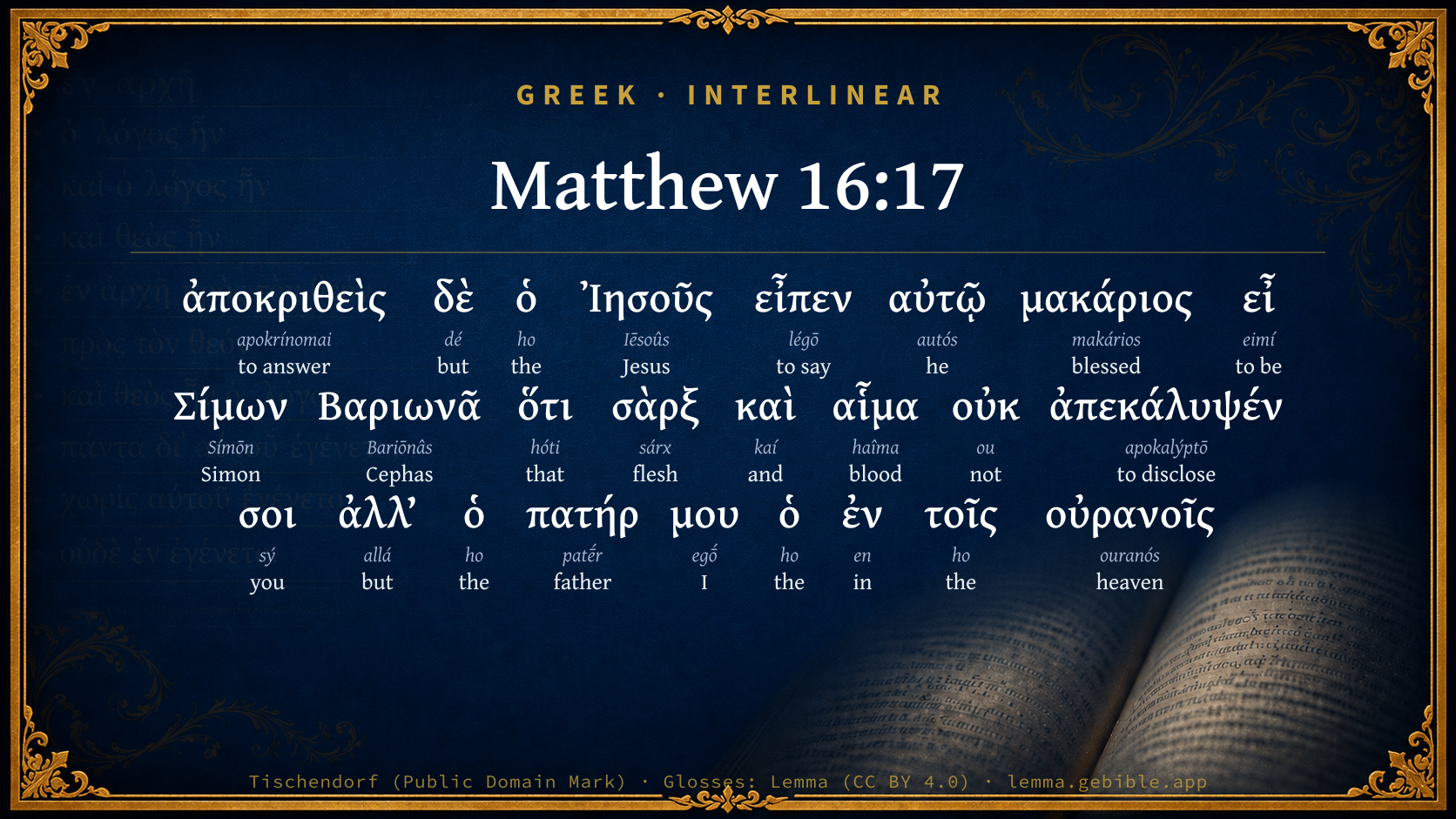
  1. ἀποκριθεὶς apokrínomai G611 “to answer” Verb, Aorist, Passive deponent, Participle, Nominative, Singular, Masculine
  2. δὲ dé G1161 “but” Conjunction
  3. ὁ ho G3588 “the” Article, Nominative, Singular, Masculine
  4. Ἰησοῦς Iēsoûs G2424 “Jesus” Noun, Nominative, Singular, Masculine
  5. εἶπεν légō G3004 “to say” Verb, Aorist, Active, Indicative, 3rd person, Singular
  6. αὐτῷ autós G846 “he” Personal pronoun, Dative, Singular, Masculine
  7. μακάριος makários G3107 “blessed” Adjective, Nominative, Singular, Masculine
  8. εἶ eimí G1510 “to be” Verb, Present, Active, Indicative, 2nd person, Singular
  9. Σίμων Símōn G4613 “Simon” Noun, Vocative, Singular, Masculine
  10. ὅτι hóti G3754 “that” Conjunction
  11. σὰρξ sárx G4561 “flesh” Noun, Nominative, Singular, Feminine
  12. καὶ kaí G2532 “and” Conjunction
  13. αἷμα haîma G129 “blood” Noun, Nominative, Singular, Neuter
  14. οὐκ ou G3756 “not” Particle, Negative
  15. ἀπεκάλυψέν apokalýptō G601 “to disclose” Verb, Aorist, Active, Indicative, 3rd person, Singular
  16. σοι sý G4771 “you” Personal pronoun, 2nd person, Dative, Singular
  17. ἀλλ’ allá G235 “but” Conjunction
  18. ὁ ho G3588 “the” Article, Nominative, Singular, Masculine
  19. πατήρ patḗr G3962 “father” Noun, Nominative, Singular, Masculine
  20. μου egṓ G1473 “I” Personal pronoun, 1st person, Genitive, Singular
  21. ὁ ho G3588 “the” Article, Nominative, Singular, Masculine
  22. ἐν en G1722 “in” Preposition
  23. τοῖς ho G3588 “the” Article, Dative, Plural, Masculine
  24. οὐρανοῖς ouranós G3772 “heaven” Noun, Dative, Plural, Masculine

About this verse

These counts appear in no published source. They are computed here, from the morphology-tagged text and Lemma’s own curated glosses. What Lemma adds →

25
words
22
distinct lemmas
Gospels
section

Notable vocabulary

1 hapax legomenon — a word that appears only here in the entire Greek New Testament:

  • Βαριωνᾶ Cephas G920

First appearance in Scripture

These words make their first canonical appearance in the Greek New Testament here:

  • Βαριωνᾶ Cephas G920
  • σὰρξ flesh G4561
  • αἷμα blood G129

Shared distinctive vocabulary

ἀπεκάλυψέν to disclose G601 occurs in 26 verses of the Greek New Testament. Also found in:

Repetition

A word recurs within this verse:

Cross-references

25

Topical passages linked to Matthew 16:17 in the Treasury of Scripture Knowledge — connected by theme and wording, ordered by reader-vote popularity; previews shown in the World English Bible.

  • John 6:45 It is written in the prophets, 'They will all be taught by God.' Therefore everyone who hears from the Father, and has learned, comes to me.
  • Ephesians 1:17–18 that the God of our Lord Jesus Christ, the Father of glory, may give to you a spirit of wisdom and revelation in the knowledge of him;
  • Matthew 11:25–27 At that time, Jesus answered, "I thank you, Father, Lord of heaven and earth, that you hid these things from the wise and understanding, and revealed them to infants.
  • Galatians 1:16 to reveal his Son in me, that I might preach him among the Gentiles, I didn't immediately confer with flesh and blood,
  • 1 John 5:20 We know that the Son of God has come, and has given us an understanding, that we know him who is true, and we are in him who is true, in his Son Jesus Christ. This is the true God, and eternal life.
  • 1 Corinthians 15:50 Now I say this, brothers, that flesh and blood can't inherit the Kingdom of God; neither does corruption inherit incorruption.
  • Matthew 13:16–17 "But blessed are your eyes, for they see; and your ears, for they hear.
  • Luke 10:21–24 In that same hour Jesus rejoiced in the Holy Spirit, and said, "I thank you, O Father, Lord of heaven and earth, that you have hidden these things from the wise and understanding, and revealed them to little children. Yes, Father, for so it was well-pleasing in your sight."
  • Galatians 1:11–12 But I make known to you, brothers, concerning the Gospel which was preached by me, that it is not according to man.
  • 1 Corinthians 2:9–12 But as it is written, "Things which an eye didn't see, and an ear didn't hear, Which didn't enter into the heart of man, These God has prepared for those who love him."
  • Isaiah 54:13 All your children shall be taught of Yahweh; and great shall be the peace of your children.
  • John 17:6–8 I revealed your name to the people whom you have given me out of the world. They were yours, and you have given them to me. They have kept your word.
  • Ephesians 3:5 which in other generations was not made known to the children of men, as it has now been revealed to his holy apostles and prophets in the Spirit;
  • Colossians 1:26–27 the mystery which has been hidden for ages and generations. But now it has been revealed to his saints,
  • John 1:42 He brought him to Jesus. Jesus looked at him, and said, "You are Simon the son of Jonah. You shall be called Cephas" (which is by interpretation, Peter).
  • John 21:15–17 So when they had eaten their breakfast, Jesus said to Simon Peter, "Simon, son of Jonah, do you love me more than these?" He said to him, "Yes, Lord; you know that I have affection for you." He said to him, "Feed my lambs."
  • Ephesians 2:8 for by grace you have been saved through faith, and that not of yourselves; it is the gift of God,
  • 1 Peter 5:1 I exhort the elders among you, as a fellow elder, and a witness of the sufferings of Christ, and who will also share in the glory that will be revealed.
  • 1 John 4:15 Whoever confesses that Jesus is the Son of God, God remains in him, and he in God.
  • Matthew 5:3–11 "Blessed are the poor in spirit, For theirs is the Kingdom of Heaven.
  • Ephesians 6:12 For our wrestling is not against flesh and blood, but against the principalities, against the powers, against the world's rulers of the darkness of this age, and against the spiritual hosts of wickedness in the heavenly places.
  • Hebrews 2:14 Since then the children have shared in flesh and blood, he also himself in like manner partook of the same, that through death he might bring to nothing him who had the power of death, that is, the devil,
  • 1 Peter 1:3–5 Blessed be the God and Father of our Lord Jesus Christ, who according to his great mercy became our father again to a living hope through the resurrection of Jesus Christ from the dead,
  • Luke 22:32 but I prayed for you, that your faith wouldn't fail. You, when once you have turned again, establish your brothers."
  • Ephesians 3:18–19 may be strengthened to comprehend with all the saints what is the breadth and length and height and depth,

Cross-references courtesy of OpenBible.info (CC BY 4.0).

Commentary

Notes on Matthew 16:17 from classic Christian and Jewish commentators (each source and its license shown beneath its notes). The classic Christian expositions comment on the surrounding passage and are grouped to its opening verse, so a note may address several verses; the Jewish commentaries on the Tanakh (Rashi and others) are per-verse, so they appear only where the commentator wrote on this verse.

Lemma curates 59 commentaries, every one of them public domain or Creative Commons licensed, each selected and text-cleaned for this edition rather than reprinted as found. About our sources →

The Biblical Illustrator

Joseph S. Exell

Mat_16:13; Mat_16:17

Whom do men say that I, the Son of man, am?

Confession and cross-bearing

I. The confession.

1. The substance of the confession.

2. The source of the confession (Mat_16:17).

3. The power of the confession (Mat_16:18-19).

4. The limitations of the confession (Mat_16:20).

II. The covenant of the christian church

1. The dignity of cross-bearing (Mat_16:21; Mat_16:23).

2. The necessity of crossbearing (Mat_16:24-26).

3. The rewards of cross-bearing (Mat_16:27-28). (Monday Club Sermons.)

The Son of man-the Son of God

I. The question of Jesus Christ-Whom do men, etc.

1. The first word we shall emphasize is the word men. His mind soars above all national distinctions.

2. The other word we shall emphasize is the word Son of man. He is humanity condensed.

3. We shall next emphasize the two words together-men and Son of man. The Saviour presents Himself on the level of our common humanity, and appeals to our common sense, our common nature, to say who He is.

II. The answer of the world.

III. The answer of the church. (J. C. Jones.)

Christ the universal man

He is not an excrescence of our nature. No poet He, no philosopher He, no man of science He. He was all these in one, He was man, thorough man, growing out of the depths of our nature. The sea on the surface is divided into waves-go down and you will soon come to a region where there are no waves, where there is nothing but water. And humanity on the surface is broken into nationalities and individualities. But go down a little way, and you will soon come to a region where differences give place to resemblances: force your way down and you will soon arrive at the region of human unities, where every man is like every other man. Now Jesus Christ emerges from the profoundest depths of our nature, from the region of unities. No Jew He-no Greek He-no Roman He-but Man. He touches you and me not in our branches but in our roots. Show me an oak and show me an ash tree: it is easy to tell the difference between them in the branches, but not so easy in the roots. Show me a rose and show me a tulip: any one can tell the difference between them in the leaf, but only a very few can tell the difference between them in their seeds. And Jesus Christ is the Root of Jesse, the Seed of Abraham and of David; and all nations and all men in their roots and seeds are very much alike. (Monday Club Sermons)

The true idea of Christ to be obtained from the New Testament rather than from creeds

Creeds embody the ripest and most advanced thoughts of the ages they represent. It is not against the use of creeds that I speak-we cannot very conveniently do without them-but against their abuse, against setting them up in every jot and tittle as infallible standards for all subsequent ages. If you look at a picture of the sky in our picture galleries, you will find that with rare exceptions it has been rendered too hard and too material. The sky on canvas is a ceiling beyond which the eye cannot wander. But if you go out of the gallery a very different sky will open itself before you-a sky which seems to recede for ever before your vision. The sky of painters is too often a thing to be looked at; the sky of nature is not a thing to be looked at, but a thing to be looked through. In like manner, the truth concerning Christ as rendered in creeds and systems is hard and dry-it is the sky of the picture. The truth concerning Christ as presented in the Gospels is deep, living, infinite-it is the sky of nature. And I greatly rejoice that men try to understand the Christ of the Gospels and not the Christ of the creeds, the Christ of the evangelists and not the Christ of the schools. Thou art the Christ, the Son of the living God. (Monday Club Sermons.)

Christ the centre of theology

An American writer says: We have in our congregation a little deaf and dumb boy. On Sunday he loves to have his mother find for him the words that we are all singing, though the music never thrills his quiet ear, nor touches his heart. He looks at the hymn, glides his little finger over every word to the end; if he finds Jesus there, he is satisfied and absorbed to the close of the singing; but if the word Jesus is not there, he closes the book, and will have nothing more to do with it. So should we test the religions of the day-if we find Jesus the central thought of any system of theology, it is good, it will do for us; if not, turn away and have nothing to do with it.

Christ mentally conceived

He was conceived over thirty years ago in the nature of man, but in the text for the first time is He conceived in the mind of man; and the conception in the mind was as necessary to our salvation as the conception in the nature. (Monday Club Sermons.)

Opinion sought by a question

Benjamin Franklin made an experiment, one of the most daring ever made by mortal man. Seeing a cluster of thunder-clouds hanging overhead, he let fly into their midst a paper kite, to which was attached a metallic chain. As the kite was flying among the clouds, anxiety weighed heavily on his heart. At last he presumptuously applied his knuckles to the chain and called forth sparks of wild lightning; and had the stream of electricity been a little stronger at the time, the philosopher would have met with instantaneous death. He has left on record, that so surprising was the discovery to him, that in the ecstasy of the moment he expressed his willingness to die there and then. In like manner there were clouds of opinion afloat in society respecting Jesus Christ, indeed the thunder-clouds were gathering fast. Whom do men say that I, the Son of man, am? … Some say that Thou art John the Baptist-that is one cloud. Others, Elias-that is another cloud. Others, Jeremiah, or one of the prophets-that is a cluster of clouds. Everything seemed mist and haze, vagueness and uncertainty. Jesus Christ prayerfully and anxiously flies a question into the midst of these dark clouds. What will the result be? His heart trembles, therefore He prays. See the question fly-But whom say ye that I am? What answer will be called forth? Simon Peter answered and said, Thou art the Christ, the Son of the living God. (Monday Club Sermons.)

The Christ of God

I. The question-Whom say ye that I am? It is a great mercy that Jesus calls out the faith that is in His disciples. By what various means of questioning does He speak? Sometimes by conscious afflictions; by our very fails. This is the question of questions; not what we think of Churches, disciples, but of Christ.

II. The answer-Thou art the Christ, etc. There was little comparative light in the apostles before the Day of Pentecost; the Holy Spirit must teach to saving profit. But they were still His disciples, though their faith was small. It is humbling that, having so much more light than they, we should have less love. All the glory of Christ as the Mediator hangs upon the glory of His Person. If a mere creature, His work is comparatively nothing.

III. The vast encouragement-Blessed art thou. The infinite condescension of Jesus. He takes notice and encourages the weakest faith.

1. How blessed the condition of those who have been taught this lesson. Flesh and blood hath not revealed it. Nature, education, miracles, never taught it. What a foundation for strong confidence. He, the Son of God.

2. How great the sin of the man who rejects this Son of the living God. (J. H. Evans, M. A.)

Peters faith

I. Peters faith.

II. The source of Peters faith.

III. What Peters faith qualified him to be.

IV. The special reward of Peters faith. Conclusion: How can we become stones in Christs Church? Not naturally. Only by having Peters faith. In Jesus as the Christ. In Jesus as the Son of God. How may we get this faith? God alone can give it-ask Him. (E. Stock.)

Peters compression

How hearty and distinct is this utterance! This is the first Confession of Faith. This is the true Apostles Creed. These are the prime and essential articles of catholic verity, upon which rest all sound theology and all saving faith. In this short but illustrious statement, says a great theologian, you have the whole truth with respect to the Person and the work of Jesus Christ.

1. It is plainly implied that Jesus Christ possesses human nature, a true body and a reasonable soul. He put the question as the Son of man. He was a real man.

2. The confession of Peter asserts the divinity as well as the humanity of our Lord. He calls Him the Son of the living God. This expression denotes Divine nature. He is set forth as a Divine Person in the Old Testament. He manifested Himself in this character in the days of His flesh, etc. Had He been less than Divine, He could not have been the Saviour.

3. The confession of Peter asserts the truth with regard to the office or work as well as the Person of the Son of God. He declares that He is the Christ, that is, the Messiah, etc. And for what end? It is to save sinners. This is the great work given Him to do. He is the only, the all-sufficient, Saviour of sinners. To Him alone belongs all the glory. Believest thou these things? Is this thy heartfelt creed and confession? (A. Thompson.)

Christs appeal to our individual faith

This is a most pertinent question now. Reasons why we should ask it of ourselves.

I. We are in danger, as the disciples were, of being affected by the crude opinions of men about our Lord, and His religion, and His Church.

II. The question is vital, for it asserts the great truth that only a deep, strong faith will ever inspire confidence in others.

III. It shows us how dear to Christ is the personal faith of the soul. (Ellison Capers.)

Right apprehensions of the character of Christ essential to salvation

I. That there are many opinions about Christ.

1. As regards His Person.

2. As regards the nature of the work which He came to accomplish.

3. As regards His religion, His acquirements, and His claims.

II. It is of the utmost importance that we form correct and decided opinions on this subject. Our opportunities of doing so are very great. (Dr. T. Raffles.)

Whom do men say that I am?-

I. That when Christ became a man he could not seem divine according to the pre-conceptions of men, who looked for the exhibition of that which appeals to the sense, and who did not look for inward harmony. Christ did bring with Him the Divine nature, but not the attributes of Jehovah disclosed in their amplitude. He humbled Himself.

II. Every person came to Christ through some elements that were in himself. Some came to Him through the door of sympathy; some from lower motives. What is Christ to you? Is He part of your life? (H. W. Beecher.)

The personal affirmations of Christ

What did Christ teach concerning Himself?

1. He affirmed the divinity of His redemptive mission.

2. His independence of, and separation from, the world.

3. His pre-existence.

4. Some of the affirmations of Christ contain most impressive representations of His character and work-I am the Bread of Life, I am the Light of the World, I am the Door, I am the True Vine.

5. Some of the affirmations of our Lord contain wondrous glimpses of His grace and glory.

6. His second coming in great glory. (G. W. McCree.)

Public opinion concerning Jesus Christ

1. Was not Christ superior to what men thought about him? He did not stoop to public opinion, but was anxious to know that men had clear and right conceptions concerning Him; that He did not live and teach in vain. What are men saying in yonder workshop of you?

2. We must try and find out what is the public opinion to-day about Christ, and instruct, correct it, gently. (W. Cuff.)

Christs divinity incidentally indicated in the New Testament, not logically proved

It is in these incidental ways that we see Jesus Christ best. Yes, and I will venture to say that it is in these incidental ways we see all men best. We do not understand men best because we see them in their great efforts. Please do not take me to the poet, if you want me to understand him thoroughly, when he has got his pen, ink, and paper ready to write his great poem. I should see him then in a great mood, but I should not see him in an incidental way, and in all the little things that make up the mans character. I do not want to see Mr. Gladstone when he is braced up to chop down an ash-tree; nor do I want to see him as he has braced himself to make a great speech in the House of Commons. I should want to see him as his wife sees him; and I venture to say that we should understand him better in that than in any other way. Your wife knows you better than anybody else; she sees you in the little things of every-day life, and it is in these incidental ways that the great things and the great truths come up all through the life and teachings of Jesus Christ. You do not value that clock yonder for its striking capacity. I do not know whether it strikes at all; however, it has a very fine musical bell in it that knocks off twelve, when it is twelve, in a quick or slow manner, but you would not value it for that. You value the clock for its capacity to tell you every minute of the time and every hour of the day. And just as you look at the little things on the face, and get the minutes as well as the hour, you value the clock for its correctness. (W. Cuff.)

Varied views of Christ

We find Christ so differently because we seek Him in such very different ways. We cannot have a uniform Christ any more than we can have a uniform experience. In essence, in character, in love, in pity, Jesus Christ will ever be the same to every sinner who comes to Him, but as we come to Him we shall seem to have a very different Christ, because we use our own glasses, and, therefore, see Him from different points of view, and have different convictions about Him. Here is a person who comes to Jesus Christ, who has been educated and brought up in a manner of refinement and beauty, whose home has been the centre of everything that was charming; his mother was gentle, and sweet as an angel, his education from boarding-school days until he settled himself in life was all that could be desired to train the taste, to balance the judgment, and to make the character round, unique, and beautiful. By-and-by he comes to Jesus Christ, and he comes along such a different path to that man over there, for he was born down a back street, where hardly a gleam of sunshine ever burst through his mothers window, and he hardly ever saw a beautiful flower; certainly his boyish feet never tripped along a green field; he never heard the birds sing in the wood, nor saw the light and charm of nature as others have seen it; rough, rude, uneducated, unable to read one word of the New Testament. By-and-by that man comes to Christ, and he sits in the church at the Lords table by the side of that other educated and refined Christian. If they compare notes they will seem to have a very different Christ, because they came along such very different roads up to the cross. I believe, brethren, that that first view of Jesus in the souls experience makes a vast deal of difference to his whole thinking and to his whole life about the Saviour whom he first saw. Oh, what passion burns in one man, and what calm, strong, intellectual, and dignified faith wrestles and grapples in the other, as he comes up first to look at Jesus Christ. John Newton saw Him like this:-

I saw One hanging on a tree

In agonies and blood,

Who fixed His languid eyes on me,

As near His cross I stood;

And never till my latest breath

Shall I forget that look,

It seemed to charge me with His death,

Though not a word He spoke.

James Allen saw Him like this:-

Sweet the moments, rich in blessing,

Which before the cross I spend,

Love and health and peace possessing,

From the sinners dying friend.

Here it is I find my heaven

While upon His cross I gaze,

Love I much? Ive more forgiven,

I am a miracle of grace.

So the poets and hymn-writers came to Him differently, and seemed to take a different view of Him. (W. Cuff.)

The revelation of Christ often misinterpreted

Payson, when he lay on his bed dying, said: All my life Christ has seemed to me as a star afar off; but little by little He has been advancing and growing larger and larger, till now His beams seem to fill the whole hemisphere, and I am floating in the glory of God, wondering with unutterable wonder how such a mote as I should be glorified in His light; but he came to that after a long life. (H. W. Beecher.)

The revelation of Christ an inward power, rather than a scientific belief

But how many people there are whose God is no bigger than a confession of faith! How many persons have a God that is like a dried specimen of a flower in a herbarium, which is good for science, and for nothing else? But Christ is a power-a glory-a life; and he that has come to Christ, and accepted Him even in the smallest degree, to him it is given to become, and to know that he is becoming, a son of God. To all of you I say, stand fast in the faith, in the inward sense, of a living Saviour. Love Him and trust Him. (H. W. Beecher)

The revelation of Christ perfected in heaven

And remember that what you see now is full of mixture-that, like ill-blown glass, it is full of crinckles-that it is full of elements that are drawn from the peculiarities of your own nature. Look upon Christ as one that, all after, much as He is to you, is to be revealed in you-that is to say, when you have grown, when you have been cleansed, when you leave this body behind, and when you rise to stand face to face with God, the little that you knew before will be as what a man has seen who has never been out of his garden here compared with what he would see if he were, by some power, translated into a tropical forest. He has seen growths in a northern clime largely developed under glass, but oh, to see the growths that have been developed by the tropical powers of nature! And when we shall see Him as He is-in magnitude-in wonderful disposition-in profound, and sweet, and life-giving influences-then, with an ecstasy of joy, we shall cast our crowns at His feet and say: Not unto us, not unto us, but unto Thy name be the praise. (H. W. Beecher)

Perverse views of Christ

Well, now I must gather up the fragments and close; and I will do so by saying that there will be, as there have been, very different answers given as to who the Son of man is. There always were different answers; there always must be; because men look at Christ as they look at other men and other things. We do not all look at the New Testament through the same mental laws; and that makes all the difference in the answer we shall give to the question, Whom do you say I, the Son of God, am? You know if you go to the photographers shop and ask the artist to be kind enough to let you look through the lens covered by that little black piece of cloth, and if you look at the chair on which you have to sit for your portrait, it is reversed, and the opposite of what you expected it to be. That is how some men look at other men. They always see them reversed-very different to what they are. That is precisely the kind of lens that many bring to the New Testament to look at Christ. (W. Cuff.)

Religious affections produce a conviction of reality

Spiritual things have the influence of reality upon renewed persons. Their eyes are opened to see that the doctrines of the Bible are really true. Not all religious affections are attended with this conviction, because not produced by the spiritual illumination of the mind. Whore the understanding is spiritually enlightened, the affections do not spring from so-called discoveries, from a strong confidence of their good estate, from a strong persuasion that the Christian religion is true as the result of education, or from mere reasons and arguments. Spiritual affections spring from the beauty of Divine things; their beauty is discerned through the illumination of the mind; and this view produces the conviction of their reality.

I. Directly. The judgment is directly convinced of the divinity of the gospel by the clear view of its inherent glory and excellence. Many things in the gospel are hid from the eyes of natural men which are manifest to those who have a spiritual sense and taste, and to whom the beauty and glory of the gospel are revealed. To them alone religion becomes experimental. Were it otherwise, the illiterate and the heathen could not have so thorough a conviction as to embrace the gospel and hazard every earthly thing for its possession. God gives to these some sort of evidence that His covenant is true beyond all mere probability or historical evidence, which the illiterate are capable of, and which produces the full assurance of faith. They become witnesses to the truth through being spiritually enlightened. Infidelity never prevailed so much in any age as in this, wherein these arguments (from ancient traditions, histories and monuments) are handled to the greatest advantage. To be a witness is to see the truth.

II. Indirectly.

1. This view of Divine glory removes enmities and prejudices of the heart, so that the mind is more open to the force of the reasons which are presented.

2. And, by thus removing hindrances, it positively helps reason. It makes even the speculative notions more lively. In this way truly gracious affections are distinguished from others, for gracious affections are evermore attended with such a conviction of the judgment.

III. Some conclusions.

1. There is a degree of conviction which arises from the common enlightenings of the Spirit of God. This may lead to belief, but not to the spiritual conviction of truth, and the apprehension of its Divine beauty and glory.

2. There are extraordinary impressions on the imagination, which are delusive, and produce only a counterfeit faith.

3. Those beliefs of truth, which rest merely upon our supposed interest in what the gospel reveals and promises, are also vain. (J. Edwards.)

St. Peter here confesses that our Lord is

I.

(1) The Christ-not merely an anointed one, as priests and prophets of old might have been anointed, but that He is the One anointed of God, having received this gift in a super-eminent manner.

(2) The Son-not one son merely out of many, but that He was so beyond all others, and in a way which singled Him out from them. Son and only-begotten, not by grace, but of the substance of the Father.

(3) The Son of the living God-not of the gods of the heathen world, the object of Gentile idolatry, but the Son of the One living, and true God, who has life in Himself, who is uncreated life-the living life-giving principle to all mankind.

(4) That He is Christ and at the same time Son of the living God-in contradistinction to the crowd, who believed Him to be the Baptist, Elias, or one of the prophets; Peter acknowledged Him to be Christ, and the Son of the living God.

II. In this confession there are included these. Truths-

(1) The nature which Christ took; the human nature, that is, which was anointed or consecrated.

(2) The anointing which He received, the fulness of the Holy Spirit, imparted without measure to Christ at His conception.

(3) The object of this anointing-that He might be the Christ, the King, the Priest, the Prophet of His people. (W. Denton, M. A.)

.

This truth was not revealed to Peter-

(1) By carnal men, nor indeed by men at all, since man cannot of himself make known the things of the Spirit;

(2) Through mere carnal reasoning (1Co_2:11.);

(3) Nor was it the revelation of Christs flesh. It was not merely that Peter had been able to pierce beyond the veil of Christs human nature, and through that, and by means of that, to understand the Divinity. No. It was the direct act of the Father, by which he was enlightened. (W. Denton, M. A.)

The Biblical Illustrator, edited by Joseph S. Exell (c. 1880s–1900s) — public domain. Text from a community e-Sword module.

Joseph Benson's Commentary

Mat 16:17. Jesus answered, Blessed [or happy, as μακαριος signifies] art thou, Simon Bar-jona, (or the son of Jonas,) namely, in being brought thus firmly to believe and confess this most important truth, on believing and confessing which the present and everlasting salvation of mankind depends. For flesh and blood hath not revealed it unto thee — “Thou hast not learned it by human report, or the unassisted sagacity of thy own mind; but my Father in heaven has discovered it to thee, and wrought in thy soul this cordial assent, in the midst of those various prejudices against it which present circumstances might suggest.” Our Lord proceeds, and promises, (alluding to his surname of Peter, from πετρα, a rock,) that he should have a principal concern in establishing Christ’s kingdom. Thou art Peter — As if he had said, “Thou art, as thy name signifies, a substantial rock; and as thou hast shown it in this good confession, I assure thee that upon this rock I will build my church. Faith in me as the Son of God shall be its great support, and I will use thee as a glorious instrument in raising it: yea, so immoveable and firm shall its foundation be, and so secure the superstructure, that though earth and hell unite their assaults against it, and death in its most dreadful forms be armed for its destruction; the gates of hell, or the unseen world, shall not finally prevail against it to its ruin: but one generation of Christians shall arise after another, even to the very end of time, to maintain this truth, and to venture their lives and their souls upon it, till at length the whole body of them be redeemed from the power of the grave.” See Doddridge, who further observes, “This is one of those scriptures, the sense of which might be most certainly fixed by the particular tone of voice and gesture with which it was spoken. If our Lord altered his accent, and laid his hand on his breast, it would show that he spoke, not of the person, but of the confession of Peter, (as most Protestant divines have understood it,) and meant to point out himself as the great foundation.” Compare 1Co 3:10-11. In confirmation of this sense, it may be observed, that when our Lord says, Upon this rock, he does not make use of the word πετρος, as if he referred to Peter himself, but πετρα, which is an appellative noun, and immediately refers to Peter’s confession. “But if, when our Lord uttered these words, he turned to the other apostles, and pointed to Peter, that would show he meant to intimate the honour he would do him, in making him an eminent support to his church. This is the sense which Grotius, Le Clerc, Dr. Whitby, and L’Enfant defend. But to be a foundation in this sense, was not Peter’s honour alone; his brethren shared with him in it, (see Eph 2:20; Rev 21:14,) as they did also in the power of binding and loosing, Mat 18:18; Joh 20:23. — On the whole, how weak the arguments are which the Papists draw from hence, to support the supremacy of Peter in their wild sense of it, is sufficiently shown by Bishop Burnet On the Articles, p. 196; Dr. Barrow On the Creed, sermon twenty- eight; Dr. Patrick in his sermon on this text, and many more not necessary to be named. There seems a reference in this expression to the common custom of building citadels upon a rock.” The gates of hell — As gates and walls were the strength of cities, and as courts of judicature were held in their gates, this phrase properly signifies the power and policy of Satan and his instruments: shall not prevail against it — Not against the church universal, so as to destroy it. And they never did, for there hath been a small remnant in all ages. And they never will, for faithful is he who hath made this promise, and he will certainly fulfil it.

Joseph Benson's Commentary on the Old and New Testaments (1811–1818) — public domain. Text from a community e-Sword module.

Tyndale Open Study Notes

Tyndale Open Resources

16:17 God revealed to Peter his plan of salvation in Jesus, the Messiah. This moment of revelation was a high point in the unfolding of God’s will for humanity (cp. Gal 1:16; 3:23; Eph 3:5).

Tyndale Open Study Notes — © Tyndale Open Resources, licensed CC BY-SA 4.0. Text via the HelloAO Bible API.

Bengel's Gnomon

Johann Albrecht Bengel

Mat 16:17. Μακάριος, blessed) This word signifies a condition not only blessed, but at the same time rare; see ch. Mat 13:16. Jesus had not previously told His disciples explicitly that He was the Christ. He had done and said those things by which, through the revelation of the Father, they might recognise Him as the Christ.—Σίμων Βὰρ Ἰωνᾶ, Simon Bar-jona) This express naming signifies that the Lord knoweth them that are His, and recalls to Peters remembrance that sample of omniscience which had been given to him in Joh 1:42; cf. ibid. Mat 21:15.[738]—ΣᾺΡΞ ΚΑῚ ΑἿΜΑ, flesh and blood) i.e. any man whatsover; flesh and blood are put by metonymy[739] for body and soul: see Eph 6:12; Gal 1:16. No mortal at that time knew this truth before Peter; see Mat 16:14.—ΟὐΚ ἈΠΕΚΆΛΥΨΕ, hath not revealed) The knowledge of Christ is not obtained except by Divine revelation; see ch. Mat 11:27.—ὁ Πατήρ Μου, κ.τ.λ., My Father, etc.) By these words the sum and substance of Peter’s confession is repeated and confirmed. The heavenly Father had revealed it to Peter by the teaching of Jesus Christ, and thus inscribed it on the apostle’s heart.

[738] Peter himself hardly thought that he was so acceptable [before God]. Blessed is the man, not he who attributes aught to himself on his own authority, but whom the Lord pronounces to be blessed.—V. g.

[739] See explanation of technical terms in Appendix.—(I. B.)

Bengel's Gnomon of the New Testament — English translation (T&T Clark, Edinburgh, 1860) — public domain. Text from a community e-Sword module.

Meyer's Critical & Exegetical Commentary

Heinrich August Wilhelm Meyer

Mat_16:17. Simon, son (בַּר) of Jona, a solemnly circumstantial style of address, yet not intended as a contrast to the designation of him as Peter which is about to follow (de Wette), in connection with which view many expositors have allegorized the Βαριωνᾶ in an arbitrary and nugatory fashion, but merely on account of the importance of the subsequent statement, in which case Βαριωνᾶ is to be ascribed to the practice of adding the patronymic designation, and blending the βάρ. with the proper name (Mat_10:3; Act_13:6; Mar_10:46).

ὅτι] because thou art favoured far above my other followers in having had such a revelation as this.

σὰρξ κ. αἷμα] בָּשָׂר וְדָם (among the Rabbis), paraphrastic expression for man, involving the idea of weakness as peculiar to his bodily nature, Sir_14:18; Lightfoot on this passage; Bleeks note on Heb_2:14. Comp. the note on Gal_1:16; Eph_6:12. Therefore to be interpreted thus: no weak mortal (mortalium ullus) has communicated this revelation to thee; but, and so on. Inasmuch as ἀποκαλύπτειν, generally, is a thing to which no human being can pretend, the negative half of the statement only serves to render the positive half all the more emphatic. Others refer σὰρξ κ. αἷμα to ordinary knowledge and ideas furnished by the senses, in contradistinction to πνεῦμα (de Wette, following Beza, Calvin, Calovius, Neander, Olshausen, Glöckler, Baumgarten-Crusius, Keim). Incorrectly, partly because the lower part of mans nature is denoted simply by σάρξ, not by σὰρξ κ. αἷμα (in 1Co_15:50 the expression flesh and blood is employed in quite a peculiar, a physical sense), partly because ἀπεκάλυψε (Mat_11:25) compels us to think exclusively of a knowledge which is obtained in some other way than through the exercise of ones human faculties. For a similar reason, the blending of both views (Bleek) is no less objectionable.

It must not be supposed that, in describing this confession as the result of a divine revelation, there is anything inconsistent with the fact that, for a long time before, Jesus had, in word and deed, pointed to Himself as the Messiah (comp. above all the Sermon on the Mount, and such passages as Mat_11:5 f., 27), and had also been so designated by others (John the Baptist, and such passages as Mat_8:29, Mat_14:33), nay, more, that from the very first the disciples themselves had recognised Him as the Messiah, and on the strength of His being so had been induced to devote themselves to His person and service (Mat_4:19; Joh_1:42; Joh_1:46; Joh_1:50); nor are we to regard the point of the revelation as consisting in the ὁ υἱὸς τ. θεοῦ τ. ζῶντος, sometimes supposed (Olshausen) to indicate advanced, more perfect knowledge, a view which it would be difficult to reconcile with the parallel passages in Mark and Luke; but observe: (1) That Jesus is quite aware that, in spite of the vacillating opinions of the multitude, His disciples continue to regard Him as the Messiah, but, in order to strengthen and elevate both them and Himself before beginning (Mat_16:21) the painful and trying announcement of His future sufferings, and as furnishing a basis on which to take His stand in doing so, He seeks first of all to elicit from them an express and decided confession of their faith. (2) That Peter acts as the mouthpiece of all the others, and with the utmost decision and heartiness makes such a declaration of his belief as, at this turning-point in His ministry, and at a juncture of such grave import as regards the gloomy future opening up before Him, Jesus must have been longing to hear, and such as He could not fail to be in need of. (3) That He, the heart-searching one, immediately perceives and knows that Peter (as ὁ τοῦ χοροῦ τῶν ἀποστόλων κορυφαῖος, Chrysostom) was enabled to make such a declaration from his having been favoured with a special revelation from God (Mat_11:27), that He speaks of the distinction thus conferred, and connects with it the promise of the high position which the apostle is destined to hold in the church. Consequently ἀπεκάλυψε is not to be understood as referring to some revelation which had been communicated to the disciples at the outset of their career as followers of Jesus, but it is to be restricted to Peter, and to a special revelation from God with which he had been favoured. This confession, founded as it was upon such a revelation, must naturally have been far more deliberate, far more deeply rooted in conviction, and for the Lord and His work of far greater consequence, than that contained in the exclamation of the people in the boat (Mat_14:33) when under the influence of a momentary feeling of amazement, which latter incident, however, our present passage does not require us to treat as unhistorical (Keim and others); comp. note on Mat_14:33.

Observe, further, how decidedly the joyful answer of Jesus, with the great promise that accompanies it, forbids the supposition that He consented to accept the title and dignity of a Messiah only from not being able to avoid a certain amount of accommodation to the ideas of the people (Schenkel; see, on the other hand, Weissenborn, p. 43 ff.).

Meyer — Critical and Exegetical Commentary on the New Testament — English translation by Peter Christie, edited by Frederick Crombie (T&T Clark, 1880) — public domain. Text from a community e-Sword module.

Expositor's Greek Testament

ed. W. Robertson Nicoll

Mat 16:17-19 . Solemn address of Jesus to Peter , peculiar to Mt., and of doubtful authenticity in the view of many modern critics, including Wendt ( Die Lehre Jesu , i., p. 181), either an addendum by the evangelist or introduced at a later date by a reviser. This question cannot be fully discussed here. It must suffice to say that psychological reasons are in favour of something of the kind having been said by Jesus. It was a great critical moment in His career, at which His spirit was doubtless in a state of high tension. The firm tone of conviction in Peter’s reply would give Him a thrill of satisfaction demanding expression. One feels that there is a hiatus in the narratives of Mk. and Lk.: no comment, on the part of Jesus, as if Peter had delivered himself of a mere trite commonplace. We may be sure the fact was not so. The terms in which Jesus speaks of Peter are characteristic warm, generous, unstinted. The style is not that of an ecclesiastical editor laying the foundation for Church power and prelatic pretensions, but of a noble-minded Master eulogising in impassioned terms a loyal disciple. Even the reference to the “Church” is not unseasonable. What more natural than that Jesus, conscious that His labours, outside the disciple circle, have been fruitless, so far as permanent result is concerned, should fix His hopes on that circle, and look on it as the nucleus of a new regenerate Israel, having for its raison d’être that it accepts Him as the Christ? And the name for the new Israel, ἐκκλησία , in His mouth is not an anachronism. It is an old familiar name for the congregation of Israel, found in Deut. (Mat 18:16 ; Mat 23:2 ) and Psalms (Mat 22:26 ), both books well known to Jesus.

Mat 16:17 . μακάριος : weighty word chosen to express a rare and high condition, virtue, or experience (“hoc vocabulo non solum beata, sed etiam rara simul conditio significatur,” Beng.). It implies satisfaction with the quality of Peter’s faith. Jesus was not easily satisfied as to that. He wanted no man to call Him Christ under a misapprehension; hence the prohibition in Mat 16:20 . He congratulated Peter not merely on believing Him to be the Messiah, but on having an essentially right conception of what the title meant. Σ . Βαριωνᾶ : full designation, name, and patronymic, suiting the emotional state of the speaker and the solemn character of the utterance, echo of an Aramaic source, or of the Aramaic dialect used then, if not always, by Jesus. σὰρξ καὶ αἷμα : synonym in current Jewish speech for “man”. “Infinitâ frequentiâ hanc formulam loquendi adhibent Scriptores Judaici, eaque homines Deo opponunt.” Lightfoot, Hor. Heb. Vide Mat 16:23 . There is a tacit contrast between Peter’s faith and the opinions of the people just recited, as to source. Flesh and blood was the source of these opinions, and the fact is a clue to the meaning of the phrase. The contrast between the two sources of inspiration is not the very general abstract one between creaturely weakness and Divine power (Wendt, Die Begriffe Fleisch und Geist , p. 60). “Flesh and blood” covers all that can contribute to the formation of religious opinion of little intrinsic value tradition, custom, fashion, education, authority, regard to outward appearance. Hilary, and after him Lutteroth, takes the reference to be to Christ’s flesh and blood, and finds in the words the idea: if you had looked to my flesh you would have called me Christ, the Son of David , but higher guidance has taught you to call me Son of God . ὁ πατήρ μου : this is to be taken not in a merely ontological sense, but ethically, so as to account for the quality of Peter’s faith. The true conception of Christhood was inseparable from the true conception of God. Jesus had been steadily working for the transformation of both ideas, and He counted on the two finding entrance into the mind together. No one could truly conceive the Christ who had not learned to think of God as the Father and as His Father. There were thus two revelations in one: of God as Father, and of Christ by the Father. Peter had become a Christian .

The Expositor's Greek Testament, edited by W. Robertson Nicoll (1897–1910) — public domain. Text from a community e-Sword module.

International Critical Commentary

17-19. The editor here inserts three verses which are not in Mk. For the prominence given to S. Peter, cf. 10:2, 14:28-31, 15:15.

(L)

17. And Jesus answered and said to him, Blessed art thou, Simon Bar Jona, because flesh and blood did not reveal (it) to thee, but My Father who is in the heavens.]—Σίμων] for the form, see on 4:18. βάρ is the Aramaic “son,” and Ἰωνᾶ (cf. Joh 1:43) = יונה = Jouah יונא as a shortened form of יוחנן = John, is not found elsewhere. See Dalm. Gram. p. 179, Anm. 5.—σὰρξ καὶ αἷμα] בשר ודם is very common in the Talmud and Midrashim as an expression for humanity as contrasted with God; cf. B. Berakhoth 28b “a king of flesh and blood,” contrasted with “the King of kings, “the fear of flesh and blood” contrasted with the “fear of heaven.”—ὁ πατήρ μου ὁ ἐν τοῖς οὐρανοῖς] see on 5:16.

(L)

17-19. The whole passage, therefore, might be paraphrased thus: “Happy are you, Simon, son of Jonah, because the truth to which you have given utterance was revealed to you by God Himself. Your name is Petros, and this truth is a rock (πέτρα) upon which I will build My Church. It will be the foundation truth of the belief of My disciples, i.e. of those who await the kingdom of heaven. In that kingdom you shall hold an exalted position, having the keys of administrative power, and the right to legislate for the needs of its citizens.”

As an alternative, we might interpret τὰς κλεῖς with special reference to the function of a key in opening shut doors. Cf. Mat 23:13 “You shut the kingdom of the heavens before men: for you enter not, nor suffer those who are entering to go in”; Luk 11:52 “You took away the key of knowledge,” i.e. refused to open the doors of the kingdom of “knowledge” to others. δώσω σοὶ τὰς κλεῖς woe will then mean: “I will give to you the right of admitting others to the kingdom.” The Evangelist may very possibly have had in mind the part taken by S. Peter in the early days of the Church in admitting Gentiles to its privileges, just as in the “binding” and “loosing” he may have had in mind the prominent part taken by S. Peter in regulating the affairs of the infant Church.

It is possible that originally the “keys” described the effect of S. Peter’s insight into divine truth. His perception that Jesus was the Divine Son, was a key which admitted him into the kingdom. By bringing others to the same faith, he would open for them, too, the kingdom, in contrast to the scribes and Pharisees, who locked it in the face of those who wished to enter, 23:13. But, if so, the Evangelist by inserting v. 18 before v. 19, and by combining the saying about “the keys” with the saying about “binding” and “loosing,” has obscured the original meaning. In his connection the “keys” are not equivalent to S. Peter’s faith, but represent a privilege promised to the Apostle as a reward for it. Further, the position of v. 18, with its description of the Church as a fortress impregnable against the attacks of evil (the gates of Hades), suggests irresistibly that “the keys of the kingdom” mean more than power to open merely, and imply rather authority within the kingdom. And this is confirmed by the “binding” and “loosing” which immediately follow. The latter saying occurs again with the verbs in the plural in 18:18. This may be its more original form. If so, the Evangelist is here, as elsewhere, compiling detached sayings, fitting them into contexts which seemed to him to be suited to them. If we remove, therefore, 19b as alien to the context, we are justified in asking whether the remaining three verses originally formed part of this incident. V. 17 is in every respect suitable to the context. V. 18 might seem to betray the hand of the Evangelist in the phrase οἰκοδομήσω μου τὴν ἐκκλησίαν, which certainly seems to reflect ideas which presuppose the history and growth of Christianity in the early Apostolic age. But if Christ, wishing to commend S. Peter’s faith, drew from his name a metaphor, “the rock,” to symbolise the value and importance of the revealed truth to which S. Peter had given utterance, this metaphor of the rock would suggest the phrase “to build” rather than any such expression as “My disciples shall stand.” ἐκκλησία may well be the equivalent of some Aramaic expression for community, society, school, band of disciples. Further, the idea thus gained of the Christian body as a building firmly founded, would suggest the use of the common phrase “gates of Hades” to describe the forces of evil which would attack it. And it is possible that this latter phrase would suggest the keys of the kingdom of the heavens as a term expressing some privilege to be given to S. Peter. The real difficulty in supposing that vv. 17-19a were spoken on this occasion, lies in the vagueness of the idea thus expressed. What were the keys thus given? Even if we identify the kingdom with the Church, it is not entirely satisfactory to suppose that the Lord simply foretold that S. Peter was to take a prominent part in the work of opening the door of faith to the Gentiles. His share in that work, though a great, was not an exclusive one. S. Paul bore the burden of it. Of course we might, without identifying Church and Kingdom, give the words some such meaning as this. The truth of the divine Sonship shall be the keynote of the doctrine of My disciples in their work of preaching the coming kingdom. All to whom this truth is revealed will have in it a key to the kingdom, and will be able to admit others to it, i.e. make them members of the society which waits for the kingdom. In this case S. Peter would be mentioned on the ground that it was he who had given utterance to the divinely revealed truth, with the implication that all to whom it should be revealed would have the same privileges. But in view of the fact that v. 19b is almost certainly added to this context and modified by the Evangelist so as to apply specially to S. Peter, it is difficult not to be drawn to the conclusion that the whole of the passage, vv. 17-19, inserted in S. Mark, is the work of the Evangelist. The motive must have been to emphasise the prominence of S. Peter in the Christian body as foretold and sanctioned by Christ Himself. Throughout the Gospel the twelve Apostles are everywhere represented in a more favourable light than in Mk. Rebukes addressed to them by Christ are softened, see on 8:26, 16:9. Statements that they did not understand, or did not know what to say, or disputed, are passed over, cf. Mar 6:52, Mar 6:9:5, Mar 6:10, Mar 6:32, Mar 6:33, Mar 6:34, Mar 6:14:40. On the other hand, it is expressly said that they did understand, Mat 16:12, Mat 17:13. They had left all to follow Christ; but when He sat on the throne of His glory they would sit on twelve thrones, judging the twelve tribes of Israel, 19:28. And amongst them Peter was pre-eminent. He was πρῶτος, 10:2. He had shown remarkable ventures of faith, 14:29-31. To him Christ had given the keys, and the power of “binding” and “loosing.” It is, therefore, possible that 16:17-19 are in their present order and connection the work of the Evangelist compiling detached sayings in honour of the great Apostle. The Jewish colouring in these sayings is very remarkable; σὰρξ καὶ αἶμα, ὁ πατήρ μου ὁ ἐν τοῖς οὐρανοῖς, πύλαι ᾅδου, τὰς κλεῖς, ἡ βασιλεία τῶν οὐρανῶν, the “binding” and “loosing,” the literary contrast of “earth” and “heaven,” were probably all commonplaces of Jewish theological thought. The single word ἐκκλησία alone lies open to the suspicion of betraying Christian influence, and it may easily be explained as representing a more specifically Jewish or less Christian word.

(M)

International Critical Commentary — older volumes (1896–1929), various authors — public domain. Text from a community e-Sword module.

Geneva Bible (1599)

Geneva Bible translators

Faith is of grace, not of nature.

By this kind of speech is meant man’s natural procreation upon the earth, the creature not being destroyed which was made, but deformed through sin: So then this is the meaning: this was not revealed to thee by any understanding of man, but God showed it thee from heaven.

Geneva Bible (1599) marginal notes — public domain. Text via Bolls.life.

Jamieson, Fausset & Brown

Robert Jamieson, A. R. Fausset & David Brown

And Jesus answered and said unto him, Blessed art thou--Though it is not to be doubted that Peter, in this noble testimony to Christ, only expressed the conviction of all the Twelve, yet since he alone seems to have had clear enough apprehensions to put that conviction in proper and suitable words, and courage enough to speak them out, and readiness enough to do this at the right time--so he only, of all the Twelve, seems to have met the present want, and communicated to the saddened soul of the Redeemer at the critical moment that balm which was needed to cheer and refresh it. Nor is Jesus above giving indication of the deep satisfaction which this speech yielded Him, and hastening to respond to it by a signal acknowledgment of Peter in return.

Simon-Barjona--or, "son of Jona" (Joh 1:42), or "Jonas" (Joh 21:15). This name, denoting his humble fleshly extraction, seems to have been purposely here mentioned, to contrast the more vividly with the spiritual elevation to which divine illumination had raised him.

for flesh and blood hath not revealed it unto thee--"This is not the fruit of human teaching."

but my Father which is in heaven--In speaking of God, Jesus, it is to be observed, never calls Him, "our Father" (see on Joh 20:17), but either "your Father"--when He would encourage His timid believing ones with the assurance that He was theirs, and teach themselves to call Him so--or, as here, "My Father," to signify some peculiar action or aspect of Him as "the God and Father of our Lord Jesus Christ."

Jamieson, Fausset & Brown — Commentary Critical and Explanatory on the Whole Bible (1871) — public domain (CC PDM 1.0). Text via the HelloAO Bible API.

Adam Clarke's Commentary

Verse 17. Blessed art thou, Simon Bar-jona] Or Simon, son of Jonah; so Bar-jonah should be translated, and so it is rendered by our Lord, Joh 1:42. Flesh and blood - i.e. MAN; - no human being hath revealed this; and though the text is literal enough, yet every body should know that this is a Hebrew periphrasis for man; and the literal translation of it here, and in Ga 1:16, has misled thousands, who suppose that flesh and blood signify carnal reason, as it is termed, or the unregenerate principle in man. Is it not evident, from our Lord's observation, that it requires an express revelation of God in a man's soul, to give him a saving acquaintance with Jesus Christ; and that not even the miracles of our Lord, wrought before the eyes, will effect this? The darkness must be removed from the heart by the Holy Spirit, before a man can become wise unto salvation.

Adam Clarke's Commentary on the Bible (1810–1826) — public domain. Text from a community e-Sword/MySword module.

Ellicott's Commentary for English Readers

(17) Blessed art thou, Simon Bar-jona.—Looking to the reality of our Lord’s human nature, its capacity for wonder (Mar_6:6, Luk_7:9), anger (Mar_3:5), sorrow (Joh_11:35, Luk_19:41), and other emotions, it is not over-bold to recognise in these words something like a tone of exalted joy. It is the first direct personal beatitude pronounced by Him; and, as such, presents a marked contrast to the rebukes which had been addressed to Peter, as to the others, as being “without understanding,” “of little faith,” with “their heart yet hardened.” Here, then, He had found at last the clear, unshaken, unwavering faith which was the indispensable condition for the manifestation of His kingdom as a visible society upon earth. The beatitude is solemnised (as in Joh_1:42) by the full utterance of the name which the disciple had borne before he was called by the new name of Cephas, or Peter, to the work of an Apostle. He was to distinguish between the old natural and the new supernatural life. (Comp. Joh_21:15.)

Flesh and blood hath not revealed it unto thee.—Better, It was not flesh and blood that revealed. The words are used in their common Hebrew meaning (as in Joh_1:13; 1Co_15:50; Eph_6:12) for human nature, human agency, in all their manifold forms. The disciple had received the faith which he now professed, not through popular rumours, not through the teaching of scribes, but by a revelation from the Father. He was led, in the strictest sense of the words, through the veil of our Lord’s human nature to recognise the divine.

A Bible Commentary for English Readers, edited by Charles John Ellicott (1878–1897) — public domain. Text from a community e-Sword module.

The Cambridge Bible for Schools and Colleges

gen. ed. J. J. S. Perowne

17. Bar-jona] “son of Jonah.” Bar is Aramaic for son; cp. Barabbas, Bar-tholomew, Bar-nabas.

for flesh and blood, &c.] Not man, but God; “flesh and blood” was a common Hebrew expression in this contrast.

The Cambridge Bible for Schools and Colleges (gen. ed. J. J. S. Perowne; Cambridge University Press, 1878–1918) — public domain. Text from a community e-Sword module.

John Gill's Exposition

And I say also unto thee,.... Either besides what he had already said concerning his happiness; or, as the father had revealed something great and valuable, so likewise would he; or inasmuch as he had freely said and declared who, and what he was, in like manner he also would say what Peter was, thou art Peter: intimating, that he was rightly called Peter, or Cephas, by him, when he first became a follower of him, Mat 4:18, which words signify the same thing, a rock, or stone; because of his firmness and solidity, and because he was laid upon the sure foundation, and built on the rock Christ, and was a very fit stone to be laid in the spiritual building. The aptness of this name to him is easy to be seen in his full assurance of faith, as to the person of Christ, and his free, open, and undaunted confession of him.

And upon this rock will I build my church: by the church, is meant, not an edifice of wood, stones, &c. but an assembly, and congregation of men; and that not of any sort; not a disorderly, tumultuous assembly, in which sense this word is sometimes taken; nor does it design the faithful of a family, which is sometimes the import of it; nor a particular congregated church, but the elect of God, the general assembly and church of the first born, whose names are written in heaven; and especially such of them as were to be gathered in, and built on Christ, from among the Jews and Gentiles. The materials of this building are such, as are by nature no better, or more fit for it, than others: these stones originally lie in the same quarry with others; they are singled out, and separated from the rest, according to the sovereign will of God, by powerful and efficacious grace; and are broken and hewn by the Spirit of God, generally speaking, under the ministry of the word, and are, by him, made living stones; and being holy and spiritual persons, are built up a spiritual house: and these are the only persons which make up the true and invisible church of Christ in the issue, and are only fit to be members of the visible church; and all such ought to be in a Gospel church state, and partake of the privileges of it: these materials are of different sorts, and have a different place, and have a different usefulness in this building; some are only as common stones, and timber; others are as pillars, beams, and rafters; and all are useful and serviceable; and being put, and knit together, grow up as an holy temple to the Lord: and are called, by Christ, "my" church, because given him by the Father; and he has purchased them with his own blood; are built by him, and on him; inhabited by him, and of whom he is the head, king, and governor; though not to the exclusion of the Father, whose house they also are; nor of the Spirit, who dwells in them, as in his temple. This church Christ promises to "build". Though his ministers are builders, they are but under builders; they are qualified, employed, directed, encouraged, and succeeded by him; he is the wise, able, and chief master builder. This act of building seems to have a special regard to the conversion of God's elect, both among Jews and Gentiles, particularly the latter; and to the daily conversions of them in all ages; and to the building up of saints in faith and holiness; each of which will more manifestly appear in the latter day; and are both generally effected through the word, and ordinances, as means, the Spirit of Christ blessing them. By the rock on which Christ builds his church, is meant, not the person of Peter; for Christ does not say, upon thee Peter, but upon this rock, referring to something distinct from him: for though his name signifies a rock, or stone, and there may be some allusion to it; and he is so called because of his trust and confidence in the Lord, on whom he was built; but not because he was the foundation on which any others, and especially the whole church, were built: it is true, he may be called the foundation, as the rest of the twelve apostles of the Lamb are, Eph 2:20 without any distinction from them, and preference to them; they and he agreeing in laying doctrinally and ministerially Christ Jesus as the foundation of faith and hope, but not in such sense as he is; neither he, nor they, are the foundation on which the church is built, which is Christ, and him only. Moreover, what is said to Peter in these, and the following words, is not said to him personally and separately from the rest of the apostles, but is designed for them, as well as him, as appears by comparing them with Mat 18:18. As he spoke in the name of them all, to Christ; so Christ spake to him, including them all. Peter had no preeminence over the rest of the apostles, which he neither assumed, nor was it granted; nor would it ever have been connived at by Christ, who often showed his resentment at such a spirit and conduct, whenever there was any appearance of it in any of them; see Mat 18:1 and though Peter, with James, and John, had some particular favours bestowed on him by Christ; as to be at the raising of Jairus's daughter, and at the transfiguration of Christ on the mount, and with him in the garden; and he appeared to him alone after his resurrection, and before he was seen by the rest of the disciples; yet in some things he was inferior to them, being left to deny his Lord and master, they did not; and upon another account is called Satan by Christ, which they never were; not to mention other infirmities of his, which show he is not the rock: and, after all, what is this to the pope of Rome, who is no successor of Peter's? Peter, as an apostle, had no successor in his office; nor was he bishop of Rome; nor has the pope of Rome either his office, or his doctrine: but here, by the rock, is meant, either the confession of faith made by Peter; not the act, nor form, but the matter of it, it containing the prime articles of Christianity, and which are as immoveable as a rock; or rather Christ himself, who points, as it were, with his finger to himself, and whom Peter had made such a glorious confession of; and who was prefigured by the rock the Israelites drank water out of in the wilderness; and is comparable to any rock for height, shelter, strength, firmness, and duration; and is the one and only foundation of his church and people, and on whom their security, salvation, and happiness entirely depend. Christ is a rock that is higher than they, where they find safety in times of distress, and the shadow of which is refreshing to them; and therefore betake themselves to him for shelter, and where they are secure from the wrath of God, and rage of men: he is the rock of ages, in whom is everlasting strength; and is the sure, firm, and everlasting foundation on which the church, and all true believers, are laid: he is the foundation of their faith, and hope, and everlasting happiness, and will ever continue; and the gates of hell shall not prevail against it. The Jews speak of the gates of hell: sometimes of the gate of hell, in the singular number (p); and sometimes of the gates of hell, in the plural number. They say (q), that

"Mnhygl vy Myxtp hvlv, "hell has three gates", one in the wilderness, one in the sea, and one in Jerusalem.''

They talk (r) of

"an angel that is appointed , "over the gates of hell", whose name is Samriel; who has three keys in his hands, and opens three doors.''

And elsewhere (s) they say, that

"he that is appointed over hell his name is Dumah, and many myriads of destroying angels are with him, and he stands , "at the gate of hell"; and all those that keep the holy covenant in this world, he has no power to bring them in.''

Our Lord may allude to these notions of the Jews, and his sense be, that all the infernal principalities and powers, with all their united cunning and strength, will never be able to extirpate his Gospel, to destroy his interest, to demolish his church in general, or ruin anyone particular soul that is built upon him. Again, the gates of "Hades", or hell, sometimes seem to design no other than the gates of death, and the grave, and persons going into the state of death; see Job 38:17 where the Septuagint use the same phrase as here; and then the sense is, that neither death, nor the grave, shall finally, and totally prevail over the people of God, and members of Christ; but they shall be raised out of such a state, and live gloriously with him for ever. By it here is not meant Peter himself; though it is true of him, that Satan, and his posse of devils that beset him, did not prevail against him, so as to destroy his grace, hurt his estate, and hinder his salvation: nor could death, in all its frightful appearances, deter him from holding, and preaching, and maintaining the doctrine of Christ; and though death, and the grave, have now power over him, yet they shall not always detain him: but rather, it designs the doctrine Peter made a confession of; which, though it may be opposed by hell and earth, by Satan, and his emissaries, by the open force of persecutors, and the secret fraud of heretics, it may be brought into contempt by the scandalous lives of professors; and though the true professors of it may die off, yet truth itself always lives, and defies the power of death, and the grave: or else the church in general is meant, and every true believer. These words do not ascertain the continuance of anyone particular congregated church, but secures the church universal, which will continue as long as the sun and moon endure, and the perseverance of everyone of God's elect; and assure that death, and the grave, shall not always have the dominion over the saints, but that they shall be rescued from them. Once more, this "it" may refer to Christ the rock, who, though he was brought to the dust of death, by the means of Satan, and the powers of darkness, yet to the ruin of him that had the power of death; and though death, and the grave, had power over him for a while, yet could not hold him; he rose victorious over them, and ever lives, having the keys of hell and death, to open the gates thereof, and let his people out when he thinks fit.

(p) T. Bab. Sabbat, fol. 39. 1. Succa, fol. 32. 2. Bava Bathra, fol. 84. 1. (q) T. Bab. Erubin, fol. 19. 1. Menasseh ben Israel, Nishmat Chayim, fol, 33. 1, 2. (r) Zohar in Gen. fol. 47. 4. (s) Ib. fol. 7. 1.

John Gill's Exposition of the Whole Bible (1746–1763) — public domain (CC PDM 1.0). Text via the HelloAO Bible API.

Trapp's Complete Commentary

John Trapp

17 And Jesus answered and said unto him, Blessed art thou, Simon Barjona: for flesh and blood hath not revealed it unto thee, but my Father which is in heaven.

Ver. 17. Blessed art thou, Simon] These and the following words of our Saviour to Peter were meant to all the apostles also, Joh 20:22-23. Christ took his beginning of one, to teach unity in his Church, in the confession of faith. Note this against the Papists, who miserably wrest and deprave this text, to the proving of the papal monarchy. Gregory the Great, though he styled himself a servant of God’s servants, and detested the pope of Constantinople for arrogating the title of Universal Bishop, during the reign of Mauritius; yet when he was slain, and succeeded by the traitor Phocas, he ceased not to flatter the same Phocas, to commend unto him the care of the Church of Rome, and to exhort him to remember this saying of our Saviour, "Thou art Peter," &c., and for no other end, than that he might extend his power by the favour of the parricide.

John Trapp, A Commentary or Exposition upon All the Books of the Old and New Testament (1647–1656) — public domain. Text from a community e-Sword module.

Haydock's Catholic Bible Commentary

Blessed art thou, Simon Bar-Jona. Greek: Simon is undoubtedly Greek: Sumeon, as written 2 Peter i. 1. Greek: Bariona is son of Jona, or John, an abridgment for Greek: Barioanna. Bar, in Chaldaic, is son; hence St. Peter is called, in John xi, 16. and 17, Simon, son of John. It was customary with the Jews to add to a rather common name, for the sake of discrimination, a Greek: patronumikon, or patronymic, as appears from Matthew x. 3. and xxiii. 35. Mark ii. 14. John vi. 42. (Pastorini)

George Leo Haydock (1774–1849), Haydock's Catholic Family Bible and Commentary, 1859 edition — public domain. Excludes Psalms (Douay-Rheims chapter numbering differs from Protestant) and Deuterocanonical books (Catholic canon only).

Matthew Poole's English Annotations

Our Lord appeareth here to be mightily pleased with this confession of Peter and the rest of his disciples, (for we shall observe in the Gospel, that Peter was usually the first in speaking, Joh 6:68), he pronounces him

blessed, and giveth the reason of it afterward.

Simon bar-jona, that is, Simon son of Jona, or, as some would have it, son of John (they think Jona is a contraction of Johanna). Our Lord gives him the same name, Joh 21:15.

For flesh and blood hath not revealed it unto thee, but my Father which is in heaven. By flesh and blood our Saviour meaneth man, and the reason and wisdom of man. Thus it is often used in Scripture, Isa 40:5; Gal 1:16; Eph 6:12. Some note it always signifieth so when it is in Scripture opposed to God. Thou hast not learned this by tradition, or any dictates from man, nor yet by any human ratiocination, but from my Father which is in heaven. This confirmeth what we have Eph 2:8, that faith is the gift of God. No man cometh to the Son, but he whom the Father draweth, Joh 6:44. Men may assent to things from the reports of men, or from the evidence of reason, but neither of these is faith. Faith must be an assent to a proposition upon the authority of God revealing it. Nor doth any man truly and savingly believe that Jesus Christ is the eternal Son of God, and the Saviour of the world, but he in whom God hath wrought such a persuasion; yet is not the ministry of the word needless in the case, because, as the apostle saith, faith comes by hearing, and ministers are God’s instruments by whom men believe. No faith makes a soul blessed but that which is of the operation of God.

Matthew Poole's English Annotations on the Holy Bible (1683–1685) — public domain. Text from a community e-Sword/MySword module.

Whedon's Commentary on the Bible

Daniel D. Whedon

17. Blessed art thou — Highest of blessings, to be the confessor and apostle of the Son of God. Bar-jonah — Son of Jonah. Spoken simply as a matter of solemn emphasis. Flesh and blood — Mere frail humanity, whether of himself or others. Our Lord had already thanked his Father that while he hid these things from the wise and prudent he had revealed them unto babes. See note on Mat_11:25. No wisdom of man, therefore, but the guidance of God, had made him an apostle and revealed the Messiah to him.

Daniel D. Whedon (gen. ed.), Commentary on the Old and New Testaments (1874–1909) — public domain. Text from a community e-Sword module.

The Pulpit Commentary

Jesus answered and said unto him. This weighty and momentous answer is given alone by St. Matthew. St. Mark, who wrote under the instruction of Peter, and for Roman Christians, mentions it not; the other two evangelists are equally silent, having evidently not understood the special importance attached to it. Blessed art thou, Simon Bar-jona. "Blessed," as in the sermon on the mount, (Mt 5) expressing a solemn benediction, not a mere encomium. Peter was highly favoured by a special revelation from God. Christ calls him "son of Jona," to intimate that Peter"s confession is true that he himself is as naturally and truly Son of God as Peter is son of Jona. So Christ addresses him when he restores the fallen apostle at the Sea of Galilee after the second miraculous draught of fishes, reminding him of his frail human nature in the face of great spiritual privileges. (Joh_21:15, etc.; comp. Mat_1:4) Simon would be the name given at his circumcision; Bar-jona, a patronymic to distinguish him from others of the same name. For (oti). This introduces the reason why Christ calls him "Blessed." Flesh and blood. This is a phrase to express the idea of the natural man, with his natural endowments and faculties. So St. Paul says, (Gal_1:16) "I conferred not with flesh and blood;" and "Our wrestling is not against flesh and blood". (Eph_6:12) The Son of Sirach speaks of "the generation of flesh and blood" (Ecc 14:18). No natural sagacity, study, or discernment had revealed the great truth. None of these had overcome slowness of apprehension, prejudices of education, slackness of faith. No unregenerate mortal man had taught him the gospel mystery. My Father which is in heaven. Christ thus accepts Peter"s definition of him as "the Son of the living God." None but the Father could have revealed to thee the Son.

The Pulpit Commentary (1880–1919), ed. H.D.M. Spence-Jones & Joseph S. Exell — public domain. Text from a community e-Sword module.

John Wesley's Explanatory Notes

Flesh and blood - That is, thy own reason, or any natural power whatsoever.

John Wesley, Explanatory Notes Upon the Whole Bible (1754–1765) — public domain. Text via the GEBible commentary corpus.

Scofield Reference Notes

C. I. Scofield

Barjona

Son of Jonas.

The Scofield Reference Bible (1917 edition), notes by C. I. Scofield — public domain. Text from a community e-Sword module.

The People's New Testament

B. W. Johnson

17. Blessed art thou, Simon Bar-jona. Happy are all lips that make this confession, for such shall be confessed before the Father in heaven. For flesh and blood hath not revealed it unto thee, but my Father. This holy and blessed confession no one can make from the heart unless he is moved by the Spirit. See 1 John 4:1, 2.

B. W. Johnson's The People's New Testament with Notes (1889–1891) — public domain. Electronic text from the Christian Classics Ethereal Library (CCEL) ThML edition.

unfoldingWord translationNotes

Door43 World Missions Community

Simon Bar Jonah

"Simon son of Jonah" (See: How to Translate Names)

flesh and blood have not revealed

Here "flesh and blood" refers to a human being. AT: "a human did not reveal" (See: Synecdoche)

this to you

Here "this" refers to Peter's statement that Jesus is the Christ and the Son of the Living God.

but my Father who is in heaven

The understood information can be made clear. AT: "but it was my Father in heaven who revealed this to you" (See: Ellipsis)

my Father

This is an important title for God that describes the relationship between God and Jesus. (See: Translating Son and Father)

I also say to you

This adds emphasis to what Jesus says next.

you are Peter

The name Peter means "rock." (See: Assumed Knowledge and Implicit Information)

upon this rock I will build my church

Here "build my church" is a metaphor for uniting the people who believe in Jesus into a community. Possible meanings are 1) "this rock" represents Peter, or 2) "this rock" represents the truth that Peter had just said in Matthew 16:16. (See: Metaphor)

The gates of Hades will not prevail against it

Here "Hades" is spoken of as if it were a city surrounded by walls with gates that keep dead people in and other people out. Here "Hades" represents death, and its "gates" represent its power. Possible meanings are 1) "the powers of death will not overcome my church" or 2) "my church will break down the power of death the way an army breaks into a city." (See: Metaphor and Metonymy)

translationWords

Jesus

bless

Peter

flesh

blood

reveal

God the Father

heaven

church

gate

Hades

unfoldingWord translationNotes — © Distant Shores Media and the Door43 World Missions Community, licensed CC BY-SA 4.0. Source: git.door43.org/Door43/en_tn.

Cambridge Greek Testament for Schools and Colleges

17. Βὰρ Ἰωνᾶ, ‘son of Jonah,’ or ‘son of John.’ The Greek form may stand for either name (see Bp. Lightfoot on a Fresh Revision of N.T., pp. 159, 160); but the reading adopted by the best editors Joh 1:43, υἱὸς Ἰωάνου, seems conclusive in favour of the latter rendering. Bar is Aramaic for son; cp. Bar-abbas, Bar-tholomew, Bar-nabas.

ὅτι σὰρξ καὶ αἷμα κ.τ.λ. Not man, but God; ‘flesh and blood’ was a common Hebrew expression in this contrast. The recognition was not by material test or human judgment, but by the witness of the Holy Spirit.

Cambridge Greek Testament for Schools and Colleges (Cambridge University Press, 1896; 21 vols, various authors incl. Carr, Maclear, Plummer, Farrar, Lumby, Moule, M. R. James, Simcox) — public domain. Text from a community e-Sword module.

Alford’s Greek Testament

Henry Alford

17.] μακάριος, as in ch. 5:4, &c., is a solemn expression of blessing, an inclusion of him to whom it is addressed in the kingdom of heaven, not a mere word of praise. And the reason of it is, the fact that the Father had revealed the Son to him (see ch. 11:25-27); cf. Gal 1:15, Gal 1:16, in which passage the occurrence of σαρκὶ καὶ αἵματι seems to indicate a reference to this very saying of the Lord. The whole declaration of St. Paul in that chapter forms a remarkable parallel to the character and promise given to St. Peter in our text,—as establishing Paul’s claim to be another such πέτρα or στύλος as Peter and the other great Apostles, because the Son had been revealed in him not of man nor by men, but by God Himself. The name Simon Bar Jonas is doubtless used as indicating his fleshly state and extraction, and forming the greater contrast to his spiritual state, name, and blessing, which follow. The same ‘Simon son of Jonas’ is uttered when he is reminded by the thrice repeated enquiry, ‘Lovest thou me?’ of his frailty, in his previous denial of his Lord.

Henry Alford, The Greek Testament (1849–1861) — public domain. Text from a community e-Sword module.

Vincent's Word Studies in the New Testament

Marvin R. Vincent

Blessed [μακαριος] . See on ch. Mt 5:3.

Marvin R. Vincent, Word Studies in the New Testament (1887–1900) — public domain. Text from a community e-Sword/MySword module.

Lesson kit

Teaching starters — assembled from the data on this page, not authored interpretation. Every prompt links to the verse data it draws on. Edit before teaching.

Matthew, in the Gospels, opens this verse with 25 words (22 distinct Greek lemmas). Its most distinctive word is Bariōnâs (“Cephas”). A historical commentator’s framing appears above. Read the whole chapter for the surrounding context.

Discussion questions

  1. The word Bariōnâs carries the sense “Cephas.” How does it shape the verse?
  2. 1 word here appears nowhere else in the Greek New Testament. Why might the author reach for such rare wording?
  3. 3 words make their first appearance in Scripture here. What does this debut establish?
  4. How does Matthew 10:26, which shares the word «to disclose», read alongside this verse?
  5. What does the repetition of “the” (4× in this one verse) do in this verse?
  6. These translations render this verse differently. What is at stake in choosing one wording over another?
  7. Compare how The Biblical Illustrator and Joseph Benson's Commentary read this verse. Where do they agree or differ?

Things to notice

  • 1 word in this verse appears nowhere else in the Greek New Testament.
  • 3 words make their first canonical appearance in Scripture here.
  • These translations choose different wording for 17 words in this verse.
  • “the” occurs 4× in this single verse.
  • 22 distinct Greek lemmas span 25 words in this verse.

Reading settings

Reading text

Shown beneath each verse's original-language words.

Old Testament
Old Testament edition

Read the OT as the Masoretic Hebrew (MT) or the Greek Septuagint (LXX).

English shown for the Greek Septuagint (in the Hebrew ↔ Greek comparison).

Comparing translations? Open the Compare panel on any verse page to stack up to four side by side.