Matthew 13:43

Greek (Tischendorf 8th ed.) Matthew 13:43 appears in the Greek New Testament. The text above is from the Tischendorf 8th edition. Each word links to its Strong’s number and a concise gloss. Click any word for its full Thayer’s Greek Lexicon entry.
Download image
Cite this verse

Matthew 13:43 (World English Bible). Public Domain. Lemma interlinear Bible study tool, https://lemma.gebible.app/v/matthew/13/43.

Show BibTeX & RIS
BibTeX
RIS
English Translation
Then the righteous will shine forth like the sun in the Kingdom of their Father. He who has ears to hear, let him hear.
World English Bible · Public Domain
Highlights
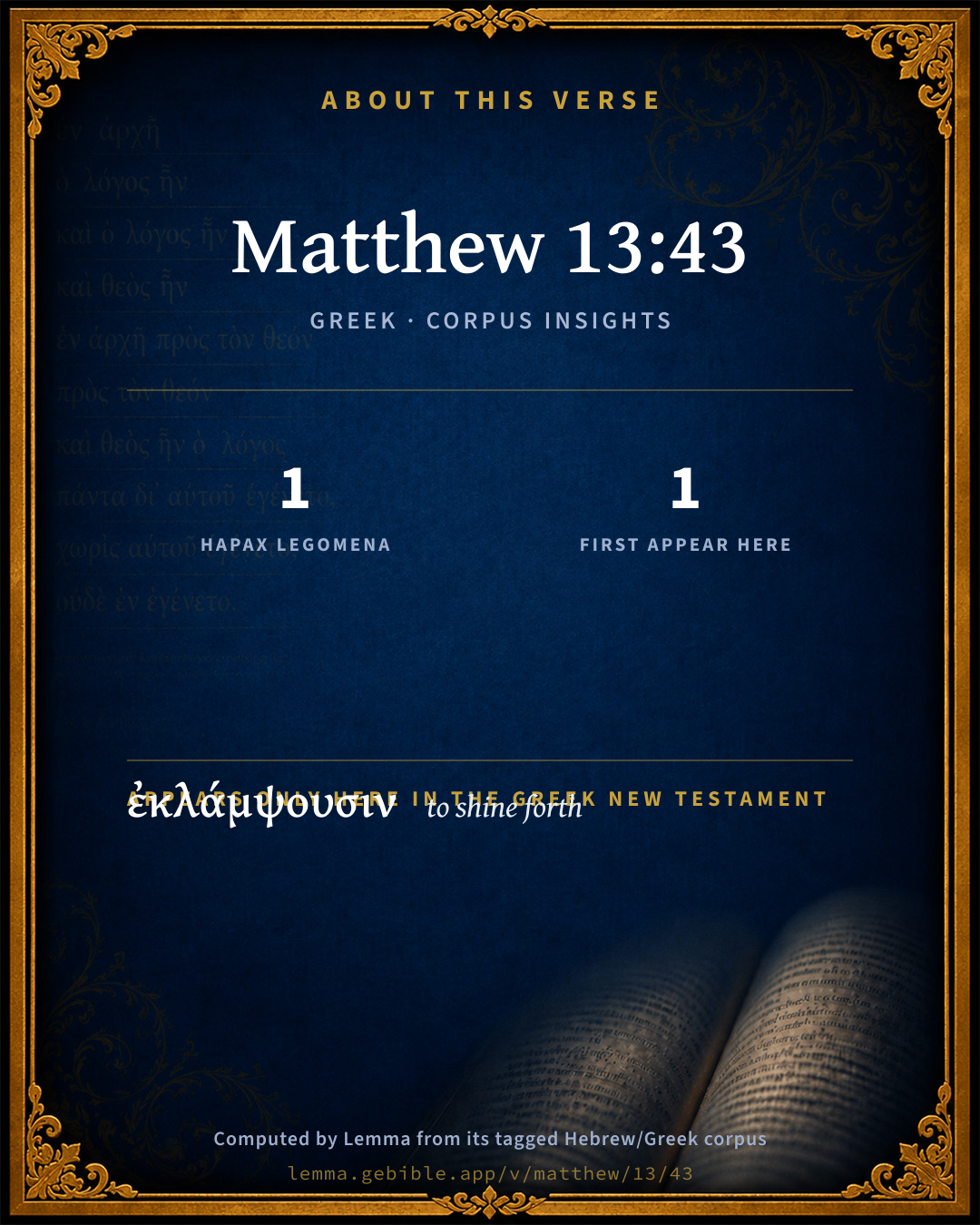
  • 1 hapax legomenon — only here in the Greek New Testament
  • 1 first appearance in the Greek New Testament
Full analysis ↓
Download a study sheet

One document with this verse’s original text, its word-by-word gloss line, the meaning frame, cross-references with their text, attributed commentary, and full source and license credits — printable, and it pastes into notes with its structure intact.

This verse Autodidact and up

Study sheet (.html) Plain text (.txt)

A passage Seminary Student

Up to 50 verses in one chapter. A passage sheet keeps up to 6 commentary sources and 12 cross-references per verse, in the order this page ranks them, and says so on the sheet whenever that leaves anything out. Ask for a single verse and you get the Autodidact verse sheet above.

Everything on this page stays free to read, with no account — the sheet is a download of what is already on screen, not access to it.

Want to remove ads? Support Godless Engineer
Compare translations 3

The same verse in 3 English versions, stacked beneath the original-language interlinear above. Click any original word for its lexicon entry.

Each is an independent rendering of the whole verse — the interlinear is not word-aligned to these translations.

Highlighted words mark where these versions differ — a whole-verse word diff, not a word-by-word alignment.

  • World English Bible Public Domain
    Then the righteous will shine forth like the sun in the Kingdom of their Father. He who has ears to hear, let him hear.
  • King James Version Public Domain
    Then shall the righteous shine forth as the sun in the kingdom of their Father. Who hath ears to hear, let him hear.
  • unfoldingWord Literal Text CC BY-SA 4.0
    Then the righteous will shine as the sun in the kingdom of their Father. The one having ears, let him hear.

unfoldingWord Literal Text — © unfoldingWord, licensed CC BY-SA 4.0. Word-aligned USFM3 via Door43 (git.door43.org/unfoldingWord/en_ult).

Versions to compare (up to 4)

3 of 4 selected

Show all 19 translations

Every available English version of this verse, each an independent rendering of the whole verse.

  • World English Bible Public Domain
    Then the righteous will shine forth like the sun in the Kingdom of their Father. He who has ears to hear, let him hear.
  • Berean Standard Bible Public Domain
    Then the righteous will shine like the sun in the kingdom of their Father. He who has ears, let him hear.
  • Majority Standard Bible Public Domain
    Then the righteous will shine like the sun in the kingdom of their Father. He who has ears to hear, let him hear.
  • King James Version Public Domain
    Then shall the righteous shine forth as the sun in the kingdom of their Father. Who hath ears to hear, let him hear.
  • American Standard Version (1901) Public Domain
    Then shall the righteous shine forth as the sun in the kingdom of their Father. He that hath ears, let him hear.
  • Revised Version (1885) Public Domain
    Then shall the righteous shine forth as the sun in the kingdom of their Father. He that hath ears, let him hear.
  • Geneva Bible (1599) Public Domain
    Then shall the iust men shine as ye sunne in the kingdome of their Father. Hee that hath eares to heare, let him heare.
  • Douay-Rheims (1899) Public Domain
    Then shall the just shine as the sun, in the kingdom of their Father. He that hath ears to hear, let him hear.
  • Young's Literal Translation Public Domain
    `Then shall the righteous shine forth as the sun in the reign of their Father. He who is having ears to hear -- let him hear.
  • Literal Standard Version CC BY-SA 4.0
    Then will the righteous shine forth as the sun in the kingdom of their Father. He who is having ears to hear—let him hear.
  • Unlocked Literal Bible CC BY-SA 4.0
    Then will the righteous people shine like the sun in the kingdom of their Father. He who has ears, let him listen.
  • unfoldingWord Literal Text CC BY-SA 4.0
    Then the righteous will shine as the sun in the kingdom of their Father. The one having ears, let him hear.
  • Darby Bible Public Domain
    Then the righteous shall shine forth as the sun in the kingdom of their Father. He that has ears, let him hear.
  • World Messianic Bible Public Domain
    Then the righteous will shine like the sun in the Kingdom of their Father. He who has ears to hear, let him hear.
  • Webster's Bible Public Domain
    Then shall the righteous shine as the sun in the kingdom of their Father. Who hath ears to hear, let him hear.
  • Free Bible Version CC BY-SA 4.0
    Then those who live right will shine like the sun in the kingdom of their Father. Anybody with ears should be listening!
  • Bible in Basic English Public Domain
    Then will the upright be shining as the sun in the kingdom of their Father. He who has ears, let him give ear.
  • Text-Critical English NT CC BY 4.0
    Then the righteous will shine like the sun in the kingdom of their Father. He who has ears to hear, let him hear.
  • Tyndale New Testament (1534) Public Domain
    Then shall the iuste men shyne as bryght as the sunne in the kyngdome of their father. Whosoever hath eares to heare let him heare.

Literal Standard Version (2020), Covenant Press — licensed CC BY-SA 4.0. Text via the HelloAO Bible API (eBible.org). Unlocked Literal Bible (unfoldingWord) — licensed CC BY-SA 4.0. Text via the HelloAO Bible API (eBible.org). unfoldingWord Literal Text — © unfoldingWord, licensed CC BY-SA 4.0. Word-aligned USFM3 via Door43 (git.door43.org/unfoldingWord/en_ult). Free Bible Version, Dr. Jonathan Gallagher — licensed CC BY-SA 4.0. Text via the HelloAO Bible API (eBible.org).

Word by word

More ways to search: Search by grammar → Find every occurrence → Compare this word →

Practice this passage: Drill this verse → Learn its vocabulary →

ἐκλάμψουσιν
eklámpō
G1584
“to shine forth”
Verb, Future, Active, Indicative, 3rd person, Plural
Part of Speech
Verb
Tense
Future
Voice
Active
Mood
Indicative
Person
3rd person
Number
Plural
Full Thayer's Definition

Origin: from G1537 and G2989

TDNT: 04:16,5

1. to shine forth
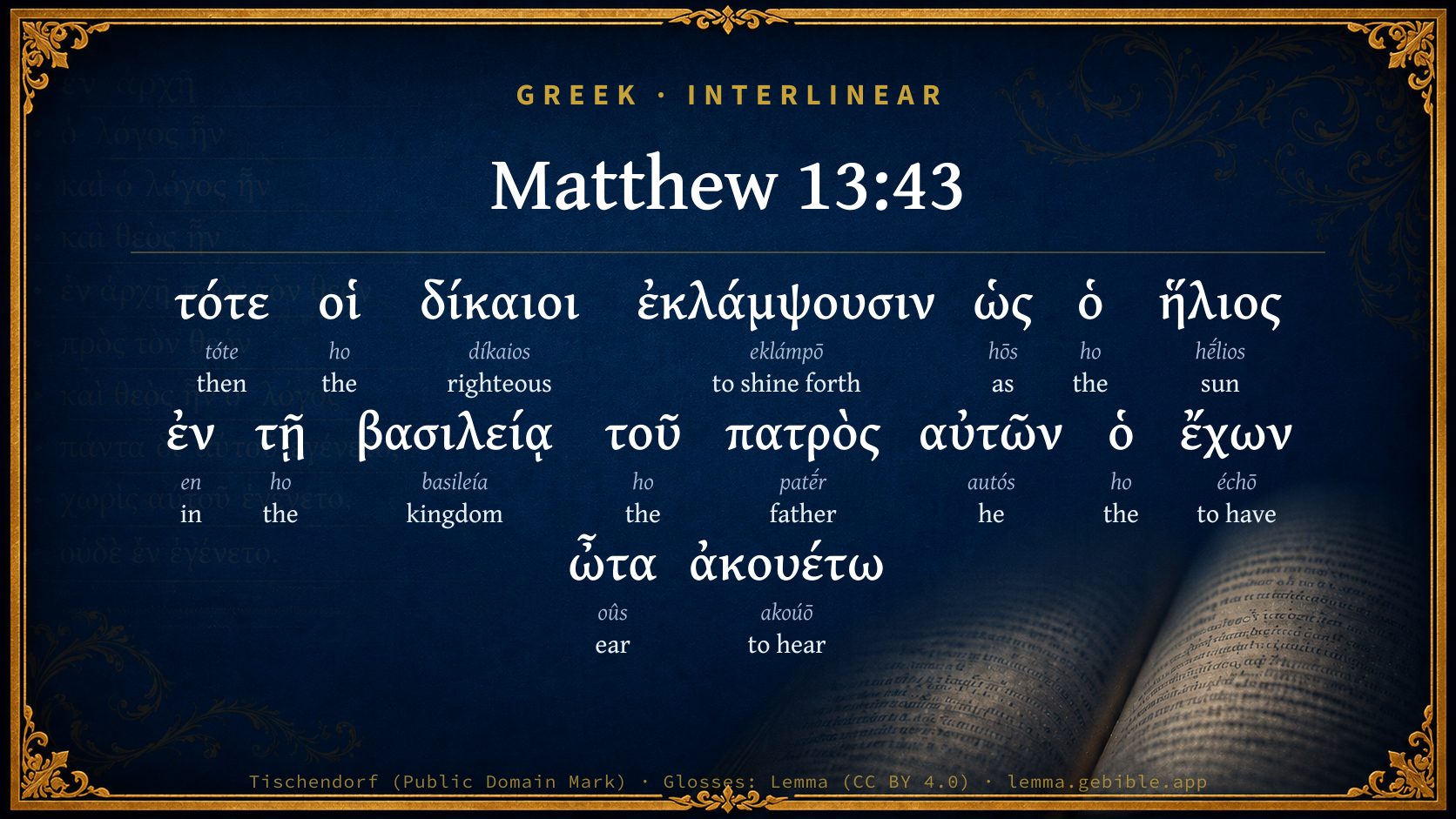
  1. τότε tóte G5119 “then” Adverb
  2. οἱ ho G3588 “the” Article, Nominative, Plural, Masculine
  3. δίκαιοι díkaios G1342 “righteous” Adjective, Nominative, Plural, Masculine
  4. ὡς hōs G5613 “as” Adverb
  5. ὁ ho G3588 “the” Article, Nominative, Singular, Masculine
  6. ἥλιος hḗlios G2246 “sun” Noun, Nominative, Singular, Masculine
  7. ἐν en G1722 “in” Preposition
  8. τῇ ho G3588 “the” Article, Dative, Singular, Feminine
  9. βασιλείᾳ basileía G932 “kingdom” Noun, Dative, Singular, Feminine
  10. τοῦ ho G3588 “the” Article, Genitive, Singular, Masculine
  11. πατρὸς patḗr G3962 “father” Noun, Genitive, Singular, Masculine
  12. αὐτῶν autós G846 “he” Personal pronoun, Genitive, Plural, Masculine
  13. ὁ ho G3588 “the” Article, Nominative, Singular, Masculine
  14. ἔχων échō G2192 “to have” Verb, Present, Active, Participle, Nominative, Singular, Masculine
  15. ὦτα oûs G3775 “ear” Noun, Accusative, Plural, Neuter
  16. ἀκουέτω akoúō G191 “to hear” Verb, Present, Active, Imperative, 3rd person, Singular

About this verse

These counts appear in no published source. They are computed here, from the morphology-tagged text and Lemma’s own curated glosses. What Lemma adds →

17
words
13
distinct lemmas
Gospels
section

Notable vocabulary

1 hapax legomenon — a word that appears only here in the entire Greek New Testament:

  • ἐκλάμψουσιν to shine forth G1584

First appearance in Scripture

This word makes its first canonical appearance in the Greek New Testament here:

  • ἐκλάμψουσιν to shine forth G1584

Shared distinctive vocabulary

ἥλιος sun G2246 occurs in 32 verses of the Greek New Testament. Also found in:

Repetition

A word recurs within this verse:

Cross-references

12

Topical passages linked to Matthew 13:43 in the Treasury of Scripture Knowledge — connected by theme and wording, ordered by reader-vote popularity; previews shown in the World English Bible.

  • Daniel 12:3 Those who are wise shall shine as the brightness of the expanse; and those who turn many to righteousness as the stars forever and ever.
  • Luke 12:32 Don't be afraid, little flock, for it is your Father's good pleasure to give you the Kingdom.
  • Matthew 11:15 He who has ears to hear, let him hear.
  • Matthew 25:34 Then the King will tell those on his right hand, 'Come, blessed of my Father, inherit the Kingdom prepared for you from the foundation of the world;
  • 1 Corinthians 15:41–54 There is one glory of the sun, another glory of the moon, and another glory of the stars; for one star differs from another star in glory.
  • Revelation 21:22–23 I saw no temple in it, for the Lord God, the Almighty, and the Lamb, are its temple.
  • Revelation 21:3–5 I heard a loud voice out of heaven saying, "Behold, God's dwelling is with people, and he will dwell with them, and they will be his people, and God himself will be with them as their God.
  • Matthew 25:36 naked, and you clothed me; I was sick, and you visited me; I was in prison, and you came to me.'
  • James 2:5 Listen, my beloved brothers. Didn't God choose those who are poor in this world to be rich in faith, and heirs of the Kingdom which he promised to those who love him?
  • Matthew 26:29 But I tell you that I will not drink of this fruit of the vine from now on, until that day when I drink it anew with you in my Father's Kingdom."
  • Luke 22:29 I confer on you a kingdom, even as my Father conferred on me,
  • 1 Corinthians 15:58 Therefore, my beloved brothers, be steadfast, immovable, always abounding in the Lord's work, because you know that your labor is not in vain in the Lord.

Cross-references courtesy of OpenBible.info (CC BY 4.0).

Commentary

Notes on Matthew 13:43 from classic Christian and Jewish commentators (each source and its license shown beneath its notes). The classic Christian expositions comment on the surrounding passage and are grouped to its opening verse, so a note may address several verses; the Jewish commentaries on the Tanakh (Rashi and others) are per-verse, so they appear only where the commentator wrote on this verse.

Lemma curates 59 commentaries, every one of them public domain or Creative Commons licensed, each selected and text-cleaned for this edition rather than reprinted as found. About our sources →

The Biblical Illustrator

Joseph S. Exell

Mat_13:43

Then shall the righteous shine forth as the sun

The glory of the righteous

I.

Its present concealment. The whole structure of the parable implies that the beauty of the righteous man is hidden in the present; tares and wheat scarcely distinguished. The glory has begun in men here, though veiled. The wheat had in it the germ of the golden grain. The sun shines forth from the clouds which had obscured his radiance. Reasons of this concealment:-

1. The first reason is the nature of the only true righteousness in man. Man becomes righteous by denying his own righteousness and accepting that of another; this why it is hidden now. Our faith is cradled in tears and made strong by storms.

2. We find a second reason for concealment in the discipline by which the righteous are perfected. Faith grows by trials, which conceal glory. The worlds eye sees little beauty in the crown of thorns.

II. Its future manifestation. The present concealment will pass away; the germ of faith will ripen unto eternal glory. By the silent growth of faith the image of the heavenly is being secretly formed within. Who can tell how the souls of the righteous will ripen in the sun-light of Christs smile,

III. Its mighty lessons. Who hath ears to hear let him hear. Hear it, slothful Christian. Hear it, earnest, struggling soul. Hear it, downcast spirit. Hear it, unbeliever. (E. L. Hull, B. A.)

Moral beauty manifested after death

Just as the flower bursts forth in beauty from its concealment in the seed, so shall it be with the righteous when the last temptation has been vanquished, and the body, so frail and weary, has been laid aside. We see it not in our dying friends. We see only the expiring animal nature. We see not how the Christlike grew within them during the hushed endurance of pain, and while their faith held on during that long horror of darkness. We see not this rising inner life. We see only their failing humanity. (E. L. Hull, B. A.)

The Divine tracery not seen at present

But we cannot see the glory which is behind. We cannot fully understand how the discipline of life is fitting the soul for the fruition of the future. At present we cannot read the Divine tracery inscribed by the hand of sorrow; it has all a heavenly compensation, infinitely greater than its present misery … The veil is over us; we do not see what royal souls are being formed by it here. But in the end it shall be seen that all the feelings of pain and weakness, solitude and weariness, have a corresponding weight of joy. (E. L. Hull, B. A.)

These words describe the happiness of the righteous

I. In its elements. Like the sun-visible, pure, active, glorious.

II. In its platform. It is in the kingdom of their Father. This imports-

1. All the privileges and security of an organized society of the highest order.

2. For ever to dwell at home.

III. Its juncture. Then-day of judgment, when the righteous shall be publicly recognized as such.

IV. Its truth. On what do we ground these expectations? On the express declarations of God; the nature of the gospel, and the work of grace on the heart; and the witness of the Holy Spirit. Suggests-self-scrutiny and submission. (J. Hirst.)

I. The present concealment of the righteous. On account of-The nature of their excellence-not discerned or appreciated by the world; the sphere within which it is displayed-in the common walks of life; the imperfections, etc., with which it is often accompanied; the reserve by which it is sometimes hidden-unobtrusive, silent.

II. The future manifestation of the righteous. The time, place, splendour, duration. (Brooks.)

We hare here a description of the glorious state of believers, called the righteous

Believers have a twofold righteousness.

1. The righteousness of justification.

2. The righteousness of sanctification. What need shall the saints have to shine in Christs righteousness, when they shall be perfectly holy in themselves?

1. Because it was not their own inherent righteousness which was their title to heaven, but the righteousness of Christ alone; therefore they shall boast of and shine in the righteousness of Christ for ever.

2. Because their own inherent righteousness was imperfect and full of spots whilst they lived upon the earth, and it was made perfect only as an act of Christs purchase, or the fruits of His merits and obedience, to make them meet for that inheritance. The glory of believers is reserved to that time; now their life is a hidden life, and their glory is veiled (1Jn_3:1-3).

When the end of the world comes, or at the day of the resurrection, the saints shall shine forth gloriously.

1. Because being Gods jewels, they are then all made up, or completed every way, and shall shine before wicked men and devils, to the shame and confusion for ever of these wretches.

2. Moreover, as heirs, they then come to a perfect age, and to possess the purchased inheritance, to the praise of Gods glory and grace.

3. Then the marriage of the Lamb will be celebrated, and the bride be adorned in all her marriage robes and rich attire (Rev_19:7).

4. Because then the bodies and souls of all believers shall be reunited, both being made perfect: a curious piece of work, whether a jewel or clockwork, never appears so glorious until it is all joined together, and every way perfected. So the glory of the saints will then be every way full and perfect, both in respect of soul and body too.

5. Because Christ will then appear; and when He appears, we shall appear with Him in glory (Col_3:4; Joh_3:4).

6. Because then will be the time of the manifestation Of the sons of God (Rom_8:19). Then they shall be crowned with glory. That will be the saints coronation day.

7. Then will be the time of the saints reaping, as now is their time for sowing, and they that sow in tears shall reap in joy (Psa_126:5). Shine as the sun, etc. This denotes the greatness of the glory of the saints. The glory, excellence, and splendour of believers in that day will be amazing.

Consider:

1. The sun is the greatest glory of this world, or far excels in glory all other things. So the saints shall shine forth in the greatest glory, beyond the glory of Solomon, or all earthly potentates whatsoever.

2. When the sun shines forth in his full strength, all dark clouds and mists are vanquished and driven away. So when the saints shall shine in their greatest glory, all dark mists of ignorance, and clouds of sin and corruption, shall be expelled from them for ever. No more dark days or unbelief for ever.

3. The sun is a singular light, and shines with a singular glory. There are many stars, but one sun. So the glory of the saints shall be a singular glory. No glory like that glory, or to be compared to it.

4. The sun is a pure, bright, and spotless creature, far brighter than the moon or stars, so the glory of the saints wall be a pure, bright, and spotless glory, not like the glory of this world, nor like the glory which attends the saints while they are here in this mortal body.

5. The glory of the sun is an unchangeable glory; he alters not, changes not in his glory as the moon doth.

So the glory of the saints in that day will ever abide the same, and never change or be less, because they then shall arrive to a full perfection of glory; nay, it shall exceed that of the sun.

1. Because the sun sets, or goes out of our sight, but the saints sun shall never go down, their glory never sets (Isa_60:20).

2. The sun is sometimes clouded, its glory appears not, but the glory of the saints shall never be clouded any more as it was in this world.

3. The sun shall then be ashamed (Isa_24:23). That is, the glory of the saints shall so far excel the glory of the sun, that the sun shall, as it were, be ashamed (as such are said to be, when they are outshined), or outdone by others.

4. The sun is sometimes eclipsed by the gross body of the moon interposing betwixt us and it; but the glory of the saints shall by no dark body of sin, corruption, or of this world, be eclipsed any more for ever.

5. The sun is so glorious, that mortals cannot behold it, but their eyes will dazzle. So the glory of the saints will be too great for sinners to behold, it would even put out their eyes, or confound them. O happy believers! (B. Keach)

The Biblical Illustrator, edited by Joseph S. Exell (c. 1880s–1900s) — public domain. Text from a community e-Sword module.

MacLaren's Expositions of Holy Scripture

Alexander MacLaren

Proverbs

FROM DAWN TO NOON

Pro 4:18. - Mat 13:43.

The metaphor common to both these texts is not infrequent throughout Scripture. In one of the oldest parts of the Old Testament, Deborah’s triumphal song, we find, ‘Let all them that love Thee be as the sun when he goeth forth in his might.’ In one of the latest parts of the Old Testament, Daniel’s prophecy, we read, ‘They that be wise shall shine as the brightness of the firmament; and they that turn many to righteousness as the stars for ever and ever.’ Then in the New Testament we have Christ’s comparison of His servants to light, and the great promise which I have read as my second text. The upshot of them all is this-the most radiant thing on earth is the character of a good man. The world calls men of genius and intellectual force its lights. The divine estimate, which is the true one, confers the name on righteousness.

But my first text follows out another analogy; not only brightness, but progressive brightness, is the characteristic of the righteous man.

We are to think of the strong Eastern sun, whose blinding light steadily increases till the noontide. ‘The perfect day’ is a somewhat unfortunate translation. What is meant is the point of time at which the day culminates, and for a moment, the sun seems to stand steady, up in those southern lands, in the very zenith, raying down ‘the arrows that fly by noonday.’ The text does not go any further, it does not talk about the sad diminution of the afternoon. The parallel does not hold; though, if we consult appearance and sense alone, it seems to hold only too well. For, sadder than the setting of the suns, which rise again to-morrow, is the sinking into darkness of death, from which there seems to be no emerging. But my second text comes in to tell us that death is but as the shadow of eclipse which passes, and with it pass obscuring clouds and envious mists, and ‘then shall the righteous blaze forth like the sun in their Heavenly Father’s kingdom.’

And so the two texts speak to us of the progressive brightness, and the ultimate, which is also the progressive, radiance of the righteous.

I. In looking at them together, then, I would notice, first, what a Christian life is meant to be.

I must not linger on the lovely thoughts that are suggested by that attractive metaphor of life. It must be enough, for our present purpose, to say that the light of the Christian life, like its type in the heavens, may be analysed into three beams-purity, knowledge, blessedness. And these three, blended together, make the pure whiteness of a Christian soul.

But what I wish rather to dwell upon is the other thought, the intention that every Christian life should be a life of increasing lustre, uninterrupted, and the natural result of increasing communion with, and conformity to, the very fountain itself of heavenly radiance.

Remember how emphatically, in all sorts of ways, progress is laid down in Scripture as the mark of a religious life. There is the emblem of my text. There is our Lord’s beautiful one of vegetable growth: ‘First the blade, then the ear, then the full corn in the ear.’ There is the other metaphor of the stages of human life, ‘babes in Christ,’ young men in Him, old men and fathers. There is the metaphor of the growth of the body. There is the metaphor of the gradual building up of a structure. We are to ‘edify ourselves together,’ and to ‘build ourselves up on our most holy faith.’ There is the other emblem of a race-continual advance as the result of continual exertion, and the use of the powers bestowed upon us.

And so in all these ways, and in many others that I need not now touch upon, Scripture lays it down as a rule that life in the highest region, like life in the lowest, is marked by continual growth. It is so in regard to all other things. Continuity in any kind of practice gives increasing power in the art. The artisan, the blacksmith with his hammer, the skilled artificer at his trade, the student at his subject, the good man in his course of life, and the bad man in his, do equally show that use becomes second nature. And so, in passing, let me say what incalculable importance there is in our getting habit, with all its mystical power to mould life, on the side of righteousness, and of becoming accustomed to do good, and so being unfamiliar with evil.

Let me remind you, too, how this intention of continuous growth is marked by the gifts that are bestowed upon us in Jesus Christ. He gives us-and it is by no means the least of the gifts that He bestows-an absolutely unattainable aim as the object of our efforts. For He bids us not only be ‘perfect, as our Father in Heaven is perfect,’ but He bids us be entirely conformed to His own Self. The misery of men is that they pursue aims so narrow and so shabby that they can be attained, and are therefore left behind, to sink hull down on the backward horizon. But to have before us an aim which is absolutely unreachable, instead of being, as ignorant people say, an occasion of despair and of idleness, is, on the contrary, the very salt of life. It keeps us young, it makes hope immortal, it emancipates from lower pursuits, it diminishes the weight of sorrows, it administers an anaesthetic to every pain. If you want to keep life fresh, seek for that which you can never fully find.

Christ gives us infinite powers to reach that unattainable aim, for He gives us access to all His own fullness, and there is more in His storehouses than we can ever take, not to say more than we can ever hope to exhaust. And therefore, because of the aim that is set before us, and because of the powers that are bestowed upon us to reach it, there is stamped upon every Christian life unmistakably as God’s purpose and ideal concerning it, that it should for ever and for ever be growing nearer and nearer, as some ascending spiral that ever circles closer and closer, and yet never absolutely unites with the great central Perfection which is Himself.

So, brethren, for every one of us, if we are Christian people at all, ‘this is the will of God, even your perfection.’

II. Consider the sad contrast of too many Christian lives.

I would not speak in terms that might seem to be reproach and scolding. The matter is far too serious, the disease far too widespread, to need or to warrant any exaggeration. But, dear brethren, there are many so-called and, in a fashion, really Christian people to whom Christ and His work are mainly, if not exclusively, the means of escaping the consequences of sin-a kind of ‘fire-escape.’ And to very many it comes as a new thought, in so far as their practical lives are concerned, that these ought to be lives of steadily increasing deliverance from the love and the power of sin, and steadily increasing appropriation and manifestation of Christ’s granted righteousness. There are, I think, many of us from whom the very notion of progress has faded away. I am sure there are some of us who were a great deal farther on on the path of the Christian life years ago, when we first felt that Christ was anything to us, than we are to-day. ‘When for the time ye ought to be teachers, ye have need that one teach you which be the first principles of the oracles of God.’

There is an old saying of one of the prophets that a child would die a hundred years old, which in a very sad sense is true about very many folk within the pale of the Christian Church who are seventy-year-old babes still, and will die so. Suns ‘growing brighter and brighter until the noonday!’ Ah! there are many of us who are a great deal more like those strange variable stars that sometimes burst out in the heavens into a great blaze, that brings them up to the brightness of stars of the first magnitude, for a day or two; and then they dwindle until they become little specks of light that the telescope can hardly see.

And there are hosts of us who are instances, if not of arrested, at any rate of unsymmetrical, development. The head, perhaps, is cultivated; the intellectual apprehension of Christianity increases, while the emotional, and the moral, and the practical part of it are all neglected. Or the converse may be the case; and we may be full of gush and of good emotion, and of fervour when we come to worship or to pray, and our lives may not be a hair the better for it all. Or there may be a disproportion because of an exclusive attention to conduct and the practical side of Christianity, while the rational side of it, which should be the basis of all, and the emotional side of it, which should be the driving power of all, are comparatively neglected.

So, dear brethren! what with interruptions, what with growing by fits and starts, and long, dreary winters like the Arctic winters, coming in between the two or three days of rapid, and therefore brief and unwholesome, development, we must all, I think, take to heart the condemnation suggested by this text when we compare the reality of our lives with the divine intention concerning them. Let us ask ourselves, ‘Have I more command over myself than I had twenty years ago? Do I live nearer Jesus Christ today than I did yesterday? Have I more of His Spirit in me? Am I growing? Would the people that know me best say that I am growing in the grace and knowledge of my Lord and Saviour?’ Astronomers tell us that there are dark suns, that have burnt themselves out, and are wandering unseen through the skies. I wonder if there are any extinguished suns of that sort listening to me at this moment.

III. How the divine purpose concerning us may be realised by us.

Now the Alpha and the Omega of this, the one means which includes all other, is laid down by Jesus Christ Himself in another metaphor when He said, ‘Abide in Me, and I in you; so shall ye bring forth much fruit.’ Our path will brighten, not because of any radiance in ourselves, but in proportion as we draw nearer and nearer to the Fountain of heavenly radiance.

The planets that move round the sun, further away than we are on earth, get less of its light and heat; and those that circle around it within the limits of our orbit, get proportionately more. The nearer we are to Him, the more we shall shine. The sun shines by its own light, drawn indeed from the shrinkage of its mass, so that it gives away its very life in warming and illuminating its subject-worlds. But we shine only by reflected light, and therefore the nearer we keep to Him the more shall we be radiant.

That keeping in touch with Jesus Christ is mainly to be secured by the direction of thought, and love, and trust to Him. If we follow close upon Him we shall not walk in darkness. It is to be secured and maintained very largely by what I am afraid is much neglected by Christian people of all sorts nowadays, and that is the devotional use of their Bibles. That is the food by which we grow. It is to be secured and maintained still more largely by that which I, again, am afraid is but very imperfectly attained to by Christian people now, and that is, the habit of prayer. It is to be secured and maintained, again, by the honest conforming of our lives, day by day, to the present amount of our knowledge of Him and of His will. Whosoever will make all his life the manifestation of his belief, and turn all his creed into principles of action, will grow both in the comprehensiveness, and in the depths of his Christian character. ‘Ye are the light in the Lord.’ Keep in Him, and you will become brighter and brighter. So shall we ‘go from strength to strength, till we appear before God in Zion.’

IV. Lastly, what brighter rising will follow the earthly setting?

My second text comes in here. Beauty, intellect, power, goodness; all go down into the dark. The sun sets, and there is left a sad and fading glow in the darkening pensive sky, which may recall the vanished light for a little while to a few faithful hearts, but steadily passes into the ashen grey of forgetfulness.

But ‘then shall the righteous blaze forth like the sun, in their Heavenly Father’s kingdom.’ The momentary setting is but apparent. And ere it is well accomplished, a new sun swims into the ‘ampler ether, the diviner air’ of that future life, ‘and with new spangled beams, flames in the forehead of the morning sky.’

The reason for that inherent brightness suggested in our second text is that the soul of the righteous man passes from earth into a region out of which we ‘gather all things that offend, and them that do iniquity.’ There are other reasons for it, but that is the one which our Lord dwells on. Or, to put it into modern scientific language, environment corresponds to character. So, when the clouds have rolled away, and no more mists from the undrained swamps of selfishness and sin and animal nature rise up to hide the radiance, there shall be a fuller flood of light poured from the re-created sun.

That brightness thus promised has for its highest and most blessed character that it is conformity to the Lord Himself. For, as you may remember, the last use of this emblem that we find in Scripture refers not to the servant but to the Master, whom His beloved disciple in Apocalyptic vision saw, with His ‘countenance as the sun shining in his strength.’ Thus ‘we shall be like Him, for we shall see Him as He is.’ And therefore that radiance of the sainted dead is progressive, too. For it has an infinite fulness to draw upon, and the soul that is joined to Jesus Christ, and derives its lustre from Him, cannot die until it has outgrown Jesus and emptied God. The sun will one day be a dark, cold ball. We shall outlast it.

But, brethren, remember that it is only those who here on earth have progressively appropriated the brightness that Christ bestows who have a right to reckon on that better rising. It is contrary to all probability to believe that the passage from life can change the ingrained direction and set of a man’s nature. We know nothing that warrants us in affirming that death can revolutionise character. Do not trust your future to such a dim peradventure. Here is a plain truth. They who on earth are as ‘the shining light that shineth more and more unto the perfect day,’ shall, beyond the shadow of eclipse, shine on as the sun does, behind the opaque, intervening body, all unconscious of what looks to mortal eyes on earth an eclipse, and ‘shall blaze out like the sun in their Heavenly Father’s kingdom.’ For all that we know and are taught by experience, religious and moral distinctions are eternal. ‘He that is righteous, let him be righteous still; and he that is filthy, let him be filthy still.’

Alexander MacLaren, Expositions of Holy Scripture (1904–1910) — public domain. Text from a community e-Sword module.

Tyndale Open Study Notes

Tyndale Open Resources

13:43 The righteous do the will of God as revealed by Jesus, in contrast to those “who do evil” (13:41).

Tyndale Open Study Notes — © Tyndale Open Resources, licensed CC BY-SA 4.0. Text via the HelloAO Bible API.

Bengel's Gnomon

Johann Albrecht Bengel

Mat 13:43. Τότε, then) After the ungodly have been removed.—ἐκλάμψουσιν, they shall shine forth) They shall not burn as the ungodly, but they shall shine forth, singly, and much more, collectively.[637] The same word is employed by the LXX. in Dan 12:3.—τοῦ Πατρὸς αὐτῶν, of their Father) who is righteous and glorious. How great is the difference of the righteous from the children of the wicked one! see Mat 13:38.—ὁ ἔχων ὦτα, κ.τ.λ., he that hath ears, etc.) A formula suited, not only to the people, but also to the disciples.

[637] What can be sweeter, even to think of, than this?—V. g.

Bengel's Gnomon of the New Testament — English translation (T&T Clark, Edinburgh, 1860) — public domain. Text from a community e-Sword module.

Meyer's Critical & Exegetical Commentary

Heinrich August Wilhelm Meyer

Mat_13:43. Τότε] then, when this purging out of all the σκάνδαλα has been effected.

ἐκλάμψ.] the compound verb, which is used on purpose (to shine forth, to burst into light, Xen. Cyr. vii. 1, 2; Plat. Gorg. p. 484 A, Rep. iv. p. 435 A), and so not to be taken merely as descriptive of eternal felicity in its general aspect, but as conveying the idea of a sublime display of majestic splendor, of the δόξα of the righteous in the future kingdom of the Messiah. Comp. Dan. 13:3; Enoch 38:4, 39:7, 104:4. Contrast to the fate of the wicked in the furnace of fire.

τοῦ πατρὸς αὐτῶν] sweet closing words, full of blessed confidence, Mat_25:34.

Meyer — Critical and Exegetical Commentary on the New Testament — English translation by Peter Christie, edited by Frederick Crombie (T&T Clark, 1880) — public domain. Text from a community e-Sword module.

Expositor's Greek Testament

ed. W. Robertson Nicoll

Mat 13:43 . ἐκλάμψουσι : vide Dan 12:2 , which seems to be in view; an expressive word suggestive of the sun emerging from behind a cloud. The mixture of good and evil men in this world hides the characters of both.

The Expositor's Greek Testament, edited by W. Robertson Nicoll (1897–1910) — public domain. Text from a community e-Sword module.

Jamieson, Fausset & Brown

Robert Jamieson, A. R. Fausset & David Brown

Then shall the righteous shine forth as the sun in the kingdom of their Father--as if they had been under a cloud during the present association with ungodly pretenders to their character, and claimants of their privileges, and obstructors of their course.

Who hath ears to hear, let him hear--(See Mar 4:9).

Fifth and Sixth Parables or Third Pair: THE HIDDEN TREASURE and THE PEARL OF GREAT PRICE (Mat 13:44-46).

The subject of this last pair, as of the two former, is the same, but also under a slight diversity of aspect: namely--

THE PRICELESS VALUE OF THE BLESSINGS OF THE KINGDOM. And while the one parable represents the Kingdom as "found without seeking," the other holds forth the Kingdom as "sought and found."

The Hidden Treasure (Mat 13:44).

Jamieson, Fausset & Brown — Commentary Critical and Explanatory on the Whole Bible (1871) — public domain (CC PDM 1.0). Text via the HelloAO Bible API.

Ellicott's Commentary for English Readers

(43) Then shall the righteous shine forth as the sun.—The imagery is so natural that we hardly need to look for any reference to older teaching, yet we can hardly help remembering the path of the just that “shineth more and more unto the perfect day” (Pro_4:18), and yet more, as connected more closely with the judgment to come, those “that shall shine as the brightness of the firmament and as the stars for ever and ever” (Dan_12:3). Yet the promise here has one crowning and supreme blessing: the kingdom in which the righteous shall thus shine forth is the kingdom of their Father.

A Bible Commentary for English Readers, edited by Charles John Ellicott (1878–1897) — public domain. Text from a community e-Sword module.

The Cambridge Bible for Schools and Colleges

gen. ed. J. J. S. Perowne

43. Then shall the righteous shine forth as the sun] Cp. Dan_12:3, “Then they that be wise shall shine as the brightness of the firmament.”

The Cambridge Bible for Schools and Colleges (gen. ed. J. J. S. Perowne; Cambridge University Press, 1878–1918) — public domain. Text from a community e-Sword module.

John Gill's Exposition

Again, the kingdom of heaven is like unto a merchant man,.... This parable may be understood of Christ's seeking, finding, and purchasing his elect: for, certain it is, that he has sought after them; which implies, that they were lost and going astray; expresses his great love to them, value for them, and desire after them; in doing which, he took much pains, and used much diligence: and certain it also is, that he finds them in redemption, and in effectual calling; and that they are to him a pearl of great price; as very precious to God, so highly esteemed of by Christ, as his portion, his inheritance, and his jewels. He has also parted with all he had for the sake of these persons; he became poor, emptied himself of everything, even gave himself a ransom for them, and so made a purchase of them, with the price of his own blood: though to this sense it may be objected, that it does not seem so agreeable, that Christ should be compared to a merchant man, which better suits with those that deal with him, than as he is concerned with them; nor does he seek after any other than his elect: whereas this merchant man is said to beeking goodly pearls; any pearls that were so: nor is Christ's finding his elect a chance business; nor have they any intrinsic excellency in them, to denominate them pearls, but by his grace. The more common interpretation of it is, that it designs a sensible sinner, seeking after the true way of salvation, and finding Christ, and parting with all for him: such a man is a spiritual merchant, who trades in foreign parts, and in things of worth and value; and such an one seeks after a variety of things, which at first sight seem "goodly", in order to obtain salvation by; as civility, morality, a legal righteousness, fasting, watchings, prayer, a profession of religion, and a submission to external ordinances; but at length finds Christ,

the pearl of great price: who is of an unspeakable brightness and glory, of intrinsic worth and value; who is enriching to those that possess him, and precious to them that believe; and of such a price, that no valuable consideration can be given for him: wherefore such a soul is willing to part with all for him; with sinful self, and righteous self; and with the honours, riches, and profits of this world; and buy him, his grace and righteousness, without money, and without price. Though I rather think, that in connection and agreement with the other parables, this is to be understood of such, who are seeking after knowledge in every branch of it, natural, moral, and spiritual; and so may be compared to a "merchant man, seeking goodly pearls"; and who find the Gospel, and prefer it to everything else,

Who when he had found one pearl of great price: for such who seek after wisdom and knowledge in the use of proper means, are like merchant men, that trade abroad, and for things of value; and these, under divine direction, find in the Scriptures, and through the ministry of the word, and by prayer and study, the truths of the everlasting Gospel, respecting Christ, his person, office, grace and righteousness; which are equal to, yea transcend a pearl of the highest price; for their original, coming from a far country, from heaven; for their brightness, clearness, and perspicuity; for their ornament and glory; for their firmness and solidity; for their virtue and value, to them that know the worth of them; and such will buy, but not sell them; reckon all things but loss and dung, in comparison of them; and will contend for them, and stand fast in them.

John Gill's Exposition of the Whole Bible (1746–1763) — public domain (CC PDM 1.0). Text via the HelloAO Bible API.

Trapp's Complete Commentary

John Trapp

43 Then shall the righteous shine forth as the sun in the kingdom of their Father. Who hath ears to hear, let him hear.

Ver. 43. Then shall the righteous shine] Those that have here lain among the pots, smucht and sullied, shall then outshine the sun in his strength. Shine they shall in their bodies, which shall be clarified and conformed to Christ’s most glorious body, the standard, Php 3:21; In their souls, those spirits of men made perfectly holy and happy. And in their whole person, as the spouse of Christ. Uxor fulget radiis mariti, she shall shine with the beams of his beauty. Three glimpses of which glory were seen in Moses’ face, in Christ’s transfiguration, in Stephen’s countenance.

Who hath ears to hear, let him hear] q.d. This is worth hearing. Lend both your ears to such a bargain as this is. "What shall we say to these things?" saith the apostle, after he had spoke of glorification, Rom 8:31. q.d. We can never satisfy ourselves in speaking, you should never show yourselves sated in hearing.

John Trapp, A Commentary or Exposition upon All the Books of the Old and New Testament (1647–1656) — public domain. Text from a community e-Sword module.

Whedon's Commentary on the Bible

Daniel D. Whedon

43. Righteous… as the sun — A most resplendent image of the glorified saints in heaven. The Greek verb is very expressive — shine out — as if during their sojourn in this world they were obscured by a cloud. Heaven is the firmament in which every luminary is a sun.

Daniel D. Whedon (gen. ed.), Commentary on the Old and New Testaments (1874–1909) — public domain. Text from a community e-Sword module.

The Pulpit Commentary

Then shall the righteous. For with these also their character is seen in their lives. (Mat_5:45, note) Shine forth as the sun. An undoubted reference to the substance of Dan_12:3. Observe that according to the thought of the parable, it is suggested that the likeness consists not only in the brightness of the sun in itself, but also in its being alone in the sky, with nothing round it to prevent its full glory being seen. Then. The chief lesson of the parable; not before, but at, that time. In the kingdom of their Father. In ver. 38 they were spoken of as "the sons of the kingdom;" here their Father is expressly mentioned, not "the Son of man" (vers. 37, 41). The same reference to his Father rather than to himself is found in Mat_26:29. Did our Lord wish already to hint that "then cometh the end, when he shall deliver up the kingdom to God, even the Father"? (1Co_15:24) Had St. Paul"s teaching also here a direct connexion with that of our Lord (ver. 41, note)? Who hath ears to hear, let him hear (ver. 9, note).

The Pulpit Commentary (1880–1919), ed. H.D.M. Spence-Jones & Joseph S. Exell — public domain. Text from a community e-Sword module.

Scofield Reference Notes

C. I. Scofield

Then

The kingdom does not become the kingdom of the "Father" until Christ, having "put all enemies under his feet," including the last enemy, death, has "delivered up the kingdom to God, even the Father" 1Co 15:24-28; Rev 20:2. There is triumph over death at the first resurrection 1Co 15:54; 1Co 15:55 but death, "the last enemy," is not destroyed till the end of the millennium. Rev 20:14.

righteous (See Scofield "Rom 10:10"), Also, Col 3:4; 2Th 1:5-10

The Scofield Reference Bible (1917 edition), notes by C. I. Scofield — public domain. Text from a community e-Sword module.

Cambridge Greek Testament for Schools and Colleges

43. τότε οἱ δίκαιοι κ.τ.λ. Cp. Dan 12:3, ‘Then they that be wise shall shine as the brightness of the firmament.’

Cambridge Greek Testament for Schools and Colleges (Cambridge University Press, 1896; 21 vols, various authors incl. Carr, Maclear, Plummer, Farrar, Lumby, Moule, M. R. James, Simcox) — public domain. Text from a community e-Sword module.

Alford’s Greek Testament

Henry Alford

43. ἐκλάμψουσιν] shall shine out (their light here being enfeebled and obscured), as the sun from a cloud. τοῦ πατρός, answering to οἱ υἱοί, ver. 38. This sublime announcement is over and above the interpretation of the parable.

Henry Alford, The Greek Testament (1849–1861) — public domain. Text from a community e-Sword module.

International Critical Commentary

(L) 43. Then the righteous shall shine as the sun in the kingdom of their Father. Who hath ears to hear, let him hear.]

τότε] see on 2:7.—οἱ δίκαιοι ἐκλάμψουσιν] Cf. Dan 12:3 Th. καὶ οἱ συνιέντες λάμψουσιν—καὶ ἀπὸ τῶν δικαίων.—ὡς ὁ ἥλιος] cf. references on 17:2, and add Ecclus 50:7 ὡς ἥλιος ἐκλάμπων; Ep. Jer 66.—ὁ ἔχων, κ.τ.λ.] A similar refrain occurs in 11:15, 13:9.

The parable deals with the period prior to the future establishment of the kingdom, during which Christ and His disciples preach its “secrets” and announce its coming. See Introduction, p. lxx.

International Critical Commentary — older volumes (1896–1929), various authors — public domain. Text from a community e-Sword module.

Vincent's Word Studies in the New Testament

Marvin R. Vincent

Shine forth [εκλαμψουσιν] . The compound verb with ejk, forth, is designedly used to express a dissipating of darkness which has hidden : a bursting into light. The righteous shall shine forth as the sun from behind a cloud. The mixture of evil with good in the world obscures the good, and veils the true glory of righteous character. Compare Dan 12:3.

Marvin R. Vincent, Word Studies in the New Testament (1887–1900) — public domain. Text from a community e-Sword/MySword module.

Lesson kit

Teaching starters — assembled from the data on this page, not authored interpretation. Every prompt links to the verse data it draws on. Edit before teaching.

Matthew, in the Gospels, opens this verse with 17 words (13 distinct Greek lemmas). Its most distinctive word is eklámpō (“to shine forth”). A historical commentator’s framing appears above. Read the whole chapter for the surrounding context.

Discussion questions

  1. The word eklámpō carries the sense “to shine forth.” How does it shape the verse?
  2. 1 word here appears nowhere else in the Greek New Testament. Why might the author reach for such rare wording?
  3. This is the first place “to shine forth” appears in Scripture (first appears here). What does its debut here establish?
  4. How does Matthew 5:45, which shares the word «sun», read alongside this verse?
  5. What does the repetition of “the” (5× in this one verse) do in this verse?
  6. These translations render this verse differently; the difference is in the English rendering, not the original. What questions does that raise?
  7. Compare how The Biblical Illustrator and MacLaren's Expositions of Holy Scripture read this verse. Where do they agree or differ?

Things to notice

  • 1 word in this verse appears nowhere else in the Greek New Testament.
  • 1 word makes its first canonical appearance in Scripture here.
  • These translations choose different wording for 8 words in this verse.
  • “the” occurs 5× in this single verse.
  • 13 distinct Greek lemmas span 17 words in this verse.

Reading settings

Reading text

Shown beneath each verse's original-language words.

Old Testament
Old Testament edition

Read the OT as the Masoretic Hebrew (MT) or the Greek Septuagint (LXX).

English shown for the Greek Septuagint (in the Hebrew ↔ Greek comparison).

Comparing translations? Open the Compare panel on any verse page to stack up to four side by side.