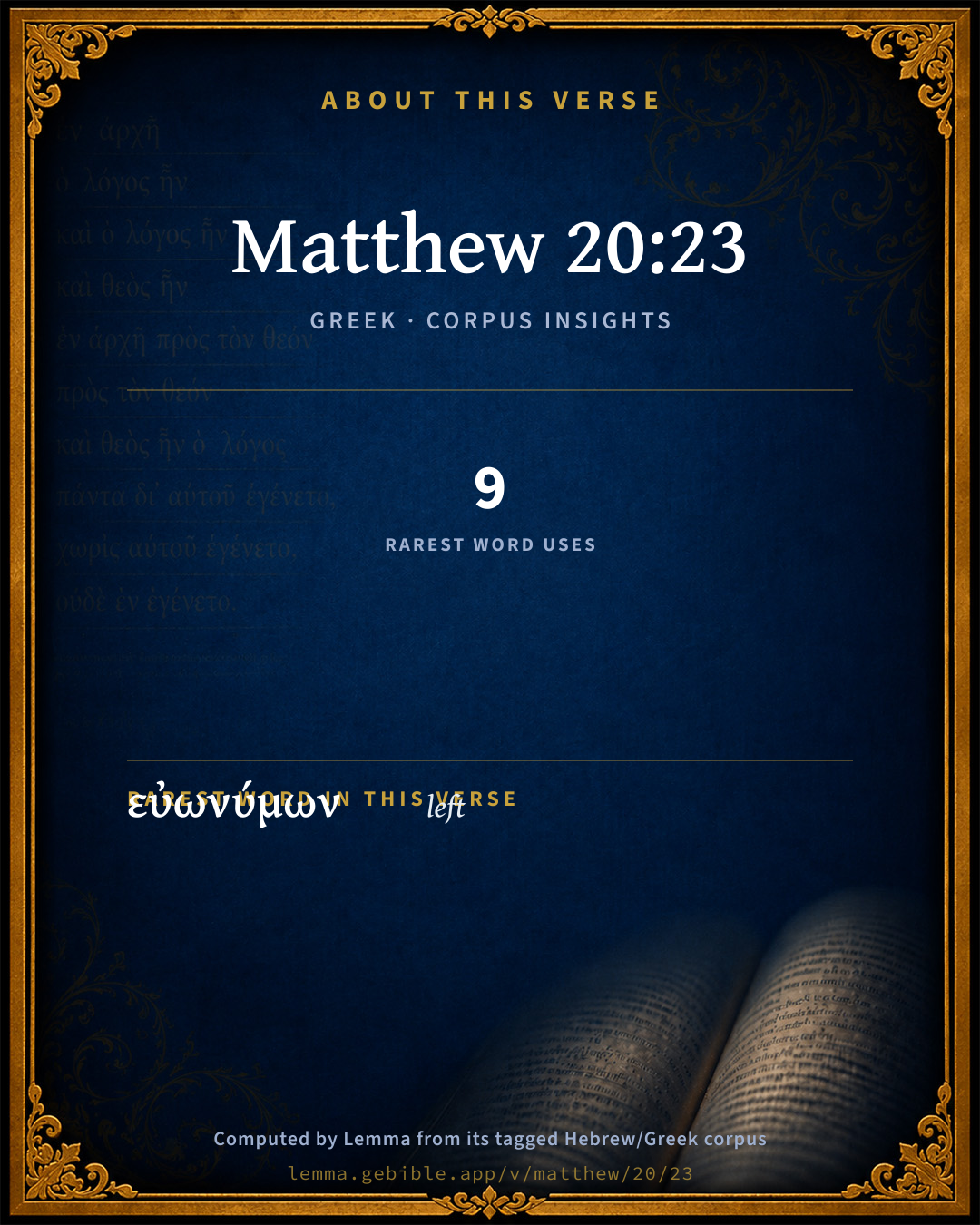
Matthew 20:23

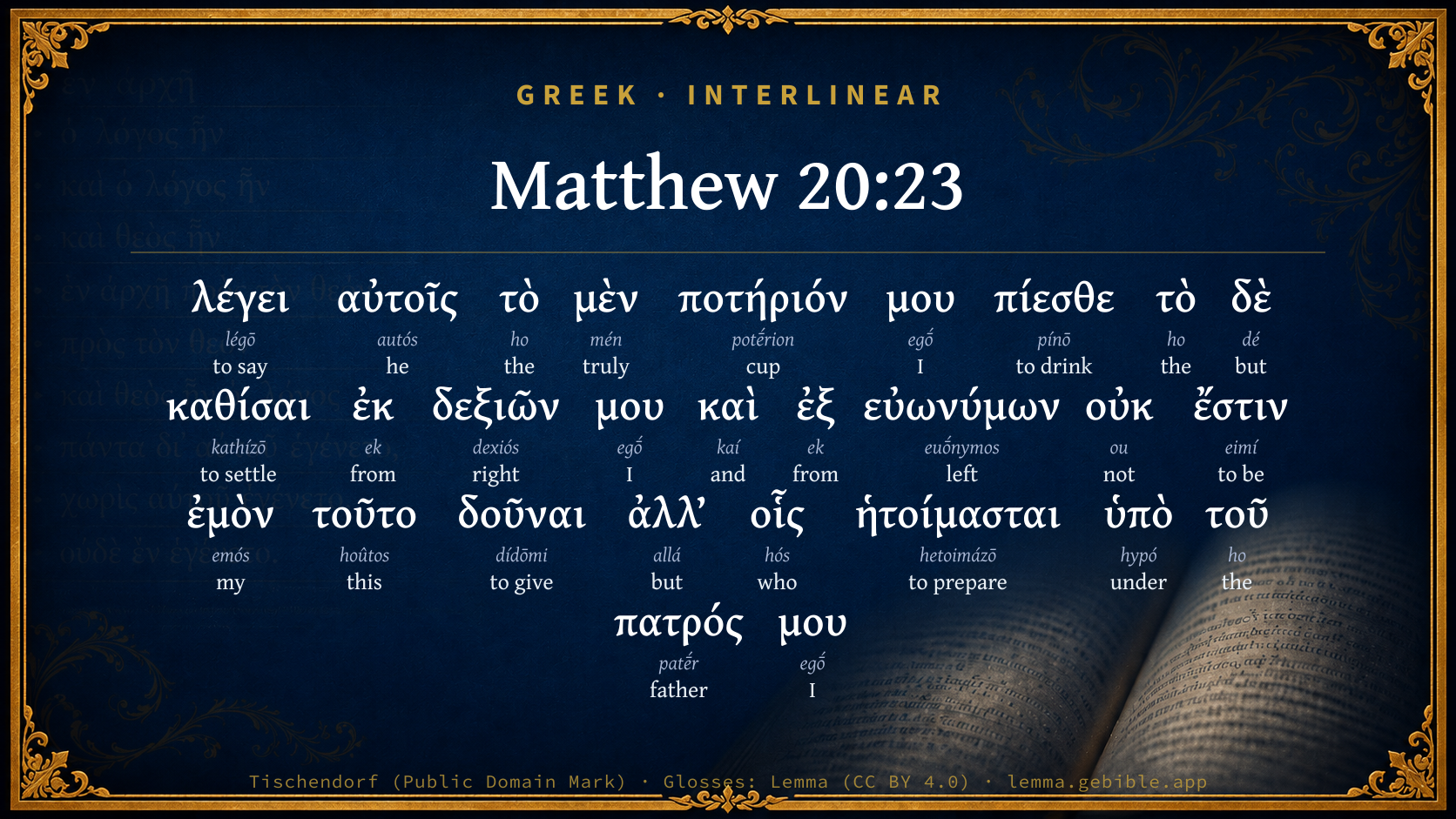
Greek (Tischendorf 8th ed.) Matthew 20:23 appears in the Greek New Testament. The text above is from the Tischendorf 8th edition. Each word links to its Strong’s number and a concise gloss. Click any word for its full Thayer’s Greek Lexicon entry.
Download image
Cite this verse

Matthew 20:23 (World English Bible). Public Domain. Lemma interlinear Bible study tool, https://lemma.gebible.app/v/matthew/20/23.

Show BibTeX & RIS
BibTeX
RIS
English Translation
He said to them, "You will indeed drink my cup, and be baptized with the baptism that I am baptized with, but to sit on my right hand and on my left hand is not mine to give; but it is for whom it has been prepared by my Father."
World English Bible · Public Domain
Download a study sheet

One document with this verse’s original text, its word-by-word gloss line, the meaning frame, cross-references with their text, attributed commentary, and full source and license credits — printable, and it pastes into notes with its structure intact.

This verse Autodidact and up

Study sheet (.html) Plain text (.txt)

A passage Seminary Student

Up to 50 verses in one chapter. A passage sheet keeps up to 6 commentary sources and 12 cross-references per verse, in the order this page ranks them, and says so on the sheet whenever that leaves anything out. Ask for a single verse and you get the Autodidact verse sheet above.

Everything on this page stays free to read, with no account — the sheet is a download of what is already on screen, not access to it.

Want to remove ads? Support Godless Engineer
Compare translations 3

The same verse in 3 English versions, stacked beneath the original-language interlinear above. Click any original word for its lexicon entry.

Each is an independent rendering of the whole verse — the interlinear is not word-aligned to these translations.

Highlighted words mark where these versions differ — a whole-verse word diff, not a word-by-word alignment.

  • World English Bible Public Domain
    He said to them, "You will indeed drink my cup, and be baptized with the baptism that I am baptized with, but to sit on my right hand and on my left hand is not mine to give; but it is for whom it has been prepared by my Father."
  • King James Version Public Domain
    And he saith unto them, Ye shall drink indeed of my cup, and be baptized with the baptism that I am baptized with: but to sit on my right hand, and on my left, is not mine to give, but it shall be given to them for whom it is prepared of my Father.
  • unfoldingWord Literal Text CC BY-SA 4.0
    He says to them, “My cup you will drink. But to sit at my right hand and at my left hand is not mine to give, but for whom it has been prepared by my Father.”

unfoldingWord Literal Text — © unfoldingWord, licensed CC BY-SA 4.0. Word-aligned USFM3 via Door43 (git.door43.org/unfoldingWord/en_ult).

Versions to compare (up to 4)

3 of 4 selected

Show all 19 translations

Every available English version of this verse, each an independent rendering of the whole verse.

  • World English Bible Public Domain
    He said to them, "You will indeed drink my cup, and be baptized with the baptism that I am baptized with, but to sit on my right hand and on my left hand is not mine to give; but it is for whom it has been prepared by my Father."
  • Berean Standard Bible Public Domain
    “You will indeed drink My cup,” Jesus said. “But to sit at My right or left is not Mine to grant. These seats belong to those for whom My Father has prepared them.”
  • Majority Standard Bible Public Domain
    “You will indeed drink My cup and be baptized with the baptism with which I am baptized,” Jesus said. “But to sit at My right or left is not Mine to grant. These seats belong to those for whom My Father has prepared them.”
  • King James Version Public Domain
    And he saith unto them, Ye shall drink indeed of my cup, and be baptized with the baptism that I am baptized with: but to sit on my right hand, and on my left, is not mine to give, but it shall be given to them for whom it is prepared of my Father.
  • American Standard Version (1901) Public Domain
    He saith unto them, My cup indeed ye shall drink: but to sit on my right hand, and on `my' left hand, is not mine to give; but `it is for them' for whom it hath been prepared of my Father.
  • Revised Version (1885) Public Domain
    He saith unto them, My cup indeed ye shall drink: but to sit on my right hand, and on my left hand, is not mine to give, but it is for them for whom it hath been prepared of my Father.
  • Geneva Bible (1599) Public Domain
    And he said vnto them, Ye shall drinke in deede of my cup, and shall be baptized with the baptisme, that I am baptized with, but to sit at my right hande, and at my left hand, is not mine to giue: but it shalbe giuen to them for whome it is prepared of my Father.
  • Douay-Rheims (1899) Public Domain
    He saith to them: My chalice indeed you shall drink; but to sit on my right or left hand, is not mine to give to you, but to them for whom it is prepared by my Father.
  • Young's Literal Translation Public Domain
    And he saith to them, `Of my cup indeed ye shall drink, and with the baptism that I am baptized with ye shall be baptized; but to sit on my right hand and on my left is not mine to give, but -- to those for whom it hath been prepared by my father.'
  • Literal Standard Version CC BY-SA 4.0
    And He says to them, “Of My cup indeed you will drink, and with the immersion that I am immersed with you will be immersed; but to sit on My right hand and on My left is not Mine to give, but—to those for whom it has been prepared by My Father.”
  • Unlocked Literal Bible CC BY-SA 4.0
    He said to them, “My cup you will indeed drink. But to sit at my right hand and at my left hand is not mine to give, but it is for those for whom it has been prepared by my Father.”
  • unfoldingWord Literal Text CC BY-SA 4.0
    He says to them, “My cup you will drink. But to sit at my right hand and at my left hand is not mine to give, but for whom it has been prepared by my Father.”
  • Darby Bible Public Domain
    [And] he says to them, Ye shall drink indeed my cup, but to sit on my right hand and on [my] left, is not mine to give, but to those for whom it is prepared of my Father.
  • World Messianic Bible Public Domain
    He said to them, “You will indeed drink my cup, and be immersed with the immersion that I am immersed with; but to sit on my right hand and on my left hand is not mine to give, but it is for whom it has been prepared by my Father.”
  • Webster's Bible Public Domain
    And he saith to them, Ye shall drink indeed of my cup, and be baptized with the baptism that I am baptized with: but to sit on my right hand, and on my left, is not mine to give, but it shall be given to them for whom it is prepared by my Father.
  • Free Bible Version CC BY-SA 4.0
    “You will certainly drink from my cup,” he said to them, “but the privilege to sit on my right or on my left isn't mine to give. My Father is the one who has decided who that will be. ”
  • Bible in Basic English Public Domain
    They say to him, We are able. He says to them, Truly, you will take of my cup: but to be seated at my right hand and at my left is not for me to give, but it is for those for whom my Father has made it ready.
  • Text-Critical English NT CC BY 4.0
    So he said to them, “You will indeed drink my cup and be baptized with the baptism that I am baptized with, but to sit on my right and on my left is not mine to give, but is for those for whom it has been prepared by my Father.”
  • Tyndale New Testament (1534) Public Domain
    And he sayd vnto the: Ye shall drinke of my cvp and shalbe baptised with the baptyme that I shalbe baptised with. But to syt on my ryght hond and on my lyst hond is not myne to geve: but to them for whom it is prepared of my father.

Literal Standard Version (2020), Covenant Press — licensed CC BY-SA 4.0. Text via the HelloAO Bible API (eBible.org). Unlocked Literal Bible (unfoldingWord) — licensed CC BY-SA 4.0. Text via the HelloAO Bible API (eBible.org). unfoldingWord Literal Text — © unfoldingWord, licensed CC BY-SA 4.0. Word-aligned USFM3 via Door43 (git.door43.org/unfoldingWord/en_ult). Free Bible Version, Dr. Jonathan Gallagher — licensed CC BY-SA 4.0. Text via the HelloAO Bible API (eBible.org).

Word by word

More ways to search: Search by grammar → Find every occurrence → Compare this word →

Practice this passage: Drill this verse → Learn its vocabulary →

εὐωνύμων
euṓnymos
G2176
“left”
Adjective, Genitive, Plural, Masculine
Part of Speech
Adjective
Case
Genitive
Number
Plural
Gender
Masculine
Full Thayer's Definition

Origin: from G2095 and G3686

TDNT: None

1. of good name and of good omen a. in the latter sense used in taking auguries; but those omens were euphemistically called "euonumos" which in fact were regarded as unlucky, i.e. which came from the left, sinister omens, (for which a good name was desired) 2. left, on the left hand
  1. λέγει légō G3004 “to say” Verb, Present, Active, Indicative, 3rd person, Singular
  2. αὐτοῖς autós G846 “he” Personal pronoun, Dative, Plural, Masculine
  3. τὸ ho G3588 “the” Article, Accusative, Singular, Neuter
  4. μὲν mén G3303 “truly” Particle
  5. ποτήριόν potḗrion G4221 “cup” Noun, Accusative, Singular, Neuter
  6. μου egṓ G1473 “I” Personal pronoun, 1st person, Genitive, Singular
  7. πίεσθε pínō G4095 “to drink” Verb, Future, Middle deponent, Indicative, 2nd person, Plural
  8. τὸ ho G3588 “the” Article, Accusative, Singular, Neuter
  9. δὲ dé G1161 “but” Conjunction
  10. καθίσαι kathízō G2523 “to settle” Verb, Aorist, Active, Infinitive
  11. ἐκ ek G1537 “from” Preposition
  12. δεξιῶν dexiós G1188 “right” Adjective, Genitive, Plural, Masculine
  13. μου egṓ G1473 “I” Personal pronoun, 1st person, Genitive, Singular
  14. καὶ kaí G2532 “and” Conjunction
  15. ἐξ ek G1537 “from” Preposition
  16. οὐκ ou G3756 “not” Particle, Negative
  17. ἔστιν eimí G1510 “to be” Verb, Present, Active, Indicative, 3rd person, Singular
  18. ἐμὸν emós G1699 “my” Possessive pronoun, 1st person, Nominative, Singular, Neuter
  19. τοῦτο hoûtos G3778 “this” Demonstrative pronoun, Accusative, Singular, Neuter
  20. δοῦναι dídōmi G1325 “to give” Verb, Aorist, Active, Infinitive
  21. ἀλλ’ allá G235 “but” Conjunction
  22. οἷς hós G3739 “who” Relative pronoun, Dative, Plural, Masculine
  23. ἡτοίμασται hetoimázō G2090 “to prepare” Verb, Perfect, Passive, Indicative, 3rd person, Singular
  24. ὑπὸ hypó G5259 “under” Preposition
  25. τοῦ ho G3588 “the” Article, Genitive, Singular, Masculine
  26. πατρός patḗr G3962 “father” Noun, Genitive, Singular, Masculine
  27. μου egṓ G1473 “I” Personal pronoun, 1st person, Genitive, Singular

About this verse

These counts appear in no published source. They are computed here, from the morphology-tagged text and Lemma’s own curated glosses. What Lemma adds →

28
words
23
distinct lemmas
Gospels
section

Notable vocabulary

The rarest word here is εὐωνύμων left G2176 — appearing just 9 times in the whole Greek New Testament.

Shared distinctive vocabulary

εὐωνύμων left G2176 occurs in 9 verses of the Greek New Testament. Also found in:

Repetition

Words recur within this verse:

Cross-references

10

Topical passages linked to Matthew 20:23 in the Treasury of Scripture Knowledge — connected by theme and wording, ordered by reader-vote popularity; previews shown in the World English Bible.

  • Matthew 25:34 Then the King will tell those on his right hand, 'Come, blessed of my Father, inherit the Kingdom prepared for you from the foundation of the world;
  • Mark 10:40 but to sit at my right hand and at my left hand is not mine to give, but for whom it has been prepared."
  • Revelation 1:9 I John, your brother and partner with you in oppression, Kingdom, and perseverance in Christ Jesus, was on the isle that is called Patmos because of God's Word and the testimony of Jesus Christ.
  • Acts 12:2 He killed James, the brother of John, with the sword.
  • 2 Timothy 2:11–12 This saying is faithful: For if we died with him, We will also live with him.
  • Romans 8:17 and if children, then heirs; heirs of God, and joint-heirs with Christ; if indeed we suffer with him, that we may also be glorified with him.
  • 1 Corinthians 2:9 But as it is written, "Things which an eye didn't see, and an ear didn't hear, Which didn't enter into the heart of man, These God has prepared for those who love him."
  • 2 Corinthians 1:7 Our hope for you is steadfast, knowing that, since you are partakers of the sufferings, so also are you of the comfort.
  • Colossians 1:24 Now I rejoice in my sufferings for your sake, and fill up on my part that which is lacking of the afflictions of Christ in my flesh for his body's sake, which is the assembly;
  • Hebrews 11:16 But now they desire a better country, that is, a heavenly one. Therefore God is not ashamed of them, to be called their God, for he has prepared a city for them.

Cross-references courtesy of OpenBible.info (CC BY 4.0).

Where the printed editions differ

1 variant

Places in this verse where the major printed Greek editions disagree on the wording in a way that affects the translation — a comparison of editions, not a manuscript-by-manuscript collation. The editions are the modern critical texts (Nestlé-Aland 28/27, SBL, Westcott-Hort, Tregelles, Tyndale House) and the traditional texts behind the KJV (the Textus Receptus and the Byzantine/Majority text). It is not a claim about which reading is original.

  1. Extra text
    καὶ τὸ βάπτισμα ὃ ἐγὼ βαπτίζομαι βαπτισθήσεσθε,

    “and <the> baptism what I myself am baptized will be baptized”

    In TRByz Not in NA28NA27TynSBLWHTreg

    καὶ τὸ βάπτισμα ὃ ἐγὼ βαπτίζομαι βαπτισθήσεσθε, (kai to baptisma ho egō baptizomai baptisthēsesthe) 'and baptism what I myself am baptized will be baptized' is only in traditional manuscripts (TR+Byz)

Textual data: Translators Amalgamated Greek New Testament (STEPBible TAGNT) · CC BY 4.0.

Commentary

Notes on Matthew 20:23 from classic Christian and Jewish commentators (each source and its license shown beneath its notes). The classic Christian expositions comment on the surrounding passage and are grouped to its opening verse, so a note may address several verses; the Jewish commentaries on the Tanakh (Rashi and others) are per-verse, so they appear only where the commentator wrote on this verse.

Lemma curates 59 commentaries, every one of them public domain or Creative Commons licensed, each selected and text-cleaned for this edition rather than reprinted as found. About our sources →

Tyndale Open Study Notes

Tyndale Open Resources

20:23 You will indeed: James was eventually martyred (Acts 12:2), and John suffered significant persecution (Acts 4:3; 5:40; Rev 1:9).

Tyndale Open Study Notes — © Tyndale Open Resources, licensed CC BY-SA 4.0. Text via the HelloAO Bible API.

Bengel's Gnomon

Johann Albrecht Bengel

Mat 20:23. Τὸ μὲν ποτήριόν, κ.τ.λ., the cup indeed, etc.) This, together with the parallel passages, has been treated with singular industry by Thomas Gataker in his Adversaria Miscellanea, B. i. ch. 3, of which we shall take the chief points.—καθίσαι, κ.τ.λ., to sit, etc.) There will, therefore, clearly be some who will sit on the right and left hand of Christ.—ἀλλʼ οἷς, κ.τ.λ., except to those for whom) By this opposition or exception (for it comes to the same thing) Jesus does not deny that it is His to give (see Rev 3:21), but limits and declares to whom He will give it, as well as the time and the order, referring, as is His wont, all things to the Father. Jesus did not give it until, His passion having been suffered and concluded,[894] He had sat down Himself on the right hand of the Father. It is neither an earthly kingdom in which He gives it, nor does He give it to those who have not yet suffered. Under, therefore, the very appearance of a repulse, He gives a promise to James and John.

[894] ‘Exantlatâ,’ ‘having been drained to the dregs.’—(I. B.)

Bengel's Gnomon of the New Testament — English translation (T&T Clark, Edinburgh, 1860) — public domain. Text from a community e-Sword module.

Meyer's Critical & Exegetical Commentary

Heinrich August Wilhelm Meyer

Mat_20:23. The disciples reply: δυνάμεθα, not because they did not quite understand what Jesus meant (Mat_20:18 f.), but because they were animated by a sincere though self-confident determination, such, too, as was afterwards sufficiently verified in the case of both, only in somewhat different ways.

οὐκ ἔστιν ἐμὸν δοῦναι, ἀλλʼ οἷς ἡτοίμ. ὑπὸ τοῦ πατρ. μ.] sc. δοθήσεται: is not my business (does not behove me) to give, but it will be given to those for whom it has been prepared (has been put in readiness, Mat_25:34; 1Co_2:9) by my Father. For ἐμὸν ἐστί with infinitive, comp. Plat. Legg. ii. p. 664 B: ἐμὸν ἂν εἴη λέγειν. Jesus thus discourages the questionable request by frankly declaring that the granting of what has just been asked is one of those things which God has reserved to Himself; that it is a matter with which He, the Son, must not interfere. For another instance of such reservation on the part of the Father, see Mat_24:36; Mar_13:32. This evident meaning of the words is not to be explained away or modified. The former has been done by Chrysostom and his successors, also by Castalio, Grotius, Kuinoel, who took ἀλλά as equivalent to εἰ μή; the latter by Augustine, Luther, according to whom the words as man (secundum formam servi) are to be understood, and Bengel, who modifies οὐκ ἔστιν ἐμὸν δοῦναι by erroneously supplying the words: till after my death. Further, the words τὸ μὲν ποτήρ. μ. πίεσθε are to be regarded as expressing the Lords unfeigned trust and confidence in the δυνάμεθα of the disciples; He feels confident that they will verify it by their actions. His words, therefore, are only indirectly tantamount to a prediction, and that not exactly of death by martyrdom, which was certainly the fate of James, Acts 12, though not of John,[5] but of suffering generally in the interests of the Messiahs kingdom (Rom_8:17; 2Co_1:5). It is probable, however, that the apocryphal story about John swallowing a cup full of poison (see Fabricius, ad Cod. Apocr. I. p. 576; Tischendorf, Act. ap. apocr. p. 269), and that without being anything the worse (Mar_16:18), as well as the legend about the attempt to scald him to death in boiling oil (Tertullian, de praescr. 36), owe their existence and propagation to the present passage. Origen views our Lords words on this occasion in connection with the banishment of John to Patmos.

[5] The statement of Gregorius Hamartolos (quoted by Nolte in the Tüb. theol. Quartalschr. 1862, p. 466), to the effect that, in his λόγια, Papias declares that John was put to death by the Jews, cannot outweigh the testimony of the early church to the fact that he died a natural death. For the discussion of this point, see Hilgenfeld in his Zeitschr. 1865, p. 78 ff.; Overbeck, ibid. 1867, p. 68 ff.; Holtzmann in Schenkels Lex. III. p. 333; Keim, III. p. 44 f.; Steitz in the Stud. u. Krit. 1868, p. 487 ff.

Meyer — Critical and Exegetical Commentary on the New Testament — English translation by Peter Christie, edited by Frederick Crombie (T&T Clark, 1880) — public domain. Text from a community e-Sword module.

Expositor's Greek Testament

ed. W. Robertson Nicoll

Mat 20:23 . τὸ μὲν π . μ . πίεσθε , as for my cup, ye shall drink of it: predictive of the future fact, and also conferring a privilege = I have no objection to grant you companionship in my sufferings; that favour may be granted without risk of abuse. τὸ δὲ καθίσαι , etc., but as for sitting on right and left, hand that is another affair. οὐκ ἔστιν ἐμὸν δοῦναι = is not a matter of mere personal favour: favouritism has no place here; it depends on fitness. That is the meaning of the last clause, οἷς ἡτοίμασται ὑ . τ . π . μ . = it is not an affair of arbitrary favour on the part of the Father any more than on my part. Thrones are for those who are fit to sit on them, and prepared by moral trial and discipline to bear the honour worthily: τοῖς ἀπὸ τῶν ἔργων δυναμένοις γενέσθαι λομπροῖς Chrys., Hom. lxv. The same Father illustrates supposing an ἀγωνοθέτης to be asked by two athletes as assign to them the crowns of victory, and replying: “it is not mine to give, but they belong to those for whom they are prepared by struggle and sweat” ( ἀπὸ τῶν πόνων καὶ τῶν ἱδρώτων ).

The Expositor's Greek Testament, edited by W. Robertson Nicoll (1897–1910) — public domain. Text from a community e-Sword module.

Geneva Bible (1599)

Geneva Bible translators

The almightiness of Christ his divinity is not shut out by this, but it showeth the debasing of himself by taking man’s nature upon him.

Geneva Bible (1599) marginal notes — public domain. Text via Bolls.life.

Adam Clarke's Commentary

Verse 23. Is not mine to give, but it shall be given to them for whom it is prepared of my Father.] The common translation, in which the words, it shall be given to them; are interpolated by our translators, utterly changes and destroys the meaning of the passage. It represents Christ (in opposition to the whole Scriptures) as having nothing to do in the dispensing of rewards and punishments; whereas, our Lord only intimates that, however partial he may be to these two brethren, yet seats in glory can only be given to those who are fitted for them. No favour can prevail here; the elevated seat is for him who is filled with the fulness of God. The true construction of the words is this: - ουκ εϚιν εμον δουναι, αλλ' ὁις ητοιμυϚαι ὑπο του πατρος μου, To sit on my right hand and on my left, is not mine to give, except to them for whom it is prepared of my Father. According to the prediction of Christ, these brethren did partake of his afflictions: James was martyred by Herod, Ac 12:2; and John was banished to Patmos, for the testimony of Christ, Re 1:9.

Adam Clarke's Commentary on the Bible (1810–1826) — public domain. Text from a community e-Sword/MySword module.

Ellicott's Commentary for English Readers

(23) Is not mine to give.—The words in italics are, of course, not in the Greek, and they spoil the true construction of the sentence. Our Lord does not say that it does not belong to Him to give what the disciples asked, but that He could only give it according to His Father’s will and the laws which He had fixed. Considered as a prediction, there was a singular contrast in the forms of its fulfilment in the future of the two brothers. James was the first of the whole company of the Twelve to pass through the baptism of blood (Act_12:2). For John was reserved the weariness and loneliness of an old age surviving all the friendships and companionships of youth and manhood, the exile in Patmos, and the struggle with the great storm of persecution which raged throughout the empire under Nero and Domitian.

To them for whom it is prepared of my Father.—He does not say who these are; but the reappearance of the same words in Mat_25:34, throws some light on its meaning here. The kingdom is reserved for those who do Christ-like deeds of love; the highest places in the kingdom must be reserved for those whose love is like His own, alike in its intensity and its width.

A Bible Commentary for English Readers, edited by Charles John Ellicott (1878–1897) — public domain. Text from a community e-Sword module.

The Cambridge Bible for Schools and Colleges

gen. ed. J. J. S. Perowne

23. Ye shall drink indeed of my cup] James was slain by the sword of Herod Agrippa I. (Act_12:2). John suffered many persecutions, but died a natural death. The rebuke of Jesus is very gentle; His soul knew what suffering was in store for the two brothers.

it shall be given] These words are not in the Greek text, but may be understood from the infinitive “to give” in the first clause. By another interpretation “but” = “except,” and the sentence would run, “it is not mine to give except to those,” &c., but it is more than doubtful whether the Greek word can have this meaning.

The Cambridge Bible for Schools and Colleges (gen. ed. J. J. S. Perowne; Cambridge University Press, 1878–1918) — public domain. Text from a community e-Sword module.

John Gill's Exposition

And when they ten heard it,.... The other ten apostles, who either were within hearing the request made, and Christ's answer, or had by some means information of it:

they were moved with indignation against the two brethren; the two sons of Zebedee, James and John: they were not so much displeased with the mother of them, who asked the favour for them, as with her sons, knowing that they have put her upon making this motion to Christ; nor were they so much moved with indignation at the action, detesting all notions of superiority and preeminence; for they were all tinctured with the same carnal principle, and each was desirous of the chief place for himself; but they were angry, and out of all temper, that these two brethren should move for that, which they thought they had as good a right unto, as any of them: wherefore, as Mark says, "they began to be much displeased with" them, and to show their resentment, not only by their looks and gestures, but by words; and very probably they would have rose to very high words, and a downright quarrel, had not Christ interposed; as, from the following verse, it appears he did.

John Gill's Exposition of the Whole Bible (1746–1763) — public domain (CC PDM 1.0). Text via the HelloAO Bible API.

Trapp's Complete Commentary

John Trapp

23 And he saith unto them, Ye shall drink indeed of my cup, and be baptized with the baptism that I am baptized with: but to sit on my right hand, and on my left, is not mine to give, but it shall be given to them for whom it is prepared of my Father.

Ver. 23. Ye shall drink indeed of my cup] Illud solum quod suavius et limpidius. The saints sip of the top of God’s cup; as for the dregs, the wicked shall wring them out, and drink them up.

And be baptized, &c.] Or ducked, washed (not drowned), as St Paul was in the shipwreck; or as the baptized child, which shakes off the water, or is dried after baptism. Afflictions, saith one, are called baptism, because they set God’s mark upon us (as baptism doth) that we belong to God; this for outward afflictions. And for desertion, it is called Christ’s cup, because we are sure to pledge him in that too, and be conformed unto him, as was Job, David, Heman, Psa 88:1-18, &c. Grace is no target against affliction; but the best shall have terrors within and troubles without, as sure as the coat is on their back or the heart in their belly.

Is not mine to give] i.e. It is no part of my present office; or, I have no such commission from my Father to give precedencies to all that affect them. Christ hereby seeks to raise up the low grovelling spirits of his apostles to things supernatural, supernal.

John Trapp, A Commentary or Exposition upon All the Books of the Old and New Testament (1647–1656) — public domain. Text from a community e-Sword module.

Haydock's Catholic Bible Commentary

Of my chalice indeed you shall drink. St. James was the first apostle that suffered martyrdom at Jerusalem. (Acts xii. 2.) And St. John at Rome was put into a cauldron of boiling oil, and banished into Patmos. --- Is not mine to give you.[1] The Arians objected these words against Christ’s divinity. St. Augustine answers that the words are true if taken of Christ, as he was man. The easier answer is, that it was not his to give to them, while they were in those dispositions of pride and ambition. So that the distinction made, is not betwixt the Father and his eternal Son, as if the Father could give what the Son could not, but betwixt persons worthy, and not worthy of such a favour. It is true the word you, is now wanting in the Greek manuscripts and must have been wanting in some of them in the fourth, or at least the fifth century, since we find them not in St. John Chrysostom. St. Augustine also in one place omits it, but sometimes lays great stress upon it; Christ’s meaning being no more, than that heaven was not his to give them; that is, to the proud, &c. St. Ambrose reads it; and what is still of greater weight, St. Jerome hath it in the text of the New Testament, which he corrected from the best Greek manuscripts. (Witham) --- In your present state there is no exception of persons with God; for, whosoever is worthy of heaven, shall receive it as the reward of his merits. Therefore Christ answers them, it is not mine to bestow the kingdom of heaven upon you, because you are not yet deserving, on account of your pride in seeking to have yourselves preferred before my other apostles. But be ye humble, and heaven is prepared for you, as well as for all others, who are properly disposed. (Nicholas de Lyra.) --- Greatness in the next life will be proportioned to humility in this.

===============================

[BIBLIOGRAPHY]

Non est meum dare vobis. Now we read only in the Greek, ouk estin emon dounai. It is so also in St. John Chrysostom, in St. Cyril, (in Thesauro, Assertione xxvi, tom. v. p. 243) where he answers this objection of the Arians. Nor is Greek: umin, in the Greek text of St. Epiphanius (hær. lxix, p. 742) though it be put there in the Latin translation. St. Augustine has not vobis: (lib. i. de Trin. chap. xii, p. 765 G. tom. viii.) but in Psalm ciii, (tom. iv, p. 1157) he says, Quid est not est meum dare vobis? non est meum dare superbis. St. Ambrose (lib. v. de Fide, tom. iv. chap. iii, p. 147) Non dixit non est meum dare, sed non est meum dare vobis, hoc est, non sibi potestatem deesse asserens, sed me[]tum creaturis. Besides the Fathers, who did not read vobis in the text, shew by their expositions, that they took the sense to be the same, and no ways favourable to the Arians. See St. Augustine lib. i. de Trin. p. 766. A. non est meum dare, ac si diceretur, not est humanæ potestatis hoc dare, ut per illud intelligatur hoc dare, per quod Deus est æqualis Patri, &c. See St. John Chrysostom hom. lxvi. St. Cyril in Thesauro assert. xxvi. p. 243. St. Epiphanius hær. lxix, p. 742, &c.

====================

George Leo Haydock (1774–1849), Haydock's Catholic Family Bible and Commentary, 1859 edition — public domain. Excludes Psalms (Douay-Rheims chapter numbering differs from Protestant) and Deuterocanonical books (Catholic canon only).

Matthew Poole's English Annotations

Mark hath the same, Mar 10:39,40. Our Saviour here tells them, that as he was first to suffer and then enter into his glory, so they that should be glorified with him should also first suffer with him; for none shall be crowned but those who strive lawfully, 2Ti 2:5; and all that will live godly in Christ Jesus shall suffer persecution, 2Ti 3:12. But who should be highest in the kingdom of glory his Father must determine, upon whose will the disposal of his kingdom, and the preferences in it, depended. This text hath been abused by those who have denied Christ’s Deity, and equality to the Father, as if it served their purpose, because Christ here denieth it in his power to dispose of the kingdom of heaven; but besides that, he elsewhere asserts the contrary, Joh 10:28; 17:2. Christ doth not here speak of what was in his power, but what was his office as Mediator; so his work was to encourage them to fight the good fight, not to dispense out crowns to them. Or else he speaketh of himself as man, as he speaketh, Joh 14:28. Nor indeed doth Christ here deny that it was in his power, but only that it was in his power to give this preference to any except those for whom his Father had prepared it. Note, the Greek is, ουκ εστιν εμον δουναι αλλ’ οις ητοιμασται, that is, is not mine to give, but to them for whom it is prepared; so that those words, it shall be given to them, which our translators put in, were better left out. All this was before ordered and determined by God, and he could only dispose of the kingdom of God according to the eternal counsel. ’Aλλα (which we translate but) hath here the force of ιε μη, (unless, ) as in Mar 9:8; 2Co 2:5. Besides that, to show the order of the Trinity in working, acts of power and providence are usually ascribed to the Father, though by other scriptures it appears that the Son in them cooperates with the Father.

Matthew Poole's English Annotations on the Holy Bible (1683–1685) — public domain. Text from a community e-Sword/MySword module.

Whedon's Commentary on the Bible

Daniel D. Whedon

23. Ye shall — Ye shall undergo sufferings patterned after mine. Not mine to give — As a matter of present favour, apart from the divine plan of human redemption. To them — The faithful believers. For whom — Upon condition of their faith, it is prepared, in the plan of salvation, of my Father. The kingdom of heaven is a reward, prepared by God for his faithful children. The assignment of its abodes is fixed by the laws of the kingdom itself. It was not, therefore, to be settled by Christ on mere human favour, as caprice or affection might dictate. So, though he loved the rich young ruler who asked the mode of earning eternal life, he could not therefore save him.

Daniel D. Whedon (gen. ed.), Commentary on the Old and New Testaments (1874–1909) — public domain. Text from a community e-Sword module.

The Pulpit Commentary

Ye shall indeed drink, etc. Jesus accepts their venture of faith, and prophesies its fulfilment. St. James first shared in Christ"s baptism of blood, being murdered by Herod. (Act_12:2) He was a martyr in will and deed. St. John did not, indeed, undergo a violent death, but he stood by the cross and felt his Master"s sufferings; he lived a long life of persecution, banishment, and distress; he saw all his companions drop off one by one, till in extreme old age he was left solitary, with nothing to comfort him but the memory of vanished years, and the hope of an eternal future. Truly he was a martyr in will, if not in deed. The story that he was cast into a cauldron of boiling oil by Nero"s command, and that, coming forth unhurt, he was afterwards banished to Patmos, is one which, except as regards the banishment, has not. been accepted by modern criticism. The event is mentioned by Tertullian ("De Praescript.," 36.), Jerome ("Adv. Jovin.," 1:26; and "Comm. in Matthew" 20:27), and is commemorated in the Church Calendar on May 6, under the title of "S. Joh. ante Port. Lat.;" but it appears to have been a legend that first appeared in Tertullian"s work, and was copied from him by other writers without examination. Is not mine to give, but it shall be given to them for whom (all oiv) it is prepared. The Authorized Version inserts doyhsetai ; the Revised," But it is for them for whom it hath been prepared." The Vulgate has, Non est meum dare vobis, sed quibus paratum est a Patre meo. Probably alla here is equivalent to ei mh , as in Mat_17:8 and Mar_9:8, and means "except," "unless." The Lord does not mean that he was not able to give it, if so he thought fit, or that the boon was solely at his Father"s bestowal, not his (which he might have said, speaking in his human nature). What he affirms is this: The prize is awarded, not by favour or on any earthly considerations, but by absolute.justice, and only to those who prove themselves worthy to receive it. Christ assigns to the Father the revelation of mysteries and the election to eternal life. (see Mat_11:26 Mat_16:17) It is prepared; it hath been prepared, (Mat_25:34) according to certain impartial laws ordained by God, who is no respecter of persons. "The throne," says St. Bernard, "is the price of toils, not a grace granted to ambition; a reward of righteousness, not the concession of a request."

The Pulpit Commentary (1880–1919), ed. H.D.M. Spence-Jones & Joseph S. Exell — public domain. Text from a community e-Sword module.

John Wesley's Explanatory Notes

But to sit on my right hand - Christ applies to the glories of heaven, what his disciples were so stupid as to understand of the glories of earth. But he does not deny that this is his to give. It is his to give in the strictest propriety, both as God, and as the Son of man. He only asserts, that he gives it to none but those for whom it is originally prepared; namely, those who endure to the end in the faith that worketh by love.

John Wesley, Explanatory Notes Upon the Whole Bible (1754–1765) — public domain. Text via the GEBible commentary corpus.

Burkitt's Expository Notes on the New Testament

William Burkitt

Observe here, Our blessed Saviour’s wonderful mildness and goodness towards his disciples; he doth not with passion, much less with indignation, reprehend them, either for their ambition or presumption, but makes the best of their answer, and encourages their good intentions; he tells them, they should have the honour to share with him in his sufferings, to pledge him in his own cup, and after a conformity to him in his sufferings, they might expect to be sharers with him in his glory.

Yet observe, That when Christ says, That to sit at his right hand, was not his to give; he means, as he was man, or as he was mediator; for elslewhere, as God, we find him asserting his power to dispose at the kingdom of heaven; I give unto them eternal life Joh 10:28

However, the Arians of old, and Socinians of late, do from this text infer, that God the Father has a power reserved to himself, which he hath not committed to Christ his Son; from whence they would conclude, that he is not the same God which the Father is, because he hath not the same power which the Father has.

Answer, But if Christ be here supposed to deny his power to himself, he must then manifestly contradict himself, when he says, I appoint to you a kingdom, and All power in heaven and earth is given to me. When Christ therefore saith, he could only give this to them for whom it was appointed of his Father; this doth not signify any defect in his power, but a perfect conformity to his Father’s will, and that he could not do this, unless the divine essence and nature abided in him. This the words rather shew, than that there is any want of power in Christ.

William Burkitt's Expository Notes on the New Testament (1700–1703) — public domain. Text from a community e-Sword module.

The People's New Testament

B. W. Johnson

23. Ye shall drink indeed of my cup. They cannot do it now, but in due time they shall follow him; they shall rise to their calling, and bravely meet all its risks and hardships. See Acts 12:1, 2. Is not mine to give. The highest honors of his kingdom were not now to be disposed of by him to gratify the worldly ambition of any one. For whom it is prepared. The Father had a plan in reference to the honors of the kingdom. The lowliest would be the loftiest. They who gave up most would get most.

B. W. Johnson's The People's New Testament with Notes (1889–1891) — public domain. Electronic text from the Christian Classics Ethereal Library (CCEL) ThML edition.

Cambridge Greek Testament for Schools and Colleges

23. τὸ μὲν ποτήριόν μου πίεσθε. James was slain by the sword of Herod Agrippa I. (Act 12:2). John suffered many persecutions, but died a natural death. The rebuke of Jesus is very gentle; his soul knew what suffering was in store for the two brothers.

ἀλλʼ οἷς ἡτοίμασται. The A.V. is right in understanding δοθήσεται ἐκείνοις ‘but it shall be given, &c.,’ thus retaining the proper force of ἀλλά, which never = εἰ μή. In Mar 9:8, οὐκέτι οὐδένα εἶδον ἀλλὰ τὸν Ἰησοῦν μόνον, εἶδον must be repeated in the second clause. See Winer, 566, 728.

Cambridge Greek Testament for Schools and Colleges (Cambridge University Press, 1896; 21 vols, various authors incl. Carr, Maclear, Plummer, Farrar, Lumby, Moule, M. R. James, Simcox) — public domain. Text from a community e-Sword module.

Alford’s Greek Testament

Henry Alford

23.] The one of these brethren was the first of the Apostles to drink the cup of suffering, and be baptized with the baptism of blood, Act 12:1, Act 12:2; the other had the longest experience among them of a life of trouble and persecution.

The last clause of the verse may be understood as in the E. V., ‘is not mine to give, but it shall be given to them for whom it is prepared of my Father;’ so Meyer, al.; or, taking ἀλλά as = εἰ μή (see reff.), ‘is not mine to give, except to those for whom,’ &c. So Chrys. &c., Grot. al. If however we understand after ἀλλά ‘it shall be given by Me,’ we may say with Bengel, ‘res eodem recidit, sive oppositione, sive exceptione.’

Henry Alford, The Greek Testament (1849–1861) — public domain. Text from a community e-Sword module.

International Critical Commentary

23. He saith to them, Of My cup indeed ye shall drink; but to sit at My right hand and at the left is not Mine to give, but (it shall be given to those) for whom it has been prepared by My Father.] Mk. has: “And Jesus said to them, The cup which I drink, ye shall drink; and with the baptism with which I am baptized, shall ye be baptized. But to sit at My right hand or at the left is not Mine to give, but (it shall be given to those) for whom it has been prepared.”

For Mt.’s addition, ὑπὸ τοῦ πατρός μου, cf. 25:41, ὁ ἡτοίμασεν ὁ πατήρ μου, D 1 22 a b c ff1 2 g1 h.

(M)

23. πίεσθε] C X al add from Mk. καὶ τὸ βαπτισμα ὃ έγὼ βαπτίζομαι βαπτισθἡσεσθε.

(M)

International Critical Commentary — older volumes (1896–1929), various authors — public domain. Text from a community e-Sword module.

Lesson kit

Teaching starters — assembled from the data on this page, not authored interpretation. Every prompt links to the verse data it draws on. Edit before teaching.

Matthew, in the Gospels, opens this verse with 28 words (23 distinct Greek lemmas). Its most distinctive word is euṓnymos (“left”). A historical commentator’s framing appears above. Read the whole chapter for the surrounding context.

Discussion questions

  1. What does “left” (euṓnymos) contribute to the verse as a whole?
  2. How does Matthew 20:21, which shares the word «left», read alongside this verse?
  3. What does the repetition of “the” (3× in this one verse) do in this verse?
  4. The translations on this page render this verse differently — a whole-verse word diff, not a word-by-word alignment. What might account for the different wordings?
  5. Compare how Tyndale Open Study Notes and Bengel's Gnomon read this verse. Where do they agree or differ?

Things to notice

Reading settings

Reading text

Shown beneath each verse's original-language words.

Old Testament
Old Testament edition

Read the OT as the Masoretic Hebrew (MT) or the Greek Septuagint (LXX).

English shown for the Greek Septuagint (in the Hebrew ↔ Greek comparison).

Comparing translations? Open the Compare panel on any verse page to stack up to four side by side.