John 10:29

Greek (Tischendorf 8th ed.) John 10:29 appears in the Greek New Testament. The text above is from the Tischendorf 8th edition. Each word links to its Strong’s number and a concise gloss. Click any word for its full Thayer’s Greek Lexicon entry.
Download image
Cite this verse

John 10:29 (World English Bible). Public Domain. Lemma interlinear Bible study tool, https://lemma.gebible.app/v/john/10/29.

Show BibTeX & RIS
BibTeX
RIS
English Translation
My Father, who has given them to me, is greater than all. No one is able to snatch them out of my Father's hand.
World English Bible · Public Domain
Download a study sheet

One document with this verse’s original text, its word-by-word gloss line, the meaning frame, cross-references with their text, attributed commentary, and full source and license credits — printable, and it pastes into notes with its structure intact.

This verse Autodidact and up

Study sheet (.html) Plain text (.txt)

A passage Seminary Student

Up to 50 verses in one chapter. A passage sheet keeps up to 6 commentary sources and 12 cross-references per verse, in the order this page ranks them, and says so on the sheet whenever that leaves anything out. Ask for a single verse and you get the Autodidact verse sheet above.

Everything on this page stays free to read, with no account — the sheet is a download of what is already on screen, not access to it.

Want to remove ads? Support Godless Engineer
Compare translations 3

The same verse in 3 English versions, stacked beneath the original-language interlinear above. Click any original word for its lexicon entry.

Each is an independent rendering of the whole verse — the interlinear is not word-aligned to these translations.

Highlighted words mark where these versions differ — a whole-verse word diff, not a word-by-word alignment.

  • World English Bible Public Domain
    My Father, who has given them to me, is greater than all. No one is able to snatch them out of my Father's hand.
  • King James Version Public Domain
    My Father, which gave them me, is greater than all; and no man is able to pluck them out of my Father's hand.
  • unfoldingWord Literal Text CC BY-SA 4.0
    My Father, who has given them to me, is greater than all, and no one is able to snatch them from the hand of the Father.

unfoldingWord Literal Text — © unfoldingWord, licensed CC BY-SA 4.0. Word-aligned USFM3 via Door43 (git.door43.org/unfoldingWord/en_ult).

Versions to compare (up to 4)

3 of 4 selected

Show all 19 translations

Every available English version of this verse, each an independent rendering of the whole verse.

  • World English Bible Public Domain
    My Father, who has given them to me, is greater than all. No one is able to snatch them out of my Father's hand.
  • Berean Standard Bible Public Domain
    My Father who has given them to Me is greater than all. No one can snatch them out of My Father’s hand.
  • Majority Standard Bible Public Domain
    My Father who has given them to Me is greater than all. No one can snatch them out of My Father’s hand.
  • King James Version Public Domain
    My Father, which gave them me, is greater than all; and no man is able to pluck them out of my Father's hand.
  • American Standard Version (1901) Public Domain
    My Father, who hath given `them' unto me, is greater than all; and no one is able to snatch `them' out of the Father's hand.
  • Revised Version (1885) Public Domain
    My Father, which hath given them unto me, is greater than all; and no one is able to snatch them out of the Father’s hand.
  • Geneva Bible (1599) Public Domain
    My Father which gaue them me, is greater then all, and none is able to take them out of my Fathers hand.
  • Douay-Rheims (1899) Public Domain
    That which my Father hath given me, is greater than all: and no one can snatch them out of the hand of my Father.
  • Young's Literal Translation Public Domain
    my Father, who hath given to me, is greater than all, and no one is able to pluck out of the hand of my Father;
  • Literal Standard Version CC BY-SA 4.0
    My Father, who has given to Me, is greater than all, and no one is able to snatch out of the hand of My Father;
  • Unlocked Literal Bible CC BY-SA 4.0
    My Father, who has given them to me, is greater than all others, and no one is able to snatch them out of the hand of the Father.
  • unfoldingWord Literal Text CC BY-SA 4.0
    My Father, who has given them to me, is greater than all, and no one is able to snatch them from the hand of the Father.
  • Darby Bible Public Domain
    My Father who has given [them] to me is greater than all, and no one can seize out of the hand of my Father.
  • World Messianic Bible Public Domain
    My Father who has given them to me is greater than all. No one is able to snatch them out of my Father’s hand.
  • Webster's Bible Public Domain
    My Father, who gave them to me, is greater than all; and none is able to pluck them out of my Father's hand.
  • Free Bible Version CC BY-SA 4.0
    My Father who gave them to me is greater than anyone else; no one can snatch them from him.
  • Bible in Basic English Public Domain
    That which my Father has given to me has more value than all; and no one is able to take anything out of the Father's hand.
  • Text-Critical English NT CC BY 4.0
    My Father, who has given them to me, is greater than all, and no one is able to snatch them out of my Father's hand.
  • Tyndale New Testament (1534) Public Domain
    My father which gave the me is greatter then all and no man is able to take them out of my fathers honde.

Literal Standard Version (2020), Covenant Press — licensed CC BY-SA 4.0. Text via the HelloAO Bible API (eBible.org). Unlocked Literal Bible (unfoldingWord) — licensed CC BY-SA 4.0. Text via the HelloAO Bible API (eBible.org). unfoldingWord Literal Text — © unfoldingWord, licensed CC BY-SA 4.0. Word-aligned USFM3 via Door43 (git.door43.org/unfoldingWord/en_ult). Free Bible Version, Dr. Jonathan Gallagher — licensed CC BY-SA 4.0. Text via the HelloAO Bible API (eBible.org).

Word by word

More ways to search: Search by grammar → Find every occurrence → Compare this word →

Practice this passage: Drill this verse → Learn its vocabulary →

ἁρπάζειν
harpázō
G726
“to seize”
Verb, Present, Active, Infinitive
Part of Speech
Verb
Tense
Present
Voice
Active
Mood
Infinitive
Full Thayer's Definition

Origin: from a derivative of G138

TDNT: 08:52,8

1. to seize, carry off by force 2. to seize on, claim for one's self eagerly 3. to snatch out or away
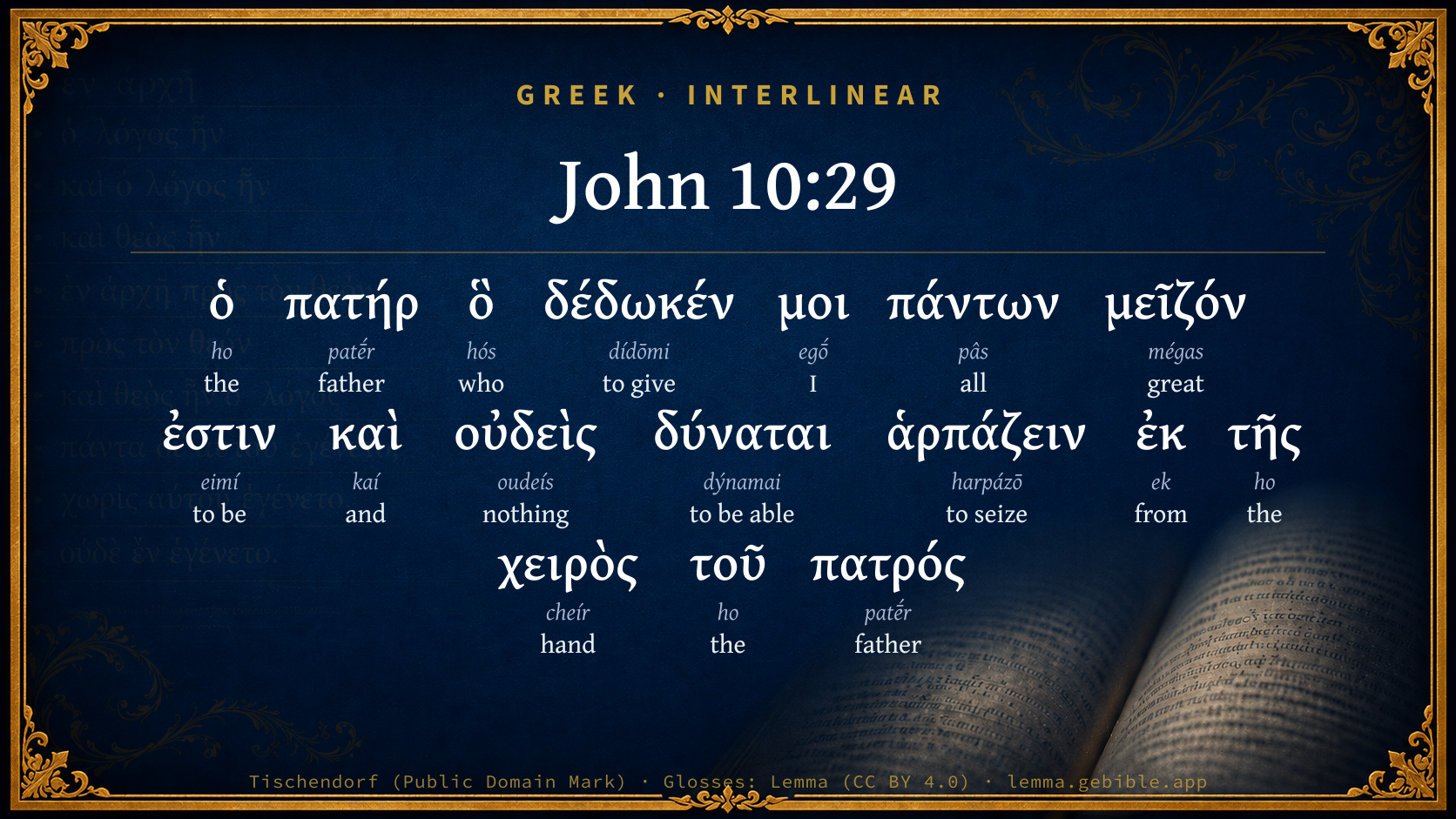
  1. ὁ ho G3588 “the” Article, Nominative, Singular, Masculine
  2. πατήρ patḗr G3962 “father” Noun, Nominative, Singular, Masculine
  3. ὃ hós G3739 “who” Relative pronoun, Accusative, Singular, Neuter
  4. δέδωκέν dídōmi G1325 “to give” Verb, Perfect, Active, Indicative, 3rd person, Singular
  5. μοι egṓ G1473 “I” Personal pronoun, 1st person, Dative, Singular
  6. πάντων pâs G3956 “all” Adjective, Genitive, Plural, Masculine
  7. μεῖζόν mégas G3173 “great” Adjective, Nominative, Singular, Neuter, Comparative
  8. ἐστιν eimí G1510 “to be” Verb, Present, Active, Indicative, 3rd person, Singular
  9. καὶ kaí G2532 “and” Conjunction
  10. οὐδεὶς oudeís G3762 “nothing” Adjective, Nominative, Singular, Masculine, Negative
  11. δύναται dýnamai G1410 “to be able” Verb, Present, Middle or Passive deponent, Indicative, 3rd person, Singular
  12. ἐκ ek G1537 “from” Preposition
  13. τῆς ho G3588 “the” Article, Genitive, Singular, Feminine
  14. χειρὸς cheír G5495 “hand” Noun, Genitive, Singular, Feminine
  15. τοῦ ho G3588 “the” Article, Genitive, Singular, Masculine
  16. πατρός patḗr G3962 “father” Noun, Genitive, Singular, Masculine

About this verse

These counts appear in no published source. They are computed here, from the morphology-tagged text and Lemma’s own curated glosses. What Lemma adds →

17
words
14
distinct lemmas
Gospels
section

Notable vocabulary

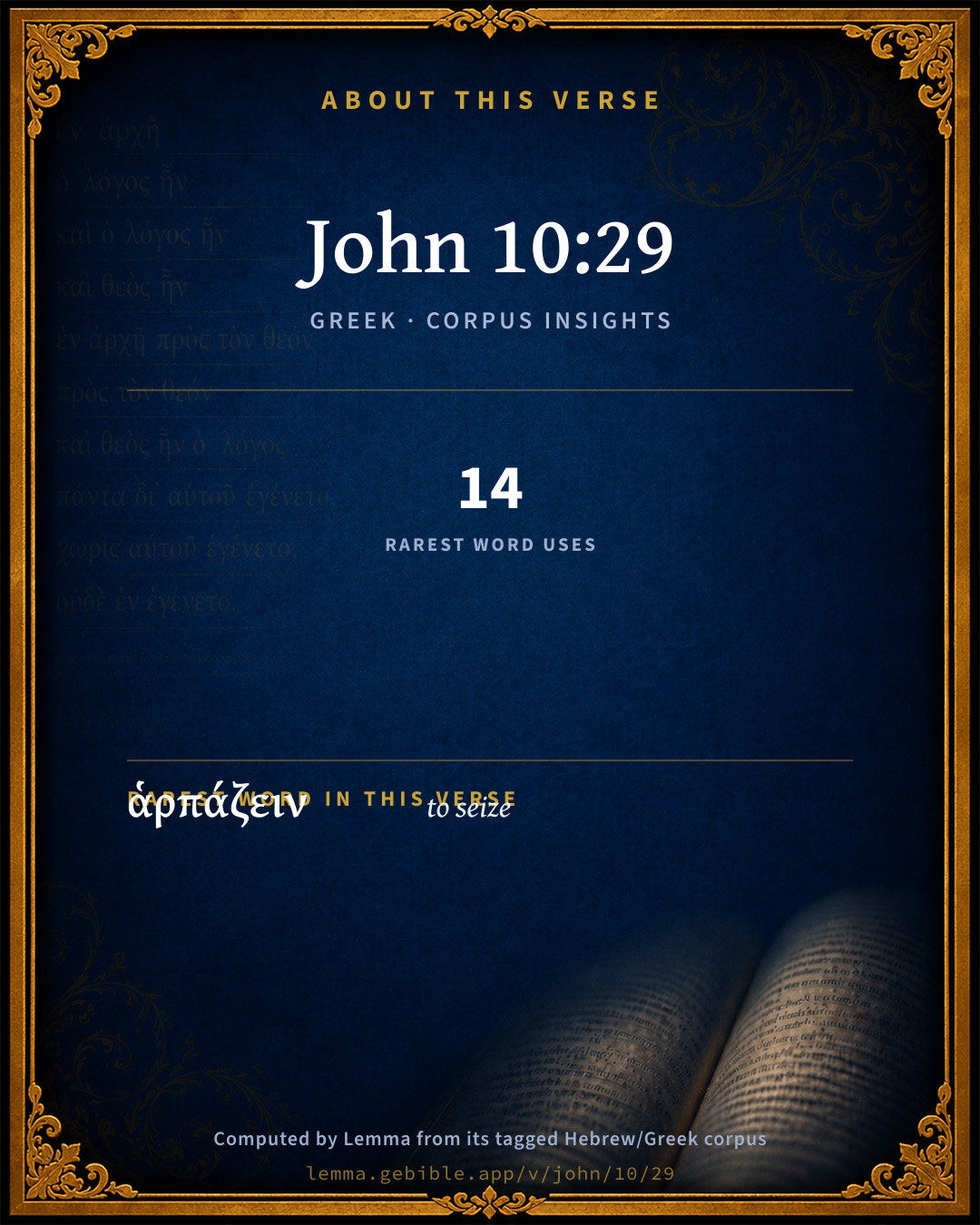
The rarest word here is ἁρπάζειν to seize G726 — appearing just 14 times in the whole Greek New Testament.

Shared distinctive vocabulary

ἁρπάζειν to seize G726 occurs in 14 verses of the Greek New Testament. Also found in:

Repetition

Words recur within this verse:

Cross-references

10

Topical passages linked to John 10:29 in the Treasury of Scripture Knowledge — connected by theme and wording, ordered by reader-vote popularity; previews shown in the World English Bible.

  • John 6:37 All those who the Father gives me will come to me. Him who comes to me I will in no way throw out.
  • John 17:2 even as you gave him authority over all flesh, he will give eternal life to all whom you have given him.
  • John 17:9 I pray for them. I don't pray for the world, but for those whom you have given me, for they are yours.
  • John 14:28 You heard how I told you, 'I go away, and I come to you.' If you loved me, you would have rejoiced, because I said 'I am going to my Father;' for the Father is greater than I.
  • Malachi 1:14 "But the deceiver is cursed, who has in his flock a male, and vows, and sacrifices to the Lord a blemished thing; for I am a great King," says Yahweh of hosts, "and my name is awesome among the nations."
  • John 17:6 I revealed your name to the people whom you have given me out of the world. They were yours, and you have given them to me. They have kept your word.
  • John 17:11 I am no more in the world, but these are in the world, and I am coming to you. Holy Father, keep them through your name which you have given me, that they may be one, even as we are.
  • Exodus 18:11 Now I know that Yahweh is greater than all gods because of the thing in which they dealt arrogantly against them."
  • Psalms 145:3 Great is Yahweh, and greatly to be praised! His greatness is unsearchable.
  • Daniel 4:3 How great are his signs! and how mighty are his wonders! his kingdom is an everlasting kingdom, and his dominion is from generation to generation.

Cross-references courtesy of OpenBible.info (CC BY 4.0).

Commentary

Notes on John 10:29 from classic Christian and Jewish commentators (each source and its license shown beneath its notes). The classic Christian expositions comment on the surrounding passage and are grouped to its opening verse, so a note may address several verses; the Jewish commentaries on the Tanakh (Rashi and others) are per-verse, so they appear only where the commentator wrote on this verse.

Lemma curates 59 commentaries, every one of them public domain or Creative Commons licensed, each selected and text-cleaned for this edition rather than reprinted as found. About our sources →

Bengel's Gnomon

Johann Albrecht Bengel

Joh 10:29. Δέδωκε, gave) Understand, these sheep.—μείζων πάντων, greater than all) Greater than all their enemies; greater than the sheep: and (in another sense) greater than even Me; ch. Joh 14:28, “My Father is greater than I.”—ἁρπάζειν, to snatch) them, the sheep.

Bengel's Gnomon of the New Testament — English translation (T&T Clark, Edinburgh, 1860) — public domain. Text from a community e-Sword module.

Meyer's Critical & Exegetical Commentary

Heinrich August Wilhelm Meyer

Joh_10:29-30. Explanation of the assertion just made, οὐχ ἁρπάσει, etc. If in my hand, they are also in the hand of my Father, who is greater than all, so that an ἁρπάζειν, etc. is impossible; I am one with Him.

ὃς δέδωκέ μοι] sc. αὐτά. On the import of the words, compare on Joh_6:37. In characterizing God as the giver of the sheep, Jesus enables us to see how fully He is justified in appealing, as He here does, to the Father.

μεῖζον (see the critical note): something greater, a greater potence. On the neuter here employed, compare Mat_12:6 (Lachmann). See Bernhardy, p. 335; Kühner II. p. 45; Dissen ad Dem. de Cor. p. 396 (πονηρὸν ὁ συκοφάντης).

πάντων] Masculine. Compare τίς, Joh_10:28, and οὐδείς, Joh_10:29. Without any limitation: all besides God.

καὶ οὐδεὶς δύναται, etc.] Necessary consequence of the μεῖζον πάντων, but not setting aside the possibility of losing the grace by ones own fault, Joh_6:66.

ἐκ τ. χειρ. τοῦ πατρ. μου]. This expression, τοῦ πατρ. μ., is due to the presupposition, flowing out of ὃς δέδωκέ μοι, that God did not let the sheep out of His hand, i.e. out of His protection and guidance, when He gave them to Christ. But this continued divine protection is really nothing else than the protection of Christ, so far, that is, as the Father is in the Son and works in Him (see Joh_10:37-38); hence the latter, as the organ and vehicle of the divine activity in carrying out the Messianic work, is not separated from God, is not a second some one outside and alongside of God; but, by the very nature of the fellowship referred to, one with God (compare Weiss, Lehrbegr. p. 205 f.). Compare on ἕν ἐσμεν, 1Co_3:8. Gods hand is therefore His hand in the accomplishment of the work, during the performance of which He administers and carries into execution the power, love, and so forth of God. The unity, therefore, is one of dynamic fellowship, i.e. a unity of action for the realization of the divine decree of redemption; according to which, the Father is in the Son, and moves in Him, so that the Father acts in the things which are done by the Son, and yet is greater than the Son (Joh_14:28), because He has commissioned, consecrated, and sent Him. The Arian idea of ethical agreement is insufficient; the reasoning would miss its mark unless unity of power be understood (on which Chrysostom, Euth. Zigabenus, and many others, also Lücke, justly lay emphasis). The orthodox interpretation, which makes it denote unity of essence (Nonnus: ἓν γένος ἐσμεν; Augustine: unum, delivers us from Charybdis, that is, from Arius, and sumus from Scylla, that is, from Sabellius), specially defended by Hengstenberg, though rejected even by Calvin as a misuse of the passage, goes beyond the argumentation; at the same time, in view of the metaphysical character of the relation of the Son to the Father, clearly taught elsewhere, and especially in John, the Homoousia, as the essential foundation, must be regarded as presupposed in the fellowship here denoted by ἕν ἐσμεν.

Meyer — Critical and Exegetical Commentary on the New Testament — English translation by Peter Christie, edited by Frederick Crombie (T&T Clark, 1880) — public domain. Text from a community e-Sword module.

Expositor's Greek Testament

ed. W. Robertson Nicoll

Joh 10:29 . These strong assertions He bases, as always, on the Father’s will and power. ὁ πατήρ μου … ἐσμεν . “My Father who has given me these sheep is greater than all: and therefore no one can snatch them out of my Father’s hand. But this is equivalent to my saying no one can snatch them out of my hand, for I and the Father are one.” ἐγὼ καὶ ὁ Πατὴρ ἕν ἐσμεν . Cf. Joh 17:21-23 , ἵνα πάντες ἓν ὦσι . Bengel says: “ Unum , non solum voluntatis consensu, sed unitate potentiae, adeoque naturae. Nam omnipotentia est attributum naturale; et serino est de unitate Patris et Filii. In his verbis Jesu plus viderunt caeci Judaei, quam hodie vident Antitrinitarii.” But Calvin is right when he denies that the words carry this sense: “Abusi sunt hoc loco veteres ut probarent Christum esse Patri ὁμοούσιον . Neque enim Christus de unitate substantiae disputat, sed de consensu quem cum Patre habet: quicquid scilicet geritur a Christo Patris virtute confirmatum iri.” An ambassador whose demands were contested might quite naturally say: “I and my sovereign are one”; not meaning thereby to claim royal dignity, but only to assert that what he did his sovereign did, that his signature carried his sovereign’s guarantee, and that his pledges would be fulfilled by all the resources of his sovereign. So here, as God’s representative, Jesus introduces the Father’s power as the final guarantee, and claims that in this respect He and the Father are one. Whether this does not involve metaphysical unity is another question. Cf. Tertullian, adv. Praxeam , 22; Hippolytus, c. Noetum , 7, δύο πρόσωπα ἔδειξεν , δύναμιν δὲ μίαν .

The Expositor's Greek Testament, edited by W. Robertson Nicoll (1897–1910) — public domain. Text from a community e-Sword module.

Godet's Commentaries

Frédéric Louis Godet

Vv. 29, 30. “My Father who has given them to me, is greater than all; and no one is able to snatch them out of my Father’s hand; 30 I and the Father are one.”

We might be tempted to find, with Luthardt, a strict syllogism in the thoughts expressed in Joh 10:29-30. Major: My Father is greater than all (Joh 10:29). Minor: I and my Father are one (Joh 10:30). Conclusion: Therefore I shall victoriously defend them against all (Joh 10:29). But, in general, the reasoning of Jesus tends rather to extend in a spiral manner than to close in upon itself like a circle. This is the case here: the sentiment rises and enlarges. Jesus begins by indicating the absolutely certain guaranty of His right of property in the sheep: God who has given them to Him is more powerful than all the forces of the universe. That any one should be able to wrest them from Him, it is necessary that He should begin by wresting them from God. Then, from this point, His thought rises still higher, even to the idea of the relation in virtue of which everything is common between the Father and the Son. We see in this gradation the filial consciousness displaying itself even till it has reached its utmost depth (Joh 10:30).

There are four principal readings in Joh 10:29 : 1. That of the T. R. and the eleven less ancient Mjj. (Γ Δ Π etc.):ὅς and μείζων : “The Father who has given them to me is greater than all.” 2. That of B. It. ὅ and μείζον : “That which the Father has given me is greater than all.” 3. That of A and X: ὅς and μείζον : “The Father who has given them to me is something greater (neuter) than all.” 4. That of א L, ὅ and μείζων, which has really no meaning unless we consent to give a masculine attribute (μείζων) to a neuter subject ὃ (“what the Father...”). It is the same with the third, in which the subject is masculine and the attribute neuter. How could God be represented as a thing? Finally, one must be singularly blinded by prejudice in favor of the text of B, to prefer, as Tischendorf and Westcott and Hort do, the second reading to the first. Not only do the ordinary documents of the Alexandrian text contradict one another; but the sense which is offered by the reading of the Vatican MS. has not the least internal probability. John would say, according to that reading, that what the Father has given to Jesus is greater than all or everything. It would thus be the flock of Jesus which is here called greater, in the sense of more precious, more excellent than all. But what a strange expression! Believers are of more value than the whole universe, perchance. But the Scriptures never express themselves in this way. They glorify God, not men, even the most faithful men. Moreover, the expressions: no one shall snatch them (Joh 10:28), no one can snatch them (Joh 10:29), show that the point in hand is a comparison of power, not between the sheep and their enemies, but between God Himself and these enemies. So Luthardt, Weiss and Keil, in this case, give up the reading against which we are contending. The following is the way in which these variants may have arisen. Offense may have been taken at seeing δέδωκε, has given, without an object, and, through a recalling of the expression in Joh 6:37; Joh 6:39 (that which the Father gives me, has given me) and Joh 17:3 (that which thou hast given me), the copyists may have changed ὅς (who) into ὅ (that which) and made ὁ πατήρ, the Father, the subject of has given. The transformation of μείζων into μεῖζον was the inevitable consequence of the first change. The other readings are mixtures resulting from the embarrassment in which the subsequent copyists found themselves.

The hand, when the Father is in question, represents power rather than possession. God has transmitted this to the Son; but His power remains the safeguard of the property of the Son which is common to Him with the Fathers. Can this guaranty insure believers against the consequences of their own unfaithfulness, as Hengstenbergasserts? The text says nothing like this. The question is of enemies from without, who seek to carry off the sheep, but not of unfaithfulness through which the sheep would themselves cease to be sheep.

According to Weiss, Joh 10:30 is intended to resolve the apparent contradiction between “guarded by my Father” and “guarded by me.” I do not believe in this relation between Joh 10:30 and Joh 10:29, because in what precedes the idea of guarding has been in reality attributed only to God; the end of Joh 10:28 referred, as we have seen, to the right of property, not to the guarding of the sheep. Joh 10:30 serves rather to explain why the Father inviolably guards that which belongs to the Son. It is because they have all things common, because they are one. If such is indeed the connection of ideas, Joh 10:30 cannot refer either to the unity of moral will (the Socinians), or of power (Chrysostom and many others, as Lucke, de Wette, etc.), or even solely to the community of action for the salvation of mankind (Weiss), as it has been described in Joh 10:19-20, and in the sense in which Paul says, 1Co 3:9, of himself and Apollos: “He that planteth and he that watereth are one (ἓν εἰσί),” namely, as to the end which they propose to themselves in their work. Here the question is of the relation, not between two workmen, but between Christ as man and God.

And if Jesus had only meant this, why did He not determine more clearly this notion of co-working, as Paul does in the following words (Joh 10:10), when he comes to speak of his relation to God: We are God’s fellow-workers? Why above all give needlessly, and as it were wantonly, an offense to the Jews by employing an expression which appeared to say more than what He in reality meant to say? No, Jesus neither meant: “We desireone and the same thing,” nor “We have the same power,” nor, “We labor in the same work.” In saying “We are one,” He has affirmed a more profound unity, that which is the inner and hidden basis of all the preceding statements and which Jesus here allows to break forth, as in Joh 8:58 He had suffered the deepest foundation of His personal existence to show itself. Reuss, being altogether indifferent to the question, since he ascribes the discourses of John to the evangelist, recognizes without hesitation the true meaning of this verse: “The filial relation here, as throughout the whole book, is not only that of love or of the community of will and of action (the ethical relation), but also that of a community of nature and essence (the metaphysical relation).” The term one expresses the consciousness of union, not only moral but essential, with God Himself; the expression we are establishes the difference of persons. As to we, it would be in itself alone a blasphemy in the mouth of a creature; God and I, we(comp. Joh 14:23)! It has been objected that the expression: to be one, is elsewhere applied to the relation between Jesus and believers, which would prove that it has a purely moral sense. But the union of Jesus and believers is not a mere agreement of will; it is a consubstantial union. The incarnation has established between Jesus and ourselves a relation of nature, and this relation embraces henceforth our entire personality, physical and moral.

Frédéric Louis Godet — Commentaries on Luke, John, Romans, and 1 Corinthians — English translation (T&T Clark, Edinburgh, 1870s–1890s) — public domain. Text from a community e-Sword module.

Jamieson, Fausset & Brown

Robert Jamieson, A. R. Fausset & David Brown

My Father, which gave them me--(See on Joh 6:37-39).

is greater than all--with whom no adverse power can contend. It is a general expression of an admitted truth, and what follows shows for what purpose it was uttered, "and none is able to pluck them out of My Father's hand." The impossibility of true believers being lost, in the midst of all the temptations which they may encounter, does not consist in their fidelity and decision, but is founded upon the power of God. Here the doctrine of predestination is presented in its sublime and sacred aspect; there is a predestination of the holy, which is taught from one end of the Scriptures to the other; not, indeed, of such a nature that an "irresistible grace" compels the opposing will of man (of course not), but so that that will of man which receives and loves the commands of God is produced only by God's grace (OLSHAUSEN--a testimony all the more valuable, being given in spite of Lutheran prejudice).

Jamieson, Fausset & Brown — Commentary Critical and Explanatory on the Whole Bible (1871) — public domain (CC PDM 1.0). Text via the HelloAO Bible API.

Adam Clarke's Commentary

Verse 29. My Father - is greater than all] More powerful than all the united energies of men and demons. He who loves God must be happy; and he who fears him need fear nothing on this side eternity.

Adam Clarke's Commentary on the Bible (1810–1826) — public domain. Text from a community e-Sword/MySword module.

Ellicott's Commentary for English Readers

(29) My Father, which gave them me (better, hath given them Me), is greater than all.—For the thought that they are given by the Father, comp. Note on Joh_6:37. Here our version has rightly made no limiting addition to “all” (comp. last verse). In the width of the word, which extends to every creature and to every power, and even to the Son in His subordination to the Father, the Father is thought of as greater than all. Again the thought mounts with each succeeding sentence: (1) “None shall pluck them out of My hand;” (2) “They are My Father’s gifts, and He is greater than all;” (3) “None shall pluck them out of My Father’s hand.”

A Bible Commentary for English Readers, edited by Charles John Ellicott (1878–1897) — public domain. Text from a community e-Sword module.

The Cambridge Bible for Schools and Colleges

gen. ed. J. J. S. Perowne

29. which gave them] Better, which hath given them. Comp. Joh_17:6; Joh_17:24. This enforces the previous assertion. ‘To snatch them out of My hand, he must snatch them out of My Father’s hand; and My Father is greater than all:’ even than the Son (Joh_14:28). But the reading is not certain. The most probable text gives, that which the Father hath given Me is greater than all. The unity of the Church is strength invincible.

out of my Father’s hand] The better reading is, out of the Father’s hand. ‘Out of His hand’ would have sufficed; but ‘Father’ is repeated for emphasis.

The Cambridge Bible for Schools and Colleges (gen. ed. J. J. S. Perowne; Cambridge University Press, 1878–1918) — public domain. Text from a community e-Sword module.

John Gill's Exposition

My Father which gave them me,.... So the sheep came to be Christ's, and to be in his hand; the Father gave them to him, put them into his hands, and made them his care and charge:

is greater than all; than all gods, than all beings, than all creatures, angels and men, and than all the enemies of his people; this must be allowed: the Vulgate Latin version, and so some of the ancients read, "what my Father gave to me, is greater than all"; meaning, that the church given to him, and built on him, is stronger than all its enemies:

and none is able to pluck them out of my Father's hand; so that these sheep have a double security; they are in the hands of Christ, and they are in the hands of the Father of Christ; wherefore could it be thought, which ought not to be, that they could be plucked out of Christ's hands, yet it can never be imagined, that any can pluck them out of the hands of God the Father; and there is no more reason to think that they can be plucked out of the hands of the one, than there is that they can be plucked out of the hands of the other, as is clear from what follows in Joh 10:30; see the Apocrypha:

"But the souls of the righteous are in the hand of God, and there shall no torment touch them.'' (Wisdom 3:1).

John Gill's Exposition of the Whole Bible (1746–1763) — public domain (CC PDM 1.0). Text via the HelloAO Bible API.

Trapp's Complete Commentary

John Trapp

29 My Father, which gave them me, is greater than all; and no man is able to pluck them out of my Father’s hand.

Ver. 29. No man is able to pluck them] Impostors seek to thrust us from God, Deu 13:5, and to drag disciples after them, with such violence, as if they would pluck them limb meal (as the word αποσπαν signifies, Act 20:30), so to deceive, if it were possible, the very elect, Mat 24:24. A thing is said to be possible, vel respectu Dei, vel respectu rei, either to honour God or to honour a thing. True grace, in itself considered, is easily separable from him that hath it, who, left to himself also, would soon lose it. But with respect to God, by whose power the saints are kept (as in a strong guard or garrison, φρουρουμενοι, 1Pe 1:5), through faith unto salvation, it is impossible that any of his should finally miscarry.

John Trapp, A Commentary or Exposition upon All the Books of the Old and New Testament (1647–1656) — public domain. Text from a community e-Sword module.

Albert Barnes' Notes on the Bible

Which gave them me - See Joh 6:37.

Is greater - Is more powerful.

Than all - Than all others - men, angels, devils. The word includes everything - everything that could attempt to pluck them away from God; in other words, it means that God is supreme. It implies, further, that God will keep them, and will so control all other beings and things that they shall be safe.

None is able - None has power to do it. In these two verses we are taught the following important truths:

1.That Christians are given by God the Father to Christ.

2.That Jesus gives to them eternal life, or procures by his death and intercession, and imparts to them by his Spirit, that religion which shall result in eternal life.

3.That both the Father and the Son are pledged to keep them so that they shall never fall away and perish. It would be impossible for any language to teach more explicitly that the saints will persevere.

4.That there is no power in man or devils to defeat the purpose of the Redeemer to save his people. We also see our safety, if we truly, humbly, cordially, and daily commit ourselves to God the Saviour. In no other way can we have evidence that we are his people than by such a persevering resignation of ourselves to him, to obey his law, and to follow him through evil report or good report. If we do that we are safe. If we do not that we have no evidence of piety, and are not, cannot be safe.

Albert Barnes' Notes on the Bible (1834–1885) — public domain. Text from a community e-Sword/MySword module.

Haydock's Catholic Bible Commentary

That which my Father hath given[1] me, is greater than all. We may look upon this as the true reading by Tertullian, St. Hillary, St. Ambrose, St. Augustine, &c. The ancient Fathers make use of these words, to shew the eternal procession of the Son from the Father; and that they are one in nature, substance, power, &c. The reading in the ordinary Greek copies is now different. My Father, who gave me them, (the sheep) is greater than all. No one can snatch, or pull them by force, out of the hand of the Father. He had said just before, no one shall, or can snatch them, out of my hand. And this shews that the hand, that is, the power of the Father and the Son, is equal, is one and the same. See St. Augustine, St. John Chrysostom, &c. (Witham)

===============================

[BIBLIOGRAPHY]

Pater meus quod dedit mihi, majus est omnibus. See Tertullian, lib. contr. Praxeam. chap xxii, p. 513. C. Ed. R.; St. Hilary, lib. vii. ed Trin. p. 930. Ed. Ben.; St. Ambrose, lib. iii. de Sp. S. chap. 18. Ed. Par. 1586.; St. Augustine, trac. 49. in Joan. p. 616, Quid dedit filio Pater majus omnibus? ut ipse illi esset Unigenitus Filius. St. John Chrysostom takes notice, that by the hand of the Father, is here understood his power. And that it follows from hence, that the power or hand of the Father and the Son is equal, is one and the same: and if their power, says he, is the same so is their substance, Greek: ei de e dunamis e aute, endelon oti kai e ousia. om. xa. (in Joan. 363. tom. viii. nov. Ed. Ben.)

George Leo Haydock (1774–1849), Haydock's Catholic Family Bible and Commentary, 1859 edition — public domain. Excludes Psalms (Douay-Rheims chapter numbering differs from Protestant) and Deuterocanonical books (Catholic canon only).

Matthew Poole's English Annotations

All that are my sheep became so by my Father’s donation and gift, so as my Father is equally with myself concerned in the preservation of them to that happy end, to which he hath ordained and designed them. Those that would pluck them out of my hand, and deprive them of that eternal life which I will give them, must be too strong, not for me alone, but for my Father also; which none is, for who can be too strong for omnipotence?

Matthew Poole's English Annotations on the Holy Bible (1683–1685) — public domain. Text from a community e-Sword/MySword module.

Whedon's Commentary on the Bible

Daniel D. Whedon

29. My Father… greater than all—All this surety is based in a pledged Omnipotence. God, who gave his Son, and gave all true believers to him, is the infinite surety that no believer shall miss eternal life.

Daniel D. Whedon (gen. ed.), Commentary on the Old and New Testaments (1874–1909) — public domain. Text from a community e-Sword module.

The Pulpit Commentary

The last statement is sustained by a still loftier assumption. Before translating, it is necessary to notice the three readings of the text.

(1) That of the T.R. and the Revisers" Text:my Father who gave (them) to me is greater than all the powers that can possibly be arrayed against them.

(2) The reading of a, D, With reference to that which my Father, One greater than all, gave me, and no one is able to pluck from the hand of the Father. Meyer, however, translates this differently; he supposes the meizon to refer to the Father "a something greater, a greater potence." Westcott and Hort prefer the reading with o and meizon ; and Westcott translates, That which my Father has given me is greater than all, and regards it as a reference to the sheep as a collective unity. The internal reasons compel Luthardt, Godet, and Lange to fall back on T.R., and surely the extraordinary strain of the meaning justifies them. Our Lord would sustain with even stronger assurance the safety of his sheep. The Father"s gift to himself, the Father"s own eternal love and power, the Divine omnipotence of the Lord God himself, is pledged to their security. "My hand" becomes "my Father"s hand." He seems to say, "If you question my capacity, you need not question his power. Sacrilegious violence may apparently nail my hands to the cross; the sword may awake against Jehovah"s Shepherd. But none can outwit, surprise, crucify, conquer, my Father, none can invalidate his care.

The Father"s perfect protection.

This verse explains, sustains, and completes the previous one. The previous verse indicates the double duty of the shepherd. He has to feed the flock, and he has to protect it. Jesus has to give eternal life, and secure it when given. But inevitably the thought arises in one"s mind that oftentimes the shepherd is slain and the sheep are scattered. This was to be illustrated to a certain extent very soon after Jesus had spoken. It was not that the sheep were plucked away and the Shepherd remained; the Shepherd was plucked away, and the sheep seemed as if they were to fall back into the world. But, in truth, the plucking of the Shepherd away was only the lifting of a veil which hid the real wall of defense. If we look only to Jesus, and fail to see some one beyond, we shall never estimate either the greatness of the danger or the perfection of the safety.

I LOOK AT THE GREATNESS OF THE DANGER. The perils of a stupid, helpless, defense-less sheep are really but a feeble illustration of the perils besetting the Christian. We never do properly comprehend those perils. Even as it is the shepherd and not the sheep that really knows the perils of the sheep, so it is Jesus and the Father of Jesus who really know the perils of the Christian. Well is it that we know not all our perils. A perfect knowledge of them might only increase our misery without diminishing our peril in the least. We are to learn the greatness of our peril in an indirect way. We have to learn it by the provisions that have been evidently made. Jesus provides against perils that we appreciate very imperfectly; and perils we make a great deal of, he treats as passing inconveniences. The full power of Heaven is engaged for our safety; that alone should show us the greatness of our danger.

II LOOK AT THE PLEDGE OF SAFETY. It is not a pledge of devotion and attention merely; it is a pledge of absolute safety. It lifts shepherd and sheep alike into a region where no wolf ever wanders, where no thief breaks through nor steals. It is the defense that comes from being in a totally different sphere of life. Those on board a ship in mid-ocean are perfectly safe from the fierce and mighty sharks that swim all around; safe so long as the ship is safe; safe so long as they keep on board; but let any of them come into the water, and the sharks snap them up at once. But if these same people are on land, they can go wherever they like and have no fear of the shark; they are utterly removed from his element. Each element has its own peril and its own safety. But those who have put themselves into the hand of the great Shepherd, the only Shepherd truly good, as uniting faithfulness with ability, are in an element where all the essentials of life are safe. The intent of our heavenly Father is, not that we should be delivered from dangers when they actually come upon us, but that we should rise into a sphere where dangers will not really come. Observe exactly how Jesus puts it both with reference to his protection and his Father"s protection. He does not say that he or the Father will pluck his sheep from the clutches of any foe that may seize them. He goes further than that: the foe is not to pluck the sheep out of the Father"s hand. Y.

The Pulpit Commentary (1880–1919), ed. H.D.M. Spence-Jones & Joseph S. Exell — public domain. Text from a community e-Sword module.

The People's New Testament

B. W. Johnson

29. No man is able to pluck them out of my Father's hand. The sheep who hear his voice and follow him (verse 27). This is the condition of their safety. If they comply with it God's grace will save them from the adversary.

B. W. Johnson's The People's New Testament with Notes (1889–1891) — public domain. Electronic text from the Christian Classics Ethereal Library (CCEL) ThML edition.

unfoldingWord translationNotes

Door43 World Missions Community

My Father, who has given them to me

The word "Father" is an important title for God. (See: Translating Son and Father)

the hand of the Father

The word "hand" is a metonym that refers to God's possession and protective care. AT: "No one can steal them from my Father" (See: Metonymy)

I and the Father are one

Jesus, God the Son, and God the Father are one. The word "Father" is an important title for God. (See: Translating Son and Father)

Then the Jews took up stones

The word "Jews" is a synecdoche for the Jewish leaders who opposed Jesus. AT: "Then the Jewish leaders started picking up stones again" (See: Synecdoche)

translationWords

God the Father

Jew

stone

unfoldingWord translationNotes — © Distant Shores Media and the Door43 World Missions Community, licensed CC BY-SA 4.0. Source: git.door43.org/Door43/en_tn.

Cambridge Greek Testament for Schools and Colleges

29. ὅ (אB1L) for ὅς (AB2), and πάντων μιε͂ζον for μείζων πάντων.

29. δέδωκεν. see on Joh 3:35 and comp. Joh 17:6; Joh 17:24. That which the Father hath given Me is greater than all. The unity of the Church is invincible. But the reading is doubtful: ὃ δ. μ. μεῖζον has the most ancient authority (B1, old Latin, Memphitic) and agrees with Joh 6:39, Joh 17:2: the common reading, ὃς δ. μ. μείζων, and ὁ δεδωκώς μ. μείζων (D), are obvious corrections: that of א L, ὃ δ. μ. μείζων, is impossible: that of AB2X, ὃς δ. μ. μεῖζον, is easy and may be right; My Father who gave them to Me is a greater power than all (comp. Mat 12:6).

ἐκ τ. χ. τ. πατρός] Emphatic repetition of πατήρ: ἐκ τ. χ. αὐτοῦ would have sufficed. ‘The souls of the righteous are in the hand of God, and there shall no torment touch them’ (Wis 3:1): comp. Deu 33:3; Isa 49:2; Isa 51:16.

Cambridge Greek Testament for Schools and Colleges (Cambridge University Press, 1896; 21 vols, various authors incl. Carr, Maclear, Plummer, Farrar, Lumby, Moule, M. R. James, Simcox) — public domain. Text from a community e-Sword module.

International Critical Commentary

29. ὁ πατήρ μου ὃς δέδωκέν μοι πάντων μείζων ἐστίν. The textual variants are puzzling. For ὅς (AB2ΓΔΘ syrr. sah.), אB*LW latt. have ὅ; and for μείζων (אDLΓΔW Syr. sin. sah.), ABΘ latt. have μεῖζον.

Thus the weight of MS. authority favours the reading ὃ … μεῖζον. The Vulgate, following the O.L., clearly supports this: “pater meus, quod dedit mihi maius omnibus est.” But the meaning then must be: “As for my Father, that which He has given me (i.e. my flock of sheep) is greater than all.” This is quite unsuited to the context, as not only here, but in vv. 1-18, the main thought is of the weakness of the sheep and their dependence on the Shepherd’s strength. To introduce at this point the idea of the Church as a mighty organisation would be wholly irrelevant, and the reading ὃ … μεῖζον is to be rejected.

ὁ πατήρ μου must be the subject of ἐστίν, and ὅς must be preferred to ὅ. The neuter singular is used several times in Jn. to denote the sum-total of those who have been given by the Father to the Son; and probably through reminiscence of such phrases as πᾶν ὃ δέδωκέν μοι (6:39, and see note on 6:37) and πᾶν ὃ δέδωκας αὐτῷ (17:2), ὅ has got into the text at this point. μείζων has then been changed to μεῖζον, so as to agree with ὅ.

Burney1 found in the aberrant ὃ … μεῖζον an illustration of his theory that in the Fourth Gospel we have to do with a translation from an Aramaic source, רַבָּא … דְּ being rendered ὃ … μεῖζον, instead of ὃς … μείζων. This ingenious argument is, however, not necessary, as the variants can be explained otherwise.

The rendering, then, of the text which we adopt is simple: “My Father, who gave (them) to me, is greater than all things,” i.e. is all-powerful. For the “giving” by the Father to the Son, see on 3:35; and cf. 17:11.

καὶ οὐδεὶς δύναται ἁρπάζειν ἐκ τῆς χειρὸς τοῦ πατρός. Jesus has already given the assurance that “no one will snatch His sheep away from Him.” They are the sheep which His all-powerful Father has given to Him, and He adds (as self-evident) that “no one can snatch them away from the Father.” See Deu 32:39 οὐκ ἔστιν ὃς ἐξελεῖται ἐκ τῶν χειρῶν μου; and cf. Isa 49:2, Isa 51:16. This is at the heart of the comfortable saying of Wisd. 3:1 δικαίων δὲ ψυχαὶ ἐν χειρὶ θεοῦ.

The allegory of the Sheep and the Shepherd follows at this point. No one can snatch the sheep of Jesus from His safe-keeping, and He proceeds to explain with emphasis that it is only with Him that safety is assured (see Introd., p. xxiv).

International Critical Commentary — older volumes (1896–1929), various authors — public domain. Text from a community e-Sword module.

Vincent's Word Studies in the New Testament

Marvin R. Vincent

My Father, which gave them me, is greater than all [ο πατηρ μου ος δεδωκε μοι, μειζων παντων εστιν] . There is considerable confusion here about the reading. Westcott and Hort and Tischendorf read oJ pathr mou (Tischendorf rejects mou) o dedwken moi pantwn meizon ejstin. That which the Father (or my Father) hath given me is greater than all. Rev. gives this in the margin. For gave, render hath given.

Marvin R. Vincent, Word Studies in the New Testament (1887–1900) — public domain. Text from a community e-Sword/MySword module.

Lesson kit

Teaching starters — assembled from the data on this page, not authored interpretation. Every prompt links to the verse data it draws on. Edit before teaching.

John, in the Gospels, opens this verse with 17 words (14 distinct Greek lemmas). Its most distinctive word is harpázō (“to seize”). A historical commentator’s framing appears above. Read the whole chapter for the surrounding context.

Discussion questions

  1. The word harpázō carries the sense “to seize.” How does it shape the verse?
  2. How does Matthew 11:12, which shares the word «to seize», read alongside this verse?
  3. What does the repetition of “father” (2× in this one verse) do in this verse?
  4. The translations on this page render this verse differently — a whole-verse word diff, not a word-by-word alignment. What might account for the different wordings?
  5. Compare how Bengel's Gnomon and Meyer's Critical & Exegetical Commentary read this verse. Where do they agree or differ?

Things to notice

Reading settings

Reading text

Shown beneath each verse's original-language words.

Old Testament
Old Testament edition

Read the OT as the Masoretic Hebrew (MT) or the Greek Septuagint (LXX).

English shown for the Greek Septuagint (in the Hebrew ↔ Greek comparison).

Comparing translations? Open the Compare panel on any verse page to stack up to four side by side.