
Luke 15:17

Greek (Tischendorf 8th ed.) Luke 15:17 appears in the Greek New Testament. The text above is from the Tischendorf 8th edition. Each word links to its Strong’s number and a concise gloss. Click any word for its full Thayer’s Greek Lexicon entry.
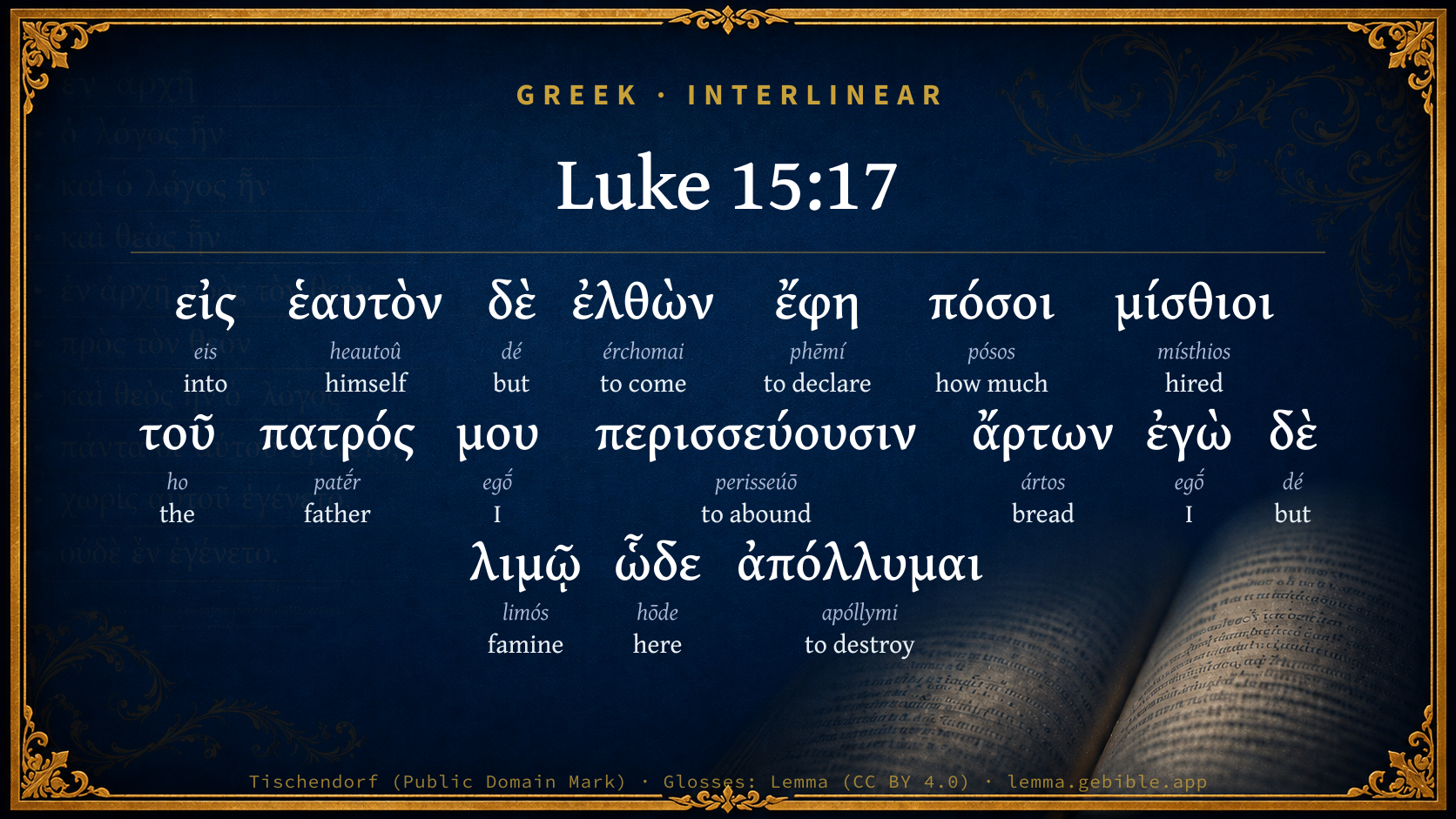
Download image
Cite this verse

Luke 15:17 (World English Bible). Public Domain. Lemma interlinear Bible study tool, https://lemma.gebible.app/v/luke/15/17.

Show BibTeX & RIS
BibTeX
RIS
English Translation
But when he came to himself he said, 'How many hired servants of my father's have bread enough to spare, and I'm dying with hunger!
World English Bible · Public Domain
Highlights
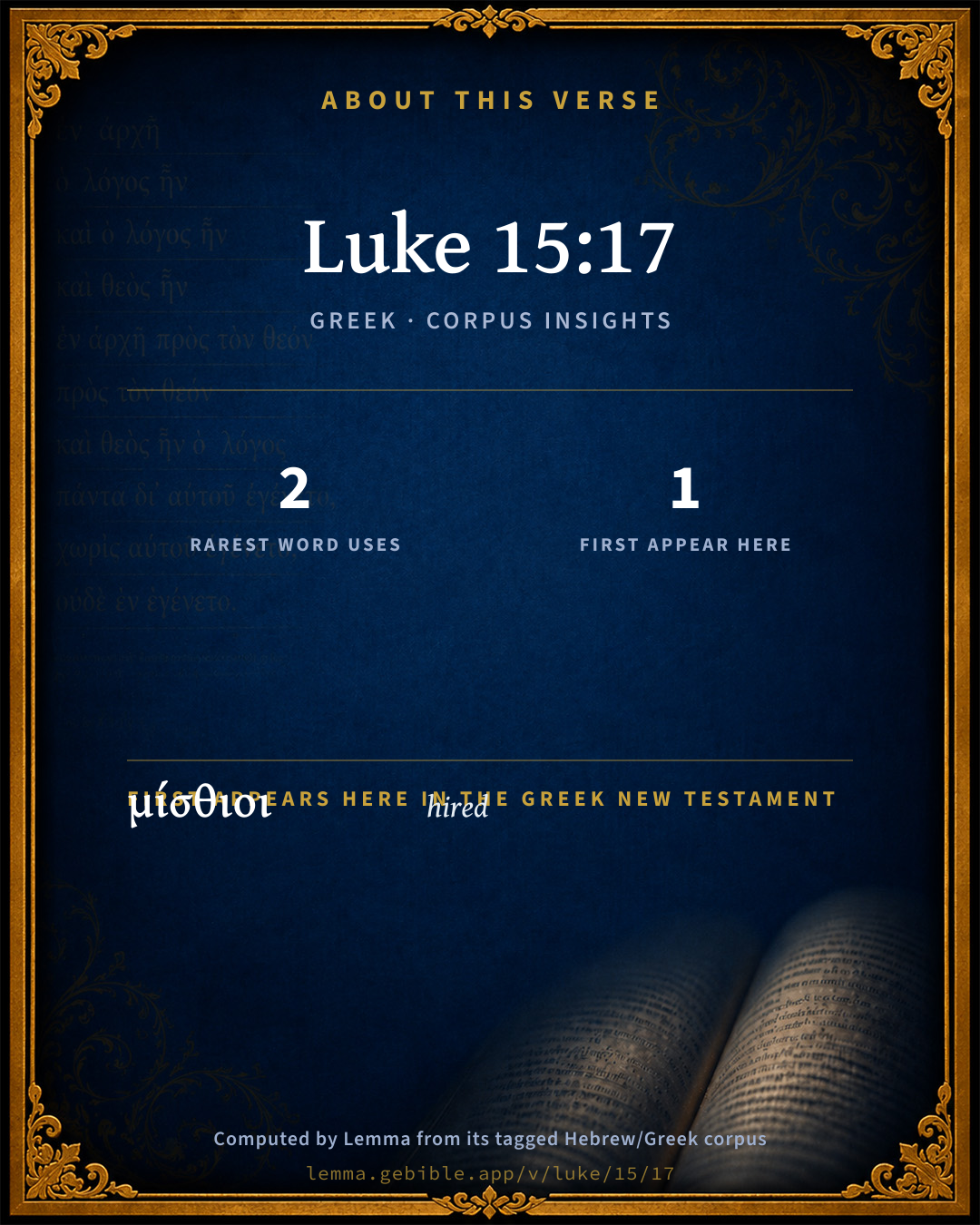
  • 1 first appearance in the Greek New Testament
Full analysis ↓
Download a study sheet

One document with this verse’s original text, its word-by-word gloss line, the meaning frame, cross-references with their text, attributed commentary, and full source and license credits — printable, and it pastes into notes with its structure intact.

This verse Autodidact and up

Study sheet (.html) Plain text (.txt)

A passage Seminary Student

Up to 50 verses in one chapter. A passage sheet keeps up to 6 commentary sources and 12 cross-references per verse, in the order this page ranks them, and says so on the sheet whenever that leaves anything out. Ask for a single verse and you get the Autodidact verse sheet above.

Everything on this page stays free to read, with no account — the sheet is a download of what is already on screen, not access to it.

Want to remove ads? Support Godless Engineer
Compare translations 3

The same verse in 3 English versions, stacked beneath the original-language interlinear above. Click any original word for its lexicon entry.

Each is an independent rendering of the whole verse — the interlinear is not word-aligned to these translations.

Highlighted words mark where these versions differ — a whole-verse word diff, not a word-by-word alignment.

  • World English Bible Public Domain
    But when he came to himself he said, 'How many hired servants of my father's have bread enough to spare, and I'm dying with hunger!
  • King James Version Public Domain
    And when he came to himself, he said, How many hired servants of my father's have bread enough and to spare, and I perish with hunger!
  • unfoldingWord Literal Text CC BY-SA 4.0
    But coming to himself, he said, ‘How many hired servants of my father have more than enough loaves, but I am perishing from hunger here!

unfoldingWord Literal Text — © unfoldingWord, licensed CC BY-SA 4.0. Word-aligned USFM3 via Door43 (git.door43.org/unfoldingWord/en_ult).

Versions to compare (up to 4)

3 of 4 selected

Show all 19 translations

Every available English version of this verse, each an independent rendering of the whole verse.

  • World English Bible Public Domain
    But when he came to himself he said, 'How many hired servants of my father's have bread enough to spare, and I'm dying with hunger!
  • Berean Standard Bible Public Domain
    Finally he came to his senses and said, ‘How many of my father’s hired servants have plenty of food? But here I am, starving to death!
  • Majority Standard Bible Public Domain
    Finally he came to his senses and said, ‘How many of my father’s hired servants have plenty of food, but I am starving to death!
  • King James Version Public Domain
    And when he came to himself, he said, How many hired servants of my father's have bread enough and to spare, and I perish with hunger!
  • American Standard Version (1901) Public Domain
    But when he came to himself he said, How many hired servants of my father's have bread enough and to spare, and I perish here with hunger!
  • Revised Version (1885) Public Domain
    But when he came to himself he said, How many hired servants of my father’s have bread enough and to spare, and I perish here with hunger!
  • Geneva Bible (1599) Public Domain
    Then he came to him selfe, and said, Howe many hired seruaunts at my fathers haue bread ynough, and I die for hunger?
  • Douay-Rheims (1899) Public Domain
    And returning to himself, he said: How many hired servants in my father's house abound with bread, and I here perish with hunger?
  • Young's Literal Translation Public Domain
    `And having come to himself, he said, How many hirelings of my father have a superabundance of bread, and I here with hunger am perishing!
  • Literal Standard Version CC BY-SA 4.0
    And having come to himself, he said, How many hired workers of my father have a superabundance of bread, and I am perishing here with hunger!
  • Unlocked Literal Bible CC BY-SA 4.0
    But when the young son came to himself, he said, 'How many of my father's hired servants have more than enough food, and I am here, dying from hunger!
  • unfoldingWord Literal Text CC BY-SA 4.0
    But coming to himself, he said, ‘How many hired servants of my father have more than enough loaves, but I am perishing from hunger here!
  • Darby Bible Public Domain
    And coming to himself, he said, How many hired servants of my father's have abundance of bread, and *I* perish here by famine.
  • World Messianic Bible Public Domain
    But when he came to himself, he said, ‘How many hired servants of my father’s have bread enough to spare, and I’m dying with hunger!
  • Webster's Bible Public Domain
    And when he came to himself, he said, How many hired servants of my father have bread enough and to spare, and I am perishing with hunger!
  • Free Bible Version CC BY-SA 4.0
    When he came to his senses, he said to himself, ‘All of my father's workers have more than enough to eat—why am I dying from hunger here?
  • Bible in Basic English Public Domain
    But when he came to his senses, he said, What numbers of my father's servants have bread enough, and more, while I am near to death here through need of food!
  • Text-Critical English NT CC BY 4.0
    When he came to his senses, he said, ‘How many of my father's hired workers have an abundance of bread, while I perish with hunger!
  • Tyndale New Testament (1534) Public Domain
    Then he came to him selfe and sayde: how many hyred servauntes at my fathers have breed ynough and I dye for honger.

Literal Standard Version (2020), Covenant Press — licensed CC BY-SA 4.0. Text via the HelloAO Bible API (eBible.org). Unlocked Literal Bible (unfoldingWord) — licensed CC BY-SA 4.0. Text via the HelloAO Bible API (eBible.org). unfoldingWord Literal Text — © unfoldingWord, licensed CC BY-SA 4.0. Word-aligned USFM3 via Door43 (git.door43.org/unfoldingWord/en_ult). Free Bible Version, Dr. Jonathan Gallagher — licensed CC BY-SA 4.0. Text via the HelloAO Bible API (eBible.org).

Word by word

More ways to search: Search by grammar → Find every occurrence → Compare this word →

Practice this passage: Drill this verse → Learn its vocabulary →

μίσθιοι
místhios
G3407
“hired”
Adjective, Nominative, Plural, Masculine
Part of Speech
Adjective
Case
Nominative
Number
Plural
Gender
Masculine
Full Thayer's Definition

Origin: from G3408

TDNT: 15:35,6

1. employed for hire, hired
  1. εἰς eis G1519 “into” Preposition
  2. ἑαυτὸν heautoû G1438 “himself” Reflexive pronoun, 3rd person, Accusative, Singular, Masculine
  3. δὲ dé G1161 “but” Conjunction
  4. ἐλθὼν érchomai G2064 “to come” Verb, Aorist, Active, Participle, Nominative, Singular, Masculine
  5. ἔφη phēmí G5346 “to declare” Verb, Imperfect, Active, Indicative, 3rd person, Singular
  6. πόσοι pósos G4214 “how much” Correlative/interrogative pronoun, Nominative, Plural, Masculine
  7. τοῦ ho G3588 “the” Article, Genitive, Singular, Masculine
  8. πατρός patḗr G3962 “father” Noun, Genitive, Singular, Masculine
  9. μου egṓ G1473 “I” Personal pronoun, 1st person, Genitive, Singular
  10. περισσεύουσιν perisseúō G4052 “to abound” Verb, Present, Active, Indicative, 3rd person, Plural
  11. ἄρτων ártos G740 “bread” Noun, Genitive, Plural, Masculine
  12. ἐγὼ egṓ G1473 “I” Personal pronoun, 1st person, Nominative, Singular
  13. δὲ dé G1161 “but” Conjunction
  14. λιμῷ limós G3042 “famine” Noun, Dative, Singular, Masculine
  15. ὧδε hōde G5602 “here” Adverb
  16. ἀπόλλυμαι apóllymi G622 “to destroy” Verb, Present, Middle, Indicative, 1st person, Singular

About this verse

These counts appear in no published source. They are computed here, from the morphology-tagged text and Lemma’s own curated glosses. What Lemma adds →

17
words
15
distinct lemmas
Gospels
section

Notable vocabulary

The rarest word here is μίσθιοι hired G3407 — appearing just 2 times in the whole Greek New Testament.

First appearance in Scripture

This word makes its first canonical appearance in the Greek New Testament here:

  • μίσθιοι hired G3407

Shared distinctive vocabulary

μίσθιοι hired G3407 occurs in 2 verses of the Greek New Testament. Also found in:
Repetition

Words recur within this verse:

Cross-references

15

Topical passages linked to Luke 15:17 in the Treasury of Scripture Knowledge — connected by theme and wording, ordered by reader-vote popularity; previews shown in the World English Bible.

  • Ezekiel 18:28 Because he considers, and turns away from all his transgressions that he has committed, he shall surely live, he shall not die.
  • Ephesians 2:4–5 But God, being rich in mercy, for his great love with which he loved us,
  • Luke 15:18–19 I will get up and go to my father, and will tell him, "Father, I have sinned against heaven, and in your sight.
  • Ephesians 5:14 Therefore he says, "Awake, you who sleep, and arise from the dead, and Christ will shine on you."
  • Acts 16:29–30 He called for lights and sprang in, and, fell down trembling before Paul and Silas,
  • Acts 26:11–19 Punishing them often in all the synagogues, I tried to make them blaspheme. Being exceedingly enraged against them, I persecuted them even to foreign cities.
  • Jeremiah 31:19 Surely after that I was turned, I repented; and after that I was instructed, I struck on my thigh: I was ashamed, yes, even confounded, because I did bear the reproach of my youth.
  • Luke 8:35 People went out to see what had happened. They came to Jesus, and found the man from whom the demons had gone out, sitting at Jesus' feet, clothed and in his right mind; and they were afraid.
  • Acts 2:37 Now when they heard this, they were cut to the heart, and said to Peter and the rest of the apostles, "Brothers, what shall we do?"
  • Psalms 73:20 As a dream when one wakes up, So, Lord, when you awake, you will despise their fantasies.
  • Lamentations 1:7 Jerusalem remembers in the days of her affliction and of her miseries all her pleasant things that were from the days of old: When her people fell into the hand of the adversary, and none did help her, The adversaries saw her, they did mock at her desolations.
  • Titus 3:4–6 But when the kindness of God our Savior and his love toward mankind appeared,
  • James 1:16–18 Don't be deceived, my beloved brothers.
  • Ecclesiastes 9:3 This is an evil in all that is done under the sun, that there is one event to all: yes also, the heart of the sons of men is full of evil, and madness is in their heart while they live, and after that they go to the dead.
  • Luke 16:23 In Hades, he lifted up his eyes, being in torment, and saw Abraham far off, and Lazarus at his bosom.

Cross-references courtesy of OpenBible.info (CC BY 4.0).

Where the printed editions differ

1 variant

Places in this verse where the major printed Greek editions disagree on the wording in a way that affects the translation — a comparison of editions, not a manuscript-by-manuscript collation. The editions are the modern critical texts (Nestlé-Aland 28/27, SBL, Westcott-Hort, Tregelles, Tyndale House) and the traditional texts behind the KJV (the Textus Receptus and the Byzantine/Majority text). It is not a claim about which reading is original.

  1. Extra text
    ὧδε

    “here”

    In NA28NA27TynSBLWHTreg Not in TRByz

    ὧδε (hōde) 'here' is only in older manuscripts (NA28+NA27+Tyn+SBL+WH+Treg)

Textual data: Translators Amalgamated Greek New Testament (STEPBible TAGNT) · CC BY 4.0.

Commentary

Notes on Luke 15:17 from classic Christian and Jewish commentators (each source and its license shown beneath its notes). The classic Christian expositions comment on the surrounding passage and are grouped to its opening verse, so a note may address several verses; the Jewish commentaries on the Tanakh (Rashi and others) are per-verse, so they appear only where the commentator wrote on this verse.

Lemma curates 59 commentaries, every one of them public domain or Creative Commons licensed, each selected and text-cleaned for this edition rather than reprinted as found. About our sources →

Joseph Benson's Commentary

Luk 15:17-18. And when he came to himself — When the infamy and distress of his present condition began to lead him into serious consideration; and he so far recovered the use of his reason, which had before been dethroned and extinguished by the mad intoxication of sensual pleasure; when the great distress he was in brought him at length to think and reflect on his unhappy condition, and to retrace the steps that had brought him into it; he said — Namely, in his heart; How many hired servants of my father’s — The meanest in his family, the very day- labourers; have bread enough and to spare — Have more meat than they can use. Even the hired servants in God’s house are well provided for; the meanest that will but hire themselves into his family to do his work, and depend upon his reward, shall have all things and abound: the consideration of which should encourage sinners, that have gone astray from God, to think of returning to him: and I perish with hunger — I, his child, who have known so many better days, am even ready to die with want, not being thought worth my food by this unkind master, to whom I have hired myself. Observe, reader, 1st, All who have wandered from God, and endeavour to satisfy themselves with earthly things, whether riches, honours, or pleasures, with worldly pursuits and carnal gratifications, living without God in the world, may really be said to be beside themselves, for they act like persons deprived of their reason. Observe, 2d, Sinners will not come to Christ, and enter into his service, till they are brought to see themselves just ready to perish in the service of sin. And though we be thus driven to Christ, he will not therefore reject us, nor think himself dishonoured by our being forced to him, but rather honoured by his being applied to in a desperate case. I will arise and go to my father — Whatever be the consequence, I am resolved that I will no longer remain in this miserable condition, but will immediately set out on my way home, if all my little remaining strength can but bring me to the end of such a journey. And I will say unto him, Father, I have sinned, &c. — That I may be received again, I am resolved to go in all humility, and confess my crimes to my father, acknowledging that I am utterly unworthy to be owned as a son, and will pray to be taken into his house, only as a hired servant, and will be contented for the future to labour and fare as the servants do, so I may but live in his sight. In saying, I have sinned against heaven and before thee, he meant, that God was injured in the person of his earthly father. And certainly nature itself teaches this, that whoever is insolent or disrespectful to his parents, rebels against God; who, by making them the instruments of communicating life to their children, has imparted to them some of his own paternal honour. In saying, I am no more worthy to be called thy son, he shows, that the idea of his undutiful behaviour was strongly impressed on his mind, whereby he was sensible that he had no title to be treated at home as a son. At the same time he knew that it never would be well with him till he was in his father’s family again; so with joy he entertained the thought of occupying the meanest station in it. Thus, while the liberality of the great Parent of men makes them wantonly run away from his family, the miseries which they involve themselves in, often constrain them to return. By the natural consequences of sin, God sometimes makes sinners to feel, that there is no felicity to be found anywhere but in himself.

Joseph Benson's Commentary on the Old and New Testaments (1811–1818) — public domain. Text from a community e-Sword module.

Bengel's Gnomon

Johann Albrecht Bengel

Luk 15:17. Εἰς, to) The supply of foods that ministered to the scattering of his senses (which the French not inappropriately term se divertir, [the word diversion implying that one is thereby turned aside from self-inspection]) had now failed. The commencement of his return to himself is immediately linked to the height of his misery: it is by the latter that his mad recklessness in sin is cooled down, so that the man returns to himself, and presently after [also] to God. His repentance is his conversion.—[ἐγὼ δὲ ὧδε, but I here) The word, ὧδε, after ἐγὼ δὲ, has the force of here, emphatically.—Not. Crit.]

Bengel's Gnomon of the New Testament — English translation (T&T Clark, Edinburgh, 1860) — public domain. Text from a community e-Sword module.

Expositor's Greek Testament

ed. W. Robertson Nicoll

Luk 15:17 . εἰς ἑαυτὸν ἐλθὼν = either, realising the situation; or, coming to his true self, his sane mind (for the use of this phrase vide Kypke, Observ. ). Perhaps both ideas are intended. He at last understood there was no hope for him there, and, reduced to despair, the human, the filial, the thought of home and father revived in the poor wretch. περισσεύονται : passive, with gen. of the thing; here only in N.T. = are provided to excess, have more given them than they can use.

The Expositor's Greek Testament, edited by W. Robertson Nicoll (1897–1910) — public domain. Text from a community e-Sword module.

Godet's Commentaries

Frédéric Louis Godet

Vers. 17-20 a.This representation, which depicts the conversion of the sinner, includes two things, repentance (Luk 15:17) and faith (Luk 15:18-20 a).

The words, when he came to himself, Luk 15:17, denote a solemn moment in human life, that in which the heart, after a long period of dissipation, for the first time becomes self-collected. The heart is God’s sanctuary. To come to ourselves is therefore to find God. Repentance is a change of feeling; we find it fully depicted in the regret which the sinner feels for that from which he has fled (the father’s house), and in that horror which fills him at that which he sought so ardently (the strange land). As to the mercenaries whom he envies, might they not represent those heathen proselytes who had a place, although a very inferior one (the outer court), in the temple, and who might thus from afar take part in the worship; advantages from which the publicans, so long as they kept to their profession, were debarred by the excommunication which fell on them.

From this change of feeling there springs a resolution (Luk 15:18), which rests on a remnant of confidence in the goodness of his father; this is the dawn of faith. Did we not recollect that we are yet in the parable, the meaning of the words before thee would appear to blend with that of the preceding, against heaven. But in the image adopted the two expressions have a distinct meaning. Heaven is the avenger of all holy feelings when outraged, and particularly of filial devotion when trampled under foot. The young man sinned before his father at the time when, the latter beholding him with grief, he defied his last look, and obstinately turned his back on him.

The possibility of an immediate and entire restoration does not enter his mind. He is ready to take the position of a servant in the house where he lived as a son, but where he shall have at least wherewith to satisfy his hunger. Here is portrayed that publican (described in chap. 18) who stood afar off, and dared not even raise his eyes to God. But the essential fact is, that the resolution once taken, he carries it out. Here is faith in its fulness, actually arising, going to God. Faith is not a thought or a desire; it is an act which brings two living beings into personal contact.

What an impression must have been produced on the publicans present by this faithful picture of their past and present experiences! But how much deeper still the emotion which awaits them when they hear Jesus unveiling, in the sequel, the feelings and conduct of God Himself toward them!

Frédéric Louis Godet — Commentaries on Luke, John, Romans, and 1 Corinthians — English translation (T&T Clark, Edinburgh, 1870s–1890s) — public domain. Text from a community e-Sword module.

Geneva Bible (1599)

Geneva Bible translators

The beginning of repentance is the acknowledging of the mercy of God, which stirreth us to hope well.

Geneva Bible (1599) marginal notes — public domain. Text via Bolls.life.

Jamieson, Fausset & Brown

Robert Jamieson, A. R. Fausset & David Brown

came to himself--Before, he had been "beside himself" (Ecc 9:3), in what sense will presently appear.

How many hired, &c.--What a testimony to the nature of the home he had left! But did he not know all this ere he departed and every day of his voluntary exile? He did, and he did not. His heart being wholly estranged from home and steeped in selfish gratification, his father's house never came within the range of his vision, or but as another name for bondage and gloom. Now empty, desolate, withered, perishing, home, with all its peace, plenty, freedom, dignity, starts into view, fills all his visions as a warm and living reality, and breaks his heart.

Jamieson, Fausset & Brown — Commentary Critical and Explanatory on the Whole Bible (1871) — public domain (CC PDM 1.0). Text via the HelloAO Bible API.

Adam Clarke's Commentary

Verse 17. When he came to himself] A state of sin is represented in the sacred writings as a course of folly and madness; and repentance is represented as a restoration to sound sense. See this fully explained on Mt 3:2.

I perish with hunger!] Or, I perish HERE. ωδε, here, is added by BDL, Syriac, all the Arabic and Persic, Coptic, AEthiopic, Gothic, Saxon, Vulgate, all the Itala, and several of the fathers.

Adam Clarke's Commentary on the Bible (1810–1826) — public domain. Text from a community e-Sword/MySword module.

Ellicott's Commentary for English Readers

(17) And when he came to himself.—The phrase is wonderfully suggestive. The man’s guilt was, that he had been self-indulgent; but he had been living to a self which was not his true self. The first step in his repentance is to wake as out of an evil dream, and to be conscious of his better nature, and then there comes the memory of happier days which is as “Sorrow’s crown of sorrow.” The “hired servants” are obviously those who serve God, not in the spirit of filial love, but from the hope of a reward. Even in that lower form of duty they find what satisfies their wants. They have not the craving of unsatisfied desire which the son feels who has cast away his sonship. He envies them, and would fain be as they are.

A Bible Commentary for English Readers, edited by Charles John Ellicott (1878–1897) — public domain. Text from a community e-Sword module.

The Cambridge Bible for Schools and Colleges

gen. ed. J. J. S. Perowne

17. And when he came to himself ] His previous state was that of his false self—a brief delusion and madness—‘the old man with his affections and lusts.’ Now he was once more beginning to be “in his right mind.” “The heart of the sons of men is full of evil, and madness is in their heart while they live,” Ecc_9:3.

How many hired servants of my father’s] The hired servants correspond to any beings who stand in a lower or more distant relation to God, yet for whom His love provides.

The Cambridge Bible for Schools and Colleges (gen. ed. J. J. S. Perowne; Cambridge University Press, 1878–1918) — public domain. Text from a community e-Sword module.

John Gill's Exposition

And when he came to himself,.... An unregenerate man, whether while a voluptuous man, or a self-righteous man, is not himself; he is beside himself; and is no other than a madman. The man that pursues his worldly lusts and pleasures, promises himself liberty, while he is a slave; he ruins himself, his soul, body, and estate, and chooses to do it rather than part with his lusts; he takes delight in doing mischief himself, and in seeing it done by others; he proclaims his folly publicly, declares his sin, and glories in it; all which a man in his right mind would never do. The self-righteous person trusts in his own heart, which is the greatest madness and folly in the world; he compasses himself about with sparks of his own kindling, and sacrifices to his own net; he dresses himself in his rags, and pleases and prides himself with them, when a robe of righteousness, and garments of salvation, are provided; which no man in his senses would ever do. But when the Spirit of God comes to work upon a sinner's heart in conversion, he brings him to himself; which a man may be said to be, when he is brought to true evangelical repentance for sin; and that is, when he has a true sense of it, as committed against God, and a godly sorrow for it, and makes an hearty and ingenuous acknowledgment of it, and forsakes it; and when he is brought to a sense of the insufficiency of his own righteousness, and is made willing to part with it, and desires to be found in Christ, and in his righteousness alone, which he is encouraged to lay hold on, and receive by faith, trust to, and rejoice in; when he has his spiritual senses exercised on Christ, and to discern between good and evil; and is brought to the feet of Jesus, as to submit to his righteousness, so to serve him; when he is all this, then, like the man in the Gospel, he is clothed, and in his right mind:

he said, how many hired servants of my father's; who, according to some, were the Scribes and Pharisees, men of a servile disposition, and of mercenary views; and were, by profession, the servants of God, and had plenty of bread, because they had all the external means and ordinances: but these are designed by the elder brother in the parable; and besides, this man had endeavoured to live as they did in this far country. It may be queried, whether the ministers of the Gospel are not intended, since these are the servants of the most high God; are labourers hired by him, and are worthy of their hire, and abound with Gospel provisions for the service of others. But to this it may be objected, the desire of this man to be made as one of them, Luk 15:19 which petition expresses his humility; whereas to be a servant, in this sense, is to have the highest place and office in his father's house. Rather therefore the meanest of the saints, and household of God, are here meant, who have the least degree of evangelical light, whose faith is weak, and their consolation small; and who, though they are sons, yet by reason of that legality and mercenariness that appear in their frames and services, differ little from servants: and yet these, in comparison of him, who was in a hungry and starving condition,

have bread enough, and to spare; as the doctrines, promises, and ordinances of the Gospel, the fulness of grace that is in Christ, and Christ himself the bread of life; which are more than enough for them, and sufficient for the whole family in heaven, and in earth; and even the meanest and weakest believer may be said to have enough and to spare, because he has an interest in all these; though by reason of the weakness of his faith, it is but now and then he has a full and comfortable meal; but this is infinitely better than to be starving, as this man was:

and I perish with hunger. The Vulgate Latin, and all the Oriental versions add, "here"; in this far country, in the citizen's fields, among his swine, and their husks: all mankind are in a lost and perishing condition; for having sinned against God, they have exposed themselves to the curses of the law, and are destitute of a justifying righteousness, and are in the way, to ruin and destruction; but all are not sensible of it, being ignorant of God, and his righteousness, of the exceeding sinfulness of sin, and of the insufficiency of their own righteousness; but some are sensible of it, and in their own apprehensions are ready to perish: these see sin in its true light, without a view of pardon; an angry God without a smile; injured justice without a righteousness; and a broken law without a satisfaction for the violation of it; and such was this man's case. The Jewish writers (a) say,

"a sinner is like to a son that runs away from his father, and turns his back upon him, who yet afterwards repents, and has a mind to return to his father's house:''

so it was now with the publicans and sinners, signified by this man.

(a) R. Chayim in Lib. Chayim, par. 4. c. 6. apud Maii Jud. Theolog. loc 15. p. 243.

John Gill's Exposition of the Whole Bible (1746–1763) — public domain (CC PDM 1.0). Text via the HelloAO Bible API.

Trapp's Complete Commentary

John Trapp

17 And when he came to himself, he said, How many hired servants of my father’s have bread enough and to spare, and I perish with hunger!

Ver. 17. And when he came to himself] For till then he had been beside himself, and not his own worthy. Nebulo rascal (saith one) cometh of Nabal; fool of φαυλος: ανοια et ανομια are of near affinity. Evil is Hebrew for a fool, &c. Wickedness is called the "foolishness of madness," Ecc 7:25.

John Trapp, A Commentary or Exposition upon All the Books of the Old and New Testament (1647–1656) — public domain. Text from a community e-Sword module.

Albert Barnes' Notes on the Bible

He came to himself - This is a very expressive phrase. It is commonly applied to one who has been “deranged,” and when he recovers we say he has “come to himself.” In this place it denotes that the folly of the young man was a kind of derangement - that he was insane. So it is of every sinner. Madness is in their hearts Ecc 9:3; they are estranged from God, and led, by the influence of evil passions, contrary to their better judgment and the decisions of a sound mind.

Hired servants - Those in a low condition of life - those who were not born to wealth, and who had no friends to provide for them.

I perish - I, who had property and a kind father, and who might have been provided for and happy.

Albert Barnes' Notes on the Bible (1834–1885) — public domain. Text from a community e-Sword/MySword module.

Matthew Poole's English Annotations

Every sinner is beside himself; his reason lackeys to his lust and passion, he is governed by appetite, and that rageth in him, while his understanding is blind, and cannot discern between good and evil; and when he hath in any measure discerned any thing, his will is stubborn, and chooseth the evil. Conversion is but the return of a soul to itself. The first thoughts of which conversion arise from a soul’s consideration, what a poor miserable creature it is, ready to perish for ever, while never a poor soul belonging to God, no, not the meanest servant in his family, wanteth any good thing that is necessary for him. These things increase in a soul thoughts of returning to his heavenly Father, through the operation of the Holy Spirit of God; for of ourselves we are not sufficient so much as to think one good thought.

Matthew Poole's English Annotations on the Holy Bible (1683–1685) — public domain. Text from a community e-Sword/MySword module.

Whedon's Commentary on the Bible

Daniel D. Whedon

17. Came to himself—For all this time he has been in an insanity or a dream. Would it were so; for then he would have been unfortunate or irresponsible. Had he but waked in the morning from a troubled dream, he would have smiled over his own imaginary miseries, and have gone down in a sweet morning innocence to meet his father’s kiss, from lips that spoke of love but not of forgiveness.

He said—The he who says this is the God-given reason, the secret conscience; long silent or unheard, now awakened by suffering, and speaking.

Hired servants—He thinks of hired servants because that has been so long his own condition. His father had, it seems, no slaves. The Greek word here is μισθιος. See note on Luk_7:2. Commentators make a very needless difficulty of the explanations of this word hired servants in the true economy of grace. If it be true that all our salvation is of grace, it is equally true that the saved are rewarded according to their works. God pays man for his services. And this none the less from the fact that he provides for man all his power, and confers upon his works all their rewardable value. See note on Luk_19:16. We may note, first, That the hired servants in the father’s house, are the Church; second, they labor for him, and by him are rewarded with the true bread; third, they have no right, as from birth, in the house, and are only adopted members of the family. All these traits are plainly to be found in converted Gentiles; and thus here we have again the defence of our Lord for receiving sinners, that is, Gentiles, whose coming to him on the banks of the Jordan at these times had excited the murmurings of the scribes and Pharisees. (Luk_15:1-2.) Not only St. James but St. Paul in the right passage will say that men are justified by works. The son was a laborer as well as the hireling.

Daniel D. Whedon (gen. ed.), Commentary on the Old and New Testaments (1874–1909) — public domain. Text from a community e-Sword module.

The Pulpit Commentary

And when he came to himself. This tardy repentance in the famous parable has been the occasion of many a sneer from the world. Even satiety, even soul-hunger, did not bring the prodigal to penitence; nothing but absolute bodily suffering, cruel hunger, drove him to take the step which in the end saved him. There is no doubt it would have been far more noble on the young man"s part if, in the midst of his downhill career, he had suddenly paused, and, with a mighty and continued effort of self-control, had turned to purity, to duty, and to God. Certainly this had been hereto conduct a term no one would think of applying to anything belonging to the life of the younger son of our story. But though not heroic, is not the conduct of the prodigal just what is of daily occurrence in common life? The world may sneer; but is not such a repentance, after all, a blessed thing? It is a poor mean way, some would tell us, of creeping into heaven; but is it not better to enter into God"s city even thus, with bowed head, than not at all? Is it not better to consecrate a few months, or perhaps years, of a wasted life to God"s service, to noble generous deeds, to brave attempts to undo past mischief and neglect, than to go sinning on to the bitter end? There is something intensely sorrowful in this consecrating to the Master the end of a sin-worn life; but there is what is infinitely worse. What a deep well, too, of comfort has the Church-taught teacher here to draw from in his weary life-experiences! How many hired servants of my father"s have bread enough and to spare, and I perish with hunger! Among the bitternesses of his present degradation, not the least was the memory of his happy childhood and boyhood in his old home. "For a sorrow"s crown of sorrows Is remembering happier things.

The family of the prodigal, as we have already remarked, was certainly possessed of wealth, and was probably one of high rank. In the old home there was nothing wanting.

Vers. 17-19. The soul"s return.

Out in the far country, living a life of guilty waste, of dreary want, of shameful degradation, the prodigal son was in truth a man "beside himself;" he was lost to himself; he had taken leave of his own better self, of his understanding, of his reason; from his own true self he was afar off. But now there is

I A RETURN TO HIMSELF.

1. He regains his wisdom as he gains a sense of his folly. He returns to his right mind; he loses his infatuation as he perceives how great is his foolishness to be in such a state of destitution when he might "have all things and abound." What insensate folly to be starving among the swine when he might be sitting down at his father"s table! The soul comes to itself and regains its wisdom when it perceives how foolish it is to be perishing with hunger in its separation from God when it might be "filled with all the fulness of God." Our reason returns to us when we refuse to be any longer misled by the infatuation, by "the deceitfulness of sin," and when we see that the pining and decay of our spiritual powers is a poor exchange indeed for the wealth and health of spiritual integrity.

2. He is restored to sanity of mind as he obtains a sense of his sinfulness. To be able to say, as he is now prepared to say, "I have sinned," is to come back into a right and sound spiritual condition. We are in a wholly unsound mental state when we can regard our disloyalty and disobedience to God with complacency and even with satisfaction. But when our ingratitude, our forgetfulness, our unfilial and rebellious behaviour towards God, is recognized by us as the "evil and bitter thing" it is, as the wrong and shameful thing it is, and when we are ready, with bowed head and humbled heart, to say," Father, J have slinked," then are we in our right mind; then have we returned to ourselves.

II A RESOLVE TO RETURN TO GOD. This return on the part of the prodigal:

1. Arose from a sense of the greatness of his need.

2. Was based on a sound confidence, viz. that the father, whose disposition he knew so well, would not reject but receive him.

3. Included a wise and right determination, viz. to make a frank confession of his sin and to accept the humblest position in the old home which the father might allot him.

(1) Out of the greatness and soreness of our need we come to the conclusion that we will return unto God. Our state of guilt and shame is no longer tolerable; we must turn our back on the guilty past and the evil present; there is no refuge for our soul but in God God, who is our home.

(2) We may hold fast the firm conviction that we shall be graciously received. Of this we have the strongest assurance we could have in the character and the promises of God, and in the experience of our brethren.

(3) Our resolution to return should include the wise and right determination:

(a) To make the fullest confession of our sin; meaning by that not the use of the strongest words we can employ against ourselves, but the full outpouring of all that is in our heart; for, above all things, God "desires truth in the inward parts.

(b) To accept whatever position in God"s service he may appoint us. Not that we are expecting that he will make us "as a hired servant;" we may be sure (see next homily) that he will place us and count us among his own children; but so humble should our spirit be, such should be our sense of undeservedness, that we should be ready to be anything and to do anything, of however lowly a character it may be, which the Divine Father may assign us in his household. C.

The Pulpit Commentary (1880–1919), ed. H.D.M. Spence-Jones & Joseph S. Exell — public domain. Text from a community e-Sword module.

John Wesley's Explanatory Notes

And coming to himself - For till then he was beside himself, as all men are, so long as they are without God in the world.

John Wesley, Explanatory Notes Upon the Whole Bible (1754–1765) — public domain. Text via the GEBible commentary corpus.

unfoldingWord translationNotes

Door43 World Missions Community

came to himself

This idiom means he realized what the truth was, that he had made a terrible mistake. AT: "clearly understood his situation" (See: Idiom)

How many of my father's hired servants have more than enough food

This is part of an exclamation, and not a question. AT: "All my father's hired servants have more than enough food to eat"

dying from hunger

This is probably not an exaggeration. The young man may really have been starving.

I have sinned against heaven

Jewish people sometimes avoided saying the word "God" and used the word "heaven" instead. AT: "I have sinned against God" (See: Metonymy)

I am no longer worthy to be called your son

"I am not worthy to be called your son." This can be stated in active form. AT: "I am not worthy for you to call me son" (See: Active or Passive)

make me as one of your hired servants

"hire me as an employee" or "hire me and I will become one of your servants." This is a request, not a command. It may be helpful to add "please" as the UDB does.

translationWords

servant

sin

heaven

worthy

son

unfoldingWord translationNotes — © Distant Shores Media and the Door43 World Missions Community, licensed CC BY-SA 4.0. Source: git.door43.org/Door43/en_tn.

Cambridge Greek Testament for Schools and Colleges

17. ὦδε. אBL. It has probably been lost in some MSS. by homoeoteleuton with ἐγὼ δέ.

17. εἰς ἑαυτὸν δὲ ἐλθών. His previous state was that of his false self—a brief delusion and madness—‘the old man with his affections and lusts.’ Now he was once more beginning to be “in his right mind.” “The heart of the sons of men is full of evil, and madness is in their heart while they live,” Ecc 9:3. In Act 12:11 the phrase is used of awaking from a trance. Comp. Lucret. IV. 994, “Donec discussis redeant erroribus ad se.”

πόσοι μίσθιοι τοῦ πατρός μου. The hired servants correspond to any beings who stand in a lower or more distant relation to God, yet for whom His love provides.

Cambridge Greek Testament for Schools and Colleges (Cambridge University Press, 1896; 21 vols, various authors incl. Carr, Maclear, Plummer, Farrar, Lumby, Moule, M. R. James, Simcox) — public domain. Text from a community e-Sword module.

Alford’s Greek Testament

Henry Alford

17-20.] His penitence. And here we have a weighty difference between the permitted rational free will of man, and the stupid wandering on of the sheep, or the inanimate coin lying till it is picked up,—both these being however true, did not God seek and save the sinner: ‘the grace of God by Christ preventing us that we may have a good will, and working with us when we have that good will.’ Article X. of the Church of England.

17. εἰς ἑαυτὸν ἐλθών] Similar expressions seem to occur in the Heb. Deu 30:1 (where . renders “Redi in temetipsum;” but Gesen. understands an accus. “si revocabis ea”); 1Ki 8:47: Isa 46:8. Before this, he was beside himself. The most dreadful torment of the lost, in fact that which constitutes their state of torment, will be this εἰς ἑαυτὸν ἐλθεῖν, when too late for repentance.

He now recalls the peace and plenty of his Father’s house.

μίσθιοι, for he now was a μίσθιος, but in how different a case!

Henry Alford, The Greek Testament (1849–1861) — public domain. Text from a community e-Sword module.

International Critical Commentary

17. εἰς ἑαυτὸν δὲ ἐλθών. Implies that hitherto he has been “beside himself”: comp. ἐν ἑαυτῷ γενόμενος (Act 12:11). The expression is classical both in Greek (Diod. Sic. xiii. 95; Epictet. iii. 1, 15) and Latin, redire ad se (Hor. Ep. ii. 2, 138; Lucret. iv. 1020; Ter. Adelph. v. 3, 8). This “coming to himself” is manifested in the thought of home and the longing for it. Want rekindles what his revelry had extinguished. See Blass on Act 12:11.

Πόσοι μίσθιοι … περισσεύονται ἄρτων. There is no emphasis on ἄρτων in contrast to κερατίων: the contrast lies in their having plenty to eat. Godet sees the proselytes in these μίσθιοι. The word occurs in N.T. only here and ver. 10: in LXX Lev 25:50; Job 7:1; Tobit 5:11; Ecclus. 7:20, 34:27, 37:11.

Only in late Greek is περισσεύω trans. In N.T. both act. (12:15, 21:4) and pass. (Mat 13:12, Mat 25:29) are used in much the same sense.

ἐγὼ δὲ λιμῷ ὧδε ἀπόλλυμαι. Comp. τῷ αἰσχίστῳ ὀλεθρῷ, λιμῷ τελευτῆσαι (Thuc. iii. 59, 4). The ὧδε is after λιμῷ in א B L before λιμῷ in D R U, ego autem hic fame pereo (Vulg.), while A A F etc. omit. The transfer to before λιμῷ caused it to be lost in ἐγὼ δέ.

International Critical Commentary — older volumes (1896–1929), various authors — public domain. Text from a community e-Sword module.

Vincent's Word Studies in the New Testament

Marvin R. Vincent

Came to himself. A striking expression, putting the state of rebellion against God as a kind of madness. It is a wonderful stroke of art, to represent the beginning of repentence as the return of a sound consciousness. Ackermann (" Christian Element in Plato ") observes that Plato thinks of redemption as a coming to one's self; an apprehending of one's self as existent; as a severing of the inmost being from the surrounding element. Several passages of Plato are very suggestive on this point. "He who bids a man know himself, would have him know his soul" (" Alcibiades, "1, 130)." 'To see her (the soul) as she really is, not as we now behold her, marred by communion with the body and other miseries, you should look upon her with the eye of reason, in her original purity, and then her beauty would be discovered, and in her image justice would be more clearly seen, and injustice, and all the things which we have described. Thus far we have spoken the truth concerning her as she appears at present; but we must remember also that we have seen her only in a condition which may be compared to that of the sea - God Glaucus, whose original image can hardly be discerned, because his natural members are broken off and crushed, and in many ways damaged by the waves; and incrustations have grown over them of sea - weed and shells and stones, so that he is liker to some sea - monster than to his natural form. And the soul is in a similar condition, disfigured by ten thousand ills : but not there, Glaucon, not there must we look' "'Where, then?'" 'At her love of wisdom. Let us see whom she affects, and what converse she seeks, in virtue of her near kindred with the immortal and eternal and divine; also, how different she would become, if wholly following this superior principle, and born by a divine impulse out of the ocean in which she now is, and disengaged from the stones and shells and things of earth and rock, which, in wild variety, grow around her, because she feeds upon earth, and is crusted over by the good things of this life as they are termed. Then would you see her as she is' "(" Republic," 611).

Have bread enough and to spare [περισσευονται αρτων] . Lit., abound in loaves. Wyc., plenty of loaves.

Perish. Better, I am perishing. The best texts insert w=de, here, in contrast with the father 's house, suggested by the father 's servants.

Marvin R. Vincent, Word Studies in the New Testament (1887–1900) — public domain. Text from a community e-Sword/MySword module.

Lesson kit

Teaching starters — assembled from the data on this page, not authored interpretation. Every prompt links to the verse data it draws on. Edit before teaching.

Luke, in the Gospels, opens this verse with 17 words (15 distinct Greek lemmas). Its most distinctive word is místhios (“hired”). A historical commentator’s framing appears above. Read the whole chapter for the surrounding context.

Discussion questions

  1. How does “hired” (místhios) shape what this verse is saying?
  2. This is the first place “hired” appears in Scripture (first appears here). What does its debut here establish?
  3. How does Luke 15:19, which shares the word «hired», read alongside this verse?
  4. What does the repetition of “but” (2× in this one verse) do in this verse?
  5. These translations render this verse differently. What is at stake in choosing one wording over another?
  6. Compare how Joseph Benson's Commentary and Bengel's Gnomon read this verse. Where do they agree or differ?

Things to notice

  • 1 word makes its first canonical appearance in Scripture here.
  • These translations choose different wording for 16 words in this verse.
  • “but” occurs 2× in this single verse.
  • 15 distinct Greek lemmas span 17 words in this verse.

Reading settings

Reading text

Shown beneath each verse's original-language words.

Old Testament
Old Testament edition

Read the OT as the Masoretic Hebrew (MT) or the Greek Septuagint (LXX).

English shown for the Greek Septuagint (in the Hebrew ↔ Greek comparison).

Comparing translations? Open the Compare panel on any verse page to stack up to four side by side.