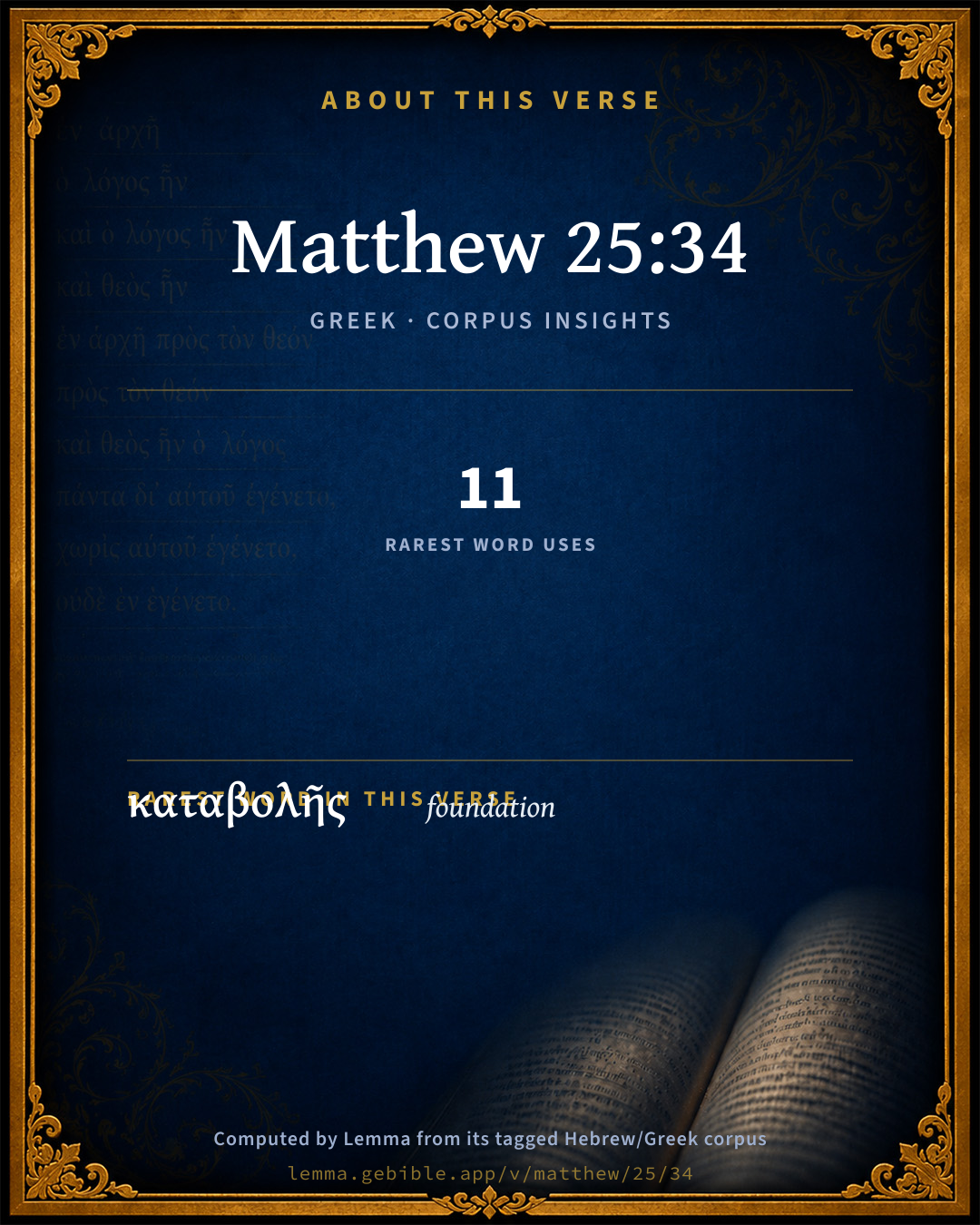
Matthew 25:34

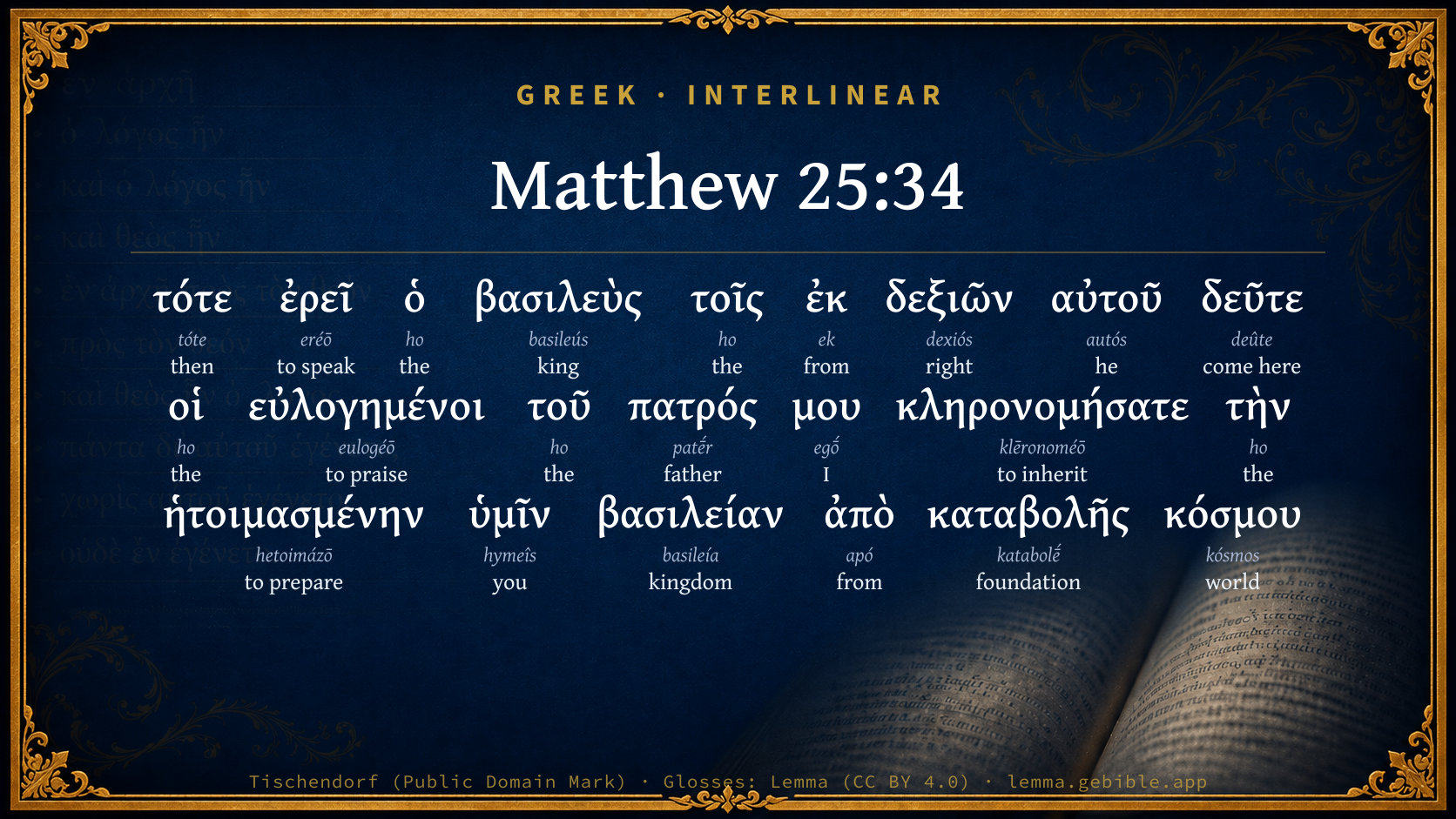
Greek (Tischendorf 8th ed.) Matthew 25:34 appears in the Greek New Testament. The text above is from the Tischendorf 8th edition. Each word links to its Strong’s number and a concise gloss. Click any word for its full Thayer’s Greek Lexicon entry.
Download image
Cite this verse

Matthew 25:34 (World English Bible). Public Domain. Lemma interlinear Bible study tool, https://lemma.gebible.app/v/matthew/25/34.

Show BibTeX & RIS
BibTeX
RIS
English Translation
Then the King will tell those on his right hand, 'Come, blessed of my Father, inherit the Kingdom prepared for you from the foundation of the world;
World English Bible · Public Domain
Download a study sheet

One document with this verse’s original text, its word-by-word gloss line, the meaning frame, cross-references with their text, attributed commentary, and full source and license credits — printable, and it pastes into notes with its structure intact.

This verse Autodidact and up

Study sheet (.html) Plain text (.txt)

A passage Seminary Student

Up to 50 verses in one chapter. A passage sheet keeps up to 6 commentary sources and 12 cross-references per verse, in the order this page ranks them, and says so on the sheet whenever that leaves anything out. Ask for a single verse and you get the Autodidact verse sheet above.

Everything on this page stays free to read, with no account — the sheet is a download of what is already on screen, not access to it.

Want to remove ads? Support Godless Engineer
Compare translations 3

The same verse in 3 English versions, stacked beneath the original-language interlinear above. Click any original word for its lexicon entry.

Each is an independent rendering of the whole verse — the interlinear is not word-aligned to these translations.

Highlighted words mark where these versions differ — a whole-verse word diff, not a word-by-word alignment.

  • World English Bible Public Domain
    Then the King will tell those on his right hand, 'Come, blessed of my Father, inherit the Kingdom prepared for you from the foundation of the world;
  • King James Version Public Domain
    Then shall the King say unto them on his right hand, Come, ye blessed of my Father, inherit the kingdom prepared for you from the foundation of the world:
  • unfoldingWord Literal Text CC BY-SA 4.0
    Then the King will say to the ones on his right, ‘Come, the ones having been blessed by my Father, inherit the kingdom prepared for you from the foundation of the world.

unfoldingWord Literal Text — © unfoldingWord, licensed CC BY-SA 4.0. Word-aligned USFM3 via Door43 (git.door43.org/unfoldingWord/en_ult).

Versions to compare (up to 4)

3 of 4 selected

Show all 19 translations

Every available English version of this verse, each an independent rendering of the whole verse.

  • World English Bible Public Domain
    Then the King will tell those on his right hand, 'Come, blessed of my Father, inherit the Kingdom prepared for you from the foundation of the world;
  • Berean Standard Bible Public Domain
    Then the King will say to those on His right, ‘Come, you who are blessed by My Father, inherit the kingdom prepared for you from the foundation of the world.
  • Majority Standard Bible Public Domain
    Then the King will say to those on His right, ‘Come, you who are blessed by My Father, inherit the kingdom prepared for you from the foundation of the world.
  • King James Version Public Domain
    Then shall the King say unto them on his right hand, Come, ye blessed of my Father, inherit the kingdom prepared for you from the foundation of the world:
  • American Standard Version (1901) Public Domain
    Then shall the King say unto them on his right hand, Come, ye blessed of my Father, inherit the kingdom prepared for you from the foundation of the world:
  • Revised Version (1885) Public Domain
    Then shall the King say unto them on his right hand, Come, ye blessed of my Father, inherit the kingdom prepared for you from the foundation of the world:
  • Geneva Bible (1599) Public Domain
    Then shall ye king say to them on his right hand, Come ye blessed of my father: take the inheritance of the kingdome prepared for you from the foundation of the world.
  • Douay-Rheims (1899) Public Domain
    Then shall the king say to them that shall be on his right hand: Come, ye blessed of my Father, possess you the kingdom prepared for you from the foundation of the world.
  • Young's Literal Translation Public Domain
    `Then shall the king say to those on his right hand, Come ye, the blessed of my Father, inherit the reign that hath been prepared for you from the foundation of the world;
  • Literal Standard Version CC BY-SA 4.0
    Then the King will say to those on His right hand, Come, the blessed of My Father, inherit the kingdom that has been prepared for you from the foundation of the world;
  • Unlocked Literal Bible CC BY-SA 4.0
    Then the King will say to those on his right hand, 'Come, you who have been blessed by my Father, inherit the kingdom prepared for you from the foundation of the world.
  • unfoldingWord Literal Text CC BY-SA 4.0
    Then the King will say to the ones on his right, ‘Come, the ones having been blessed by my Father, inherit the kingdom prepared for you from the foundation of the world.
  • Darby Bible Public Domain
    Then shall the King say to those on his right hand, Come, blessed of my Father, inherit the kingdom prepared for you from [the] world's foundation:
  • World Messianic Bible Public Domain
    Then the King will tell those on his right hand, ‘Come, blessed of my Father, inherit the Kingdom prepared for you from the foundation of the world;
  • Webster's Bible Public Domain
    Then will the King say to them on his right hand, Come, ye blessed of my Father, inherit the kingdom prepared for you from the foundation of the world:
  • Free Bible Version CC BY-SA 4.0
    Then the king will say to the ones on his right, ‘Come, you who are blessed by my Father, and inherit the kingdom that's been prepared for you from the beginning of the world.
  • Bible in Basic English Public Domain
    Then will the King say to those on his right, Come, you who have the blessing of my Father, into the kingdom made ready for you before the world was:
  • Text-Critical English NT CC BY 4.0
    Then the King will say to those on his right, ‘Come, you who are blessed by my Father, inherit the kingdom prepared for you from the foundation of the world.
  • Tyndale New Testament (1534) Public Domain
    Then shall the kynge saye to them on his right honde: Come ye blessed chyldren of my father inheret the the kyngdo prepared for you from the beginninge of the worlde.

Literal Standard Version (2020), Covenant Press — licensed CC BY-SA 4.0. Text via the HelloAO Bible API (eBible.org). Unlocked Literal Bible (unfoldingWord) — licensed CC BY-SA 4.0. Text via the HelloAO Bible API (eBible.org). unfoldingWord Literal Text — © unfoldingWord, licensed CC BY-SA 4.0. Word-aligned USFM3 via Door43 (git.door43.org/unfoldingWord/en_ult). Free Bible Version, Dr. Jonathan Gallagher — licensed CC BY-SA 4.0. Text via the HelloAO Bible API (eBible.org).

Word by word

More ways to search: Search by grammar → Find every occurrence → Compare this word →

Practice this passage: Drill this verse → Learn its vocabulary →

καταβολῆς
katabolḗ
G2602
“foundation”
Noun, Genitive, Singular, Feminine
Part of Speech
Noun
Case
Genitive
Number
Singular
Gender
Feminine
Full Thayer's Definition

Origin: from G2598

TDNT: 13:20,4

1. a throwing or laying down a. the injection or depositing of the virile semen in the womb b. of the seed of plants and animals 2. a founding (laying down a foundation)
  1. τότε tóte G5119 “then” Adverb
  2. ἐρεῖ eréō G2046 “to speak” Verb, Future, Active, Indicative, 3rd person, Singular
  3. ὁ ho G3588 “the” Article, Nominative, Singular, Masculine
  4. βασιλεὺς basileús G935 “king” Noun, Nominative, Singular, Masculine
  5. τοῖς ho G3588 “the” Article, Dative, Plural, Neuter
  6. ἐκ ek G1537 “from” Preposition
  7. δεξιῶν dexiós G1188 “right” Adjective, Genitive, Plural, Masculine
  8. αὐτοῦ autós G846 “he” Personal pronoun, Genitive, Singular, Masculine
  9. δεῦτε deûte G1205 “come here” Verb, Present, Active, Imperative, 2nd person, Plural
  10. οἱ ho G3588 “the” Article, Nominative, Plural, Masculine
  11. εὐλογημένοι eulogéō G2127 “to praise” Verb, Perfect, Passive, Participle, Nominative, Plural, Masculine
  12. τοῦ ho G3588 “the” Article, Genitive, Singular, Masculine
  13. πατρός patḗr G3962 “father” Noun, Genitive, Singular, Masculine
  14. μου egṓ G1473 “I” Personal pronoun, 1st person, Genitive, Singular
  15. κληρονομήσατε klēronoméō G2816 “to inherit” Verb, Aorist, Active, Imperative, 2nd person, Plural
  16. τὴν ho G3588 “the” Article, Accusative, Singular, Feminine
  17. ἡτοιμασμένην hetoimázō G2090 “to prepare” Verb, Perfect, Passive, Participle, Accusative, Singular, Feminine
  18. ὑμῖν hymeîs G5210 “you” Personal pronoun, 2nd person, Dative, Plural
  19. βασιλείαν basileía G932 “kingdom” Noun, Accusative, Singular, Feminine
  20. ἀπὸ apó G575 “from” Preposition
  21. κόσμου kósmos G2889 “world” Noun, Genitive, Singular, Masculine

About this verse

These counts appear in no published source. They are computed here, from the morphology-tagged text and Lemma’s own curated glosses. What Lemma adds →

22
words
18
distinct lemmas
Gospels
section

Notable vocabulary

The rarest word here is καταβολῆς foundation G2602 — appearing just 11 times in the whole Greek New Testament.

Shared distinctive vocabulary

καταβολῆς foundation G2602 occurs in 11 verses of the Greek New Testament. Also found in:

Repetition

A word recurs within this verse:

Cross-references

62

Topical passages linked to Matthew 25:34 in the Treasury of Scripture Knowledge — connected by theme and wording, ordered by reader-vote popularity; previews shown in the World English Bible.

  • 1 Peter 1:19–20 but with precious blood, as of a lamb without spot, the blood of Christ;
  • James 2:5 Listen, my beloved brothers. Didn't God choose those who are poor in this world to be rich in faith, and heirs of the Kingdom which he promised to those who love him?
  • Revelation 21:7 He who overcomes, I will give him these things. I will be his God, and he will be my son.
  • Revelation 13:8 All who dwell on the earth will worship him, everyone whose name has not been written from the foundation of the world in the book of life of the Lamb who has been killed.
  • Luke 12:32 Don't be afraid, little flock, for it is your Father's good pleasure to give you the Kingdom.
  • 1 Peter 1:3–5 Blessed be the God and Father of our Lord Jesus Christ, who according to his great mercy became our father again to a living hope through the resurrection of Jesus Christ from the dead,
  • Revelation 17:8 The beast that you saw was, and is not; and is about to come up out of the abyss and to go into destruction. Those who dwell on the earth and whose names have not been written in the book of life from the foundation of the world will marvel when they see that the beast was, and is not, and shall be present.
  • Matthew 20:23 He said to them, "You will indeed drink my cup, and be baptized with the baptism that I am baptized with, but to sit on my right hand and on my left hand is not mine to give; but it is for whom it has been prepared by my Father."
  • Ephesians 1:3–6 Blessed be the God and Father of our Lord Jesus Christ, who has blessed us with every spiritual blessing in the heavenly places in Christ;
  • Hebrews 4:3 For we who have believed do enter into that rest, even as he has said, "As I swore in my wrath, they will not enter into my rest;" although the works were finished from the foundation of the world.
  • Isaiah 6:5 Then I said, "Woe is me! For I am undone, because I am a man of unclean lips, and I dwell in the midst of a people of unclean lips: for my eyes have seen the King, Yahweh of Hosts!"
  • Matthew 25:41 Then he will say also to those on the left hand, 'Depart from me, you cursed, into the eternal fire which is prepared for the devil and his angels;
  • 1 Corinthians 15:50 Now I say this, brothers, that flesh and blood can't inherit the Kingdom of God; neither does corruption inherit incorruption.
  • 1 Corinthians 2:9 But as it is written, "Things which an eye didn't see, and an ear didn't hear, Which didn't enter into the heart of man, These God has prepared for those who love him."
  • Hebrews 11:16 But now they desire a better country, that is, a heavenly one. Therefore God is not ashamed of them, to be called their God, for he has prepared a city for them.
  • Matthew 13:35 that it might be fulfilled which was spoken through the prophet, saying, "I will open my mouth in parables; I will utter things hidden from the foundation of the world."
  • Matthew 19:29 Everyone who has left houses, or brothers, or sisters, or father, or mother, or wife, or children, or lands, for my name's sake, will receive one hundred times, and will inherit eternal life.
  • Matthew 25:21 "His lord said to him, 'Well done, good and faithful servant. You have been faithful over a few things, I will set you over many things. Enter into the joy of your lord.'
  • 1 Corinthians 6:9 Or don't you know that the unrighteous will not inherit the Kingdom of God? Don't be deceived. Neither the sexually immoral, nor idolaters, nor adulterers, nor male prostitutes, nor homosexuals,
  • Galatians 5:21 envyings, murders, drunkenness, orgies, and things like these; of which I forewarn you, even as I also forewarned you, that those who practice such things will not inherit the Kingdom of God.
  • Revelation 19:16 He has on his garment and on his thigh a name written, "KING OF KINGS, AND LORD OF LORDS."
  • Genesis 12:2–3 I will make of you a great nation. I will bless you, and make your name great. You will be a blessing.
  • Deuteronomy 11:23–28 then will Yahweh drive out all these nations from before you, and you shall dispossess nations greater and mightier than yourselves.
  • Psalms 2:6 "Yet I have set my king on my holy hill of Zion."
  • Psalms 24:7–10 Lift up your heads, you gates; Be lifted up, you everlasting doors: The King of glory will come in.
  • Psalms 115:13–15 He will bless those who fear Yahweh, Both small and great.
  • Isaiah 9:7 Of the increase of his government and of peace there shall be no end, on the throne of David, and on his kingdom, to establish it, and to uphold it with justice and with righteousness from henceforth even forever. The zeal of Yahweh of Hosts will perform this.
  • Isaiah 33:22 For Yahweh is our judge, Yahweh is our lawgiver, Yahweh is our king; he will save us.
  • Daniel 9:25 Know therefore and discern, that from the going forth of the commandment to restore and to build Jerusalem to the Anointed One, the prince, shall be seven weeks, and sixty-two weeks: it shall be built again, with street and moat, even in troubled times.
  • Zechariah 9:9–10 Rejoice greatly, daughter of Zion! Shout, daughter of Jerusalem! Behold, your king comes to you! He is righteous, and having salvation; Lowly, and riding on a donkey, Even on a colt, the foal of a donkey.
  • Matthew 3:2 "Repent, for the Kingdom of Heaven is at hand!"
  • Matthew 5:3–12 "Blessed are the poor in spirit, For theirs is the Kingdom of Heaven.
  • Matthew 5:19 Whoever, therefore, shall break one of these least commandments, and teach others to do so, shall be called least in the Kingdom of Heaven; but whoever shall do and teach them shall be called great in the Kingdom of Heaven.
  • Luke 19:38 saying, "Blessed is the King who comes in the name of the Lord! Peace in heaven, and glory in the highest!"
  • John 14:2–3 In my Father's house are many mansions. If it weren't so, I would have told you. I am going to prepare a place for you.
  • 2 Timothy 2:12 If we endure, We will also reign with him. If we deny him, He also will deny us.
  • 1 Peter 3:9 not rendering evil for evil, or reviling for reviling; but instead blessing; knowing that to this were you called, that you may inherit a blessing.
  • Isaiah 32:1–2 Behold, a king shall reign in righteousness, and princes shall rule in justice.
  • Jeremiah 23:5–6 Behold, the days come, says Yahweh, that I will raise to David a righteous Branch, and he shall reign as king and deal wisely, and shall execute justice and righteousness in the land.
  • Ezekiel 37:24–25 My servant David shall be king over them; and they all shall have one shepherd: they shall also walk in my ordinances, and observe my statutes, and do them.
  • Zephaniah 3:15 Yahweh has taken away your judgments. He has thrown out your enemy. The King of Israel, Yahweh, is in the midst of you. You will not be afraid of evil any more.
  • Matthew 21:5 "Tell the daughter of Zion, Behold, your King comes to you, Humble, and riding on a donkey, On a colt, the foal of a donkey."
  • Matthew 22:11–13 But when the king came in to see the guests, he saw there a man who didn't have on wedding clothing,
  • Matthew 25:23 "His lord said to him, 'Well done, good and faithful servant. You have been faithful over a few things, I will set you over many things. Enter into the joy of your lord.'
  • Matthew 27:37 They set up over his head the accusation against him written, "THIS IS JESUS, THE KING OF THE JEWS."
  • Mark 10:40 but to sit at my right hand and at my left hand is not mine to give, but for whom it has been prepared."
  • Luke 1:31–33 Behold, you will conceive in your womb, and bring forth a son, and will call his name 'Jesus.'
  • Luke 11:28 But he said, "On the contrary, blessed are those who hear the word of God, and keep it."
  • John 1:49 Nathanael answered him, "Rabbi, you are the Son of God! You are King of Israel!"
  • John 12:13 they took the branches of the palm trees, and went out to meet him, and cried out, "Hosanna! Blessed is he who comes in the name of the Lord, the King of Israel!"
  • John 19:15 They cried out, "Away with him! Away with him! Crucify him!" Pilate said to them, "Shall I crucify your King?" The chief priests answered, "We have no king but Caesar!"
  • John 19:19–22 Pilate wrote a title also, and put it on the cross. There was written, "JESUS OF NAZARETH, THE KING OF THE JEWS."
  • Acts 3:26 God, having raised up his servant, Jesus, sent him to you first, to bless you, in turning away everyone of you from your wickedness."
  • Acts 15:18 All his works are known to God from eternity.'
  • Romans 8:17 and if children, then heirs; heirs of God, and joint-heirs with Christ; if indeed we suffer with him, that we may also be glorified with him.
  • Galatians 3:13–14 Christ redeemed us from the curse of the law, having become a curse for us. For it is written, "Cursed is everyone who hangs on a tree,"
  • Ephesians 5:5 Know this for sure, that no sexually immoral person, nor unclean person, nor covetous man, who is an idolater, has any inheritance in the Kingdom of Christ and God.
  • 1 Thessalonians 2:12 to the end that you should walk worthily of God, who calls you into his own Kingdom and glory.
  • 2 Timothy 4:8 From now on, there is stored up for me the crown of righteousness, which the Lord, the righteous judge, will give to me on that day; and not to me only, but also to all those who have loved his appearing.
  • Hebrews 9:26 or else he must have suffered often since the foundation of the world. But now once at the end of the ages, he has been revealed to put away sin by the sacrifice of himself.
  • 1 Peter 1:9 receiving the result of your faith, the salvation of your souls.
  • Revelation 5:10 And made them kings and priests to our God, And they reign on earth."

Cross-references courtesy of OpenBible.info (CC BY 4.0).

Commentary

Notes on Matthew 25:34 from classic Christian and Jewish commentators (each source and its license shown beneath its notes). The classic Christian expositions comment on the surrounding passage and are grouped to its opening verse, so a note may address several verses; the Jewish commentaries on the Tanakh (Rashi and others) are per-verse, so they appear only where the commentator wrote on this verse.

Lemma curates 59 commentaries, every one of them public domain or Creative Commons licensed, each selected and text-cleaned for this edition rather than reprinted as found. About our sources →

The Biblical Illustrator

Joseph S. Exell

Mat_25:34-44

Then shall the King say unto them on His right hand, Come, ye blessed.

I. Consider the reference made to the conduct of the righteous.

II. Their station-the right-hand.

III. The sentence.

IV. The order of it. The righteous receive their sentence first.

1. The King will bless before He curses. That their slanderers may witness the honour which the King confers.

2. Let us now kneel to Him by whom it shall be pronounced.

V. The language of the sentence-

1. The language of welcome.

2. Of benediction.

3. Of munificent communication-Inherit the kingdom, etc.

(1) How astonishing the grace of God to provide such an inheritance for sinful creatures.

(2) How we are indebted to the grace of Christ for giving us a precious acquaintance with these things.

(3) How should we value the Scripture which makes the discovery.

(4) Remember that there is another sentence at that day. (J. A. James.)

Christ inviting His saints to His kingdom

I. The time when this invitation will be given.

1. After our Lord has assembled round Him the whole world.

2. He will give us this invitation before He condemns the ungodly.

II. The character in which Christ will give this invitation-Then shall the King, etc.

III. The persons to whom this invitation will be given.

1. Those who have abounded in good and charitable works.

2. They think nothing of their good works.

3. They are those whom the Father has blessed.

IV. The kingdom to which Christ calls his redeemed.

1. It is really a kingdom.

2. A prepared kingdom.

3. A kingdom prepared long ago.

4. It is one which we are to inherit; our possession of heaven will be full and free.

5. We are to inherit this kingdom with Christ our Lord. (C. Bradley.)

Heaven

I. The perfected nature and being of the righteous. A new body to which they will be united. Its identity with the former.

II. The state and condition in which it will be enjoyed, and to which they will be summoned. It must be a place, and not merely a state. Epithets by which this heavenly country is designated.

III. The inhabitants of this future abode. The great object of their contemplation and source of their happiness, infinitely surpassing all the rest, will be the Deity Himself. Their worship will be of the highest order. They will have the most extensive intercourse, and be in the most intimate fellowship. There will be different orders and societies among them. The happiness of all will be continually progressive, according to the degree in which it is possessed by each. (J. Leifchild, D. D.)

A call to glory

The call is not arbitrary. It signifies-

(1) Sympathy;

(2) Service;

(3) Sovereignty. (J. Vaughan, M. A.)

The unavailing declinatures of praise and blame

The true principle of Christian benevolence rests on the identifications of Christ with His people; and in the transactions of the great judgment this principle is brought out and wielded by the Judge, to the surprise alike of the righteous and the wicked. The righteous, to their astonishment, hear themselves commended for loving services to the King, which they are quite unconscious of ever having rendered. The wicked, on the other hand, to their amazement and dismay, hear themselves condemned for having refused to the King services which they are quite unconscious of ever having had opportunities to render or refuse.

I. The identification of Christ with his members.

1. Christ for me.

2. Christ with me.

3. Christ in me.

II. Its surprising influence on the judgment.

1. The plea of the unrighteous in exculpation seems to involve-

(1) A professed ignorance of Christ and His people;

(2) a complaint that if they had the opportunity it was not made plain and palpable;

(3) a profession that had they seen their opportunity they would have embraced it.

2. The righteous modest declinature of praise. It is to be explained on the grounds, on their part, of a certain want of-

(1) Recollection;

(2) Recognition;

(3) Realization. (M. Martin, M. A.)

The tests of the final judgment

I. The terms of judgment.

1. Negatively.

(1) Not the mere rightness of a creed.

(2) Not any inwrought impression upon the mans own mind, if unattended by the outward marks of a converted heart.

(3) That which is furnished in the life.

II. The justice which is manifested in the appointment of these terms. Love to Christ is the principle, without which there can be no present enjoyment and no hope of future glory. Thus we hold it to be a test of final judgment, an evidence of love to the Saviour, to have honoured the people of Christ, especially those without rank or standing in society. All the riches of providential gift are intended to be the materials whereon stated Christian principle shall work. But mark the consideration of the Saviour: He has so brought down this exhibition of charity that it is within the reach of all, a cup of cold water. (S. Robins, M. A.)

I. Consider the union which subsists between the Redeemer and His people, and the happy privilege it implies-these, My brethren.

II. The indispensable dories which the brethren of Christ owe to each other. (W. Clarke.)

I. Guard against mistake. Men think that if only they are generous they will be saved. That we cannot be justified by the merit of almsgiving.

II. The lessons here taught.

1. That though men are not justified by our works they shall be judged by them. That the Judge will pay especial attention to works of charity. (A. MeCaul, D. D.)

The objects, source, and dignity of Christian liberality

I. The objects of Christian bounty. The least of the brethren of Christ.

1. Least in consideration.

2. In civil station.

3. In age. The brethren of Christ demand our first care.

II. Its nature.

1. It is essentially humble.

2. It is tender in its exercise.

3. It is appropriate.

III. Its source.

1. Its source is the love of Christ.

2. The magnitude of His love; its activity.

IV. Its dignity. Christ considers Himself your debtor. (T. Robinson, M. A.)

The disabilities of selfishness

1. Selfishness is incompatible with the fundamental principles and purposes of human society.

2. Selfishness is inimical to the proper development and perfection of thy own individual life.

3. Selfishness is a direct contradiction of the entire mission and character of Christ.

4. What emphasis He gives to the least of My brethren, as if He would sternly exclude mixture of motive.

5. The unconsciousness of the selfish man is striking.

(1) It blinds the soul.

(2) It makes sympathy unintelligible.

(3) What grand opportunities for the service of love and reward it loses. We are all familiar with the excuses of selfishness. (H. Allon.)

The Divine law of compassion

Without this principle of love men have not the temper of Christ. His kingdom is meaningless to them. Pure philanthropy owes its noblest spirit to Christ. From what other source could it have sprung?

1. Is it a legacy to us from the ancient world? The temper of humanity could not have been wholly lacking in ancient times.

2. It is impossible that Judaism, so happily conspicuous in ancient times for the tender springs of mercy which Gods hand cleft for it out of the rock of Sinaitic Law, should have slowly leavened Gentile society with the spirit of compassion.

3. If we turn to the voluminous instructions of the great ethical systems, we are no nearer an answer to our question. We are compelled to trace to Christ the development of that spirit of humanity, of which compassion is one of the vital elements. The foundations of the Christian doctrine of compassion.

I. Much stress must be laid on the impression produced by Christs earthly life.

II. A second fruitful element was Christs revelation of the nature of sin. It was not based on a misconception of the character of those on whom it was poured.

III. This power was given to us by Christ, for He has cleansed and sanctified human nature.

VI. Christs revelation of the dignity of man.

V. Christs revelation of immortality. Let nothing tempt us to forget the spiritual and supernatural ground on which all adequate sympathy with our fellow men must stand. The most effectual benevolence rests on the mystery of Christian faith. (T. R. Evans.)

There is more in our deeds than we are aware of

Dear people, She law and conditions under which human life grows and works are the same whether we make for good or whether we make for evil. We cannot complain of them in the one case without protesting against them in the other. If we deem the conditions under which our life may go down hill to the pit to be hard and cruel, we must take into account that we are incriminating also the conditions under which our life can now climb upwards towards the blessed hills of heaven. Both stand and ,fall together. If, in this case of sin, we find ourselves to be handling and discharging powers that lie behind and within us, unsuspected, incalculable in range, yet, subject to our will, set loose and in action; so, in the case of goodness, there lie within us and behind us stores of energy immeasurable, beyond belief, such as eye hath not seen nor heart conceived-energies which wait on our little volitions to liberate and discharge themselves also. In both cases we find ourselves to be creatures that move under the influence and pressure of higher and deeper agencies than ourselves. Neither our evil nor our good dates from our own petty life, or has its origin in our tiny scope of will. Both were born long ago; both are ancient and immense; both occupy this dim and unknown background on the surface of which our little day plays itself out. Kingdoms they are named of our Lord, kingdoms-a kingdom, on the one hand, of this world, of Satan, worked and pushed and animated and fed, built and bonded together, by principalities and powers, by workers of wickedness in high places; a kingdom charged with mysterious forces and full of dark and dreadful hosts; and, on the other side, a kingdom of God, of heaven, of Christ, of righteousness, set over against the other, with its own patient and unwearied armies, who watch and war there with swords of victory and helms of flame and wide unslumbering eyes; a kingdom behind us, weighted with accumulated glories, and thick with bonded ministries, and rich with memorial honours; a kingdom of Christ, filled with His breath, and fed with His body, and alive with His promise, and aglow with His hopes, and built with His headship, and expanded by His pleadings, and mighty in His intercessions. These are the two kingdoms, on the mere skirts of which we walk, and move and live. (Canon Scott-Holland.)

Self-forgetfulness

In the text the thought is not that the just failed to discern the Master in the men they helped, but that Christ is to be the motive of all action. Let us consider for a few moments this ideal of a Christian worker.

I. The beauty of self-forgetfulness. In nature we see this lack of self-consciousness. There is no deeper tint to the bloom of the flower because there is an admiring crowd. The stars look down as beautifully in the silent desert, etc. The sea breaks and scatters its treasures on a dead shore, etc. There is an utter self-obliviousness. How this self-forgetfulness adds to the charms of a child. A saint loses his sanctity when we see that he thinks himself saintly.

II. Self-forgetfulness contributes to power. A traveller says, while climbing an ice-bridge in the Alps, he had to cut in the ice rests for his feet. There was no trouble in doing this so long as his mind was centred on his work, and he forgot self and danger. When he thought of self he trembled, and to tremble there was death. The man who loses all thought of self in a grand work, enlarges his nature until he seems to circle beyond the stars.

III. Self-forgetfulness contributes to happiness. There is joy in an unselfish ministry. Look at the steps by which we attain to this.

1. The first feeling in looking to Christ is that of shame, because of our sinfulness and insincerity.

2. The next thought: How can I attain to the exalted life of Christ?

3. Then our thoughts of self are lost in admiration of the excellences of Jesus. Christ becomes enthroned within us, and He is a force that manifests Himself constantly. The Christian shines unconsciously-as the jewel sparkles, as the bird sings. Love thinks nothing of the sacrifice it makes. Told of what it has done, it blushes at what it deems unmerited praise. Self-forgetfulness is the first sign that we are doing work for the God above us. (C. D. Bridgeman, D. D.)

Christian sympathy

I. The disciples of Jesus Christ are oftentimes found in circumstances which pathetically claim the sympathy of their fellow creatures.

1. For the sake of correction.

2. For the sake of preservation. From what dangers are we snatched by that poverty at which we murmur.

3. For the sake of example to others, and that God may be glorified in them.

4. That we may have an opportunity of exhibiting our love to the Redeemer by extending the necessary relief to them.

II. Jesus so identifies himself with his disciples, as to regard every expression of sympathy with them as an act of kindness to himself.

III. Every act of kindness to a suffering disciple, flowing from the simple motive of love to the Master, he will most assuredly acknowledge and recompense. Here is consolation for the poor; Jesus Christ is the companion of their distress. (J. Gaskin, M. A.)

The principle by which men shall be judged

I. Christs identifying himself with men-We have done it unto Me.-

1. Who are Christs brethren to whom these acts are done, and which are counted as having been done to Him? They are humble afflicted Christians; but the word brother must have a wider meaning; coldheartedness will not be excused because those who we so treated were not of Christs family. The spirit of pity is not confined by the knowledge we have that this man or that is one of Christs brethren. Christ acknowledges as His brethren men whom nobody ever acknowledged before. We shall not recognize the brethren unless we have the brotherly spirit within us; that will open our eyes and work marvels within us.

II. That our Lord is giving an outline of the principles of judgment by which men shall be tried who do not know and have not known or seen Him. Its connection between Him and His brethren is not arbitrary, it is founded in nature and fact. In all ages, and in all nations, there are circumstances sufficient to test and prove the character of man. Jesus here tears asunder every false covering under which men claim to be accounted religious, when they omit the common calls on mercy and kindness. Great duties are not open to all; go were you will, opportunity for pity can be found. (A. Watson, D. D.)

The final test

I. The person by whom the last trial is to be conducted. It is the King: who is also spoken of as the Son of Man. The combined justice and mercy in His appointment, who is to decide our portion for eternity. The equity of the trial depends mainly on the character and capacity of the being who presides. An angel would not guarantee a just verdict; the Omniscient will. Oh for a judge who can have a fellow feeling with us. It is a beautiful arrangement of the gospel that the offer of Judge and Redeemer should meet in the same Person.

II. The test. Relieving or not the distressed. The power of being charitable not limited to the richer classes. So that we show you the lower ranks of society are no more excluded than the higher from the alleged blessedness of givers; and that those who seem to you to have nothing to bestow, may as well abide, at the last, a scrutiny into ministrations to the necessitous, as others who have large indomes at their disposal, and can take the lead in all the bustle of philanthropy. Ay, and we reckon it a beautiful truth, that, from the fields and workshops of a country may be sent to the platform of judgment the most active and self-denying of the benevolent; and that however in this world the praise of liberality is awarded only to those who can draw out their purses and scatter their gold, our labourers and artizans may be counted hereafter amongst the largest contributors to the relief of the afflicted. The donations which they have wrung from overtasked limbs, or which they may be said to have coined out of their own flesh and blood, may weigh down in the balances of the judgment the more showy gifts which the wealthy dispense from their superfluities, without trenching, it may be, on their luxuries-yea, and thus is there nothing to prove to us that there may not be poured forth from the very hovels of our land, numbers who shall as well abide the searching inquiries of the Judge, as the most munificent of those who have dwelt in its palaces, and be as justly included within the summons, Come, ye blessed of My Father, though none are to be thus addressed but such as have fed the hungry, and clothed the naked, and succoured the sick. (H. Melvill, B. D.)

The reasons for Christs sentence

(1) Good works are the reasons of this sentence.

(2) The good works only of the faithful are mentioned, and not the evil they have committed.

(3) Only works of mercy, or the fruits of love, are specified.

(4) All cannot express their love and self-denial in this way. (T. Manton.)

Judgment upon works

1. At the general judgment all men shall receive their doom, or judgment shall be pronounced according to their works.

2. Christ hath so ordered His providence about His members, that some of them are exposed to necessities and wants, others in a capacity to relieve them.

3. Works of charity, done out of faith, and love to Christ, are of greater weight and consequence than the world usually taketh them to be. (T. Manton.)

The surprise of the righteous

These blessed of the Father, brethren of the Son, and heirs of the kingdom, stand amazed that the Son of Man should so overwhelm their trifling services with a glorious reward. Nay, they can hardly recollect any service at all. The ministries were so trifling, and were bestowed on objects so inconsiderable, often with such mixture of bad motives, and such deficiency of good, that it amazes them to find every transient item legible in the book of the Judge, now seated upon the throne of His glory. Mark how He receives them, how He gathers up the bruised, withered, scattered flowers which seemed dying in our hands, and makes of them a garland; binds them on His brow as a diadem; points to them before His angels as an honour. (J. W. Alexander.)

Christian benevolence

I. Why is the exercise of Christian benevolence so important?

1. Christian benevolence is the image of God-the nearest approach we can make to His likeness.

2. Peculiarly an imitation of Christ.

3. The distinguishing bond of Christian profession.

4. Is the fulfilling of the law, and contains every kind of virtue that has our fellow-creatures for its object.

5. Is the spirit of heaven.

II. Observations on the mode of doing good.

1. Secure the principle of charity by some system.

2. Visit the sick and the poor,etc. (Anon.)

True benevolence of Christianity

Pagan philosophy, says Robert Hall, soared in sublime speculation, wasted its stength in endless subtleties and debates; but among the rewards to which it aspired, it never thought of the blessedness of him that considereth the poor. You might have traversed the Roman empire, in the zenith of its power, from the Euphrates to the Atlantic, without meeting with a single charitable asylum for the sick. Monuments of pride, of ambition, of vindictive wrath, were to be found in abundance; but not one legible record of commiseration for the poor. The primitive Christians, it is evident, taught this lesson of philanthropy to the world. Hospitals were referred to as in existence at the Council of Nice, A.D. 325.

Sins of omission

The wicked are described by sins of omission.

I. Explain sins of omission.

II. Some sins of emission are greater than others.

III. In many cases, sins of omission may be more heinous and damning than sins of commission; partly because these harden more, and partly because omissions make way for commissions. (T. Manton.)

Done to my friends is done to me

Cicero writes thus to Plautius, I would have you think that whatever friendly service, or good advice, you shall bestow upon my friend Fumius, I shall take it as kindly as if it had been done to myself,

Kindhess to Christs servants

After telling us of the arrival of himself and his companions at a heathen village on the banks of the Orange River, Dr. Moffat says: We had travelled far, and were hungry and thirsty and fatigued. We asked water, but they would not supply it. I offered three or four buttons that still remained on my jacket for a little milk. This also was refused. We had the prospect of another hungry and thirsty night. When twilight drew nigh, a woman approached from the height beyond which the village lay. She bore on her head a bundle of wood, and had a vessel of milk in her hand. She laid them down, and returned to the village. A second time she approached with other and larger supplies. We asked her again and again who she was. She remained silent, till affectionately entreated to give us a reason for such unlooked-for kindness to strangers. The solitary tsar stole down her sable cheek when she replied, I love Him whose servants ye are, and surely it is my duty to give you a cup of cold water in His name. My heart is full, therefore I cannot speak the joy I feel to see you in this out-of-the-world place! I asked her how she kept the life of God in her soul, in the absence of all communion with saints. She drew from her bosom a copy of the Dutch New Testament she had received in a school some years before. This, she said, is the fountain whence I drink; this the oil which makes my lamp burn.

Christs representatives

A rich young man of Rome had been suffering from a severe illness, but at length he was cured, and received his health. Then he went for the first time into the garden, and felt as if he were newly born. Full of joy, he praised God aloud. He turned his face up to the heavens and said, O Thou Almighty Giver of all blessings, if a human being could in any way repay Thee, how willingly would I give up all my wealth! Hermas, the shepherd, listened to these words, and he said to the rich young man, All good gifts come from above; thou canst not send anything thither. Come, follow me. The youth followed the pious old man, and they came to a dark hovel, where there was nothing but misery and lamentation; for the father lay sick, and the mother wept, whilst the children stood round naked and crying for bread. Then the young man was shocked at this scene of distress. But Hermas said, Behold here an altar for thy sacrifice! Behold here the brethren and representatives of the Lord! The rich young man then opened his hand, and gave freely and richly to them of his wealth, and tended the sick man. And the poor people, relieved and comforted, blessed him, and called him an angel of God. Hermas smiled and said, Ever thus turn thy grateful looks first towards heaven, and then to earth. (Translated from the German of Krummacher.)

Practical beneficence the true Christian life

To be servant of humanity is to be servant of Christ. The love of God cannot be where compassionate love of man is wanting. From gospel truths such as these start here is made. The exclusive emphasis laid in the text on practical beneficence shows that it alone is accepted as evidence of devotion to Christ. With Christ religion is simply goodness; personal devotion to Him is the very heart of goodness.

I. Christs relation to men from which his and our true attitude to them springs-My brethren. All are His brethren. The least are included. Their poverty and destitution, pain and sorrow, are His own. Relief of their wants is relief to Him, etc. Those who are Christs brethren should be ours. We should be so lifted up into the spirit of His life, that His attitude towards all men becomes ours. Our best love of Christ is evidenced in love to man.

II. Service of the least is, in a special way, evidence of noble love. His greatest love was shown towards the worst of men, and the most genuine evidence of our love to Christ is in our stooping to the least. This attitude to men must spring from a deep interpretive sympathy-from a love which believeth all things-the enthusiasm of humanity. Service of God, which separates us from service of the least among the brethren of Christ, is monkish and not Christian. We need faith in self-sacrificing love as mighty to redeem. Gods supreme demand is that we live to bless His children. The Christian principle and life have their place in all the concerns of our daily existence. We need to be continually reminding ourselves that we are dealing with brothers.

III. What is not done to Christs brethren is defective of service rendered to him. Every opportunity which business life affords of reaching out to other souls to bless them, and which is neglected, is something positively not done to Christ. The redeeming principle must rule us in our attitude towards all the great social questions which arise for solution to-day-questions between capital and labour, landlord and tenant, seller and buyer. What is needed to-day is not a sentimental adherence to the principle of beneficence, etc., but an enthusiastic devotion to Christ, such that we shall seek with all our might His ends, and even be willing to make sacrifice to the death for their attainment. (R. Veitch, M. A.)

Necessity of good works

Be warned against that fatal fanaticism which has devastated a great part of Christendom in these latter days, which takes its stand upon one half of the truth in order to deny the other half, which calls justification by faith only the gospel, just as if judgment according to works were not equally the gospel, just as if very fundamental truth revealed in Scripture were not equally a part of the everlasting gospel. There was a certain clergyman (in Ireland) who preached all his life that we never can be saved by good works, and that all our good works are as filthy rags, and so on. At last a neighbour remonstrated with him after this manner: Why do you always preach against good works? there is not one of them in your parish! Doubtless this anecdote, which might savour of the ridiculous if it were not so sad, is only too true in fact; there are, we must fear, not a few places where justification by faith is preached every Sunday-where neither priest nor people ever do any good works of piety and charity-whence, therefore, both priest and people will certainly go into everlasting fire unless they repent and amend. God forbid I should say that justification by faith only is not true, is not part of the gospel; but I do say-and observation of mankind fully confirms me in saying-that the teaching of justification by faith, as though it were the whole of the gospel, is simply the most ruinous error that could be committed. If that be the gospel which is plainly and clearly laid down in the New Testament, then salvation by faith is the gospel, salvation by works is the gospel, and salvation by sacramental incorporation in Christ is the gospel too. The faithful preacher will preach these doctrines all round, without dwelling on any one or two to the practical exclusion of the others [or other; a faithful Christian will believe them all round, and strive to live by them, not staggered because they seem to be inconsistent, because in human systems they are made to mutually exclude one another, but knowing that what God hath joined together man has no right to put asunder, whether in doctrine or in practice. I do not ask thee for one moment to forget the law by which thou must be justified thy God, the law of faith in Him who freely justifieth the unrighteous; but I do ask thee to remember, O man, the rule by which thou shalt be tried before thy Saviour and thy Judge. Those that treat Him well He will reward, those that treat Him ill He will condemn. (R. Winterbotham, M. A.)

Relation of good works to Christianity

Good works do not make a Christian; but one must be a Christian to do good works. The tree bringeth forth the fruit, not the fruit the tree. None is made a Christian by works, but by Christ, and being in Christ, he brings forth fruit for Him. (Martin Luther.)

Faith to the power of good works is saving faith. (F. B. Proctor, M. A.)

Christ reproaching the wicked

It was I who formed you, and ye clave to another. I created the earth, the sea, and all things for your sakes, and you misused them to My dishonour. Depart from Me, ye workers of iniquity, I know you not. Ye have become the workmen of another master, even the devil. With him possess darkness, and the fire which shall not be quenched, and the worm which sleepeth not, and the gnashing of teeth. I formed your ears that you should hear the Scriptures, and you applied them to songs of devils, to harps, to jokes. I created your eyes that ye might behold the light of My commandments, and follow them; but ye opened them for adultery, and immodesty, and all uncleanness. I ordained your mouth for the praise and glory of God, and to sing psalms and spiritual songs; but ye applied it for the utterance of revilings, perjuries, and blasphemies. I made your hands that you should lift them up in prayers and supplications; ye have stretched them out in thefts and murders. (Hippolytus.)

The blessed sometimes think themselves cursed, forgotten, and forsaken

The cloud that casts its cold and its freezing shadow over your home broke into innumerable blessings. Those things that pained you when they touched your flesh no sooner approached the chancel of the soul, the immortal spirit, than they became the very soil on which character grew up, and ripened into happiness and heaven. There is not a line of suffering visible upon your road that has not had parallel with it a line of glory, of happiness, and joy. When you thought you were cursed, you were really blessed; what you dreamt in your ignorance were calamities were the very credentials of the people of God; and if God had not so dealt with you, you had never been in that happy group to whom he speaks those thrilling words, Come, ye blessed. Do you see a mother with an infant in her arms? The infant in its ignorance put forth its hands to touch the flame of the candle, as if it were a bright and beautiful plaything. The mother draws back its hand, or puts away the candle; much to the childs disappointment, but much to the childs happiness and comfort. So God deals with children of a larger growth, We in our ignorance would seize the flaming thing that would burn to the quick; He in His compassion puts it away, and bids the heart be still; and what you know not now He tells you you shall know hereafter. (J. Cumming, D. D.)

The final separation

I. The division.

1. They shall be divided into two parts-the sheep and goats. There shall be two positions, on the right and on the left hand. There will be no third class. There is no state between being converted and unconverted.

2. They will be divided readily. It is not everybody that could divide sheep from goats. They are extremely like each other: the wool of some sheep in a warm climate becomes so like hair, and the hair of a kind of goat so like wool, that a traveller scarcely knows which is which; but a shepherd who has lived amongst them knows the difference well. The eye of fire will soon separate the sheep from the goats.

3. They will be divided infallibly. Not one poor trembling sheep will be found amongst the goats.

4. That division will be keen and sharp. The husband torn away from the wife.

5. It will be very wide as well as keen. The distance between happiness and misery.

6. The separation will be final.

II. The divider. He shall separate. Jesus will be the Divider.

1. This will assure the saints of their right to heaven. He said Come.

2. This will increase the terror of the lost, that Christ shall divide them, Christ, so full of love, would not destroy a sinner unless it must be. He also has power to carry out the sentence.

III. The rule of the division. The great division between the sons of men is Christ. He is the divider and the division. The rule of the division is-

1. Actions.

2. Actions about Christ.

3. The actions which will be mentioned at the judgment day, as the proof of our being blessed of the Lord, spring from the grace of God. They fed the hungry, but sovereign grace had first fed them. (C. H. Spurgeon.)

The reward of the righteous

I. There is much of teaching in the surrounding circumstances. When the King shall come in His glory. Then we must not expect our reward till by and by. When the King shall come in His glory, then is your time of recompense. Observe with delight the august Person by whose hand the reward is given-When the King. It is Christs own gift. The character in which our Lord Jesus shall appear is significant. The King. He will come in His glory; the cross is exchanged for the crown.

II. The portion itself. The reward of the righteous is set forth by the loving benediction pronounced by the Master, but their very position gives some foreshadowing of it. The righteous the objects of Divine complacency, revealed before the sons of men. The welcome uttered-Come. It is the gospel symbol, Come ye blessed, which is a clear declaration that this is a state of happiness; from the great primary source of all good-Blessed of My Father. It is a state in which they shall recognize their right to be there; a state therefore of ease and freedom. It is inherit the kingdom. A man does not fear to lose that which he wins by descent from his parent. It denotes full possession and enjoyment. The word kingdom indicates the richness of the heritage of the saints. It is no petty estate, no happy corner in obscurity; but a kingdom. Your future joy will be all that a royal soul desires. According to the word prepared we may conceive it to be a condition of surpassing excellence.

III. The persons who shall come there.

1. Their name-Blessed of the Father.

2. Their nature. Sons to inherit.

3. Their appointment.

4. Their doings.

Actions of charity selected-

1. Because the general audience assembled around the throne would know how to appreciate this evidence of their new-born nature.

2. They may have been chosen as evidences of grace, because as actions, they are a wonderful means of separating between the hypocrite and the true Christian. (C. H. Spurgeon.)

Charitable actions reveal an inward grace

When you read for here, you must not understand it to be that their reward is because of this, but that they are proved to be Gods servants by this; and so, while they do not merit it because of these actions, yet these actions show that they were saved by grace, which is evidenced by the fact that Jesus Christ wrought such and such works in them. If Christ does not work such things in you, you have no part in Him; if you have not produced such Works as these you have not believed in Jesus. Now somebody says, Then I intend to give to the poor in future in order that I may have this reward. Ah, but you are very much mistaken if you do that. The Duke of Burgundy was waited upon by a poor man, a very loyal subject, who brought him a very large root which he had grown. He was a very poor man indeed, and every root he grew in his garden was of consequence to him; but merely as a loyal offering he brought to his prince the largest his little garden produced. The prince was so pleased with the mans evident loyalty and affection that he gave him a very large sum. The steward thought, Well, I see this pays; this man has got fifty pounds for his large root, I think I shall make the Duke a present. So he bought a horse and he reckoned that he should have in return ten times as much for it as it was worth, and he presented it with that view: the duke, like a wise man, quietly accepted the horse, and gave the greedy steward nothing. That was all. So you say, Well, here is a Christian man, and he gets rewarded. He has been giving to the poor, helping the Lords Church, the thing pays, I shall make a like investment. Yes, but you see the steward did not give the horse out of any idea of loyalty, and kindness, and love to the duke, but out of very great love to himself, and therefore had no return; and if you perform deeds of charity out of the idea of getting to heaven by them, why it is yourself that you are feeding, it is yourself that you are clothing; all your virtue is not virtue, it is rank selfishness, it smells strong of selfhood, and Christ will never accept it; you will never hear Him say, Thank you for it. You served yourself, and no reward is due. (C. H. Spurgeon.)

Heaven prepared far the saints

If I might so speak, Gods common gifts, which he throws away as though they were but nothing, are priceless; but what will be these gifts upon which the infinite mind of God has been set for ages of ages in order that they may reach the highest degree of excellence? Long before Christmas chimes were ringing, mother was so glad to think her boy was coming home, after the first quarter he had been out at school, and straightway she began preparing and planning all sorts of joys for him. Well might the holidays be happy when mother had been contriving to make them so. Now in an infinitely nobler manner the great God has prepared a kingdom for His people; He has thought that will please them, and that will bless them, and this other will make them superlatively happy. He prepared the kingdom to perfection; and then, as if that were not enough, the glorious man Christ Jesus went up from earth to heaven; and you know what He said when He departed-I go to prepare a place for you. (C. H. Spurgeon.)

Hard to see Christ in the poverty of the saints

Do not judge amiss of others. Gods people are a poor, despised, hated, scorned company in the world as to visible appearance; and what proof of Christ is there in them? Who can see Christ in a hungry beggar? or the glorious Son of God in an imprisoned and scorned believer? or one beloved of God in him that is mortified with continual sicknesses and diseases. A pearl or a jewel that is fallen into the dirt, you cannot discern the worth of it till you wash it, and see it sparkle. A prince in disguise may be jostled and affronted. To a common eye things go better with the wicked than with the children of God. If you see the image of Christ in them, you will one day see them other manner of persons than now you see them, or they appear to be. (T. Manton.)

Charity ministers to self-enjoyment

Wells are sweeter for draining; so are riches, when used as the fuel of charity. (T. Manton.)

God rewards charity

The poor cannot requite thee; therefore God will. (T. Manton.)

Destiny determined by serviceableness

The judgment will go according to our serviceableness or otherwise. Every man according to his works, whether they be good or evil. We are apt to imagine that true religion consists in extraordinary frames of mind, ecstatic moods. It consists in nothing of the kind, but in the faithful discharge, in the spirit of Christ, of the human duties of our every-day existence. Many are the legends concerning the Quest of the Holy Grail, the traditional Cup of Healing from which the Saviour drank the sacramental wine the night He was betrayed. But the prettiest of them all, prettiest because truest, is that which represents a bold knight of the Round Table travelling far over mountains and through deserts in search of the mysterious Grail. His protracted and exhaustive journeys, however, turned out fruitless. At length, wan in countenance, depressed in spirit, and fatigued in body, he resolved to return to Arthurs Hall, a sadder but not a wiser man. However, as he was nearing the gate of Camelot, he saw a poor man writhing in the ditch, evidently in the last agonies of death. Moved with compassion, the sworn defender of the rights of the poor and the weak dismounted from his steed, sought a cup of water, and handed it to the suffering man; when lo! the cup glowed as if it were a thing alive, flamed as if it were the sapphire of the New Jerusalem. The knight at last saw the Holy Grail, not, however, in traversing barren wildernesses or performing deeds of prowess, but in succouring the poor and forlorn. Inasmuch as ye have done it to one of these little ones, ye have done it unto Me. Whosoever shall give to drink unto one of these little ones a cup of cold water only in the name of a disciple, verily I say unto you, he shall not lose his reward. A little gift to a little one-it will be honourably mentioned in the judgment day. (J. C. Jones.)

The Biblical Illustrator, edited by Joseph S. Exell (c. 1880s–1900s) — public domain. Text from a community e-Sword module.

Joseph Benson's Commentary

Mat 25:34. Then shall the King say, &c. — In Mat 25:31 he had only called himself the Son of man, but he now changes the appellation, taking the title of king with great propriety, when he is speaking of himself as exercising the highest act of kingly power, in passing the final sentence on all men as his subjects, whereby their state shall be unalterably fixed for ever. And this title adds unutterable beauty to the condescending words he is represented as speaking on this great occasion. Come, ye blessed of my Father — Here we see that while Jesus asserts his proper dignity as Lord of all, he represents himself as acting in subordination to his Father in his kingdom, addressing the righteous as persons blessed of his Father — inherit the kingdom prepared for you — Purchased by my blood for you, and all others who have believed in me with the faith which wrought by love. Does it not appear probable from hence, that they are mistaken who suppose that mankind were created merely to fill up the place of the fallen angels? The present state of good men is at best but a melancholy banishment from their native country; an exile in which they are frequently exposed to manifold temptations, to persecutions, to poverty, to reproach, and to innumerable other evils. But that they may bear all with unwearied patience, courage, and constancy, “they are given to know by this sentence that they are beloved, and blessed of God as his own children; that there is no less than an eternal kingdom prepared for them, even from the foundation of the world; and that they are the undoubted heirs of this eternal kingdom. Well may such bear with the violence of their oppressors, knowing what an exceeding and eternal weight of glory awaits them!” Macknight.

Joseph Benson's Commentary on the Old and New Testaments (1811–1818) — public domain. Text from a community e-Sword module.

Tyndale Open Study Notes

Tyndale Open Resources

25:34 prepared for you from the creation of the world: This might be a reference to God’s choosing individuals for salvation in eternity past (see 13:10-17; Eph 1:4; Rev 17:8), or it might simply refer to the Kingdom itself as a place (cp. Matt 25:41).

Tyndale Open Study Notes — © Tyndale Open Resources, licensed CC BY-SA 4.0. Text via the HelloAO Bible API.

Bengel's Gnomon

Johann Albrecht Bengel

Mat 25:34. Τότε, κ.τ.λ., then, etc.) cf. this address with that to the kids [Eng. Vers., goats] in Mat 25:41.

Here, Come:

There, Depart from me:

ye blessed of my Father;

ye cursed:

inherit the kingdom:

into the fire:

prepared for you:

prepared for the devil and his angels:

from the foundation of the world.

eternal. (so called in ver. 46).

—ὁ Βασιλεὺς, the King) an appellation full of majesty, and joyful only to the godly; see Mat 25:40.—τοῦ Πατρός Μου, of My Father) We have been chosen in Christ.—κληρονομήσατε, inherit) Therefore the γὰρ, for, in the next verse ought not to be pressed too much.—ἡτοιμασμένην, prepared) There is an intimate relation between this verb and the noun καταβολὴ, foundation.—ὑμῖν, for you) Therefore elect men have not supplied the place of the angels who sinned.—ἀπὸ καταβολῆς κόσμου, from the foundation of the world) The preposition ἀπὸ, from, corresponds with the Hebrew î, which signifies before; cf. Eph 1:4. When good and bad are compared together, good is frequently described by eternity, so to speak, antecedent; bad, by its hereafter: thus it is in this verse; cf. Mat 25:41, and 1Co 2:7; 1Co 2:6.

Bengel's Gnomon of the New Testament — English translation (T&T Clark, Edinburgh, 1860) — public domain. Text from a community e-Sword module.

Meyer's Critical & Exegetical Commentary

Heinrich August Wilhelm Meyer

Mat_25:34. Ὁ βασιλεύς] because Christ is understood to have appeared ἐν τῇ βασιλείᾳ αὐτοῦ, Mat_16:28, which fact is here self-evident from Mat_25:31.

οἱ εὐλογημένοι τοῦ πατρός μου] the blessed of my Father (for in Christo electi sumus, Bengel), now actually so (see on Eph_1:3) by being admitted into the Messianic kingdom that has been prepared for them. On the use of the participial substantive with a genitive, see Lobeck, ad Aj. 358; Winer, p. 178 [E. T. 236].

ἡτοιμασμένην] not merely destined, but: put in readiness; comp. Mat_20:23; 1Co_2:9; Joh_14:2. Καὶ οὐκ εἶπε λάβετε, ἀλλά· κληρονομήσατε, ὡς οἰκεῖα, ὡς πατρῷα, ὡς ὑμέτερα, ὡς ὑμῖν ἄνωθεν ὀφειλόμενα, Chrysostom. This κληρονομία is the fulfilment of the promise of Mat_5:5, κληρονομήσουσι τὴν γῆν. Comp. Mat_19:29.

ἀπὸ καταβ. κ.] Mat_13:35, not equivalent to πρὸ κ. κ., when the election took place (Eph_1:4; 1Pe_1:20). For the order of the words, comp. Kühner, ad Xen. Anab. iv. 2. 18.

Meyer — Critical and Exegetical Commentary on the New Testament — English translation by Peter Christie, edited by Frederick Crombie (T&T Clark, 1880) — public domain. Text from a community e-Sword module.

Expositor's Greek Testament

ed. W. Robertson Nicoll

Mat 25:34-40 . οἱ εὐλογημένοι τοῦ πατρός μου , my Father’s blessed ones, the participle being in effect a substantive. κληρονομήσατε , etc.: this clause Weiss regards as a proof that the parable originally referred to disciples, as for them only could the kingdom be said to be prepared from the foundation of the world. Wendt, holding the original reference to have been to the heathen, brackets the words from οἱ εὐλογ . to κόσμου as of doubtful authenticity.

The Expositor's Greek Testament, edited by W. Robertson Nicoll (1897–1910) — public domain. Text from a community e-Sword module.

Cambridge Greek Testament for Schools and Colleges

34–46. These verses are constructed according to the rules of Hebrew poetry: they fall into two divisions, the first extends from Mat 25:34-40, the second from Mat 25:41-46.

Each division consists of a triplet or stanza of three lines containing the sentence of the Judge (Mat 25:34 answering to Mat 25:41), followed by a stanza of six lines, which in the form of a climax state the reason of the sentence (Mat 25:35-36 answering to 42, 43), then the response of those who receive the sentence (Mat 25:37-39 answering to Mat 25:44), then the reply of the Judge (Mat 25:40 answering to 44), lastly the concluding couplet describing the passage to their doom of just and unjust.

The contrast between the sentences is impressively shown in the corresponding verses:

(1) (α) τότε ἐρεῖ ὁ βασιλεὺς τοῖς ἐκ δεξιῶν αὐτοῦ.

(β) τότε ἐρεῖ καὶ τοῖς ἐξ εὐωνύμων.

The form of Hebrew poetry emphasizes differences in the corresponding lines.

Note first here the absence in (β) of the subject to ἐρεῖ (Bengel says of ὁ βασιλεύς, ‘appellatio majestatis plena solisque piis læta’) and secondly the absence of the qualifying genitive αὐτοῦ. That the omission of the subject is not unintentional appears to be proved by the repeated omission in Mat 25:40; Mat 25:45. The meaning of these two points of difference seems to be that at this dread moment the connection is severed between God and those whom He had sought in vain. He is now no King to them, no longer their God.

(2) (α) Δεῦτε οἱ εὐλογημένοι τοῦ πατρός μου | κληρονομήσατε τὴν ἡτοιμασμένην ὑμῖν βασιλείαν ἀπὸ καταβολῆς κόσμου.

(β) πορεύεσθε ἀπʼ ἐμοῦ οἱ κατηραμένοι | εἰς τὸ πῦρ τὸ αἰώνιον τὸ ἡτοιμασμένον τῷ διαβόλῳ καὶ τοῖς ἀγγέλοις αὐτοῦ.

Observe here that the righteous are said to be blessed of the Father, but the unrighteous are not cursed of the Father.

Then note the righteous as Sons of the Father inherit of right the Kingdom that has been prepared for them, whereas the disinherited children pass into the fire of the ages prepared not for them but for the devil and his angels.

In the parallel passages that follow the respective sentences contrast the brief agitated questions of the doomed with the words of the righteous lingering over the particulars of their unconscious service to Christ. Rather their words do not breath service (διηκονήσαμεν, Mat 25:44) but friendship (ἐθρέψαμεν ἐποτίσαμεν κ.τ.λ.). See on the whole of this passage Jebb, Sacred Lit., pp. 363–367.

Cambridge Greek Testament for Schools and Colleges (Cambridge University Press, 1896; 21 vols, various authors incl. Carr, Maclear, Plummer, Farrar, Lumby, Moule, M. R. James, Simcox) — public domain. Text from a community e-Sword module.

Geneva Bible (1599)

Geneva Bible translators

Blessed and happy, upon whom my Father hath most abundantly bestowed his benefits.

Geneva Bible (1599) marginal notes — public domain. Text via Bolls.life.

Adam Clarke's Commentary

Verse 34. Ye blessed of my Father] This is the king's address to his followers; and contains the reason why they were found in the practice of all righteousness, and were now brought to this state of glory - they were blessed - came as children, and received the benediction of the Father, and became, and continued to be, members of the heavenly family.

Inherit] The inheritance is only for the children of the family - if sons, then heirs, Ga 4:7, but not otherwise. The sons only shall enjoy the father's estate.

Prepared for you] That is, the kingdom of glory is designed for such as you-you who have received the blessing of the Father, and were holy, harmless, undefiled, and separated from sinners.

From the foundation of the world] It was God's purpose and determination to admit none into his heaven but those who were made partakers of his holiness, Heb 12:14. The rabbins say, Seven things were created before the foundation of the world.

1. The law.

2. Repentance.

3. Paradise.

4. Hell.

5. The throne of God.

6. The temple; and

7. The name of the Messiah.

Adam Clarke's Commentary on the Bible (1810–1826) — public domain. Text from a community e-Sword/MySword module.

Ellicott's Commentary for English Readers

(34) Ye blessed of my Father.—The Greek is not identical with “blessed by my Father,” but means rather, “ye blessed ones who belong to my Father.”

Inherit the kingdom prepared for you.—Yes; not for Israel only, or those among the brethren who should in this life believe in Christ, had the kingdom been prepared, but for these also. For those who came from east and west and north and south (Mat_8:11; Luk_13:29)—for all who in every nation feared God and wrought righteousness (Act_10:35)—had that kingdom been prepared from everlasting, though it was only through the work of Christ, and by ultimate union with Him, that it could be realised and enjoyed.

A Bible Commentary for English Readers, edited by Charles John Ellicott (1878–1897) — public domain. Text from a community e-Sword module.

The Cambridge Bible for Schools and Colleges

gen. ed. J. J. S. Perowne

34. the King] “Appellatio majestatis plena solisque piis læta,” Bengel, who also points out the correspondence between the sentence passed on the just, and that passed on the unjust, Mat_25:41.

Come,

ye blessed of my Father,

inherit the kingdom

prepared for you from

the foundation of the world.

Depart from me,

ye cursed,

into fire,

prepared for the devil and his angels

everlasting.

ye blessed of my Father] Observe that the words, “of my Father,” do not follow “ye cursed,” Mat_25:41. The blessing comes from God, the curse is brought by the sinner on himself.

The Cambridge Bible for Schools and Colleges (gen. ed. J. J. S. Perowne; Cambridge University Press, 1878–1918) — public domain. Text from a community e-Sword module.

John Gill's Exposition

Then shall the king say unto them on his right hand,.... Before Christ is called "the son of man", now "the king"; who is not only king of saints, but king of the whole world; the king of kings, and lord of lords, the judge of all the earth; he appearing in glory and majesty, sitting on a throne of glory, being attended with his glorious angels, and all nations gathered before him, waiting for the final sentence to be pronounced upon them by him; and who accordingly begins with those on his right hand, his sheep, the chosen, redeemed, and called of God, saying to them,

come. The Arabic version adds, "to me": by such a phrase he sometimes had invited, and encouraged poor sensible sinners: to come and partake of his grace: and here by it he calls the righteous, and bespeaks them in the most tender and endearing manner, and yet with the majesty of a king, and the authority of a judge, to come near unto him, with intrepidity and confidence, and take possession of a glorious kingdom; bestowing on them this high and illustrious character,

ye blessed of my Father: so called, partly because they were his Father's, not only by creation, but by his choice of them to grace and glory, and therefore most happy and blessed; and partly, because, as such a choice shows, they were dear unto him, highly in his favour, and loved by him with an everlasting love; as also, because they were blessed by him as the Father of Christ, and theirs, with all the spiritual blessings of the everlasting covenant in him; with the pardon of their sins, the justification of their persons, the sanctification of their nature, with adoption, and a right unto, and meetness for the eternal inheritance: hence it follows,

inherit the kingdom prepared for you from the foundation of the world. The happiness of the saints, in the other world, is here expressed by a "kingdom", because of the glory, riches, grandeur, and magnificence of it; as it is sometimes by a crown, for the same reason, suitable to their character and dignity, who are made kings and priests by Christ: and is likewise represented as an "inheritance", as it is elsewhere, being not acquired by industry, or obtained by merit; but is the gift of their heavenly Father, and in right of adoption, as the children of God, being made such by his free grace and favour, and denotes the stability and perpetuity of it: and this is said to be prepared, not only appointed and designed in the council purposes, and decrees of God, but got ready; it is a kingdom erected, an inheritance reserved, and a crown of righteousness laid up in heaven; a glory really provided and secured in an everlasting covenant, and that for you: for some, and not others; for the sheep on the right hand, and not the goats on the left; for the peculiar favourites of God, the objects of his love and choice, the redeemed of the Lamb, and that are born of the Spirit; and that for them,

from the foundation of the world. The place itself, where this happiness is to be enjoyed, was actually made on the first day of the creation, when the heavens were formed, and the foundations of the earth were laid, and the glory itself long before. The Ethiopic version here reads, "before the world"; and the Persic, "before the foundation of the world was laid"; and Grotius himself owns, that the phrase is the same as "before the foundation of the world"; and Dr. Hammond's paraphrase is, "before all eternity": for as early were these persons, the beloved, the chosen, and blessed of the Father: so that this glory must be of free grace, and not merit, or owing to any works of righteousness done by men; since it was not only designed and appointed, but prepared and laid up for persons before they had a being, and had done neither good nor evil. The Jews (e) speak of the law being an inheritance for all Israel, from the six days of the creation; but a much more glorious one is here spoken of: nearer to this is what they say (f) that Bathsheba was appointed to be David's wife from the day that the world was created; and add, but the mystery of the thing is, , "the kingdom that is above", which is called by her name. So in 2 Esdras, "the kingdom is already prepared for you":

"Go, and ye shall receive: pray for few days unto you, that they may be shortened: the kingdom is already prepared for you: watch.'' (2 Esdras 2:13).

(e) T. Bab. Sanhedrin, fol. 91. 2. (f) Zohar in Exod. fol. 44. 3.

John Gill's Exposition of the Whole Bible (1746–1763) — public domain (CC PDM 1.0). Text via the HelloAO Bible API.

Trapp's Complete Commentary

John Trapp

34 Then shall the King say unto them on his right hand, Come, ye blessed of my Father, inherit the kingdom prepared for you from the foundation of the world:

Ver. 34. Come, ye blessed of my Father] Paterne alloquitur. As who should say, Where have ye been, my darlings, all this while of my long absence? Come, come, now into my bosom, which is now wide open to receive you, as the most welcome guests that ever accosted me, &c. And surely if Jacob’s and Joseph’s meetings were so unspeakably comfortable: if Mary and Elisabeth did so greet and congratulate, oh what shall be the joy of that last day!

Inherit the kingdom prepared] Here (as in the Turk’s court) every man is aut Caesar aut nullus, either Caesar or nothing, as he said, either a king or a captive; as the sultan’s children, if they reign not, they die without mercy, either by the sword or halter.

From the foundation of the world] Their heads were destined long since to the diadem, as Tertullian hath it. King James was crowned in his cradle; Sapores, king of Persia, before he was born (for his father dying, the nobles set the crown on his mother’s belly); but the saints were crowned in God’s eternal counsel, before the world was founded.

John Trapp, A Commentary or Exposition upon All the Books of the Old and New Testament (1647–1656) — public domain. Text from a community e-Sword module.

Albert Barnes' Notes on the Bible

The King - That is, the Lord Jesus, the King of Zion and of the universe, now acting as Judge, Luk 19:38; Joh 18:37; Rev 17:14; Rev 19:16.

Blessed of my Father - Made happy or raised to felicity by my Father. See the notes at Mat 5:3.

Inherit the kingdom - Receive “as heirs” the kingdom, or be received there as the sons of God. Christians are often called heirs of God, Rom 8:17; Gal 4:6-7; Heb 1:14; 1Jo 3:2.

Prepared for you ... - That is, “designed” for you, or appointed for you. The phrase “from the foundation of the world” is used to denote that this was appointed for them in the beginning; that God has no new plan; that the rewards which he will now confer on them he always intended to confer. Christ says to the righteous that the kingdom was prepared for “them.” Of course, God meant to confer it on “them.” They were individuals, and it follows that He intended to bestow His salvation on them as individuals. Accordingly, the salvation of His people is universally represented as the result of the free gift of God, according to His own pleasure, bestowed on individuals, and by a plan which is eternal, Rom 8:29-30; Eph 1:4-5, Eph 1:11-12; 2Th 2:13; 1Pe 1:2; Joh 6:37. This is right and consistent with justice; because:

All people are by nature equally undeserving. Bestowing favors on one does not do injustice to another, where neither deserves favor. Pardoning one criminal is not injuring another. Bestowing great talents on Locke, Newton, or Paul did not injure me. If it is right for God to give eternal life to his people, or to admit them to heaven, it was right to “determine” to do it, which is but another way of saying that God resolved from all eternity to “do right.” Those who perish choose the paths which lead to death, and will not be saved by the merits of Jesus. No blame can be charged on God if he does not save them against their will, Joh 5:40; Mar 16:15-16.

Albert Barnes' Notes on the Bible (1834–1885) — public domain. Text from a community e-Sword/MySword module.

Haydock's Catholic Bible Commentary

Shall the king say to them ... on his right hand. By setting forth to all the world the good works of his faithful servants, the Sovereign Judge silences the murmurs of the reprobate, who might otherwise object that they had it not in their power to do good. In the same manner, the conduct of the wise virgins was the condemnation of the foolish ones; the diligence of the faithful servant, of the sloth and drunkenness of the idle one; the zeal of the servants who multiplied the talents entrusted to them, of his that hid his talent in the ground; and the fervour of the observers of the commandments, of the negligence and remissness of those who are ever transgressing them. (St. John Chrysostom, hom. lxxx.) --- These works of mercy, says St. Augustine, prevail towards life everlasting, and to the blotting out of former sins; in Psalm xlix.

George Leo Haydock (1774–1849), Haydock's Catholic Family Bible and Commentary, 1859 edition — public domain. Excludes Psalms (Douay-Rheims chapter numbering differs from Protestant) and Deuterocanonical books (Catholic canon only).

Matthew Poole's English Annotations

The King, that is, he who was before called the Son of man, who shall then sit on the throne of his glory; he shall say to his saints, to those on his right hand, those whom he designs to honour and to favour,

Come, ye blessed of my Father; you whom my Father hath blessed with all spiritual blessings in me, who were also blessed in his eternal thoughts: for there was a kingdom prepared for you from the foundation of the world; you have not purchased it by your works; no, it was prepared for you before ever you were. You were blessed in my Father’s eternal thoughts, so he prepared a kingdom for you; and you have been blessed since with all spiritual blessings through me, so you are now prepared for it. Therefore come and now inherit it, as that which you are foreordained and born unto, as that which is freely given you, not purchased by you.

Matthew Poole's English Annotations on the Holy Bible (1683–1685) — public domain. Text from a community e-Sword/MySword module.

Whedon's Commentary on the Bible

Daniel D. Whedon

34. Kingdom prepared for you — By God’s eternal purpose an immovable kingdom of glory has been prepared, and predestinated for all who should by faith in Christ and obedience to him become its heirs. The plan of redemption in Christ has been adopted with full view to this, and all who accept its terms will inherit its results. If this verse proves the eternal predestination of individuals to life, then Mat_25:41 proves that the wicked were by predestination excluded from everlasting fire, because that was prepared for devils only; and yet, contrary to predestination, they are sent there!

Daniel D. Whedon (gen. ed.), Commentary on the Old and New Testaments (1874–1909) — public domain. Text from a community e-Sword module.

The Pulpit Commentary

Then. When the division is made, the sentences are pronounced. At death a separation between good and evil is in some sort made, as we learn by the parable of Dives and Lazarus; but the final award is not given till the great day. The King. He who had called himself the Son of man, here for the first and only time in Scripture names himself the King. (comp. Mat_27:11) He, the Messiah, takes his throne and reigns, King of kings and Lord of lords, (Rev_19:16) Lord of both the dead and the living. (Rom_14:9) Unto them on his right hand. He speaks first to them, as more worthy than the others, and as he loves to reward better than to punish. How the sight and hearing of this first sentence must awake the remorse of the reprobate! Come. He calls them to be by his side, to share his kingdom and glory. (Joh_12:26) Ancient commentators have tenderly expanded this invitation, conceiving it addressed individually to patriarch, prophet, apostle, martyr, saint; others have paraphrased it in affecting terms: "Come from darkness to light, from bondage to the liberty of God"s children, from about to perpetual rest, from war to peace, from death to life, from the company of the evil to the fellowship of angels, from conflict to triumph, from daily temptation and trial to stable and eternal felicity." Ye blessed of (equivalent to by) my Father. So didaktoi tou Yeou , "taught of i.e. by God". (Joh_6:45) They were beloved by God, and were to be rewarded by the gift of eternal life. This was their blessing. (Eph_1:3) Nothing is said about election or predestination, as if they were saved because they were blessed by the Father. There is a sense in which this is true; but they were rewarded, not because of their election, but because they used the grace given to them, and cooperated with the Holy Spirit which they received. Inherit (klhronomhsate , receive as your lot). "Of what honour, of what blessedness, are these words I lie said not Take, but Inherit, as one"s own, as your Father"s, as yours, as due to you from the first. "For, before you were," saith he, "these things had been prepared, and made ready for you, forasmuch as I knew you would be such as you are (St. Chrysostom, in loc.). Christians are by baptism made in heritors of the kingdom of heaven, gifted with heavenly citizenship, which, duly used, leads to eternal glory. "If children, then heirs; heirs of God, and joint heirs with Christ". (Rom_8:17) From the foundation of the world (apo katabolhv kosmou , a constitutione mundi). In other passages we have, "before (pro) the foundation of the world". (Joh_17:24 Eph_1:4) The two expressions virtually correspond, implying God"s eternal purpose, "who willeth that all men should be saved, and come unto the knowledge of the truth". (1Ti_2:4)

The Pulpit Commentary (1880–1919), ed. H.D.M. Spence-Jones & Joseph S. Exell — public domain. Text from a community e-Sword module.

John Wesley's Explanatory Notes

Inherit the kingdom - Purchased by my blood, for all who have believed in me with the faith which wrought by love. Prepared for you - On purpose for you. May it not be probably inferred from hence, that man was not created merely to fill up the places of the fallen angels?

John Wesley, Explanatory Notes Upon the Whole Bible (1754–1765) — public domain. Text via the GEBible commentary corpus.

Scofield Reference Notes

C. I. Scofield

kingdom

(See Scofield "Mat 3:2").

The Scofield Reference Bible (1917 edition), notes by C. I. Scofield — public domain. Text from a community e-Sword module.

Kretzmann's Popular Commentary

Paul E. Kretzmann

The sentence upon the righteous:

v. 34. Then shall the King say unto them on His right hand, Come, ye blessed of My Father, inherit the kingdom prepared for you from the foundation of the world.

v. 5. For I was an hungered, and ye gave Me meat; I was thirsty, and ye gave Me drink; I was a stranger, and ye took Me in;

v. 36. naked, and ye clothed Me; I was sick, and ye visited Me; I was in prison, and ye came unto Me.

v. 37. Then shall the righteous answer Him, saying, Lord, when saw we Thee an hungered, and fed Thee? or thirsty, and gave Thee drink?

v. 38. When saw we Thee a stranger, and took Thee in? or naked, and clothed thee?

v. 39. Or when saw we Thee sick or in prison, and came unto Thee?

v. 40. And the King shall answer and say unto them, Verily I say unto you, Inasmuch as ye have done it unto one of the least of these My brethren, ye have done it unto Me.

In this picture, the Judge stands out most strongly: the former lowly and despised Nazarene, now the King of glory, King of kings, and Lord of lords. This King calls those at His right hand the blessed of His Father, since they by faith received the benediction of the Father, by which all good gifts were imparted to them, and by which they became the children of God. Having continued in this faith, they are now, spiritually considered, become of age. They are to enter upon the undisputed possession and enjoyment of their inheritance, of the estate which has been prepared and ready for them since the foundation of the world, since the eternal counsel of God for the salvation of mankind was made, Eph 1:4. It is a kingdom which they are about to inherit, for they have been made kings and priests unto God, His Father, Rev 1:6. And the reason for this wonderful gift? A reward for their faith, as shown in the ordinary, everyday deeds of kindness to the lowly brethren of Christ: feeding the hungry, giving drink to the thirsty, showing hospitality to the stranger, clothing the naked, visiting the sick and imprisoned; outward expressions of love flowing from the love of Christ, as an evidence of faith. Christ expects no heroic acts. He demands no miracles, but He will judge the world in righteousness, making these deeds of kindness and charity the basis of His judgment; for it is impossible to perform even the smallest act of kindness in His spirit without faith in Him in the heart. The humility of the believers may cause them to disclaim any personal knowledge of Him and therefore of any personal service rendered to Him; but Christ quickly instructs them on this point, telling them that such works, one without all ostentation, without any idea of personal gain, are in reality the truest service they can render to Him.

Paul E. Kretzmann, Popular Commentary of the Bible (1921–1924) — public domain. Text from a community e-Sword module.

Burkitt's Expository Notes on the New Testament

William Burkitt

Here follows the sentence which Christ will pronounce upon the righteous and the wicked at the great day: first the sentence of absolution upon the righteous; then the sentence of condemnation upon the wicked.

Learn thence, That at the day of judgment the godly shall be absolved before the wicked are condemned. The reasons are, because it is more delightful to God to reward than to punish, to save than to destroy; because it is suitable to Christ’s love to begin with his saints, and to be admired by them upon the throne with himself, as assessors and judges of the wicked world, Know ye not that the saints shall judge the world? 1Co 6:3.

Lastly, With respect to the wicked, that they may be the more affected with their loss, and have a vexatious and tormenting sense of that happiness which they have refused.

Observe next, The joyful sentence pronounced, Come ye blessed of my Father.

Where note, 1. The joyful compellation, Ye blessed. Which term is opposed to these two things:

1. To the world’s judgment of them, which accounts them vile and accursed. Here is an absolution from their unjust censures.

2. To the sentence of the law, which pronounces all its transgressors accursed, Gal 3:19. But, says Christ; I, that have redeemed you from the curse of the law, pronounced you blessed.

But why blessed of my Father?

1. To point out the fontal cause of all our happiness, the love of the Father; this prepared the kingdom.

2. This expression shows how the divine Persons glorify one another. As the Spirit glorifies the Son, so the Son glorifies the Father, and refers all to him.

Therefore Christ says not, Come, my redeemed ones; but, Come, ye blessed ones: not, Come, you that were redeemed by me; but Come, ye blessed of my Father: it is his good pleasure to give you the kingdom.

Learn hence, That the Lord Jesus Christ at his second coming will adjudge all his people into a state of glorious and everlasting happiness, which his Father has prepared, and himself has purchased, for them. Come, ye blessed of my Father, inherit the kingdom prepared for you.

William Burkitt's Expository Notes on the New Testament (1700–1703) — public domain. Text from a community e-Sword module.

The People's New Testament

B. W. Johnson

34. Then shall the King say to them on his right hand. The King is Christ. This is the only time, save in parabolic language, that he applies the title to himself, though he speaks of his kingdom and declares he came into the world to be a king. At judgment his kingly majesty will be acknowledged by all the universe. Come, ye blessed of my Father. Observe that his invitation on earth to mortals is to come: “Come ye to the waters and drink;” “Let him that is athirst come and partake of the waters of life freely.” To all who have heeded his earthly invitation he gives a heavenly invitation. Inherit the kingdom prepared for you. The blessed are now to enter on an inheritance. On earth they were heirs and joint-heirs with Christ.

B. W. Johnson's The People's New Testament with Notes (1889–1891) — public domain. Electronic text from the Christian Classics Ethereal Library (CCEL) ThML edition.

unfoldingWord translationNotes

Door43 World Missions Community

the King ... his right hand

Here, "the King" is another title for the Son of Man. Jesus was referring to himself in the third person. AT: "I, the King, ... my right hand" (See: First, Second, or Third Person)

Come, you who have been blessed by my Father

This can be stated in active form. AT: "Come, you whom my Father has blessed" (See: Active or Passive)

my Father

This is an important title for God that describes the relationship between God and Jesus. (See: Translating Son and Father)

inherit the kingdom prepared for you

This can be stated in active form. AT: "inherit the kingdom that God has made ready for you" (See: Active or Passive)

inherit the kingdom prepared for you

Here "kingdom" refers to God's rule as king. AT: "receive the blessings of God's rule that he has planned to give you" (See: Metonymy)

from the foundation of the world

"since he first created the world"

translationWords

king

right hand

bless

God the Father

inherit

kingdom

found

world

prison

unfoldingWord translationNotes — © Distant Shores Media and the Door43 World Missions Community, licensed CC BY-SA 4.0. Source: git.door43.org/Door43/en_tn.

Alford’s Greek Testament

Henry Alford

34.] The King—here for the first and only time does the Lord give Himself this name: see Rev 19:16: Rom 14:9.

δεῦτε κ.τ.λ.] Whatever of good these persons had done, was all from Him from whom cometh every good gift—and the fruit of his Spirit. And this Spirit is only purchased for man by the work of the Son, in whom the Father is well pleased: and to whom all judgment is committed. And thus they are the blessed of the Father, and those for whom this kingdom is prepared. It is not to the purpose to say that those εὐλογημ.… must be the elect of God in the stricter sense (οἱ ἐκλεκτοί)—and that, because the Kingdom has been prepared for them from the foundation of the world. For evidently this would, in the divine omniscience, be true of every single man who shall come to salvation, whether belonging to those who shall be found worthy to share the first resurrection or not. The Scripture assures us of two resurrections: the first, of the dead in Christ, to meet Him and reign with Him, and hold (1Co 6:2) judgment over the world; the second, of all the dead, to be judged according to their works. And to what purpose would be a judgment, if all were to be condemned? And if any escape condemnation, to them might the words of this verse be used: so that this objection to the interpretation does not apply.

Election to life is the universal doctrine of Scripture; but not the reprobation of the wicked: see below, on ver. 41, On ἀπὸ καταβολῆς κόσμου, see Joh 17:24: 1Pe 1:20.

Henry Alford, The Greek Testament (1849–1861) — public domain. Text from a community e-Sword module.

International Critical Commentary

34. Then shall the King say to those at His right hand, Come, ye blessed of My Father, inherit the kingdom prepared for you from the foundation of the world.]—ὁ βασιλεύς] The change from “Son of Man,” v. 31, to “king” here is very abrupt and unexpected. It looks as though a parable in which “the king” was the central figure had been adapted to refer to the coming of “the Son of Man.”—τὴν ἡτοιμασμένην ὑμῖν βασιλείαν] cf. Dan 7:27, Secrets of Enoch 9: “For them (the righteous) this place is prepared as an eternal inheritance.”—κληρονομήσατε] For the idea of “inheriting” the future blessedness, cf. Volz, Jüd, Eschat. 306; and for the inheritance as prepared, ib. 124.

(L)

International Critical Commentary — older volumes (1896–1929), various authors — public domain. Text from a community e-Sword module.

Lesson kit

Teaching starters — assembled from the data on this page, not authored interpretation. Every prompt links to the verse data it draws on. Edit before teaching.

Matthew, in the Gospels, opens this verse with 22 words (18 distinct Greek lemmas). Its most distinctive word is katabolḗ (“foundation”). A historical commentator’s framing appears above. Read the whole chapter for the surrounding context.

Discussion questions

  1. What does “foundation” (katabolḗ) contribute to the verse as a whole?
  2. Matthew 13:35 shares the word «foundation» with this verse. How do the two illuminate each other?
  3. “the” occurs 5× in this one verse. What is the effect of the repetition?
  4. These translations render this verse differently. What is at stake in choosing one wording over another?
  5. Reading how The Biblical Illustrator and Joseph Benson's Commentary read this verse, where do the two commentators agree and where do they part?

Things to notice

Reading settings

Reading text

Shown beneath each verse's original-language words.

Old Testament
Old Testament edition

Read the OT as the Masoretic Hebrew (MT) or the Greek Septuagint (LXX).

English shown for the Greek Septuagint (in the Hebrew ↔ Greek comparison).

Comparing translations? Open the Compare panel on any verse page to stack up to four side by side.