

John 10:36
Greek (Tischendorf 8th ed.) John 10:36 appears in the Greek New Testament. The text above is from the Tischendorf 8th edition. Each word links to its Strong’s number and a concise gloss. Click any word for its full Thayer’s Greek Lexicon entry.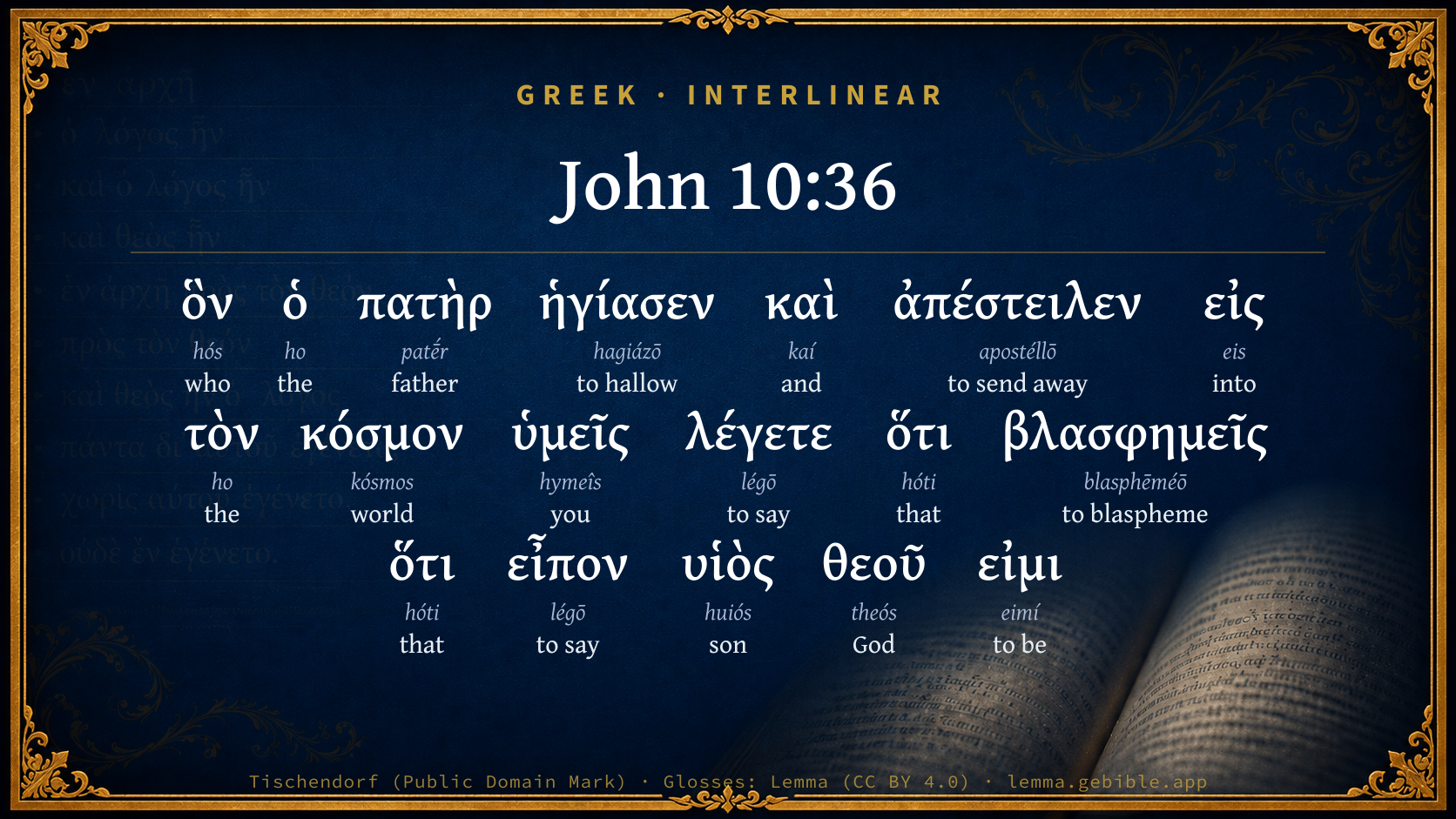
Do you say of him whom the Father sanctified and sent into the world, 'You blaspheme,' because I said, 'I am the Son of God?'
Download a study sheet
One document with this verse’s original text, its word-by-word gloss line, the meaning frame, cross-references with their text, attributed commentary, and full source and license credits — printable, and it pastes into notes with its structure intact.
This verse Autodidact and up
A passage Seminary Student
Up to 50 verses in one chapter. A passage sheet keeps up to 6 commentary sources and 12 cross-references per verse, in the order this page ranks them, and says so on the sheet whenever that leaves anything out. Ask for a single verse and you get the Autodidact verse sheet above.
Everything on this page stays free to read, with no account — the sheet is a download of what is already on screen, not access to it.
Compare translations 3
The same verse in 3 English versions, stacked beneath the original-language interlinear above. Click any original word for its lexicon entry.
Each is an independent rendering of the whole verse — the interlinear is not word-aligned to these translations.
Highlighted words mark where these versions differ — a whole-verse word diff, not a word-by-word alignment.
-
World English Bible Public Domain
Do you say of him whom the Father sanctified and sent into the world, 'You blaspheme,' because I said, 'I am the Son of God?'
-
King James Version Public Domain
Say ye of him, whom the Father hath sanctified, and sent into the world, Thou blasphemest; because I said, I am the Son of God?
-
unfoldingWord Literal Text CC BY-SA 4.0
do you say to the one the Father sanctified and sent into the world, ‘You are blaspheming,’ because I said, ‘I am the Son of God’?
unfoldingWord Literal Text — © unfoldingWord, licensed CC BY-SA 4.0. Word-aligned USFM3 via Door43 (git.door43.org/unfoldingWord/en_ult).
Show all 19 translations
Every available English version of this verse, each an independent rendering of the whole verse.
-
World English Bible Public Domain
Do you say of him whom the Father sanctified and sent into the world, 'You blaspheme,' because I said, 'I am the Son of God?'
-
Berean Standard Bible Public Domain
then what about the One whom the Father sanctified and sent into the world? How then can you accuse Me of blasphemy for stating that I am the Son of God?
-
Majority Standard Bible Public Domain
then what about the One whom the Father sanctified and sent into the world? How then can you accuse Me of blasphemy for stating that I am the Son of God?
-
King James Version Public Domain
Say ye of him, whom the Father hath sanctified, and sent into the world, Thou blasphemest; because I said, I am the Son of God?
-
American Standard Version (1901) Public Domain
say ye of him, whom the Father sanctified and sent into the world, Thou blasphemest; because I said, I am `the' Son of God?
-
Revised Version (1885) Public Domain
say ye of him, whom the Father sanctified and sent into the world, Thou blasphemest; because I said, I am the Son of God?
-
Geneva Bible (1599) Public Domain
Say ye of him, whome the Father hath sanctified, and sent into the worlde, Thou blasphemest, because I said, I am the Sonne of God?
-
Douay-Rheims (1899) Public Domain
Do you say of him whom the Father hath sanctified and sent into the world: Thou blasphemest, because I said, I am the Son of God?
-
Young's Literal Translation Public Domain
of him whom the Father did sanctify, and send to the world, do ye say -- Thou speakest evil, because I said, Son of God I am?
-
Literal Standard Version CC BY-SA 4.0
of Him whom the Father sanctified and sent into the world, do you say—You slander, because I said, I am [the] Son of God?
-
Unlocked Literal Bible CC BY-SA 4.0
do you say to him whom the Father set apart and sent into the world, 'You are blaspheming,' because I said, 'I am the Son of God'?
-
unfoldingWord Literal Text CC BY-SA 4.0
do you say to the one the Father sanctified and sent into the world, ‘You are blaspheming,’ because I said, ‘I am the Son of God’?
-
Darby Bible Public Domain
do ye say of him whom the Father has sanctified and sent into the world, Thou blasphemest, because I said, I am Son of God?
-
World Messianic Bible Public Domain
do you say of him whom the Father sanctified and sent into the world, ‘You blaspheme,’ because I said, ‘I am the Son of God’?
-
Webster's Bible Public Domain
Say ye of him, whom the Father hath sanctified, and sent into the world, Thou blasphemest; because I said, I am the Son of God?
-
Free Bible Version CC BY-SA 4.0
So why are you saying the one whom the Father set apart and sent into the world is blaspheming because I said ‘I am the Son of God’?
-
Bible in Basic English Public Domain
Do you say of him whom the Father made holy and sent into the world, Your words are evil; because I said, I am God's Son?
-
Text-Critical English NT CC BY 4.0
do you say of him whom the Father consecrated and sent into the world, ‘Yoʋ are blaspheming,’ because I said, ‘I am the Son of God’?
-
Tyndale New Testament (1534) Public Domain
saye ye then to him whom the father hath sainctified and sent into the worlde thou blasphemest because I sayd I am the sonne of God?
Literal Standard Version (2020), Covenant Press — licensed CC BY-SA 4.0. Text via the HelloAO Bible API (eBible.org). Unlocked Literal Bible (unfoldingWord) — licensed CC BY-SA 4.0. Text via the HelloAO Bible API (eBible.org). unfoldingWord Literal Text — © unfoldingWord, licensed CC BY-SA 4.0. Word-aligned USFM3 via Door43 (git.door43.org/unfoldingWord/en_ult). Free Bible Version, Dr. Jonathan Gallagher — licensed CC BY-SA 4.0. Text via the HelloAO Bible API (eBible.org).
Word by word
More ways to search: Search by grammar → Find every occurrence → Compare this word →
Practice this passage: Drill this verse → Learn its vocabulary →
- Appears 28× in the Greek New Testament
- First appears at Matthew 6:9
- Part of Speech
- Verb
- Tense
- Aorist
- Voice
- Active
- Mood
- Indicative
- Person
- 3rd person
- Number
- Singular
Full Thayer's Definition
- ὃν hós G3739 “who” Relative pronoun, Accusative, Singular, Masculine
- ὁ ho G3588 “the” Article, Nominative, Singular, Masculine
- πατὴρ patḗr G3962 “father” Noun, Nominative, Singular, Masculine
- ἡγίασεν hagiázō G37 “to hallow” Verb, Aorist, Active, Indicative, 3rd person, Singular
- καὶ kaí G2532 “and” Conjunction
- ἀπέστειλεν apostéllō G649 “to send away” Verb, Aorist, Active, Indicative, 3rd person, Singular
- εἰς eis G1519 “into” Preposition
- τὸν ho G3588 “the” Article, Accusative, Singular, Masculine
- κόσμον kósmos G2889 “world” Noun, Accusative, Singular, Masculine
- ὑμεῖς hymeîs G5210 “you” Personal pronoun, 2nd person, Nominative, Plural
- λέγετε légō G3004 “to say” Verb, Present, Active, Indicative, 2nd person, Plural
- ὅτι hóti G3754 “that” Conjunction
- βλασφημεῖς blasphēméō G987 “to blaspheme” Verb, Present, Active, Indicative, 2nd person, Singular
- ὅτι hóti G3754 “that” Conjunction
- εἶπον légō G3004 “to say” Verb, Aorist, Active, Indicative, 1st person, Singular
- υἱὸς huiós G5207 “son” Noun, Nominative, Singular, Masculine
- θεοῦ theós G2316 “God” Noun, Genitive, Singular, Masculine
- εἰμι eimí G1510 “to be” Verb, Present, Active, Indicative, 1st person, Singular
About this verse
These counts appear in no published source. They are computed here, from the morphology-tagged text and Lemma’s own curated glosses. What Lemma adds →
- 18
- words
- 15
- distinct lemmas
- Gospels
- section
Shared distinctive vocabulary
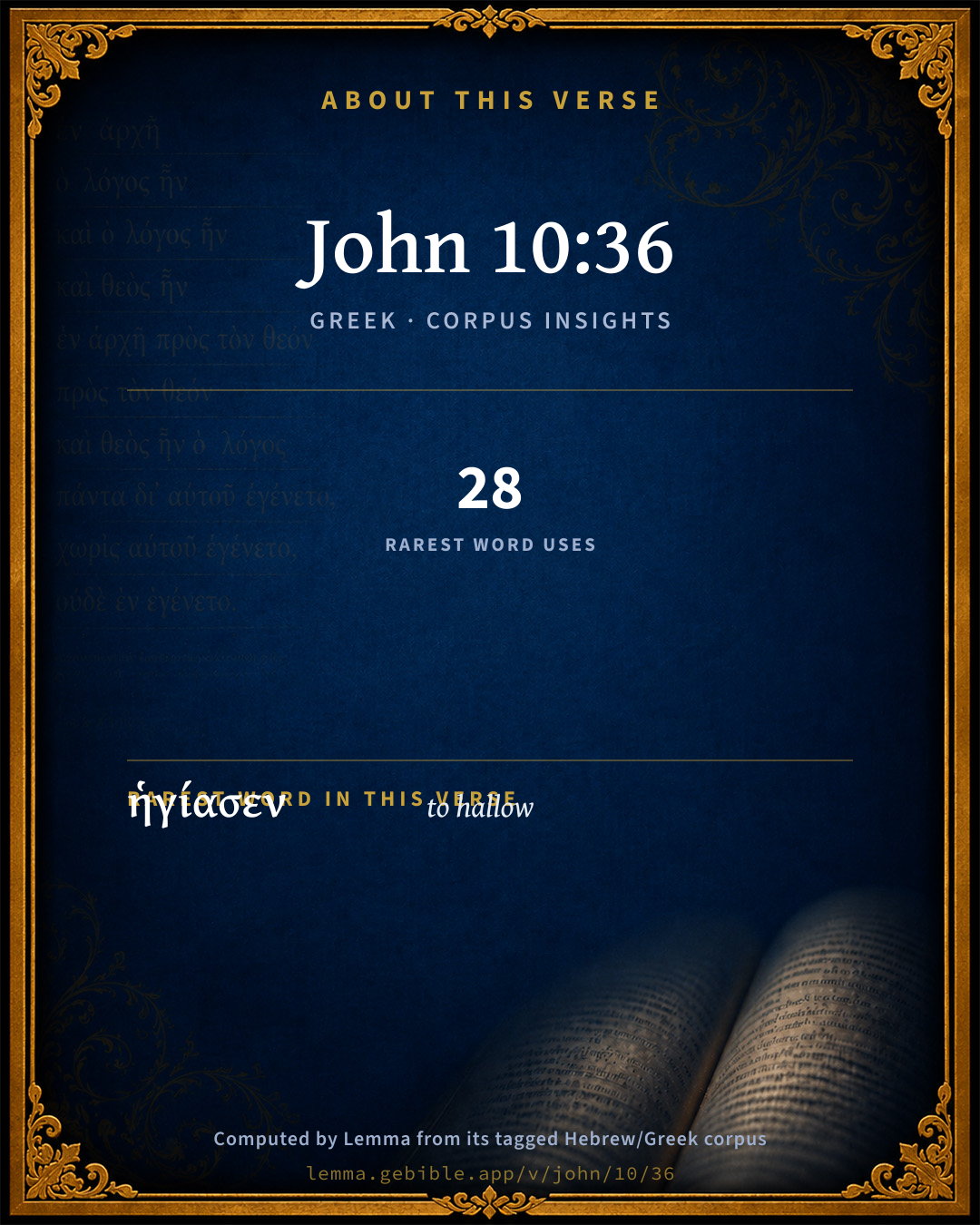
ἡγίασεν to hallow G37 occurs in 25 verses of the Greek New Testament. Also found in:
Cross-references
38Topical passages linked to John 10:36 in the Treasury of Scripture Knowledge — connected by theme and wording, ordered by reader-vote popularity; previews shown in the World English Bible.
- John 3:17 For God didn't send his Son into the world to judge the world, but that the world should be saved through him.
- Jeremiah 1:5 Before I formed you in the belly I knew you, and before you came forth out of the womb I sanctified you; I have appointed you a prophet to the nations.
- John 5:17–18 But Jesus answered them, "My Father is still working, so I am working, too."
- John 6:27 Don't work for the food which perishes, but for the food which remains to eternal life, which the Son of Man will give to you. For God the Father has sealed him."
- John 10:30–33 I and the Father are one."
- John 20:28 Thomas answered him, "My Lord and my God!"
- John 20:31 but these are written, that you may believe that Jesus is the Christ, the Son of God, and that believing you may have life in his name.
- Psalms 2:2 The kings of the earth take a stand, And the rulers take counsel together, Against Yahweh, and against his anointed, saying,
- Psalms 2:6–12 "Yet I have set my king on my holy hill of Zion."
- Isaiah 61:1–3 The Spirit of the Lord Yahweh is on me; because Yahweh has anointed me to preach good news to the humble; he has sent me to bind up the broken-hearted, to proclaim liberty to the captives, and the opening [of the prison] to those who are bound;
- Matthew 27:43 He trusts in God. Let God deliver him now, if he wants him; for he said, 'I am the Son of God.'"
- Luke 1:35 The angel answered her, "The Holy Spirit will come on you, and the power of the Most High will overshadow you. Therefore also the holy one who is born from you will be called the Son of God.
- John 3:34 For he whom God has sent speaks the words of God; for God gives the Spirit without measure.
- John 5:30 I can of myself do nothing. As I hear, I judge, and my judgment is righteous; because I don't seek my own will, but the will of my Father who sent me.
- John 6:38 For I have come down from heaven, not to do my own will, but the will of him who sent me.
- John 6:57 As the living Father sent me, and I live because of the Father; so he who feeds on me, he will also live because of me.
- John 6:69 We have come to believe and know that you are the Christ, the Son of the living God."
- John 9:35–37 Jesus heard that they had thrown him out, and finding him, he said, "Do you believe in the Son of God?"
- John 17:4–5 I glorified you on the earth. I have accomplished the work which you have given me to do.
- John 17:8 for the words which you have given me I have given to them, and they received them, and knew for sure that I came forth from you, and they have believed that you sent me.
- John 17:18 As you sent me into the world, even so I have sent them into the world.
- John 17:21 that they may all be one; even as you, Father, are in me, and I in you, that they also may be one in us; that the world may believe that you sent me.
- John 19:7 The Jews answered him, "We have a law, and by our law he ought to die, because he made himself the Son of God."
- Romans 1:4 who was declared to be the Son of God with power, according to the Spirit of holiness, by the resurrection from the dead, Jesus Christ our Lord,
- Romans 9:5 of whom are the fathers, and from whom is Christ as concerning the flesh, who is over all, God, blessed forever. Amen.
- Isaiah 11:2–5 The Spirit of Yahweh shall rest on him, the spirit of wisdom and understanding, the spirit of counsel and might, the spirit of knowledge and of the fear of Yahweh.
- Isaiah 42:1 Behold, my servant, whom I uphold; my chosen, in whom my soul delights: I have put my Spirit on him; he will bring forth justice to the Gentiles.
- Isaiah 42:3 A bruised reed will he not break, and a dimly burning wick will he not quench: he will bring forth justice in truth.
- Isaiah 49:1–3 Listen, isles, to me; and listen, you peoples, from far: Yahweh has called me from the womb; from the bowels of my mother has he made mention of my name:
- Isaiah 49:6–8 yes, he says, It is too light a thing that you should be my servant to raise up the tribes of Jacob, and to restore the preserved of Israel: I will also give you for a light to the Gentiles, that you may be my salvation to the end of the earth.
- Isaiah 55:4 Behold, I have given him for a witness to the peoples, a leader and commander to the peoples.
- Matthew 26:63–66 But Jesus held his peace. The high priest answered him, "I adjure you by the living God, that you tell us whether you are the Christ, the Son of God."
- Matthew 27:54 Now the centurion, and those who were with him watching Jesus, when they saw the earthquake, and the things that were done, feared exceedingly, saying, "Truly this was the Son of God."
- John 5:36–37 But the testimony which I have is greater than that of John, for the works which the Father gave me to accomplish, the very works that I do, testify about me, that the Father has sent me.
- John 8:42 Therefore Jesus said to them, "If God were your Father, you would love me, for I came out and have come from God. For I haven't come of myself, but he sent me.
- Romans 8:3 For what the law couldn't do, in that it was weak through the flesh, God did, sending his own Son in the likeness of sinful flesh and for sin, he condemned sin in the flesh;
- Galatians 4:4 But when the fullness of the time came, God sent out his Son, born to a woman, born under the law,
- 1 John 4:9–14 By this was God's love revealed in us, that God has sent his one and only Son into the world that we might live through him.
Cross-references courtesy of OpenBible.info (CC BY 4.0).
Lesson kit
Teaching starters — assembled from the data on this page, not authored interpretation. Every prompt links to the verse data it draws on. Edit before teaching.
John, in the Gospels, opens this verse with 18 words (15 distinct Greek lemmas). Its most distinctive word is hagiázō (“to hallow”). A historical commentator’s framing appears above. Read the whole chapter for the surrounding context.
Discussion questions
- How does “to hallow” (hagiázō) shape what this verse is saying?
- How does Matthew 6:9, which shares the word «to hallow», read alongside this verse?
- What does the repetition of “to say” (2× in this one verse) do in this verse?
- These translations render this verse differently. What is at stake in choosing one wording over another?
- Compare how Bengel's Gnomon and John Calvin's Commentaries read this verse. Where do they agree or differ?
Things to notice
- These translations choose different wording for 8 words in this verse.
- “to say” occurs 2× in this single verse.
- 15 distinct Greek lemmas span 18 words in this verse.
Commentary
Notes on John 10:36 from classic Christian and Jewish commentators (each source and its license shown beneath its notes). The classic Christian expositions comment on the surrounding passage and are grouped to its opening verse, so a note may address several verses; the Jewish commentaries on the Tanakh (Rashi and others) are per-verse, so they appear only where the commentator wrote on this verse.
Lemma curates 59 commentaries, every one of them public domain or Creative Commons licensed, each selected and text-cleaned for this edition rather than reprinted as found. About our sources →
Bengel's Gnomon
Johann Albrecht Bengel
Bengel's Gnomon of the New Testament — English translation (T&T Clark, Edinburgh, 1860) — public domain. Text from a community e-Sword module.
John Calvin's Commentaries
John Calvin's Commentaries (1540-1563) — public domain. Text from the Calvin Translation Society English edition (1840s-50s) via the Christian Classics Ethereal Library (ccel.org). Calvin's coverage is partial (roughly two-thirds of the Bible); uncommented books and verses are honest gaps, never fabricated. The 19th-century editor's footnotes and remarks are omitted so the notes are faithfully Calvin's own voice.
Ellicott's Commentary for English Readers
A Bible Commentary for English Readers, edited by Charles John Ellicott (1878–1897) — public domain. Text from a community e-Sword module.
The Cambridge Bible for Schools and Colleges
gen. ed. J. J. S. Perowne
The Cambridge Bible for Schools and Colleges (gen. ed. J. J. S. Perowne; Cambridge University Press, 1878–1918) — public domain. Text from a community e-Sword module.
John Gill's Exposition
John Gill's Exposition of the Whole Bible (1746–1763) — public domain (CC PDM 1.0). Text via the HelloAO Bible API.
Trapp's Complete Commentary
John Trapp
John Trapp, A Commentary or Exposition upon All the Books of the Old and New Testament (1647–1656) — public domain. Text from a community e-Sword module.
Matthew Poole's English Annotations
Matthew Poole's English Annotations on the Holy Bible (1683–1685) — public domain. Text from a community e-Sword/MySword module.
Whedon's Commentary on the Bible
Daniel D. Whedon
Daniel D. Whedon (gen. ed.), Commentary on the Old and New Testaments (1874–1909) — public domain. Text from a community e-Sword module.
The Pulpit Commentary
The Pulpit Commentary (1880–1919), ed. H.D.M. Spence-Jones & Joseph S. Exell — public domain. Text from a community e-Sword module.
John Wesley's Explanatory Notes
John Wesley, Explanatory Notes Upon the Whole Bible (1754–1765) — public domain. Text via the GEBible commentary corpus.
Scofield Reference Notes
C. I. Scofield
The Scofield Reference Bible (1917 edition), notes by C. I. Scofield — public domain. Text from a community e-Sword module.
Cambridge Greek Testament for Schools and Colleges
Cambridge Greek Testament for Schools and Colleges (Cambridge University Press, 1896; 21 vols, various authors incl. Carr, Maclear, Plummer, Farrar, Lumby, Moule, M. R. James, Simcox) — public domain. Text from a community e-Sword module.
Alford’s Greek Testament
Henry Alford
Henry Alford, The Greek Testament (1849–1861) — public domain. Text from a community e-Sword module.
International Critical Commentary
International Critical Commentary — older volumes (1896–1929), various authors — public domain. Text from a community e-Sword module.
Vincent's Word Studies in the New Testament
Marvin R. Vincent
Marvin R. Vincent, Word Studies in the New Testament (1887–1900) — public domain. Text from a community e-Sword/MySword module.