John 10:38

Greek (Tischendorf 8th ed.) John 10:38 appears in the Greek New Testament. The text above is from the Tischendorf 8th edition. Each word links to its Strong’s number and a concise gloss. Click any word for its full Thayer’s Greek Lexicon entry.
Download image
Cite this verse

John 10:38 (World English Bible). Public Domain. Lemma interlinear Bible study tool, https://lemma.gebible.app/v/john/10/38.

Show BibTeX & RIS
BibTeX
RIS
English Translation
But if I do them, though you don't believe me, believe the works; that you may know and believe that the Father is in me, and I in the Father."
World English Bible · Public Domain
Download a study sheet

One document with this verse’s original text, its word-by-word gloss line, the meaning frame, cross-references with their text, attributed commentary, and full source and license credits — printable, and it pastes into notes with its structure intact.

This verse Autodidact and up

Study sheet (.html) Plain text (.txt)

A passage Seminary Student

Up to 50 verses in one chapter. A passage sheet keeps up to 6 commentary sources and 12 cross-references per verse, in the order this page ranks them, and says so on the sheet whenever that leaves anything out. Ask for a single verse and you get the Autodidact verse sheet above.

Everything on this page stays free to read, with no account — the sheet is a download of what is already on screen, not access to it.

Want to remove ads? Support Godless Engineer
Compare translations 3

The same verse in 3 English versions, stacked beneath the original-language interlinear above. Click any original word for its lexicon entry.

Each is an independent rendering of the whole verse — the interlinear is not word-aligned to these translations.

Highlighted words mark where these versions differ — a whole-verse word diff, not a word-by-word alignment.

  • World English Bible Public Domain
    But if I do them, though you don't believe me, believe the works; that you may know and believe that the Father is in me, and I in the Father."
  • King James Version Public Domain
    But if I do, though ye believe not me, believe the works: that ye may know, and believe, that the Father is in me, and I in him.
  • unfoldingWord Literal Text CC BY-SA 4.0
    But if I am doing them, even if you do not believe me, believe in the works so that you might know and might understand that the Father in me, and I in the Father.”

unfoldingWord Literal Text — © unfoldingWord, licensed CC BY-SA 4.0. Word-aligned USFM3 via Door43 (git.door43.org/unfoldingWord/en_ult).

Versions to compare (up to 4)

3 of 4 selected

Show all 19 translations

Every available English version of this verse, each an independent rendering of the whole verse.

  • World English Bible Public Domain
    But if I do them, though you don't believe me, believe the works; that you may know and believe that the Father is in me, and I in the Father."
  • Berean Standard Bible Public Domain
    But if I am doing them, even though you do not believe Me, believe the works themselves, so that you may know and understand that the Father is in Me, and I am in the Father.”
  • Majority Standard Bible Public Domain
    But if I am doing them, even though you do not believe Me, believe the works themselves, so that you may know and believe that the Father is in Me, and I am in Him.”
  • King James Version Public Domain
    But if I do, though ye believe not me, believe the works: that ye may know, and believe, that the Father is in me, and I in him.
  • American Standard Version (1901) Public Domain
    But if I do them, though ye believe not me, believe the works: that ye may know and understand that the Father is in me, and I in the Father.
  • Revised Version (1885) Public Domain
    But if I do them, though ye believe not me, believe the works: that ye may know and understand that the Father is in me, and I in the Father.
  • Geneva Bible (1599) Public Domain
    But if I doe, then though ye beleeue not mee, yet beleeue the workes, that ye may knowe and beleeue, that the Father is in me, and I in him.
  • Douay-Rheims (1899) Public Domain
    But if I do, though you will not believe me, believe the works: that you may know and believe that the Father is in me, and I in the Father.
  • Young's Literal Translation Public Domain
    and if I do, even if me ye may not believe, the works believe, that ye may know and may believe that in me `is' the Father, and I in Him.'
  • Literal Standard Version CC BY-SA 4.0
    and if I do, even if you may not believe Me, believe the works, that you may know and may believe that the Father [is] in Me, and I in Him.”
  • Unlocked Literal Bible CC BY-SA 4.0
    But if I am doing them, even if you do not believe me, believe in the works so that you may know and understand that the Father is in me and that I am in the Father.”
  • unfoldingWord Literal Text CC BY-SA 4.0
    But if I am doing them, even if you do not believe me, believe in the works so that you might know and might understand that the Father in me, and I in the Father.”
  • Darby Bible Public Domain
    but if I do, even if ye believe not me, believe the works, that ye may know [and believe] that the Father is in me and I in him.
  • World Messianic Bible Public Domain
    But if I do them, though you don’t believe me, believe the works, that you may know and believe that the Father is in me, and I in the Father.”
  • Webster's Bible Public Domain
    But if I do, though ye believe not me, believe the works: that ye may know and believe that the Father is in me, and I in him.
  • Free Bible Version CC BY-SA 4.0
    But if that is what I'm doing, even though you don't believe me, you should believe because of the evidence of what I've done. That way you can know and understand that the Father is in me, and I am in the Father.”
  • Bible in Basic English Public Domain
    But if I am doing them, then have belief in the works even if you have no belief in me; so that you may see clearly and be certain that the Father is in me and I am in the Father.
  • Text-Critical English NT CC BY 4.0
    But if I do them, even if you do not believe me, believe the works, so that you may know and believe that the Father is in me and I in him.”
  • Tyndale New Testament (1534) Public Domain
    But if I do though ye beleve not me yet beleve the workes that ye maye knowe and beleve that the father is in me and I in him.

Literal Standard Version (2020), Covenant Press — licensed CC BY-SA 4.0. Text via the HelloAO Bible API (eBible.org). Unlocked Literal Bible (unfoldingWord) — licensed CC BY-SA 4.0. Text via the HelloAO Bible API (eBible.org). unfoldingWord Literal Text — © unfoldingWord, licensed CC BY-SA 4.0. Word-aligned USFM3 via Door43 (git.door43.org/unfoldingWord/en_ult). Free Bible Version, Dr. Jonathan Gallagher — licensed CC BY-SA 4.0. Text via the HelloAO Bible API (eBible.org).

Word by word

More ways to search: Search by grammar → Find every occurrence → Compare this word →

Practice this passage: Drill this verse → Learn its vocabulary →

κἂν
kán
G2579
“and if”
Conditional, Aramaic form
Part of Speech
Conditional
Degree
Aramaic form
Full Thayer's Definition

Origin: from G2532 and G1437

TDNT: None

1. and if 2. also or even if a. of only, at least b. even if
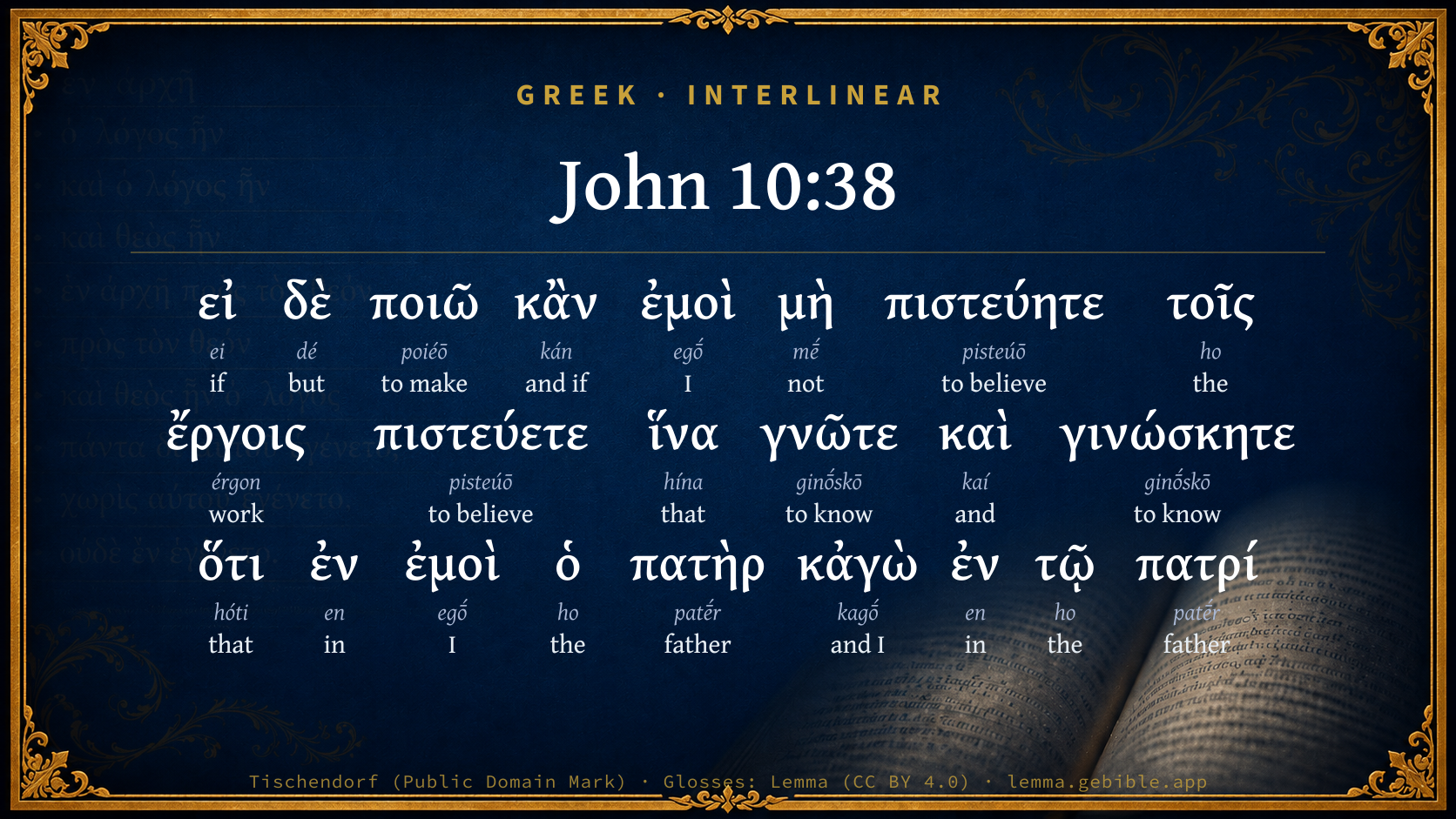
  1. εἰ ei G1487 “if” Conditional
  2. δὲ dé G1161 “but” Conjunction
  3. ποιῶ poiéō G4160 “to make” Verb, Present, Active, Indicative, 1st person, Singular
  4. ἐμοὶ egṓ G1473 “I” Personal pronoun, 1st person, Dative, Singular
  5. μὴ mḗ G3361 “not” Particle, Negative
  6. πιστεύητε pisteúō G4100 “to believe” Verb, Present, Active, Subjunctive, 2nd person, Plural
  7. τοῖς ho G3588 “the” Article, Dative, Plural, Neuter
  8. ἔργοις érgon G2041 “work” Noun, Dative, Plural, Neuter
  9. πιστεύετε pisteúō G4100 “to believe” Verb, Present, Active, Imperative, 2nd person, Plural
  10. ἵνα hína G2443 “that” Conjunction
  11. γνῶτε ginṓskō G1097 “to know” Verb, Aorist, Active, Subjunctive, 2nd person, Plural
  12. καὶ kaí G2532 “and” Conjunction
  13. γινώσκητε ginṓskō G1097 “to know” Verb, Present, Active, Subjunctive, 2nd person, Plural
  14. ὅτι hóti G3754 “that” Conjunction
  15. ἐν en G1722 “in” Preposition
  16. ἐμοὶ egṓ G1473 “I” Personal pronoun, 1st person, Dative, Singular
  17. ὁ ho G3588 “the” Article, Nominative, Singular, Masculine
  18. πατὴρ patḗr G3962 “father” Noun, Nominative, Singular, Masculine
  19. κἀγὼ kagṓ G2504 “and I” Personal pronoun, 1st person, Nominative, Singular, Aramaic form
  20. ἐν en G1722 “in” Preposition
  21. τῷ ho G3588 “the” Article, Dative, Singular, Masculine
  22. πατρί patḗr G3962 “father” Noun, Dative, Singular, Masculine

About this verse

These counts appear in no published source. They are computed here, from the morphology-tagged text and Lemma’s own curated glosses. What Lemma adds →

23
words
16
distinct lemmas
Gospels
section

Notable vocabulary

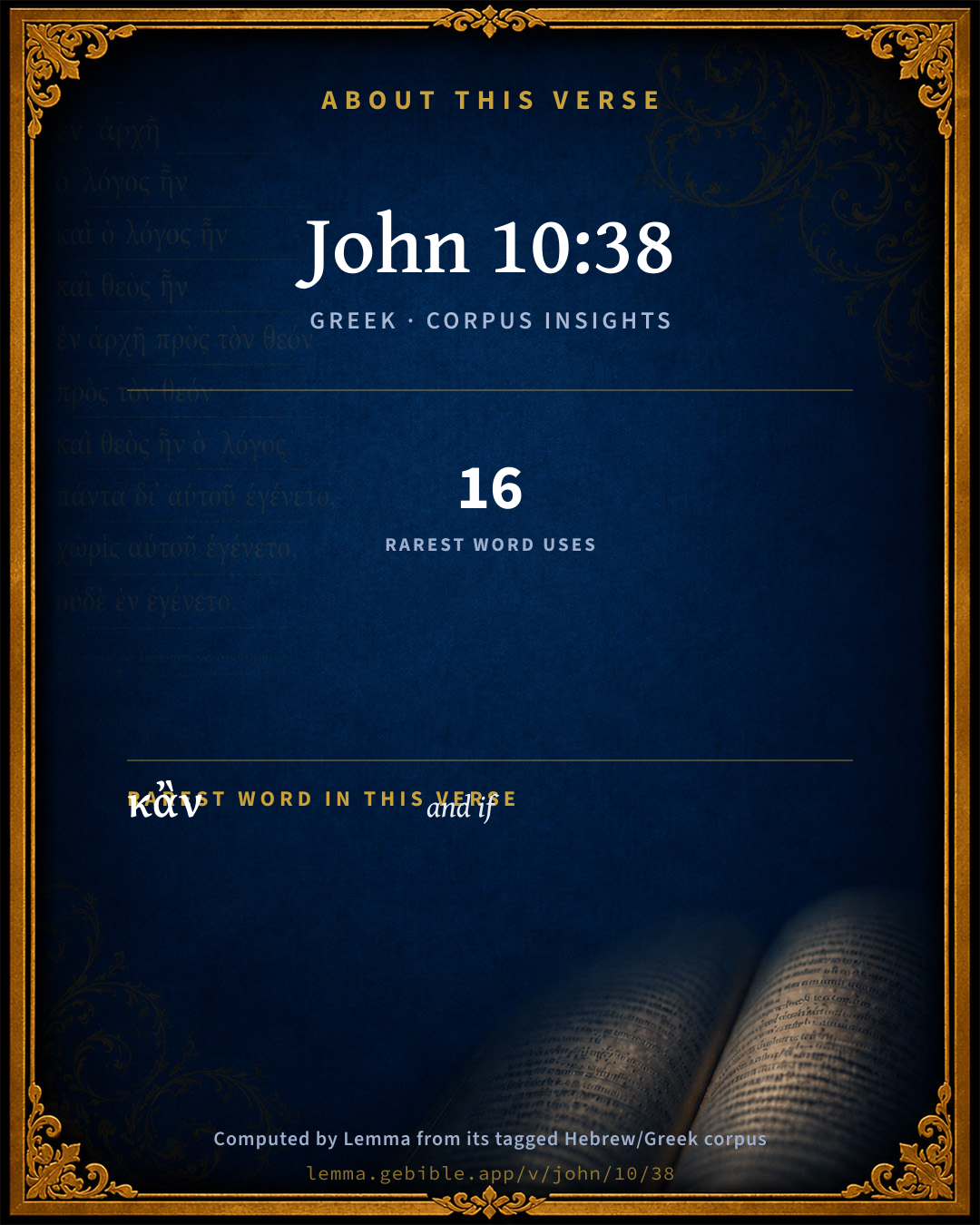
The rarest word here is κἂν and if G2579 — appearing just 16 times in the whole Greek New Testament.

Shared distinctive vocabulary

κἂν and if G2579 occurs in 15 verses of the Greek New Testament. Also found in:

Repetition

Words recur within this verse:

  • πιστεύητε to believe G4100 ×2
  • γνῶτε to know G1097 ×2
  • πατὴρ father G3962 ×2
  • τοῖς the G3588 ×3
  • ἐμοὶ I G1473 ×2
  • ἐν in G1722 ×2

Cross-references

10

Topical passages linked to John 10:38 in the Treasury of Scripture Knowledge — connected by theme and wording, ordered by reader-vote popularity; previews shown in the World English Bible.

  • John 10:30 I and the Father are one."
  • John 14:20 In that day you will know that I am in my Father, and you in me, and I in you.
  • John 10:25 Jesus answered them, "I told you, and you don't believe. The works that I do in my Father's name, these testify about me.
  • John 14:9–11 Jesus said to him, "Have I been with you such a long time, and do you not know me, Philip? He who has seen me has seen the Father. How do you say, 'Show us the Father?'
  • John 3:2 The same came to him by night, and said to him, "Rabbi, we know that you are a teacher come from God, for no one can do these signs that you do, unless God is with him."
  • John 17:21–23 that they may all be one; even as you, Father, are in me, and I in you, that they also may be one in us; that the world may believe that you sent me.
  • Acts 2:22 "Men of Israel, hear these words! Jesus of Nazareth, a man approved by God to you by mighty works and wonders and signs which God did by him in the midst of you, even as you yourselves know,
  • John 5:36 But the testimony which I have is greater than that of John, for the works which the Father gave me to accomplish, the very works that I do, testify about me, that the Father has sent me.
  • John 17:11 I am no more in the world, but these are in the world, and I am coming to you. Holy Father, keep them through your name which you have given me, that they may be one, even as we are.
  • Acts 4:8–12 Then Peter, filled with the Holy Spirit, said to them, "You rulers of the people, and elders of Israel,

Cross-references courtesy of OpenBible.info (CC BY 4.0).

Where the printed editions differ

2 variants

Places in this verse where the major printed Greek editions disagree on the wording in a way that affects the translation — a comparison of editions, not a manuscript-by-manuscript collation. The editions are the modern critical texts (Nestlé-Aland 28/27, SBL, Westcott-Hort, Tregelles, Tyndale House) and the traditional texts behind the KJV (the Textus Receptus and the Byzantine/Majority text). It is not a claim about which reading is original.

  1. Different wording
    γινώσκητε

    “may understand”

    In NA28NA27TynSBLWHTreg Not in TRByz

    πιστεύσητε (pisteusēte) 'you may believe' occurs in traditional manuscripts (TR+Byz) instead of γινώσκητε (ginōskēte) 'may understand' in older manuscripts (NA28+NA27+Tyn+SBL+WH+Treg)

  2. Different wording
    πατρί.

    “Father.”

    In NA28NA27TynSBLWHTreg Not in TRByz

    αὐτῷ (autō) 'him' occurs in traditional manuscripts (TR+Byz) instead of πατρί.¶ (patri) 'Father.' in older manuscripts (NA28+NA27+Tyn+SBL+WH+Treg)

Textual data: Translators Amalgamated Greek New Testament (STEPBible TAGNT) · CC BY 4.0.

Commentary

Notes on John 10:38 from classic Christian and Jewish commentators (each source and its license shown beneath its notes). The classic Christian expositions comment on the surrounding passage and are grouped to its opening verse, so a note may address several verses; the Jewish commentaries on the Tanakh (Rashi and others) are per-verse, so they appear only where the commentator wrote on this verse.

Lemma curates 59 commentaries, every one of them public domain or Creative Commons licensed, each selected and text-cleaned for this edition rather than reprinted as found. About our sources →

Tyndale Open Study Notes

Tyndale Open Resources

10:38 Jesus’ miraculous works should help true believers know and understand that the full reality of God dwells in Jesus.

Tyndale Open Study Notes — © Tyndale Open Resources, licensed CC BY-SA 4.0. Text via the HelloAO Bible API.

Bengel's Gnomon

Johann Albrecht Bengel

Joh 10:38. Κἂν ἐμοί, even though Me) You ought to have believed in Me: even separating Me from the works.—γνῶτε καὶ πιστεύσητε, that ye may know and believe) Faith follows subsequently to knowledge with those that are of a rather dull susceptibility.—ἐν ἐμοὶ ὁ Πατὴρ, κἄγω ἐν αὐτῷ, the Father in Me, and I in Him) I am none else than the Father, in such a way, however, that I remain still the Son; and He none else than I, in such a way, however, as that He still remains the Father. And if any one shall have known Me, he knoweth the Father, and hath learned the Son. But if the power of One were less than that of the Other, the knowledge also would mislead; for in that case neither the essence nor the power of One can be learned by means of the Other.—Chrys. on this passage. These two sentences, I and the Father are one, and, the Father in Me and I in the Father, mutually explain one another. Comp. ch. Joh 17:11; Joh 17:21, “Holy Father, keep—those—that they may be one, as We are. As Thou, Father, art in Me, and I in Thee, that they also may be one in Us.”

Bengel's Gnomon of the New Testament — English translation (T&T Clark, Edinburgh, 1860) — public domain. Text from a community e-Sword module.

Adam Clarke's Commentary

Verse 38. Believe the works] Though ye do not now credit what I have said to you, yet consider my works, and then ye will see that these works prove that I am in the Father and the Father in me; and, consequently, that I and the Father are one. This seems to be the force of our Lord's argument; and every man must see and feel that it is conclusive. There was no possibility of weakening the force of this reasoning but by asserting that these miracles were not wrought by the power of God; and then they must have proved that not only a man, but a bad man, such as they said Jesus was, could work these miracles. As this was impossible, then the argument of Christ had a complete triumph.

Adam Clarke's Commentary on the Bible (1810–1826) — public domain. Text from a community e-Sword/MySword module.

John Calvin's Commentaries

38. But if I do. He shows that they are held plainly convicted of unbelieving and sacrilegious contempt, because they render no reverence or honor to what are undoubtedly the works of God. This is a second concession, when he says, “Though I allow you to doubt of my doctrine, you cannot deny, at least, that the miracles which I have performed are from God. You therefore openly reject God, and not a man.”

That you may know and believe. Though he places knowledge before faith, as if faith were inferior to it, he does so, because he has to do with unbelieving and obstinate men, who never yield to God, until they are vanquished and constrained by experience; for rebels wish to know before they believe And yet our gracious God indulges us so far, that he prepares us for faith by a knowledge of his works. But the knowledge of God and of his secret wisdom comes after faith, because the obedience of faith opens to us the door of the kingdom of heaven.

That the Father is in me, and I in him. He repeats the same thing which he had said before in other words, I and my Father are one All tends to this point, that in his ministry there is nothing contrary to his Father. “The Father, he says, is in me; that is, Divine power is manifested in me.”

And I am in my Father; that is, “I do nothing but by the command of God, so that there is a mutual connection between me and my Father.” For this discourse does not relate to the unity of essence, but to the manifestation of Divine power in the person of Christ, from which it was evident that he was sent by God.

John Calvin's Commentaries (1540-1563) — public domain. Text from the Calvin Translation Society English edition (1840s-50s) via the Christian Classics Ethereal Library (ccel.org). Calvin's coverage is partial (roughly two-thirds of the Bible); uncommented books and verses are honest gaps, never fabricated. The 19th-century editor's footnotes and remarks are omitted so the notes are faithfully Calvin's own voice.

Ellicott's Commentary for English Readers

(38) But if I do, though ye believe not me, believe the works.—A higher faith would have believed Him. Had they truly known their own spiritual needs, and truly known the meaning of that great truth He had taught, they would have found in Him the true satisfaction of the mind’s cravings, and the faculty of faith would have rested in the object of its existence. For all this the Old Testament had been a preparation; but their minds had not been prepared by it. He will take therefore their own lower ground, and appeal to the sight of those who have not faith. (Comp. Note on Joh_20:29.) Let them test the works, think of their character, as some of them had already done (Joh_9:16), and see at least that these are of the Father.

That ye may know, and believe, that the Father is in me.—The more probable text is, that ye may perceive, and may (permanently) know that the Father is in Me . . . Failing the intuitive faith-knowledge, He appeals to the intellectual perception, which is not immediate, but from which they may ascend to that knowledge, and may then really know that such works can be only of the Father; and that, therefore, the Father is present in Him who does them, and that He who does them is one with the Father Joh_10:30).

A Bible Commentary for English Readers, edited by Charles John Ellicott (1878–1897) — public domain. Text from a community e-Sword module.

The Cambridge Bible for Schools and Colleges

gen. ed. J. J. S. Perowne

38. believe the works] ‘Blessed are they that have not seen and yet have believed’ (Joh_20:29); but it is better to have the faith that comes with sight than none at all.

that ye may know, and believe] The better reading probably is, that ye may come to know and continually know; ‘attain to knowledge and advance in knowledge in contrast to your state of suspense’ (Joh_10:24). In the Greek it is the aorist and present of the same verb ‘to come to know, perceive, recognise:’ the aorist denotes the single act, the present the permanent growth. The apparent awkwardness of having the same verb twice in the same clause has probably caused a large number of authorities to substitute another verb in the second case. But the change of tense is full of meaning, especially in reference to the Jews. Many of them attained to a momentary conviction that He was the Messiah (Joh_2:23, Joh_6:14-15, Joh_7:41, Joh_8:30, Joh_10:42, Joh_11:45); very few of them went beyond a transitory conviction (Joh_2:24, Joh_6:66, Joh_8:31).

the Father is in me, and I in him] For ‘in Him’ read with the best authorities in the Father. An instance of the solemnity and emphasis derived from repetition, so frequent in this Gospel.

The Cambridge Bible for Schools and Colleges (gen. ed. J. J. S. Perowne; Cambridge University Press, 1878–1918) — public domain. Text from a community e-Sword module.

John Gill's Exposition

Therefore they sought again to take him,.... Not to take away his life by stoning him, as before, in the manner the furious zealots did, and was the part they were about to act just now; but to lay hold upon him and bring him before the sanhedrim, as they had done in Joh 5:18, he being so far from clearing himself from the charge of blasphemy, they had brought against him, that in their opinion he had greatly strengthened it; and they thought they had now sufficient proof and evidence to convict him as a blasphemer, in their high court of judicature; and therefore attempted to lay hands on him, and bring him thither:

but he escaped out of their hands; either by withdrawing from them in some private way; or by open force, exerting his power, and obliging them on every side to fall back, and give way to him; or by rendering himself invisible to them; and this he did, not through fear of death, but because his time was not yet come, and he had other work to do, before he suffered and died.

John Gill's Exposition of the Whole Bible (1746–1763) — public domain (CC PDM 1.0). Text via the HelloAO Bible API.

Trapp's Complete Commentary

John Trapp

38 But if I do, though ye believe not me, believe the works: that ye may know, and believe, that the Father is in me, and I in him.

Ver. 38. But if I do, though ye, &c.] q.d. Stumble not at the meanness of my person, condition, followers, &c. When it was sometimes disputed among the Romans in the council, using to deify great men, whether Christ, having done many wonderful works, should be received into the number of the gods? it was at length concluded (saith the historian) quod non deberet recipi inter Deos, pro eo quod non haberet cultores, propter hoc quod paupertatem praedicaret et eligeret, quam mundus contemnit.

John Trapp, A Commentary or Exposition upon All the Books of the Old and New Testament (1647–1656) — public domain. Text from a community e-Sword module.

Matthew Poole's English Annotations

If I do such works as can be done by no less than a Divine power, being beyond the power and ability of all creatures; then, though you will not give credit to any bare affirmations of myself, because I say I am the Son of God, yet believe the things for the testimony that my works give unto it. Proper effects give testimony to the proper cause; he who doth those things which none but God can do, must needs be God, or empowered by God to do them. This is the way for you to know, be persuaded, and believe, that the Father is in me by his mighty, Divine, working power: Joh 14:10, The Father that dwelleth in me, he doeth the works; and I work in and together with him. This phrase, The Father is in me, and I in him, teacheth us three things concerning Christ:

1. His oneness in nature and essence with the Father.

2. His personal distinction from his Father: here are two mentioned, the Father, and me: none can properly be said to be in himself.

3. The most perfect and intimate indwelling of one of the Persons in the Holy Trinity in the other.

Matthew Poole's English Annotations on the Holy Bible (1683–1685) — public domain. Text from a community e-Sword/MySword module.

Whedon's Commentary on the Bible

Daniel D. Whedon

38. Believe the works—The blind-born (Joh_9:35-38) believed the works; therefore his faith was ready to underwrite whatever the author of the works should say of himself.

The Father is in me—If Omnipotence energizes my actions, the Omnipotent must pervade my person.

Our Lord’s argument here shows, 1. The use of the divine name to designate inferior beings, does not derogate from its supreme sense when applied to him. 2. The humanity of Christ is taken into the divinity, enveloped with its dignity, without changing it out of its true human nature. So that the so-called hypostatic union results in perfect man and perfect God in oneness.

Daniel D. Whedon (gen. ed.), Commentary on the Old and New Testaments (1874–1909) — public domain. Text from a community e-Sword module.

The Pulpit Commentary

But if I do if I am performing the works of my Father, if these acts of healing and helping, of mighty consolation and symbolic grace, are obviously such as you can recognize as the Father"s, believe them; learn that much, it is for your life and if you make that acquisition, though ye believe not me though you do not credit my assertion on my own authority, though you do not take me at once on my own wordbelieve the works; you may then take the further step, and both know and understand, or know broadly and completely, and then learn in details, that the Father is in me, and I in the Father. Between the assertion of ver. 30, "I and my Father are one," and that of this verse, "the works" are introduced works that are recognized as Divine, "the Father"s," but seen and known also to be Christ"s own works. Why should they stone him for blasphemy if they have evidence so resistless as this, even if it comes short of proof, that he is absolutely one with the Father? The intuitive perception of the Divine in Christ is the highest and noblest spiritual experience. His word should be, might be, enough; but, suppose it should fail, miracles, "works," come in to link the Divine Personality of the Speaker with the supreme Father. The works may teach them that he is in the Father, and the Father in him. Not by a flash of light, but by growing intellectual conviction, they must come to a conclusion which the great assertion," I and the Father are one," finally confirms.

The Pulpit Commentary (1880–1919), ed. H.D.M. Spence-Jones & Joseph S. Exell — public domain. Text from a community e-Sword module.

John Wesley's Explanatory Notes

That ye may know and believe - In some a more exact knowledge precedes, in others it follows faith. I am in the Father and the Father in me. I and the Father are one - These two sentences illustrate each other.

John Wesley, Explanatory Notes Upon the Whole Bible (1754–1765) — public domain. Text via the GEBible commentary corpus.

Cambridge Greek Testament for Schools and Colleges

38. πιστεύετε (אBDKLU) for πιστεύσατε, and γινώσκητε for πιστεύσητε (to avoid apparent repetition) with BLX against A; א has πιστεύητε.

CHRIST IS LOVE

In chapters 5 and 6 two miracles, the healing of the paralytic and the feeding of the 5000, formed the introduction to two discourses in which Christ is set forth as the Source and the Support of Life. In chapters 7 and 8 we have a discourse in which He is set forth as the Source of Truth and Light, and this is illustrated (9) by His giving physical and spiritual sight to the man born blind. In chap. 10 we again have a discourse in which Christ is set forth as Love, under the figure of the Good Shepherd giving His life for the sheep, and this is illustrated (11) by the raising of Lazarus, a work of Love which costs Him His life. As already stated, the prevailing idea throughout this section (5–11) is truth and love provoking contradiction and enmity. The more clearly the Messiah manifests Himself, and the more often He convinces some of His hearers of His Messiahship (Joh 7:40-41; Joh 7:46; Joh 7:50, Joh 8:30, Joh 9:30-38, Joh 10:21; Joh 10:42, Joh 11:45), the more intense becomes the hostility of ‘the Jews’ and the more determined their intention to kill Him.

38. τ. ἔργοις π. ‘Blessed are they that have not seen and yet have believed’ (Joh 20:29); but it is better to have the faith that comes with sight than none at all. Thus we have four stages: 1. believing the works; 2. believing Him on account of the works (Joh 14:11); 3. believing on Him (Joh 8:30); 4. abiding in His word (Joh 8:31).

The true position of miracles among the Evidences of Christianity is clearly stated here and Joh 14:11. They are not primary, as Paley would have it, but secondary and auxiliary. Christ’s doctrine bears the evidence of its Divine origin in itself.

ἵνα γνῶτε κ. γινώσκητε. That ye may come to know and continually know; attain to knowledge and advance in knowledge in contrast to their state of suspense (Joh 10:24): the aorist denotes the single act, the present the permanent growth. The apparent awkwardness of having the same verb twice in the same clause has probably caused a large number of authorities to substitute πιστεύσητε in the second case. But the change of tense is full of meaning, especially in reference to the Jews. Many of them attained to a momentary conviction that He was the Messiah (Joh 2:23, Joh 6:14-15, Joh 7:41, Joh 8:30, Joh 10:42, Joh 11:45); very few of them went beyond a transitory conviction (Joh 2:24, Joh 6:66, Joh 8:31).

κἀγὼ ἐν τ. πατρί. An instance of the solemnity and emphasis derived from repetition so frequent in this Gospel.

Cambridge Greek Testament for Schools and Colleges (Cambridge University Press, 1896; 21 vols, various authors incl. Carr, Maclear, Plummer, Farrar, Lumby, Moule, M. R. James, Simcox) — public domain. Text from a community e-Sword module.

Alford’s Greek Testament

Henry Alford

38.] Having put the charge of blasphemy aside, our Lord again has recourse to the testimony of His works, at which He hinted ver. 32; and here, to their character, as admitted by them in ver. 33. ‘If they bear not the character of the Father, believe Me not: but if they do (which even yourselves admit), though ye may hate and disbelieve Me, recognize the unquestionable testimony of the works:—that ye may be led on to the higher faith of the unity of Myself and the Father.’

γνῶτε κ. γινώσκητε] The distinction lies in the force of the present as denoting the continuance of a state, whereas the aorist implies an act of a moment. The nearest approach to it in English would perhaps be, that ye may perceive (the introductory act) and know (the abiding state). This distinction between the tenses not being appreciated, γινώσκητε has been awkwardly changed to πιστεύσητε. Cf. Plato, Legg. viii. p. 849 Α, τῶν δὲ ἐν ἄστει κατὰ τὰ αὐτὰ ἐπιμεληθῆναι καὶ ἐπιμελεῖσθαι τὴν τῶν ἀστυνόμων ἀρχήν.

Henry Alford, The Greek Testament (1849–1861) — public domain. Text from a community e-Sword module.

International Critical Commentary

38. εἰ δὲ ποιῶ κτλ. But, on the other hand, if they recognised the divine character of these ἔργα of Jesus, they should accept their witness as to His authority. This would not produce the highest kind of faith, but it would be a beginning. See 5:36-38. The witness of the works will convince them of His trustworthiness, and so they will come to believe what He says. This, in turn, will lead on to belief “in Him” (see on 1:12), to faith in the majesty of His Person.

ἵνα γνῶτε καὶ γινώσκητε, “that you may perceive, and so reach the fixed conviction of knowledge,” ὅτι ἐν ἐμοὶ ὁ πατὴρ κἀγὼ ἐν τῷ πατρί, “that the Father is in me, and I in the Father” (cf. 17:21). This faith would appreciate the saying at which they had stumbled, ἐγὼ καὶ ὁ πατὴρ ἕν ἐσμεν (v. 30).

γινώσκητε. So BLWΘ, but אAΓΔ substitute πιστεύσητε. But there is nothing pleonastic in γνῶτε followed by γινώσκητε, the pres. subjunctive referring to a continuous appreciation and understanding, the aorist to the initial apprehension of the truth. Cf. ἵνα γινώσκουσιν (17:3) and ἵνα γινώσκῃ (17:23).

The argument is repeated 14:11, πιστέυετέ μοι (i.e. believe my word) ὅτι ἐγὼ ἐν τῷ πατρὶ καὶ ὁ πατὴρ ἐν ἐμοί· εἰ δὲ μὴ (but, if you will not, then accept the lower form of witness) διὰ τὰ ἔργα αὐτὰ πιστέυετε. The reciprocal communion of the Father and the Son—“I in Him, and He in me”—is expressed again in the same mystical words at 17:21; cf. 1Jn 3:24, 1Jn 4:15.

International Critical Commentary — older volumes (1896–1929), various authors — public domain. Text from a community e-Sword module.

Vincent's Word Studies in the New Testament

Marvin R. Vincent

In Him. The best texts read ejn tw patri, in the Father.

Marvin R. Vincent, Word Studies in the New Testament (1887–1900) — public domain. Text from a community e-Sword/MySword module.

Lesson kit

Teaching starters — assembled from the data on this page, not authored interpretation. Every prompt links to the verse data it draws on. Edit before teaching.

John, in the Gospels, opens this verse with 23 words (16 distinct Greek lemmas). Its most distinctive word is kán (“and if”). A historical commentator’s framing appears above. Read the whole chapter for the surrounding context.

Discussion questions

  1. What does “and if” (kán) contribute to the verse as a whole?
  2. How does Matthew 21:21, which shares the word «and if», read alongside this verse?
  3. What does the repetition of “to believe” (2× in this one verse) do in this verse?
  4. The translations on this page render this verse differently — a whole-verse word diff, not a word-by-word alignment. What might account for the different wordings?
  5. Compare how Tyndale Open Study Notes and Bengel's Gnomon read this verse. Where do they agree or differ?

Things to notice

  • These translations choose different wording for 10 words in this verse.
  • “to believe” occurs 2× in this single verse.
  • 16 distinct Greek lemmas span 23 words in this verse.

Reading settings

Reading text

Shown beneath each verse's original-language words.

Old Testament
Old Testament edition

Read the OT as the Masoretic Hebrew (MT) or the Greek Septuagint (LXX).

English shown for the Greek Septuagint (in the Hebrew ↔ Greek comparison).

Comparing translations? Open the Compare panel on any verse page to stack up to four side by side.