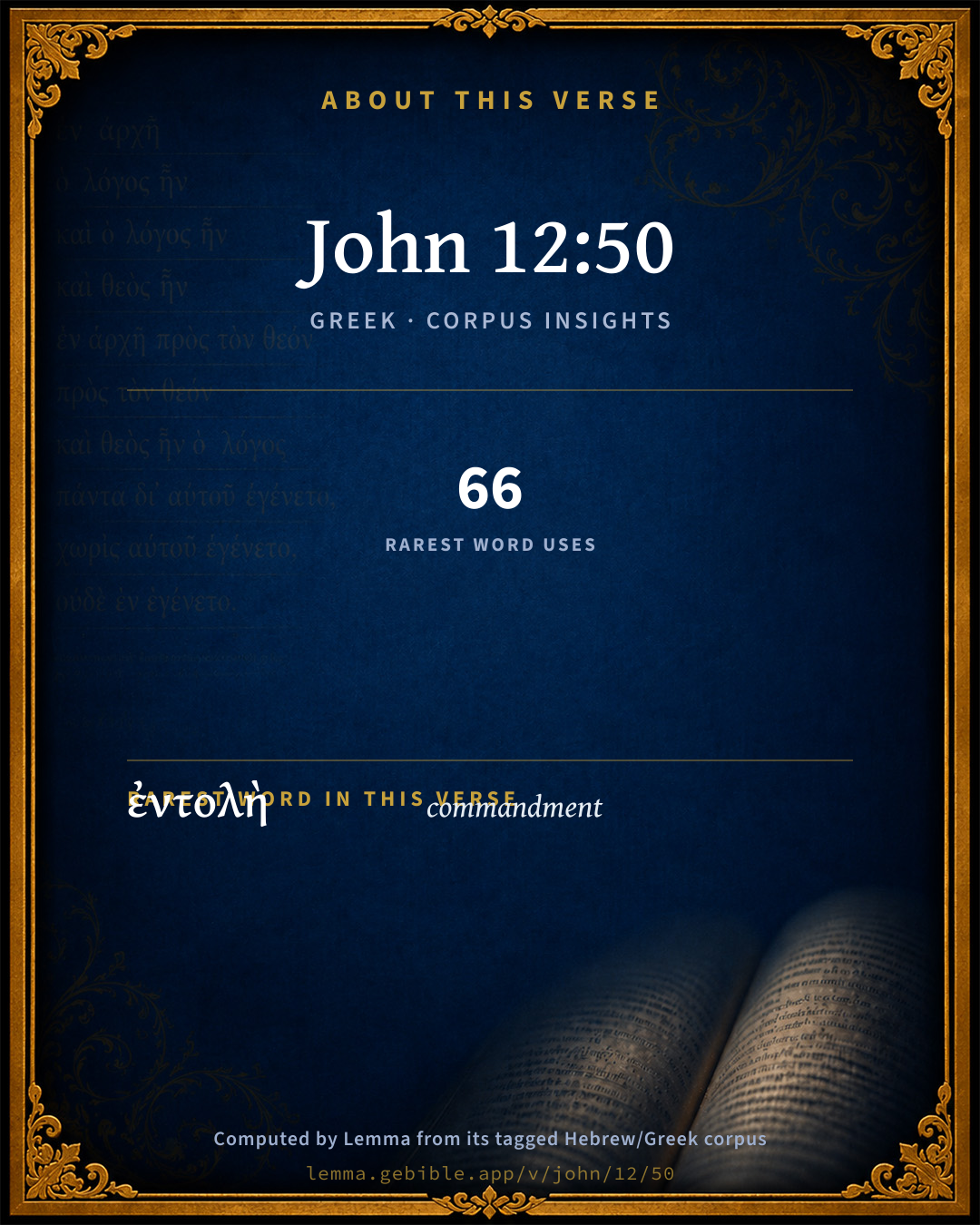
John 12:50

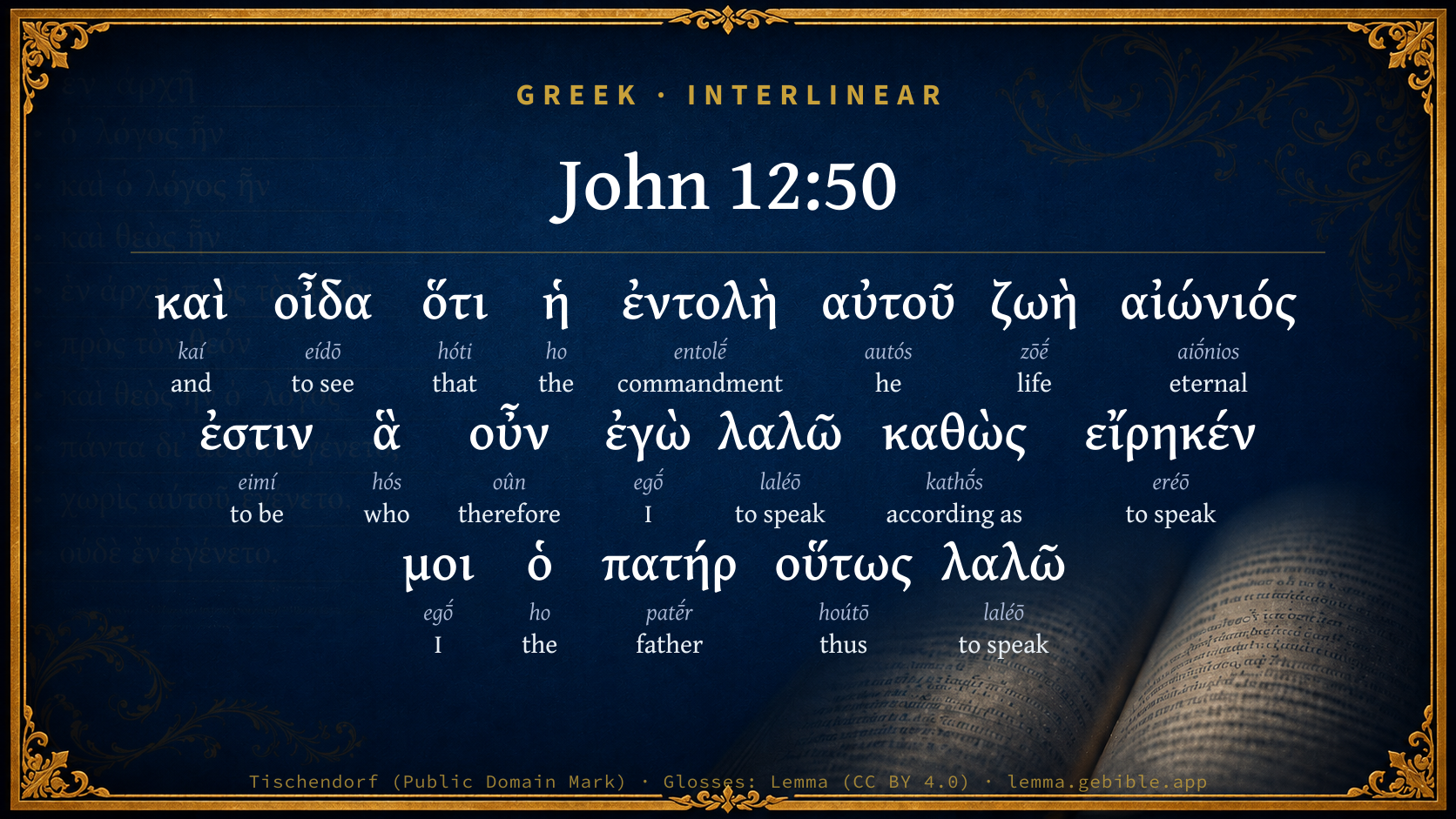
Greek (Tischendorf 8th ed.) John 12:50 appears in the Greek New Testament. The text above is from the Tischendorf 8th edition. Each word links to its Strong’s number and a concise gloss. Click any word for its full Thayer’s Greek Lexicon entry.
Download image
Cite this verse

John 12:50 (World English Bible). Public Domain. Lemma interlinear Bible study tool, https://lemma.gebible.app/v/john/12/50.

Show BibTeX & RIS
BibTeX
RIS
English Translation
I know that his commandment is eternal life. The things therefore which I speak, even as the Father has said to me, so I speak."
World English Bible · Public Domain
Download a study sheet

One document with this verse’s original text, its word-by-word gloss line, the meaning frame, cross-references with their text, attributed commentary, and full source and license credits — printable, and it pastes into notes with its structure intact.

This verse Autodidact and up

Study sheet (.html) Plain text (.txt)

A passage Seminary Student

Up to 50 verses in one chapter. A passage sheet keeps up to 6 commentary sources and 12 cross-references per verse, in the order this page ranks them, and says so on the sheet whenever that leaves anything out. Ask for a single verse and you get the Autodidact verse sheet above.

Everything on this page stays free to read, with no account — the sheet is a download of what is already on screen, not access to it.

Want to remove ads? Support Godless Engineer
Compare translations 3

The same verse in 3 English versions, stacked beneath the original-language interlinear above. Click any original word for its lexicon entry.

Each is an independent rendering of the whole verse — the interlinear is not word-aligned to these translations.

Highlighted words mark where these versions differ — a whole-verse word diff, not a word-by-word alignment.

  • World English Bible Public Domain
    I know that his commandment is eternal life. The things therefore which I speak, even as the Father has said to me, so I speak."
  • King James Version Public Domain
    And I know that his commandment is life everlasting: whatsoever I speak therefore, even as the Father said unto me, so I speak.
  • unfoldingWord Literal Text CC BY-SA 4.0
    And I know that his command is eternal life. Therefore, what I say, just as the Father has spoken to me, thus I speak.”

unfoldingWord Literal Text — © unfoldingWord, licensed CC BY-SA 4.0. Word-aligned USFM3 via Door43 (git.door43.org/unfoldingWord/en_ult).

Versions to compare (up to 4)

3 of 4 selected

Show all 19 translations

Every available English version of this verse, each an independent rendering of the whole verse.

  • World English Bible Public Domain
    I know that his commandment is eternal life. The things therefore which I speak, even as the Father has said to me, so I speak."
  • Berean Standard Bible Public Domain
    And I know that His command leads to eternal life. So I speak exactly what the Father has told Me to say.”
  • Majority Standard Bible Public Domain
    And I know that His command leads to eternal life. So I speak exactly what the Father has told Me to say.”
  • King James Version Public Domain
    And I know that his commandment is life everlasting: whatsoever I speak therefore, even as the Father said unto me, so I speak.
  • American Standard Version (1901) Public Domain
    And I know that his commandment is life eternal: the things therefore which I speak, even as the Father hath said unto me, so I speak.
  • Revised Version (1885) Public Domain
    And I know that his commandment is life eternal: the things therefore which I speak, even as the Father hath said unto me, so I speak.
  • Geneva Bible (1599) Public Domain
    And I knowe that his commandement is life euerlasting: the thinges therefore that I speake, I speake them so as the Father sayde vnto me.
  • Douay-Rheims (1899) Public Domain
    And I know that his commandment is life everlasting. The things therefore that I speak, even as the Father said unto me, so do I speak.
  • Young's Literal Translation Public Domain
    and I have known that His command is life age-during; what, therefore, I speak, according as the Father hath said to me, so I speak.'
  • Literal Standard Version CC BY-SA 4.0
    and I have known that His command is continuous life; what, therefore, I speak, according as the Father has said to Me, so I speak.”
  • Unlocked Literal Bible CC BY-SA 4.0
    I know that his command is eternal life, so that is what I say—just as the Father has spoken to me, so I speak.”
  • unfoldingWord Literal Text CC BY-SA 4.0
    And I know that his command is eternal life. Therefore, what I say, just as the Father has spoken to me, thus I speak.”
  • Darby Bible Public Domain
    and I know that his commandment is life eternal. What therefore I speak, as the Father has said to me, so I speak.
  • World Messianic Bible Public Domain
    I know that his commandment is eternal life. The things therefore which I speak, even as the Father has said to me, so I speak.”
  • Webster's Bible Public Domain
    And I know that his commandment is life everlasting: whatever I speak therefore, even as the Father said to me, so I speak.
  • Free Bible Version CC BY-SA 4.0
    I know that what he told me to say brings eternal life—so whatever I say is what the Father told me.”
  • Bible in Basic English Public Domain
    And I have knowledge that his order is eternal life: so that the things which I say, I say them even as the Father says them to me.
  • Text-Critical English NT CC BY 4.0
    And I know that his commandment leads to eternal life. What I speak, therefore, I speak just as the Father has told me.”
  • Tyndale New Testament (1534) Public Domain
    And I knowe that this comaundement is lyfe everlastinge. Whatsoever I speake therfore even as the father bade me so I speake.

Literal Standard Version (2020), Covenant Press — licensed CC BY-SA 4.0. Text via the HelloAO Bible API (eBible.org). Unlocked Literal Bible (unfoldingWord) — licensed CC BY-SA 4.0. Text via the HelloAO Bible API (eBible.org). unfoldingWord Literal Text — © unfoldingWord, licensed CC BY-SA 4.0. Word-aligned USFM3 via Door43 (git.door43.org/unfoldingWord/en_ult). Free Bible Version, Dr. Jonathan Gallagher — licensed CC BY-SA 4.0. Text via the HelloAO Bible API (eBible.org).

Word by word

More ways to search: Search by grammar → Find every occurrence → Compare this word →

Practice this passage: Drill this verse → Learn its vocabulary →

ἐντολὴ
entolḗ
G1785
“commandment”
Noun, Nominative, Singular, Feminine
Part of Speech
Noun
Case
Nominative
Number
Singular
Gender
Feminine
Full Thayer's Definition

Origin: from G1781

TDNT: 11:05,2

1. an order, command, charge, precept, injunction a. that which is prescribed to one by reason of his office 2. a commandment a. a prescribed rule in accordance with which a thing is done 1. a precept relating to lineage, of the Mosaic precept concerning the priesthood 2. ethically used of the commandments in the Mosaic law or Jewish tradition
  1. καὶ kaí G2532 “and” Conjunction
  2. οἶδα eídō G1492 “to see” Verb, Perfect, Active, Indicative, 1st person, Singular
  3. ὅτι hóti G3754 “that” Conjunction
  4. ἡ ho G3588 “the” Article, Nominative, Singular, Feminine
  5. αὐτοῦ autós G846 “he” Personal pronoun, Genitive, Singular, Masculine
  6. ζωὴ zōḗ G2222 “life” Noun, Nominative, Singular, Feminine
  7. αἰώνιός aiṓnios G166 “eternal” Adjective, Nominative, Singular, Feminine
  8. ἐστιν eimí G1510 “to be” Verb, Present, Active, Indicative, 3rd person, Singular
  9. ἃ hós G3739 “who” Relative pronoun, Accusative, Plural, Neuter
  10. οὖν oûn G3767 “therefore” Conjunction
  11. ἐγὼ egṓ G1473 “I” Personal pronoun, 1st person, Nominative, Singular
  12. λαλῶ laléō G2980 “to speak” Verb, Present, Active, Indicative, 1st person, Singular
  13. καθὼς kathṓs G2531 “according as” Adverb
  14. εἴρηκέν eréō G2046 “to speak” Verb, Perfect, Active, Indicative, 3rd person, Singular, Attic form
  15. μοι egṓ G1473 “I” Personal pronoun, 1st person, Dative, Singular
  16. ὁ ho G3588 “the” Article, Nominative, Singular, Masculine
  17. πατήρ patḗr G3962 “father” Noun, Nominative, Singular, Masculine
  18. οὕτως hoútō G3779 “thus” Adverb
  19. λαλῶ laléō G2980 “to speak” Verb, Present, Active, Indicative, 1st person, Singular

About this verse

These counts appear in no published source. They are computed here, from the morphology-tagged text and Lemma’s own curated glosses. What Lemma adds →

20
words
17
distinct lemmas
Gospels
section

Repetition

Words recur within this verse:

Cross-references

9

Topical passages linked to John 12:50 in the Treasury of Scripture Knowledge — connected by theme and wording, ordered by reader-vote popularity; previews shown in the World English Bible.

  • John 17:3 This is eternal life, that they should know you, the only true God, and him whom you sent, Jesus Christ.
  • John 6:68 Simon Peter answered him, "Lord, to whom would we go? You have the words of eternal life.
  • John 6:63 It is the spirit who gives life. The flesh profits nothing. The words that I speak to you are spirit, and are life.
  • 1 John 5:20 We know that the Son of God has come, and has given us an understanding, that we know him who is true, and we are in him who is true, in his Son Jesus Christ. This is the true God, and eternal life.
  • John 20:31 but these are written, that you may believe that Jesus is the Christ, the Son of God, and that believing you may have life in his name.
  • 1 Timothy 1:16 However, for this cause I obtained mercy, that in me first, Jesus Christ might display all his patience, for an example of those who were going to believe in him for eternal life.
  • 1 John 2:25 This is the promise which he promised us, the eternal life.
  • 1 John 3:23–24 This is his commandment, that we should believe in the name of his Son, Jesus Christ, and love one another, even as he commanded.
  • 1 John 5:11–13 The testimony is this, that God gave to us eternal life, and this life is in his Son.

Cross-references courtesy of OpenBible.info (CC BY 4.0).

Commentary

Notes on John 12:50 from classic Christian and Jewish commentators (each source and its license shown beneath its notes). The classic Christian expositions comment on the surrounding passage and are grouped to its opening verse, so a note may address several verses; the Jewish commentaries on the Tanakh (Rashi and others) are per-verse, so they appear only where the commentator wrote on this verse.

Lemma curates 59 commentaries, every one of them public domain or Creative Commons licensed, each selected and text-cleaned for this edition rather than reprinted as found. About our sources →

Bengel's Gnomon

Johann Albrecht Bengel

Joh 12:50. Ζωὴ αἰώνιος, life everlasting) Wherefore he who despises the words of Christ, despises life everlasting. For life everlasting rests upon the experimental knowledge of the Father and the Son: ch. Joh 17:3, “This is life eternal, that they might know Thee, the only true God, and Jesus Christ, whom Thou hast sent.”

Bengel's Gnomon of the New Testament — English translation (T&T Clark, Edinburgh, 1860) — public domain. Text from a community e-Sword module.

Expositor's Greek Testament

ed. W. Robertson Nicoll

Joh 12:50 . καὶ οἷδα … ἐστιν . “And I know that His commandment is life eternal,” that is, the commandment which Jesus had received (Joh 12:49 ) was to proclaim life eternal. This was His commission; this was what He was to speak. He was to announce to men that the Father offered through Him life eternal. “Therefore whatever I speak, as the Father hath said to me, so I speak.”

The Expositor's Greek Testament, edited by W. Robertson Nicoll (1897–1910) — public domain. Text from a community e-Sword module.

Adam Clarke's Commentary

Verse 50. I know that this commandment is life everlasting] These words of our Lord are similar to that saying in St. John's first epistle, 1Jo 5:11-12. This is the record, that God hath given unto us eternal life, and this life is in his Son. He that hath the Son hath life. God's commandment or commission is, Preach salvation to a lost world, and give thyself a ransom for all; and whosoever believeth on thee shall not perish, but have everlasting life. Every word of Christ, properly credited, and carefully applied, leads to peace and happiness here, and to glory hereafter. What an amiable view of the Gospel of the grace of God does this give us? It is a system of eternal life, Divinely calculated to answer every important purpose to dying, miserable man. This sacred truth Jesus witnessed with his last breath. He began his public ministry proclaiming the kingdom of God; and he now finishes it by asserting that the whole commission is eternal life; and, having attested this, he went out of the temple, and retired to Bethany.

THE public work of our Lord was now done; and the remnant of his time, previously to his crucifixion, he spent in teaching his disciples-instructing them in the nature of his kingdom, his intercession, and the mission of the Holy Spirit; and in that heavenly life which all true believers live with the Father, through faith in the Son, by the operation of the Holy Ghost.

Many persons are liberal in their condemnation of the Jews, because they did not believe on the Son of God; and doubtless their unbelief has merited and received the most signal punishment. But those who condemn them do not reflect that they are probably committing the same sort of transgression, in circumstances which heighten the iniquity of their sin. Will it avail any man, that he has believed that Christ has come in the flesh to destroy the works of the devil, who does not come unto him that he may have life, but continues to live under the power and guilt of sin? Paradoxical as it may seem, it is nevertheless possible, for a man to credit the four evangelists, and yet live and die an infidel, as far as his own salvation is concerned. Reader, it is possible to hold the truth in unrighteousness. Pray to God that this may not be thy condemnation. For a farther improvement of the principal subjects of this chapter, see the notes on verses 24, 32, and 39. Joh 12:24; Joh 12:32; Joh 12:39

Adam Clarke's Commentary on the Bible (1810–1826) — public domain. Text from a community e-Sword/MySword module.

John Calvin's Commentaries

50. And I know that his commandment is eternal life. He again applauds the fruit of his doctrine, that all may more willingly yield to it; and it is reasonable that wicked men should feel the vengeance of God, whom they now refuse to have as the Author of life.

John Calvin's Commentaries (1540-1563) — public domain. Text from the Calvin Translation Society English edition (1840s-50s) via the Christian Classics Ethereal Library (ccel.org). Calvin's coverage is partial (roughly two-thirds of the Bible); uncommented books and verses are honest gaps, never fabricated. The 19th-century editor's footnotes and remarks are omitted so the notes are faithfully Calvin's own voice.

Ellicott's Commentary for English Readers

(50) And I know that his commandment is life everlasting.—i.e., the commission of the Messianic work. It is better to read here, as before, eternal life. (Comp. Joh_3:15, et al.) The Son speaks not of Himself, but He speaks as executing this commission, which brings spiritual and eternal life to the world. It could not be otherwise. This commandment being eternal life, the whole teaching of the Messiah must simply be an utterance of it.

As the Father said unto me, so I speak.—This clause answers to “what I should say and what I should speak” in the last verse. The external revelation is regarded as the work of the Son. That which the Father says is the truth revealed, and the matter and form are here identified.

A Bible Commentary for English Readers, edited by Charles John Ellicott (1878–1897) — public domain. Text from a community e-Sword module.

The Cambridge Bible for Schools and Colleges

gen. ed. J. J. S. Perowne

50. And I know] The Son’s testimony to the Father. ‘The commission which He hath given Me is eternal life.’ (See on Joh_3:16.) His commission is to save the world.

as the Father said] The same distinction as in the previous verse: the matter of the revelation comes from the Father, the external expression of it from the Son.

With this the first main division of the Gospel ends. Christ’s revelation of Himself to the world in His ministry is concluded. The Evangelist has set before us the Testimony to the Christ, the Work of the Christ, and the Judgment respecting the work, which has ended in a conflict, and the conflict has reached a climax. We have reached the beginning of the end.

The Cambridge Bible for Schools and Colleges (gen. ed. J. J. S. Perowne; Cambridge University Press, 1878–1918) — public domain. Text from a community e-Sword module.

Trapp's Complete Commentary

John Trapp

50 And I know that his commandment is life everlasting: whatsoever I speak therefore, even as the Father said unto me, so I speak.

Ver. 50. {See Trapp on "Joh 12:49"}

John Trapp, A Commentary or Exposition upon All the Books of the Old and New Testament (1647–1656) — public domain. Text from a community e-Sword module.

Albert Barnes' Notes on the Bible

Is life everlasting - Is the cause or source of everlasting life. He that obeys the commandment of God shall obtain everlasting life; and this is his commandment, that we believe in the name of his only-begotten Son, 1Jo 3:22. We see here the reason of the earnestness and fidelity of the Lord Jesus. It was because he saw that eternal life depended on the faithful preaching of the message of God. He therefore proclaimed it in the face of all opposition, contempt, and persecution. And we see also:

That every minister of religion should have a deep and abiding conviction that he delivers a message that is to be connected with the eternal welfare of his hearers. And, Under the influence of this belief, he should fearlessly deliver his message in the face of bonds, poverty, contempt, persecution, and death.

It may not be improper to remark here that this is the close of the public preaching of Christ. The rest of his ministry was employed in the private instruction of his apostles, and in preparing them for his approaching death. It is such a close as all his ministers should desire to make a solemn, deliberate, firm exhibition of the truth of God, under a belief that on it was depending the eternal salvation of his hearers, and uttering without fear the solemn message of the Most High to a lost world.

Albert Barnes' Notes on the Bible (1834–1885) — public domain. Text from a community e-Sword/MySword module.

Matthew Poole's English Annotations

I am assured that the way to life everlasting is to obey his commandments; and that makes me speak, and deliver all that, and nothing but that, which I have in charge from my Father:

as the Father said unto me, so I speak. Therefore look you to it, in rejecting me, you reject my Father, whom you own and acknowledge for your God; and in disobeying me, you disobey my Father, and him whom you own as your Father also.

Matthew Poole's English Annotations on the Holy Bible (1683–1685) — public domain. Text from a community e-Sword/MySword module.

Whedon's Commentary on the Bible

Daniel D. Whedon

50. Commandment is life everlasting—God’s divine, authoritative word implanted within our soul is eternal life in its very element and essence.

As the Father said… so I speak—And therefore rejecting my words is rejecting God’s words, and rejecting me is rejecting God. When Israel therefore rejected Christ she rejected the ancient Israel’s God; and all history since proclaims that she is of God rejected. And this thus far concludes our Evangelist’s history of the public ministry of Jesus to his countrymen and the world. It is a conclusion for weeping, and yet he is solemnly calm.

Through the remainder of this entire Gospel, (Joh_12:13-21,) being nearly half of the whole, we have Jesus’s private ministry within his apostolic college, until he comes forth for the sacrifice, with the consummation.

Daniel D. Whedon (gen. ed.), Commentary on the Old and New Testaments (1874–1909) — public domain. Text from a community e-Sword module.

John Wesley's Explanatory Notes

His commandment - Kept, is life everlasting - That is the way to it, and the beginning of it.

John Wesley, Explanatory Notes Upon the Whole Bible (1754–1765) — public domain. Text via the GEBible commentary corpus.

Cambridge Greek Testament for Schools and Colleges

50. The Son’s testimony to the Father. ‘The commission which He has given Me is (not shall be) eternal life’ (Joh 3:15-16). ‘The things therefore which I speak, even as the Father hath said to Me, so I speak.’

With this the first main division of the Gospel ends. CHRIST’S REVELATION OF HIMSELF TO THE WORLD IN HIS MINISTRY is concluded. The Evangelist has set before ns the TESTIMONY to the Christ, the WORK of the Christ, and the JUDGMENT respecting the work, which has ended in a conflict, and the conflict has reached a climax. We have reached the beginning of the end.

Cambridge Greek Testament for Schools and Colleges (Cambridge University Press, 1896; 21 vols, various authors incl. Carr, Maclear, Plummer, Farrar, Lumby, Moule, M. R. James, Simcox) — public domain. Text from a community e-Sword module.

Alford’s Greek Testament

Henry Alford

50.] See ch. 6:63 (and note), 68. On οἶδα, ch. 3:11; 5:32; 8:55.

The ἐντολὴ αὐτοῦ is, results in, not as a means merely, but in its accomplishment and expansion, eternal life: see ch. 3:15; 5:24; 6:40.

Thus all who do not believe are without excuse;—because Jesus is not come, and speaks not, of Himself, but of the Father, Whose will and commandment respecting Him is, that He should be, and give, Life to all. They who reject Him, reject Life, and (ch. 3:19) prefer darkness to Light.

Henry Alford, The Greek Testament (1849–1861) — public domain. Text from a community e-Sword module.

International Critical Commentary

50. καὶ οἶδα ὅτι κτλ. Cf. 5:32, 8:55, this form of solemn assurance being used in each case by Jesus, when speaking of His knowledge of the “witness” or “commandment” of God, or of God Himself.

ἡ ἐντολὴ αὐτοῦ ζωὴ αἰώνιός ἐστιν. See for ζωὴ αἰώνιος on 3:15; and cf. 6:68, where Peter confesses to Jesus ῥήματα ζωῆς αἰωνίου ἔχεις. It is instructive to recall the Synoptic story that the answer to the young man who asked τί ποιήσω ἵνα ζωὴν αἰώνιον κληρονομήσω; was to refer him to the Ten Commandments (Mar 10:18). It is not only for Jn., but for the Synoptists too, that the Divine Commandment, when fully realised, is Eternal Life, although in the Synoptists the idea of eternal life as already present is only latent and is not made explicit.

καθὼς εἴρηκέν μοι ὁ πατήρ, οὕτως λαλῶ. This is the secret of the absolute value of the words of Jesus; cf. 8:28 and 14:31.

1 Attempts have been made to treat this Simon as the father, or as the husband, of Martha; but there is no early evidence.

2 See Introd., p. xcvi, for the parallels in full.

1 J. B. Mayor (D.B., iii. 280) cites Aristoph. Vespœ 608, where a daughter is represented as anointing and kissing her father’s feet.

1 A good and convenient summary will be found in J. B. Mayor’s article, “Mary,” in D.B., vol. iii.

1 Salmon held Jn. to believe that Mary had anointed the Lord’s feet twice, but he did not discuss the matter fully (Human Element in the Gospels, p. 484).

A Alexandrinus (δ 4). British Museum. v. Cc. 6:50-8:52 are missing.

D Bezæ (δ 5). Cambridge. v-vi. Græco-Latin. Cc. 18:14-20:13 are missing in the Greek text, and the gap has been filled by a ninth-century scribe (Dsupp).

Γ̠(ε 70) Oxford and Leningrad. ix-x. Contains Son 1:1-13 8:3-15:24 19:6 to end.

Δ̠Sangallensis (ε 76). St. Gall. ix-x. Græco-Latin.

Θ̠Koridethi (ε 050). Tiflis. vii-ix. Discovered at Koridethi, in Russian territory, and edited by Beermann & Gregory (Leipzig, 1913). The text is akin to that of fam. 13, fam. 1, and the cursives 28, 565, 700 See Lake and Blake in Harvard Theol. Review (July 1923) and Streeter, The Four Gospels. Cf. also J.T.S. Oct. 1915, April and July 1925.

אԠSinaiticus (δ 2). Leningrad. iv.

B Vaticanus (δ 1). Rome. Cent. iv.

L Regius (ε 56). Paris. viii. Cc. 15:2-20 21:15-25 are missing.

W Freer (ε 014). Washington. iv-vi. Discovered in Egypt in 1906. The Gospels are in the order Mt., Jn., Lk., Mk. Collation in The Washington MS. of the Four Gospels, by H. A. Sanders (1912).

Diat. E. A. Abbott’s Diatessarica, including his Johannine Vocabulary and Johannine Grammar, Parts I.-X. (1900-1915).

1 See Lightfoot, Hor. Hebr. in Joh 12:3.

E.B. Cheyne’s Encyclopædia Biblica, 4 vols. (1899-1903).

1 See Introd., p. xcvi.

1 See also Moulton-Milligan, Vocab.106.

1 See Introd., p. xcvii.

2 Ibid., p. xcvi.

1 See Dalman, Words of Jesus, p. 220 f.; Cooper, in D.C.G. i. 749; and Cheyne, in E.B. 2117, for the word hosanna.

1 Justin (Dial. 53) follows Mt. in this, and specially dwells upon the choice of two animals.

1 See Sanday, Sacred Sites, p. 95; G. A. Smith, Hist. Geogr. of Holy Land, p. 458; Rix, Tent and Testament, pp. 265 ff.; the last-named work giving a full discussion of the situation of Bethsaida.

1 E.B., 1829, s.v. “Gospels.”

1 For a full and learned account of the doctrine of bath-qôl, see Abbott, Diat. 726 f.; and cf. Dalman, Words of Jesus, p. 204 f.

2 See Box, D.C.G. ii. 810.

3 Abbott, Diat. 783.

1 Cf. also Schlatter, Die Sprache, etc., p. 121.

1 Cf. Introd., p. cxxiii.

1 Cf. Abbott, Diat. 2998 (xxi. b).

2 So R.V. It is possible that we should translate ὡς by “according as.”

1 Cf. Deissmann, Bible Studies, pp. 161 ff., for a full discussion of υἱός with a genitive following.

1 Cf. Introd., p. xxx.

2 Cf. Introd., p. xxxiv.

1 Cf. Introd., p. cliv.

2 Aramaic Origin, p. 100.

1 See, for a full note on πώρωσις, J. A. Robinson, Ephesians, pp. 264 ff.

A Alexandrinus (δ 4). British Museum. v. Cc. 6:50-8:52 are missing.

B Vaticanus (δ 1). Rome. Cent. iv.

L Regius (ε 56). Paris. viii. Cc. 15:2-20 21:15-25 are missing.

W Freer (ε 014). Washington. iv-vi. Discovered in Egypt in 1906. The Gospels are in the order Mt., Jn., Lk., Mk. Collation in The Washington MS. of the Four Gospels, by H. A. Sanders (1912).

Θ̠Koridethi (ε 050). Tiflis. vii-ix. Discovered at Koridethi, in Russian territory, and edited by Beermann & Gregory (Leipzig, 1913). The text is akin to that of fam. 13, fam. 1, and the cursives 28, 565, 700 See Lake and Blake in Harvard Theol. Review (July 1923) and Streeter, The Four Gospels. Cf. also J.T.S. Oct. 1915, April and July 1925.

Γ̠(ε 70) Oxford and Leningrad. ix-x. Contains Son 1:1-13 8:3-15:24 19:6 to end.

Δ̠Sangallensis (ε 76). St. Gall. ix-x. Græco-Latin.

אԠSinaiticus (δ 2). Leningrad. iv.

D Bezæ (δ 5). Cambridge. v-vi. Græco-Latin. Cc. 18:14-20:13 are missing in the Greek text, and the gap has been filled by a ninth-century scribe (Dsupp).

1 Luk 18:18f. Cf. Garvie, The Beloved Disciple, p. 231.

B Vaticanus (δ 1). Rome. Cent. iv.

אԠSinaiticus (δ 2). Leningrad. iv.

A Alexandrinus (δ 4). British Museum. v. Cc. 6:50-8:52 are missing.

D Bezæ (δ 5). Cambridge. v-vi. Græco-Latin. Cc. 18:14-20:13 are missing in the Greek text, and the gap has been filled by a ninth-century scribe (Dsupp).

L Regius (ε 56). Paris. viii. Cc. 15:2-20 21:15-25 are missing.

W Freer (ε 014). Washington. iv-vi. Discovered in Egypt in 1906. The Gospels are in the order Mt., Jn., Lk., Mk. Collation in The Washington MS. of the Four Gospels, by H. A. Sanders (1912).

Θ̠Koridethi (ε 050). Tiflis. vii-ix. Discovered at Koridethi, in Russian territory, and edited by Beermann & Gregory (Leipzig, 1913). The text is akin to that of fam. 13, fam. 1, and the cursives 28, 565, 700 See Lake and Blake in Harvard Theol. Review (July 1923) and Streeter, The Four Gospels. Cf. also J.T.S. Oct. 1915, April and July 1925.

C Ephræmi (δ 3). Paris. v. Palimpsest. Contains considerable fragments of Jn.

International Critical Commentary — older volumes (1896–1929), various authors — public domain. Text from a community e-Sword module.

Lesson kit

Teaching starters — assembled from the data on this page, not authored interpretation. Every prompt links to the verse data it draws on. Edit before teaching.

John, in the Gospels, opens this verse with 20 words (17 distinct Greek lemmas). Its most distinctive word is entolḗ (“commandment”). A historical commentator’s framing appears above. Read the whole chapter for the surrounding context.

Discussion questions

  1. The word entolḗ carries the sense “commandment.” How does it shape the verse?
  2. How does John 17:3, which shares this passage’s theme, read alongside this verse?
  3. What does the repetition of “to speak” (2× in this one verse) do in this verse?
  4. These translations render this verse differently. What is at stake in choosing one wording over another?
  5. Compare how Bengel's Gnomon and Expositor's Greek Testament read this verse. Where do they agree or differ?

Things to notice

  • These translations choose different wording for 15 words in this verse.
  • “to speak” occurs 2× in this single verse.
  • 17 distinct Greek lemmas span 20 words in this verse.

Reading settings

Reading text

Shown beneath each verse's original-language words.

Old Testament
Old Testament edition

Read the OT as the Masoretic Hebrew (MT) or the Greek Septuagint (LXX).

English shown for the Greek Septuagint (in the Hebrew ↔ Greek comparison).

Comparing translations? Open the Compare panel on any verse page to stack up to four side by side.