
Matthew 2:22

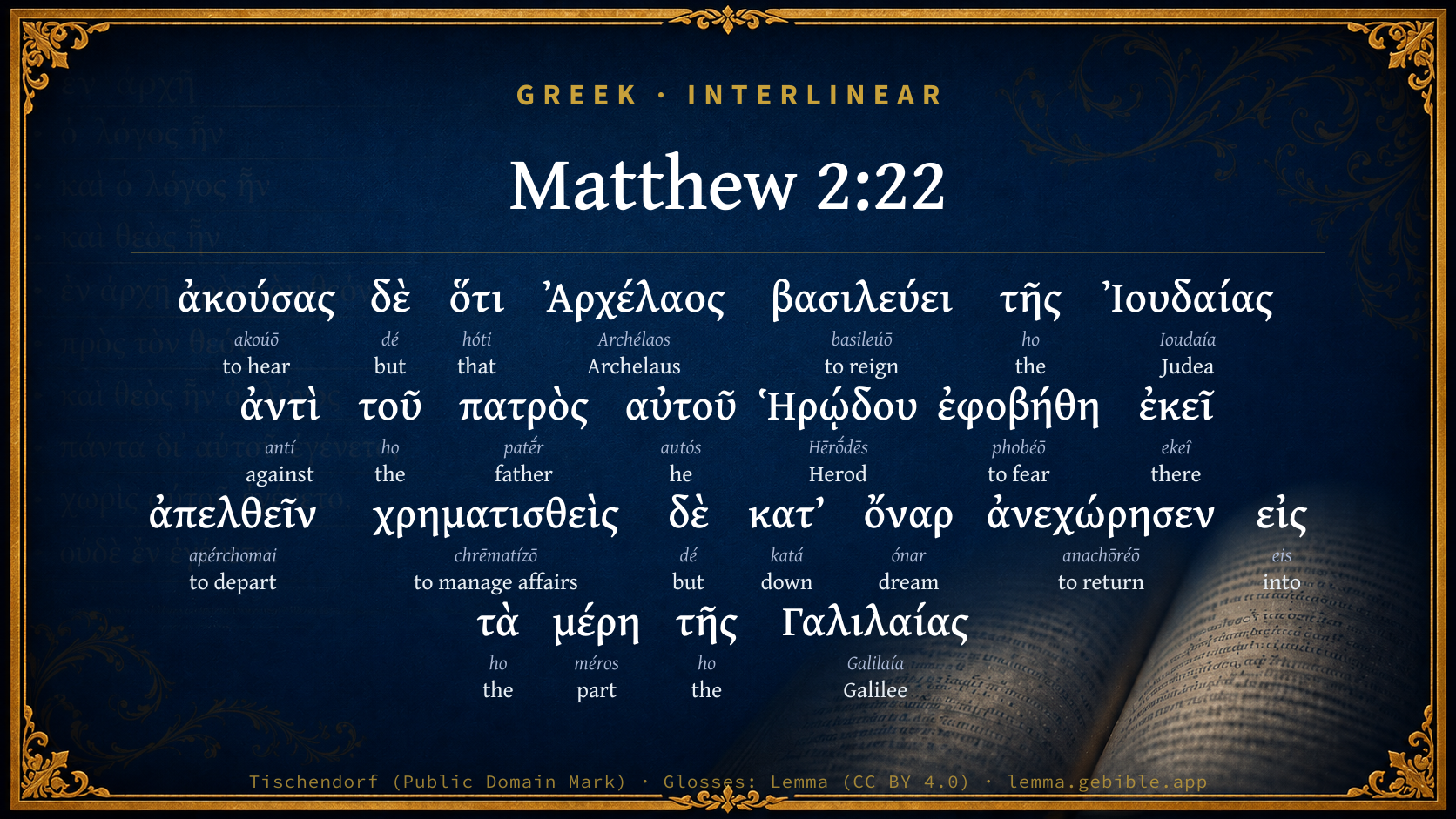
Greek (Tischendorf 8th ed.) Matthew 2:22 appears in the Greek New Testament. The text above is from the Tischendorf 8th edition. Each word links to its Strong’s number and a concise gloss. Click any word for its full Thayer’s Greek Lexicon entry.
Download image
Cite this verse

Matthew 2:22 (World English Bible). Public Domain. Lemma interlinear Bible study tool, https://lemma.gebible.app/v/matthew/2/22.

Show BibTeX & RIS
BibTeX
RIS
English Translation
But when he heard that Archelaus was reigning over Judea in the place of his father, Herod, he was afraid to go there. Being warned in a dream, he withdrew into the region of Galilee,
World English Bible · Public Domain
Highlights
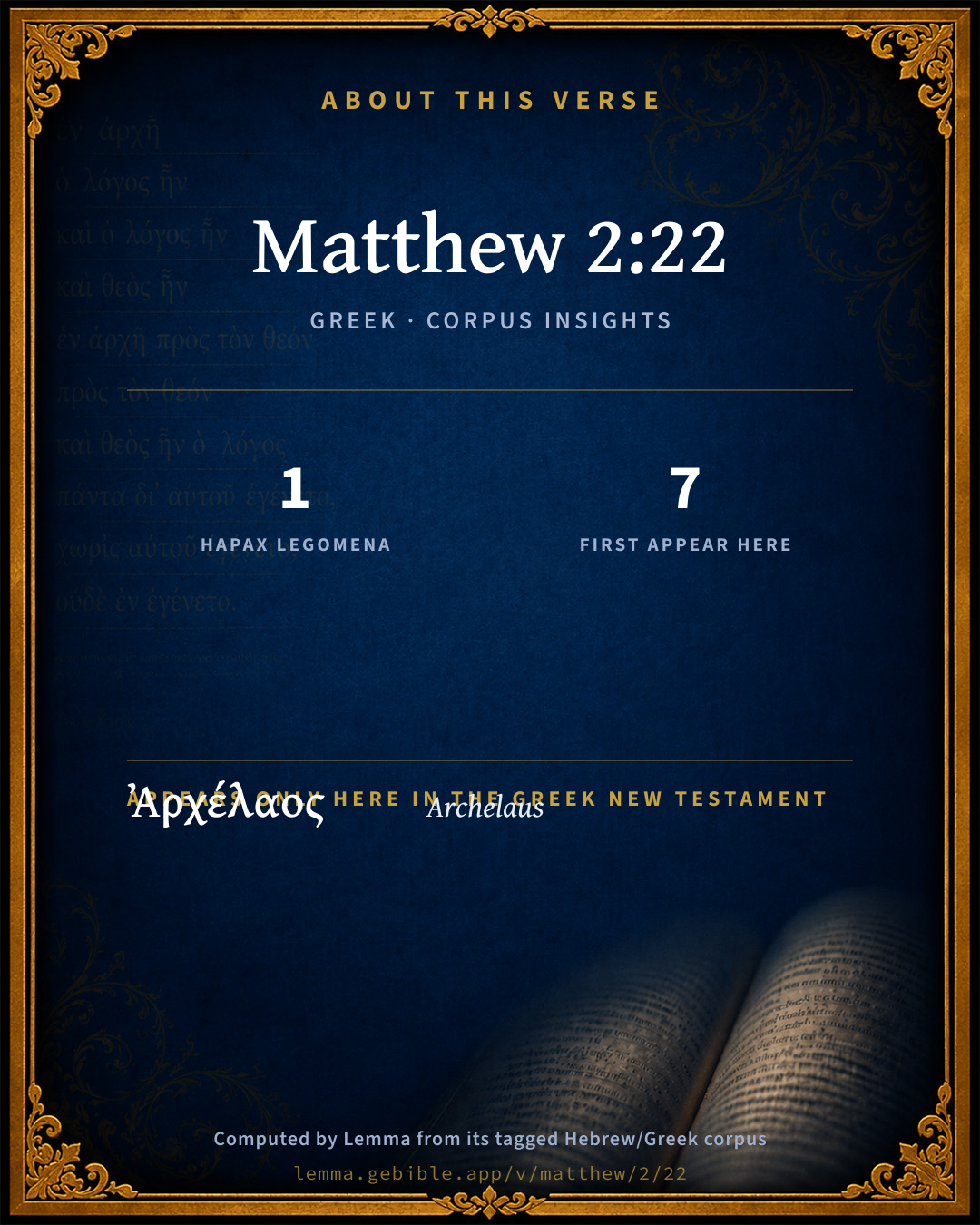
  • 1 hapax legomenon — only here in the Greek New Testament
  • 7 first appearances in the Greek New Testament
Full analysis ↓
Download a study sheet

One document with this verse’s original text, its word-by-word gloss line, the meaning frame, cross-references with their text, attributed commentary, and full source and license credits — printable, and it pastes into notes with its structure intact.

This verse Autodidact and up

Study sheet (.html) Plain text (.txt)

A passage Seminary Student

Up to 50 verses in one chapter. A passage sheet keeps up to 6 commentary sources and 12 cross-references per verse, in the order this page ranks them, and says so on the sheet whenever that leaves anything out. Ask for a single verse and you get the Autodidact verse sheet above.

Everything on this page stays free to read, with no account — the sheet is a download of what is already on screen, not access to it.

Want to remove ads? Support Godless Engineer
Compare translations 3

The same verse in 3 English versions, stacked beneath the original-language interlinear above. Click any original word for its lexicon entry.

Each is an independent rendering of the whole verse — the interlinear is not word-aligned to these translations.

Highlighted words mark where these versions differ — a whole-verse word diff, not a word-by-word alignment.

  • World English Bible Public Domain
    But when he heard that Archelaus was reigning over Judea in the place of his father, Herod, he was afraid to go there. Being warned in a dream, he withdrew into the region of Galilee,
  • King James Version Public Domain
    But when he heard that Archelaus did reign in Judaea in the room of his father Herod, he was afraid to go thither: notwithstanding, being warned of God in a dream, he turned aside into the parts of Galilee:
  • unfoldingWord Literal Text CC BY-SA 4.0
    But having heard that Archelaus is reigning over Judea in the place of his father Herod, he was afraid to go there. But having been warned by means of a dream, he withdrew to the region of Galilee,

unfoldingWord Literal Text — © unfoldingWord, licensed CC BY-SA 4.0. Word-aligned USFM3 via Door43 (git.door43.org/unfoldingWord/en_ult).

Versions to compare (up to 4)

3 of 4 selected

Show all 19 translations

Every available English version of this verse, each an independent rendering of the whole verse.

  • World English Bible Public Domain
    But when he heard that Archelaus was reigning over Judea in the place of his father, Herod, he was afraid to go there. Being warned in a dream, he withdrew into the region of Galilee,
  • Berean Standard Bible Public Domain
    But when he learned that Archelaus was reigning in Judea in place of his father Herod, he was afraid to go there. And having been warned in a dream, he withdrew to the district of Galilee,
  • Majority Standard Bible Public Domain
    But when he learned that Archelaus was reigning in Judea in place of his father Herod, he was afraid to go there. And having been warned in a dream, he withdrew to the district of Galilee,
  • King James Version Public Domain
    But when he heard that Archelaus did reign in Judaea in the room of his father Herod, he was afraid to go thither: notwithstanding, being warned of God in a dream, he turned aside into the parts of Galilee:
  • American Standard Version (1901) Public Domain
    But when he heard that Archelaus was reigning over Judaea in the room of his father Herod, he was afraid to go thither; and being warned `of God' in a dream, he withdrew into the parts of Galilee,
  • Revised Version (1885) Public Domain
    But when he heard that Archelaus was reigning over Judaea in the room of his father Herod, he was afraid to go thither; and being warned of God in a dream, he withdrew into the parts of Galilee,
  • Geneva Bible (1599) Public Domain
    But whe he heard that Archelaus did reigne in Iudea in stead of his father Herod, he was afraide to go thither: yet after he was warned of God in a dreame, he turned aside into the parts of Galile,
  • Douay-Rheims (1899) Public Domain
    But hearing that Archelaus reigned in Judea in the room of Herod his father, he was afraid to go thither: and being warned in sleep retired into the quarters of Galilee.
  • Young's Literal Translation Public Domain
    and having heard that Archelaus doth reign over Judea instead of Herod his father, he was afraid to go thither, and having been divinely warned in a dream, he withdrew to the parts of Galilee,
  • Literal Standard Version CC BY-SA 4.0
    and having heard that Archelaus reigns over Judea instead of his father Herod, he was afraid to go there, and having been divinely warned in a dream, he withdrew to the parts of Galilee,
  • Unlocked Literal Bible CC BY-SA 4.0
    But when he heard that Archelaus was reigning over Judea in the place of his father Herod, he was afraid to go there. After God warned him in a dream, he left for the region of Galilee
  • unfoldingWord Literal Text CC BY-SA 4.0
    But having heard that Archelaus is reigning over Judea in the place of his father Herod, he was afraid to go there. But having been warned by means of a dream, he withdrew to the region of Galilee,
  • Darby Bible Public Domain
    but having heard that 'Archelaus reigns over Judaea, instead of Herod his father,' he was afraid to go there; and having been divinely instructed in a dream, he went away into the parts of Galilee,
  • World Messianic Bible Public Domain
    But when he heard that Archelaus was reigning over Judea in the place of his father, Herod, he was afraid to go there. Being warned in a dream, he withdrew into the region of Galilee,
  • Webster's Bible Public Domain
    But when he heard that Archelaus reigned in Judea in the room of his father Herod, he was afraid to go thither: notwithstanding, being warned by God in a dream, he turned aside into the parts of Galilee:
  • Free Bible Version CC BY-SA 4.0
    But Joseph was afraid to go there after he learned that Archelaus had succeeded his father Herod as king of Judea. Warned in a dream, Joseph went to the Galilee area
  • Bible in Basic English Public Domain
    But when it came to his ears that Archelaus was ruling over Judaea in the place of his father Herod, he was in fear of going there; and God having given him news of the danger in a dream, he went out of the way into the country parts of Galilee.
  • Text-Critical English NT CC BY 4.0
    But when he heard that Archelaus was reigning over Judea in place of his father Herod, he was afraid to go there. And being warned in a dream, he withdrew to the district of Galilee
  • Tyndale New Testament (1534) Public Domain
    But when he hearde that Archelaus did raygne in Iury in the roume of his father Herode he was afrayde to goo thither. Not withstondynge after he was warned of god in a dreame he turned a syde into the parties of Galile

Literal Standard Version (2020), Covenant Press — licensed CC BY-SA 4.0. Text via the HelloAO Bible API (eBible.org). Unlocked Literal Bible (unfoldingWord) — licensed CC BY-SA 4.0. Text via the HelloAO Bible API (eBible.org). unfoldingWord Literal Text — © unfoldingWord, licensed CC BY-SA 4.0. Word-aligned USFM3 via Door43 (git.door43.org/unfoldingWord/en_ult). Free Bible Version, Dr. Jonathan Gallagher — licensed CC BY-SA 4.0. Text via the HelloAO Bible API (eBible.org).

Word by word

More ways to search: Search by grammar → Find every occurrence → Compare this word →

Practice this passage: Drill this verse → Learn its vocabulary →

Ἀρχέλαος
Archélaos
G745
“Archelaus”
Noun, Nominative, Singular, Masculine
Part of Speech
Noun
Case
Nominative
Number
Singular
Gender
Masculine
Full Thayer's Definition

Origin: from G757 and G2994

TDNT: None

Archelaus = "prince of the people" 1. A son of Herod the Great by Malthace, the Samaritan woman. He and his brother Antipas were brought up with a certain private man in Rome. After the death of his father, he ruled as ethnarch over Judaea, Samaria and Idumaea, (with the exception of the cities of Gaza, Gadara and Hipo). The Jews and the Samaritans having accused him at Rome of tyranny, he was banished by the emperor Augustus to Vienna of the Allobroges and died there.
  1. ἀκούσας akoúō G191 “to hear” Verb, Aorist, Active, Participle, Nominative, Singular, Masculine
  2. δὲ dé G1161 “but” Conjunction
  3. ὅτι hóti G3754 “that” Conjunction
  4. βασιλεύει basileúō G936 “to reign” Verb, Present, Active, Indicative, 3rd person, Singular
  5. τῆς ho G3588 “the” Article, Genitive, Singular, Feminine
  6. Ἰουδαίας Ioudaía G2449 “Judea” Noun, Genitive, Singular, Feminine
  7. ἀντὶ antí G473 “against” Preposition
  8. τοῦ ho G3588 “the” Article, Genitive, Singular, Masculine
  9. πατρὸς patḗr G3962 “father” Noun, Genitive, Singular, Masculine
  10. αὐτοῦ autós G846 “he” Personal pronoun, Genitive, Singular, Masculine
  11. Ἡρῴδου Hērṓdēs G2264 “Herod” Noun, Genitive, Singular, Masculine
  12. ἐφοβήθη phobéō G5399 “to fear” Verb, Aorist, Passive deponent, Indicative, 3rd person, Singular
  13. ἐκεῖ ekeî G1563 “there” Adverb
  14. ἀπελθεῖν apérchomai G565 “to depart” Verb, Aorist, Active, Infinitive
  15. χρηματισθεὶς chrēmatízō G5537 “to manage affairs” Verb, Aorist, Passive, Participle, Nominative, Singular, Masculine
  16. δὲ dé G1161 “but” Conjunction
  17. κατ’ katá G2596 “down” Preposition
  18. ὄναρ ónar G3677 “dream” Noun, Indeclinable
  19. ἀνεχώρησεν anachōréō G402 “to return” Verb, Aorist, Active, Indicative, 3rd person, Singular
  20. εἰς eis G1519 “into” Preposition
  21. τὰ ho G3588 “the” Article, Accusative, Plural, Neuter
  22. μέρη méros G3313 “part” Noun, Accusative, Plural, Neuter
  23. τῆς ho G3588 “the” Article, Genitive, Singular, Feminine
  24. Γαλιλαίας Galilaía G1056 “Galilee” Noun, Genitive, Singular, Feminine

About this verse

These counts appear in no published source. They are computed here, from the morphology-tagged text and Lemma’s own curated glosses. What Lemma adds →

25
words
21
distinct lemmas
Gospels
section

Notable vocabulary

1 hapax legomenon — a word that appears only here in the entire Greek New Testament:

  • Ἀρχέλαος Archelaus G745

First appearance in Scripture

These words make their first canonical appearance in the Greek New Testament here:

  • Ἀρχέλαος Archelaus G745
  • βασιλεύει to reign G936
  • ἀντὶ against G473
  • πατρὸς father G3962
  • ἀπελθεῖν to depart G565
  • μέρη part G3313
  • Γαλιλαίας Galilee G1056

Shared distinctive vocabulary

ὄναρ dream G3677 occurs in 6 verses of the Greek New Testament. Also found in:
Repetition

Words recur within this verse:

Cross-references

16

Topical passages linked to Matthew 2:22 in the Treasury of Scripture Knowledge — connected by theme and wording, ordered by reader-vote popularity; previews shown in the World English Bible.

  • Isaiah 48:17–18 Thus says Yahweh, your Redeemer, the Holy One of Israel: I am Yahweh your God, who teaches you to profit, who leads you by the way that you should go.
  • Luke 2:39 When they had accomplished all things that were according to the law of the Lord, they returned into Galilee, to their own city, Nazareth.
  • John 7:52 They answered him, "Are you also from Galilee? Search, and see that no prophet has arisen out of Galilee."
  • Genesis 19:17–21 It came to pass, when they had taken them out, that he said, "Escape for your life! Don't look behind you, neither stay anywhere in the plain. Escape to the mountain, lest you be consumed!"
  • 1 Samuel 16:2 Samuel said, How can I go? if Saul hear it, he will kill me. Yahweh said, Take a heifer with you, and say, I am come to sacrifice to Yahweh.
  • Psalms 48:14 For this God is our God forever and ever. He will be our guide even to death.
  • Psalms 73:24 You will guide me with your counsel, And afterward receive me to glory.
  • Psalms 107:6–7 Then they cried to Yahweh in their trouble, And he delivered them out of their distresses,
  • Psalms 121:8 Yahweh will keep your going out and your coming in, From this time forth, and forevermore.
  • Isaiah 30:21 and your ears shall hear a word behind you, saying, This is the way, walk you in it; when you turn to the right hand, and when you turn to the left.
  • Matthew 1:20 But when he thought about these things, behold, an angel of the Lord appeared to him in a dream, saying, "Joseph, son of David, don't be afraid to take to yourself Mary, your wife, for that which is conceived in her is of the Holy Spirit.
  • Matthew 2:12–13 Being warned in a dream that they shouldn't return to Herod, they went back to their own country another way.
  • Matthew 2:19 But when Herod was dead, behold, an angel of the Lord appeared in a dream to Joseph in Egypt, saying,
  • Matthew 3:13 Then Jesus came from Galilee to the Jordan to John, to be baptized by him.
  • John 7:41–42 Others said, "This is the Christ." But some said, "What, does the Christ come out of Galilee?
  • Acts 9:13–14 But Ananias answered, "Lord, I have heard from many about this man, how much evil he did to your saints at Jerusalem.

Cross-references courtesy of OpenBible.info (CC BY 4.0).

Commentary

Notes on Matthew 2:22 from classic Christian and Jewish commentators (each source and its license shown beneath its notes). The classic Christian expositions comment on the surrounding passage and are grouped to its opening verse, so a note may address several verses; the Jewish commentaries on the Tanakh (Rashi and others) are per-verse, so they appear only where the commentator wrote on this verse.

Lemma curates 59 commentaries, every one of them public domain or Creative Commons licensed, each selected and text-cleaned for this edition rather than reprinted as found. About our sources →

Tyndale Open Study Notes

Tyndale Open Resources

2:22 Archelaus, like his father, governed brutally, immorally, and tyrannically. • Joseph fulfilled prophecy in moving to Galilee to avoid Archelaus’s jurisdiction (cp. 4:12-16).

Tyndale Open Study Notes — © Tyndale Open Resources, licensed CC BY-SA 4.0. Text via the HelloAO Bible API.

Bengel's Gnomon

Johann Albrecht Bengel

Mat 2:22. Βασιλεύει, is reigning) Archelaus was reigning, whether with or without the name of king.—ἐφοβήθη, was afraid) Anxious about the child, fearful lest Archelaus should emulate his father’s hatred.—ἐκεῖ, thither) The Hebrew שמה, thither, is frequently rendered ἐκεῖ by the LXX.—ἀπελθεῖν, to depart) Mary and Joseph also, without doubt, had previously dwelt at Nazareth.—εἰς τὰ μέρη, into the parts) From hence may be inferred the poverty of Joseph, who had not a fixed abode which he could return to as a matter of course.—τῆς Γαλιλαίας, of Galilee) This did not prevent attentive souls from knowing the real birthplace of Christ.

Bengel's Gnomon of the New Testament — English translation (T&T Clark, Edinburgh, 1860) — public domain. Text from a community e-Sword module.

Meyer's Critical & Exegetical Commentary

Heinrich August Wilhelm Meyer

Mat_2:22. Augustus, after the death of Herod and the complications connected with it,[372] divided the kingdom amongst his three sons in such a manner that Archelaus received the half of the four quarters of the kingdom, namely, Judea, Idumaea, and Samaria; Antipas, Galilee and Perea; Philip, Batanea, Trachonitis, and Auranitis. Both the latter were called Tetrarchs, but Archelaus obtained the title of Ethnarch, Josephus, Antt. xvii. 8. 1, xvii. 11. 4, which was to be exchanged for the title of king should he prove worthy of it. But after nine years he was banished by Augustus on account of his cruelty to Vienne (Josephus, Antt. xvii. 13. 2; B. J. ii. 7. 3), and died there. His territory was added to the province of Syria, and placed under the administration of a procurator.

βασιλεύειν is therefore here taken generally: regnare, as it often is in the classics. On ἀντί, compare Herod. i. 108; Xen. Anab. i. 1, iv. 2; 2Ch_33:20; 1Ma_3:1; 1Ma_9:31; 1Ma_13:4.

ἐφοβήθη] for Archelaus resembled his father in his suspicious and cruel temper, Josephus, Antt. xvii. 11. 2 f.

ἐκεῖ ἀπελθεῖν] a well-known attraction: adverbs of rest with verbs of direction, Mat_17:20; Joh_7:35; Joh_8:21; Joh_11:8; Joh_18:3; Rom_15:24; LXX. Deu_1:37; 2Sa_17:18; Winer, p. 439 [E. T. 591]; Bernhardy, p. 349 f. ΓΑΛΙΛΑΊΑς] in the portions of his district belonging to Galilee, (Mat_15:21, Mat_16:13; Act_2:10), so that he avoided Judea, and did not return to Bethlehem. The voluptuary Antipas was known to be more humane than Archelaus.

[372] Comp. Schneckenburger, neutest. Zeitgesch. p. 201 ff.; Hausrath, neut. Zeitgesch. I. p. 284 ff.; Keim in Schenkels Bibellex.

Meyer — Critical and Exegetical Commentary on the New Testament — English translation by Peter Christie, edited by Frederick Crombie (T&T Clark, 1880) — public domain. Text from a community e-Sword module.

Expositor's Greek Testament

ed. W. Robertson Nicoll

Mat 2:22-23 . Settlement in Nazareth in Galilee . Joseph returns with mother and child to Israel , but not to Judaea and Bethlehem. ἀκούσας … Ἡρῴδου : Archelaos reigns in his father’s stead. A man of kindred nature, suspicious, truculent (Joseph., Ant., 17, 11, 2), to be feared and avoided by such as had cause to fear his father. βασιλεύει , reigns, not in the strict sense of the word. He exercised the authority of an ethnarch, with promise of a royal title if he conducted himself so as to deserve it. In fact he earned banishment. At Herod’s death the Roman emperor divided his kingdom into four parts, of which he gave two to Archelaus, embracing Judaea, Idumaea and Samaria; the other two parts were assigned to Antipas and Philip, also sons of Herod: to Antipas, Galilee and Peraea; to Philip, Batanea, Trachonitis and Auranitis. They bore the title of Tetrarch, ruler of a fourth part (Joseph., Ant., 17, 11, 4). ἐφοβήθη ἐκεῖ ἀπελθεῖν . It is implied that to settle in Judaea was the natural course to follow, and that it would have beer followed but for a special reason. Schanz, taking a hint from Augustine, suggests that Joseph wished to settle in Jerusalem, deeming that city the most suitable home for the Messiah, but that God judged the despised Galilee a better training school for the future Saviour of publicans, sinners and Pagans. This hypothesis goes on the assumption that the original seat of the family was Nazareth. ἐκεῖ : late Greek for ἐκεῖσε . In later Greek authors the distinction between ποῖ ποῦ , οἷ οὗ , ὅποι ὅπου , ἐκεῖ and ἐκεῖσε practically disappeared. Rutherford’s New Phrynichus , p. 114. Vide for another instance, Luk 21:2 . Others explain the substitution as a case of attraction common in adverbs of place. The idea of remaining is in the mind = He feared to go thither to abide there. vide Lobeck’s Phryn. , p. 44, and Fritzsche. χρηματισθεὶς τῆς Γαλιλαίας : again oracular counsel given in a dream, implying again mental perplexity and need of guidance. Going to Galilee, Judaea being out of the question, was not a matter of course, as we should have expected. The narrative of the first Gospel appears to be constructed on the assumption that Nazareth was not the original home of the holy family, and to represent a tradition for which Nazareth was the adopted home, Bethlehem being the original. “The evangelist did not know that Nazareth was the original seat of the family.” Weiss, Matt. evang. p. 98.

The Expositor's Greek Testament, edited by W. Robertson Nicoll (1897–1910) — public domain. Text from a community e-Sword module.

Jamieson, Fausset & Brown

Robert Jamieson, A. R. Fausset & David Brown

But when he heard that Archelaus did reign in Judea in the room of his father Herod--Archelaus succeeded to Judea, Samaria, and Idumea; but Augustus refused him the title of king till it should be seen how he conducted himself; giving him only the title of ethnarch [JOSEPHUS, Antiquities, 17.11,4]. Above this, however, he never rose. The people, indeed, recognized him as his father's successor; and so it is here said that he "reigned in the room of his father Herod." But, after ten years' defiance of the Jewish law and cruel tyranny, the people lodged heavy complaints against him, and the emperor banished him to Vienne in Gaul, reducing Judea again to a Roman province. Then the "scepter" clean "departed from Judah."

he was afraid to go thither--and no wonder, for the reason just mentioned.

notwithstanding--or more simply, "but."

being warned of God in a dream, he turned aside--withdrew.

into the parts of Galilee--or the Galilean parts. The whole country west of the Jordan was at this time, as is well known, divided into three provinces--GALILEE being the northern, JUDEA the southern, and SAMARIA the central province. The province of Galilee was under the jurisdiction of Herod Antipas, the brother of Archelaus, his father having left him that and Perea, on the east side of the Jordan, as his share of the kingdom, with the title of tetrarch, which Augustus confirmed. Though crafty and licentious, according to JOSEPHUS--precisely what the Gospel history shows him to be (see on Mark 6:14-30; Luk 13:31-35) --he was of a less cruel disposition than Archelaus; and Nazareth being a good way off from the seat of government, and considerably secluded, it was safer to settle there.

Jamieson, Fausset & Brown — Commentary Critical and Explanatory on the Whole Bible (1871) — public domain (CC PDM 1.0). Text via the HelloAO Bible API.

Adam Clarke's Commentary

Verse 22. When he heard that Archelaus did reign] Herod, having put Antipater his eldest son to death, altered his will, and thus disposed of his dominions: he gave the tetrarchy of Galilee and Petrea to his son Antipas; the tetrarchy of Gaulonitis, Trachonitis, Batanea, and Paneadis, to his son Philip; and left the kingdom of Judea to his eldest remaining son, Archelaus. This son partook of the cruel and blood-thirsty disposition of his father: at one of the passovers, he caused three thousand of the people to be put to death in the temple and city. For his tyranny and cruelty, Augustus deprived him of the government, and banished him. His character considered, Joseph, with great propriety, forbore to settle under his jurisdiction.

He turned aside into the parts of Galilee] Here Antipas governed, who is allowed to have been of a comparatively mild disposition: and, being intent on building two cities, Julias and Tiberias, he endeavoured, by a mild carriage and promises of considerable immunities, to entice people from other provinces to come and settle in them. He was besides in a state of enmity with his brother Archelaus: this was a most favourable circumstance to the holy family; and though God did not permit them to go to any of the new cities, yet they dwelt in peace, safety, and comfort at Nazareth.

Adam Clarke's Commentary on the Bible (1810–1826) — public domain. Text from a community e-Sword/MySword module.

Ellicott's Commentary for English Readers

(22) Archelaus.—Strictly speaking, this prince, who, under his father’s will (made just before his death), governed Judæa, Samaria, and Idumæa, was never recognised as a king by the Roman Emperor, but received the inferior title of Ethnarch. Antipas had Galilee and Peræa, Philip the region of Trachonitis. Popularly, however, the higher title was still used of him as we find it in 14:9 of the Tetrarch Antipas. The character of Archelaus was as cruel and treacherous as that of his father, and within a few months after his accession, he sent in his horsemen to disperse a multitude, and slew not less than 3,000 men. The temper of Antipas on the other hand was as yet looked on as milder. This, and possibly his absence from Galilee on a visit to Rome, may well have led Joseph to turn to that region as offering a prospect of greater safety (Jos. Ant. xvii. 2, 5, 6, 8, 9). Nine years later the oppression of Archelaus became so intolerable that both Jews and Samaritans complained of him to the Emperor, and he was deposed and banished to Gaul.

A Bible Commentary for English Readers, edited by Charles John Ellicott (1878–1897) — public domain. Text from a community e-Sword module.

The Cambridge Bible for Schools and Colleges

gen. ed. J. J. S. Perowne

22. Archelaus] A son of Herod the Great. His mother was Malthaké, a Samaritan. After a cruel and disturbed reign (under the title of Ethnarch) of about eight years he was banished to Vienna in Gaul—the modern Vienne. His dominions, including Samaria, Judæa, and Idumæa, then passed into the direct government of Rome. See note, ch. Mat_14:1, and Introduction, p. 25.

22, 23. The Dwelling at Nazareth

22. notwithstanding] Rather “but” or “so.”

he turned aside] Rather, retired or withdrew. The English ‘anchorite’ is derived from the Greek word in the original. The same word is translated in Mat_2:12-13, “departed.”

Galilee] Now under the government of Herod Antipas, full brother of Archelaus. For the extent of his dominions see Map.

The Cambridge Bible for Schools and Colleges (gen. ed. J. J. S. Perowne; Cambridge University Press, 1878–1918) — public domain. Text from a community e-Sword module.

John Gill's Exposition

And he came and dwelt in a city called Nazareth,.... Which was a city of Galilee, and where Joseph and Mary had both dwelt before, Luk 1:26 here they came and fixed their habitation,

that it might be fulfilled which was spoken by the prophet. This affair of going into Galilee, and settling at Nazareth, was brought about with this view, to accomplish what had been foretold by the prophets, or prophet, the plural number being used for the singular, as in Joh 6:45. And indeed it is so rendered here in the Syriac, Persic, and Ethiopic versions; and designs the prophet Isaiah, and respects that prophecy of his in Isa 11:1 "and there shall come forth a rod out of the stem of Jesse, and "a branch shall grow out of his roots"; a prophecy owned by the Jews (e) themselves to belong to the Messiah, and which was now fulfilled in Jesus; who as he was descended from Jesse's family, so by dwelling at Nazareth, he would appear to be, and would be "called a Nazarene, or Netzer, the branch"; being an inhabitant of Natzareth, or Netzer, so called from the multitude of plants and trees that grew there.

A Nazarene, as David de Pomis says (f),

"is one that is born in the city Netzer, which is said to be in the land of Galilee, three days journey distant from Jerusalem.''

Now though Christ was not born, yet because he dwelt at Nazareth, and was educated there; hence the Jews frequently call him , "Jesus, the Nazarene (g)"; and sometimes only "the Nazarene" (h). They also design him by , "Ben Netzer" (i), of whom they say a great many evil things: and that Christ is often called Jesus of Nazareth, or the Nazarene, and his followers Nazarenes, from the place of his habitation, is known to everyone. One of Christ's disciples is called Netzer in the Talmud (k), and made to plead for his life, because his name signified a branch, according to Isa 11:1. Surenhusius observes (l), that the form "to fulfil what is said", used by the Talmudists, and which he takes to be the same with this here, is used by them, when they allege not the very words of Moses, or the prophets, but their sense, which is deduced as a certain axiom from them; and thinks it is applicable to the present case.

(e) Targum, Jarchi, Aben Ezra & Kimchi in loc. (f) Lexic Heb. fol. 141. 2. (g) T. Bab. Avoda Zara, fol. 17. 1. Ganz. par. 2. fol. 14. 2. Abarbinel in Dan. fol. 44. 1. (h) Ganz. par. 1. fol. 24. 2. (i) T. Bab. Cetuboth, fol. 51. 2. & Gloss. in ib. Bereshith Rabba, fol. 67. 2. Abarbinel in Dau. fol. 44. 1. (k) T. Bab. Sanhedrim, fol. 43. 1. (l) Biblos Katallages, p, 2, 3, 4, 197, &c.

Next: Matthew Chapter 3

John Gill's Exposition of the Whole Bible (1746–1763) — public domain (CC PDM 1.0). Text via the HelloAO Bible API.

Trapp's Complete Commentary

John Trapp

22 But when he heard that Archelaus did reign in Judaea in the room of his father Herod, he was afraid to go thither: notwithstanding, being warned of God in a dream, he turned aside into the parts of Galilee:

Ver. 22. But when he heard that Archelaus] Neither good egg nor good bird, as they say, Caracalla (saith Dio) nihil cogitabat boni, quia id non didicerat, quod ipse fatebatur: never thought of any good, for he had never learned it. No more had this Archelaus. Pope Paul III, when his son Farnesis had committed an unspeakable violence on the person of Cosmos Chaerius, Bishop of Fanum, and then poisoned him, held himself excused that he could say, Haec vitia, me non commonstratore, didicit: he never learned this of the father. But Archelaus, though he could never attain to his father’s craft, yet he had learned his cruelty. Fierce he was, but foolish; savage, but silly; a slug, a slow belly, an evil beast; wherefore the Jews soon rebelled against him; and Augustus (after ten years’ abuse of his authority) banished him to Vienna, or, as others say, to Lyons in France; setting up in his stead his brother Herod, the same that derided and set at nought our Saviour at his passion, as St Jerome writes.

John Trapp, A Commentary or Exposition upon All the Books of the Old and New Testament (1647–1656) — public domain. Text from a community e-Sword module.

Albert Barnes' Notes on the Bible

He heard that Archelaus did reign - Archelaus possessed a cruel and tyrannical disposition similar to his father. At one of the Passovers he caused 3,000 of the people to be put to death in the temple and city. For his crimes, after he had reigned 9 years, he was banished by Augustus, the Roman emperor, to Gaul, where he died. Knowing his character, and fearing that he would not be safe, Joseph hesitated about going there, and was directed by God to go to Galilee, a place of safety.

The parts of Galilee - The country of Galilee. At this time the land of Palestine was divided into three parts: Galilee, on the north; Samaria, in the middle; and Judea, on the south. Galilee was under the government of Herod Antipas, who was comparatively a mild prince, and in his dominions Joseph might find safety.

Albert Barnes' Notes on the Bible (1834–1885) — public domain. Text from a community e-Sword/MySword module.

Whedon's Commentary on the Bible

Daniel D. Whedon

22. When he heard that Archelaus did reign — He heard this first after he had reached the land of Israel, that is, the southwestern border of Palestine. He knew the death of Herod by revelation in Egypt.

Archelaus was the son of Herod the Great, by his fourth wife, Malthace. After Herod had slain his three sons, Aristobulus, Alexander, and Antipater, he left by will his dominions to Archelaus as king. Upon the death of Herod, Archelaus was proclaimed king by the populace, but did not dare assume the crown until his title should be confirmed by the Emperor of Rome. Thereupon the Jews sent a solemn embassy to the emperor, petitioning that they might be exempted from the reign of any of Herod’s family, and that Judea might be governed as a Roman province, under the governor of Syria. The emperor, having heard the representations of all parties, appointed Archelaus not king, but ethnarch, that is, (in the Greek language,) nation-ruler, promising him the title of king, provided he should prove a good ruler. But the cruelty of the father was inherited by the son. Archelaus, after a reign of nine years, was deposed by the emperor at the suit of the Jewish people, and banished to Vienna, in Gaul, where he died. It is therefore very consistent with history, that when the parents of Jesus learned that Archelaus reigned in the stead of his father Herod, they should avoid his dominions, turn aside to Galilee, and make their abode in Nazareth.

It seems singular that Matthew has not thus far alluded to Nazareth by name, although we plentifully know by Luke that Nazareth was the home of the Holy Family before the flight to Egypt. Some think Matthew was not aware of the fact, which is hardly possible. But as Matthew wrote for Jews, it is more probable that he omits it because it was so well known. See concluding remarks of chapter i, par. 2.

Archelaus had as great a reputation for oppression as his cruel father. Herod Antipas, his brother, was ruler in Galilee. Thereby our Saviour’s residence was transferred to a scene predicted by the prophecies of the Old Testament.

Afraid to go thither — Some think that they would have gone thither because they had a residence in Bethlehem. This is disproved from the fact that Mary had not even an acquaintance to afford her a lodging at an exigency when any friend would have made a sacrifice to accommodate her. But they had relatives in Judea, (Luk_1:36; Luk_1:39-40;) Judah was their hereditary tribe, and Jerusalem might seem the suitable place for the young heir of David. These facts can surely explain their apparent disposition to settle in Judea. Galilee — Was the northern one of the three great divisions of Palestine. The word signifies circuit. The province consisted of a mixed population of Jews and Gentiles, and so was much despised by the purer Jews of Judea.

Daniel D. Whedon (gen. ed.), Commentary on the Old and New Testaments (1874–1909) — public domain. Text from a community e-Sword module.

The Pulpit Commentary

But when he heard that Archelaus. Until his murder five days before Herod"s own death in the spring of A.U.C. 750, Antipater, Herod"s eldest son, might naturally have been regarded as the successor, though in fact Antipas had been named as such in the will. But after Antipater"s death Herod altered his will; and appointing Antipas Tetrarch of Galilee and Peraea, and Philip Tetrarch of Gaulonitis, Traehonitis, and Paneas, he granted the kingdom to Archelaus. Further, even after Herod"s death, the succession was far from certain until the consent of Augustus had been obtained, and this, in fact, was jeopardized by Archelaus"s massacre of three thousand cf those who, on his accession, called for justice on the agents of the barbarities of the late reign. Eventually, however, Herod"s last arrangement was practically confirmed by Augustus, save that he expressly gave Archelaus, who had hastened to Rome, but half of his father"s dominion, and appointed him only ethnarch, promising to make him king "if he governed that part virtuously" (Josephus, "Ant.," 17:8. 1; 11. 4; cf. "Bell. Jud:," 1:33:8 2:7:3). Joseph"s fear of Archelaus quite corresponds to the character given of him by the Jewish ambassadors before Augustus. "He seemed to be afraid lest he should not be deemed Herod"s own son; and so, without any delay, he immediately Jet the nation understand his meaning," i.e. by the slaughter of the three thousand malcontents above referred to (Josephus, "Ant.," 17:11.2). He was in A.D. 6 deposed for his cruelty, and banished to Vienne, in Gaul. Did reign; Revised Version, was reigning; an attempt to express the vivid present of the original, which recalls the very words he heard. After Augustus"s decision, Archelaus could not legally have called himself basileuv , but the title, especially as implied in the verb, would have been customary in popular speech. (cf. Mat_14:9) But it is possible that the expression was used before Archelaus went to Rome, and at the time of his first grasp of power under Herod"s will. In Judaea. The Revised Version (over Judaea, basileuei thv Ioudaiav ) rightly implies not only that he lived in Judaea, but that, unlike his father, was not king of the whole of Palestine, but emphatically of Judaea. To this Idumaea and Samaria were appendages. In the room of his father Herod. Had St. Matthew the same thought as the Jewish ambassadors above? He was afraid to go thither; and presumably he told God his fears. Notwithstanding (only de); Revised Version, and. Being warned of God (ver. 12, note). For he does not leave his people in perplexity. In a dream. No angel is mentioned this time. He turned aside; Revised Version, he withdrew (anecwrhseN). into the parts of Galilee; where Antipas was tetrarch. The form (cf. Mat_15:21 Mat_16:13) seems to imply removal from one spot to another before finally settling at Nazareth, and also the subordinate importance of the places visited, compared with the more populous towns.

Fears qualifying faith.

Joseph was a good, God-fearing, obedient man. Fie had clear intimations of the will of God concerning him and his. And yet the directions were not so explicit as to interfere with the exercise of his own judgment. He was to return, with the Child and his mother, into the "land of Israel;" but where in the land of Israel, he was not told. It might seem as if he was expected to return to Bethlehem, and this appears to have been taken into consideration. He had faith in that Divine direction he had received. He proceeded to obey. He started out on his journey. But he received news, as he approached the land of Judah, that Archelaus was Governor of Judaea in place of the dead Herod; and the character of Archelaus was well known. He would scheme to kill any one whom he heard of as claiming to be a native-born prince. So Joseph feared, and let his fears decide his faith, or rather the obedience to which his faith inspired him.

I OUR FEARS MAY INTERFERE WITH OUR FAITH. Then we may refuse to do, or neglect to do, what we believe to be our duty, and our fears may create practical unbelief. Where a man"s way is clearly and precisely defined by God for him, his fears should have no influence on him. After-considerations must never be permitted to interfere with the declaration of the Divine will. If Joseph had been precisely told to return to Bethlehem, he would just have had to go there, even though the reports about Archelaus had frightened him out of his senses. This truth is illustrated in the story of the prophet from Judah given in 1Ki 13.

II OUR FEARS MAY GUIDE THE OBEDIENCE OF OUR FAITH. This we have in the text. Joseph"s fears about Archelaus are the things used by the Divine providence for guiding him to the particularpart of the "land of Israel" where he was to settle. So we learn the Divine control and use of all the forces and faculties, as well as of all the circumstances, of a man"s life. Divine direction does not undertake for a man; it leaves him still to take counsel with his own judgment and his own fears. God"s gracious working of his providences, through man"s mental movements and character-movements and subjective influences, has never yet been systematically thought out. R.T.

Nazareth as our Lord" s training-school.

Ancient biographies take no account whatever of child-life. Manhood was not seen to be a product of child-influences. Probably the small esteem in which woman was usually held led to a small esteem of her influence on children. More probably the philosophizing which loves to trace causes and developments is a modern mental practice. We sometimes wonder that no records remain of the Child-life of Jesus, hut it is to be remembered that no records of the child-life of any ancient hero have been preserved. It is especially a modern notion that the place where a child is brought up may have an important influence on the moulding of his character; all the more if he be a sensitive, poetical, child. This idea gained embodiment in Hugh Miller"s "Schools and Schoolmasters." And in all recent biographies this element of training is taken into full account. All our Lord"s Childhood and Boyhood were spent at Nazareth; and we may trace the influence of such things as the following, using our own associations, but carefully qualifying them by due regard for the Eastern and the Palestinian associations.

I THE INFLUENCE OF SMALL-TOWN LIFE. Familiarity with everybody. Local prejudices. Impressions unvaried, and persistently renewed.

II THE INFLUENCE OF ISOLATED-TOWN LIFE. Peculiarity of Nazareth was that it was out of the way; apart from the great currents of life; secluded. This may tend to nourish a meditative mood, when there is active-mindedness. Life is slow. Time is plentiful. Men can dream, think, pray.

III THE INFLUENCE OF JEWISH-TOWN LIFE. At this time patriotism took one special feature. It spent itself in anticipations of the near coming of the delivering and conquering Messiah. This filled men"s thoughts and talk. It would be supremely fascinating to a thoughtful, sensitive boy. Think with what things the heart of the Child Jesus must have been filled.

IV THE INFLUENCE OF A WELL-SITUATED TOWN. One among the hills; with extensive outlook; beautiful surrounding landscapes; and in full view of scenes rich with Bible associations (see descriptions of Nazareth). For such as Jesus a great voice speaks "out of Nature"s heart. R.T.

The Pulpit Commentary (1880–1919), ed. H.D.M. Spence-Jones & Joseph S. Exell — public domain. Text from a community e-Sword module.

John Wesley's Explanatory Notes

He was afraid to go thither - into Judea; and so turned aside into the region of Galilee - a part of the land of Israel not under the jurisdiction of Archelaus.

John Wesley, Explanatory Notes Upon the Whole Bible (1754–1765) — public domain. Text via the GEBible commentary corpus.

Scofield Reference Notes

C. I. Scofield

Archelaus

Son of Herod the Great, Mat 2:1 and Malthace, a Samaritan woman. Deposed A.D. 6.

The Scofield Reference Bible (1917 edition), notes by C. I. Scofield — public domain. Text from a community e-Sword module.

The People's New Testament

B. W. Johnson

22. When he heard that Archelaus did reign in Judea. Archelaus is one of the four sons of Herod, who are named in the New Testament. See note on verse 1. Was afraid to go thither. This implies that he had designed to return thither.

B. W. Johnson's The People's New Testament with Notes (1889–1891) — public domain. Electronic text from the Christian Classics Ethereal Library (CCEL) ThML edition.

unfoldingWord translationNotes

Door43 World Missions Community

Connecting Statement:

This is the end of the part of the story that began in Matthew 2:1 about Herod's attempt to kill the new King of the Jews.

But when he heard

"But when Joseph heard"

Archelaus

This is the name of Herod's son. (See: How to Translate Names)

he was afraid

"Joseph was afraid"

what had been spoken through the prophets

This can be stated in active form. AT: "what the Lord spoke long ago through the prophets" (See: Active or Passive)

he would be called a Nazarene

Here "he" refers to Jesus. The prophets before the time of Jesus would have referred to him as the Messiah or the Christ. AT: "people would say that the Christ is a Nazarene" (See: How to Translate Names)

translationWords

reign

Judea

Herod the Great

dream

Galilee

Nazareth

fulfill

prophet

unfoldingWord translationNotes — © Distant Shores Media and the Door43 World Missions Community, licensed CC BY-SA 4.0. Source: git.door43.org/Door43/en_tn.

Cambridge Greek Testament for Schools and Colleges

22. Ἀρχέλαος. A son of Herod the Great. His mother was Malthaké, a Samaritan. After a cruel and disturbed reign (under the title of Ethnarch) of about eight years he was banished to Vienna in Gaul—the modern Vienne. His dominions, including Samaria, Judæa, and Idumæa, then passed into the direct government of Rome. See note, ch. Mat 14:1, and Introduction, p. xxix.

ἐκεῖ for ἐκεῖσε, as in English there for thither: cp. Soph O. C. 1019, ὁδοῦ κατάρχειν τῆς ἐκεῖ. Hdt. VII. 147, καὶ ἡμεῖς ἐκεῖ πλέομεν.

τὰ μέρη τῆς Γαλιλαίας. Now under the government of Herod Antipas, full brother of Archelaus. For the extent of his dominions see Map.

Cambridge Greek Testament for Schools and Colleges (Cambridge University Press, 1896; 21 vols, various authors incl. Carr, Maclear, Plummer, Farrar, Lumby, Moule, M. R. James, Simcox) — public domain. Text from a community e-Sword module.

Alford’s Greek Testament

Henry Alford

22. ἀκούσας δέ] Archelaus was the son of Herod by Malthace, a Samaritan woman: he was brought up at Rome (Jos. B. J. i. 31. 1); succeeded his father, but never had the title of king, only that of Ethnarch, with the government of Idumæa, Judæa, and Samaria, the rest of his father’s dominions being divided between his brothers Philip and Antipas. (Jos. Antt. xvii. 11. 4.) But, (1) very likely the word βασιλεύω is here used in the wider meaning:—(2) Archelaus did, in the beginning of his reign, give out and regard himself as king: τὸ πλῆθος … εὐχαριστεῖ … τῆς πρὸς αὐτὸν θεραπείας ὡς πρὸς βέβαιον ἤδη βασιλέα (Jos. B. J. ii. 1.1): (3) in ch. 14:9, Herod the Tetrarch is called ὁ βασιλεύς.

In the ninth year of his government Archelaus was dethroned, οὐ μόνον Ἰουδαίοις, ἀλλά καὶ Σαμαρεῦσι χρησάμενος ὠμῶς, πρεσβευσαμένων ἑκατέρων κατʼ αὐτοῦ πρὸς Καίσαρα, … φυγαδεύεται μὲν εἰς Βιένναν, πόλις τῆς Γαλατίας … i.e. Vienne, in Gaul. (ibid. ii. 7. 3.)

ἀνεχώρησεν εἰς τ. μ. τ. Γαλ.] This account gives rise to some difficulty as compared with St. Luke’s history. It would certainly, on a first view, appear that this Evangelist was not aware that Nazareth had been before this the abode of Joseph and Mary. And it is no real objection to this, that he elsewhere calls Nazareth τὴν πατρίδα αὐτοῦ, ch. 13:54, 57. It is perhaps just possible that St. Matthew, writing for Jews, although well aware of the previous circumstances, may not have given them a place in his history, but made the birth at Bethlehem the prominent point, seeing that his account begins at the birth (ch. 1:18), and does not localize what took place before it, which is merely inserted as subservient to that great leading event. If this view be correct, all we could expect is, that his narrative would contain nothing inconsistent with the facts related in Luke; which we find to be the case. I should prefer, however, believing, as more consistent, in foro conscientiæ, with the fair interpretation of our text, that St. Matthew himself was not aware of the events related in Luk 1:2, and wrote under the impression that Bethlehem was the original dwelling-place of Joseph and Mary. Certainly, had we only his Gospel, this inference from it would universally be made.

ἀνεχώρησεν must not be pressed (as Wordsw., .) into the service of reconciling the two accounts by being rendered ‘returned;’ for the same word is used (ver. 14) of the journey to Egypt.

Henry Alford, The Greek Testament (1849–1861) — public domain. Text from a community e-Sword module.

International Critical Commentary

22. And having heard that Archelaus is reigning over Judæa in the place of Heod his father, he feared to go there. But being divinely instructed in a dream, he departed into the regions of Galilce.] For χρηματισθείς, see on v. 12; for κατʼ ὄναρ, on 1:20.

(PO)

International Critical Commentary — older volumes (1896–1929), various authors — public domain. Text from a community e-Sword module.

Lesson kit

Teaching starters — assembled from the data on this page, not authored interpretation. Every prompt links to the verse data it draws on. Edit before teaching.

Matthew, in the Gospels, opens this verse with 25 words (21 distinct Greek lemmas). Its most distinctive word is Archélaos (“Archelaus”). A historical commentator’s framing appears above. Read the whole chapter for the surrounding context.

Discussion questions

  1. How does “Archelaus” (Archélaos) shape what this verse is saying?
  2. This verse holds 1 word here found nowhere else in the Greek New Testament. What might the rare word draw attention to?
  3. 7 words here appear for the first time in Scripture. What is being introduced at this debut?
  4. Matthew 1:20 shares the word «dream» with this verse. How do the two illuminate each other?
  5. “the” occurs 4× in this one verse. What is the effect of the repetition?
  6. These translations render this verse differently. What is at stake in choosing one wording over another?
  7. Reading how Tyndale Open Study Notes and Bengel's Gnomon read this verse, where do the two commentators agree and where do they part?

Things to notice

  • 1 word in this verse appears nowhere else in the Greek New Testament.
  • 7 words make their first canonical appearance in Scripture here.
  • These translations choose different wording for 23 words in this verse.
  • “the” occurs 4× in this single verse.
  • 21 distinct Greek lemmas span 25 words in this verse.

Reading settings

Reading text

Shown beneath each verse's original-language words.

Old Testament
Old Testament edition

Read the OT as the Masoretic Hebrew (MT) or the Greek Septuagint (LXX).

English shown for the Greek Septuagint (in the Hebrew ↔ Greek comparison).

Comparing translations? Open the Compare panel on any verse page to stack up to four side by side.