
John 8:42

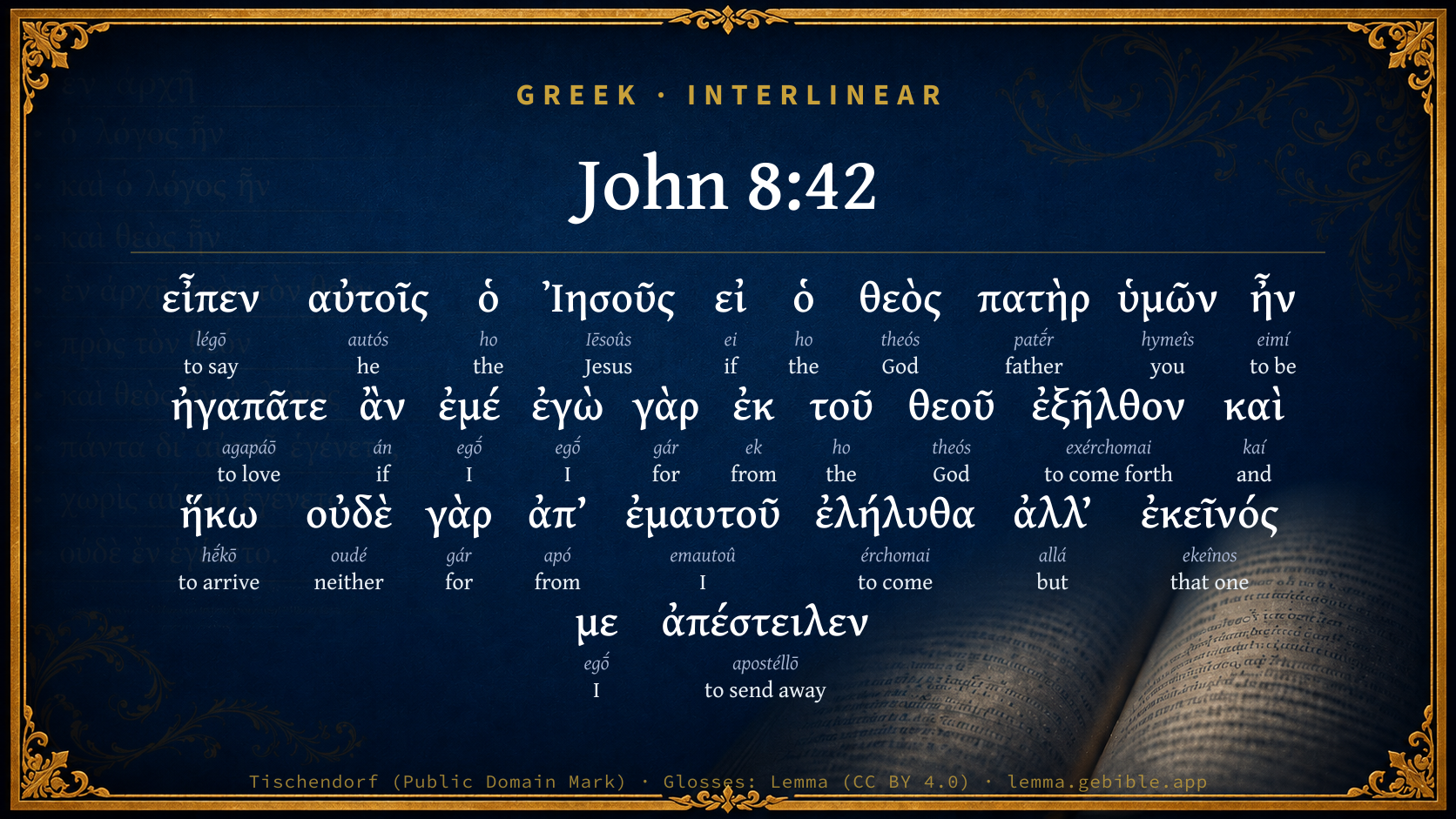
Greek (Tischendorf 8th ed.) John 8:42 appears in the Greek New Testament. The text above is from the Tischendorf 8th edition. Each word links to its Strong’s number and a concise gloss. Click any word for its full Thayer’s Greek Lexicon entry.
Download image
Cite this verse

John 8:42 (World English Bible). Public Domain. Lemma interlinear Bible study tool, https://lemma.gebible.app/v/john/8/42.

Show BibTeX & RIS
BibTeX
RIS
English Translation
Therefore Jesus said to them, "If God were your Father, you would love me, for I came out and have come from God. For I haven't come of myself, but he sent me.
World English Bible · Public Domain
Download a study sheet

One document with this verse’s original text, its word-by-word gloss line, the meaning frame, cross-references with their text, attributed commentary, and full source and license credits — printable, and it pastes into notes with its structure intact.

This verse Autodidact and up

Study sheet (.html) Plain text (.txt)

A passage Seminary Student

Up to 50 verses in one chapter. A passage sheet keeps up to 6 commentary sources and 12 cross-references per verse, in the order this page ranks them, and says so on the sheet whenever that leaves anything out. Ask for a single verse and you get the Autodidact verse sheet above.

Everything on this page stays free to read, with no account — the sheet is a download of what is already on screen, not access to it.

Want to remove ads? Support Godless Engineer
Compare translations 3

The same verse in 3 English versions, stacked beneath the original-language interlinear above. Click any original word for its lexicon entry.

Each is an independent rendering of the whole verse — the interlinear is not word-aligned to these translations.

Highlighted words mark where these versions differ — a whole-verse word diff, not a word-by-word alignment.

  • World English Bible Public Domain
    Therefore Jesus said to them, "If God were your Father, you would love me, for I came out and have come from God. For I haven't come of myself, but he sent me.
  • King James Version Public Domain
    Jesus said unto them, If God were your Father, ye would love me: for I proceeded forth and came from God; neither came I of myself, but he sent me.
  • unfoldingWord Literal Text CC BY-SA 4.0
    Jesus said to them, “If God were your Father, you would have loved me, for I came from God and am here; for neither have I come from myself, but that one sent me.

unfoldingWord Literal Text — © unfoldingWord, licensed CC BY-SA 4.0. Word-aligned USFM3 via Door43 (git.door43.org/unfoldingWord/en_ult).

Versions to compare (up to 4)

3 of 4 selected

Show all 19 translations

Every available English version of this verse, each an independent rendering of the whole verse.

  • World English Bible Public Domain
    Therefore Jesus said to them, "If God were your Father, you would love me, for I came out and have come from God. For I haven't come of myself, but he sent me.
  • Berean Standard Bible Public Domain
    Jesus said to them, “If God were your Father, you would love Me, for I have come here from God. I have not come on My own, but He sent Me.
  • Majority Standard Bible Public Domain
    Jesus said to them, “If God were your Father, you would love Me, for I have come here from God. I have not come on My own, but He sent Me.
  • King James Version Public Domain
    Jesus said unto them, If God were your Father, ye would love me: for I proceeded forth and came from God; neither came I of myself, but he sent me.
  • American Standard Version (1901) Public Domain
    Jesus said unto them, If God were your Father, ye would love me: for I came forth and am come from God; for neither have I come of myself, but he sent me.
  • Revised Version (1885) Public Domain
    Jesus said unto them, If God were your Father, ye would love me: for I came forth and am come from God; for neither have I come of myself, but he sent me.
  • Geneva Bible (1599) Public Domain
    Therefore Iesus sayde vnto them, If God were your Father, then woulde ye loue mee: for I proceeded foorth, and came from God, neither came I of my selfe, but he sent me.
  • Douay-Rheims (1899) Public Domain
    Jesus therefore said to them: If God were your Father, you would indeed love me. For from God I proceeded, and came; for I came not of myself, but he sent me:
  • Young's Literal Translation Public Domain
    Jesus then said to them, `If God were your father, ye were loving me, for I came forth from God, and am come; for neither have I come of myself, but He sent me;
  • Literal Standard Version CC BY-SA 4.0
    Jesus then said to them, “If God were your father, you were loving Me, for I came forth from God, and am come; for neither have I come of Myself, but He sent Me;
  • Unlocked Literal Bible CC BY-SA 4.0
    Jesus said to them, “If God were your Father, you would love me, for I came from God and am here; for neither have I come of myself, but he sent me.
  • unfoldingWord Literal Text CC BY-SA 4.0
    Jesus said to them, “If God were your Father, you would have loved me, for I came from God and am here; for neither have I come from myself, but that one sent me.
  • Darby Bible Public Domain
    Jesus said to them, If God were your father ye would have loved me, for I came forth from God and am come [from him]; for neither am I come of myself, but *he* has sent me.
  • World Messianic Bible Public Domain
    Therefore Yeshua said to them, “If God were your father, you would love me, for I came out and have come from God. For I haven’t come of myself, but he sent me.
  • Webster's Bible Public Domain
    Jesus said to them, If God were your Father, ye would love me: for I proceeded forth and came from God; neither came I of myself, but he sent me.
  • Free Bible Version CC BY-SA 4.0
    Jesus replied, “If God really was your father, you would love me. I came from God and now I am here. The decision to come wasn't mine, but the one who sent me.
  • Bible in Basic English Public Domain
    Jesus said to them, If God was your Father you would have love for me, because it was from God I came and am here. I did not come of myself, but he sent me.
  • Text-Critical English NT CC BY 4.0
    Jesus said to them, “If God were your Father, you would love me, for I have come here from God. I have not come of my own accord, but he sent me.
  • Tyndale New Testament (1534) Public Domain
    Why do ye not knowe my speache? even because ye cannot abyde the hearynge of my wordes.

Literal Standard Version (2020), Covenant Press — licensed CC BY-SA 4.0. Text via the HelloAO Bible API (eBible.org). Unlocked Literal Bible (unfoldingWord) — licensed CC BY-SA 4.0. Text via the HelloAO Bible API (eBible.org). unfoldingWord Literal Text — © unfoldingWord, licensed CC BY-SA 4.0. Word-aligned USFM3 via Door43 (git.door43.org/unfoldingWord/en_ult). Free Bible Version, Dr. Jonathan Gallagher — licensed CC BY-SA 4.0. Text via the HelloAO Bible API (eBible.org).

Word by word

More ways to search: Search by grammar → Find every occurrence → Compare this word →

Practice this passage: Drill this verse → Learn its vocabulary →

ἥκω
hḗkō
G2240
“to arrive”
Verb, Present, Active, Indicative, 1st person, Singular
Part of Speech
Verb
Tense
Present
Voice
Active
Mood
Indicative
Person
1st person
Number
Singular
Full Thayer's Definition

Origin: a primary verb

TDNT: 17:26,3

1. to have come, have arrived, be present 2. metaph. a. to come to one, i.e. to seek an intimacy with one, become his follower: to come upon one (unexpectedly) b. to come upon one, of things endured
  1. εἶπεν légō G3004 “to say” Verb, Aorist, Active, Indicative, 3rd person, Singular
  2. αὐτοῖς autós G846 “he” Personal pronoun, Dative, Plural, Masculine
  3. ὁ ho G3588 “the” Article, Nominative, Singular, Masculine
  4. Ἰησοῦς Iēsoûs G2424 “Jesus” Noun, Nominative, Singular, Masculine
  5. εἰ ei G1487 “if” Conditional
  6. ὁ ho G3588 “the” Article, Nominative, Singular, Masculine
  7. θεὸς theós G2316 “God” Noun, Nominative, Singular, Masculine
  8. πατὴρ patḗr G3962 “father” Noun, Nominative, Singular, Masculine
  9. ὑμῶν hymeîs G5210 “you” Personal pronoun, 2nd person, Genitive, Plural
  10. ἦν eimí G1510 “to be” Verb, Imperfect, Active, Indicative, 3rd person, Singular
  11. ἠγαπᾶτε agapáō G25 “to love” Verb, Imperfect, Active, Indicative, 2nd person, Plural
  12. ἂν án G302 “if” Particle
  13. ἐμέ egṓ G1473 “I” Personal pronoun, 1st person, Accusative, Singular
  14. ἐγὼ egṓ G1473 “I” Personal pronoun, 1st person, Nominative, Singular
  15. γὰρ gár G1063 “for” Conjunction
  16. ἐκ ek G1537 “from” Preposition
  17. τοῦ ho G3588 “the” Article, Genitive, Singular, Masculine
  18. θεοῦ theós G2316 “God” Noun, Genitive, Singular, Masculine
  19. ἐξῆλθον exérchomai G1831 “to come forth” Verb, Aorist, Active, Indicative, 1st person, Singular
  20. καὶ kaí G2532 “and” Conjunction
  21. οὐδὲ oudé G3761 “neither” Conjunction, Negative
  22. γὰρ gár G1063 “for” Conjunction
  23. ἀπ’ apó G575 “from” Preposition
  24. ἐμαυτοῦ emautoû G1683 “I” Reflexive pronoun, 1st person, Genitive, Singular, Masculine
  25. ἐλήλυθα érchomai G2064 “to come” Verb, Perfect, Active, Indicative, 1st person, Singular
  26. ἀλλ’ allá G235 “but” Conjunction
  27. ἐκεῖνός ekeînos G1565 “that one” Demonstrative pronoun, Nominative, Singular, Masculine
  28. με egṓ G1473 “I” Personal pronoun, 1st person, Accusative, Singular
  29. ἀπέστειλεν apostéllō G649 “to send away” Verb, Aorist, Active, Indicative, 3rd person, Singular

About this verse

These counts appear in no published source. They are computed here, from the morphology-tagged text and Lemma’s own curated glosses. What Lemma adds →

30
words
24
distinct lemmas
Gospels
section

Shared distinctive vocabulary

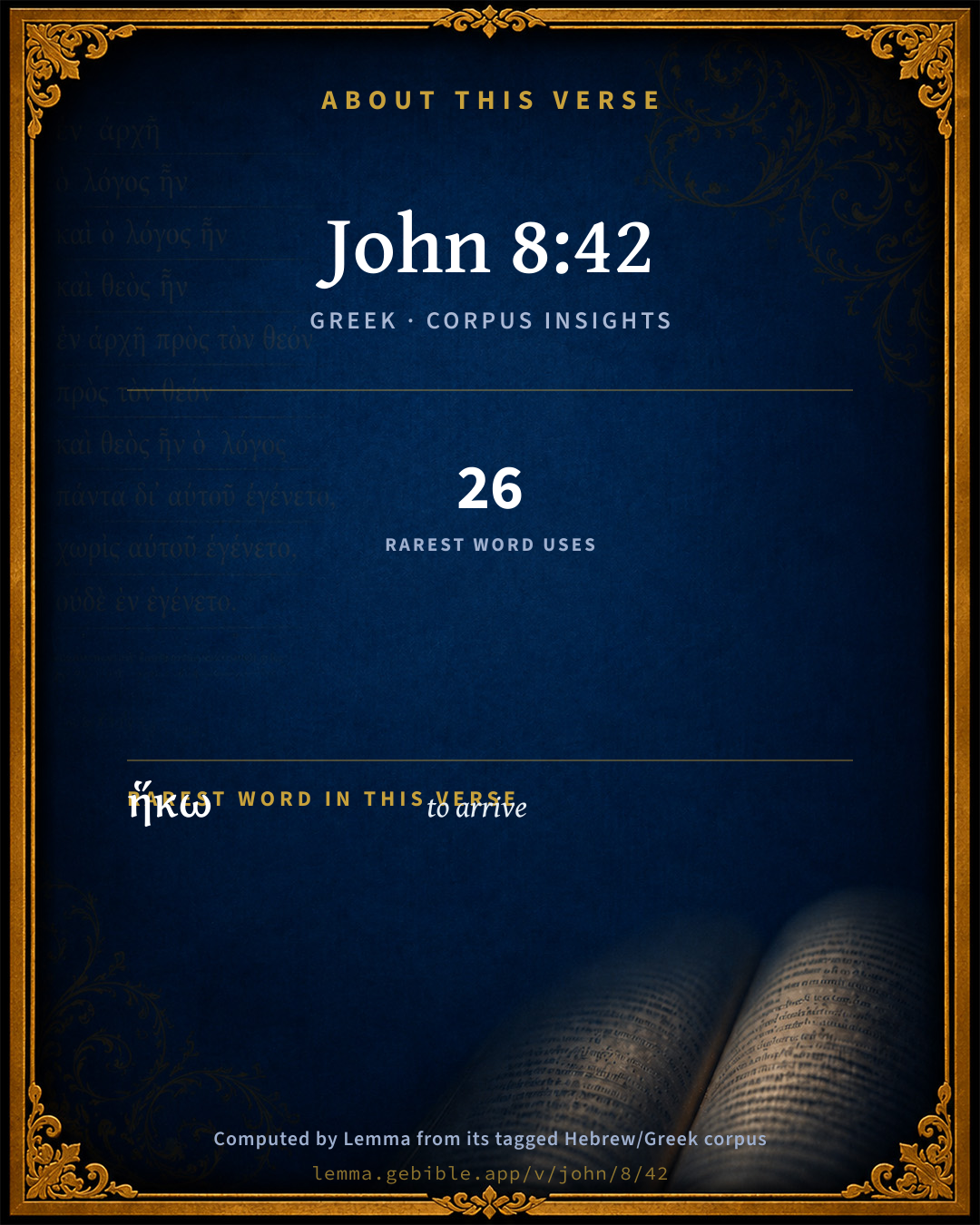
ἥκω to arrive G2240 occurs in 25 verses of the Greek New Testament. Also found in:
Repetition

Words recur within this verse:

Cross-references

18

Topical passages linked to John 8:42 in the Treasury of Scripture Knowledge — connected by theme and wording, ordered by reader-vote popularity; previews shown in the World English Bible.

  • John 12:49 For I spoke not from myself, but the Father who sent me, he gave me a commandment, what I should say, and what I should speak.
  • John 14:10 Don't you believe that I am in the Father, and the Father in me? The words that I tell you, I speak not from myself; but the Father who lives in me does his works.
  • John 17:8 for the words which you have given me I have given to them, and they received them, and knew for sure that I came forth from you, and they have believed that you sent me.
  • John 17:25 Righteous Father, the world hasn't known you, but I knew you; and these knew that you sent me.
  • John 15:23–24 He who hates me, hates my Father also.
  • Malachi 1:6 "A son honors his father, and a servant his master. If I am a father, then where is my honor? And if I am a master, where is the respect due me? Says Yahweh of Hosts to you, priests, who despise my name. You say, 'How have we despised your name?'
  • John 1:14 The Word became flesh, and lived among us. We saw his glory, such glory as of the one and only Son of the Father, full of grace and truth.
  • 1 John 5:1–2 Whoever believes that Jesus is the Christ is born of God. Whoever loves the father also loves the child who is born of him.
  • 1 John 4:14 We have seen and testify that the Father has sent the Son as the Savior of the world.
  • John 5:43 I have come in my Father's name, and you don't receive me. If another comes in his own name, you will receive him.
  • 1 Corinthians 16:22 If any man doesn't love the Lord Jesus Christ, let him be accursed. Come, Lord!
  • John 7:28–29 Jesus therefore cried out in the temple, teaching and saying, "You both know me, and know where I am from. I have not come of myself, but he who sent me is true, whom you don't know.
  • John 3:17 For God didn't send his Son into the world to judge the world, but that the world should be saved through him.
  • John 5:23 that all may honor the Son, even as they honor the Father. He who doesn't honor the Son doesn't honor the Father who sent him.
  • John 16:27–28 for the Father himself loves you, because you have loved me, and have believed that I came forth from God.
  • 1 John 4:9–10 By this was God's love revealed in us, that God has sent his one and only Son into the world that we might live through him.
  • Revelation 22:1 He showed me a river of water of life, clear as crystal, proceeding out of the throne of God and of the Lamb,
  • Galatians 4:4 But when the fullness of the time came, God sent out his Son, born to a woman, born under the law,

Cross-references courtesy of OpenBible.info (CC BY 4.0).

Where the printed editions differ

1 variant

Places in this verse where the major printed Greek editions disagree on the wording in a way that affects the translation — a comparison of editions, not a manuscript-by-manuscript collation. The editions are the modern critical texts (Nestlé-Aland 28/27, SBL, Westcott-Hort, Tregelles, Tyndale House) and the traditional texts behind the KJV (the Textus Receptus and the Byzantine/Majority text). It is not a claim about which reading is original.

  1. Extra text
    οὖν

    “therefore”

    In TRByz Not in NA28NA27TynSBLWHTreg

    οὖν (oun) 'therefore' is only in traditional manuscripts (TR+Byz)

Textual data: Translators Amalgamated Greek New Testament (STEPBible TAGNT) · CC BY 4.0.

Commentary

Notes on John 8:42 from classic Christian and Jewish commentators (each source and its license shown beneath its notes). The classic Christian expositions comment on the surrounding passage and are grouped to its opening verse, so a note may address several verses; the Jewish commentaries on the Tanakh (Rashi and others) are per-verse, so they appear only where the commentator wrote on this verse.

Lemma curates 59 commentaries, every one of them public domain or Creative Commons licensed, each selected and text-cleaned for this edition rather than reprinted as found. About our sources →

Bengel's Gnomon

Johann Albrecht Bengel

Joh 8:42. Ἠγαπᾶτε, ye would love) ye would not persecute Me with such deadly hatred as ye do.—ἐξῆλθον, I came forth) Hereby is intimated the “terminus a quo” [the source from which].—ἥκω, I am come) Hereby is intimated the “terminus ad quem” [the destination to which].

Bengel's Gnomon of the New Testament — English translation (T&T Clark, Edinburgh, 1860) — public domain. Text from a community e-Sword module.

Meyer's Critical & Exegetical Commentary

Heinrich August Wilhelm Meyer

Joh_8:42 f. God is not your Father, else would ye love me, because ye would be of like descent with me; ἑνὸς γεγαῶτα τοκῆος ἀῤῥαγέος φιλίης ἀλύτῳ ξυνώσατε θεσμῷ, Nonnus. This ἀγαπᾶτε ἂν ἐμὲ would be the ethical test (Luthardt) of the like paternity; the fact of its non-existence, although it might have existed, is evidence to the contrary.

ἐγώ] spoken with a feeling of divine assurance.

ἐξῆλθον] the proceeding forth from that essential pre-human fellowship with God, which was His as the Son of God, and which took place through the incarnation (Joh_13:3, Joh_16:27-28; Joh_16:30, Joh_17:8). The idea of a mere sending would not be in harmony with the context, the proper subject of which is the Fatherhood of God; comp. Joh_6:62, Joh_17:5.

καὶ ἥκω) Result of the ἐξῆλθον: and am here, it belongs, along with the rest, also to ἐκ τ. θεοῦ.

οὐδὲ γὰρ ἀπʼ ἐμαυτοῦ, etc.] Confirmation of ἐκ τ. θεοῦ, etc.; for not even of my own self-determination, etc. If Jesus, namely, had not manifested Himself as proceeding from God, He might have come either from a third person, or, at all events, ἀφʼ ἑαυτοῦ; on the contrary, not even (οὐδέ) was this latter the case.

Joh_8:43. After having shown them that they were the children neither of Abraham nor of God, before positively declaring whose children they actually are, He discloses to them the ground of their not understanding His discourse; for everything that they had advanced from Joh_8:33 onwards had been in fact such a non-understanding. The form of expression here used, namely, question and answer (ὅτι, because; comp. Rom_9:32; 2Co_11:11), is an outflow of the growing excitement; Dissen, ad Dem, de Cor. p. 186, 347. De Wette (comp. Luther, Beza, Calvin) takes ὅτι as equivalent to εἰς ἐκεῖνο ὅτι (see on Joh_2:18): I say this with reference to the circumstance that. Illogical, as the clauses must then have stood in the reverse order (διατί οιὐ δύνασθε … ὅτι τὴν λαλιάν, etc.), because, namely, the words οὐ γινώσκετε denote the relation which is clear from what has preceded.

In the question and in the answer, that on which the emphasis rests is thrown to the end. His discourse was unintelligible to them, because its substance, to wit, His word, was inaccessible to their apprehension, because they had no ears for it. For the cause of this ethical οὐ δύνασθε, see Joh_8:47. λαλιά, which in classical Greek denoted talk, chatter (see on Joh_4:42), signifies in later writers (e.g. Polyb. 32. 9, 4; Joseph. Bell. ii. 8. 5), and in the LXX. and Apocrypha, also Discourse, Sermo,[27] without any contemptuous meaning. Comp. Mat_26:73. So also here; indeed, so different is it from ὁ λόγος, that whilst this last mentioned term denotes the doctrinal substance expressed by the ΛΑΛΙΆ,the doctrine, the substance of that which is delivered,[28]

λαλιά denotes the utterance itself, by which expression is given to the doctrine. Comp. Joh_12:48 : ὁ λόγος ὃν ἐλάλησα; Php_1:14; Heb_12:7.

[27] On λάλιος in bonam partem, see Jacobs, ad Anthol. vi. p. 99, vii. p. 140.

[28] Comp. Weizsäcker in d. Jahrb. für deutsche Theol. 1857, p. 196 f. But in the gospel it is always the verbum vocale, and it should not be confounded with the λόγος of the prologue, which is the verbum substantiale; hence, also, it furnishes no evidence of a deviation from the doctrine of the Logos. The consciousness Jesus possessed of speaking, keeping, doing, etc., the λόγος of God, rested on His consciousness of His being that which is denoted by the Logos of the prologue. Now this consciousness is not the abstract divine, but that of the divine-human Ego, corresponding to the ὁ λόγος σὰρξ ἐγένετο.

Meyer — Critical and Exegetical Commentary on the New Testament — English translation by Peter Christie, edited by Frederick Crombie (T&T Clark, 1880) — public domain. Text from a community e-Sword module.

Expositor's Greek Testament

ed. W. Robertson Nicoll

Joh 8:42 . But this claim Jesus explodes by the same argument: Εἰ ὁ θεὸς … ἀπέστειλε . Were God your Father you would love me, for I am from God. ἐξῆλθον ἐκ τοῦ θεοῦ expresses “the proceeding forth from that essential pre-human fellowship with God, which was His as the Son of God, and which took place through the incarnation,” Meyer. The meaning of the expression is fixed by that with which it is contrasted in Joh 13:3 , Joh 16:28 . ἥκω is added, as ἐλήλυθα εἰς τὸν κόσμον in Joh 16:28 , almost in the sense in which it is used in the Dramatists, announcing the arrival of one of the “personae” on the stage, “I am come from such and such a place and here I am”. The coming itself was the result of God’s action rather than of His own: οὐδὲ … ἀπέστειλε . This is His constant argument, that as He came forth from God and was sent by Him, they must have welcomed Him had they been God’s children. Their misunderstanding had a moral root. διατί … ἐμόν . They did not recognise His speech as Divine, because they were unable to receive the message He brought. “In λαλεῖν (= loqui) the fact of uttering human language is the prominent notion; in λέγειν (= dicere) it is the words uttered, and that these are correlative to reasonable thoughts within the breast of the utterer” (Trench, Synonyms , 271). All His individual expressions and the very language He used were misunderstood, because there was in them a moral incapacity to receive the truth He delivered.

The Expositor's Greek Testament, edited by W. Robertson Nicoll (1897–1910) — public domain. Text from a community e-Sword module.

Jamieson, Fausset & Brown

Robert Jamieson, A. R. Fausset & David Brown

If God were your Father, ye would love me--"If ye had anything of His moral image, as children have their father's likeness, ye would love Me, for I am immediately of Him and directly from Him." But "My speech" (meaning His peculiar style of expressing Himself on these subjects) is unintelligible to you because ye cannot take in the truth which it conveys.

Jamieson, Fausset & Brown — Commentary Critical and Explanatory on the Whole Bible (1871) — public domain (CC PDM 1.0). Text via the HelloAO Bible API.

Adam Clarke's Commentary

Verse 42. If God were your Father, ye would love me] I came from God, and it would be absurd to suppose that you would persecute me if you were under the influence of God. The children of the same father should not murder each other.

Adam Clarke's Commentary on the Bible (1810–1826) — public domain. Text from a community e-Sword/MySword module.

John Calvin's Commentaries

42. If God were your Father, you would love me. Christ’s argument is this: “Whoever is a child of God will acknowledge his first-born Son; but you hate me, and therefore you have no reason to boast, that you are God’s children.” We ought carefully to observe this passage, that there is no piety and no fear of God where Christ is rejected. Hypocritical religion, indeed, presumptuously shelters itself under the name of God; but how can they agree with the Father who disagree with his only Son? What kind of knowledge of God is that in which his lively image is rejected? And this is what Christ means, when he testifies that he came from the Father.

For I proceeded and came from God. He means that all that he has is divine; and therefore it is most inconsistent that the true worshippers of God should fly from his truth and righteousness. “I did not come,” says he, “of myself. You cannot show that anything about me is contrary to God. In short, you will find nothing that is either earthly or human in my doctrine, or in the whole of my ministry.” For he does not speak of his essence, but of his office.

John Calvin's Commentaries (1540-1563) — public domain. Text from the Calvin Translation Society English edition (1840s-50s) via the Christian Classics Ethereal Library (ccel.org). Calvin's coverage is partial (roughly two-thirds of the Bible); uncommented books and verses are honest gaps, never fabricated. The 19th-century editor's footnotes and remarks are omitted so the notes are faithfully Calvin's own voice.

Ellicott's Commentary for English Readers

(42) If God were your Father, ye would love me.—This follows because they would then be in a relationship of spiritual affinity to Him. God’s children would bear the spiritual image of their Father, and would love Him who came from God, but they were seeking to kill Him (Joh_8:40).

I proceeded forth and came from God.—Better, am come, am here. His presence with them was the result of His proceeding from God. As the Son of God He had eternal fellowship with the Father. The Incarnation was not the mission of one whose existence was separate from that of God, but it was the mission of the Son who proceeded from the Father. (Comp. Joh_16:27 et seq.)

Neither came I of myself, but he sent me.—Literally, for not even of Myself am I come, but He sent Me; as opposed to the thought that His origin was distinct from the Father. His coming was not His own act, but was a mission from God to the world.

But if He is sent from God, if He is present with them from God, if He proceeded from the Father, it must be that all who are true children of God would recognise and love Him.

It is important to note here that in our Lord’s own words there is an assertion of the oneness of nature and of will with that of the Father, and yet the distinction of person is maintained. He is come from God, but He proceeded from the divine essence. He proceeded forth, and yet He was sent.

A Bible Commentary for English Readers, edited by Charles John Ellicott (1878–1897) — public domain. Text from a community e-Sword module.

The Cambridge Bible for Schools and Colleges

gen. ed. J. J. S. Perowne

42. Moral proof that God is not their father; if they were God’s children they would love His Son. Comp. Joh_15:23, and ‘every one that loveth Him that begat loveth Him also that is begotten of Him’ (1Jn_5:1). For the construction comp. Joh_8:19, Joh_5:46, Joh_9:41, Joh_15:19, Joh_13:36 : in all these cases we have imperfects, not aorists. Contrast Joh_4:10, Joh_11:21; Joh_11:32, Joh_14:28.

I proceeded forth and came from God] Rather, I came out (see on Joh_16:28) from God and am here from God among you. Surely then God’s true children would recognise and love Me.

neither came I of myself] Rather, For not even of Myself have I come. The ‘for’ must on no account be omitted; it introduces a proof that He is come from God. ‘For (not only have I not come from any other than God) I have not even come of My own self-determination.’

The Cambridge Bible for Schools and Colleges (gen. ed. J. J. S. Perowne; Cambridge University Press, 1878–1918) — public domain. Text from a community e-Sword module.

John Gill's Exposition

And because I tell you the truth,.... And no lie, the whole truth of the Gospel, and particularly the truth of his divine sonship:

ye believe me not; to such an infatuation and judicial blindness were they give up, to disbelieve him, because he told the truth, and to believe a lie, that they might be damned; which showed them to be the children of the devil, and under his power and influence.

John Gill's Exposition of the Whole Bible (1746–1763) — public domain (CC PDM 1.0). Text via the HelloAO Bible API.

Trapp's Complete Commentary

John Trapp

42 Jesus said unto them, If God were your Father, ye would love me: for I proceeded forth and came from God; neither came I of myself, but he sent me.

Ver. 42. If God were your Father] So that there is no true piety nor fear of God where Christ is rejected. Frustra utitur, qui Christo non innititur, He enjoys in vain who does not lean on Christ. saith Bernard. If the historian would say, Ut quisque Seiano intimus, ita ad Caesaris amicitiam validus: contra, quibus inoffensus esset, metu et sordibus conflictabantur. (Tacitus.) No man could be inward with the emperor but by the favour of Sejanus; and to be out with him, was to be utterly unhappy. How much more may we say the same of Christ, who is all in all with the Father? If any will be Christless, they must he comfortless.

John Trapp, A Commentary or Exposition upon All the Books of the Old and New Testament (1647–1656) — public domain. Text from a community e-Sword module.

Albert Barnes' Notes on the Bible

If God were your Father - If you had the spirit of God, or love to him, or were worthy to be called his children.

Ye would love me - Jesus was “the brightness of the Father’s glory and the express image of his person,” Heb 1:3. “Everyone that loveth him that begat, loveth him also that is begotten of him,” 1Jo 5:1. From this we see:

1.That all who truly love God, love his Son Jesus Christ.

2.That men that pretend that they love God, and reject his Son, have no evidence that they are the friends of God.

3.That those who reject the Bible cannot be the friends of God. If they loved God, they would love Him who came from him, and who bears his image.

Albert Barnes' Notes on the Bible (1834–1885) — public domain. Text from a community e-Sword/MySword module.

Matthew Poole's English Annotations

This agreeth with what we have 1Jo 5:1, Every one that loveth him that begat, loveth him also that is begotten of him. But here our Saviour rather seemeth to speak of his proceeding forth and coming from God, as sent into the world to fulfil the will of God as to the redemption of man, than of his proceeding from his Father by eternal generation. It is true, that he who loves the father will also love the child, so far forth as he resembles his father, and acts like unto him; and it is as true, that he who loveth him that sends a messenger will also love the messenger, executing the commission of him that sent him.

Matthew Poole's English Annotations on the Holy Bible (1683–1685) — public domain. Text from a community e-Sword/MySword module.

Whedon's Commentary on the Bible

Daniel D. Whedon

42. Ye would love me—Spiritual worship is shown by conformity of character. True sons of God will love the Son of God, not seek to murder him.

Daniel D. Whedon (gen. ed.), Commentary on the Old and New Testaments (1874–1909) — public domain. Text from a community e-Sword module.

The Pulpit Commentary

But Jesus will not allow them to claim the full privilege of sons of God. Said unto them, If God were your Father, ye would be loving me, not seeking to slay me. Seeing that you do not love me, God is not your Father in the sense in which you are boasting such relation to him. The reason is: For I came forth out (ek) of God. This expression only occurs in one other passage, (Joh_16:28) and there the texts vary between ek apo , and para . It points to the momentous and unique fact of his incarnation, as the projection from the very essence of God involved in the essence of his being. The Father is the eternal Source of Christ"s Divine nature. There are two ether forms of expression used by our Lord. In Joh_13:3 and Joh_16:30 exelyein apo is adopted, which describes rather the act of the incarnated One; and in Joh_16:27 and Joh_17:8 exelyein para , whereby is suggested the procession of Christ into the condition of fellowship with the eternal Father or that of being pron or eiv tolpon . By exelyein ek he implies an even sublimer conception of the prenatal glory, and that, as the author of the Epistle to the Hebrews puts it, "he was the Effulgence of his glory, and the express Image of his substance." And I am come. I am hero face to face with you. Meyer and others would make both verbs depend on ek tou Yeou : but if we are right in the special meaning of the preposition, the force of it would be lost in the second clause. The exhlyon refers to his eternal procession from the very nature of God, and special indication of it when he took our human nature up into his own; and the hkw refers to his presence and appearance in their midst as a "Man who told them the truth." For neither have I come. The perfect tense here is used in contrast to the present hkw , to show that he has the whole past of his career as a divinely sent Messenger present in his consciousness. And he establishes the fact that he has proceeded from God by the dismission of every other alternative. I have not come from myself, as an act of self-determination; I have not come to do my own will, but the Father"s. I have not come on any self-chosen, self-honouring path, with motives of self-interest; but in strict obedience to the Father"s injunctionhe sent me. You would have loved me, not hated me, you would have trusted me and rejoiced in me, and not sought to kill me, if God were your Father; for you would then have felt all through my career that that One Father, of whom you boast an intimate knowledge, was revealing himself as One near to you, close to you, in the bare fact of my presence among you.

The Pulpit Commentary (1880–1919), ed. H.D.M. Spence-Jones & Joseph S. Exell — public domain. Text from a community e-Sword module.

John Wesley's Explanatory Notes

I proceeded forth - As God, and come - As Christ.

John Wesley, Explanatory Notes Upon the Whole Bible (1754–1765) — public domain. Text via the GEBible commentary corpus.

Kretzmann's Popular Commentary

Paul E. Kretzmann

The true ancestry of the Jews:

v. 42. Jesus said unto them, If God were your Father, ye would love Me; for I proceeded forth and came from God; neither came I of Myself, but He sent Me.

v. 43. Why do ye not understand My speech? Even because ye cannot hear My Word.

v. 44. Ye are of your father, the devil, and the lusts of your father ye will do. He was a murderer from the beginning, and abode not in the truth, because there is no truth in him. When he speaketh a lie, he speaketh of his own; for he is a liar, and the father of it.

v. 45. And because I tell you the truth, ye believe Me not.

v. 46. Which of you convinceth Me of sin? And if I say the truth, why do ye not believe Me?

v. 47. He that is of God heareth God’s words; ye therefore hear them not because ye are not of God.

The Jews had vehemently repudiated the idea of their being idolaters and had just as emphatically insisted that they were children of God, that they belonged to God’s house as children. But Jesus now shows that God cannot be their Father. For if that relationship obtained, then it would follow without fail that they would love Him, since He proceeded forth from eternity from the Father. He did not come on a mission of His own scheming and devising, but God has sent Him. If they were really children of God, they would love Him, for brothers must feel brotherly love toward one another. He that does not love Christ has no part in God. And not only the fact that they refused to welcome Him was an unmistakable argument against their being God’s children, but also the fact that His speech was incomprehensible to them, that they could not understand the commonest things concerning the Father which He told them. The ears of their mind, of their understanding, were closed. Even the substance of His words was foreign to them; His language, His mode of speech, everything was strange and unfamiliar to them. For that reason they also refused to give ear to His preaching. Unbelief has its cause and reason in not wanting to accept Jesus and His doctrine. And having thus shown in two points that the Jews cannot possibly be children of God, Jesus no longer minces words, but tells them that according to their spiritual nature they are children of the devil and exhibit the devil’s characteristics. They have hardened their own hearts, and therefore the judgment of this hardening is upon them. They want to perform, they find their greatest delight in performing, the desires of their father, the devil. Note: The distinction should be observed between servants of the devil and children of the devil. All men, as the result of inherited sin, are servants of sin and of the devil, because they are in the power of the devil and are forced to do his bidding. But children of the devil are such people as deliberately invite the devil to take possession of their heart and mind. They are truly one with the devil, all their thinking and speaking is specifically devilish. He that rejects Christ, the Savior, and consistently refuses to accept His Word, is doubly a child of the devil. Wherein the devil delights, as things that are opposed to the good and gracious will of God, therein they also find their delight. They are not betrayed into this condition, but they have deliberately embraced that which is wrong. And the traits of their spiritual father the Jews now exhibit especially in two ways. The devil is a murderer and a liar from the beginning. His great delight is to destroy man, the image of God, according to body and soul. This idea has actuated him from the beginning; it has found its expression in every murder since the time of Cain. And he has no idea of the truth, he does not adhere to it nor live in it. The domain of lies, of deliberate, malignant, malicious falsehoods, is his special province. He himself is a liar and the father of all liars. Note: There is a splendidly consoling thought in the words of Christ that the devil is a liar. If he then tries to make a Christian believe that his sins cannot be forgiven, the latter has a weapon in this saying of Christ wherewith he can conquer the devil and quiet his doubting heart. Now the Jews par took of the nature of the devil, their spiritual father, in both these. traits. In the first place, they would not believe Christ, although He told them the truth. And in the second place, they had a murderous hatred of Him in their hearts. Not one of them could substantiate a single charge against Him. But if they must confess their failure in this respect, they must thereby concede His infallibility. What He therefore speaks, is the truth. So utterly irrational and bigoted were the Jews that they might have believed Him had He spoken falsehood, for it was their nature to believe falsehood. The Lord plainly tells them that He has believers and always will have believers among such as have a different moral and spiritual descent. A person that is truly born of God, regenerated according to God’s loving counsel, has the manner and nature of "God in himself, he under stands the words of God as spoken by Jesus and accepts them. In open contrast to this the fact that they do not and will not hear God’s words proves that they are not His children, that they have nothing in common with Him. It is a truth which should be repeated in our days in the case of every person that refuses to hear and learn the Word of God according to the will of God.

Paul E. Kretzmann, Popular Commentary of the Bible (1921–1924) — public domain. Text from a community e-Sword module.

The People's New Testament

B. W. Johnson

42. If God were your Father, ye would love me. They made this claim (verse 41). Their hatred of the Son was proof that they were not God's children.

B. W. Johnson's The People's New Testament with Notes (1889–1891) — public domain. Electronic text from the Christian Classics Ethereal Library (CCEL) ThML edition.

unfoldingWord translationNotes

Door43 World Missions Community

love

This is the kind of love that comes from God and is focused on the good of others (including those who are our enemies), even when it does not benefit oneself.

Why do you not understand my words?

Jesus is using this question mainly to rebuke the Jewish leaders for not listening to him. AT: "I will tell you why you do not understand what I say!" (See: Rhetorical Question)

It is because you cannot hear my words

Here "words" is a metonym for the "teachings" of Jesus. AT: "It is because you will not accept my teachings. (See: Metonymy)

You are of your father, the devil

"You belong to your father, Satan"

the father of lies

Here "father" is a metaphor for the one who originates all lies. AT: "he is the one who created all lies in the beginning" (See: Metaphor)

translationWords

love

Satan

true

unfoldingWord translationNotes — © Distant Shores Media and the Door43 World Missions Community, licensed CC BY-SA 4.0. Source: git.door43.org/Door43/en_tn.

Cambridge Greek Testament for Schools and Colleges

42. Moral proof that God is not their Father; if He were, they would love His Son. Comp. Joh 15:23 and ‘Every one that loveth Him that begat loveth Him also that is begotten of Him’ (1Jn 5:1). Here, as in Joh 8:19, Joh 5:46, Joh 9:41, Joh 15:19, Joh 13:36, we have imperfects, not aorists: contrast Joh 4:10, Joh 11:21; Joh 11:32, Joh 14:28.

ἐκ. τ. θ. ἐξῆλθον κ. ἥκω. I came out from God and am here from God among you. See on Joh 16:28, the only other place where ἐκ τ. Θ. ἐξῆλθον occurs: it includes the Divine Generation of the Son. In the highest and fullest sense He is ‘of God:’ if they were God’s children they would recognise and love Him.

οὐδὲ γάρ. Proof of His Divine origin: for not even of Myself have I come. ‘So far from having come from any other than God, I have not even come of My own self-determination.’

Cambridge Greek Testament for Schools and Colleges (Cambridge University Press, 1896; 21 vols, various authors incl. Carr, Maclear, Plummer, Farrar, Lumby, Moule, M. R. James, Simcox) — public domain. Text from a community e-Sword module.

Alford’s Greek Testament

Henry Alford

42.] ‘If you were the children of God, the ethical proof (as Lutbardt well calls it) of such descent would be, that you would love Me, who am κατʼ ἐξοχήν the Son of God, and who am come by the mission, and bearing the character, of God.’

ἥκω conveys the result of ἐξῆλθον, as Meyer; who also remarks that mere sending will not exhaust ἐξῆλθον, which must be taken metaphysically, of the proceeding forth of the Eternal Son from the essence of the Father.

Henry Alford, The Greek Testament (1849–1861) — public domain. Text from a community e-Sword module.

International Critical Commentary

42. The rec. adds οὖν after εἶπεν, with אDΔ; om. BCLNTWΓΘ.

εἰ ὁ θεός κτλ., “If God were your Father, you would love me.” This is the same argument as that in 1Jn 5:1, 1Jn 5:2, sc. “If you were the children of God, you would love God, and, as whoever loves a father loves his son, therefore you would love Jesus, His Son.” The Jews have turned the argument, so that now spiritual fatherhood is in question, and Jesus shows them what the consequences of this spiritual fatherhood must be.

ἐγὼ γὰρ ἐκ τοῦ θεοῦ ἐξῆλθον, sc. “for I, even I who speak to you (ἐγώ being emphatic), came forth from God,” i.e. in the Incarnation. ἐκ θεοῦ is a phrase that has found a place in the Nicene Creed; while as early as 196 b.c. Ptolemy Epiphanes was described as ὑπάρχων θεὸς ἐκ θεοῦ καὶ θεᾶς.1

Attempts have been made to distinguish ἐκ τοῦ θεοῦ (cf. 16:28) and ἀπὸ τοῦ θεοῦ (cf. 13:3, 16:30), but they will not bear scrutiny. See on 1:44; and cf. 16:27 and the note there.

For ἐξῆλθον ἐκ, see on 4:30.

καὶ ἥκω (cf. 1Jn 5:20). The present tense is emphatic, “and I am here.”

οὐδὲ γὰρ ἀπʼ ἐμαυτοῦ ἐλήλυθα. This is repeated from 7:28, and with the same significance, “I have not come of myself,” i.e. without a Divine mission, “but God sent me.” For this “sending” of Christ by the Father, see on 3:17; and cf. 17:8.

For ἐκεῖνος in Jn., see on 1:8, 19:35.

International Critical Commentary — older volumes (1896–1929), various authors — public domain. Text from a community e-Sword module.

Vincent's Word Studies in the New Testament

Marvin R. Vincent

I proceeded forth - from God [εκ του θεου εξηλθον] . Rev., came forth. The phrase occurs only here and in Joh 16:28. Exelqein is found in Joh 13:3; Joh 16:30, and emphasizes the idea of separation; a going from God to whom He was to return (and goeth unto God). Exelqein para (Joh 16:27; Joh 17:8), is going from beside, implying personal fellowship with God. Exelqein ejk, here, emphasizes the idea of essential, community of being :

"I came forth out of."

And am come [ηκω] . As much as to say, and here I am.

Of myself [απ εμαυτου] . Of my own self - determination, independently, but my being is divinely derived. See on 7 17.

Marvin R. Vincent, Word Studies in the New Testament (1887–1900) — public domain. Text from a community e-Sword/MySword module.

Lesson kit

Teaching starters — assembled from the data on this page, not authored interpretation. Every prompt links to the verse data it draws on. Edit before teaching.

John, in the Gospels, opens this verse with 30 words (24 distinct Greek lemmas). Its most distinctive word is hḗkō (“to arrive”). A historical commentator’s framing appears above. Read the whole chapter for the surrounding context.

Discussion questions

  1. What does “to arrive” (hḗkō) contribute to the verse as a whole?
  2. How does Matthew 8:11, which shares the word «to arrive», read alongside this verse?
  3. What does the repetition of “God” (2× in this one verse) do in this verse?
  4. The translations on this page render this verse differently — a whole-verse word diff, not a word-by-word alignment. What might account for the different wordings?
  5. Compare how Bengel's Gnomon and Meyer's Critical & Exegetical Commentary read this verse. Where do they agree or differ?

Things to notice

Reading settings

Reading text

Shown beneath each verse's original-language words.

Old Testament
Old Testament edition

Read the OT as the Masoretic Hebrew (MT) or the Greek Septuagint (LXX).

English shown for the Greek Septuagint (in the Hebrew ↔ Greek comparison).

Comparing translations? Open the Compare panel on any verse page to stack up to four side by side.