
Matthew 26:39

Greek (Tischendorf 8th ed.) Matthew 26:39 appears in the Greek New Testament. The text above is from the Tischendorf 8th edition. Each word links to its Strong’s number and a concise gloss. Click any word for its full Thayer’s Greek Lexicon entry.
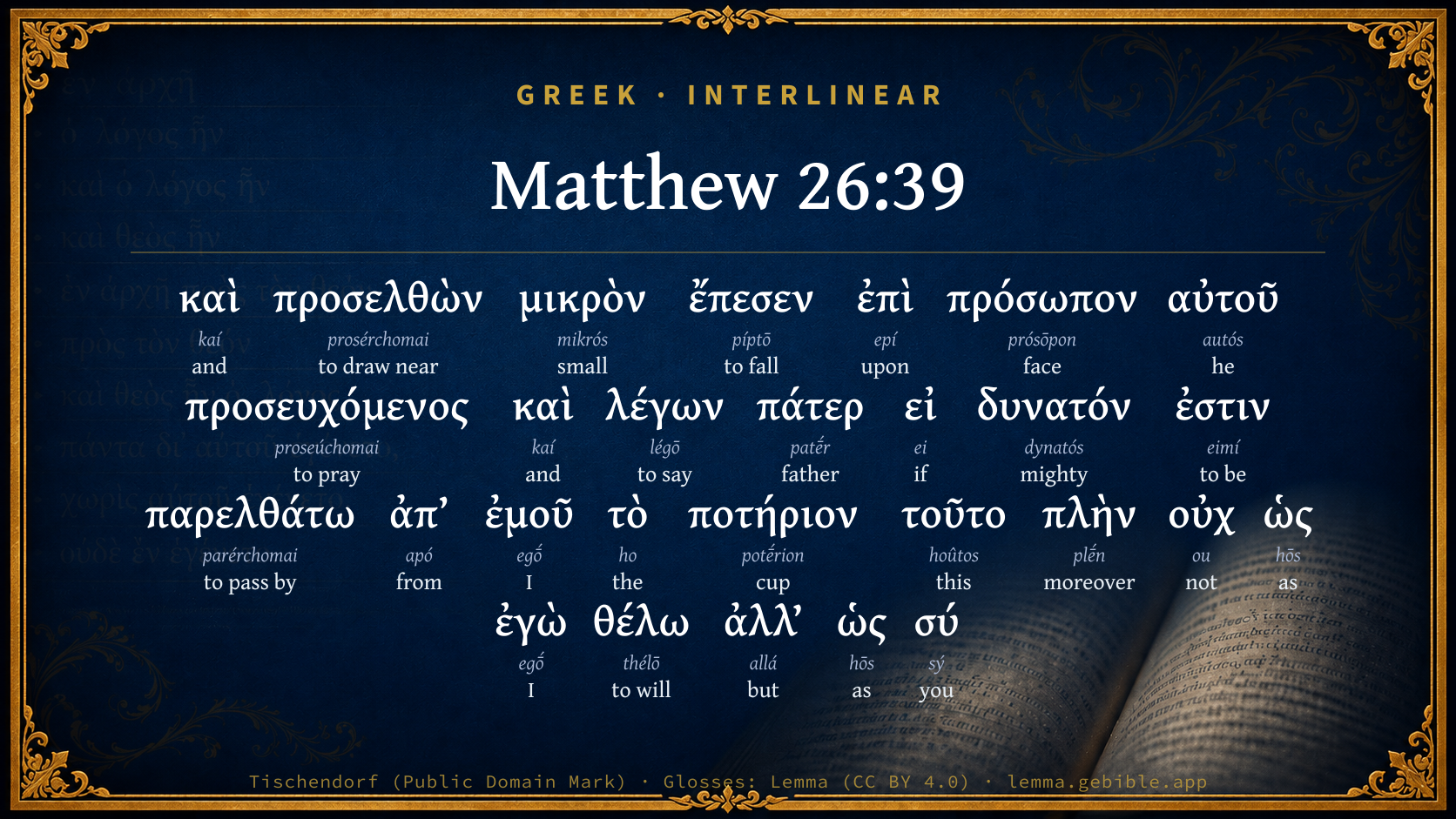
Download image
Cite this verse

Matthew 26:39 (World English Bible). Public Domain. Lemma interlinear Bible study tool, https://lemma.gebible.app/v/matthew/26/39.

Show BibTeX & RIS
BibTeX
RIS
English Translation
He went forward a little, fell on his face, and prayed, saying, "My Father, if it is possible, let this cup pass away from me; nevertheless, not what I desire, but what you desire."
World English Bible · Public Domain
Download a study sheet

One document with this verse’s original text, its word-by-word gloss line, the meaning frame, cross-references with their text, attributed commentary, and full source and license credits — printable, and it pastes into notes with its structure intact.

This verse Autodidact and up

Study sheet (.html) Plain text (.txt)

A passage Seminary Student

Up to 50 verses in one chapter. A passage sheet keeps up to 6 commentary sources and 12 cross-references per verse, in the order this page ranks them, and says so on the sheet whenever that leaves anything out. Ask for a single verse and you get the Autodidact verse sheet above.

Everything on this page stays free to read, with no account — the sheet is a download of what is already on screen, not access to it.

Want to remove ads? Support Godless Engineer
Compare translations 3

The same verse in 3 English versions, stacked beneath the original-language interlinear above. Click any original word for its lexicon entry.

Each is an independent rendering of the whole verse — the interlinear is not word-aligned to these translations.

Highlighted words mark where these versions differ — a whole-verse word diff, not a word-by-word alignment.

  • World English Bible Public Domain
    He went forward a little, fell on his face, and prayed, saying, "My Father, if it is possible, let this cup pass away from me; nevertheless, not what I desire, but what you desire."
  • King James Version Public Domain
    And he went a little farther, and fell on his face, and prayed, saying, O my Father, if it be possible, let this cup pass from me: nevertheless not as I will, but as thou wilt.
  • unfoldingWord Literal Text CC BY-SA 4.0
    And having gone a little farther, he fell on his face, praying and saying, “My Father, if it is possible, let this cup pass away from me. Yet, not as I will, but as you.”

unfoldingWord Literal Text — © unfoldingWord, licensed CC BY-SA 4.0. Word-aligned USFM3 via Door43 (git.door43.org/unfoldingWord/en_ult).

Versions to compare (up to 4)

3 of 4 selected

Show all 19 translations

Every available English version of this verse, each an independent rendering of the whole verse.

  • World English Bible Public Domain
    He went forward a little, fell on his face, and prayed, saying, "My Father, if it is possible, let this cup pass away from me; nevertheless, not what I desire, but what you desire."
  • Berean Standard Bible Public Domain
    Going a little farther, He fell facedown and prayed, “My Father, if it is possible, let this cup pass from Me. Yet not as I will, but as You will.”
  • Majority Standard Bible Public Domain
    Going a little farther, He fell facedown and prayed, “My Father, if it is possible, let this cup pass from Me. Yet not as I will, but as You will.”
  • King James Version Public Domain
    And he went a little farther, and fell on his face, and prayed, saying, O my Father, if it be possible, let this cup pass from me: nevertheless not as I will, but as thou wilt.
  • American Standard Version (1901) Public Domain
    And he went forward a little, and fell on his face, and prayed, saying, My Father, if it be possible, let this cup pass away from me: nevertheless, not as I will, but as thou wilt.
  • Revised Version (1885) Public Domain
    And he went forward a little, and fell on his face, and prayed, saying, O my Father, if it be possible, let this cup pass away from me: nevertheless, not as I will, but as thou wilt.
  • Geneva Bible (1599) Public Domain
    So hee went a litle further, and fell on his face, and praied, saying, O my Father, if it be possible, let this cup passe from me: neuerthelesse, not as I will, but as thou wilt.
  • Douay-Rheims (1899) Public Domain
    And going a little further, he fell upon his face, praying, and saying: My Father, if it be possible, let this chalice pass from me. Nevertheless not as I will, but as thou wilt.
  • Young's Literal Translation Public Domain
    And having gone forward a little, he fell on his face, praying, and saying, `My Father, if it be possible, let this cup pass from me; nevertheless, not as I will, but as Thou.'
  • Literal Standard Version CC BY-SA 4.0
    And having gone forward a little, He fell on His face, praying, and saying, “My Father, if it be possible, let this cup pass from Me; nevertheless, not as I will, but as You.”
  • Unlocked Literal Bible CC BY-SA 4.0
    He went a little farther, fell on his face, and prayed. He said, “My Father, if it is possible, let this cup pass from me. Yet, not as I will, but as you will.”
  • unfoldingWord Literal Text CC BY-SA 4.0
    And having gone a little farther, he fell on his face, praying and saying, “My Father, if it is possible, let this cup pass away from me. Yet, not as I will, but as you.”
  • Darby Bible Public Domain
    And going forward a little he fell upon his face, praying and saying, My Father, if it be possible let this cup pass from me; but not as *I* will, but as *thou* [wilt].
  • World Messianic Bible Public Domain
    He went forward a little, fell on his face, and prayed, saying, “My Father, if it is possible, let this cup pass away from me; nevertheless, not what I desire, but what you desire.”
  • Webster's Bible Public Domain
    And he went a little further, and fell on his face, and prayed, saying, O my Father, if it is possible, let this cup pass from me: nevertheless, not as I will, but as thou wilt.
  • Free Bible Version CC BY-SA 4.0
    He went a little farther forward, fell facedown, and prayed. “My Father, please, if it's possible, let this cup of suffering be taken from me,” Jesus asked. “Even so, may it not be what I want but what you want.”
  • Bible in Basic English Public Domain
    And he went forward a little, and falling down on his face in prayer, he said, O my Father, if it is possible, let this cup go from me; but let not my pleasure, but yours be done.
  • Text-Critical English NT CC BY 4.0
    And going a little farther, he fell on his face and prayed, “My Father, if possible, let this cup pass from me; nevertheless, not as I will, but as yoʋ will.”
  • Tyndale New Testament (1534) Public Domain
    And he went a lytell aparte and fell flat on his face and prayed sayinge: O my father yf it be possible let this cuppe passe from me: neverthelesse not as I wyll but as thou wylt.

Literal Standard Version (2020), Covenant Press — licensed CC BY-SA 4.0. Text via the HelloAO Bible API (eBible.org). Unlocked Literal Bible (unfoldingWord) — licensed CC BY-SA 4.0. Text via the HelloAO Bible API (eBible.org). unfoldingWord Literal Text — © unfoldingWord, licensed CC BY-SA 4.0. Word-aligned USFM3 via Door43 (git.door43.org/unfoldingWord/en_ult). Free Bible Version, Dr. Jonathan Gallagher — licensed CC BY-SA 4.0. Text via the HelloAO Bible API (eBible.org).

Word by word

More ways to search: Search by grammar → Find every occurrence → Compare this word →

Practice this passage: Drill this verse → Learn its vocabulary →

παρελθάτω
parérchomai
G3928
“to pass by”
Verb, Aorist, Active, Imperative, 3rd person, Singular
Part of Speech
Verb
Tense
Aorist
Voice
Active
Mood
Imperative
Person
3rd person
Number
Singular
Full Thayer's Definition

Origin: from G3844 and G2064

TDNT: 13:21,3

1. to go past, pass by a. of persons moving forward 1. to pass by b. of time 1. an act continuing for a time c. metaph. 1. to pass away, perish 2. to pass by (pass over), that is, to neglect, omit, (transgress) 3. to be led by, to be carried past, be averted 2. to come near, come forward, arrive
  1. καὶ kaí G2532 “and” Conjunction
  2. προσελθὼν prosérchomai G4334 “to draw near” Verb, Aorist, Active, Participle, Nominative, Singular, Masculine
  3. μικρὸν mikrós G3398 “small” Adjective, Accusative, Singular, Masculine
  4. ἔπεσεν píptō G4098 “to fall” Verb, Aorist, Active, Indicative, 3rd person, Singular
  5. ἐπὶ epí G1909 “upon” Preposition
  6. πρόσωπον prósōpon G4383 “face” Noun, Accusative, Singular, Neuter
  7. αὐτοῦ autós G846 “he” Personal pronoun, Genitive, Singular, Masculine
  8. προσευχόμενος proseúchomai G4336 “to pray” Verb, Present, Middle or Passive deponent, Participle, Nominative, Singular, Masculine
  9. καὶ kaí G2532 “and” Conjunction
  10. λέγων légō G3004 “to say” Verb, Present, Active, Participle, Nominative, Singular, Masculine
  11. πάτερ patḗr G3962 “father” Noun, Vocative, Singular, Masculine
  12. εἰ ei G1487 “if” Conditional
  13. δυνατόν dynatós G1415 “mighty” Adjective, Nominative, Singular, Neuter
  14. ἐστιν eimí G1510 “to be” Verb, Present, Active, Indicative, 3rd person, Singular
  15. ἀπ’ apó G575 “from” Preposition
  16. ἐμοῦ egṓ G1473 “I” Personal pronoun, 1st person, Genitive, Singular
  17. τὸ ho G3588 “the” Article, Nominative, Singular, Neuter
  18. ποτήριον potḗrion G4221 “cup” Noun, Nominative, Singular, Neuter
  19. τοῦτο hoûtos G3778 “this” Demonstrative pronoun, Nominative, Singular, Neuter
  20. πλὴν plḗn G4133 “moreover” Adverb
  21. οὐχ ou G3756 “not” Particle, Negative
  22. ὡς hōs G5613 “as” Adverb
  23. ἐγὼ egṓ G1473 “I” Personal pronoun, 1st person, Nominative, Singular
  24. θέλω thélō G2309 “to will” Verb, Present, Active, Indicative, 1st person, Singular
  25. ἀλλ’ allá G235 “but” Conjunction
  26. ὡς hōs G5613 “as” Adverb
  27. σύ sý G4771 “you” Personal pronoun, 2nd person, Nominative, Singular

About this verse

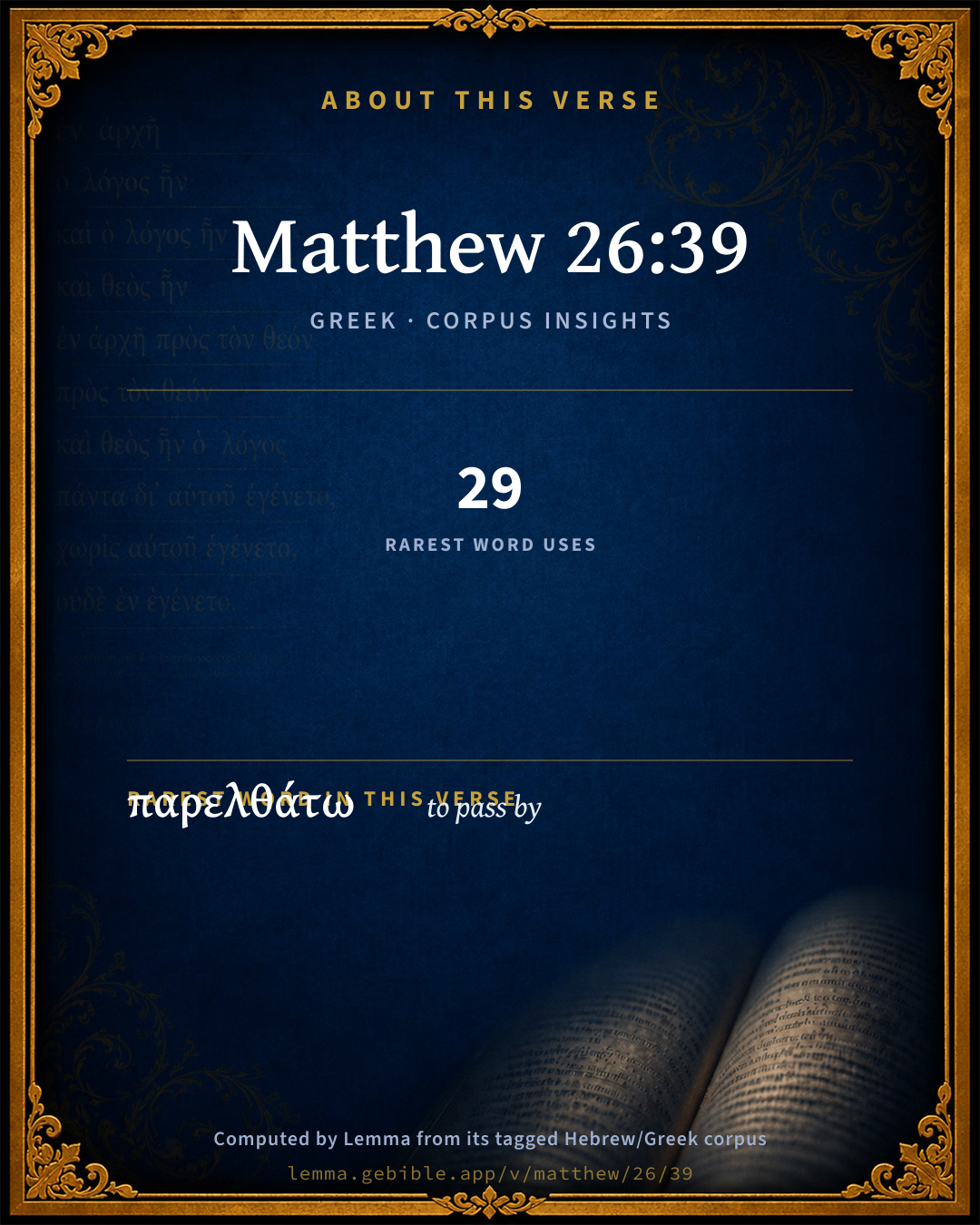
These counts appear in no published source. They are computed here, from the morphology-tagged text and Lemma’s own curated glosses. What Lemma adds →

28
words
25
distinct lemmas
Gospels
section

Shared distinctive vocabulary

παρελθάτω to pass by G3928 occurs in 25 verses of the Greek New Testament. Also found in:
Repetition

Words recur within this verse:

Cross-references

24

Topical passages linked to Matthew 26:39 in the Treasury of Scripture Knowledge — connected by theme and wording, ordered by reader-vote popularity; previews shown in the World English Bible.

  • John 6:38 For I have come down from heaven, not to do my own will, but the will of him who sent me.
  • Philippians 2:8 And being found in human form, he humbled himself, becoming obedient to death, yes, the death of the cross.
  • Matthew 26:42 Again, a second time he went away, and prayed, saying, "My Father, if this cup can't pass away from me unless I drink it, your desire be done."
  • Luke 22:41–42 He was withdrawn from them about a stone's throw, and he knelt down and prayed,
  • John 5:30 I can of myself do nothing. As I hear, I judge, and my judgment is righteous; because I don't seek my own will, but the will of my Father who sent me.
  • Hebrews 5:7 He, in the days of his flesh, having offered up prayers and petitions with strong crying and tears to him who was able to save him from death, and having been heard for his godly fear,
  • Mark 14:35–36 He went forward a little, and fell on the ground, and prayed that, if it were possible, the hour might pass away from him.
  • John 12:27–28 "Now my soul is troubled. What shall I say? 'Father, save me from this time?' But for this cause I came to this time.
  • John 14:31 But that the world may know that I love the Father, and as the Father commanded me, even so I do. Arise, let us go from here.
  • John 18:11 Jesus therefore said to Peter, "Put the sword into its sheath. The cup which the Father has given me, shall I not surely drink it?"
  • Matthew 20:22 But Jesus answered, "You don't know what you are asking. Are you able to drink the cup that I am about to drink, and be baptized with the baptism that I am baptized with?" They said to him, "We are able."
  • John 11:41 So they took away the stone from the place where the dead man was lying. Jesus lifted up his eyes, and said, "Father, I thank you that you listened to me.
  • Numbers 16:22 They fell on their faces, and said, God, the God of the spirits of all flesh, shall one man sin, and will you be angry with all the congregation?
  • 2 Samuel 15:26 but if he say thus, I have no delight in you; behold, here am I, let him do to me as seems good to him.
  • Romans 15:1–3 Now we who are strong ought to bear the weaknesses of the weak, and not to please ourselves.
  • Genesis 17:3 Abram fell on his face. God talked with him, saying,
  • Numbers 14:5 Then Moses and Aaron fell on their faces before all the assembly of the congregation of the children of Israel.
  • Ezekiel 1:28 As the appearance of the bow that is in the cloud in the day of rain, so was the appearance of the brightness round about. This was the appearance of the likeness of the glory of Yahweh. When I saw it, I fell on my face, and I heard a voice of one that spoke.
  • Matthew 24:24 For there will arise false christs, and false prophets, and they will show great signs and wonders, so as to lead astray, if possible, even the chosen ones.
  • 1 Chronicles 21:16 David lifted up his eyes, and saw the angel of Yahweh standing between earth and the sky, having a drawn sword in his hand stretched out over Jerusalem. Then David and the elders, clothed in sackcloth, fell on their faces.
  • Revelation 19:10 I fell down before his feet to worship him. He said to me, "Look! Don't do it! I am a fellow bondservant with you and with your brothers who hold the testimony of Jesus. Worship God, for the testimony of Jesus is the Spirit of Prophecy."
  • Mark 13:22 For there will arise false christs and false prophets, and will show signs and wonders, that they may lead astray, if possible, even the chosen ones.
  • Luke 17:16 He fell on his face at Jesus' feet, giving him thanks; and he was a Samaritan.
  • Acts 10:25 When it happened that Peter entered, Cornelius met him, fell down at his feet, and worshiped him.

Cross-references courtesy of OpenBible.info (CC BY 4.0).

Commentary

Notes on Matthew 26:39 from classic Christian and Jewish commentators (each source and its license shown beneath its notes). The classic Christian expositions comment on the surrounding passage and are grouped to its opening verse, so a note may address several verses; the Jewish commentaries on the Tanakh (Rashi and others) are per-verse, so they appear only where the commentator wrote on this verse.

Lemma curates 59 commentaries, every one of them public domain or Creative Commons licensed, each selected and text-cleaned for this edition rather than reprinted as found. About our sources →

Joseph Benson's Commentary

Mat 26:39. And he went a little further — Luke says, He was withdrawn from them about a stone’s cast, so that the apostles could still both see and hear him; and fell on his face — It seems he first knelt down, Luk 22:41, and then, as the ardour of his soul increased, prostrated himself on his face to the ground, and prayed, saying, O my Father, if it be possible — That is, if it be consistent with the salvation of the world; let this cup — Of bitterness and terror, pass from me — And it did pass from him soon; for when he cried unto God with strong cries and tears, he was heard in that which he feared, Heb 5:7. God took away the terror and severity of that inward conflict. That it was not the fear of dying on the cross which made our Lord speak and pray in the manner here related, is evident from this, that to suppose it would be to degrade his character infinitely. Suppose his sufferings to be as terrible as possible, clothe them with all the aggravating circumstances imaginable; yet if no more was included in them than the pains of death, inasmuch as his human nature was strengthened far beyond the natural pitch by its union with the divine, for Jesus to have shrunk at the prospect of them, would have shown a weakness which many of his followers were strangers to, encountering more terrible deaths without the least emotion. Nevertheless, not as I will, but as thou wilt — Here we see, that though his prayer was most fervent, yet it was accompanied with due expressions of entire resignation.

Joseph Benson's Commentary on the Old and New Testaments (1811–1818) — public domain. Text from a community e-Sword module.

Tyndale Open Study Notes

Tyndale Open Resources

26:39 If it is possible: Jesus’ heart’s desire was for uninterrupted communion with the Father instead of coming under God’s wrath. • Yet I want your will to be done: His resolution to do the Father’s will was firm (4:1-11; 16:23; John 6:38).

Tyndale Open Study Notes — © Tyndale Open Resources, licensed CC BY-SA 4.0. Text via the HelloAO Bible API.

Bengel's Gnomon

Johann Albrecht Bengel

Mat 26:39. Ἐπὶ πρόσωπον, on His face) not only on His knees[1147]—the deepest humiliation.[1148]—ΠΆΤΕΡ ΜΟΥ, My Father) Jesus prays as a Son.—εἰ δυνατόν ἐστι, if it is possible) cf. Mat 26:53, from which verse it also appears how promptly and perfectly Jesus surrendered Himself to the will of the Father.—τὸ ποτήριον, the cup) offered by the Father, brimful with the whole draught of suffering.—θέλω, I will) This Will of Jesus that the cup might pass away from Him, was not absolute without reference to His Fathers Will. Cf. the latter part of Joh 21:18.[1149]

[1147] Which Luke records.—V. g.

[1148] Such as occurs in His history, nowhere else.—V. g.

[1149] Where Peter’s flesh is represented as not willing (ὅπου οὐ θέλεις) that which his spirit would be willing to bear. The not-willingness is not absolute without reference to God’s will and glory. His flesh would wish to escape, only if so were God’s will.—ED.

Bengel's Gnomon of the New Testament — English translation (T&T Clark, Edinburgh, 1860) — public domain. Text from a community e-Sword module.

Meyer's Critical & Exegetical Commentary

Heinrich August Wilhelm Meyer

Mat_26:39. Μικρόν] belongs to προελθών: after He had gone forward a short distance. For μικρόν comp. Xen. Cyrop. iv. 2. 6 (μικρὸν πορευθέντες); Hist. Gr. vii. 2. 13 (μικρὸν δʼ αὐτοὺς προπέμψαντες).

ἐπὶ πρόσωπον αὐτοῦ] The article was not necessary before πρόσωπ. (in opposition to Fritzsche, who takes αὐτοῦ as meaning there). Comp. Mat_11:10, Mat_17:6, and elsewhere. Winer, p. 116 [E. T. 152]. Bengel appropriately observes: in faciem, non modo in genua; summa demissio.

εἰ δυνατόν ἐστι] ethical possibility according to the divine purpose. Similarly the popular expression πάντα δυνατά σοι is to be understood, according to the sense in which Jesus uses it, as implying the necessary condition of harmony with the divine will.

τὸ ποτήριον τοῦτο] i.e. this suffering and death immediately before me. Comp. Mat_20:22.

πλὴν οὐχ, κ.τ.λ.] The wish, to which in His human dread of suffering He gave utterance, that, if possible, He should not be called upon to endure it (ἔδειξε τὸ ἀνθρώπινον, Chrysostom), at once gives place to absolute submission, Joh_5:30; Joh_6:38. The word to be understood after σύ (θέλεις) is not γενέσθω, but, as corresponding with the οὐχ (not μή, observe), γενήσεται, or ἔσται, in which the petitioner expresses his final determination. It may be observed further, that the broken utterance is in keeping with the deep emotion of our Lord.

For ὡς, which, so far as the essential meaning is concerned, is identical with the relative pronoun, comp. Hermann, ad Hom. h. in Cer. 172.

Meyer — Critical and Exegetical Commentary on the New Testament — English translation by Peter Christie, edited by Frederick Crombie (T&T Clark, 1880) — public domain. Text from a community e-Sword module.

Expositor's Greek Testament

ed. W. Robertson Nicoll

Mat 26:39 . μικρὸν , a little space, presumably near enough for them to hear ( cf. Luk 22:41 ). ἐπὶ πρόσωπον , on His face, not on kness, summa demissio (Beng.). πάτερ , Father! Weiss in Markus-Evang. seems to think that the one word Abba was all the three heard, the rest of the prayer being an expansion and interpretation by the evangelist. But if they heard one word they could hear more. The prayer uttered in such a state of distress would be a loud outburst ( cf. μετὰ κραυγῆς ἰσχυρᾶς , Heb 5:7 ), at once , therefore before the disciples had time to fall asleep or even get drowsy. τὸ ποτήριον τ ., this cup (of death). πλὴν , etc., howbeit not as I wish, but as Thou, expressively elliptical; no doubt spoken in a calmer tone, the subdued accent suggestive of a change of mood even if the very words did not distinctly reach the ear of the three. Grotius, from theological solicitudes, takes θέλω = θέλοιμι , “vellem” (“more Hebraeorum, qui neque potentialem neque optativum modum habent”).

The Expositor's Greek Testament, edited by W. Robertson Nicoll (1897–1910) — public domain. Text from a community e-Sword module.

Geneva Bible (1599)

Geneva Bible translators

Let it pass me, and not touch me.

That is, which is at hand, and is offered and prepared for me: a kind of speech which the Hebrews use, for the wrath of God, and the punishment he sendeth. See also Matt. 20:22.

Geneva Bible (1599) marginal notes — public domain. Text via Bolls.life.

Adam Clarke's Commentary

Verse 39. Fell on his face] See Clarke on Lu 22:44. This was the ordinary posture of the supplicant when the favour was great which was asked, and deep humiliation required. The head was put between the knees, and the forehead brought to touch the earth-this was not only a humiliating, but a very painful posture also.

This cup] The word cup is frequently used in the Sacred Writings to point out sorrow, anguish, terror, death. It seems to be an allusion to a very ancient method of punishing criminals. A cup of poison was put into their hands, and they were obliged to drink it. Socrates was killed thus, being obliged by the magistrates of Athens to drink a cup of the juice of hemlock. To death, by the poisoned cup, there seems an allusion in Heb 2:9, Jesus Christ, by the grace of God, TASTED death for every man. The whole world are here represented as standing guilty and condemned before the tribunal of God; into every man's hand the deadly cup is put, and he is required to drink off the poison-Jesus enters, takes every man's cup out of his hand, and drinks off the poison, and thus tastes or suffers the death which every man otherwise must have undergone.

Pass from me] Perhaps there is an allusion here to several criminals standing in a row, who are all to drink of the same cup; but, the judge extending favour to a certain one, the cup passes by him to the next.

Instead of προελθων μικρον, going a little forward, many eminent MSS. have προσελθων, coming a little forward-but the variation is of little moment. At the close of this verse several MSS. add the clause in Lu 22:43,

There appeared an angel, &c.

Adam Clarke's Commentary on the Bible (1810–1826) — public domain. Text from a community e-Sword/MySword module.

Ellicott's Commentary for English Readers

(39) He went a little farther.—St. Luke adds (Luk_22:41) “about a stone’s cast.” The eight were left, we may believe, near the entrance of the garden; the three, “apart by themselves,” further on; the Master, still further, by Himself. The three heard the words that came from His lips as with a half-consciousness which revived afterwards in memory, but they were then numbed and stupefied with weariness and sorrow. It was now near the dawning of the day, and their eyes had not closed in sleep for four-and-twenty hours.

If it be possible, let this cup pass from me.—We shrink instinctively from analysing or commenting on the utterances of that hour of agony. But, happily, words are given us where our own words fail. Thus it was, we are told, that “He learned obedience by the things that He suffered” (Heb_5:8). He had spoken before to the very disciples who were now near Him of the “cup” which His Father had given Him to drink (Mat_20:23). Now the “cup” is brought to His lips, and His human will at once shrinks from it and accepts it. The prayer which He had taught His disciples to use, “Lead us not into temptation,” is now His prayer, but it is subordinated to that other prayer, which is higher even than it, “Thy will be done.” In the prayer “If it be possible” we recognise, as in Mar_13:32, the natural, necessary limits of our Lord’s humanity In one sense “with God all things are possible,” but even the Divine Omnipotence works through self-imposed laws, in the spiritual as in the natural world, and there also ends cannot be obtained except through their appointed and therefore necessary means. God might have redeemed mankind, men have rashly said, without the sufferings and death of the Son of Man, but the higher laws of the Divine Government made such a course, if we may venture so to speak, morally impossible.

A Bible Commentary for English Readers, edited by Charles John Ellicott (1878–1897) — public domain. Text from a community e-Sword module.

The Cambridge Bible for Schools and Colleges

gen. ed. J. J. S. Perowne

39. went a little further] The paschal full moon would make deep shadow for the retirement of Jesus.

O my Father] St Mark has the Aramaic Abba as well as the Greek word for Father.

this cup] See note, ch. Mat_20:22. Were these words overheard by the sons of Zebedee? If so, the thought of their ambition and of their Master’s answer would surely recur to them (ch. Mat_20:20-23).

not as I will] In the “Agony,” as in the Temptation, the Son submits Himself to His Father’s will.

The Cambridge Bible for Schools and Colleges (gen. ed. J. J. S. Perowne; Cambridge University Press, 1878–1918) — public domain. Text from a community e-Sword module.

John Gill's Exposition

And he cometh unto the disciples,.... The three he took with him, Peter, James, and John, after he had finished his prayer,

and findeth them asleep: many things might contribute to, and bring this drowsiness upon them; as the great fatigue they had had in preparing the passover in the day, the plentiful meal they had eaten at night, though without excess, and the lateness of the night, it being now probably midnight; but the chief reason of their sleepiness was their sorrow, as is expressed in Luk 22:45, what Christ had said to them of his soul troubles, and what they saw in him, had filled their hearts with sorrow, which brought on them an amazement and stupidity of mind; and this issued in sleep. We have other instances of persons in excessive grief and trouble falling asleep, as Elijah in Kg1 19:4, and Jonah in Jon 1:5, so that this did not arise from a secure, lazy, indolent frame of spirit; or from any disregard to Christ, and neglect of him, and unconcernedness for him; but from their great sorrow of heart; for, the trouble and distress that he was in, added to the causes above mentioned. Though some have thought, that Satan might be, concerned in it, who induced this sleepiness, or increased it, that he might the more easily surprise them with his temptations, he was preparing for them, which I will not deny. Now, though this sleep was natural bodily sleep, which the disciples fell into, yet was an emblem of, and carried in it a resemblance to, the spiritual sleep and drowsiness of the people of God; for as this was after a delightful entertainment and conversation with Christ at the passover and Lord's supper, so it sometimes is, that the children of God fall into a sleepy frame of soul, after much communion with Christ, as the church did in Sol 5:1, and as this sleep befell them, when Christ was withdrawn a little space from them; so it was with the church, when her beloved was absent from her, Sol 3:1, and with the wise virgins when the bridegroom tarried, Mat 25:6, and as this was not an entire thorough sleep; they knew all the while what Christ was doing, and could relate, as they have done, the circumstances of it; so the children of God, when asleep, they are not like unregenerate persons, in a dead sleep of sin, that hear, and see, and feel, and know nothing; but though they are asleep, their hearts are awake, as was the church's, Sol 5:2, yet as the disciples were so much asleep, that the bare words of Christ did not arouse them from it for a while; so such is the sleep of the saints sometimes, that they are not to be aroused by the bare ministry of the word, though the most powerful arguments, and the most moving and melting language are made use of, as were with the church, Sol 5:2,

and saith unto Peter, what! could ye not watch with me one hour? This was said particularly to Peter, because he had so lately, in such a confident manner, declared, that he would not be offended with Christ, but abide with him, stand by him, and even die with him, was there an occasion for it; and yet, in so short a space of time, was fallen asleep, as were the rest who said the same things also: and it is as if Christ should say, how will you be able to stand by me throughout this night, when ye cannot watch with me so much as one hour, though I so earnestly desired you to tarry here, and watch with me, and you saw in what distress I was in? how will you be able to withstand the temptations that will beset you quickly, and perform your promises of love, fidelity, constancy, and close attachment to me, in the greatest dangers, when you cannot keep yourselves awake one hour for my sake?

John Gill's Exposition of the Whole Bible (1746–1763) — public domain (CC PDM 1.0). Text via the HelloAO Bible API.

Trapp's Complete Commentary

John Trapp

39 And he went a little further, and fell on his face, and prayed, saying, O my Father, if it be possible, let this cup pass from me: nevertheless not as I will, but as thou wilt.

Ver. 39. And he went a little farther] Amat secessum ardens oratio. St Luke saith he was violently withdrawn from them, about a stone’s cast, and there he kneeled down and prayed, for farther he could not go, through earnest desire of praying to his heavenly Father, Luk 22:41. απεσπασθη. Illud desiderium precandi eum incessit, ut illum quodam modo truderet.

And fell on his face] He putteth his mouth in the dust, if so be there may be hope, Lam 3:29. This and the like humble gestures in God’s service do at once testify, and excite inward devotion.

Let this cup pass] In the time of execution, they gave the malefactor a cup of wine, mingled with myrrh, Mar 15:23, to stupify his senses, and so to mitigate his pains. Hence the word calix or cup is put here and elsewhere for death itself, which, being terrible to nature, is therefore here with strong crying and tears deprecated by our Saviour, Heb 5:7. This was natural in him, and not sinful in us, so it do not degenerate into that which is carnal fear of death.

Nevertheless not as I will, but, &c.] Here Christ doth not correct his former request (for then there should have been some kind of fault in it), but explieateth only on what condition he desired deliverance, and becometh "obedient unto death, even the death of the cross," Php 2:8, crying out, "not as I will, but as thou wilt," which shows that he had a distinct human will from the will of his Father, and so was very man as well as God. And here Aristotle, that great philosopher, is clearly confuted. For he denies that a magnanimous man can be exceeding sorrowful for anything that befalls him. {a} Our Saviour (his Church’s stoutest champion) was exceeding sorrowful even to the death; and yet of so great a spirit, that he yields up himself wholly to God. Magnus est animus, qui se Deo tradidit; pusillus et degener, qui obluctatur, saith Seneca. He is a brave man that trusts God with all.

{a} Μεγαλοψυχος ουκ εστι περιλυπος. Arist. Eth.

John Trapp, A Commentary or Exposition upon All the Books of the Old and New Testament (1647–1656) — public domain. Text from a community e-Sword module.

Haydock's Catholic Bible Commentary

Going a little further. St. Luke says, about a stone’s cast, kneeling down; or as here in Matthew, prostrating himself. He did both. --- Father, if it is possible. Which is the same, says St. Augustine, as if he said, if thou wilt, let this cup of sufferings pass from me. --- Nevertheless not as I will, but as thou wilt. He that was God and man, had both a divine and a human will. He was pleased to let us know what he naturally feared, as man, and in the sensitive part of his soul; yet shews his human will had nothing contrary to his divine will, by presently adding, but not my will, but thine be done. Here, as related by St. Luke, followed his bloody sweat. (Luke xxii. 43.) (Witham) --- These words are a source of instruction for all Christians. These words inflame the breasts of confessors; the same also crown the fortitude of the martyrs. For, who could overcome the hatred of the world, the assaults of temptations, and the terrors of persecutors, unless Christ in all, and for all, had said to his eternal Father: Nevertheless, not as I will, but as thou willest. Let all the children of the Church then understand well these words, that when calamities violently beat upon us, we may with resignation exclaim: nevertheless, not as I will, but, &c. (St. Leo the great)

George Leo Haydock (1774–1849), Haydock's Catholic Family Bible and Commentary, 1859 edition — public domain. Excludes Psalms (Douay-Rheims chapter numbering differs from Protestant) and Deuterocanonical books (Catholic canon only).

Matthew Poole's English Annotations

Mark saith, Mar 14:35,36, He went forward a little, and fell on the ground, and prayed that, if it were possible, the hour might pass from him. And he said, Abba, Father, all things are possible unto thee; take away this cup from, me: nevertheless not what I will, but what thou wilt. Luke saith, Luk 22:41,42, He was withdrawn from them about a stone’s cast, and kneeled down, and prayed, saying, Father, if thou be willing, remove this cup from me: nevertheless not my will, but thine, be done. Here are three distinct forms of words, but all agreeing in one and the same sense. Matthew saith, He went a little farther, and fell on his face, and prayed. He at his first motion carried but three with him, Peter, James, and John; now he leaves them, but not far, Luke saith, about a stone’s cast.. Fervent prayer loves privacy, and Christ by this teacheth us that secret prayer is our duty. He fell on his face; Luke saith, he kneeled; he possibly at first kneeled, then fell on his face. We read in Scripture of sitting, standing, kneeling, and prostration used in prayer; the first and last rarely; standing and kneeling were the most ordinary postures. David prayed sitting in his house, 2Sa 7:18. Abraham fell on his face, Gen 17:17. So did Moses and Aaron, Num 16:22,45. Prostration was ordinarily used in great passions; hardly otherwise in prayer.

Saying, O my Father, if it be possible, let this cup pass from me: nevertheless not as I will, but as thou wilt. Mark first tells us the sum of his prayer, then saith he said, Abba, Father, all things are possible unto thee; take away this cup from me: nevertheless not what I will, but what thou wilt. Luke saith he said, If thou be willing, remove this cup from me: nevertheless not my will, but thine, be done. Luke’s if thou be willing expounds Matthew’s if it be possible. A thing in itself may be possible which considered in its circumstances is not so: thus, as it is in Mark, all things are to God possible; but yet it is not possible for God to alter any thing which he hath decreed, or said shall come to pass; because God is not as man, one that can lie, or repent. But it will be objected, Did not Christ know that it was not possible? Did not he himself, Mat 26:54, say,

thus it must be? I answer, It is one thing what he knew as he was God, and of counsel with the Father; and another thing what he prayed for as man. Besides, our Saviour’s saying, if it be possible, doth not suppose that he knew it was possible; it signifieth no more than this, Father, my human nature hath an aversion from this heavy stroke, so as, if it were possible, it craves of thee a discharge from this curse: nevertheless not my will, but thine, be done. The first clause is but the expression of the natural (but not sinful) infirmity of his flesh; the latter a perfect resignation of his will to God. In the first he tells his Father what his natural flesh would crave, if it might consist with the will of God. In the second he begs that, whatsoever his flesh craved, yet the will of God might be done. And herein he sets us a perfect pattern for our prayers for deliverance from temporal evils, viz. with a submission to the will of God. By this our Saviour doth not declare himself ignorant or uncertain of the Divine will: only as, though the person that died was God man, yet the human nature only died; so, though the person that prayed was God man, yet he only prayed as he was man.

Matthew Poole's English Annotations on the Holy Bible (1683–1685) — public domain. Text from a community e-Sword/MySword module.

Whedon's Commentary on the Bible

Daniel D. Whedon

39. And he went a little further — Luke says, “He went about a stone’s cast.” So that there were three divisions of the little band: there were the eight disciples; the three chosen ones; and, at the distance of a “stone’s throw,” the suffering Saviour. While he suffers they slumber.

And prayed — The disciples were entreated to watch with our Lord, but not to pray with him or for him. That work he does alone, and asks no participation. They cannot pray his prayer. He may intercede for them, not they for him. Saying — The disciples could not have heard this prayer. The distance was too great, and they were even unable to keep awake. They must have learned the truth from our Lord’s own explanations of his sufferings after his resurrection. See Luk_24:27; Luk_24:32.

O my Father — This prayer has three distinct points: the appeal, the deprecation, and the resignation.

The purpose of recording this prayer is great. It contains a profound lesson, how under affliction the sufferer may innocently writhe under the pain, may ask to be delivered, up to the point of the divine will. But at that point, however deep the agony, the resignation must be absolute. Father — However near the paternity of God, it still leaves him the right and the reason to inflict upon us terrible sorrows. Yet true faith looks up, even to his frowning face, with a filial claim. If it be possible — The possibility here meant presupposes that the solid plans of redemption must be undisturbed. If, without lifting up these foundations, it be possible. This cup — What was this cup? Not the crucifixion; but the present supernatural agonies of the garden. For, as his sorrows were greater than his strength, they opened up before him a just and true fear that a complete catastrophe, even to unknown depths of failure, could result. Those terrible results lay as dregs at the bottom of the cup. And as Paul says, (Heb_5:7) He was saved in that he feared. From that fearful and inevitable break-down which he justly feared, and could escape only by obtaining supplicated aid, he was saved. But was this failure truly possible? Not only possible but surely certain, but for the power of this same faithful prayer, and for the true spirit in which the Redeemer offered it. O how narrow was the pass of danger through which our Jesus trod to his and our redemption! Pass from me — Saint Paul truly says that this prayer was heard. Causes were bearing down upon this lonely victim, as sure to crush as the rail-car would the shrinking infant lying on its track. Before the dregs of the cup were reached, the draught attained its limit! So God shall temper our trial to our strength, and our strength to our trial, if but the earnest prayer be put forth and the deep submission be retained. Not as I will — His own individual will was but a wish, which could not be wrong so long as it existed in complete submission to God’s will. To sacrifice our own preferences, in order that our wills may be one with God’s, is true resignation.

Daniel D. Whedon (gen. ed.), Commentary on the Old and New Testaments (1874–1909) — public domain. Text from a community e-Sword module.

The Pulpit Commentary

He went a little further. Deeper into the wood, beneath the gloomy shadow of the olive trees, yet so as not to feel absolutely alone. St. Luke names the distance, "He was withdrawn from them about a stone"s cast." By some clerical error the genuine reading, proelywn , "having gone forward," has been altered in most of the best manuscripts into proselywn , "having approached." There can be no doubt that this latter reading is erroneous; and it is well, as occasion bids, to call attention to possible mistakes in the most important uncials. Fell on his face, and prayed. He prostrated himself on the ground in utter abasement and desolation, yet in submission withal. In this terrible crisis there is no resource but prayer. The shadow of death enveloped him, wave and storm rolled over his soul; yet out of the deep he called unto the Lord. In the Epistle to the Hebrews (Heb_5:7, Heb_5:8) some affecting details are added, "Who in the days of his flesh, when he had offered up prayers and supplications with strong crying and tears unto him that was able to save him from death, and having been heard for his godly fear, though he was a Son, yet learned obedience by the things which he suffered." O my Father (Pater mou). The personal pronoun is omitted in some manuscripts, but it has high authority. Only on this occasion and in his great prayer (Joh 17) does Christ so address the Father, his human nature in the depth of suffering retaining still the sense of this paternity. St. Mark has, "Abba, Father," as if he spake for the Hebrew race and the Gentile world. If it be possible; i.e. if there is any other way in which man may be saved and thou be glorified; if there is any other mode of redemption. It is the cry of humanity, yet conditioned by perfect submission. Let this cup pass from me. The "cup" is the bitter agony of his Passion and death, with all their grievous accompaniments. (see Mat_20:22, and note there) All heroism and manly endurance in the face of pain and death Christ exhibited to the full; but the elements of suffering in his case were different, and fraught with exquisite torture (see above, on ver. 28). Such was the anguish that it would have then separated soul and body of such rigour that "his sweat became as it were great drops of blood falling down upon the ground had not an angel appeared from heaven to strengthen and support the fainting human life. (Luk_22:43, Luk_22:44) Nevertheless not as I will, but as thou wilt. In this prayer are shown the two wills of Christ, the human and Divine. The natural shrinking of the human soul from ignominy and torture is overborne by entire submission to and compliance with the Divine purpose. So it is said that the Captain of our salvation was made perfect through sufferings, learned obedience by the things which he suffered (Heb_2:10 Heb_5:8) By this passage the Monophysite and Monothelite heresies are clearly refuted, the two natures and two wills of Christ being plainly displayed. The three apostles saw only some part of their Master"s intense agony, and heard only some broken utterances of his supplication; hence there are some slight variations in the synoptical accounts. St. Mark doubtless derived his account immediately from St Peter; the other synoptists from some other source.

Gethsemane a representative conflict.

Wherein does the scene of Calvary differ from the scene of Gethsemane? It would be easy to point out the sameness, the essential oneness, of the two scenes. But there is a difference. It lies in this: At Calvary the physical suffering is prominent. Our thought is sympathizingly occupied with our Lord"s bodily agonies, and bleeding, breaking heart. At Gethsemane the physical is subordinate, the mental and spiritual are prominent; we are in the presence of an awful soul struggle. Life is everywhere a conflict. Earth is a great battlefield. What does it all mean? Conflict in the heart. Conflict in the home. Conflict in the nation. Conflict everywhere. If we get light on the mystery anywhere, we get it in the garden of Gethsemane, where the Son of man is seen in bitter, almost overwhelming conflict.

I THE CONFLICT OF LIFE IS REALLY A CONFLICT OF WILLS. God is the supreme will; and his will ought to be supreme with his creatures. But to man has been entrusted a limited free will. That free will man has exercised until it has become masterful, and is constantly setting itself against God"s will. Bodily conditions, the slavery of the senses, the attractions of the seen and temporal, all help to the strengthening of man"s will, man"s wilfulness, so that the fight sometimes becomes severe. Our Lord, in taking on himself our human nature, took on him our sense conditioned human will. And this in Gethsemane tried a wrestling with the will of God.

II THE TRIUMPH IN THE CONFLICT OF LIFE IS YIELDING OUR WILL TO GOD"S WILL. This is the triumph of Gethsemane. Our Lord did not want the Divine will to be altered. He wanted to gain the full surrender of his whole nature body, mind, soul to the acceptance of the will. Man never gives up his will save as the issue of a fierce struggle. What force can renew and strengthen man"s will so that it shall accept God"s will, and make it his?

1. The truth as it is in Jesus.

2. The work wrought through for us by Jesus.

3. The grace won for us and given to us by Jesus.

4. The actual present power exerted on us by Jesus.

5. The constrainings of the love of Jesus.

Christ came to make the will of God infinitely attractive to us. He is the gracious Persuader of the human will. R.T.

The Pulpit Commentary (1880–1919), ed. H.D.M. Spence-Jones & Joseph S. Exell — public domain. Text from a community e-Sword module.

John Wesley's Explanatory Notes

And going a little farther - About a stone's cast, Luke xxii, 41 - So that the apostles could both see and hear him still. If it be possible, let this cup pass from me - And it did pass from him quickly. When he cried unto God with strong cries and tears, he was heard in that which he feared. God did take away the terror and severity of that inward conflict.

John Wesley, Explanatory Notes Upon the Whole Bible (1754–1765) — public domain. Text via the GEBible commentary corpus.

Scofield Reference Notes

C. I. Scofield

cup

The "cup" must be interpreted by our Lord’s own use of that symbol in speaking of His approaching sacrificial death Mat 20:22; Joh 18:11. In view of Joh 10:17; Joh 10:18 He could have been in no fear of an unwilling death. The value of the account of the agony in the Garden is in the evidence it affords that He knew fully what the agony of the cross would mean when His soul was made an offering for sin, Isa 53:10, in the hiding of the Father’s face. Knowing the cost to the utmost, he voluntarily paid it.

The Scofield Reference Bible (1917 edition), notes by C. I. Scofield — public domain. Text from a community e-Sword module.

Kretzmann's Popular Commentary

Paul E. Kretzmann

The first prayer:

v. 39. And He went a little farther, and fell on His face, and prayed, saying, O My Father, if it be possible, let this cup pass from Me; nevertheless not as I will, but as Thou wilt.

v. 40. And He cometh unto the disciples, and findeth them asleep, and saith unto Peter, What, could ye not watch with Me one hour?

v. 41. Watch and pray, that ye enter not into temptation; the spirit indeed is willing, but the flesh is weak.

Leaving even His favorite disciples, though near the place where He was going, He felt constrained to be all alone with the horrors of death and hell, with the realization of the unquenchable wrath of God upon the sins of the world which He had taken upon Him. As the vicar, the representative of sinful mankind, damnation stared Him in the face. He throws Himself down upon His face in the dust, and from a heart full of the anguish of terrible suffering His prayer is wrung: Father, if it be possible, let this cup, literally, go along past Me, but by no means as I will, but as Thou wilt. The cup of excruciating torture, of death on the cross, was before His eyes, and His weak human nature shrinks back from its terrors. For death is an unnatural condition, it destroys the life which God has created, it tears asunder the bond between body and soul which was tied by God. If therefore there is any possibility of carrying out the work of salvation without being obliged to endure the sum total of all punishments upon sin, without draining the cup of God’s wrath to the very dregs, He begs to be given leave to choose that easier way. The counsel of God, to which He Himself had agreed, that redemption for the lost and condemned sinners would have to be gained through suffering and death, had become obscured in His human consciousness. What deep humiliation! And yet, there was not the slightest hint of objecting and murmuring in His prayer. By all means, in every way, the will of the heavenly Father should be carried out. "How, then, does Christ pray? This is a useful and necessary instruction, which we ought to follow gladly and not forget. Our dear Lord Jesus prays that God should take the cup from Him, and expects, as the only-begotten Son, nothing but good from the Father. And yet He adds these words: Not as I will, but as Thou wilt. Do thou the same way. If thou art in tribulation and suffering, be careful not to think that God for that reason is thy enemy; turn to Him, as a child to his father (for since we believe on Christ, He wants to accept us as sons and coheirs of Christ), cry to Him for help, say: O Father, behold what things are happening to me here and there; help me for the sake of Thy dear Son Jesus Christ. Now we should, in all matters pertaining to the body, place our will under God’s will; for, as Paul says, we know not how to pray as we ought. Then it is often also highly necessary that God keep us in cross and distress. Now, since God alone knows what is good and useful for us, we should place His will ahead, and our will after, and prove our obedience in patience. " Returning to His disciples after His prayer, the Lord found them asleep. They were unable to stand the test of the great strain; human nature demanded rest. The greatness and depth of the revelation unfolding before their eyes was too much for their feeble flesh. Reproachfully Jesus addresses Himself to Peter, in an effort to rouse him: So, then, you could not watch with Me for even one hour, after all the protestations of a short hour before. He urges them all to maintain a state of watchfulness, and for that reason to pray lest they fall into temptation, for the weakness of the flesh would be only too apt to overcome the strength of the spirit, be it never so willing. It is in the hours of bitter and severe trial, when the weakness of the flesh is ready to give up the hard fight, that prayerful watchfulness, together with unwavering trust in God’s power, will maintain the strength of the spirit to keep the faith.

Paul E. Kretzmann, Popular Commentary of the Bible (1921–1924) — public domain. Text from a community e-Sword module.

The People's New Testament

B. W. Johnson

39. And he went a little farther. “About a stone's cast” (Luke). If it be possible. If it were possible to save men, and carry out the divine work of redeeming them. Let this cup pass from me. This cup is the betrayal, the trial, the mocking, the scourging, the cross, and all besides which our thoughts cannot reach. But as thou wilt. This is an example of perfect faith—the faith by which alone answers to prayer can be obtained. He that insists on his will, when it is contrary to the will of God, fails in faith.

B. W. Johnson's The People's New Testament with Notes (1889–1891) — public domain. Electronic text from the Christian Classics Ethereal Library (CCEL) ThML edition.

unfoldingWord translationNotes

Door43 World Missions Community

fell on his face

He purposely lay face down on the ground to pray. (See: Idiom)

My Father

This is an important title for God that shows the relationship between God and Jesus. (See: Translating Son and Father)

let this cup pass from me

Jesus speaks of the work that he must do, including dying on the cross, as if it were a bitter liquid that God has commanded him to drink from a cup. The word "cup" is an important word in the New Testament, so try to use an equivalent for that in your translation. (See: Metaphor)

this cup

Here "cup" is a metonym that stands for the cup and the contents within it. The contents in the cup are a metaphor for the suffering that Jesus will have to endure. Jesus is asking the Father if it is possible for him not to have to experience the death and suffering that Jesus knows will soon happen. (See: Metonymy and Metaphor)

Yet, not as I will, but as you will

This can be expressed as a full sentence. AT: "But do not do what I want; instead, do what you want" (See: Ellipsis)

he said to Peter, "What, could you not watch

Jesus is speaking to Peter, but the "you" is plural, referring to Peter, James, and John. (See: Forms of You)

What, could you not watch with me for one hour?

Jesus uses a question to scold Peter, James, and John. AT: "I am disappointed that you could not stay awake with me for one hour!" (See: Rhetorical Question)

you do not enter into temptation

Here the abstract noun "temptation" can be stated as a verb. AT: "no one tempts you to sin" (See: Abstract Nouns)

The spirit indeed is willing, but the flesh is weak

Here "spirit" is a metonym that stands for a person's desires to do good. "Flesh" stands for the needs and desires of a person's body. Jesus means that the disciples may have the desire to do what God wants, but as humans they are weak and often fail. (See: Metonymy and Synecdoche)

translationWords

pray

God the Father

will of God

disciple

Peter

watch

tempt

spirit

flesh

unfoldingWord translationNotes — © Distant Shores Media and the Door43 World Missions Community, licensed CC BY-SA 4.0. Source: git.door43.org/Door43/en_tn.

Cambridge Greek Testament for Schools and Colleges

39. προσελθὼν for προελθὼν. Here B is opposed to all the other important uncials.

39. προσελθὼν μικρόν. The paschal full moon would make deep shadow for the retirement of Jesus.

Πάτερ μου. St Mark has the Aramaic Abba as well as πάτερ.

τὸ ποτήριον τοῦτο. See note, ch. Mat 20:22. Were these words over-heard by the sons of Zebedee? Christ was probably praying aloud, according to the usual custom. If so, the thought of their ambition and of their Master’s answer would surely recur to them (ch. Mat 20:20-23).

οὐχ ὡς ἐγὼ θέλω. In the ‘Agony,’ as in the Temptation, the Son submits Himself to his Father’s will.

Cambridge Greek Testament for Schools and Colleges (Cambridge University Press, 1896; 21 vols, various authors incl. Carr, Maclear, Plummer, Farrar, Lumby, Moule, M. R. James, Simcox) — public domain. Text from a community e-Sword module.

Alford’s Greek Testament

Henry Alford

39.] προελθὼν μικρόν (Matt., Mark) ═ ἀπεσπάσθη ἀπʼ αὐτῶν ὡσεὶ λίθου βολήν Luke, who in this description is the more precise. ἀπεσπ., I cannot help thinking, implies something more than mere removal from them—something of the reluctance of parting.

The distance would be very small, not above forty or fifty yards. Hence the disciples might well catch the leading words of our Lord’s prayers, before drowsiness overpowered them. Luke has however only θεὶς τὰ γόνατα, which is not so full as our account.

προσευχ.] Stier finely remarks: ‘This was in truth a different prayer from that which went before, which John has recorded.’ But still in the same spirit, uttered by the same Son of God and Redeemer of men. The glorifying (Joh 17:1) begins with suffering, as the previous words, ἐλήλυθεν ἡ ὥρα, might lead us to expect. The ‘power over all flesh’ shews itself first as power of the conflicting and victorious spirit over his own flesh, by virtue of which He is ‘one of us.’

Mark expresses the substance of the prayer, and interprets ποτήριον by ὥρα. Luke’s report differs only in verbal expression from Matthew’s. In the address, we have here and in Luke Πάτερ—in Mark ἀββᾶ ὁ πατήρ. In all, and in the prayer itself, there is the deepest feeling and apprehension in the Redeemer’s soul of his Sonship and the unity of the Father—the most entire and holy submission to His Will. We must not for a moment think of the Father’s wrath abiding on Him as the cause of his suffering. Here is no fear of wrath,—but, in the depth of his human anguish, the very tenderness of filial love.

The variation in Mark and Luke in the substance of the prayer, though slight, is worthy of remark.

εἰ δυνατόν ἐστιν = πάντα δυνατά σοι, = εἰ βούλει. All these three find their union in one and the same inward feeling. That in the text expresses, ‘If, within the limits of Thy holy Will, this may be;’—that in Mark, ‘All things are (absolutely) possible to Thee—Thou canst therefore—but not what I will, but what Thou wilt:’—that in Luke, ‘If it be Thy Will to remove, &c. (Thou canst): but not my will, but Thine be done.’ The very words used by our Lord, the Holy Spirit has not seen fit to give us—shewing us, even in this solemn instance, the comparative indifference of the letter, when we have the inner spirit. That our Lord should have uttered all three forms of the prayer, is not for a moment to be thought of; and such a view could only spring out of the most petty and unworthy appreciation of the purpose of Scripture narrative.

παρελθάτω] as we should say of a threatening cloud, ‘It has gone over.’

But what is the ποτήριον or ὥρα, of which our Lord here prays that it may pass by? Certainly, not the mere present feebleness and prostration of the bodily frame: not any mere section of his sufferings—but the whole—the betrayal, the trial, the mocking, the scourging, the cross, the grave, and all besides which our thoughts cannot reach. Of this all, his soul, in humble subjection to the higher Will, which was absolutely united and harmonious with the Will of the Father, prays that if possible it may pass over. And this prayer was heard—see Heb 5:7—ἀπὸ τῆς εὐλαβείας—on account of His pious resignation to the Father’s will, or on the ground of it, so that it prevailed—He was strengthened from Heaven. He did indeed drink the cup to the dregs—but He was enabled to do it, and this ἐνίσχυσις was the answer to his prayer.

πλὴν οὐχ …] The Monothelite heresy, which held but one will in the Lord Jesus, is here plainly convicted of error. The distinction is clear, and marked by our Lord Himself. In His human soul, He willed to be freed from the dreadful things before Him—but this human will was overruled by the inner and divine purpose—the Will at unity with the Father’s Will.

Henry Alford, The Greek Testament (1849–1861) — public domain. Text from a community e-Sword module.

International Critical Commentary

(M) 39. And He went forward a little, and fell on His face, praying, and saying, My Father, if it is possible, let this cup pass away from Me; but not as I will, but as Thou (willest).] Mk. has: “And He went forward a little, and fell (imp.) (on His face, D al curss S1 k) upon the ground, and was praying that, if it were (ἐστίν) possible, the hour might pass from Him. And He said, Abba Father, all things are possible to Thee. Take this cup from Me. But not what I will, but what Thou (willest).” k omits ἀπʼ αὐτοῦ—παρένεγκε.—ἔπεσεν] aor. for Mk.’s imp., as often.—ἐπὶ πρόσωπον αὐτοῦ] cf. 17:6. Mk. has in ἐπί τῆς γῆς. Mk. puts the contents of the prayer twice—once indirectly, and again directly. Mt., as usual, shortens; cf. Introd. p. xxiv.—προσευχόμενος] Mt. omits here ἵνα εἰ δυνατόν ἐστιν παρέλθῃ ἀπʼ αὐτοῦ ἠ ὥρα. ἠ ὥρα. here is ambiguous, and is used in a different sense in v. 37. But Mt. transfers εἰ δυνατόν ἐστιν and παρέρχομαι to the next verse; cf. k’s omission in Mk.—πάτερ μου] Mk. has Ἀββᾶ ὁ πατήρ. Mt. omits the Aramaic Ἀββά = My Father: cf. Dalm. Gram.2 p. 90. 198. For Mk.’s ὁ πατήρ, cf. Blass, p. 86; Moulton, pp. 70 ff. Mt. substitutes πάτερ; cf. 6:9. For ποτήριον as a symbol of sorrow, cf. on 20:22 The “cup” can be nothing but the approaching passion. “The Lord’s human soul shrank from the cross,” Swete.—εἰ δυνατόν ἐστιν] Mk. has πάντα δυνατά σοι , but εἰ δυνατόν ἐστιν in v. 35. The recognition of the fact of God’s sovereign power seems less suitable here than the expression of acquiescence in the necessity of the “cup.” Lk. has been influenced by a similar feeling, but he has the still easier εἰ βούλει.—παρελθάτω] softens Mk.’s direct παρένεγκε, but cf. παρέλθῃ in Mk v. 35.—πλήν] cf. 11:22, 24, and Blass, p. 268. Lk. also adds πλήν. In Mk. the request is conditioned by the last clause, but the whole verse leaves the impression of an ungranted request more strongly than Mt.’s modified rendering.—ὡς ἐγὼ θέλω] Mk. has the more difficult τί, on which see Blass, p. 175 (D has ὅ). On the “cup,” see Hastings, DCG. i. p. 37.

International Critical Commentary — older volumes (1896–1929), various authors — public domain. Text from a community e-Sword module.

Lesson kit

Teaching starters — assembled from the data on this page, not authored interpretation. Every prompt links to the verse data it draws on. Edit before teaching.

Matthew, in the Gospels, opens this verse with 28 words (25 distinct Greek lemmas). Its most distinctive word is parérchomai (“to pass by”). A historical commentator’s framing appears above. Read the whole chapter for the surrounding context.

Discussion questions

  1. What does “to pass by” (parérchomai) contribute to the verse as a whole?
  2. Matthew 5:18 shares the word «to pass by» with this verse. How do the two illuminate each other?
  3. “and” occurs 2× in this one verse. What is the effect of the repetition?
  4. The translations on this page render this verse differently — a whole-verse word diff, not a word-by-word alignment. What might account for the different wordings?
  5. Reading how Joseph Benson's Commentary and Tyndale Open Study Notes read this verse, where do the two commentators agree and where do they part?

Things to notice

Reading settings

Reading text

Shown beneath each verse's original-language words.

Old Testament
Old Testament edition

Read the OT as the Masoretic Hebrew (MT) or the Greek Septuagint (LXX).

English shown for the Greek Septuagint (in the Hebrew ↔ Greek comparison).

Comparing translations? Open the Compare panel on any verse page to stack up to four side by side.