Matthew 28:19

Greek (Tischendorf 8th ed.) Matthew 28:19 appears in the Greek New Testament. The text above is from the Tischendorf 8th edition. Each word links to its Strong’s number and a concise gloss. Click any word for its full Thayer’s Greek Lexicon entry.
Download image
Cite this verse

Matthew 28:19 (World English Bible). Public Domain. Lemma interlinear Bible study tool, https://lemma.gebible.app/v/matthew/28/19.

Show BibTeX & RIS
BibTeX
RIS
English Translation
Therefore go, and make disciples of all nations, baptizing them in the name of the Father and of the Son and of the Holy Spirit,
World English Bible · Public Domain
Download a study sheet

One document with this verse’s original text, its word-by-word gloss line, the meaning frame, cross-references with their text, attributed commentary, and full source and license credits — printable, and it pastes into notes with its structure intact.

This verse Autodidact and up

Study sheet (.html) Plain text (.txt)

A passage Seminary Student

Up to 50 verses in one chapter. A passage sheet keeps up to 6 commentary sources and 12 cross-references per verse, in the order this page ranks them, and says so on the sheet whenever that leaves anything out. Ask for a single verse and you get the Autodidact verse sheet above.

Everything on this page stays free to read, with no account — the sheet is a download of what is already on screen, not access to it.

Want to remove ads? Support Godless Engineer
Compare translations 3

The same verse in 3 English versions, stacked beneath the original-language interlinear above. Click any original word for its lexicon entry.

Each is an independent rendering of the whole verse — the interlinear is not word-aligned to these translations.

Highlighted words mark where these versions differ — a whole-verse word diff, not a word-by-word alignment.

  • World English Bible Public Domain
    Therefore go, and make disciples of all nations, baptizing them in the name of the Father and of the Son and of the Holy Spirit,
  • King James Version Public Domain
    Go ye therefore, and teach all nations, baptizing them in the name of the Father, and of the Son, and of the Holy Ghost:
  • unfoldingWord Literal Text CC BY-SA 4.0
    Having gone, therefore, disciple all the nations, baptizing them into the name of the Father, and of the Son, and of the Holy Spirit;

unfoldingWord Literal Text — © unfoldingWord, licensed CC BY-SA 4.0. Word-aligned USFM3 via Door43 (git.door43.org/unfoldingWord/en_ult).

Versions to compare (up to 4)

3 of 4 selected

Show all 19 translations

Every available English version of this verse, each an independent rendering of the whole verse.

  • World English Bible Public Domain
    Therefore go, and make disciples of all nations, baptizing them in the name of the Father and of the Son and of the Holy Spirit,
  • Berean Standard Bible Public Domain
    Therefore go and make disciples of all nations, baptizing them in the name of the Father, and of the Son, and of the Holy Spirit,
  • Majority Standard Bible Public Domain
    Therefore go and make disciples of all nations, baptizing them in the name of the Father and of the Son and of the Holy Spirit,
  • King James Version Public Domain
    Go ye therefore, and teach all nations, baptizing them in the name of the Father, and of the Son, and of the Holy Ghost:
  • American Standard Version (1901) Public Domain
    Go ye therefore, and make disciples of all the nations, baptizing them into the name of the Father and of the Son and of the Holy Spirit:
  • Revised Version (1885) Public Domain
    Go ye therefore, and make disciples of all the nations, baptizing them into the name of the Father and of the Son and of the Holy Ghost:
  • Geneva Bible (1599) Public Domain
    Go therefore, and teach all nations, baptizing them in the Name of the Father, and the Sonne, and the holy Ghost,
  • Douay-Rheims (1899) Public Domain
    Going therefore, teach ye all nations; baptizing them in the name of the Father, and of the Son, and of the Holy Ghost.
  • Young's Literal Translation Public Domain
    having gone, then, disciple all the nations, (baptizing them -- to the name of the Father, and of the Son, and of the Holy Spirit,
  • Literal Standard Version CC BY-SA 4.0
    having gone, then, disciple all the nations, immersing them into the Name of the Father, and of the Son, and of the Holy Spirit,
  • Unlocked Literal Bible CC BY-SA 4.0
    Go therefore and make disciples of all the nations. Baptize them into the name of the Father, of the Son, and of the Holy Spirit.
  • unfoldingWord Literal Text CC BY-SA 4.0
    Having gone, therefore, disciple all the nations, baptizing them into the name of the Father, and of the Son, and of the Holy Spirit;
  • Darby Bible Public Domain
    Go [therefore] and make disciples of all the nations, baptising them to the name of the Father, and of the Son, and of the Holy Spirit;
  • World Messianic Bible Public Domain
    Go and make disciples of all nations, immersing them in the name of the Father and of the Son and of the Holy Spirit,
  • Webster's Bible Public Domain
    Go ye therefore and teach all nations, baptizing them in the name of the Father, and of the Son, and of the Holy Spirit.
  • Free Bible Version CC BY-SA 4.0
    So go and make disciples of people of all nations, and baptize them in the name of the Father and of the Son and of the Holy Spirit.
  • Bible in Basic English Public Domain
    Go then, and make disciples of all the nations, giving them baptism in the name of the Father and of the Son and of the Holy Spirit:
  • Text-Critical English NT CC BY 4.0
    Go and make disciples of all nations, baptizing them in the name of the Father and of the Son and of the Holy Spirit,
  • Tyndale New Testament (1534) Public Domain
    Go therfore and teache all nacions baptysinge them in the name of the father and the sonne and the holy goost:

Literal Standard Version (2020), Covenant Press — licensed CC BY-SA 4.0. Text via the HelloAO Bible API (eBible.org). Unlocked Literal Bible (unfoldingWord) — licensed CC BY-SA 4.0. Text via the HelloAO Bible API (eBible.org). unfoldingWord Literal Text — © unfoldingWord, licensed CC BY-SA 4.0. Word-aligned USFM3 via Door43 (git.door43.org/unfoldingWord/en_ult). Free Bible Version, Dr. Jonathan Gallagher — licensed CC BY-SA 4.0. Text via the HelloAO Bible API (eBible.org).

Word by word

More ways to search: Search by grammar → Find every occurrence → Compare this word →

Practice this passage: Drill this verse → Learn its vocabulary →

μαθητεύσατε
mathēteúō
G3100
“to disciple”
Verb, Aorist, Active, Imperative, 2nd person, Plural
Part of Speech
Verb
Tense
Aorist
Voice
Active
Mood
Imperative
Person
2nd person
Number
Plural
Full Thayer's Definition

Origin: from G3101

TDNT: 11:41,6

1. to be a disciple of one a. to follow his precepts and instructions 2. to make a disciple a. to teach, instruct
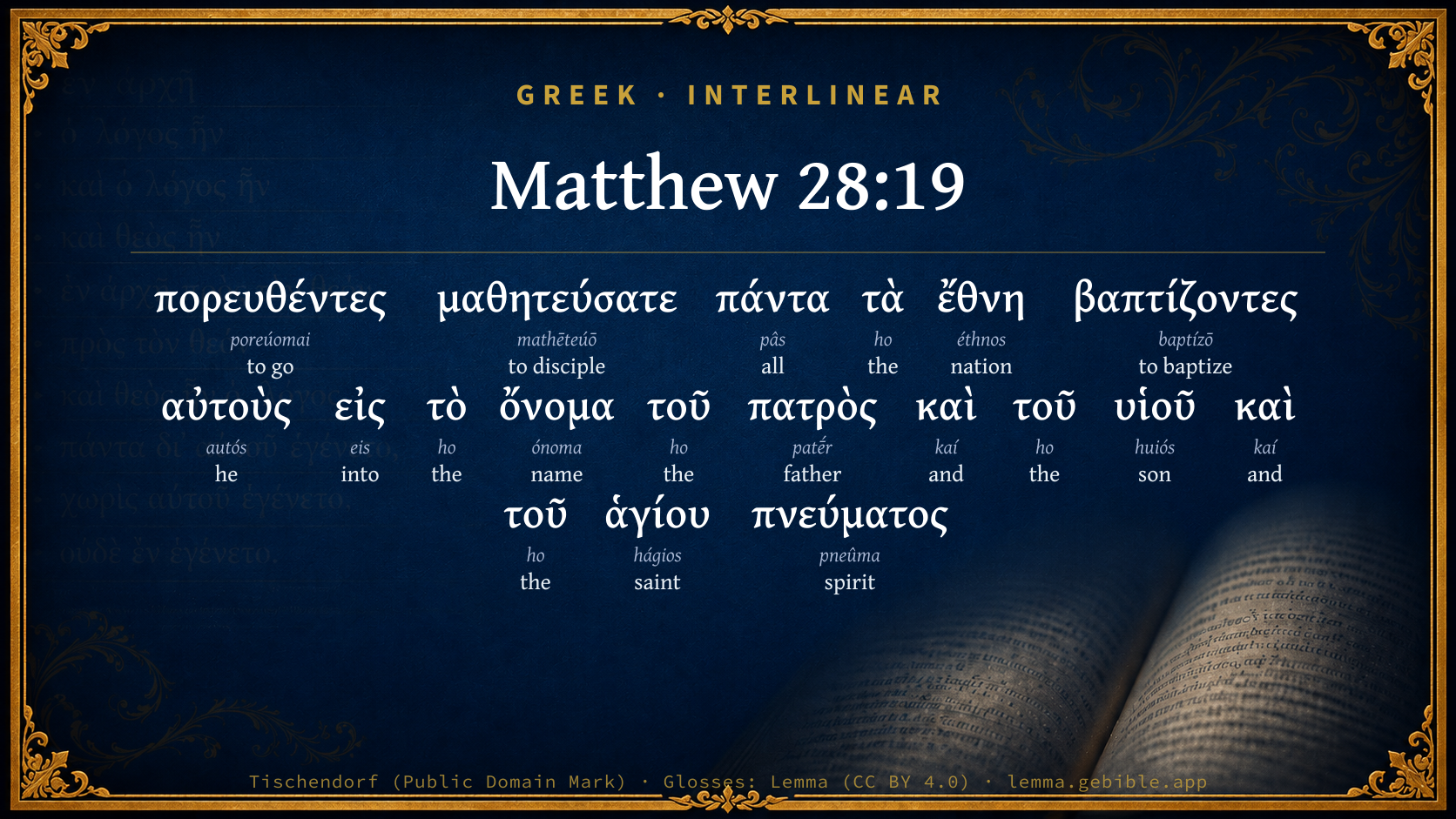
  1. πορευθέντες poreúomai G4198 “to go” Verb, Aorist, Passive deponent, Participle, Nominative, Plural, Masculine
  2. πάντα pâs G3956 “all” Adjective, Accusative, Plural, Neuter
  3. τὰ ho G3588 “the” Article, Accusative, Plural, Neuter
  4. ἔθνη éthnos G1484 “nation” Noun, Accusative, Plural, Neuter
  5. βαπτίζοντες baptízō G907 “to baptize” Verb, Present, Active, Participle, Nominative, Plural, Masculine
  6. αὐτοὺς autós G846 “he” Personal pronoun, Accusative, Plural, Masculine
  7. εἰς eis G1519 “into” Preposition
  8. τὸ ho G3588 “the” Article, Accusative, Singular, Neuter
  9. ὄνομα ónoma G3686 “name” Noun, Accusative, Singular, Neuter
  10. τοῦ ho G3588 “the” Article, Genitive, Singular, Masculine
  11. πατρὸς patḗr G3962 “father” Noun, Genitive, Singular, Masculine
  12. καὶ kaí G2532 “and” Conjunction
  13. τοῦ ho G3588 “the” Article, Genitive, Singular, Masculine
  14. υἱοῦ huiós G5207 “son” Noun, Genitive, Singular, Masculine
  15. καὶ kaí G2532 “and” Conjunction
  16. τοῦ ho G3588 “the” Article, Genitive, Singular, Neuter
  17. ἁγίου hágios G40 “saint” Adjective, Genitive, Singular, Neuter
  18. πνεύματος pneûma G4151 “spirit” Noun, Genitive, Singular, Neuter

About this verse

These counts appear in no published source. They are computed here, from the morphology-tagged text and Lemma’s own curated glosses. What Lemma adds →

19
words
14
distinct lemmas
Gospels
section

Notable vocabulary

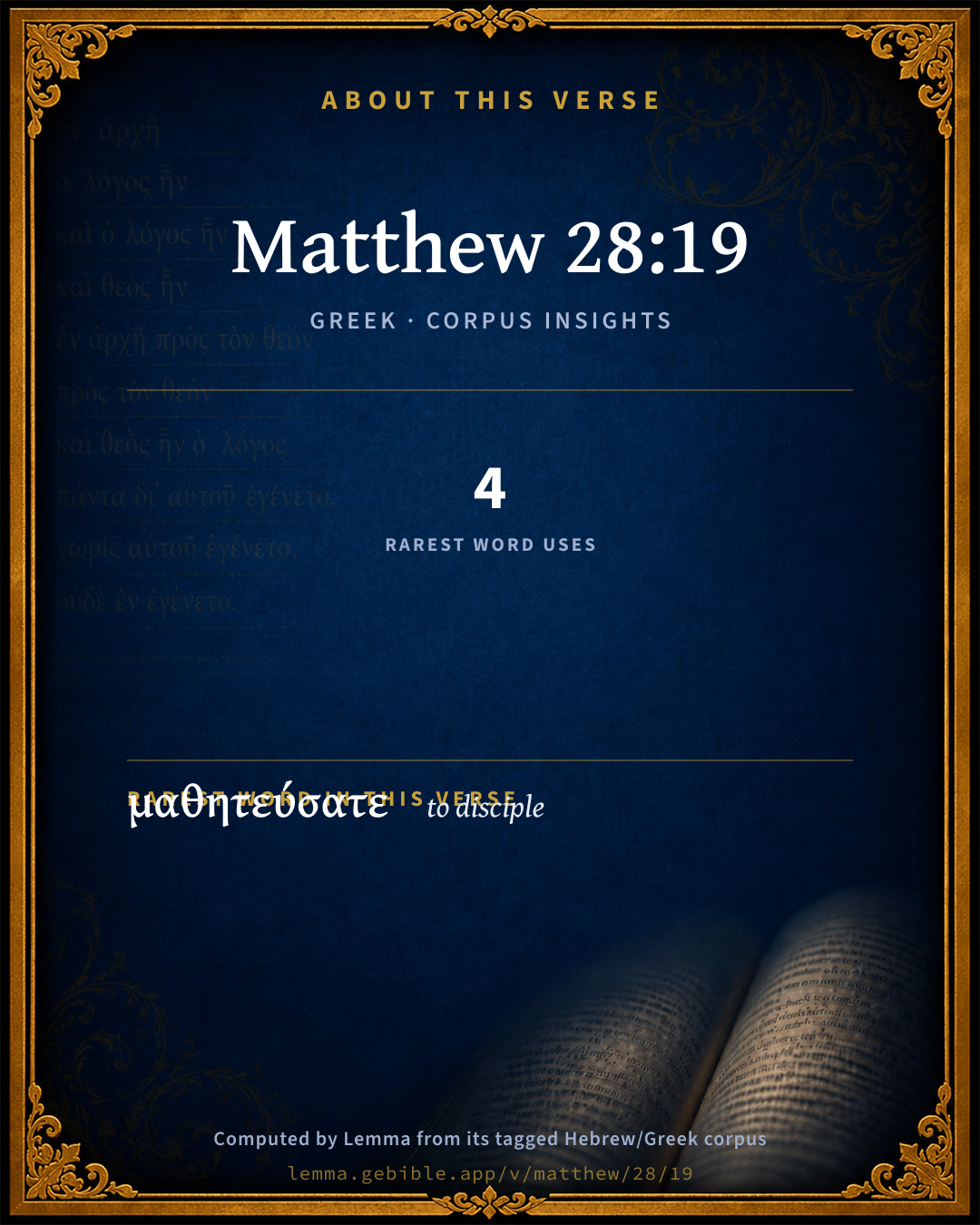
The rarest word here is μαθητεύσατε to disciple G3100 — appearing just 4 times in the whole Greek New Testament.

Shared distinctive vocabulary

μαθητεύσατε to disciple G3100 occurs in 4 verses of the Greek New Testament. Also found in:

Repetition

Words recur within this verse:

Cross-references

37

Topical passages linked to Matthew 28:19 in the Treasury of Scripture Knowledge — connected by theme and wording, ordered by reader-vote popularity; previews shown in the World English Bible.

  • Mark 16:15–16 He said to them, "Go into all the world, and preach the Gospel to the whole creation.
  • Acts 2:38–39 Peter said to them, "Repent, and be baptized, everyone of you, in the name of Jesus Christ for the forgiveness of sins, and you will receive the gift of the Holy Spirit.
  • Acts 1:8 But you will receive power when the Holy Spirit has come upon you. You will be witnesses to me in Jerusalem, in all Judea and Samaria, and to the uttermost parts of the earth."
  • Luke 24:47–48 and that repentance and remission of sins should be preached in his name to all the nations, beginning at Jerusalem.
  • Acts 19:3–5 He said, "Into what then were you baptized?" They said, "Into John's baptism."
  • Isaiah 49:6 yes, he says, It is too light a thing that you should be my servant to raise up the tribes of Jacob, and to restore the preserved of Israel: I will also give you for a light to the Gentiles, that you may be my salvation to the end of the earth.
  • Galatians 3:27 For as many of you as were baptized into Christ have put on Christ.
  • Acts 13:46–47 Paul and Barnabas spoke out boldly, and said, "It was necessary that God's word should be spoken to you first. Since indeed you thrust it from you, and judge yourselves unworthy of eternal life, behold, we turn to the Gentiles.
  • Acts 10:47–48 "Can any man forbid the water, that these who have received the Holy Spirit as well as we should not be baptized?"
  • Romans 6:3–4 Or don't you know that all we who were baptized into Christ Jesus were baptized into his death?
  • Matthew 3:16–17 Jesus, when he was baptized, went up directly from the water: and behold, the heavens were opened to him. He saw the Spirit of God descending as a dove, and coming on him.
  • Romans 10:18 But I say, didn't they hear? Yes, most assuredly, "Their sound went out into all the earth, Their words to the ends of the world."
  • Ephesians 2:18 For through him we both have our access in one Spirit to the Father.
  • Acts 8:12–16 But when they believed Philip preaching good news concerning the Kingdom of God and the name of Jesus Christ, they were baptized, both men and women.
  • Acts 2:41 Then those who gladly received his word were baptized. There were added that day about three thousand souls.
  • Acts 28:28 "Be it known therefore to you, that the salvation of God is sent to the Gentiles. They will also listen."
  • 1 Peter 3:21 This is a symbol of baptism, which now saves you-- not the putting away of the filth of the flesh, but the answer of a good conscience toward God, through the resurrection of Jesus Christ,
  • Acts 8:36–38 As they went on the way, they came to some water, and the eunuch said, "Behold, here is water. What is keeping me from being baptized?"
  • Isaiah 66:18–19 For I [know] their works and their thoughts: [the time] comes, that I will gather all nations and languages; and they shall come, and shall see my glory.
  • Numbers 6:24–27 'Yahweh bless you, and keep you.
  • Genesis 1:26 God said, "Let us make man in our image, after our likeness: and let them have dominion over the fish of the sea, and over the birds of the sky, and over the cattle, and over all the earth, and over every creeping thing that creeps on the earth."
  • Isaiah 48:16 Come you near to me, hear you this; from the beginning I have not spoken in secret; from the time that it was, there am I: and now the Lord Yahweh has sent me, and his Spirit.
  • Isaiah 52:10 Yahweh has made bare his holy arm in the eyes of all the nations; and all the ends of the earth have seen the salvation of our God.
  • Psalms 98:2–3 Yahweh has made known his salvation. He has openly shown his righteousness in the sight of the nations.
  • Acts 14:21 When they had preached the Gospel to that city, and had made many disciples, they returned to Lystra, Iconium, and Antioch,
  • 1 Corinthians 15:29 Or else what will they do who are baptized for the dead? If the dead aren't raised at all, why then are they baptized for the dead?
  • Isaiah 42:1–4 Behold, my servant, whom I uphold; my chosen, in whom my soul delights: I have put my Spirit on him; he will bring forth justice to the Gentiles.
  • Acts 9:18 Immediately something like scales fell from his eyes, and he received his sight. He arose and was baptized.
  • Psalms 22:27–28 All the ends of the earth shall remember and turn to Yahweh. All the relatives of the nations shall worship before you.
  • Revelation 1:4–6 John, to the seven assemblies that are in Asia: Grace to you and peace, from God, who is and who was and who is to come; and from the seven Spirits who are before his throne;
  • Acts 16:15–33 When she and her household were baptized, she begged us, saying, "If you have judged me to be faithful to the Lord, come into my house, and stay." So she persuaded us.
  • 1 Corinthians 1:13–16 Is Christ divided? Was Paul crucified for you? Or were you baptized into the name of Paul?
  • 1 Corinthians 12:4–6 Now there are various kinds of gifts, but the same Spirit.
  • 2 Corinthians 13:14 The grace of the Lord Jesus Christ, the love of God, and the communion of the Holy Spirit, be with you all. Amen.
  • Colossians 1:23 if it is so that you continue in the faith, grounded and steadfast, and not moved away from the hope of the Gospel which you heard, which is being proclaimed in all creation under heaven; of which I, Paul, was made a servant.
  • 1 John 5:7 For there are three who testify:
  • Matthew 13:52 He said to them, "Therefore, every scribe who has been made a disciple in the Kingdom of Heaven is like a man who is a householder, who brings out of his treasure new and old things."

Cross-references courtesy of OpenBible.info (CC BY 4.0).

Commentary

Notes on Matthew 28:19 from classic Christian and Jewish commentators (each source and its license shown beneath its notes). The classic Christian expositions comment on the surrounding passage and are grouped to its opening verse, so a note may address several verses; the Jewish commentaries on the Tanakh (Rashi and others) are per-verse, so they appear only where the commentator wrote on this verse.

Lemma curates 59 commentaries, every one of them public domain or Creative Commons licensed, each selected and text-cleaned for this edition rather than reprinted as found. About our sources →

The Biblical Illustrator

Joseph S. Exell

Mat_28:19

Go ye, therefore, and teach all nations.

A plea for missions

There are many lessons in these words.

1. A lesson as to the result of death. Some thought that death had taken all power from Christ. They that follow Christ as well as the Master are not robbed by death; but on the other side of it they say, Power is given unto me in heaven and in earth.

2. The reward of labour. The reward of toil is a call to a wider task, to conquer the world for Christ.

3. The cure of doubt. But some doubted. And Jesus said, Go ye, and preach the gospel.

I. The largeness of the Saviours purpose-GO ye, and teach all nations. What an amplitude there is in the gaze of Christ. What a reach in His merciful design. Calvary has not robbed Him of His love. With the freshness of the resurrection power upon Him, He bids men to look at mankind and conquer the world for Him. Our hearts are wofully small, and the little heart projects its littleness into everything at which it looks. From this littleness of hope and faith lift up yourself to the dream of the Saviour. His eye has never rested upon the man of whom He despaired.

II. The lowly methods which Christ adopts-go ye, therefore. The instrumentality is weak only in our conception of it. Christ knows what the gospel will effect. Christ is a true force, and can touch the heart. He knows the power of the cross in its very gentleness. He chose men to preach it. He knew the weakness of the twelve; He also knew the power there is in each one of us; He knew the power of sympathy to enter the soul.

III. The encouragements to obey the Saviours call-All power is given unto Me. Lo, I am with you always. Error says, All power is given unto me. Sin, death, say the same. But truth says, All power is given unto Christ. All things work together on behalf of the gospel.

IV. How this charge has been obeyed. (R. Glover.)

Each church contributing to the mission-plan of God

It has been a constant joy to me that from year to year this church has been one of its affluents; and as the Amazon does not disdain any side-stream which rolls its treasure into the bosom of that ocean river, so every single church, every sidestream, is not disdained that rolls its golden sands into this great movement which is the river of God that is fertilizing the whole globe. (H. W. Beecher.)

The work of the Church

I. The nature of the work which Christ has entrusted to His Church.

1. Work of spiritual enlightenment.

2. Work of ingathering into His Church. Manifold, yet one. Let us arouse ourselves to the duty of gathering all suitable persons into its fellowship.

3. Work of incitement to holiness. As holiness is characteristic of God, so it ought to be of His people. Thus the work is rapidly sketched by the Redeemer.

II. The extent of the work Christ has committed to His Church. Christs preaching prepared the way for the doctrine of universal brotherhood. No people, near or remote, are to be neglected. This distinguishes Christianity from all other systems of religion. It is not let them come if they will and receive the gospel, but go forth, leave all, and proclaim the gospel, etc.

III. The encouragements to the work which Christ has entrusted to His Church. There are many discouragements in the execution of this commission. The kings of the earth have set themselves together, etc.

1. The power of Christ. We have might as well as right on our side.

2. The presence of Christ. (A. A. Southerns.)

I. A great truth was revealed-All power, etc.

II. A great trust was imparted.

1. They were to make disciples of all nations.

2. They were to administer the ordinance of Christian Baptism.

3. They were to instruct their converts in the mind and will of the great Master and Saviour. Who is sufficient for these things?

III. A great promise. (J. R. Thompson.)

The great commission

I. the nature of the command.

1. It gives authority for missionary undertakings.

2. Obedience to it is a test of a disciples love.

3. Connected with the Saviours promise-I am with you.

4. It is binding until Jesus comes again.

II. What encouragement is derived from it?

1. Encouragement as to Gods purposes concerning our fallen world.

2. That human instrumentality is appointed for the furtherance of Gods purposes.

3. This explains the opposition we meet with in doing Gods work: Satan is the god of this world.

4. We may reckon on our Masters sympathy.

5. We have a certain hope of final success. (W. Cadman, M. A.)

The great commission

A church, even of five hundred, represented by eleven unknown and inexperienced workmen, looked a very poor engine with which to convert the world, but the least thing became a mighty thing in the service of a mighty agent.

I. The first point to be considered in this great charter of missionary enterprize was that the churchs missionary work reposed upon Christs elevation to supreme command.

1. On the eve of His mortal shame, when His feelings seemed to lie at the lowest, He still knew that the Father had given all things into His hands; and after the resurrection, within a few days of His ascension, He claimed it as a gift given to His crowned mediatorship-all power in heaven and in earth. The sphere in which He had been thus constituted rightful Master was the whole universe; as stated by the eloquent apostle, it extended far above all principalities, and powers, etc. It is on this universal range of lawful control held now by Jesus in virtue of His office, that the world-wide missionary activity of His Church depends. Christs rule was the basis of their mission. It was only when He was on the point of ascending to the throne above the heavens that He revoked His former restriction, which was, Go not into the way of the Gentiles, and into any city of the Samaritans enter ye not; but now, in the room of that revoked restriction, He issued His commission to His ambassadors in the widest terms, Go ye now and convert all the nations. This gave the legal authorization to their missionary enterprize, justifying the missionary in setting aside the edicts of magistrates, and braving their threats of persecution.

2. What was the work to which Jesus committed His Church in this authoritative fashion? The word translated teach in the text would read better disciple; the apostles were to be the representation to other men in other lands of that same spiritual process which had passed upon themselves. The two processes which made up conversion were discriminated as baptizing and teaching. Christ first brought His disciples to that point at which they were willing to accept Him by a public profession and a symbolic sacrament, and then built up their Christian life in knowledge and service. What he had done for them He desired them to do for others. To do the work of baptizing and teaching required a combination of qualities which were very rarely blended in a single character. It was necessary to combine enthusiasm with patience, faith with labour; the former for the first, the latter for the second, stage in the Christianizing process. In the glorious warfare in which we are engaged there is room for every temperament. All are soldiers.

II. The churchs missionary success depends upon the spiritual support and presence of the Lord Jesus.

1. The results of mission labour ought to be less discouraging than they sometimes seem to be. The friends of missions are too prone to credit the disparaging representations made by their enemies. They speak of this great enterprize, more than they need do, in a tone of apology.

2. We are living near the beginning of what might be called the third great missionary era-and what might prove to be the last age of Christian propagandism.

3. The conversion of the world is the task for which the Church of this country has girt itself. Much has already been accomplished, and on the ground of natural likelihood alone-to say nothing at all of Divine promises-the conversion of the world to Christianity began to appear to the candid eye of an onlooker but a mere question of time.

4. The promised presence of Christ has not failed.

5. Let us throw ourselves with new heart and soul into this most cheering and hopeful of all enterprizes. (J. Oswald Dykes, D. D.)

The great command

The command to teach all nations implies-

1. That Christianity is a universal religion; not merely one of the religions of the world from which, with others, we, in this later day, are to select an eclectic or universal religion.

2. That it is adapted to all nations and all classes (Rom_1:6), a claim which history has abundantly justified, but which was urged by early opponents as a conclusive objection to 2:3. That not a natural development, but obedience to the principles inculcated by Jesus Christ, constitutes the secret of true civilization among all nations, and thus that Christian missions are the mother of civilization.

4. That from all nations the members of Christs Church triumphant are to be gathered to God by obedience to this commission. (L. Abbott.)

The great commission

I. The time of it, or the occasion and circumstances under which it was given.

II. The obligation of it, or the authority by which it is enforced.

III. The extent of it, or the sphere of its operation.

IV. The nature of it, or the message to be communicated. (A. L. R. Foote.)

The false and the true universalism

This incident-the concluding one of Christs earthly sojourn-is extremely valuable, among other reasons, as bringing forward what may be called the universal element in Christianity. There is a false universalism, and dangerous as false, and common, too, as dangerous. How to meet it? Not, surely, by running into an opposite extreme of exclusiveness, but by exhibiting the true universalism. For there is a valid universalism in the gospel, and what is it? Not Christ in every man-which is the latest form of error in this matter-but Christ for every man. Not Christ at the root of human nature, in some inexplicable way, waiting only to be developed, but Christ at the root of the gospel, waiting only to be received by a simple faith. (A. L. R. Foote.)

Practical missionary zeal

The heathen are perishing; they are dying by millions without Christ, and Christs last commandment to us is, Go ye, teach all nations: are you obeying it? I cannot go, says one, I have a family and many ties to bind me at home, My dear brother, then, I ask you, Are you going as far as you can? Do you travel to the utmost length of the providential tether which has fastened you where you are? Can you say Yes? Then, what are you doing to help others to go? As I was thinking over this discourse, I reflected how very little we were most of us doing towards sending the gospel abroad. We are, as a church, doing a fair share for our heathen at home, and I rejoice at the thought of it; but how much a year do you each give to foreign missions? I wish you would put down in your pocket-book how much you give per annum for missions, and then calculate how much per cent. It is of your income. There let it stand-Item: Gave to the collection last April … ls. One shilling a year towards the salvation of the world! Perhaps it will run thus-Item: Income, £5000; annual subscription to mission, £12 How does that look? I cannot read your hearts, but I could read your pocket-books and work a sum in proportion. I suggest that you do it yourselves, while I also take a look at my own expenditure. Let us all see what more can be done for the spread of the Redeemers kingdom. (C. H. Spurgeon.)

The slow progress of Christianity

Now one of the laws which God has arranged, and which He observes is this-the higher the form of life, the longer it is in coming to the fulness of its power, to maturity and perfection. For instance, a child continues helpless longer, and takes far more time and care to rear and train than does the offspring of any one of the lower animals. It is even so among these lower animals themselves, for the lion has a longer infancy than the sheep, and the sagacious elephant than either. Take, again, a more abstract illustration. For example, how rapidly does a mans physical life grow and develop compared with his mental or moral. So, too, with society: shops grow faster than schools, and a nation, as our own has done, may progress in a most marked manner in the region of politics or commerce, and yet, like our own again, lag sadly behind in the matter of education. Besides, how much more is education than the diffusion of information or the quickening of intelligence? Is there not the difficult task of upbuilding character, and, alas! how marked often is the discrepancy between the intellectual standard and the moral tone? Thus the law runs: the higher the goal to be gained or the good to be sought, the slower is the race or the individual in its pursuit, the longer in its attainment. In the light of this law, we at once see that it is just what might be expected, that Christianity, as the highest possible form or principle of life, should be, speaking of it as a whole, the most gradual in its progress and realization, and, further, that it is according to all nature and analogy that Christianity, as the grandest and most delicate order of life, should be at once the most sensitive to the unfavourable touch of man, as well as the soonest subject to the prejudicial effects of his mistakes or defects. (J. T. Stannard.)

Baptizing them.-

Christian baptism

I. The command-to make disciples of all nations.

1. They preached the gospel.

2. They baptized the proselytes.

(1) Proselytes were baptized without delay-that same day (Act_2:41; Act_8:26; Act_8:40).

(2) They administered baptism with water. This was symbolical of the renewing influences of the Holy Ghost.

(3) Apostolic baptism was administered in the Name of the Father, the Son, and the Holy Ghost.

3. The apostles taught the baptized persons to observe all things whatsoever Christ had commanded them.

II. The encouragement. Lo, I am with you, etc.

1. This encouragement was intended primarily and especially for the apostles.

2. It was intended also for all other ministers and teachers in every age.

(1) Ministers still need the gracious assurance of their Lord.

(2) Baptism teaches parents what things they should teach their children. (H. March.)

Significance of the form of baptism

I. This form of baptizing in the name Of the Father, the Son, and the Holy Ghost may refer to their authority as giving rise to this institution.

II. It may refer to the whole scheme of Christian doctrine, which centres in the discoveries that are made us concerning the sacred Three.

III. It refers to the distinct dedication to Father, Son, and Holy Ghost, that is required as to all that are baptized, which the ancients reckoned to be signified by the triune immersion that was commonly used among them. (Edward Calamy.)

The form of baptism

I. By being baptized in the name of God, can be meant no less than entering into covenant with a person, as God; professing faith in Him as such; enlisting ones self into His service; and vowing all obedience and submission to Him.

II. What has Scripture revealed at large concerning the Divinity of the three names into which we are baptized?

1. Concerning the Divinity of the Father there is no dispute.

2. Divine titles are given to the Son in Holy Scripture.

3. The Holy Spirit is described as the immediate author and worker of miracles. The very same things are said in different places of Scripture of all the three Divine Persons, and the very same actions are ascribed to them.

III. What interest have we in the doctrine of the Trinity?

1. Many regard this as a speculative doctrine only.

2. Our religion is founded upon it. For what is Christianity but a manifestation of the three Divine persons, as engaged in the great work of mans redemption, begun, continued, and to be ended by them, in their several relations of Father, Son, and Holy Ghost; Creator, Redeemer, and Sanctifier, Three Persons, One God? If there be no Son of God, where is our Redemption? If there be no Holy Spirit, where is our sanctification? Without both, where is our salvation? (Bishop Horne.)

Christian baptism

Baptism is a religious rite, which was generally practised before our Saviour instituted it; for the Gentiles, in their solemn acts of devotion, made use of sprinkling and ablutions, and the Jews baptized all proselytes to their religion. To explain this part of our religion we must consider-

I. What that belief is which qualifies persons for baptism.

II. What is the end and design of baptism.

III. What is meant by being baptized in the Name of the Father, the Son, and the Holy Ghost.

IV. How baptism is to be performed. (J. Jortin.)

In the name of the Father, and of the Son, and of the Holy Ghost.-

The doctrine of the Trinity practically considered

I. Let me remind you that the scriptural Trinity implies that God is one. The trinity of our faith means a distinction of persons within one common indivisible Divine nature. It implies, therefore, at its base, that the Divine nature is one and indivisible. For this reason God revealed the essential oneness of His being first; and it was only after many centuries that Jesus could disclose to His disciples the name of the Father, and of the Son, and of the Holy Ghost. On polytheistic soil no such revelation could have been intelligible; it was to monotheistic Israel that it was made. The new revelation of a Trinity in God left quite unaltered the faith of the apostles that God is one. What is the chief spiritual benefit which we derive from the knowledge of the unity of God? It is the only religious basis for a moral law of perfect and unwavering righteousness. Rival gods, who care each for his own separate interests, and for no other, must neglect moral law in pursuit of their partial ends. You have no central power raised above the contention of inconsistent passions, whose only care is to make for righteousness and the common weal. Throughout the Old Testament there runs a stern denial of all secondary divinities, stern insistence upon one only true God, to whose single will all the wide fields of creation lie subject, and all the nations of men. The single will is righteous. It is the sole source of law; religion becomes the basis of virtue. Thus the Christian doctrine of the Trinity has preserved to us in undiminished power all the moral advantages which Hebrew religion drew from its revelation of the one God.

II. What religious advantage do we reap from the fresh christian discovery of a trinity within this unity of the divine nature?

1. The doctrine of the Trinity has heightened and enriched our conception of the nature of God. Such a Trinity as this leaves room in the Divine nature for the play of such moral affections as would be quite impossible to a mere single or solitary divinity. The lonely Deity whom human intellect, untaught by revelation, is able to fabricate for itself, is one utterly without passion or love till He has externalized Himself m a created world. The outcome of this is pantheism.

2. It affords a basis for those gracious relations which it has pleased God to sustain towards us in the economy of our salvation. These are facts of experience. (J. O. Dykes, D. D.)

The mystery of the most blessed Trinity

I. Is the greatest homage of faith.

1. By believing in this mystery we believe in the most incomprehensible of all mysteries, and consequently, we pay God the greatest homage. For I can have no sublimer conception of God than by professing Him absolutely incomprehensible. What else do we know respecting this adorable mystery but that we know nothing?

2. We sacrifice to God the noblest faculty of our nature, our intellect, by believing a mystery, of which we could not have the least idea, before God revealed it to us.

II. Is the most solid ground of our hope. Without faith, no salvation. The most necessary article of faith is the belief in the most blessed Trinity. No one can be saved, except he knows and believes

(1) that there are three Persons in one God; and

(2) that the second Divine Person became man for us.

III. Is the most urgent motive of charity.

1. It is the bond of brotherly love-keeping the unity of the Spirit, etc. (Eph_4:1).

2. It is the model of brotherly love (Joh_17:11; Psa_132:1). Peroration: Oh, most adorable Trinity, unite us in this world, that we may be united in heaven, etc. (Bourdalone.)

The doctrine of the Trinity considered in relation to practical religion

Let us see what simple facts are apparent in this revelation of God, and what service they may render to us in real life.

I. The father

1. He is the Creator of all things. As such He reveals His wisdom, etc.

2. He is the preserver of all things.

3. He is King of all, bending all to His will, and overruling all by His providence.

4. He is in a peculiar sense the Parent of His spiritual family.

II. The Son. God with us. This is a revelation of the humanity of God, and serves great purposes. It helps us to know and love God, and makes the redemption of man possible.

III. The Holy Ghost. God within us. His presence is proved by its fruits (Gal_5:22-23). (W. F. Adeney, M. A.)

The distinctions in the Godhead

Divine revelation makes known to us one living and true God, and prohibits all worship being paid to any being except Jehovah. But the phraseology employed obviously presents the one Jehovah under certain distinctions, involving the idea of a plurality in the Godhead. This distinction has been generally denominated the Trinity-Father, Son, and Holy Ghost. The doctrine has been controverted in all ages, and numerous are the theories which men have endeavoured to maintain on this deeply profound, and confessedly difficult subject.

I. It is obvious that a threefold distinction in Deity is not impossible. We have many symbols of this in nature: the sun-the light and heat thereof; man-body, soul, and spirit.

II. The Old Testament writings lead us to this conclusion (Gen_2:22; Gen_2:7; Num_6:24; Psa_14:6; Psa_41:7; Psa_110:1; Psa_136:1-3; 2Sa_23:3; Isa_6:8; Isa_42:1; Isa_48:16; Isa_59:19-20).

III. The writings of the New Testament exhibit this triune distinction (Mat_3:16-17; Joh_14:16; Joh_15:26; Act_1:4-5; Act_5:30-35; Act_10:38; Act_20:27; Act_02:28; Rom_5:5-6).

IV. The Divine works are ascribed to each of the triune persons.

1. Creation.

2. Inspiration.

3. Holiness.

4. Raising the dead.

V. That the essential titles and attributes are given to Father, Son, and Holy Spirit.

1. Eternity.

2. Omnipresence.

3. Omniscience.

4. Power.

5. Wisdom.

Observations:

1. With what reverence and profound veneration we should study the nature and character of God. How awfully sublime is the theme-how utterly incompetent we must be to find it out to perfection- how essentially requisite holy fear and humility of mind in its investigation.

2. We should labour to ascertain the connection between the Divine Persons in the Godhead in the exercise of devotion and worship. We are to come to God through the Son and by the Holy Spirit. We are thus, also, to praise God, and to pray to Him. The Father is chiefly the object of worship, Christ is the way, and by the Spirit we worship Him in spirit and in truth. God our Father-God our Redeemer-God our Comforter and Guide.

3. Divine honours are to be equally given to Father, Son, and Holy Ghost. Let us labour to attain and enjoy love of the Father, the grace of the Lord Jesus Christ, and the fellowship and communion of the Holy Spirit. (J. Burns, LL. D.)

Threefold manifestation of Deity

Although we shall never again paint the Almighty as Giotto painted Him, as an old man with white hair in the clouds, with a young man at His side, and a dove flying from beneath His feet; and whilst we shall never again describe God as Athanasius described Him, yet the doctrine of a Trinity in Unity is fundamental, and rests on an impregnable basis. The Unity, the Humanity, and the Affinity or Immanent Deity, these are the root conceptions of all true theology, and these remain. The conception of variety in unity, the many and the one, pervades all life and nature, and is presented to us in man in a trinity of body, mind, and spirit. So Trinity in Unity is in God a diversity of manifestation or function, combined with a unity of life and purpose. We can hardly think of the Almighty in any other way. It is the normal order of thought metaphysically. Let us see. First, our conception of God is vague and indefinite: Creative Force pervading, correlating, co-ordinating all things everywhere. It is the All-Father, the First Person. But the instant we think more closely, our only definite conception proves insensibly anthropomorphic. All power, wisdom, intelligence, love, is, in some sort, human, manifested and transferred to God, but still human in nature and thought; and thus, the Ideal Man, the God under the limitations of humanity, steps forth. This would be so in the order of thought were there no figure of Jesus in history. We cannot but-we always have made God in our own image, God the Son, or the Second Person. But in prayer and worship He is apprehended as a Spirit only, in communion, in sympathy with ours; then He is God the Holy Ghost, or the Third Person. God the Vague, God the Definite, God the Immanent, that is the inexorable order of thought, and that is the eternal doctrine of the Trinity in Unity. This would be true whether we call ourselves Christians or not. But if you are a Christian, you believe in addition that the Ideal Humanity of God has once in all time been realized, and realized in Jesus. You believe that the eternally human side of God-which was before the Life Divine in Galilee, and will be for ever after it, the life-giving and the love-giving One-that all of Him which could become incarnate did become incarnate-came forth and dwelt amongst us as it has never before or since; that then and there, in the fulness of time, amongst the chosen people and in the holy land 1,900 years ago, a special use of human nature was made for a special purpose, and that we beheld His glory, the glory as of the Only-begotten of the Father, full of grace and truth. (H. B. Haweis, M. A.)

The mystery of the Trinity

The Father, Son, and Holy Ghost-three distinct Persons: in the Name, not names-one essence. The Holy Ghost is called the finger of God, Christ the hand of the Father. Now, as the finger is in the hand, and the hand on the body, so of one and the same most pure and simple essence is the Father, Son, and Spirit. But, as it was reported of Alanus, when he promised his auditory to discourse the next Sunday more clearly of the Trinity, and to make plain that mystery; while he was studying the point by the seaside, he spied a boy very busy with a little spoon, trudging often between the sea and a small hole he had digged in the ground. Alanus asked him what he meant to do. The boy answered, I intend to bring all the sea into this pit. Alanus replies, Why dost thou attempt such impossibilities, and mis-spend thy time? The boy answered, So dost thou, Alanus: I shall as soon bring all the sea into this hole, as thou bring all the knowledge of the Trinity into thy head. All is equally possible we have begun together, we shall finish together; save that of the two my labour hath more hope and possibility of taking effect. I conclude with, It is rashness to search, godliness to believe, safeness to preach, and eternal blessedness to know the Trinity; yet let us know to praise the Trinity in the words of the Church: Glory be to the Father, etc. And let all answer, As it was … Amen. (T. Adams.)

Doctrine of the Trinity: God a mystery to man

You have seen a steam threshing-machine at work. You know perhaps how the steam acts upon the machinery, and sets the wheels in motion; but does the little insect that settles on the engine know what you know? Could it be taught? Well, when we try to understand the great God, we are like the fly trying to understand the engine. The being of God is a mystery to us; that is, it is something which we cannot understand. Man is a mystery to a dog or a horse. We can no more hope to understand how God is what He is than a dog or a horse can understand what man is, or what speech and thought and memory are. (J. E. Vernon, M. A.)

Belief in the Trinity not against reason though beyond it

Though I cannot explain this mystery to you, I think I can show you in nature certain figures whereby we may get some idea of how true the mystery is, though it is beyond our understanding. If I were to shut the window of a room, and cut a slit in the shutter, and put into the slit a piece of glass called a prism, you would see on the wall on the other side of the room a streak of red, yellow, and blue light. If I take the piece of glass away, there is only a streak of white light. Now learned men have found out that all pure white light is made up of red, yellow, and blue light; and by that piece of glass a ray of light can always be separated into the parts which make it up. Now, the red ray is light, the yellow ray is light, the blue ray is light. But the three together make up only one ray of light. Then, again. In your own self you have an image of the Trinity. You are made up of spirit, and soul, and body. Your spirit thinks, it prays, and you say, I think, I pray. Your spirit is you. If anything pains your body, you say, I am in pain, speaking now of your body as yourself. Again, your soul is moved by some passion, fear, or love. You speak of your soul as yourself, and say, I fear, or I love. Well, here there is the spirit you, the body you, and the soul you; and yet you are not three different creatures, but you body, soul, and spirit, make up one being, called man. Take another illustration. You know the florin, or two-shilling piece, has a cross of shields on one side. In the corners of that cross are flowers or plants. In the first and fourth are roses, the badge of England. In the second is the thistle, the badge of Scotland. In the third is a little cluster of clover leaves. The clover leaf, called in Ireland the shamrock, is the badge of Ireland. I will tell you how the Irish obtained the clover leaf as their badge. Long ago, when the Irish were heathens, there came to their shores St. Patrick, to teach them the true Catholic faith. He was brought to the king, and he spoke before him of the religion of Christ. The king listened attentively. But when St. Patrick began to tell him that there was but one God, and yet in that Godhead there were Three Persons, the king stopped him, saying, I do not understand you. You say the Father is God? Yes. And you say that the Son is God. Yes. And you say that the Holy Ghost is God? Yes. Then, said the king, there must be three Gods. St. Patrick, instead of answering, stooped down and picked a little clover leaf which grew at his feet. The clover leaf, as you know, is made up of three little leaves, joined together by a slim stalk, so that the three leaves make only one leaf. St. Patrick held up only one division of the leaf, and said, This is a leaf? Yes, said the king. He showed the second division of the leaf, and said, This is a leaf? Yes, said the king. He showed the third, saying the same words, and receiving the same reply. Then he held up the whole leaf by its long stalk before the king, and asked, What is this? It is a leaf, replied the king. So learn from a humble plant the mystery of the Trinity, said the saint. Now all this does not make us any more able to understand the mystery of the Holy Trinity; but it at least shows us that, although it is above our reason, it is not contrary to our reason to believe that God is Three Persons and yet but One God. (J. E. Vernon, M. A.)

The mystery of the Trinity

An ancient writer informs us that when the Egyptians named their greatest God who was over all, they cried thrice, Darkness! Darkness! Darkness! In the name of the Father-Darkness; and of the Son-Darkness; and of the Holy Ghost-Darkness! for, however much the mind may strive to penetrate this mystery, it can never attain to its solution. Just as the eye, looking at the sun, sees the overpowering light as a dark ball, being dazzled by its excessive glory, so the eye of the mind perceives only darkness when looking into the infinite splendour of God in Three Persons. We may, indeed, see sundry likenesses here on earth which assist us in believing the doctrine of the Holy Trinity; but they are helps, and helps only, not explanations. Thus, the sun may shine into a glass, and the glass reflect in clear water, and we see three suns-a sun in the heavens, a sun in the glass, and a sun in the water; and this assists us to understand how the Son of God is of the Father, and the Holy Ghost is of the Father and of the Son, and how that each is God, and yet that there are not Three Gods but One God. But, after all, the doctrine of the Holy Trinity is a matter of faith, and not of reason. We must believe, though we cannot understand. (S. Baring Gould.)

Mystery no bar to conviction

Sitting lately, says one, in a public room at Brighton, where an infidel was haranguing the company upon the absurdities of the Christian religion, I could not but be pleased to see how easily his reasoning pride was put to shame. He quoted those passages, I and My Father are one; I in them, and Thou in Me; and that there are Three Persons in One God. Finding his auditors not disposed to applaud his blasphemy, he turned to one gentleman, and said, with an oath, Do you believe Such nonsense? The gentleman replied, Tell me how that candle burns. Why, he answered, the tallow, the cotton, and the atmospheric air, produce the light. Then they make one light, do they not? Yes. Will you tell me how they are one in the other, and yet but one light? No, I cannot. But you believe it? He could not say but that he did. The company instantly made the application, by smiling at his folly; upon which the conversation was changed. This may remind the young and inexperienced that if they believe only what they can explain, they may as well part with their senses; for they are surrounded by the wonderful works of God, whose ways are past finding out.

The Biblical Illustrator, edited by Joseph S. Exell (c. 1880s–1900s) — public domain. Text from a community e-Sword module.

Joseph Benson's Commentary

Mat 28:19. Go ye therefore, and teach — Greek, μαθητευσατε, disciple, or make disciples of, or, as Dr. Doddridge renders it, proselyte all nations. This includes the whole design of Christ’s commission. Baptizing and teaching are the two great branches of that general design: and these were to be determined by the circumstances of things; which made it necessary, in baptizing adult Jews or heathen, to teach them before they were baptized; in disciplining their children, to baptize them before they were taught, as the Jewish children in all ages were first circumcised, and after taught to do all God had commanded them. It must be observed, that the word rendered teaching, in the next verse, (namely, διδασκοντες,) though in our translation confounded with the word used in this verse, yet is a word of a very different sense: and properly implies instructing, which the word used in this verse does not necessarily imply, but, as has been observed, merely to proselyte, or make disciples. The argument, therefore, that some draw from this verse, as if our Lord enjoined all to be taught before they were to be baptized, is without foundation. Our Lord’s words, taken together, in both verses, distinctly enjoin three things, and that in the following order, μαθητευειν, βαρτιζειν, διδασκειν, that is, to proselyte men to Christ, to baptize, and to teach them. It is true, however, that adult persons, before they can be made Christ’s disciples, or be proselyted, must be instructed and brought to believe the great essential truths of Christianity, and even to profess their faith in them. But the case is different with infants, who may be admitted to baptism, as the children of the Jews were to the rite of circumcision, and be instructed afterward. And, as Dr. Doddridge justly observes, if Christ had sent out these missionaries to propagate Judaism in the world, he might have used the same, or similar language: “Go and proselyte all nations, circumcising them in the name of the God of Israel, and teaching them to observe all that Moses commanded.” The whole tenor of the succeeding books of the New Testament shows, that Christ designed, by this commission, that the gospel should be preached to all mankind without exception; not only to the Jews, but to the idolatrous Gentiles: but the prejudices of the apostles led them, at first, to mistake the sense of it, and to imagine that it referred only to their going to preach the gospel to the Jews among all nations, or to those who should be willing to become Jews.

Baptizing them in the name of the Father, &c. — Concerning the general nature of baptism, see note on Mat 3:6. But we are here instructed respecting the appropriation of this institution to the Christian dispensation, in its most complete form. The apostles, and their successors in the ministry of the word, are ordered to baptize those whom they made Christ’s disciples, εις το ονομα, into the name, (not names,) of the Father, Son, and Holy Ghost — Words which have been considered, in all ages of the Christian Church, as a most decisive proof of the doctrine of the Trinity; implying not only the proper personality and Deity of the Father, but also those of the Son and of the Holy Spirit. For it would be absurd to suppose that either a mere creature, or a mere quality, or mode of existence of the Deity, should be joined with the Father in the one name into which all Christians are baptized. “To be baptized into the name of any one implies a professed dependance on him, and devoted subjection to him; to be baptized, therefore, into the name of the Father, and of the Son, and of the Holy Ghost, implies a professed dependance on these three divine persons, jointly and equally, and a devoting of ourselves to them as worshippers and servants. This is proper and obvious, upon the supposition of the mysterious unity of three coequal persons in the unity of the Godhead; but not to be accounted for upon any other principles.” — Scott. “Our Lord,” says Mr. Fletcher, “enjoining us to be equally baptized in the name (equally consecrated to the service) of the Father, of the Son, and of the Holy Ghost, teaches us to honour the Son as we honour the Father, and to honour the Holy Ghost as we do the Son; and when the Socinians assert that the Son is a mere man, they indirectly tell us, that he is as improperly joined with the Father to be the great object of our faith in baptism, as a taper would improperly be joined with the sun to enlighten the universe. And when they represent the Holy Ghost as a mere power, and a power whereby we must not now hope to be influenced, they might as well tell us, that he is as unfit to have a place among the — Three who bear record in heaven; as their power of motion, or the energy of their minds, would be absurdly mentioned as parties in a contract, where their names and persons are particularly specified. — Thus, they take from us the two Comforters, with whom we are particularly blessed under the gospel. If we believe them, the one is a mere man, who cannot hear us; and the other is a mere property, or an unconscious energy, by which we shall be no way benefited, and as insensible to our faith as to our unbelief: and when our Lord bids all nations to be baptized in the name of the Father, and of the Son, and of the Holy Ghost, (if the word Son do not mean the proper Son of God; if it mean only, the son of the carpenter, Joseph, and if the Holy Ghost be only the Father’s energy, and an energy whereby we can neither be quickened nor comforted,) this gospel charter is far more extraordinary than would be the royal patents by which gentlemen are created lords, if they all began thus: Be it enacted, in the name, or by the supreme authority, of King George the Third, of Josiah the carpenter’s son, and of the royal power or energy, that A.B., Esq., be numbered among the peers of the realm. Such is the wisdom displayed by philosophers, who call the divinity of the Son the leading corruption of Christianity, and who pretend to reform all the Reformed Churches!” See his Works, vol. 9. p. 26, octavo edit. Though perhaps, we ought not to assert that the use of these very words is essential to Christian baptism, yet surely, as Dr. Doddridge observes, “the expression must intimate the necessity of some distinct regard to each of the Sacred Three, which is always to be maintained in the administration of this ordinance; and consequently it must imply, that more was said to those of whose baptism we read in the Acts than is there recorded, before they were admitted to it. The Christian Church, in succeeding ages, has acted a wise and safe part in retaining these words; and they contain so strong an intimation that each of these persons is properly called God, and that worship is to be paid, and glory ascribed to each, that I cannot but hope they will be a means of maintaining the belief of the one, and the practice of the other, among the generality of Christians, to the end of the world.”

Joseph Benson's Commentary on the Old and New Testaments (1811–1818) — public domain. Text from a community e-Sword module.

Tyndale Open Study Notes

Tyndale Open Resources

28:19 go and: Literally going, a participle that supports the main imperative, make disciples. Matthew probably intended go to be understood as a separate command (as it is translated) and not as a circumstantial modifier (i.e., while you go; cp. the same construction in 9:6; Acts 10:20). • make disciples: A disciple is one who repents of sin, trusts in Jesus for salvation, and obeys his teachings. • all the nations: The mission to the Gentile nations formally began here (see Matt 10:5-6; 15:24; see also 1:1; 2:1-12; 8:5-13; 21:43; 24:14; 26:13). • Two aspects of making disciples are baptizing and teaching (28:20).. Baptism indicates public identification with, and surrender to, Jesus and the work he has done for salvation (see 3:13-17; 10:32-33; 20:28; 26:28; Acts 2:38; Rom 6:1-11; 1 Pet 3:21). • In the name of means entrance into a relationship and its benefits, which come to those who truly believe. • Father . . . Son . . . Holy Spirit: This is a formulaic expression for the nature of God as a trinity (see also 1 Cor 12:4-6; 2 Cor 13:14; Eph 4:4-6; 2 Thes 2:13-14; 1 Pet 1:2; Rev 1:4-6).

Tyndale Open Study Notes — © Tyndale Open Resources, licensed CC BY-SA 4.0. Text via the HelloAO Bible API.

Bengel's Gnomon

Johann Albrecht Bengel

Mat 28:19. [1232] Πορευθέντες οὖν, κτλ., go ye therefore, etc.) This injunction, to go forth, presupposes the waiting for the Paraclete mentioned in Luk 24:49. It is the sum of the Acts, which may with that view be profitably compared with the Gospels, the sum of which is “all things whatsoever I have commanded.”—μαθητεύσατε—βαπτίζοντες, discipulize—baptizing) The verb, μαθητεύειν, signifies to make disciples; it includes baptism and teaching; cf. Joh 4:1, with the present passage.—αὐτούς, them) sc. τὰ ἔθνη, the nations, a synthesis[1233] of frequent occurrence; see ch. Mat 25:32, etc. The Jews who had been already brought into covenant with God by circumcision, were to be baptised in the name of Jesus Christ, and to receive the gift of the Holy Ghost; see Act 2:38. It is plainly commanded by these words of Institution, that the Gentiles should be baptized “In the name of the Father, and of the Son, and of the Holy Ghost;” they had been altogether aliens from God; see Gnomon on Eph 3:6, and cf. Gnomon on Act 11:21. The Gentiles, mentioned in Acts 10 were not altogether ignorant of the God of Israel, nor altogether aliens from Him. The Jews, who had once acknowledged Jesus Christ to be the Son of God, could not but by that very act acknowledge the Father of our Lord Jesus Christ, and the Spirit of the Son.—εἰς τὸ ὄνομα, κ.τ.λ., into the name, etc.[1234]) This formula of Baptism is most solemn and important; in fact it embraces the sum of all piety.[1235] After our Lord’s resurrection, the mystery of the Holy Trinity was most clearly revealed, together with the relations of the Divine Persons to each other and to us (see Gnomon on Rom 8:9); and since the confession of the Holy Trinity was so closely interwoven with Baptism, it is not to be wondered at, that it is not frequently put thus expressly in the Scriptures of the New Testament.

[1232] The Saviour, when brought back from the dead, very frequently enjoined upon His Apostles the office of preaching the Gospel (Joh 20:21; Joh 21:15). The Evangelists, therefore, might present a summary of such injunctions, according as this or that opportunity presented itself. Matthew connects this summary with His appearance in Galilee; Luke records it after that appearing, ch. Mat 24:49, nay, at Jerusalem, up to and upon the day of His ascension. Comp. Act 1:2, etc. And we may conjecture the same as to Mark, from ch. Mat 16:15; Mat 16:19.—Harm., p. 612.

[1233] The word synthesis is not used here in its logical or mathematical sense, but as a technico-grammatical term, representing the figure otherwise called synesis; i.e. a joining together of words with respect to the idea conveyed, and not to the word by which it is expressed: see Riddle in vocc. In the present passage τὰ ἔθνη, the nations, are neuter and aggregate; αὐτούς, them, masculine and individual. This is Bengel’s meaning.—(I. B.)

[1234] Engl. Vers. “In the name.—(I. B.)

[1235] At the baptism of Christ Jesus Himself, the Father, the Son, and the Holy Ghost manifested themselves [cf. Gnomon on ch. Mat 3:16-17]. The entire Sum of Saving knowledge and doctrine is bound up with Baptism: and all the Ancient Creeds and Confessions of Faith are, in fact, a Periphrasis and Working-out [Ausführung, rendered by E. B. ἐξεργασία] of this incomparably momentous Formula of Baptism.—B. G. V.

Bengel's Gnomon of the New Testament — English translation (T&T Clark, Edinburgh, 1860) — public domain. Text from a community e-Sword module.

Meyer's Critical & Exegetical Commentary

Heinrich August Wilhelm Meyer

Mat_28:19 The οὖν of the Received text (see the critical remarks) is a gloss correctly representing the connection of the thoughts. The fact stated in Mat_28:18 is itself the reason why all nations should be brought under His government, and made subject to His sway by means of the μαθητεύειν, etc.

μαθητεύσατε] make them my μαθηταί (Joh_4:1); comp. Mat_13:52; Act_14:21. This transitive use of the verb is not met with in classical Greek. Observe how here every one who becomes a believer is conceived of as standing to Christ in the personal relation of a μαθητής, in accordance with which view the term came to be applied to Christians generally.

πάντα τὰ ἔθνη] all nations without exception, Mat_25:32, Mat_24:14, Mat_26:13. With these wordsand this is the new feature in the present instructionsthe previous prohibition, Mat_10:5, was cancelled, and the apostolic mission declared to be a mission to the whole world. On this occasion Jesus makes no mention of any particular condition on which Gentiles were to be admitted into the church, says nothing about whether it was or was not necessary that they should in the first instance become Jewish proselytes (Act_15:1; Gal_2:1), though He certainly meant that it was not necessary; and hence, because of this omission, the difficulty which the apostles had at first about directly and unconditionally admitting the Gentiles. If this latter circumstance had been borne in mind, it could hardly have been asserted, as it has been, that the special revelation from heaven, for the purpose of removing the scruples in question, Acts 10, tells against the authenticity of the commission recorded in our passage (in answer to Credner, Einleit. I. p. 203; Strauss, Keim).

βαπτίζοντες, κ.τ.λ.] in which the μαθητεύειν is to be consummated, not something that must be done after the μαθητεύσατε (Hofmann, Schriftbew. II. 2, p. 164; comp. also, on the other hand, Theod. Schott, p. 18), as though our passage ran thus, μαθητεύσαντες … βαπτίζετε. Besides, that the phrase βαπτίζοντες κ.τ.λ. did not require in every case the performance of the ceremony by the apostles themselves, was distinctly manifest to them in the discharge of their functions even from the first (Act_2:41). Comp. also 1Co_1:17.

βαπτίζειν εἰς] means to baptize with reference to. The particular object to which the baptism has reference is to be gathered from the context. See on Rom_6:3, and thereon Fritzsche, I. p. 359; comp. also on 1Co_10:2. Here, where the βαπτίζειν εἰς τὸ ὄνομα is regarded as that through which the μαθητεύειν is operated, and through which, accordingly, the introduction into spiritual fellowship with, and ethical dependence upon Christ is brought about, it must be understood as denoting that by baptism the believer passes into that new phase of life in which he accepts the name of the Father (of Christ) and of the Son and of the Holy Spirit as the sum of his creed and confession, τὸ ὄνομα, because it is precisely the name of him who is confessed that expresses his whole specific relation considered by itself, and with reference to him who confesses, and accordingly the three names, Father, Son, and Spirit, are to be understood as expressing the sum-total of the distinctive confession which the individual to be baptized is to accept as his both now and for all time coming.[42] Consequently the Corinthians were not baptized εἰς τὸ ὄνομα Παύλου (1Co_1:13), because it was not the name Paul, but the name Christ, that was to constitute the sum of their creed and their confession. For a similar reason, when the Samaritans circumcised, they did so לשם הל גדיזים (see Schöttgen on the passage), because the name Gerizim represented the specific point in their distintive creed and confession (their shibboleth). The dedication of the believer to the Father, etc., is of course to be regarded as practically taking place in the course of the ΒΑΠΤΊΖΕΙΝ ΕἸς ΤῸ ὌΝΟΜΑ Κ.Τ.Λ.; for though this is not directly intimated by the words themselves (in opposition to Hofmann, Schriftbew. II. 2, p. 163; Thomasius, Chr. Pers. u. Werk, III. 2, p. 12), it is implied in the act of baptism, and could have been expressed by the simple use of εἰς (without ΤῸ ὌΝΟΜΑ), as in 1Co_10:2; Rom_6:3; Gal_3:27. Further, ΕἸς ΤῸ ὌΝΟΜΑ is not to be taken as equivalent to ΕἸς ΤῸ ὈΝΟΜΆΖΕΙΝ (Francke in the Sächs. Stud. 1846, p. 11 ff.), as though the meaning of the baptism consisted merely in calling God the Father, Christ the Son, and the Spirit the Holy Spirit. Such a view certainly could not apply in the last-mentioned case, for, like Father and Son, ΤῸ ΠΝΕῦΜΑ ἍΓΙΟΝ must be understood to be a specifically Christian designation of the Spirit, ΤῸ ὌΝΟΜΑ is rather intended to indicate the essential nature of the Persons or Beings to whom the baptism has reference, that nature being revealed in the gospel, then expressed in the name of each Person respectively, and finally made the subject of the Christians confession and creed. Finally, in opposition to the utterly erroneous view of Bindseil (in the Stud. u. Krit. 1832, p. 410 ff.), that ΒΑΠΤΊΖΕΙΝ ΕἸς ΤῸ ὌΝΟΜΑ means: to lead to the adoption of the name through baptism, i.e. to get the person who is to be baptized to call himself after the particular name or names in question, see Fritzsche as above. But as for the view of Weisse (Evangelienfr. p. 186 f.) and of Volkmar, p. 629, as well, that Christs commission to baptize is entirely unhistorical, it is only of a piece with their denial of the actual bodily resurrection of Jesus. Ewald, too (Gesch. d. Apost. Zeit. p. 180), is disposed to trace the origin of the commission to the inner world of a later apostolic consciousness.

It is a mistake to speak of our passage as the formula of baptism;[43] for Jesus is not to be understood as merely repeating the words that were to be employed on baptismal occasions (and accordingly no trace of any such use of the words is found in the apostolic age; comp. on the contrary, the simple expression: βαπτίζειν εἰς Χριστόν, Rom_6:3; Gal_3:27; ΒΑΠΤΊΖΕΙΝ ΕἸς ΤῸ ὌΝΟΜΑ, Χ., Act_8:16, and ἘΠῚ Τῷ ὈΝΌΜ. Χ., Act_2:38), but as indicating the particular aim and meaning of the act of baptism. See Reiche, de baptism, orig., etc., 1816, p. 141 ff. The formula of baptism (for it was so styled as early as the time of Tertullian, de bapt. 13), which in its strictly literal sense has no bearing whatever upon the essence of the sacrament (Höfling, I. p. 40 ff.), was constructed out of the words of the text at a subsequent period (see already Justin, Ap. 1:61), as was also the case, at a still later period, with regard to the baptismal confession of the three articles (see Köllner, Symbol. d. Luth. K. p. 14 ff.). There is therefore nothing here to justify those who question the genuineness of our passage (Teller, Exc. 2, ad Burnet de fide et officiis Christianorum, 1786, p. 262; see, on the other hand, Beckhaus, Aechth. d. s. g. Taufformel, 1794), or those who of late have doubted its originality, at least in the form in which it has come down to us (Strauss, Bruno Bauer, de Wette, Wittichen in the Jahrb. f. D. Theol. 1862, p. 336; Hilgenfeld, Volkmar, Scholten, Keim), and that because, forsooth, they have professed to see in it a ὕστερον πρότερον. Exception has been taken, again, partly to the ΠΆΝΤΑ ΤᾺ ἜΘΝΗ, though it is just in these words that we find the broader and more comprehensive spirit that characterized, as might be expected, our Lords farewell commission, and partly to the studied summary (de Wette) of the New Testament doctrine of the Trinity. But surely if there was one time more than another when careful reflection was called for, it was now, when, in the course of this calm and solemn address, the risen Redeemer was endeavouring to seize the whole essence of the Christian faith in its three great leading elements as represented by the three substantially co-equal persons of the Godhead with a view to its being adopted as a constant ΣΗΜΕῖΟΝ to be used by the disciples when they went forth to proclaim the gospel (Chrysostom: ΠᾶΣΑΝ ΣΎΝΤΟΜΟΝ ΔΙΔΑΣΚΑΛΊΑΝ ἘΓΧΕῚΡΗΣΑς ΤῊΝ ΔΙᾺ ΤΟῦ ΒΑΠΤΊΣΜΑΤΟς). The conjecture put forward by Keim, III. p. 286 f., that Jesus instituted baptismthough without any specific reference to all nationson the night of the last supper, to serve the purpose of a second visible sign of His continued fellowship with the church after His departure from the world, is inadmissible, because there is no trace of this in the text, and because, had such a contemporaneous institution of the two sacraments taken place, it would have made so deep an impression that it could never have been forgotten, to say nothing of the impossibility of reconciling such a view with Joh_4:1 f.

[42] Had Jesus used the words τὰ ὀνόματα instead of τὸ ὄνομα, then, however much He may have intended the names of three distinct persons to be understood, He would still have been liable to be misapprehended, for it might have been supposed that the plural was meant to refer to the various names of each separate person. The singular points to the specific name assigned in the text to each of the three respectively, so that εἰς τὸ ὄνομα is, of course, to be understood both before τοῦ υἱοῦ and τοῦ ἁυίου πνεύματος; comp. Rev_14:1 : τὸ ὄνομα αὐτοῦ καὶ τὸ ὄνομα τοῦ πατρὸς αὐτοῦ. We must beware of making any such dogmatic use of the singular as to employ it as an argument either for (Basilides, Jerome, Theophylact) or against (the Sabellians) the orthodox doctrine of the Trinity. We should be equally on our guard against the view of Gess, who holds that Christ abstained from using the words of God the Father, etc., because he considers the designation God to belong to the Son and the Holy Spirit as well. Such a dogmatic idea was not at all likely to be present to His mind upon an occasion of leave-taking like the present, any more than was the thing itself on which the idea is supposed to be based, for He was never known to claim the name ειός either for Himself or for the Holy Spirit. Still the New Testament, i.e. the Subordinatian, view of the Trinity as constituting the summary of the Christian creed and confession lies at the root of this whole phraseology.Observe, further, that the baptismal formula: in nomine, and: in the name, rests entirely on a mistranslation on the part of the Itala and Vulgate, so that there is accordingly no ground for the idea, adopted from the older expositors, that the person who baptizes acts as Christs representative (Sengelmann in the Zeitschr. f. Protestantism. 1856, p. 341 ff.), neither is this view countenanced by Act_10:48. Tertullian (de bapt. 13) gives the correct rendering in nomen, though as early as the time of Cyprian (Ep. lxxiii. 5) in nomine is met with. The practice of dipping three times dates very far back (being vouched for even by Tertullian), but cannot be traced to the apostolic age.

[43] It is no less erroneous to suppose that our passage represents the first institution of baptism. For long before this the disciples had been baptizing in obedience to the instructions of Jesus, as may be seen from Joh_4:1 f., where baptism by the disciples is spoken of as tantamount to baptism by Jesus Himself, and where again there is as little reason to suppose the mere continuation of the baptism of John to be meant as there is in the case of our present passage (Joh_3:5). In the passage before us we have the same commission as that just referred to, only with this difference, that it is now extended so as to apply to all nations. This at once disposes of the question as to whether baptism should not occupy merely a secondary place as a sacrament (Laufs in the Stud. u. Krit. 1858, p. 215 ff.). Comp. also, on the other hand, 1Co_10:1-3, where there is an unmistakeable reference to baptism and the Lords Supper as the two great and equally important sacraments of the Christian church. Of these two, however, it is clearly not the Lords Supper, but baptism, on which the greatest stress is laid as forming the divine constituent factor in the work of redemption, and that above all in the Epistles of Paul, in which the only instance of anything like a full treatment of the subject of the Lords Supper is that of First Corinthians, and even then it is of a somewhat incidental character.

Meyer — Critical and Exegetical Commentary on the New Testament — English translation by Peter Christie, edited by Frederick Crombie (T&T Clark, 1880) — public domain. Text from a community e-Sword module.

Expositor's Greek Testament

ed. W. Robertson Nicoll

Mat 28:19 . πορευθέντες οὖν : the οὖν omitted in many texts aptly expresses the connection. The commission to the Apostles arises out of the power claimed = all power has been given to me on earth, go ye therefore , and make the power a reality. μαθητεύσατε πάντα τὰ ἔθνη : make disciples (act., cf. at Mat 27:57 ) of all the nations ( cf. Mat 10:5 , “go not into the way of the Gentiles”). βαπτίσαντες : baptism the condition of discipleship = make disciples by baptising; the sole condition, circumcision, and everything particularistic or Judaistic tacitly negatived. Christian baptism referred to here only in this Gospel. αὐτοὺς refers to ἔθνη , a constr. ad sensum , as in Act 15:17 ; Rom 2:14 . In the anabaptist controversy αὐτοὺς was taken by the opponents of infant baptism as referring to μαθητὰς in μαθητεύσατε , and the verb was held to mean “teach”. For some references to this extinct controversy vide Wetstein, ad loc. , and Hermann’s Viger , p. 61. εἰς τὸ ὄνομα , into the name, i.e. , as confessing the name which embodies the essence of the Christian creed. τοῦ πατρὸς , etc.: it is the name not of one but of three, forming a baptismal Trinity Father, Son, and Holy Ghost. It is not said into the names of, etc., nor into the name of the Father, and the name of the Son, and the name of the Holy Ghost. Hence might be deduced the idea of a Trinity constituting at the same time a Divine Unity. But this would probably be reading more into the words han was intended.

The Expositor's Greek Testament, edited by W. Robertson Nicoll (1897–1910) — public domain. Text from a community e-Sword module.

Geneva Bible (1599)

Geneva Bible translators

The sum of the Apostleship is, the publishing of the doctrine received of Christ throughout all the world, and the ministering of the Sacraments: the efficacy of which things hangeth not of the ministers, but of the Lord.

Calling upon the name of the Father, the Son, and the holy Ghost.

Geneva Bible (1599) marginal notes — public domain. Text via Bolls.life.

Jamieson, Fausset & Brown

Robert Jamieson, A. R. Fausset & David Brown

Go ye therefore, and teach all nations--rather, "make disciples of all nations"; for "teaching," in the more usual sense of that word, comes in afterwards, and is expressed by a different term.

baptizing them in the name of the Father, and of the Son, and of the Holy Ghost--It should be, "into the name"; as in Co1 10:2, "And were all baptized unto (or rather 'into') Moses"; and Gal 3:27, "For as many of you as have been baptized into Christ."

Jamieson, Fausset & Brown — Commentary Critical and Explanatory on the Whole Bible (1871) — public domain (CC PDM 1.0). Text via the HelloAO Bible API.

Adam Clarke's Commentary

Verse 19. Go ye therefore] Because I have the authority aforesaid, and can send whomsoever I will to do whatsoever I please: - teach, μαθητευσατε, make disciples of all nations, bring them to an acquaintance with God who bought them, and then baptize them in the name of the Father. It is natural to suppose that adults were the first subjects of baptism; for as the Gospel was, in a peculiar manner, sent to the Gentiles, they must hear and receive it, before they could be expected to renounce their old prejudices and idolatries, and come into the bonds of the Christian covenant. But, certainly, no argument can be drawn from this concession against the baptism of children. When the Gentiles and Jews had received the faith and blessings of the Gospel, it is natural enough to suppose they should wish to get their children incorporated with the visible Church of Christ; especially if, as many pious and learned men have believed, baptism succeeded to circumcision, which I think has never yet been disproved. The apostles knew well that the Jews not only circumcised the children of proselytes, but also baptized them; and as they now received a commission to teach and proselyte all the nations, and baptize them in the name of the holy Trinity, they must necessarily understand that infants were included: nor could they, the custom of their country being considered, have understood our Lord differently, unless he had, in the most express terms, said that they were not to baptize children, which neither he nor his apostles ever did. And as to the objection, that the baptized were obliged to profess their faith, and that, therefore, only adults should be baptized, there is no weight at all in it; because what is spoken of such refers to those who, only at that period of life, heard the Gospel, and were not born of parents who had been Christians; therefore they could not have been baptized into the Christian faith, forasmuch as no such faith was at their infancy preached in the world. That the children and even infants, of proselytes, were baptized among the Jews, and reputed, in consequence, clean, and partakers of the blessings of the covenant, see proved at large by Wetstein, in his note on Mt 3:16. See Clarke on Mt 3:6, and particularly See Clarke on Mr 16:16.

In the name of the Father, c.] Baptism, properly speaking, whether administered by dipping or sprinkling, signifies a full and eternal consecration of the person to the service and honour of that Being in whose name it is administered but this consecration can never be made to a creature; therefore the Father, and the Son, and the Holy Spirit, are not creatures. Again, baptism is not made in the name of a quality or attribute of the Divine nature; therefore the Father, and the Son, and the Holy Spirit, are not qualities or attributes of the Divine nature. The orthodox, as they are termed, have generally considered this text as a decisive proof of the doctrine of the holy Trinity: and what else can they draw from it? Is it possible for words to convey a plainer sense than these do? And do they not direct every reader to consider the Father, the Son, and the Holy Spirit, as three distinct persons? "But this I can never believe." I cannot help that - you shall not be persecuted by me for differing from my opinion. I cannot go over to you; I must abide by what I believe to be the meaning of the Scriptures. Dr. Lightfoot has some good thoughts on this commission given to the apostles: -

"I. Christ commands them to go and baptize the nations: but how much time was past before such a journey was taken! And when the time was now come that this work should be begun, Peter doth not enter upon it without a previous admonition given him from heaven. And this was occasioned hereby, that, according to the command of Christ, the Gospel was first to be preached to Judea, Samaria, and Galilee.

"II. He commands them to baptize in the name of the Father, and of the Son, and of the Holy Ghost; but among the Jews, they baptized only in the name of Jesus. See Ac 2:38; Ac 8:16; Ac 19:5. For this reason, that thus the baptizers might assert, and the baptized confess, Jesus to be the true Messias; which was chiefly controverted by the Jews. Of the same nature is that apostolic blessing, Grace and peace from God the Father, and from our Lord Jesus Christ. Where then is the Holy Ghost? He is not excluded, however he be not named. The Jews did more easily consent to the Spirit of the Messias, which they very much celebrate, than to the person of the Messias. Above all others they deny and abjure Jesus of Nazareth. It belonged to the apostles, therefore, the more earnestly to assert Jesus (to be the Messias) by how much the more vehemently they opposed him: which being once cleared, the acknowledging of the Spirit of Christ would be introduced without delay or scruple. Moses, (in Ex 6:14,) going about to reckon up all the tribes of Israel, goes no farther than the tribe of Levi; and takes up with that to which his business and story at that present related. In like manner, the apostles, for the present, baptize in the name of Jesus, and bless in the name of the Father and of Jesus, that thereby they might more firmly establish the doctrine of Jesus, which met with such sharp and virulent opposition; which doctrine being established among them, they would soon agree about the Holy Ghost.

"III. Among the Jews, the controversy was about the true Messias; among the Gentiles, about the true God. It was therefore proper among the Jews to baptize in the name of Jesus, that he might be vindicated to be the true Messias. Among the Gentiles, in the name of the Father, and of the Son, and of the Holy Ghost, that they might be hereby instructed in the doctrine of the true God. - Let this be particularly noted.

"IV. The Jews baptized proselytes into the name of the Father, that is, into the profession of God, whom they called by the name of Father. The apostles baptize the Jews into the name of Jesus the Son, and the Gentiles, into the name of the Father, and of the Son, and of the Holy Ghost.

"V. The Father hath revealed himself in the old covenant; the Son in the new; in human flesh by his miracles, doctrine, resurrection and ascension; the Holy Ghost in his gifts and miracles. Thus the doctrine of the ever blessed Trinity grew by degrees to full maturity. For the arriving to the acknowledgment of which, it was incumbent upon all who professed the true God to be three in one to be baptized into his name." LIGHTFOOT'S Works, vol. ii. p. 274.

Adam Clarke's Commentary on the Bible (1810–1826) — public domain. Text from a community e-Sword/MySword module.

Ellicott's Commentary for English Readers

(19) Teach all nations.—Better, make disciples of all the heathen. The Greek verb is the same as that which is rendered “instructed” in Mat_13:52, and is formed from the noun for “disciple.” The words recognise the principle of a succession in the apostolic office. The disciples, having learnt fully what their Master, their Rabbi, had to teach them, were now to become in their turn, as scribes of the kingdom of heaven, the teachers of others. It is, to say the least, suggestive that in this solemn commission, stress should be laid on the teaching, rather than on what is known as the sacerdotal element, of the Christian ministry; but the inference that that element is altogether excluded requires to be balanced by a careful study of the words of Joh_20:23, which seem at first sight to point in an opposite direction. (See Note on Joh_20:23.)

The words rendered “all nations” are the same as those in Mat_25:32. and, as commonly used by the Jews, would point to the Gentile nations of the world, as distinguished from the people of Israel. They are therefore an emphatic expansion of the commission given in Mat_10:5. And it is every way interesting that this full declaration of the universality of the Gospel should be specially recorded in the Gospel written, as we see throughout, specially for Jews.

Baptizing them in the name of the Father.—We have to deal (1) with the form, (2) with the substance. As regards (1) we have to explain why, with this command so recently given, the baptisms recorded in the Acts (Act_2:38; Act_10:48; Act_19:5), and referred to in the Epistles (Rom_6:3; Gal_3:27). are in (or rather, into) “the name of the Lord Jesus,” or “of Christ.” What has been noted as to the true meaning of the word “nations” seems the best solution of the difficulty which thus presents itself. It was enough for converts from the house of Israel, already of the family of God, to be baptised into the name of Jesus as the Messiah, as the condition of their admission into the Church which He had founded. By that confession they gave a fresh life to doctrines which they had partially received before, and belief in the Father and the Spirit was virtually implied in their belief in Jesus as the incarnate Son. For the heathen the case stood otherwise, They had worshipped “gods many and lords many” (1Co_8:5), had been “without God in the world” (Eph_2:12), and so they had not known the Father. (2) There remains the question, What is meant by being baptised “into a name”? The answer is to be found in the fact so prominent in the Old Testament (e.g. Exo_3:14-15), that the Name of God is a revelation of what He is. Baptism was to be no longer, as it had been in the hands of John as the forerunner, merely a symbol of repentance, but was the token that those who received it were brought into an altogether new relation to Him who was thus revealed to them. The union of the three names in one formula (as in the benediction of 2Co_13:14) is in itself a proof at once of the distinctness and equality of the three Divine Persons. We cannot conceive of a command given to. and adopted by, the universal Church to baptise all its members in the name (not “the names”) of God and a merely human prophet and an impersonal influence or power.

A Bible Commentary for English Readers, edited by Charles John Ellicott (1878–1897) — public domain. Text from a community e-Sword module.

The Cambridge Bible for Schools and Colleges

gen. ed. J. J. S. Perowne

19. therefore] i. e. because Christ hath all power in heaven and earth. The word however is omitted in the leading MSS.

teach] Properly, make disciples of. The same mistranslation occurs Act_14:21, “having taught,” see ch. Mat_13:52, Mat_27:57, where the same word is used. Teaching, Mat_28:20, = “instructing.” “Make disciples of all nations by baptism and by instruction.”

in the name] Rather, into the name. Jewish proselytes were baptized into the name of the Father; Jesus adds the names of the Son and of the Holy Ghost. In the instances of baptism recorded in the Act_2:38; Act_8:16; Act_10:48; Act_19:5, the name of Jesus Christ (or the Lord Jesus) alone occurs in the baptismal formula, but the promise of the Holy Ghost is given (Act_2:38), or the gift of the Holy Ghost follows the rite (Mat_8:17, Mat_19:6), or precedes it (Act_10:44; Act_10:47).

The Cambridge Bible for Schools and Colleges (gen. ed. J. J. S. Perowne; Cambridge University Press, 1878–1918) — public domain. Text from a community e-Sword module.

John Gill's Exposition

Go ye therefore,.... Into all the world; some into one place, and some into another; since his power and authority, and so now the commission he gave them, reached every where: before it was confined to Judea, but now it is extended to all the nations of the world; see Mat 10:6,

and teach all nations; Jews and Gentiles, first the one, and then the other, the doctrines of the Gospel, and the ordinances of it; whatever they had learned from Christ, or were ordered by him, or "disciple all nations": make them disciples by teaching them; or, as the Persic version, by way of explanation, adds, "bring them to my religion and faith": not that they were able to do this of themselves, but they were to teach men externally, or outwardly minister the word, whilst the Spirit of God internally applied it, and taught, and made men true disciples of Christ: and they are such, who have learned to know themselves, their sin, and lost estate by nature; to deny themselves, both sinful and righteous self; who have learnt to know Christ, and the way of righteousness, peace, pardon, life, and salvation by him; and who are taught and enabled to part with all for Christ, and to bear all for his sake, and to believe in him, and give up themselves to him, and follow him whithersoever he goes:

baptizing them; not all nations, for the antecedent to the relative "them", cannot be "all nations"; since , the words for "all nations", are of the neuter gender, whereas "them", is of the masculine: nor can it be thought that it should be the mind of Christ, that all the individuals of all nations should be baptized, as Heathens, Turks, and Jews; but "disciples", supposed and contained in the word "teach", or "make disciples"; such as are taught, and made disciples by teaching, or under the ministry of the word by the Spirit of God: Christ's orders are to "baptize": "dip" them, as Munster's Hebrew Gospel renders it; that is, in water, which, though not expressed, is implied; for with no other baptism could the apostles baptize: not with the Holy Ghost, and with fire; for this was Christ's peculiar prerogative; but with water, which they in obedience to this commission practised, Act 8:36, and which was to be done

in the name of the Father, and of the Son, and of the Holy Ghost; by the authority of these three divine persons, who all appeared, and testified their approbation of the administration of this ordinance, at the baptism of Christ: and as they are to be invocated in it, so the persons baptized not only profess faith in each divine person, but are devoted to their service, and worship, and are laid under obligation to obedience to them, Hence a confirmation of the doctrine of the Trinity, there are three persons, but one name, but one God, into which believers are baptized; and a proof of the true deity both of the Son, and of the Holy Ghost; and that Christ, as the Son of God, is God; since baptism is administered equally in the name of all three, as a religious ordinance, a part of divine instituted worship, which would never be in the name of a creature. This is the first, and indeed the only, place in which the Trinity of persons is expressed in this order, and in the selfsame words. Galatinus (f) pretends, that the ancient Jews used the same way of speaking. It would be well if proof could be made of it: he asserts it to be in Zohar on Deu 6:4, and in the Targum of Jonathan ben Uzziel on Isa 6:3. In the former he says, it is expressed thus, "hear, O Israel; the Lord", he is called "the Father; our God", he is called the Son; "is one Lord", this is "the Holy Ghost", who proceeds from both; and again, by the same R. Simeon, it is said, "holy", this is "the Father"; "holy", this is "the Son"; "holy", this is , "the Holy Ghost": and in the latter after this manner, "Holy Father, Holy Son, and Holy Holy Ghost"; but no such words are now to be found in either of these places. He affirms, that he himself saw a copy of Jonathan's Targum that had these words. The Jews often speak of the Tetragrammaton, or name of four letters, the name Jehovah, which they say is not lawful to be pronounced; and also of the name of twelve letters, which the above writer (g) makes to be "Father, Son, and Holy Ghost"; and of forty two letters, which from a book called Gale Razia, he says is,

"Father God, Son God, Holy Ghost God, three in one, and one in three;''

which in the Hebrew language make up so many letters; but this wants better authority.

(f) L. 2. c. 1. (g) Ib. c. 11, 12. Vid. Buxtorf. Lex. Heb. in voce

John Gill's Exposition of the Whole Bible (1746–1763) — public domain (CC PDM 1.0). Text via the HelloAO Bible API.

Trapp's Complete Commentary

John Trapp

19 Go ye therefore, and teach all nations, baptizing them in the name of the Father, and of the Son, and of the Holy Ghost:

Ver. 19. Go ye therefore] In this my strength, as Gideon did against the Midianites, Jdg 7:13; and though but a barley cake, coarse and contemptible, yet shall ye overthrow the world’s tents, yea, the strongholds of Satan; though you have but lamps and pitchers in your hands, yet shall ye achieve great matters. The apostles were those white horses whereupon the Lord Christ sitting went forth conquering and to conquer. Britannorum inaccessa Romanis loca, Christo patuerunt, saith Tertullian. The Burgundians, much afflicted by the Huns, fled to Christ the God of the Christians; whom, after a long dispute, they determined to be a great God, and a great King above all gods. Sir Francis Drake tells us of twelve martyrs burnt for religion at Lima in Mexico, not two months before his coming thither. And he that set forth New England’s firstfruits, assures us of some of those natives, that being converted to the faith, lived Christianly, and died comfortably.

And teach all nations] Gr. disciple them, μαθητευσατε, Discipulate, make them Christians first, and then teach them to observe, &c., Mat 28:20, as in baptism they have promised; for otherwise it was pity that font water was ever spilt upon their faces. In the kingdom of Congo, in Africa, many different heathens, by the persuasion of the Portugals, arriving there, were content to become Christians, and to be baptized; allowing of the principles of religion, and professing Christ, till the priests pressed them to lead their lives according to their profession; which the most of them in no case enduring, they returned back again to their Gentilism. As for the Spanish converts in Mexico, they so little remember their covenant made with Christ in baptism, that many times they forgot their very names soon after they have been baptized.

Baptizing them into the name of, &c.] That is, consecrating them unto the sincere service of the sacred Trinity, and confirming them by this holy sacrament, in the faith of the forgiveness of their sins, and in the hope of life eternal. This is the end, use, and efficacy of baptism; which, Piscator saith, few of the Fathers rightly understood; those Popish asses certainly did not, who moved this foolish question, An asinus bibens ex baptismo bibat aquam baptismi, et sic asinus dicendus sic baptisatus. {a} Pity but these questionites had been present, when the young scholar reading publicly the fifth of the First of Corinthians for probation sake, at the college of Bamberg, when he came to that passage, Expurgate vetus fermentum, &c. Sicut estis Azymi, he not understanding the word Azymi, unleaven bread, read, Sicut estis asini. The wiser sort of prebendaries (clergy) there present said among themselves, Cum a sapientioribus nolumus huiusmodi audire, a pueris audire cogimur. Children and fools usually tell the truth.

{a} Melancth. apud Manl.

John Trapp, A Commentary or Exposition upon All the Books of the Old and New Testament (1647–1656) — public domain. Text from a community e-Sword module.

Albert Barnes' Notes on the Bible

Go ye therefore - “Because” all power is mine, go! I can defend you. The world is placed under my control. It is redeemed. It is given me in promise by my Father, as the purchase of my death. Though you are weak, yet I am strong! Though you will encounter many troubles and dangers, yet I can defend you! Though you die, yet I live, and the work shall be accomplished!

Teach all nations - The word rendered “teach,” here, is not the one that is usually so translated in the New Testament. This word properly means “to disciple, or to make disciples of.” This was to be done, however, by teaching, and by administering baptism.

All nations - This gracious commission was the foundation of their authority to go to the Gentiles. The Jews had expected that the offers of life under the Messiah would be confined to their own nation. Jesus broke down the partition wall, and commissioned his disciples to go everywhere, and bring the “world” to the knowledge of himself.

Baptizing them - as an emblem of the purifying influences of the Christian religion through the Holy Spirit, and solemnly devoting them to God.

In the name ... - This phrase does not mean, here, “by the authority” of the Father, etc. To be baptized in the name of the Father, etc., is the same as to be baptized “unto” the Father; as to believe on the “name” of Christ is the same as to believe “on Christ,” Joh 1:12; Joh 2:23; Joh 3:18; 1Co 1:13. To be baptized “unto” anyone is publicly to receive and adopt him as a religious teacher or lawgiver; to receive his system of religion. Thus, the Jews were baptized “unto Moses,” 1Co 10:2. That is, they received the system that he taught; they acknowledged him as their lawgiver and teacher. So Paul asks 1Co 1:13, “Were ye baptized in the name of Paul?” - that is, Were you devoted to Paul by this rite? Did you bind yourselves to “him,” and give yourselves away to “him,” or to God? So to be baptized in the name of the Father, or unto the Father, means publicly, by a significant rite, to receive his system of religion; to bind the soul to obey his laws; to be devoted to him; to receive, as the guide and comforter of the life, his instructions, and to trust to his promises. To be baptized unto the Son, in like manner, is to receive him as the Messiah - our Prophet, Priest, and King - to submit to his laws, and to receive him as a Saviour. To be baptized unto the Holy Spirit is to receive him publicly as the Sanctifier, Comforter, and Guide of the soul. The meaning, then, may be thus expressed: Baptizing them unto the Father, Son, and Holy Spirit by a solemn profession of the only true religion, and by a solemn consecration to the service of the sacred Trinity.

The union of these three names in the form of baptism proves that the Son and Holy Spirit are equal with the Father. Nothing would be more absurd or blasphemous than to unite the name of a creature - a man or an angel - with the name of the ever-living God in this solemn rite. If Jesus was a mere man or an angel, as is held by many who deny his divinity, and if the Holy Spirit was a mere “attribute” of God, then it would have been the height of absurdity to use a form like this, or to direct the apostles to baptize people under them. How absurd would be the direction - nay, how blasphemous - to have said, “Baptize them unto God, and unto Paul, and unto the “wisdom or power” of God!” Can we believe that our Saviour would have given a direction so absurd as this? Yet, unless he himself is divine, and the Holy Spirit is divine, Jesus gave a direction substantially the same as this. The form of baptism, therefore, has been always regarded as an unbreakable argument for the doctrine of the Trinity, or that the Son and Holy Spirit are equal with the Father.

Albert Barnes' Notes on the Bible (1834–1885) — public domain. Text from a community e-Sword/MySword module.

Haydock's Catholic Bible Commentary

Teach all nations. In St. Mark we read, going into the whole world, preach to every creature, that is capable of it; not only to the Jews, but to all nations throughout the whole world, baptizing them, &c. The Anabaptists pretend to shew from this place, that not are to be baptized, unless they be first taught and instructed. This is true, as to persons who are already come to an age, in which they are capable of being instructed before their baptism. But according to the tradition and constant doctrine of the Catholic Church, received also by the pretended Reformed Churches, new born children are to be baptized before they are capable of instruction: nor can they enter into the kingdom of heaven without baptism. --- In the name of the Father, &c. We are made Christians in the name of the Father, and of the Son, and of the Holy Ghost: we profess to believe, and hope for our salvation, by believing, hoping, serving, and adoring the same three divine Persons, from whence the Fathers prove the Father, the Son, and the Holy Ghost to be one God, and equal in all perfections. (Witham) --- Had Christ only said, Lo! I am with you all days; it might, in that case, be limited to the natural lives of the apostles; but as He moreover adds, even to the consummation of the world, it must necessarily be extended to their successors in the ministry, till the end of time. (Estius) --- By these words Go, teach, he gives them the power of teaching not only what relates to faith, but also what is necessarily connected with piety and a holy conversation. For we see added a further explanation, teaching them to observe all things whatsoever I have commanded you; which words, beyond all doubt, must be referred to the precepts of a holy life. How egregiously then must those men be deceived, who infer from the words teach all nations, that faith alone will suffice. What follows, baptizing them, shews another part of the pastoral functions, which consists in the administration of the sacraments. Hence also all heretics are refuted, who pretend to affirm that all ecclesiastical ministry consists in barely delivering the world. (Estius, in different location)

George Leo Haydock (1774–1849), Haydock's Catholic Family Bible and Commentary, 1859 edition — public domain. Excludes Psalms (Douay-Rheims chapter numbering differs from Protestant) and Deuterocanonical books (Catholic canon only).

Whedon's Commentary on the Bible

Daniel D. Whedon

19. Go ye therefore — Therefore, that is, because all power is given unto me. Being, as I am now, the fountain of all authority; crowned, as I now am, with a rightful dominion, go forth and win it to a willing subjection by grace. All nations — Both organically and individually. Teach — Literally, Disciple them. And he shows how: First, by baptizing them into the faith, and then teaching. Of course, if they are at responsible age, they must become willing subjects of a true conversion. And a true baptism cannot take place unless the subject be a justified person, either by faith, or, as an infant, without faith. As infants are a large part of all nations, they are to be discipled by baptism, and subsequent teaching as soon as susceptible of it.

Upon this we may remark, 1. That our Lord here adds baptism to the Lord’s Supper as permanent institutes of the Christian Church. He is commissioning his apostles to preach among all nations. He is confirming them in their duty to that effect by a promise that shows that he is commissioning to the end of the world. To the end of the world their commission includes baptism. 2. Baptism, being the first part of the process of disciplining, is the proper initiating rite into the Christian Church. It is to circumcision what the Lord’s Supper is to the passover — the substitution of a milder rite to answer the same purpose. 3. As baptism and the Lord’s Supper are obligatory institutions in the Christian Church, binding upon every individual Christian, so it is the obligation of every Christian to be a member of the visible Church of God. There are those who imagine that they can be good Christians just as well without the Church as in. Such persons are probably self-deceived. They imagine to themselves a religion which does not intend to obey the plain commands of Christ. So far as they are concerned, the ordinances of Christ would perish. The death of Christ would never be commemorated. A piety of so loose a kind is never-likely to save the soul.

In regard to the inclusion of all nations, we may remark that it includes the idea that all nations, and every creature, as another evangelist expresses it, shall be discipled, baptized, and taught. As Christ is a universal Saviour, so his Gospel is framed to be a universal Gospel, and his religion a universal religion. It knows no distinction of race, clime, or colour. It belongs to man, and holds that humanity is a unit; and claiming to be a blessing for all, and to possess a right over all, it designs to spread that blessing and assert that right.

Daniel D. Whedon (gen. ed.), Commentary on the Old and New Testaments (1874–1909) — public domain. Text from a community e-Sword module.

The Pulpit Commentary

Go ye therefore (oun). The illative particle is perhaps spurious, but it is implied by what has preceded. It is because Jesus has plenary authority, and can delegate power to whom he will, that he confers the following commission. He is addressing the eleven apostles, of whom alone St. Matthew makes mention (ver. 16); but as they personally could not execute the grand commission in all its extent and duration, he lays his commands upon their representatives and successors in all ages. They were to go forth, and carry the gospel throughout the world. Doubtless herein is implied the duty of all Christians to be in some sense missionaries, to use their utmost efforts to spread abroad the knowledge of Christ, and to make men obedient to his Law. The propagation of the gospel is a work for all in their several spheres. Teach; docete (Vulgate). These are unfortunate renderings of the verb mayhteusate , which means, "make disciples." Teaching is expressed in ver. 20, as one of the elements or components of full discipleship. The imperative aorist mayhteusate is, as it were, decomposed by the two following present participles, "baptizing" and "teaching." In the case of infants the process is exactly what is here represented; they are admitted into the Christian society by baptism, and then instructed in faith and duty. Adults have to be instructed before baptism; but they form a small minority in most Christian communities, where, generally, infant baptism is the rule, and would be regarded rather as exceptions. Teaching alone is not stated by the Lord to be the only thing necessary to convert an unbeliever into a Christian; this is effected by the grace of God applied as Christ proceeds to explain. All nations (panta ta eynh all the nations). The apostles were no longer to go only to "the lost sheep of the house of Israel"; (Mat_10:6) they were to Christianize all the nations of the world, Jew and Gentile alike. The gospel is adapted to all the varying minds and habits of men, barbarous and civilized, near and remote, ignorant or cultivated; and it is the duty and privilege of Christ"s ministers to make it known and acceptable in all quarters of the globe. Baptizing them; i.e. individuals of all the nations. The present participle denotes the mode of initiation into discipleship. Make them disciples by baptizing them. Christ thus explains his mysterious announcement to Nicodemus, (Joh_3:5) "Except a man be born of water and the Spirit, he cannot enter into the kingdom of God." To the disciples the notion of baptism was no new thing. As a rite typifying the cleansing of the heart and the purpose of leading a new life, it had been long practised in the case of proselytes to the Jewish faith; they had seen it employed by John the Baptist, (Mat_3:6) and had used it themselves. (Joh_4:1, Joh_4:2) Christ adopts the old rite, gives it a new solemnity, a most sacred formula of administration, a new meaning, new spiritual effects. The persons to whom and in whose presence he spoke would understand his injunction as applicable to all who were capable of its reception, children and adults, the subjects of the initiatory ceremony of proselytism. There was no need of closer specification. Or, if any such instruction was needed, the rules concerning circumcision would be a sufficient guide. In (eiv , into) the Name of the Father, and of the Son, and of the Holy Ghost. Our version follows the Vulgate, in nomine, which does not give the right force to the expression. The phrase does not mean merely invoking the Name, under the sanction of the great Name, but something more than this. It signifies into the power and influence of the Holy Trinity, into faith in the three Persons of God, and the duties and privileges consequent on that faith, into the family of God and obedience unto its Head. The "into" shows the end and aim of the consecration of baptism. The "Name" of God is that by which he is known to us that which connotes his being and his attributes, that by which there exists a conscious connection between God and ourselves. (comp. Mat_18:20) So being baptized into the Name of God implies being placed in subjection to and communion with God himself, admitted into covenant with him. It is to be observed that the term is "name," not "names," thus denoting the unity of the Godhead in the trinity of Persons. The Lord"s words have always been taken as the formula of baptism, and have in all ages been used in its administration. The three Divine Persons were revealed at the baptism of Jesus; (Mat_3:16, Mat_3:17) they are invoked at every Christian baptism. It is true that we read, in the early Church, of persons being baptized "in the Name of the Lord Jesus," and "in the Name of the Lord"; (Act_8:16 Act_10:48) but this expression by no means assumes that the names of the other Divine Persons were not used; it denotes that the converts were admitted into the religion which Jesus instituted, in fact, were made Christians. The above formula has from primitive times been considered indispensable for the valid administration of this sacrament (see "Apost. Can.," 41; Tertull., "De Bapt.," 13.; Justin Martyr, "Apol.," 1:79). "From this sacred form of baptism," says Bishop Pearson, "did the Church derive the rule of faith, requiring the profession of belief in the Father, Son, and Holy Ghost, before they could be baptized in their Name" ("On the Creed," art. 1.).

The threefold Name.

"In the Name of the Father, and of the Son, and of the Holy Ghost." Sometimes the Name of the Lord Jesus only is mentioned in the formula. Here our Lord gives one Name with three sounds. Each separate Name giving a distinct relation of the one Being to men. Our Lord did not say, "in the names," but "in the Name." However we may present the threefoldness, we must keep it manifestly consistent with the Divine unity. "The union of the three names in one formula (as in the benediction of 2Co_13:14) is in itself a proof at once of the distinctness and equality of the three Divine Persons." The apostles were to go forth, and disciple all nations, that is, bring them all into the full joy of sonship with God, into which they had themselves been brought; and they were to receive their pledge and seal their sonship by baptizing them into the Name of the Father, and the Son, and the Holy Ghost. The significance of the threefold Name is seen in the light of this recovered sonship of men.

I THE NAME OF THE FATHER, WHO CLAIMS THE SONSHIP. It is the relation to himself in which God set his creatures. They are his children. He designed to give them fatherly care; he expected from them sonlike obedience. Men are sons of God, and they ought to have lived and served like sons. Man"s sin lay in refusing his sonship. But man"s wilfulness could not affect God"s claim. God still demands sonship of every child born in his image.

II THE NAME OF THE SON, WHO SHOWS THE SONSHIP. In his own earth life of trust and obedience. Men who, in their wilfulness, refused their sonship, came at last to lose their sense of sonship; they needed to have the very idea recovered; they needed to see it as an actual realized fact, and that is the meaning of Christ"s living through a Son"s life here on earth.

III THE NAME OF THE HOLY GHOST, WHO WORKS THE SONSHIP. For the sonship must not he a mere external fact, a formal ordering of the conduct and relations. True sonship is a cherished spirit, which finds expression in outward relations. And the Holy Ghost is God working within us, in the spheres of thought, Of motive, and of feeling. He ever freshly inspired the spirit of sonship. One Name God who asks response in sonship. R.T.

The Pulpit Commentary (1880–1919), ed. H.D.M. Spence-Jones & Joseph S. Exell — public domain. Text from a community e-Sword module.

John Wesley's Explanatory Notes

Disciple all nations - Make them my disciples. This includes the whole design of Christ's commission. Baptizing and teaching are the two great branches of that general design. And these were to be determined by the circumstances of things; which made it necessary in baptizing adult Jews or heathens, to teach them before they were baptized; in discipling their children, to baptize them before they were taught; as the Jewish children in all ages were first circumcised, and after taught to do all God had commanded them. Mark xvi, 15.

John Wesley, Explanatory Notes Upon the Whole Bible (1754–1765) — public domain. Text via the GEBible commentary corpus.

Scofield Reference Notes

C. I. Scofield

Go

With the death and resurrection of Jesus Christ begins the "dispensation of the grace of God" Eph 3:2, which is defined as "his kindness toward us through Christ Jesus"; and, "the gift of God: not of works, lest any man should boast." Eph 2:7-9, under grace God freely gives to the believing sinner eternal life Rom 6:23 accounts to him a perfect righteousness; Rom 3:21; Rom 3:22; Rom 4:4; Rom 4:5 and accords to him a perfect position Eph 1:6

The predicted results of this sixth testing of man are

(1) the salvation of all who believe Act 16:31.

(2) judgment upon an unbelieving world and an apostate church. Mat 25:31-46; 2Th 1:7-10; 1Pe 4:17; 1Pe 4:18; Rev 3:15; Rev 3:16.

(1) Man’s state at the beginning of the dispensation of Grace Rom 3:19; Gal 3:22; Eph 2:11; Eph 2:12.

(2) Man’s responsibility under grace Joh 1:11; Joh 1:12; Joh 3:36; Joh 6:28; Joh 6:29.

(3) His predicted failure Mat 24:37-39; Luk 18:8; Luk 19:12-14.

(4) The judgment 2Th 2:7-12.

Name

The word is in the singular, the "name," not names. Father, Son, and Holy Spirit is the final name of the one true God. It affirms:

(1) That God is one.

(2) That He subsists in a personality which is threefold, indicated by relationship as Father and Son; by a mode of being as Spirit; and by the different parts taken by the Godhead in manifestation and in the work of redemption, e.g. Joh 3:5; Joh 3:6 (Spirit), Joh 3:16; Joh 3:17 (Father and Son). In; Mat 3:16; Mat 3:17; Mar 1:10; Mar 1:11; Luk 3:21; Luk 3:22 the three persons are in manifestation together.

(3) The conjunction in one name of the Three affirms equality and oneness of substance. See O.T. Names of God:

(See Scofield "Gen 1:1") See Scofield "Gen 2:4" See Scofield "Gen 14:18" See Scofield "Gen 15:2" See Scofield "Gen 17:1" See Scofield "Gen 21:33" See Scofield "1Sa 1:3"

The next reference, Mal 3:18, provides a Summary

(See Scofield "Mal 3:18")

See "Lord" (See Scofield "Mat 8:2")

"Word" (Logos), (See Scofield "Joh 1:1") "Holy Spirit," See Scofield "Act 2:4" See "Christ, Deity of," See Scofield "Joh 20:28"

teach

Or, disciple. See Mar 16:15; Mar 16:16; Luk 24:47; Luk 24:48; Act 1:8.

The Scofield Reference Bible (1917 edition), notes by C. I. Scofield — public domain. Text from a community e-Sword module.

The People's New Testament

B. W. Johnson

19. Go ye therefore, and make disciples of all nations. There are several things to be noticed: 1. Go, implies an aggressive warfare. The Gospel army must move upon the nations. The Lord seeks universal empire, and sends forth his armies to conquer the world. Every church and every disciple must understand that they have marching orders. 2. Not only is every saint commanded to go, or to take steps to make the gospel go, but the object is stated. They are to make disciples, or pupils, and scholars of Christ; not great philosophers, but “babes in Christ Jesus,” who have entered the school of Christ and are to be taught afterwards. 3. Who are to be made disciples is next indicated. Not the Jews only, but all nations. Christ came to be the Savior of the world. His is a universal religion. In the Great Commission he looks beyond Judea, and commands that the Gospel shall be offered to all nations. The test of eighteen centuries shows that Christianity is not local or national, but is adapted to the needs of all mankind. 4. It is next stated how disciples shall be made. Baptizing them. The rite by which those who believe upon him should be formally enlisted and enrolled in the school of Christ is baptism. It is not a baptism of the Spirit that he means, because it is one that those whom he addresses are commanded to administer. He alone baptized with the Spirit; his apostles and disciples baptized in water, and it is to this rite that he refers. Hence, when we turn to the preaching of the apostles under this commission, we find that all converts were at once baptized (Acts 2:38–41; 8:12–18). 5. The end or result of baptism is also given. Converts were to be baptized into the name of the Father, and of the Son, and of the Holy Spirit. It is a positive affirmation of the Old Testament that where the name of the Lord is recorded there will he meet his disciples, or there will be his presence. See Exod. 20:24. The Lord declares that the three names, that of the Father, and of the Son, and of the Holy Spirit, are recorded in baptism. In this rite, then, Father, Son, and Holy Spirit meet the believer; the Father to receive him as a child, the Son to welcome him as a brother, and to cover him with the mantle of his own purity; the Holy Spirit to endow him with that Spirit by which he can say, “Abba, Father.” “Into the name of” is equivalent to “into the presence of,” or “into the Father, and into the Son, and into the Holy Spirit.”

B. W. Johnson's The People's New Testament with Notes (1889–1891) — public domain. Electronic text from the Christian Classics Ethereal Library (CCEL) ThML edition.

Cambridge Greek Testament for Schools and Colleges

19. μαθητεύσατε. Make disciples of. Cp. Act 14:21, μαθητεύσαντες ἱκανούς, and see ch. Mat 13:52, Mat 27:57, where the same word is used. διδάσκοντες, Mat 28:20, = ‘instructing.’ ‘Make disciples of all the Gentiles πάντα τὰ ἔθνη) by baptism and by instruction in all my commands to you’ (πάντα ὅσα ἐνετειλάμην).

εἰς τὸ ὄνομα. ‘Into the name.’ Jewish proselytes were baptized into the name of the Father; Jesus adds the name of the Son and of the Holy Ghost. In the instances of baptism recorded in the Act 2:38; Act 8:16; Act 10:48; Act 19:5, the name of Jesus Christ (or the Lord Jesus) alone occurs in the baptismal formula, but the promise of the Holy Ghost is given (Act 2:38), or the gift of the Holy Ghost follows the rite (Act 8:17, Act 19:6), or precedes it (Act 10:44; Act 10:47).

Cambridge Greek Testament for Schools and Colleges (Cambridge University Press, 1896; 21 vols, various authors incl. Carr, Maclear, Plummer, Farrar, Lumby, Moule, M. R. James, Simcox) — public domain. Text from a community e-Sword module.

Alford’s Greek Testament

Henry Alford

19.] οὖν (in .) is probably a gloss, but an excellent one. It is the glorification of the Son by the Father through the Spirit, which is the foundation of the Church of Christ in all the world. And when we baptize into the Name (i.e. into the fulness of the consequence of the objective covenant, and the subjective confession) of Father, Son, and Holy Ghost, it is this which forms the ground and cause of our power to do so—that this flesh of man, of which God hath made πάντα τὰ ἔθνη, is glorified in the Person of our Redeemer, through whom we all have access by one Spirit to the Father.

πορ. μαθ.] Demonstrably, this was not understood as spoken to the Apostles only, but to all the brethren. Thus we read, πάντες διεσπάρησαν … πλὴν τῶν ἀποστόλων (Act 8:2): οἱ μὲν οὖν διασπαρέντες διῆλθον εὐαγγελιζόμενοι τὸν λόγον (ibid. ver. 4).

There is peculiar meaning in μαθητεύσατε. All power is given me—go therefore and … subdue? Not so: the purpose of the Lord is to bring men to the knowledge of the truth—to work on and in their hearts, and lift them up to be partakers of the divine Nature. And therefore it is not ‘subdue,’ but make disciples of (see below). πάντα τὰ ἔθνη again is closely connected with πᾶσα ἐξουσία ἐπὶ τῆς γῆς.

πάντα τὰ ἔθνη] all nations, including the Jews. It is absurd to imagine that in these words of the Lord there is implied a rejection of the Jews, in direct variance with his commands elsewhere, and also with the world-wide signification of ἐπὶ τῆς γῆς above. Besides, the (temporary) rejection of the Jews consists in this, that they are numbered among πάντα τὰ ἔθνη, and not a peculiar people any longer: and are become, in the providence of God, the subjects of that preaching, of which by original title they ought to have been the promulgators. We find the first preachers of the gospel, so far from excepting the Jews, uniformly bearing their testimony to them first. With regard to the difficulty which has been raised on these words,—that if they had been thus spoken by the Lord, the Apostles would never have had any doubt about the admission of the Gentiles into the Church,—I would answer, with Ebrard, Stier, De Wette, Meyer, and others, ‘that the Apostles never had any doubt whatever about admitting Gentiles,—only whether they should not be circumcised first.’ In this command, the prohibition of ch. 10:5 is for ever removed.

βαπτίζοντες] Both these present participles are the conditioning components of the imperative aor. preceding. The μαθητεύειν consists of two parts—the initiatory, admissory rite, and the subsequent teaching. It is much to be regretted that the rendering of μαθ. ‘teach,’ has in our Bibles clouded the meaning of these important words. It will be observed that in our Lord’s words, as in the Church, the process of ordinary discipleship is from baptism to instruction—i.e. is, admission in infancy to the covenant, and growing up into τηρεῖς πάντα κ.τ.λ.—the exception being, what circumstances rendered so frequent in the early Church, instruction before baptism, in the case of adults. On this we may also remark, that baptism as known to the Jews included, just as it does in the Acts (ch. 16:15, 33) whole households—wives and children.

As regards the command itself, no unprejudiced reader can doubt that it regards the outward rite of baptism, so well known in this Gospel as having been practised by John, and received by the Lord Himself. And thus it was immediately, and has been ever since, understood by the Church. As regards all attempts to explain away this sense, we may say—even setting aside the testimony furnished by the Acts of the Apostles,—that it is in the highest degree improbable that our Lord should have given, at a time when He was summing up the duties of his Church in such weighty words, a command couched in figurative or ambiguous language—one which He must have known would be interpreted by his disciples, now long accustomed to the rite and its name, otherwise than He intended it.

εἰς τὸ ὄν.…] Reference is apparently made to the Baptism of the Lord Himself, where the whole Three Persons of the Godhead were in manifestation.

Not τὰ ὀνόματα—but τὸ ὄνομα—setting forth the Unity of the Godhead.

It is unfortunate again here that our English Bibles do not give us the force of this εἰς. It should have been into, (as in Gal 3:27 al.,) both here and in 1Co 10:2, and wherever the expression with εἰς is used. It imports, not only a subjective recognition hereafter by the child of the truth implied in τὸ ὄνομα κ.τ.λ., but an objective admission into the covenant of Redemption—a putting on of Christ. Baptism is the contract of espousal (Eph 5:26) between Christ and his Church. Our word ‘in’ being retained both here and in our formula of Baptism, it should always be remembered that the Sacramental declaration is contained in this word; that it answers (as Stier has well observed, vii. 268) to the τοῦτό ἐστιν in the other Sacrament. On the difference between the baptism of John, and Christian baptism, see notes on ch. 3:11: Act 18:25; Act 19:1-5.

Henry Alford, The Greek Testament (1849–1861) — public domain. Text from a community e-Sword module.

International Critical Commentary

19. Go therefore, make disciples of all the nations, baptizing them into the name of the Father, and of the Son, and of the Holy Ghost.]—μαθητεύειν] See on 13:52.—πάντα τὰ ἔθνη] is due to Mt.’s source (Mark?); cf. Mar 13:10. βαπτίζειν in the New Testament describes a ceremonial process of the application of water (whether by immersion or affusion?) to persons. The rite thus termed presupposes a good deal that is not always expressed.

(a) The person baptized has repented of his sins, and baptism implies the consequent forgiveness of them; Act 2:38.

(b) Baptism also implies belief in Christ. The person baptized expressed this belief, and was regarded after baptism as a disciple of Christ.

(c) In connection with baptism we find two expressions, “in the name of Christ”—Act 2:38, Act 10:48—and “into the name of Christ”—Act 19:5. These are not identical in meaning.

“In the name of Christ” probably implies the fact that the person baptized had expressed his belief in Christ, and his wish to be Christ’s disciple, and that the name of Christ was uttered over him, symbolising the fact that as a result of the ceremony he had become a disciple of Christ. The phrase thus describes a part of the procedure of the baptismal ceremony.

“Into the name of Christ,” on the other hand, lays stress on the result of the ceremony. The person baptized became “into the name of Christ,” i.e. became His disciple, i.e. entered into a state of allegiance to Him and of fellowship with Him.1

“Baptizing them into the name of the Father, and of the Son, and of the Holy Spirit” means, therefore, “causing them to submit to a rite which results in their becoming disciples of, and confers upon them fellowship with, Father, Son, and Holy Spirit.”

The remarkable fact that here only in the New Testament do we get the Triune Name used in connection with baptism, can be easily misunderstood. Elsewhere we have only the name of Christ. It is urged that a series of passages in the New Testament are most reasonably explained, if the writers were acquainted with the tradition that Christ Himself had sanctioned the use of the Threefold Name in connection with baptism. But, on the other hand, it is equally difficult to believe that if the tradition as recorded here by Mt. had been widely known in the time of S. Paul, and had been interpreted as a direction of Christ as to the exact form of words to be used in baptism, we should find several references to baptism in or into the name of Christ, and none in or into the Threefold Name. Nevertheless, the conclusion that the formula as here recorded marks a developed and late stage of doctrinal belief and ecclesiastical practice, is unjustified. The phrase may already have stood in the lost ending of Mk.; but even if we suppose that Mk.’s ending contained a reference to baptism in or into Christ’s name, or no clause about baptism at all, and if the connection of baptism with the Threefold Name is due to the editor, yet the conception Father, Son, and Holy Spirit is clearly as ancient as the Christian Society itself. For S. Paul, cf. 1Co 12:4-6, 2Co 13:14; for S. Peter, 1 P 1:2; for S. John, 1Jn 3:23, 1Jn 3:24 and the Gospel, passim. In the earliest Gospel, Mar 13:32, we already have the antithesis “the Father, the Son,” which, combined with the Jewish and Christian conception of the Holy Spirit, presupposes the possibility of the formula “Father, Son, and Holy Spirit.” Mt. has borrowed this phrase from Mk., and in 11:27 he has a parallel saying showing that the combination “the Son, the Father,” was also familiar to the source from which he was drawing (the Matthæan Logia?). This antithesis “the Father—the Son” is above all characteristic of the Fourth Gospel, and is no doubt due to the Palestinian background of that very Hebraic book. Thus, even if the editor of the first Gospel was the first to connect baptism with the Threefold Name, he was probably only bringing that rite into connection with a circle of Christological ideas and phrases which were current in the early Palestinian Church, and which from Palestine had penetrated Christian teaching everywhere. The objection that the Gospel containing this phrase cannot be early, because it conflicts with the custom of the early Palestinian Church, which baptized in or into the name of Christ, rests upon the false assumption that the editor intended to represent Christ as prescribing the formula which should be used at baptism. The words rather mean baptizing them into the fellowship of the Father, and of the Son, and of the Holy Ghost, and describe, not the formula to be used at baptism, but the end and aim which would be secured in and through baptism. The editor may well have written these words at a period when it was customary to baptize in or into the name of Christ, without at all wishing to represent Christ as having prescribed a fuller formula, but simply with the intention of summing up in a phrase the end and aim of the Christian life into which the convert entered at baptism. The best commentary on the words would be 1Jn 1:3 combined with 1Jn 3:23, 1Jn 3:24. See Briggs, Messiah of the Gospels, p. 229.

19. βαπτίζοντες αὐτοὺς εἰς τὸ ὄνομα τοῦ πατρὸς καὶ τοῦ υἱοῦ καὶ τοῦ ἁγίου πνεύματος] On the text, see Conybeare, Zeitsch. für die Neutest. Wissensch. 1901, 275 ff.; Hibbert Journal, October 1902; Lake, Inaugural Lecture; Riggenbach, Der Trinitarische Taufbefehl; Chase, Journal Theol. Stud. vi. 481 ff. The evidence of Eusebius must be regarded as indecisive, in view of the fact that all Greek MSS. and all extant VSS., contain the clause (S1 S2 are unhappily wanting). The Eusebian quotation: πορευθέντες μαθητεύσατε πάντα τὰ ἔθνη ἐν τῷ ὀνόματί μου cannot be taken as decisive proof that the clause εἰς τὸ ὄνομα, κ.τ.λ., was lacking in copies known to Eusebius, because ἐν τῷ ὀνόματί may be Eusebius’ way of abbreviating, for whatever reason, the following clause. On the other hand, Eusebius cites in this short form so often that it is easier to suppose that he is definitely quoting the words of the Gospel, than it is to invent possible reasons which may have caused him so frequently to paraphrase it. And if we once suppose his short form to have been current in MSS. of the Gospel, there is much probability in the conjecture that it is the original text of the Gospel, and that in the second century the clause, βαπτίζοντες αὐτοὺς εἰς τὸ ὄνομα, κ.τ.λ., supplanted the shorter ἐν τῷ ὀνόματί μου. An insertion of this kind derived from liturgical use would very rapidly be adopted by copyists and translators. The Didaché has, ch. 7: βαπτίσατε εἰς τὸ ὄνομα τοῦ πατρὸς καὶ τοῦ υἱοῦ καὶ τοῦ ἁγίου πνεύματος: but the passage need not be dependent on our canonical Gospel, and the Didaché elsewhere has a liturgical addition to the texts of the Gospels in the doxology attached to the Lord’s Prayer. But Irenæus and Tertullian already have the longer clause.

(M?)

International Critical Commentary — older volumes (1896–1929), various authors — public domain. Text from a community e-Sword module.

Vincent's Word Studies in the New Testament

Marvin R. Vincent

Teach [μαθητευσατε] . Rev., rightly, make disciples of.

In the name [εις το ονομα] . Rev., correctly, "into the name." Baptizing into the name has a twofold meaning.

1. Unto, denoting object or purpose, as eijv metanoian, unto repentance (Mt 3:11); eijv afesin aJmartiwn, for the remission of sins (Act 2:38).

2. Into, denoting union or communion with, as Rom 6:3, "baptized into Christ Jesus; into his death;" i e., we are brought by baptism into fellowship with his death. Baptizing into the name of the Holy Trinity implies a spiritual and mystical union with him. Eijv, into, is the preposition commonly used with baptize. See Act 8:16; Act 19:3, 5; 1Co 1:13, 15; 1Co 10:2; Gal 3:27. In Act 2:38, however, Peter says, " Be baptized upon [επι] the name of Jesus Christ; and in Act 10:48, he commands Cornelius and his friends to be baptized in [εν] the name of the Lord. To be baptized upon the name is to be baptized on the confession of that which the name implies : on the ground of the name; so that the name Jesus, as the contents of the faith and confession, is the ground upon which the becoming baptized rests. In the name [εν] has reference to the sphere within which alone true baptism is accomplished. The name is not the mere designation, a sense which would give to the baptismal formula merely the force of a charm. The name, as in the Lord 's Prayer (" Hallowed be they name "), is the expression of the sum total of the divine Being : not his designation as God or Lord, but the formula in which all his attributes and characteristics are summed up. It is equivalent to his person. The finite mind can deal with him only through his name; but his name if of no avail detached from his nature. When one is baptized into the name of the Trinity, he professes to acknowledge and appropriate God in all that he is and in all that he does for man. He recognized and depends upon God the Father as his Creator and Preserver; receives Jesus Christ as his only Mediator and Redeemer, and his pattern of life; and confesses the Holy Spirit as his Sanctifier and Comforter.

Alway [πασας τας ημερας] . Lit., all the days. Wyc., in all days.

Marvin R. Vincent, Word Studies in the New Testament (1887–1900) — public domain. Text from a community e-Sword/MySword module.

Lesson kit

Teaching starters — assembled from the data on this page, not authored interpretation. Every prompt links to the verse data it draws on. Edit before teaching.

Matthew, in the Gospels, opens this verse with 19 words (14 distinct Greek lemmas). Its most distinctive word is mathēteúō (“to disciple”). A historical commentator’s framing appears above. Read the whole chapter for the surrounding context.

Discussion questions

  1. What does “to disciple” (mathēteúō) contribute to the verse as a whole?
  2. Matthew 13:52 shares the word «to disciple» with this verse. How do the two illuminate each other?
  3. “the” occurs 5× in this one verse. What is the effect of the repetition?
  4. These translations render this verse differently. What is at stake in choosing one wording over another?
  5. Reading how The Biblical Illustrator and Joseph Benson's Commentary read this verse, where do the two commentators agree and where do they part?

Things to notice

Reading settings

Reading text

Shown beneath each verse's original-language words.

Old Testament
Old Testament edition

Read the OT as the Masoretic Hebrew (MT) or the Greek Septuagint (LXX).

English shown for the Greek Septuagint (in the Hebrew ↔ Greek comparison).

Comparing translations? Open the Compare panel on any verse page to stack up to four side by side.