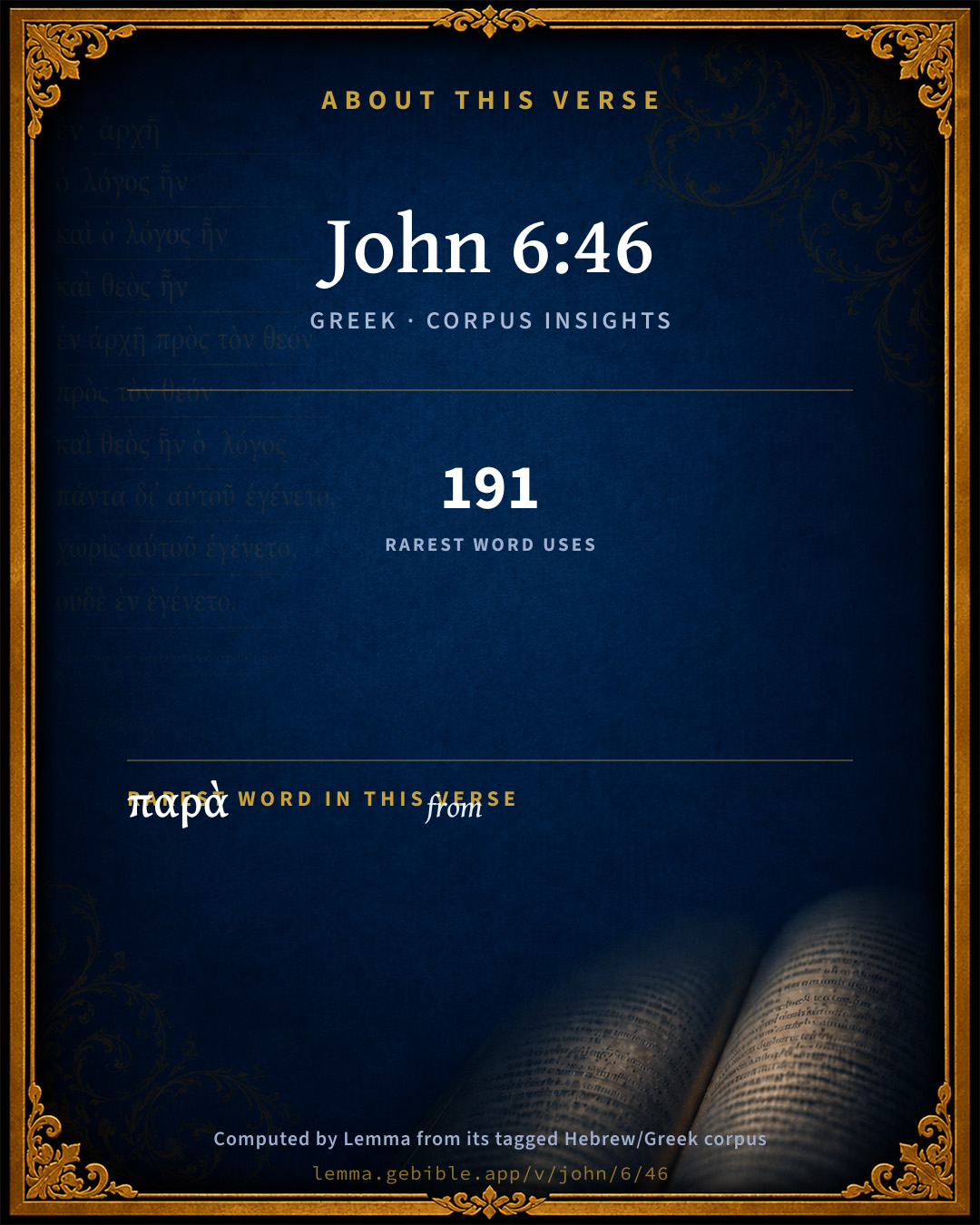
John 6:46

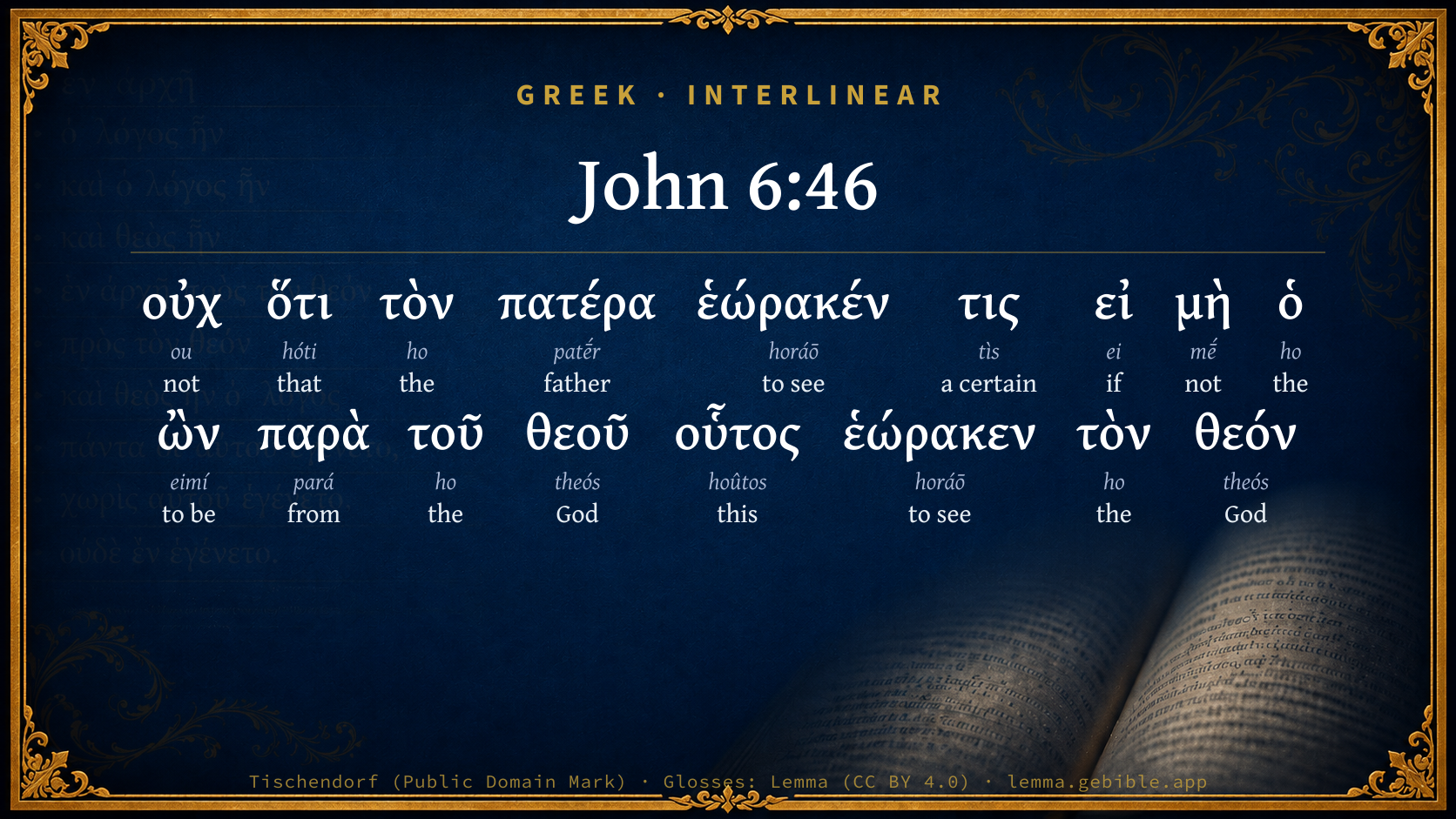
Greek (Tischendorf 8th ed.) John 6:46 appears in the Greek New Testament. The text above is from the Tischendorf 8th edition. Each word links to its Strong’s number and a concise gloss. Click any word for its full Thayer’s Greek Lexicon entry.
Download image
Cite this verse

John 6:46 (World English Bible). Public Domain. Lemma interlinear Bible study tool, https://lemma.gebible.app/v/john/6/46.

Show BibTeX & RIS
BibTeX
RIS
English Translation
Not that anyone has seen the Father, except he who is from God. He has seen the Father.
World English Bible · Public Domain
Download a study sheet

One document with this verse’s original text, its word-by-word gloss line, the meaning frame, cross-references with their text, attributed commentary, and full source and license credits — printable, and it pastes into notes with its structure intact.

This verse Autodidact and up

Study sheet (.html) Plain text (.txt)

A passage Seminary Student

Up to 50 verses in one chapter. A passage sheet keeps up to 6 commentary sources and 12 cross-references per verse, in the order this page ranks them, and says so on the sheet whenever that leaves anything out. Ask for a single verse and you get the Autodidact verse sheet above.

Everything on this page stays free to read, with no account — the sheet is a download of what is already on screen, not access to it.

Want to remove ads? Support Godless Engineer
Compare translations 3

The same verse in 3 English versions, stacked beneath the original-language interlinear above. Click any original word for its lexicon entry.

Each is an independent rendering of the whole verse — the interlinear is not word-aligned to these translations.

Highlighted words mark where these versions differ — a whole-verse word diff, not a word-by-word alignment.

  • World English Bible Public Domain
    Not that anyone has seen the Father, except he who is from God. He has seen the Father.
  • King James Version Public Domain
    Not that any man hath seen the Father, save he which is of God, he hath seen the Father.
  • unfoldingWord Literal Text CC BY-SA 4.0
    Not that anyone has seen the Father, except the one being from God—he has seen the Father.

unfoldingWord Literal Text — © unfoldingWord, licensed CC BY-SA 4.0. Word-aligned USFM3 via Door43 (git.door43.org/unfoldingWord/en_ult).

Versions to compare (up to 4)

3 of 4 selected

Show all 19 translations

Every available English version of this verse, each an independent rendering of the whole verse.

  • World English Bible Public Domain
    Not that anyone has seen the Father, except he who is from God. He has seen the Father.
  • Berean Standard Bible Public Domain
    not that anyone has seen the Father except the One who is from God; only He has seen the Father.
  • Majority Standard Bible Public Domain
    not that anyone has seen the Father except the One who is from God; only He has seen the Father.
  • King James Version Public Domain
    Not that any man hath seen the Father, save he which is of God, he hath seen the Father.
  • American Standard Version (1901) Public Domain
    Not that any man hath seen the Father, save he that is from God, he hath seen the Father.
  • Revised Version (1885) Public Domain
    Not that any man hath seen the Father, save he which is from God, he hath seen the Father.
  • Geneva Bible (1599) Public Domain
    Not that any man hath seene the Father, saue hee which is of God, hee hath seene the Father.
  • Douay-Rheims (1899) Public Domain
    Not that any man hath seen the Father; but he who is of God, he hath seen the Father.
  • Young's Literal Translation Public Domain
    not that any one hath seen the Father, except he who is from God, he hath seen the Father.
  • Literal Standard Version CC BY-SA 4.0
    not that anyone has seen the Father, except He who is from God, He has seen the Father.
  • Unlocked Literal Bible CC BY-SA 4.0
    Not that anyone has seen the Father, except he who is from God—he has seen the Father.
  • unfoldingWord Literal Text CC BY-SA 4.0
    Not that anyone has seen the Father, except the one being from God—he has seen the Father.
  • Darby Bible Public Domain
    not that any one has seen the Father, except he who is of God, he has seen the Father.
  • World Messianic Bible Public Domain
    Not that anyone has seen the Father, except he who is from God. He has seen the Father.
  • Webster's Bible Public Domain
    Not that any man hath seen the Father, save he who is from God, he hath seen the Father.
  • Free Bible Version CC BY-SA 4.0
    Not that anyone has seen God, except he who is from God; he has seen the Father.
  • Bible in Basic English Public Domain
    Not that anyone has ever seen the Father; only he who is from God, he has seen the Father.
  • Text-Critical English NT CC BY 4.0
    not that anyone has seen the Father, except he who is from God; he has seen the Father.
  • Tyndale New Testament (1534) Public Domain
    Not that eny man hath sene the father save he which is of God: the same hath sene the father.

Literal Standard Version (2020), Covenant Press — licensed CC BY-SA 4.0. Text via the HelloAO Bible API (eBible.org). Unlocked Literal Bible (unfoldingWord) — licensed CC BY-SA 4.0. Text via the HelloAO Bible API (eBible.org). unfoldingWord Literal Text — © unfoldingWord, licensed CC BY-SA 4.0. Word-aligned USFM3 via Door43 (git.door43.org/unfoldingWord/en_ult). Free Bible Version, Dr. Jonathan Gallagher — licensed CC BY-SA 4.0. Text via the HelloAO Bible API (eBible.org).

Word by word

More ways to search: Search by grammar → Find every occurrence → Compare this word →

Practice this passage: Drill this verse → Learn its vocabulary →

παρὰ
pará
G3844
“from”
Preposition
Part of Speech
Preposition
Full Thayer's Definition

Origin: a root word

TDNT: 17:07,8

1. from, of at, by, besides, near
  1. οὐχ ou G3756 “not” Particle, Negative
  2. ὅτι hóti G3754 “that” Conjunction
  3. τὸν ho G3588 “the” Article, Accusative, Singular, Masculine
  4. πατέρα patḗr G3962 “father” Noun, Accusative, Singular, Masculine
  5. ἑώρακέν horáō G3708 “to see” Verb, Perfect, Active, Indicative, 3rd person, Singular, Attic form
  6. τις tìs G5100 “a certain” Indefinite pronoun, Nominative, Singular, Masculine
  7. εἰ ei G1487 “if” Conditional
  8. μὴ mḗ G3361 “not” Particle, Negative
  9. ὁ ho G3588 “the” Article, Nominative, Singular, Masculine
  10. ὢν eimí G1510 “to be” Verb, Present, Active, Participle, Nominative, Singular, Masculine
  11. τοῦ ho G3588 “the” Article, Genitive, Singular, Masculine
  12. θεοῦ theós G2316 “God” Noun, Genitive, Singular, Masculine
  13. οὗτος hoûtos G3778 “this” Demonstrative pronoun, Nominative, Singular, Masculine
  14. ἑώρακεν horáō G3708 “to see” Verb, Perfect, Active, Indicative, 3rd person, Singular, Attic form
  15. τὸν ho G3588 “the” Article, Accusative, Singular, Masculine
  16. θεόν theós G2316 “God” Noun, Accusative, Singular, Masculine

About this verse

These counts appear in no published source. They are computed here, from the morphology-tagged text and Lemma’s own curated glosses. What Lemma adds →

17
words
12
distinct lemmas
Gospels
section

Repetition

Words recur within this verse:

  • ἑώρακέν to see G3708 ×2
  • θεοῦ God G2316 ×2
  • τὸν the G3588 ×4

Cross-references

12

Topical passages linked to John 6:46 in the Treasury of Scripture Knowledge — connected by theme and wording, ordered by reader-vote popularity; previews shown in the World English Bible.

  • John 1:18 No one has seen God at any time. The one and only Son, who is in the bosom of the Father, he has declared him.
  • John 7:29 I know him, because I am from him, and he sent me."
  • Matthew 11:27 All things have been delivered to me by my Father. No one knows the Son, except the Father; neither does anyone know the Father, except the Son, and he to whom the Son desires to reveal him.
  • Luke 10:22 Turning to the disciples, he said, "All things have been delivered to me by my Father. No one knows who the Son is, except the Father, and who the Father is, except the Son, and he to whomever the Son desires to reveal him."
  • 1 Timothy 6:16 who alone has immortality, dwelling in unapproachable light; whom no man has seen, nor can see: to whom be honor and eternal power. Amen.
  • 1 John 4:12 No one has seen God at any time. If we love one another, God remains in us, and his love has been perfected in us.
  • John 14:9–10 Jesus said to him, "Have I been with you such a long time, and do you not know me, Philip? He who has seen me has seen the Father. How do you say, 'Show us the Father?'
  • Colossians 1:15 who is the image of the invisible God, the firstborn of all creation.
  • John 5:37 The Father himself, who sent me, has testified about me. You have neither heard his voice at any time, nor seen his form.
  • John 8:19 They said therefore to him, "Where is your Father?" Jesus answered, "You know neither me, nor my Father. If you knew me, you would know my Father also."
  • John 8:55 You have not known him, but I know him. If I said, 'I don't know him,' I would be like you, a liar. But I know him, and keep his word.
  • John 15:24 If I hadn't done among them the works which no one else did, they wouldn't have had sin. But now have they seen and also hated both me and my Father.

Cross-references courtesy of OpenBible.info (CC BY 4.0).

Commentary

Notes on John 6:46 from classic Christian and Jewish commentators (each source and its license shown beneath its notes). The classic Christian expositions comment on the surrounding passage and are grouped to its opening verse, so a note may address several verses; the Jewish commentaries on the Tanakh (Rashi and others) are per-verse, so they appear only where the commentator wrote on this verse.

Lemma curates 59 commentaries, every one of them public domain or Creative Commons licensed, each selected and text-cleaned for this edition rather than reprinted as found. About our sources →

Bengel's Gnomon

Johann Albrecht Bengel

Joh 6:46. Οὐκ ὅτι, not that) By the addition of this declaration it is intimated, that the Father is heard then only, when the Son is heard; and that He is seen then only, when the Son is discerned: ch. Joh 14:9, [Jesus to Philip] “He that hath seen Me, hath seen the Father.”—ἐώρακεν, hath seen) Understand, and hath heard. Comp. the preceding verse, who hath heard (and hath seen). But because to see is a more intimate perception than to hear, the seeing is with elegant propriety ascribed to the Son, the hearing to the believers. Comp. ch. Joh 1:18, “No man hath seen God at any time; the only-begotten Son, etc., hath declared Him.”—ὁ ὢν παρὰ τοῦ Θεοῦ, He who is from God) So ch. Joh 7:29, “I know Him, for I am from Him, and He hath sent Me.”

Bengel's Gnomon of the New Testament — English translation (T&T Clark, Edinburgh, 1860) — public domain. Text from a community e-Sword module.

Expositor's Greek Testament

ed. W. Robertson Nicoll

Joh 6:46 . Lest His hearers should suppose that in Messianic times direct knowledge of God was to be communicated, He adds, οὐχ ὅτι τὸν πατέρα τις ἑώρακεν , it is not by direct vision men are to learn of God. One alone has direct perception of the Father, ὁ ὢν παρὰ τοῦ Θεοῦ , He whose origin is Divine; not ὁ ἀπεσταλμένος παρὰ Θεοῦ , a designation which belonged to all prophets, but He whose Being is directly derived from God. Similarly, in Joh 7:29 , we find Jesus saying ἐγὼ οἶδα αὐτόν ὅτι παρʼ αὐτοῦ εἰμί καὶ ἐκεῖνός με ἀπέστειλεν , where the source of the mission and the source of the being are separately mentioned. To refer this exclusive vision of the Father to any earthly experience seems out of the question. No one who was not more than man could thus separate himself from all men. See Joh 1:18 . Having thus explained that they could not believe in Him without having first been taught of God, He returns (Joh 6:47 ) to the affirmation of Joh 6:40 , ἀμὴν … ζωῆς . Their unbelief does not alter the fact, nor weaken His assurance of the fact. This consciousness of Messiahship was so identified with His spiritual experience and existence that nothing could shake it. But now He adds a significant confirmation of His claim.

The Expositor's Greek Testament, edited by W. Robertson Nicoll (1897–1910) — public domain. Text from a community e-Sword module.

Geneva Bible (1599)

Geneva Bible translators

If the son only hath seen the Father, then it is he only that can teach and instruct us truly.

Geneva Bible (1599) marginal notes — public domain. Text via Bolls.life.

Jamieson, Fausset & Brown

Robert Jamieson, A. R. Fausset & David Brown

Not that any man hath seen, &c.--Lest they should confound that "hearing and learning of the Father," to which believers are admitted by divine teaching, with His own immediate access to Him, He here throws in a parenthetical explanation; stating, as explicitly as words could do it, how totally different the two cases were, and that only He who is "from God" hath this naked, immediate access to the Father. (See Joh 1:18).

Jamieson, Fausset & Brown — Commentary Critical and Explanatory on the Whole Bible (1871) — public domain (CC PDM 1.0). Text via the HelloAO Bible API.

Adam Clarke's Commentary

Verse 46. Not that any man hath seen the Father] He does not teach men by appearing personally before them, or by any other outward voice than that of his word and messengers; but he teaches by his Spirit. This teaching from God implies:

1. That they shall have proper instruction.

2. That they shall comprehend it; for, when God teaches, there is no delay in learning. And,

3. That this teaching should be by the influence of the Holy Ghost upon their minds.

He which is of God] That is, Christ alone: neither Moses nor any of the prophets had ever seen God: Jesus, who lay in the bosom of the Father, HE saw and revealed him, Joh 1:18.

Adam Clarke's Commentary on the Bible (1810–1826) — public domain. Text from a community e-Sword/MySword module.

John Calvin's Commentaries

46. Not that any man hath seen the Father. As he has hitherto magnified the grace of his Father, so now he earnestly directs believers to himself alone. For both must be joined together; that no knowledge of Christ can be obtained, until the Father enlighten by his Spirit those who are by nature blind; and yet that it is in vain to seek God, unless Christ go before; for the majesty of God is so lofty, that the senses of men cannot reach him. Nay, more, all that knowledge of God which men may think that they have attained out of Christ will be a deadly abyss. When he says that he alone hath known the Father, he means that it is an office which belongs peculiarly to himself, to manifest God to men, who would otherwise have been concealed.

John Calvin's Commentaries (1540-1563) — public domain. Text from the Calvin Translation Society English edition (1840s-50s) via the Christian Classics Ethereal Library (ccel.org). Calvin's coverage is partial (roughly two-thirds of the Bible); uncommented books and verses are honest gaps, never fabricated. The 19th-century editor's footnotes and remarks are omitted so the notes are faithfully Calvin's own voice.

Ellicott's Commentary for English Readers

(46) But this hearing and learning of the Father was the preparation for, not the substitute for, the fuller revelation in the person of the Son. Once again He declares that “No man hath seen God at any time; the only begotten Son which is in the bosom of the Father, He hath been the interpreter.” (See Note on Joh_1:18; and comp. Joh_3:13; Joh_8:38.) Every man, in proportion as he had been taught of God, would feel how little he knew of God, and there would be in him the yearning desire and the trained faculty to see Him who is of God.

A Bible Commentary for English Readers, edited by Charles John Ellicott (1878–1897) — public domain. Text from a community e-Sword module.

The Cambridge Bible for Schools and Colleges

gen. ed. J. J. S. Perowne

46. Not that any man hath seen] To be enlightened and taught by the Father it is not necessary to see Him. “That is a privilege reserved for a later stage in the spiritual life, and is only to be attained mediately through the Son (comp. Joh_1:18).” S. p. 129.

he which is of God] Or, He which is from God, with whom He was previous to the Incarnation; Joh_1:1; Joh_1:14, Joh_8:42, Joh_16:27.

The Cambridge Bible for Schools and Colleges (gen. ed. J. J. S. Perowne; Cambridge University Press, 1878–1918) — public domain. Text from a community e-Sword module.

John Gill's Exposition

Verily, verily, I say unto you,.... This is a certain truth, and to be depended on:

he that believeth on me hath everlasting life; not only he may have it, as in Joh 6:40, and shall have it, but he has it; he has it in Christ, his head and representative; he has it in the covenant of grace; he has it in faith and hope; he has a right unto it, and a meetness for it; he has the earnest of it, the grace and Spirit of God; and he has the beginning and foretastes of it in his soul, and shall certainly enjoy it.

John Gill's Exposition of the Whole Bible (1746–1763) — public domain (CC PDM 1.0). Text via the HelloAO Bible API.

Trapp's Complete Commentary

John Trapp

46 Not that any man hath seen the Father, save he which is of God, he hath seen the Father.

Ver. 46. He hath seen the Father] And hath it in commission to manifest him to all his, by working faith (either actual, or, at least, virtual, as in infants) in their hearts, whereby they see him that is invisible, being well seen in Moses’ optics.

John Trapp, A Commentary or Exposition upon All the Books of the Old and New Testament (1647–1656) — public domain. Text from a community e-Sword module.

Albert Barnes' Notes on the Bible

Not that any man hath seen the Father - Jesus added this, evidently, to guard against mistake. He had said that all who came to him were taught of God. The teacher was commonly seen and heard by the pupil; but, lest it should be supposed that he meant to say that a man to come to him must see and hear God, visibly and audibly, he adds that he did not intend to affirm this. It was still true that no man had seen God at any time. They were not, therefore, to expect to see God, and his words were not to be perverted as if he meant to teach that.

Save he which is of God - Jesus here evidently refers to himself as the Son of God. He had just said that no man had seen the Father. When he affirms that he has seen the Father, it implies that he is more than man. He is the only-begotten Son who is in the bosom of the Father, Joh 1:18; the brightness of his glory, and the express image of his person, Heb 1:3; God over all, blessed forever, Rom 9:5. By his being of God is meant that he is the only-begotten Son of God, and sent as the Messiah into the world.

Hath seen - Hath intimately known or perceived him. He knows his nature, character, plans. This is a claim to knowledge superior to what man possesses, and it cannot be understood except by supposing that Jesus is equal with God.

Albert Barnes' Notes on the Bible (1834–1885) — public domain. Text from a community e-Sword/MySword module.

Matthew Poole's English Annotations

None must dream that the Father should visibly appear in the world to teach men; for the essence of God is invisible, none hath seen it at any time, saving he alone who is the only begotten Son of the Father; he hath seen the essence of the Father, he knoweth his will, and most secret counsels.

Matthew Poole's English Annotations on the Holy Bible (1683–1685) — public domain. Text from a community e-Sword/MySword module.

Whedon's Commentary on the Bible

Daniel D. Whedon

46. Not… seen the Father—From the phrase hath heard the Father, his opponents might represent him as teaching the visibility, of God to men. He, therefore, guards his language by limiting the true vision, or seeing of God, to himself.

He which is of God—Rather from God, referring to himself.

Daniel D. Whedon (gen. ed.), Commentary on the Old and New Testaments (1874–1909) — public domain. Text from a community e-Sword module.

The Pulpit Commentary

Not that any one hath seen the Father, save he who is from God, he hath seen the Father. "Hearing" and "learning do not amount to the beatific vision. "No one (as John said, Joh_1:18) hath seen Godat any time, the only begotten Son who is in the bosom of the Father, (pron , Joh_1:1; eiv tolpon , Joh_1:18) he hath declared him". (cf. Mat_11:27) The full revelation of the Father is alone possible to one who is (para tou Yeou) "forth from God," yet evermore standing in close association with God. Cyril and Erasmus here suggest the fact that Christ distinguishes himself from Moses, and some suggest that Christ protests against the supposition which would make the spiritual "inner Christ" of modern speculation of more value than the historical personality. But para in association with wn indicates more than mission from God, and obviously stands in indissoluble relation with the teaching of the prologue, viz. the eternal pre-existence of the personal Logos the identity of the Person who was made flesh with the Christ of this discourse. These words bring our Lord"s teaching back to a full justification or reassertion of the statement that he had come down from heaven.

The Pulpit Commentary (1880–1919), ed. H.D.M. Spence-Jones & Joseph S. Exell — public domain. Text from a community e-Sword module.

John Wesley's Explanatory Notes

Not that any one - Must expect him to appear in a visible shape. He who is from or with God - In a more eminent manner than any creature.

John Wesley, Explanatory Notes Upon the Whole Bible (1754–1765) — public domain. Text via the GEBible commentary corpus.

The People's New Testament

B. W. Johnson

46. Not that any man hath seen. They are drawn by hearing the word, not by seeing.

B. W. Johnson's The People's New Testament with Notes (1889–1891) — public domain. Electronic text from the Christian Classics Ethereal Library (CCEL) ThML edition.

unfoldingWord translationNotes

Door43 World Missions Community

Connecting Statement:

Jesus now continues speaking to the crowd and the Jewish leaders.

Truly, truly

See how you translated this in John 1:51.

Not that anyone has seen the Father, except he who is from God

Although no human who is alive on earth has seen God the Father, Jesus, the Son of God, has seen the Father.

Father

This is an important title for God. (See: Translating Son and Father)

he who believes has eternal life

God gives "eternal life" to those who trust in Jesus, the Son of God.

translationWords

amen

believe

eternity

unfoldingWord translationNotes — © Distant Shores Media and the Door43 World Missions Community, licensed CC BY-SA 4.0. Source: git.door43.org/Door43/en_tn.

Cambridge Greek Testament for Schools and Colleges

46. ἑώρακεν. see on Joh 1:18. Hearing is not the same as seeing, and in order to hear and learn from the Father it is not necessary to see Him. The result of hearing is to lead men to the only One who has seen (Joh 1:18), and in whom the Father may be seen (Joh 14:9).

ὁ ὤν παρὰ τ. θ. The expression, as in Joh 7:29, implies a permanent relation, and points to the generation rather than the mission of the Son. On οὗτος see on Joh 3:32.

Cambridge Greek Testament for Schools and Colleges (Cambridge University Press, 1896; 21 vols, various authors incl. Carr, Maclear, Plummer, Farrar, Lumby, Moule, M. R. James, Simcox) — public domain. Text from a community e-Sword module.

Alford’s Greek Testament

Henry Alford

46.] The connexion is: the mention of ἀκούσας παρὰ τοῦ πατρός might lead them to think of a personal communication from the Father to each man, and thus the necessity of the mission of the Son might be invalidated. This was the only way in which a Jew could misunderstand ver. 45; he could not dream of a seeing of the Father with bodily eyes.

ὁ ὢν παρὰ τ. θεοῦ is Jesus Himself: see ch. 7:29. His knowledge of the Father is complete and immediate; ours, partial, and derived through Him only.

Henry Alford, The Greek Testament (1849–1861) — public domain. Text from a community e-Sword module.

International Critical Commentary

46. This “hearing” of God’s voice is, however, not by way of immediate personal communication; it is not “seeing the Father.” Only One has “seen” God (1:18), although it is true, in another sense, that he who has “seen” Jesus has “seen the Father” (14:9).

οὐχ ὅτι τὸν πατέρα ἑώρακέν τις. So אBCDLNWΘ; the rec. has τις ἑώρακεν. א*D have τὸν θεόν for τόν πατέρα, a reminiscence of 1:18, where see note. Cf. 5:37.

εἰ μὴ ὁ ὢν παρὰ τοῦ θεοῦ, sc. not only He who has been sent by God (see on 3:17), as παρὰ θεοῦ means (1:6, 9:16, 33), but He whose origin is from God; cf. παρὰ πατρός (1:14, where see note), παρʼ αὐτοῦ εἰμι (7:29), παρὰ τοῦ πατρὸς ἐξῆλθον (16:27), παρὰ σοῦ ἐξῆλθον (17:8).

οὗτος ἑώρακεν τὸν πατέρα. The λόγος was πρὸς τὸν θεόν (1:1); see 8:38 for the things which He has seen παρὰ τῷ πατρί (cf. also 3:32). See on 14:7.

For the repetition (οὗτος) of the subject of the sentence, in the interests of emphasis, cf. 1:2, 7:18, 15:5, and see 10:25.

International Critical Commentary — older volumes (1896–1929), various authors — public domain. Text from a community e-Sword module.

Vincent's Word Studies in the New Testament

Marvin R. Vincent

Hath seen. As contrasted with hearing and learning. (ver. 45). The Father is not seen immediately, but through the Son. Compare Joh 1:18; Joh 14:9; 1Jo 3:2, Mt 11:27.

Of God [παρα του θεου] . More correctly, as Rev., from, with an idea of association with : from with God. Para is used of procession from a personal object, indicating it generally as the starting - point.

Marvin R. Vincent, Word Studies in the New Testament (1887–1900) — public domain. Text from a community e-Sword/MySword module.

Godet's Commentaries

Frédéric Louis Godet

Ver. 46. The phrase οὐχ ὅτι, not that, marks a restriction. This restriction can only refer to the term teaching (Joh 6:45). The notion of teaching seems to imply a direct contact between the disciple and the Master. Now no other but Jesus has possessed and possesses the privilege of immediate contact with God through sight. All can certainlyhear, it is true, but He alone has seen. And this is the reason why the divine teaching of which He has just spoken is only preparatory; it is designed not to take the place of His own, but to lead to Him, the only one who has seen and consequently can reveal God perfectly, Joh 17:3; comp. Mat 11:27. This saying is, certainly, one of those from which John has drawn the fundamental ideas of his Prologue (comp. Joh 1:1; Joh 1:14; Joh 1:18). If the preposition παρά, from, were not connected with the words ὁ ὤν, who is, it might be applied solely to the mission of Jesus. But that participle obliges us to think of origin and essence; comp. Joh 7:29. This παρά is the counterpart of the πρός of Joh 1:1; united, they sum up the entire relation of the Son to the Father. Everything in the Son is from (παρά) the Father and tends to (πρός) the Father.

Does the sight of the Father here ascribed to Jesus proceed from His divine state before the incarnation, as most interpreters and even Weiss think? This does not seem to me possible. It is the contents of the human consciousness which He has of God, which He sets forth to His brethren in human words. Comp. Joh 3:34-35, where His knowledge of God is inferred from the communication of the Spirit without measure, which has been made to Him as man; the same in Joh 14:10, where it is explained by the communion in which He lives here on earth with the Father. The perfect ἑώρακε, has seen, proves absolutely nothing for the contrary view; comp. Joh 8:38, and the analogous expressions,Joh 5:19-20, which evidently refer to His earthly existence. Only it must not be forgotten that the unique intimacy of this paternal and filial relation rests on the eternal relation of Jesus to the Father; comp. Joh 17:24 : “Thou didst love me before the foundation of the world.” It is because this son of man is the eternal well-beloved of the Father, that God completely communicates Himself to Him. The readings of א : “who comes from the Father,” instead of “from God,” and of א D: “has seen God,” instead of “the Father,” arose undoubtedly from the desire to make our text more literally conformed to the parallel expressions of the Prologue; comp. for the first Joh 1:14 : παρὰ τοῦ πατρός, and for the second Joh 1:18 : Θεὸν ἑώρακε . By this saying Jesus gives it to be understood that after the divine teaching has led to the Son, it is He, the Son, who, in His turn, leads to the Father: “I am the way, the truth and the life; no one comes to the Father but by me” (Joh 14:6). Through this idea Jesus comes back to the principal idea which had excited the murmuring of the Jews and He reaffirms it with still more of solemnity than before, in the words of Joh 6:47-51 :

Frédéric Louis Godet — Commentaries on Luke, John, Romans, and 1 Corinthians — English translation (T&T Clark, Edinburgh, 1870s–1890s) — public domain. Text from a community e-Sword module.

Lesson kit

Teaching starters — assembled from the data on this page, not authored interpretation. Every prompt links to the verse data it draws on. Edit before teaching.

John, in the Gospels, opens this verse with 17 words (12 distinct Greek lemmas). Its most distinctive word is pará (“from”). A historical commentator’s framing appears above. Read the whole chapter for the surrounding context.

Discussion questions

  1. The word pará carries the sense “from.” How does it shape the verse?
  2. How does John 1:18, which shares this passage’s theme, read alongside this verse?
  3. What does the repetition of “to see” (2× in this one verse) do in this verse?
  4. The translations on this page render this verse differently — a whole-verse word diff, not a word-by-word alignment. What might account for the different wordings?
  5. Compare how Bengel's Gnomon and Expositor's Greek Testament read this verse. Where do they agree or differ?

Things to notice

Reading settings

Reading text

Shown beneath each verse's original-language words.

Old Testament
Old Testament edition

Read the OT as the Masoretic Hebrew (MT) or the Greek Septuagint (LXX).

English shown for the Greek Septuagint (in the Hebrew ↔ Greek comparison).

Comparing translations? Open the Compare panel on any verse page to stack up to four side by side.