
Leviticus 10:4

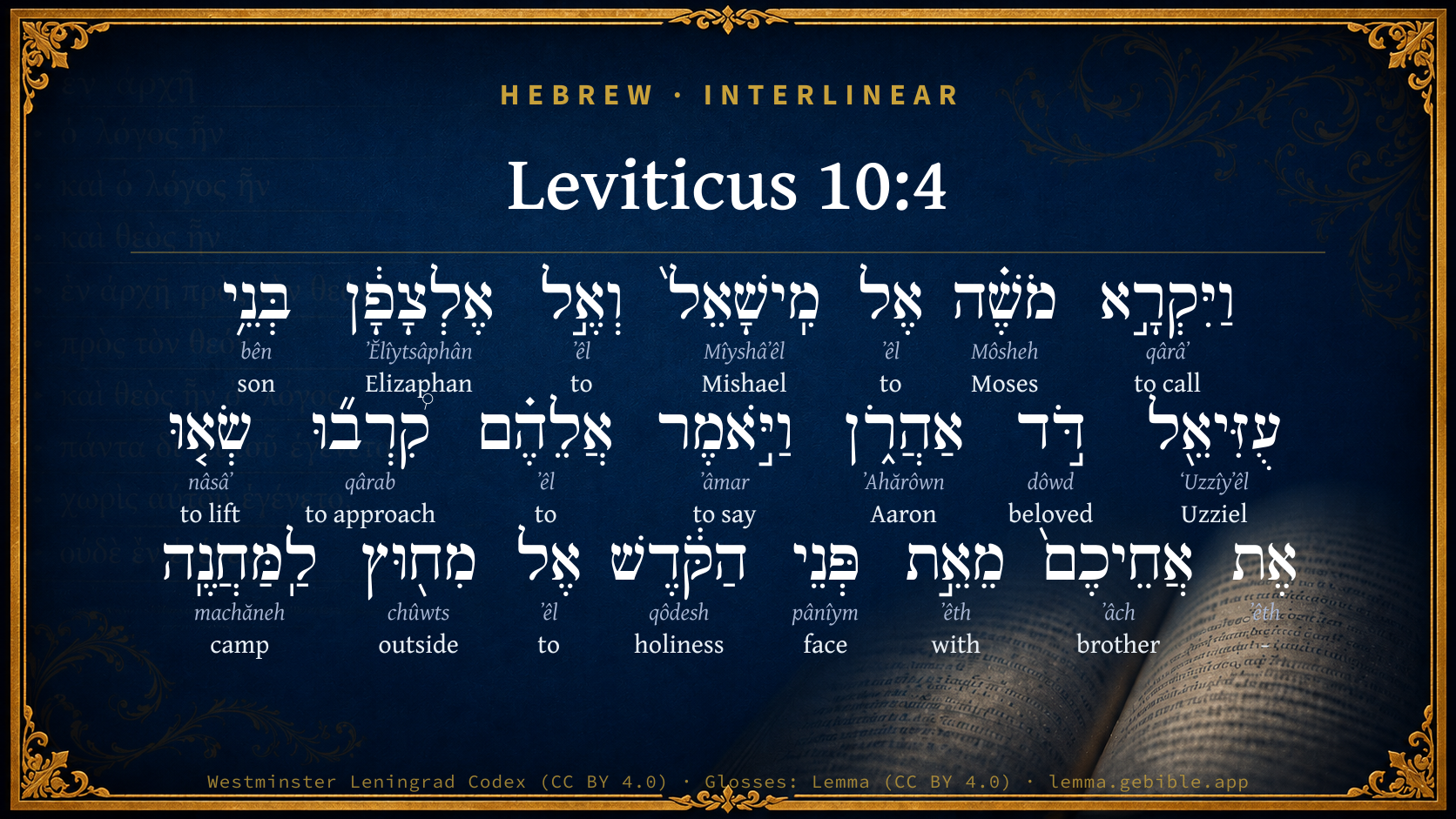
Hebrew (Westminster Leningrad Codex) Leviticus 10:4 appears in the Hebrew Old Testament. The text above is from the Westminster Leningrad Codex. Each word links to its Strong’s number, a concise gloss, and parsing drawn from the Open Scriptures Hebrew Bible morphology. Click any word for its full Brown-Driver-Briggs (BDB) entry.
Download image
Cite this verse

Leviticus 10:4 (World English Bible). Public Domain. Lemma interlinear Bible study tool, https://lemma.gebible.app/v/leviticus/10/4.

Show BibTeX & RIS
BibTeX
RIS
English Translation
Moses called Mishael and Elzaphan, the sons of Uzziel the uncle of Aaron, and said to them, "Draw near, carry your brothers from before the sanctuary out of the camp."
World English Bible · Public Domain
Highlights
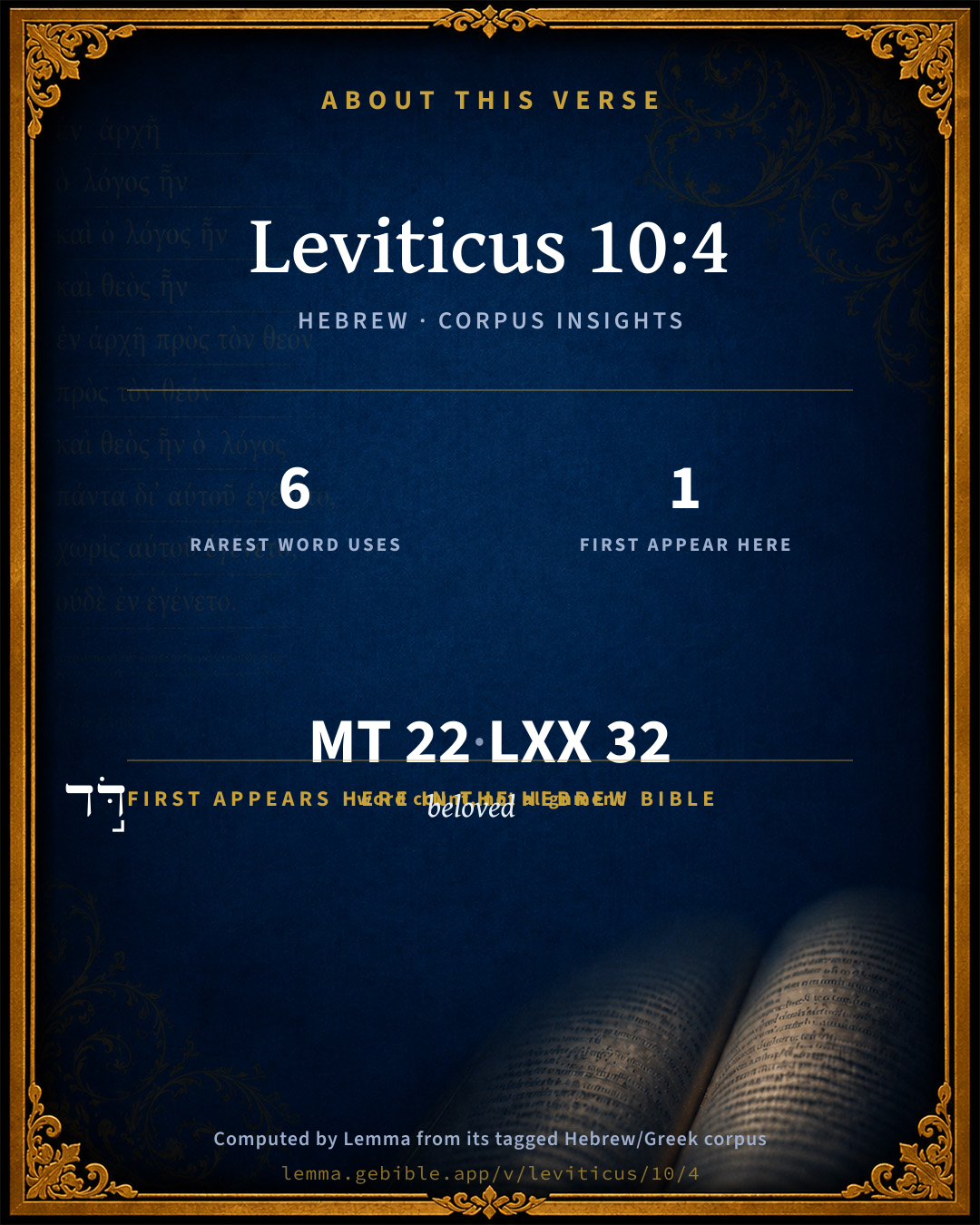
  • 1 first appearance in the Hebrew Bible
Full analysis ↓
Download a study sheet

One document with this verse’s original text, its word-by-word gloss line, the meaning frame, cross-references with their text, attributed commentary, and full source and license credits — printable, and it pastes into notes with its structure intact.

This verse Autodidact and up

Study sheet (.html) Plain text (.txt)

A passage Seminary Student

Up to 50 verses in one chapter. A passage sheet keeps up to 6 commentary sources and 12 cross-references per verse, in the order this page ranks them, and says so on the sheet whenever that leaves anything out. Ask for a single verse and you get the Autodidact verse sheet above.

Everything on this page stays free to read, with no account — the sheet is a download of what is already on screen, not access to it.

Want to remove ads? Support Godless Engineer
Compare translations 3

The same verse in 3 English versions, stacked beneath the original-language interlinear above. Click any original word for its lexicon entry.

Each is an independent rendering of the whole verse — the interlinear is not word-aligned to these translations.

Highlighted words mark where these versions differ — a whole-verse word diff, not a word-by-word alignment.

  • World English Bible Public Domain
    Moses called Mishael and Elzaphan, the sons of Uzziel the uncle of Aaron, and said to them, "Draw near, carry your brothers from before the sanctuary out of the camp."
  • King James Version Public Domain
    And Moses called Mishael and Elzaphan, the sons of Uzziel the uncle of Aaron, and said unto them, Come near, carry your brethren from before the sanctuary out of the camp.
  • unfoldingWord Literal Text CC BY-SA 4.0
    And Moses called to Mishael and to Elzaphan, the sons of Uzziel the uncle of Aaron. And he said to them, “Present lift your brothers from the face of the Holy Place to on the outside of the camp.”

unfoldingWord Literal Text — © unfoldingWord, licensed CC BY-SA 4.0. Word-aligned USFM3 via Door43 (git.door43.org/unfoldingWord/en_ult).

Versions to compare (up to 4)

3 of 4 selected

Show all 18 translations

Every available English version of this verse, each an independent rendering of the whole verse.

  • World English Bible Public Domain
    Moses called Mishael and Elzaphan, the sons of Uzziel the uncle of Aaron, and said to them, "Draw near, carry your brothers from before the sanctuary out of the camp."
  • Berean Standard Bible Public Domain
    Moses summoned Mishael and Elzaphan, sons of Aaron’s uncle Uzziel, and said to them, “Come here; carry the bodies of your cousins outside the camp, away from the front of the sanctuary.”
  • Majority Standard Bible Public Domain
    Moses summoned Mishael and Elzaphan, sons of Aaron’s uncle Uzziel, and said to them, “Come here; carry the bodies of your cousins outside the camp, away from the front of the sanctuary.”
  • King James Version Public Domain
    And Moses called Mishael and Elzaphan, the sons of Uzziel the uncle of Aaron, and said unto them, Come near, carry your brethren from before the sanctuary out of the camp.
  • American Standard Version (1901) Public Domain
    And Moses called Mishael and Elzaphan, the sons of Uzziel the uncle of Aaron, and said unto them, Draw near, carry your brethren from before the sanctuary out of the camp.
  • Revised Version (1885) Public Domain
    And Moses called Mishael and Elzaphan, the sons of Uzziel the uncle of Aaron, and said unto them, Draw near, carry your brethren from before the sanctuary out of the camp.
  • Geneva Bible (1599) Public Domain
    And Moses called Mishael and Elzaphan the sonnes of Vzziel, the vncle of Aaron, and saide vnto them, Come neere, cary your brethre from before the Sanctuarie out of the hoste.
  • Douay-Rheims (1899) Public Domain
    And Moses called Misael and Elisaphan, the sons of Oziel, the uncle of Aaron, and said to them: Go and take away your brethren from before the sanctuary, and carry them without the camp.
  • Young's Literal Translation Public Domain
    And Moses calleth unto Mishael and unto Elzaphan, sons of Uzziel, uncle of Aaron, and saith unto them, `Come near, bear your brethren from the front of the sanctuary unto the outside of the camp;'
  • Literal Standard Version CC BY-SA 4.0
    And Moses calls to Mishael and to Elzaphan, sons of Uzziel, uncle of Aaron, and says to them, “Come near, carry your brothers from the front of the holy place to the outside of the camp”;
  • Unlocked Literal Bible CC BY-SA 4.0
    Moses called Mishael and Elzaphan, the sons of Uzziel the uncle of Aaron, and said to them, “Come here and carry your brothers out of the camp from before the tabernacle.”
  • unfoldingWord Literal Text CC BY-SA 4.0
    And Moses called to Mishael and to Elzaphan, the sons of Uzziel the uncle of Aaron. And he said to them, “Present lift your brothers from the face of the Holy Place to on the outside of the camp.”
  • Darby Bible Public Domain
    And Moses called Mishael and Elzaphan, the sons of Uzziel the uncle of Aaron, and said to them, Come near, carry your brethren from before the sanctuary out of the camp.
  • World Messianic Bible Public Domain
    Moses called Mishael and Elzaphan, the sons of Uzziel the uncle of Aaron, and said to them, “Draw near, carry your brothers from before the sanctuary out of the camp.”
  • Webster's Bible Public Domain
    And Moses called Mishael and Elzaphan, the sons of Uzziel the uncle of Aaron, and said to them, Come near, carry your brethren from before the sanctuary out of the camp.
  • Free Bible Version CC BY-SA 4.0
    Moses called Mishael and Elzaphan, sons of Aaron's uncle Uzziel, and told them, “Come and carry away the bodies of your cousins and take them outside the camp, away from the front of the sanctuary.”
  • Bible in Basic English Public Domain
    And Moses sent for Mishael and Elzaphan, the sons of Uzziel, the brother of Aaron's father, and said to them, Come near and take your brothers away from before the holy place, outside the tent-circle.
  • JPS Tanakh (1917) Public Domain
    And Moses called Mishael and Elzaphan, the sons of Uzziel the uncle of Aaron, and said unto them: 'Draw near, carry your brethren from before the sanctuary out of the camp.'

Literal Standard Version (2020), Covenant Press — licensed CC BY-SA 4.0. Text via the HelloAO Bible API (eBible.org). Unlocked Literal Bible (unfoldingWord) — licensed CC BY-SA 4.0. Text via the HelloAO Bible API (eBible.org). unfoldingWord Literal Text — © unfoldingWord, licensed CC BY-SA 4.0. Word-aligned USFM3 via Door43 (git.door43.org/unfoldingWord/en_ult). Free Bible Version, Dr. Jonathan Gallagher — licensed CC BY-SA 4.0. Text via the HelloAO Bible API (eBible.org).

Word by word

More ways to search: Search by grammar → Find every occurrence → Compare this word →

Practice this passage: Drill this verse → Learn its vocabulary →

אֶלְצָפָ֔ן
ʼĔlîytsâphân
H469
“Elizaphan”
Noun, Proper
Part of Speech
Noun
Type
Proper
Full BDB Definition

Origin: from H410 and H6845

TWOT: None

Elizaphan or Elzaphan = "my God has protected" - a Kohathite chief in the wilderness - a Zebulunite chief - Uzziel's son, Mishael's brother in time of Moses
  1. וַיִּקְרָ֣א qârâʼ H7121 “and · to call” Conjunction + Verb, Qal, Sequential Imperfect, 3rd Person, Masculine, Singular
  2. מֹשֶׁ֗ה Môsheh H4872 “Moses” Noun, Proper
  3. אֶל ʼêl H413 “to” Preposition
  4. מִֽישָׁאֵל֙ Mîyshâʼêl H4332 “Mishael” Noun, Proper
  5. וְאֶ֣ל ʼêl H413 “and · to” Conjunction + Preposition
  6. בְּנֵ֥י bên H1121 “sons of” Noun, Common, Masculine, Plural, Construct
  7. עֻזִּיאֵ֖ל ʻUzzîyʼêl H5816 “Uzziel” Noun, Proper
  8. דֹּ֣ד dôwd H1730 “beloved of” Noun, Common, Masculine, Singular, Construct
  9. אַהֲרֹ֑ן ʼAhărôwn H175 “Aaron” Noun, Proper
  10. וַיֹּ֣אמֶר ʼâmar H559 “and · to say” Conjunction + Verb, Qal, Sequential Imperfect, 3rd Person, Masculine, Singular
  11. אֲלֵהֶ֗ם ʼêl H413 “to · them” Preposition + Suffix, Personal, 3rd Person, Masculine, Plural
  12. קִ֠רְב֞וּ qârab H7126 “approach” Verb, Qal, Imperative, 2nd Person, Masculine, Plural
  13. שְׂא֤וּ nâsâʼ H5375 “lift” Verb, Qal, Imperative, 2nd Person, Masculine, Plural
  14. אֶת ʼêth H853 “-” Particle, Direct Object
  15. אֲחֵיכֶם֙ ʼâch H251 “brothers · your” Noun, Common, Masculine, Plural, Construct + Suffix, Personal, 2nd Person, Masculine, Plural
  16. מֵאֵ֣ת ʼêth H854 “from · with” Preposition + Preposition
  17. פְּנֵי pânîym H6440 “face(s) of” Noun, Common, Both, Plural, Construct
  18. הַקֹּ֔דֶשׁ qôdesh H6944 “the · holiness” Particle, Definite Article + Noun, Common, Masculine, Singular, Absolute
  19. אֶל ʼêl H413 “to” Preposition
  20. מִח֖וּץ chûwts H2351 “from · outside” Preposition + Noun, Common, Masculine, Singular, Absolute
  21. לַֽמַּחֲנֶֽה machăneh H4264 “to/for the · camp” Preposition, Determined + Noun, Common, Both, Singular, Absolute

About this verse

These counts appear in no published source. They are computed here, from the morphology-tagged text and Lemma’s own curated glosses. What Lemma adds →

22
words
19
distinct lemmas
Pentateuch
section

Notable vocabulary

The rarest word here is אֶלְצָפָ֔ן Elizaphan H469 — appearing just 6 times in the whole Hebrew Bible.

First appearance in Scripture

This word makes its first canonical appearance in the Hebrew Bible here:

  • דֹּ֣ד beloved H1730

Shared distinctive vocabulary

אֶלְצָפָ֔ן Elizaphan H469 occurs in 6 verses of the Hebrew Bible. Also found in:

Grammatical profile

  • 4 verbs
  • 12 nouns
  • 5 prepositions
  • 1 particle

Verb forms

  • וַיִּקְרָ֣א Qal · Sequential Imperfect
  • וַיֹּ֣אמֶר Qal · Sequential Imperfect
  • קִ֠רְב֞וּ Qal · Imperative
  • שְׂא֤וּ Qal · Imperative

Repetition

A word recurs within this verse — often emphatic in Hebrew:

  • אֶל to H413 ×4

Hebrew & Septuagint length

In English translation the verse runs 30 words from the Hebrew and 34 from the Septuagint (LXX English) — closely comparable.

A rough comparison of the two English renderings, which tokenize alike — not a word-level alignment.

Word counts can differ between the Hebrew and the Greek without any difference in meaning — e.g. the Hebrew direct-object marker אֵת has no separate Greek word, and Greek often adds the article ὁ.

In the original languages it is 22 Hebrew tokens and 32 Greek tokens — but the two are counted differently (Hebrew bundles its prefixes and suffixes into one token; the Greek is in lemma form), so that isn’t a like-for-like length.

Cross-references

9

Topical passages linked to Leviticus 10:4 in the Treasury of Scripture Knowledge — connected by theme and wording, ordered by reader-vote popularity; previews shown in the World English Bible.

  • Exodus 6:22 The sons of Uzziel: Mishael, and Elzaphan, and Sithri.
  • Exodus 6:18 The sons of Kohath: Amram, and Izhar, and Hebron, and Uzziel; and the years of the life of Kohath were one hundred thirty-three years.
  • Numbers 3:19 The sons of Kohath by their families: Amram, and Izhar, Hebron, and Uzziel.
  • Numbers 3:30 The prince of the fathers' house of the families of the Kohathites shall be Elizaphan the son of Uzziel.
  • Acts 5:6 The young men arose and wrapped him up, and they carried him out and buried him.
  • Acts 5:9–10 But Peter asked her, "How is it that you have agreed together to tempt the Spirit of the Lord? Behold, the feet of those who have buried your husband are at the door, and they will carry you out."
  • 1 Chronicles 6:2 The sons of Kohath: Amram, Izhar, and Hebron, and Uzziel.
  • Luke 7:12 Now when he drew near to the gate of the city, behold, one who was dead was carried out, the only son of his mother, and she was a widow. Many people of the city were with her.
  • Acts 8:2 Devout men buried Stephen, and lamented greatly over him.

Cross-references courtesy of OpenBible.info (CC BY 4.0).

Hebrew and Greek witnesses Masoretic Hebrew ↔ Greek Septuagint

The same verse in the two great witnesses to the Old Testament, shown verse-for-verse.

These are two independent witnesses, not word-aligned to each other, and the Septuagint is shown in lemma (dictionary) form.

Hebrew Leviticus 10:4 Masoretic · Westminster Leningrad Codex

וַיִּקְרָ֣א מֹשֶׁ֗ה אֶל מִֽישָׁאֵל֙ וְאֶ֣ל אֶלְצָפָ֔ן בְּנֵ֥י עֻזִּיאֵ֖ל דֹּ֣ד אַהֲרֹ֑ן וַיֹּ֣אמֶר אֲלֵהֶ֗ם קִ֠רְב֞וּ שְׂא֤וּ אֶת אֲחֵיכֶם֙ מֵאֵ֣ת פְּנֵי הַקֹּ֔דֶשׁ אֶל מִח֖וּץ לַֽמַּחֲנֶֽה

Moses called Mishael and Elzaphan, the sons of Uzziel the uncle of Aaron, and said to them, "Draw near, carry your brothers from before the sanctuary out of the camp."

World English Bible · Public Domain

Greek LXX Leviticus 10:4 Septuagint · lemma form

καί καλέω μωυσῆς ὁ μισαδαι καί ὁ ελισαφαν υἱός οζιηλ υἱός ὁ ἀδελφός ὁ πατήρ ἀαρών καί εἶπον αὐτός προςἔρχομαι καί αἴρω ὁ ἀδελφός σύ ἐκ πρόσωπον ὁ ἅγιος ἔξω ὁ παρεμβολή

And Moses called Misadae, and Elisaphan, sons of Oziel, sons of the brother of Aaron's father, and said to them, Draw near and take your brethren from before the sanctuary out of the camp.

LXX2012 (modern English Septuagint) · Public Domain

Hebrew: Westminster Leningrad Codex (CC BY 4.0). Greek: Septuagint (public domain); English from LXX2012 (modern English Septuagint) (Public Domain). How the Septuagint differs from the Hebrew →

Targum (Aramaic paraphrase)

2

The Targum is the ancient Jewish Aramaic paraphrase of the Hebrew Scriptures — an interpretive translation, not the Hebrew text itself. Onkelos (literal) and Pseudo-Jonathan (expansive) render the Torah, and Jonathan the Prophets. Coverage is partial: where no permissively-licensed English translation exists for a verse, only the Aramaic is shown. This is verse-level text, not a word-by-word alignment to the Hebrew.

  1. Targum Onkelos Torah (Genesis–Deuteronomy)
    וּקְרָא מֹשֶׁה לְמִישָׁאֵל וּלְאֶלְצָפָן בְּנֵי עֻזִיאֵל אַח אֲבוּהִי דְאַהֲרֹן וַאֲמַר לְהוֹן קְרִיבוּ טוּלוּ יָת אֲחֵיכוֹן מִן קֳדָם אַפֵּי קוּדְשָׁא לְמִבָּרָא לְּמַשְׁרִיתָא

    (no public-domain English translation for this verse)

    Targum Onkelos — Aramaic: “Onkelos Genesis” (public domain); “Onkelos Exodus” (public domain); “Onkelos Leviticus” (public domain); “Onkelos Numbers” (public domain); “Onkelos Deuteronomy” (public domain). English: “Sefaria Community Translation” (CC0 1.0 (public-domain dedication)); “J.W. Etheridge. The Targums of Onkelos and Jonathan Ben Uzziel on the Pentateuch. London: Longmans, Green, 1862” (public domain). Text via Sefaria.

  2. Targum Pseudo-Jonathan Torah (Genesis–Deuteronomy)
    וּקְרָא משֶׁה לְמִישָׁאֵל וּלְאֶלְצָפָן בְּנוֹי דְעוּזִיאֵל לֵיוָאֵי חֲבִיבָא דְאַהֲרן וַאֲמַר לְהוֹן קְרִיבוּ טוּלוּ יַת אֲחוּכוֹן מִן קוּדְשָׁא וּתְסוֹבְרִינוּן לְמִבָּרָא לְמַשְׁרִיתָא

    And Mosheh called unto Mishael and to Elzaphan, the sons of Uzziel the Levite, the relative of Aharon, and said to them, Take your brethren from the sanctuary, and carry them, without the camp.

    Targum Pseudo-Jonathan — Aramaic: “Targum Jonathan on Genesis” (public domain); “Targum Jonathan on Exodus” (public domain); “Targum Jonathan on Leviticus” (public domain); “Targum Jonathan on Numbers” (public domain); “Targum Jonathan on Deuteronomy” (public domain). English: “The Targum of Jonathan ben Uzziel, trans. J. W. Etheridge, London, 1862” (public domain). Text via Sefaria.

Commentary

Notes on Leviticus 10:4 from classic Christian and Jewish commentators (each source and its license shown beneath its notes). The classic Christian expositions comment on the surrounding passage and are grouped to its opening verse, so a note may address several verses; the Jewish commentaries on the Tanakh (Rashi and others) are per-verse, so they appear only where the commentator wrote on this verse.

Lemma curates 59 commentaries, every one of them public domain or Creative Commons licensed, each selected and text-cleaned for this edition rather than reprinted as found. About our sources →

Trapp's Complete Commentary

John Trapp

Lev 10:4 And Moses called Mishael and Elzaphan, the sons of Uzziel the uncle of Aaron, and said unto them, Come near, carry your brethren from before the sanctuary out of the camp.

Ver. 4. And Moses called Mishael, &c.] Aaron’s first cousins were called, to carry these two unhappy brethren out for burial: their brethren the priests might not leave their ministry to do it. Accordingly we read of one Pulvillus, a heathen, that he was about to consecrate a temple to Jupiter, and when news was brought him of the death of his son, he would not desist from his enterprise; but with much composure of mind gave order for decent burial.

John Trapp, A Commentary or Exposition upon All the Books of the Old and New Testament (1647–1656) — public domain. Text from a community e-Sword module.

Joseph Benson's Commentary

Lev 10:4. Moses called Mishael — For Aaron and his sons were employed in their holy ministrations, from which they were not to be called for funeral solemnities. Brethren — That is, kinsmen, as that word is often used. Out of the camp — Where the burying-places of the Jews were, that the living might neither be annoyed by the unwholesome scent of the dead, nor defiled by the touch of their graves.

Joseph Benson's Commentary on the Old and New Testaments (1811–1818) — public domain. Text from a community e-Sword module.

The Expositor's Bible

MOURNING IN SILENCE

Lev_10:4-7

"And Moses called Mishael and Elzaphan, the sons of Uzziel the uncle of Aaron, and said unto them, Draw near. carry your brethren from before the sanctuary out of the camp. So they drew near, and carried them in their coats out of the camp; as Moses had said. And Moses said unto Aaron, and unto Eleazar and unto Ithamar, his sons. Let not the hair of your heads go loose, neither rend your clothes; that ye die not, and that He be not wroth with. all the congregation: but let your brethren, the whole house of Israel, bewail the burning which the Lord hath kindled. And ye shall not go out from the door of the tent of meeting, lest ye die: for the anointing oil of the Lord is upon you. And they did according to the word of Moses."

Even in ordinary cases, restrictions were placed upon Aaron and his sons as regards the outward signs of mourning; but exceptions were made in the case of the nearest relations, and, in particular, of the death of a son, or a brother. {Lev_21:2} In this case, however, this permission could not be given; and they are warned that by public expressions of grief they would not only bring death from the Lord upon themselves, but also bring His wrath upon the whole congregation which they represented before God. They are not indeed forbidden to mourn in their hearts, but from all the outward and customary signs of mourning they must abstain. And the reason for this is given; "The anointing oil of the Lord is upon you." That is, by the anointing they had been set apart to represent God before Israel. Hence, when God had thus manifested His holy wrath against sin, for them to have exhibited the public signs of mourning for this, even though the stroke of wrath had fallen into their own family, would have been a visible contradiction between their actions and their priestly position. To others, indeed, these outward tokens of mourning are expressly permitted, for they stood in no such special relation to God; their brethren, "the whole house of Israel," might bewail the burning which the Lord had kindled, but they, although nearest of kin to the dead, are not permitted even to follow the slain of the Lord to the grave, and (Lev_10:4-5) the sad duty is assigned to their cousins, who bear the dead, in their white priestly robes, just as they had fallen, out of the camp to burial, while Aaron and his sons mourn silently within the tent of meeting.

This has seemed hard to many, and has furnished some another illustration of the hardness. and severity of the character of God as held up in the Pentateuch. But we shall do well to remember that in all this we have nothing which in any respect goes beyond the very solemn words of the tender hearted and most compassionate Saviour, who said, for example, "If any man cometh unto Me, and hateth not his own father, and mother, and wife, and children, and brethren, and sisters he cannot be My disciple." {Luk_14:26} In language such as this, we cannot but recognise the same character as in this command unto Aaron and his sons; and if such "hard sayings" are to be held: reason for rejecting the revelation of the character of God as given in the Old Testament, the same logic, in the presence of similar words, will require us also to reject the revelation of Gods character as given by Christ in the New Testament.

The teaching of both Testaments on this matter is plain. Natural affection is right; it is indeed implanted in our hearts by the God who made us in all our human relations. But none the less, whenever the feelings which belong even to the nearest and tenderest earthly relations come into conflict with absolute fealty and submission to the will of God, and unswerving loyalty to the will of Christ, then, hard though indeed it may be, natural affection must give way, and mourn within the tent in the silence of a holy submission to the Lord.

William Robertson Nicoll, ed., The Expositor's Bible (London: Hodder & Stoughton, 1887–1910) — public domain. 65 of 66 books (1 Corinthians is not separately keyed, as that volume carries no machine-parseable verse references); section-level commentary keyed to the opening verse. Introductory and overview sections not keyed to a specific passage are excluded.

Tyndale Open Study Notes

Tyndale Open Resources

10:4 Mishael and Elzaphan . . . uncle Uzziel: See Exod 6:18, 22. • carry away the bodies of your relatives: Aaron, the high priest, and the priests Eleazar and Ithamar (Lev 10:6) could not defile themselves by making contact with a dead person (21:10-12).

Tyndale Open Study Notes — © Tyndale Open Resources, licensed CC BY-SA 4.0. Text via the HelloAO Bible API.

Geneva Bible (1599)

Geneva Bible translators

Or, cousins.

Geneva Bible (1599) marginal notes — public domain. Text via Bolls.life.

Jamieson, Fausset & Brown

Robert Jamieson, A. R. Fausset & David Brown

Moses called Mishael and Elzaphan--The removal of the two corpses for burial without the camp would spread the painful intelligence throughout all the congregation; and the remembrance of so appalling a judgment could not fail to strike a salutary fear into the hearts both of priests and people. The interment of the priestly vestments along with Nadab and Abihu, was a sign of their being polluted by the sin of their irreligious wearers.

Jamieson, Fausset & Brown — Commentary Critical and Explanatory on the Whole Bible (1871) — public domain (CC PDM 1.0). Text via the HelloAO Bible API.

Adam Clarke's Commentary

Verse 4. Uzziel the uncle of Aaron] He was brother to Amram the father of Aaron; see Ex 6:18-22.

Adam Clarke's Commentary on the Bible (1810–1826) — public domain. Text from a community e-Sword/MySword module.

Ellicott's Commentary for English Readers

(4) And Moses called . . . the sons of Uzziel.—Uzziel was the son of Kohath, the younger brother of Amram. As Amram was the father of Aaron, Uzziel was the uncle of Aaron. Uzziel had three sons, of whom Mishael and Elzaphan were two (Exo_6:18; Exo_6:22). Eleazar and Ithamar, as ordinary priests, might have been employed in removing the remains of their slain brothers. (See Lev_21:1-4) Naturally they were too much affected by this appalling scene; Moses therefore wanted to spare their feelings, and hence charged their cousins-german with the task of carrying away the dead bodies. The reason why Izar and Hebron, the two older uncles of Aaron, are here passed over is because the discontent of their children with the choice of Aaron and his sons to the priesthood, which afterward broke out in open rebellion on the part of Korah, Izar’s son (Numbers 16, 17), had evidently begun to show itself when they witnessed the imposing ceremonies of the consecration. It was necessary that those who suffered so signally for the transgression of the Divine institutions should be buried by men whose allegiance to God’s law was unimpeachable.

Carry your brethren.—That is, your kinsmen. The expression brother is frequently used in the Bible in the sense of near relation. (See Gen_13:8; Gen_14:6; Gen_24:48; Gen_29:12-15, &c.)

From before the sanctuary.—In the courtyard of the sanctuary, where the incense was offered in the midst of the rejoicing people, and where they were struck dead. (See Lev_9:5.)

A Bible Commentary for English Readers, edited by Charles John Ellicott (1878–1897) — public domain. Text from a community e-Sword module.

The Cambridge Bible for Schools and Colleges

gen. ed. J. J. S. Perowne

4. For the relationship between the persons mentioned see Exo_6:18; Exo_6:22.

The Cambridge Bible for Schools and Colleges (gen. ed. J. J. S. Perowne; Cambridge University Press, 1878–1918) — public domain. Text from a community e-Sword module.

John Gill's Exposition

And Moses called Mishael and Elzaphan, the sons of Uzziel, the uncle of Aaron,.... Uzziel was a son of Kohath, a brother of Amram, the father of Aaron, and so Aaron's uncle, as here; he had four sons, two of which are here mentioned as called by Moses; these were first cousins to Aaron, and second to his sons; see Exo 6:18,

and said unto them, come near; it is very probable they were in the court of the tabernacle, being Kohathites, of the tribe of Levi; but not being priests, had no right to go into the holy place, where the two sons of Aaron lay dead, without a special order for it, which they here had for this time, and upon this occasion:

carry your brethren from before the sanctuary, out of the camp; the sons of Aaron are called their brethren, though but cousins, it being usual to call any relations brethren, and even if only of the same tribe, yea, of the same nation. Now these were ordered to take the dead bodies of Aaron's sons out of the holy place, and out of the tabernacle, even from before it, which, as Aben Ezra says, was the court over against the camp; and they were to carry them out of the camp into some field, or place adjacent, and there bury them; it not being usual in those times to bury in cities and towns, and much less in places devoted to sacred worship, as the tabernacle was; and therefore they were carried from both the sanctuary and the camp: it is an observation of Aben Ezra, that"some say the incense was before the altar of burnt offering, and the Levites entered there;''but if by incense is meant the altar of incense, the place where these sons of Aaron offered theirs, that was in the holy place, and not in the court, where stood the altar of burnt offering: but they seem to mean as if their incense was offered in another place, and not on the altar, somewhere in the court, and before you come to the altar of burnt offering; and so the persons Moses called could come in thither, and take up their bodies there fallen: but the same writer observes, that others say, that"it was upon the altar of incense (i.e. that their incense was offered), and Moses brought them out of the tabernacle of the congregation,''and then called these men to carry them from thence without the camp.

John Gill's Exposition of the Whole Bible (1746–1763) — public domain (CC PDM 1.0). Text via the HelloAO Bible API.

Albert Barnes' Notes on the Bible

The first cousins of Aaron Exo 6:22 are selected by Moses to convey the bodies of Nadab and Abihu out of the camp and bury them, probably because they were the nearest relations who were not priests. See Num 9:6.

Albert Barnes' Notes on the Bible (1834–1885) — public domain. Text from a community e-Sword/MySword module.

Haydock's Catholic Bible Commentary

Brethren; cousins. These were ordered to bury the priests, as Aaron and his family were employed about the altar, (Haydock) and could not perform the office without contracting a legal uncleanness. (Josephus) (Tirinus)

George Leo Haydock (1774–1849), Haydock's Catholic Family Bible and Commentary, 1859 edition — public domain. Excludes Psalms (Douay-Rheims chapter numbering differs from Protestant) and Deuterocanonical books (Catholic canon only).

Matthew Poole's English Annotations

For Aaron and his sons had scarce finished their consecration work, and were employed in their holy ministrations, from which they were not to be called for funeral solemnities. See Lev 21:1, &c.

The uncle of Aaron. See Exo 6:18; Num 3:19.

Your brethren, i.e. kinsmen, as that word is oft used, as Gen 13:8; 24:27. Out of the camp, where the burying-places of the Jews were, that the living might neither be annoyed by the unwholesome scent of the dead, nor defiled by the touch of their graves.

Matthew Poole's English Annotations on the Holy Bible (1683–1685) — public domain. Text from a community e-Sword/MySword module.

Whedon's Commentary on the Bible

Daniel D. Whedon

4. Moses called — He who had amid the quakings of Horeb and the thunderings and lightnings drawn near and entered into the cloud where God was not the man to be disconcerted by this awful catastrophe.

Sons of Uzziel — The third son, Zithri, (Exo_6:22,) was not summoned to this painful task. Being Kohathites, soon to be charged with the transportation of the sacred furniture, it was fitting that they should be employed to remove the bodies of these sacred persons. Elizaphan was chief of the Kohathites. Num_3:30-31.

Carry your brethren — They were kindred of the fifth degree, and loosely termed brethren.

Before the sanctuary — As they fell between the great altar and the tabernacle with smoking censers in their hands, it is evident that they were going toward the holy place to burn incense at the golden altar unbidden, and possibly against a positive prohibition.

Daniel D. Whedon (gen. ed.), Commentary on the Old and New Testaments (1874–1909) — public domain. Text from a community e-Sword module.

The Pulpit Commentary

Uzziel was the youngest brother of Amram. (see Exo_6:18-22) His sons, Mishael and Elzaphan, were therefore second cousins of Nadab and Abihu, who are here called their brethren. (Cf. the use of the term "brothers of the Lord," applied probably to his first cousins in the New Testament.)

The Pulpit Commentary (1880–1919), ed. H.D.M. Spence-Jones & Joseph S. Exell — public domain. Text from a community e-Sword module.

John Wesley's Explanatory Notes

Moses called Mishael - For Aaron and his sons were employed in their holy ministrations, from which they were not called for funeral solemnities. Brethren - That is, kinsmen, as that word is oft used. Out of the camp - Where the burying-places of the Jews were, that the living might neither be annoyed by the unwholesome scent of the dead, nor defiled by the touch of their graves.

John Wesley, Explanatory Notes Upon the Whole Bible (1754–1765) — public domain. Text via the GEBible commentary corpus.

Keil & Delitzsch

C. F. Keil & F. Delitzsch

Moses then commanded Mishael and Elzaphan, the sons of Uzziel Aaron's paternal uncle, Aaron's cousins therefore, to carry their brethren (relations) who had been slain from before the sanctuary out of the camp, and, as must naturally be supplied, to bury them there. The expression, "before the sanctuary" (equivalent to "before the tabernacle of the congregation" in Lev 9:5), shows that they had been slain in front of the entrance to the holy place. They were carried out in their priests' body-coats, since they had also been defiled by the judgment. It follows from this, too, that the fire of Jehovah had not burned them up, but had simply killed them as with a flash of lightning.

Keil & Delitzsch — Biblical Commentary on the Old Testament (1861–1891) — public domain (CC PDM 1.0). Text via the HelloAO Bible API. (Old Testament only.)

Scofield Reference Notes

C. I. Scofield

Mish-a-el, ’one with God.’ El-za-phan, ’God protects.’ Uz-zi-el, ’power of God.’

The Scofield Reference Bible (1917 edition), notes by C. I. Scofield — public domain. Text from a community e-Sword module.

Rashi

Rabbi Shlomo Yitzchaki (Rashi)

דד אהרן THE UNCLE OF AARON — Uzziel was Amram’s brother, as it is said (Exodus 6:18) “And the sons of Kehath were [Amram …. and Uzziel]”.

שאו את אחיכם וגו׳ CARRY YOUR BRETHREN etc. — as a man who says to his fellow: Remove the corpse from before the bride in order not to disturb the joy.

Rashi on the Tanakh — English translations: “The Judaica Press complete Tanach with Rashi, translated by A. J. Rosenberg” (CC BY 4.0); “Pentateuch with Rashi's commentary by M. Rosenbaum and A.M. Silbermann, 1929-1934” (public domain); “The Metsudah Tanach series, Lakewood, N.J” (CC BY 4.0); and “The Book of Joshua, Metsudah Publications, 1997” (CC BY 4.0). Text via Sefaria.

Ramban (Nachmanides)

Rabbi Moshe ben Nachman (Ramban / Nachmanides)

AND MOSES CALLED MISHAEL AND ELZAPHAN, THE SONS OF UZZIEL THE UNCLE OF AARON, AND SAID UNTO THEM: DRAW NEAR, CARRY YOUR BRETHREN FROM BEFORE THE SANCTUARY OUT OF THE CAMP. I have found written in the Torath Kohanim in the section of the consecration: 38. “Rabbi Eliezer says: the sons of Aaron died outside [the Sanctuary], in a place where the Levites [Mishael and Elzaphan] were permitted to enter, as it is said, So they drew near, and carried them in their tunics. If so, why then does it say, and they died before the Eternal? It was an angel who smote them [Nadab and Abihu] and thrust them out of the Sanctuary [and they did not die until they were outside it]. Rabbi Akiba says: they died inside the Sanctuary, as it is said, and they died before the Eternal. If so, why does it say, So they drew near, and carried them in their tunics [since Levites are not permitted to enter the Sanctuary]? They put iron hooks on them, and dragged them and brought them out of the Sanctuary.” Thus far is the text of the Beraitha, Note 65. and the meaning thereof is as follows: Even though priests are also forbidden to enter the Sanctuary except at the time of Service, this prohibition applies only if they enter it needlessly. But one may enter the Sanctuary in order to remove an uncleanness, or to make Temple repairs. For thus we were taught in the Torath Kohanim: 3:11. “I might think one is not permitted to enter the Sanctuary to make the beaten plates [for a covering of the golden altar, or for the Holy of Holies]; Scripture therefore says, ‘Only’ he shall not go in unto the Veil [the word ‘only’ denoting an exception to the general law]; such is their command: priests may go in there [at any time to make the above repairs]. If there are no priests present, Levites may enter. If there are no [ritually] pure ones [priests or Levites], impure ones may go in. If there are no unblemished ones, blemished ones may enter there.” Now on that day [when Nadab and Abihu died] there were no priests present [who could remove them from the Sanctuary where they had died], since [Aaron and his two remaining sons] were expressly commanded that they should not defile themselves for them. But since it was possible to do it through dragging them out with iron hooks, [Mishael and Elzaphan] were not permitted to enter there. [Such is the opinion of Rabbi Akiba.] But Rabbi Eliezer, who is of the opinion [that an angel thrust Nadab and Abihu out of the Sanctuary, and they died outside, thinks] that since Scripture states of Mishael and Elzaphan, so they drew near, it was outside the Sanctuary [that they died], and therefore he does not say [as does Rabbi Akiba] that they dragged them outside in their tunics. The meaning of the expression in their tunics is that Nadab and Abihu were then dressed in the priestly garments. Moses thus commanded that they carry them out of the camp, and there they should strip them of their priestly garments, and clothe them in burial shrouds, and bury them, as was their custom with other people who died in the desert. After that they purified the sacred garments and they were used by the other priests.

Ramban (Nachmanides) on the Tanakh — English translation: “Commentary on the Torah by Ramban (Nachmanides). Translated and annotated by Charles B. Chavel. New York, Shilo Pub. House, 1971-1976” (CC BY 4.0). Text via Sefaria.

Lesson kit

Teaching starters — assembled from the data on this page, not authored interpretation. Every prompt links to the verse data it draws on. Edit before teaching.

Leviticus, in the Pentateuch, opens this verse with 22 words (19 distinct Hebrew lemmas). Its most distinctive word is ʼĔlîytsâphân (“Elizaphan”). A historical commentator’s framing appears above. Read the whole chapter for the surrounding context.

Discussion questions

  1. The word ʼĔlîytsâphân carries the sense “Elizaphan.” How does it shape the verse?
  2. This is the first place “beloved” appears in Scripture (first appears here). What does its debut here establish?
  3. How does Exodus 6:22, which shares the word «Elizaphan», read alongside this verse?
  4. What does the repetition of “to” (4× in this one verse) do in this verse?
  5. The translations on this page render this verse differently — a whole-verse word diff, not a word-by-word alignment. What might account for the different wordings?
  6. «וַיִּקְרָ֣א» is a Qal Sequential Imperfect verb. How does that grammatical form shape the action described?
  7. Compare how Trapp's Complete Commentary and Joseph Benson's Commentary read this verse. Where do they agree or differ?

Things to notice

Reading settings

Reading text

Shown beneath each verse's original-language words.

Old Testament
Old Testament edition

Read the OT as the Masoretic Hebrew (MT) or the Greek Septuagint (LXX).

English shown for the Greek Septuagint (in the Hebrew ↔ Greek comparison).

Comparing translations? Open the Compare panel on any verse page to stack up to four side by side.