Luke 22:42

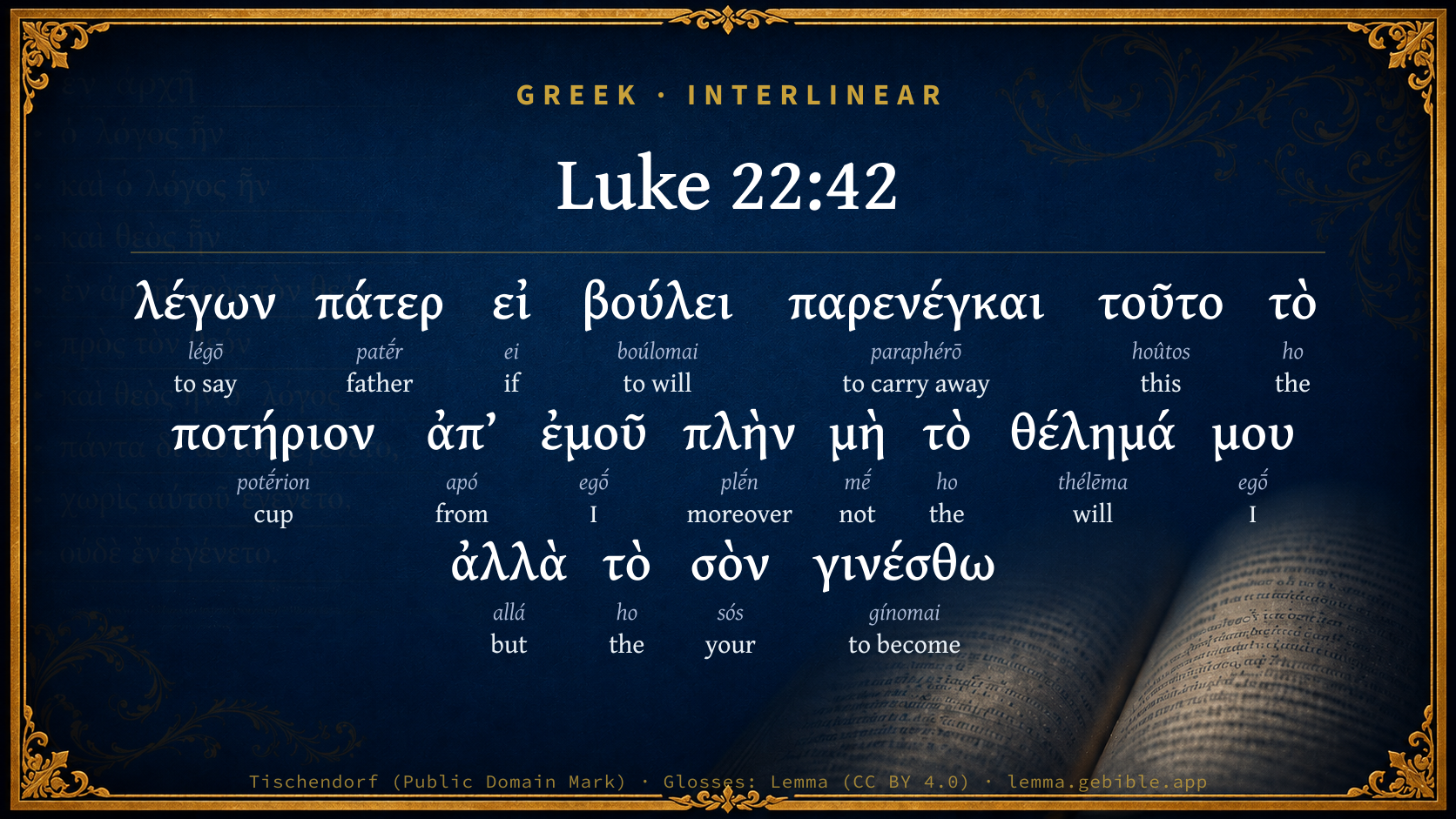
Greek (Tischendorf 8th ed.) Luke 22:42 appears in the Greek New Testament. The text above is from the Tischendorf 8th edition. Each word links to its Strong’s number and a concise gloss. Click any word for its full Thayer’s Greek Lexicon entry.
Download image
Cite this verse

Luke 22:42 (World English Bible). Public Domain. Lemma interlinear Bible study tool, https://lemma.gebible.app/v/luke/22/42.

Show BibTeX & RIS
BibTeX
RIS
English Translation
saying, "Father, if you are willing, remove this cup from me. Nevertheless, not my will, but yours, be done."
World English Bible · Public Domain
Download a study sheet

One document with this verse’s original text, its word-by-word gloss line, the meaning frame, cross-references with their text, attributed commentary, and full source and license credits — printable, and it pastes into notes with its structure intact.

This verse Autodidact and up

Study sheet (.html) Plain text (.txt)

A passage Seminary Student

Up to 50 verses in one chapter. A passage sheet keeps up to 6 commentary sources and 12 cross-references per verse, in the order this page ranks them, and says so on the sheet whenever that leaves anything out. Ask for a single verse and you get the Autodidact verse sheet above.

Everything on this page stays free to read, with no account — the sheet is a download of what is already on screen, not access to it.

Want to remove ads? Support Godless Engineer
Compare translations 3

The same verse in 3 English versions, stacked beneath the original-language interlinear above. Click any original word for its lexicon entry.

Each is an independent rendering of the whole verse — the interlinear is not word-aligned to these translations.

Highlighted words mark where these versions differ — a whole-verse word diff, not a word-by-word alignment.

  • World English Bible Public Domain
    saying, "Father, if you are willing, remove this cup from me. Nevertheless, not my will, but yours, be done."
  • King James Version Public Domain
    Saying, Father, if thou be willing, remove this cup from me: nevertheless not my will, but thine, be done.
  • unfoldingWord Literal Text CC BY-SA 4.0
    saying, “Father, if you are willing, remove this cup from me. Yet, let not my will, but yours, happen.”

unfoldingWord Literal Text — © unfoldingWord, licensed CC BY-SA 4.0. Word-aligned USFM3 via Door43 (git.door43.org/unfoldingWord/en_ult).

Versions to compare (up to 4)

3 of 4 selected

Show all 19 translations

Every available English version of this verse, each an independent rendering of the whole verse.

  • World English Bible Public Domain
    saying, "Father, if you are willing, remove this cup from me. Nevertheless, not my will, but yours, be done."
  • Berean Standard Bible Public Domain
    “Father, if You are willing, take this cup from Me. Yet not My will, but Yours be done.”
  • Majority Standard Bible Public Domain
    “Father, if You are willing, take this cup from Me. Yet not My will, but Yours be done.”
  • King James Version Public Domain
    Saying, Father, if thou be willing, remove this cup from me: nevertheless not my will, but thine, be done.
  • American Standard Version (1901) Public Domain
    saying, Father, if thou be willing, remove this cup from me: nevertheless not my will, but thine, be done.
  • Revised Version (1885) Public Domain
    saying, Father, if thou be willing, remove this cup from me: nevertheless not my will, but thine, be done.
  • Geneva Bible (1599) Public Domain
    Saying, Father, if thou wilt, take away this cuppe from mee: neuerthelesse, not my will, but thine be done.
  • Douay-Rheims (1899) Public Domain
    Saying: Father, if thou wilt, remove this chalice from me: but yet not my will, but thine be done.
  • Young's Literal Translation Public Domain
    saying, `Father, if Thou be counselling to make this cup pass from me --; but, not my will, but Thine be done.' --
  • Literal Standard Version CC BY-SA 4.0
    saying, “Father, if You are willing, remove this cup from Me, but not My will, but Yours be done.”
  • Unlocked Literal Bible CC BY-SA 4.0
    saying, “Father, if you are willing, remove this cup from me. Nevertheless not my will, but yours be done.”
  • unfoldingWord Literal Text CC BY-SA 4.0
    saying, “Father, if you are willing, remove this cup from me. Yet, let not my will, but yours, happen.”
  • Darby Bible Public Domain
    saying, Father, if thou wilt remove this cup from me: -- but then, not my will, but thine be done.
  • World Messianic Bible Public Domain
    saying, “Father, if you are willing, remove this cup from me. Nevertheless, not my will, but yours, be done.”
  • Webster's Bible Public Domain
    Saying, Father, if thou art willing, remove this cup from me: nevertheless not my will, but thine be done.
  • Free Bible Version CC BY-SA 4.0
    “Father,” he prayed, “if you're willing, please take away this cup of suffering from me. But I want to do what you want, not what I want.”
  • Bible in Basic English Public Domain
    Father, if it is your pleasure, take this cup from me: but still, let your pleasure, not mine, be done.
  • Text-Critical English NT CC BY 4.0
    “Father, if yoʋ are willing to take this cup away from me, do so; nevertheless, not my will, but yoʋrs be done.”
  • Tyndale New Testament (1534) Public Domain
    sayinge: Father yf thou wilt withdrawe this cup from me. Neverthelesse not my will but thyne be be fulfilled.

Literal Standard Version (2020), Covenant Press — licensed CC BY-SA 4.0. Text via the HelloAO Bible API (eBible.org). Unlocked Literal Bible (unfoldingWord) — licensed CC BY-SA 4.0. Text via the HelloAO Bible API (eBible.org). unfoldingWord Literal Text — © unfoldingWord, licensed CC BY-SA 4.0. Word-aligned USFM3 via Door43 (git.door43.org/unfoldingWord/en_ult). Free Bible Version, Dr. Jonathan Gallagher — licensed CC BY-SA 4.0. Text via the HelloAO Bible API (eBible.org).

Word by word

More ways to search: Search by grammar → Find every occurrence → Compare this word →

Practice this passage: Drill this verse → Learn its vocabulary →

παρενέγκαι
paraphérō
G3911
“to carry away”
Verb, Aorist, Active, Infinitive
Part of Speech
Verb
Tense
Aorist
Voice
Active
Mood
Infinitive
Full Thayer's Definition

Origin: from G3844 and G5342 (including its alternate forms)

TDNT: None

1. to bear to, bring to, put before 2. to lead aside from the right course or path, to carry away 3. to carry past, lead past a. to cause to pass by, to remove
  1. λέγων légō G3004 “to say” Verb, Present, Active, Participle, Nominative, Singular, Masculine
  2. πάτερ patḗr G3962 “father” Noun, Vocative, Singular, Masculine
  3. εἰ ei G1487 “if” Conditional
  4. βούλει boúlomai G1014 “to will” Verb, Present, Middle or Passive deponent, Indicative, 2nd person, Singular
  5. τοῦτο hoûtos G3778 “this” Demonstrative pronoun, Accusative, Singular, Neuter
  6. τὸ ho G3588 “the” Article, Accusative, Singular, Neuter
  7. ποτήριον potḗrion G4221 “cup” Noun, Accusative, Singular, Neuter
  8. ἀπ’ apó G575 “from” Preposition
  9. ἐμοῦ egṓ G1473 “I” Personal pronoun, 1st person, Genitive, Singular
  10. πλὴν plḗn G4133 “moreover” Adverb
  11. μὴ mḗ G3361 “not” Particle, Negative
  12. τὸ ho G3588 “the” Article, Nominative, Singular, Neuter
  13. θέλημά thélēma G2307 “will” Noun, Nominative, Singular, Neuter
  14. μου egṓ G1473 “I” Personal pronoun, 1st person, Genitive, Singular
  15. ἀλλὰ allá G235 “but” Conjunction
  16. τὸ ho G3588 “the” Article, Nominative, Singular, Neuter
  17. σὸν sós G4674 “your” Possessive pronoun, 2nd person, Nominative, Singular, Neuter
  18. γινέσθω gínomai G1096 “to become” Verb, Present, Middle or Passive deponent, Imperative, 3rd person, Singular

About this verse

These counts appear in no published source. They are computed here, from the morphology-tagged text and Lemma’s own curated glosses. What Lemma adds →

19
words
16
distinct lemmas
Gospels
section

Notable vocabulary

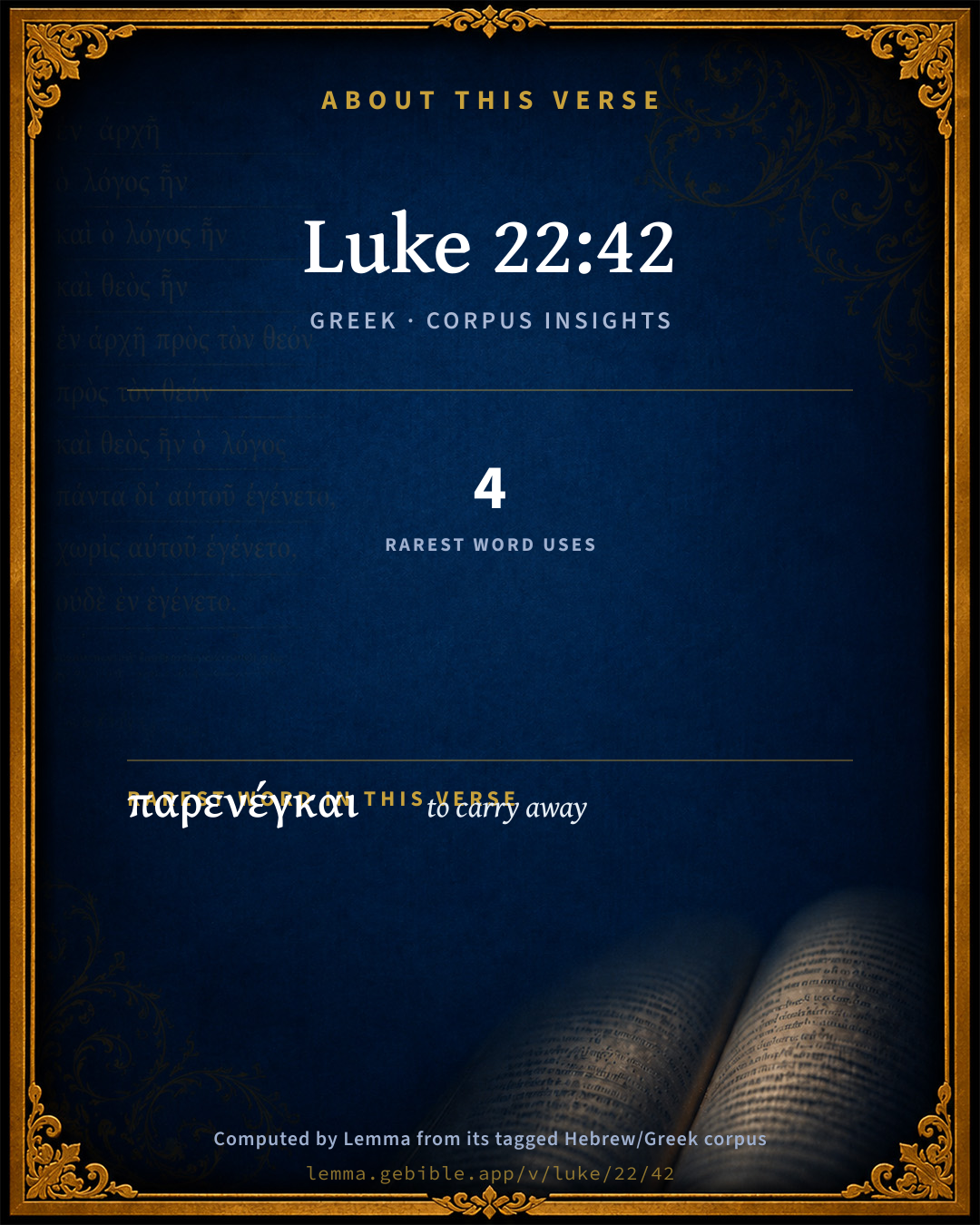
The rarest word here is παρενέγκαι to carry away G3911 — appearing just 4 times in the whole Greek New Testament.

Shared distinctive vocabulary

παρενέγκαι to carry away G3911 occurs in 4 verses of the Greek New Testament. Also found in:

Repetition

Words recur within this verse:

Cross-references

15

Topical passages linked to Luke 22:42 in the Treasury of Scripture Knowledge — connected by theme and wording, ordered by reader-vote popularity; previews shown in the World English Bible.

  • John 12:27–28 "Now my soul is troubled. What shall I say? 'Father, save me from this time?' But for this cause I came to this time.
  • Matthew 26:39 He went forward a little, fell on his face, and prayed, saying, "My Father, if it is possible, let this cup pass away from me; nevertheless, not what I desire, but what you desire."
  • Matthew 26:42 Again, a second time he went away, and prayed, saying, "My Father, if this cup can't pass away from me unless I drink it, your desire be done."
  • Mark 14:36 He said, "Abba, Father, all things are possible to you. Please remove this cup from me. However, not what I desire, but what you desire."
  • Psalms 40:8 I delight to do your will, my God. Yes, your law is within my heart."
  • John 18:11 Jesus therefore said to Peter, "Put the sword into its sheath. The cup which the Father has given me, shall I not surely drink it?"
  • Matthew 20:22 But Jesus answered, "You don't know what you are asking. Are you able to drink the cup that I am about to drink, and be baptized with the baptism that I am baptized with?" They said to him, "We are able."
  • John 5:30 I can of myself do nothing. As I hear, I judge, and my judgment is righteous; because I don't seek my own will, but the will of my Father who sent me.
  • John 6:38 For I have come down from heaven, not to do my own will, but the will of him who sent me.
  • John 4:34 Jesus said to them, "My food is to do the will of him who sent me, and to accomplish his work.
  • Hebrews 10:7–10 Then I said, 'Behold, I have come (In the scroll of the book it is written of me) To do your will, God.'"
  • Luke 22:17–20 He received a cup, and when he had given thanks, he said, "Take this, and share it among yourselves,
  • Isaiah 51:22 Thus says your Lord Yahweh, and your God who pleads the cause of his people, Behold, I have taken out of your hand the cup of staggering, even the bowl of the cup of my wrath; you shall no more drink it again:
  • Matthew 26:44 He left them again, went away, and prayed a third time, saying the same words.
  • Jeremiah 25:15 For thus says Yahweh, the God of Israel, to me: take this cup of the wine of wrath at my hand, and cause all the nations, to whom I send you, to drink it.

Cross-references courtesy of OpenBible.info (CC BY 4.0).

Commentary

Notes on Luke 22:42 from classic Christian and Jewish commentators (each source and its license shown beneath its notes). The classic Christian expositions comment on the surrounding passage and are grouped to its opening verse, so a note may address several verses; the Jewish commentaries on the Tanakh (Rashi and others) are per-verse, so they appear only where the commentator wrote on this verse.

Lemma curates 59 commentaries, every one of them public domain or Creative Commons licensed, each selected and text-cleaned for this edition rather than reprinted as found. About our sources →

Tyndale Open Study Notes

Tyndale Open Resources

22:42 please take this cup of suffering away: A cup is a metaphor for experiencing either judgment or blessing (see, e.g., Pss 23:5; 75:8; 116:13; Isa 51:17). Jesus felt all the emotions of his humanity, including fear and anxiety.

Tyndale Open Study Notes — © Tyndale Open Resources, licensed CC BY-SA 4.0. Text via the HelloAO Bible API.

Bengel's Gnomon

Johann Albrecht Bengel

Luk 22:42. Εἰ βούλει παρενεγκεῖν, if thou he willing, remove) The Infinitive put for the Imperative is a frequent usage of the Greeks. See note on Rev 10:9.[246] And in this passage, indeed, such an Enallage (or change of mood and tense) expresses the reverential modesty of Jesus towards the Father. But in this passage, if we suppose an aposiopesis of the verb παρένεγκε [and make παρενεγκεῖν the Infin. after βούλει, this feeling of reverential modesty will be still more expressively conveyed.

[246] The Infinitive expressing the absolute idea of the verb, irrespective of the particular relations of mood and tense, tends to impart the feeling of majesty to the language when used for the Imperative; especially when God speaks. It was often used archaically for the Imperative, and also for the Imperfect Indicative, in both Latin and Greek.—E. and T.

Bengel's Gnomon of the New Testament — English translation (T&T Clark, Edinburgh, 1860) — public domain. Text from a community e-Sword module.

Expositor's Greek Testament

ed. W. Robertson Nicoll

Luk 22:42 . πάτερ , Father! the keynote, a prayer of faith however dire the distress. εἰ βούλει , etc.: with the reading παρένεγκε the sense is simple: if Thou wilt, take away. With παρενεγκεῖν or παρενέγκαι we have a sentence unfinished: “apodosis suppressed by sorrow” (Winer, p. 750), or an infinitive for an imperative (Bengel, etc.). The use of παρ . in the sense of “remove” is somewhat unusual. Hesychius gives as synonyms verbs of the opposite meaning παραθεῖναι , παραβαλεῖν . The ἀπʼ ἐμοῦ leaves no doubt what is meant. In Lk.’s narrative there is only a single act of prayer. The whole account is mitigated as compared with that in Mt. and Mk. Jesus goes to the accustomed place, craves no sympathy from the three, kneels, utters a single prayer, then returns to the Twelve. With this picture the statement in Luk 22:43-44 is entirely out of harmony.

The Expositor's Greek Testament, edited by W. Robertson Nicoll (1897–1910) — public domain. Text from a community e-Sword module.

Ellicott's Commentary for English Readers

(42) Not my will, but thine, be done.—See Notes on Mat_26:39. Here there is a more distinct echo of the prayer which He had taught His disciples. He, too, could say, “Lead us not into temptation,” but that prayer was subject, now explicitly, as at all times implicitly, to the antecedent condition that it was in harmony with “Thy will be done.”

A Bible Commentary for English Readers, edited by Charles John Ellicott (1878–1897) — public domain. Text from a community e-Sword module.

The Cambridge Bible for Schools and Colleges

gen. ed. J. J. S. Perowne

42. if thou be willing] The principle of His whole life of suffering obedience, Joh_5:30; Joh_6:38.

this cup] Mat_20:22; comp. Eze_22:31; Psa_75:8. This prayer is an instance of the “strong crying and tears,” amid which He “learned obedience by the things which He suffered,” Heb_5:7-8.

The Cambridge Bible for Schools and Colleges (gen. ed. J. J. S. Perowne; Cambridge University Press, 1878–1918) — public domain. Text from a community e-Sword module.

John Gill's Exposition

And there appeared an angel unto him from heaven,.... Whether this was Michael the archangel, as some have conjectured, or Gabriel, or what particular angel, is not for us to know, nor is it of any importance: it is certain, it was a good angel: "an angel of God", as the Ethiopic version reads; since he came from heaven, and was one of the angels of heaven, sent by God on this occasion; and it is clear also, that he was in a visible form, and was seen by Christ, since he is said to appear to him:

strengthening him; under his present distress, against the terrors of Satan, and the fears of death, by assuring him of the divine favour, as man, and of the fulfilment of the promises to him to stand by him, assist, strengthen, and carry him through what was before him; and by observing to him the glory and honour he should be crowned with, after his sufferings and death, find the complete salvation of his people, which would be obtained hereby, and which was the joy set before him; and which animated him, as man, to bear the cross, and despise the shame with a brave and heroic Spirit. Now, though God the Father could have strengthened the human nature of Christ, without making use of an angel; and Christ could have strengthened it himself, by his divine nature, to which it was united; but the human nature was to be brought into so low a condition, and to be left to itself, as to stand in need of the assistance of an angel: and this shows not only the ministration of angels to Christ, as man, but that he was at this present time made a little lower than the angels, who was the Creator and Lord of them; as he afterwards more apparently was, through the sufferings of death.

John Gill's Exposition of the Whole Bible (1746–1763) — public domain (CC PDM 1.0). Text via the HelloAO Bible API.

Trapp's Complete Commentary

John Trapp

42 Saying, Father, if thou be willing, remove this cup from me: nevertheless not my will, but thine, be done.

Ver. 42. lf thou be willing] He was so astonished with the greatness of his present pressures, that he seems for a time to suffer some kind of forgetfulness of his office.

John Trapp, A Commentary or Exposition upon All the Books of the Old and New Testament (1647–1656) — public domain. Text from a community e-Sword module.

Matthew Poole's English Annotations

We have a larger account given us of our Saviour’s prayer, See Poole on "Mat 26:39", and following verses to Mat 26:46. See Poole on "Mar 14:35", and following verses to Mar 14:42.

Matthew Poole's English Annotations on the Holy Bible (1683–1685) — public domain. Text from a community e-Sword/MySword module.

The Pulpit Commentary

Saying, Father, if thou be willing, remove this cup from me: nevertheless not my will, but thine, be done. The three synoptists give this prayer in slightly varying terms; "but the figure of the cup is common to all the three; "it was indelibly impressed on tradition. This cup, which Jesus entreats God to cause to pass from before (para) his lips, is the symbol of that terrible punishment, the dreadful and mournful picture of which is traced before him at this moment by a skillful painter with extraordinary vividness. The painter is the same who in the wilderness, using a like illusion, passed before his view the magical scene -f the glories belonging to the Messianic kingdom" (Godet). If thou be willing. He looked on in this supreme hour, just before "the Passion" really began, to the Crucifixion and all the horrors which preceded it and accompanied it to the treason of Judas; the denial of Peter; the desertion of the apostles; the cruel, relentless enmity of the priests and rulers; the heartless abandonment of the people; the insults; the scourging: and then the shameful and agonizing lingering death which was to close the Passion; and, more dreadful than all, the reason why he was here in Gethsemane; why he was to drink this dreadful cup of suffering; the memory of all the sin of man! To drink this cup of a suffering, measureless, inconceivable, the Redeemer for a moment shrank back, and asked the Father if the cross was the only means of gaining the glorious end in view the saving the souls of unnumbered millions. Could not God in his unlimited power find another way of reconciliation? And yet beneath this awful agony, the intensity of which we are utterly incapable of grasping beneath it there lay the intensest desire that his Father"s wish and will should be done. That wish and will were in reality his own. The prayer was made and answered. It was not the Father"s will that the cup should pass away, and the Son"s will was entirely the same; it was answered by the gift of strength strength from heaven being given to enable the Son to drink the cup of agony to its dregs. How this strength was given St. Luke relates in the next verse.

Self-surrender.

"Not my will, but thine, be done." These words are suggestive as well as expressive. They suggest to us

I THE ESSENTIAL NATURE OF SIN. Where shall we find the root of sin? Its manifold fruits we see around us in all forms of irreligion, of vice, of violence. But in what shall we find its root? In the preference of our own will to the will of God. If we trace human wrong-doing and wrong-being to its ultimate point, we arrived that conclusion. It is because men are not willing to be what God created them to be, not willing to do what he desires them to do; it is because they want to pursue those lines of thought and of action which he has forbidden, and to find their pleasure and their portion in things which he has disallowed, that they err from the strait path and begin the course which ends in condemnation and in death. The essence of all sin is in this assertion of our will against the will of God. We fail to recognize the foundation truth that we are his; that by every sacred tie that can bind one being to another we are bound, and we belong to him from whom we came and in whom we live, and move, and have our being. We assume to be the masters of our own lives and fortunes, the directors of our own selves, of our own will; we say, "My will, not thine, be done." Thus are we radically wrong; and being radically wrong, the issues of our hearts are evil. From this fountain of error and of evil the streams of sin are flowing; to that we trace their origin.

II THE HOUR AND ACT OF SPIRITUAL SURRENDER. When does the human spirit return to God, and by what act? That hour and that act, we reply, are not found at the time of any intellectual apprehension of the truth. A man may understand but little of Christian doctrine, and yet may be within the kingdom of heaven; or, on the other hand, he may know much, and yet remain outside that kingdom. Nor at the time of keen sensibility; for it is possible to be moved to deep and to fervent feeling, and yet to withhold the heart and life from the Supreme. Nor at the time of association with the visible Church of Christ. It is the hour at which and the act by which the soul cordially surrenders itself to God. When, in recognition of the paramount claims of God the Divine Father, the gracious Savior of mankind, we yield ourselves to God, that for all the future he may lead and guide us, may employ us in his holy service; when we have it in our heart to say, "Henceforth thy will, not ours, be done; then do we return unto the Lord our God, and then does he count us among the number of his own.

III THE HIGHEST ATTAINMENT OF CHRISTIAN ENDEAVOUR. When do we reach our highest point? Not when we have fought our fiercest battle, or have done our most fruitful work, or have gained our clearest and brightest vision of Divine truth; but when we have reached the point in which we can most cheerfully and most habitually say, after Christ our Lord, "Not my will, but thine, be done;" when under serious discouragement or even sad defeat, when after exhausting pain or before terrible suffering, when under heavy loss or in long-continued loneliness, or in prospect of early death, we are perfectly willing that God should do with us as his own wisdom and love direct. C.

The Pulpit Commentary (1880–1919), ed. H.D.M. Spence-Jones & Joseph S. Exell — public domain. Text from a community e-Sword module.

Scofield Reference Notes

C. I. Scofield

cup

(See Scofield "Mat 26:39").

The Scofield Reference Bible (1917 edition), notes by C. I. Scofield — public domain. Text from a community e-Sword module.

Cambridge Greek Testament for Schools and Colleges

42. εἰ βούλει. Aposiopesis. Sacrifice of His own will was the principle of His whole life of suffering obedience, Joh 5:30; Joh 6:38.

παρένεγκε. So BD, Vulg[383] It[384] &c. If παρενεγκεῖν be read with the Rec[385] or παρενέγκαι with א we must suppose that as in Luk 19:42 “sorrow has suppressed the apodosis”—Winer, p. 750.

[383] Vulg. Vulgate.

[384] It. Old Latin Version (Itala).

[385] Rec. The Textus Receptus.

τοῦτο τὸ ποτήριον. Mat 20:22; comp. Eze 22:31; Psa 75:8. This prayer is an instance of the “strong crying and tears,” amid which He “learned obedience by the things which He suffered,” Heb 5:7-8.

Cambridge Greek Testament for Schools and Colleges (Cambridge University Press, 1896; 21 vols, various authors incl. Carr, Maclear, Plummer, Farrar, Lumby, Moule, M. R. James, Simcox) — public domain. Text from a community e-Sword module.

Alford’s Greek Testament

Henry Alford

42.] εἰ is not to be rendered ‘utinam,’ but ‘si,’ and the sentence is broken off at ἐμοῦ: thus rendering the meaning equivalent to a wish. Some suppose παρενεγκεῖν to be an inf. for an imperative, but incorrectly.

Henry Alford, The Greek Testament (1849–1861) — public domain. Text from a community e-Sword module.

International Critical Commentary

42. Πάτερ, εἰ βούλει, παρένεγκε. We might have expected εἰ θέλεις (comp. ἐὰν θέλῃς, 5:12), because of τὸ θέλημα in the next sentence. But this is one of the passages which tend to show that in N.T. θέλω indicates mere choice, while βούλομαι implies deliberate selection (Mat 1:19). The latter is far less common in N.T. In LXX there is not much difference.

This is the only passage in which the Attic βούλει for βούλῃ is well supported. Such forms are found in some texts Mat 27:4; Joh 11:40; Act 16:31, Act 24:8.

In D a c d e ff2 μὴ τὸ θέλημα … γενέσθω precedes εἰ βούλει … ἐμοῦ, πλήν being omitted. Several of the same authorities have a similar inversion 9:62.

The reading παρενεγκεῖν (A Q X Γ Δ Λ) turns the prayer into an unfinished pleading: “Father, if Thou be willing to remove this cup from Me.”—Comp. Exo 32:32. B D T Versions, and Orig. support παρένεγκε. Vulg. transfer calicem istum; Tert. transfer poculum istud; but he may be quoting Mar 14:36 (De Orat. 4.). Boh. Sah. Syr-Cur. Syr-Sin. have “let this cup pass.”

παρέενεγκε τοῦτο τὸ ποτήριον ἀπʼ ἐμοῦ. “This cup” and the address “Father” are in all three accounts. In O.T. the metaphor of “cup” for a person’s fortune, whether good or bad, is very common (Psa 11:6, Psa 16:5, Psa 23:5, Psa 75:8, etc.). In N.T. specially of the sufferings of Christ (Mar 14:36; Joh 18:11; Mat 20:22, Mat 20:23; Mar 10:38, Mar 10:39): comp. Rev 14:10, Rev 16:19, Rev 18:6. In class. Grk. παραφέρειν ποτήριον would mean to place a cup at the side of a person. put it on the table near him (Hdt. 1:119, 5, 133, 3; Plat. Rep. 1. p. 354). But in Plutarch παραφέρειν is used in the sense of “lay aside, remove” (Camill. 41.). Elsewhere in N.T. it is used of leading astray (Heb 13:9; Jud 1:12).

τὸ θέλημά μου. Either βούλημα or βουλή might have been used of the Father’s will. but less suitably of Christ’s (Eph 1:11). The γινέσθω is peculiar to Lk. It recalls γέηθήτω τὸ θέλημά σου (Mat 6:10), which Lk. omits (11:2). For πλήν comp. 10:11, 14, 20.

International Critical Commentary — older volumes (1896–1929), various authors — public domain. Text from a community e-Sword module.

Lesson kit

Teaching starters — assembled from the data on this page, not authored interpretation. Every prompt links to the verse data it draws on. Edit before teaching.

Luke, in the Gospels, opens this verse with 19 words (16 distinct Greek lemmas). Its most distinctive word is paraphérō (“to carry away”). A historical commentator’s framing appears above. Read the whole chapter for the surrounding context.

Discussion questions

  1. What does “to carry away” (paraphérō) contribute to the verse as a whole?
  2. How does Mark 14:36, which shares the word «to carry away», read alongside this verse?
  3. What does the repetition of “the” (3× in this one verse) do in this verse?
  4. The translations on this page render this verse differently — a whole-verse word diff, not a word-by-word alignment. What might account for the different wordings?
  5. Compare how Tyndale Open Study Notes and Bengel's Gnomon read this verse. Where do they agree or differ?

Things to notice

Reading settings

Reading text

Shown beneath each verse's original-language words.

Old Testament
Old Testament edition

Read the OT as the Masoretic Hebrew (MT) or the Greek Septuagint (LXX).

English shown for the Greek Septuagint (in the Hebrew ↔ Greek comparison).

Comparing translations? Open the Compare panel on any verse page to stack up to four side by side.