Luke 3:8

Greek (Tischendorf 8th ed.) Luke 3:8 appears in the Greek New Testament. The text above is from the Tischendorf 8th edition. Each word links to its Strong’s number and a concise gloss. Click any word for its full Thayer’s Greek Lexicon entry.
Download image
Cite this verse

Luke 3:8 (World English Bible). Public Domain. Lemma interlinear Bible study tool, https://lemma.gebible.app/v/luke/3/8.

Show BibTeX & RIS
BibTeX
RIS
English Translation
Bring forth therefore fruits worthy of repentance, and don't begin to say among yourselves, 'We have Abraham for our father;' for I tell you that God is able to raise up children to Abraham from these stones!
World English Bible · Public Domain
Download a study sheet

One document with this verse’s original text, its word-by-word gloss line, the meaning frame, cross-references with their text, attributed commentary, and full source and license credits — printable, and it pastes into notes with its structure intact.

This verse Autodidact and up

Study sheet (.html) Plain text (.txt)

A passage Seminary Student

Up to 50 verses in one chapter. A passage sheet keeps up to 6 commentary sources and 12 cross-references per verse, in the order this page ranks them, and says so on the sheet whenever that leaves anything out. Ask for a single verse and you get the Autodidact verse sheet above.

Everything on this page stays free to read, with no account — the sheet is a download of what is already on screen, not access to it.

Want to remove ads? Support Godless Engineer
Compare translations 3

The same verse in 3 English versions, stacked beneath the original-language interlinear above. Click any original word for its lexicon entry.

Each is an independent rendering of the whole verse — the interlinear is not word-aligned to these translations.

Highlighted words mark where these versions differ — a whole-verse word diff, not a word-by-word alignment.

  • World English Bible Public Domain
    Bring forth therefore fruits worthy of repentance, and don't begin to say among yourselves, 'We have Abraham for our father;' for I tell you that God is able to raise up children to Abraham from these stones!
  • King James Version Public Domain
    Bring forth therefore fruits worthy of repentance, and begin not to say within yourselves, We have Abraham to our father: for I say unto you, That God is able of these stones to raise up children unto Abraham.
  • unfoldingWord Literal Text CC BY-SA 4.0
    Therefore, produce fruits worthy of repentance, and do not begin to say within yourselves, ‘We have Abraham father.’ For I say to you that God is able to raise up children for Abraham from these stones.

unfoldingWord Literal Text — © unfoldingWord, licensed CC BY-SA 4.0. Word-aligned USFM3 via Door43 (git.door43.org/unfoldingWord/en_ult).

Versions to compare (up to 4)

3 of 4 selected

Show all 19 translations

Every available English version of this verse, each an independent rendering of the whole verse.

  • World English Bible Public Domain
    Bring forth therefore fruits worthy of repentance, and don't begin to say among yourselves, 'We have Abraham for our father;' for I tell you that God is able to raise up children to Abraham from these stones!
  • Berean Standard Bible Public Domain
    Produce fruit, then, in keeping with repentance. And do not begin to say to yourselves, ‘We have Abraham as our father.’ For I tell you that out of these stones God can raise up children for Abraham.
  • Majority Standard Bible Public Domain
    Produce fruit, then, in keeping with repentance. And do not begin to say to yourselves, ‘We have Abraham as our father.’ For I tell you that out of these stones God can raise up children for Abraham.
  • King James Version Public Domain
    Bring forth therefore fruits worthy of repentance, and begin not to say within yourselves, We have Abraham to our father: for I say unto you, That God is able of these stones to raise up children unto Abraham.
  • American Standard Version (1901) Public Domain
    Bring forth therefore fruits worthy of repentance, and begin not to say within yourselves, We have Abraham to our father: for I say unto you, that God is able of these stones to raise up children unto Abraham.
  • Revised Version (1885) Public Domain
    Bring forth therefore fruits worthy of repentance, and begin not to say within yourselves, We have Abraham to our father: for I say unto you, that God is able of these stones to raise up children unto Abraham.
  • Geneva Bible (1599) Public Domain
    Bring foorth therefore fruites worthy amendment of life, and beginne not to say with your selues, We haue Abraham to our father: for I say vnto you, that God is able of these stones to raise vp children vnto Abraham.
  • Douay-Rheims (1899) Public Domain
    Bring forth therefore fruits worthy of penance; and do not begin to say, We have Abraham for our father. For I say unto you, that God is able of these stones to raise up children to Abraham.
  • Young's Literal Translation Public Domain
    make, therefore, fruits worthy of the reformation, and begin not to say within yourselves, We have a father -- Abraham; for I say to you, that God is able out of these stones to raise children to Abraham;
  • Literal Standard Version CC BY-SA 4.0
    Make, therefore, fruits worthy of conversion, and do not begin to say within yourselves, We have a father—Abraham; for I say to you that God is able to raise children to Abraham out of these stones;
  • Unlocked Literal Bible CC BY-SA 4.0
    Therefore, produce fruits that are worthy of repentance, and do not begin to say within yourselves, 'We have Abraham for our father,' for I tell you that God is able to raise up children for Abraham from these stones.
  • unfoldingWord Literal Text CC BY-SA 4.0
    Therefore, produce fruits worthy of repentance, and do not begin to say within yourselves, ‘We have Abraham father.’ For I say to you that God is able to raise up children for Abraham from these stones.
  • Darby Bible Public Domain
    Produce therefore fruits worthy of repentance; and begin not to say in yourselves, We have Abraham for [our] father, for I say unto you that God is able of these stones to raise up children to Abraham.
  • World Messianic Bible Public Domain
    Therefore produce fruits worthy of repentance, and don’t begin to say among yourselves, ‘We have Abraham for our father;’ for I tell you that God is able to raise up children to Abraham from these stones!
  • Webster's Bible Public Domain
    Bring forth therefore fruits worthy of repentance, and begin not to say within yourselves, We have Abraham for our father: for I say to you, that God is able of these stones to raise up children to Abraham.
  • Free Bible Version CC BY-SA 4.0
    “Demonstrate that you have truly repented. Don't try to justify yourselves by saying, ‘We're Abraham's descendants.’ Let me tell you, God can create children of Abraham from these stones.
  • Bible in Basic English Public Domain
    Make clear by your acts that your hearts have been changed; and do not say to yourselves, We have Abraham for our father: for I say to you that God is able from these stones to make children of Abraham.
  • Text-Critical English NT CC BY 4.0
    Produce fruit consistent with repentance, and do not begin to say to yourselves, ‘We have Abraham as our father,’ for I tell you that God is able from these stones to raise up children for Abraham.
  • Tyndale New Testament (1534) Public Domain
    Bringe forth due frutes of repentaunce and begynne not to saye in youre selves we have Abraham to oure father. For I saye vnto you: God is able of these stones to reyse vp chyldren vnto Abraham.

Literal Standard Version (2020), Covenant Press — licensed CC BY-SA 4.0. Text via the HelloAO Bible API (eBible.org). Unlocked Literal Bible (unfoldingWord) — licensed CC BY-SA 4.0. Text via the HelloAO Bible API (eBible.org). unfoldingWord Literal Text — © unfoldingWord, licensed CC BY-SA 4.0. Word-aligned USFM3 via Door43 (git.door43.org/unfoldingWord/en_ult). Free Bible Version, Dr. Jonathan Gallagher — licensed CC BY-SA 4.0. Text via the HelloAO Bible API (eBible.org).

Word by word

More ways to search: Search by grammar → Find every occurrence → Compare this word →

Practice this passage: Drill this verse → Learn its vocabulary →

μετανοίας
metánoia
G3341
“repentance”
Noun, Genitive, Singular, Feminine
Part of Speech
Noun
Case
Genitive
Number
Singular
Gender
Feminine
Full Thayer's Definition

Origin: from G3340

TDNT: 20:15,6

1. a change of mind, as it appears to one who repents, of a purpose he has formed or of something he has done
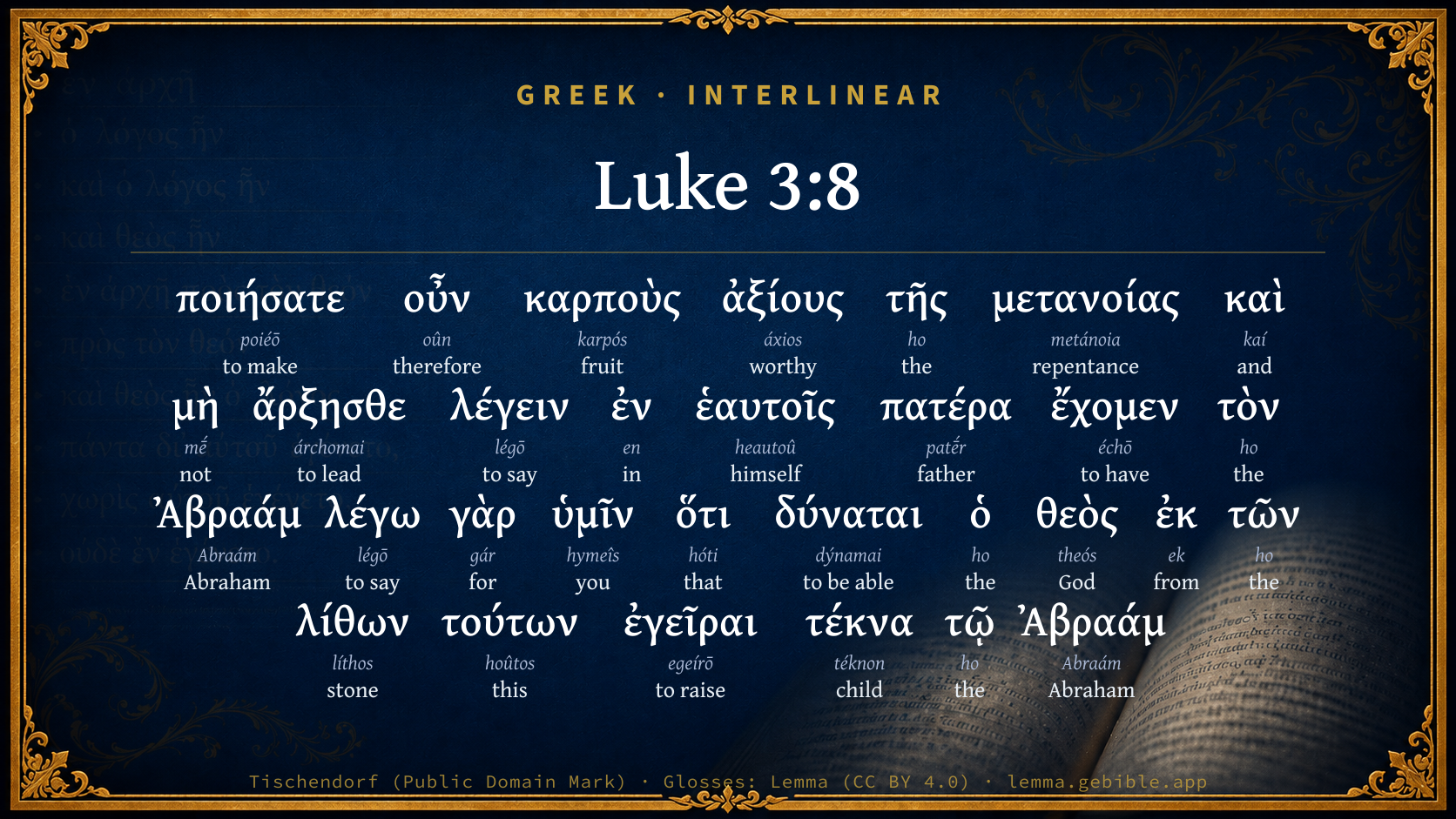
  1. ποιήσατε poiéō G4160 “to make” Verb, Aorist, Active, Imperative, 2nd person, Plural
  2. οὖν oûn G3767 “therefore” Conjunction
  3. καρποὺς karpós G2590 “fruit” Noun, Accusative, Plural, Masculine
  4. ἀξίους áxios G514 “worthy” Adjective, Accusative, Plural, Masculine
  5. τῆς ho G3588 “the” Article, Genitive, Singular, Feminine
  6. καὶ kaí G2532 “and” Conjunction
  7. μὴ mḗ G3361 “not” Particle, Negative
  8. ἄρξησθε árchomai G756 “to lead” Verb, Aorist, Middle, Subjunctive, 2nd person, Plural
  9. λέγειν légō G3004 “to say” Verb, Present, Active, Infinitive
  10. ἐν en G1722 “in” Preposition
  11. ἑαυτοῖς heautoû G1438 “himself” Reflexive pronoun, 2nd person, Dative, Plural, Masculine
  12. πατέρα patḗr G3962 “father” Noun, Accusative, Singular, Masculine
  13. ἔχομεν échō G2192 “to have” Verb, Present, Active, Indicative, 1st person, Plural
  14. τὸν ho G3588 “the” Article, Accusative, Singular, Masculine
  15. Ἀβραάμ Abraám G11 “Abraham” Noun, Proper, indeclinable
  16. λέγω légō G3004 “to say” Verb, Present, Active, Indicative, 1st person, Singular
  17. γὰρ gár G1063 “for” Conjunction
  18. ὑμῖν hymeîs G5210 “you” Personal pronoun, 2nd person, Dative, Plural
  19. ὅτι hóti G3754 “that” Conjunction
  20. δύναται dýnamai G1410 “to be able” Verb, Present, Middle or Passive deponent, Indicative, 3rd person, Singular
  21. ὁ ho G3588 “the” Article, Nominative, Singular, Masculine
  22. θεὸς theós G2316 “God” Noun, Nominative, Singular, Masculine
  23. ἐκ ek G1537 “from” Preposition
  24. τῶν ho G3588 “the” Article, Genitive, Plural, Masculine
  25. λίθων líthos G3037 “stone” Noun, Genitive, Plural, Masculine
  26. τούτων hoûtos G3778 “this” Demonstrative pronoun, Genitive, Plural, Masculine
  27. ἐγεῖραι egeírō G1453 “to raise” Verb, Aorist, Active, Infinitive
  28. τέκνα téknon G5043 “child” Noun, Accusative, Plural, Neuter
  29. τῷ ho G3588 “the” Article, Dative, Singular, Masculine
  30. Ἀβραάμ Abraám G11 “Abraham” Noun, Proper, indeclinable

About this verse

These counts appear in no published source. They are computed here, from the morphology-tagged text and Lemma’s own curated glosses. What Lemma adds →

31
words
25
distinct lemmas
Gospels
section

Notable vocabulary

The rarest word here is μετανοίας repentance G3341 — appearing just 22 times in the whole Greek New Testament.

Shared distinctive vocabulary

μετανοίας repentance G3341 occurs in 22 verses of the Greek New Testament. Also found in:

Repetition

Words recur within this verse:

  • λέγειν to say G3004 ×2
  • Ἀβραάμ Abraham G11 ×2
  • τῆς the G3588 ×5

Cross-references

20

Topical passages linked to Luke 3:8 in the Treasury of Scripture Knowledge — connected by theme and wording, ordered by reader-vote popularity; previews shown in the World English Bible.

  • Ezekiel 18:27–31 Again, when the wicked man turns away from his wickedness that he has committed, and does that which is lawful and right, he shall save his soul alive.
  • Acts 26:20 but declared first to them of Damascus, at Jerusalem, and throughout all the country of Judea, and also to the Gentiles, that they should repent and turn to God, doing works worthy of repentance.
  • Isaiah 1:16–18 Wash yourselves, make yourself clean. Put away the evil of your doings from before my eyes; Cease to do evil.
  • Matthew 21:43 "Therefore I tell you, the Kingdom of God will be taken away from you, and will be given to a nation bringing forth its fruits.
  • Galatians 5:22–24 But the fruit of the Spirit is love, joy, peace, patience, kindness, goodness, faithfulness,
  • Hebrews 6:7–8 For the land which has drunk the rain that comes often on it, and brings forth a crop suitable for them for whose sake it is also tilled, receives blessing from God;
  • Joshua 4:3–8 and command you them, saying, Take hence out of the midst of the Jordan, out of the place where the priests' feet stood firm, twelve stones, and carry them over with you, and lay them down in the lodging-place, where you shall lodge this night.
  • Luke 19:40 He answered them, "I tell you that if these were silent, the stones would cry out."
  • Romans 4:16 For this cause it is of faith, that it may be according to grace, to the end that the promise may be sure to all the seed, not to that only which is of the law, but to that also which is of the faith of Abraham, who is the father of us all.
  • Romans 9:7 Neither, because they are Abraham's seed, are they all children. But, "In Isaac will your seed be called."
  • 2 Corinthians 7:10–11 For godly sorrow works repentance to salvation, which brings no regret. But the sorrow of the world works death.
  • Philippians 1:11 being filled with the fruits of righteousness, which are through Jesus Christ, to the glory and praise of God.
  • John 8:33 They answered him, "We are Abraham's seed, and have never been in bondage to anyone. How do you say, 'You will be made free?'"
  • Galatians 3:28–29 There is neither Jew nor Greek, there is neither slave nor free man, there is neither male nor female; for you are all one in Christ Jesus.
  • Isaiah 48:1–2 Hear you this, house of Jacob, who are called by the name of Israel, and are come forth out of the waters of Judah; who swear by the name of Yahweh, and make mention of the God of Israel, but not in truth, nor in righteousness
  • Jeremiah 7:4–10 Don't you trust in lying words, saying, The temple of Yahweh, the temple of Yahweh, the temple of Yahweh, are these.
  • Matthew 8:11–12 I tell you that many will come from the east and the west, and will sit down with Abraham, Isaac, and Jacob in the Kingdom of Heaven,
  • Luke 13:28–29 There will be weeping and gnashing of teeth, when you see Abraham, Isaac, Jacob, and all the prophets, in the Kingdom of God, and yourselves being thrown outside.
  • Luke 16:23–31 In Hades, he lifted up his eyes, being in torment, and saw Abraham far off, and Lazarus at his bosom.
  • John 8:39 They answered him, "Our father is Abraham." Jesus said to them, "If you were Abraham's children, you would do the works of Abraham.

Cross-references courtesy of OpenBible.info (CC BY 4.0).

Commentary

Notes on Luke 3:8 from classic Christian and Jewish commentators (each source and its license shown beneath its notes). The classic Christian expositions comment on the surrounding passage and are grouped to its opening verse, so a note may address several verses; the Jewish commentaries on the Tanakh (Rashi and others) are per-verse, so they appear only where the commentator wrote on this verse.

Lemma curates 59 commentaries, every one of them public domain or Creative Commons licensed, each selected and text-cleaned for this edition rather than reprinted as found. About our sources →

Trapp's Complete Commentary

John Trapp

8 Bring forth therefore fruits worthy of repentance, and begin not to say within yourselves, We have Abraham to our father: for I say unto you, That God is able of these stones to raise up children unto Abraham.

Ver. 8. {See Trapp on "Mat 3:8"} {See Trapp on "Mat 3:9"}

John Trapp, A Commentary or Exposition upon All the Books of the Old and New Testament (1647–1656) — public domain. Text from a community e-Sword module.

The Biblical Illustrator

Joseph S. Exell

Luk_3:8

Fruits worthy of repentance

Fruitfulness

Every living fruit-tree is in some measure fruitful; though some bring forth more fruit, some less, yet all bring forth some.

All living Christians are thriving and bearing fruit; though some are more eminent for growth and proficiency in grace, yet all bring forth fruits meet for repentance. The hypocrite, like a dead stake in a hedge, continues at a stay, is without good fruit, nay, grows more rotten every month; but the true saint, like the living tree, the longer he continues rooted in Christ the more abundant he is in the work of the Lord. (George Swinnock.)

Fruit-bearing the test of life

When we see the effigy or portraiture of any king stand still without motion, exquisitely graven in metal or painted out in lively colours, we know that, for all the eyes and mouth and nose it has, there is no life in it. So, when we see professors of religion without the powerful practice of godliness, and supreme officers of state without the administration of justice, we can safely conclude that the life of God is not in them; that they are not actuated by any Divine principle within, but are mere idols and images of vanity. (C. Leslie.)

Deceptive appearances

Those persons who practise devotion, and who fail to do works of faith and charity, are like trees in blossom. You think there will be as much fruit as flower, but there is a great difference. (Vianney.)

The life must accord with the profession

His religion is in vain whose profession brings not letters testimonial from a holy life. Sacrifice without obedience is sacrilege. (W. Gurnall.)

Thou callest thyself Christian; but we question whether thou hast a right to the title; thy conduct is too contrary to that sacred name, which is too holy to be written on a rotten post. (W. Gurnall.)

Repentance results in change of action

Just as the whole ship turns in obedience to the helm, so the change of mind produces a change of life. Here comes in the well-known story of the storekeeper who could not recollect the sermon; she only knew that after it she went straight home and destroyed all her light weights. A Hindu candidate for Christian baptism was asked what evidence he had to offer of his conversion. Formerly, he said, I was proud, and delighted in evil, but since I heard the words of Jesus, I delight in these things no more. (Sunday School Times.)

Repentance shows itself

The real thing always shows itself. Whether it is love, or friendship, or generosity, or gratitude, or trust, or repentance, it will evidence its genuineness in something more than profession. There are shams and there are realities in all these spheres, and the differences between them will stand out in the long run. There is a great deal of sorrow over sin and over sinning that is not repentance. The guilty prisoner is sorry that he got caught. The guilty man who has not got caught is sorry that so much of evil and trouble comes of his wrong doing. There is sorrow because of the results of sin, in every sinners soul. But that is not repentance, Repentance is the turning away of the soul from sin as sin; it is the turning toward something better than sin. This state of mind will show itself in conduct that gives proof of sincerity. Sinful courses will be abandoned. Reparation will be made. A new course of living will be adopted. In word and in action there will be fruits worthy of the name of true repentance. (H. C. Trumbull.)

Change of mind involves change of practice

The fruits worthy of repentance are the renunciation of formerly indulged sins, and the performance of formerly neglected duties. We, ourselves, would not give credit to a man who said he was sorry for having offended us, but who still went on repeating the same offence: as little need we suppose we are penitents if we persevere in our disobedience to God. Repentance begins, and chiefly consists in a change of mind; but that change must evidence itself, and if it be real it will evidence itself in outward reformation and in an exemplary life. John called on his hearers to let it be seen, by their subsequent conduct, that they were converts indeed. (James Foote, M. A.)

Motives to repentance

Motives to repentance are found in,

1. Divine precepts.

2. Penalty.

3. Promises.

4. The danger of delay.

Time may fail. The Spirits aid may be refused (Joh_3:27). Habits are formed (Jer_13:23). The will is inefficient (Joh_6:44). The flower of existence spent in sin; blind and lame, a mere wreck brought at last to God. (W. H. Van Doren, D. D.)

Repentance is more than penance-doing

One of Luthers happiest moments was when, reading in his Greek Testament, he found that repentance meant a change of mind rather than penance-doing. A captain at sea discovers that by some mistake the steersman is steering the ship directly for the rocks. How is the danger to be avoided? By scrubbing the decks or setting the men to the pumps? No I these things are good enough in their own time, but if the ship is to be saved, one thing must be done--her course must be changed. So the captain utters a few quick words, and the ship turns and speeds away from the hanger. Johns preaching was in like manner. A call to men to turn from the dangerous rocks of sin, and to make for the only safe haven. (Sunday School Times.)

Fruits meet for repentance

A coal merchant in one of our American cities was approached by a minister in regard to the salvation of his soul.

The merchant declared it an impossibility for him ever to become a Christian. He gave as a reason his mode of business. For a long term of years, he had, according to a too general custom, given short weight. He had thus grown rich, and now felt the inconsistency of seeking religion without restitution. This was impossible: many of his customers were dead, others beyond his knowledge. The thought of the poor who had paid for coal they never received rested heavily on him. He asked the minister if he thought the substitution of a gift to the poor would be acceptable to God. The minister advised him to try it. A large donation, more than equal in amount of his unjust gains, was accordingly made, and the merchant sought God in earnest. He was happily converted, and is to-day a prominent member of the Church.

Proof of turning from sin

One of two infidel companions was converted to God. He went to tell his sceptical friend, who was surprised, and sneered at him. Well, said the Christian, I have a duty to do to you, and I have scarcely slept two nights for thinking of it. I have got four sheep in my flock that belong to you. They came into my field six years ago, and I marked them with my mark. They are in my field with the increase of them. I have laid awake, groaned over it, and I have come to get rid of it. I will do what you will, go to prison, pay the money, or restore the property. The infidel began to tremble. If you have got them sheep you are welcome to them; I dont want nothing of you, if you will go away; something must have got hold of you I dont understand I You may keep the sheep if you will only go away. No, said the Christian, I must settle this up. He counted out the value of the four sheep, 6 per cent interest, and then put double the amount down. This was turning from sin. (G. Bowden.)

The necessity of penitence

I. PENITENCE IS NECESSARY FOR THE SINNER, in order to be reconciled to God.

1. According to the written Word of God (Luk_13:5; Joh_3:5).No excuse. No grace in case of negligence.

2. According to the example of all the saints. David. Magdalen. Peter.

3. Reason teaches its necessity.

(1) As satisfaction for the guilt, the injury against God (Mat_5:26).

(2) As atonement (Zec_1:3; Eze_18:21).

(3) As punishment. Man is the author of sin. The Divine Justice owes it to itself to resent every attack upon the moral order (Psa_37:33).

(4) As spiritual remedy. To repair moral damage--the balsam to heal the wound, after the arrow has been taken out. Exciting zeal, conferring grace, setting aside the occasions of sin.

II. PENITENCE IS NECESSARY TO THE JUST.

1. No one is sure of justification.

2. Every one offends daily in little things, and for every sin satisfaction must be made.

3. After the remission of guilt and eternal punishment, there remains yet temporal punishment to expiate. Call to mind the rigour of the ancient Church, of her penitential canons, etc.

4. Every one is liable to fall, while he lives. Fruits worthy of repentance are like a hedge of thorns around the paradise of virtues. (Valke.)

The ministry of John Baptist

1. Moral, not theological, in its aim.

2. Faithful, not temporizing in its appeal.

3. Symbolic, not superstitious, in its ritual.

4. Humble, not haughty in its spirit. (Dr. Thomas.)

A father brought to repentance

It pleased God to visit one of the daughters of a wicked father with mortal sickness; but before her death she was instrumental in exciting the attention of her parent to the concerns of his soul. Father, inquired the dying child, can you spell repentance? The artless question, through the blessing of God, was effectual to awaken concern. Spell repentance! repeated the astonished father; why, what is repentance? Thus he became desirous of knowing, and ultimately was taught its sacred meaning; and discovered that he had been a stranger to it, both in theory and experience. He also discovered that he needed repentance; that he was a guilty condemned sinner, deserving Gods wrath and everlasting misery; and repentance unto life was granted to him. He spelled out his Divine import; and obtained an acquaintance with that Saviour whom God has exalted to give repentance and remission of sins; and by bringing forth the fruits of righteousness, he in afterlife supported and adorned his Christian profession.

A call for John the Baptist

John had a word and a sign. The word was--Repent; and the sign was-Baptism. Word and sign were intimatelyrelated. His was the baptism of repentance. The word commanded. The sign accepted. A great moral and religious impulse swept wave-like over the people. The baptism of repentance became the order of the day. But, unfortunately, in the degree that the baptism became a fashion it also became a form. Johns soul was too upright to be blinded by what looked like success. His language, its directness, and the form with which he clothed his ideas, all showed how radical was the thing he aimed at. The axe, winnowing, uprooting, fire-cleansing, were the symbols that naturally expressed his violent and stormy thoughts and intents. What would John the Baptist say, if he were now to come into our churches and pulpits? He would fiercely denounce all shows and shams in religion. He would scathe and scatter with the lightnings of his indignation all moral delusions. He would demand the putting away of all unholiness. He would say, Let us have soundness and solidness, sincerity and spiritual mindedness, or nothing at all. No doubt there would be a sensation. Well-bred people would be scandalized. Prudent men would say, You must use milder language, sir, or we shall have the church empty. And the prophet would reply, Exactly; that is what I have come for. I have come to drive either the sinners or their sins out of the churches. The great truth to be carried home is, that genuine repentance must always precede the kingdom of God. There is a repentance that is easy and cheap, and is worth as much as it costs or a little less. Repentance is--

(1) Not a piece of ceremonialism;

(2) more than an emotion, an excitement;

(3) a resolve, an action against sin.

The call to repent is a call to action. It means, change your mind about wrong-doing; change your whole course of moral thought, feeling, conduct. It must be personal and spring from a personal source. The kingdom of heaven is at hand, and it is as full of promise as of judgment. (W. Hubbard.)

Repentance

The word is often used for the compunction with which one may reflect on a particular sin. Whether such compunction procures the forgiveness of the sin, seems to me a question which it is rather too bold to ask, but which is quite unimportant to have answered, unless forgiveness of sins were the same thing as forgiveness of sin. They are entirely different, and there is an equal and exactly corresponding difference between repentance in the sense just mentioned, and in that signified by the word which in the New Testament expresses the condition to which forgiveness of sin is attached. The Greek word denotes a change of mind, heart, or disposition, which is equivalent to the cessation of sin as a habit or state. Sins may be repented of without any such annihilation of sin. And without such annihilation I venture to doubt whether God Himself could forgive sin, any more than He could make two contrary propositions identical, or the same thing to be and not to be at the same time. (Bishop Thirlwall.)

The ministry of John

An awful ministry truly! The gospel concludes with benediction but it invariably begins with sword and fire. One of the first things that a true minister has to do is to destroy false hopes. It is thus that John did when he broke in thus rudely upon the traditional hopes of those who heard him. They were living securely in the facts that Abraham was their father, and their reasoning was that if Abraham was their father they themselves were necessarily good, and their moral position was invincible. John takes the roof off this house of refuge, and pours the Divine storm upon their heads. He throws down the walls within which they had enclosed themselves, and sends the floods of Divine judgment along the courses of their foundations. But there is a word of hope even in this storm of vengeance. John declares the possibility of repentance even on the part of a generation of vipers. The Christian teacher ought not to content himself with mere denunciation. Let him be faithful in describing the real character of those who hear him; but when he has done so, let him see that they do not die of despair, for want of the hopeful word of repentance. A severe thing this to say about Abraham was it not? The meaning is that hereditary piety is of no use; that we are not good simply because we have a good ancestry; and that as for mere history, God is able to make it out of the very stones under our feet. (J. Parker, D. D.)

A parable of the fig-trees

What fruits arc meet for repentance? To that question let me reply with a parable. You remember that as our Lord went from Bethany to Jerusalem He saw a fig-tree by the wayside, full of leaves, and came to it that He might eat of its fruit. But when He reached it, He found nothing but leaves on it. The conscious tree withered beneath His rebuke. This story is familiar to you all: but perhaps you did not know that three other fig-trees were growing hard by, near enough to hear what passed between Christ and the fruitless tree, and to mark how it withered beneath His curse. Yet there were such trees, or we shall assume that there were. And being observant and reflective trees they were very much alarmed to see that the axe was laid to the roots of the trees, and that every tree which brought not forth good fruit would be hewn down and cast into the fire. They said among themselves: We, indeed, have some fruits; but, oh, how fowl We will do better next year, lest we should likewise perish. The seasons passed; the winds blew, the rains fell, the sun shone; and now, at last, the time of figs has come round again. We take the road to Bethany, to see how these three trees have kept their purpose of amendment.

1. We approach the first tree; and looking at it attentively, we are surprised and grieved to find that, though it is thick with broad tender leaves, it has but little fruit, and that but poor. We say, How is this? And the tree replies, I waited day after day, month after month, and no prophet passed this way. Why should I trouble myself? I have done more than last year. I have some fruits to show, and many leaves. Why should I not be content? No prophet will ever pass this way again; or if a prophet should come, I have done enough to save myself from his curse. This tree has not brought forth fruits meet for repentance; for it has done nothing from love, and very little from fear.

2. We advance to the second tree; and on this also we find only a few figs: but they are very large and good. We do not for a moment mistake it for a cumberer of the ground; its few but large fruits show plainly through the leaves. Yet the tree wears an aspect of sadness, and waits with some apprehension to hear what we have to say to it. Noting its aspect of settled grief, we do not ask, Why are your fruits so few when your purpose was so earnest? We say, Be not sad and discouraged O tree, because you have borne but little fruit; rather be glad that your fruit is so fine and sweet. You will do more and better next year, if you hold fast to your purpose of amendment, and soon your fruit will be as abundant as it is good. This tree has brought forth fruits meet for repentance; for it has done well, and is sorry that it has not done better.

3. We pass on to the third tree; and on this we find much fruit indeed, but its fruit is exceedingly various in quality; some of the figs are large and sweet, but some are so small and rude that there is little chance of their being brought to perfection. In haste to prevent us from giving it more than its due, it says, It grieves me that my fruit, which is so abundant, is yet so poor. I have discovered in myself, since I resolved to amend, both a power that I knew not of, and an impotence which I did not suspect. I did not know I could do so much as I have done; but I did think that what I could do, that I should do well. Power is mine; alas, that I should so have wasted it! but, alas, weakness is also mine; and though I can do much, I do it but to little purpose! This third tree, like the second, has brought forth fruits meet for repentance; for it has done much and would fain have done better: and, therefore, we bid it be of good heart, and leave it with good hope that, as it has already borne much fruit, so, in due time, all its fruit will become perfect.

4. But here some humble soul may cry out, Alas, sir, I am no fruit-tree! I am but as a thorn or a brier. Have you no word of comfort, or promise for me? Surely I have. Instead of the thorn shall come up the fir-tree, &c. In the kingdom and garden of Christ strange transformations take place. However wild and barren your nature may be, if you crave comfort and promise, that is, if you honestly desire to amend, there is a power in Christ capable of making you better. You are repenting of the past; and He will show you how, in the future, even you may bring forth fruits meet for repentance. (T. T. Lynch.)

Tests of religious life

I. FALSE TESTS ARE FOUND IN THE POSSESSION OF ADVANTAGES. We have Abraham, &c. This may be regarded--

1. As a sentimental advantage: related to the past. Their Church not a thing of yesterday.

2. As an ecclesiastical advantage: they were related to a privileged past.

3. As a moral advantage: they were related to a worthy past--had a noble ancestry.

II. THE TRUE TEST FOUND IN THE MANIFESTATION OF FRUITFULNESS. This--

1. The demand of Scripture. Insisted upon by--

(1) prophets (Isaiah and Micah);

(2) apostles;

(3) the Lord.

2. The demand of society. In relation to--

(1) secular questions;

(2) religious questions. The test is applied everywhere.

III. HOW MAY FRUITFULNESS BE GAINED? Only by union with Christ. Abide in Me, &c. (Joh_15:4-5). (W. Glyde Tarbolton.)

We have Abraham to our father

Pride of ancestry

Pride of ancestry is a common evil, and it was very prevalent among the Jews.

I. LET US ATTEND TO A FEW GENERAL REMARKS ON THE PASSAGE,

1. It must be admitted that it was once a privilege to have Abraham for a father. It was in consequence of the Israelites being the children of Abraham, that unto them pertained the adoption, and the glory, and the covenants, and the giving of the law, and the service of God, and the promises. It was, therefore, one of the first honours, to belong to the family of Abraham (Deu_33:29; Psa_105:42; Rom_9:4).

2. It was no unusual thing for the Jews, in their most degenerate state, to boast of their descent from this eminent patriarch.

3. To be descended from pious parents is still a privilege, which we should carefully improve. A heathen philosopher blessed God that he was born at Athens; and have we not greater reason to bless Him that we were born in a Christian country, and descended from godly ancestors. David mentions the piety of his mother as a motive for devoting himself to the service of God, and as a reason of his having obtained mercy. Oh, Lord, says he, truly I am Thy servant; I am Thy servant, and the son of Thy handmaid; Thou hast loosed my bonds. And in giving a solemn charge to his son, he uses similar language, Thou Solomon, my son, know thou the God of thy father (2Ti_1:5; Psa_116:16).

4. Though it is an honour to be descended from pious ancestors, yet we are warned against trusting in it as a substitute for personal religion. Think not to say within yourselves, we have Abraham to our father; for so had Ishmael and Esau; and yet they were none the better for it. Do not imagine that this will be any excuse for sin, or a sufficient plea for mercy.

II. Consider THE REASONS THAT SHOULD CAUTION US AGAINST PLACING ANY DEPENDENCE ON NATURAL DESCENT, as giving us a title to eternal life, or rendering us more secure from the wrath to come.

1. The children of pious parents are defiled with original sin as well as others, and therefore have the same propensities to evil. Corruption runs in the blood, though grace does not. Though the Jews themselves were circumcised, their children were horn in uncircumcision; and were by nature children of wrath, even as others (Psa_51:5; Eph_2:2-3).

2. In too many instances, the children of religious parents, like the prodigal son, have grown weary of restraint, and indulged in those criminal excesses which are common to the most abandoned characters. What were the sons of Eli, and the sons of Aaron; their conduct, and their end! Guilty of intemperance, impurity, and profaneness, they died under the visible marks of Divine displeasure. That excellent prince Josiah had four sons, and they all proved wicked. Benjamin was so called, to denote that he was the son of his fathers right hand; and yet most of the left-handed men we read of in Scripture were Benjamites, as if it were intended to show that the course of events and the formation of character are oftentimes the reverse of what we had reason to expect.

3. It is still more painful to observe, that some of the best of men have had the very worst of children, who have been a grief and a dishonour to their parents. The sweetest wine makes the sharpest vinegar, and the most promising children sometimes turn out the worst of characters. Nabal the churl was of the posterity of the noble and disinterested Caleb. Absalom who murdered Amnon, and Amnon who defiled his sister, were the sons of David, the man after Gods own heart.

4. Our being the children of pious parents merely can no more effect our salvation, than our being the children of wicked parents can effect our destruction; personal character being that alone by which our future state will be determined.

5. The futility of every plea arising from our connection with pious ancestors is also evinced in what is alleged by the sacred writer, that God is able of these stones to raise up children unto Abraham. He who gave Abraham a son when he was past age, and afterwards raised him up in a figure from the altar, can be at no loss to give him a spiritual seed as numerous as the stars of heaven. (B. Beddome, M. A.)

Regeneration

I. Now with regard to these stones. I shall pass Joshua by with his stones, and the heathen soldiers also, and give you a Scriptural proof that ruined sinners with stony hearts are the persons really meant--sinners that are like stones--and I will give you a passage of Scripture that confirms this statement without the possibility of contradiction, because it is Gods own. If you turn to the seventh chapter of the Prophet Zechariah you will find what God says about them, They refused to hearken, and pulled away the shoulder and stopped their ears that they should not hear, yea, they made their hearts as an adamant stone. Why, they are as incapable of feeling as stones--they are as helpless as stones. But mark a little further, for I want you to have a right and an humbling view of the Fall, he is worse than a stone; find a stone where you will, it has got no enmity in it. I grant it is hard and helpless, and immoveable, but it has got no enmity in it. Now, my Bible tells me expressly that, the carnal mind is enmity against God.

II. But I am very anxious, having said thus much in as concise terms as I could, to lead on your attention to the almighty grace put forth, God is able. How does He manage to raise up children? Does He do as a mason would, hew out the stones and carve them, and shape them, and cut them? That is the way men make Christians. I know they get hold of these rough stones, and they say they are very rude and very ignorant, perhaps very licentious, perhaps very immoral, perhaps very unjust and dishonest, very ugly rough forbidding stones, such as one hardly likes to have in ones sight; but forth comes one of these skilful masons, and cuts them, and carves them, and polishes them very nicely with the tools of education and superstition. Take your stone, and carve it as handsomely as you can, and work it into a statue as tall as any of you, and give the handsomest features that any of you possess, and throw the most graceful robes around it that can be worn, and paint it what colour you please, it is a stone after all--and that is a striking emblem of thousands who pass for Christians. But when God works, He puts the Spirit of life from God into a poor sinners heart; it is another and a new principle; a holy life that cannot sin. And observe here, that He invariably exercises His own absolute sovereignty. But just mark further. This new life which God Himself imparts and bestows, this quickening by the power of the Holy Ghost according to the sovereignty of His own will, is nourished and trained up by Him. I should like to detain you a moment longer here to mark, that when Jehovah thus exercises His absolute sovereignty, and quickens sinners to newness of life, He excludes all vain boasting, all creature pretensions.

III. Now let us, for a moment or two, glance at the nature thus bestowed. Peradventure you will say, You have surely taken up this all along. Well, I must say a little more about it. And, first of all, it is relative, and claims relationship with Abraham--children unto Abraham. Well, why not unto some Gentile parent? Why not relationship to some among the heathens that surrounded John while he was thus speaking? Why, beloved, if you will consult the statement of the Holy Ghost by the apostle, you will find what is really descriptive of all the children of Abraham, whether Jews or Gentiles. So then, he says, after a lengthened argument, they that are of faith are the children of faithful Abraham. Now this is the relationship that is bestowed upon them. Come a little closer into apprehension of it. Abrahams faith talked with God as a man talketh with his friend; more than that,--Abrahams faith pleaded with God, and even proposed terms and conditions for the saving of Sodom, because his brother Lot was there. Abrahams faith was such as constituted him the father of the faithful; consequently, the sons must be something like him--they must be partakers of like precious faith. (J. Irons.)

False reasoning

The Pharisees taught that no child of Abraham could perish. His name was thus used as a shield to turn aside the arrows of truth. But we must remember that ties of blood, ancestral piety, or rites of the Church, cannot save. Abrahams blood, without Abrahams faith, will avail only to condemn. The Church of saints and martyrs can give the unrenewed no passport to heaven. Paul in the pulpit would perish, if Paul were not in Christ. It is a terribly perilous doctrine among the Romanists, that a wicked Catholic (so-called) is more certain of reaching heaven than the best Protestant who ever lived. (Various.)

False reliance

It was not that the Jews were to disown their descent from Abraham, but that they were not to rely on that descent as their means of salvation. There is a great deal of this looking to ones stock or to ones surroundings as a hope of heaven. One thinks that his mothers prayers will save him. Another, that his Church-membership is a fair ground of confidence. Another, that his being included in a good congregation will sweep him over danger. Every expectation of this sort is even more foolish than the confidence of the Jews in their earthly parentage. Begin not to say anything of the kind in your heart as a source of hope; and if you have begun to say it, quit it forthwith, and find something to rest in that will stand the test to which your faith must finally be subjected. (H. C. Trubull.)

The Biblical Illustrator, edited by Joseph S. Exell (c. 1880s–1900s) — public domain. Text from a community e-Sword module.

Godbey's Commentary on the New Testament

William B. Godbey

THE ABRAHAMIC PATERNITY

Mat 3:8-10, and Luk 3:8-10. O the withering denunciations which leaped from the eloquent lips of John, like lightning from the skirts of the clouds! “Ye generations of vipers, who hath warned you to flee from the wrath to come? Bring forth therefore fruit worthy of repentance; and do not think to say among yourselves, We have father Abraham: for I say unto you, That God is able of these stones to raise up children unto Abraham.

Already, indeed, the ax is lying at the root of the trees; therefore every tree, not producing good fruit, is hewn down and cast into the fire.” The rank and the of fallen Judaism at that day, like the Moslem millions now, as well as the unbelieving Jews, were depending upon their Abrahamic lineage to save them, pursuant to the infallible promises of Cod to that patriarch and his seed, constituting the Abrahamic Covenant. This is all a fond delusion of the devil, a greased plank, over which he has slidden countless millions into hell. Under the Mohammedan priesthood the barbaric children of Abraham, through Ishmael and Esau, this day expect heaven pursuant to the Abrahamic Covenant. Really there is no Abrahamic Covenant, but it is simply the Covenant of Redemption, which God made with His Son, before Abel died, to save all the faithful in Christ. This identical covenant God reiterated and established with Abraham. (Gal 3:16.) Hence the Abrahamic paternity is not carnal, but spiritual, including all the saved in Christ. (Gal 3:7.) The viper of the Old World is the congener of the rattlesnake in this country. The serpent is the progeny of Satan, having been subsidized by him in the abduction of humanity, and anathematized by the Almighty (Gen 3:14) in his transformation into the groveling, obnoxious, poisonous progeny of the archenemy. Stones here symbolize the flinty hearts of Satan-ridden reprobates, which the Holy Ghost is abundantly competent to transform into the sanctified children of heaven, thus making them the spiritual children of Abraham. The ax symbolizes Divine retribution; the tree, every human being. The whole human race are under a dispensation of grace, whether they have ever heard the gospel trumpet sound a solitary note. A momentous crisis came to the Jews with the ministry of John and his introduction of Jesus. Hitherto they could be saved by the Excarnate Christ, under the ministry of the law and the prophets. Now that He has come in human flesh, they must receive Him, or grieve away the Holy Spirit and take the fatal plunge into reprobacy and damnation. O what a flood-tide, led by those proud Church-rulers, to whom John was preaching this awfully plain truth, did reject Christ and take the horrific plunge into irretrievable woe!

William B. Godbey, Commentary on the New Testament (1896–1900) — public domain. Text from a community e-Sword module.

Tyndale Open Study Notes

Tyndale Open Resources

3:8 we are descendants of Abraham: Some Jews believed that their descent from Abraham guaranteed their salvation (see John 8:33-39; Acts 7:2; Rom 4:1). • That means nothing: God had selected the Israelites as his people, and he could reject them and create children of Abraham from these very stones if he chose (cp. Hos 1:3-9; Rom 9:6-8, 27-28; 11:17-21).

Tyndale Open Study Notes — © Tyndale Open Resources, licensed CC BY-SA 4.0. Text via the HelloAO Bible API.

Bengel's Gnomon

Johann Albrecht Bengel

Luk 3:8. Μὴ ἄρξησθε λέγειν, do not begin to say) He cuts off by anticipation every even attempt at self-excuse.

Bengel's Gnomon of the New Testament — English translation (T&T Clark, Edinburgh, 1860) — public domain. Text from a community e-Sword module.

Expositor's Greek Testament

ed. W. Robertson Nicoll

Luk 3:8 . καρποὺς : instead of καρπὸν , perhaps to answer to the various types of reform specified in the sequel. ἄρξησθε instead of δόξητε ( vide on Mt.), on which Bengel’s comment is: “omnem excusationis etiam conatum praecidit”. While the words they are forbidden to say are the same in both accounts, perhaps the raising up children to Abraham has a wider range of meaning for the Pauline Lk. than for Mt.: sons from even the Pagan world.

The Expositor's Greek Testament, edited by W. Robertson Nicoll (1897–1910) — public domain. Text from a community e-Sword module.

International Critical Commentary

8. ποιήσατε οὖν καρποὺς ἀξίους τ. μ. “If you desire to escape this wrath and to welcome the Messiah (οὖν), repent, and act at once (aor. imperat.) as those who repent.” Comp. 20:24; Act 3:4, Act 3:7:33, Act 3:9:11, Act 3:16:9, Act 3:21:39, Act 3:22:13; and see Win. xliii. 3. a, p. 393. Mt. has καρπ ό ν (3:8), which treats the series of acts as a collective result. Comp. S. Paul’s summary of his own preaching, esp. ἄξια τῆς μετανοίας ἔργα πράσσοντας (Act 26:20).

It was a Rabbinical saying, “If Israel would repent only one day, the Son of David would come forthwith”; and again, “If Israel would observe only one sabbath according to the ordinance, forthwith would the Son of David come”; and, “All the stages are passed, and all depends solely on repentance and good works.”

The phrase ποιεῖν καρπόν is not necessarily a Hebraism (Gen 1:11, Gen 1:12): it occurs [Arist.] De Plant. i. 4, p. 819, ii. 10, p. 829. Comp. Jas 3:12: Mar 4:32.

μὴ ἄρξησθε. “Do not even begin to have this thought in your minds.” Omnem excusationis etiam conatum præcidit (Beng.). If there are any passages in which ἄρχομαι with an infin. is a mere periphrasis for the simple verb (20:9), this is not one of them. See Win. lxv. 7. d, p. 767; Grim-Thay. p. 79; Fritzsche on Mat 16:21, p. 539.— λέγειν ἐν ἑαυτοῖς. “To say within yourselves” rather than “among yourselves.” Comp. 7:49 and λέγετε ἐν ταῖς καρδίαις ὑμῶν (Psa 4:5). For the perennial boast about their descent from Abraham comp. Joh 8:33, Joh 8:53; Jas 2:21; Jam_2 Esdr. 6:56-58; Jos. Ant. iii. 5, 3; B. J. v. 9, 4; Wetst. on Mat 3:9.

ἐκ τῶν λίθων τούτων. There is a play upon words between “children” (banim) and “stones” (abanim). It was God who made Abraham to be the rock whence the Jews were hewn (Isa 51:1, Isa 51:2); and out of the most unpromising material He can make genuine children of Abraham (Rom 4:9:6, Rom 4:7, 11:Rom 4:13-24; Gal 4:21-31). The verb ἐγεῖραι is applicable to both stones and children.

International Critical Commentary — older volumes (1896–1929), various authors — public domain. Text from a community e-Sword module.

The Cambridge Bible for Schools and Colleges

gen. ed. J. J. S. Perowne

8. Bring forth] The verb implies instant effort. “Produce at once.”

begin not to say] He cuts off even all attempt at self-excuse.

We have Abraham to our father] Rather, as our father. The Jews had so exalted a conception of this privilege (Joh_8:39) that they could scarcely believe it possible that any son of Abraham should ever be lost. This is seen in many passages of the Talmud, which maintain that a “single Israelite is of more worth in God’s sight than all the nations of the world.” “Thou madest the world for our sakes. As for the other people … Thou hast said … that they are nothing but be like unto spittle, and hast likened the abundance of them unto a drop that falleth from a vessel.… But we Thy people (whom Thou hast called Thy firstborn, Thy only begotten, and Thy fervent lover), &c.” 2Es_6:56-58. The Prophets had long ago warned them that privileges without duties were no protection (Jer_7:3-4; Mic_3:11; Isa_48:2, &c.). Christ taught them that Abraham’s seed had no exclusive offer of salvation (Mat_8:11-12), and it was a special part of the mission of St Paul to bring home to them that “they are not all Israel which are of Israel” Rom_9:6-7; Gal_3:29; Gal_6:15.

of these stones] He pointed to the rocky boulders, or the flints on the strand of Jordan, around him. He who had made Adam from the clay could make sons of Abraham from those stones (Bengel). St John’s imagery is that of the wilderness,—the rock, the serpent, the barren tree.

The Cambridge Bible for Schools and Colleges (gen. ed. J. J. S. Perowne; Cambridge University Press, 1878–1918) — public domain. Text from a community e-Sword module.

John Gill's Exposition

Bring forth therefore fruits worthy of repentance,.... Or "meet" for it, such as will show it to be true and genuine: "and begin not to say within yourselves": in one of Beza's copies, and in another of Stephens's, it was read, "think not", as in Mat 3:9. the sense is the same. The Vulgate Latin and Ethiopic versions, leave out the phrase, "within yourselves": what they are forbid to say follows,

we have Abraham to our father, for I say unto you, God is able of these stones to raise up children unto Abraham; which need not be thought strange, when the creation of Adam out of the earth, and the production of such a numerous offspring, as the Israelites were, from Abraham and Sarah, when past all hope of children, and are signified by the rock and pit in Isa 51:1 are considered; See Gill on Mat 3:9.

John Gill's Exposition of the Whole Bible (1746–1763) — public domain (CC PDM 1.0). Text via the HelloAO Bible API.

Haydock's Catholic Bible Commentary

It is one thing to bring forth fruits of penance, and another to bring forth worthy fruits. We should know that the man who has committed nothing unlawful, may have a right to use the lawful things of the world, and can perform works of piety, without forsaking innocent enjoyments, unless he pleases. But, if he has fallen into great crimes, let him abstain from what is lawful, as much as he has transgressed, by yielding to guilt. Nor is equal penance required of him who has sinned little, and of him who has fallen into many crimes. And let those, whose consciences convict them, labour to lay up a treasure of good works, proportioned to the injury they have done themselves by their sins. (St. Gregory, hom. xx. in Evang.) --- It is not sufficient for penitents to forsake their sins, they must also bring forth worthy fruits, according to that of the psalmist, decline from evil, and do good. (Psalm xxxvi.) As it is not enough to extract the dart; and external application is also necessary. He says not fruit, but fruits, to shew the abundance of good works we ought to perform. (St. John Chrysostom, hom. x. on S. Matt.) --- He does not mean to say that they did not descend from Abraham, but that their descending from Abraham would avail them nothing, unless they kept up the succession of his virtues. (St. John Chrysostom, hom. xi. and xii. on S. Matt.) --- What can those be thought but stones, who have given themselves to the adoration of stones; to which, says the psalmist, they are assimilated, who place their trust in them? By this the Baptist prophesies, that faith shall be infused into the stony hearts of the Gentiles, who by faith shall become the children of Abraham. (St. Ambrose) --- Consider, says St. John Chrysostom, how St. John draws them from boasting of their pedigree, and trusting to their descent from Abraham, to place their hope of salvation in the practice of penance and a holy life. (hom. xi.) --- A lesson this for Catholics, not to expect to find mercy at the last day, for being members of the true religion, unless they live up to the maxims which it prescribes. If I should have all faith, so that I could move mountains, and have not charity, I am nothing. (1 Corinthians xiii. 2.)

George Leo Haydock (1774–1849), Haydock's Catholic Family Bible and Commentary, 1859 edition — public domain. Excludes Psalms (Douay-Rheims chapter numbering differs from Protestant) and Deuterocanonical books (Catholic canon only).

The Pulpit Commentary

Bring forth therefore fruits worthy of repentance. In other words, "Since you profess to have taken flight from the wrath to come, show at once, by your change of life, that your repentance is worth something, has some meaning in it." Begin not to say within yourselves, We have Abraham to our father. These words show that John had the splendid courage to strike boldly at the very root of Jewish pride. Gradually Jewish belief in the especial favor of God, which they were to enjoy through all eternity, had grown up till it resulted in such extravagant expressions as these: "Abraham would sit at the gates of hell, and would not permit any circumcised Israelite of decent moral character to enter it;" "A single Israelite is worth more in God"s sight than all the nations of the world;" "The world was made for their (Israel"s) sake." This incredible arrogancy grew as their earthly fortunes became darker and darker. Only an eternity of bliss, of which they alone were to be partakers, could make up for the woes they were made to suffer here, while an eternity of anguish for the Gentile world outside Israel was a necessary vengeance for the indignities this Gentile world had inflicted upon the chosen people. Long ago the great Hebrew prophets had warned the deluded race that their election would profit them nothing if they failed in their duties to their God and their neighbor. For I say unto you, That God is able of these stones to raise up children unto Abraham; pointing, no doubt, to the rough shingle lying on the river Jordan"s banks. John"s thought was the same which Paul afterwards expressed to the Galatians in his own nervous language, "Know ye therefore that they which are of faith, the same are the children of Abraham;" "And if ye be Christ"s, then are ye Abraham"s seed, and heirs according to the promise". (Gal_3:7, Gal_3:29)

Vers. 8-14. The futile in religion, etc.

In these verses we have brought into view four aspects of religious truth.

I THE FUTILE. The Pharisee, if he were charged with any evil course, consoled himself with the thought that he was a "son of Abraham;" to his mind it was everything with God that he was lineally descended from the father of the faithful, and had been admitted by the rite of circumcision into the "commonwealth of Israel." John, anticipating the doctrine of Jesus Christ, demolishes this delusion. That, he tells his audience on the banks of Jordan, is a matter of very small account with Heaven; that is not the criterion of character; that is not the passport to the kingdom of God. Let no man think to build on that poor foundation. Not genealogical connection with the best of men, (see Joh_1:13) not admission by outward rite into any visible community, decides our state before God. If we appear before him, and have no better plea than this to offer, we must prepare for his dismissal. All that is fleshly, all that is circumstantial, all that is outward and unspiritual, falls short of the Divine requirement. It does not bring us into the kingdom of heaven.

II THE DIFFICULT. "God is able of these stones," etc. Nothing could be easier than for Almighty power to raise up children unto Abraham to bring into existence more children of privilege. He had bet to "speak, and it would be done; to command, and it would come forth." But it was quite another thing to win the disobedient and the disloyal to filial love and holy service, to bring the hard of heart and the proud of spirit to penitence and confession of sin, to conduct the feet that had long been walking in paths of selfishness and guilt into the ways of wisdom and of worth. This is a work in the accomplishment of which even the Divine Spirit employs many means and expends great resources and exercises long patience. He teaches, he invites, he pleads, he warns, he chastens, he waits. And on this great, this most difficult work, this spiritual victory, on which the eternal Father spends so much of the Divine, we surely may be well content to put forth all our human, strength.

III THE SEVERE. "Now also the axe is laid unto the root... is hewn down, and cast into the fire." John intimates that a new dispensation is arriving, and with its coming there will come also a more severe sentence against disobedience and unfruitfulness. The shining of the fuller light will necessarily throw far deeper shadows. They who will not learn of the great Teacher will fall under great condemnation. The useless trees in the garden of the Lord will now not only be disbranched, they will be cut down. It is a very solemn thing to live in the full daylight of revealed religion. With every added ray of privilege and opportunity comes increase of sacred responsibility and exposure to the Divine severity.

IV THE PRACTICAL. (Vers. 10-14) Real repentance will show itself in right behavior, and every man, according to his vocation, will take his rightful part. The man of means will be pitiful and generous; the man in office will be just and upright; the soldier will be civil; the servant will be faithful and be satisfied with the receipt of what is due to him; the master and the mistress will be fair in their expectation of service; the father will be considerate of his children"s weakness; the children will be regardful of their parents" will. And while the right thing will be done, it will be done reverently and religiously, not only as unto man, but as "unto Christ the Lord. C.

The Pulpit Commentary (1880–1919), ed. H.D.M. Spence-Jones & Joseph S. Exell — public domain. Text from a community e-Sword module.

John Wesley's Explanatory Notes

Say not within yourselves, We have Abraham to our father - That is, trust not in your being members of the visible Church, or in any external privileges whatsoever: for God now requires a change of heart; and that without delay.

John Wesley, Explanatory Notes Upon the Whole Bible (1754–1765) — public domain. Text via the GEBible commentary corpus.

unfoldingWord translationNotes

Door43 World Missions Community

produce fruits that are worthy of repentance

In this metaphor, a person's behavior is compared to fruit. Just as a plant is expected to produce fruit that is appropriate for that kind of plant, a person who says that he has repented is expected to live righteously. AT: "produce the kind of fruit that shows that you have repented" or "do the good things that show that you have turned away from your sin" (See: Metaphor)

to say within yourselves

"saying to yourselves" or "thinking"

We have Abraham for our father

"Abraham is our ancestor" or "We are Abraham's descendants." If it is unclear why they would say this, you may also add the implied information: "so God will not punish us." (See: Assumed Knowledge and Implicit Information)

raise up children for Abraham

"create children for Abraham"

from these stones

John was probably referring to the actual stones along the Jordan River.

translationWords

repent

Abraham

ancestor

God

children

unfoldingWord translationNotes — © Distant Shores Media and the Door43 World Missions Community, licensed CC BY-SA 4.0. Source: git.door43.org/Door43/en_tn.

Cambridge Greek Testament for Schools and Colleges

8. ποιήσατε. The verb implies instant effort. “Produce at once.”

μὴ ἄρξησθε λέγειν. He cuts off even all attempt at self-excuse. ‘Do not allow yourselves to say.’ The ἄρξησθε is almost like ‘Do not harp on the old boast’ (Das alte Lied anfangen). St Matthew has μὴ δόξητε, ‘do not deceive yourselves on the subject by a mere illusion.’

πατέρα ἔχομεν τὸν Ἀβραάμ. ‘We have Abraham as our father.’ The Jews had so exalted a conception of this privilege (Joh 8:39) that they could scarcely believe it possible that any son of Abraham should ever be lost. This is seen in many passages of the Talmud, which maintain that a “single Israelite is of more worth in God’s sight than all the nations of the world.” “Thou madest the world for our sakes. As for the other people … Thou hast said … that they are nothing but be like unto spittle, and hast likened the abundance of them unto a drop that falleth from a vessel … But we Thy people whom Thou hast called Thy firstborn, Thy only begotten, and Thy fervent lover, &c.” 2Es 6:56-58. The Prophets had long ago warned them that privileges without duties were no protection (Jer 7:3-4; Mic 3:11; Isa 48:2, &c.). Christ taught them that Abraham’s seed had no exclusive offer of salvation (Mat 8:11-12; Joh 8:33-39), and it was a special part of the mission of St Paul to bring home to them that “they are not all Israel which are of Israel,” Rom 4:1; Rom 9:6-7; Gal 3:29; Gal 6:15.

ἐκ τῶν λίθων τούτων. He pointed to the rocky boulders, or the flints on the strand of Jordan, around him. He who had made Adam from the clay could make sons of Abraham from those stones (Bengel). St John’s imagery is that of the wilderness,—the rock, the serpent, the barren tree.

Cambridge Greek Testament for Schools and Colleges (Cambridge University Press, 1896; 21 vols, various authors incl. Carr, Maclear, Plummer, Farrar, Lumby, Moule, M. R. James, Simcox) — public domain. Text from a community e-Sword module.

Vincent's Word Studies in the New Testament

Marvin R. Vincent

Fruits [καρπους] . Matthew has the singular number, karpon, friut. Repentance [της μετανοιας] . Note the article : the repentance which you profess in coming to my baptism. Rev., in margin, "your repentance." See on Mt 3:2.

Begin. With the first accusing of your conscience. "He anticipates even attempt at excuse" (Bengel). Matthew has think not, indicating a delusive fancy.

Father. The word stands first in the sentence, "We have Abraham to our father," and is therefore emphatic, and with reason; for it was on their descent that the answer of these Jews to John's rebuke turned : " Our father is Abraham.

These stones. See on Mt 3:9.

Marvin R. Vincent, Word Studies in the New Testament (1887–1900) — public domain. Text from a community e-Sword/MySword module.

Lesson kit

Teaching starters — assembled from the data on this page, not authored interpretation. Every prompt links to the verse data it draws on. Edit before teaching.

Luke, in the Gospels, opens this verse with 31 words (25 distinct Greek lemmas). Its most distinctive word is metánoia (“repentance”). A historical commentator’s framing appears above. Read the whole chapter for the surrounding context.

Discussion questions

  1. What does “repentance” (metánoia) contribute to the verse as a whole?
  2. Matthew 3:8 shares the word «repentance» with this verse. How do the two illuminate each other?
  3. “to say” occurs 2× in this one verse. What is the effect of the repetition?
  4. These translations render this verse differently; the difference is in the English rendering, not the original. What questions does that raise?
  5. Reading how Trapp's Complete Commentary and The Biblical Illustrator read this verse, where do the two commentators agree and where do they part?

Things to notice

  • These translations choose different wording for 8 words in this verse.
  • “to say” occurs 2× in this single verse.
  • 25 distinct Greek lemmas span 31 words in this verse.

Reading settings

Reading text

Shown beneath each verse's original-language words.

Old Testament
Old Testament edition

Read the OT as the Masoretic Hebrew (MT) or the Greek Septuagint (LXX).

English shown for the Greek Septuagint (in the Hebrew ↔ Greek comparison).

Comparing translations? Open the Compare panel on any verse page to stack up to four side by side.