
Mark 14:36

Greek (Tischendorf 8th ed.) Mark 14:36 appears in the Greek New Testament. The text above is from the Tischendorf 8th edition. Each word links to its Strong’s number and a concise gloss. Click any word for its full Thayer’s Greek Lexicon entry.
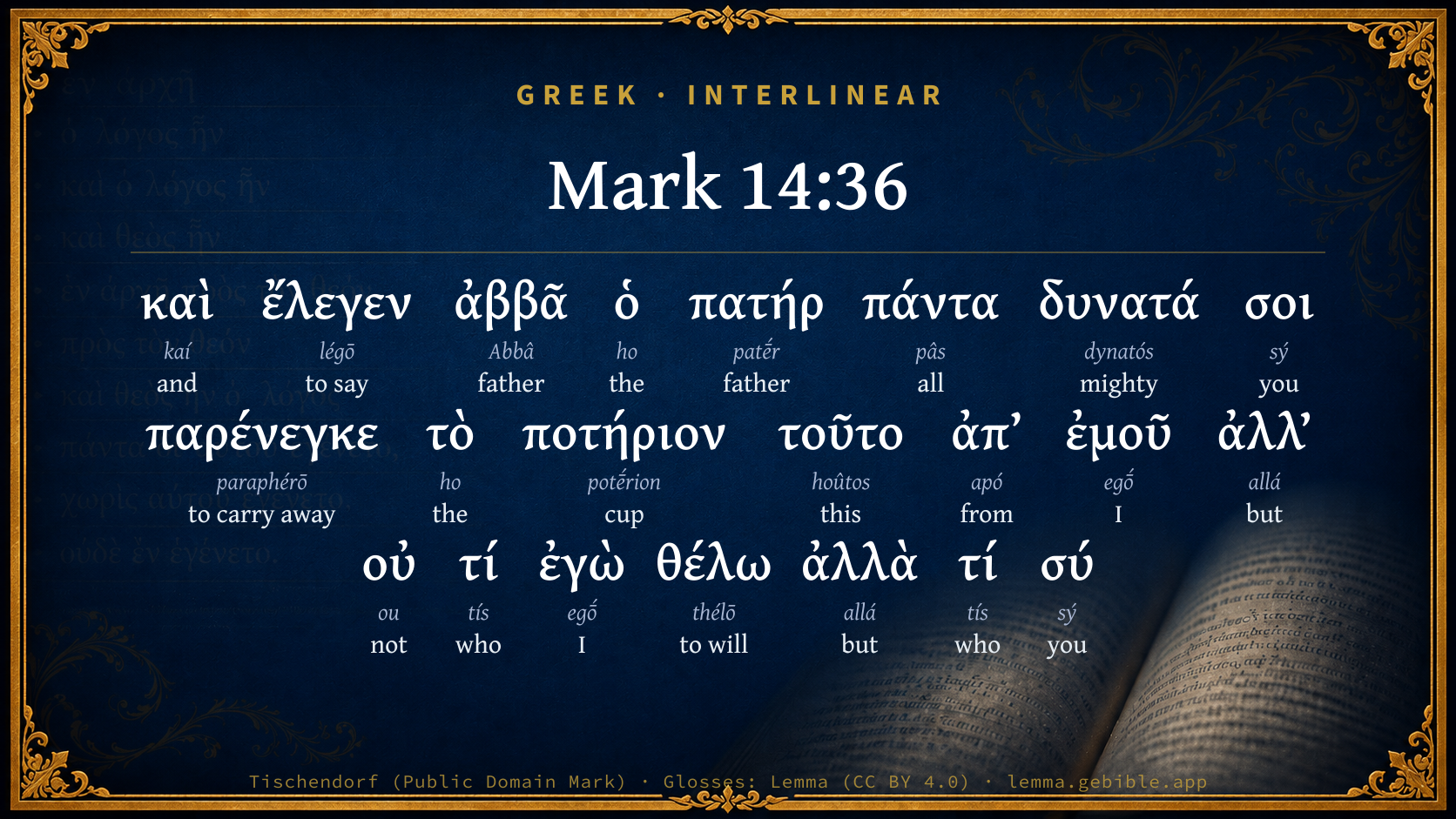
Download image
Cite this verse

Mark 14:36 (World English Bible). Public Domain. Lemma interlinear Bible study tool, https://lemma.gebible.app/v/mark/14/36.

Show BibTeX & RIS
BibTeX
RIS
English Translation
He said, "Abba, Father, all things are possible to you. Please remove this cup from me. However, not what I desire, but what you desire."
World English Bible · Public Domain
Highlights
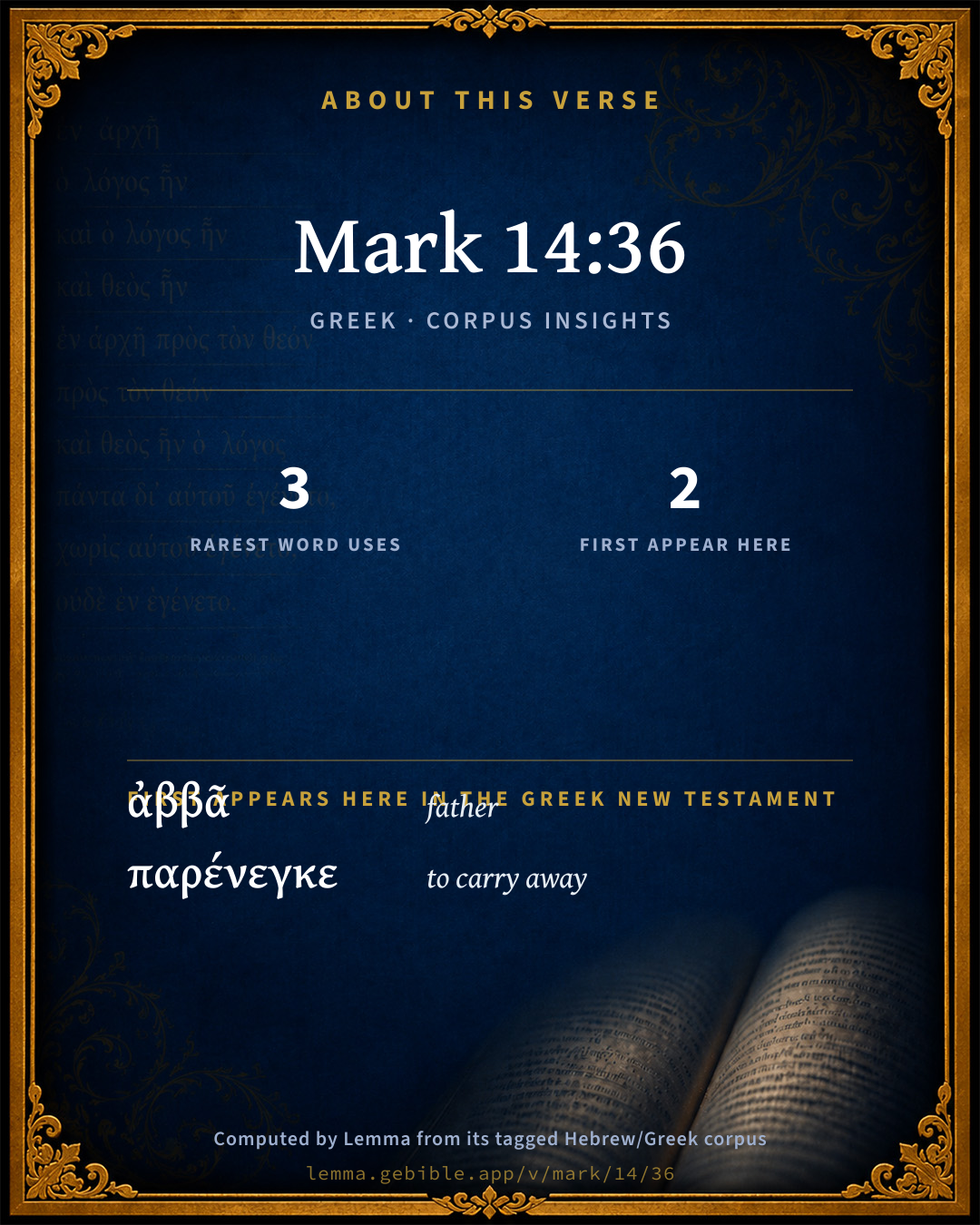
  • 2 first appearances in the Greek New Testament
Full analysis ↓
Download a study sheet

One document with this verse’s original text, its word-by-word gloss line, the meaning frame, cross-references with their text, attributed commentary, and full source and license credits — printable, and it pastes into notes with its structure intact.

This verse Autodidact and up

Study sheet (.html) Plain text (.txt)

A passage Seminary Student

Up to 50 verses in one chapter. A passage sheet keeps up to 6 commentary sources and 12 cross-references per verse, in the order this page ranks them, and says so on the sheet whenever that leaves anything out. Ask for a single verse and you get the Autodidact verse sheet above.

Everything on this page stays free to read, with no account — the sheet is a download of what is already on screen, not access to it.

Want to remove ads? Support Godless Engineer
Compare translations 3

The same verse in 3 English versions, stacked beneath the original-language interlinear above. Click any original word for its lexicon entry.

Each is an independent rendering of the whole verse — the interlinear is not word-aligned to these translations.

Highlighted words mark where these versions differ — a whole-verse word diff, not a word-by-word alignment.

  • World English Bible Public Domain
    He said, "Abba, Father, all things are possible to you. Please remove this cup from me. However, not what I desire, but what you desire."
  • King James Version Public Domain
    And he said, Abba, Father, all things are possible unto thee; take away this cup from me: nevertheless not what I will, but what thou wilt.
  • unfoldingWord Literal Text CC BY-SA 4.0
    And he was saying, “Abba, Father, all things possible for you. Remove this cup from me. But not what I will, but what you.”

unfoldingWord Literal Text — © unfoldingWord, licensed CC BY-SA 4.0. Word-aligned USFM3 via Door43 (git.door43.org/unfoldingWord/en_ult).

Versions to compare (up to 4)

3 of 4 selected

Show all 19 translations

Every available English version of this verse, each an independent rendering of the whole verse.

  • World English Bible Public Domain
    He said, "Abba, Father, all things are possible to you. Please remove this cup from me. However, not what I desire, but what you desire."
  • Berean Standard Bible Public Domain
    “Abba, Father,” He said, “all things are possible for You. Take this cup from Me. Yet not what I will, but what You will.”
  • Majority Standard Bible Public Domain
    “Abba, Father,” He said, “all things are possible for You. Take this cup from Me. Yet not what I will, but what You will.”
  • King James Version Public Domain
    And he said, Abba, Father, all things are possible unto thee; take away this cup from me: nevertheless not what I will, but what thou wilt.
  • American Standard Version (1901) Public Domain
    And he said, Abba, Father, all things are possible unto thee; remove this cup from me: howbeit not what I will, but what thou wilt.
  • Revised Version (1885) Public Domain
    And he said, Abba, Father, all things are possible unto thee; remove this cup from me: howbeit not what I will, but what thou wilt.
  • Geneva Bible (1599) Public Domain
    And he saide, Abba, Father, all things are possible vnto thee: take away this cup from me: neuertheles not that I will, but that thou wilt, be done.
  • Douay-Rheims (1899) Public Domain
    And he saith: Abba, Father, all things are possible to thee: remove this chalice from me; but not what I will, but what thou wilt.
  • Young's Literal Translation Public Domain
    and he said, `Abba, Father; all things are possible to Thee; make this cup pass from me; but, not what I will, but what Thou.'
  • Literal Standard Version CC BY-SA 4.0
    and He said, “Abba, Father; all things are possible to You; make this cup pass from Me; but not what I will, but what You [will].”
  • Unlocked Literal Bible CC BY-SA 4.0
    He said, “Abba, Father, all things are possible with you. Remove this cup from me. But not my will, but yours.”
  • unfoldingWord Literal Text CC BY-SA 4.0
    And he was saying, “Abba, Father, all things possible for you. Remove this cup from me. But not what I will, but what you.”
  • Darby Bible Public Domain
    And he said, Abba, Father, all things are possible to thee: take away this cup from me; but not what *I* will, but what *thou* [wilt].
  • World Messianic Bible Public Domain
    He said, “Abba, Father, all things are possible to you. Please remove this cup from me. However, not what I desire, but what you desire.”
  • Webster's Bible Public Domain
    And he said, Abba, Father, all things are possible to thee; take away this cup from me: nevertheless, not what I will, but what thou wilt.
  • Free Bible Version CC BY-SA 4.0
    “Abba, Father! You can do everything,” he said. “Please, take this cup of suffering away from me. Yet it's not what I want, but what you want.”
  • Bible in Basic English Public Domain
    And he said, Abba, Father, all things are possible to you; take away this cup from me: but even so let not my pleasure, but yours be done.
  • Text-Critical English NT CC BY 4.0
    He said, “Abba, Father, all things are possible for yoʋ. Take this cup away from me; nevertheless, not what I will, but what yoʋ will.”
  • Tyndale New Testament (1534) Public Domain
    And he sayd: Abba father all thinges are possible vnto the take awaye this cup from me. Neverthelesse not that I will but that thou wilt be done.

Literal Standard Version (2020), Covenant Press — licensed CC BY-SA 4.0. Text via the HelloAO Bible API (eBible.org). Unlocked Literal Bible (unfoldingWord) — licensed CC BY-SA 4.0. Text via the HelloAO Bible API (eBible.org). unfoldingWord Literal Text — © unfoldingWord, licensed CC BY-SA 4.0. Word-aligned USFM3 via Door43 (git.door43.org/unfoldingWord/en_ult). Free Bible Version, Dr. Jonathan Gallagher — licensed CC BY-SA 4.0. Text via the HelloAO Bible API (eBible.org).

Word by word

More ways to search: Search by grammar → Find every occurrence → Compare this word →

Practice this passage: Drill this verse → Learn its vocabulary →

ἀββᾶ
Abbâ
G5
“father”
Noun, Proper, indeclinable
Part of Speech
Noun · Proper, indeclinable
Full Thayer's Definition

Origin: of Aramaic origin H2

TDNT: 01:05,1

Abba = "father" 1. father, customary title used of God in prayer. Whenever it occurs in the New Testament it has the Greek interpretation joined to it, that is apparently to be explained by the fact that the Chaldee "ABBA" through frequent use in prayer, gradually acquired the nature of a most sacred proper name, to which the Greek speaking Jews added the name from their own tongue.
  1. καὶ kaí G2532 “and” Conjunction
  2. ἔλεγεν légō G3004 “to say” Verb, Imperfect, Active, Indicative, 3rd person, Singular
  3. ὁ ho G3588 “the” Article, Nominative, Singular, Masculine
  4. πατήρ patḗr G3962 “father” Noun, Nominative, Singular, Masculine
  5. πάντα pâs G3956 “all” Adjective, Nominative, Plural, Neuter
  6. δυνατά dynatós G1415 “mighty” Adjective, Nominative, Plural, Neuter
  7. σοι sý G4771 “you” Personal pronoun, 2nd person, Dative, Singular
  8. παρένεγκε paraphérō G3911 “to carry away” Verb, Aorist, Active, Imperative, 2nd person, Singular
  9. τὸ ho G3588 “the” Article, Accusative, Singular, Neuter
  10. ποτήριον potḗrion G4221 “cup” Noun, Accusative, Singular, Neuter
  11. τοῦτο hoûtos G3778 “this” Demonstrative pronoun, Accusative, Singular, Neuter
  12. ἀπ’ apó G575 “from” Preposition
  13. ἐμοῦ egṓ G1473 “I” Personal pronoun, 1st person, Genitive, Singular
  14. ἀλλ’ allá G235 “but” Conjunction
  15. οὐ ou G3756 “not” Particle, Negative
  16. τί tís G5101 “who” Interrogative pronoun, Accusative, Singular, Neuter
  17. ἐγὼ egṓ G1473 “I” Personal pronoun, 1st person, Nominative, Singular
  18. θέλω thélō G2309 “to will” Verb, Present, Active, Indicative, 1st person, Singular
  19. ἀλλὰ allá G235 “but” Conjunction
  20. τί tís G5101 “who” Interrogative pronoun, Accusative, Singular, Neuter
  21. σύ sý G4771 “you” Personal pronoun, 2nd person, Nominative, Singular

About this verse

These counts appear in no published source. They are computed here, from the morphology-tagged text and Lemma’s own curated glosses. What Lemma adds →

22
words
17
distinct lemmas
Gospels
section

Notable vocabulary

The rarest word here is ἀββᾶ father G5 — appearing just 3 times in the whole Greek New Testament.

First appearance in Scripture

These words make their first canonical appearance in the Greek New Testament here:

  • ἀββᾶ father G5
  • παρένεγκε to carry away G3911

Shared distinctive vocabulary

ἀββᾶ father G5 occurs in 3 verses of the Greek New Testament. Also found in:
Repetition

Words recur within this verse:

Cross-references

19

Topical passages linked to Mark 14:36 in the Treasury of Scripture Knowledge — connected by theme and wording, ordered by reader-vote popularity; previews shown in the World English Bible.

  • Galatians 4:6 And because you are children, God sent out the Spirit of his Son into your hearts, crying, "Abba, Father!"
  • John 5:30 I can of myself do nothing. As I hear, I judge, and my judgment is righteous; because I don't seek my own will, but the will of my Father who sent me.
  • Romans 8:15–16 For you didn't receive the spirit of bondage again to fear, but you received the Spirit of adoption, by whom we cry, "Abba! Father!"
  • Hebrews 5:7–8 He, in the days of his flesh, having offered up prayers and petitions with strong crying and tears to him who was able to save him from death, and having been heard for his godly fear,
  • John 12:27 "Now my soul is troubled. What shall I say? 'Father, save me from this time?' But for this cause I came to this time.
  • Mark 10:27 Jesus, looking at them, said, "With men it is impossible, but not with God, for all things are possible with God."
  • John 6:38–39 For I have come down from heaven, not to do my own will, but the will of him who sent me.
  • John 18:11 Jesus therefore said to Peter, "Put the sword into its sheath. The cup which the Father has given me, shall I not surely drink it?"
  • Philippians 2:8 And being found in human form, he humbled himself, becoming obedient to death, yes, the death of the cross.
  • Genesis 18:14 Is anything too hard for Yahweh? At the set time I will return to you, when the season comes round, and Sarah will have a son."
  • Psalms 40:8 I delight to do your will, my God. Yes, your law is within my heart."
  • Jeremiah 32:27 Behold, I am Yahweh, the God of all flesh: is there anything too hard for me?
  • Matthew 6:9 Pray like this: 'Our Father in heaven, may your name be kept holy.
  • Matthew 26:39 He went forward a little, fell on his face, and prayed, saying, "My Father, if it is possible, let this cup pass away from me; nevertheless, not what I desire, but what you desire."
  • John 4:34 Jesus said to them, "My food is to do the will of him who sent me, and to accomplish his work.
  • 2 Timothy 2:13 If we are faithless, He remains faithful. He can't deny himself.
  • Titus 1:2 in hope of eternal life, which God, who can't lie, promised before eternal times;
  • Luke 22:41–42 He was withdrawn from them about a stone's throw, and he knelt down and prayed,
  • Hebrews 6:18 that by two immutable things, in which it is impossible for God to lie, we may have a strong encouragement, who have fled for refuge to take hold of the hope set before us.

Cross-references courtesy of OpenBible.info (CC BY 4.0).

Commentary

Notes on Mark 14:36 from classic Christian and Jewish commentators (each source and its license shown beneath its notes). The classic Christian expositions comment on the surrounding passage and are grouped to its opening verse, so a note may address several verses; the Jewish commentaries on the Tanakh (Rashi and others) are per-verse, so they appear only where the commentator wrote on this verse.

Lemma curates 59 commentaries, every one of them public domain or Creative Commons licensed, each selected and text-cleaned for this edition rather than reprinted as found. About our sources →

Bengel's Gnomon

Johann Albrecht Bengel

Mar 14:36. Ἀββᾶ ὁ πατὴρ, Abba Father) Mark seems to have added Father, by way of interpretation: For Matthew, ch. Mat 26:39; Mat 26:42, says that what was said by Jesus was simply, “My Father:” Luke, ‘Father,’ Mat 22:42. on the cross, He said Eli, Eli.—τὶ, what) The question in the case, saith He, is not what I will, but what Thou wilt.

Bengel's Gnomon of the New Testament — English translation (T&T Clark, Edinburgh, 1860) — public domain. Text from a community e-Sword module.

Expositor's Greek Testament

ed. W. Robertson Nicoll

Mar 14:36 . Ἀββᾶ ὁ πατήρ : in the parallels simply πάτερ . In the Apostolic Church the use of the double appellation among Gentile Christians was common ( vide Rom 8:15 , Gal 4:6 ), Ἀββά having become a proper name and πατὴρ being added as its interpretation = God our Father. Mk. imparts into the prayer of our Lord this apostolic usage. Jesus doubtless would use only one of the names, probably the Aramaic. παρένεγκε τ . π . τ ., remove this cup; equivalent to παρέλθῃ in Mar 14:35 (Luk 22:42 ). ἀλλʼ οὐ , etc.; “ but not what ( τί for ὃ ) I will, but what Thou”; elliptical but clear and expressive: γενήσεται or γενέσθαι δεῖ (not γενέσθω which would demand μὴ before θέλω ) is understood ( vide Holtzmann, H. C., and Weiss in Meyer).

The Expositor's Greek Testament, edited by W. Robertson Nicoll (1897–1910) — public domain. Text from a community e-Sword module.

Geneva Bible (1599)

Geneva Bible translators

This doubling of the word was used in those days, when their languages were so mixed together: for this word, Abba, is a Syrian word.

Geneva Bible (1599) marginal notes — public domain. Text via Bolls.life.

Adam Clarke's Commentary

Verse 36. Abba, Father] This Syriac word, which intimates filial affection and respect, and parental tenderness, seems to have been used by our blessed Lord merely considered as man, to show his complete submission to his Father's will, and the tender affection which he was conscious his Father had for him, [Syriac] Abba, Syriac, is here joined to οπατηρ, Greek, both signifying father; so St. Paul, Ro 8:15; Ga 4:6. The reason is, that from the time in which the Jews became conversant with the Greek language, by means of the Septuagint version and their commerce with the Roman and Greek provinces, they often intermingled Greek and Roman words with their own language. There is the fullest evidence of this fact in the earliest writings of the Jews; and they often add a word of the same meaning in Greek to their own term; such as מרי קירי, Mori, κυριε my Lord, Lord; פילי שער, pili, πυλη, shuar, gate, gate: and above, אבא, πατηρ, father, father: see several examples in Schoettgen. The words אבי and אבא appear to have been differently used among the Hebrews; the first Abbi, was a term of civil respect; the second, Abba, a term of filial affection. Hence, Abba, Abbi, as in the Syriac version in this place, may be considered as expressing, My Lord, my Father. And in this sense St. Paul is to be understood in the places referred to above. See Lightfoot.

Adam Clarke's Commentary on the Bible (1810–1826) — public domain. Text from a community e-Sword/MySword module.

Ellicott's Commentary for English Readers

(36) And he said, Abba, Father.—The record of the word “Abba” as actually uttered, is peculiar to St. Mark. We, perhaps, find traces of the impression it made on the minds of men in the “Abba, Father” of Rom_8:15, Gal_4:6.

A Bible Commentary for English Readers, edited by Charles John Ellicott (1878–1897) — public domain. Text from a community e-Sword module.

The Cambridge Bible for Schools and Colleges

gen. ed. J. J. S. Perowne

36. Abba] St Mark alone has preserved for us this word. St Peter could not fail to have treasured up the words of murmured anguish, which, “about a stone’s throw” apart, he may have caught before he was overpowered with slumber. It is used only twice more in the New Testament, and both times by St Paul, Rom_8:15, “we have received the spirit of adoption, whereby we cry Abba, Father” and Gal_4:6, “God hath sent forth the Spirit of his Son into your hearts, crying Abba, Father.” In Syriac it is said to have been pronounced with a double b when applied to a spiritual father, with a single b when used in its natural sense. With the double letter at all events it has passed into the European languages, as an ecclesiastical term, ‘abbas,’ ‘abbot.’ See Canon Lightfoot on Gal_4:6.

Father] St Mark adds this probably to explain the Aramaic word, after his wont.

The Cambridge Bible for Schools and Colleges (gen. ed. J. J. S. Perowne; Cambridge University Press, 1878–1918) — public domain. Text from a community e-Sword module.

John Gill's Exposition

And he cometh and findeth them sleeping,.... His three disciples, Peter, James, and John:

and saith unto Peter; particularly, he having so lately asserted, with so much confidence, his love to Christ, and close attachment to him:

Simon, sleepest thou? Christ calls him by the name he first went by, and not by that which he had given him, Cephas, or Peter; he not now having that firmness and constancy, though he boasted of it, which answers to that name:

couldst thou not watch one hour? The Arabic and Persic versions add, with me; and so does the Complutensian edition; See Gill on Mat 26:40.

John Gill's Exposition of the Whole Bible (1746–1763) — public domain (CC PDM 1.0). Text via the HelloAO Bible API.

Trapp's Complete Commentary

John Trapp

34 And saith unto them, My soul is exceeding sorrowful unto death: tarry ye here, and watch.

35 And he went forward a little, and fell on the ground, and prayed that, if it were possible, the hour might pass from him.

36 And he said, Abba, Father, all things are possible unto thee; take away this cup from me: nevertheless not what I will, but what thou wilt.

Ver. 36. Abba, Father] Father, Father, with greatest earnestness. This was an effectual prayer, had he said no more. God can feel breath in prayer, Lam 3:56.

Not what I will, but, &c.] Aposiopesis emphatica, saith Beza.

John Trapp, A Commentary or Exposition upon All the Books of the Old and New Testament (1647–1656) — public domain. Text from a community e-Sword module.

Whedon's Commentary on the Bible

Daniel D. Whedon

36. Abba, Father — The word Abba signifies father in the Syriac, which was the dialect that our Saviour spoke. In that section of country where both Hebrew and Greek were spoken by the people, it was sometimes customary to give both the Hebrew and the Greek words, one to explain the other. Similar was the custom of bestowing upon the same individual both a Hebrew and Greek name.

Daniel D. Whedon (gen. ed.), Commentary on the Old and New Testaments (1874–1909) — public domain. Text from a community e-Sword module.

The Pulpit Commentary

And he said, Abba, Father. Some commentators suppose that our Lord only used the Hebrew or Aramaic word "Abba," and that St. Mark adds the Greek and Latin synonym (pathr) for the benefit of those to whom he was writing. But it is far more natural to conclude that St. Mark is here taking his narrative from an eye and ear witness, St. Peter; and that both the words were uttered by him; so that he thus, in his agony, cried to God in the name of the whole human family, the Jew first, and also the Gentile. We can quite understand why St. Matthew, writing to Jews, gives only the Hebrew word. All things are possible unto thee. Speaking absolutely, with God nothing is impossible. But the Deity is himself bound by his own laws; and hence this was impossible, consistently with his purposes of mercy for the redemption of the world. The Lord himself knew this. Therefore he does not ask for anything contrary to the will of his Father. But it was the natural craving of his humanity, which, subject to the supreme will of God, desired to be delivered from this terrible load. Remove this cup from me. The "cup," both in Holy Scripture and in profane writers, is taken to signify that lot or portion, whether good or evil, which is appointed for us by God. Hence St. John is frequently represented as holding a cup. Howbeit, not what I will, but what thou wilt. Our Lord has no sooner offered his conditional prayer than he subordinates it to the will of God. St. Luke (Luk_22:42) here says, "Nevertheless not my will, but thine, be done." Hence it appears that there was not, as the Monothelites taught, one will, partly human and partly Divine, in Christ; but there were two distinct wills, one human and the other Divine, both residing in the one Christ; and it was by the subjecting of his human will to the Divine that he wrought out our redemption.

The cup of experience.

The mystery of our Lord"s suffering is beyond our power of accurate analysis. We cannot fathom the depths of sin and grief which he experienced. We must not suppose that, because we are so familiar with this narrative, we know all its significance. At the most we have only felt one wave of the sea of sorrow which sobbed and swelled in his infinite heart. Only one phase of this many-sided subject will engage our attention. Leaving the atoning nature of the sufferings of our Lord, we will now regard him as the Representative of his people, their Forerunner in this as in all things. The "cup" is a figure familiar enough to all students of Scripture.

I THE CUP OF EXPERIENCE may be represented by the cup which was the symbol of the mockery and shame and grief the Savior suffered.

1. The phrase reminds us that our joys and griefs are measured. A cup is not illimitable. Full to the brim, it can only hold its own measure.

(1) Our joys are limited by what is in us, and by what is in them. If a man prospers in the world, his wealth brings him not only comfort, but care, anxiety, and responsibility, so that he may occasionally wish himself back in his former lowlier lot. And family joys bring their anxieties to every home which has them. No one drinks here of an ocean of bliss but he thanks God for a "cup" of it, measured by One who knows what will be best for character. This is true even of spiritual joys. The time of ecstasy is followed by a season of depression. The Valley of Humiliation is passed, as well as the Delectable Mountains, by Christian in his pilgrimage. Nowhere on earth can we say, "I am satisfied;" but many, like the psalmist, can exclaim, "I shall be satisfied.

(2) Our griefs are limited also. They are proportioned to our strength, adapted for our improvement. Even in the saddest bereavement there is much to moderate our grief if we will but receive it: gratitude for all our dear one was and did; gladness over all the testimonies of love and esteem in which he was held; hope that by-and-by there shall be the reunion, where there shall be no more sorrow and sighing, and where "God shall wipe away all tears from our eyes." God does not let an ocean of sadness surge up and overwhelm us, but gives us a cup, which we may drink in fellowship with Christ in his sufferings.

2. The phrase in our text suggests not only measurement, but loving control. Our Lord recognized, as we may humbly do, that the cup was filled and proffered by him whom he addressed as "Abba, Father." In one sense the events in Gethsemane and on Calvary were the results of natural causes. Integrity and sinlessness called forth the antagonism of those whose sins were thereby rebuked. Plain-spoken denunciations of the ecclesiastical leaders aroused their undying hate, and no hatred is more malignant than that of irreligious theologians. Judas, disappointed and abashed, was a ready instrument for evil work. Yet, behind all this, One unseen was carrying out his eternal purpose, fulfilling his promise, "The seed of the woman shall bruise the serpent"s head." Hence Jesus speaks not of the plot accomplished by his foes, but of the cup given him by the Father. We are at an infinite remove from him, yet, as the same law which controls worlds controls insects, so the truth which held good with the Son of man holds good also with us. We may recognize God"s overruling in man"s working, and accept every measure of experience as provided and proffered by our Father"s hand.

II THE PURPOSE OF ITS APPOINTMENT. That it comes from our "Father" shows that it has a purpose, and that it is one of love, not of cruelty. It is not like the cup of hemlock Socrates received from his foes, but like that potion you give your child that he may be refreshed, or strengthened, or cured.

1. Sometimes the purpose respects ourselves. Even of Jesus Christ, the sinless One, it is said he was "made perfect through sufferings;" that as our Brother he might feel for us, and as our High Priest might sympathize, being "touched with the feeling of our infirmities." Much more is the experience of life a blessing to us who are imperfect and sinful; correcting our worldliness, and destroying our self-confidence.

2. Sometimes the purpose respects others. It was so with our Lord preeminently. He "came not to be ministered unto, but to minister, and to give his life a ransom for many." "None of us liveth unto himself." If our cup of blessing runs over, its overflowings, whether of wealth, or strength, or spiritual joy, are for the good of those around us. If our lot be one of suffering, we may in it witness for our Lord, and from it learn to console others with the comfort wherewith we ourselves have been comforted of God. A.R.

The Pulpit Commentary (1880–1919), ed. H.D.M. Spence-Jones & Joseph S. Exell — public domain. Text from a community e-Sword module.

John Wesley's Explanatory Notes

Abba, Father - St. Mark seems to add the word Father, by way of explication.

John Wesley, Explanatory Notes Upon the Whole Bible (1754–1765) — public domain. Text via the GEBible commentary corpus.

Scofield Reference Notes

C. I. Scofield

cup

See note on the meaning of the cup. (See Scofield "Mat 26:39").

The Scofield Reference Bible (1917 edition), notes by C. I. Scofield — public domain. Text from a community e-Sword module.

Cambridge Greek Testament for Schools and Colleges

36. καὶ ἔλεγεν. Here again, as in the Institution of the Eucharist, there is remarkable difference as to the words used; see on Mar 14:22. Lk. gives only one prayer. Mk gives two and says that the second was the same as the first. Mt. gives three, the second differing from the first, but the third the same as the second. There is substantial agreement between all three as to the wording of the first prayer.

Ἀββᾶ ὁ πατήρ. As in Mar 5:41 and Mar 7:34, Mk gives the Aramaic. Christ spoke both Aramaic and Greek, and it is not improbable that in the opening address He used first one language and then the other. Repetition, whether in one language or two, is the outcome of strong feeling and is impressive; Martha, Martha (Luk 10:41), Simon, Simon (Luk 22:31), Jerusalem, Jerusalem (Mat 23:37). This is much more probable than that ὁ πατήρ is Mk’s translation of Ἀββᾶ. Translation injected into such a prayer would be unnatural. But it is possible that Mk here attributes to Christ a form of address which had become usual in public worship. Nom. with art. instead of voc. is freq. in N.T.; see on Mar 5:8. Lk. has πάτερ, Mt. πάτερ μου. See on Gal 4:6.

πάντα δυνατά σοι. See on Mar 10:27. Mt. softens this to εἰ δυνατόν ἐστιν, Lk. to εἰ βούλει.

παρένεγκε. “Carry past, without causing Me to drink, this cup of suffering and death.” In class. Grk the words would mean, “Place this cup at my side” (Hdt. i. 119, 133; Plato, Rep. p. 354); but in Plutarch the verb is used in the sense of removing (Camill. 41). In Heb 13:9 and Jud 1:12 it is used of being swept out of one’s course and carried astray. Orat transire calicem, ut ostendat vere quod et homo erat (Bede). The view that our Lord’s Agony was nothing but His sorrow for the sins of men is not found in the Gospels. The metaphor of a cup is used in O.T. of both good and bad fortune (Psa 16:5; Psa 23:5; Jer 25:15; Isa 51:17; etc.). In N.T. it is specially used of Christ’s sufferings (Mar 10:38-39; Joh 18:11).

ἀλλʼ οὐ τί ἐγὼ θέλω. Lk. has his favourite πλήν and brings the wording closer to that of the Lord’s Prayer; πλὴν μὴ τὸ θέλημά μου ἀλλὰ τὸ σὸν γινέσθω. With this condition it is lawful to pray, as for other temporal blessings, so also for the removal of suffering. Whichever wording we adopt, the petition is proof of the existence in Christ of a human will, distinct from, but always submissive to, the Father’s will. Mackintosh, The Person of Jesus Christ, pp. 220–222, 294–299, 399. Note the οὐ, not μή, the effect of which is “But I am not asking,” or “But the question is not.”

Cambridge Greek Testament for Schools and Colleges (Cambridge University Press, 1896; 21 vols, various authors incl. Carr, Maclear, Plummer, Farrar, Lumby, Moule, M. R. James, Simcox) — public domain. Text from a community e-Sword module.

Alford’s Greek Testament

Henry Alford

36.] ἀββᾶ = אַבָּא, an Aramaic form, and after Mark’s manner inserted, as ‘Ephphatha,’ ch. 7:34,—‘Talitha cum,’ ch. 5:41.

ὁ πατήρ is not the interpretation of ἀββᾶ, but came to be attached to it in one phrase, as a form of address: see reff. Meyer rightly supplies the ellipsis after ἀλλʼ: nevertheless, the question is not …: not οὐ γινέσθω, which would not come into construction with τί … τί.

Henry Alford, The Greek Testament (1849–1861) — public domain. Text from a community e-Sword module.

International Critical Commentary

36. Ἀββᾶ ὁ πατήρ. This combination of the Greek and Hebrew words would not of course appear in the speech of our Lord, who used only the Hebrew. Neither is the ὁ πατήρ explanatory of the Ἀββᾶ, as the Evangelists employ for this the formulas, ὅ ἐστι μεθερμηνευόμενον, or simply ὅ ἐστι, Mat 1:23, Mat 27:33, Mar 3:17, Mar 3:5:41, Mar 3:15:16, Mar 3:34. But this is a combination of the two, belonging to the later usage, and put here by the evangelist into the mouth of Jesus. πάντα δυνατά σοι—all things are possible to thee. Here the condition, if it is possible, is changed into the statement, all things are possible to thee, and so, as for the matter of possibility, the prayer is left unconditioned, remove this cup from me. But the condition is made now the will of God. This is Jesus’ wish and prayer, to have the cup removed. But, after all, he knows that not his will, but that of the Father, will be carried out, and with that he is content.

International Critical Commentary — older volumes (1896–1929), various authors — public domain. Text from a community e-Sword module.

Lesson kit

Teaching starters — assembled from the data on this page, not authored interpretation. Every prompt links to the verse data it draws on. Edit before teaching.

Mark, in the Gospels, opens this verse with 22 words (17 distinct Greek lemmas). Its most distinctive word is Abbâ (“father”). A historical commentator’s framing appears above. Read the whole chapter for the surrounding context.

Discussion questions

  1. What does “father” (Abbâ) contribute to the verse as a whole?
  2. 2 words make their first appearance in Scripture here. What does this debut establish?
  3. How does Romans 8:15, which shares the word «father», read alongside this verse?
  4. What does the repetition of “the” (2× in this one verse) do in this verse?
  5. The translations on this page render this verse differently — a whole-verse word diff, not a word-by-word alignment. What might account for the different wordings?
  6. Compare how Bengel's Gnomon and Expositor's Greek Testament read this verse. Where do they agree or differ?

Things to notice

  • 2 words make their first canonical appearance in Scripture here.
  • These translations choose different wording for 12 words in this verse.
  • “the” occurs 2× in this single verse.
  • 17 distinct Greek lemmas span 22 words in this verse.

Reading settings

Reading text

Shown beneath each verse's original-language words.

Old Testament
Old Testament edition

Read the OT as the Masoretic Hebrew (MT) or the Greek Septuagint (LXX).

English shown for the Greek Septuagint (in the Hebrew ↔ Greek comparison).

Comparing translations? Open the Compare panel on any verse page to stack up to four side by side.