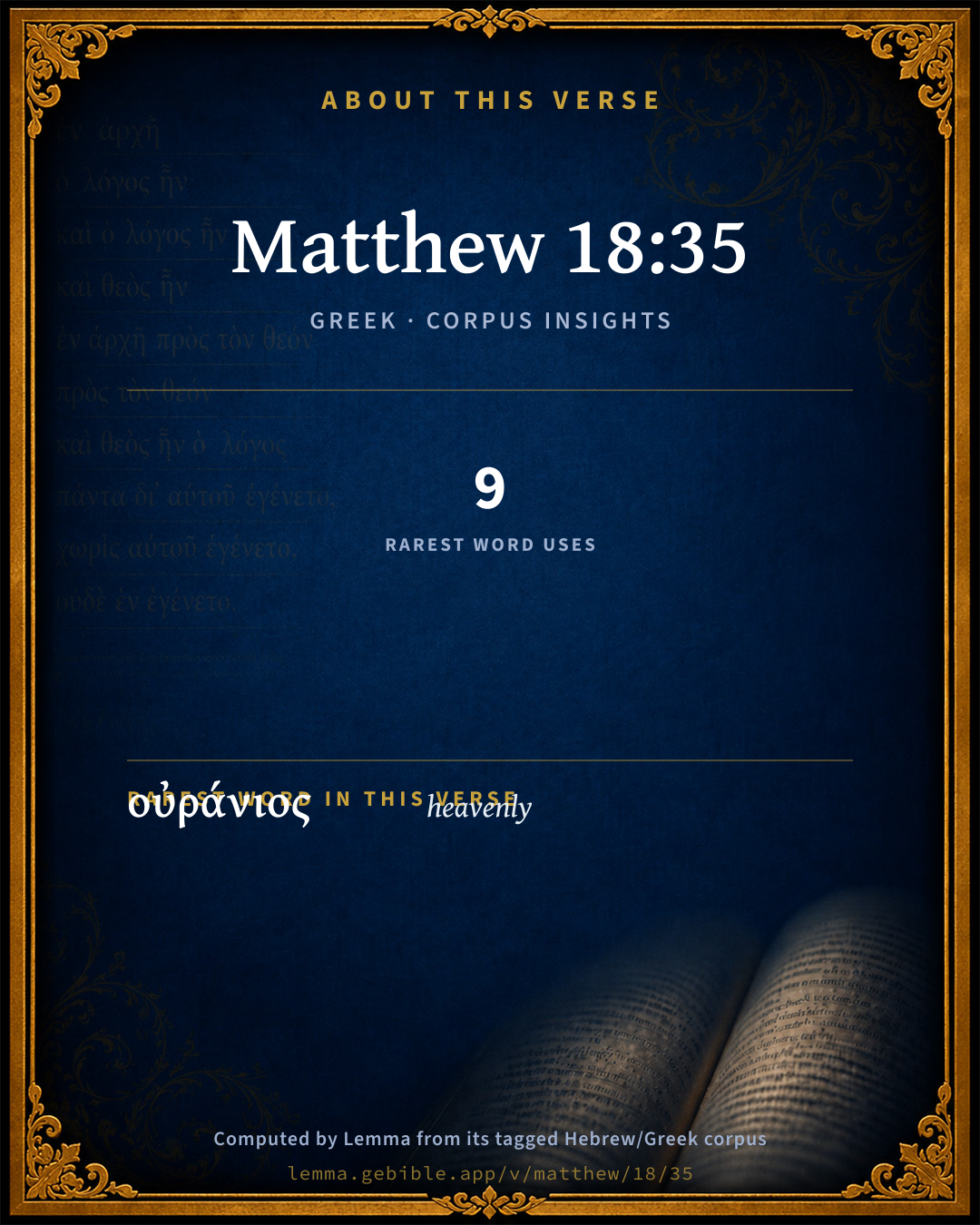
Matthew 18:35

Greek (Tischendorf 8th ed.) Matthew 18:35 appears in the Greek New Testament. The text above is from the Tischendorf 8th edition. Each word links to its Strong’s number and a concise gloss. Click any word for its full Thayer’s Greek Lexicon entry.
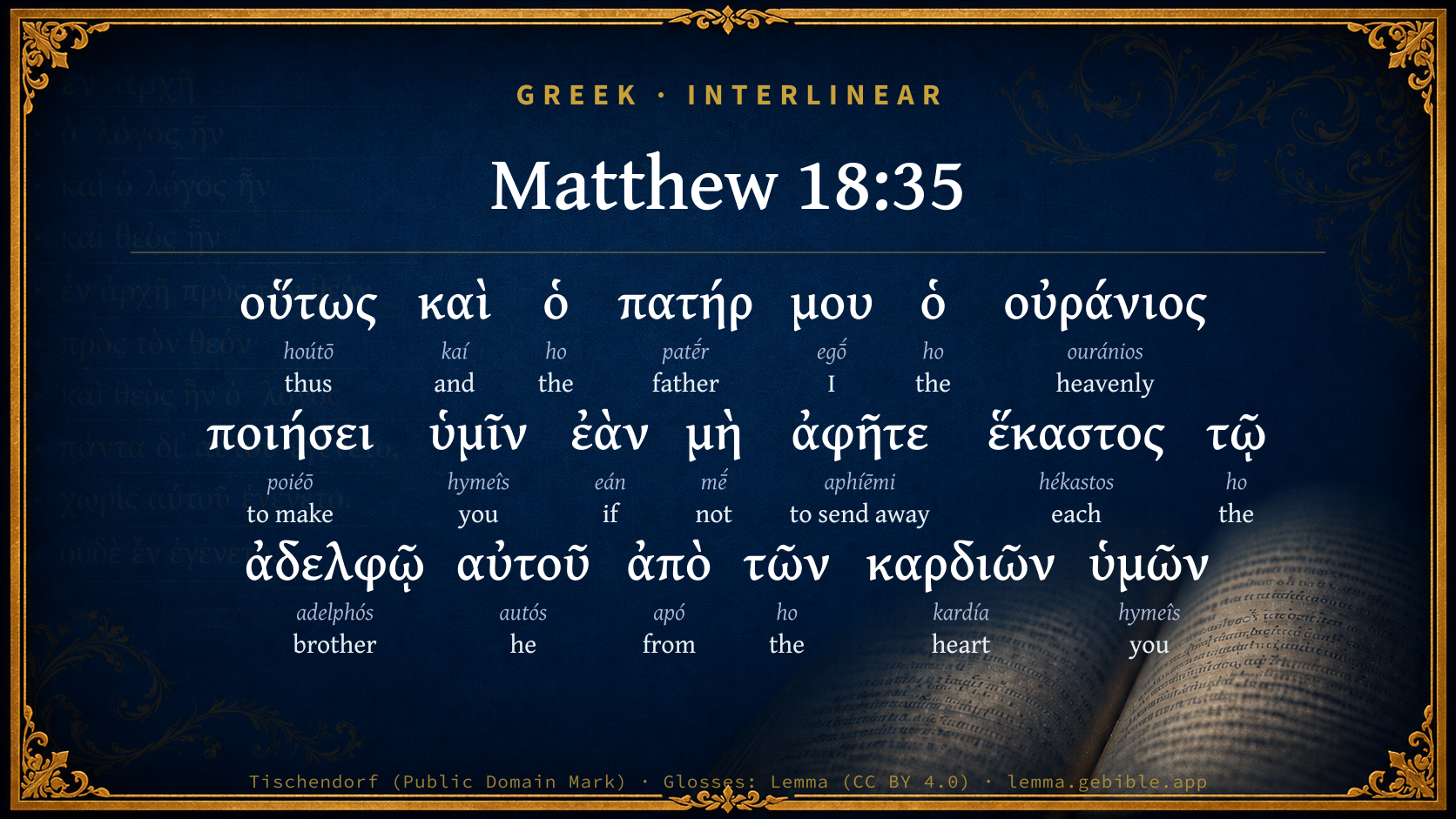
Download image
Cite this verse

Matthew 18:35 (World English Bible). Public Domain. Lemma interlinear Bible study tool, https://lemma.gebible.app/v/matthew/18/35.

Show BibTeX & RIS
BibTeX
RIS
English Translation
So my heavenly Father will also do to you, if you don't each forgive your brother from your hearts for his misdeeds."
World English Bible · Public Domain
Download a study sheet

One document with this verse’s original text, its word-by-word gloss line, the meaning frame, cross-references with their text, attributed commentary, and full source and license credits — printable, and it pastes into notes with its structure intact.

This verse Autodidact and up

Study sheet (.html) Plain text (.txt)

A passage Seminary Student

Up to 50 verses in one chapter. A passage sheet keeps up to 6 commentary sources and 12 cross-references per verse, in the order this page ranks them, and says so on the sheet whenever that leaves anything out. Ask for a single verse and you get the Autodidact verse sheet above.

Everything on this page stays free to read, with no account — the sheet is a download of what is already on screen, not access to it.

Want to remove ads? Support Godless Engineer
Compare translations 3

The same verse in 3 English versions, stacked beneath the original-language interlinear above. Click any original word for its lexicon entry.

Each is an independent rendering of the whole verse — the interlinear is not word-aligned to these translations.

Highlighted words mark where these versions differ — a whole-verse word diff, not a word-by-word alignment.

  • World English Bible Public Domain
    So my heavenly Father will also do to you, if you don't each forgive your brother from your hearts for his misdeeds."
  • King James Version Public Domain
    So likewise shall my heavenly Father do also unto you, if ye from your hearts forgive not every one his brother their trespasses.
  • unfoldingWord Literal Text CC BY-SA 4.0
    Thus also my heavenly Father will do to you, if each of you does not forgive his brother out of your hearts.”

unfoldingWord Literal Text — © unfoldingWord, licensed CC BY-SA 4.0. Word-aligned USFM3 via Door43 (git.door43.org/unfoldingWord/en_ult).

Versions to compare (up to 4)

3 of 4 selected

Show all 19 translations

Every available English version of this verse, each an independent rendering of the whole verse.

  • World English Bible Public Domain
    So my heavenly Father will also do to you, if you don't each forgive your brother from your hearts for his misdeeds."
  • Berean Standard Bible Public Domain
    That is how My heavenly Father will treat each of you unless you forgive your brother from your heart.”
  • Majority Standard Bible Public Domain
    That is how My heavenly Father will treat each of you unless you forgive your brother his trespasses from your heart.”
  • King James Version Public Domain
    So likewise shall my heavenly Father do also unto you, if ye from your hearts forgive not every one his brother their trespasses.
  • American Standard Version (1901) Public Domain
    So shall also my heavenly Father do unto you, if ye forgive not every one his brother from your hearts.
  • Revised Version (1885) Public Domain
    So shall also my heavenly Father do unto you, if ye forgive not every one his brother from your hearts.
  • Geneva Bible (1599) Public Domain
    So likewise shall mine heauenly Father doe vnto you, except ye forgiue from your hearts, eche one to his brother their trespasses.
  • Douay-Rheims (1899) Public Domain
    So also shall my heavenly Father do to you, if you forgive not every one his brother from your hearts.
  • Young's Literal Translation Public Domain
    so also my heavenly Father will do to you, if ye may not forgive each one his brother from your hearts their trespasses.'
  • Literal Standard Version CC BY-SA 4.0
    so also My heavenly Father will do to you, if you may not forgive each one his brother from your hearts their trespasses.”
  • Unlocked Literal Bible CC BY-SA 4.0
    So also my heavenly Father will do to you, if you do not forgive your brother from your heart.”
  • unfoldingWord Literal Text CC BY-SA 4.0
    Thus also my heavenly Father will do to you, if each of you does not forgive his brother out of your hearts.”
  • Darby Bible Public Domain
    Thus also my heavenly Father shall do to you if ye forgive not from your hearts every one his brother.
  • World Messianic Bible Public Domain
    So my heavenly Father will also do to you, if you don’t each forgive your brother from your hearts for his misdeeds.”
  • Webster's Bible Public Domain
    So likewise shall my heavenly Father do to you, if ye from your hearts forgive not every one his brother their trespasses.
  • Free Bible Version CC BY-SA 4.0
    This is what my heavenly Father will do to every one of you unless you sincerely forgive your brothers.”
  • Bible in Basic English Public Domain
    So will my Father in heaven do to you, if you do not everyone, from your hearts, give forgiveness to his brother.
  • Text-Critical English NT CC BY 4.0
    My heavenly Father will also do the same to you if each one of you, from your hearts, does not forgive his brother for his trespasses.”
  • Tyndale New Testament (1534) Public Domain
    So lyke wyse shall my hevenly father do vnto you except ye forgeve with youre hertes eache one to his brother their treaspases.

Literal Standard Version (2020), Covenant Press — licensed CC BY-SA 4.0. Text via the HelloAO Bible API (eBible.org). Unlocked Literal Bible (unfoldingWord) — licensed CC BY-SA 4.0. Text via the HelloAO Bible API (eBible.org). unfoldingWord Literal Text — © unfoldingWord, licensed CC BY-SA 4.0. Word-aligned USFM3 via Door43 (git.door43.org/unfoldingWord/en_ult). Free Bible Version, Dr. Jonathan Gallagher — licensed CC BY-SA 4.0. Text via the HelloAO Bible API (eBible.org).

Word by word

More ways to search: Search by grammar → Find every occurrence → Compare this word →

Practice this passage: Drill this verse → Learn its vocabulary →

οὐράνιος
ouránios
G3770
“heavenly”
Adjective, Nominative, Singular, Masculine
Part of Speech
Adjective
Case
Nominative
Number
Singular
Gender
Masculine
Full Thayer's Definition

Origin: from G3772

TDNT: 13:56,7

1. heavenly a. dwelling in heaven b. coming from heaven
  1. οὕτως hoútō G3779 “thus” Adverb
  2. καὶ kaí G2532 “and” Conjunction
  3. ὁ ho G3588 “the” Article, Nominative, Singular, Masculine
  4. πατήρ patḗr G3962 “father” Noun, Nominative, Singular, Masculine
  5. μου egṓ G1473 “I” Personal pronoun, 1st person, Genitive, Singular
  6. ὁ ho G3588 “the” Article, Nominative, Singular, Masculine
  7. ποιήσει poiéō G4160 “to make” Verb, Future, Active, Indicative, 3rd person, Singular
  8. ὑμῖν hymeîs G5210 “you” Personal pronoun, 2nd person, Dative, Plural
  9. ἐὰν eán G1437 “if” Conditional
  10. μὴ mḗ G3361 “not” Particle, Negative
  11. ἀφῆτε aphíēmi G863 “to send away” Verb, Aorist, Active, Subjunctive, 2nd person, Plural
  12. ἕκαστος hékastos G1538 “each” Adjective, Nominative, Singular, Masculine
  13. τῷ ho G3588 “the” Article, Dative, Singular, Masculine
  14. ἀδελφῷ adelphós G80 “brother” Noun, Dative, Singular, Masculine
  15. αὐτοῦ autós G846 “he” Personal pronoun, Genitive, Singular, Masculine
  16. ἀπὸ apó G575 “from” Preposition
  17. τῶν ho G3588 “the” Article, Genitive, Plural, Feminine
  18. καρδιῶν kardía G2588 “heart” Noun, Genitive, Plural, Feminine
  19. ὑμῶν hymeîs G5210 “you” Personal pronoun, 2nd person, Genitive, Plural

About this verse

These counts appear in no published source. They are computed here, from the morphology-tagged text and Lemma’s own curated glosses. What Lemma adds →

20
words
16
distinct lemmas
Gospels
section

Notable vocabulary

The rarest word here is οὐράνιος heavenly G3770 — appearing just 9 times in the whole Greek New Testament.

Shared distinctive vocabulary

οὐράνιος heavenly G3770 occurs in 9 verses of the Greek New Testament. Also found in:

Repetition

Words recur within this verse:

Cross-references

14

Topical passages linked to Matthew 18:35 in the Treasury of Scripture Knowledge — connected by theme and wording, ordered by reader-vote popularity; previews shown in the World English Bible.

  • Matthew 6:14–15 "For if you forgive men their trespasses, your heavenly Father will also forgive you.
  • James 2:13 For judgment is without mercy to him who has shown no mercy. Mercy triumphs over judgment.
  • Luke 6:37–38 Don't judge, And you won't be judged. Don't condemn, And you won't be condemned. Set free, And you will be set free.
  • Mark 11:25 Whenever you stand praying, forgive, if you have anything against anyone; so that your Father, who is in heaven, may also forgive you your transgressions.
  • Matthew 6:12 Forgive us our debts, as we also forgive our debtors.
  • Proverbs 21:2 Every way of a man is right in his own eyes, But Yahweh weighs the hearts.
  • Proverbs 21:13 Whoever stops his ears at the cry of the poor, He will also cry out, but shall not be heard.
  • Matthew 7:1–2 "Don't judge, so that you won't be judged.
  • Luke 16:15 He said to them, "You are those who justify yourselves in the sight of men, but God knows your hearts. For that which is exalted among men is an abomination in the sight of God.
  • Zechariah 7:12 Yes, they made their hearts as hard as flint, lest they might hear the law, and the words which Yahweh of Hosts had sent by his Spirit by the former prophets. Therefore great wrath came from Yahweh of Hosts.
  • James 3:14 But if you have bitter jealousy and selfish ambition in your heart, don't boast and don't lie against the truth.
  • James 4:8 Draw near to God, and he will draw near to you. Cleanse your hands, you sinners; and purify your hearts, you double-minded.
  • Revelation 2:23 I will kill her children with Death, and all the assemblies will know that I am he who searches the minds and hearts. I will give to each one of you according to your deeds.
  • Jeremiah 3:10 Yet for all this her treacherous sister Judah has not returned to me with her whole heart, but only in pretense, says Yahweh.

Cross-references courtesy of OpenBible.info (CC BY 4.0).

Where the printed editions differ

1 variant

Places in this verse where the major printed Greek editions disagree on the wording in a way that affects the translation — a comparison of editions, not a manuscript-by-manuscript collation. The editions are the modern critical texts (Nestlé-Aland 28/27, SBL, Westcott-Hort, Tregelles, Tyndale House) and the traditional texts behind the KJV (the Textus Receptus and the Byzantine/Majority text). It is not a claim about which reading is original.

  1. Extra text
    τὰ παραπτώματα αὐτῶν.

    “the trespasses of them.”

    In TRByz Not in NA28NA27TynSBLWHTreg

    τὰ παραπτώματα αὐτῶν.¶ (ta paraptōmata autōn) 'the trespasses of them.' is only in traditional manuscripts (TR+Byz)

Textual data: Translators Amalgamated Greek New Testament (STEPBible TAGNT) · CC BY 4.0.

Commentary

Notes on Matthew 18:35 from classic Christian and Jewish commentators (each source and its license shown beneath its notes). The classic Christian expositions comment on the surrounding passage and are grouped to its opening verse, so a note may address several verses; the Jewish commentaries on the Tanakh (Rashi and others) are per-verse, so they appear only where the commentator wrote on this verse.

Lemma curates 59 commentaries, every one of them public domain or Creative Commons licensed, each selected and text-cleaned for this edition rather than reprinted as found. About our sources →

Albert Barnes' Notes on the Bible

So likewise ... - This verse contains the sum or moral of the parable. When Christ has explained one of his own parables, we are to receive it just as he has explained it, and not attempt to draw spiritual instruction from any parts or circumstances which he has not explained. The following seems to be the particulars of the general truth which he meant to teach:

1.That our sins are great.

2.That God freely forgives them.

3.That the offences committed against us by our brethren are comparatively small.

4.That we should therefore most freely forgive them.

5.That if we do not, God will be justly angry with us, and punish us.

From your hearts - That is, not merely in words, but really and truly to feel and act toward him as if he had not offended us.

Trespasses - Offences, injuries. Words and actions designed to do us wrong.

Remarks On Matthew 18

1. We see that it is possible to make a profession of religion an occasion of ambition, Mat 18:1. The apostles at first sought honor, and expected office as a consequence of following Christ. So thousands have done since. Religion, notwithstanding all the opposition it has met with, really commands the confidence of mankind. To make a profession of it may be a way of access to that confidence. Thousands, it is to be feared, even yet enter the church merely to obtain some worldly benefit. Especially does this danger beset ministers of the gospel. There are few paths to the confidence of mankind so easily trod as to enter the ministry. Every minister, of course, if at all worthy of his office, has access to the confidence of multitudes, and is never despised but by the worst and lowest of mankind. No way is so easy to step at once to public confidence. Other people toil long to establish influence by personal character. The minister has it by virtue of his office. Those who now enter the ministry are tempted far more in this respect than were the apostles; and how should they search their own hearts, to see that no such abominable motive has induced them to seek that office!

2. It is consummate wickedness thus to prostitute the most sacred of all offices to the worst of purposes. The apostles at this time were ignorant. They expected a kingdom in which it would be right to seek distinction. But we labor under no such ignorance. We know that the kingdom of Christ is not of this world, and woe to the man that acts as though it were. Deep and awful must be the doom of him who thus seeks the honors of the world while he is professedly following the meek and lowly Jesus!

3. Humility is indispensable to religion, Mat 18:3. No man who is not humble can possibly be a Christian. He must be willing to esteem himself as he is, and to have others esteem him so also. This is humility, and humility is lovely. It is not meanness it is not cowardice - it is not want of proper self-esteem; it is a view of ourselves just as we are, and a willingness that God and all creatures should so esteem us. What can be more lovely than such an estimation of ourselves! and how foolish and wicked is it to be proud that is, to think more of ourselves, and wish others to think so, than we really deserve! To put on appearances, and to magnify our own importance, and to think that the affairs of the universe could not go on without us, and to be indignant when all the world does not bow down to do us homage this is hypocrisy as well as wickedness; and there may be, therefore, hypocrites out of the church as well as in it.

4. Humility is the best evidence of piety, Mat 18:4. The most humble man is the most eminent Christian. He is greatest in the kingdom of heaven. The effect of sin is to produce pride. Religion overcomes it by producing a just sense of ourselves, of other people, of angels, and of God. We may therefore measure the advance of piety in our own souls by the increase of humility.

5. We see the danger of despising and doing injury to real Christians, and more especially the guilt of attempting to draw them into sin, Mat 18:6. God watches over them. He loves them. In the eye of the world they may be of little importance, but not so with God. The most obscure follower of Christ is dear, infinitely dear, to him, and he will take care of him. He that attempts to injure a Christian, attempts to injure God; for God has redeemed him, and loves him.

6. People will do much to lead others into sin, Mat 18:7. In all communities there are some who seem to live for this. They have often much wealth, or learning, or accomplishment, or address, or professional influence, and they employ it for the sake of seducing the unwary and leading them into ruin. Hence, offences come, and many of the young and thoughtless are led astray. But He who has all power has pronounced woe upon them, and judgment will not always linger. No class of people have a more fearful account to render to God than they who thus lead others into vice and infidelity.

7. We must forsake our dearest sins, Mat 18:8-9. We must do this, or go to hell-fire. There is no way of avoiding it. We cannot love and cherish those sins and be saved.

8. The wicked they who will not forsake their sins - must certainly go to eternal punishment, Mat 18:8-9. So said the compassionate Saviour. The fair and obvious meaning of his words is that the sufferings of hell are eternal, and Christ did not use words without meaning. He did not mean to frighten us by bugbears or to hold up imaginary fears. If Christ speaks of hell, then there is a hell. If he says it is eternal, then it is so. Of this we may be sure, that every word which the God of mercy has spoken about the punishment of the wicked is full of meaning.

9. Christians are protected, Mat 18:10. Angels are appointed as their friends and guardians. Those friends are very near to God. They enjoy his favor, and his children shall be safe.

10. Christians are safe, Mat 18:11-14. Jesus came to save them. He left the heavens for this end. God rejoices in their salvation. He secures it at great sacrifices, and none can pluck them out of his hand. After the coming of Jesus to save them - after all that he has done for that, and that only - after the joy of God and of angels at their recovery, it is impossible that they should be wrested from him and destroyed. See Joh 10:27-28.

11. It is our duty to admonish our brethren when they injure us, Mat 18:15. We have no right to speak of the offence to anyone else, not even to our best friends, until we have given them an opportunity to explain.

12. The way to treat offending brethren is clearly pointed out, Mat 18:15-17. Nor have we a right to take any other course. Infinite Wisdom - the Prince of Peace - has declared that this is the way to treat our brethren. No other can be right; and no other, therefore, can be so well adapted to promote the peace of the church. And yet how different from this is the course commonly pursued! How few go honestly to an offending brother and tell him his fault! Instead of this, every breeze bears the report - it is magnified - mole-hills swell to mountains, and a quarrel of years often succeeds what might have been settled at once. No robber is so cruel as he who steals away the character of another. Nothing can compensate for the loss of this. Wealth, health, mansions, equipage, all are trifles compared with this. Especially is this true of a Christian. His reputation gone, he has lost his power of doing good; he has brought dishonor on the cause he most loved; he has lost his peace, and worlds cannot repay him.

“Who steals my purse, steals trash: ’tis something, nothing:

’Twas mine, ’tis his, and has been slave to thousands.

But he that filches from me my good name

Robs me of that which not enriches him,

And makes me poor indeed.”

13. We have every encouragement to pray, Mat 18:20. We are poor, and sinful, and dying, and none can comfort us but God. At his throne we may find all that we want. We know not which is most wonderful - that God deigns to hear our prayers, or that people are so unwilling to use so simple and easy a way of obtaining what they so much need.

14. We should never be weary of forgiving our brethren, Mat 18:22. We should do it cheerfully. We should do it always. We are never better employed than when we are doing good to those who have injured us. Thus doing, we are most like God.

15. There will be a day in which we must give up our account, Mat 18:23. It may tarry long; but God will reckon with us, and everything shall be brought into judgment.

16. We are greatly indebted to God - far, far beyond what we are able to pay, Mat 18:24. We have sinned, and in no way can we make atonement for past sins; but Jesus the Saviour has made an atonement and paid our debt, and we may be free.

17. It is right to pray to God when we feel that we have sinned, and are unable to pay the debt, Mat 18:26. We have no other way. Poor, and needy, and wretched, we must cast ourselves upon his mercy or die - die forever.

18. God will have compassion on those who do this, Mat 18:27. At his feet, in the attitude of prayer, the burdened sinner finds peace. We have nowhere else to go but to the very Being that we have offended. None but he can save us from death.

19. From the kindness of God to us we should learn not to oppress others, Mat 18:28.

20. It is our true interest, as well as duty, to forgive those that offend us, Mat 18:34. God will take vengeance, and in due time we must suffer if we do not forgive others.

21. Christians are often great sufferers for harboring malice. As a punishment, God withdraws the light of his countenance; they walk in darkness; they cannot enjoy religion; their conscience smites them, and they are wretched. No man ever did or ever can enjoy religion who did not from his heart forgive his brother his trespasses.

22. One reason why Christians ever walk in darkness is, that there is some such duty neglected. They think they have been injured, and very possibly they may have been; they think they are in the right, and possibly they are so; but mingled with a consciousness of this is an unforgiving spirit, and they cannot enjoy religion until that is subdued.

23. Forgiveness must not be in word merely, but from the heart, Mat 18:35. No other can be genuine. No other is like God.

Albert Barnes' Notes on the Bible (1834–1885) — public domain. Text from a community e-Sword/MySword module.

Tyndale Open Study Notes

Tyndale Open Resources

18:35 That’s what my heavenly Father will do to you: Prison and torture (18:34) is thus a metaphor for hell (see 5:22).

Tyndale Open Study Notes — © Tyndale Open Resources, licensed CC BY-SA 4.0. Text via the HelloAO Bible API.

Bengel's Gnomon

Johann Albrecht Bengel

Mat 18:35. Ἀπὸ τῶν καρδιῶν ὑμῶν, from your hearts) A wrong is recalled to the mind: it must be dismissed from the mind and from the heart. Things which are thus done, are done with unwearied frequency [But if not, whenever the debtor unexpectedly meets us, our indignation is liable to revive.—V. g.]; cf. σπλαγχνισθεὶς, (being moved with compassion) in Mat 18:27.

Bengel's Gnomon of the New Testament — English translation (T&T Clark, Edinburgh, 1860) — public domain. Text from a community e-Sword module.

Expositor's Greek Testament

ed. W. Robertson Nicoll

Mat 18:35 . Application . οὕτως : so, mutatis mutandis , for feelings, motives, methods rise in the moral scale when we pass to the spiritual sphere. So in general, not in all details, on the same principle; merciless to the merciless. ὁ πατήρ μ . ὁ οὐρ .: Jesus is not afraid to bring the Father in in such a connection. Rather He is here again defining the Father by discriminating use of the name, as One who above all things abhors mercilessness. μου : Christ is in full sympathy with the Father in this. ὑμῖν : to you , my own chosen disciples. ἕκαστος : every man of you. ἀπὸ τῶν καρδιῶν : from your hearts, no sham or lip pardon; real, unreserved, thoroughgoing, and in consequence again and again, times without number, because the heart inclines that way.

The Expositor's Greek Testament, edited by W. Robertson Nicoll (1897–1910) — public domain. Text from a community e-Sword module.

Jamieson, Fausset & Brown

Robert Jamieson, A. R. Fausset & David Brown

So likewise--in this spirit, or on this principle.

shall my heavenly Father do also unto you, if ye from your hearts forgive not every one his brother their trespasses.

Next: Matthew Chapter 19

Jamieson, Fausset & Brown — Commentary Critical and Explanatory on the Whole Bible (1871) — public domain (CC PDM 1.0). Text via the HelloAO Bible API.

Adam Clarke's Commentary

Verse 35. So likewise shall my heavenly Father do also unto you] The goodness and indulgence of God towards us is the pattern we should follow in our dealings with others. If we take man for our exemplar we shall err, because our copy is a bad one; and our lives are not likely to be better than the copy we imitate. Follow Christ; be merciful as your Father who is in heaven is merciful. You cannot complain of the fairness of your copy. Reader, hast thou a child, or servant who has offended thee, and humbly asks forgiveness? Hast thou a debtor, or a tenant, who is insolvent, and asks for a little longer time? And hast thou not forgiven that child or servant? Hast thou not given time to that debtor or tenant? How, then, canst thou ever expect to see the face of the just and merciful God? Thy child is banished, or kept at a distance; thy debtor is thrown into prison, or thy tenant sold up: yet the child offered to fall at thy feet; and the debtor or tenant, utterly insolvent, prayed for a little longer time, hoping God would enable him to pay thee all; but to these things thy stony heart and seared conscience paid no regard! O monster of ingratitude! Scandal to human nature, and reproach to God! If thou canst, go hide thyself - even in hell, from the face of the Lord!

Their trespasses.] These words are properly left out by GREISBACH, and other eminent critics, because they are wanting in some of the very best MSS. most of the versions, and in some of the chief of the fathers. The words are evidently an interpolation; the construction of them is utterly improper, and the concord false.

In our common method of dealing with insolvent debtors, we in some sort imitate the Asiatic customs: we put them in prison, and all their circumstances there are so many tormentors; the place, the air, the company, the provision, the accommodation, all destructive to comfort, to peace, to health, and to every thing that humanity can devise. If the person be poor, or comparatively poor, is his imprisonment likely to lead him to discharge his debt? His creditor may rest assured that he is now farther from his object than ever: the man had no other way of discharging the debt but by his labour; that is now impossible, through his confinement, and the creditor is put to a certain expense towards his maintenance. How foolish is this policy! And how much do such laws stand in need of revision and amendment! Imprisonment for debt, in such a case as that supposed above, can answer no other end than the gratification of the malice, revenge, or inhumanity of the creditor. Better sell all that he has, and, with his hands and feet untied, let him begin the world afresh. Dr. Dodd very feelingly inquires here, "Whether rigour in exacting temporal debts, in treating without mercy such as are unable to satisfy them - whether this can be allowed to a Christian, who is bound to imitate his God and Father? To a debtor, who can expect forgiveness only on the condition of forgiving others? To a servant, who should obey his Master? - and to a criminal, who is in daily expectation of his Judge and final sentence?" Little did he think, when he wrote this sentence, that himself should be a melancholy proof, not only of human weakness, but of the relentless nature of those laws by which property, or rather money, is guarded. The unfortunate Dr. Dodd was hanged for forgery, in 1777, and the above note was written only seven years before!

The unbridled and extravagant appetites of men sometimes require a rigour even beyond the law to suppress them. While, then, we learn lessons of humanity from what is before us, let us also learn lessons of prudence, sobriety, and moderation. The parable of the two debtors is blessedly calculated to give this information.

Adam Clarke's Commentary on the Bible (1810–1826) — public domain. Text from a community e-Sword/MySword module.

Ellicott's Commentary for English Readers

(35) My heavenly Father.—The adjective is slightly different in form from that commonly used, suggesting rather the thought of the “Father in heaven.”

Do also unto you.—The words cut through the meshes of many theological systems by which men have deceived themselves. Men have trusted in the self-assurance of justification, in the absolving words of the priest, as though they were final and irreversible. The parable teaches that the debt may come back. If faith does not work by love, it ceases to justify. If the man bind himself once again to his old evil nature, the absolution is annulled. The characters of the discharge are traced (to use another similitude) as in sympathetic ink, and appear or disappear according to the greater or less glow of the faith and love of the pardoned debtor.

From your hearts.—A verbal, formal forgiveness does not satisfy the demands of the divine righteousness. God does not so forgive, neither should man.

Every one his brother their trespasses.—The two last words are not in some of the best MSS., and have probably been added to make the verse correspond with Mat_6:14-15.

A Bible Commentary for English Readers, edited by Charles John Ellicott (1878–1897) — public domain. Text from a community e-Sword module.

The Cambridge Bible for Schools and Colleges

gen. ed. J. J. S. Perowne

35. from your hearts] A different principle from the Pharisee’s arithmetical rules of forgiveness.

their trespasses] The MS. authority is against these words.

The Cambridge Bible for Schools and Colleges (gen. ed. J. J. S. Perowne; Cambridge University Press, 1878–1918) — public domain. Text from a community e-Sword module.

Trapp's Complete Commentary

John Trapp

35 So likewise shall my heavenly Father do also unto you, if ye from your hearts forgive not every one his brother their trespasses.

Ver. 35. If ye from your hearts forgive not] Forget as well as forgive, which some protest they will never do, neither think they that any do. But what saith the heathen orator to this unchristian censure? If any think that we, that have been once out, can never heartily forgive, and love one another again, he proveth not our false heartedness, but showeth his own. Siqui sest qui neminem in gratiam putat redire posse, non nostram is perfidiam arguit, sed indicat suam. Cicer. eph 37, lib. 2.

John Trapp, A Commentary or Exposition upon All the Books of the Old and New Testament (1647–1656) — public domain. Text from a community e-Sword module.

Haydock's Catholic Bible Commentary

So also shall my heavenly Father do to you. In this parable the master is said to have remitted the debt, and yet afterwards to have punished the servant for it. God doth not in this manner with us. But we may here observe, once for all, that in parables, diverse things are only ornamental to the parable itself; and a caution and restriction is to be used in applying them. (Witham) --- Not that God will revoke a pardon once granted; for this would be contrary to his infinite mercy, and his works are without repentance. It means that God will not pardon, or rather that he will severely punish the ingratitude and inhumanity of the man, who, after having received from God the most liberal pardon of his grievous transgressions, refuses to forgive the slightest offence committed against him by his neighbour, who is a member, nay a son of his God. This ingratitude may justly be compared with the 10,000 talents, as every grievous offence committed against God, exceeds, in an infinite degree, any offence against man. (Tirinus) --- This forgiveness must be real, not pretended; from the heart, and not in word and appearance only; sacrificing all desire of revenge, all anger, hatred and resentment, at the shrine of charity.

====================

George Leo Haydock (1774–1849), Haydock's Catholic Family Bible and Commentary, 1859 edition — public domain. Excludes Psalms (Douay-Rheims chapter numbering differs from Protestant) and Deuterocanonical books (Catholic canon only).

Whedon's Commentary on the Bible

Daniel D. Whedon

35. So — On the same principle of retribution. If we forgive not others, God will not forgive us. From your hearts — In mercy to ourselves we must turn the resentment out from our inmost hearts, that our own hearts may be abodes of peace and love. To this rule we consent every time we repeat the Lord’s prayer. Surely the law of forgiveness must prevail in the kingdom of love. Judgment without mercy is for him that shows no mercy.

Daniel D. Whedon (gen. ed.), Commentary on the Old and New Testaments (1874–1909) — public domain. Text from a community e-Sword module.

The Pulpit Commentary

So likewise. This points to the moral of the parable intended by Christ. It is not a lesson against ingratitude, but against unmercifulness. "Blessed are the merciful: for they shall obtain mercy." But want of charity makes a man incapable of retaining God"s pardon; the Holy Spirit cannot abide in an unforgiving soul. My heavenly Father. He says, not "your", (Mat_6:14, Mat_6:26) nor "our," but "my heavenly Father," the Father of Christ, the God of all mercies. He cannot join himself in mention with such as are not children of God. From your hearts. Forgiveness must be real, sincere, not pretended, nor merely outward. There must not only be no outward act of revenge, but no malice in tile heart, no storing up of evil passions for future outlet, as occasion may arise. The heart must be in harmony with the conduct, and both must evidence a true spirit of charity. This alone enables one to continue in a state of grace and in reconciliation with God; this alone makes prayer acceptable; and we are assured that, as our heavenly Father requires us to forgive without limit, so his mercy is infinite and will be extended to us in measure unbounded. Their trespasses. These words are omitted by many manuscripts, the Vulgate, and most modern editors; and they are not required by the sense. They have been, perhaps, added to obviate a certain abruptness in the conclusion of the parable.

Moral fitness for receiving Divine forgiveness.

Upon his earnest petition, the man gains a full and free forgiveness; but the question arises Did he deserve it? Was he in a state of mind fit to receive it? Was the forgiveness any real moral good to him? This is soon answered. The man, fresh from his great forgiveness, finds a fellow servant who owes him but a trifling sum, and his severity with him shows clearly enough that his heart was untouched. The unforgiving manifest that they are unfitted to receive Gods forgiveness. The Christian limit of forgiveness is Forgive your fellow men as freely and as fully as God has forgiven you. The Christian law of forgiveness is Expect God to forgive you only when you are in such a penitent, humble, and sympathetic frame of mind that you can easily forgive your fellows.

I SEE WHAT A MARVEL OF GRACE THAT DIVINE FORGIVENESS IS. Estimate it aright, and you will feel that there must be some preparedness for receiving such a blessing.

1. Think of the greatness of the sin to be forgiven us. Take Christ"s figure of the immense debt. See sin as ingratitude; and as disobedience.

2. Think of the aggravations of sin. The witfulness of many sins. They are sins against light and knowledge. They are even committed after forgiveness.

3. Think what love is shown in the conditions of forgiveness. The objective ground of remission is the gift and sacrifice of God"s well beloved Son.

4. Think of the freeness and fulness of God"s forgiveness. There is no possibility of purchasing it; it must come to us as a gift of infinite love. It is no limited blessing. God blots out the record utterly, as a cloud is blotted from the sky, and flings our sins away into the depths of the sea.

II SEE WHAT IS THE STATE OF MIND BEFITTING THE RECIPIENTS OF THE DIVINE FORGIVENESS. We can see plainly enough that the man introduced by our Lord was wholly unworthy of the forgiveness of that debt. It did him no sort of moral good. He was in no sense ready for the forgiveness. So there are many who cannot be forgiven because they are not in such moral states as would make forgiveness any blessing to them. A humbled, regretful, gracious spirit is necessary. Such a spirit would be tested at once by an opportunity of showing a forgiving mind. Tender, melted, kind. The feeling of being undeserving, unworthy. Christ"s teaching on this point has even a severe side even his forgiveness may be revoked, if he finds, by our behaviour after forgiveness, that we were morally unfitted to receive it. R.T.

The Pulpit Commentary (1880–1919), ed. H.D.M. Spence-Jones & Joseph S. Exell — public domain. Text from a community e-Sword module.

Kretzmann's Popular Commentary

Paul E. Kretzmann

The application:

v. 35. So likewise shall My heavenly Father do also unto you, if ye from your hearts forgive not every one his brother their trespasses.

Christ here opens up the meaning of the entire parable. He pictures the average person in his treatment of his fellow-man. "Such is man, so harsh and hard, when he walks otherwise than in a constant sense of forgiveness received from God. Ignorance or forgetfulness of his own guilt make him harsh, unforgiving, and cruel to others; or, at least, he is only hindered from being such by those weak defenses of natural character which may at any moment be broken down. " God is merciless to the merciless. He wants every person without exception to be ready at all times to forgive from the heart, without sham or lip pardon, not with a cruel: Forgive, but not forget. For we Christians are all servants of God, the heavenly King. And by nature we are unprofitable servants. We are guilty before the Lord on account of our thousandfold transgressions of the Law. Our debt before Him is so great that it staggers the imagination, as Luther suggests, that we can never hope to pay it off. We are therefore guilty of hell and damnation before Him. But now God has had mercy upon us for the sake of Jesus, who paid the debt of our sin. He has loosed us from the imprisonment we deserve and forgiven the debt. Therefore we have the obligation of gratitude resting upon us that we gladly forgive our fellow-men what they have sinned against us. Even if such a transgression be great in the sight of men, it cannot come into consideration in comparison with the debt which God has mercifully forgiven us. Any man, therefore, that is unmerciful, hardhearted, unforgiving toward his fellow-man, thereby denies and repudiates God’s grace and mercy. His former debt is again charged to his account. The just anger of God will deliver him into a merciless judgment, from which there is no salvation, no delivery. "It is a fine, comforting Gospel, and sweet for the saddened consciences, since it has nothing but forgiveness of sins. But on the other hand, to the hard heads and to the stubborn it is a terrible judgment, and, especially, since the servant is not a heathen, but belongs under the Gospel and had faith. For since the lord has mercy upon him and forgives what he has done, he must undoubtedly be a Christian. Therefore this is not a punishment for the heathen, nor for the great mass that do not hear the Word of God, but for those that hear the Gospel with the ears and have it on the tongue, but will not live in harmony with it."

Summary.Christ warns against giving offense to children and to the lowly in His kingdom, illustrating His discourse with the parable of the lost sheep, teaches how to deal with an erring brother, and gives a lesson on forgiveness, illustrated with the parable of the unmerciful servant.

Paul E. Kretzmann, Popular Commentary of the Bible (1921–1924) — public domain. Text from a community e-Sword module.

The People's New Testament

B. W. Johnson

35. So likewise shall my heavenly Father do also unto you, etc. Observe Christ says, “My heavenly Father,” not your. God will not be their heavenly Father unless they emulate his spirit of mercy, and are as ready to forgive others their trespasses as he is to forgive their own. “Blessed are the merciful, for they shall obtain mercy.” “As ye mete to others it shall be measured to you.” “Forgive us our trespasses even as we forgive those who trespass against us.” “Whatsoever a man soweth that shall he also reap.” If we are hard and unforgiving to our fellow-men, we can never expect our heavenly Father to overlook our own sins. It is a vital doctrine that we, by our own mind towards others, determine what shall be the mind of God towards us.

B. W. Johnson's The People's New Testament with Notes (1889–1891) — public domain. Electronic text from the Christian Classics Ethereal Library (CCEL) ThML edition.

Cambridge Greek Testament for Schools and Colleges

35. τὰ παραπτώματα αὐτῶν. After καρδιῶν ὑμῶν. These words have the support of C and 12 uncials, but are omitted in the earlier MSS.

35. ἀπὸ τῶν καρδιῶν ὑμῶν. A different principle from the Pharisee’s arithmetical rules of forgiveness.

Cambridge Greek Testament for Schools and Colleges (Cambridge University Press, 1896; 21 vols, various authors incl. Carr, Maclear, Plummer, Farrar, Lumby, Moule, M. R. James, Simcox) — public domain. Text from a community e-Sword module.

Alford’s Greek Testament

Henry Alford

35. ὁ π. μου] not ὑμῶν, as in the similar declaration in ch. 6:14, 15. This is more solemn and denunciatory (οὐ γὰρ ἄξιον τοῦ τοιούτου πατέρα καλεῖσθαι τὸν Θεόν, τοῦ οὕτω πονηροῦ κ. μισανθρώπου. Chrys. Hom. lxi. 4, p. 617). ἐπουράνιος is not elsewhere used by our Evangelist.

Henry Alford, The Greek Testament (1849–1861) — public domain. Text from a community e-Sword module.

International Critical Commentary

35. So also my heavenly Father will do to you, if ye forgive not each his brother from your hearts.]

The details of the parable do not seem altogether consistent. After v. 23 we seem to have a story of a wealthy merchant and his slaves, rather than one of a king and his ministers. The story has quite probably been adapted by the editor to suit the context. But the main point, that an unmerciful disposition will meet with the divine wrath, is quite clear. The parable begins with the formula “the kingdom of heaven is like.” This means nothing more than that a lesson may be drawn from what follows, which all who hope to enter the kingdom should lay to heart.

M the Second Gospel.

L the Matthæan Logia.

1 Men like the Exorcist, vv. 38-40, or like him who merely gave a cup of cold water, v. 41, were “little ones who believe in Me.” No stumbling-blocks were to be placed in their way.

Ps.-Sol. The Psalms of Solomon.

S Syriac version: Curetonian.

al i.e. with other uncial MSS.

latt. Manuscripts of the Old Latin Version.

B. Babylonian Talmud.

S Syriac version: Sinaitic MS.

Polyb. Polybius.

LXX. The Septuagint Version.

Ox. Pap. Oxyrhynchus Papyri.

1 For examples from the Papyri, see Deissmann, Bib. Stud. p. 221. And add Ox. Pap. ii. 286. 18 (a.d. 82), 272. 16 (a.d. 66), iv. 719. 24 (a.d. 193) 736. 75 (a.d. 1); Fayûm Towns, 247. The word is not found in literature outside the New Testament.

International Critical Commentary — older volumes (1896–1929), various authors — public domain. Text from a community e-Sword module.

Lesson kit

Teaching starters — assembled from the data on this page, not authored interpretation. Every prompt links to the verse data it draws on. Edit before teaching.

Matthew, in the Gospels, opens this verse with 20 words (16 distinct Greek lemmas). Its most distinctive word is ouránios (“heavenly”). A historical commentator’s framing appears above. Read the whole chapter for the surrounding context.

Discussion questions

  1. What does “heavenly” (ouránios) contribute to the verse as a whole?
  2. How does Matthew 5:48, which shares the word «heavenly», read alongside this verse?
  3. What does the repetition of “the” (4× in this one verse) do in this verse?
  4. The translations on this page render this verse differently — a whole-verse word diff, not a word-by-word alignment. What might account for the different wordings?
  5. Compare how Albert Barnes' Notes on the Bible and Tyndale Open Study Notes read this verse. Where do they agree or differ?

Things to notice

Reading settings

Reading text

Shown beneath each verse's original-language words.

Old Testament
Old Testament edition

Read the OT as the Masoretic Hebrew (MT) or the Greek Septuagint (LXX).

English shown for the Greek Septuagint (in the Hebrew ↔ Greek comparison).

Comparing translations? Open the Compare panel on any verse page to stack up to four side by side.