
Luke 15:12

Greek (Tischendorf 8th ed.) Luke 15:12 appears in the Greek New Testament. The text above is from the Tischendorf 8th edition. Each word links to its Strong’s number and a concise gloss. Click any word for its full Thayer’s Greek Lexicon entry.
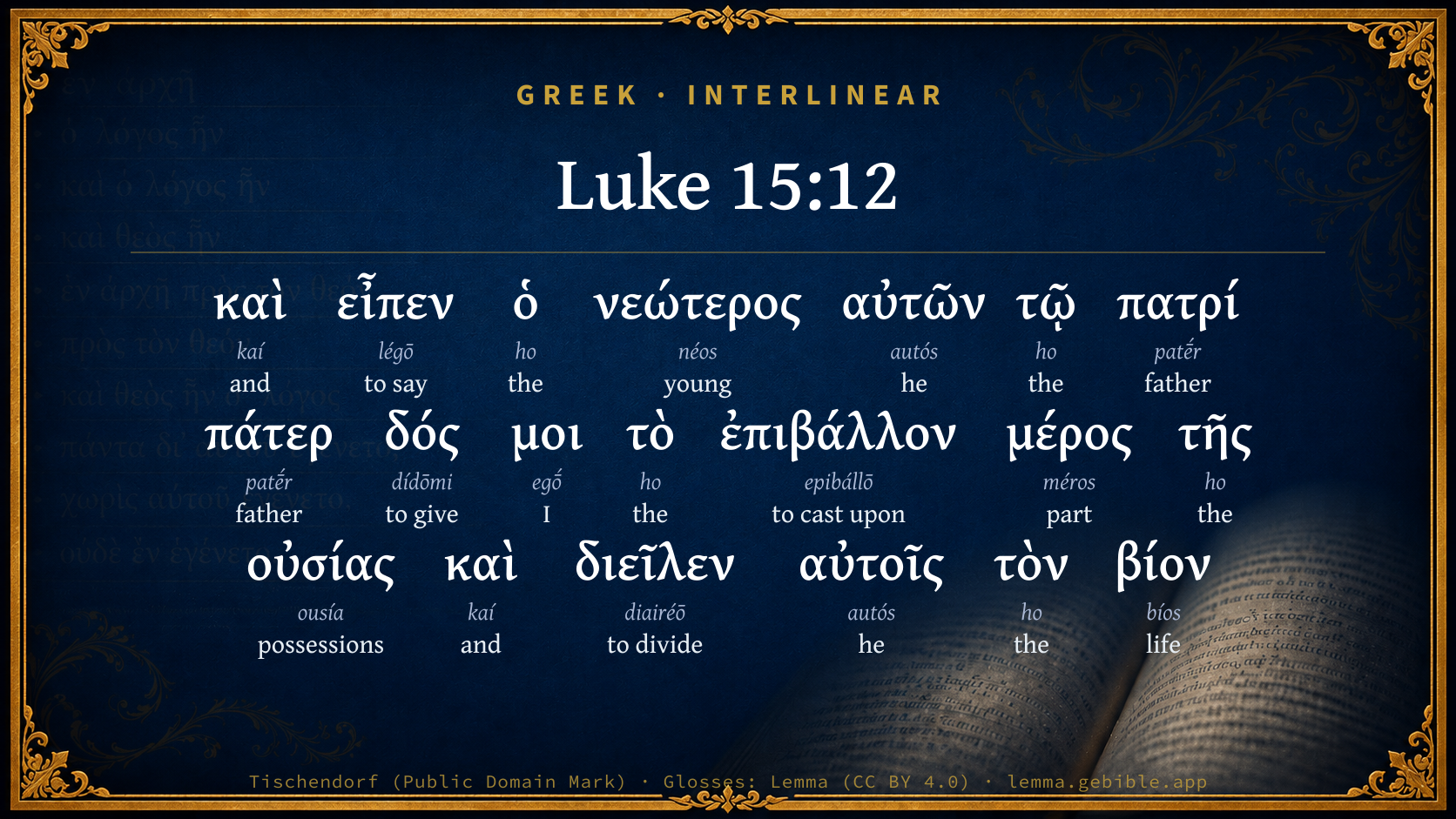
Download image
Cite this verse

Luke 15:12 (World English Bible). Public Domain. Lemma interlinear Bible study tool, https://lemma.gebible.app/v/luke/15/12.

Show BibTeX & RIS
BibTeX
RIS
English Translation
The younger of them said to his father, 'Father, give me my share of your property.' He divided his livelihood between them.
World English Bible · Public Domain
Highlights
  • 2 first appearances in the Greek New Testament
Full analysis ↓
Download a study sheet

One document with this verse’s original text, its word-by-word gloss line, the meaning frame, cross-references with their text, attributed commentary, and full source and license credits — printable, and it pastes into notes with its structure intact.

This verse Autodidact and up

Study sheet (.html) Plain text (.txt)

A passage Seminary Student

Up to 50 verses in one chapter. A passage sheet keeps up to 6 commentary sources and 12 cross-references per verse, in the order this page ranks them, and says so on the sheet whenever that leaves anything out. Ask for a single verse and you get the Autodidact verse sheet above.

Everything on this page stays free to read, with no account — the sheet is a download of what is already on screen, not access to it.

Want to remove ads? Support Godless Engineer
Compare translations 3

The same verse in 3 English versions, stacked beneath the original-language interlinear above. Click any original word for its lexicon entry.

Each is an independent rendering of the whole verse — the interlinear is not word-aligned to these translations.

Highlighted words mark where these versions differ — a whole-verse word diff, not a word-by-word alignment.

  • World English Bible Public Domain
    The younger of them said to his father, 'Father, give me my share of your property.' He divided his livelihood between them.
  • King James Version Public Domain
    And the younger of them said to his father, Father, give me the portion of goods that falleth to me. And he divided unto them his living.
  • unfoldingWord Literal Text CC BY-SA 4.0
    and the younger of them said to his father, ‘Father, give me the portion of the wealth that falls to.’ And he distributed his livelihood to them.

unfoldingWord Literal Text — © unfoldingWord, licensed CC BY-SA 4.0. Word-aligned USFM3 via Door43 (git.door43.org/unfoldingWord/en_ult).

Versions to compare (up to 4)

3 of 4 selected

Show all 19 translations

Every available English version of this verse, each an independent rendering of the whole verse.

  • World English Bible Public Domain
    The younger of them said to his father, 'Father, give me my share of your property.' He divided his livelihood between them.
  • Berean Standard Bible Public Domain
    The younger son said to him, ‘Father, give me my share of the estate.’ So he divided his property between them.
  • Majority Standard Bible Public Domain
    The younger son said to him, ‘Father, give me my share of the estate.’ So he divided his property between them.
  • King James Version Public Domain
    And the younger of them said to his father, Father, give me the portion of goods that falleth to me. And he divided unto them his living.
  • American Standard Version (1901) Public Domain
    and the younger of them said to his father, Father, give me the portion of `thy' substance that falleth to me. And he divided unto them his living.
  • Revised Version (1885) Public Domain
    and the younger of them said to his father, Father, give me the portion of thy substance that falleth to me. And he divided unto them his living.
  • Geneva Bible (1599) Public Domain
    And the yonger of them sayde to his father, Father, giue mee the portion of the goods that falleth to mee. So he deuided vnto them his substance.
  • Douay-Rheims (1899) Public Domain
    And the younger of them said to his father: Father, give me the portion of substance that falleth to me. And he divided unto them his substance.
  • Young's Literal Translation Public Domain
    and the younger of them said to the father, Father, give me the portion of the substance falling to `me', and he divided to them the living.
  • Literal Standard Version CC BY-SA 4.0
    and the younger of them said to the father, Father, give me the portion of the substance falling to [me], and he divided to them the living.
  • Unlocked Literal Bible CC BY-SA 4.0
    and the younger of them said to his father, 'Father, give me the portion of the wealth that falls to me.' So he divided his property between them.
  • unfoldingWord Literal Text CC BY-SA 4.0
    and the younger of them said to his father, ‘Father, give me the portion of the wealth that falls to.’ And he distributed his livelihood to them.
  • Darby Bible Public Domain
    and the younger of them said to his father, Father, give to me the share of the property that falls [to me]. And he divided to them what he was possessed of.
  • World Messianic Bible Public Domain
    The younger of them said to his father, ‘Father, give me my share of your property.’ So he divided his livelihood between them.
  • Webster's Bible Public Domain
    And the younger of them said to his father, Father, give me the portion of goods that falleth to me. And he divided to them his living.
  • Free Bible Version CC BY-SA 4.0
    “The younger one told his father, ‘Father, give me my inheritance now.’ So the man divided his property between them.
  • Bible in Basic English Public Domain
    And the younger of them said to his father, Father, give me that part of your property which will be mine. And he made division of his goods between them.
  • Text-Critical English NT CC BY 4.0
    The younger of the two said to his father, ‘Father, give me the share of property that will belong to me.’ So the father divided his assets between his two sons.
  • Tyndale New Testament (1534) Public Domain
    and the yonger of them sayde to his father: father geve me my parte of the goodes that to me belongeth. And he devided vnto them his substaunce.

Literal Standard Version (2020), Covenant Press — licensed CC BY-SA 4.0. Text via the HelloAO Bible API (eBible.org). Unlocked Literal Bible (unfoldingWord) — licensed CC BY-SA 4.0. Text via the HelloAO Bible API (eBible.org). unfoldingWord Literal Text — © unfoldingWord, licensed CC BY-SA 4.0. Word-aligned USFM3 via Door43 (git.door43.org/unfoldingWord/en_ult). Free Bible Version, Dr. Jonathan Gallagher — licensed CC BY-SA 4.0. Text via the HelloAO Bible API (eBible.org).

Word by word

More ways to search: Search by grammar → Find every occurrence → Compare this word →

Practice this passage: Drill this verse → Learn its vocabulary →

οὐσίας
ousía
G3776
“possessions”
Noun, Genitive, Singular, Feminine
Part of Speech
Noun
Case
Genitive
Number
Singular
Gender
Feminine
Full Thayer's Definition

Origin: from the feminine of G5607

TDNT: None

1. what one has, i.e. property, possessions, estate
  1. καὶ kaí G2532 “and” Conjunction
  2. εἶπεν légō G3004 “to say” Verb, Aorist, Active, Indicative, 3rd person, Singular
  3. ὁ ho G3588 “the” Article, Nominative, Singular, Masculine
  4. νεώτερος néos G3501 “young” Adjective, Nominative, Singular, Masculine, Comparative
  5. αὐτῶν autós G846 “he” Personal pronoun, Genitive, Plural, Masculine
  6. τῷ ho G3588 “the” Article, Dative, Singular, Masculine
  7. πατρί patḗr G3962 “father” Noun, Dative, Singular, Masculine
  8. πάτερ patḗr G3962 “father” Noun, Vocative, Singular, Masculine
  9. δός dídōmi G1325 “to give” Verb, Aorist, Active, Imperative, 2nd person, Singular
  10. μοι egṓ G1473 “I” Personal pronoun, 1st person, Dative, Singular
  11. τὸ ho G3588 “the” Article, Accusative, Singular, Neuter
  12. ἐπιβάλλον epibállō G1911 “to cast upon” Verb, Present, Active, Participle, Accusative, Singular, Neuter
  13. μέρος méros G3313 “part” Noun, Accusative, Singular, Neuter
  14. τῆς ho G3588 “the” Article, Genitive, Singular, Feminine
  15. καὶ kaí G2532 “and” Conjunction
  16. διεῖλεν diairéō G1244 “to divide” Verb, Aorist, Active, Indicative, 3rd person, Singular
  17. αὐτοῖς autós G846 “he” Personal pronoun, Dative, Plural, Masculine
  18. τὸν ho G3588 “the” Article, Accusative, Singular, Masculine
  19. βίον bíos G979 “life” Noun, Accusative, Singular, Masculine

About this verse

These counts appear in no published source. They are computed here, from the morphology-tagged text and Lemma’s own curated glosses. What Lemma adds →

20
words
13
distinct lemmas
Gospels
section

Notable vocabulary

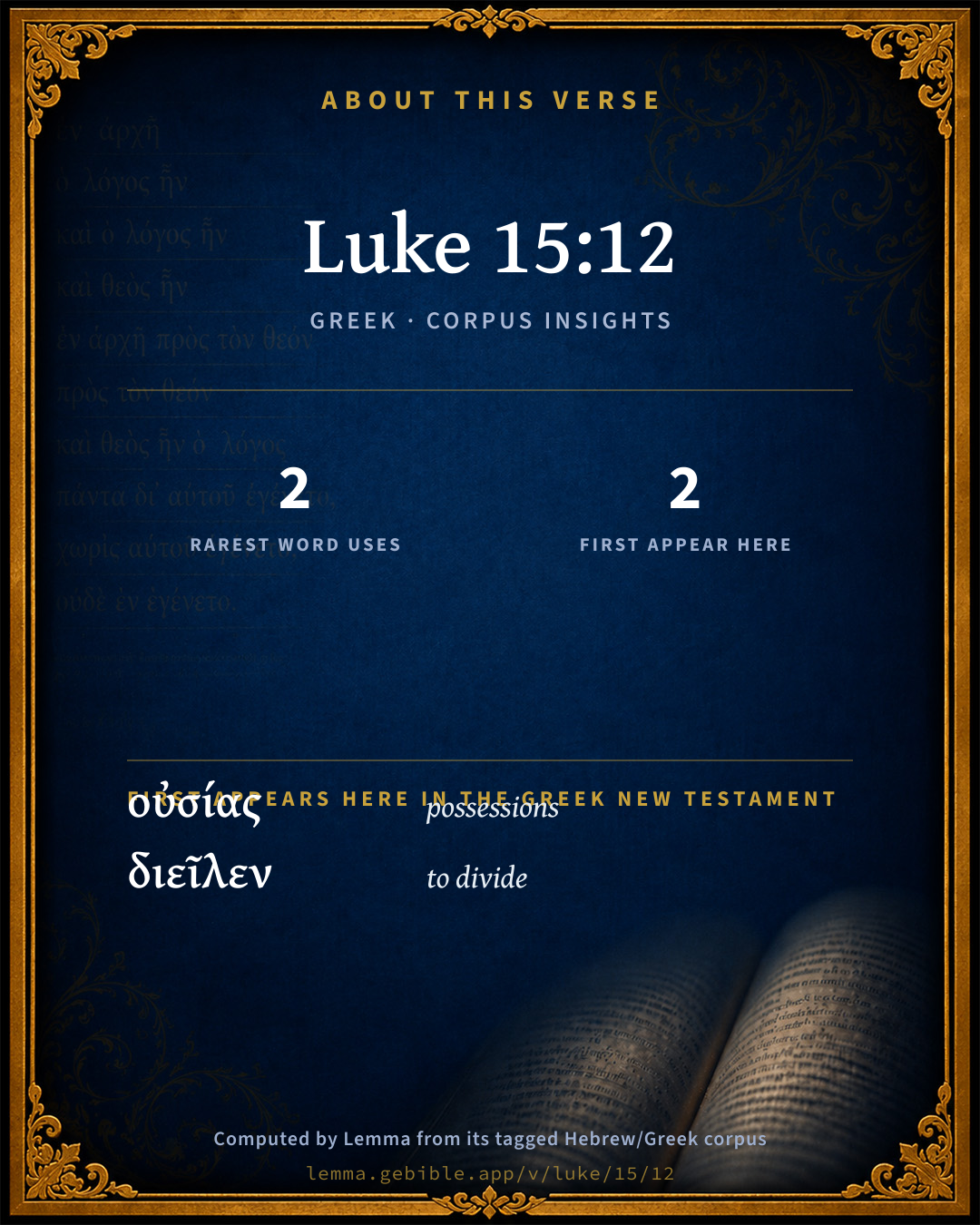
The rarest word here is οὐσίας possessions G3776 — appearing just 2 times in the whole Greek New Testament.

First appearance in Scripture

These words make their first canonical appearance in the Greek New Testament here:

  • οὐσίας possessions G3776
  • διεῖλεν to divide G1244

Shared distinctive vocabulary

οὐσίας possessions G3776 occurs in 2 verses of the Greek New Testament. Also found in:
Repetition

Words recur within this verse:

Cross-references

4

Topical passages linked to Luke 15:12 in the Treasury of Scripture Knowledge — connected by theme and wording, ordered by reader-vote popularity; previews shown in the World English Bible.

  • Deuteronomy 21:16–17 then it shall be, in the day that he causes his sons to inherit that which he has, that he may not make the son of the beloved the firstborn before the son of the hated, who is the firstborn:
  • Mark 12:44 for they all gave out of their abundance, but she, out of her poverty, gave all that she had to live on."
  • Psalms 17:14 From men by your hand, Yahweh, From men of the world, whose portion is in this life. You fill the belly of your cherished ones. Your sons have plenty, And they store up wealth for their children.
  • Luke 15:30 But when this, your son, came, who has devoured your living with prostitutes, you killed the fattened calf for him.'

Cross-references courtesy of OpenBible.info (CC BY 4.0).

Commentary

Notes on Luke 15:12 from classic Christian and Jewish commentators (each source and its license shown beneath its notes). The classic Christian expositions comment on the surrounding passage and are grouped to its opening verse, so a note may address several verses; the Jewish commentaries on the Tanakh (Rashi and others) are per-verse, so they appear only where the commentator wrote on this verse.

Lemma curates 59 commentaries, every one of them public domain or Creative Commons licensed, each selected and text-cleaned for this edition rather than reprinted as found. About our sources →

The Cambridge Bible for Schools and Colleges

gen. ed. J. J. S. Perowne

12. the portion of goods that falleth to me] This would be one third (Deu_21:17). The granting of this portion corresponds to the natural gifts and blessings which God bestows on all alike, together with the light of conscience, and the rich elements of natural religion. Here we have the history of a sinful soul. Its sin (Luk_15:12-13); its misery (Luk_15:14-16); its penitence (Luk_15:17-20); its forgiveness (Luk_15:20-24).

he divided unto them his living] See Luk_6:35. “The Lord is good to all,” Psa_145:9. “God is no respecter of persons,” Act_10:34. “He maketh His sun to rise on the evil, and on the good, and sendeth rain on the just and on the unjust,” Mat_5:45.

“God answers sharp and sudden on some prayers;

And flings the thing we have asked for in our face,

A gauntlet—with a gift in it.”

E. B. Browning.

The Cambridge Bible for Schools and Colleges (gen. ed. J. J. S. Perowne; Cambridge University Press, 1878–1918) — public domain. Text from a community e-Sword module.

Tyndale Open Study Notes

Tyndale Open Resources

15:12 I want my share of your estate now: This appalling request essentially says, “To me, you are dead.” There could be no greater insult to a father.

Tyndale Open Study Notes — © Tyndale Open Resources, licensed CC BY-SA 4.0. Text via the HelloAO Bible API.

Bengel's Gnomon

Johann Albrecht Bengel

Luk 15:12. Ὁ νεώτερος) ὁ ἕτερος) is the expression in Mat 21:30. There is hereby signified a pair of sons different in character.—τὸ ἐπιβάλλον) So τοῦ καρποῦ τοῦ ἐπιβάλλοντός μοι λαβεῖν, 1Ma 10:29 (30).—μέρος, the portion) Each man receives his portion from God.—αὐτοῖς, to them) even to his elder son [as well as to the younger], though he was not asking for it; not giving up to him, however, as yet, the full actual enjoyment,[161] as appears from Luk 15:31.

[161] ‘Usufructus,’ which is both the usus and fructus; whereas usus is only the use, without the full enjoyment. In both usus and usufructus the ownership is not given, but still remains in the hands of another.—E. and T.

Bengel's Gnomon of the New Testament — English translation (T&T Clark, Edinburgh, 1860) — public domain. Text from a community e-Sword module.

Meyer's Critical & Exegetical Commentary

Heinrich August Wilhelm Meyer

Luk_15:12-13. Ὁ νεώτερος] νεώτερον δὲ ὀνομάζει τὸν ἁμαρτωλὸν ὡς νηπιόφρονα καὶ εὐεξαπάτητον, Euthymius Zigabenus.

τὸ ἐπιβάλλου μέτος] the portion falling to my share, that which belongs to me, Herod. iv. 115; Dem. 312. 2, 317. 1; Diod. Sic. xiv. 17; Polyb. xviii. 24. 1, vi. 34. 1, and elsewhere. See also Wetstein and Kypke, I. p. 289. According to the Hebrew law of inheritance, there fell to the younger son only half as much as the first-born received (Deu_21:17; Michaelis, Mos. R. § 79; Saalschütz, p. 820 f.). The son asks that this his future portion of inheritance be given to him in advance. The father grants non quod oportebat, sed quod licebat facere, Maldonatus. An agreement, according to an approximate estimate, must be presupposed. But the granting of his request is a necessary part of the parable, on account of human freedom. Discedentes a se non prohibet, redeuntes amplectitur, Maldonatus.

διεῖλεν αὐτοῖς] to both the sons, in such wise, however, as to reserve to himself until his death the right of usufruct over the portion of the eldest, and the latter remained in his service, Luk_15:29-31.

τὸν βίον] Mar_12:44; Luk_8:43 : that whereon the family lived, i.e. nothing else than their means. Hesiod. Op. 230. 575; Herod. i. 31, viii. 51, and frequently. Paulus (comp. Michaelis) makes, without reason, a distinction between this and οὐσία, which, according to him, is the whole means, saying that the father, however, divided merely his stock of provisions, not his capital. See, on the other hand, Luk_15:31.

Luk_15:13. μετʼ οὐ πολλ. ἡμέρ.] The greediness for unlimited pleasure urged him to haste.

ἅπαντα] what, namely, he had received as his portion of the inheritance, partly in natura, partly in money in settlement of what could not be taken with him.

ἀσώτως] recklessly, Dem. 1025. 19; Josephus, Antt. xii. 4. 8. Comp. on Eph_5:18. The sinful nature is developed from an independence which, under the influence of sinful longing, shakes itself loose from God (comp. Psa_73:27) by the satisfaction of immoral pleasure.

Meyer — Critical and Exegetical Commentary on the New Testament — English translation by Peter Christie, edited by Frederick Crombie (T&T Clark, 1880) — public domain. Text from a community e-Sword module.

Expositor's Greek Testament

ed. W. Robertson Nicoll

Luk 15:12 . ὁ νεώτερος , the younger, with a certain fitness made to play the foolish part. The position of an elder son presents more motives to steadiness. τὸ ἐπιβάλλον μέρος , the portion falling or belonging to , the verb occurs in this sense in late authors (here only in N.T.). The portion of the younger when there were two sons would be one third, the right of the first-born being two portions (Deu 21:17 ). διεῖλεν : the father complies, not as bound, but he must do it in the parable that the story may go on. βίον = οὐσίαν , as in Mar 12:44 , Luk 8:43 .

The Expositor's Greek Testament, edited by W. Robertson Nicoll (1897–1910) — public domain. Text from a community e-Sword module.

Jamieson, Fausset & Brown

Robert Jamieson, A. R. Fausset & David Brown

III. THE PRODIGAL SON. (Luke 15:11-32)

the younger--as the more thoughtless.

said, &c.--weary of restraint, panting for independence, unable longer to abide the check of a father's eye. This is man impatient of divine control, desiring to be independent of God, seeking to be his own master; that "sin of sins, in which all subsequent sins are included as in their germ, for they are but the unfolding of this one" [TRENCH].

he divided, &c.--Thus "God, when His service no longer appears a perfect freedom, and man promises himself something far better elsewhere, allows him to make the trial; and he shall discover, if need be by saddest proof, that to depart from Him is not to throw off the yoke, but to exchange a light yoke for a heavy one, and one gracious Master for a thousand imperious tyrants and lords" [TRENCH].

Jamieson, Fausset & Brown — Commentary Critical and Explanatory on the Whole Bible (1871) — public domain (CC PDM 1.0). Text via the HelloAO Bible API.

Adam Clarke's Commentary

Verse 12. Give me the portion of goods] It may seem strange that such a demand should be made, and that the parent should have acceded to it, when he knew that it was to minister to his debauches that his profligate son made the demand here specified. But the matter will appear plain, when it is considered, that it has been an immemorial custom in the east for sons to demand and receive their portion of the inheritance during their father's lifetime; and the parent, however aware of the dissipated inclinations of the child, could not legally refuse to comply with the application. It appears indeed that the spirit of this law was to provide for the child in case of ill treatment by the father: yet the demand must first be acceded to, before the matter could be legally inquired into; and then, "if it was found that the father was irreproachable in his character, and had given no just cause for the son to separate from him, in that case, the civil magistrate fined the son in two hundred puns of cowries." See Code of Gentoo laws, pr. disc. p. 56; see also do. chap. 2: sec. 9, p. 81, 82; xxi. sec. 10, p. 301.

Adam Clarke's Commentary on the Bible (1810–1826) — public domain. Text from a community e-Sword/MySword module.

Ellicott's Commentary for English Readers

(12) The younger of them said to his father.—In its bearing on the individual life, the younger son represents the temper that is eager for independence, self-asserting, energetic; the elder that which is contemplative, devout, ceremonial, quiescent. As the latter pre-eminently characterises, as noticed above, the sons of Shem as distinguished from those of Japheth, the Semitic as distinct from the Aryan race, the younger son represents primarily the Jew who has yielded to non-Jewish tendencies; and on the wider scale of interpretation, stands for the whole Gentile world. The contrast between the Esau and Jacob types of character is reproduced (Gen_25:27), only here the elder brother answers to Jacob and the younger to Esau, the variation indicating that the former is with all its short-comings the natural heir of the double portion of the first-born in the spiritual inheritance of God’s kingdom. Israel remains within comparatively narrow limits of thought and habitation. Japheth is “enlarged” (Gen_9:27) and goes forth with all his marvellous gifts of speech and thought, and fancy and invention.

Divided unto them his living.—In the normal scale of distribution, the elder son would have as his portion two-thirds of the personal, and possibly also of the real, property, the younger the remainder. In the framework of the story, the father and the elder son become, as it were, tenants in common (Luk_15:31), the former still retaining the general direction of affairs. The state of things so described represents roughly the life of Israel under its theocracy, acknowledging God as its true King and Father.

A Bible Commentary for English Readers, edited by Charles John Ellicott (1878–1897) — public domain. Text from a community e-Sword module.

John Gill's Exposition

And the younger of them said to his father,.... God's chosen ones among the publicans and sinners, are fitly signified by the younger son, since man, as a sinner, is younger than man as righteous; and since there are instances of God's choice of the younger, before the elder, as Jacob before Esau, &c. and the characters and conduct of young men agree with God's elect, in a state of nature; who are imprudent and ignorant, without any knowledge of divine and spiritual things, and of themselves, their state and condition, and of Christ, and salvation by him; and yet are conceited of themselves, and fancy themselves very wise and knowing, and capable of acting for themselves, independent, and without any assistance or advice; do not care to be under restraints, withdraw from all yokes, and break all bands asunder; and so become children of disobedience, prone to every vice, and servants and slaves to every lust; by which they are deceived, and in which they take a great deal of imaginary pleasure; and are often envious and spiteful, and live in malice, hateful, and hating one another: the request made by this younger son, is "to his Father"; to God, who was his Father by creation, by providential care, and by national adoption, and by special grace; though as yet he knew it not, nor could he call him so in faith: many call God Father, who should not, and many that should, do not: the request follows;

father, give me the portion of goods that falleth to me: this portion may be considered, as internal or external; as internal, and such who think the Gentiles are meant by the younger son understand it of the light of nature, and of natural gifts and talents. The ancients generally interpret it, of man's free will: it may intend natural knowledge in general, to which there is in man a natural desire, and in which he is self-sufficient: or rather as external, such as the outward blessings of food, raiment, health, &c. the honours, pleasures, and riches of the world: the good things of this world belonged to men by right of creation, and according the laws and dues of it, but have been all forfeited by the sin of man; and yet this is a portion, which in the apprehension of men, of right belongs to them; and which suits their nature, which is carnal and worldly:

and he divided unto them his living; natural gifts, external privileges, and worldly good things; which of all men in the earth, the Jewish nation shared; see Psa 115:16.

John Gill's Exposition of the Whole Bible (1746–1763) — public domain (CC PDM 1.0). Text via the HelloAO Bible API.

Trapp's Complete Commentary

John Trapp

12 And the younger of them said to his father, Father, give me the portion of goods that falleth to me. And he divided unto them his living.

Ver. 12. He divided unto them his living] Gr. τον βιον, his life. Our life is called the "life of our hands," Isa 57:10, because it is upheld by the labour of our hands.

John Trapp, A Commentary or Exposition upon All the Books of the Old and New Testament (1647–1656) — public domain. Text from a community e-Sword module.

Albert Barnes' Notes on the Bible

And the younger of them said - By this younger son we are to understand the publicans and sinners to be represented. By the older, the Pharisees and scribes.

Give me the portion - The part.

Of goods - Of property.

That falleth to me - That is properly my share. There is no impropriety in supposing that he was of age; and, as he chose to leave his father’s house, it was proper that his father should, if he chose, give him the part of the estate which would be his.

He divided unto them his living - His property, or “means” of living. The division of property among the Jews gave the older son twice as much as the younger. In this case it seems the younger son received only money or movable property, and the older chose to remain with his father and dwell on the paternal estate. The lands and fixed property remained in their possession. Among the ancient Romans and Syrophoenicians, it was customary, when a son came to the years of maturity, if he demanded his part of the inheritance, for the father to give it to him. This the son might claim by law. It is possible that such a custom may have prevailed among the Jews, and that our Saviour refers to some such demand made by the young man.

Albert Barnes' Notes on the Bible (1834–1885) — public domain. Text from a community e-Sword/MySword module.

Haydock's Catholic Bible Commentary

It is ver probable, from this verse, that the children of the family, when come of age, could demand of their parents the share of property which would fall to their lot. For these parables suppose the ordinary practices of the country, and are founded on what was customarily done. Grotius thinks this was the common law among the Phœnicians. --- The Gentiles, prefigured by the prodigal son, received from their father, (the Almighty,) free-will, reason, mind, health, natural knowledge, and the goods which are common to mankind, all which they dissipated and abused. Sinners who have besides received the gift of faith and sanctification, by baptism, and who have profaned the holiness of their state, by crimes, are more express figures of the bad conduct of this son. (Calmet)

George Leo Haydock (1774–1849), Haydock's Catholic Family Bible and Commentary, 1859 edition — public domain. Excludes Psalms (Douay-Rheims chapter numbering differs from Protestant) and Deuterocanonical books (Catholic canon only).

Whedon's Commentary on the Bible

Daniel D. Whedon

12. The younger—According to a narrower view of genealogy the Jew is the older, and the Gentile the younger. But extending our view further back, we shall find that Abraham was the first Jew and that Adam was Gentile. Thence tracing the genealogy of Jesus back, according to Luke, he was the son of man, (and the word Adam in the Hebrew signifies man,) and not merely the son of Abraham.

Younger of them—As being least experienced and wise.

His living—Rather, the substance, the property. It is said by some that both sons had by Jewish law the right to make this demand; and a law of this nature is quoted as existing among the Hindoos. It is difficult to suppose that such a law would exist anywhere. But it is plain, at any rate, that in this case, though the parent divided the estate to them, yet he gave the half but to the younger; for the elder complains that he had not been allowed to own a kid; while the father pacifies him by the assurance that the still existing mine is in promise, at least, a thine.

Daniel D. Whedon (gen. ed.), Commentary on the Old and New Testaments (1874–1909) — public domain. Text from a community e-Sword module.

The Pulpit Commentary

Vers. 12, 13. And the younger of them said to his father, Father, give me the portion of goods that falleth to me. And he divided unto them his living. And not many days after the younger son gathered all together. The subject of the story this time is not derived from humble life. The family pictured is evidently one belonging to the wealthy class. There was money to be distributed; there were estates to be cultivated; means existed to defray the cost of feasting on a large scale; mention, too, is made incidentally of costly clothing and even of gems. Like other of the Lord"s parable-teachings, the framework of the story was most likely founded upon fact. The family of the father and the two sons no doubt had been personally known to the Galilaean Teacher. This imperious demand of the younger seems strange to us. Such a division, however, in the lifetime of the father was not uncommon in the East. So Abraham in his lifetime bestowed the main body of his possessions on Isaac, having previously allotted portions to his other sons. There was, however, no Jewish law which required any such bestowal of property in the parent"s lifetime. It was a free gift on the part of the father. But to the young son it was a hapless boon. "God answers sharp and sudden on some prayers; And flings the thing we have asked in our face, A gauntlet with a gift in it. (E. B. Browning.)

And took his journey into a far country. The.youth, who probably in the Master"s experience had suggested this part of the story, after receiving his share of money, started with unformed purposes of pleasure, perhaps of trade. The man, who was a Jew, left his home for one of the great world"s marts, such as Carthage or Alexandria, Antioch or Rome. And there wasted his substance with riotous living. This is an extreme case. Few probably of the publicans and sinners whose hearts the Lord touched so deeply, and who are examples of the great class in every age to whom his gospel appeals so lovingly, had sinned so deeply as the young man of the story. Indecent haste to be free from the orderly quiet home-life, ingratitude, utter forgetfulness of all duty, the wildest profligacy, these were the sins of the prodigal. It has been well remarked that the line runs out widely to embrace such a profligate, that every sinner may be encouraged to return to God and live. There is a grave reticence in sparing all details of the wicked life a veil which the elder son with pitiless hand would snatch away (ver. 30).

Vers. 12, 13. Departure; the far country.

We all know only too well that God"s gracious purpose concerning us (see previous homily) has been diverted by our sin; the holy and happy home-life which he designed and introduced has been broken up by our unfilial attitude and action. From the Father"s home we have wandered away into "the far country." The strict parallel to this picture we find in the disobedience of our first parents and in the gradual departure of our race from God and from his righteousness to a great distance from him. As to ourselves, there never was a time when we were not outside the home; yet we may speak of

I THE NEARNESS OF CHILDHOOD. For not only does a great poet speak of "heaven lying about us in our infancy," but One from whom there is no appeal tells us that "of such as the little child is the kingdom of heaven." In childhood are those qualities which are most favourable to the reception of the truth and grace of God. And if in our childhood we did not stand actually within the door, we did stand upon the threshold of the Father"s house. Then God spoke to us, whispered his promises in our ear, laid his hand upon us, touched the chords of our heart, drew forth our thought, our wonder, our hope, our yearning, our prayer. And well is it for us, blessed are we among the children of men, if, thus hearing that voice and feeling that hand Divine. we chose the good part, entered in at the open door, and have been thenceforth inmates of that home of faith and love! But perhaps it was not so; perhaps, like the prodigal son, we were dissatisfied with the heritage of the Father"s favour, of a Saviour"s love; perhaps we wanted a "portion of goods" quite different from this, and went away and astray from God. And there came

II A DEPARTURE FROM THIS NEARNESS OF CHILDHOOD. We opened the Bible with less interest and closed it with less profit; we neglected the throne of grace; we began to shun the sanctuary; we became less careful of our speech and our behaviour; God was less and still less in our thought; our hold upon Christian principle became relaxed, and the cords of the temporal and the material were wound around us. Then we dwelt in

III THE FAR COUNTRY OF SIN. For sin is a "far country.

1. It is to be a long way off from God himself; to be separated from him in spirit and in sympathy; to be willing to spend our time without his society; to be satisfied with his absence. The soul, instead of continually looking up for his guidance and his good pleasure, shuns his eye and tries to shake itself free from his hand; instead of placing itself under his elevating teaching and enlarging influence, the soul sinks into lower conditions, and loses its grasp of truth and power and goodness; instead of sharing his likeness, the soul goes down into folly and wrong.

2. It is to be a long way from his home. For God"s home is the home of righteousness, of wisdom, and of blessedness; and to be living under the dominion of sin is to be dwelling in a sphere of unrighteousness; it is to be spending our days and our powers in an element of folly; it is to be cutting ourselves off from the sources of true joy, and to be where all the roots of sorrow are in the soil. Surely there is no epithet anywhere applied to sin which so truly and so powerfully characterizes it as this it is the far country of the soul; under its sway the human spirit is separated by a measureless distance from all that is worthiest and best. Why should any soul continue there, when God is ever saying, "Return unto me, and I will return unto you;" when Christ is ever saying, "Come unto me, and I will give you rest."? C.

Vers. 13-15. Life in the far country.

When the prodigal son had attained his wish and was free to do as he liked without the restraints of home, how did he fare? He found, as in our distance from God we shall find, that life there meant three evil things

I A TWOFOLD WASTE. He "wasted his substance in riotous living." He misspent his powers, devoting to frivolous and unremunerative enjoyment those bodily and mental faculties that might have been put to profitable use, and he scattered the material resources with which he started. Sin is spiritual waste.

1. It is the waste of consumption. The substance" of the soul includes:

(1) Spiritual understanding; a noble capacity to perceive Divine truths and heavenly realities the thoughts, the wishes, the purposes of God. Under the dominion of sin this capacity becomes enfeebled; in disuse it rusts and is eaten away: "From him that hath not uses not what he has is taken away that unused capacity which he has.

(2) Spiritual sensibility; the capacity of feeling the force of things Divine, of being sensibly and practically affected by them, of being moved and stirred by them to appropriate decision and action. No man can live on in conscious sin without continually losing this sacred and precious sensibility. Neglected and unapplied, it withers away, it wastes.

2. It is the waste of perversion. Man was made for the very highest ends made for God; to study, to know, to love, to serve, to rejoice in God himself. And when he spends his powers on himself and on his own animal enjoyment, he is "wasting his substance," turning from their true Object to one immeasurably lower the faculties and the opportunities with which he came into the world.

II PITIABLE WANT. "He began to be in want." Indulgence is expensive, and unfits for work; sinful companions are happy to share the treat, but they are slow to refill the purse. Sin leads down to destitution; it takes away a taste for all pure enjoyment, and provides nothing lasting in its stead. The man who yields himself to the power of sin loses all joy in God, all relish for spiritual enjoyments, all gratification in sacred service, all capacity for appreciating the fellowship of the good and great, all sense of the sacredness and spiritual worth of life. What has he left? He is beggared, ruined. "No man gives unto him;" no man can give unto him. You cannot give to a man what he is not capable of receiving; and until he is radically changed he cannot receive anything truly precious at your hands.

III GRIEVOUS DEGRADATION. He was "sent into the fields to feed swine." This was bad enough; yet was there one thing worse he was fain to fill his belly with the husks the swine did eat." He went down to the lowest grade imaginable. The degradation of the soul is the very saddest thing under the sun. When we see a man who was made to find his heritage in God"s likeness and service satisfying himself with that which is bestial, degrading himself to the drunkard"s song, to the impure jest, to the part of astute roguery, and finding a horrible enjoyment in these shameful things, then we see a human heart satiating itself with "husks that the swine do eat," and then we witness the most lamentable of all degradations. Such is life in the "far country." Distance from God means waste, want, degradation. Its full and final outworking may take time, or it may hasten with terrible rapidity. But it comes sooner or later.

1. There is a way of return even from that "strange land," that evil estate(see succeeding homilies).

2. How wise to place ourselves out of danger of these dire evils by connecting ourselves at once with Jesus Christ! C.

The Pulpit Commentary (1880–1919), ed. H.D.M. Spence-Jones & Joseph S. Exell — public domain. Text from a community e-Sword module.

John Wesley's Explanatory Notes

Give me the part of goods that falleth to me - See the root of all sin! A desire of disposing of ourselves; of independency on God!

John Wesley, Explanatory Notes Upon the Whole Bible (1754–1765) — public domain. Text via the GEBible commentary corpus.

MacLaren's Expositions of Holy Scripture

Alexander MacLaren

Luke

THE PRODIGAL AND HIS FATHER

Luk 15:11 - Luk 15:24.

The purpose of the three parables in this chapter has to be kept in mind. Christ is vindicating His action in receiving sinners, which had evoked the murmurings of the Pharisees. The first two parables, those of the lost sheep and the lost drachma, appeal to the common feeling which attaches more importance to lost property just because it is lost than to that which is possessed safely. This parable rises to a higher level. It appeals to the universal emotion of fatherhood, which yearns over a wandering child just because he has wandered.

We note a further advance, in the proportion of one stray sheep to the ninety-nine, and of one lost coin to the nine, contrasted with the sad equality of obedience and disobedience in the two sons. One per cent., ten per cent., are bearable losses, but fifty per cent. is tragic.

I. The first part {Luk 15:11 - Luk 15:16} tells of the son’s wish to be his own master, and what came of it.

The desire to be independent is good, but when it can only be attained by being dependent on him whose authority is irksome, it takes another colour. This foolish boy wished to be able to use his father’s property as his own, but he had to get the father’s consent first. It is a poor beginning of independence when it has to be set up in business by a gift.

That is the essential absurdity in our attempts to do without God and to shake off His control. We can only get power to seem to do it by misusing His gifts. When we say, ‘Who is Lord over us?’ the tongues which say it were given us by Him. The next step soon followed. ‘Not many days after,’ of course, for the sense of ownership could not be kept up while near the father. A man who wishes to enjoy worldly good without reference to God is obliged, in self-defence, to hustle God out of his thoughts as soon and as completely as possible.

The ‘far country’ is easily reached; and it is far, though a step can land us in it. A narrow bay may compel a long journey round its head before those on its opposite shores can meet. Sin takes us far away from God, and the root of all sin is that desire of living to one’s self which began the prodigal’s evil course.

The third step in his downward career, wasting his substance in riotous living, comes naturally after the two others; for all self-centred life is in deepest truth waste, and the special forms of gross dissipation to which youth is tempted are only too apt to follow the first sense of being their own masters, and removed from the safeguards of their earthly father’s home. Many a lad in our great cities goes through the very stages of the parable, and, when a mother’s eye is no longer on him, plunges into filthy debauchery. But living which does not outrage the proprieties may be riotous all the same; for all conduct which ignores God and asserts self as supreme is flagrantly against the very nature of man, and is reckless waste.

Such a ‘merry’ life is sure to be ‘short.’ There is always famine in the land of forgetfulness of God, and when the first gloss is off its enjoyments, and one’s substance is spent, its pinch is felt. The unsatisfied hunger of heart, which dogs godless living, too often leads but to deeper degradation and closer entanglement with low satisfactions. Men madly plunge deeper into the mud in hope of finding the pearl which has thus far eluded their search.

A miserable thing this young fool had made of his venture, having spent his capital, and now being forced to become a slave, and being set to nothing better than to feed swine. The godless world is a hard master, and has very odious tasks for its bondsmen. The unclean animals are fit companions for one who made himself lower than they, since filth is natural to them and shameful for him. They are better off than he is, for husks do nourish them, and they get their fill, but he who has sunk to longing for swine’s food cannot get even that. The dark picture is only too often verified in the experience of godless men.

II. The wastrel’s returning sanity is described in Luk 15:17 - Luk 15:20.

‘He came to himself.’ Then he had been beside himself before. It is insanity to try to shake off God, to aim at independence, to wander from Him, to fling away our ‘substance,’ that is, our true selves, and to starve among the swine-troughs. He remembers the bountiful housekeeping at home, as starving men dream of feasts, and he thinks of himself with a kind of pity and amazement.

There is no sign that his conscience smote him, or that his heart woke in love to his father. His stomach, and it only, urged him to go home. He did, indeed, feel that he had been wrong, and had forfeited the right to be called a son, but he did not care much for losing that name, or even for losing the love to which it had the right, if only he could get as much to eat as one of the hired servants, whose relation to the master was less close, and, in patriarchal times, less happy, than that of slaves born in the house.

One good thing about the lad was that he did not let the grass grow under his feet, but, as soon as he had made the resolution, began to carry it into effect. The bane of many a resolve to go back to God is that it is ‘sicklied o’er’ by procrastination. The ragged prodigal has not much to leave which need hold him, but many such a one says, ‘I will arise and go to my father to-morrow,’ and lets all the to-morrows become yesterdays, and is sitting among the swine still.

Low as the prodigal’s motive for return was, the fact of his return was enough. So is it in regard to our attitude to the gospel. Men may be drawn to give heed to its invitations from the instinct of self-preservation, or from their sense of hungry need, and the belief that in it they will find the food they crave for, while there may be little consciousness of longing for more from the Father than the satisfaction of felt wants. The longing for a place in the Father’s heart will spring up later, but the beginning of most men’s taking refuge in God as revealed in Christ is the gnawing of a hungry heart. The call to all is, ‘Ho, every one that thirsteth, come ye to the waters, and he that hath no money; come ye, buy, and eat.’

III. The climax of the parable, for which all the rest is but as scaffolding, is the father’s welcome {vs. 20b-24}.

Filial love may die in the son’s heart, but paternal yearning lives in the father’s. The wanderer’s heart would be likely to sink as he came nearer the father’s tent. It had seemed easy to go back when he acted the scene in imagination, but every step homewards made the reality more difficult.

No doubt he hesitated when the old home came in sight, and perhaps his resolution would have oozed out at his finger ends if he had had to march up alone in his rags, and run the gauntlet of servants before he came to speech with his father. So his father’s seeing him far off and running to meet him is exquisitely in keeping, as well as movingly setting forth how God’s love goes out to meet His returning prodigals. That divine insight which discerns the first motions towards return, that divine pity which we dare venture to associate with His infinite love, that eager meeting the shamefaced and slow-stepping boy half-way, and that kiss of welcome before one word of penitence or request had been spoken, are all revelations of the heart of God, and its outgoings to every wanderer who sets his face to return.

Beautifully does the father’s welcome make the son’s completion of his rehearsed speech impossible. It does not prevent his expression of penitence, for the more God’s love is poured over us, the more we feel our sin. But he had already been treated as a son, and could not ask to be taken as a servant. Beautifully, too, the father gives no verbal answer to the lad’s confession, for his kiss had answered it already; but he issues instructions to the servants which show that the pair have now reached the home and entered it together.

The gifts to the prodigal are probably significant. They not only express in general the cordiality of the welcome, but seem to be capable of specific interpretations, as representing various aspects of the blessed results of return to God. The robe is the familiar emblem of character. The prodigal son is treated like the high-priest in Zechariah’s vision; his rags are stripped off, and he is clothed anew in a dress of honour. ‘Them he also justified: and whom he justified, them he also sanctified.’ The ring is a token of wealth, position, and honour. It is also a sign of delegated authority, and is an ornament to the hand. So God gives His prodigals, when they come back, an elevation which unforgiven beings do not reach, and sets them to represent Him, and arrays them in strange beauty. No doubt the lad had come back footsore and bleeding, and the shoes may simply serve to keep up the naturalness of the story. But probably they suggest equipment for the journey of life. That is one of the gifts that accompany forgiveness. Our feet are shod with the preparedness of the gospel of peace.

Last of all comes the feast. Heaven keeps holiday when some poor waif comes shrinking back to the Father. The prodigal had been content to sink his sonship for the sake of a loaf, but he could not get bread on such terms. He had to be forgiven and bathed in the outflow of his father’s love before he could be fed; and, being thus received, he could not but be fed. The feast is for those who come back penitently, and are received forgivingly, and endowed richly by the Father in heaven.

Alexander MacLaren, Expositions of Holy Scripture (1904–1910) — public domain. Text from a community e-Sword module.

Cambridge Greek Testament for Schools and Colleges

12. τὸ ἐπιβάλλον μέρος τῆς οὐσίας. This would be one third (Deu 21:17). The granting of this portion corresponds to the natural gifts and blessings which God bestows on all alike, together with the light of conscience, and the rich elements of natural religion. Here we have the history of a sinful soul. Its sin (12, 13); its misery (14–16); its penitence (17–20); its forgiveness (20–24).

διεῖλεν αὐτοῖς τὸν βίον. See Luk 6:35. “The Lord is good to all,” Psa 145:9. “God is no respecter of persons,” Act 10:34. “He maketh His sun to rise on the evil, and on the good, and sendeth rain on the just and on the unjust,” Mat 5:45. But the boon, though granted in merciful accordance with a divine plan, was in reality a bane; it is equivalent to παραδιδόναι ταῖς ἐπιθυμίαις (Rom 1:24-28), though that too is often a mercifully-intended punishment.

“God answers sharp and sudden on some prayers;

And flings the thing we have asked for in our face,

A gauntlet—with a gift in it.”

E. B. BROWNING.

Cambridge Greek Testament for Schools and Colleges (Cambridge University Press, 1896; 21 vols, various authors incl. Carr, Maclear, Plummer, Farrar, Lumby, Moule, M. R. James, Simcox) — public domain. Text from a community e-Sword module.

Alford’s Greek Testament

Henry Alford

12-20.] The part of the parable relating to the prodigal himself divides itself into three parts—1. his sin: 2. his misery: 3. his penitence. In vv. 12, 13 his sin is described. It consists in a desire to depart from his Father’s house and control, and to set up for himself,—to live a life of what the carnal man calls liberty.

12.] τὸ ἐπιβάλλον μέρος is classical Greek—ἀπολαχόντες τῶν κτημάτων τὸ ἐπιβάλλον, Herod. iv. 115.

Such a request as this is shewn by Orientalists to have been known in the East, though not among the Jews.

βίος = οὐσία:—no distinction is implied, as some (Paulus, Stier) have thought. The first-born had two-thirds of the property, see Deu 21:17. The father, as implied in the parable, reserves to himself the power during his life over the portion of the first-born, see ver. 31.

The parable sets before us very strikingly the permission of free will to man.

Henry Alford, The Greek Testament (1849–1861) — public domain. Text from a community e-Sword module.

International Critical Commentary

12. τὸ ἐπιβάλλον μέρος. According to Jewish law this would be half what the eldest received, i.e. one-third (Deu 21:17): but had he any claim to it in his father’s lifetime?

Very possibly he had. We have here perhaps a survival of that condition of society in which testaments “took effect immediately on execution, were not secret, and were not revocable” (Maine, Ancient Law, ch. vi. p. 174, ed. 1861), and in which it was customary for a father, when his powers were failing, to abdicate and surrender his property to his sons. In such cases the sons were bound to give the father maintenance; but the act of resignation was otherwise complete and irrevocable. Both in Semitic and in Aryan society this seems to have been the primitive method of succession, and the Mosaic Law makes no provision for the privileges of testatorship (ibid. p. 197). The son of Sirach warns his readers against being in a hurry to abdicate (Ecclus. 33:19-23), but he seems to assume that it will be done before death. We may say, then, that the younger son was not making an unheard-of claim. His father would abdicate some day in any case: he asks him to abdicate now. See Expositor, 3rd series, 10. pp. 122-136, 1889; Edersh. Hist. of J. N. p. 367.

This intrans. use of ἐπιβάλλω occurs Tobit 3:17, 6:11; 1 Mac. 10:30. Comp, κτημάτων τὸ ἐπιβάλλον (Hdt. iv. 115, 1). Other examples in Suicer. For οὐσία comp. Tobit 14:13; 3 Mac. 3:28.

διε͂λεν αὐτοῖς τὸν βίον. The verb occurs elsewhere in bibl. Grk. 1Co 12:1; Num 31:27; Num_1 Mal 1:6, etc For τὸν βίον see on 8:43. Here it means the same as ἡ οὐσία: comp. ver. 31.

International Critical Commentary — older volumes (1896–1929), various authors — public domain. Text from a community e-Sword module.

Vincent's Word Studies in the New Testament

Marvin R. Vincent

The portion. According to the Jewish law of inheritance, if there were but two sons, the elder would receive two portions, the younger the third of all movable property. A man might, during his lifetime, dispose of all his property by gift as he chose. If the share of younger children was to be diminished by gift or taken away, the disposition must be made by a person presumably near death. No one in good health could diminish, except by gift, the legal portion of a younger son. The younger son thus was entitled by law to his share, though he had not right to claim it during his father 's lifetime. The request must be regarded as asking a favor (Edersheim).

Unto them. Even to the elder, who did not ask it.

Marvin R. Vincent, Word Studies in the New Testament (1887–1900) — public domain. Text from a community e-Sword/MySword module.

Lesson kit

Teaching starters — assembled from the data on this page, not authored interpretation. Every prompt links to the verse data it draws on. Edit before teaching.

Luke, in the Gospels, opens this verse with 20 words (13 distinct Greek lemmas). Its most distinctive word is ousía (“possessions”). A historical commentator’s framing appears above. Read the whole chapter for the surrounding context.

Discussion questions

  1. The word ousía carries the sense “possessions.” How does it shape the verse?
  2. 2 words here appear for the first time in Scripture. What is being introduced at this debut?
  3. Luke 15:13 shares the word «possessions» with this verse. How do the two illuminate each other?
  4. “father” occurs 2× in this one verse. What is the effect of the repetition?
  5. The translations on this page render this verse differently — a whole-verse word diff, not a word-by-word alignment. What might account for the different wordings?
  6. Reading how The Cambridge Bible for Schools and Colleges and Tyndale Open Study Notes read this verse, where do the two commentators agree and where do they part?

Things to notice

  • 2 words make their first canonical appearance in Scripture here.
  • These translations choose different wording for 12 words in this verse.
  • “father” occurs 2× in this single verse.
  • 13 distinct Greek lemmas span 20 words in this verse.

Reading settings

Reading text

Shown beneath each verse's original-language words.

Old Testament
Old Testament edition

Read the OT as the Masoretic Hebrew (MT) or the Greek Septuagint (LXX).

English shown for the Greek Septuagint (in the Hebrew ↔ Greek comparison).

Comparing translations? Open the Compare panel on any verse page to stack up to four side by side.