
Matthew 19:29

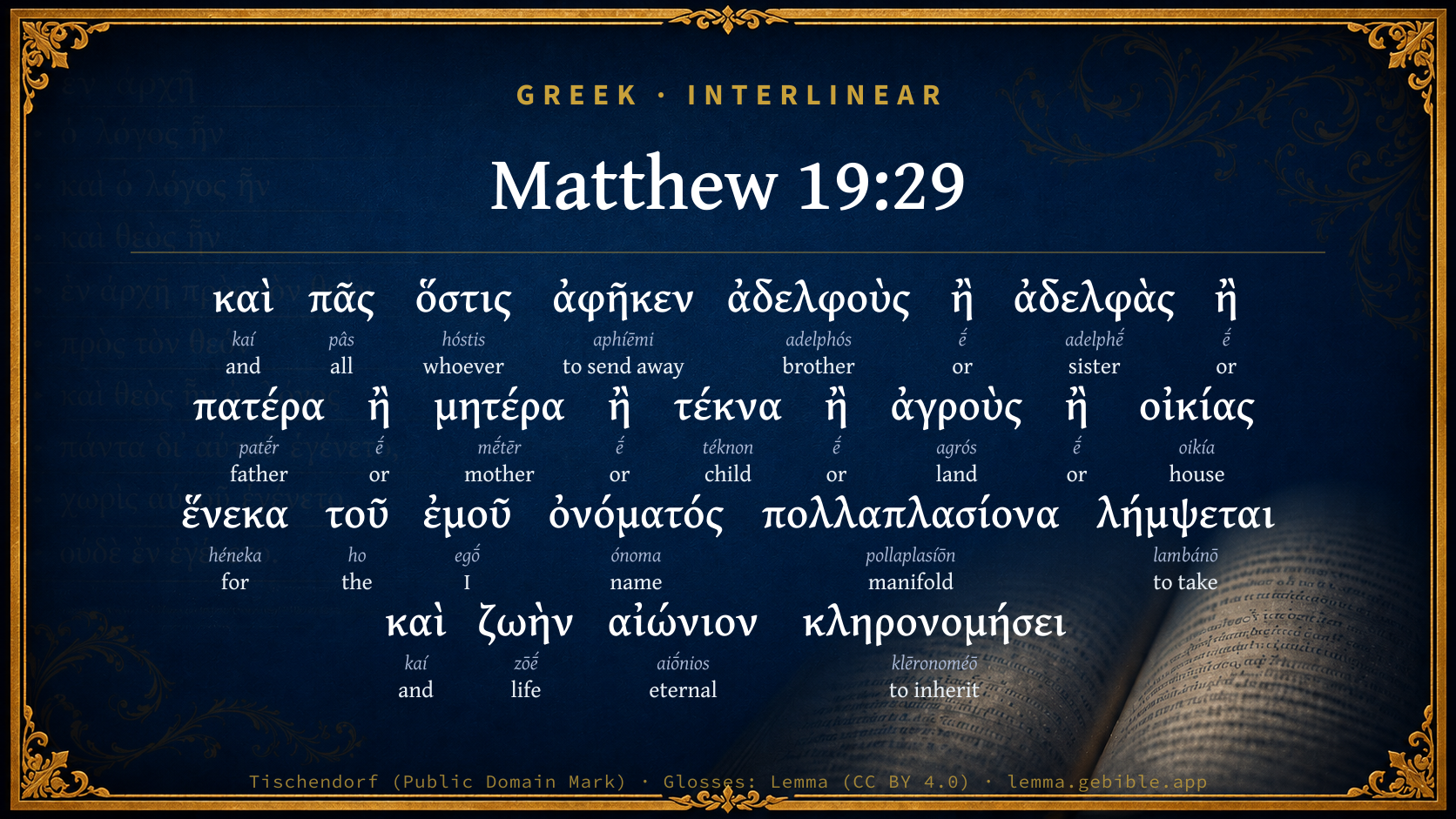
Greek (Tischendorf 8th ed.) Matthew 19:29 appears in the Greek New Testament. The text above is from the Tischendorf 8th edition. Each word links to its Strong’s number and a concise gloss. Click any word for its full Thayer’s Greek Lexicon entry.
Download image
Cite this verse

Matthew 19:29 (World English Bible). Public Domain. Lemma interlinear Bible study tool, https://lemma.gebible.app/v/matthew/19/29.

Show BibTeX & RIS
BibTeX
RIS
English Translation
Everyone who has left houses, or brothers, or sisters, or father, or mother, or wife, or children, or lands, for my name's sake, will receive one hundred times, and will inherit eternal life.
World English Bible · Public Domain
Highlights
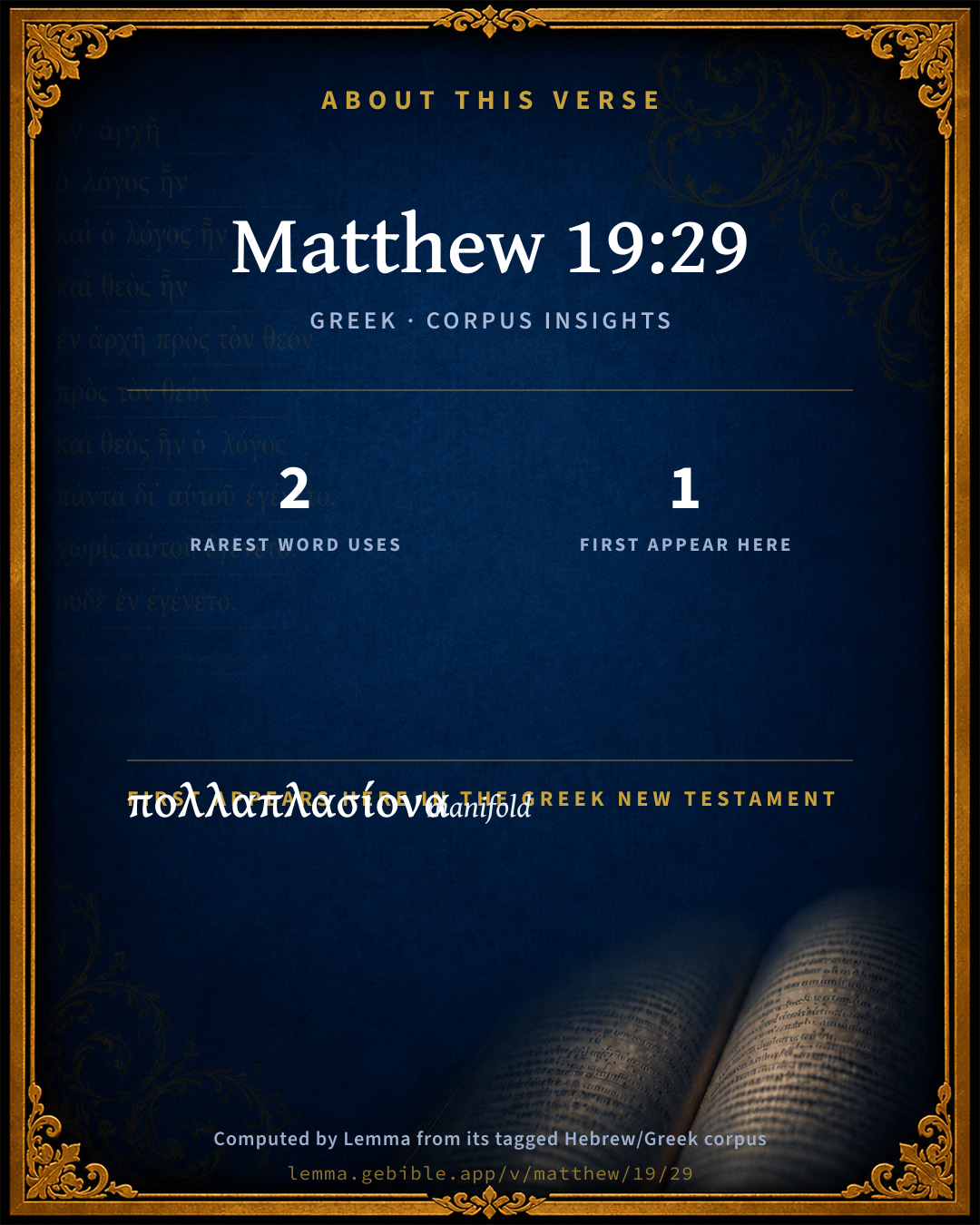
  • 1 first appearance in the Greek New Testament
Full analysis ↓
Download a study sheet

One document with this verse’s original text, its word-by-word gloss line, the meaning frame, cross-references with their text, attributed commentary, and full source and license credits — printable, and it pastes into notes with its structure intact.

This verse Autodidact and up

Study sheet (.html) Plain text (.txt)

A passage Seminary Student

Up to 50 verses in one chapter. A passage sheet keeps up to 6 commentary sources and 12 cross-references per verse, in the order this page ranks them, and says so on the sheet whenever that leaves anything out. Ask for a single verse and you get the Autodidact verse sheet above.

Everything on this page stays free to read, with no account — the sheet is a download of what is already on screen, not access to it.

Want to remove ads? Support Godless Engineer
Compare translations 3

The same verse in 3 English versions, stacked beneath the original-language interlinear above. Click any original word for its lexicon entry.

Each is an independent rendering of the whole verse — the interlinear is not word-aligned to these translations.

Highlighted words mark where these versions differ — a whole-verse word diff, not a word-by-word alignment.

  • World English Bible Public Domain
    Everyone who has left houses, or brothers, or sisters, or father, or mother, or wife, or children, or lands, for my name's sake, will receive one hundred times, and will inherit eternal life.
  • King James Version Public Domain
    And every one that hath forsaken houses, or brethren, or sisters, or father, or mother, or wife, or children, or lands, for my name's sake, shall receive an hundredfold, and shall inherit everlasting life.
  • unfoldingWord Literal Text CC BY-SA 4.0
    And everyone who has left houses, or brothers, or sisters, or a father, or a mother, or a wife, or children, or lands for the sake of my name, will receive 100 times and will inherit eternal life.

unfoldingWord Literal Text — © unfoldingWord, licensed CC BY-SA 4.0. Word-aligned USFM3 via Door43 (git.door43.org/unfoldingWord/en_ult).

Versions to compare (up to 4)

3 of 4 selected

Show all 19 translations

Every available English version of this verse, each an independent rendering of the whole verse.

  • World English Bible Public Domain
    Everyone who has left houses, or brothers, or sisters, or father, or mother, or wife, or children, or lands, for my name's sake, will receive one hundred times, and will inherit eternal life.
  • Berean Standard Bible Public Domain
    And everyone who has left houses or brothers or sisters or father or mother or wife or children or fields for the sake of My name will receive a hundredfold and will inherit eternal life.
  • Majority Standard Bible Public Domain
    And everyone who has left houses or brothers or sisters or father or mother or wife or children or fields for the sake of My name will receive a hundredfold and will inherit eternal life.
  • King James Version Public Domain
    And every one that hath forsaken houses, or brethren, or sisters, or father, or mother, or wife, or children, or lands, for my name's sake, shall receive an hundredfold, and shall inherit everlasting life.
  • American Standard Version (1901) Public Domain
    And every one that hath left houses, or brethren, or sisters, or father, or mother, or children, or lands, for my name's sake, shall receive a hundredfold, and shall inherit eternal life.
  • Revised Version (1885) Public Domain
    And every one that hath left houses, or brethren, or sisters, or father, or mother, or children, or lands, for my name’s sake, shall receive a hundredfold, and shall inherit eternal life.
  • Geneva Bible (1599) Public Domain
    And whosoeuer shall forsake houses, or brethren, or sisters, or father, or mother, or wife, or children, or lands, for my Names sake, he shall receiue an hundreth folde more, and shall inherite euerlasting life.
  • Douay-Rheims (1899) Public Domain
    And every one that hath left house, or brethren, or sisters, or father, or mother, or wife, or children, or lands for my name's sake, shall receive an hundredfold, and shall possess life everlasting.
  • Young's Literal Translation Public Domain
    and every one who left houses, or brothers, or sisters, or father, or mother, or wife, or children, or fields, for my name's sake, an hundredfold shall receive, and life age-during shall inherit;
  • Literal Standard Version CC BY-SA 4.0
    and everyone who left houses, or brothers, or sisters, or father, or mother, or wife, or children, or fields, for My Name’s sake, will receive a hundredfold, and will inherit continuous life;
  • Unlocked Literal Bible CC BY-SA 4.0
    Every one who has left houses, brothers, sisters, father, mother, children, or land for my name's sake, will receive one hundred times as much and will inherit eternal life.
  • unfoldingWord Literal Text CC BY-SA 4.0
    And everyone who has left houses, or brothers, or sisters, or a father, or a mother, or a wife, or children, or lands for the sake of my name, will receive 100 times and will inherit eternal life.
  • Darby Bible Public Domain
    And every one who has left houses, or brethren, or sisters, or father, or mother, or wife, or children, or lands, for my name's sake, shall receive a hundredfold, and shall inherit life eternal.
  • World Messianic Bible Public Domain
    Everyone who has left houses, or brothers, or sisters, or father, or mother, or wife, or children, or lands, for my name’s sake, will receive one hundred times, and will inherit eternal life.
  • Webster's Bible Public Domain
    And every one that hath forsaken houses, or brethren, or sisters, or father, or mother, or wife, or children, or lands for my name's sake, shall receive a hundred-fold, and shall inherit everlasting life.
  • Free Bible Version CC BY-SA 4.0
    All those who because of me have left their homes, brothers, sisters, father, mother, children, and fields, will receive back a hundred times more, and will receive eternal life.
  • Bible in Basic English Public Domain
    And everyone who has given up houses, or brothers, or sisters, or father, or mother, or child, or land, for my name, will be given a hundred times as much, and have eternal life.
  • Text-Critical English NT CC BY 4.0
    And everyone who has left houses, brothers, sisters, father, mother, wife, children, or fields for my name's sake, will receive a hundred times more and will inherit eternal life.
  • Tyndale New Testament (1534) Public Domain
    And whosoever forsaketh housses or brethren or systers other father or mother or wyfe or chyldren or landes for my names sake the same shall receave an hundred folde and shall inheret everlastynge lyfe.

Literal Standard Version (2020), Covenant Press — licensed CC BY-SA 4.0. Text via the HelloAO Bible API (eBible.org). Unlocked Literal Bible (unfoldingWord) — licensed CC BY-SA 4.0. Text via the HelloAO Bible API (eBible.org). unfoldingWord Literal Text — © unfoldingWord, licensed CC BY-SA 4.0. Word-aligned USFM3 via Door43 (git.door43.org/unfoldingWord/en_ult). Free Bible Version, Dr. Jonathan Gallagher — licensed CC BY-SA 4.0. Text via the HelloAO Bible API (eBible.org).

Word by word

More ways to search: Search by grammar → Find every occurrence → Compare this word →

Practice this passage: Drill this verse → Learn its vocabulary →

πολλαπλασίονα
pollaplasíōn
G4179
“manifold”
Adjective, Accusative, Plural, Neuter
Part of Speech
Adjective
Case
Accusative
Number
Plural
Gender
Neuter
Full Thayer's Definition

Origin: from G4183 and probably a derivative of G4120

TDNT: None

1. manifold, much, more
  1. καὶ kaí G2532 “and” Conjunction
  2. πᾶς pâs G3956 “all” Adjective, Nominative, Singular, Masculine
  3. ὅστις hóstis G3748 “whoever” Relative pronoun, Nominative, Singular, Masculine
  4. ἀφῆκεν aphíēmi G863 “to send away” Verb, Aorist, Active, Indicative, 3rd person, Singular
  5. ἀδελφοὺς adelphós G80 “brother” Noun, Accusative, Plural, Masculine
  6. ἢ ḗ G2228 “or” Particle
  7. ἀδελφὰς adelphḗ G79 “sister” Noun, Accusative, Plural, Feminine
  8. ἢ ḗ G2228 “or” Particle
  9. πατέρα patḗr G3962 “father” Noun, Accusative, Singular, Masculine
  10. ἢ ḗ G2228 “or” Particle
  11. μητέρα mḗtēr G3384 “mother” Noun, Accusative, Singular, Feminine
  12. ἢ ḗ G2228 “or” Particle
  13. τέκνα téknon G5043 “child” Noun, Accusative, Plural, Neuter
  14. ἢ ḗ G2228 “or” Particle
  15. ἀγροὺς agrós G68 “land” Noun, Accusative, Plural, Masculine
  16. ἢ ḗ G2228 “or” Particle
  17. οἰκίας oikía G3614 “house” Noun, Accusative, Plural, Feminine
  18. ἕνεκα héneka G1752 “for” Preposition
  19. τοῦ ho G3588 “the” Article, Genitive, Singular, Neuter
  20. ἐμοῦ egṓ G1473 “I” Personal pronoun, 1st person, Genitive, Singular
  21. ὀνόματός ónoma G3686 “name” Noun, Genitive, Singular, Neuter
  22. λήμψεται lambánō G2983 “to take” Verb, Future, Middle deponent, Indicative, 3rd person, Singular
  23. καὶ kaí G2532 “and” Conjunction
  24. ζωὴν zōḗ G2222 “life” Noun, Accusative, Singular, Feminine
  25. αἰώνιον aiṓnios G166 “eternal” Adjective, Accusative, Singular, Feminine
  26. κληρονομήσει klēronoméō G2816 “to inherit” Verb, Future, Active, Indicative, 3rd person, Singular

About this verse

These counts appear in no published source. They are computed here, from the morphology-tagged text and Lemma’s own curated glosses. What Lemma adds →

27
words
21
distinct lemmas
Gospels
section

Notable vocabulary

The rarest word here is πολλαπλασίονα manifold G4179 — appearing just 2 times in the whole Greek New Testament.

First appearance in Scripture

This word makes its first canonical appearance in the Greek New Testament here:

  • πολλαπλασίονα manifold G4179

Shared distinctive vocabulary

πολλαπλασίονα manifold G4179 occurs in 2 verses of the Greek New Testament. Also found in:
Repetition

Words recur within this verse:

Cross-references

22

Topical passages linked to Matthew 19:29 in the Treasury of Scripture Knowledge — connected by theme and wording, ordered by reader-vote popularity; previews shown in the World English Bible.

  • Luke 18:29–30 He said to them, "Most assuredly I tell you, there is no one who has left house, or wife, or brothers, or parents, or children, for the Kingdom of God's sake,
  • Mark 10:29–30 Jesus said, "Most assuredly I tell you, there is no one who has left house, or brothers, or sisters, or father, or mother, or wife, or children, or land, for my sake, and for the Gospel's sake,
  • Philippians 3:8 Yes most assuredly, and I count all things to be loss for the excellency of the knowledge of Christ Jesus, my Lord, for whom I suffered the loss of all things, and count them nothing but refuse, that I may gain Christ
  • Luke 14:26 "If anyone comes to me, and doesn't hate his own father, mother, wife, children, brothers, and sisters, yes, and his own life also, he can't be my disciple.
  • Matthew 16:25 For whoever desires to save his life will lose it, and whoever will lose his life for my sake will find it.
  • Matthew 10:37–38 He who loves father or mother more than me is not worthy of me; and he who loves son or daughter more than me isn't worthy of me.
  • Matthew 6:33 But seek first God's Kingdom, and his righteousness; and all these things will be given to you as well.
  • 1 Peter 4:14 If you are insulted for the name of Christ, blessed are you; because the Spirit of glory and of God rests on you. On their part he is blasphemed, but on your part he is glorified.
  • Matthew 10:22 You will be hated by all men for my name's sake, but he who endures to the end will be saved.
  • John 15:19 If you were of the world, the world would love its own. But because you are not of the world, since I chose you out of the world, therefore the world hates you.
  • Luke 6:22 Blessed are you when men shall hate you, and when they shall exclude and mock you, and throw out your name as evil, for the Son of Man's sake.
  • Matthew 5:11 "Blessed are you when people reproach you, persecute you, and say all kinds of evil against you falsely, for my sake.
  • Matthew 8:21–22 Another of his disciples said to him, "Lord, allow me first to go and bury my father."
  • Acts 9:16 For I will show him how many things he must suffer for my name's sake."
  • Matthew 25:34 Then the King will tell those on his right hand, 'Come, blessed of my Father, inherit the Kingdom prepared for you from the foundation of the world;
  • 1 Corinthians 2:9 But as it is written, "Things which an eye didn't see, and an ear didn't hear, Which didn't enter into the heart of man, These God has prepared for those who love him."
  • Matthew 19:16 Behold, one came to him and said, "Good teacher, what good thing shall I do, that I may have eternal life?"
  • Matthew 13:23 What was sown on the good ground, this is he who hears the word, and understands it, who most assuredly bears fruit, and brings forth, some one hundred times as much, some sixty, and some thirty."
  • Matthew 13:8 and others fell on good soil, and yielded fruit: some one hundred times as much, some sixty, and some thirty.
  • Matthew 25:46 These will go away into eternal punishment, but the righteous into eternal life."
  • 2 Corinthians 5:16 Therefore we know no one after the flesh from now on. Even though we have known Christ after the flesh, yet now we know him so no more.
  • 3 John 1:7 because for the sake of the Name they went out, taking nothing from the Gentiles.

Cross-references courtesy of OpenBible.info (CC BY 4.0).

Where the printed editions differ

2 variants

Places in this verse where the major printed Greek editions disagree on the wording in a way that affects the translation — a comparison of editions, not a manuscript-by-manuscript collation. The editions are the modern critical texts (Nestlé-Aland 28/27, SBL, Westcott-Hort, Tregelles, Tyndale House) and the traditional texts behind the KJV (the Textus Receptus and the Byzantine/Majority text). It is not a claim about which reading is original.

  1. Extra text
    γυναῖκα ἢ

    “wife or”

    In TynSBLTRByz Not in NA28NA27WHTreg

    γυναῖκα ἢ (gunaika ē) 'wife or' is only in traditional manuscripts (Tyn+SBL+TR+Byz)

  2. Different wording
    ἑκατονταπλασίονα

    “a hundredfold”

    In NA28NA27TynSBLTRByz Not in WHTreg

    πολλαπλασίονα (pollaplasiona) 'many more' occurs in a few manuscripts (WH+Treg) instead of ἑκατονταπλασίονα (hekatontaplasiona) 'a hundredfold' in older manuscripts (NA28+NA27+Tyn+SBL+TR+Byz)

Textual data: Translators Amalgamated Greek New Testament (STEPBible TAGNT) · CC BY 4.0.

Commentary

Notes on Matthew 19:29 from classic Christian and Jewish commentators (each source and its license shown beneath its notes). The classic Christian expositions comment on the surrounding passage and are grouped to its opening verse, so a note may address several verses; the Jewish commentaries on the Tanakh (Rashi and others) are per-verse, so they appear only where the commentator wrote on this verse.

Lemma curates 59 commentaries, every one of them public domain or Creative Commons licensed, each selected and text-cleaned for this edition rather than reprinted as found. About our sources →

Joseph Benson's Commentary

Mat 19:29-30. And every one — In every age and country, and not you my apostles only; that hath forsaken houses, or brethren, or wife, or children — Either by giving any of them up, when they could not be retained with a clear conscience; or by willingly refraining from acquiring them: shall receive a hundred-fold — In value, though not in kind, even in the present world, in the inward satisfaction and divine consolation attending real religion; and inherit everlasting life — Shall enjoy to all eternity that unspeakable felicity and glory which God has prepared for all his children, and especially for those who have cheerfully made such sacrifices as those, and have given such proofs of their faith in, and love to, their God and Saviour. But many first — In the advantages and privileges which they enjoy; shall — notwithstanding this, fall short of others, and be last — in the great day of accounts; and those who are the last, shall prove in this respect the first: for some, from whom it might be least expected, shall embrace the gospel, and courageously endure the greatest hardships for it; while others, with far greater advantages, shall reject it, and under much stronger engagements shall desert it. The words thus interpreted may be considered as a prediction that the Gentiles would receive and obey the gospel, while the Jews should reject it. As if he had said, “Though you may imagine that you and your brethren have a peculiar title to the great and substantial blessings of my kingdom, which I have been describing, the Gentiles shall have equal opportunities and advantages for obtaining them; because they shall be admitted to all the privileges of the gospel on the same footing with you Jews; nay, in point of time, they shall be before you; for they shall generally embrace the gospel before your nation is converted, Rom 11:25-26.” — Macknight. The words may also be thus interpreted: Many that are first in profession, and in the opinion of their fellow-creatures, and their own opinion, for piety and virtue, shall be last in my esteem, and in that of my Father, or shall be found wanting, and therefore shall be condemned at the day of judgment: and the last in the opinion of men, and in their own opinion, and who are despised and rejected by those that judge according to appearance, shall be first — Shall be preferred to others, and be found highest in my favour in that day. The passage has evidently yet another sense, namely, Many of those who were first called shall be last, shall have the lowest reward, those who came after them being preferred before them: and yet possibly both the first and the last may be saved, though with different degrees of glory. The doctrine contained in this sentence is illustrated by the parable of the householder, contained in the beginning of the following chapter.

Joseph Benson's Commentary on the Old and New Testaments (1811–1818) — public domain. Text from a community e-Sword module.

Bengel's Gnomon

Johann Albrecht Bengel

Mat 19:29. Καὶ πᾶς, and every one) Not only apostles, to whom Peters question ought not to have referred exclusively. See 2Ti 4:8.—ἀφῆκεν, hath relinquished) If the Lord so command (as in Mat 4:19), or thus guide by various means.—οἰκίας, houses[877]) This is placed first; cf. concerning it, Mat 19:21; Mat 19:27.—St Matthew, in the present instance, and St Mark, in Mat 10:29, maintain the order of affection in the enumeration of relations, mentioning them by pairs in an ascending scale, lands being placed last; whereas St Luke, in Mat 18:29, follows the order of time.—ἤ γυναῖκα, or wife) i.e. without breaking the law of Moses; see Mat 19:9. The singular number of this word (i.e. wife) should be remarked, as an argument against polygamy; for those things of which there can be more than one, brothers, etc., are put in the plural number in this passage. In like manner in Mar 10:29, οἰκία, a house, is also put in the singular number. A man may, indeed, have more than one house, though such is the case of few; but no one dwells in two at the same time, so as to be able to leave them both at once.—ἕνεκεν τοῦ ὀνοματός ΜΟΥ, on account of My name) sc. on account of confessing and preaching the name of Christ.—ἑκατονταπλασίονα, an hundredfold) i.e. of the same things which are enumerated in this verse; cf. Mar 10:30.—λήψεται, shall receive) sc. in this life: for the future life is an hundredfold, nay, a thousandfold more productive in its returns; see Luk 19:16-17. He shall receive them, however, not as civil or personal possessions; yet he truly shall receive them, as far as the believer needs to do so, and he does so in the person of others, to whom, as a believer, he would especially wish them to belong; cf. Mat 5:5: Act 4:35; 1Co 3:22.—The ungodly are usurpers; the right of possession belongs to God and His heirs; they receive as much as is expedient for them. The word λήψεται (shall receive) agrees rather with the notion of hire or wages: but κληρονομήσει (shall inherit) implies something far more abundant. Scripture speaks more expressly and copiously of temporal punishments than of temporal rewards, and of eternal rewards than of eternal punishments.—ζωὴν, life) see Mat 19:16-17.

[877] Beng., in his Appar. Crit. on this passage, p. 482, had considered the singular, οἰκίαν, had been derived from the parallel passages in the other Gospels. Hence also in the Gnomon (Ed. ii., p. 128) he preferred the plural number. But in the smaller Ed. of N. T. Gr., A.D. 1753, he changed his opinion, and gave the superiority to the singular, οἰκίαν, by appending the sign β, and with this the Germ. vers. of the passage subsequently corresponds. In this view, the observation in the Gnomon which immediately follows, has the more force.—E. B.

Tischend, reads ἢ οἰκίας after ἤ ἀηροὺς, with CL Memph., MSS. of Vulg. Origen 1,283c; 3,689a. Lachm., as Rec. Text, reads οἰκίας ἢ before ἀδελφοὺς with BD. The oldest MS. of Vulg. (Amiatinus) reads the sing. ‘domum,’ and puts it before “vel fratres aut sorores.” abcd Hil. also read domum.’ Irenaeus, “agros aut domos aut parentes (ἢ γονεῖς) aut fratres aut filios.” The ἢ οἰκίαν first in the enumeration is probably drawn from Mar 8:29 and Luk 18:29.—ED.

Bengel's Gnomon of the New Testament — English translation (T&T Clark, Edinburgh, 1860) — public domain. Text from a community e-Sword module.

Meyer's Critical & Exegetical Commentary

Heinrich August Wilhelm Meyer

Mat_19:29. The promise that has hitherto been restricted to the apostles now becomes general in its application: and (in general) every one who, etc.

ἀφῆκεν] has left, completely abandoned. Comp. Mat_19:27.

ἕνεκεν τ. ὀν. μ.] i.e. because my name represents the contents of his belief and confession. Comp. Luk_21:12. This leaving of all for the sake of Jesus may take place without persecution, simply by ones choosing to follow Him as a disciple; but it may also be forced upon one through persecution, as for instance by such a state of matters as we find in Mat_10:35 ff.

πολλαπλασίονα (see critical notes) λήψεται, according to the context (see καθίσεσθε, Mat_19:28; κληρονομήσει, Mat_19:29; ἔσονται, Mat_19:30), can certainly have no other reference but to the recompense in the future kingdom of the Messiah, in which a manifold compensation will be given for all that may have been forsaken. Here the view of Matthew diverges from that of Mar_10:38, Luk_18:30, both of whom represent this manifold compensation as being given during the period preceding the second advent. This divergence is founded upon a difference of conception, existing from the very first, regarding the promise of Jesus, so that the distinction between the καιρὸς οὗτος and the αἰὼν ἐρχόμενος in Mark and Luke may be regarded as the result of exegetical reflection on the meaning of the expressions in the original Hebrew. The words are likewise correctly referred to the reward of the future world by de Wette, Bleek, Keim, Hilgenfeld, while Fritzsche is at a loss to decide. In opposition to the context, the usual interpretation in the case of Matthew as well, is to refer the promise of a manifold compensation to the αἰὼν οὗτος, some supposing it to point to the happiness arising from Christian ties and relationships, as Jerome, Theophylact, Euthymius Zigabenus, Erasmus, Grotius, Wetstein; others, to the receiving of all things in return for the few (1Co_3:21; Olshausen); others, again, to inward peace, hope, the fellowship of love (Kuinoel, Calvin), or generally, the spiritual blessings of believers (Bengel); and others still, to Christ Himself, as being (Mat_12:49 f.) infinitely more to us than father, mother, brother, etc. (Maldonatus, Calovius). Julian mocked at the promise.

κ. ζωὴν αἰ. κληρ.] the crown of the whole, which perfects all by rendering it an eternal possession. Observe, further, how what is promised is represented as a recompense, no doubt, yet not for meritorious works, but for self-denying, trustful obedience to Christ, and to His invitation and will. Comp. Apol. Conf. A., p. 285 f.

Meyer — Critical and Exegetical Commentary on the New Testament — English translation by Peter Christie, edited by Frederick Crombie (T&T Clark, 1880) — public domain. Text from a community e-Sword module.

Expositor's Greek Testament

ed. W. Robertson Nicoll

Mat 19:29 . eneral promise for all faithful ones. ἀδελφούς , etc.: detailed specification of the things renounced for Christ. πολλαπλασίονα λήψεται : shall receive manifoldly the things renounced, i.e. , in the final order of things, in the new-born world, as nothing is said to the contrary. Mk. and Lk. make the compensation present . καὶ ζωὴν αἰώνιον : this higher boon, the summum bonum , over and above the compensation in kind. Here the latter comes first; in chap. Mat 6:33 the order is reversed.

The Expositor's Greek Testament, edited by W. Robertson Nicoll (1897–1910) — public domain. Text from a community e-Sword module.

Adam Clarke's Commentary

Verse 29. Shall receive a hundredfold] Viz. in this life, in value, though perhaps not in kind; and in the world to come everlasting life. A glorious portion for a persevering believer! The fulness of GRACE here, and the fulness of GLORY hereafter! See on Mr 10:30.

Adam Clarke's Commentary on the Bible (1810–1826) — public domain. Text from a community e-Sword/MySword module.

Ellicott's Commentary for English Readers

(29) Every one that hath forsaken.—While the loyalty and faith of the Apostles were rewarded with a promise which satisfied their hopes then, and would bring with it, as they entered more deeply into its meaning, an ever-increasing satisfaction, their claim to a special privilege and reward was at least indirectly rebuked. Not for them only, but for all who had done or should hereafter do as they did, should there be a manifold reward, even within the limits of their earthly life, culminating hereafter in the full fruition of the “eternal life” of which they had heard so recently in the question of the young ruler.

For my name’s sake.—The variations in the other Gospels, “for my sake and the gospel’s” (Mar_10:29), “for the kingdom of God’s sake” (Luk_18:29), are significant, (1) as explanatory, (2) as showing that the substantial meaning of all three is the same. The act of forsaking home and wealth must not originate in a far-sighted calculation of reward; it must proceed from devotion to a Person and a cause, must tend to the furtherance of the gospel and the establishment of the divine Kingdom.

Shall receive an hundredfold.—The better MSS. have “manifold more,” as in St. Luke. The received reading agrees with St. Mark. Here it is manifestly impossible to take the words literally, and this may well make us hesitate in expecting a literal fulfilment of the promise that precedes. We cannot look for the hundredfold of houses, or wives, or children. What is meant is, that the spirit of insight and self-sacrifice for the sake of God’s kingdom multiplies and intensifies even the common joys of life. Relationships multiply on the ground of spiritual sympathies. New homes are opened to us. We find new friends. The common things of life—sky, and sea, and earth—are clothed with a new beauty to the cleansed eyes of those who have conquered self. St. Mark (Mar_10:30) adds words which, if one may so speak, are so strange that they must have been actually spoken,—“with persecutions.” We seem to hear the words spoken as a parenthesis, and in a tone of tender sadness, not, perhaps, altogether unmingled with a touch of the method which teaches new truths, by first meeting men’s expectations, and then suddenly presenting that which is at variance with them. The thoughts of the disciples were travelling on to that “hundredfold,” as though it meant that all things should be smooth and prosperous with them. They are reminded that persecution in some shape, the trials that test and strengthen, is inseparable from the higher life of the kingdom. (Comp. Act_14:22.) Men need that discipline in order that they may feel that the new things are better than the old.

A Bible Commentary for English Readers, edited by Charles John Ellicott (1878–1897) — public domain. Text from a community e-Sword module.

The Cambridge Bible for Schools and Colleges

gen. ed. J. J. S. Perowne

29. hath forsaken] Bp Thirlwall remarks, “Strange as it may sound, there is a sense in which it is a most certain truth that a man may leave that which he keeps, and keep that which he leaves. And there can be no doubt that this is the sense in which our Lord meant to be understood. For it is clear that He is speaking not of a mere outward act, but of the disposition from which it proceeds.”

shall receive an hundredfold] St Mark seems to take the words of Jesus in a more literal sense by naming the earthly goods expressly, and adding “now in this time,” but he points to the true and spiritual interpretation by subjoining “with persecutions.”

The Cambridge Bible for Schools and Colleges (gen. ed. J. J. S. Perowne; Cambridge University Press, 1878–1918) — public domain. Text from a community e-Sword module.

John Gill's Exposition

And everyone that hath forsaken houses,.... Not only the then disciples of Christ, but any other believer in him, whether at that time, or in any age, that should be called to quit their habitations, or leave their dearest relations, friends, and substance: as

brethren or sisters, or father or mother, or wife or children, lands, for my name's sake; or, as in Luke, "for the kingdom of God's sake"; that is, for the sake of the Gospel, and a profession of it. Not that believing in Christ, and professing his name, do necessarily require a parting with all worldly substance, and natural relations, but when these things stand in competition with Christ, he is to be loved and preferred before them; and believers are always to be ready to part with them for his sake, when persecution arises, because of the word. All these things are to be relinquished, rather than Christ, and his Gospel; and such who shall be enabled, through divine grace, to do so,

shall receive an hundred fold: Mark adds, "now in this time"; and Luke likewise, "in this present time", in this world; which may be understood either in spiritual things, the love of God, the presence of Christ, the comforts of the Holy Ghost, the communion of saints, and the joys and pleasures felt in the enjoyment of these things, being an hundred times more and better to them, than all they have left or lost for Christ's sake; or in temporal things, so in Mark it seems to be explained, that such shall now receive an hundred fold,

even houses and brethren, and sisters and mothers, and children and lands; not that they should receive, for the leaving of one house, an hundred houses; or for forsaking one brother, an hundred brethren, &c. which last indeed might be true, as to a spiritual relation; but that the small pittance of this world's goods, and the few friends they should have "with persecutions" along with them, and amidst them, should be so sweetened to them, with the love and presence of God, that these should be more and better to them than an hundred houses, fields, and friends, without them:

and shall inherit everlasting life. The other evangelists add, "in the world to come", which is infinitely best of all; for this is an inheritance incorruptible, undefiled, which fades not away, reserved in the heavens, when all other inheritances are corruptible, defiled, fading and perishing; houses fall, relations die, friends fail, and lands and estates do not continue for ever: they then have the best of it, who being called, in providence, to quit all terrene enjoyments for Christ's sake, are favoured with his presence here, and shall enjoy eternal glory and happiness with him in another world.

John Gill's Exposition of the Whole Bible (1746–1763) — public domain (CC PDM 1.0). Text via the HelloAO Bible API.

Trapp's Complete Commentary

John Trapp

29 And every one that hath forsaken houses, or brethren, or sisters, or father, or mother, or wife, or children, or lands, for my name’s sake, shall receive an hundredfold, and shall inherit everlasting life.

Ver. 29. Shall receive an hundred fold] In reference to Isaac’s hundred fold increase of his seed, Gen 26:12, or that best of grounds, Mat 13:8. Those that do pillage us, they do but husband us, sow for us, when they make long furrows on our backs, Psa 126:6, and ride ever our heads, Psa 66:12. Gordius the martyr said, it is to my loss, if you bate me anything in my sufferings. Crudelitas vestra, nostra gloria, said they in Tertullian, your cruelty is our glory; and the harder we are put to it, the greater shall be our reward in heaven. Nay, on earth too: the saints shall have their losses for Christ recompensed, either in money or money’s worth, either in the same or a better thing, Maiora certamina maiora sequuntur praemia (Tertullian). Job had all doubled to him; Valentinian, for his tribuneship, the empire cast upon him, after Julian the apostate, who had put him out of office for his religion. {a} Queen Elizabeth (whose life for a long while had been like a ship in the midst of an Irish sea) after long restraint was exalted from misery to majesty, from a prisoner to a princess. Optanda nimirum est iactura quae lucro maiore pensatur, saith Agricola. It is doubtless a lovely loss that is made up with so great gain. Had Queen Elizabeth foreknown, while she was in prison, what a glorious reign she should have had for 44 years, she would never have wished herself a milk maid. So, did but the saints understand what great things abide them both here and hereafter, they would bear anything cheerfully. A hundred fold here, and eternal life hereafter: oh, who would not then turn spiritual purchaser? Well might St Paul say, "Godliness is profitable to all things." Well might the Psalmist say, "In doing (in suffering) thy will there is a great reward." Not for doing it only, but in doing it; for righteousness is its own reward. St Mark hath it thus: He that leaveth house, brethren, sisters, father, &c., shall receive the same in kind, house, brethren, sisters, father, &c. That Isa 1:1-31. He shall have communion with God and his consolations, which are better than them all; as Caleacius, that Italian marquis that left all for Christ, avowed them; and as Paulinus Nolanus, when his city was taken by the barbarians, prayed thus to God, Lord, let me not be troubled at the loss of my gold and silver, for thou art all in all unto me. Ne excrucier ob aurum et argentum; tu entre es mihi omnia. (Aug. C. D. i. 1.) Communion with Jesus Christ is praemium ante praemium, heaven beforehand, the anticipation of glory. 2. He many times gives his suffering servants here such supplies of their outward losses, in raising them up other friends and means, as do abundantly countervail what they have parted with. Thus, though David was driven from his wife, and she was given to another, God gave him a friend, Jonathan, whose love was beyond the love of women, 2Sa 1:26. So though Naomi lost her husband and children, Boaz, Ruth, and Obed became to her instead of all. The apostles left their houses and household stuff to follow Christ, but then they had the houses of all godly people open to them, and free for them, and happy was that Lydia that could entertain them; so that having nothing, they yet possessed all things, 2Co 6:10. They left a few friends, but they found far more wherever they came. Wherefore it was a senseless sarcasm of Julian the apostate, when reading this text, he jeeringly demanded, whether they should have a hundred wives also, for that one they had parted with? 3. God commonly exalts his people to the contrary good to that evil they suffer for him; as Joseph, of a slave, became a ruler; as Christ, that was judged by men, is Judge of all men. The first thing that Gaius did, after he came to the empire, was to prefer Agrippa, who had been imprisoned for wishing him emperor. Constantine embraced Paphnutius, and kissed his lost eye. The King of Poland sent Zelislaus, his general, who had lost his hand in his wars, a golden hand instead thereof. God is far more liberal to those that serve him, suffer for him. Can any son of Jesse do for us as he can?

{a} Qui pro Christi nomine amiserat tribunatum, retribuente Christo accepit imperium Oros.

John Trapp, A Commentary or Exposition upon All the Books of the Old and New Testament (1647–1656) — public domain. Text from a community e-Sword module.

Haydock's Catholic Bible Commentary

Shall receive a hundred-fold. In St. Mark we read a hundred-fold now in this time, and in the world to come life everlasting. Which hundred-fold is to be understood of the blessings in this life, or interior consolations, or the peace of a good conscience, and in general of spiritual gifts and graces, which are much more valuable than all temporal goods. And besides these spiritual graces in this world, he shall have everlasting glory in the world to come. (Witham) --- Our Saviour does not here lay down a precept of separating from wives; but, as when he before said, he that loseth his life for my sake, shall find it, he did not counsel, much less command us to lay violent hands upon ourselves; so here he teaches us to prefer the duties of piety to every other consideration. (St. John Chrysostom, hom. lxv.) --- The reward will be a hundred-fold, by the accumulation of spiritual gifts and graces in this life, infinitely superior to all we have left, and the inheritance of life eternal in the next. (Bible de Vence)

George Leo Haydock (1774–1849), Haydock's Catholic Family Bible and Commentary, 1859 edition — public domain. Excludes Psalms (Douay-Rheims chapter numbering differs from Protestant) and Deuterocanonical books (Catholic canon only).

Matthew Poole's English Annotations

Mark saith, Mar 10:29,30, for my sake, and the gospel’s, but he shall receive an hundredfold now in this time, houses, and brethren, and sisters, and mothers, and children, and lands, with persecutions; and in the world to come eternal life. Luke saith, Luk 18:29,30, for the kingdom of God’s sake, who shall not receive manifold more in this present time, and in the world to come life everlasting. The words are a liberal promise, and we must consider,

1. To whom it is made.

2. Of what it is.

The former promise respected the apostles, and was special, as appears by the number of twelve thrones. This respecteth all those that should forsake any thing, houses, brethren, lands, sisters, fathers, mothers, wife, children, for Christ; which is expressed by three phrases (for my name’s sake, for the gospel’s sake, for the kingdom of God’s sake) all of the same import; rather than they will forsake me, and the profession of my gospel; rather than they will sin against God. The promise is,

1. Of an hundredfold in this time.

2. Of eternal life.

We must not understand of an hundredfold in specie, but in value. Therefore Mark saith, he shall receive what he hath in this life with persecutions. What is therefore this hundredfold in this life?

1. Joy in the Holy Ghost, peace of conscience, the sense of God’s love; so as, with the apostles, they shall rejoice that they are thought worthy to suffer any thing for the name of Christ, Act 5:41. They shall, with Paul and Silas, Act 16:25, sing in the prison; with those, Heb 10:34, take joyfully the spoiling of their goods, knowing they have in heaven a better and an enduring substance. This inward joy and peace shall be a hundredfold more than fathers and mothers, or brethren, or sisters.

2. Contentment. They shall have a contented frame of spirit with the little that is left; though they have not so much to drink as they had, yet they shall have less thirst, Phi 4:11,12.

3. God will stir up the hearts of others to supply their wants, and that supply shall be sweeter to them than their abundance was.

4. God sometimes repays them in this life, as he restored Job after his trial to greater riches. But they shall have a certain reward in another world, eternal happiness.

Matthew Poole's English Annotations on the Holy Bible (1683–1685) — public domain. Text from a community e-Sword/MySword module.

Whedon's Commentary on the Bible

Daniel D. Whedon

29. Every one — Of you apostles. A hundredfold — Not a hundredfold of the same article; for certainly no man would expect to receive a hundred fathers or mothers. It was a hundredfold better to have an apostolic throne like Peter, than to have a fortune like the rich young man, whose case prompted Peter’s question. And all this, by the parallel passage in Mar_10:30, is to be now in this time. It is also to be with persecution, and in spite of persecution. That the apostles of Christ during their holy ministration in the Church were the happiest of men, over and above all the privations they suffered, was doubtless true to the letter. Thousands of mankind would indeed think and choose otherwise. But a rich part of the blessedness of the apostolate was to have a divine assurance within, by which it could know and realize its own exceeding great reward. And shall inherit everlasting life — In a world to come. Up to this clause Jesus had confined his statement of the apostolic reward to this world; showing, contrary to the sorrow of the rich young man, that godliness, is most profitable even for the life that now is. But to this earthly advantage everlasting life is to be superadded.

Daniel D. Whedon (gen. ed.), Commentary on the Old and New Testaments (1874–1909) — public domain. Text from a community e-Sword module.

The Pulpit Commentary

Every one that hath forsaken. The Lord extends the promise. Even those who have not risen to the utter self-sacrifice of apostles, who have not surrendered so much as they, shall have their reward, though nothing to be compared to the unspeakable recompense of the twelve. Houses... lands. Some manuscripts, followed by some modern editors, omit or wife, the omission being probably first made by some critical scribe, who deemed that a wife should never be left. The Lord enumerates the persons and objects upon which men"s hearts are most commonly and firmly fixed. He begins and ends the list with material possessions houses and lands, and between them introduces in gradation the most cherished members of the family circle. "Forsaking wife and children" may be understood as abstaining from marriage in order the better to serve God. For my Name"s sake. In consequence of belief in Christ, rather than do despite to his grace, or in order to confess and follow him more completely. In times of persecution, under many different cases of pressure, or where his friends were heathens or infidels, a Christian might feel himself constrained to relinquish the dearest ties, to east off all old associations, to put himself wholly in God"s hands, freed from all worldly things; such a one should receive ample reward in the present life. A hundredfold. Some read "manifold," as in Luk_18:30. The spiritual relationship into which religion would introduce him largely compensates for the loss of earthly connections. He shall have brothers and sisters in the faith hundreds who will show him the affection of father and mother, hundreds who will love him as well a s wife and children. And if he suffer temporal loss, this shall be made up by the charity of the Christian society, all whose resources are at his command, and he shall enjoy that peace and comfort of heart which no worldly possessions can give, and which are superior to all changes of fortune. And it may well be that the relief from the cares and distractions caused by wealth brings a hundredfold more real happiness than its possession ever supplied. "Godliness is profitable for all things, having the promise of the life which now is, and of that which is to come". (1Ti_4:8) Everlasting life. The hope of future happiness is in itself sufficient to lighten and dissipate all earthly troubles, and to stimulate severest sacrifices.

The Christian possession and Christian heritage.

"Shall receive a hundredfold, and shall inherit everlasting life." St. Peter (1Pe_1:4, 1Pe_1:9) speaks of "receiving the end of your faith, even the salvation of your souls;" and of our lively hope of the "inheritance incorruptible and undefiled, and that fadeth not away." We may unduly fix our thoughts on that which we gain now by becoming Christians. But many fail of due appreciation of present blessings, because they are absorbed in anticipation of the good things that are to come. Our Lord had to deal with disciples who were very easily led to think about what they should get by being disciples. In this passage he seeks to deliver them from material notions of getting, and to help them in forming worthy estimates of the spiritual blessings of discipleship.

I THE SPIRITUAL THINGS A DISCIPLE NOW HAS. Things answering to "houses and lands," and to "wife and children." Man here on earth has two supreme satisfactions they are found in "things possessed," and in "objects of affection." Discipleship to Christ provides no sort of guarantee for a hundredfold more in number of possessions or objects of affection. It does guarantee a hundredfold better in quality. There are answering soul possessions; there are answering soul affections. How firmly St. Paul declares of the Christian, "All things are yours, whether Paul, or Apollos, or Cephas, or the world, or life, or death, or things present, or things to come; all are yours, and ye are Christ"s, and Christ is God"s"! Riches and objects of affection depend on the faculties wakened in us. Discipleship wakens new and nobler faculties; and these Christ provides for.

II THE SPIRITUAL THINGS A DISCIPLE EXPECTS. Lest there should be any mistake, our Lord distinctly speaks of the future as higher, nobler, sublimer life life." We are in danger of materializing the heavenly, because we can only get apprehensions of it with the aid of sensible figures mansions," "crowns," "harps," "palms." But the apostles help to liberate and raise our thoughts, for they speak of a "crown of righteousness," a "crown of life," a "crown of glory." "Godliness has the promise of the life that now is, and of that which is to come." The Christian makes "the best of both worlds. R.T.

The Pulpit Commentary (1880–1919), ed. H.D.M. Spence-Jones & Joseph S. Exell — public domain. Text from a community e-Sword module.

John Wesley's Explanatory Notes

And every one - In every age and country; not you my apostles only; That hath forsaken houses, or brethren, or wife, or children - Either by giving any of them up, when they could not be retained with a clear conscience or by willingly refraining from acquiring them: Shall receive a hundred-fold - In value, though not in kind, even in the present world.

John Wesley, Explanatory Notes Upon the Whole Bible (1754–1765) — public domain. Text via the GEBible commentary corpus.

Kretzmann's Popular Commentary

Paul E. Kretzmann

The application to all Christians:

v. 29. And every one that hath forsaken houses, or brethren, or sisters, or father, or mother, or wife, or children, or lands for My name’s sake shall receive an hundredfold, and shall inherit everlasting life.

v. 30. But many that are first shall be last, and the last shall be first.

Most impressively Jesus details the persons and goods which usually claim the affection of people in this world. The recital serves to bring out all the more emphatically the denial of self, which is a demand of Christ. For the sake of Christ and in the confession of His name everything else must cheerfully be given up and sacrificed without a single regret, even if it means the breaking of all earthly ties. All the greater will be His reward of mercy. Manifoldly, in great fullness, shall they receive from Him in return. Not only shall the value of all be restored in richest abundance, but as the climax of all the reward of mercy will include eternal life. All this for those that suffered and denied for the sake of Christ, to bear His shame and to further His kingdom. But the Lord adds a warning for the sake of such as are inclined to be self-satisfied and proud of their own works. The earlier or later calling has no influence upon a person’s standing in the Judgment. But he that wants to depend upon his works and intends to urge those on the last day as meriting the bliss of heaven, he has denied the grace and atoning work of His Savior and will find no place in the kingdom of heaven. All poor sinners, however, that want to be saved by grace only, will find their place prepared in the heavenly mansions.

Summary.Christ gives a lesson on marriage and divorce, blesses little children, shows the danger of placing trust in riches, and assures the apostles and all Christians of their reward of grace in heaven.

Paul E. Kretzmann, Popular Commentary of the Bible (1921–1924) — public domain. Text from a community e-Sword module.

Burkitt's Expository Notes on the New Testament

William Burkitt

The foregoing promises, Mat 19:28, respected the apostles; this, all Christians, who forsake their dearest enjoyment for Christ: he assures them, they shall be recompenced in this life an hundred-fold: how? Non formaliter, sed endnenter: Not in specie, but in valour; not in kind, but in equivalence; not an hundred brethren or sisters, or lands, but first, He shall have that in God, which all creatures would not be to him, if they were multiplied an hundred times.

Secondly, The gifts and graces, the comforts and consolations, of the Holy Spriit, shall be an hundred-fold better portion than anything we can part with for the sake of Christ and his gospel here. Though we may be losers for Christ, yet shall we never be losers by him. Christ gives present recompences, as well as future rewards; insomuch that they who have suffered and lost most for Christ, have never complained of their sufferings or losses.

Therefore never be afraid to lose anything for Christ, he will not only see you indemnified, but plentifully rewarded; in this world an hundred-fold; in that to come, life eternal.

William Burkitt's Expository Notes on the New Testament (1700–1703) — public domain. Text from a community e-Sword module.

The People's New Testament

B. W. Johnson

29. Every one. Not only apostles, but every one who leaves all for Christ shall receive a hundred fold. A hundred fold. Mark says, “Now in this time.” They shall be taken care of in this world, and have earthly peace and joy, such as no sinner can have, and above all, “eternal life.”

B. W. Johnson's The People's New Testament with Notes (1889–1891) — public domain. Electronic text from the Christian Classics Ethereal Library (CCEL) ThML edition.

unfoldingWord translationNotes

Door43 World Missions Community

for my name's sake

Here "name" refers to the entire person. AT: "because of me" or "because he believes in me" (See: Metonymy)

receive one hundred times

"receive from God 100 times as many good things as they gave up" (See: Numbers)

inherit eternal life

This is an idiom that means "God will bless them with eternal life" or "God will cause them to live forever." (See: Idiom)

But many who are first will be last, and the last will be first

Here "first" and "last" refer to people's status or importance. Jesus is contrasting people's status now with their status in the kingdom of heaven. AT: "But many who seem to be important now will be the least important, and many who seem to be unimportant now will be very important"

translationWords

name

inherit

eternity

unfoldingWord translationNotes — © Distant Shores Media and the Door43 World Missions Community, licensed CC BY-SA 4.0. Source: git.door43.org/Door43/en_tn.

Cambridge Greek Testament for Schools and Colleges

29. After ἢ μητέρα the leading editors omit ἢ γυναῖκα with B D and some versions and on good patristic evidence.

πολλαπλασίονα (B L) for ἑκατονταπλασίονα (א C D and other uncials). The best editors adopt πολλ. notwithstanding the strong support of the other reading. ἑκατονταπ. probably introduced from Mark to explain the less definite πολλαπλασίονα.

29. This saying would fulfil itself in many ways to the thoughts of the Apostles. (1) In the spiritual relationships, homes, children, and fathers in Christ that sprang up to them wherever the gospel was preached. In a deep sense the thought of ‘omne solum forti patria est’ would come home to the first evangelists. (2) As Christ recognised his kindred in those who did the work of His Father, reciprocally His servants found in their brethren, wife, children and lands. (3) Sometimes self-renouncement created intensified love for others: sometimes kinsfolk forsaken for Christ were in turn won for Christ, and thus increased manifold the gift and love of kinship.

πολλαπλασίονα λήμψεται. St Mark adds μετὰ διωγμῶν. Did this word that explains so much fall so softly at the end of the sentence as to be heard only by the nearest to the Saviour? Was it half forgotten till persecution came?

Cambridge Greek Testament for Schools and Colleges (Cambridge University Press, 1896; 21 vols, various authors incl. Carr, Maclear, Plummer, Farrar, Lumby, Moule, M. R. James, Simcox) — public domain. Text from a community e-Sword module.

International Critical Commentary

(M) 29. And every one who hath left houses, or brethren, or sisters, or father, or mother, or children, or lands, for My name’s sake, shall receive a hundredfold, and shall inherit eternal life.] Mk. has “There is no one who hath left house, or brethren, or sisters, or father, or mother, or children, or lands, for My sake, and for the gospel’s sake, but he shall receive an hundredfold now in this present time, houses, and brethren, and sisters, and mothers, and children, and lands, with persecutions; and in the coming age eternal life.” Mt. avoids Mk.’s harsh construction, οὐδεὶς ἔστιν ὃς ἀφῆκεν—ἐὰν μὴ λάβῃ. In Mk v. 30 the thought is of the many advantages of incorporation into the Christian society. In it the convert should find fresh ties and new interests more satisfying than those from which he had cut himself adrift; cf. 1Co 3:21. But in Mt.’s connection, after the insertion of v. 28, the whole emphasis is on the future reward in the παλινγενεσία. This is why Mt. omits Mk.’s νῦν ἐν τῷ καιρῷ τούτῳ—διωγμῶν, for which his κληρονομήσει is a sort of substitute. The Apostles should sit on thrones; but even the humblest disciple should receive a manifold compensation, and inherit an estate greater than any which he had abandoned, namely, life everlasting.

29. μητέπα] א C K al S2 add ἢ γυναῖκα, which occurs in Luk 18:29. It is omitted here by B D 1 S1 a b e ff 12. It is unnatural here after the express prohibition of divorce in vv. 1-9.

ἐκατονταπλασίονα] So א C D X S1 S2. πολλαπλασίονα as in Lk. is read by B L.

E editorial passages.

M the Second Gospel.

S Syriac version: Sinaitic MS.

al i.e. with other uncial MSS.

LXX. The Septuagint Version.

1 See also p. 167, note 1

Jos. Josephus.

2 Cf. also Ass. Mos. 1:17, 12:4 ab initio creaturœ orbis terrarum.

1 γέγονεν. For the perfect cf. 21:21, Dan 12:1 Th. It seems to mean “Moses indeed tolerated divorce; but from the creation onwards it was not and never has been the Divine intention. Behind the Mosaic toleration lay always the ideal implied in Gen 1:27, Gen 5:2.

L the Matthæan Logia.

S Syriac version: Curetonian.

latt. Manuscripts of the Old Latin Version.

Wellh. Wellhausen.

1 It would be natural to suppose that παρεκτὸς λὸγου πορνείας is original here, if it were not that we should then have to explain why (εἰ) μὴ ἐπί πορνείᾳ has been substituted here only, and not in 5:32. The two phrases maÿ be alternative renderings by the editor of the דבד ערוה of the school of Shammai. See on 5:32.

Dalm. Dalman.

Win.-Schm. Winer-Schmiedel.

X passages in which Mt. and Lk. agree closely, borrowed from an unknown source or sources.

Luc. Lucian.

1 Weiss renders this in Mk. “From all these I guarded myself.” See Meyer’s Comm. 6th ed. in loc., and cf. Act 21:25, 2Ti 4:15.

Th. Theodotion.

Ditt. Dittenberger Sylloge.

Arist. Aristotle.

Ox. Pap. Oxyrhynchus Papyri.

Onq. The Targum of Onkelos.

International Critical Commentary — older volumes (1896–1929), various authors — public domain. Text from a community e-Sword module.

Vincent's Word Studies in the New Testament

Marvin R. Vincent

Every one [πας] . Compare 2Ti 4:8, "to all them that love his appearing." " Not only apostles, nor ought Peter to have inquired only concerning them " (Bengel). The promise hitherto restricted to the apostles now becomes general.

A hundred - fold [εκατονταπλασιονα] . But many very high authorities read pollaplasiona, manifold. So Rev. in margin. Compare Mr 10:30, where there is added "houses and brethren," etc. Also the Arabic proverb : "Purchase the next world with this; so shalt thou win both."

Marvin R. Vincent, Word Studies in the New Testament (1887–1900) — public domain. Text from a community e-Sword/MySword module.

Lesson kit

Teaching starters — assembled from the data on this page, not authored interpretation. Every prompt links to the verse data it draws on. Edit before teaching.

Matthew, in the Gospels, opens this verse with 27 words (21 distinct Greek lemmas). Its most distinctive word is pollaplasíōn (“manifold”). A historical commentator’s framing appears above. Read the whole chapter for the surrounding context.

Discussion questions

  1. How does “manifold” (pollaplasíōn) shape what this verse is saying?
  2. This is the first place “manifold” appears in Scripture (first appears here). What does its debut here establish?
  3. How does Luke 18:30, which shares the word «manifold», read alongside this verse?
  4. What does the repetition of “or” (6× in this one verse) do in this verse?
  5. These translations render this verse differently; the difference is in the English rendering, not the original. What questions does that raise?
  6. Compare how Joseph Benson's Commentary and Bengel's Gnomon read this verse. Where do they agree or differ?

Things to notice

  • 1 word makes its first canonical appearance in Scripture here.
  • These translations choose different wording for 19 words in this verse.
  • “or” occurs 6× in this single verse.
  • 21 distinct Greek lemmas span 27 words in this verse.

Reading settings

Reading text

Shown beneath each verse's original-language words.

Old Testament
Old Testament edition

Read the OT as the Masoretic Hebrew (MT) or the Greek Septuagint (LXX).

English shown for the Greek Septuagint (in the Hebrew ↔ Greek comparison).

Comparing translations? Open the Compare panel on any verse page to stack up to four side by side.