John 14:7

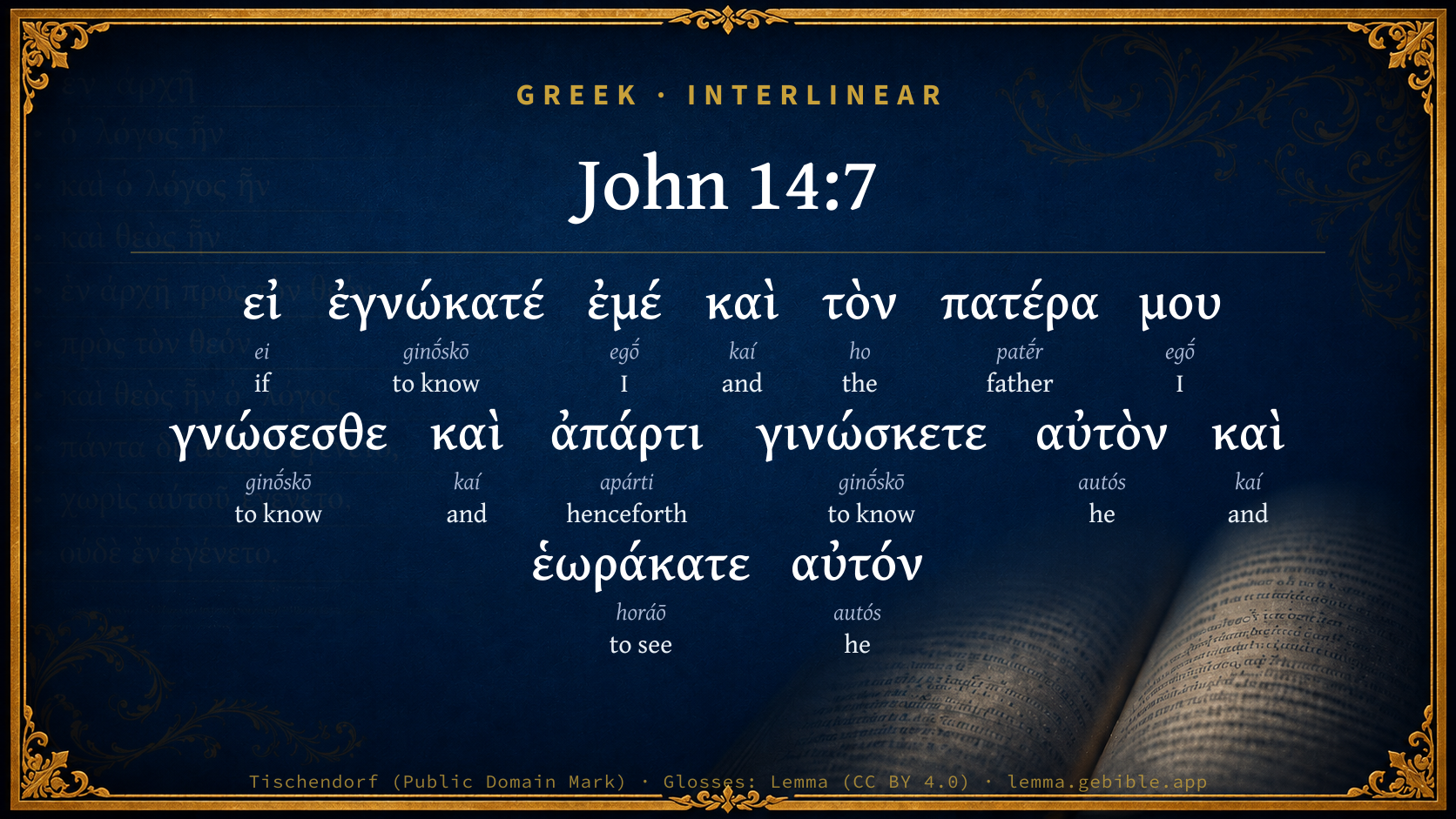
Greek (Tischendorf 8th ed.) John 14:7 appears in the Greek New Testament. The text above is from the Tischendorf 8th edition. Each word links to its Strong’s number and a concise gloss. Click any word for its full Thayer’s Greek Lexicon entry.
Download image
Cite this verse

John 14:7 (World English Bible). Public Domain. Lemma interlinear Bible study tool, https://lemma.gebible.app/v/john/14/7.

Show BibTeX & RIS
BibTeX
RIS
English Translation
If you had known me, you would have known my Father also. From now on, you know him, and have seen him."
World English Bible · Public Domain
Download a study sheet

One document with this verse’s original text, its word-by-word gloss line, the meaning frame, cross-references with their text, attributed commentary, and full source and license credits — printable, and it pastes into notes with its structure intact.

This verse Autodidact and up

Study sheet (.html) Plain text (.txt)

A passage Seminary Student

Up to 50 verses in one chapter. A passage sheet keeps up to 6 commentary sources and 12 cross-references per verse, in the order this page ranks them, and says so on the sheet whenever that leaves anything out. Ask for a single verse and you get the Autodidact verse sheet above.

Everything on this page stays free to read, with no account — the sheet is a download of what is already on screen, not access to it.

Want to remove ads? Support Godless Engineer
Compare translations 3

The same verse in 3 English versions, stacked beneath the original-language interlinear above. Click any original word for its lexicon entry.

Each is an independent rendering of the whole verse — the interlinear is not word-aligned to these translations.

Highlighted words mark where these versions differ — a whole-verse word diff, not a word-by-word alignment.

  • World English Bible Public Domain
    If you had known me, you would have known my Father also. From now on, you know him, and have seen him."
  • King James Version Public Domain
    If ye had known me, ye should have known my Father also: and from henceforth ye know him, and have seen him.
  • unfoldingWord Literal Text CC BY-SA 4.0
    If you have known me, you will know my Father also. And from now on you know him and have seen him.”

unfoldingWord Literal Text — © unfoldingWord, licensed CC BY-SA 4.0. Word-aligned USFM3 via Door43 (git.door43.org/unfoldingWord/en_ult).

Versions to compare (up to 4)

3 of 4 selected

Show all 19 translations

Every available English version of this verse, each an independent rendering of the whole verse.

  • World English Bible Public Domain
    If you had known me, you would have known my Father also. From now on, you know him, and have seen him."
  • Berean Standard Bible Public Domain
    If you had known Me, you would know My Father as well. From now on you do know Him and have seen Him.”
  • Majority Standard Bible Public Domain
    If you had known Me, you would know My Father as well. From now on you do know Him and have seen Him.”
  • King James Version Public Domain
    If ye had known me, ye should have known my Father also: and from henceforth ye know him, and have seen him.
  • American Standard Version (1901) Public Domain
    If ye had known me, ye would have known my Father also: from henceforth ye know him, and have seen him.
  • Revised Version (1885) Public Domain
    If ye had known me, ye would have known my Father also: from henceforth ye know him, and have seen him.
  • Geneva Bible (1599) Public Domain
    If ye had knowen mee, ye should haue knowen my Father also: and from henceforth ye know him, and haue seene him.
  • Douay-Rheims (1899) Public Domain
    If you had known me, you would without doubt have known my Father also: and from henceforth you shall know him, and you have seen him.
  • Young's Literal Translation Public Domain
    if ye had known me, my Father also ye would have known, and from this time ye have known Him, and have seen Him.'
  • Literal Standard Version CC BY-SA 4.0
    if you had known Me, you would also have known My Father, and from this time you have known Him, and have seen Him.”
  • Unlocked Literal Bible CC BY-SA 4.0
    If you had known me, you would have known my Father also. From now on you know him and have seen him.”
  • unfoldingWord Literal Text CC BY-SA 4.0
    If you have known me, you will know my Father also. And from now on you know him and have seen him.”
  • Darby Bible Public Domain
    If ye had known me, ye would have known also my Father, and henceforth ye know him and have seen him.
  • World Messianic Bible Public Domain
    If you had known me, you would have known my Father also. From now on, you know him and have seen him.”
  • Webster's Bible Public Domain
    If ye had known me, ye would have known my Father also: and from henceforth ye know him, and have seen him.
  • Free Bible Version CC BY-SA 4.0
    If you had known me, you would know my Father as well. From now on, you do know him and you have seen him.”
  • Bible in Basic English Public Domain
    If you had knowledge of me, you would have knowledge of my Father: you have knowledge of him now and have seen him.
  • Text-Critical English NT CC BY 4.0
    If you had known me, you would have known my Father also. From now on you do know him and have seen him.”
  • Tyndale New Testament (1534) Public Domain
    Yf ye had knowen me ye had knowen my father also. And now ye knowe him and have sene him.

Literal Standard Version (2020), Covenant Press — licensed CC BY-SA 4.0. Text via the HelloAO Bible API (eBible.org). Unlocked Literal Bible (unfoldingWord) — licensed CC BY-SA 4.0. Text via the HelloAO Bible API (eBible.org). unfoldingWord Literal Text — © unfoldingWord, licensed CC BY-SA 4.0. Word-aligned USFM3 via Door43 (git.door43.org/unfoldingWord/en_ult). Free Bible Version, Dr. Jonathan Gallagher — licensed CC BY-SA 4.0. Text via the HelloAO Bible API (eBible.org).

Word by word

More ways to search: Search by grammar → Find every occurrence → Compare this word →

Practice this passage: Drill this verse → Learn its vocabulary →

About this verse

These counts appear in no published source. They are computed here, from the morphology-tagged text and Lemma’s own curated glosses. What Lemma adds →

15
words
9
distinct lemmas
Gospels
section

Notable vocabulary

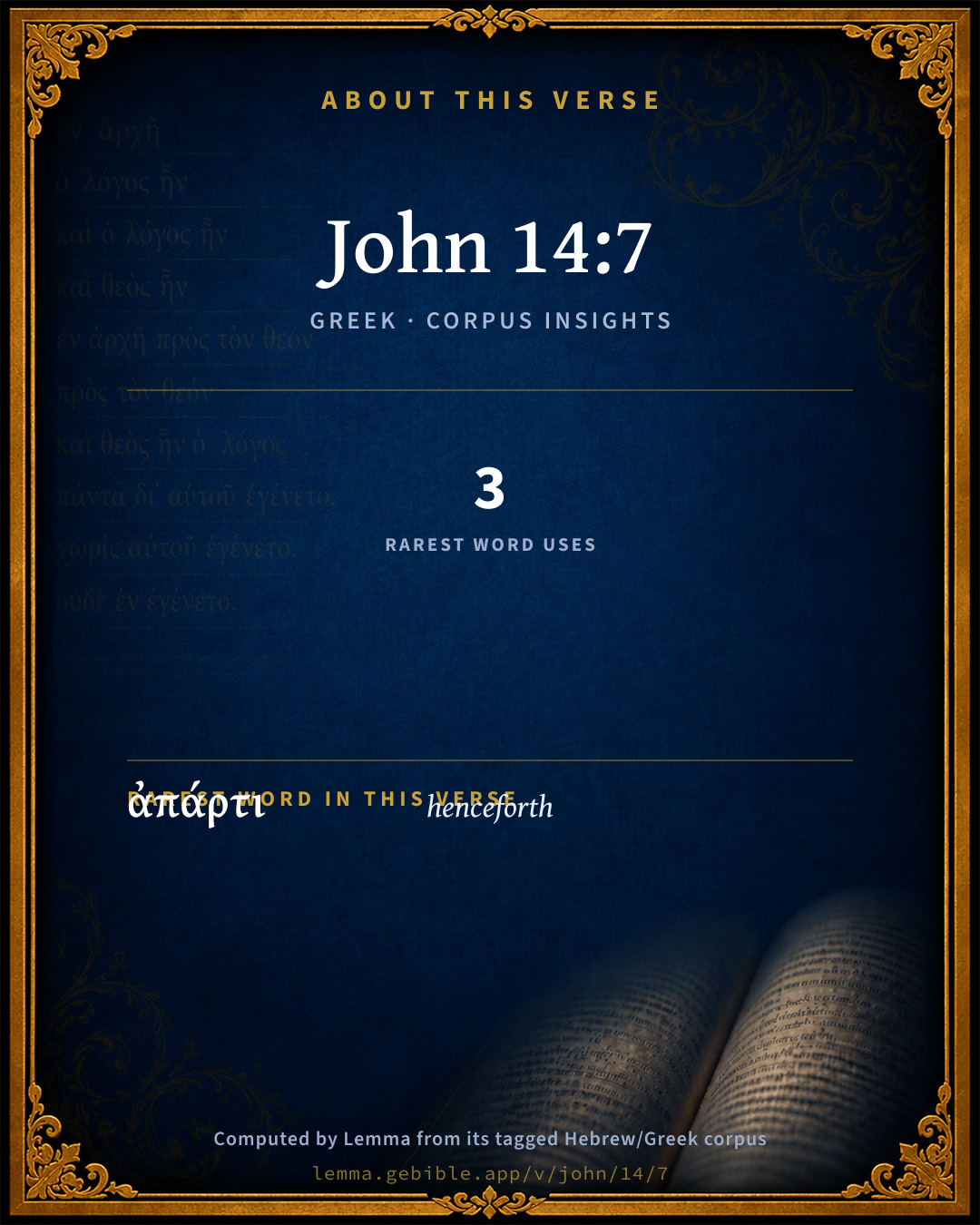
The rarest word here is ἀπάρτι henceforth G534 — appearing just 3 times in the whole Greek New Testament.

Shared distinctive vocabulary

ἀπάρτι henceforth G534 occurs in 3 verses of the Greek New Testament. Also found in:

Repetition

Words recur within this verse:

  • ἐγνώκατέ to know G1097 ×3
  • καὶ and G2532 ×3
  • ἐμέ I G1473 ×2
  • αὐτὸν he G846 ×2

Cross-references

21

Topical passages linked to John 14:7 in the Treasury of Scripture Knowledge — connected by theme and wording, ordered by reader-vote popularity; previews shown in the World English Bible.

  • Colossians 1:15–17 who is the image of the invisible God, the firstborn of all creation.
  • John 8:19 They said therefore to him, "Where is your Father?" Jesus answered, "You know neither me, nor my Father. If you knew me, you would know my Father also."
  • Luke 10:22 Turning to the disciples, he said, "All things have been delivered to me by my Father. No one knows who the Son is, except the Father, and who the Father is, except the Son, and he to whomever the Son desires to reveal him."
  • John 17:8 for the words which you have given me I have given to them, and they received them, and knew for sure that I came forth from you, and they have believed that you sent me.
  • John 17:6 I revealed your name to the people whom you have given me out of the world. They were yours, and you have given them to me. They have kept your word.
  • John 14:9–10 Jesus said to him, "Have I been with you such a long time, and do you not know me, Philip? He who has seen me has seen the Father. How do you say, 'Show us the Father?'
  • John 14:16–20 I will pray to the Father, and he will give you another Counselor, that he may be with you forever,--
  • John 16:3 They will do these things because they have not known the Father, nor me.
  • John 17:21 that they may all be one; even as you, Father, are in me, and I in you, that they also may be one in us; that the world may believe that you sent me.
  • John 17:23 I in them, and you in me, that they may be perfected into one; that the world may know that you sent me, and loved them, even as you loved me.
  • John 17:26 I made known to them your name, and will make it known; that the love with which you loved me may be in them, and I in them."
  • 2 Corinthians 4:6 seeing it is God who said, "Light will shine out of darkness," who has shone in our hearts, to give the light of the knowledge of the glory of God in the face of Jesus Christ.
  • Colossians 2:2–3 that their hearts may be comforted, they being knit together in love, and gaining all riches of the full assurance of understanding, that they may know the mystery of God, both of the Father and of Christ,
  • 1 John 2:13 I write to you, fathers, because you know him who is from the beginning. I write to you, young men, because you have overcome the evil one. I write to you, little children, because you know the Father.
  • Matthew 11:27 All things have been delivered to me by my Father. No one knows the Son, except the Father; neither does anyone know the Father, except the Son, and he to whom the Son desires to reveal him.
  • John 1:18 No one has seen God at any time. The one and only Son, who is in the bosom of the Father, he has declared him.
  • John 6:46 Not that anyone has seen the Father, except he who is from God. He has seen the Father.
  • John 15:24 If I hadn't done among them the works which no one else did, they wouldn't have had sin. But now have they seen and also hated both me and my Father.
  • John 16:13–16 However when he, the Spirit of truth, has come, he will guide you into all truth, for he will not speak from himself; but whatever he hears, he will speak. He will declare to you things that are coming.
  • Hebrews 1:3 His Son is the radiance of his glory, the very image of his substance, and upholding all things by the word of his power, when he had by himself made purification for our sins, sat down on the right hand of the Majesty on high;
  • John 17:3 This is eternal life, that they should know you, the only true God, and him whom you sent, Jesus Christ.

Cross-references courtesy of OpenBible.info (CC BY 4.0).

Commentary

Notes on John 14:7 from classic Christian and Jewish commentators (each source and its license shown beneath its notes). The classic Christian expositions comment on the surrounding passage and are grouped to its opening verse, so a note may address several verses; the Jewish commentaries on the Tanakh (Rashi and others) are per-verse, so they appear only where the commentator wrote on this verse.

Lemma curates 59 commentaries, every one of them public domain or Creative Commons licensed, each selected and text-cleaned for this edition rather than reprinted as found. About our sources →

Joseph Benson's Commentary

Joh 14:7. If ye had known me — As ye might and ought to have known me. If ye had earnestly sought and obtained that knowledge of me which is communicated by the Spirit of wisdom and revelation, (Eph 1:17,) ye would have known my Father also — In his various perfections, and in those blessed relations in which he stands to such as believe on Christ with a living faith, and are accepted through him, the beloved. “If you had had an adequate idea of my character, from the miracles I have performed, and from the marks of goodness, justice, and wisdom, which have manifested themselves in my life and doctrine; you could not have been ignorant of my Father; because his attributes are the same.” And from henceforth ye know him, and have seen him — As it may be truly affirmed, considering the discoveries that I have made of him, and the manifestation of the divine perfections which you have seen in me.

Joseph Benson's Commentary on the Old and New Testaments (1811–1818) — public domain. Text from a community e-Sword module.

Bengel's Gnomon

Johann Albrecht Bengel

Joh 14:7. Εἰ, if) This if does not altogether deny [that they knew Him], but it draws their souls to onward progress: Joh 14:28.[345] [So Luk 17:6. “If ye had faith as a grain of mustard seed:” after they had said, “Lord, increase our faith.”]—ἑωράκατε, ye have seen) The preterite: ye have begun to see, and see Him.

[345] “If ye loved Me, ye would rejoice:” not denying wholly that they loved Him, but inciting them to greater love.—E. and T.

Bengel's Gnomon of the New Testament — English translation (T&T Clark, Edinburgh, 1860) — public domain. Text from a community e-Sword module.

Meyer's Critical & Exegetical Commentary

Heinrich August Wilhelm Meyer

Joh_14:7. Had you known me (for they had indeed not known that He was the Way), you would also have known the Father (of their non-acquaintance with whom their οὐκ οἴδαμεν, ποῦ ὑπάγεις, Joh_14:5, had testified).

The emphasis changes (otherwise in Joh_8:19); it lies in the protasis on ἐγνώκ., not on the enclitic μέ; in the apodosis on τ. πατ. μον.

καὶ ἀπʼ ἄρτι, κ.τ.λ.] andwhich I can nevertheless now addfrom henceforward (after I have told you in Joh_14:6 so definitely and fully what I am) you know Him, and have (in me, Joh_14:9) beheld Him. This view of the meaning, which flows immediately out of the context, Joh_14:6; Joh_14:9, the point of which is the idea of the adequate self-revelation of God in Christ, entirely excludes any interpretation of the two verbs in a future sense (Chrysostom, Kuinoel, and many others), and the reference to a future terminus a quo (Chrysostom, Lücke, Ewald, and several others), which is wont to be assumed as the time of the communication of the Spirit, nay, even a mentally supplied I hope (De Wette) with ἀπάρτι. The reference of ἀπάρτι to the whole time of their fellowship with Christ since their conversion (Hengstenberg), is, even in a linguistic point of view, impossible. See on Joh_13:19, Joh_1:51. In that case only νῦν could stand. Godets remark is also incorrect: at the point at which my teaching has now arrived, as if ἄρτι merely were expressed.

On καί, which, without altering its meaning, significantly subjoins an adversative clause (and … i.e. and nevertheless), see on Joh_7:28.

Meyer — Critical and Exegetical Commentary on the New Testament — English translation by Peter Christie, edited by Frederick Crombie (T&T Clark, 1880) — public domain. Text from a community e-Sword module.

Expositor's Greek Testament

ed. W. Robertson Nicoll

Joh 14:7 . He is the essential knowledge, εἰ ἐγνώκειτέ με … Some press the distinction between ἐγνώκειτε and ἤδειτε , “the first representing a knowledge acquired and progressive; the second a knowledge perceptive and immediate”. But this discrimination is here inappropriate. The clause explains the foregoing. The Father is in Jesus, and to know Him is to know the Father. They had unconsciously been coming to the Father and living in Him. Now they were to do so consciously: ἀπʼ ἄρτι γινώσκετε … αὐτόν . The repeated αὐτόν brings out the point, that it was the Father that was henceforth to be recognised by them when they saw and thought of Jesus: “ye know Him and have seen Him ”.

The Expositor's Greek Testament, edited by W. Robertson Nicoll (1897–1910) — public domain. Text from a community e-Sword module.

Geneva Bible (1599)

Geneva Bible translators

It is plain by this place, that to know God, and to see God, is all one: Now whereas he said before, that no man saw God at any time, that it is to be understood thus, without Christ: or were it not through Christ, no man could ever see, nor saw God at any time: for as Chrysostom saith, the Son is a very short and easy setting forth of the father’s nature unto us.

Geneva Bible (1599) marginal notes — public domain. Text via Bolls.life.

Jamieson, Fausset & Brown

Robert Jamieson, A. R. Fausset & David Brown

from henceforth--now, or from this time, understand.

Jamieson, Fausset & Brown — Commentary Critical and Explanatory on the Whole Bible (1871) — public domain (CC PDM 1.0). Text via the HelloAO Bible API.

Adam Clarke's Commentary

Verse 7. If ye had known me, ye should have known my Father] Because I and the Father are ONE, Joh 10:30. Or, if ye had properly examined the intention and design of the law, ye would have been convinced that it referred to me; and that all that I have done and instituted was according to the design and intention of the Father, as expressed in that law.

Adam Clarke's Commentary on the Bible (1810–1826) — public domain. Text from a community e-Sword/MySword module.

John Calvin's Commentaries

7. If you had known me. He confirms what we have just now said, that it is a foolish and pernicious curiosity, when men, not satisfied with him, attempt to go to God by indirect and crooked paths. They admit that there is nothing better than the knowledge of God; but when he is near them, and speaks to them familiarly, they wander through their own speculations, and seek above the clouds him whom they do not deign to acknowledge as present. Christ, therefore, blames the disciples for not acknowledging that the fullness of the Godhead was manifested in him. “I see,” (says he,) “that hitherto you have not known me in a right and proper manner, because you do not yet acknowledge the lively image of the Father which is exhibited in me.”

And henceforth you know him, and have seen him. He adds this, not only to soften the severity of the reproof, but likewise to accuse them of ingratitude and slothfulness, if they do not consider and inquire what has been given to them; for he said this rather for the purpose of commending his doctrine than of extolling their faith. The meaning therefore is, that God is now plainly exhibited to them if they would but open their eyes. The word see expresses the certainty of faith.

John Calvin's Commentaries (1540-1563) — public domain. Text from the Calvin Translation Society English edition (1840s-50s) via the Christian Classics Ethereal Library (ccel.org). Calvin's coverage is partial (roughly two-thirds of the Bible); uncommented books and verses are honest gaps, never fabricated. The 19th-century editor's footnotes and remarks are omitted so the notes are faithfully Calvin's own voice.

Ellicott's Commentary for English Readers

(7) If ye had known me, ye should have known my Father also.—The thought here is made quite plain by what has preceded; but the form in which it is expressed demands attention. The emphasis of the first part of the sentence is not upon “Me” as is generally supposed, but upon “known.” In the second part the emphatic words are “My Father.” The English word “known” represents two Greek words in the better text which are not identical in meaning. The former means, to know by observation, the latter to know by reflection. It is the difference between connaître and savoir; between kennen (ken, k(e)now), and wissen (wit, wisdom). We may express the meaning more exactly thus, “If ye had recognised Me, ye would have known My Father also.” If ye had recognised who I really am; ye would have known that I and My Father are one.

And from henceforth ye know him, and have seen him.—Comp. Joh_13:31, where the glorifying of the Son of Man is regarded as in the future which is immediately present. He can, therefore, say that from this time onwards, after the full declaration of Himself in Joh_14:6; Joh_14:9 et seq., they know and have seen the Father.

A Bible Commentary for English Readers, edited by Charles John Ellicott (1878–1897) — public domain. Text from a community e-Sword module.

The Cambridge Bible for Schools and Colleges

gen. ed. J. J. S. Perowne

7. If ye had known me] In the better MSS, we have here again two different words for ‘know’ (see on Joh_7:26, Joh_8:55, Joh_13:7), and the emphasis in the first clause is on ‘known’ in the second on ‘Father.’ Beware of the common mistake of putting an emphasis on ‘Me.’ The meaning is: ‘If ye had recognized Me, ye would have known My Father also.’ The veil of Jewish prejudice was still on their hearts, hiding from them the true meaning both of Messianic prophecy and of the Messiah’s acts.

from henceforth] The same expression as is mistranslated ‘now’ in Joh_13:19 : it is to be understood literally, not proleptically.

ye know him] Or, recognise Him. From this time, onwards, after the plain declaration of Himself in Joh_14:6, they begin to recognise the Father in Him. Philip’s request leads to a fuller statement of Joh_14:6.

The Cambridge Bible for Schools and Colleges (gen. ed. J. J. S. Perowne; Cambridge University Press, 1878–1918) — public domain. Text from a community e-Sword module.

John Gill's Exposition

If ye had known me,.... Christ having made mention of his Father's house, and of himself, as the way thither, and the way of access to the Father, was willing to inform his disciples better concerning him before his departure from them, which he introduces, saying: "if ye had known me"; that is, more fully and perfectly; for that they knew Christ to be the Son of God, the Saviour of the world, and true Messiah, is certain, though they were not so thoroughly acquainted, as afterwards, with his person, power, and office:

ye should have known my Father also; for the knowledge of the Father, and of Christ, go together; he that sees the one, sees the other; he that believes in the one, believes in the other; and the knowledge of both is necessary to eternal life; and as a person increases in the knowledge of the one, so of the other. The disciples had some knowledge of them both, but what was very small and obscure, in comparison of what they afterwards had:

and from henceforth ye know him, and have seen him; some read these words, "henceforwards ye shall know him, and see him"; that is, in a very short time, when the Spirit is poured down from on high upon you, and you have received the gifts of the Holy Ghost, you shall then have an enlarged knowledge both of me and my Father. Others render them, as an exhortation, "henceforward know ye him"; acknowledge the Father in all that I have done, believing that you see the Father in me, and in all my works; though they are rather to be considered as an assertion, declaring, that they then had some knowledge of the Father; "and now ye know him, and", or "because ye have seen him"; in me, who am "the brightness of his glory, and the express image of his person".

John Gill's Exposition of the Whole Bible (1746–1763) — public domain (CC PDM 1.0). Text via the HelloAO Bible API.

Trapp's Complete Commentary

John Trapp

7 If ye had known me, ye should have known my Father also: and from henceforth ye know him, and have seen him.

Ver. 7. And from henceforth ye know him] Or else the more shame for you, having had me (his express image) so long among you. Christians have a privilege above the Church of the Old Testament. The sea about the altar was brazen, 1Ki 7:23, and what eyes could pierce through it? Now, our sea about the throne is glassy, Rev 4:6, like the crystal, clearly conveying the light and sight of God in Christ to our eyes.

John Trapp, A Commentary or Exposition upon All the Books of the Old and New Testament (1647–1656) — public domain. Text from a community e-Sword module.

Albert Barnes' Notes on the Bible

If ye had known me - By this Jesus does not intend to say that they were not truly his disciples, but that they had not a full and accurate knowledge of his character and designs. They still retained, to a large extent, the Jewish notions respecting a temporal Messiah, and did not fully understand that he was to die and be raised from the dead.

Ye should have known my Father also - You would have known the counsels and designs of my Father respecting my death and resurrection. If you had been divested of your Jewish prejudices about the Messiah, if you had understood that it was proper for me to die, you would also have understood the purposes and plans of God in my death; and, knowing that, you would have seen that it was wise and best. We see here that a correct knowledge of the character and work of Christ is the same as a correct knowledge of the counsels and plans of God; and we see, also, that the reasons why we have not such a knowledge are our previous prejudices and erroneous views.

From henceforth - From this time. From my death and resurrection you shall understand the plans and counsels of God.

Ye know him - You shall have just views of his plans and designs.

Have seen him - That is, they had seen Jesus Christ, his image, and the brightness of his glory Heb 1:3, which was the same as having seen the Father, Joh 14:9.

Albert Barnes' Notes on the Bible (1834–1885) — public domain. Text from a community e-Sword/MySword module.

Haydock's Catholic Bible Commentary

If you know me, you would surely[1] have known my Father also. That is, (says St. John Chrysostom; St. Cyril; &c.) did you know me to be his true, and eternal Son, you would always know him to be the Father from all eternity. And from henceforth, especially from the coming of the Holy Ghost, you shall know him with a more perfect knowledge. And you have seen him, not as to the divine nature: in this manner, you have neither seen him, nor me. But,

===============================

[BIBLIOGRAPHY]

Cognoscetis eum, in the present Greek copies (one excepted) we read, cognoscitis, Greek: ginoskete; Maldonatus judges it the true reading. But not only St. Augustine and the Latin Fathers, but even St. John Chrysostom reads it in the future tense, Greek: gnosesthe: and takes particular notice of this reading. Greek: to men mellontos, hom. lxxiii. tom. 8. p. 432. Ed. Montfaucon.

George Leo Haydock (1774–1849), Haydock's Catholic Family Bible and Commentary, 1859 edition — public domain. Excludes Psalms (Douay-Rheims chapter numbering differs from Protestant) and Deuterocanonical books (Catholic canon only).

Matthew Poole's English Annotations

If ye had known me as you ought to have known me, as I am indeed the eternal Son of God, sent by my Father into the world, you should have known my Father, with whom I am equal, and one and the same God, so as in knowing one of us, you must have known both: but you stick in my outward form and appearance, while I appear to you in the form of a man; and you stick in your prejudices sucked in from the notion you have of the Messiah, expecting I know not what temporal prince: these things blind you as to my Divine nature, (personally united to my human nature), that you see nothing of my Godhead, which if you had clearly known and believed, you would not have been at a loss to know the Father, the brightness of whose glory, and the express image of whose person, I am, though my glory be veiled by my human nature. And if you will yet believe what I say, from henceforth you do know the Father, and you have seen the Father so oft as you have seen me.

Matthew Poole's English Annotations on the Holy Bible (1683–1685) — public domain. Text from a community e-Sword/MySword module.

Whedon's Commentary on the Bible

Daniel D. Whedon

7. Known me… known my Father—For Christ the Son is at the same time the incarnation of God entire, of the entire Trinity at once. He is the human personation of God; showing to men how God would be, and how God would act, if God were himself a man. God in Christ became man-like that he might show man how to become godlike. Said the infidel Rosseau, “Socrates died like a philosopher, but Jesus Christ died like a god.”

Have seen him—They have not indeed seen the substance of the invisible God; for God the Spirit can be seen only by the spirit’s eye; but they had seen God as they had seen man, with the bodily eye, by looking upon the bodily person of Jesus.

Daniel D. Whedon (gen. ed.), Commentary on the Old and New Testaments (1874–1909) — public domain. Text from a community e-Sword module.

John Wesley's Explanatory Notes

Ye have known - Ye have begun to know him.

John Wesley, Explanatory Notes Upon the Whole Bible (1754–1765) — public domain. Text via the GEBible commentary corpus.

Burkitt's Expository Notes on the New Testament

William Burkitt

Observe here, 1. What a gross conception the apostles had, and St. Philip in particular, of the divine nature and being, as if God the Father could be seen with mortal eyes. Shew us the Father, and it sufficeth us. It is not easy to determine what degrees of ignorance may consist with saving grace; doubtless, as the degrees of revelation and means of knowledge are more or less, so a person’s ignorance is more or less excusable before God.

Observe, 2. How meekly our Saviour reproves their ignorance, Have I been so long time with you, and yet hast thou not known me, Philip? and then proceeds to instruct them in, and farther acquaint them with, the oneness of himself with the Father, and the personal union of the divine and human nature in himself.

Learn hence, That the Father being invisible in his essence, to know or see him with mortal, bodily eyes is impossible; but he was seen in his Son, who is the express image of the Father, being one in essence with him, and one in operation also: He that hath seen me, hath seen the Father.

William Burkitt's Expository Notes on the New Testament (1700–1703) — public domain. Text from a community e-Sword module.

The People's New Testament

B. W. Johnson

7. If ye had known me, ye should have known my Father also. The great truth declared is that the way to study God and know him is to know Christ. From henceforth ye know him, and have seen him. From the cross. On the next morning they would see Christ dying. From the sepulcher would burst forth upon their minds a new revelation of the character and mission of the Son.

B. W. Johnson's The People's New Testament with Notes (1889–1891) — public domain. Electronic text from the Christian Classics Ethereal Library (CCEL) ThML edition.

Cambridge Greek Testament for Schools and Colleges

7. εἰ ἐγνώκειτέ με, κ. τ. π. μ. ἐγνώκειτε ἄν. The better reading is ἂν ἤδειτε: If ye had learned to know Me, ye would know My Father also. The change of verb and of order are both significant. see on Joh 7:26, Joh 8:55, Joh 13:7. The emphasis is on ἐγνώκειτε and on πάτερα: ‘If ye had recognised Me, ye would know My Father also.’ Beware of putting an emphasis on ‘Me:’ an enclitic cannot be emphatic.

ἀπ’ ἄρτι. To be understood literally, not proleptically (comp. Joh 13:19; Rev 14:13). Hitherto the veil of Jewish prejudice had been on their hearts, obscuring the true meaning of Messianic prophecy and Messianic acts. But henceforth, after the plain declaration in Joh 14:6, they learn to know the Father in Him. Philip’s request leads to a fuller statement of Joh 14:6.

Φίλιππος. For the fourth and last time S. Philip appears in this Gospel (see notes on Joh 1:44-49, Joh 6:5-7, Joh 12:22). Thrice he is mentioned in close connexion with S. Andrew, who may have brought about his being found by Christ; twice he follows in the footsteps of S. Andrew in bringing others to Christ, and on both occasions it is specially to see Him that they are brought; ‘Come and see’ (Joh 1:45); ‘We would see Jesus’ (Joh 12:21). Like S. Thomas he has a fondness for the practical test of personal experience; he would see for himself, and have others also see for themselves. His way of stating the difficulty about the 5000 (Joh 6:7) is quite in harmony with this practical turn of mind. Like S. Thomas also he seems to have been somewhat slow of apprehension, and at the same time perfectly honest in expressing the cravings which he felt. No fear of exposing himself keeps either Apostle back: and the freedom with which each speaks shews how truly Christ had ‘called them friends’ (Joh 15:15).

δεῖξον ἡμῖν. He is struck by Christ’s last words, ‘Ye have seen the Father,’ and cannot find that they are true of himself. It is what he has been longing for in vain; it is the one thing wanting. He has heard the voice of the Father from Heaven, and it has awakened a hunger in his heart. Christ has been speaking of the Father’s home with its many abodes to which He is going; and Philip longs to see for himself. And when Christ tells him that he has seen he unreservedly opens his mind: ‘Only make that saying good, and it is enough.’ He sees nothing impossible in this. There were the theophanies, which had accompanied the giving of the Law through Moses. And a greater than Moses was here.

Cambridge Greek Testament for Schools and Colleges (Cambridge University Press, 1896; 21 vols, various authors incl. Carr, Maclear, Plummer, Farrar, Lumby, Moule, M. R. James, Simcox) — public domain. Text from a community e-Sword module.

Alford’s Greek Testament

Henry Alford

7.] See ch. 8:19.

ἀπʼ ἄρτι] There is no difficulty, if we bear in mind the νῦν of ch. 13:31. The henceforth is the future time, beginning with our Lord’s glorification, which was now at hand. Lücke remarks: “ἀπʼ ἄρτι is not entirely future nor entirely present, but the moment of transition, the identification of the present and future. Christ speaks here proleptically, in reference to the hour of His glorification being come” (ii. 598).

Henry Alford, The Greek Testament (1849–1861) — public domain. Text from a community e-Sword module.

International Critical Commentary

7. The verb contains a rebuke. The disciples ought to have known what was meant by going to “the Father.” That they did not know the Father was due to the fact that they had not yet learnt to know the Son.

εἰ ἐγνώκειτέ με, καὶ τὸν πατέρα μου ἂν ᾔδειτε. Jesus had said the same thing to His Jewish critics (8:19), in identical language, except that in the former passage we have εἰ ἐμὲ ᾔδειτε instead of εἰ ἐγνώκειτέ με. But we cannot distinguish οἶδα from γινώσκω in passages like this (see on 1:26 for the usage of these verbs).

For ἐγνώκειτε (ABCD2LNΘ) and ᾔδειτε (BC*L), אD* have ἐγνώκατε and γνώσεσθε, which would turn the rebuke into a promise. Syr. sin. gives, “If me ye have not known, my Father also will ye know?” For ᾔδειτε the rec. substitutes ἐγνώκειτε (AC3D2NΓΔΘ), so that the same verb may appear in both clauses.

ἀπʼ ἄρτι κτλ. So BC*L, omitting the prefatory καί: this would be consonant with Jn.’s paratactic style. But ins. אAC2DNΓΔΘ, a strong combination. If καί is retained, it stands for καίτοι, in accordance with a Johannine idiom (see on 3:11). In any case, there is a contrast between the rebuke in the first part of the verse and the assurance in the second part.

ἀπʼ ἄρτι γινώσκετε αὐτόν κτλ., “from now (see on 13:19 for ἀπʼ ἄρτι) you are beginning to know Him.” This is the force of the present tense γινώσκετε, which א tries to emphasise by reading γνώσεσθε. The moment marked by ἀπʼ ἄρτι is the moment of the Passion; cf. νῦν ἐδοξάσθη ὁ υἱὸς τοῦ ἀνθρώπου (13:31), and see on 16:5. The Revelation of the Father was not complete until Jesus had removed His visible presence. Only after that did His disciples begin to understand how much He had revealed of God’s nature and purpose (cf. 17:3). In the next generation, Jn. could say of his younger fellow-disciples ἐγνώκατε τὸν πατέρα (1Jn 2:13). But during the earthly ministry of Jesus that claim could not have been made. (“No one knoweth (γινώσκει) who the Father is, save the Son, and he to whom the Son willeth to reveal Him” (Luk 10:22; cf. Mat 11:27, who substitutes ἐπιγινώσκει, signifying complete knowledge, for the simple γινώσκει).

καὶ ἑωράκατε αὐτόν. BC* omit αὐτόν (perhaps because of the difficulty of the phrase), but ins. אAC3DLNWΘ. The verb ὁρᾶν in the pres. and pft. tenses (see on 3:32; and cf. 1:51) is generally, but not always, used in Jn. of seeing with the eyes of the body. θεὸν οὐδεὶς ἑώρακεν πώποτε (1:18; cf. 5:37) is a general principle of Judaism: the only One of whom it could be said ἑώρακεν τὸν πατέρα is Jesus (6:46), and in that case the reference is to spiritual vision. But at v. 9 we have ὁ ἑωρακὼς ἐμὲ ἑώρακεν τὸν πατέρα, which is parallel to ὁ θεωρῶν ἐμὲ θεωρεῖ τὸν πέμψαντά με (12:45, where see note). In neither case can the verb for “seeing” be taken as representing physical vision, for many of the opponents of Jesus who “saw” Him in the flesh did not thereby “see the Father.” Accordingly θεωρῶν at 12:45 and ἑώρακεν in v. 9 must imply spiritual insight in some degree. Those who saw in the Works and Life of Christ something of His purpose and personality, thereby saw something of the nature of God who sent Him. Those who “saw and hated” Jesus, on the other hand, could be justly said to have “seen and hated” God the Father (15:24); the false impression which they acquired of Jesus, issuing in an equally false impression of God. Thus the strange statement, as it must have seemed, “You are beginning to know Him, and (indeed) have seen Him,” must mean that while the disciples would begin henceforth consciously to appropriate the new revelation of God as He is, they had already (although unconsciously) “seen” the reflection of His mind and purpose in the life of Jesus, with whom they had long been in close intimacy.

Abbott (Diat. 2760-2764) suggests as possible another rendering (apparently favoured by Nonnus) of ἀπʼ ἄρτι γινώσκετε αὐτὸν καὶ ἑωράκατε αὐτόν, which takes γινώσκετε as an imperative, “From henceforth begin to know Him, and (then) you have seen Him.” But this makes ἑωράκατε αὐτόν even more difficult than it is when we take γινώσκετε as indicative, for with this rendering there can be no reference to “seeing” God in Jesus, visible in the flesh.

Philip Asks to Be Shown the Father. The Coinherence of the Father and the Son Explained (vv. 8-14)

International Critical Commentary — older volumes (1896–1929), various authors — public domain. Text from a community e-Sword module.

Vincent's Word Studies in the New Testament

Marvin R. Vincent

Had known [εγνωκειτε] . Rather, had learned to know, through my successive revelations of myself.

Ye should have known [εγωκειτε αν] . The same verb as above. Some editors, however, read hdeite, the verb signifying absolute knowledge, the knowledge of intuition and satisfied conviction. If this is adopted, it marks a contrast with the progressive knowledge indicated by ejgnwkeite. See on 2 24.

My Father. Not the Father, as ver. 6. It is the knowledge of the Father in His relation to the Son. Through this knowledge the knowledge of God as the Father, "in the deepest verity of His being," is attained. This latter knowledge is better expressed by oi=da. See on 4 21.

Have seen. See on 1 18.

Marvin R. Vincent, Word Studies in the New Testament (1887–1900) — public domain. Text from a community e-Sword/MySword module.

Godet's Commentaries

Frédéric Louis Godet

Ver. 7. “If you had known me, you would have known my Father also; and from henceforth you know him and have seen him.”

This verse reproduces the idea of the last clause of the preceding verse, that of coming to the Father through Jesus. If Jesus is really the manifestation of God (Joh 14:6), to have well known Him Himself would be enough for the arriving through Him at the knowledge of God (pluperfect ἐγνώκειτε). This is the sense of the received reading which is perfectly suitable; it is also that of the reading of some Alexandrian authorities which read ἤδειτε for the second ἐγνώκειτε . It seems that Jesus hereby denies to them this twofold knowledge; and in fact it is only after having received the Spirit that they will possess it fully (Joh 14:20). Yet He afterwards partially concedes it to them, because they possess the beginning of it already.Meyer takes the term from henceforth literally: “since my preceding declaration” (that of Joh 14:6). This sense is too restricted and even insignificant. Chrysostom and Lucke find here an anticipatory indication of the approaching illumination at Pentecost; but how can the from henceforth and the pluperfects allow this sense? Jesus alludes to all that has just occurred in the course of this last evening. The washing of the feet and the dismissal of Judas, with all that He had said to them since then, were well fitted to bring to light the true character of God and the spiritual nature of His kingdom. The germ of the true knowledge of God had from henceforth been deposited in them. By showing Himself to them, as He had just done, even the inmost depths of His heart, Jesus had revealed to them forever the essence of God. The reading of א D, adopted by Tischendorf (8th ed.): “If you have known me, you will know my Father also,” comes doubtless from the scruple which the copyists felt at making Jesus say that His disciples had not known Him up to that moment (seeLuthardt).— Weiss, accepting the reading of some Alexandrian authorities which omit the καί (and) before ἀπ᾿ ἄρτι, from henceforth, makes γινώσκετε an imperative, in this sense: “Know Him from henceforth as He is revealed to you in me, and thereby you will have seen Him; you will be in possession of the life.” But this imperative scarcely suits the adverb: from henceforth; and we do not say: Know God, as we say: “Believe in God” (Joh 14:1).

This last word: you have seen Him, seems intended, as already Joh 14:4, to call forth the expression of some opposite thought. It is, as it were, a new challenge offered to this inward trouble which Jesus perceives in them. To have become beholders of God (perfect, ἑωράκατε)—was it not the greatest thing which the apostles could desire? This privilege had, to a certain degree, been granted to Moses and to Elijah, under the old covenant. Certainly, if Jesus could cause them to enjoy it, their faith would for the future be immovable. Isaiah had positively made this promise for the Messianic times: “The glory of the Lord shall be manifested, and all flesh shall see it” (Isa 40:5). Thus is the demand of Philip naturally explained: “Thou sayest: you have seen; we answer: show us!”

Frédéric Louis Godet — Commentaries on Luke, John, Romans, and 1 Corinthians — English translation (T&T Clark, Edinburgh, 1870s–1890s) — public domain. Text from a community e-Sword module.

Lesson kit

Teaching starters — assembled from the data on this page, not authored interpretation. Every prompt links to the verse data it draws on. Edit before teaching.

John, in the Gospels, opens this verse with 15 words (9 distinct Greek lemmas). Its most distinctive word is apárti (“henceforth”). A historical commentator’s framing appears above. Read the whole chapter for the surrounding context.

Discussion questions

  1. How does “henceforth” (apárti) shape what this verse is saying?
  2. How does John 13:19, which shares the word «henceforth», read alongside this verse?
  3. What does the repetition of “to know” (3× in this one verse) do in this verse?
  4. The translations on this page render this verse differently — a whole-verse word diff, not a word-by-word alignment. What might account for the different wordings?
  5. Compare how Joseph Benson's Commentary and Bengel's Gnomon read this verse. Where do they agree or differ?

Things to notice

  • These translations choose different wording for 7 words in this verse.
  • “to know” occurs 3× in this single verse.
  • 9 distinct Greek lemmas span 15 words in this verse.

Reading settings

Reading text

Shown beneath each verse's original-language words.

Old Testament
Old Testament edition

Read the OT as the Masoretic Hebrew (MT) or the Greek Septuagint (LXX).

English shown for the Greek Septuagint (in the Hebrew ↔ Greek comparison).

Comparing translations? Open the Compare panel on any verse page to stack up to four side by side.