John 5:22

Greek (Tischendorf 8th ed.) John 5:22 appears in the Greek New Testament. The text above is from the Tischendorf 8th edition. Each word links to its Strong’s number and a concise gloss. Click any word for its full Thayer’s Greek Lexicon entry.
Download image
Cite this verse

John 5:22 (World English Bible). Public Domain. Lemma interlinear Bible study tool, https://lemma.gebible.app/v/john/5/22.

Show BibTeX & RIS
BibTeX
RIS
English Translation
For the Father judges no one, but he has given all judgment to the Son,
World English Bible · Public Domain
Download a study sheet

One document with this verse’s original text, its word-by-word gloss line, the meaning frame, cross-references with their text, attributed commentary, and full source and license credits — printable, and it pastes into notes with its structure intact.

This verse Autodidact and up

Study sheet (.html) Plain text (.txt)

A passage Seminary Student

Up to 50 verses in one chapter. A passage sheet keeps up to 6 commentary sources and 12 cross-references per verse, in the order this page ranks them, and says so on the sheet whenever that leaves anything out. Ask for a single verse and you get the Autodidact verse sheet above.

Everything on this page stays free to read, with no account — the sheet is a download of what is already on screen, not access to it.

Want to remove ads? Support Godless Engineer
Compare translations 3

The same verse in 3 English versions, stacked beneath the original-language interlinear above. Click any original word for its lexicon entry.

Each is an independent rendering of the whole verse — the interlinear is not word-aligned to these translations.

Highlighted words mark where these versions differ — a whole-verse word diff, not a word-by-word alignment.

  • World English Bible Public Domain
    For the Father judges no one, but he has given all judgment to the Son,
  • King James Version Public Domain
    For the Father judgeth no man, but hath committed all judgment unto the Son:
  • unfoldingWord Literal Text CC BY-SA 4.0
    For not even the Father judges anyone, but he has given all judgment to the Son

unfoldingWord Literal Text — © unfoldingWord, licensed CC BY-SA 4.0. Word-aligned USFM3 via Door43 (git.door43.org/unfoldingWord/en_ult).

Versions to compare (up to 4)

3 of 4 selected

Show all 19 translations

Every available English version of this verse, each an independent rendering of the whole verse.

  • World English Bible Public Domain
    For the Father judges no one, but he has given all judgment to the Son,
  • Berean Standard Bible Public Domain
    Furthermore, the Father judges no one, but has assigned all judgment to the Son,
  • Majority Standard Bible Public Domain
    Furthermore, the Father judges no one, but has assigned all judgment to the Son,
  • King James Version Public Domain
    For the Father judgeth no man, but hath committed all judgment unto the Son:
  • American Standard Version (1901) Public Domain
    For neither doth the Father judge any man, but he hath given all judgment unto the Son;
  • Revised Version (1885) Public Domain
    For neither doth the Father judge any man, but he hath given all judgment unto the Son;
  • Geneva Bible (1599) Public Domain
    For the Father iudgeth no man, but hath committed all iudgement vnto the Sonne,
  • Douay-Rheims (1899) Public Domain
    For neither doth the Father judge any man, but hath given all judgment to the Son.
  • Young's Literal Translation Public Domain
    for neither doth the Father judge any one, but all the judgment He hath given to the Son,
  • Literal Standard Version CC BY-SA 4.0
    for neither does the Father judge anyone, but all the judgment He has given to the Son,
  • Unlocked Literal Bible CC BY-SA 4.0
    For the Father judges no one, but he has given all judgment to the Son
  • unfoldingWord Literal Text CC BY-SA 4.0
    For not even the Father judges anyone, but he has given all judgment to the Son
  • Darby Bible Public Domain
    for neither does the Father judge any one, but has given all judgment to the Son;
  • World Messianic Bible Public Domain
    For the Father judges no one, but he has given all judgment to the Son,
  • Webster's Bible Public Domain
    For the Father judgeth no man; but hath committed all judgment to the Son:
  • Free Bible Version CC BY-SA 4.0
    The Father judges no one. He has given to the Son all the authority to judge,
  • Bible in Basic English Public Domain
    The Father is not the judge of men, but he has given all decisions into the hands of the Son;
  • Text-Critical English NT CC BY 4.0
    The Father judges no one, but has given all judgment to the Son,
  • Tyndale New Testament (1534) Public Domain
    Nether iudgeth the father eny man: but hath committed all iudgement vnto the sonne

Literal Standard Version (2020), Covenant Press — licensed CC BY-SA 4.0. Text via the HelloAO Bible API (eBible.org). Unlocked Literal Bible (unfoldingWord) — licensed CC BY-SA 4.0. Text via the HelloAO Bible API (eBible.org). unfoldingWord Literal Text — © unfoldingWord, licensed CC BY-SA 4.0. Word-aligned USFM3 via Door43 (git.door43.org/unfoldingWord/en_ult). Free Bible Version, Dr. Jonathan Gallagher — licensed CC BY-SA 4.0. Text via the HelloAO Bible API (eBible.org).

Word by word

More ways to search: Search by grammar → Find every occurrence → Compare this word →

Practice this passage: Drill this verse → Learn its vocabulary →

κρίσιν
krísis
G2920
“judgment”
Noun, Accusative, Singular, Feminine
Part of Speech
Noun
Case
Accusative
Number
Singular
Gender
Feminine
Full Thayer's Definition

Origin: perhaps a primitive word

TDNT: 18:41,5

1. a separating, sundering, separation a. a trial, contest 2. selection 3. judgment a. opinion or decision given concerning anything 1. esp. concerning justice and injustice, right or wrong b. sentence of condemnation, damnatory judgment, condemnation and punishment 4. the college of judges (a tribunal of seven men in the several cities of Palestine; as distinguished from the Sanhedrin, which had its seat at Jerusalem) 5. right, justice
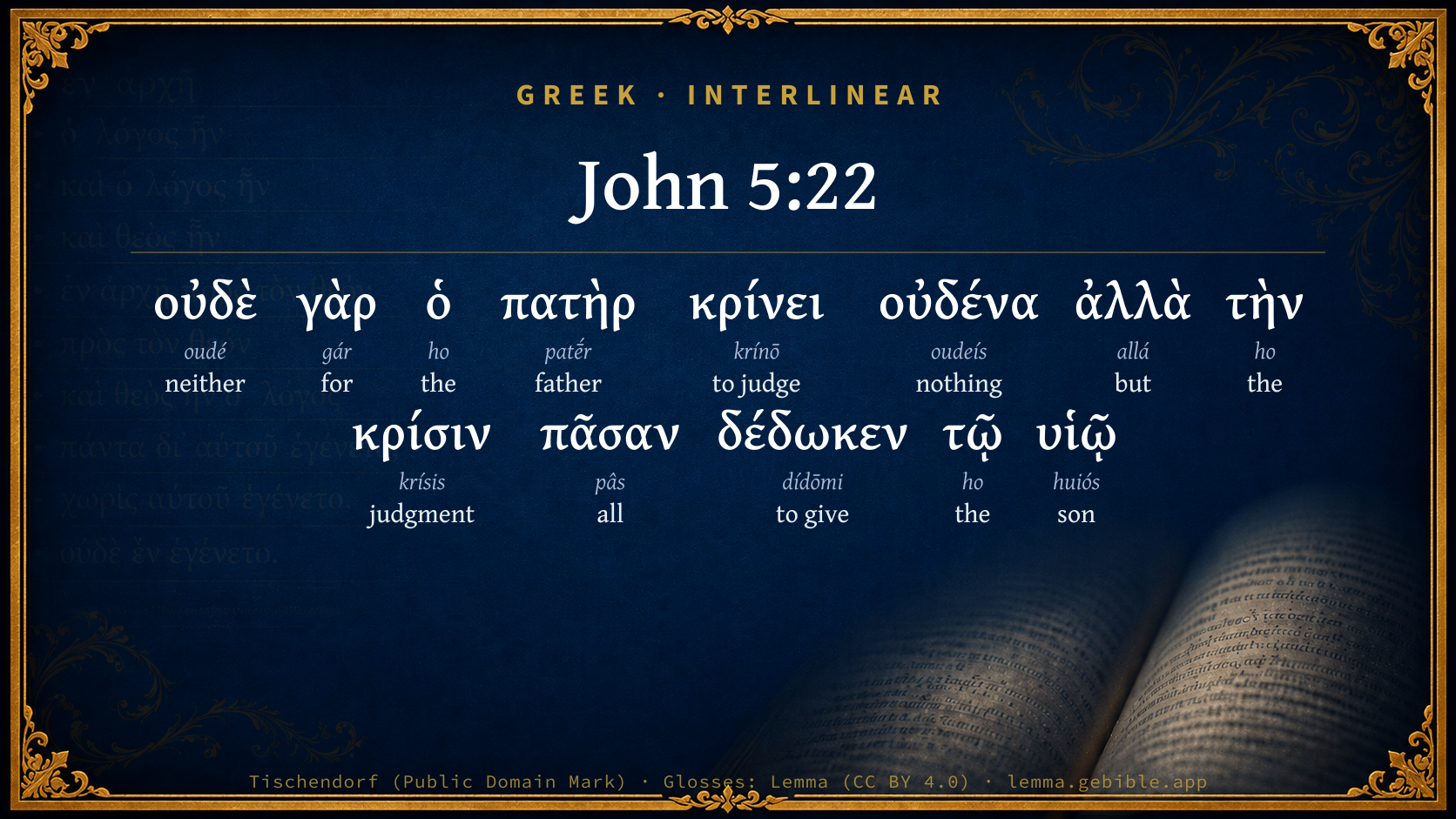
  1. οὐδὲ oudé G3761 “neither” Conjunction, Negative
  2. γὰρ gár G1063 “for” Conjunction
  3. ὁ ho G3588 “the” Article, Nominative, Singular, Masculine
  4. πατὴρ patḗr G3962 “father” Noun, Nominative, Singular, Masculine
  5. κρίνει krínō G2919 “to judge” Verb, Present, Active, Indicative, 3rd person, Singular
  6. οὐδένα oudeís G3762 “nothing” Adjective, Accusative, Singular, Masculine, Negative
  7. ἀλλὰ allá G235 “but” Conjunction
  8. τὴν ho G3588 “the” Article, Accusative, Singular, Feminine
  9. πᾶσαν pâs G3956 “all” Adjective, Accusative, Singular, Feminine
  10. δέδωκεν dídōmi G1325 “to give” Verb, Perfect, Active, Indicative, 3rd person, Singular
  11. τῷ ho G3588 “the” Article, Dative, Singular, Masculine
  12. υἱῷ huiós G5207 “son” Noun, Dative, Singular, Masculine

About this verse

These counts appear in no published source. They are computed here, from the morphology-tagged text and Lemma’s own curated glosses. What Lemma adds →

13
words
11
distinct lemmas
Gospels
section

Shared distinctive vocabulary

κρίσιν judgment G2920 occurs in 46 verses of the Greek New Testament. Also found in:

Repetition

A word recurs within this verse:

Cross-references

23

Topical passages linked to John 5:22 in the Treasury of Scripture Knowledge — connected by theme and wording, ordered by reader-vote popularity; previews shown in the World English Bible.

  • John 5:27 He also gave him authority to execute judgment, because he is a son of man.
  • Acts 17:31 because he has appointed a day in which he will judge the world in righteousness by the man whom he has ordained; of which he has given assurance to all men, in that he has raised him from the dead."
  • Matthew 28:18 Jesus came to them and spoke to them, saying, "All authority has been given to me in heaven and on earth.
  • 2 Corinthians 5:10 For we must all be revealed before the judgment seat of Christ; that each one may receive the things in the body, according to what he has done, whether good or bad.
  • Acts 10:42 He charged us to preach to the people and to testify that this is he who is appointed by God as the Judge of the living and the dead.
  • John 9:39 Jesus said, "I came into this world for judgment, that those who don't see may see; and that those who see may become blind."
  • Romans 2:16 in the day when God will judge the secrets of men, according to my Gospel, by Jesus Christ.
  • 2 Timothy 4:1 I charge you therefore before God and the Lord Jesus Christ, who will judge the living and the dead at his appearing and his Kingdom:
  • John 17:2 even as you gave him authority over all flesh, he will give eternal life to all whom you have given him.
  • Psalms 96:13 Before Yahweh; for he comes, For he comes to judge the earth. He will judge the world with righteousness, The peoples with his truth.
  • 1 Peter 4:5 who will give account to him who is ready to judge the living and the dead.
  • Psalms 9:7–8 But Yahweh reigns forever. He has prepared his throne for judgment.
  • Psalms 98:9 Let them sing before Yahweh, For he comes to judge the earth. He will judge the world with righteousness, And the peoples with equity.
  • Matthew 16:27 For the Son of Man will come in the glory of his Father with his angels, and then he will render to everyone according to his deeds.
  • John 3:35 The Father loves the Son, and has given all things into his hand.
  • Romans 14:10–12 But you, why do you judge your brother? Or you again, why do you despise your brother? For we will all stand before the judgment seat of Christ.
  • Ecclesiastes 11:9 Rejoice, young man, in your youth, And let your heart cheer you in the days of your youth, And walk in the ways of your heart, And in the sight of your eyes; But know that for all these things God will bring you into judgment.
  • Matthew 11:27 All things have been delivered to me by my Father. No one knows the Son, except the Father; neither does anyone know the Father, except the Son, and he to whom the Son desires to reveal him.
  • 2 Thessalonians 1:7–10 and to give relief to you that are afflicted with us, when the Lord Jesus is revealed from heaven with his mighty angels in flaming fire,
  • Revelation 20:11–12 I saw a great white throne, and him who sat on it, from whose face the earth and the heaven fled away. There was found no place for them.
  • Psalms 50:3–6 Our God comes, and does not keep silent. A fire devours before him. It is very tempestuous around him.
  • Ecclesiastes 12:14 For God will bring every work into judgment, with every hidden thing, whether it is good, or whether it is evil.
  • Matthew 25:31–46 "But when the Son of Man comes in his glory, and all the holy angels with him, then he will sit on the throne of his glory.

Cross-references courtesy of OpenBible.info (CC BY 4.0).

Commentary

Notes on John 5:22 from classic Christian and Jewish commentators (each source and its license shown beneath its notes). The classic Christian expositions comment on the surrounding passage and are grouped to its opening verse, so a note may address several verses; the Jewish commentaries on the Tanakh (Rashi and others) are per-verse, so they appear only where the commentator wrote on this verse.

Lemma curates 59 commentaries, every one of them public domain or Creative Commons licensed, each selected and text-cleaned for this edition rather than reprinted as found. About our sources →

Tyndale Open Study Notes

Tyndale Open Resources

5:22 In addition to giving life, Jesus claimed the absolute authority to judge, which belongs to God alone.

Tyndale Open Study Notes — © Tyndale Open Resources, licensed CC BY-SA 4.0. Text via the HelloAO Bible API.

Bengel's Gnomon

Johann Albrecht Bengel

Joh 5:22. Οὐδέ, neither) The Father does not judge alone, nor without the Son: yet He does judge; Joh 5:45, “Do not think I will accuse you to the Father;” Act 17:31, “He hath appointed a day, in the which He will judge the world in righteousness by that Man whom He hath ordained;” Rom 3:6, “God forbid: for then how shall God judge the world?” Nor is the word δέδωκε, He hath given, in this passage, opposed [to the Father’s judging]: comp. Joh 5:26, “As the Father hath life in Himself, so hath He given the Son to have life in Himself,” with Joh 5:21, “For as the Father raiseth up the dead, and quickeneth them: even so the Son quickeneth whom He will.”—γάρ, for) The Son decides by His own judgment whom He pleases [wills] to quicken. [And for that end the dead are raised up, that they may be judged.—V. g.]—οὐδένα, no man) To this refer πάντες, all men, in the ver. following.

Bengel's Gnomon of the New Testament — English translation (T&T Clark, Edinburgh, 1860) — public domain. Text from a community e-Sword module.

Meyer's Critical & Exegetical Commentary

Heinrich August Wilhelm Meyer

Joh_5:22 does not state the ground of the Sons call to bestow life (Luthardt, comp. Tholuck and Hengstenberg), but is a justification of the οὓς θέλει,because the κρίσις refers only to those whom He will not raise to life,in so far as it is implied that the others, whom the Son will not make alive, will experience in themselves the judgment of rejection (the anticipatory analogon of the decisive judgment at the second advent, Joh_5:29). It is given to no other than the Son to execute this final judgment. The κρίνει οὐδένα should have prevented the substitution of the idea of separation for that of judgment (comp. Joh_3:17-18).

οὐδὲ γὰρ ὁ π.] for not even the Father, to whom, however, by universal acknowledgment, judgment belongs.[209] Consequently it depends only upon the Son, and the οὓς θέλει has its vindication. Concerning οὐδέ, which is for the most part neglected by commentators, comp. Joh_7:5, Joh_8:42, Joh_21:25. The antithesis ἀλλὰ, κ.τ.λ., tells how far, though God is the worlds Judge, the Father does not judge, etc.

κρίνει] the judgment of condemnation (Joh_3:17-18, Joh_5:24; Joh_5:27; Joh_5:29), whose sentence is the opposite of ζωοποιεῖν, the sentence of spiritual death.

τὴν κρίσιν πᾶσαν] judgment altogether (here also to be understood on its condemnatory side), therefore not only of the last act on the day of judgment (Joh_5:27), but of its entirety (see on Joh_16:13), and consequently in its progress in time, whereby the οὓς θέλει is decided.

[209] Weiss, Lehrbegr. p. 185, explains it as if it ran: οὐδὲ γὰρ κρίνει ὁ πατήρ, etc.

Meyer — Critical and Exegetical Commentary on the New Testament — English translation by Peter Christie, edited by Frederick Crombie (T&T Clark, 1880) — public domain. Text from a community e-Sword module.

Expositor's Greek Testament

ed. W. Robertson Nicoll

Joh 5:22 . But not only does the Son quicken whom He will, but He also judges; οὐδὲ γὰρ … υἱῷ . “For not even does the Father judge any one, but has given all judgment to the Son.” “For since He knows Himself to be the sole mediator of true life for men, He can also declare that all those who will not partake through Him of this blissful life, just therein experience judgment whereby they sink into death.” Wendt, ii. 211; and cf. Joh 5:27 . οὐδὲ γὰρ introduces the fresh statement, that He judges, not only as the reason for what goes before, but on its own account also, as an additional fact to be noticed. It would seem an astonishing thing that even “judgment,” the allotting of men to their eternal destinies, should be handed over to the Son. But so it is: and without exception, τὴν κρίσιν πᾶσαν , “all judgment,” of all men and without appeal.

The Expositor's Greek Testament, edited by W. Robertson Nicoll (1897–1910) — public domain. Text from a community e-Sword module.

Godet's Commentaries

Frédéric Louis Godet

Vv. 22, 23. “For also the Father judgeth no man; but he hath committed all power of judging unto the Son, 23, to the end that all may honor the Son as they honor the Father. He that honoreth not the Son honoreth not the Father who sent him.”

Two particles connect Joh 5:22 with the preceding: γάρ, for, and οὐδέ (translated by also), which literally signifies: and no more. The meaning is, therefore: “For the Father no more judges any one (no more than He raises from the dead, when once He has committed to the Son the charge and power of raising from the dead,” Joh 5:21). The for presents the second fact (the passing over of judgment to the Son) as the explanation of the first (the passing over of the power to raise from the dead). Indeed, to make alive is to absolve, to refuse to make alive is to condemn.

The power of making alive those whom one wills implies, therefore, the dignity of a judge. Meyer understands judge here, as in chap. 3, in the sense of condemn. But in Joh 5:21, the question is expressly of making alive, saving, and not of the opposite; and the expression τὴν κρίσιν πᾶσαν, judgment in all its forms (Joh 5:22), shows that the term judge should be taken in the most general sense. H. Meyer (Discourses of the Fourth Gospel, p. 36) is shocked because this term is taken in Joh 5:22 in the spiritual sense (present moral judgment), in Joh 5:29 in the external sense (the final judgment), and finally in Joh 5:30 in a sense purely subjective (the individual judgment of Jesus), and hence he concludes that the tenor of the discourse has not been, in this case, exactly reproduced. But in Joh 5:22 the question is of judgment in the most general sense, without definite application (all judgment). It is only in the following cycle, Joh 5:24-29, that the meaning of this term is precisely stated, and that it is taken, first, in the spiritual sense, then, in the external sense. Everything is, therefore, correct in the progress of the thought.

Frédéric Louis Godet — Commentaries on Luke, John, Romans, and 1 Corinthians — English translation (T&T Clark, Edinburgh, 1870s–1890s) — public domain. Text from a community e-Sword module.

Geneva Bible (1599)

Geneva Bible translators

These words are not so to be taken, as though they simply denied that God governeth the world, but as the Jews imagined it, which separate the Father from the Son, whereas indeed, the Father doth not govern the world but only in the person of his Son, being made manifest in the flesh: so saith he afterward, verse 30, that he came not to do his own will: that his doctrine is not his own, John 7:16, that the blind man and his parents sinned not, etc., John 9:3.

This word (judgeth) is taken by the figure Synecdoche, for all government.

Geneva Bible (1599) marginal notes — public domain. Text via Bolls.life.

Jamieson, Fausset & Brown

Robert Jamieson, A. R. Fausset & David Brown

For the Father judgeth no man, &c.--rather, "For neither doth the Father judge any man," implying that the same "thing was meant in the former verse of the quickening of the dead"--both acts being done, not by the Father and the Son, as though twice done, but by the Father through the Son as His voluntary Agent.

all judgment--judgment in its most comprehensive sense, or as we should say, all administration.

Jamieson, Fausset & Brown — Commentary Critical and Explanatory on the Whole Bible (1871) — public domain (CC PDM 1.0). Text via the HelloAO Bible API.

Adam Clarke's Commentary

Verse 22. The Father judgeth no man] This confirms what he had said before, Joh 5:17; Joh 5:19, that the Father acts not without the Son, nor the Son without the Father; their acts are common, their power equal.

Adam Clarke's Commentary on the Bible (1810–1826) — public domain. Text from a community e-Sword/MySword module.

John Calvin's Commentaries

22. For the Father judgeth no man. He now states more clearly the general truth, that the Father governs the world in the person of the Son, and exercises dominion by his hand; for the Evangelist employs the word judgment, agreeably to the idiom of the Hebrew language, as denoting authority and power We now perceive the amount of what is stated here, that the Father hath given to the Son a kingdom, that he may govern heaven and earth according to his pleasure. But this might appear to be very absurd, that the Father, surrendering his right to govern, should remain unemployed in heaven, like a private person. The answer is easy. This is said both in regard to God and to men; for no change took place in the Father, when he appointed Christ to be supreme King and Lord of heaven and earth; for he is in the Son, and works in him. But since, when we wish to rise to God, all our senses immediately fail, Christ is placed before our eyes as a lively image of the invisible God. There is no reason, therefore, why we should toil to no purpose in exploring the secrets of heaven, since God provides for our weakness by showing himself to be near in the person of Christ; but, on the other hand, whenever the inquiry relates to the government of the world, to our own condition, to the heavenly guardianship of our salvation, let us learn to direct our eyes to Christ alone, as all power is committed to him, (Matthew 28:18,) and in his face God the Father, who would otherwise have been hidden and at a distance, appears to us so that the unveiled majesty of God does not swallow us up by its inconceivable brightness.

John Calvin's Commentaries (1540-1563) — public domain. Text from the Calvin Translation Society English edition (1840s-50s) via the Christian Classics Ethereal Library (ccel.org). Calvin's coverage is partial (roughly two-thirds of the Bible); uncommented books and verses are honest gaps, never fabricated. The 19th-century editor's footnotes and remarks are omitted so the notes are faithfully Calvin's own voice.

Ellicott's Commentary for English Readers

(22) For the Father judgeth no man.—Better, For not even doth the Father judge any man; and if not the Father, to whom judgment belongs, then none other but the Son to whom He hath committed all judgment. To judge (comp. Joh_5:29) is the opposite of to quicken in the previous verse. The fact that the Son hath power to judge is correlative with His power to quicken whom He will. The spiritual life given to, and received by, some (Joh_5:24), is a separation from, and a judgment of, others. The eternal life which shall be given to some, shall be the eternal separation from, and exclusion of, others. The reason why judgment is committed to the Son is given in Joh_5:27 as resulting from His humanity. It is stated here as resulting from His divinity. It is that this power, like the quickening power of Joh_5:21, should lead all to give to the Son honour equal to that which they render to the Father. Again, this relation is urged against those who professed to honour God, and as a proof of it were seeking to kill His Son. That Sonship, expressing at once subordination and unity, necessarily involved the Fatherhood. To reject Him was to reject the Father who sent Him. (Comp. Joh_5:24; Joh_5:30; Joh_5:36-37.)

A Bible Commentary for English Readers, edited by Charles John Ellicott (1878–1897) — public domain. Text from a community e-Sword module.

The Cambridge Bible for Schools and Colleges

gen. ed. J. J. S. Perowne

22. For the Father judgeth no man] Rather, For not even doth the Father (to Whom judgment belongs) judge any man. The Son therefore has both powers, to make alive whom He will, and to judge: but the second is only the corollary of first. Those whom He does not will to make alive are by that very fact judged, separated off from the living, and left in the death which they have chosen. He does not make them dead, does not slay them. They are spiritually dead already, and will not be made alive. Here, as in Joh_3:17-18, the judgment is one of condemnation; but this comes from the context, not from the word.

hath committed] Or, given; there is no reason for varying the common rendering.

The Cambridge Bible for Schools and Colleges (gen. ed. J. J. S. Perowne; Cambridge University Press, 1878–1918) — public domain. Text from a community e-Sword module.

John Gill's Exposition

For the Father judgeth no man,.... That is, without the Son; which is another proof of their equality: for that he does judge is certain; he is the Judge of the whole earth; he is God that judgeth in the earth, or governs the world with his Son, who works together in the affairs of providence: he judged and condemned the old world, but not without his Son, who by his Spirit, or in his divine nature, went and preached to the spirits now in prison, then disobedient in the times of Noah; he judged and condemned Sodom and Gomorrah, but not without the Son; for Jehovah the Son rained, from Jehovah the Father, fire and brimstone upon those cities, and consumed them; he judged the people of Israel, and often chastised them for their sins, but not without his Son; the angel of his presence that went before them; he judges all men, and justifies and acquits whom he pleases, but not without his Son; but through his justifying righteousness, which he imputes to them; in doing which he appears to he a just judge, and to do right; and he will judge the world in righteousness at the last day by his Son, whom he has ordained; so as the Son does nothing without the Father, the Father does nothing without the Son, which shows perfect equality. The Jews had an officer in their sanhedrim, whom they called Ab Beth Din, or "the father of the house of judgment", to whom belonged the trying of causes, and of judging and determining them. Hence the Targumist on Sol 7:4 says,

, "and the father of the house of judgment", who judgeth thy judgments, or determines thy causes, is mighty over thy people, &c.''

Whether there may not be some allusion here to this officer, I leave to be considered:

but hath committed all judgment to the Son; as the judgment, or government of his church and people, especially under the Gospel dispensation; and which he exercises by giving ordinances peculiar to it, such as baptism and the Lord's supper; and by enacting laws, and prescribing rules for the discipline of his house, over which he is as a Son; and by appointing proper officers under him, over his churches, to administer these ordinances, and see that these laws are put in execution, which he qualifies them for, by bestowing proper gifts upon them: and he exercises this judgment, by protecting and defending his people from all their enemies, so that they well safely under his government: as also the general judgment of the world at the last day, is committed to him; which affair will be managed by Christ, the Son of God, when he comes a second time; he will then raise the dead, that everyone may receive for the things done in his body, whether good or evil; he will gather all nations before him, and all shall stand before his judgment seat, both great and small; he will separate one from another, the sheep from the goats, and set the one on his right hand, and the other on his left; he will bring every work into judgment, with every secret thing, and show himself to be the searcher of the hearts, and the trier of the reins of the children of men, and will pass a most righteous and decisive sentence upon all: now for such a trust, and such a work as this, whether the particular government of the church, or the general judgment of the world, he would not be fit, was he not God equal with the Father; the thing he had suggested, and which he supports and maintains in this vindication of himself.

John Gill's Exposition of the Whole Bible (1746–1763) — public domain (CC PDM 1.0). Text via the HelloAO Bible API.

Trapp's Complete Commentary

John Trapp

22 For the Father judgeth no man, but hath committed all judgment unto the Son:

Ver. 22. The Father judgeth no man] viz. The Father alone, but by the Son, to whom all judicatory power is committed.

John Trapp, A Commentary or Exposition upon All the Books of the Old and New Testament (1647–1656) — public domain. Text from a community e-Sword module.

Albert Barnes' Notes on the Bible

Judgeth no man - Jesus in these verses is showing his “equality with God.” He affirmed Joh 5:17 that he had the same power over the Sabbath that his Father had; in Joh 5:19, that he did the same things as the Father; in Joh 5:21 particularly that he had the same power to raise the dead. He now adds that God has given him the authority to “judge” men. The Father pronounces judgment on no one. This office he has committed to the Son. The power of judging the world implies ability to search the heart, and omniscience to understand the motives of all actions. This is a work which none but a divine being can do, and it shows, therefore, that the Son is equal to the Father.

Hath committed ... - Hath appointed him to be the judge of the world. In the previous verse he had said that he had power “to raise the dead;” he here adds that it will be his, also, to “judge” them when they are raised. See Matt. 25; Act 17:31.

Albert Barnes' Notes on the Bible (1834–1885) — public domain. Text from a community e-Sword/MySword module.

Haydock's Catholic Bible Commentary

Neither doth the Father judge any man. It is certain that God is the Judge of all, by divers places of the holy Scriptures; and to judge, belongs both to the Father and to the Son, as they are the same God: so that when it is added, that the Father hath given all judgment to the Son,[6] this is meant of the exterior exercise of his judgment upon all mankind at the end of the world, in as much as Christ then will return, in his human body, to judge all men, even as man, in their bodies. (Witham)

===============================

[BIBLIOGRAPHY]

Omne judicium dedit filio. St. Augustine expounds it (trac. xxi.) sed judicium manifestum. Pater occultus erit judex, filius manifestus, quia mani feste ad judicium veniet.

====================

George Leo Haydock (1774–1849), Haydock's Catholic Family Bible and Commentary, 1859 edition — public domain. Excludes Psalms (Douay-Rheims chapter numbering differs from Protestant) and Deuterocanonical books (Catholic canon only).

Matthew Poole's English Annotations

Alone he judgeth no man, he judgeth no man but by the Son, no man without the Son; but committed all judgment in the administration of the mediatory kingdom in the church to his Son, and by his Son will judge the world at the last day.

Matthew Poole's English Annotations on the Holy Bible (1683–1685) — public domain. Text from a community e-Sword/MySword module.

Whedon's Commentary on the Bible

Daniel D. Whedon

22. The Father—In his primitive essence.

Judgeth no man—The manifestive act of judgment is performed by his Son; and even by that Son as Son of man, as well as Son of God.

Daniel D. Whedon (gen. ed.), Commentary on the Old and New Testaments (1874–1909) — public domain. Text from a community e-Sword module.

The Pulpit Commentary

That ouv yelei is the point of connection with what follows, and that the Son quickeneth whom he willeth, is more clear, seeing that (gar) the Father even judges no man; judges no man apart from the Son. "Pater non judicat solus nec sine filio, judicat tamen (ver. 45; Rom_3:6)" (Bengel). The word krinei does not mean exclusively either "condemn" or "acquit," but the exercise of judicial functions which will either acquit or condemn. As in Joh_3:17, the "condemnation" is rather inferred than asserted. Moreover, we are there told that the Son was not sent into the world for the purpose of judgment, but for the larger purposes of salvation, and "to give eternal life." Nevertheless, "life" to some is judgment to others, and judgment even unto death is the obverse of the gift of life when the conditions of life are not found, in Joh_1:39 Christ declares that one solemn consequence of his coming was eiv krima , "unto judgment to reveal the final decisions of the Judge. How, then, shall we reconcile these apparently incongruous statements? Judgment unquestionably results from the rejection of the proffer of mercy. The judgment rests on those who say, "We see." Their sin remaineth. Those who are not willing to be made whole remain unhealed. Those who love darkness rather than light abide in the darkness. This is the judgment, but this judicial process was (not the end, but) the consequence of his mission. The Father"s ordinary providence, which is always passing judgment upon the lives of men, is now placed in the hands of "the Son." Howbeit he hath given the whole judgmenti.e. the judgment in all its partsto the Son. He has made the entire juridical process which brings to light the essential tendencies of human hearts, issue from the reception given by man to the Son. The whole question of right against wrong, of life versus death, acquittal against condemnation, is determined by the attitude of men towards the Son. In many passages this plenipotentiary endowment of "the Son" with functions, powers, authorities, is expressed by this same word ( dedwke), "he hath given". (ver. 36; Joh_3:35 Joh_6:37, 39 10:29 17:2, 4) Meyer limits the meaning of krinei to "condemnation," and Slier includes in it the separation of sin from the life of believers; but surely the judgment of the world is effected by the light that shines upon it, and the essence of the judgment (krisiv) is the discrimination which infallibly follows the revelation of the Father through the Son.

Vers. 22-27. The human Judge upon the Divine throne.

Many are the offices which it is appointed for the Son of man to hold. Yet they are all consistent one with another, and only a complete view of them can present Christ as he really is, and can elicit towards him all those sentiments which are justly due to him. If he is the Saviour of sinners and the Friend of his people, he is also the Lord of the earth and the Judge of all mankind.

I THE QUALIFICATIONS OF CHRIST AS JUDGE. As represented by himself, these are two.

1. His Divine ability of knowledge, of authority, of justice, in virtue of his nature as Son of God. This is asserted in the claim he makes in ver. 22 of equality with the Father, and of a consequent right to the same honour which is accorded to the Father.

2. His participation in our human nature implied in the designation "Son of man" in ver. 27. This true humanity of our Lord ensures that all judgment shall be conducted not only with Divine knowledge and equity, but with human sympathy and consideration.

II THE PERSONS OVER WHOM CHRIST EXERCISES HIS JUDICIAL FUNCTIONS. All mankind must stand at his bar; God hath committed all judgment unto him, and a day is appointed in which God will judge all men by the Man Christ Jesus. Friends and subjects, enemies and rebels, alike must receive sentence from his lips.

III THE PRINCIPLES WHICH DIRECT CHRIST"S JUDGMENT. Of these two may be mentioned.

1. The thoughts and intents of the heart are considered as well as outward actions.

2. With respect to those who have been privileged to hear the gospel, the all-important question is Did they receive or reject the Divine Mediator, the offer of Divine mercy?

IV THE INSTINCT PERIODS OF CHRIST"S JUDGMENT.

1. There is judgment here and now, as seems implied in ver. 22. Christ is ever passing judgment upon men, criticizing their character and their action, discriminating between the evil and the good, making allowance for human infirmities on the one hand, and for human endeavours on the other. It is well for us that Christ judges his people now; that when necessary he has a controversy with them; that he has words of reproach for the unfaithful, and words of encouragement for the depressed; that he chastens his people in kindness and with purposes of love. It is for them to submit themselves to their Lord, to bow before his chastising hand, to profit by his correction.

2. There is judgment hereafter. Life has to be considered, not only in detail, but as a whole. When it is finished, then is the time for it to be duly estimated and justly recompensed. Now, our Lord himself assures us that retribution in the life to come is his peculiar work. The anticipation of this process should quicken our spiritual diligence and solicitude. The sinner may well repent and seek acceptance, so that he may recognize his Saviour upon the judgment seat; and the Christian may well prepare to render in his account "with joy and not with grief. T.

The Pulpit Commentary (1880–1919), ed. H.D.M. Spence-Jones & Joseph S. Exell — public domain. Text from a community e-Sword module.

John Wesley's Explanatory Notes

For neither doth the Father judge - Not without the Son: but he doth judge by that man whom he hath ordained, Acts xvii, 31.

John Wesley, Explanatory Notes Upon the Whole Bible (1754–1765) — public domain. Text via the GEBible commentary corpus.

Burkitt's Expository Notes on the New Testament

William Burkitt

A fourth instance of Christ’s godhead, and proof of his equality with the Father, is, That it is his work to judge the world: The Father, says Christ, judges no man: that is, no man without me, but all men by me, to this intent, That all men should honour the Son, even as they honour the Father: that is, honour him with the same faith, love, fear, and worship, that is due and payable to God the Father.

Hence learn, 1. That Christ, as God, hath the absolute power of life and death, of absolution and condemnation, which he executes in conjunction with his Father.

2. That having this power of judging the world with the Father, doth shew that the same glory is due to him, which is due unto the Father. All men should honour the Son, even as they honour the Father.

3. That such as pretend to honour Christ, but deny him to be God, equal with the Father, withdraw the highest honour from him: and such as withdraw the honour from the Son, deny it to the Father, who will not be honoured but in and through honouring of the Son. This text speaks dread and terror to the Socinians, who pretend to honour Christ, but not with the same honour with which they pretend to honour the Father: in God’s account they honour him not at all: For he that honoureth not the Son, honoureth not the Father. True, they pray to Christ, and give him divine worship, though they believe him to be but a creature; but what is this but idolatry, to worship that which by nature is not God, and to do that to a creature which God requires to be given to himself, having said, My glory will I not give unto another? Isa 48:11

Divine honour can be only due to a divine person; that is, to him that is God blessed for evermore.

William Burkitt's Expository Notes on the New Testament (1700–1703) — public domain. Text from a community e-Sword module.

The People's New Testament

B. W. Johnson

22, 23. That all men should honour the Son. Three “fors” occur in the 20th, 21st and 22d verses, all stating the exaltation given to the Son.

B. W. Johnson's The People's New Testament with Notes (1889–1891) — public domain. Electronic text from the Christian Classics Ethereal Library (CCEL) ThML edition.

Cambridge Greek Testament for Schools and Colleges

22. οὐδὲ γὰρ ὁ π. For not even doth the Father (to Whom judgment belongs) judge any man. The Son therefore has both powers, to make alive whom He will, and to judge: but the second is only the corollary of the first. Those whom He does not will to make alive are by that very fact judged, separated off from the living, and left in the death which they have chosen. He does not make them dead, does not slay them. They are spiritually dead already, and will not be made alive. As in Joh 3:17-18, the context shews that the judgment is one of condemnation. Note the emphatic position of πᾶσαν.

Cambridge Greek Testament for Schools and Colleges (Cambridge University Press, 1896; 21 vols, various authors incl. Carr, Maclear, Plummer, Farrar, Lumby, Moule, M. R. James, Simcox) — public domain. Text from a community e-Sword module.

Alford’s Greek Testament

Henry Alford

22.] In the οὐδὲ γάρ is implied that as the Father does not Himself, by His own proper act, vivify any, but commits all quickening power to the Son:—so is it with judgment also. And judgment contains eminently in itself the οὓς θέλει,—when ζωοπ. is understood—as it must be now—of bestowing everlasting life. Again; the raising of the outwardly dead is to be understood as a sign that He who works it is appointed Judge of quick and dead, for it is a part of the office of that Judge;—in the vivifying, the judgment is made: see below, ver. 29, and Psa 72:1-4.

Henry Alford, The Greek Testament (1849–1861) — public domain. Text from a community e-Sword module.

International Critical Commentary

22, 23. The second of the “greater works” of Christ is that of judgment, a prerogative which has been already implied in οὓς θέλει of the preceding verse, for all judgment or separation between the evil and the good is a selective process.

Judgment is the prerogative of God (cf. Deu 1:17), for to be perfectly administered it demands omniscience. But this tremendous office has been “given” (see on 3:35) by the Father to the Son. ὁ πατὴρ κρίνει οὐδένα, ἀλλὰ τὴν κρίσιν πᾶσαν δέδωκεν τῷ υἱῷ. The doctrine of the Son of Man as the final Judge of mankind has been already examined (see Introd., pp. cxxvii, clvi; cf. 3:17). Here is added the Divine reason for this delegation of judgment to the Son by the Father. It is ἵνα πάντες τιμῶσι τὸν υἱόν καθὼς τιμῶσι τὸν πατέρα.

The Jews were dishonouring Jesus (cf. 8:49) in accusing Him of blasphemy (v. 18), but worship is His due, for the honour due to the Father is His. With the thought that they who dishonour Him dishonour the Father, cf. 15:23, 1Jn 2:23, and Luk 10:16.

τιμᾶν is found in Jn. again at 8:49, 12:26, and is generally used by him of the honour due to Christ or to His Father.

τὸν πέμψαντα αὐτόν: see on 3:17.

International Critical Commentary — older volumes (1896–1929), various authors — public domain. Text from a community e-Sword module.

Vincent's Word Studies in the New Testament

Marvin R. Vincent

For the Father [ουδε γαρ ο πατηρ] . The A. V. misses the climax in ouJude; not even the Father, who might be expected to be judge.

Hath committed [δεδωκεν] . Rev., given. The habitual word for the bestowment of the privileges and functions of the Son. See ver. Joh 5:36; Joh 3:35; Joh 6:37, 39; Joh 10:29, etc.

All judgment (thn krisin pasan). Literally, the judgment wholly.

Marvin R. Vincent, Word Studies in the New Testament (1887–1900) — public domain. Text from a community e-Sword/MySword module.

Lesson kit

Teaching starters — assembled from the data on this page, not authored interpretation. Every prompt links to the verse data it draws on. Edit before teaching.

John, in the Gospels, opens this verse with 13 words (11 distinct Greek lemmas). Its most distinctive word is krísis (“judgment”). A historical commentator’s framing appears above. Read the whole chapter for the surrounding context.

Discussion questions

  1. The word krísis carries the sense “judgment.” How does it shape the verse?
  2. Matthew 5:21 shares the word «judgment» with this verse. How do the two illuminate each other?
  3. “the” occurs 3× in this one verse. What is the effect of the repetition?
  4. These translations render this verse differently; the difference is in the English rendering, not the original. What questions does that raise?
  5. Reading how Tyndale Open Study Notes and Bengel's Gnomon read this verse, where do the two commentators agree and where do they part?

Things to notice

Reading settings

Reading text

Shown beneath each verse's original-language words.

Old Testament
Old Testament edition

Read the OT as the Masoretic Hebrew (MT) or the Greek Septuagint (LXX).

English shown for the Greek Septuagint (in the Hebrew ↔ Greek comparison).

Comparing translations? Open the Compare panel on any verse page to stack up to four side by side.