John 8:27

Greek (Tischendorf 8th ed.) John 8:27 appears in the Greek New Testament. The text above is from the Tischendorf 8th edition. Each word links to its Strong’s number and a concise gloss. Click any word for its full Thayer’s Greek Lexicon entry.
Download image
Cite this verse

John 8:27 (World English Bible). Public Domain. Lemma interlinear Bible study tool, https://lemma.gebible.app/v/john/8/27.

Show BibTeX & RIS
BibTeX
RIS
English Translation
They didn't understand that he spoke to them about the Father.
World English Bible · Public Domain
Download a study sheet

One document with this verse’s original text, its word-by-word gloss line, the meaning frame, cross-references with their text, attributed commentary, and full source and license credits — printable, and it pastes into notes with its structure intact.

This verse Autodidact and up

Study sheet (.html) Plain text (.txt)

A passage Seminary Student

Up to 50 verses in one chapter. A passage sheet keeps up to 6 commentary sources and 12 cross-references per verse, in the order this page ranks them, and says so on the sheet whenever that leaves anything out. Ask for a single verse and you get the Autodidact verse sheet above.

Everything on this page stays free to read, with no account — the sheet is a download of what is already on screen, not access to it.

Want to remove ads? Support Godless Engineer
Compare translations 3

The same verse in 3 English versions, stacked beneath the original-language interlinear above. Click any original word for its lexicon entry.

Each is an independent rendering of the whole verse — the interlinear is not word-aligned to these translations.

Highlighted words mark where these versions differ — a whole-verse word diff, not a word-by-word alignment.

  • World English Bible Public Domain
    They didn't understand that he spoke to them about the Father.
  • King James Version Public Domain
    They understood not that he spake to them of the Father.
  • unfoldingWord Literal Text CC BY-SA 4.0
    (They did not understand that he was speaking to them about the Father.)

unfoldingWord Literal Text — © unfoldingWord, licensed CC BY-SA 4.0. Word-aligned USFM3 via Door43 (git.door43.org/unfoldingWord/en_ult).

Versions to compare (up to 4)

3 of 4 selected

Show all 19 translations

Every available English version of this verse, each an independent rendering of the whole verse.

  • World English Bible Public Domain
    They didn't understand that he spoke to them about the Father.
  • Berean Standard Bible Public Domain
    They did not understand that He was telling them about the Father.
  • Majority Standard Bible Public Domain
    They did not understand that He was telling them about the Father.
  • King James Version Public Domain
    They understood not that he spake to them of the Father.
  • American Standard Version (1901) Public Domain
    They perceived not that he spake to them of the Father.
  • Revised Version (1885) Public Domain
    They perceived not that he spake to them of the Father.
  • Geneva Bible (1599) Public Domain
    They vnderstoode not that hee spake to them of the Father.
  • Douay-Rheims (1899) Public Domain
    And they understood not, that he called God his Father.
  • Young's Literal Translation Public Domain
    They knew not that of the Father he spake to them;
  • Literal Standard Version CC BY-SA 4.0
    They did not know that He spoke to them of the Father;
  • Unlocked Literal Bible CC BY-SA 4.0
    They did not understand that he was speaking to them about the Father.
  • unfoldingWord Literal Text CC BY-SA 4.0
    (They did not understand that he was speaking to them about the Father.)
  • Darby Bible Public Domain
    They knew not that he spoke to them of the Father.
  • World Messianic Bible Public Domain
    They didn’t understand that he spoke to them about the Father.
  • Webster's Bible Public Domain
    They understood not that he spoke to them concerning the Father.
  • Free Bible Version CC BY-SA 4.0
    They didn't understand that he was talking to them about the Father.
  • Bible in Basic English Public Domain
    They did not see that his words were about the Father.
  • Text-Critical English NT CC BY 4.0
    (They did not know that he was speaking to them about the Father.)
  • Tyndale New Testament (1534) Public Domain
    Then sayde Iesus vnto them: when ye have lyft vp an hye the sonne of man then shall ye knowe that I am he and that I do nothinge of my selfe: but as my father hath taught me even so I speake:

Literal Standard Version (2020), Covenant Press — licensed CC BY-SA 4.0. Text via the HelloAO Bible API (eBible.org). Unlocked Literal Bible (unfoldingWord) — licensed CC BY-SA 4.0. Text via the HelloAO Bible API (eBible.org). unfoldingWord Literal Text — © unfoldingWord, licensed CC BY-SA 4.0. Word-aligned USFM3 via Door43 (git.door43.org/unfoldingWord/en_ult). Free Bible Version, Dr. Jonathan Gallagher — licensed CC BY-SA 4.0. Text via the HelloAO Bible API (eBible.org).

Word by word

More ways to search: Search by grammar → Find every occurrence → Compare this word →

Practice this passage: Drill this verse → Learn its vocabulary →

ἔγνωσαν
ginṓskō
G1097
“to know”
Verb, Aorist, Active, Indicative, 3rd person, Plural
Part of Speech
Verb
Tense
Aorist
Voice
Active
Mood
Indicative
Person
3rd person
Number
Plural
Full Thayer's Definition

Origin: a prolonged form of a primary verb

TDNT: 12:29,1

1. to learn to know, come to know, get a knowledge of perceive, feel a. to become known 2. to know, understand, perceive, have knowledge of a. to understand b. to know 3. Jewish idiom for sexual intercourse between a man and a woman 4. to become acquainted with, to know
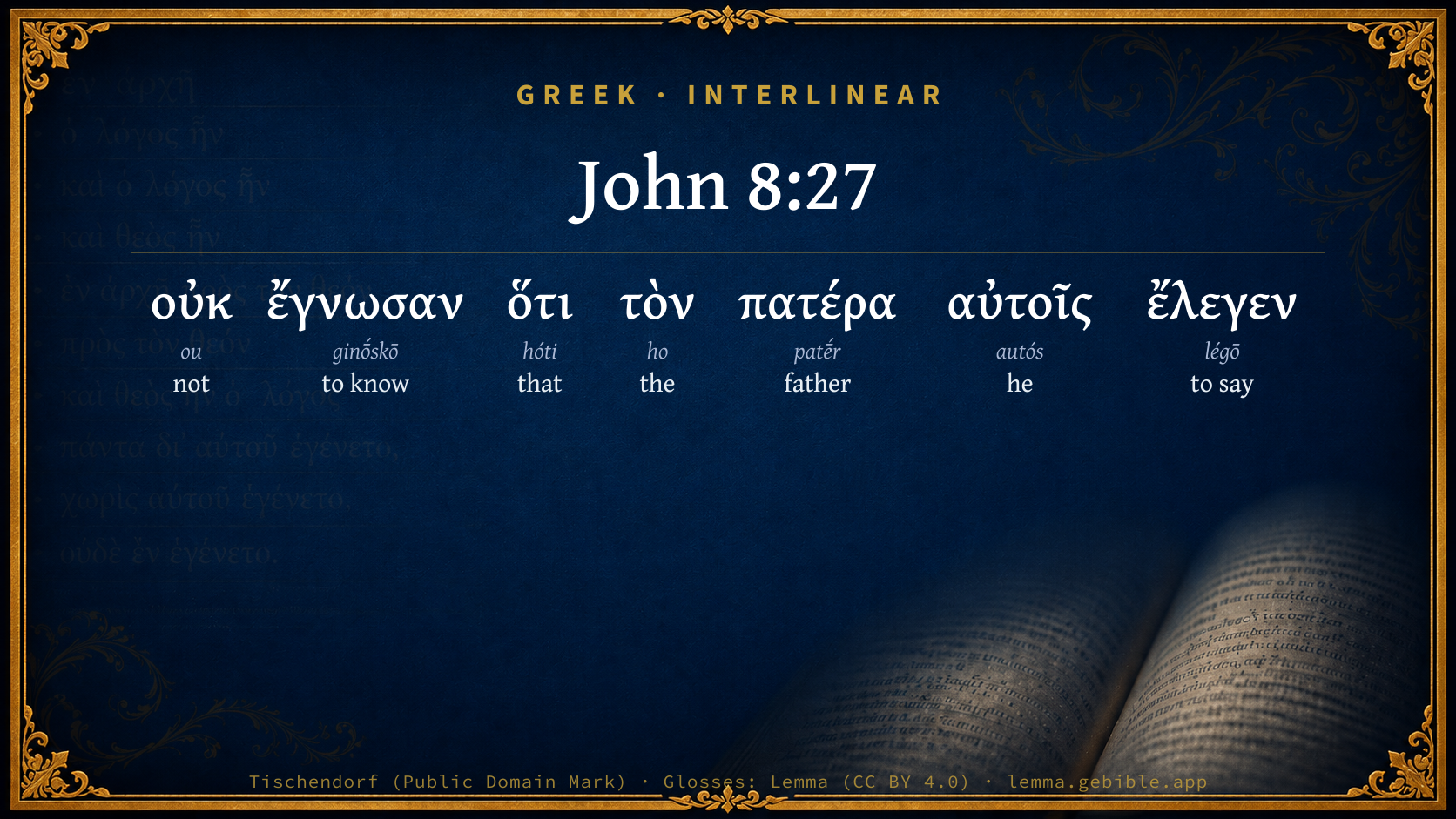
  1. οὐκ ou G3756 “not” Particle, Negative
  2. ὅτι hóti G3754 “that” Conjunction
  3. τὸν ho G3588 “the” Article, Accusative, Singular, Masculine
  4. πατέρα patḗr G3962 “father” Noun, Accusative, Singular, Masculine
  5. αὐτοῖς autós G846 “he” Personal pronoun, Dative, Plural, Masculine
  6. ἔλεγεν légō G3004 “to say” Verb, Imperfect, Active, Indicative, 3rd person, Singular

About this verse

These counts appear in no published source. They are computed here, from the morphology-tagged text and Lemma’s own curated glosses. What Lemma adds →

7
words
7
distinct lemmas
Gospels
section

Cross-references

7

Topical passages linked to John 8:27 in the Treasury of Scripture Knowledge — connected by theme and wording, ordered by reader-vote popularity; previews shown in the World English Bible.

  • Isaiah 6:9 He said, "Go, and tell this people, 'You hear indeed, But don't understand; And you see indeed, But don't perceive.'
  • Isaiah 42:18–20 Hear, you deaf; and look, you blind, that you may see.
  • Isaiah 59:10 We grope for the wall like the blind; yes, we grope as those who have no eyes: we stumble at noonday as in the twilight; among those who are lusty we are as dead men.
  • John 8:43 Why don't you understand my speech? Because you can't hear my word.
  • John 8:47 He who is of God hears the words of God. For this cause you don't hear, because you are not of God."
  • Romans 11:7–10 What then? That which Israel seeks for, that he didn't obtain, but the chosen ones obtained it, and the rest were hardened.
  • 2 Corinthians 4:3–4 Even if our Gospel is veiled, it is veiled in those who perish;

Cross-references courtesy of OpenBible.info (CC BY 4.0).

Commentary

Notes on John 8:27 from classic Christian and Jewish commentators (each source and its license shown beneath its notes). The classic Christian expositions comment on the surrounding passage and are grouped to its opening verse, so a note may address several verses; the Jewish commentaries on the Tanakh (Rashi and others) are per-verse, so they appear only where the commentator wrote on this verse.

Lemma curates 59 commentaries, every one of them public domain or Creative Commons licensed, each selected and text-cleaned for this edition rather than reprinted as found. About our sources →

Bengel's Gnomon

Johann Albrecht Bengel

Joh 8:27. Οὐκ ἔγνωσαν, they understood not) By means of this epicrisis [explanatory addition] John intimates his astonishment at the unbelief and blindness of the Jews; as at ch. Joh 12:37, “But though He had done so many miracles before them, yet they believed not on Him.”—τὸν τατέρα, the Father) the Father had sent Him, Joh 8:26: and had they known the Father, they would have known who Jesus was, Joh 8:25.

Bengel's Gnomon of the New Testament — English translation (T&T Clark, Edinburgh, 1860) — public domain. Text from a community e-Sword module.

Meyer's Critical & Exegetical Commentary

Heinrich August Wilhelm Meyer

Joh_8:27. Ὢ τῆς ἀγνοίας! οὐ διέλιπεν αὐτοῖς περὶ αὐτοῦ διαλεγόμενος, καὶ οὐκ ἐγίνωσκον, Chrysostom and Euth. Zigabenus calls them φρενοβλαβεῖς. But the surprising, nay more, the very improbable element (De Wette) which has been found in this non-understanding, disappears when it is remembered that at Joh_8:21 a new section of the discourse commenced, and that we are not obliged to suppose that precisely the same hearers were present in both cases (Joh_8:16-17). The less, therefore, is it allowable to convert non-understanding into the idea of non-recognition (Lücke); or to regard it as equivalent to obduracy (Tholuck, Brückner); or to explain ὅτι as in which sense (Hofmann, l.c. p. 180); or with Luthardt, to press αὐτοῖς, and to give as the meaning of the simple words: that in bearing witness to Himself He bears witness to them that the God who sends Him is the Father; or with Ebrard, to find in ἔλεγεν: that it is His vocation to proclaim to them; or, with Hengstenberg, to understand ἔγνωσαν, etc., of the true knowledge, namely, of the deity of Christ. For such interpretations as these there is no foundation in the passage; it simply denotes: they knew not (comp. Joh_8:28) that in these words (ὁ πέμψας με, etc.) He spoke to them of the Father. On λέγειν, with the accus. in the sense of λαλ. περί, see Stallbaum, ad Plat. Apolog. p. 23 A; Phaed. p. 79 C. Comp. on Joh_1:15.

Meyer — Critical and Exegetical Commentary on the New Testament — English translation by Peter Christie, edited by Frederick Crombie (T&T Clark, 1880) — public domain. Text from a community e-Sword module.

Expositor's Greek Testament

ed. W. Robertson Nicoll

Joh 8:27 . His hearers did not identify “Him that sent me” with “the Father”: Οὐκ ἔγνωσαν … ἔλεγεν .

The Expositor's Greek Testament, edited by W. Robertson Nicoll (1897–1910) — public domain. Text from a community e-Sword module.

Godet's Commentaries

Frédéric Louis Godet

Ver. 27. Criticism declares the want of understanding of the Jews which is mentioned in Joh 8:27 impossible. Can those of whom John speaks, then, be, as Meyer thinks, new hearers who had not been present at the previous discourses? Or must we understand with Lucke : They were not willing to acknowledge that it was the Father who really made Him speak in this way; or with Weiss: They did not understand that He had the mission to reveal the Father by declaring what He inwardly heard from Him. These are manifest tortures inflicted on the text. The ἔλεγεν cannot be taken here in the same sense as in Joh 6:71 : to speak of. It must be observed that in this whole discourse from Joh 8:21, Jesus had spoken of Him who sent Him, without once pronouncing the name either of God or of the Father. Now among the multitude there might be found hearers who were unable to imagine so close a relation between a human creature and the infinite God as that of which Jesus was bearing witness, and who consequently asked themselves whether He did not mean to speak of some one of the persons who were to precede the Messiah and with whom Jesus sustained a secret relation, as the Messiah was to do with Elijah. Think of the strange misunderstandings attributed by the Synoptics to the apostles themselves! After eighteen centuries of Christianity, many things in the discourses of Jesus appear evident to us, which, through their novelty and the opposition which they encountered from inveterate prejudices, must have appeared strange in the extreme to the greater part of His hearers. No doubt, if the heart had been better disposed, the mind would have been more open.

To this want of intelligence in His present hearers, Jesus opposes the announcement of the day when the full light will come among them respecting His mission, after the great national crime which they are on the point of committing.

Frédéric Louis Godet — Commentaries on Luke, John, Romans, and 1 Corinthians — English translation (T&T Clark, Edinburgh, 1870s–1890s) — public domain. Text from a community e-Sword module.

Geneva Bible (1599)

Geneva Bible translators

Even the contempt of Christ maketh for his glory: which thing his enemies shall feel at length to their great smart.

Geneva Bible (1599) marginal notes — public domain. Text via Bolls.life.

John Calvin's Commentaries

27. They did not know that he spoke to them about the Father. Hence we see how stupid those men are whose understandings are possessed by Satan. Nothing could be more plain than that they were summoned to the judgment-seat of God. But what then? They are altogether blind. This happens daily to other enemies of the Gospel; and such blindness ought to instruct us to walk with fear.

John Calvin's Commentaries (1540-1563) — public domain. Text from the Calvin Translation Society English edition (1840s-50s) via the Christian Classics Ethereal Library (ccel.org). Calvin's coverage is partial (roughly two-thirds of the Bible); uncommented books and verses are honest gaps, never fabricated. The 19th-century editor's footnotes and remarks are omitted so the notes are faithfully Calvin's own voice.

Ellicott's Commentary for English Readers

(27) They understood not that he spake (better, was speaking) to them of the Father.—We have seen in Note on Joh_8:21 that a new discourse commences there, and that the hearers are not necessarily the same as those who had asked the question and heard the answer of Joh_8:19. Still the speakers then, and those spoken of now, are “the Jews” (comp. Joh_8:13; Joh_8:22); and they are probably in part identical with those of whom our Lord tells us there, that they knew neither Him nor the Father. Of these men St. John tells us now that they did not know that the Sender and the Father are one. The statement of their want of perception, which strikes us as so marvellous, is made just because it was marvellous. St. John remembers it many years afterwards, and remembers that on account of it Jesus proceeded to declare more fully that every act He did was done in the Father, and that every word He spoke was taught by the Father, and that in every event of His life the Father was present.

A Bible Commentary for English Readers, edited by Charles John Ellicott (1878–1897) — public domain. Text from a community e-Sword module.

The Cambridge Bible for Schools and Colleges

gen. ed. J. J. S. Perowne

27. They understood not that he spake] Better, they perceived not that He was speaking. This statement of the Evangelist has seemed to some so unaccountable after Joh_8:18, that they have attempted to make his words mean something else. But the meaning of the words is quite unambiguous, and is not incredible. We have seen that there is an interval, possibly of days, between Joh_8:20 and Joh_8:21. The audience may have changed very considerably; but if not, experience shews that the ignorance and stupidity of unbelief are sometimes almost unbounded. Still we may admit that the dulness exhibited here is extraordinary; and it is precisely because it is so extraordinary that St John records it.

The Cambridge Bible for Schools and Colleges (gen. ed. J. J. S. Perowne; Cambridge University Press, 1878–1918) — public domain. Text from a community e-Sword module.

John Gill's Exposition

As he spake these words,.... Concerning his being lifted up, or his crucifixion, and the knowledge the Jews should then have of him; of the excellency and divinity of his doctrine, of his mission from the Father, and of the Father's presence with him, and of his always doing the things that are pleasing in his sight; which were spoken by him with majesty and authority, and came with power:

many believed on him: as the Son of God, and true Messiah: faith came by hearing; Christ's hearers were of different sorts; some understood him not, and disbelieved, and rejected him; others had their eyes, and their hearts opened, and received him, and his words.

John Gill's Exposition of the Whole Bible (1746–1763) — public domain (CC PDM 1.0). Text via the HelloAO Bible API.

Trapp's Complete Commentary

John Trapp

27 They understood not that he spake to them of the Father.

Ver. 27. They understood not] Though he cited them to God’s dreadful tribunal, and threatened them with his judgment. The devil had strangely stupefied them; like the smith’s dog, whom neither the hammer above him nor the sparks of fire falling round about him can awake; like birds in a belfry or fishes in the sea, not frightened at any ringing or roaring made there.

John Trapp, A Commentary or Exposition upon All the Books of the Old and New Testament (1647–1656) — public domain. Text from a community e-Sword module.

Albert Barnes' Notes on the Bible

They understood not - They knew not, or they were unwilling to receive him as a messenger from God. They doubtless understood that he meant to speak of God, but they were unwilling to acknowledge that he really came from God.

Albert Barnes' Notes on the Bible (1834–1885) — public domain. Text from a community e-Sword/MySword module.

Haydock's Catholic Bible Commentary

Now they, &c. Some of the more ignorant among the Jews understood not Christ when he clearly enough signified that he was equal to God, and of one and the same nature; but at other times they that heard him, perceived it very well; and so, in this place, they were for stoning him to death. (Witham)

George Leo Haydock (1774–1849), Haydock's Catholic Family Bible and Commentary, 1859 edition — public domain. Excludes Psalms (Douay-Rheims chapter numbering differs from Protestant) and Deuterocanonical books (Catholic canon only).

Matthew Poole's English Annotations

The Jews (as we are told) used to call God The Father, in a way of eminency: they understood that he spake to them of his Father; but they would not understand when he spake to them of his Father, or the Father, he meant God the Father of all; their minds were blinded, that they could not see, and their hearts hardened, that they could not understand.

Matthew Poole's English Annotations on the Holy Bible (1683–1685) — public domain. Text from a community e-Sword/MySword module.

Whedon's Commentary on the Bible

Daniel D. Whedon

27. Understood not… the Father—Perhaps, think these men, he now means some coadjutor in attaining Messianic power.

Daniel D. Whedon (gen. ed.), Commentary on the Old and New Testaments (1874–1909) — public domain. Text from a community e-Sword module.

The Pulpit Commentary

They understood (perceived) not that he spake to them of the Father. This difficult parenthesis of the evangelist calls attention to the fact that, during the immediately preceding discourse and controversy, Jesus had dropped his references to the Father, and had used the periphrasis, "he that sent me," probably suggesting to this strangely excited populace, fed with weird fancies and wild expectations, that the mysterious Being with whom they were conversing was but the Delegate of One mightier than he, who was hidden in the secret place of God"s providence until the hour of his own manifestation should appear to have struck. They might have remembered the utter deference which the great prophet John had displayed before a Messiah whom as yet they knew not. They may have heard that even John himself, at a later date, sent from the prison two of his disciples to propound the query, "Art thou he that should come, or do we look for another?" in other words, "Art thou the final Manifestation of all that I have predicted and believed? or is another to make his appearance with fire and axe and available force to compel obedience and to secure universal homage?" It is more than probable that the evangelist, being personally alive to the cross currents of passion, enthusiasm, and hostility which were at work in the hearts of the populace, saw by the very blankness and confusion on their faces, and the "asides" of the multitude, that they had not perceived that Jesus was throughout in these references speaking of the Father of all the supreme Source of all power, the Lord of hosts. Even when he had said, "Ye have not known me, nor my Father," they had not risen to such a conception of the Lord"s meaning as to suppose that the supreme Father himself was being suggested to them and cited as the corroborative Witness, as the supernatural Aid and Divine Presence which was giving validity to all that Christ has said about himself. Their ignorance and lack of perception need not astonish us when we reflect upon the obscurity and non-receptivity of the apostles themselves, and the like obtuseness of theologians and cultivated men of the world in every age from that day to this. The remark is, moreover, added doubtless to interpret the following verses, in which the ideas of ver. 26 are repeated, with the difference that, whereas he had already spoken of him that sent him, and who had authorized his words and judgments, Jesus now gives to him the beloved name of "the Father."

The Pulpit Commentary (1880–1919), ed. H.D.M. Spence-Jones & Joseph S. Exell — public domain. Text from a community e-Sword module.

John Wesley's Explanatory Notes

They understood not - That by him that sent him he meant God the Father. Therefore in ver. 28, 29 he speaks plainly of the Father, and again claims the Divine name, I AM.

John Wesley, Explanatory Notes Upon the Whole Bible (1754–1765) — public domain. Text via the GEBible commentary corpus.

Cambridge Greek Testament for Schools and Colleges

27. οὐκ ἔγνωσαν. They perceived not that He was speaking. This statement of the Evangelist has seemed to some so unaccountable after Joh 8:18, that they have attempted to make his words mean something else. But the meaning of the words is quite unambiguous, and is not incredible. Even Apostles were sometimes strangely wanting. We have seen that there is an interval, possibly of days, between Joh 8:20 and Joh 8:21. The audience may have changed very considerably: but if not, experience shews that the ignorance and stupidity of unbelief are sometimes almost unbounded. Still we may admit that the dulness exhibited here is extraordinary; and it is precisely because it is so extraordinary that S. John records it.

Cambridge Greek Testament for Schools and Colleges (Cambridge University Press, 1896; 21 vols, various authors incl. Carr, Maclear, Plummer, Farrar, Lumby, Moule, M. R. James, Simcox) — public domain. Text from a community e-Sword module.

Alford’s Greek Testament

Henry Alford

27.] They did not identify ὁ πέμψας με with ὁ πατήρ μου. However improbable this may be after ὁ πέμψας με πατήρ, ver. 18 (De Wette), it is stated as a fact; and the Evangelist certainly would not have done so without some sure ground:—εἰκὸς αὐτοὺς διαπορεῖν πρὸς ἀλλήλους λέγοντας Τίς ἐστιν ὁ πέμψας αὐτόν; Euthym. There is no accounting for the ignorance of unbelief, as any minister of Christ knows by painful experience.

Henry Alford, The Greek Testament (1849–1861) — public domain. Text from a community e-Sword module.

International Critical Commentary

27. οὐκ ἔγνωσαν ὅτι τὸν πατέρα αὐτοῖς ἔλεγεν. This is one of the evangelist’s comments on his narrative (see Introd., p. xxxiv), and it seems to confirm what has been said on v. 25 about the Jews’ misunderstanding of the words of mystery which Jesus had uttered.

International Critical Commentary — older volumes (1896–1929), various authors — public domain. Text from a community e-Sword module.

Vincent's Word Studies in the New Testament

Marvin R. Vincent

They understood [εγνωσαν] . Perceived, as Rev.

He spake. Imperfect. Was speaking would be much better.

Marvin R. Vincent, Word Studies in the New Testament (1887–1900) — public domain. Text from a community e-Sword/MySword module.

Lesson kit

Teaching starters — assembled from the data on this page, not authored interpretation. Every prompt links to the verse data it draws on. Edit before teaching.

John, in the Gospels, opens this verse with 7 words (7 distinct Greek lemmas). Its most distinctive word is ginṓskō (“to know”). A historical commentator’s framing appears above. Read the whole chapter for the surrounding context.

Discussion questions

  1. What does “to know” (ginṓskō) contribute to the verse as a whole?
  2. Isaiah 6:9 shares this passage’s theme. How do the two illuminate each other?
  3. These translations render this verse differently; the difference is in the English rendering, not the original. What questions does that raise?
  4. Reading how Bengel's Gnomon and Meyer's Critical & Exegetical Commentary read this verse, where do the two commentators agree and where do they part?

Things to notice

Reading settings

Reading text

Shown beneath each verse's original-language words.

Old Testament
Old Testament edition

Read the OT as the Masoretic Hebrew (MT) or the Greek Septuagint (LXX).

English shown for the Greek Septuagint (in the Hebrew ↔ Greek comparison).

Comparing translations? Open the Compare panel on any verse page to stack up to four side by side.