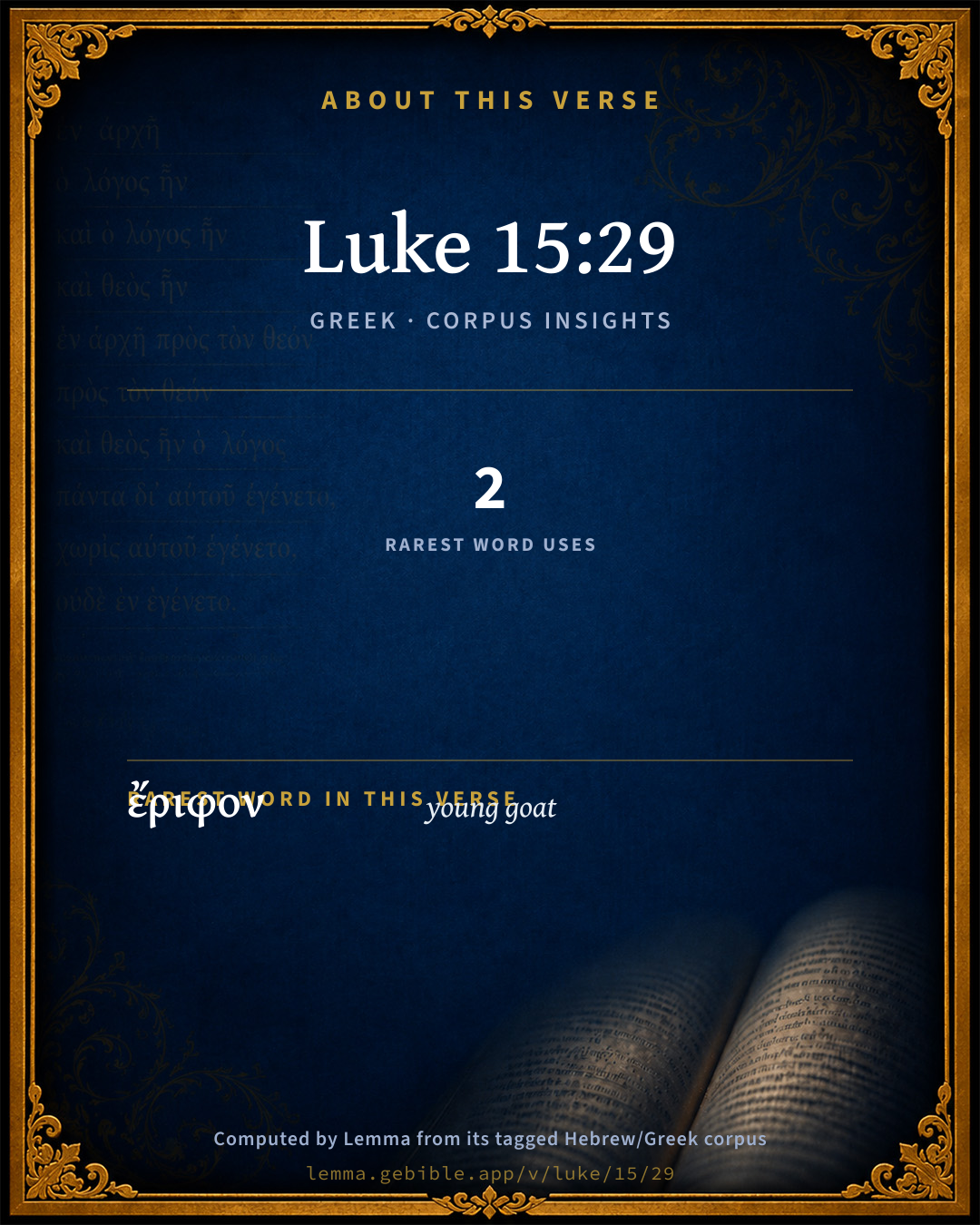
Luke 15:29

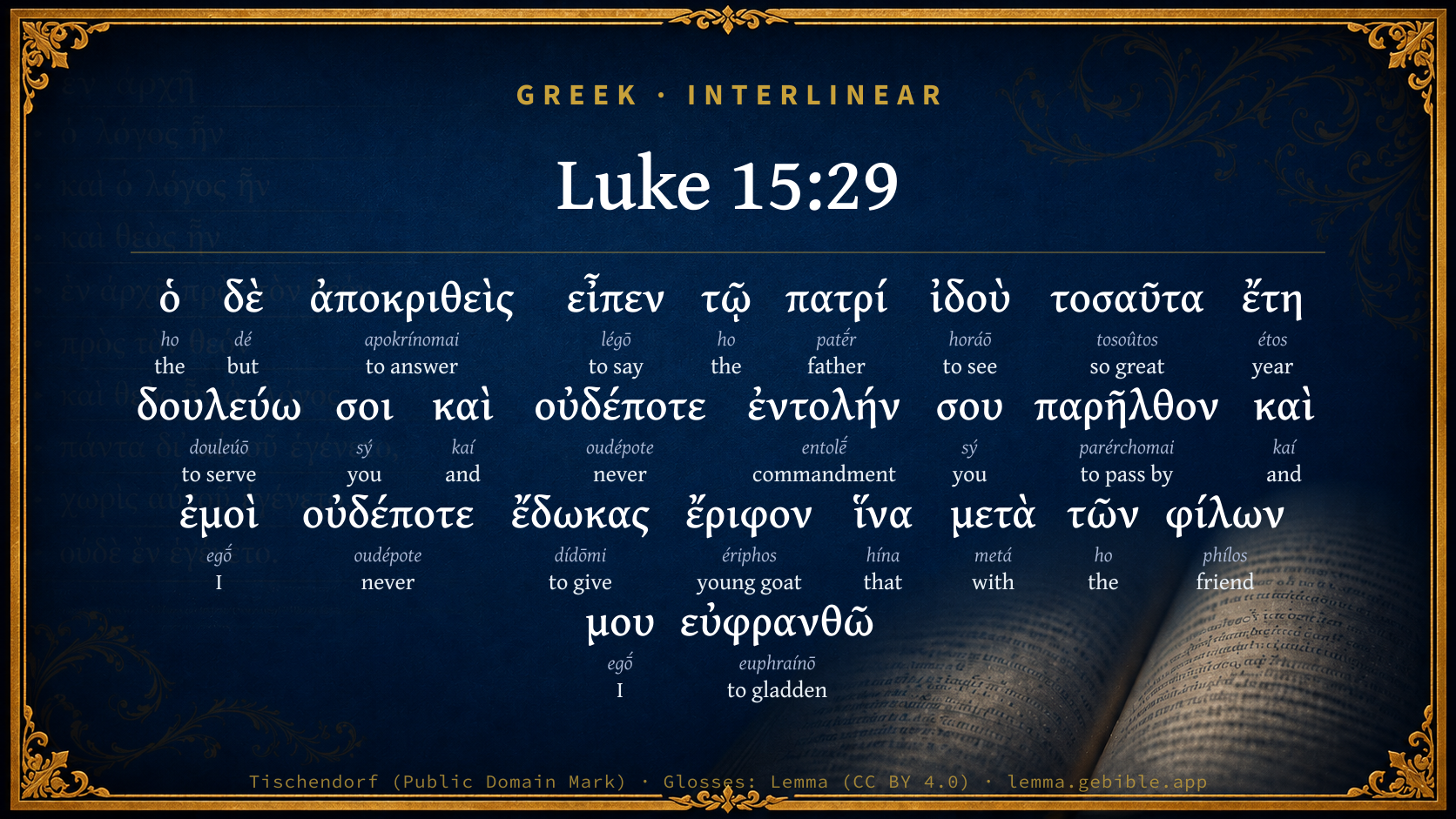
Greek (Tischendorf 8th ed.) Luke 15:29 appears in the Greek New Testament. The text above is from the Tischendorf 8th edition. Each word links to its Strong’s number and a concise gloss. Click any word for its full Thayer’s Greek Lexicon entry.
Download image
Cite this verse

Luke 15:29 (World English Bible). Public Domain. Lemma interlinear Bible study tool, https://lemma.gebible.app/v/luke/15/29.

Show BibTeX & RIS
BibTeX
RIS
English Translation
But he answered his father, 'Behold, these many years I have served you, and I never disobeyed a commandment of yours, but you never gave me a goat, that I might celebrate with my friends.
World English Bible · Public Domain
Download a study sheet

One document with this verse’s original text, its word-by-word gloss line, the meaning frame, cross-references with their text, attributed commentary, and full source and license credits — printable, and it pastes into notes with its structure intact.

This verse Autodidact and up

Study sheet (.html) Plain text (.txt)

A passage Seminary Student

Up to 50 verses in one chapter. A passage sheet keeps up to 6 commentary sources and 12 cross-references per verse, in the order this page ranks them, and says so on the sheet whenever that leaves anything out. Ask for a single verse and you get the Autodidact verse sheet above.

Everything on this page stays free to read, with no account — the sheet is a download of what is already on screen, not access to it.

Want to remove ads? Support Godless Engineer
Compare translations 3

The same verse in 3 English versions, stacked beneath the original-language interlinear above. Click any original word for its lexicon entry.

Each is an independent rendering of the whole verse — the interlinear is not word-aligned to these translations.

Highlighted words mark where these versions differ — a whole-verse word diff, not a word-by-word alignment.

  • World English Bible Public Domain
    But he answered his father, 'Behold, these many years I have served you, and I never disobeyed a commandment of yours, but you never gave me a goat, that I might celebrate with my friends.
  • King James Version Public Domain
    And he answering said to his father, Lo, these many years do I serve thee, neither transgressed I at any time thy commandment: and yet thou never gavest me a kid, that I might make merry with my friends:
  • unfoldingWord Literal Text CC BY-SA 4.0
    But answering, he said to his father, ‘Behold, for so many years I am slaving for you, and I have never disregarded your command, and you never gave a young goat to me so that I might celebrate with my friends,

unfoldingWord Literal Text — © unfoldingWord, licensed CC BY-SA 4.0. Word-aligned USFM3 via Door43 (git.door43.org/unfoldingWord/en_ult).

Versions to compare (up to 4)

3 of 4 selected

Show all 19 translations

Every available English version of this verse, each an independent rendering of the whole verse.

  • World English Bible Public Domain
    But he answered his father, 'Behold, these many years I have served you, and I never disobeyed a commandment of yours, but you never gave me a goat, that I might celebrate with my friends.
  • Berean Standard Bible Public Domain
    But he answered his father, ‘Look, all these years I have served you and never disobeyed a commandment of yours. Yet you never gave me even a young goat so I could celebrate with my friends.
  • Majority Standard Bible Public Domain
    But he answered his father, ‘Look, all these years I have served you and never disobeyed a commandment of yours. Yet you never gave me even a young goat so I could celebrate with my friends.
  • King James Version Public Domain
    And he answering said to his father, Lo, these many years do I serve thee, neither transgressed I at any time thy commandment: and yet thou never gavest me a kid, that I might make merry with my friends:
  • American Standard Version (1901) Public Domain
    But he answered and said to his father, Lo, these many years do I serve thee, and I never transgressed a commandment of thine; and `yet' thou never gavest me a kid, that I might make merry with my friends:
  • Revised Version (1885) Public Domain
    But he answered and said to his father, Lo, these many years do I serve thee, and I never transgressed a commandment of thine: and yet thou never gavest me a kid, that I might make merry with my friends:
  • Geneva Bible (1599) Public Domain
    But he answered and said to his father, Loe, these many yeeres haue I done thee seruice, neither brake I at any time thy commadement, and yet thou neuer gauest mee a kidde that I might make merie with my friends.
  • Douay-Rheims (1899) Public Domain
    And he answering, said to his father: Behold, for so many years do I serve thee, and I have never transgressed thy commandment, and yet thou hast never given me a kid to make merry with my friends:
  • Young's Literal Translation Public Domain
    and he answering said to the father, Lo, so many years I do serve thee, and never thy command did I transgress, and to me thou didst never give a kid, that with my friends I might make merry;
  • Literal Standard Version CC BY-SA 4.0
    and he answering said to the father, Behold, so many years I serve you, and never did I transgress your command, and you never gave to me a kid that I might make merry with my friends;
  • Unlocked Literal Bible CC BY-SA 4.0
    But the older son answered and said to his father, 'Look, these many years I slaved for you, and I never broke a rule of yours, and yet you never gave me a young goat that I might celebrate with my friends,
  • unfoldingWord Literal Text CC BY-SA 4.0
    But answering, he said to his father, ‘Behold, for so many years I am slaving for you, and I have never disregarded your command, and you never gave a young goat to me so that I might celebrate with my friends,
  • Darby Bible Public Domain
    But he answering said to his father, Behold, so many years I serve thee, and never have I transgressed a commandment of thine; and to me hast thou never given a kid that I might make merry with my friends:
  • World Messianic Bible Public Domain
    But he answered his father, ‘Behold, these many years I have served you, and I never disobeyed a commandment of yours, but you never gave me a goat, that I might celebrate with my friends.
  • Webster's Bible Public Domain
    And he answering, said to his father, Lo, these many years do I serve thee, neither have I at any time transgressed thy commandment; and yet thou never gavest me a kid, that I might make merry with my friends:
  • Free Bible Version CC BY-SA 4.0
    He told his father, ‘Look, all these years I've served you, and never disobeyed you, but you never once gave me even a young goat so I could have a party with my friends.
  • Bible in Basic English Public Domain
    But he made answer and said to his father, See, all these years I have been your servant, doing your orders in everything: and you never gave me even a young goat so that I might have a feast with my friends:
  • Text-Critical English NT CC BY 4.0
    But he said to his father in response, ‘Behold, all these years I have served yoʋ and have never disobeyed yoʋr command, yet yoʋ have never given me even a young goat so that I could celebrate with my friends.
  • Tyndale New Testament (1534) Public Domain
    He answered and sayde to his father: Loo these many yeares have I done the service nether brake at eny tyme thy commaundment and yet gavest thou me never soo moche as a kyd to make mery with my lovers:

Literal Standard Version (2020), Covenant Press — licensed CC BY-SA 4.0. Text via the HelloAO Bible API (eBible.org). Unlocked Literal Bible (unfoldingWord) — licensed CC BY-SA 4.0. Text via the HelloAO Bible API (eBible.org). unfoldingWord Literal Text — © unfoldingWord, licensed CC BY-SA 4.0. Word-aligned USFM3 via Door43 (git.door43.org/unfoldingWord/en_ult). Free Bible Version, Dr. Jonathan Gallagher — licensed CC BY-SA 4.0. Text via the HelloAO Bible API (eBible.org).

Word by word

More ways to search: Search by grammar → Find every occurrence → Compare this word →

Practice this passage: Drill this verse → Learn its vocabulary →

ἔριφον
ériphos
G2056
“young goat”
Noun, Accusative, Singular, Masculine
Part of Speech
Noun
Case
Accusative
Number
Singular
Gender
Masculine
Full Thayer's Definition

Origin: perhaps from the same as G2053 (through the idea of hairiness)

TDNT: None

a. a kid, a young goat
  1. ὁ ho G3588 “the” Article, Nominative, Singular, Masculine
  2. δὲ dé G1161 “but” Conjunction
  3. ἀποκριθεὶς apokrínomai G611 “to answer” Verb, Aorist, Passive deponent, Participle, Nominative, Singular, Masculine
  4. εἶπεν légō G3004 “to say” Verb, Aorist, Active, Indicative, 3rd person, Singular
  5. τῷ ho G3588 “the” Article, Dative, Singular, Masculine
  6. πατρί patḗr G3962 “father” Noun, Dative, Singular, Masculine
  7. ἰδοὺ horáō G3708 “to see” Verb, Aorist, Middle, Imperative, 2nd person, Singular
  8. τοσαῦτα tosoûtos G5118 “so great” Demonstrative pronoun, Accusative, Plural, Neuter
  9. ἔτη étos G2094 “year” Noun, Accusative, Plural, Neuter
  10. δουλεύω douleúō G1398 “to serve” Verb, Present, Active, Indicative, 1st person, Singular
  11. σοι sý G4771 “you” Personal pronoun, 2nd person, Dative, Singular
  12. καὶ kaí G2532 “and” Conjunction
  13. οὐδέποτε oudépote G3763 “never” Adverb, Negative
  14. ἐντολήν entolḗ G1785 “commandment” Noun, Accusative, Singular, Feminine
  15. σου sý G4771 “you” Personal pronoun, 2nd person, Genitive, Singular
  16. παρῆλθον parérchomai G3928 “to pass by” Verb, Aorist, Active, Indicative, 1st person, Singular
  17. καὶ kaí G2532 “and” Conjunction
  18. ἐμοὶ egṓ G1473 “I” Personal pronoun, 1st person, Dative, Singular
  19. οὐδέποτε oudépote G3763 “never” Adverb, Negative
  20. ἔδωκας dídōmi G1325 “to give” Verb, Aorist, Active, Indicative, 2nd person, Singular
  21. ἵνα hína G2443 “that” Conjunction
  22. μετὰ metá G3326 “with” Preposition
  23. τῶν ho G3588 “the” Article, Genitive, Plural, Masculine
  24. φίλων phílos G5384 “friend” Adjective, Genitive, Plural, Masculine
  25. μου egṓ G1473 “I” Personal pronoun, 1st person, Genitive, Singular
  26. εὐφρανθῶ euphraínō G2165 “to gladden” Verb, Aorist, Passive, Subjunctive, 1st person, Singular

About this verse

These counts appear in no published source. They are computed here, from the morphology-tagged text and Lemma’s own curated glosses. What Lemma adds →

27
words
21
distinct lemmas
Gospels
section

Notable vocabulary

The rarest word here is ἔριφον young goat G2056 — appearing just 2 times in the whole Greek New Testament.

Shared distinctive vocabulary

ἔριφον young goat G2056 occurs in 2 verses of the Greek New Testament. Also found in:

Repetition

Words recur within this verse:

Cross-references

21

Topical passages linked to Luke 15:29 in the Treasury of Scripture Knowledge — connected by theme and wording, ordered by reader-vote popularity; previews shown in the World English Bible.

  • Zechariah 7:3 and to speak to the priests of the house of Yahweh of Hosts, and to the prophets, saying, "Should I weep in the fifth month, separating myself, as I have done these so many years?"
  • Malachi 3:14 You have said, 'It is vain to serve God;' and 'What profit is it that we have kept his charge, and that we have walked mournfully before Yahweh of Hosts?
  • Luke 15:7 I tell you that even so there will be more joy in heaven over one sinner who repents, than over ninety-nine righteous people who need no repentance.
  • Luke 18:11–12 The Pharisee stood and prayed to himself like this: 'God, I thank you, that I am not like the rest of men, extortioners, unrighteous, adulterers, or even like this tax collector.
  • 1 Samuel 15:13–14 Samuel came to Saul; and Saul said to him, Blessed are you by Yahweh: I have performed the commandment of Yahweh.
  • Isaiah 65:5 who say, Stand by yourself, don't come near to me, for I am holier than you. These are a smoke in my nose, a fire that burns all the day.
  • Malachi 1:12–13 "But you profane it, in that you say, 'Yahweh's table is polluted, and its fruit, even its food, is contemptible.'
  • Matthew 20:12 saying, 'These last have spent one hour, and you have made them equal to us, who have borne the burden of the day and the scorching heat!'
  • Luke 17:10 Even so you also, when you have done all the things that are commanded you, say, 'We are unworthy servants. We have done our duty.'"
  • Luke 18:9 He spoke also this parable to certain people who were convinced of their own righteousness, and who despised all others.
  • Luke 18:20–21 You know the commandments: 'Don't commit adultery,' 'Don't murder,' 'Don't steal,' 'Don't give false testimony,' 'Honor your father and your mother.'"
  • Luke 19:21 for I feared you, because you are an exacting man. You take up that which you didn't lay down, and reap that which you didn't sow.'
  • Romans 7:9 I was alive apart from the law once, but when the commandment came, sin revived, and I died.
  • Philippians 3:4–6 though I myself might have confidence even in the flesh. If any other man thinks that he has confidence in the flesh, I yet more:
  • 1 John 1:8–10 If we say that we have no sin, we deceive ourselves, and the truth is not in us.
  • Revelation 2:17 He who has an ear, let him hear what the Spirit says to the assemblies. To him who overcomes, to him I will give of the hidden manna, and I will give him a white stone, and on the stone a new name written, which no one knows but he who receives it.
  • Revelation 3:17 Because you say, 'I am rich, and have gotten riches, and have need of nothing;' and don't know that you are the wretched one, miserable, poor, blind, and naked;
  • Isaiah 58:2–3 Yet they seek me daily, and delight to know my ways: as a nation that did righteousness, and didn't forsake the ordinance of their God, they ask of me righteous judgments; they delight to draw near to God.
  • Romans 3:20 Because by the works of the law, no flesh will be justified in his sight. For through the law comes the knowledge of sin.
  • Romans 3:27 Where then is the boasting? It is excluded. By what manner of law? Of works? No, but by a law of faith.
  • Romans 10:3 For being ignorant of God's righteousness, and seeking to establish their own righteousness, they didn't subject themselves to the righteousness of God.

Cross-references courtesy of OpenBible.info (CC BY 4.0).

Commentary

Notes on Luke 15:29 from classic Christian and Jewish commentators (each source and its license shown beneath its notes). The classic Christian expositions comment on the surrounding passage and are grouped to its opening verse, so a note may address several verses; the Jewish commentaries on the Tanakh (Rashi and others) are per-verse, so they appear only where the commentator wrote on this verse.

Lemma curates 59 commentaries, every one of them public domain or Creative Commons licensed, each selected and text-cleaned for this edition rather than reprinted as found. About our sources →

Joseph Benson's Commentary

Luk 15:29-30. But he answering, said to his father — The kindness and respect which his father showed him on this occasion, did not soften him in the least. He stubbornly persisted in his anger, and answered the affectionate speeches of his parent with nothing but loud and haughty accusations of his conduct. These many years do I serve thee, neither transgressed I at any time — This branch of the parable is finely contrived to express the high opinion which the Pharisees, here represented by the elder brother, entertained of their own righteousness and merit. Yet thou never gavest me a kid, &c. — Perhaps God does not usually give much consolation to those who never felt the deep sorrows of repentance. But as soon as this thy son was come — The ungracious youth disdained to call him his brother, and at the same time insolently insinuated, that his father seemed to despise all his other children, and to reckon this prodigal only his son; which hath devoured thy living with harlots — Hath wasted thy property in a long course of scandalous debaucheries, to his own ruin, and the infamy of the family. Thou hast killed for him the fatted calf — And made him as welcome as if he had been the most dutiful child upon earth. And he said — With great gentleness, when he might have taken offence at his son’s unbecoming reply, Son, thou art ever with me — And art every day receiving some token of my kindness. By calling him his son, after the insolent speech he had made, the father insinuated, that he acknowledged him likewise for his son, and that neither the undutifulness of the one, nor the frowardness of the other of his children, had extinguished his affection, or cancelled the relation subsisting between them. All that I have is thine — As thou hast formerly lived in my family, and hast had the command of my property, as far as thy exigencies required; so thou art at present heir to the bulk of my estate. This is a material intimation, and suggests a strong reason against murmuring at the indulgence shown to the greatest sinners. As the father’s receiving the youngest son did not cause him to disinherit the elder, so God’s receiving notorious sinners will be no loss to those who have always served him: neither will he raise these to a state of glory equal to that of those who have always served him, if they have, upon the whole, made a greater progress in inward as well as outward holiness.

Joseph Benson's Commentary on the Old and New Testaments (1811–1818) — public domain. Text from a community e-Sword module.

Bengel's Gnomon

Johann Albrecht Bengel

Luk 15:29. Τοσαῦτα ἔτη, these so many years) In antithesis to ὅτε, as soon as, in Luk 15:30.—δουλεύω, I serve) A confession of the slave-like spirit which influenced him. He does not add [in the spirit of Sonship], Father.—ἔδωκας, thou hast never given) much less wouldest thou kill [ἔθυσεν, mactavit, Luk 15:27],—ἔριφον, a kid) much less the calf, Luk 15:27.—φίλων, my friends) In antithesis to πορνῶν, harlots, Luk 15:30.

Bengel's Gnomon of the New Testament — English translation (T&T Clark, Edinburgh, 1860) — public domain. Text from a community e-Sword module.

Expositor's Greek Testament

ed. W. Robertson Nicoll

Luk 15:29 . ἔριφον , a kid, not to speak of the fatted calf. μετὰ τῶν φίλων μου : he would have been content if there had been any room made for the festive element in his life, with a modest meeting with his own friends, not to speak of a grand family demonstration like this. But no, there was nothing but work and drudgery for him.

The Expositor's Greek Testament, edited by W. Robertson Nicoll (1897–1910) — public domain. Text from a community e-Sword module.

Jamieson, Fausset & Brown

Robert Jamieson, A. R. Fausset & David Brown

these many years . . . neither transgressed I at any time thy commandment--The words are not to be pressed too far. He is merely contrasting his constancy of love and service with the conduct of his brother; just as Job, resenting the charge of hypocrisy by his friends, speaks as if nothing could be laid to his charge (Job 23:10-12), and David too (Psa 18:20-24). The father attests the truth of all he says.

never . . . a kid--I say not a calf, but not even a kid.

that I might make merry with my friends--Here lay his misapprehension. It was no entertainment for the gratification of the prodigal: it was a father's expression of the joy he felt at his recovery.

thy son . . . thy living--How unworthy a reflection on the common father of both, for the one not only to disown the other, but fling him over upon his father, as if he should say, Take him, and have joy of him!

Jamieson, Fausset & Brown — Commentary Critical and Explanatory on the Whole Bible (1871) — public domain (CC PDM 1.0). Text via the HelloAO Bible API.

Adam Clarke's Commentary

Verse 29. Never-a kid] It is evident from Lu 15:12, that the father gave him his portion when his profligate brother claimed his; for he divided his whole substance between them. And though he had not claimed it, so as to separate from, and live independently of, his father, yet he might have done so whenever he chose; and therefore his complaining was both undutiful and unjust.

Adam Clarke's Commentary on the Bible (1810–1826) — public domain. Text from a community e-Sword/MySword module.

Ellicott's Commentary for English Readers

(29) Lo, these many years do I serve thee.—The very word “I serve,” as a slave serves, is eminently suggestive. The obedience had all along been servile, prompted by fear and hope, even as the slave’s obedience is. The language put into the mouth of the elder son is clearly meant to represent the habitual thoughts of the Pharisees. They are taken, as it were, after our Lord’s manner, as seen in the previous parables, at their own valuation of themselves. They are conscious of no transgressions; but in that very unconsciousness lies the secret of the absence of any sense of joy in being forgiven, of any power to sympathise with the joy of others, even of any satisfaction in the service in which they pride themselves. (Comp. Notes on Luk_7:47-50.) They are scandalised at the gladness which others feel when a penitent returns to God. It seems like an insult and wrong to themselves. Their life has been one of uniform obedience; they have performed their religious duties. Why is so much stir made about those who have fallen as they never fell?

A Bible Commentary for English Readers, edited by Charles John Ellicott (1878–1897) — public domain. Text from a community e-Sword module.

The Cambridge Bible for Schools and Colleges

gen. ed. J. J. S. Perowne

29. do I serve thee] Rather, I am thy slave. He does not say ‘Father:’ and evidently regards the yoke not as perfect freedom but as distasteful bondage. The slave is ever dissatisfied; and this son worked in the spirit of a ‘hired-servant.’

neither transgressed I at any time thy commandment] This is the very spirit of the Pharisee and the Rabbi, Luk_18:11-12. “All these things have I kept from my youth up.” Such self-satisfaction can only spring from an ignorance of the breadth and spirituality of God’s commandments. The respectable Jews, sunk in the complacency of formalism and letter-worshipping orthodoxy, had lost all conception that they were, at the best, but unprofitable servants. Like this elder son they “went about to establish their own righteousness” (Rom_9:14); and though they kept many formal commandments they ‘transgressed’ the love of God (Luk_11:42). Observe that while the younger son confesses with no excuse, the elder son boasts with no confession. This at once proves his hollowness, for the confessions of the holiest are ever the most bitter. The antitheses in the verse are striking, ‘You never gave me a kid, much less sacrificed a fatted calf;—not even for my friends, much less for harlots.’

thou never gavest me a kid] The reward of a life near his father’s presence, and in the safety of the old home, was nothing to him. He is like the rescued Israelites still yearning for the flesh-pots of Egypt.

The Cambridge Bible for Schools and Colleges (gen. ed. J. J. S. Perowne; Cambridge University Press, 1878–1918) — public domain. Text from a community e-Sword module.

John Gill's Exposition

And he answering, said to his father,.... Commending himself, and reflecting on his father:

lo, these many years do I serve thee; for though he was called a son, yet differed little from a servant; he was of a servile disposition, and under a spirit of bondage; he served his father, not in the Gospel, but in the law, moral and ceremonial; in the letter of it, and not in the newness of the Spirit; externally, and not internally; from fear, and not from love; with mercenary views, and not freely; with trust in, and dependence on his service, seeking justification and eternal life by it, and not with a view to the glory of God; and this he had done "many years"; from his youth upwards, as the Pharisee in Mat 19:20 whereas his younger brother had never served him, but his own lusts; and yet as soon as ever he was come home, before he could enter upon service, this entertainment was made for him, and which he therefore resented: moreover, he does not say I have served thee, but "I do"; denoting the continuance and constancy of his service; and intimating that his life had been, and was one continued series of obedience:

neither transgressed I at any time thy commandment; which though true of the elect angels, can never be said of any of the sons of men; and which shows, that he had never been under a work of the Spirit of God, who convinces of sin; and had never seen himself in a true light, in the glass of that law, he pretended to serve God in; that he was a stranger to the plague of his own heart, and was a self-deceiver, and the truth of grace was not in him: he could not be a good man, for so to say, is contrary to the experience of all good men; to their groans, complaints, and confessions; to their prayers, for fresh application of pardoning grace; and to the observation of all wise and good men in all ages; and most fully proves him to be, a Pharisee:

and yet thou never gavest me a kid, that I might make merry with my friends; some by a "kid", or "goat", as Theophylact, understand a persecutor, as Saul was of David, and Ahab of Elijah; and so means that God had not delivered up such an one into his hands; or took him away by death, that he might have some peace and rest, amidst his labours and service; and others understand this of the Jews, desiring Barabbas, a goat, and not Jesus, the Lamb of God; but his meaning seems to be, that he had never received any favour in proportion to the services he had done; and so charges his father with ingratitude.

John Gill's Exposition of the Whole Bible (1746–1763) — public domain (CC PDM 1.0). Text via the HelloAO Bible API.

Trapp's Complete Commentary

John Trapp

29 And he answering said to his father, Lo, these many years do I serve thee, neither transgressed I at any time thy commandment: and yet thou never gavest me a kid, that I might make merry with my friends:

Ver. 29. And yet thou never gavest me a kid] Much less a calf. Hypocrites hold God to be in their debt, and through discontent weigh not his favours, as being never without some ailment.

John Trapp, A Commentary or Exposition upon All the Books of the Old and New Testament (1647–1656) — public domain. Text from a community e-Sword module.

Albert Barnes' Notes on the Bible

A kid - A young goat. This was of less value than the calf; and he complains that while his father had never given “him” a thing of so little value as “a kid,” he had now given his other son the “fatted calf.”

Make merry with - Entertain them give them a feast. This complaint was unreasonable, for his father had divided his property, and he “might” have had his portion, and his father had uniformly treated him with kindness. But it serves to illustrate the conduct of the scribes and Pharisees, and the folly of their complaint.

Albert Barnes' Notes on the Bible (1834–1885) — public domain. Text from a community e-Sword/MySword module.

Haydock's Catholic Bible Commentary

I have never transgressed, &c. With what face could the Jews, represented here by the eldest son, say they have never transgressed the commandments of their father? This made Tertullian think that this was not the expression of the Jews, but of the faithful Christians; and, therefore, he interprets the whole parable as applied to a disciple of Christ. But we should recollect, that it is not uncommon for presumption to boast of what it never has done. The whole history of the Jews is full of numberless details of their prevarication and disobedience. (Calmet) --- A kid, &c. The Jews demanded a kid, but the Christians a lamb; therefore was Barabbas set at liberty for them, whilst for us the lamb was immolated. (St. Ambrose)

====================

George Leo Haydock (1774–1849), Haydock's Catholic Family Bible and Commentary, 1859 edition — public domain. Excludes Psalms (Douay-Rheims chapter numbering differs from Protestant) and Deuterocanonical books (Catholic canon only).

Whedon's Commentary on the Bible

Daniel D. Whedon

29, 30. In these two verses our Lord gives, in parable, the substance of the Pharisaic murmur. We are the piety of the nation; and for us should be reserved all the respect and deference which the professed prophet of God has to pay. But us have you deserted, and given all your interest and labour to these publicans, who have prostituted their birthright to the service of a heathen power.

29. Do I serve thee—The word serve here is the service of a slave, and hence some have held it as characterizing the Pharisee’s devotion to God.

A kid—Far inferior to the fatted calf.

Daniel D. Whedon (gen. ed.), Commentary on the Old and New Testaments (1874–1909) — public domain. Text from a community e-Sword module.

The Pulpit Commentary

Vers. 29-32. Lo, these many years do I serve thee. Bengel quaintly comments here, "Serous erat." This was the true nature of this later Jewish service of the Eternal. To them the eternal God was simply a Master. They were slaves who had a hard and difficult task to perform, and for which they looked for a definite payment. Neither transgressed I at any time thy commandment. We have here reproduced the spirit, almost the very words, of the well-known answer of the young man in the gospel story, who was no doubt a promising scion of the Pharisee party: "All these things have I kept from my youth up." The same thought was in the mind, too, of him who thus prayed in the temple: "God, I thank thee that I am not as other men are," etc. (Luk_18:11, Luk_18:12) Yet thou never gavest me a kid... All that I have is thine. Thy brother has the shoes, the ring, the robe, the banquet; thou the inheritance, for all that I have is thine. Why grudge to thy brother an hour of the gladness which has been thine these many years? As soon as this thy son was come,... For this thy brother was dead. The angry elder son will not even acknowledge the prodigal as his brother; with bitter scorn and some disrespect he speaks of him to his father as "thy son." The father throughout the scene is never incensed. He pleads rather than reproaches, and to this insolence he simply retorts, "Thy brother was dead to us, but now It was meet that we should make merry, and be glad." What was the end of this strange scene? The last words, breathing forgiveness and joy, leave a sweet sense of hope upon the reader that all would yet be well in that divided household, and that the brothers, friends again, would clasp hands before the loving father"s eyes. But when Jesus told the parable to the crowds, the story was not yet played out. It depended on the Pharisees and rulers how the scene was to end. What happened at Jerusalem a few weeks later, when the Passion-drama was acted, and some forty years later, when the city was sacked, tells us something of what subsequently happened to the elder son of the Lord"s parable. But the end has yet to come. We shall yet see the brothers, Jew and Gentile, clasp hands in loving friendship before the father, when the long-lost elder son comes home. There will be joy then indeed in the presence of the angels of God.

The Pulpit Commentary (1880–1919), ed. H.D.M. Spence-Jones & Joseph S. Exell — public domain. Text from a community e-Sword module.

John Wesley's Explanatory Notes

Lo, so many years do I serve thee - So he was one of the instances mentioned ver. 7. How admirably therefore does this parable confirm that assertion! Yet thou never gavest me a kid, that I might make merry with my friends - Perhaps God does not usually give much joy to those who never felt the sorrows of repentance.

John Wesley, Explanatory Notes Upon the Whole Bible (1754–1765) — public domain. Text via the GEBible commentary corpus.

Cambridge Greek Testament for Schools and Colleges

29. δουλεύω σοι. ‘I am thy slave.’ He does not say “Father:” and evidently regards the yoke not as perfect freedom but as distasteful bondage. The slave is ever dissatisfied; and this son worked in the spirit of a “hired servant.”

οὐδέποτε ἐντολήν σου παρῆλθον. This is the very spirit of the Pharisee and the Rabbi, Luk 18:11-12. “All these things have I kept from my youth up.” Such self-satisfaction can only spring from an ignorance of the breadth and spirituality of God’s commandments. The respectable Jews, sunk in the complacency of formalism and letter-worshipping orthodoxy, had lost all conception that they were, at the best, but unprofitable servants. Like this elder son they “went about to establish their own righteousness” (Rom 9:14); and though they kept many formal commandments they ‘transgressed’ the love of God (Luk 11:42). Observe that while the younger son confesses with no excuse, the elder son boasts with no confession. This at once proves his hollowness, for the confessions of the holiest are ever the most bitter. The antitheses in the verse are striking, ‘You never gave me a kid, much less sacrificed a fatted calf;—not even for my friends, much less for harlots.’ He is so satisfied with himself as to be quite dissatisfied with his father on whose “unfairness” towards him, and “unjust lenience” to his other son, he freely comments.

ἐμοὶ οὐδέποτε ἔδωκας ἔριφον. He is bitter and reproachful. To me thou never gavest (so much as) a kid, (B has ἐρίφιον, a kidling); but to him the fatted calf. The reward of a life near his father’s presence and in the safety of the old home was nothing to him. He is like the rescued Israelites still yearning for the flesh-pots of Egypt.

μετὰ τῶν φίλων μου. Here again is a touch of self-satisfied malignity. I should not have eaten the kid μετὰ πορνῶν, as he has done, but with worthy friends.

Cambridge Greek Testament for Schools and Colleges (Cambridge University Press, 1896; 21 vols, various authors incl. Carr, Maclear, Plummer, Farrar, Lumby, Moule, M. R. James, Simcox) — public domain. Text from a community e-Sword module.

Alford’s Greek Testament

Henry Alford

29.] ἰδ. τοσ. ἔτη δουλ. σοι, the very manner of speech of a Pharisee: as is the continuation—οὐδέπ. ἐντ. σου παρ. Could the Jewish nation be introduced saying this, even in the falsest hypocrisy?

ἐμοὶ οὐδέποτε ἔδωκας answers to the younger son’s δός μοι in ver. 12;—it is a separation of the individual son from his father, and, as there pointed out, the very root and ground of sin.

ἔριφον, of less value than a calf.

τ. φίλ. μου—who are these? this elder son also then has friends, who are not his father’s friends: see Mat 22:16, τ. μαθητὰς αὐτῶν μετὰ τῶν Ἡρωδιανῶν.

Henry Alford, The Greek Testament (1849–1861) — public domain. Text from a community e-Sword module.

International Critical Commentary

29. τοσαῦτα ἔτη δουλεύω σοι. His view of his relation to his father is a servile one. With τοσαῦτα comp. Joh 12:37, Joh 21:11.

οὐδέποτε ἐντολήν σου παρῆλθον. The blind self-complacency of the Pharisee, trusting in his scrupulous observance of the letter of the Law, is here clearly expressed. This sentence alone is strong evidence that the elder brother represents the Pharisees rather than the Jewish nation as a whole, which could hardly be supposed to make so demonstrably false a claim. For παρῆλθον in the sense of “neglect, transgress,” see on 11:42.

ἐμοὶ οὐδέποτε ἔδωκας ἔριφον. The pronoun first with emphasis: “Thou never gavest me a kid,”—much less a fatted calf. He is jealous, and regards his father as utterly weak in his treatment of the prodigal; but what specially moves him is the injustice of it all. His own unflagging service and propriety have never been recognized in any way, while the spendthrift has only to show himself in order to receive a handsome recognition.

Both here and Mat 25:32, B has ἐρίφιον for ἔριφος. Here the diminutive has point. In LXX ἔριφος prevails.

ἵνα μετὰ τῶν φίλων μου εὐφρανθῶ. He does not see that he is exhibiting much the same spirit as his brother. He wants to have his father’s property in order that he may enjoy himself apart from him.

International Critical Commentary — older volumes (1896–1929), various authors — public domain. Text from a community e-Sword module.

Vincent's Word Studies in the New Testament

Marvin R. Vincent

Kid [εριφον] . Some read the diminutive, ejrifion, "a little kid." In any event a contrast is intended between the kid and the fatted calf.

Marvin R. Vincent, Word Studies in the New Testament (1887–1900) — public domain. Text from a community e-Sword/MySword module.

Lesson kit

Teaching starters — assembled from the data on this page, not authored interpretation. Every prompt links to the verse data it draws on. Edit before teaching.

Luke, in the Gospels, opens this verse with 27 words (21 distinct Greek lemmas). Its most distinctive word is ériphos (“young goat”). A historical commentator’s framing appears above. Read the whole chapter for the surrounding context.

Discussion questions

  1. The word ériphos carries the sense “young goat.” How does it shape the verse?
  2. Matthew 25:32 shares the word «young goat» with this verse. How do the two illuminate each other?
  3. “never” occurs 2× in this one verse. What is the effect of the repetition?
  4. These translations render this verse differently. What is at stake in choosing one wording over another?
  5. Reading how Joseph Benson's Commentary and Bengel's Gnomon read this verse, where do the two commentators agree and where do they part?

Things to notice

Reading settings

Reading text

Shown beneath each verse's original-language words.

Old Testament
Old Testament edition

Read the OT as the Masoretic Hebrew (MT) or the Greek Septuagint (LXX).

English shown for the Greek Septuagint (in the Hebrew ↔ Greek comparison).

Comparing translations? Open the Compare panel on any verse page to stack up to four side by side.