John 14:21

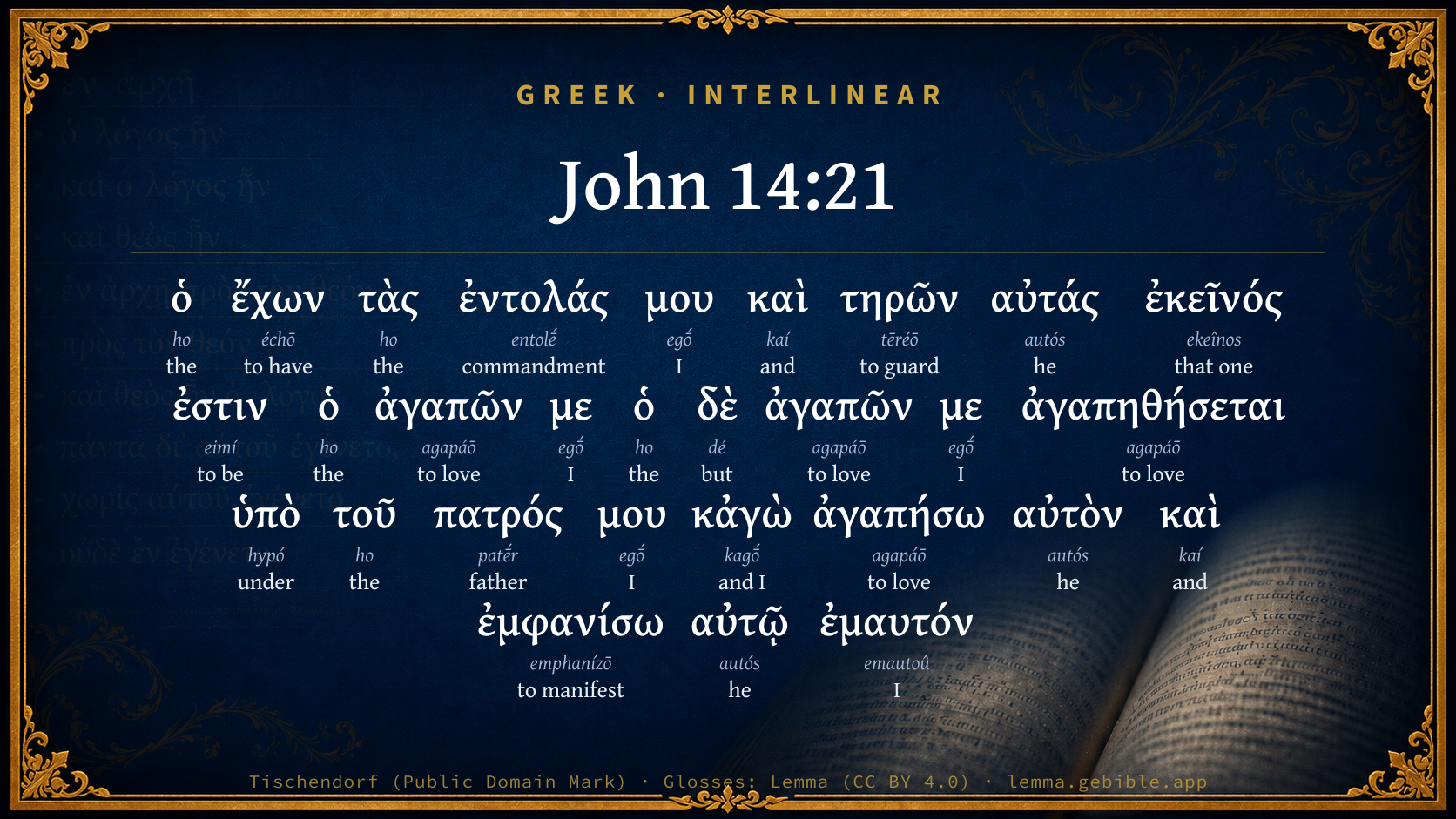
Greek (Tischendorf 8th ed.) John 14:21 appears in the Greek New Testament. The text above is from the Tischendorf 8th edition. Each word links to its Strong’s number and a concise gloss. Click any word for its full Thayer’s Greek Lexicon entry.
Download image
Cite this verse

John 14:21 (World English Bible). Public Domain. Lemma interlinear Bible study tool, https://lemma.gebible.app/v/john/14/21.

Show BibTeX & RIS
BibTeX
RIS
English Translation
One who has my commandments, and keeps them, that person is one who loves me. One who loves me will be loved by my Father, and I will love him, and will reveal myself to him."
World English Bible · Public Domain
Download a study sheet

One document with this verse’s original text, its word-by-word gloss line, the meaning frame, cross-references with their text, attributed commentary, and full source and license credits — printable, and it pastes into notes with its structure intact.

This verse Autodidact and up

Study sheet (.html) Plain text (.txt)

A passage Seminary Student

Up to 50 verses in one chapter. A passage sheet keeps up to 6 commentary sources and 12 cross-references per verse, in the order this page ranks them, and says so on the sheet whenever that leaves anything out. Ask for a single verse and you get the Autodidact verse sheet above.

Everything on this page stays free to read, with no account — the sheet is a download of what is already on screen, not access to it.

Want to remove ads? Support Godless Engineer
Compare translations 3

The same verse in 3 English versions, stacked beneath the original-language interlinear above. Click any original word for its lexicon entry.

Each is an independent rendering of the whole verse — the interlinear is not word-aligned to these translations.

Highlighted words mark where these versions differ — a whole-verse word diff, not a word-by-word alignment.

  • World English Bible Public Domain
    One who has my commandments, and keeps them, that person is one who loves me. One who loves me will be loved by my Father, and I will love him, and will reveal myself to him."
  • King James Version Public Domain
    He that hath my commandments, and keepeth them, he it is that loveth me: and he that loveth me shall be loved of my Father, and I will love him, and will manifest myself to him.
  • unfoldingWord Literal Text CC BY-SA 4.0
    The one having my commandments and keeping them, this is the one loving me, and the one loving me will be loved by my Father, and I will love him and I will show myself to him.”

unfoldingWord Literal Text — © unfoldingWord, licensed CC BY-SA 4.0. Word-aligned USFM3 via Door43 (git.door43.org/unfoldingWord/en_ult).

Versions to compare (up to 4)

3 of 4 selected

Show all 19 translations

Every available English version of this verse, each an independent rendering of the whole verse.

  • World English Bible Public Domain
    One who has my commandments, and keeps them, that person is one who loves me. One who loves me will be loved by my Father, and I will love him, and will reveal myself to him."
  • Berean Standard Bible Public Domain
    Whoever has My commandments and keeps them is the one who loves Me. The one who loves Me will be loved by My Father, and I will love him and reveal Myself to him.”
  • Majority Standard Bible Public Domain
    Whoever has My commandments and keeps them is the one who loves Me. The one who loves Me will be loved by My Father, and I will love him and reveal Myself to him.”
  • King James Version Public Domain
    He that hath my commandments, and keepeth them, he it is that loveth me: and he that loveth me shall be loved of my Father, and I will love him, and will manifest myself to him.
  • American Standard Version (1901) Public Domain
    He that hath my commandments, and keepeth them, he it is that loveth me: and he that loveth me shall be loved of my Father, and I will love him, and will manifest myself unto him.
  • Revised Version (1885) Public Domain
    He that hath my commandments, and keepeth them, he it is that loveth me: and he that loveth me shall be loved of my Father, and I will love him, and will manifest myself unto him.
  • Geneva Bible (1599) Public Domain
    He that hath my commandements, and keepeth them, is he that loueth me: and he that loueth me, shall be loued of my Father: and I will loue him, and wil shewe mine owne selfe to him.
  • Douay-Rheims (1899) Public Domain
    He that hath my commandments, and keepeth them; he it is that loveth me. And he that loveth me, shall be loved of my Father: and I will love him, and will manifest myself to him.
  • Young's Literal Translation Public Domain
    he who is having my commands, and is keeping them, that one it is who is loving me, and he who is loving me shall be loved by my Father, and I will love him, and will manifest myself to him.'
  • Literal Standard Version CC BY-SA 4.0
    he who is having My commands, and is keeping them, that one it is who is loving Me, and he who is loving Me will be loved by My Father, and I will love him, and will manifest Myself to him.”
  • Unlocked Literal Bible CC BY-SA 4.0
    He who has my commandments and keeps them is the one who loves me, and he who loves me will be loved by my Father, and I will love him and I will show myself to him.”
  • unfoldingWord Literal Text CC BY-SA 4.0
    The one having my commandments and keeping them, this is the one loving me, and the one loving me will be loved by my Father, and I will love him and I will show myself to him.”
  • Darby Bible Public Domain
    He that has my commandments and keeps them, he it is that loves me; but he that loves me shall be loved by my Father, and I will love him and will manifest myself to him.
  • World Messianic Bible Public Domain
    One who has my commandments and keeps them, that person is one who loves me. One who loves me will be loved by my Father, and I will love him, and will reveal myself to him.”
  • Webster's Bible Public Domain
    He that hath my commandments, and keepeth them, he it is that loveth me: and he that loveth me, shall be loved by my Father, and I will love him, and will manifest myself to him.
  • Free Bible Version CC BY-SA 4.0
    Those who keep my commands are the ones who love me, those who love me will be loved by my Father. I will love them too, and will reveal myself to them.”
  • Bible in Basic English Public Domain
    He who has my laws and keeps them, he it is who has love for me: and he who has love for me will be loved by my Father, and I will have love for him and will let myself be seen clearly by him.
  • Text-Critical English NT CC BY 4.0
    Whoever has my commandments and keeps them is the one who loves me. He who loves me will be loved by my Father, and I will love him and manifest myself to him.”
  • Tyndale New Testament (1534) Public Domain
    He that hath my commaundementes and kepeth them the same is he that loveth me. And he that loveth me shall be loved of my father: and I will love him and will shewe myne awne selfe vnto him.

Literal Standard Version (2020), Covenant Press — licensed CC BY-SA 4.0. Text via the HelloAO Bible API (eBible.org). Unlocked Literal Bible (unfoldingWord) — licensed CC BY-SA 4.0. Text via the HelloAO Bible API (eBible.org). unfoldingWord Literal Text — © unfoldingWord, licensed CC BY-SA 4.0. Word-aligned USFM3 via Door43 (git.door43.org/unfoldingWord/en_ult). Free Bible Version, Dr. Jonathan Gallagher — licensed CC BY-SA 4.0. Text via the HelloAO Bible API (eBible.org).

Word by word

More ways to search: Search by grammar → Find every occurrence → Compare this word →

Practice this passage: Drill this verse → Learn its vocabulary →

ἐμφανίσω
emphanízō
G1718
“to manifest”
Verb, Future, Active, Indicative, 1st person, Singular
Part of Speech
Verb
Tense
Future
Voice
Active
Mood
Indicative
Person
1st person
Number
Singular
Full Thayer's Definition

Origin: from G1717

TDNT: 09:07,1

1. to manifest, exhibit to view 2. to show one's self, come to view, appear, be manifest 3. to indicate, disclose, declare, make known
  1. ὁ ho G3588 “the” Article, Nominative, Singular, Masculine
  2. ἔχων échō G2192 “to have” Verb, Present, Active, Participle, Nominative, Singular, Masculine
  3. τὰς ho G3588 “the” Article, Accusative, Plural, Feminine
  4. ἐντολάς entolḗ G1785 “commandment” Noun, Accusative, Plural, Feminine
  5. μου egṓ G1473 “I” Personal pronoun, 1st person, Genitive, Singular
  6. καὶ kaí G2532 “and” Conjunction
  7. τηρῶν tēréō G5083 “to guard” Verb, Present, Active, Participle, Nominative, Singular, Masculine
  8. αὐτάς autós G846 “he” Personal pronoun, Accusative, Plural, Feminine
  9. ἐκεῖνός ekeînos G1565 “that one” Demonstrative pronoun, Nominative, Singular, Masculine
  10. ἐστιν eimí G1510 “to be” Verb, Present, Active, Indicative, 3rd person, Singular
  11. ὁ ho G3588 “the” Article, Nominative, Singular, Masculine
  12. ἀγαπῶν agapáō G25 “to love” Verb, Present, Active, Participle, Nominative, Singular, Masculine
  13. με egṓ G1473 “I” Personal pronoun, 1st person, Accusative, Singular
  14. ὁ ho G3588 “the” Article, Nominative, Singular, Masculine
  15. δὲ dé G1161 “but” Conjunction
  16. ἀγαπῶν agapáō G25 “to love” Verb, Present, Active, Participle, Nominative, Singular, Masculine
  17. με egṓ G1473 “I” Personal pronoun, 1st person, Accusative, Singular
  18. ἀγαπηθήσεται agapáō G25 “to love” Verb, Future, Passive, Indicative, 3rd person, Singular
  19. ὑπὸ hypó G5259 “under” Preposition
  20. τοῦ ho G3588 “the” Article, Genitive, Singular, Masculine
  21. πατρός patḗr G3962 “father” Noun, Genitive, Singular, Masculine
  22. μου egṓ G1473 “I” Personal pronoun, 1st person, Genitive, Singular
  23. κἀγὼ kagṓ G2504 “and I” Personal pronoun, 1st person, Nominative, Singular, Aramaic form
  24. ἀγαπήσω agapáō G25 “to love” Verb, Future, Active, Indicative, 1st person, Singular
  25. αὐτὸν autós G846 “he” Personal pronoun, Accusative, Singular, Masculine
  26. καὶ kaí G2532 “and” Conjunction
  27. αὐτῷ autós G846 “he” Personal pronoun, Dative, Singular, Masculine
  28. ἐμαυτόν emautoû G1683 “I” Reflexive pronoun, 1st person, Accusative, Singular, Masculine

About this verse

These counts appear in no published source. They are computed here, from the morphology-tagged text and Lemma’s own curated glosses. What Lemma adds →

29
words
16
distinct lemmas
Gospels
section

Notable vocabulary

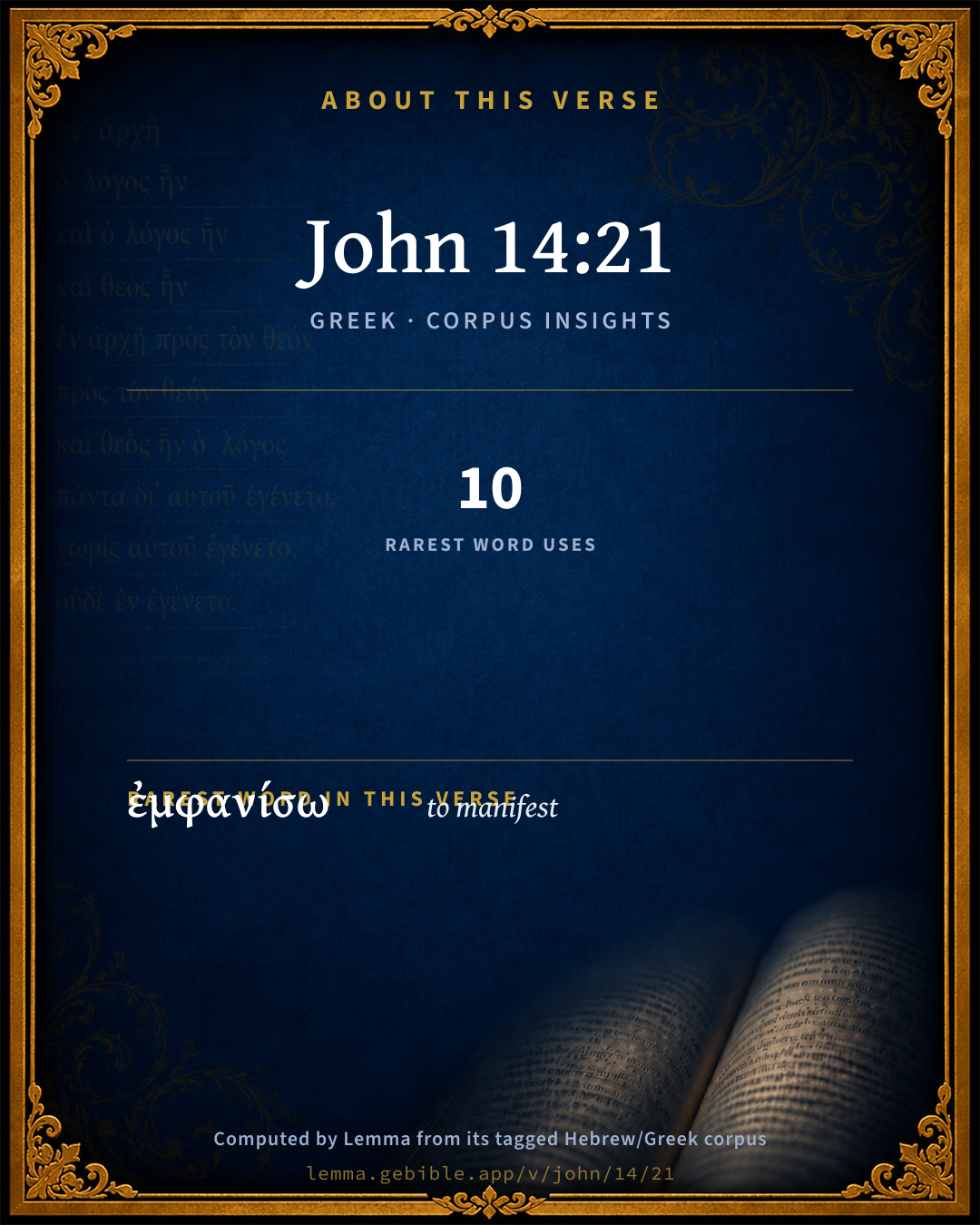
The rarest word here is ἐμφανίσω to manifest G1718 — appearing just 10 times in the whole Greek New Testament.

Shared distinctive vocabulary

ἐμφανίσω to manifest G1718 occurs in 10 verses of the Greek New Testament. Also found in:

Repetition

Words recur within this verse:

  • ἀγαπῶν to love G25 ×4
  • ὁ the G3588 ×5
  • μου I G1473 ×4
  • αὐτάς he G846 ×3
  • καὶ and G2532 ×2

Cross-references

39

Topical passages linked to John 14:21 in the Treasury of Scripture Knowledge — connected by theme and wording, ordered by reader-vote popularity; previews shown in the World English Bible.

  • John 14:15 If you love me, keep my commandments.
  • 1 John 5:3 For this is the love of God, that we keep his commandments. His commandments are not grievous.
  • 1 John 2:5 But whoever keeps his word, God's love has most assuredly been perfected in him. This is how we know that we are in him:
  • 2 John 1:6 This is love, that we should walk according to his commandments. This is the commandment, even as you heard from the beginning, that you should walk in it.
  • John 15:9–10 Even as the Father has loved me, I also have loved you. Remain in my love.
  • John 16:27 for the Father himself loves you, because you have loved me, and have believed that I came forth from God.
  • Deuteronomy 11:13 It shall happen, if you shall listen diligently to my commandments which I command you this day, to love Yahweh your God, and to serve him with all your heart and with all your soul,
  • Luke 11:28 But he said, "On the contrary, blessed are those who hear the word of God, and keep it."
  • Ezekiel 36:25–27 I will sprinkle clean water on you, and you shall be clean: from all your filthiness, and from all your idols, will I cleanse you.
  • 1 John 3:18–24 My little children, let's not love in word only, neither with the tongue only, but in deed and truth.
  • John 14:22–24 Judas (not Iscariot) said to him, "Lord, what has happened that you are about to reveal yourself to us, and not to the world?"
  • Deuteronomy 10:12–13 Now, Israel, what does Yahweh your God require of you, but to fear Yahweh your God, to walk in all his ways, and to love him, and to serve Yahweh your God with all your heart and with all your soul,
  • Deuteronomy 30:6–8 Yahweh your God will circumcise your heart, and the heart of your seed, to love Yahweh your God with all your heart, and with all your soul, that you may live.
  • Psalms 119:4–6 You have commanded your precepts, That we should fully obey them.
  • John 15:14 You are my friends, if you do whatever I command you.
  • 1 John 1:1–3 That which was from the beginning, that which we have heard, that which we have seen with our eyes, that which we saw, and our hands touched, concerning the Word of life
  • Revelation 3:20 Behold, I stand at the door and knock. If anyone hears my voice and opens the door, then I will come in to him, and will dine with him, and he with me.
  • John 17:23 I in them, and you in me, that they may be perfected into one; that the world may know that you sent me, and loved them, even as you loved me.
  • 2 Corinthians 4:6 seeing it is God who said, "Light will shine out of darkness," who has shone in our hearts, to give the light of the knowledge of the glory of God in the face of Jesus Christ.
  • James 2:23–24 and the Scripture was fulfilled which says, "Abraham believed God, and it was accounted to him as righteousness;" and he was called the friend of God.
  • Revelation 22:14 Blessed are those who do his commandments, that they may have the right to the tree of life, and may enter in by the gates into the city.
  • 2 Corinthians 5:14–15 For the love of Christ constrains us; because we judge thus, that one died for all, therefore all died.
  • Revelation 2:17 He who has an ear, let him hear what the Spirit says to the assemblies. To him who overcomes, to him I will give of the hidden manna, and I will give him a white stone, and on the stone a new name written, which no one knows but he who receives it.
  • Psalms 35:27 Let them shout for joy and be glad, who favor my righteous cause. Yes, let them say continually, "Yahweh be magnified, Who has pleasure in the prosperity of his servant!"
  • Isaiah 62:2–5 The nations shall see your righteousness, and all kings your glory, and you shall be called by a new name, which the mouth of Yahweh shall name.
  • Zephaniah 3:17 Yahweh, your God, is in the midst of you, a mighty one who will save. He will rejoice over you with joy. He will rest in his love. He will rejoice over you with singing.
  • 1 John 3:1 Behold, how great a love the Father has bestowed on us, that we should be called children of God! For this cause the world doesn't know us, because it didn't know him.
  • Genesis 26:3–5 Sojourn in this land, and I will be with you, and will bless you. For to you, and to your seed, I will give all these lands, and I will establish the oath which I swore to Abraham your father.
  • Jeremiah 31:31 Behold, the days come, says Yahweh, that I will make a new covenant with the house of Israel, and with the house of Judah:
  • Jeremiah 31:33–34 But this is the covenant that I will make with the house of Israel after those days, says Yahweh: I will put my law in their inward parts, and in their heart will I write it; and I will be their God, and they shall be my people:
  • 2 Corinthians 3:18 But we all, with unveiled face beholding as in a mirror the glory of the Lord, are transformed into the same image from glory to glory, even as from the Lord, the Spirit.
  • 2 Thessalonians 2:16 Now our Lord Jesus Christ himself, and God our Father, who loved us and gave us eternal comfort and good hope through grace,
  • John 14:18 I will not leave you orphans. I will come to you.
  • John 16:14 He will glorify me, for he will take from what is mine, and will declare it to you.
  • Acts 18:9–11 The Lord said to Paul in the night by a vision, "Don't be afraid, but speak and don't be silent;
  • 2 Timothy 4:17–18 But the Lord stood by me, and strengthened me, that through me the message might be fully proclaimed, and that all the Gentiles might hear; and I was delivered out of the mouth of the lion.
  • Acts 22:18 and saw him saying to me, 'Hurry and get out of Jerusalem quickly, because they will not receive testimony concerning me from you.'
  • 2 Timothy 4:22 The Lord Jesus Christ be with your spirit. Grace be with you. Amen.
  • 2 Corinthians 12:8 Concerning this thing, I begged the Lord three times that it might depart from me.

Cross-references courtesy of OpenBible.info (CC BY 4.0).

Commentary

Notes on John 14:21 from classic Christian and Jewish commentators (each source and its license shown beneath its notes). The classic Christian expositions comment on the surrounding passage and are grouped to its opening verse, so a note may address several verses; the Jewish commentaries on the Tanakh (Rashi and others) are per-verse, so they appear only where the commentator wrote on this verse.

Lemma curates 59 commentaries, every one of them public domain or Creative Commons licensed, each selected and text-cleaned for this edition rather than reprinted as found. About our sources →

The Biblical Illustrator

Joseph S. Exell

Joh_14:21

He that hath My commandments, and keepeth them, he it is that loveth Me

Love to Christ

I.

THE REASONS WHICH JUSTIFY ITS EXERCISE. If we love an object, it is because of something amiable in that object.

1. And is there not real excellency in Jesus Christ--the brightness of His Fathers glory, etc. He is altogether lovely!

2. Is He not nearly related to us (Heb_2:11; Mat_12:48-50)?

3. Is He not our Friend, our kindest and best Benefactor? He gave His life a ransom for us.

II. THE PROPERTIES BY WHICH IT IS DISTINGUISHED. It must be

1. Sincere (Rom_12:9).

2. Supreme. Love to any object should rise according to its worth.

3. Constant.

III. THE TEST BY WHICH IT IS ASCERTAINED. It is good to have the commandments of Christ, to be born in a land of Bibles; but this is not enough. He that hath them, and keepeth them, he it is that loveth Him. And what is this keeping the commandments of Christ? Do they keep them

1. Who are ignorant of them, and who discover little concern to become acquainted with them?

2. Who have no relish for them?

3. Who do not obey them?

IV. THE REWARD WITH WHICH IT IS CONNECTED.

1. The favour of the greatest Father.

2. The affection of the kindest Saviour.

3. The presence of the best Friend. From the whole, learn

1. The insufficiency of external privileges.

2. The honour which attends real Christianity.

3. The proper use of religious ordinances, and the spirit in which we should attend them. (T. Kidd.)

Love to Christ

I. THE OBEDIENCE WHICH IS THE SIGN AND TEST OF LOVE. The words are here substantially equivalent to Joh_14:15. Only the former begins with the root and traces it upwards to its fruits, love blossoming into obedience. Our text reverses the process. Note

1. How remarkably our Lord here declares the possession of His commandments to be a sign of love to Him. He that hath, etc. There are two ways of having: in the Bible, and in the heart; before my eye as a law that I ought to obey, or within my will, as a power that shapes it. And the latter is the only kind of having that Christ regards as real and valid. Love possesses the knowledge of the loved ones will. Do we not all know how strange is the power of divining desires that goes along with true affection, and how the power, not only of divining, but of treasuring, these desires is the thermometer of our true love. Some of us, perhaps, have laid away in sacred, secret places tattered yellow old bits of paper with the words of a dear one on them that we would not part with. He that hath My commandments laid up in lavender in the recesses of his faithful heart, he it is that loveth Me.

2. Obedience: There are two motives for keeping commandments, one, because they are commanded, and one because we love Him that commands. The one is slavery, the other is liberty. The one is like the Arctic regions, cold and barren, the other is like tropical lands, full of warmth and sunshine, glorious and glad fertility.

3. The form of the sentence suggests how easy it is for people to delude themselves about their love to Jesus Christ. That emphatic He, and the putting first of the character before He states its root, are directed against false pretensions to love. The love that Christ stamps with His hallmark is no mere emotion, however passionate and sweet; no mere sentiment however pure and deep. The tiniest dribble that drives a mill is better than a Niagara that rushes and foams and tumbles idly. And there is ever so much so-called love to Jesus Christ that goes masquerading up and down the world; from which the paint is stripped by the sharp application of the words of my text.

II. THE DIVINE LOVE AND MANIFESTATION WHICH REWARD OUR LOVE AND OBEDIENCE. Note

1. The extraordinary boldness of that majestic saying: If a man loves Me, My Father will love him. God regards our love to Jesus Christ as containing in it the germ of all that is pleasing in His sight. And so, upon our hearts, if we love Christ, there falls the benediction of the Fathers love.

2. Of course, our Lord here is not beginning at the very beginning of everything. We love Him because He first loved us digs a story deeper down than the words of my text. That being understood, here is a great lesson. It is not all the same to God whether a man is a scoundrel or a saint. Gods love is a moral love; and whilst the sunbeams play upon the ice and melt it sometimes, they flash back from, and rest more graciously and fully on, the rippling stream into which the ice has turned. God loves them that love Him not, but the depths of His heart and the secret sacred favours of His grace can only be bestowed upon those who love Christ and obey Him.

3. If, then, we seek to know that dear Lord, the path is plain. Walk on the way of obedience, and Christ will meet us with the unveiling of more and more of His love. To live what we believe is the sure way to increase its amount. To be faithful to the little is the certain way to inherit the much. He gives us His whole self at the first, but we traverse the breadth of the gift by degrees. The flower is but a bud when we get it, and as we hold it, it opens its petals to the light. (A. Maclaren, D. D.)

Obedience the proof of love

I. SOME WHO THINK THEY LOVE JESUS ARE MISTAKEN AS TO THE GENUINENESS AND SINCERITY OF THEIR LOVE TO HIM. There is an emphasis on He it is, singling Him out as the only real lover. Men may be misled as to the reality of their love.

1. By regarding strong, keen and frequent feelings of sorrow and compassion for Christ as an innocent sufferer, as evidence of true love. Such an emotion is an element in, but is not love.

2. By substituting an intellectual and moral admiration of Christ. But many infidels evince this.

3. By counting sufficient an outward and decorous attention to His laws and institutions. This is sufficient to keep from sins of a gross nature; but at the bottom it may be self-love, a bid for the worlds good opinion.

II. THEY ONLY WHO HAVE AND KEEP CHRISTS COMMANDMENTS TRULY LOVE HIM.

1. Having Christs commandments implies

(1) A recognition of them as of binding authority being enforced by His love.

(2) An intelligent appreciation of their meaning and spirit.

(3) Treasuring them in the head and heart.

2. Keeping them. We may have without keeping them. Practice and knowledge must keep step.

3. Here is

(1) A test of Christian profession (1Jn_2:3-5; 1Jn_5:1-3).

(2) A ground of comfort to doubting Christians. Their Lord does not insist on warm feelings which are fluctuating, but on obedience.

(3) An inducement to obedience. (A. Warrack, M. A.)

Obedience the sign of love

A king in ancient times made some wise laws for his people, and most of them loved and reverenced him as a father, but not all. Some who professed a great affection for him were very unwilling to obey him; and a few complained that his laws were too strict, and, whenever they could do so without fear of punishment, they broke them. Now the king had a country far off where troubles and tumults bad arisen, and the governor wrote to ask the king to go and visit his discontented people, and try if his own presence would win them to obedience and love. The king promised to go; but before he left, he gave every family a copy of the laws. He was away a long time, and on his return there were loud rejoicings. But when he came to his council chamber, there were some sad stories of rebellion and disobedience, not among the poor alone, but among the nobles, who had been louder than all the rest in their professions of love and songs of welcome. But when the king, having discovered the offenders, asked for a copy of the laws, and one by one read them to the rebels, they were confused and silent. Some, indeed, had lost the paper he had given them; some had wilfully burnt it, and declared that they would not obey; many had broken one or more of the rules. He was a gentle king, but firm and just; and so he gathered his disobedient subjects together, and looking sorrowfully at them, he gravely asked each, If he loved his sovereign? They all answered Yes, but on holding up a copy of his laws, they all hung down their heads. He that hath my laws and keepeth them, he said, he, and he only, loves me. So with Christs laws. (Mrs. Geldart.)

Christ known only to the loving

I. WE CANNOT KNOW CHRIST THROUGH THE INTELLECT. The intellect has tried for ages to find out God, and after all its investigations it has pronounced Him unknowable, The world by wisdom knew not God.

II. WE CANNOT KNOW CHRIST THROUGH THE IMAGINATION. Imagination has filled the world with myths, superstitions and idols, but has never, unaided by the heart, found Christ.

III. WE CANNOT KNOW CHRIST THROUGH AN EXCITED CONSCIENCE. Conscience has formulated a god of vengeance. Christ is God and reveals Himself to the loving. (Homiletic Monthly.)

Character and privilege of true Christians

I. THE PECULIAR CHARACTER OF TRUE CHRISTIANS.

1. They love Christ.

(1) They love Himself

(a) As a Divine person, glorious in moral perfection and loveliness.

(b) As the incarnate Divinity, the image, of Him whom we should love with all the heart, and soul, and strength.

(c) As the God-man Mediator, the Only-begotten of Him whose name and nature is love.

(d) As the man, Christ Jesus, possessed of every quality which can command esteem and excite love.

(2) This love extends to everything in the Saviour--His holiness, as well as His grace; His laws, as well as His promises; the yoke He lays on them, as well as the crown He is to confer; His house, His word, His day, His people, His cause.

(3) This love leads them to seek intercourse with Him; they cannot be happy away from Him.

(4) This love is common to all the saints. They have not all the same measure of it--that depends on the measure of their knowledge and faith and capacity of affection; but they have all the same kind of love.

(5) And as this love is common to all the saints, so it is peculiar to them. To the unbelieving world He has no form nor comeliness, etc.

2. They have His commandments, words, sayings. These are not to be confined to what was preceptive in our Lords teaching; they include all His communications.

(1) To have is something more than to possess the Bible, or even to have a general knowledge of its contents. It is to have it in the mind and the heart.

(2) They who receive our Lords words cannot but love Him, for they, in the degree in which they receive them, know and believe Him to be the proper object of supreme affection.

3. They keep His commandments. As it is by having the words of Christ that men come to love Him, so it is by keeping His words that they manifest and prove their love to Him. They must be kept

(1) As He gives us them. We must not detract from them, nor add to them, nor modify them (Deu_4:2).

(2) In the mind. There are men who find it disquieting to them, and seek to get rid of it as soon as possible. There are others who, ceasing to give it any attention, suffer it to slip out of their mind. And there are others who permit, who invite, the wicked one to come and take away what was sown in their hearts. But the lover of Christ lets the word of Christ dwell in his heart, and often reviews it as his most precious treasure.

(3) By our having no other opinions on the subjects to which they refer than those unfolded in them, and by fashioning the whole system of our sentiments and judgments with a reference to them.

(a) The promises are to be kept by firmly believing them in the most trying circumstances.

(b) The warnings are to be kept by keeping at a distance from their subjects, and by cherishing a habitual holy fear of sin.

(c) His commandments, with regard to tempers and dispositions, are to be kept by keeping our hearts with all diligence.

(d) Those with regard to our general conduct are to be kept by our not following the course of this world, but walking according to the will of God.

(e) Those with regard to institutions are to be kept by observing all things whatsoever He has commanded.

II. THEIR PECULIAR PRIVILEGES.

1. They are loved of the Father and the Son.

(1) As elected in sovereign love to eternal life.

(2) As actually united to Christ by believing.

(3) As transformed and sanctified by the Holy Spirit.

2. This love is discovered in the Sons manifesting Himself to them, and in the Father and the Son coming to them, and making their abode with them.

III. THE CONNECTION BETWEEN THE TWO.

1. He only who possesses the character can enjoy the privilege.

2. He who possesses the character must enjoy the privilege.

3. The measure in which the character is possessed is the measure in which the privilege is enjoyed. The more a man loves Christ, the more must both God and Christ love him. (J. Brown, D. D.)

The secret of self-consecration

Here is the secret of self-consecration: in our being possessed by the love of Christ; and feeling--He loves me more than I love Him. Possessed by this love, I yield myself wholly and joyfully to Him. My hand is His, redeemed by Him, sacred to Him, and cannot do unholy work; my foot is His, and cannot go on unholy errands; my ear is His, and cannot listen to unholy words; my eye is His, and cannot look upon unholy deeds; my tongue is His, and cannot utter unholy speeches; my mind is His, and cannot think unholy thoughts; my heart is His, and cannot cherish unholy feelings and desires; my whole being is His, redeemed by Him, sacred to Him, and is surrendered to His will. (J. Culross, D. D.)

Practical religion

Since a vestment ornamented with gold is a beautiful and conspicuous object, but seems much more so to us when it is worn upon our own persons, thus also the precepts of God are beautiful when but praised, but appear far more lovely when they are rightly observed, and conspicuous in our own life. (T. H. Leary, D. C. L.)

The Biblical Illustrator, edited by Joseph S. Exell (c. 1880s–1900s) — public domain. Text from a community e-Sword module.

Bengel's Gnomon

Johann Albrecht Bengel

Joh 14:21. Ἐγὼ, I) likewise as My Father.—ἀγαπήσω αὐτὸν, καὶ ἐμφανίσω αὐτῷ ἐμαυτὸν) Exo 33:13, εἰ οὖν εὕρηκα χάριν ἐναντίου σου, ἐμφάνισόν μοι σεαυτὸν, If therefore I have found grace in Thy sight, manifest Thyself to me.

Bengel's Gnomon of the New Testament — English translation (T&T Clark, Edinburgh, 1860) — public domain. Text from a community e-Sword module.

Expositor's Greek Testament

ed. W. Robertson Nicoll

Joh 14:21 . The conditions on which depended the manifestation of the departed Christ are then exhibited, ὁ ἔχων … ἐμαυτόν . The love to which Christ promises a manifestation of Himself is not an idle sentiment or shallow fancy, but a principle prompting obedience, ὁ ἔχων τὰς ἐντολάς μου , cf. 1Jn 2:7 ; 1Jn 4:21 , 2Jn 1:5 ; it means more than “hearing,” and is yet not equivalent to τηρῶν ; it seems to point to the permanent possession of the commandments in consciousness. This finds its appropriate expression in τηρῶν αὐτάς “keeping them,” observing them in the life. This is the expression and proof of love, and this love finds its response and reward in the love of the Father and of the Son, and in the manifestation of the Son to the individual. The appropriateness of introducing the Father and His love appears in Joh 14:24 . The love of Christ is that which prompts the manifestation. ἐμφανίσω , the word is used by Moses in Exo 33:13 . Reynolds says: “This remarkable word implies that the scene or place of the higher manifestation will be in ( ἐν ) the consciousness of the soul”. The word however is currently used for outward manifestation; although here the manifestation alluded to is inward. Cf. Judas’ words. The nature of the manifestation has already been explained, Joh 14:19 .

The Expositor's Greek Testament, edited by W. Robertson Nicoll (1897–1910) — public domain. Text from a community e-Sword module.

Godet's Commentaries

Frédéric Louis Godet

Vv. 21 states with preciseness the manner of this illumination. Jesus had said summarily, Joh 14:15 : “Keep my commandments, and I will pray the Father.” Here he enumerates in detail all the links of the chain of graces which will be connected with this practical fidelity of His followers: It is necessary to hold inwardly (ἔχειν) His word, and toobserve it practically (τηρεῖν); this is not done by the world, which has heard it, but rejected it; for this reason it is not fitted to receive these higher graces.

By means of this moral fidelity,

1. Such an individual (ἐκεῖνος, that exceptional man) assumes the character of a being who truly loves Jesus (ὁ ἀγαπῶν με).

2. Hence he becomes the beloved of the Father, who, loving the Son, also loves whoever makes Him the object of his love. This love of the Father is not that which is spoken of in Joh 3:16 : “God so loved the world.” These two loves differ as the compassion of a man for his guilty and wretched neighbor and the tender affection of a father for his child, or a husband for his wife, differ.

3. The Son, seeing the eye of the Father turning with tenderness towards the disciple who loves Him, feels Himself united with the latter by a new bond (“and I will love him”); He loves him still more tenderly in proportion as He sees the love of the Father enveloping him.

4. Finally, from all this follows the supreme miracle of the love of the Father and the Son: the perfect revelation which Jesus gives to the disciple of Himself: I will manifest myself to him.

This is the condition of the you shall know, Joh 14:20. This altogether extraordinary term ἐμφανίζειν refers to the inward manifestation of the Messiah. It will not by any means suit the external and passing appearances of the Risen One, to which even Weiss gives up referring it; but to substitute what? Certain manifestations of the nearness of Jesus granted to His disciples in the course of their life, like that of the Lord to Moses (Exo 33:13; Exo 33:18); “but in any case not by means of the Spirit,” adds this interpreter. And yet the asyndeta after Joh 14:17 prove, by themselves alone, that Jesus is here developing the promise of the gift of the Spirit; and Joh 14:23 shows clearly enough what Jesus means to speak of in Joh 14:21. It is precisely this wholly inward character of the manifestation described in Joh 14:21 which calls forth the question of Judas in Joh 14:22.

In the face of these interruptions of the disciples, Gess compares Jesus to a skilful pilot who does not suffer himself to be turned aside by the rushing waves, but by a prompt stroke of the helm gives each time to the ship the desired direction.

Frédéric Louis Godet — Commentaries on Luke, John, Romans, and 1 Corinthians — English translation (T&T Clark, Edinburgh, 1870s–1890s) — public domain. Text from a community e-Sword module.

Geneva Bible (1599)

Geneva Bible translators

I will show myself to him, and be known of him, as if he saw me with his eyes: but this showing of himself is not bodily, but spiritually, yet so plain as none can be more.

Geneva Bible (1599) marginal notes — public domain. Text via Bolls.life.

Jamieson, Fausset & Brown

Robert Jamieson, A. R. Fausset & David Brown

He that hath my commandments and keepeth them, &c.--(See on Joh 14:15).

my Father and I will love him--Mark the sharp line of distinction here, not only between the Divine Persons but the actings of love in Each respectively, towards true disciples.

Jamieson, Fausset & Brown — Commentary Critical and Explanatory on the Whole Bible (1871) — public domain (CC PDM 1.0). Text via the HelloAO Bible API.

Adam Clarke's Commentary

Verse 21. He it is that loveth me] See Clarke on Joh 14:15.

And will manifest myself to him.] All my faithful disciples shall see me after my resurrection; and I will manifest my power and goodness to all those who believe in and obey me, even to the end of the world.

Adam Clarke's Commentary on the Bible (1810–1826) — public domain. Text from a community e-Sword/MySword module.

John Calvin's Commentaries

21. He who hath my commandments. He again repeats the former statement, that the undoubted proof of our love to him lies in our keeping his commandments; and the reason why he so frequently reminds the disciples of this is, that they may not turn aside from this object; for there is nothing to which we are more prone than to slide into a carnal affection, so as to love something else than Christ under the name of Christ. Such is also the import of that saying of Paul,

Though we have known Christ after the flesh, yet henceforth we know him no longer in this manner. Let us therefore be a new creature, (2 Corinthians 5:16, 17.)

To have his commandments means to be properly instructed in them; and to keep his commandments is to conform ourselves and our life to their rule.

And he that loveth me will be loved by my Father. Christ speaks as if men loved God before he loved them; which is absurd, for,

when we were enemies, he reconciled us to him, (Romans 5:10;)

and the words of John are well known,

Not that we first loved him, but he first loved us, (1 John 4:10.)

But there is no debate here about cause or effect; and therefore there is no ground for the inference, that the love with which we love Christ comes in order before the love which God has toward us; for Christ meant only, that all who love him will be happy, because they will also be loved by him and by the Father; not that God then begins to love them, but because they have a testimony of his love to them, as a Father, engraven on their hearts. To the same purpose is the clause which immediately follows: —

And I will manifest myself to him. Knowledge undoubtedly goes before love; but Christ’s meaning was, I will grant to those who purely observe my doctrine, that they shall make progress from day to day in faith; “that is, “I will cause them to approach more nearly and more familiarly to me.” Hence infer, that the fruit of piety is progress in the knowledge of Christ; for he who promises that he will give himself to him who has it rejects hypocrites, and causes all to make progress in faith who, cordially embracing the doctrine of the Gospel, bring themselves entirely into obedience to it. And this is the reason why many fall back, and why we scarcely see one in ten proceed in the right course; for the greater part do not deserve that he should manifest himself to them It ought also to be observed, that a more abundant knowledge of Christ is here represented as an extraordinary reward of our love to Christ; and hence it follows that it is an invaluable treasure.

John Calvin's Commentaries (1540-1563) — public domain. Text from the Calvin Translation Society English edition (1840s-50s) via the Christian Classics Ethereal Library (ccel.org). Calvin's coverage is partial (roughly two-thirds of the Bible); uncommented books and verses are honest gaps, never fabricated. The 19th-century editor's footnotes and remarks are omitted so the notes are faithfully Calvin's own voice.

Ellicott's Commentary for English Readers

(21) He that hath my commandments.—Comp. Joh_14:15 and Joh_5:36. This verse points out the successive degrees which led up to the full manifestation of Christ. The first step is the moral apprehension and practical observance of our Lord’s commandments, which necessarily result from love to Christ.

He it is that loveth me.—The next step is the special receptivity of the Father’s love which he who loves Christ possesses, and therefore there is a special sense in which the Father loves him. The words express with fulness of emphasis, “He it is, and he only.”

And I will love him, and will manifest myself to him.—The special love of the Son follows from the special love of the Father, and is accompanied by the full manifestation of the Son. This is further explained in Joh_14:23.

A Bible Commentary for English Readers, edited by Charles John Ellicott (1878–1897) — public domain. Text from a community e-Sword module.

The Cambridge Bible for Schools and Colleges

gen. ed. J. J. S. Perowne

21. hath my commandments, and keepeth them] Bears them in his mind and observes them in his life.

he it is] With great emphasis; he and no one else.

will manifest myself to him] Once more willing obedience is set forth as the road to spiritual enlightenment (see on Joh_7:17). The word for ‘manifest’ is not S. John’s favourite word (phaneroun) but one which he uses only in these two verses (emphanizein).

The Cambridge Bible for Schools and Colleges (gen. ed. J. J. S. Perowne; Cambridge University Press, 1878–1918) — public domain. Text from a community e-Sword module.

John Gill's Exposition

He that hath my commandments, and keepeth them,.... He that has not merely the external revelation of them in the Bible; but has them written on his heart, by the finger of the Spirit of God, and keeps them under the influence of grace and strength received from him:

he it is that loveth me: others may talk of loving Christ, but this is the man that truly does love him; for his observance of Christ's commands is a proof and evidence that he loves him not in word only, but in deed and in truth: and to encourage souls to love and obedience, Christ adds,

he that loveth me, shall be loved of my Father; not that love to is the cause, condition, or motive of the Father's love to his people; nor does his love to them begin when they begin to love Christ; but this expression denotes some further and greater manifestation of the Father's love to such persons, and shows how grateful to the Father are love and obedience to the Son:

and I will love him; which must be understood in the same manner; Christ does not begin to love his people when they begin to love, and obey him; their love and obedience to him, spring from his love to them; which love of his towards them was from everlasting: but this phrase signs a clearer discovery of his love to them, which passeth knowledge; and some fresh mark and token of his affection for them; and which is explained in the next clause:

and will manifest myself to him; not in a visible way, or in a corporeal form, as he did to his disciples after his resurrection; but in a spiritual manner, as when he makes himself known to his people in ordinances, and favours them with communion with him, and they see his beauty, his fulness, his grace and righteousness, his power, and his glory.

John Gill's Exposition of the Whole Bible (1746–1763) — public domain (CC PDM 1.0). Text via the HelloAO Bible API.

Trapp's Complete Commentary

John Trapp

21 He that hath my commandments, and keepeth them, he it is that loveth me: and he that loveth me shall be loved of my Father, and I will love him, and will manifest myself to him.

Ver. 21. And I will love him, and manifest, &c.] Increase of the saving knowledge of Christ is promised as a singular reward of our love to him and fruit of his love to us, εμφανισω, tacite et clam indicabo. By quietness and silence I will point out. (Eras.) Imo palam et in media luce. No indeed, openly and is the midst of light, Beza. This is, saith Agur, "to ascend into heaven," Pro 30:3-4. This is, saith our Saviour elsewhere, the great talent of all others. There is a "much" in it, Luk 12:48. This is, saith St Paul, the Christian’s riches, 1Co 1:5; and David reckons of his wealth by it, Psa 119:32.

John Trapp, A Commentary or Exposition upon All the Books of the Old and New Testament (1647–1656) — public domain. Text from a community e-Sword module.

Albert Barnes' Notes on the Bible

He that hath ... - This intimate union is further manifested by these facts:

That true love to Jesus will produce obedience. See Joh 14:15. That those who love him will be loved of the Father, showing that there is a union between the Father and the Son. That Jesus also will love them, evincing still the same union. Religion is love. The love of one holy being or object is the love of all. The kingdom of God is one. His people, though called by different names, are one. They are united to each other and to God, and the bond which unites the whole kingdom in one is love.

Will manifest myself to him - To manifest is to show, to make appear, to place before the eyes so that an object may be seen. This means that Jesus would so show himself to his followers that they should see and know that he was their Saviour. In what way this is done, see Joh 14:23.

Albert Barnes' Notes on the Bible (1834–1885) — public domain. Text from a community e-Sword/MySword module.

Haydock's Catholic Bible Commentary

Now that Christ in this place speaks only of this imperfect union of affection, appears by the following words: he that keepeth my commandments, loveth me: and he that loveth me, shall be loved by my Father, and I will love him, by a recompense of glory in the next life. (Witham)

George Leo Haydock (1774–1849), Haydock's Catholic Family Bible and Commentary, 1859 edition — public domain. Excludes Psalms (Douay-Rheims chapter numbering differs from Protestant) and Deuterocanonical books (Catholic canon only).

Matthew Poole's English Annotations

He that hath my commandments and keepeth them, he it is that loveth me: our Lord here doth repeat what he had before said, Joh 14:15, declaring that there is no infallible indication of our love to Christ, but obedience, which is here expressed under two notions.

1. Having Christ’s commandments and keeping them: they must both concur to make a true indication of our love to Christ. It is possible that men may have Christ’s commandments in their ears, in their notion, in their mouths, and yet not keep them; they may hear them, they may know and remember them, they may talk of them, yet they may not keep them; for keeping them denotes universal, diligent and industrious, steady and constant obedience to them; and this alone will speak our love to Christ.

2. And if any man thus declareth his love to Christ, Christ declareth, that both he and his Father will take a pleasure and delight in him to do him good; and he shall not live only under the real benefits of his love to him, but under the sensible manifestations of it. Here is no mention of the Spirit’s coming with the Father and the Son, because the Son dwelleth in us by the Spirit.

Matthew Poole's English Annotations on the Holy Bible (1683–1685) — public domain. Text from a community e-Sword/MySword module.

Whedon's Commentary on the Bible

Daniel D. Whedon

21. Hath my commandments, and keepeth—Hath them in his knowledge, and keepeth them in his practice.

He it is that loveth me—For there can be no true keeping Christ’s commandments which springs not from love to Christ; and there is no true love to Christ which does not produce a keeping of his commandments.

Will manifest myself unto him—And this is the true witness of the Spirit with our spirits that we are born of God. This manifestation of Christ to the soul is self-evidencing. There may be false imaginations, just as there may be dreams; but these false imaginations can no more, invalidate or destroy the certainty of that manifestation, than dreams can destroy the certainty of any reality viewed by our waking senses. He who does not recognize from his own inner feelings what this manifestation of Christ to the soul is, stands in great need of a deeper religious experience. It behooves him well to look to it that his interest in Christ is real.

Daniel D. Whedon (gen. ed.), Commentary on the Old and New Testaments (1874–1909) — public domain. Text from a community e-Sword module.

The Pulpit Commentary

Then for a moment he turns from the eleven, and stretches out his searching gaze and far-sweeping love to every one who hath my commandments as a sure possession and lofty privilege and sufficient standard, and keepeth them , thus proving that he it is that loveth me; returning thus back to Ver. 15, where he said that love would induce and ought to compel to obedience; and he adds another and wonderful benediction: He will be loved by my Father, in a sense more intense than that in which God is said to love the world. (Joh_3:16) God the Father loves those who love the Son, i.e. love the object of his own superlative affection. But who can this wondrous Being be who adds, as a climax of privilege and honor, as though it were more even than the love of the Father, I will love him, and will manifest myself in him (not apokaluqw or fanerwsw), not merely "disclose an undiscovered presence" or make evident a hidden glory, but I will take special means to disclose my Person and nature and goodness to him? Christ will do this to those who have and keep his commandments of self-forgetting love and perfect consecration. This remarkable word, emfanisw , implies that the scene and place of the higher manifestation will be in" (en) the consciousness of the soul. "The kingdom of God is within men.

The Pulpit Commentary (1880–1919), ed. H.D.M. Spence-Jones & Joseph S. Exell — public domain. Text from a community e-Sword module.

John Wesley's Explanatory Notes

He that hath my commandments - Written in his heart. I will manifest myself to him - More abundantly.

John Wesley, Explanatory Notes Upon the Whole Bible (1754–1765) — public domain. Text via the GEBible commentary corpus.

Kretzmann's Popular Commentary

Paul E. Kretzmann

The effects of the mystical union:

v. 21. He that hath My commandments and keepeth them, he it is that loveth Me; and he that loveth Me shall be loved of My Father, and I will love him, and will manifest Myself to him.

v. 22. Judas saith unto Him, not Iscariot, Lord, how is it that Thou wilt manifest Thyself unto us and not unto the world?

v. 23. Jesus answered and said unto him, If a man love Me, he will keep My words; and My Father will love him, and We will come unto him, and make Our abode with him.

Not the having only, but the keeping of the commandments of Christ is an evidence and proof of faith. For the love of Christ, which grows from faith, is a principle prompting obedience. There must be evidence and expression of faith by observing the commandments of Christ in life. But where a person is found with such proofs of the faith of his heart, he would receive a wonderful proof and manifestation of the love of both Father and Son. The love of the Father will rest upon, be communicated to, such a one. And Jesus Himself will show the greatness of His love by appearing and manifesting Himself to the believer as the Son of God and the Savior of the world. This is a most comforting promise. For a believer does not always live and move in blissful emotions, but is troubled more or less often by doubts concerning His salvation and other matters pertaining to His Christian life. In such cases, however, he must cling firmly to the Word and its promises, continue his work for Christ with undiminished vigor, and know that Christ is his Savior in spite of all attacks. Judas Jacobi here interrupted the Master. He had understood so much from the exposition of Jesus that the hope of the disciples for a temporal Messianic kingdom would not be realized. He wanted to know now why Christ intended to manifest Himself only to His believers, and not to the whole world, perhaps in the form of a conquering hero. Judas (Lobbies or Thaddeus) had always held that opinion concerning Messianic glory that it would be in the nature of a great demonstration, with much display of temporal power. He could not understand what had prompted Jesus to determine it otherwise. Once more Jesus, therefore, patiently explains. It is impossible for Him to reveal Himself to the world, because the world rejects Him and His Word. But if any man, filled with true faith toward Him, now also shows his faith in love, the proof will be found in the fact that he keeps His Word, that he clings to the Gospel of grace and mercy. To him Jesus and the Father will come, in him They will make Their abode, through the Spirit; his house and table Companions They will be forever. That is the mystery and the beauty of the mystical union. The Triune God Himself, personally, lives in the hearts of the believers, not only with some manifestation of His power and strength, but with His actual essence. There is no need for the Christian to sigh longingly for the union with the Triune God in heaven, for His throne is also right here on earth, wherever his Word is preached and He enters into the hearts of the believers. That is a blessed mystery and a glorious fact.

Paul E. Kretzmann, Popular Commentary of the Bible (1921–1924) — public domain. Text from a community e-Sword module.

Burkitt's Expository Notes on the New Testament

William Burkitt

Our blessed Saviour in these words repeats what he had before enjoined at verse 15, namely, to evidence the sincerity of our love to him, by the universality of our obedience to his commands: He that hath my commandments, and keepeth them, he it is that loveth me.

Where note, 1. The necessity of knowledge in order unto practice.

2. The necessity of practice in order unto happiness. We must first have Christ’s commandments, before we can keep them: we must have them in our understandings and judgments, in our wills and affections; not have them only in our eyes to read, in our ears to hear, or in our mouths to talk of them but to hide them in our hearts, that we may not sin against Christ, in the willful violation of them.

Farther, we must keep, as well as have, these commandments. This denotes an universal, diligent, and pesevering obedience to them.

Hence learn, That although many loose professors pretend love to Christ, because they hear, read, know, and can talk of, his commandments; yet in Christ’s account none do truly love him, but those who make conscience of their obedience to him: He that hath my commandments, and keepeth them, he it is that loveth me.

Observe next, The gracious promise of Christ to such as thus express their love unto him.

1. He shall be loved of my Father, and of myself.

And shall he not be loved of the Holy Ghost too? Yes, no doubt. But why is he not named then? Because the Son dwelleth in us by the Spirit, and shed his love abroad in our hearts by the Holy Ghost.

2., I will manifest myself unto him: that is, such obedient Christians shall not only enjoy the fruit and benefit of my love, but they shall enjoy the sense of my love, and experience the sensible manifestations and inward diffusions of my love in their own souls.

Learn hence, That the only way to have Christ love us, and to let out his love upon us, and to know that he loves us is to look diligently to our obediential walking with him and before him. We may as rationally think to nourish our bodies with poison, as to enjoy the manifestation of Christ’s love in a way of sin.

William Burkitt's Expository Notes on the New Testament (1700–1703) — public domain. Text from a community e-Sword module.

The People's New Testament

B. W. Johnson

21–23. He that hath my commandments, etc. The conditions on which Christ will be present in each soul, seen, and enjoyed, are here given: (1) One must love Christ; (2) so love him that he will obey from the heart his commandments; (3) this loving, obedient soul will be loved of the Father; (4) Christ will love him; (5) both the Father and the Son will manifest themselves to him; (6) this manifestation is by their coming and abiding in him through the Helper.

B. W. Johnson's The People's New Testament with Notes (1889–1891) — public domain. Electronic text from the Christian Classics Ethereal Library (CCEL) ThML edition.

unfoldingWord translationNotes

Door43 World Missions Community

loves

This kind of love comes from God and focuses on the good of others, even when it does not benefit oneself. This kind of love cares for others, no matter what they do.

he who loves me will be loved by my Father

You can translate this in an active form. AT: "my Father will love anyone who loves me" (See: Active or Passive)

my Father

This is an important title for God. (See: Translating Son and Father)

Judas (not Iscariot)

This refers to another disciple whose name was Judas, not to the disciple who was from the village of Kerioth who betrayed Jesus. (See: How to Translate Names)

why is it that you will show yourself to us

Here the word "show" refers to revealing how wonderful Jesus is. AT: "Why will you reveal yourself only to us" or "Why will you only let us see how wonderful you are?"

not to the world

Here "world" is a metonym that represents the people who oppose God. AT: "not to those who do not belong to God" (See: Metonymy)

translationWords

command

love

God the Father

world

unfoldingWord translationNotes — © Distant Shores Media and the Door43 World Missions Community, licensed CC BY-SA 4.0. Source: git.door43.org/Door43/en_tn.

Cambridge Greek Testament for Schools and Colleges

21. ἔχων … τηρῶν. Bearing them steadfastly in his mind and observing them in his life. Ἐκεῖνος, with great emphasis (see on Joh 1:18); he and no else.

ἐμφανίσω. Once more, as in Joh 7:17, willing obedience is set forth as the road to spiritual enlightenment. Ἐμφανίζειν (here only in S. John) is stronger than φανεροῦν.

Cambridge Greek Testament for Schools and Colleges (Cambridge University Press, 1896; 21 vols, various authors incl. Carr, Maclear, Plummer, Farrar, Lumby, Moule, M. R. James, Simcox) — public domain. Text from a community e-Sword module.

Alford’s Greek Testament

Henry Alford

21.] ἔχων κ. τηρῶν, “qui habet in memoria et servat in vita.” Aug. in loc. Or perhaps more accurately (with Stier). “He who has my commandments, as being my disciple by outward profession (not thus only: but holds them, by the inner possession of a living faith. So Meyer), and keeps them:” see Luk 11:28. And τηρ. is more of the inner will to keep them, than the absolute observance, which can only follow on high degrees of spiritual advancement.

ἐμφ. αὐτ. ἐμ., by the Holy Spirit: see ch. 16:14. This (as Stier observes) is the highest promise which can be made to man (see ver. 23), and yet it is made to every man who ἔχει κ. τηρεῖ the commandments of the Lord Jesus. Cf. Exod. in reff.

Henry Alford, The Greek Testament (1849–1861) — public domain. Text from a community e-Sword module.

International Critical Commentary

21. What has heretofore been said in terms primarily applicable to the listening disciples is now said more generally. The teaching of v. 21 is for all future believers. Not only for the apostles, but for every disciple, the sequence of spiritual experience is Obedience, Love, Life, Vision.

ἔχων τὰς ἐντολάς (the phrase does not occur again) is to have them in one’s heart, to know them and apprehend their meaning; but τηρεῖν τὰς ἐντολάς is to keep them, which is a harder thing. See on v. 15 above, where (as at v. 23) it is said that love issues in obedience; here the point is, that obedience is the proof of love.

ἐκεῖνος: he it is (and no other) who loves me.

ὁ δὲ ἀγαπῶν με ἀγαπηθήσεται ὑπὸ τοῦ πατρός μου. This has been said before at 16:27, where φιλεῖν was used instead of ἀγαπᾶν (but see on 21:15), and where, in accordance with Jn.’s usual style, the active voice (ὁ πατὴρ φιλεῖ ὑμᾶς) was preferred to the passive. Abbott (Diat. 1885j) notes that in this verse is the only instance in Jn. of ὑπό followed by a genitive of the agent.

κἀγὼ ἀγαπήσω αὐτόν. Cf. Pro 8:17.

καὶ ἐμφανίσω αὐτῷ ἐμαυτόν. ἐμφανίζειν (in Jn. only here and at v. 22) is used as in Exo 33:13, Exo 33:18 of a special manifestation of the Divine; cf. also Wisd. 1:2, 17:4, Mat 27:53. The reference is to that fuller revelation of Christ which will be made through the Spirit’s illumination: cf. 16:14.

Jude Asks Why Jesus Will Not Manifest Himself to the World; No Direct Answer is Given, the Former Teaching Being Repeated (vv. 22-24)

International Critical Commentary — older volumes (1896–1929), various authors — public domain. Text from a community e-Sword module.

Vincent's Word Studies in the New Testament

Marvin R. Vincent

Hath. "Who has in memory and keeps in life" (Augustine).

Will manifest [εμφανισω] . Properly, of manifestation to the sight, as distinguished from dhlow, to make evident to the mind (1Co 3:13; Col 1:8, etc.). A clear, conspicuous manifestation is indicated. Compare ye see me (ver. 19). "It conveys more than the disclosing of an undiscovered presence [αποκαλυπτω] , or the manifesting of a hidden one [φανεροω] " (Westcott).

Marvin R. Vincent, Word Studies in the New Testament (1887–1900) — public domain. Text from a community e-Sword/MySword module.

Lesson kit

Teaching starters — assembled from the data on this page, not authored interpretation. Every prompt links to the verse data it draws on. Edit before teaching.

John, in the Gospels, opens this verse with 29 words (16 distinct Greek lemmas). Its most distinctive word is emphanízō (“to manifest”). A historical commentator’s framing appears above. Read the whole chapter for the surrounding context.

Discussion questions

  1. How does “to manifest” (emphanízō) shape what this verse is saying?
  2. How does Matthew 27:53, which shares the word «to manifest», read alongside this verse?
  3. What does the repetition of “to love” (4× in this one verse) do in this verse?
  4. The translations on this page render this verse differently — a whole-verse word diff, not a word-by-word alignment. What might account for the different wordings?
  5. Compare how The Biblical Illustrator and Bengel's Gnomon read this verse. Where do they agree or differ?

Things to notice

Reading settings

Reading text

Shown beneath each verse's original-language words.

Old Testament
Old Testament edition

Read the OT as the Masoretic Hebrew (MT) or the Greek Septuagint (LXX).

English shown for the Greek Septuagint (in the Hebrew ↔ Greek comparison).

Comparing translations? Open the Compare panel on any verse page to stack up to four side by side.