
John 8:44

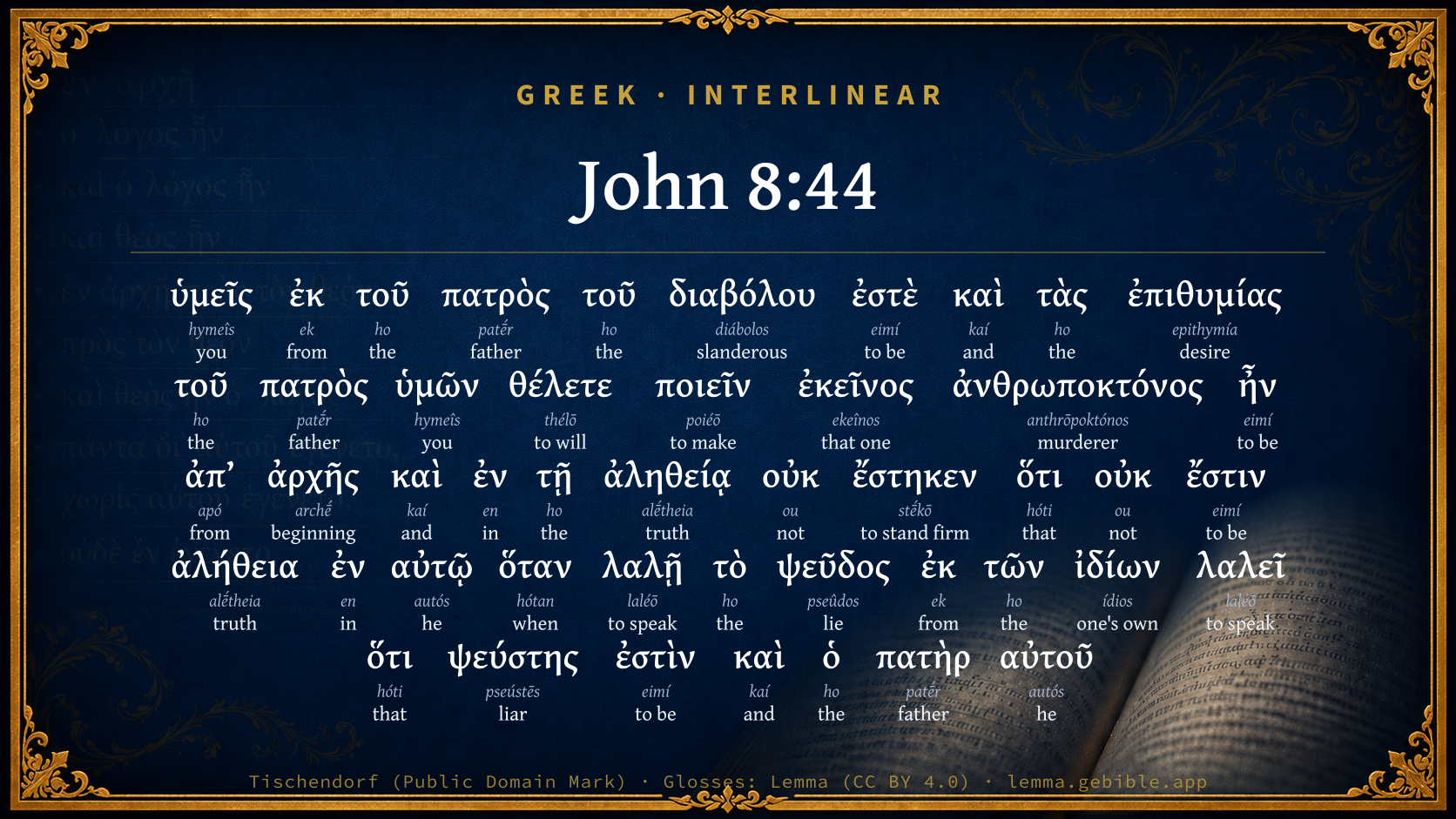
Greek (Tischendorf 8th ed.) John 8:44 appears in the Greek New Testament. The text above is from the Tischendorf 8th edition. Each word links to its Strong’s number and a concise gloss. Click any word for its full Thayer’s Greek Lexicon entry.
Download image
Cite this verse

John 8:44 (World English Bible). Public Domain. Lemma interlinear Bible study tool, https://lemma.gebible.app/v/john/8/44.

Show BibTeX & RIS
BibTeX
RIS
English Translation
You are of your Father, the devil, and you want to do the desires of your father. He was a murderer from the beginning, and doesn't stand in the truth, because there is no truth in him. When he speaks a lie, he speaks on his own; for he is a liar, and the father of it.
World English Bible · Public Domain
Highlights
  • 3 first appearances in the Greek New Testament
Full analysis ↓
Download a study sheet

One document with this verse’s original text, its word-by-word gloss line, the meaning frame, cross-references with their text, attributed commentary, and full source and license credits — printable, and it pastes into notes with its structure intact.

This verse Autodidact and up

Study sheet (.html) Plain text (.txt)

A passage Seminary Student

Up to 50 verses in one chapter. A passage sheet keeps up to 6 commentary sources and 12 cross-references per verse, in the order this page ranks them, and says so on the sheet whenever that leaves anything out. Ask for a single verse and you get the Autodidact verse sheet above.

Everything on this page stays free to read, with no account — the sheet is a download of what is already on screen, not access to it.

Want to remove ads? Support Godless Engineer
Compare translations 3

The same verse in 3 English versions, stacked beneath the original-language interlinear above. Click any original word for its lexicon entry.

Each is an independent rendering of the whole verse — the interlinear is not word-aligned to these translations.

Highlighted words mark where these versions differ — a whole-verse word diff, not a word-by-word alignment.

  • World English Bible Public Domain
    You are of your Father, the devil, and you want to do the desires of your father. He was a murderer from the beginning, and doesn't stand in the truth, because there is no truth in him. When he speaks a lie, he speaks on his own; for he is a liar, and the father of it.
  • King James Version Public Domain
    Ye are of your father the devil, and the lusts of your father ye will do. He was a murderer from the beginning, and abode not in the truth, because there is no truth in him. When he speaketh a lie, he speaketh of his own: for he is a liar, and the father of it.
  • unfoldingWord Literal Text CC BY-SA 4.0
    You are from your father, the devil, and you want to do the desires of your father. That one was a murderer from the beginning and does not stand in the truth, because there is no truth in him. When he would speak a lie, he speaks from his own, because he is a liar and the father of it.

unfoldingWord Literal Text — © unfoldingWord, licensed CC BY-SA 4.0. Word-aligned USFM3 via Door43 (git.door43.org/unfoldingWord/en_ult).

Versions to compare (up to 4)

3 of 4 selected

Show all 19 translations

Every available English version of this verse, each an independent rendering of the whole verse.

  • World English Bible Public Domain
    You are of your Father, the devil, and you want to do the desires of your father. He was a murderer from the beginning, and doesn't stand in the truth, because there is no truth in him. When he speaks a lie, he speaks on his own; for he is a liar, and the father of it.
  • Berean Standard Bible Public Domain
    You belong to your father, the devil, and you want to carry out his desires. He was a murderer from the beginning, refusing to uphold the truth, because there is no truth in him. When he lies, he speaks his native language, because he is a liar and the father of lies.
  • Majority Standard Bible Public Domain
    You belong to your father, the devil, and you want to carry out his desires. He was a murderer from the beginning, refusing to stand in the truth, because there is no truth in him. When he lies, he speaks his native language, because he is a liar and the father of lies.
  • King James Version Public Domain
    Ye are of your father the devil, and the lusts of your father ye will do. He was a murderer from the beginning, and abode not in the truth, because there is no truth in him. When he speaketh a lie, he speaketh of his own: for he is a liar, and the father of it.
  • American Standard Version (1901) Public Domain
    Ye are of `your' father the devil, and the lusts of your father it is your will to do. He was a murderer from the beginning, and standeth not in the truth, because there is no truth in him. When he speaketh a lie, he speaketh of his own: for he is a liar, and the father thereof.
  • Revised Version (1885) Public Domain
    Ye are of your father the devil, and the lusts of your father it is your will to do. He was a murderer from the beginning, and stood not in the truth, because there is no truth in him. When he speaketh a lie, he speaketh of his own: for he is a liar, and the father thereof.
  • Geneva Bible (1599) Public Domain
    Ye are of your father the deuill, and the lustes of your father ye will doe: hee hath bene a murtherer from the beginning, and abode not in the trueth, because there is no trueth in him. When hee speaketh a lie, then speaketh hee of his owne: for he is a liar, and the father thereof.
  • Douay-Rheims (1899) Public Domain
    You are of your father the devil, and the desires of your father you will do. He was a murderer from the beginning, and he stood not in the truth; because truth is not in him. When he speaketh a lie, he speaketh of his own: for he is a liar, and the father thereof.
  • Young's Literal Translation Public Domain
    `Ye are of a father -- the devil, and the desires of your father ye will to do; he was a man-slayer from the beginning, and in the truth he hath not stood, because there is no truth in him; when one may speak the falsehood, of his own he speaketh, because he is a liar -- also his father.
  • Literal Standard Version CC BY-SA 4.0
    You are of a father—the Devil, and the desires of your father you will to do; he was a manslayer from the beginning, and he has not stood in the truth, because there is no truth in him; when one may speak the falsehood, he speaks of his own, because he is a liar—also his father.
  • Unlocked Literal Bible CC BY-SA 4.0
    You are of your father, the devil, and you wish to do the desires of your father. He was a murderer from the beginning and does not stand in the truth because there is no truth in him. When he speaks a lie, he speaks from his own nature because he is a liar and the father of lies.
  • unfoldingWord Literal Text CC BY-SA 4.0
    You are from your father, the devil, and you want to do the desires of your father. That one was a murderer from the beginning and does not stand in the truth, because there is no truth in him. When he would speak a lie, he speaks from his own, because he is a liar and the father of it.
  • Darby Bible Public Domain
    Ye are of the devil, as [your] father, and ye desire to do the lusts of your father. He was a murderer from the beginning, and has not stood in the truth, because there is no truth in him. When he speaks falsehood, he speaks of what is his own; for he is a liar and its father:
  • World Messianic Bible Public Domain
    You are of your father the devil, and you want to do the desires of your father. He was a murderer from the beginning, and doesn’t stand in the truth, because there is no truth in him. When he speaks a lie, he speaks on his own; for he is a liar, and the father of lies.
  • Webster's Bible Public Domain
    Ye are of your father the devil, and the lusts of your father ye will do: he was a murderer from the beginning, and abode not in the truth, because there is no truth in him. When he speaketh a lie, he speaketh of his own: for he is a liar, and the father of it.
  • Free Bible Version CC BY-SA 4.0
    Your father is the devil, and you love to follow your father's evil desires. He was a murderer from the beginning. He never stood for the truth, because there is no truth in him. When he lies he reveals his true character, for he's a liar and the father of lies.
  • Bible in Basic English Public Domain
    You are the children of your father the Evil One and it is your pleasure to do his desires. From the first he was a taker of life; and he did not go in the true way because there is no true thing in him. When he says what is false, it is natural to him, for he is false and the father of what is false.
  • Text-Critical English NT CC BY 4.0
    You belong to your father the devil, and you want to carry out your father's desires. He was a murderer from the beginning and does not stand in the truth, because there is no truth in him. When he speaks lies, he speaks from his own character, because he is a liar and the father of lies.
  • Tyndale New Testament (1534) Public Domain
    He was a murtherer from the beginnynge and aboode not in the trueth because ther is no trueth in him. When he speaketh a lye then speaketh he of his awne. For he is a lyar and the father therof.

Literal Standard Version (2020), Covenant Press — licensed CC BY-SA 4.0. Text via the HelloAO Bible API (eBible.org). Unlocked Literal Bible (unfoldingWord) — licensed CC BY-SA 4.0. Text via the HelloAO Bible API (eBible.org). unfoldingWord Literal Text — © unfoldingWord, licensed CC BY-SA 4.0. Word-aligned USFM3 via Door43 (git.door43.org/unfoldingWord/en_ult). Free Bible Version, Dr. Jonathan Gallagher — licensed CC BY-SA 4.0. Text via the HelloAO Bible API (eBible.org).

Word by word

More ways to search: Search by grammar → Find every occurrence → Compare this word →

Practice this passage: Drill this verse → Learn its vocabulary →

ἀνθρωποκτόνος
anthrōpoktónos
G443
“murderer”
Adjective, Nominative, Singular, Masculine
Part of Speech
Adjective
Case
Nominative
Number
Singular
Gender
Masculine
Full Thayer's Definition

Origin: from G444 and kteine (to kill)

TDNT: None

1. a manslayer, murderer
  1. ὑμεῖς hymeîs G5210 “you” Personal pronoun, 2nd person, Nominative, Plural
  2. ἐκ ek G1537 “from” Preposition
  3. τοῦ ho G3588 “the” Article, Genitive, Singular, Masculine
  4. πατρὸς patḗr G3962 “father” Noun, Genitive, Singular, Masculine
  5. τοῦ ho G3588 “the” Article, Genitive, Singular, Masculine
  6. διαβόλου diábolos G1228 “slanderous” Adjective, Genitive, Singular, Masculine
  7. ἐστὲ eimí G1510 “to be” Verb, Present, Active, Indicative, 2nd person, Plural
  8. καὶ kaí G2532 “and” Conjunction
  9. τὰς ho G3588 “the” Article, Accusative, Plural, Feminine
  10. ἐπιθυμίας epithymía G1939 “desire” Noun, Accusative, Plural, Feminine
  11. τοῦ ho G3588 “the” Article, Genitive, Singular, Masculine
  12. πατρὸς patḗr G3962 “father” Noun, Genitive, Singular, Masculine
  13. ὑμῶν hymeîs G5210 “you” Personal pronoun, 2nd person, Genitive, Plural
  14. θέλετε thélō G2309 “to will” Verb, Present, Active, Indicative, 2nd person, Plural
  15. ποιεῖν poiéō G4160 “to make” Verb, Present, Active, Infinitive
  16. ἐκεῖνος ekeînos G1565 “that one” Demonstrative pronoun, Nominative, Singular, Masculine
  17. ἦν eimí G1510 “to be” Verb, Imperfect, Active, Indicative, 3rd person, Singular
  18. ἀπ’ apó G575 “from” Preposition
  19. ἀρχῆς archḗ G746 “beginning” Noun, Genitive, Singular, Feminine
  20. καὶ kaí G2532 “and” Conjunction
  21. ἐν en G1722 “in” Preposition
  22. τῇ ho G3588 “the” Article, Dative, Singular, Feminine
  23. ἀληθείᾳ alḗtheia G225 “truth” Noun, Dative, Singular, Feminine
  24. οὐκ ou G3756 “not” Particle, Negative
  25. ἔστηκεν stḗkō G4739 “to stand firm” Verb, Imperfect, Active, Indicative, 3rd person, Singular
  26. ὅτι hóti G3754 “that” Conjunction
  27. οὐκ ou G3756 “not” Particle, Negative
  28. ἔστιν eimí G1510 “to be” Verb, Present, Active, Indicative, 3rd person, Singular
  29. ἀλήθεια alḗtheia G225 “truth” Noun, Nominative, Singular, Feminine
  30. ἐν en G1722 “in” Preposition
  31. αὐτῷ autós G846 “he” Personal pronoun, Dative, Singular, Masculine
  32. ὅταν hótan G3752 “when” Conjunction
  33. λαλῇ laléō G2980 “to speak” Verb, Present, Active, Subjunctive, 3rd person, Singular
  34. τὸ ho G3588 “the” Article, Accusative, Singular, Neuter
  35. ψεῦδος pseûdos G5579 “lie” Noun, Accusative, Singular, Neuter
  36. ἐκ ek G1537 “from” Preposition
  37. τῶν ho G3588 “the” Article, Genitive, Plural, Neuter
  38. ἰδίων ídios G2398 “one's own” Adjective, Genitive, Plural, Neuter
  39. λαλεῖ laléō G2980 “to speak” Verb, Present, Active, Indicative, 3rd person, Singular
  40. ὅτι hóti G3754 “that” Conjunction
  41. ψεύστης pseústēs G5583 “liar” Noun, Nominative, Singular, Masculine
  42. ἐστὶν eimí G1510 “to be” Verb, Present, Active, Indicative, 3rd person, Singular
  43. καὶ kaí G2532 “and” Conjunction
  44. ὁ ho G3588 “the” Article, Nominative, Singular, Masculine
  45. πατὴρ patḗr G3962 “father” Noun, Nominative, Singular, Masculine
  46. αὐτοῦ autós G846 “he” Personal pronoun, Genitive, Singular, Masculine

About this verse

These counts appear in no published source. They are computed here, from the morphology-tagged text and Lemma’s own curated glosses. What Lemma adds →

47
words
25
distinct lemmas
Gospels
section

Notable vocabulary

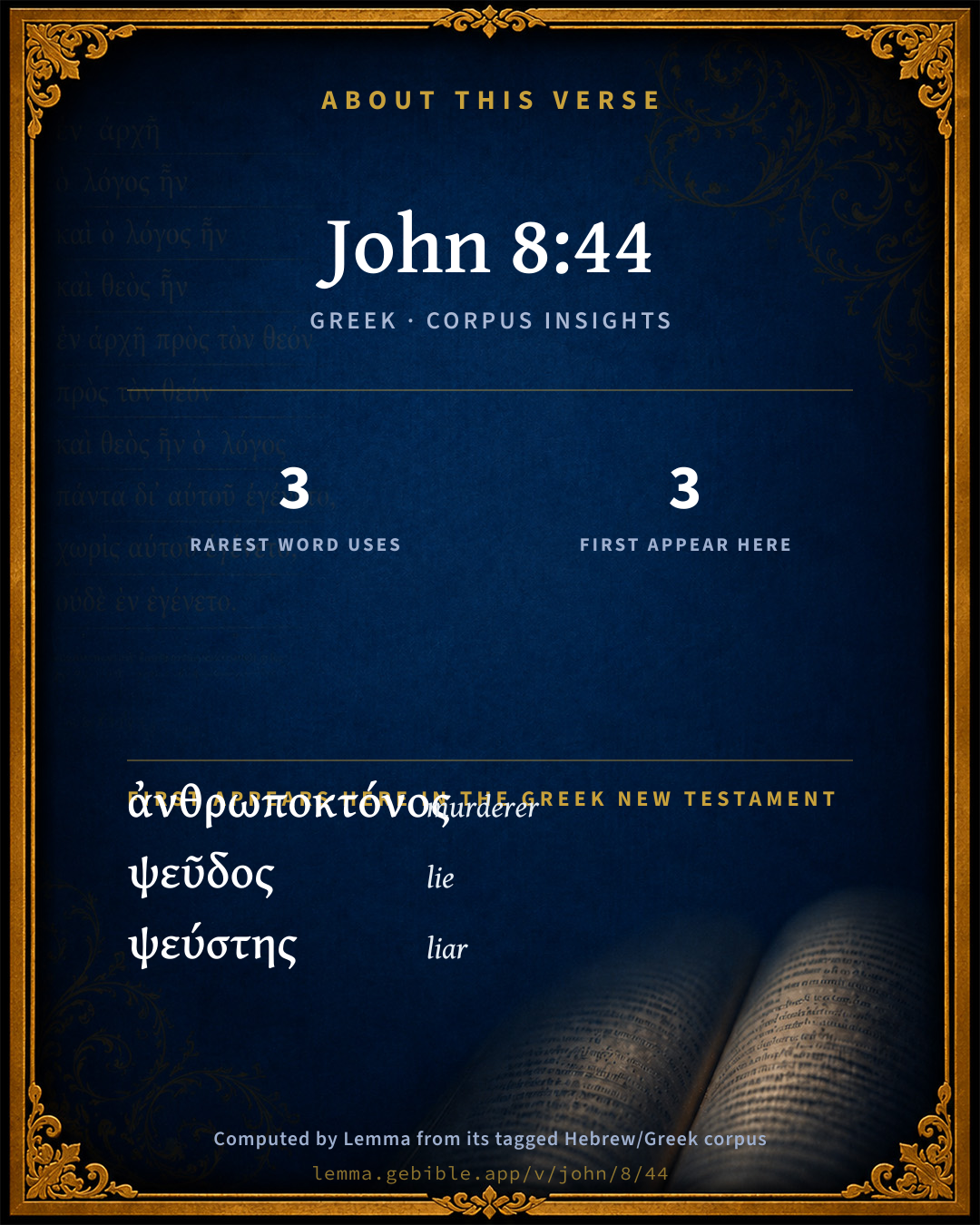
The rarest word here is ἀνθρωποκτόνος murderer G443 — appearing just 3 times in the whole Greek New Testament.

First appearance in Scripture

These words make their first canonical appearance in the Greek New Testament here:

  • ἀνθρωποκτόνος murderer G443
  • ψεῦδος lie G5579
  • ψεύστης liar G5583

Shared distinctive vocabulary

ἀνθρωποκτόνος murderer G443 occurs in 2 verses of the Greek New Testament. Also found in:
Repetition

Words recur within this verse:

  • ἐστὲ to be G1510 ×4
  • πατρὸς father G3962 ×3
  • ἀληθείᾳ truth G225 ×2
  • λαλῇ to speak G2980 ×2
  • τοῦ the G3588 ×8
  • καὶ and G2532 ×3
  • ὑμεῖς you G5210 ×2
  • ἐκ from G1537 ×2
  • ἐν in G1722 ×2
  • οὐκ not G3756 ×2
  • ὅτι that G3754 ×2
  • αὐτῷ he G846 ×2

Cross-references

34

Topical passages linked to John 8:44 in the Treasury of Scripture Knowledge — connected by theme and wording, ordered by reader-vote popularity; previews shown in the World English Bible.

  • Acts 13:10 and said, "Full of all deceit and all cunning, you son of the devil, you enemy of all righteousness, will you not cease to pervert the right ways of the Lord?
  • 1 John 3:12 unlike Cain, who was of the evil one, and killed his brother. Why did he kill him? Because his works were evil, and his brother's righteous.
  • 1 John 3:8–10 He who sins is of the devil, for the devil has been sinning from the beginning. To this end the Son of God was revealed, that he might destroy the works of the devil.
  • 2 Corinthians 11:3 But I am afraid that somehow, as the serpent deceived Eve in his craftiness, so your minds might be corrupted from the simplicity that is in Christ.
  • Revelation 12:9 The great dragon was thrown down, the old serpent, he who is called the devil and Satan, the deceiver of the whole world. He was thrown down to the earth, and his angels were thrown down with him.
  • John 8:38 I say the things which I have seen with my Father; and you also do the things which you have seen with your father."
  • Revelation 20:7–10 And after the thousand years, Satan will be released from his prison,
  • John 8:41 You do the works of your father." They said to him, "We were not born of sexual immorality. We have one Father, God."
  • Matthew 13:38 the field is the world; and the good seed, these are the children of the Kingdom; and the darnel are the children of the evil one.
  • 1 John 2:4 One who says, "I know him," and doesn't keep his commandments, is a liar, and the truth isn't in him.
  • 1 John 3:15 Whoever hates his brother is a murderer, and you know that no murderer has eternal life remaining in him.
  • Jude 1:6 Angels who didn't keep their first domain, but deserted their own dwelling place, he has kept in everlasting bonds under darkness for the judgment of the great day.
  • 1 Peter 5:8 Be sober and self-controlled. Be watchful. Your adversary the devil, walks around like a roaring lion, seeking whom he may devour.
  • Acts 5:3 But Peter said, "Ananias, why has Satan filled your heart to lie to the Holy Spirit, and to keep back part of the price of the land?
  • Revelation 21:8 But for the cowardly, unbelieving, sinners, abominable, murderers, sexually immoral, sorcerers, idolaters, and all liars, their part is in the lake that burns with fire and sulfur, which is the second death."
  • Genesis 3:15 I will put enmity between you and the woman, and between your offspring and her offspring. He will bruise your head, and you will bruise his heel."
  • 2 Corinthians 11:13–15 For such men are false apostles, deceitful workers, masquerading as Christ's apostles.
  • Genesis 3:3–7 but of the fruit of the tree which is in the midst of the garden, God has said, 'You shall not eat of it, neither shall you touch it, lest you die.'"
  • 1 Chronicles 21:1 Satan stood up against Israel, and moved David to number Israel.
  • 2 Chronicles 18:20–22 There came forth a spirit, and stood before Yahweh, and said, I will entice him. Yahweh said to him, 'How?'
  • Revelation 9:11 They have over them as king the angel of the abyss. His name in Hebrew is "Abaddon," but in Greek, he has the name "Apollyon."
  • John 6:70 Jesus answered them, "Didn't I choose you, the twelve, and one of you is a devil?"
  • 2 Thessalonians 2:9–11 even he whose coming is according to the working of Satan with all power and signs and lying wonders,
  • 2 Peter 2:4 For if God didn't spare angels when they sinned, but cast them down to Tartarus, and committed them to pits of darkness, to be reserved to judgment;
  • Revelation 2:10 Don't be afraid of the things which you are about to suffer. Behold, the devil is about to throw some of you into prison, that you may be tested; and you will have oppression for ten days. Be faithful to death, and I will give you the crown of life.
  • Revelation 13:6–8 He opened his mouth for blasphemy against God, to blaspheme his name, and his dwelling, those who dwell in heaven.
  • Revelation 20:2–3 He seized the dragon, the old serpent, which is the devil and Satan, who deceives the whole inhabited earth, and bound him for a thousand years,
  • Revelation 13:14 He deceives my own people who dwell on the earth because of the signs he was granted to do in front of the beast; saying to those who dwell on the earth, that they should make an image to the beast who had the sword wound and lived.
  • Genesis 4:8–9 Cain said to Abel, his brother, "Let's go into the field." It happened, when they were in the field, that Cain rose up against Abel, his brother, and killed him.
  • Revelation 22:15 Outside are the dogs, the sorcerers, the sexually immoral, the murderers, the idolaters, and everyone who loves and practices falsehood.
  • Job 2:4–6 Satan answered Yahweh, and said, "Skin for skin. Yes, all that a man has will he give for his life.
  • James 4:1–7 Where do wars and fightings among you come from? Don't they come from your pleasures that war in your members?
  • 1 Kings 22:22 Yahweh said to him, 'How?' He said, 'I will go forth, and will be a lying spirit in the mouth of all his prophets.' He said, 'You shall entice him, and shall prevail also: go forth, and do so.'
  • Job 1:11 But put forth your hand now, and touch all that he has, and he will renounce you to your face."

Cross-references courtesy of OpenBible.info (CC BY 4.0).

Commentary

Notes on John 8:44 from classic Christian and Jewish commentators (each source and its license shown beneath its notes). The classic Christian expositions comment on the surrounding passage and are grouped to its opening verse, so a note may address several verses; the Jewish commentaries on the Tanakh (Rashi and others) are per-verse, so they appear only where the commentator wrote on this verse.

Lemma curates 59 commentaries, every one of them public domain or Creative Commons licensed, each selected and text-cleaned for this edition rather than reprinted as found. About our sources →

Joseph Benson's Commentary

Joh 8:44-47. Ye are of your father the devil — Ye are the genuine children of Satan; and the lusts — Τας επιθυμιας, the desires; of your father ye will do — Namely, resolutely and obstinately, as the words, θελετε ποιειν, evidently imply. The account which Josephus gives of the wickedness of the Jews, about this time, abundantly vindicates this assertion of our Lord from any appearance of undue severity. He was a murderer — Greek, ανθρωποκτονος, man-slayer, or man-killer; from the beginning — The common term for murderer, in the New Testament, is φονευς. And it seems “not without intention, that the devil, a being not of earthly extraction, is rather called a manslayer than a murderer, as marking with greater precision his enmity to the human race.” — Campbell. Satan was a manslayer in inclination, from the beginning of his becoming a devil, and actually such from the beginning of the world: for, from the beginning of the creation, he contrived and designed the ruin of mankind. And he has ever since endeavoured to work their ruin; sometimes by seducing them into sin by his lies, (for as he abode not in the truth, there is no truth in him,) and sometimes by instigating them to kill those whom God sends to reclaim them; as well as in various other ways. Withal, having early departed from holiness and truth, a habit of lying has become perfectly natural to him; and when he speaketh a lie, he speaketh of his own — Speaketh what is proper to himself, he being the proper parent, and, as it were, creator of lying. Because I tell you the truth, ye believe me not — Ye, his children, disbelieve me, because, instead of soothing you in your sins, and flattering you with lies, I tell you the truth, to which, like your father, you are utterly averse. Which of you convinceth me of sin? — Greek, ελεγχει με περι αμαρτιας, which of you convicteth me of sin. The word convinceth is not the proper term in this place; for it relates only to the opinion of the person himself, about whom the question is. But our Lord here, in order to show that the unbelief of his hearers had no reasonable excuse, challenges them openly to convict him, if they could, in any instance, of a deviation from truth or righteousness. As if he had said, Bring evidence of such a deviation, evince it to the world: prove that I have not received my commission from God; or that I have done something to render me unworthy of credit. Show, if you can, that I have taught false doctrine, reproved you unjustly for your actions, or committed sin myself. If you cannot, but must acknowledge that my life is as unreprovable as my doctrine; that the latter is confirmed by the former, and that both are such as become a messenger of God; what is the reason that ye do not believe me? He that is of God, heareth God’s words — He that is a child of God, humbly receiveth the revelations which God makes of himself by his messengers, hears his words, and obeys his commands, with joy and reverence. Ye, therefore, hear them not — Ye reject the revelations, doctrines, commandments, promises, and threatenings, and his word in general, declared by me, his Messenger, and my servants, for no other reason but because you are not his children.

Joseph Benson's Commentary on the Old and New Testaments (1811–1818) — public domain. Text from a community e-Sword module.

Tyndale Open Study Notes

Tyndale Open Resources

8:44 Since the unbelieving people did not love Jesus (8:42; 1 Jn 5:1), they were not children of the Father in heaven who sent his beloved Son (John 8:47). Their true spiritual ancestry was revealed in their desire to kill God’s Son. This was the work of the devil, who brought death to the world (see Gen 3:1-20; Rom 5:12-14).

Tyndale Open Study Notes — © Tyndale Open Resources, licensed CC BY-SA 4.0. Text via the HelloAO Bible API.

Bengel's Gnomon

Johann Albrecht Bengel

Joh 8:44. Ὑμεῖς, ye) A most undisguised proof against them.—καὶ, and) and thence it is that.—ἐπιθυμίας, the lusts) which from the beginning he has been unable to accomplish, as respects the Son of God.—θέλετε, ye wish) with all your might.—ἀνθρωπο—κτόνος) a man-destroyer [murderer].—ἀπʼ ἀρχῆς, from the beginning) ever since he knew anything of the nature of man.—καὶ ἐν—ὅταν, and in—when) Two sentences, expressing two contraries; to each of the two, ὅτι, because [for] is added.—οὐκ ἕστηκεν, he abode not [did not stand fast]) The Præterite time, and the theme itself ἵστημι, I stand, imply this to be the meaning; He did not attain to a fixed standing in the truth: (A similar expression occurs Rom 5:2, “We have access by faith into this grace, wherein we have obtained an established standing”) i.e. He was a liar from the beginning, as well as a man-destroyer; for this clause does not go before the mention of his lust of murder, but follows it.—οὐκ ἔστιν, is not) There was truth in him; but there is not now. Moreover, when first the truth ceased to exist in him, it was by his own fault; the lust of murder had place in him, and he determined to destroy man for that very reason, because man was then in the truth. From this it is evident that it was not long before the sin of man, that the devil sinned, and that the devil was created, not long before he sinned.—τὸ ψεῦδος, what is false [a lie]) Scripture is wont to designate not merely a voluntary lie by this severe term, but even error itself. Rom 1:25, “Who changed the truth of God into a lie;” 2Th 2:9; 2Th 2:11, “lying wonders—God shall send them strong delusion, that they should believe a lie;” 1Jn 2:21, “Because ye know—the truth—and that no lie is of the truth;” 27, “The anointing—is truth, and is no lie.”—ἐκ τῶν ἰδίων, of his own) The origin of evil. The contrary holds good of Christ; ch. Joh 7:17, “If any man will do His will, he shall know of the doctrine, whether it be of God, or whether I speak of Myself; He that speaketh of himself seeketh his own glory, but He that seeketh His glory that sent Him, the same is true, and no unrighteousness is in Him.”—καὶ ὁ πατὴρ αὐτοῦ, his father) The article ὁ has this force; and so. The word αὐτοῦ can be expressly referred to ψεῦδος, concerning which lie treats in the following clause; but it ought rather to be referred to the noun ψεύστης, a liar, which must be repeated in an indefinite sense.[229] For sometimes a relative expressed or implied appertains to another subject similar to it. 1Ti 2:15, “She shall be saved,” namely, woman, indefinitely although the she is to be referred to Eve [the woman alluded to, “Adam was not deceived, but the woman,” in the previous verse. So Job 1:21, “Naked came I forth from my mother’s womb, and naked shall I return THITHER” [to my mother’s womb in a different and wider sense than in the first clause, viz. the womb of the earth]. Thus here the devil is said to be both a liar himself and father of every liar. For the opposition is clear between God and the devil, and between the sons of God and the sons of the devil. The man who is a liar, is a son of the devil. It is not the lie that is said in this passage to be the offspring of the devil.

[229] The father of every one who is a liar.—E. and T.

Bengel's Gnomon of the New Testament — English translation (T&T Clark, Edinburgh, 1860) — public domain. Text from a community e-Sword module.

Meyer's Critical & Exegetical Commentary

Heinrich August Wilhelm Meyer

Joh_8:44. After the negative statement in Joh_8:42-43 comes now the positive: Ye (ὑμεῖς, with great, decided emphasisye people, who deem yourselves children of God!) are children of the devil,[29] in the sense, namely, of ethical genesis (comp. 1Jn_3:8; 1Jn_3:12), which is further explained from ἐκεῖνος onward. The expression must therefore not be regarded as teaching an original difference in the natures of men (Hilgenfeld, comp. on Joh_3:6).

ἐκ τοῦ πατρ. τ. διαβ.] of the father who is the devil, not of your father, etc. (De Wette, Lücke), which is inappropriate after the emphatic ὑμεῖς, or ought to have been specially marked as emphatic (ὙΜΕῖς ἘΚ ΤΟῦ ὙΜῶΝ ΠΑΤΡῸς, etc.). Nonnus well indicates the qualitative character of the expression: ὙΜΕῖς ΔῆΤΑ ΤΈΚΝΑ ΔΥΣΑΝΤΈΟς ἘΣΤῈ ΤΟΚῆΟς. Hilgenfelds view, which is adopted by Volkmar: Ye descend from the father of the devil, which father is the (Gnostic) God of the Jews, is not only generally unbiblical, but thoroughly un-Johannine, and here opposed to the context. John could have written simply ἐκ τοῦ διαβ., if the connection had not required that prominence should be given to the idea of father. But in the entire connection there is nothing that would call for a possible father of the devil; the question is solely of the devil himself, as the father of those Jews. Erroneously also Grotius, who explains the passage as though it ran,

τοῦ πατρ. τῶν διαβόλων.

καὶ τὰς ἐπιθυμίας, etc.] The conscious will of the child of the devil is to accomplish that after which its father, whose organ it is, lusts. This is rooted in the similarity of their moral nature. The desire to kill is not exclusively referred to, though, as even the plural ἐπιθυμίας shows, it is included.

ἘΚΕῖΝΟς, etc.] for murder and lying were just the two devilish lusts which they were minded to carry out against Jesus.

ἀνθρωποκτόνος ἦν ἀπʼ ἀρχῆς] from the beginning of the human race. This more exact determination of the meaning is derivable from ἀνθρωποκτόνος, inasmuch as it was through his seduction that the fall was brought about, in whose train death entered into the world (see on Rom_5:12). So Origen, Chrysostom, Augustine, Theophylact, and the majority of commentators; also Kuinoel, Schleiermacher, Tholuck, Olshausen, Klee, Maier, Lange (referring it, however, after the example of Euth. Zigabenus, also to Cain), Luthardt, Ewald, Godet, Hofmann, Schriftbeweis, I. pp. 418, 478; Müller, Lehre v. d. Sünde, II. p. 544 f. ed. 5; Lechler in the Stud. u. Kritik. 1854, p. 814 f.; Hahn, Theol. d. N. T. I. p. 355; Messner, Lehre d. Apostel, p. 332; Philippi, Glaubenslehre, III. p. 272; see especially Hengstenberg on the passage, and his Christol. I. p. 8 ff.; Weiss, Lehrbegr. p. 133 f. Compare the corresponding parallels, Wis_2:24; Rev_12:9; Rev_20:2; also Ev. Nicod. 23, where the devil is termed ἡ τοῦ θανάτου ἀρχὴ, ἡ ῥίζα τῆς ἁμαρτίας; see also Grimm on Wis_1:1. This view is the only one that is appropriate to the expression ἈΠʼ ἈΡΧῆς, which the design of the context requires to be taken exactly (מן בראשׁיח, Lightfoot, p. 1045), as it must also be understood in 1Jn_3:8. Comp. Joseph. Antiq. I. 1, 4. Others refer to Cains murder of his brother (Cyril, Nitzsch in the Berl. theol. Zeitschr. III. p. 52 ff., Schulthess, Lücke, Kling, De Wette, Reuss, Beitr. p. 53, Hilgenfeld, Baeumlein, Grimm), which is not, however, rendered necessary by 1Jn_3:12, and would further, without any warrant, exclude an earlier commencement; would be opposed to the national and New Testament view (see on 2Co_11:3) of the fall and the connection of the present passage; and would finally lack any allusion to it in Genesis 4; whilst, on the contrary, the antithesis between truth and falsehood, which follows afterwards, points unmistakeably to Genesis 3. Finally, inasmuch as ἀπʼ ἀρχῆς must signify some definite historical starting-point, it is incorrect, with B. Crusius, to deny a reference either to the fall or to Cains murder of his brother, and to take ἀνθρωποκτ. ἀπʼ ἀρχῆς as simply a general designation.

Brückner also treats the reference to a definite fact as unnecessary.

ἮΝ] that is, during the entire past, ἈΠʼ ἈΡΧῆς onwards.

Κ. ἘΝ Τῇ ἈΛΗΘ. ΟὐΧ ἝΣΤΗΚΕΝ] does not refer to the fall of the devil (2Pe_2:4; Jud_1:6), as Augustine, Nonnus, and most Catholics maintain,[30] as though εἱστήκει (Vulg.: stetit) had been employed, but is his constant characteristic:[31] and he does not abide in the truth, ἐμμένει, ἀναπαύεται, Euth. Zigabenus. The truth is the domain in which he has not his footing; to him it is a foreign, heterogeneous sphere of life: the truth is the opposite of the lie, both in formal and material significance. The lie is the sphere in which he holds his place; in it he is in the element proper and peculiar to him; in it he has his lifes standing.

ὅτι οὐκ ἔστιν ἀλήθ. ἐν αὐτῷ] the inner ground of the preceding statement. The determining cause of this inner ground, however, is expressed by the words ἐν αὐτῷ, which are emphatically placed at the end. As truth is not found in him, as it is lacking to his inner essence and life, it cannot possibly constitute the sphere of his objective life. Without truth in the inward partstruth regarded, namely, as a subjective qualification, temper, tendencythat is, without truth in the character, a man must necessarily be foreign to, and far from, the domain of objective truth, and cannot have his life and activity therein. Without truth in the inward parts, a man deals in life with lies, deception, cunning, and all ἀδικία. Note that ἀλήθ. is used first with, and then without, the article.

ἐκ τῶν ἰδίων] of that which is his own, which constitutes the proper ground or essence of his inner man,of that which is most peculiarly his ethical nature. Comp. Mat_12:34.

κ. ὁ πατὴρ αὐτοῦ] namely, of the liar; he, generically considered, to wit, the liar as such in general, is the devils child. The characterization of the devil thus aptly concludes with a declaration which at the same time confirms the reproach, ὑμεῖς ἐκ. τ. πατρὸς τοῦ διαβ. ἐστέ. The less to be approved, therefore, is the common explanation of αὐτοῦ, as standing for τοῦ ψεύδους, which is to be derived from ψεύστης (mendacii auctor, after Gen_3:4 f.); although, linguistically considered, it is in itself admissible (Winer, p. 181 f. [E. T. p. 138]; Buttmann, p. 93 [E. T. p. 106]). The correct view has been taken also by B. Crusius, Luthardt, Tholuck, Hengstenberg, and as early as Bengel. The old heretical explanation, as his father,[32] or, also his father, as though αὐτοῦ referred to the devil, and the demiurge, whose lie is the pretending to be the most high God, were really intended (Hilgenfeld, Volkmar), must be rejected; for, on the one hand, John ought at the very least, in order to avoid being completely misunderstood, to have written ὅτι αὐτὸς ψ. ἐ. κ. ὁ. π. ἀ.;[33] while, on the other hand, he did not in the remotest degree entertain the monstrous, wholly unbiblical notion of a father of the devil. Nay, further, a father of this kind would not at all harmonize with the context. Even a writer as early as Photius, Quaest. Amphiloch. 88, takes the opposite view; as also Ewald, Jahrb. V. p. 198 f. It was in the highest degree unnecessary that Lachmann, (Praef. II. p. 7), in order to avoid having to refer αὐτοῦ to the devil, should have approved the reading qui, or ὃς ἄν, instead of ὅταν, which is supported by the feeblest evidence: qui loquitur mendacium, ex propriis loquitur, quia patrem quoque mendacem habet.

[29] In his Leben Jesu (p. 338 ff.), Schleiermacher groundlessly advances the opinion that Jesus had here no intention of teaching any doctrine regarding the devil, but wished merely to add force to His reproach by referring to the generally-adopted interpretation of the narrative of the fall. On the contrary, by His reproach, he not merely lays down the doctrine, but also further intentionally and explicitly expounds it, especially by assigning the ground, ὅτι οὐχ ἔστιν, etc. Baur (still in his Neut. Theol. p. 393) deduces from this passage that, according to John, Jesus had little sympathy for the Jews. He is speaking, however, not at all against the Jews in general, but merely against the party that was hostile to Him.

[30] Comp. also Martensens Dogmatics, § 105. Delitzsch, too (see Psychol. p. 62), explains the passage as though εἱστήκει were used: the devil, instead of taking his stand in the truth, revolted, as the god of the world, selfishly against God; for which reason the world has been degraded and materialized by God to a תהו ובהו, etc. In this way a new creation of the world is made out of the creation in Genesis 1, and out of the first act in the history of the world, a second.

[31] At the same time, we do not mean herewith to deny to John the idea of a fall of the devil, or, in other words, to represent him as believing the devil to have been originally evil. The passage under consideration treats merely of the evil constitution of the devil as it is, without giving any hint as to its origin. This in answer to Frommann, p. 330, Reuss, and Hilgenfeld. In relation to the doctrine of the fall of the devil nothing is here taught. Comp. Hofmann, Schriftbeweis, passim; Hahn, Theol. d. N. T. I. p. 319. Such a fall is, however, necessarily presupposed by this passage.

[32] Hence, also, the readings ὡς and καθὼς καί, instead of καί, which, though early in date, are supported by feeble testimony.

[33] Comp. Nonnus: ψεύστης αὐτὸς ἔφυ, ψευδήμονος ἐκ γενετῆρος.

Meyer — Critical and Exegetical Commentary on the New Testament — English translation by Peter Christie, edited by Frederick Crombie (T&T Clark, 1880) — public domain. Text from a community e-Sword module.

Expositor's Greek Testament

ed. W. Robertson Nicoll

Joh 8:44 . This was the result and evidence of their paternity: ὑμεῖς … [ τοῦ πατρὸς is read by all recent editors]. “Ye are of the father who is the devil.” The translation, “of the father of the devil,” i.e. , the (Gnostic) God of the Jews, is, as Meyer says, thoroughly un-Johannine. Perhaps a slight pause before the culminating words τοῦ διαβόλου would emphasise them and show that this had been in His mind throughout the conversation. Being, of this parentage they deliberately purpose [ θέλετε ] and not merely unintentionally are betrayed into the fulfilment of his desires. Their origin is determined by the fact that “from the first the devil was a manslayer”. To what does ἀπʼ ἀρχῆς refer? Since the beginning of the human race, or since men first were killed; not since the devil’s beginning. Cyril and some others think it is the first murder, that of Abel, that is in view ( cf. 1Jn 3:15 ), but far more probably it is the introduction of death through the first sin ( Wis 2:23-24 ). So almost all recent commentators. Some think both references are admissible (see Lücke). καὶ ἐν τῇ ἀληθείᾳ οὐχ ἕστηκεν , “and stands not in the truth”. R.V [70] has “and stood not”; so the Vulgate “et in veritate non stetit”. W.H [71] adopt the same translation, reading οὐκ ἔστηκεν , the imperfect of στήκω , I stand; but good reasons against this reading are given by Thayer s.v. ἕστηκεν is the usual perfect of ἵστημι with the sense of a present. The reference therefore is not to the fall of the angels, but to the constant attitude of the devil; οὐκ ἐμμένει , Euthymius. “The truth is not the domain in which he has his footing.” Meyer, Weiss. He does not adhere to the truth and live in it. The reason being, ὅτι … αὐτῷ , “because truth is not in him”. There is not in him any craving for the truth. He is not true to what he knows. His nature is so false that ὅταν λαλῇ τὸ ψεῦδος ἐκ τῶν ἰδίων λαλεῖ , “whenever he speaks what is false, he speaks of his own”. “But the article may mean ‘the lie that is natural to him,’ ‘ his lie’ ” (Plummer). ἐκ τῶν ἰδίων means that he speaks out of that which is characteristically and peculiarly his ( cf. Mat 12:34 ); “because he is” this is his character and description “a liar and his father,” i.e. , he is himself a liar and the father of all liars. This is added to reflect light on the first statement of this verse. So Holtzmann and most recent interpreters. But Weiss rightly defends the reference of αὐτοῦ to ψεῦδος as in A.V [72] Westcott proposes to translate: “Whenever a man speaketh a lie, he speaketh of his own, for his father also is a liar”. Paley renders: “When (one) utters … he is speaking from his own, because he is a liar, and (so is) his father”. Westcott’s translation makes excellent sense and suits the context and gives a good meaning to the ἰδίων , but, as he himself owns, the omission of the subject ( ὅταν λαλῇ ) is certainly harsh; it may be said, impossible.

[70] Revised Version.

[71] Westcott and Hort.

[72] Authorised Version.

The Expositor's Greek Testament, edited by W. Robertson Nicoll (1897–1910) — public domain. Text from a community e-Sword module.

Godet's Commentaries

Frédéric Louis Godet

Ver. 44. “You are born of the father, the devil, and you wish to fulfil the desires of your father. He was a murderer from the beginning, and he is not in the truth, because there is no truth in him; when he speaks falsehood, he speaks of his own, for he is a liar and the father of the liar.”

The light does not succeed in penetrating into this Jewish medium, because it is subjected to a principle of darkness. ῾Υμεῖς, you, is strongly emphasized: “You who boast of having God as your Father.” Grotius made τοῦ διαβόλου, of the devil, the object ofπατρός, taking the former word in a collective sense: the father of the demons. Hilgenfeld, starting from the same grammatical construction, surprises the evangelist here in the very act of Gnosticism. This father of the devil, according to this critic, is the Demiurge of the Gnostics; in other words, the creator of this material world, the God of the Jews, who is designated here as the father of Satan, in accordance with the doctrine of the Ophites in Irenaeus. Jesus would thus say to the Jews, not: “You are the sons of the devil,” but: “You are the sons of the father of the devil;” that is to say, the brothers of the latter. But where can we find in the Scriptures a word respecting the person of the devil’s father? And how, on the supposition that this father of the devil was the God of the Jews, could Jesus have called this God of the Jews His own Father (“the house of my Father” Joh 2:16)? Finally, it is sufficient to compare 1Jn 3:10, in order to understand that He calls the Jews not the brothers, but the sons of the devil. The literal meaning is the following: You are sons of the father who is the devil, and not, as you think, of that other father who is God.”

The lawless passions (ἐπιθυμίαι) by which this father is animated and which he communicates to them, are unfolded in the second part of the verse: they are, first, hatred of man, and then, abhorrence of truth; precisely the tendencies with which Jesus had just reproached the Jews, Joh 8:40. The verb θέλετε, you desire, you are eager for(Joh 8:35), is contrary to the fatalistic principle which Hilgenfeld attributes to John; it expresses the voluntary assent, the abounding sympathy with which they set themselves to the work of realizing the aspirations of their father. The first of these diabolical appetites is the thirst for human blood. Some interpreters ancient and modern (Cyril, Nitzsch, Lucke, de Wette, Reuss) explain the word ἀνθρωποκτόνος, murderer, by an allusion to the murder of Abel. Comp. 1Jn 3:12; 1Jn 3:15 : “Not as Cain, who was of the evil one and slew his brother....Whosoever hates his brother is a murderer.” But the Scriptures do not ascribe to the demon a part in this crime, and the relation which Jesus establishes here between the murderous hatred of Satan and his character as a liar, leads us rather to refer the word murderer to the seduction in Paradise by which Satan caused man to fall under the yoke of sin and thereby of death. By thus separating him from God, through falsehood, he has devoted him to spiritual and physical ruin. The expression from the beginning may, on this view, be much more strictly explained. The sense of ἀρχή, beginning, does not differ from that of this word in Joh 1:1, except that here the question is of the beginning of the human race, there of the beginning of creation. As to the quotation taken from 1 John, it proves nothing in favor of the allusion to the act of Cain; for that act is there cited as the first example of the hatred of a man to his brother.

When Jesus said in Joh 8:40 : “You seek to kill me, a man,” He already had in His mind the idea of that murderous hatred which is expressed by the word ἀνθρωποκτόνος . Whence did this hatred of Satan against man arise? Undoubtedly, from the fact that he had discerned in him the future organ of divine truth and the destroyer of his own lies. Thus the two features of his character are united: hatred of man and enmity to the truth. And we may understand how this double hatred must be concentrated in the highest degree upon Jesus, in whom at length was perfectly realized the idea of man and of man as the organ of divine truth. Some interpreters, ancient and modern, have applied the expression ἐν ἀληθείᾳ οὐχ ἕστηκεν to the fall of the devil. Vulgate: in veritate non stetit; Arnaud: he did not abide in the truth; Ostervald: he did not persist in ...But the perfect ἕστηκα does not mean: did not abide in; its sense, in the sacred as in the classic Greek, is: “I have placed myself in a position and I am there.” Jesus therefore does not mean to say that the devil has abandoned the domain of truth, in which he was originally placed by God, but rather that he does not find himself there, or, more exactly, that he has not taken his place there, and consequently is not there. The domain of truth is that of the real essence of things, clearly recognized and affirmed, holiness. And why does he not live in this domain? Because, Jesus adds, there is no truth in him. He is wanting in inward truth, truth in the subjective sense, that uprightness of will which aspires after divine reality. We must observe, in this last clause, the absence of the article before the word ἀληθεία, truth: Satan is cut off from the truth, because he is destitute of truth. One can abide in the truth (objectively speaking) in that which God reveals, only when one sincerely desires it. The ὅτι, because, is the counterpart of that in Joh 8:43. Like father, like son: each of the two lives and works in what is false, because he is false.

What Jesus has just set forth in a negative form, He reproduces in a positive form in the second part of the verse. Not desiring to derive anything from divine truth, Satan is compelled to draw everything that he says from his own resources, that is from the nothingness of his own subjectivity; for the creature, separated from God, is incapable of possessing and creating anything real. Lying is, in this condition, his natural language, as much as speaking the truth is the natural language of Jesus (Joh 8:38) in the communion with God in which He lives. ᾿Εκ τῶν ἰδίων, from his own resources, admirably characterizes the creative faculty of a being separated from God, who is capable no doubt of producing something, even sometimes great works, and of uttering great words, but whose creations, in proportion as he creates apart from God, are always only a vain phantasmagoria. The word ψεύστης, a liar, reproduces the idea: He has no truth in him. In the expression: “He is a liar and also his father,” we must not make the word his father a second subject to is, as if the question were here also of the father of the devil (Hilgenfeld). The word: and his father is the predicate: “he is a liar and father of...” Otherwise ὅτι αὐτὸς ψεύστης ἐστὶ καὶ ὁ πατὴρ αὐτοῦ would have been necessary.

Only it may be asked to what substantive it is necessary to refer the pronoun αὐτοῦ (his); to the wordψεύστης, liar, or the word ψευδοῦς, falsehood, in the preceding clause? I think, with Lucke, Meyer and others, that the context is decisive in favor of the first alternative. For the question here is, not of the origin of falsehood in general, but specially of the moral sonship of the individual liars whom Jesus has before Him (Joh 8:40; Joh 8:44). Weissobjects that in the expression: “he is a liar,” the word liar is used in the generic sense. It is true; but we may certainly derive from it the notion of a concrete substantive. In both senses, there is a slight grammatical difficulty to be overcome. The theory of accommodation, by means of which it is often sought to weaken the force of the declarations of Jesus respecting the personal existence of Satan, may have some probability when it is applied to His conversations with the demoniacs. But here Jesus gives altogether spontaneously this teaching with respect to the person, the character and the part of this mysterious being. After this Jesus comes back from the father to the children: they are enemies of the truth, just as the evil being is to whom they are subject:

Frédéric Louis Godet — Commentaries on Luke, John, Romans, and 1 Corinthians — English translation (T&T Clark, Edinburgh, 1870s–1890s) — public domain. Text from a community e-Sword module.

Geneva Bible (1599)

Geneva Bible translators

That is, continued not constantly, or remained not.

That is, in faithfulness, and uprightness, that is, kept not his creation.

Even of his own head, and of his own brain or disposition.

The author thereof.

From the beginning of the world: for as soon as man was made, the devil cast him headlong into death.

Geneva Bible (1599) marginal notes — public domain. Text via Bolls.life.

Jamieson, Fausset & Brown

Robert Jamieson, A. R. Fausset & David Brown

Ye are of your father the devil--"This is one of the most decisive testimonies to the objective (outward) personality of the devil. It is quite impossible to suppose an accommodation to Jewish views, or a metaphorical form of speech, in so solemn an assertion as this" [ALFORD].

the lusts of your father--his impure, malignant, ungodly propensities, inclinations, desires.

ye will do--are willing to do; not of any blind necessity of nature, but of pure natural inclination.

He was a murderer from the beginning--The reference is not to Cain (as LOCKE, DE WETTE, ALFORD, &c.), but to Adam [GROTIUS, CALVIN, MEYER, LUTHARDT, &c.]. The death of the human race, in its widest sense, is ascribed to the murderous seducer of our race.

and abode not in the truth--As, strictly speaking, the word means "abideth," it has been denied that the fall of Satan from a former holy state is here expressed [LOCKE, &c.], and some superior interpreters think it only implied [OLSHAUSEN, &c.]. But though the form of the thought is present--not past--this is to express the important idea, that his whole character and activity are just a continual aberration from his own original truth or rectitude; and thus his fall is not only the implied basis of the thought, but part of the statement itself, properly interpreted and brought out.

no truth in him--void of all that holy, transparent rectitude which, as His creature, he originally possessed.

When he speaketh a lie, he speaketh of his own--perhaps his own resources, treasures (Mat 12:35) [ALFORD]. (The word is plural). It means that he has no temptation to it from without; it is purely self-begotten, springing from a nature which is nothing but obliquity.

the father of it--that is, of lying: all the falsehood in the world owes its existence to him. What a verse is this! It holds up the devil (1) as the murderer of the human race; but as this is meant here in the more profound sense of spiritual death, it holds him up, (2) as the spiritual parent of this fallen human family, communicating to his offspring his own evil passions and universal obliquity, and stimulating these into active exercise. But as there is "a stronger than he," who comes upon him and overcomes him (Luk 11:21-22), it is only such as "love the darkness," who are addressed as children of the devil (Mat 13:38; Jo1 3:8-10).

Jamieson, Fausset & Brown — Commentary Critical and Explanatory on the Whole Bible (1871) — public domain (CC PDM 1.0). Text via the HelloAO Bible API.

Adam Clarke's Commentary

Verse 44. Ye are of your father the devil] Ye are the seed of the old serpent. See Clarke on Joh 8:37.

The lusts of your father] Like father like son. What Satan desires, ye desire; because ye are filled with his nature. Awful state of unregenerate men! They have the nearest alliance to Satan; they partake of his nature and have in them the same principles and propensities which characterize the very nature and essence of the devil! Reader, canst thou rest in this state? Apply to God, through Christ, that thou mayest be born again.

He was a murderer from the beginning] It was through him that Adam transgressed; in consequence of which death entered into the world, and slew him and all his posterity. This was the sentiment of the Jews themselves. In Sohar Kadash, the wicked are called, "The children of the old serpent, who slew Adam and all his descendants." See Schoettgen.

Abode not in the truth] He stood not in the truth-was once in a state of glorious felicity, but fell from it; and, being deprived of all good himself, he could not endure that others should enjoy any; therefore by his lies he deceived Eve, and brought her, her husband, and, through them, their posterity, into his own condemnation.

He speaketh of his own] εκ των ιδιων λαλει, He speaketh of his own offspring, or, from his own disposition, for he is the father and fountain of all error and falsity; and all who are deceived by him, and partake of his disposition, falsity and cruelty, are his offspring, for he is a liar, and the father of it-καιοπατηρ αυτου-literally, his father also. There is considerable difficulty in this verse. The Cainites, and the Archontites, mentioned by Epiphanius, read it thus: "Ye are the children of your father the devil, because he is a liar, and his father was a liar. He was a man-slayer, and he did not remain in the truth. When he speaketh, he speaketh a lie of his own, (progenitors understood,) because his father also was a liar." The consequences which the above heretics drew from this verse were the following. They said that the father of the Jews was a demon; that he also had a demon for his father; and that he had a demon for his father, c. The Archontites maintained that Cain had a demon for his father, the spirit which our Lord speaks of here and that the Jews proceeded from the race of Cain.

Grotius, supposing that the devil who tempted Eve was not the prince of devils, but rather a subordinate one, seems to think he may be understood here, he is a liar, and his father also, which is the literal translation of the latter clause of the text, ωςκαιοπατηραυτου, as it has been read by many of the primitive fathers.

Mr. Wakefield, by changing το, before ψευδος, into τις, gives the text the following translation:- "The devil is your father, and ye willingly perform the lusts of your father. He was a man-slayer from the first, and continued not in the truth, because there is no truth in him. When ANY ONE speaketh a lie, he speaketh according to his own kindred: for his father also is a liar." Our own translation, that refers πατηρ αυτου to ψευδος, a lie, and not to ψευστης, a liar, is probably the most correct.

Adam Clarke's Commentary on the Bible (1810–1826) — public domain. Text from a community e-Sword/MySword module.

John Calvin's Commentaries

44. You are of your father the devil. What he had twice said more obscurely, he now expresses more fully, that they are the devil’s children But we must supply the contrast, that they could not cherish such intense hatred to the Son of God, were it not that they had for their father the perpetual enemy of God. He calls them children of the devil, not only because they imitate him, but because they are led by his instigation to fight against Christ. For as we are called the children of God, not only because we resemble him, but because he governs us by his Spirit, because Christ lives and is vigorous in us, so as to conform us to the image of his Father; so, on the other hand, the devil is said to be the father of those whose understandings he blinds, whose hearts he moves to commit all unrighteousness, and on whom, in short, he acts powerfully and exercises his tyranny; as in 2 Corinthians 4:4; Ephesians 2:2, and in other passages.

The Manicheans foolishly and ineffectually abused this passage to prove their absurd tenets. For since, when Scripture calls us the children of God, this does not refer to the transmission or origin of the substance, but to the grace of the Spirit, which regenerates us to newness of life; so this swing of Christ does not relate to the transmission of substance, but to the corruption of nature, of which man’s revolt was the cause and origin. When men, therefore, are born children of the devil, it must not be imputed to creation, but to the blame of sin. Now Christ proves this from the effect, because they willingly, and of their own accord, are disposed to follow the devil.

He was a murderer from the beginning. He explains what are those desires, and mentions two instances, cruelty and falsehood; in which the Jews too much resembled Satan. When he says that the devil was a murderer, he means that he contrived the destruction of man; for as soon as man was created, Satan, impelled by a wicked desire of doing injury, bent his strength to destroy him. Christ does not mean the beginning of the creation, as if God implanted in him the disposition to do injury; but he condemns in Satan the corruption of nature, which he brought upon himself. This appears more clearly from the second clause, in which he says,

He did not remain in the truth. For though those who imagine that the devil was wicked by nature, endeavor to make evasions, yet these words plainly state that there was a change for the worse, and that the reason why Satan was a liar was, that he revolted from the truth That he is a liar, arises not from his nature having been always contrary to truth, but because he fell from it by a voluntary fall. This description of Satan is highly useful to us, that every person for himself may endeavor to beware of his snares, and, at the same time, to repel his violence and fury; for

he goeth about as a roaring lion, seeking whom he may devour, (1 Peter 5:8,)

and has a thousand stratagems at his command for deceiving. So much the more ought believers to be supplied with spiritual arms for fighting, and so much the more earnestly ought they to keep watch with vigilance and sobriety. Now, if Satan cannot lay aside this disposition, we ought not to be alarmed at it, as if it were a new and uncommon occurrence, when errors exceedingly numerous and varied spring up; for Satan stirs up his followers like bellows, to deceive the world by their impostures. And we need not wonder that Satan puts forth such strenuous efforts to extinguish the light of truth; for it is the only life of the soul. So, then, the most important and most deadly wound for killing the soul is falsehood. As all who have eyes to see perceive, in the present day, such a picture of Satan in Popery, they ought, first, to consider with what enemy they carry on war, and, next, to betake themselves to the protection of Christ their Captain, under whose banner they fight.

Because the truth is not in him. This statement, which immediately follows the other, is a confirmation a posteriori, as the phrase is; that is, it is drawn from the effect. For Satan hates the truth, and therefore cannot endure it, but, on the contrary, is entirely covered with falsehoods. Hence Christ infers, that he is entirely fallen from the truth, and entirely turned away from it. Let us not wonder, therefore, if he daily exhibits the fruits of his apostacy.

When he speaketh falsehood. These words are generally explained as if Christ affirmed that the blame of falsehood does not belong to God, who is the Author of nature, but, on the contrary, proceeds from corruption. But I explain it more simply, that it is customary with the devil to speak falsehood, and that he knows nothing but to contrive corruptions, frauds, and delusions. And yet we justly infer from these words, that the devil has this vice from himself, and that, while it is peculiar to him, it may likewise be said to be accidental; for, while Christ makes the devil to be the contriver of lying, he evidently separates him from God, and even declares him to be contrary to God. For he is a liar, and the father of it The word father has the same object as the preceding statement; for the reason why Satan is said to be the father of falsehood is, because he is estranged from God, in whom alone truth dwells, and from whom it flows as from the only fountain.

John Calvin's Commentaries (1540-1563) — public domain. Text from the Calvin Translation Society English edition (1840s-50s) via the Christian Classics Ethereal Library (ccel.org). Calvin's coverage is partial (roughly two-thirds of the Bible); uncommented books and verses are honest gaps, never fabricated. The 19th-century editor's footnotes and remarks are omitted so the notes are faithfully Calvin's own voice.

Ellicott's Commentary for English Readers

(44) Ye are of your father the devil.—“Ye” is emphatic. “Ye who have claimed Abraham and God as your father. Ye are of the father, but that father is the devil.” The possessive pronoun (your) is not expressed in the Greek, and the form of the sentence is one which would have required it if it were included in the sense. The father who has been referred to in Joh_8:38; Joh_8:41 is now definitely named. The relation between father and son is maintained, but the father of the thoughts and acts of those to whom He speaks was not God, not Abraham, but the devil.

And the lusts of your father ye will do.—Better, ye desire to do, ye will to do. The verb is not an auxiliary, as it appears to be in our version, but expresses the determination of the will. (Comp. Notes on Joh_5:40; Joh_7:17.)

He was a murderer from the beginning.—Comp. Wis_2:23-24, “For God created man to be immortal, and made him to be an image of His own eternity. Nevertheless, through envy of the devil came death into the world, and they that do hold of his side do find it.” So St. Paul, “By one man sin entered into the world, and death by sin” (Rom_5:12). The Fall was the murder of the human race; and it is in reference to this, of which the fratricide in the first family was a signal result, that the Tempter is called a murderer from the beginning (see Note on Joh_1:1). “Cain was of that wicked one, and slew his brother.” (Comp. Notes on 1Jn_3:8-12, where the thought is expanded.) The reference to the murderer is suggested here by the fact that the Jews had been seeking to kill our Lord (Joh_8:40). They are true to the nature which their father had from the beginning.

And abode not in the truth, because there is no truth in him.—Better, and standeth not in the truth, because there is no truth in him. The word is not that which we have before had in the sense of “abide” (see Note on Joh_5:38), and the tense of the verb is present in meaning. The words do not refer to the fall of the devil, which is here implied but not stated, but to his constant character. He has no place in the sphere of the truth; it is not the region of his action and outer life; and the result of this is that there is no truth in the sphere of his thought and inner life. Had he been true, he would have come to stand in the light and life of truth.

When he speaketh a lie, he speaketh of his own.—This is in contrast to the work of Christ (Joh_8:28; Joh_8:40) and to the work of the Holy Spirit (Note on Joh_16:13.) The Holy Spirit will not speak of Himself; He came to speak the truth which He heard from God. The devil speaketh a lie (comp. Genesis 3), and this is of his own (see Note on Mat_12:35).

For he is a liar, and the father of it.—Better, and the father of the liar. This is probably the meaning of the Greek, and it can only be expressed in English by the repetition of the substantive. The verse ends as it begins, by a reference to the Jews whom He is addressing. They were of the nature of him whose spiritual children they were. The murderous thoughts in their hearts, and their non-receptivity of truth, plainly indicated who their father was.

The reader will hardly, perhaps, need to be cautioned against the old heretical rendering of the first and last clauses of this verse, by “Ye are of the father of the devil . . . for he is a liar, and also his father.” Still, as this view has been revived in some quarters in our own day, one word of reminder that it is no less opposed to the context and the teaching of this Gospel than it is to the whole tenor of Biblical truth and of rational theology, may not be misplaced. On the personality of the devil, which, if plain words have any meaning, is here implied in the words of Christ, see Notes on Matthew 4.

A Bible Commentary for English Readers, edited by Charles John Ellicott (1878–1897) — public domain. Text from a community e-Sword module.

The Cambridge Bible for Schools and Colleges

gen. ed. J. J. S. Perowne

44. Ye are of your father the devil] At last Christ says plainly, what He has implied in Joh_8:38; Joh_8:41. ‘Ye’ is emphatic; ‘ye, who boast that ye have Abraham and God as your Father, ye are morally the Devil’s children.’ Comp. 1Jn_3:8; 1Jn_3:10, which is perhaps an echo of Christ’s words.

This passage seems to be conclusive as to the real personal existence of the devil. It can scarcely be an economy, a concession to ordinary modes of thought and language. Would Christ have resorted to a popular delusion in a denunciation of such solemn and awful severity? Comp. ‘the children of the wicked one’ (Mat_13:38); ‘ye make him twofold more the child of hell than yourselves’ (Mat_23:15). With this denunciation generally compare those contained in Mat_11:20-24; Mat_23:13-36. “It is likely that dialogues of this sort would be of not infrequent occurrence, especially just at this time when the conflict is reaching its climax. It is likely too that they would be of the nature of dialogues broken by impatient interruptions on the part of the Jews, and not always a continuous strain of denunciation as in Matthew 23.” S. p. 159.

A monstrous but grammatically possible translation of these words is adopted by some who attribute a Gnostic origin to this Gospel;—‘ye are descended from the father of the devil.’ This Gnostic demonology, according to which the father of the devil is the God of the Jews, is utterly unscriptural, and does not suit the context here.

and the lusts of your father ye will do] Rather, ye will to do. See on Joh_6:67, Joh_7:17; and comp. Joh_8:40. ‘Ye love to gratify the lusts which characterize him, especially the lust for blood. Being his children, ye are like him in nature.’

He was a murderer from the beginning] The word for ‘murderer’ etymologically means ‘man-slayer,’ and seems to connect this passage with Joh_8:40 (see note there). The devil was a murderer by causing the Fall, and thus bringing death into the world. Comp. ‘God created man to be immortal, and made him to be an image of His own eternity. Nevertheless, through envy of the devil came death into the world, and they that do hold of his side shall find it (Wis_2:23-24): and ‘Cain was of that wicked one and slew his brother:’ and ‘whosoever hateth his brother is a murderer’ (1Jn_3:12; 1Jn_3:15).

and abode not in the truth] Rather, and standeth not in the truth. The verb is not S. John’s favourite word ‘abide’ (see on Joh_1:33), but (according to the common reading) the same that is used in Joh_1:35, Joh_3:29, Joh_7:37, &c. Though perfect in form it is present in meaning: therefore not ‘hath stood,’ still less ‘stood’ or ‘abode,’ but standeth. The true reading, however, is probably not hestêken, but estêken, the imperfect of stêkein (Joh_1:26; Rom_14:4), a stronger form of the verb; stood firm. Truth is a region from which the devil has long since departed.

he speaketh of his own] Literally, he speaketh out of his own; out of his own resources, out of his own nature: the outcome is what might be expected from him.

for he is a liar, and the father of it] Better, because he is a liar and the father thereof, i.e. father of the liar, rather than father of the lie (understood in liar). Here again a monstrous misinterpretation is grammatically possible;—‘for he is a liar, and his father also.’ It is not strange that Gnostics of the second and third centuries should have tried to wring a sanction for their fantastic systems out of the writings of S. John. It is strange that any modern critics should have thought demonology so extravagant compatible with the theology of the Fourth Gospel.

The Cambridge Bible for Schools and Colleges (gen. ed. J. J. S. Perowne; Cambridge University Press, 1878–1918) — public domain. Text from a community e-Sword module.

John Gill's Exposition

He that is of God,.... Who is born, not of blood, by carnal descent from any person, or of the carnal will, or by the power of freewill, or of the will of the best man in the world; but of God, according to his abundant mercy, of his own will, by the power of his grace; and so has God to be his Father: such an one

heareth God's words; the doctrines of the Gospel, which have God for their author, being of his ordaining, sending, and publishing; and his grace for the matter of them, displayed in election, redemption, justification, pardon, adoption, and eternal salvation, and his glory for the end: now a regenerate man has eyes to see into the glory, loveliness, excellency, suitableness, and usefulness of these things; and he has ears to hear, and a heart to understand them, which others have not; and therefore hears them with pleasure, receives them in the love of them, cordially embraces them by faith, and distinguishes them from the words of man; and puts such of them in practice, as requires it:

ye therefore hear them not, because ye are not of God; because God was not their Father, or they were not born of him, as they boasted; therefore they had not eyes to see, nor ears to hear, nor hearts to understand: and it may as fairly be inferred, that because they did not hear the words of God, therefore they were not of God; for these two necessarily imply each other; it looks very dark on such persons, who neither hear the doctrines of the Gospel externally nor internally.

John Gill's Exposition of the Whole Bible (1746–1763) — public domain (CC PDM 1.0). Text via the HelloAO Bible API.

Trapp's Complete Commentary

John Trapp

44 Ye are of your father the devil, and the lusts of your father ye will do. He was a murderer from the beginning, and abode not in the truth, because there is no truth in him. When he speaketh a lie, he speaketh of his own: for he is a liar, and the father of it.

Ver. 44. Ye are of your father the devil] Who hath set his limbs in you, so that ye are as like him as if spit out of his mouth. Satan is called the god of this world, because as God at first did but speak the word, and it was done; so if the devil do but hold up his finger, give the least hint, they obey him.

The lusts of your father ye will do] If the fruits of the flesh (said Bradford) grow out of the trees of your hearts, surely, surely, the devil is at inn with you. You are his birds, whom when he hath well fed, he will broach you and eat you, chaw you and champ you, world without end, in eternal woe and misery, &c.

And abode not in the truth] Si Satan in conspectu Dei tantas res ausus est, quid apud nos non audebit? (Bucholcer.)

When he speaketh a lie, he speaketh of his own] And so when we do evil, we work de nostro, et secundum hominem, 1Co 3:3. It is as impossible for us naturally to do good as for a toad to spit cordials.

For he is a liar, and the father of it] The devil did only equivocate to our first parents, and yet is here called a liar, and 2Co 11:3, a deceiver. A lie hath been always held hateful; but equivocation is now set forth of a later impression. The Jesuits have called back this pest from hell, lately, for the comfort of afflicted Catholics, as arch-priest Blackwell and provincial Garnet shamed not to profess. Est autem Satanae pectus semper faecundissimum mendaciis, saith Luther. He began his kingdom by a lie, and by lies he upholds it, as were easy to instance. {See Trapp on "Gen 3:1"} &c.

John Trapp, A Commentary or Exposition upon All the Books of the Old and New Testament (1647–1656) — public domain. Text from a community e-Sword module.

Albert Barnes' Notes on the Bible

Ye are of your father the devil - That is, you have the temper, disposition, or spirit of the devil. You are influenced by him, you imitate him, and ought therefore to be called his children. See also 1Jo 3:8-10; Act 13:10; “Thou child of the devil.”

The devil - See the notes at Mat 4:1.

The lusts - The desires or the wishes. You do what pleases him.

Ye will do - The word “will,” here, is not an auxiliary verb. It does not simply express futurity, or that such a thing will take place, but it implies an act of volitions. This you will or choose to do. The same mode of speech occurs in Joh 5:40. In what respects they showed that they were the children of the devil he proceeds to state:

1.In their murderous disposition;

2.In rejecting the truth;

3.In being favorable to falsehood and error.

He was a murderer from the beginning - That is, from the beginning of the world, or in the first records of him he is thus represented. This refers to the seduction of Adam and Eve. Death was denounced against sin, Gen 2:17. The devil deceived our first parents, and they became subject to death, Gen. 3. As he was the cause why death came into the world, he may be said to have been a murderer in that act, or from the beginning. We see here that the tempter mentioned in Gen. 3 was Satan or the devil, who is here declared to have been the murderer. Compare Rom 5:12, and Rev 12:9; “And the great dragon was cast out, that old serpent called the devil, and Satan, which deceiveth the whole world.” Besides, Satan has in all ages deceived men, and been the cause of their spiritual and eternal death. His work has been to destroy, and in the worst sense of the word he may be said to have been a murderer. It was by his instigation, also, that Cain killed his brother, 1Jo 3:12; “Not as Cain, who was of that wicked one, and slew his brother.” As the Jews endeavored to kill the Saviour, so they showed that they had the spirit of the devil.

Abode not in the truth - He departed from the truth, or was false and a liar.

No truth in him - That is, he is a liar. It is his nature and his work to deceive.

He speaketh of his own - The word “own” is in the plural number, and means of the things that are appropriate to him, or that belong to his nature. His speaking falsehood is originated by his own propensities or disposition; he utters the expressions of his genuine character.

He is a liar - As when he deceived Adam, and in his deceiving, as far as possible, the world, and dragging man down to perdition.

The father of it - The father or originator of falsehood. The word “it” refers to lie or falsehood understood. From him falsehood first proceeded, and all liars possess his spirit and are under his influence. As the Jews refused to hear the truth which Jesus spoke, so they showed that they were the children of the father of lies.

Albert Barnes' Notes on the Bible (1834–1885) — public domain. Text from a community e-Sword/MySword module.

Haydock's Catholic Bible Commentary

You are of your father, the devil, and have made yourselves his slaves. --- He was a murderer from the beginning of the world, having brought both a corporal and a spiritual death by sin, upon all mankind. --- He abode not in the truth, in the ways of truth and obedience to God. --- He is a liar, and the father thereof: that is, the father of lies. I speak truth, being truth itself. (Witham) -- St. Augustine compares heretics, who drive Christians out of the Church, to the devil, who was the cause of our first parents’ banishment from paradise. (Cont. lit. Petil. lib. ii. chap. 13.)

George Leo Haydock (1774–1849), Haydock's Catholic Family Bible and Commentary, 1859 edition — public domain. Excludes Psalms (Douay-Rheims chapter numbering differs from Protestant) and Deuterocanonical books (Catholic canon only).

Matthew Poole's English Annotations

Our Saviour now plainly tells them what he meant by their

father, mentioned Joh 8:38; viz. the devil, whose children though they were not by natural traduction, yet they were by imitation, wilfully doing the things which the devil would have them do. He instances in two of these lusts: 1. Murder. He saith, The devil from the beginning of the world had a mind and design against the sons of men; and he ever since (as the apostle tells us, 1Pe 5:9) hath gone about like a roaring lion, seeking whom he may devour. And in this they were his true children, using all arts imaginable to destroy him whom God had sent into the world for man’s salvation. In another thing also they were the true and genuine children of the devil; the devil had no truth in him, nor did he abide in the truth. God indeed created the angels (who afterward fell) in a state of rectitude, without unrighteousness; but they did not keep their first station. So, neither did they love the truth, nor abide in it, but were wholly false and liars, and could not abide the truth.

Matthew Poole's English Annotations on the Holy Bible (1683–1685) — public domain. Text from a community e-Sword/MySword module.

Whedon's Commentary on the Bible

Daniel D. Whedon

44. Your father—Not Abraham, not God, but the devil. It is clear that the devil is here named as a personal being, as truly as Abraham or God.

Lusts… will do—Their sonship consists in the conformity of their lusts and their doings to their father’s.

A murderer—As these men are in heart murderers of Jesus, Joh_7:19; Joh_8:28; Joh_8:37; Joh_8:40.

Murderer from the beginning—He murdered the previously pure and perfect Adam, and through him murdered the race. Cain was his son and image, showing by his character what his father Satan was.

Abode not in the truth—In which he once stood, but, as his lie to Eve showed, most disastrously fell. So that as the devil is here most clearly named as a personal being, so his FALL, from his previous purity is decisively implied.

No truth in him—He is so completely full of lie, that there is no room for truth in him Such are the great mass of wicked men. Satan’s falsehood so completely fills them, that they admit not a particle of the opposite truth of God.

He speaketh of his own—Speaketh out from the full fund that is in him.

Father of it—The grand original inventor of all lying in the universe. Before he lied, the harmony of truth universally reigned. God and all were truth; Satan created lie.

Others, however, as Alford, render this phrase, Father of him, that is, of the liar. Satan is the liar and the liar’s father. This accords with the current of thought, as Jesus is speaking of moral paternity and sonship.

Daniel D. Whedon (gen. ed.), Commentary on the Old and New Testaments (1874–1909) — public domain. Text from a community e-Sword module.

The Pulpit Commentary

Ye are of the father who is the devil. In this way the great bulk of the best commentators translate this difficult clause, Hilgenfeld, Volkmar, and Davidson translate, "You are of the father of the devil;" and suggest that here the evangelist betrays his fierce Gnostic (Ophite) antagonism to the Jews, and adopts the view that the God of the Old Testament, the "Creator," was the Father of the serpent. This is surely untenable. The Creator of all things, in the prologue, is none other than the Father acting through the Logos. In the third, fourth, and fifth chapters, the greatest honours are ascribed to the God of the Jewish people, and not the faintest hint given of such radical divergence from the standpoint of Judaism. In this very passage the father of the faithful Jews is spoken of with profound reverence. "The second-century Gnostic" must have so cleverly concealed his sentiments, and have refuted his position so frequently, that it is inexcusably inept for him to have shown his cloven foot on this occasion. Thoma ignores the wild conjecture of Hilgenfeld. Our Lord was not dealing with the parentage of the devil, but with the moral and religious parentage of those Jews who were manifesting the most bitter antagonism to himself and plotting his destruction. For them to claim spiritual kinship and childlike feeling to the Father whose holy nature and whose love to them he was revealing, was a strange contradiction in terms. Our Lord repudiated it in this terrible language. He had worsted the seductive suggestions of the devil, and when he saw and heard them repeated and set forth as Divine proposals, he gave them their true name. "You disclaim the faintest sympathy with other gods; you resent the bar sinister on your escutcheon; you say that religiously as well as historically you are not born of any fornication there is no taint in your theological position; but I tell you plainly that you are from, you are manifesting the very essence and substance of, the father who is the prime enemy of God and man. The phrase is in perfect keeping with many synoptic phrases. (Mat_13:38 Mat_23:15; cf. John the Baptist"s language, Mat_3:7) And the lusts of your father those of falsehood and murder, lying and slaughter, being the top and chief of all his evil passionsye are willing, desirous to do. He has engendered these very lusts within you. The paternity of your angry passions, your incapacity to see and accept my word, are both alike explained. There is no more terrible rebuke in the whole compass of revelation. The disciple whom Jesus loved, in preserving these words, shows very decidedly that he was a "Son of Thunder," and calls down fire from heaven (a very storm) which has been ever since descending upon the heads of these and all other bitter antagonists of the Son of man. He was a murderer (literally, a manslayer) from the beginning. This has often been referred to the spirit which animated Cain in the slaughter of his brother Abel. There is some corroboration of such a reference in 1Jn_3:12, "Cain was ek tou ponhrou of that wicked one, and slew his brother;" and in the language of 1Jn_3:15, "Whoso hateth his brother is a murderer." (So Lucke, Reuss, De Wette, and others.) But the narrative of the death of Abel makes no reference to the agency of the devil, but rather indicates that the sin of Cain was originated by his having been begotten in the image of the fallen Adam. The better interpretation and reference of the words may be seen in 1Jn_3:8, "He that doeth sin is from the devil (ek tou diabolou), for the devil sinneth from the beginning (ap archv)." And sin entered into the world through the seduction and false statements of the devil, by which the first man was veritably slain, his moral nature killed outright. Grace was not shut out, but Adam died. In the day that he ate of the forbidden tree, man most surely and in the deepest sense died. "God created man to be immortal, and made him to be an image of his own eternity. Nevertheless, through envy of the devil came death into the world: and they that do hold of its side do find it"; (RAPC Wis 2:23, 24 Rev_12:9) "Sin entered into the world, and death by sin". (Rom_5:12) The work of destruction at the beginning of humanity upon earth has never been exhausted. In murderous propensity, in lying and seductive words and ways, the children of wrath are ever showing their parentage. To this statement our Lord added what has by many been regarded as a distinct revelation of the fall of Satan himself from the condition of rectitude. (cf. Jud_1:6 2Pe_2:4) He stands not; continues not in the truth (esthken in the perfect is the better reading, and demands this translation; the rendering of the Vulgate, stetit, favoured by Augustine, and involving a reference to the fall of the devil, would have required eisthkei , pluperfect). Jesus (lid not, therefore, explicitly assert anything with reference to the act of original revolt of the devil, but declared that the devil has no place in truth; he restlessly resists, throwing a hopeless, perilous glamour of falsehood round all he touches. Schaff suggests, rightly, that the combination of this statement with that of the prologue (Joh_1:3) presupposes the fall of this mighty and murderous spirit from a previous condition of rectitude, and the dictum of our Lord ought never to have been charged with the admission of an eternal principle of evil. The fall of the lost angels is not explicitly stated. Because there is no truth in him. The absence of the article before "truth" shows that in the previous clause the objective truth is meant, that the reality of things as known by him is referred to. The truth was that region or sphere of action in which he elected not to stand, and, as a matter of fact, does not stand nor find place. By "truth" is meant subjective truth or "truthfulness," the spirit which repudiates falsehood in all its forms and manifestations. There is no consistency with himself, no inward harmony with reality. This is given as reason why the devil stands not in the truth. Whensoeverhe speaketh a lie, he speaketh (lalei) from (ek , out of) his own resources from what is most entirely his own, revealing the depth of his truthless, loveless, fatal, godless nature. Schaff quotes from Gothe"s "Faust" the account which Mephistopheles gives of his own being. Here it is in Kegan Paul"s translation"I am the spirit, who aye deny! And rightly so; for everything Is only good for perishing; So better "twere that nought had been, And, therefore, all that you call sin Ruin, whate"er with evil"s rife Is my true element of life.

Gothe exactly expressed the ek twn idiwn by "mein eigentliches element." Because he is a liar, and the father of the liar. This translation makes the autou refer to teusthv , which is the most natural antecedent (so Bengel, Meyer, Lange, Godet, etc.), notwithstanding the difficulty of the construction. This language asserts not only the agelong proof which history gives of the falsehood of this terrible personality, but declares that he exerts an evil paternity in the life of every liar. "Brood of vipers" is a phrase used by John Baptist and Christ himself when addressing Pharisees. The well known imagery of the first promise, "I will put enmity between her seed and thy seed," etc., suggests the same thought. There is an awful significance in this power of the devil to sow his deadly seed in human life, and to produce thus, on the soil of human nature, "children of the wicked one" (cf. Paul"s language, Act_13:10, addressed to Elymas, uie diabolou , "son of the devil"). Another translation makes autou refer to qeudov : He is a liar, and the father of falsehood, or thereof (Revised Version); thus drawing an abstract out of the concrete qeusthv , or possibly referring to the first he which slew the spiritual life of men to the "Ye shall not surely die" of Gen_3:4. It is against this view that our Lord is here dealing with persons rather than with abstractions. Westcott and Moulton and Revised Version in margin have given indefiniteness to the subject of the verb lalh , and translate, "Whensoever one or, "a man speaketh a lie, he speaketh of his own; for his father also is a liar;" the idea being that the evil inheritance from the father of lies has even made falsehood the essential element, the proprium, of the liar. This, however, appears to involve a very complicated thought. The ek twn idiwn , if strictly spoken, contradicts the idea of the liar"s peculiarities being the result of inheritance. Still less satisfactory is the vain endeavour of the Gnostics, who found here a second reference to the father of the devil. They discovered in some Italic Versions, and in the usage of some of the Fathers, kayw , in place of kai , and so took it to mean, "he is a liar, as also his father." Higenfeld and Volkmar have fastened upon this text also, and thus found further proof of Gnostic (Ophite) heresy in the Gospel. Riggenbach and Godet have remarked that, if the father of the devil was spoken of in the previous clause, "his father" would mean "the father of the father of the devil"! We have already seen how groundless such a charge against the Gospel is, and how such a rendering would throw the entire context into confusion. If we accept the first translation, we find that our Lord announces a doctrine concerning the devil, and conveys more information than can be obtained from any other source. This is not mere accommodation to the consciousness of a demoniac or the prejudices of the Jews, as some have interpreted Christ"s language in the synoptic Gospels, but it is distinct dogmatic teaching about the personality, character, and method of the devil.

The Pulpit Commentary (1880–1919), ed. H.D.M. Spence-Jones & Joseph S. Exell — public domain. Text from a community e-Sword module.

John Wesley's Explanatory Notes

He was a murderer - In inclination, from the beginning - Of his becoming a devil; and abode not in the truth - Commencing murderer and liar at the same time. And certainly he was a killer of men (as the Greek word properly signifies) from the beginning of the world: for from the very creation he designed and contrived the ruin of men. When he speaketh a lie, he speaketh of his own - For he is the proper parent, and, as it were, creator of it. See the origin not only of lies, but of evil in general!

John Wesley, Explanatory Notes Upon the Whole Bible (1754–1765) — public domain. Text via the GEBible commentary corpus.

Scofield Reference Notes

C. I. Scofield

the devil

diabolos. (See Scofield "Rev 20:10")

Satan, Joh 13:2; Joh 13:27; Gen 3:1.

The Scofield Reference Bible (1917 edition), notes by C. I. Scofield — public domain. Text from a community e-Sword module.

The People's New Testament

B. W. Johnson

44. Ye are of your father, the devil. There are two households: that of God, composed of his children; and that of the devil, composed of his children. All who hear the voice of Christ become God's children by adoption (Rom. 8:15–17), and all who refuse to hear him, do so because they belong to the devil's household and hear his voice. They “will do the lusts of their father.” He was a murderer from the beginning. He caused the first murder, moves those who do murder, and those who seek to kill Christ are of his spirit.

B. W. Johnson's The People's New Testament with Notes (1889–1891) — public domain. Electronic text from the Christian Classics Ethereal Library (CCEL) ThML edition.

Cambridge Greek Testament for Schools and Colleges

44. ὑμεῖς ἐκ τ. π. τ. δ. ἐστέ. At last Christ says plainly, what He has implied in Joh 8:38; Joh 8:41. ‘Ye’ is emphatic; ‘ye, who boast that ye have Abraham and God as your Father, ye are morally the devil’s children.’ 1Jn 3:8; 1Jn 3:10 is perhaps an echo of Christ’s words.

This passage seems to be conclusive as to the real personal existence of the devil. It can scarcely be an economy, a concession to ordinary modes of thought and language. Would Christ have resorted to a popular delusion in a denunciation of such solemn and awful severity? Comp. ‘the children of the wicked one’ (Mat 13:38); ‘ye make him twofold more the child of hell than yourselves’ (Mat 23:15). With this denunciation generally comp. Mat 11:20-24; Mat 23:13-36.

A monstrous but grammatically possible translation of these words is adopted by some who attribute a Gnostic origin to this Gospel;—‘ye are descended from the father of the devil.’ This Gnostic demonology, according to which the father of the devil is the God of the Jews, is utterly unscriptural, and does not suit the context here.

θέλετε ποιεῖν. Ye will to do: see on Joh 6:67, Joh 7:17; comp. Joh 8:40. ‘Ye love to gratify the lusts which characterize him, especially the lust for blood; this shews your moral relationship to him.’ The θέλετε brings out their full consent and sympathy.

ἀνθρωποκτόνος. See on Joh 8:40. The devil was a murderer by causing the Fall, and thus bringing death into the world. In the Gospel of Nicodemus, he is called ἡ τοῦ θανάτου ἀρχή. Comp. ‘God created man to be immortal, and made him to be an image of His own eternity. Nevertheless, through envy of the devil came death into the world, and they that do hold of his side shall find it’ (Wis 2:23-24): and ‘Cain was of that wicked one and slew his brother:’ and ‘whosoever hateth his brother is a murderer’ (1Jn 3:12; 1Jn 3:15).

οὐχ ἕστηκεν. Standeth not in the truth (Joh 3:29, Joh 6:22, &c.). The true reading however is probably ἔστηκεν, imperf. of στήκειν (Joh 1:26; Rom 14:4), a stronger form; stood firm. The truth is a region from which the devil has long since departed, because truth (no article) is not in him. In S. John the most complete union is expressed by mutual indwelling, ‘I in you, and you in Me:’ this is the converse of it. The devil is not in the truth because truth is not in him: there is absolute separation. The truth cannot be possessed by one who is internally alien to it.

τὸ ψεῦδος. Falsehood as a whole as opposed to ἡ ἀλήθεια as a whole: in English we speak of ‘the truth,’ but not of ‘the falsehood.’ But the article may mean ‘the lie that is natural to him;’ whenever he speaketh his lie.

ἐκ τῶν ἰδίων. Out of his own resources, or nature: the outcome is what may be expected from him: comp. 2Co 3:5.

ὅτι ψ. ἐ. κ. ὁ π. αὐ. Because he is a liar and the father thereof, either of the liar, or of the lie. Thus he lied to Eve, “Ye shall not surely die” (Gen 3:4). The article before πατήρ does not at all prevent πατήρ being included in the predicate. It is, however, possible to take this obscure sentence (comp. Joh 8:26) very differently, and to make ὁ πατήρ the subject of the last clause; Whenever a man speaketh his lie, he speaketh of his own, for his father also is a liar: i. e. a man by lying proclaims himself to be a child of the devil acting in harmony with his parentage. But the change of subject from ‘the devil’ to ‘a man’ understood is very awkward. And here again a monstrous misinterpretation is grammatically possible;—‘for the devil is a liar, and his father also.’ It is not strange that Gnostics of the second and third centuries should have tried to wring a sanction for their fantastic systems out of the writings of S. John. It is strange that any modern critics should have thought demonology so extravagant compatible with the theology of the Fourth Gospel.

Cambridge Greek Testament for Schools and Colleges (Cambridge University Press, 1896; 21 vols, various authors incl. Carr, Maclear, Plummer, Farrar, Lumby, Moule, M. R. James, Simcox) — public domain. Text from a community e-Sword module.

Alford’s Greek Testament

Henry Alford

44.] The first article τοῦ is important, and to be rendered (against Meyer) as in E. V., your father the devil. This verse is one of the most decisive testimonies for the objective personality of the devil. It is quite impossible to suppose an accommodation to Jewish views, or a metaphorical form of speech, in so solemn and direct an assertion as this.

θέλετε ποιεῖν is important, and should have been in E. V. more marked: Your will is to do: or, as A.V.R. “ye love to do” [or, are inclined to do]. It indicates, as in ch. 5:40, the freedom of the human will, as the foundation of the condemnation of the sinner.

ἀνθρωποκτόνος] The most obvious reference seems to be, to the murder of Abel by Cain: see the Apostle’s own comment on these words, 1Jn 3:12, 1Jn 3:15. But this itself was only a result of the introduction of death by sin, which was the work of the devil: Adam and Eve were the first whom he murdered. But then again both these were only manifestations of the fact here stated by divine omniscience respecting him: that he was ἀνθρωποκτόνος.

ἀπʼ ἀρχῆς, the author and bringer in of that hate which is ἀνθρωποκτονία, 1Jn 3:15.

The mention of murder is introduced because the Jews went about to kill Jesus; and the typical parallel of Cain and Abel is certainly hinted at in the words: see Lücke’s note, ii. 338 ff., and Stier, iv. 414 (edn. 2) ff.

οὐχ ἕστηκεν, not ‘abode not,’ E. V.; a sense which ἕστηκα will not bear, being always present in meaning, and = ‘I have placed myself,’ i.e. I stand: see Mat 12:47; Mat 20:6: Mar 9:1; Mar 11:5: Joh 3:29: Act 1:11; Act 7:33: Rom 5:2; Rom 11:20 al. fr.: whereas the pluperfect, εἱστήκειν, ‘I had placed myself,’ i.e. I stood, is imperfect in sense: see Mat 12:46. And that this place forms no exception, is shewn by ὅτι οὐκ ἔστιν (not ἦν) immediately following. But as the account of this present sense shews, it is not a mere present, but a present dependent on and commencing with an implied past fact. And that fact here is, the fall of the devil, which was not an insulated act, but in which state of apostasy from the truth he ἕστηκεν,—it is his status. So Euthym.: ἐμμένει, ἀναπαύεται.

ἡ ἀλήθεια, as De Wette remarks, is objective: the truth of God:—in this he standeth not, because there is no truth (‘truthfulness,’ subjective) in him. His lie has become his very nature, and therefore he is thoroughly alien from the truth of God. To take ὅτι as ‘not the cause, but the proof’ (for, i.e. ‘for we see it by this, that’ …) is not only to do violence to construction, but to overthrow the whole sense of the passage.

τὸ ψεῦδος, a lie; generic: we in English have retained the article in the expression ‘to speak the truth,’ but not in the corresponding one. He ἐλάλει τὸ ψεῦδος to Eve.

ἐκ τ. ἰδ., of his own, as E. V., not, ‘according to his character’ (De Wette),—but ‘out of his own resources,’ ‘treasures:’ see Mat 12:35.

ὁ πατ. αὐτοῦ] i.e. either τοῦ ψεύδους—(absolutely, or as understood in ψεύστης,—Orig., Euthym., Theophyl., &c. Nitzsch (Theol. Zeitschrift, 1822), De Wette, Lücke, Wordsw., and Winer, § 22. 3. b),—or τοῦ ψεύστου (= τῶν ψευστῶν), of the liar generally. The former is not the fact,—for the devil is not the father τοῦ ψεύδους, but τῶν ψευστῶν, by being himself one whose very nature has become τὸ ψεῦδος. Certainly by this he has become the author, promoter, of falsehood among men; but this kind of paternity is not here in question: the object being to shew that he was the father of these lying Jews. I therefore hold the latter interpretation, with Bengel, Meyer, and Stier.

The construction of this passage with the art. before πατήρ has presented insuperable difficulty to Bp. Middleton and others: see Midd. in loc. The rendering which he proposes is this: “When (any of you) speaks that which is false, he speaks after the manner of his kindred (ἐκ τῶν ἰδίων!), for he is a liar, and so also is his father,” i.e. the devil. To which the late Prof. Scholefield proposes an emendation, to take away the comma after ἐστίν, and translate, “For his father also is a liar,” not knowing, apparently, that this was the ancient heretical interpretation according to which the πατὴρ αὐτοῦ was the Demiurge: see Meyer, edn. 3, and Hilgenfeld, referred to by him as supporting this rendering. It is really almost incredible that learned men, students of our Lord’s discourses, should seriously uphold an interpretation so utterly absurd and preposterous. It is only an instance how the judgment may be warped by the adoption of canons respecting the article grounded on insufficient observation. The instances which Middleton adduces to prove that according to the ordinary rendering, the article must be omitted before πατήρ, none of them touch the question. The article here is emphatic, and could not be omitted, any more than in the sentence ἐγώ εἰμι ὁ ἄρτος τῆς ζωῆς. The simple account to be given of this construction, is that it = ὅτι ψεύστης ἐστίν, καὶ ὁ πατὴρ αὐτῶν: but by ψεύστης being singular, the pronoun is attracted into the singular also.

Henry Alford, The Greek Testament (1849–1861) — public domain. Text from a community e-Sword module.

International Critical Commentary

44. ὑμεῖς (an emphatic beginning) ἐκ τοῦ πατρὸς τοῦ διαβόλου ἐστέ κτλ., “You are of your father, the devil.” Similar language is ascribed to Jesus Mat 13:38, Mat 23:15.

The sentence would admit of the translation, “You are of the father of the devil”; and Hilgenfeld, with some other critics, have found here a trace of Gnostic doctrine. According to the Ophites, Ialdabaoth, the God of the Jews, was the father of the serpent (Iren. Hœr. I. xxx. 6, 10). But such a notion is not relevant to this context, the evangelist representing Jesus as telling the Jews plainly for the first time that they are the devil’s children, a climax of denunciation to which the preceding verses have led up. Closely parallel in language and in thought 1Jn 3:8 ὁ ποιῶν τὴν ἁμαρτίαν ἐκ τοῦ διαβόλου ἐστίν, ὅτι ἀπʼ ἀρχῆς ὁ διάβολος ἁμαρτάνει.

For the constr. εἶναι ἐκ, see on v. 23 above.

καὶ τὰς ἐπιθυμίας τοῦ πατρὸς ὑμῶν θέλετε ποιεῖν, “And your will is to do the lusts of your father,” θέλετε indicating a settled purpose of will.

ἀνθρωποκτόνος occurs elsewhere in the Greek Bible only at 1Jn 3:15. In the Apostolic Constitutions (VIII. vii. 5) the devil is alluded to as ὁ ἀνθρωποκτόνος ὄφις.

That he was “a murderer from the beginning” is probably a reference to the Jewish doctrine that death was a consequence of the Fall, which was due to the devil’s prompting; cf. Wisd. 2:24 φθόνῳ δὲ διαβόλου θάνατος εἰσῆλθεν εἰς τὸν κόσμον, and see Rom 5:12. ἀπʼ ἀρχῆς is used thus in 1Jn 3:8 (quoted above); cf. Ecc 3:11, Mat 19:4. See on 15:27.

The allusion, however, may be to the murder of Abel by Cain. At 1Jn 3:12 we have Κάϊν ἐκ τοῦ πονηροῦ ἦν καὶ ἔσφαξε τὸν ἀδελφὸν αὐτοῦ, and three verses after we find ὁ μισῶν τὸν ἀδελφὸν αὐτοῦ ἀνθρωποκτόνος.

Whatever be the precise reference of the words ἐκεῖνος ἀνθρωποκτόνος ἦν ἀπʼ ἀρχῆς, their appositeness to the argument is derived from the fact that the Jews were seeking to kill Jesus (see vv. 37, 40), who now explains to them that their murderous intent is due to their spiritual parentage. They are doing the works of their father (v. 41).

καὶ ἐν τῇ ἀληθείᾳ οὐκ ἔστηκεν. οὐκ is read by אB*DLNWΘ, and must be preferred to the rec. οὐχ. Hence we have ἔστηκεν, and not ἕστηκεν, which would be the perfect of ἵστημι, used like a present, “has no footing in the truth.” But ἔστηκεν, the impft. of στήκω, follows naturally after the impft. ἦν, non stetit, as the Vulgate renders it.

ὅτι οὐκ ἔστιν ἀλήθεια ἐν αὐτῳ. For ἀλήθεια in Jn. see on 1:14. Mention of the falseness of the devil may have primary reference here to his deceitful words of temptation (Gen 3:4), which led to sin and death.

For the phrase “the truth is not in him (us),” cf. 1Jn 1:8, 1Jn 2:4 and 1 Macc. 7:18.

ὅταν λαλῇ τὸ ψεῦδος, ἐκ τῶν ἰδίων λαλεῖ. It is the devil’s nature to be false; “when he tells a lie, he speaks out of his own inmost being”: cf. Mat 12:34 ἐκ τοῦ περισσεύματος τῆς καρδίας τὸ στόμα λαλεῖ. Much stress is laid in Jn. on the repeated assurance of Jesus, ἐγὼ ὲξ ἐμαυτοῦ οὐκ ἐλάλησα (12:49; and see on 7:17). His words always express the mind of God; while the devil’s words only express his own false nature. In contradistinction to this, it is said (16:13) that the Holy Spirit will lead into all truth, because “He will not speak of Himself (ἀφʼ ἑαυτοῦ), but will speak of that which He shall hear.” This contrast is noted by Origen (Comm. in Joann. 346).

ὅτι ψεύστης ἐστὶν καὶ ὁ πατὴρ αὐτοῦ. Jn. uses the word ψεύστης frequently (8:55, 1Jn 1:10, 1Jn 1:2:4, 22, 1Jn 1:4:20, 1Jn 1:5:10), just because he dwells on the significance of ἀλήθεια (see on 1:14). ὁ πατὴρ αὐτοῦ may mean (a) the father of a liar, or (b) the father of a lie, according as αὐτοῦ is masculine or neuter. Probably the latter rendering is right, ὡς καὶ ὁ πατὴρ τοῦ ψεύδους ψεύστης ἐστίν (Origen, Comm. in Joann. 347).

Westcott would render the sentence differently, sc. “Whenever a man speaketh a lie, he speaketh of his own, for his father also is a liar.” But it is difficult to supply a new subject to the verb, between ὅταν and λαλῇ.1 The point is not that the Jews have been lying, for they have not been charged with lying up to this point (cf. v. 55), but that they are following the promptings of their father the devil, who is both a murderer and a liar, in seeking to kill Jesus. And this leads up naturally to the next verse. They are trusting to the promptings of a liar, but they will not trust Jesus who tells them the truth. Indeed, it is because He speaks the truth that His words are unwelcome, for His hearers are spiritual sons of one in whom the truth is not.

International Critical Commentary — older volumes (1896–1929), various authors — public domain. Text from a community e-Sword module.

Vincent's Word Studies in the New Testament

Marvin R. Vincent

Ye [υμεις] . Emphatic, in contrast with hJmeiv, we, of ver. 41. Of your father [εκ] . Very suggestive, implying community of nature, as in ver. 42. Compare 1Jo 3:8, 10.

The Devil. See on Mt 4:1. John uses Satan only once in the Gospel (xiii. 27), frequently in Revelation, and nowhere in the Epistles. A few critics have adopted the very singular rendering, which the Greek will bear, ye are of the father of the devil. This is explained by charging John with Gnosticism, and making him refer to the Demiurge, a mysterious and inferior being descended from God, by whom God, according to the Gnostics, created the universe, and who had rebelled against God, and was the father of Satan. It is only necessary to remark with Meyer that such a view is both unbiblical and un - Johannine.

Lusts [επιθυμιας] . See on Mr 4:19.

Ye will do [θελετε ποιειν] . Wrong. Properly, ye will to do. Rev., it is your will to do. See on 7 17.

Murderer [ανθρωποκτονος] . Only here and 1Jo 3:15. Literally, a manslayer; from anqrwpov, man, and kteinw, to kill. The epithet is applied to Satan, not with reference to the murder of Abel, but to the fact of his being the author of death to the race. Compare Rom 7:8, 11; Heb 2:14.

From the beginning. Of the human race.

Stood not [ουκ εστηκεν] . This may be explained in two ways. The verb may be taken as the perfect tense of isthmi, which is the form for the English present tense, I stand. In that case it would describe Satan 's present standing in the element of falsehood : he standeth not in the truth. Or it may be taken as the imperfect tense of sthkw, I keep my standing, or simply, I stand, in which case the form will be esthken, and it will mean that even before his fall he was not true, or that he did not remain true to God, but fell. Meyer, who takes it in the former sense, observes : "Truth is the domain in which he has not his footing; to him it is a foreign, heterogeneous sphere of life.... The lie is the sphere in which he holds his place." So Mephistopheles in Goethe's "Faust" :

"I am the spirit that denies! And justly so; for all things from the void Called forth, deserve to be destroyed; 'Twere better, then, were naught created. Thus, all which you as sin have rated, - Destruction, - aught with evil blent, - That is my proper element."

When he speaketh a lie [οταν λαλη το ψευδος] . More strictly, whenever - the lie, as opposed to the truth, regarded as a whole. Two interpretations are given. According to one, the Devil is the subject of speaketh : according to the other, the subject is indefinite; "when one speaketh;" stating a general proposition.

Of his own [εκ των ιδιων] . Literally, out of the things which are his own. "That which is most peculiarly his ethical nature" (Meyer).

For he is a liar, and the father of it [οτι ψευστης εστι και ο πατηρ αυτου] . Three interpretations are given.

1. That of the A. V. and Rev. "He is a liar, and the father of the lie."

2. "He is a liar, and the father of the liar (since of it may also be rendered of him)."

3. Making oJ pathr aujtou, his father, the subject of the sentence, and referring his to one, the indefinite subject of speaketh (" when one speaketh a lie "). Thus the rendering will be, Because his father is a liar. As to Jesus ' course of thought - if we accept either of the first two renderings, it turns on the character of Satan.

After stating that the Jews are children of the Devil, He goes on to describe the Devil as a murderer and a liar, and enlarges on the latter characteristic by saying that falsehood is his natural and peculiar element. Whenever he lies he speaks out of his own false nature, for he is a liar, and the father of the lie or of the liar. If we accept the third rendering, the thought turns rather on the character of the Jews as children of Satan. He utters first, the general charge, ye are the children of the Devil, and as such will do his works. Hence you will be both murderers and liars. He was a murderer, and ye are seeking to kill me. He stood not in the truth, neither do ye; for, when one speaketh a lie, he speaketh out of his own false nature, by a birthright of falsehood, since his father also is a liar. 33

Marvin R. Vincent, Word Studies in the New Testament (1887–1900) — public domain. Text from a community e-Sword/MySword module.

Lesson kit

Teaching starters — assembled from the data on this page, not authored interpretation. Every prompt links to the verse data it draws on. Edit before teaching.

John, in the Gospels, opens this verse with 47 words (25 distinct Greek lemmas). Its most distinctive word is anthrōpoktónos (“murderer”). A historical commentator’s framing appears above. Read the whole chapter for the surrounding context.

Discussion questions

  1. The word anthrōpoktónos carries the sense “murderer.” How does it shape the verse?
  2. 3 words make their first appearance in Scripture here. What does this debut establish?
  3. How does 1 John 3:15, which shares the word «murderer», read alongside this verse?
  4. What does the repetition of “to be” (4× in this one verse) do in this verse?
  5. The translations on this page render this verse differently — a whole-verse word diff, not a word-by-word alignment. What might account for the different wordings?
  6. Compare how Joseph Benson's Commentary and Tyndale Open Study Notes read this verse. Where do they agree or differ?

Things to notice

  • 3 words make their first canonical appearance in Scripture here.
  • These translations choose different wording for 14 words in this verse.
  • “to be” occurs 4× in this single verse.
  • 25 distinct Greek lemmas span 47 words in this verse.

Reading settings

Reading text

Shown beneath each verse's original-language words.

Old Testament
Old Testament edition

Read the OT as the Masoretic Hebrew (MT) or the Greek Septuagint (LXX).

English shown for the Greek Septuagint (in the Hebrew ↔ Greek comparison).

Comparing translations? Open the Compare panel on any verse page to stack up to four side by side.