
Mark 8:38

Greek (Tischendorf 8th ed.) Mark 8:38 appears in the Greek New Testament. The text above is from the Tischendorf 8th edition. Each word links to its Strong’s number and a concise gloss. Click any word for its full Thayer’s Greek Lexicon entry.
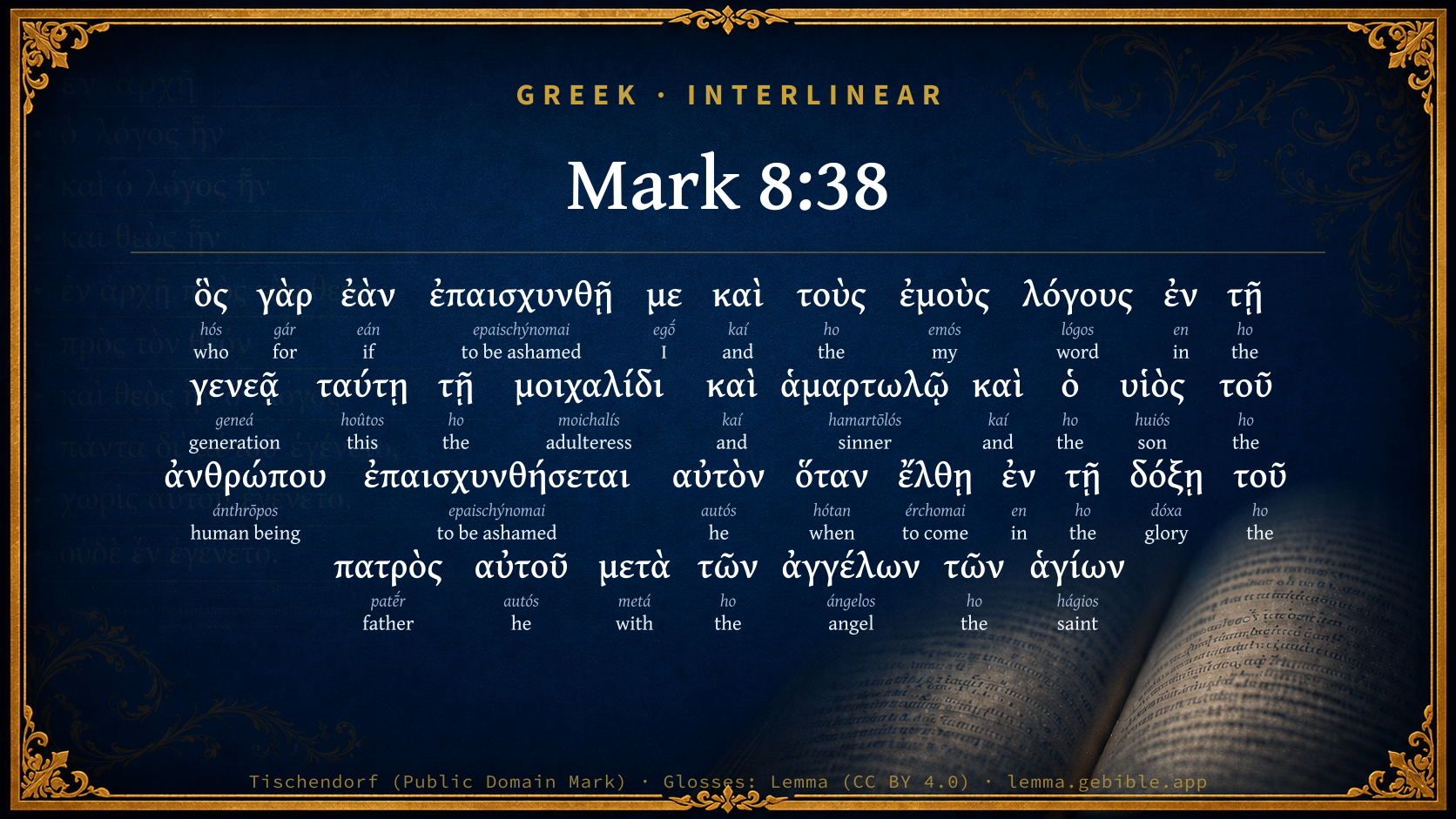
Download image
Cite this verse

Mark 8:38 (World English Bible). Public Domain. Lemma interlinear Bible study tool, https://lemma.gebible.app/v/mark/8/38.

Show BibTeX & RIS
BibTeX
RIS
English Translation
For whoever will be ashamed of me and of my words in this adulterous and sinful generation, the Son of Man also will be ashamed of him, when he comes in the glory of his Father with the holy angels."
World English Bible · Public Domain
Highlights
  • 1 first appearance in the Greek New Testament
Full analysis ↓
Download a study sheet

One document with this verse’s original text, its word-by-word gloss line, the meaning frame, cross-references with their text, attributed commentary, and full source and license credits — printable, and it pastes into notes with its structure intact.

This verse Autodidact and up

Study sheet (.html) Plain text (.txt)

A passage Seminary Student

Up to 50 verses in one chapter. A passage sheet keeps up to 6 commentary sources and 12 cross-references per verse, in the order this page ranks them, and says so on the sheet whenever that leaves anything out. Ask for a single verse and you get the Autodidact verse sheet above.

Everything on this page stays free to read, with no account — the sheet is a download of what is already on screen, not access to it.

Want to remove ads? Support Godless Engineer
Compare translations 3

The same verse in 3 English versions, stacked beneath the original-language interlinear above. Click any original word for its lexicon entry.

Each is an independent rendering of the whole verse — the interlinear is not word-aligned to these translations.

Highlighted words mark where these versions differ — a whole-verse word diff, not a word-by-word alignment.

  • World English Bible Public Domain
    For whoever will be ashamed of me and of my words in this adulterous and sinful generation, the Son of Man also will be ashamed of him, when he comes in the glory of his Father with the holy angels."
  • King James Version Public Domain
    Whosoever therefore shall be ashamed of me and of my words in this adulterous and sinful generation; of him also shall the Son of man be ashamed, when he cometh in the glory of his Father with the holy angels.
  • unfoldingWord Literal Text CC BY-SA 4.0
    For whoever is ashamed of me and of my words in this adulterous and sinful generation, the Son of Man will also be ashamed of him when he comes in the glory of his Father with the holy angels.”

unfoldingWord Literal Text — © unfoldingWord, licensed CC BY-SA 4.0. Word-aligned USFM3 via Door43 (git.door43.org/unfoldingWord/en_ult).

Versions to compare (up to 4)

3 of 4 selected

Show all 19 translations

Every available English version of this verse, each an independent rendering of the whole verse.

  • World English Bible Public Domain
    For whoever will be ashamed of me and of my words in this adulterous and sinful generation, the Son of Man also will be ashamed of him, when he comes in the glory of his Father with the holy angels."
  • Berean Standard Bible Public Domain
    If anyone is ashamed of Me and My words in this adulterous and sinful generation, the Son of Man will also be ashamed of him when He comes in His Father’s glory with the holy angels.”
  • Majority Standard Bible Public Domain
    If anyone is ashamed of Me and My words in this adulterous and sinful generation, the Son of Man will also be ashamed of him when He comes in His Father’s glory with the holy angels.”
  • King James Version Public Domain
    Whosoever therefore shall be ashamed of me and of my words in this adulterous and sinful generation; of him also shall the Son of man be ashamed, when he cometh in the glory of his Father with the holy angels.
  • American Standard Version (1901) Public Domain
    For whosoever shall be ashamed of me and of my words in this adulterous and sinful generation, the Son of man also shall be ashamed of him, when he cometh in the glory of his Father with the holy angels.
  • Revised Version (1885) Public Domain
    For whosoever shall be ashamed of me and of my words in this adulterous and sinful generation, the Son of man also shall be ashamed of him, when he cometh in the glory of his Father with the holy angels.
  • Geneva Bible (1599) Public Domain
    For whosoeuer shall be ashamed of mee, and of my wordes among this adulterous and sinfull generation, of him shall the Sonne of man be ashamed also, when he commeth in the glorie of his Father with the holy Angels.
  • Douay-Rheims (1899) Public Domain
    For he that shall be ashamed of me, and of my words, in this adulterous and sinful generation: the Son of man also will be ashamed of him, when he shall come in the glory of his Father with the holy angels.
  • Young's Literal Translation Public Domain
    for whoever may be ashamed of me, and of my words, in this adulterous and sinful generation, the Son of Man also shall be ashamed of him, when he may come in the glory of his Father, with the holy messengers.'
  • Literal Standard Version CC BY-SA 4.0
    For whoever may be ashamed of Me, and of My words, in this adulterous and sinful generation, the Son of Man will also be ashamed of him when He may come in the glory of His Father with the holy messengers.”
  • Unlocked Literal Bible CC BY-SA 4.0
    Whoever is ashamed of me and my words in this adulterous and sinful generation, the Son of Man will be ashamed of him when he comes in the glory of his Father with the holy angels.”
  • unfoldingWord Literal Text CC BY-SA 4.0
    For whoever is ashamed of me and of my words in this adulterous and sinful generation, the Son of Man will also be ashamed of him when he comes in the glory of his Father with the holy angels.”
  • Darby Bible Public Domain
    For whosoever shall be ashamed of me and of my words in this adulterous and sinful generation, of him shall the Son of man also be ashamed when he shall come in the glory of his Father with the holy angels.
  • World Messianic Bible Public Domain
    For whoever will be ashamed of me and of my words in this adulterous and sinful generation, the Son of Man also will be ashamed of him when he comes in his Father’s glory with the holy angels.”
  • Webster's Bible Public Domain
    Whoever therefore shall be ashamed of me, and of my words, in this adulterous and sinful generation; of him also will the Son of man be ashamed, when he cometh in the glory of his Father with the holy angels.
  • Free Bible Version CC BY-SA 4.0
    If you're ashamed to acknowledge me and what I say among this unfaithful and sinful people, then the Son of man will be ashamed to acknowledge you when he comes with his Father's glory with the holy angels.”
  • Bible in Basic English Public Domain
    Whoever has a feeling of shame because of me and my words in this false and evil generation, the Son of man will have a feeling of shame because of him, when he comes in the glory of his Father with the holy angels.
  • Text-Critical English NT CC BY 4.0
    If anyone is ashamed of me and my words in this adulterous and sinful generation, the Son of Man will also be ashamed of him when he comes in the glory of his Father with the holy angels.”
  • Tyndale New Testament (1534) Public Domain
    Whosoever therfore shall be asshamed of me and of my wordes amonge this advoutrous and sinfull generacion: of him shall the sonne of man be ashamed when he cometh in the glory of his father with the holy angels.

Literal Standard Version (2020), Covenant Press — licensed CC BY-SA 4.0. Text via the HelloAO Bible API (eBible.org). Unlocked Literal Bible (unfoldingWord) — licensed CC BY-SA 4.0. Text via the HelloAO Bible API (eBible.org). unfoldingWord Literal Text — © unfoldingWord, licensed CC BY-SA 4.0. Word-aligned USFM3 via Door43 (git.door43.org/unfoldingWord/en_ult). Free Bible Version, Dr. Jonathan Gallagher — licensed CC BY-SA 4.0. Text via the HelloAO Bible API (eBible.org).

Word by word

More ways to search: Search by grammar → Find every occurrence → Compare this word →

Practice this passage: Drill this verse → Learn its vocabulary →

μοιχαλίδι
moichalís
G3428
“adulteress”
Noun, Dative, Singular, Feminine
Part of Speech
Noun
Case
Dative
Number
Singular
Gender
Feminine
Full Thayer's Definition

Origin: a prolonged form of the feminine of G3432

TDNT: 16:09,6

1. an adulteress 2. as the intimate alliance of God with the people of Israel was likened to a marriage, those who relapse into idolatry are said to commit adultery or play the harlot a. fig. equiv. to faithless to God, unclean, apostate
  1. ὃς hós G3739 “who” Relative pronoun, Nominative, Singular, Masculine
  2. γὰρ gár G1063 “for” Conjunction
  3. ἐὰν eán G1437 “if” Conditional
  4. ἐπαισχυνθῇ epaischýnomai G1870 “to be ashamed” Verb, Aorist, Passive deponent, Subjunctive, 3rd person, Singular
  5. με egṓ G1473 “I” Personal pronoun, 1st person, Accusative, Singular
  6. καὶ kaí G2532 “and” Conjunction
  7. τοὺς ho G3588 “the” Article, Accusative, Plural, Masculine
  8. ἐμοὺς emós G1699 “my” Possessive pronoun, 1st person, Accusative, Plural, Masculine
  9. λόγους lógos G3056 “word” Noun, Accusative, Plural, Masculine
  10. ἐν en G1722 “in” Preposition
  11. τῇ ho G3588 “the” Article, Dative, Singular, Feminine
  12. γενεᾷ geneá G1074 “generation” Noun, Dative, Singular, Feminine
  13. ταύτῃ hoûtos G3778 “this” Demonstrative pronoun, Dative, Singular, Feminine
  14. τῇ ho G3588 “the” Article, Dative, Singular, Feminine
  15. καὶ kaí G2532 “and” Conjunction
  16. ἁμαρτωλῷ hamartōlós G268 “sinner” Adjective, Dative, Singular, Feminine
  17. καὶ kaí G2532 “and” Conjunction
  18. ὁ ho G3588 “the” Article, Nominative, Singular, Masculine
  19. υἱὸς huiós G5207 “son” Noun, Nominative, Singular, Masculine
  20. τοῦ ho G3588 “the” Article, Genitive, Singular, Masculine
  21. ἀνθρώπου ánthrōpos G444 “human being” Noun, Genitive, Singular, Masculine
  22. ἐπαισχυνθήσεται epaischýnomai G1870 “to be ashamed” Verb, Future, Passive deponent, Indicative, 3rd person, Singular
  23. αὐτὸν autós G846 “he” Personal pronoun, Accusative, Singular, Masculine
  24. ὅταν hótan G3752 “when” Conjunction
  25. ἔλθῃ érchomai G2064 “to come” Verb, Aorist, Active, Subjunctive, 3rd person, Singular
  26. ἐν en G1722 “in” Preposition
  27. τῇ ho G3588 “the” Article, Dative, Singular, Feminine
  28. δόξῃ dóxa G1391 “glory” Noun, Dative, Singular, Feminine
  29. τοῦ ho G3588 “the” Article, Genitive, Singular, Masculine
  30. πατρὸς patḗr G3962 “father” Noun, Genitive, Singular, Masculine
  31. αὐτοῦ autós G846 “he” Personal pronoun, Genitive, Singular, Masculine
  32. μετὰ metá G3326 “with” Preposition
  33. τῶν ho G3588 “the” Article, Genitive, Plural, Masculine
  34. ἀγγέλων ángelos G32 “angel” Noun, Genitive, Plural, Masculine
  35. τῶν ho G3588 “the” Article, Genitive, Plural, Masculine
  36. ἁγίων hágios G40 “saint” Adjective, Genitive, Plural, Masculine

About this verse

These counts appear in no published source. They are computed here, from the morphology-tagged text and Lemma’s own curated glosses. What Lemma adds →

37
words
24
distinct lemmas
Gospels
section

Notable vocabulary

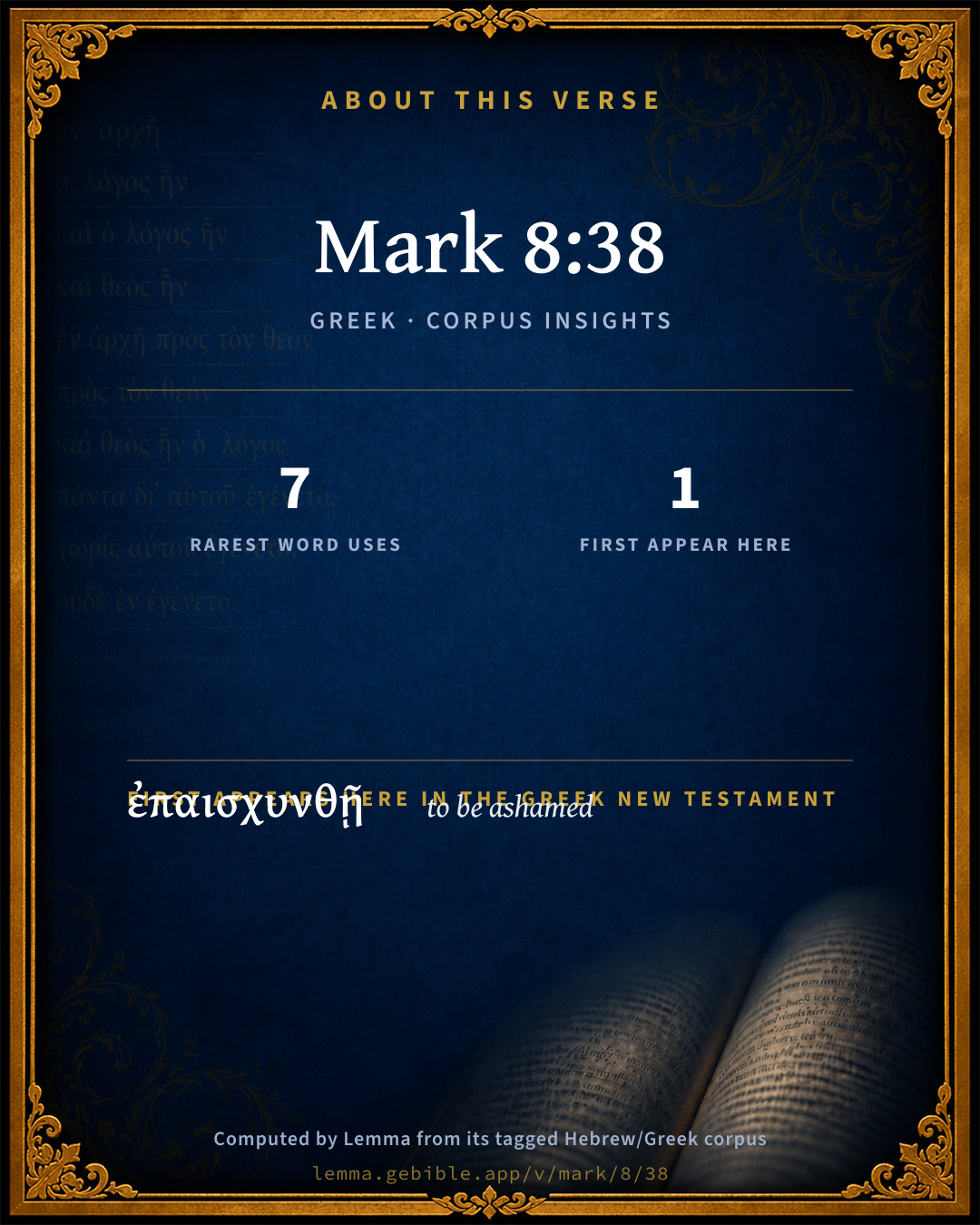
The rarest word here is μοιχαλίδι adulteress G3428 — appearing just 7 times in the whole Greek New Testament.

First appearance in Scripture

This word makes its first canonical appearance in the Greek New Testament here:

  • ἐπαισχυνθῇ to be ashamed G1870

Shared distinctive vocabulary

μοιχαλίδι adulteress G3428 occurs in 6 verses of the Greek New Testament. Also found in:
Repetition

Words recur within this verse:

  • ἐπαισχυνθῇ to be ashamed G1870 ×2
  • τοὺς the G3588 ×9
  • καὶ and G2532 ×3
  • ἐν in G1722 ×2
  • αὐτὸν he G846 ×2

Cross-references

36

Topical passages linked to Mark 8:38 in the Treasury of Scripture Knowledge — connected by theme and wording, ordered by reader-vote popularity; previews shown in the World English Bible.

  • Luke 12:8–9 "I tell you, everyone who confesses me before men, him will the Son of Man also confess before the angels of God;
  • Romans 1:16 For I am not ashamed of the Gospel of Christ, for it is the power of God for salvation for everyone who believes; for the Jew first, and also for the Greek.
  • 1 John 2:23 Whoever denies the Son, the same doesn't have the Father. He who confesses the Son has the Father also.
  • James 4:4 You adulterers and adulteresses, don't you know that friendship with the world is enmity with God? Whoever therefore wants to be a friend of the world makes himself an enemy of God.
  • Matthew 10:32–33 Everyone therefore who confesses me before men, him I will also confess before my Father who is in heaven.
  • Luke 9:26 For whoever will be ashamed of me and of my words, of him will the Son of Man be ashamed, when he comes in his glory, and the glory of the Father, and of the holy angels.
  • Matthew 26:64 Jesus said to him, "You have said it. Nevertheless, I tell you, henceforth you will see the Son of Man sitting at the right hand of Power, and coming on the clouds of the sky."
  • 2 Timothy 1:8 Therefore don't be ashamed of the testimony of our Lord, nor of me his prisoner; but endure hardship for the Gospel according to the power of God,
  • Matthew 16:27 For the Son of Man will come in the glory of his Father with his angels, and then he will render to everyone according to his deeds.
  • Matthew 12:39 But he answered them, "An evil and adulterous generation seeks after a sign, but no sign will be given it but the sign of Jonah the prophet.
  • 2 Timothy 1:12 For this cause I suffer also these things. Yet I am not ashamed, for I know him whom I have believed, and I am persuaded that he is able to guard that which I have committed to him against that day.
  • Hebrews 11:16 But now they desire a better country, that is, a heavenly one. Therefore God is not ashamed of them, to be called their God, for he has prepared a city for them.
  • Hebrews 11:26 accounting the reproach of Christ greater riches than the treasures of Egypt; for he looked to the reward.
  • Matthew 25:31 "But when the Son of Man comes in his glory, and all the holy angels with him, then he will sit on the throne of his glory.
  • John 1:51 He said to him, "Most assuredly, I tell you, hereafter you will see heaven opened, and the angels of God ascending and descending on the Son of Man."
  • 2 Timothy 2:12–13 If we endure, We will also reign with him. If we deny him, He also will deny us.
  • Matthew 24:30 and then the sign of the Son of Man will appear in the sky. Then all the tribes of the earth will mourn, and they will see the Son of Man coming on the clouds of the sky with power and great glory.
  • Matthew 13:41 The Son of Man will send out his angels, and they will gather out of his Kingdom all things that cause stumbling, and those who do iniquity,
  • Luke 19:26 'For I tell you that to everyone who has, will more be given; but from him who doesn't have, even that which he has will be taken away from him.
  • Deuteronomy 33:2 He said, Yahweh came from Sinai, Rose from Seir to them; He shined forth from Mount Paran, He came from the ten thousands of holy ones: At his right hand was a fiery law for them.
  • Daniel 7:10 A fiery stream issued and came forth from before him: thousands of thousands ministered to him, and ten thousand times ten thousand stood before him: the judgment was set, and the books were opened.
  • Daniel 7:13 I saw in the night-visions, and, behold, there came with the clouds of the sky one like a son of man, and he came even to the ancient of days, and they brought him near before him.
  • Mark 14:62 Jesus said, "I AM. You will see the Son of Man sitting at the right hand of Power, and coming with the clouds of the sky."
  • John 5:27 He also gave him authority to execute judgment, because he is a son of man.
  • John 12:34 The multitude answered him, "We have heard out of the law that the Christ remains forever. How do you say, 'The Son of Man must be lifted up?' Who is this Son of Man?"
  • Acts 5:41 They therefore departed from the presence of the council, rejoicing that they were counted worthy to suffer dishonor for Jesus' name.
  • Galatians 6:14 But far be it from me to boast, except in the cross of our Lord Jesus Christ, through which the world has been crucified to me, and I to the world.
  • 1 Thessalonians 1:7–8 so that you became an example to all who believe in Macedonia and in Achaia.
  • 2 Timothy 1:16 May the Lord grant mercy to the house of Onesiphorus, for he often refreshed me, and was not ashamed of my chain,
  • Hebrews 12:2–3 looking to Jesus, the author and perfecter of faith, who for the joy that was set before him endured the cross, despising shame, and has sat down at the right hand of the throne of God.
  • Hebrews 13:13 Let us therefore go forth to him outside of the camp, bearing his reproach.
  • Jude 1:14–15 About these also Enoch, the seventh from Adam, prophesied, saying, "Behold, the Lord came with ten thousands of his holy ones,
  • Zechariah 14:5 You shall flee by the valley of my mountains; for the valley of the mountains shall reach to Azel; yes, you shall flee, just like you fled from before the earthquake in the days of Uzziah king of Judah. Yahweh my God will come, and all the holy ones with you.
  • Matthew 8:20 Jesus said to him, "The foxes have holes, and the birds of the sky have nests, but the Son of Man has nowhere to lay his head."
  • Matthew 16:4 An evil and adulterous generation seeks after a sign, and there will be no sign given to it, except the sign of the prophet Jonah." He left them, and departed.
  • John 1:14 The Word became flesh, and lived among us. We saw his glory, such glory as of the one and only Son of the Father, full of grace and truth.

Cross-references courtesy of OpenBible.info (CC BY 4.0).

Commentary

Notes on Mark 8:38 from classic Christian and Jewish commentators (each source and its license shown beneath its notes). The classic Christian expositions comment on the surrounding passage and are grouped to its opening verse, so a note may address several verses; the Jewish commentaries on the Tanakh (Rashi and others) are per-verse, so they appear only where the commentator wrote on this verse.

Lemma curates 59 commentaries, every one of them public domain or Creative Commons licensed, each selected and text-cleaned for this edition rather than reprinted as found. About our sources →

The Biblical Illustrator

Joseph S. Exell

Mar_8:38

Whosoever therefore shall be ashamed of Me and of My words.

-

Ashamed of Jesus

I. Inquire into the nature of the crime of being ashamed of Christ, and of His words. The duty opposed to the crime is expressed by confessing Christ before men; therefore to be ashamed of Christ and of His word, is to deny or disown Christ and His doctrine before men. There have not wanted some in all times to justify the prudence of concealing our religious sentiments, and to encourage men to live well with the world in an outward compliance with its customs, provided the heart be right with God. It is also added that to suppose it necessary for men to own their religious sentiments at the peril of their lives, is making God a hard master. What does our confession avail Him who can see the heart? But yet these are but excuses, and founded in ignorance of the nature of religion, and of the great ends to be served by it. Were we to estimate our religion by the service or benefit done to God, we might part with it all at once. He gets no more by the sincerity of our hearts than by our outward professions; and therefore upon this view we may bid adieu to both. If you think, however, that there is something in inward sincerity that is agreeable in His sight, that renders men acceptable to Him, I wonder, at the same time, you should not think hypocrisy and dissimulation with the world odious in His sight, and such vices as will render us detestable to Him. To suppose inward sincerity consistent with an external hypocrisy toward the world, is itself a very great absurdity. For what is hypocrisy But how comes it to be necessary for a man to say anything about his religion? To a clear resolution of this question we must consider the nature of religion, and the ends to be served by it. The duties of religion respect God but also the well-being of the world. Religion is a principle of obedience to God, as Governor of the world. It cannot therefore possibly be a mere secret concern between God and every mans conscience, since it respects Him in so public a character, and must extend to everything in which God, as Governor of the world, is supposed to be concerned. For surely it is impossible to pay the proper respect and obedience which is due to the Governor of the world, whilst we deny Him, in the face of the world, to be the Governor of it. But further: if any religious obedience be due to God as Governor of the world, it must principally consist in promoting the great end of His government. Again: if it be really, as it is, impossible for us to do God any private service by which He may be the better, it is very absurd to imagine that religion can consist, or be preserved by any secret belief or opinion, how cordially soever embraced. What thanks can be due to you for silently believing God to be the Governor of the world, whilst you openly deny it, and in your actions disclaim it? Even this principle, which is the foundation of all religion, has nothing of religion in it, so long as it is inactive, and consists in speculation, without bringing forth fruits agreeable to such a persuasion. Lastly: if it be any part of religion to promote religion and the knowledge of Gods truth in the world, it cannot be consistent with our duty to dissemble, or to deny our faith. The man who hides his own religion close in his heart, tempts others, who suspect not his hypocrisy, to throw theirs quite out; and whilst he rejoices in this sheet anchor of a pure inward faith, he sees others who steer after him make shipwreck of their faith and their salvation. Under this head I have one thing more to observe to you, that there are in this vice, as indeed in most others, very different degrees. While some were contented to hide themselves, and dissemble their acquaintance with Christ, St. Peter openly denied Him, and confirmed it with an oath, that he knew not the Man. Thus some for fear in those days of persecution, denied their Lord; and some in these days, such is our unhappy case, are so vain and conceited, as to he ashamed of the Lord who bought them. Among these, some openly blaspheme Him; others are content to make a sport of His religion; whilst a third sort profess a pleasure in such conversation, though their hearts ache for their iniquity, but they want the courage to rebuke even by their silence the sin of the scorner. All these are in the number of those who are ashamed of Christ. Secondly: to inquire into the several temptations which lead men to this crime of bring ashamed of Christ and of His words. The fountain from which these temptations spring is plainly enough described in the text, This adulterous and sinful generation. And we know full well, that there is not a natural fear lurking in the heart of man, but the world knows how to reach it; not a passion, but it has an enchantment ready for it; no weakness, no vanity, but it knows how to lay hold of it so that all our natural hopes and fears, our passions, our infirmities, are liable to be drawn into the conspiracy against Christ and His word. But the other kind of temptations come upon our invitation: we make our faith a sacrifice to the great idol, the world, when we part with it for honour, wealth, or pleasure. In this circumstance men take pains to show how little they value their religion, and seek occasions to display their libertinism and infidelity, in order to make their way to the favour of a corrupt and degenerate age. This behaviour admits of no excuse. But whenever infidelity grows into credit and repute, and the world has so vitiated a taste, as to esteem the symptoms of irreligion as signs of a good understanding and sound judgment; that a man cannot appear to be in earnest concerned for his religion without being thought a fool, or suspected to be a knave; then there arises another temptation to make men ashamed of Christ, and of His word. No man likes to be despised by those about him. There is a contagion in ill company, and he who dwells with the scorner shall not be guiltless. Had our Lord been merely a teacher of good things, without any special commission or authority from the great Creator and Governor of the world, it would have been highly absurd to assume to Himself this great prerogative of being owned and acknowledged before men. When, therefore, we read that our Lord requires of us to confess Him before men, the true way to know what we are to confess, is to reflect what He confessed Himself; for it cannot be supposed that He thought it reasonable for Himself to make one confession, and for His disciples and servants to make another. Look, then, into the gospel, and see His own confession. He confessed Himself to be the only Son of God, to come from the bosom of the Father to die for the sins of the world; to have all power given to Him in heaven and earth; to be the Judge of the world. (The Practical Pulpit.)

Our great work for Christ is to confess Him

But this confession of Christ-this not being ashamed of Him and of His words-is different in different generations and different societies. In the earliest age of all, the offence was the offence of the cross-that men should not he ashamed to confess that they believed that He who was crucified was the Son of God, and that they hoped to be saved by His very cress. Since then, this offence has ceased in outward form, but in reality it has reappeared under different forms of religious cowardice. In licentious ages and societies men have been ashamed of the self-denying words and example of the Lord; in superstitious ages, of upholding the purity of His religion; in heretical ages, of manfully contending for the faith of His true godhead; in later periods of our history men seem to have been ashamed of confessing that we are saved through Christ alone; and in this age, and in learned and scientific societies, are not men ashamed of confessing those words of Christ, and of His servants, which assert the supernatural in our holy religion? (M. F. Sadler.)

Ashamed of Jesus

I. The persons described. Those who, from shame-

(1) Decline to assume a profession of the gospel;

(2) Do not maintain a consistent profession of the gospel;

(3) Abandon the profession of the gospel.

II. The doom threatened. It is certain, awful, just. (Plans of Sermons.)

.

The Biblical Illustrator, edited by Joseph S. Exell (c. 1880s–1900s) — public domain. Text from a community e-Sword module.

Godbey's Commentary on the New Testament

William B. Godbey

THE SECOND COMING

Mat 16:27-28. “For the Son of man is about to come in the glory of His Father, with His angels, and will then give to each one according to his work. Truly, I say unto you, There are certain ones of those standing here who may not taste of death, until they may see the Son of man coming in His kingdom.” Mar 8:38; Mar 9:1 : “For whosoever shall be ashamed of Me and My words in this adulterous and wicked generation, truly, the Son of man shall be ashamed of him, when He may come in the glory of His Father, with His holy angels. And He said to them, Truly, I say unto you, That there are certain ones of those standing here who may not taste of death until they may see the kingdom of God having come in power.”

Luk 9:26-27 : “For whosoever may be ashamed of Me and My words, of him shall the Son of man be ashamed, when He shall come in His glory, and that of the Father, and that of the holy angels. And, truly, I say unto you, There are certain ones of those standing here who may not taste of death until they may see the kingdom of God.” Very pertinently does our Savior here follow that terribly rigid and close sermon on discipleship, by one of the grandest of all possible inspirations, to settle the problem of discipleship, at any and every conceivable cost, making sure of heaven if we lose everything else, which is certainly the normal verdict of sound intelligence.

a. As this passage, recorded by Mark and Luke, reads in E.V., it has been the puzzle of millions. I know not why they give us the future tense, indicative mode, when the Greek has the present subjunctive. Within about one week from the time of this utterance, Peter, James, and John actually witnessed a prelude of His second coming on the Mount of Transfiguration.

“For not having followed cunningly devised fables, having made known unto you the power and coming of our Lord Jesus Christ, but having been eye-witnesses of His majesty. . . . And we heard this voice borne from heaven, being along with Him in the holy mount.” (2Pe 1:16-18.)

Here you see, Peter certifies that they witnessed His power and coming, while they were with Him in the holy mount. Now what was that holy mount? Why the Mount of Transfiguration, which they actually visited in a few days from that time, it being the preliminary coming of the Lord in His glory; i.e., an actual adumbration of His second coming. As Peter, James, and John were all present in His audience, and actually witnessed this prelude of His second and glorious coming, we, on the Mount of Transfiguration, have a preliminary fulfillment of this prophecy.

b. Within forty years of that date, while many of those people were still living, the Lord actually came, in His awful retributive judgments on the unbelieving Jews, executing righteous retribution for the rejection of His Son, destroying Jerusalem, and desolating the land with the awful scourge of the Roman armies, putting an end to the Jewish State and nationality, and annihilating the Jewish polity. Some able critics here find the fulfillment of this prophecy.

c. On the day of Pentecost the kingdom did certainly, as Mark says, “come in power,” having been on earth during the ministry of our Savior; but in the fiery baptisms and rushing tempest on the day of Pentecost it certainly did come in the signal manifestation of unprecedented power.

d. I see no reason why we may not take the whole passage as it is, and apply it to the existing generation, as it simply affirms a gracious possibility; i.e., there are some of those who are standing here, who may not taste of death until they may see the Son of man coming in His kingdom. Hence you see it simply affirms a gracious possibility on the part of that generation to see the Son of man coming in His glory, with the glory of the Father and the holy angels, before they pass away. You must remember that man has always been a failure. He failed in Eden; failed in antediluvian times; failed after the flood, landing in Egyptian slavery; failed in Judaism, rejecting and murdering their own Savior; and, according to the prophecies, will fail in the Gentile age, bringing on the tribulation, and forfeiting the millennium. Is not this very discouraging? O no! While man is a failure under all circumstances, God is an invariable and glorious success. Hence, all of these human failures should only inspire us to give up humanity, and fly to God, sinking away, lost in Him, to spend an eternity of bliss. The generation contemporary with Jesus was no exception. There was a gracious possibility for that generation to have preached the gospel to every nation, and so evangelize the world as to meet the condition of our Lord’s return (Mat 24:14); as in that case He would have returned in His glory before the death of that generation. Here our Savior assures us, “Whosoever may be ashamed of Me and My words, in this wicked and adulterous world, the Son of man shall be ashamed of him, when He may come in the glory of His Father, with His holy angels.” Remember, this is the peroration of that awful sermon on discipleship, which nowadays is dodged, perverted, and misconstrued by clergy and laity, laying under contribution all their wits, to devise an easy way to heaven, washing, dressing, and educating old Adam, and taking him along with them. N.B. In a similar manner we find so many tender footed on the coming of the Lord, which our Savior here gives in immediate connection with His exposition of discipleship. The true, blood-washed, fire-baptized, and Spirit-filled disciple is not troubled when we preach the coming of the Lord, but elated with heaven-born enthusiasm, causing him to leap, shout, and run to meet Him. Jesus here calls the people who are ashamed of Him and His words, “a wicked and adulterous generation.” Far from shame or embarrassment at the coming of the Lord, we should be watching and waiting, and ready with shouts, to meet Him. “And now, little children, abide in Him, in order that if He may appear, we may have boldness, and not shrink with embarrassment from Him at His coming.” E.V. says we “may not be ashamed.” This is the same word which our Lord uses with reference to His words and His presence when He comes in His glory. Hence we should all be so saved and sanctified as to put us in perfect harmony with the words of Jesus; so we do not want to turn and twist them about, nor evade their force in any way, but want them to remain just as Jesus gave them. And as to Himself, “He is the fairest among ten thousand, and altogether lovely.” Since His ascension, the widowed Church has mourned the absence of her Heavenly Spouse, and longed for His return, even now watching and waiting, ready to run to meet Him with shouts of triumph. So be sure that you are not ashamed nor embarrassed, when you read His Word, and contemplate His personal coming in a cloud this day.

William B. Godbey, Commentary on the New Testament (1896–1900) — public domain. Text from a community e-Sword module.

Tyndale Open Study Notes

Tyndale Open Resources

8:38 When Jesus, as the Son of Man, returns in glory to judge the world, he will be ashamed of those who were ashamed to be identified with him and his message (cp. Matt 7:21-23; 10:32-33; Luke 12:8-9; 2 Tim 2:12).

Tyndale Open Study Notes — © Tyndale Open Resources, licensed CC BY-SA 4.0. Text via the HelloAO Bible API.

Bengel's Gnomon

Johann Albrecht Bengel

Mar 8:38. Ἐπαισχυνθῇ, shall be ashamed) in words and deeds. [It is by the undaunted confession of Christ itself that His own life is brought into danger.—V. g.]—Με—ὁ Υἱὸς τοῦ ἀνθρώπου, Me—the Son of Man) concerning the present time, He speaks in the first person [Me]; concerning the future, in the third [the Son of Man. λόγους, words) of the cross [which carry with them the need of taking up a cross). The plural implies, that one may confess Christ in general, and yet be ashamed of this or that word, this or that saying of His; for instance, Matthew 5 This kind of shame must also be overcome.—ἐν τῇ γενεᾷ ταύτῃ in this generation) To this there stands in antithesis the general assembly of the last day, which is spoken of presently after.—τῇ μοιχαλίδι καὶ ἁμαρτωλῷ, this adulterous and sinful) which, as an adulteress, despises Christ:[2] as sinful, despises His words: and in consequence throws out in the way of those who confess Him all kinds of threats and promises. Such a crowd ought to be altogether despised. Who need fear them?—who regard them?—ὁ Υἱὸς ἀνθρώπου, the Son of Man) He had just now said, Me and My words, not the Son of Man and His words; but now He does not say, I, but the Son of Man, which appellation has a peculiar connection with His glorious and visible Advent. Luk 9:26.—ἐπαισχυνθήσεται, shall regard as an object of shame) with good reason: and so shall not acknowledge as His, but shall put away from Him.—τοῦ Πατρὸς, the Father) Therefore His glory is, as of the Only-begotten of the Father, Joh 1:14.—μετὰ τῶν ἀγγέλων τῶν ἁγίων) This is the Greek reading, and that of the Goth. Version, etc. See App. Crit. Ed. ii. on this passage. O what shame! To be regarded as an object of shame in the presence of God the Father, of Christ, and of angels!

[2] The true Husband and Bridegroom of the Church.—ED. and TRANSL.

Bengel's Gnomon of the New Testament — English translation (T&T Clark, Edinburgh, 1860) — public domain. Text from a community e-Sword module.

Expositor's Greek Testament

ed. W. Robertson Nicoll

Mar 8:38 reproduces the logion in Mat 10:33 concerning being ashamed of Jesus, which does not find a place here in Mt.’s version. In Mt.’s form it is the outward ostensible act of denial that is animadverted on; here the feeling of shame, which is its cause Mar 9:1 . καὶ ἔλεγεν αὐτοῖς : with this phrase Mk. makes a new start, and turns the close of the Caesarea Philippi conversation into an introduction to the following narrative concerning the transfiguration, apparently suggesting that in the latter event the words found their fulfilment. This impression, if it existed, does not bind the interpreter. ἀμὴν , introducing a solemn statement. ἕως ἂν ἴδωσιν , etc.: the promised vision is differently described in the three accounts, as thus:

Till they see: the Son of Man coming in His Kingdom (Mt.).

Till they see: the Kingdom of God come ( ἐληλυθυῖαν ) in power (Mk.).

Till they see: the Kingdom of God (Lk.).

The Expositor's Greek Testament, edited by W. Robertson Nicoll (1897–1910) — public domain. Text from a community e-Sword module.

Adam Clarke's Commentary

Verse 38. Whosoever - shall be ashamed of me] Our Lord hints here at one of the principal reasons of the incredulity of the Jews,-they saw nothing in the person of Jesus Christ which corresponded to the pompous notions which they had formed of the Messiah.

If Jesus Christ had come into the world as a mighty and opulent man, clothed with earthly glories and honours, he would have had a multitude of partisans, and most of them hypocrites.

And of my words] This was another subject of offence to the Jews: the doctrine of the cross must be believed; a suffering Messiah must be acknowledged; and poverty and affliction must be borne; and death, perhaps, suffered in consequence of becoming his disciples.

Of him, and of his words, in this sense, the world is, to this day, ashamed.

Of him also shall the Son of man be ashamed] As he refused to acknowledge me before men, so will I refuse to acknowledge him before God and his angels. Terrible consequence of the rejection of Christ! And who can help him whom the only Saviour eternally disowns. Reader! Lay this subject seriously to heart; and see the notes on Mt 16:24, c., and at the end of that chapter. See Clarke on Mt 16:28.

ALL the subjects contained in this chapter are very interesting but particularly:

1. The miraculous feeding of the multitudes, which is a full, unequivocal proof of the supreme Divinity of Jesus Christ: in this miracle he truly appears in his creative energy, with which he has associated the tenderest benevolence and humanity. The subject of such a prince must ever be safe; the servant of such a master must ever have kind usage; the follower of such a teacher can never want nor go astray.

2. The necessity of keeping the doctrine of the Gospel uncorrupt, is strongly inculcated in the caution to avoid the leaven of the Pharisees and of Herod: the doctrine of the cross must not only be observed and held inviolate, but that doctrine must never be mixed with worldly politics. Time-serving is abominable in the sight of God: it shows that the person has either no fixed principle of religion, or that he is not under the influence of any.

Adam Clarke's Commentary on the Bible (1810–1826) — public domain. Text from a community e-Sword/MySword module.

Ellicott's Commentary for English Readers

(38) Whosoever therefore.—Here St. Mark differs from St. Matthew, who omits these words, and agrees, though not quite verbally, with St. Luke. It is obvious that general as the words are, they had a special bearing on those who, like Peter, and probably the other disciples, had shown that they were “ashamed” of the words which had just been spoken.

This adulterous and sinful generation.—The words are not found in St. Luke’s report, but they agree with language which our Lord had used before (Mat_12:39; Mat_16:4). Their force here lies in the contrast drawn between those from whose frown or scorn the disciples were now shrinking, and the bright hosts in whose presence the faithless should be put to shame when the Son of Man should come in His glory. They were to look on this picture and on that, and ask themselves which ordeal was the most terrible.

A Bible Commentary for English Readers, edited by Charles John Ellicott (1878–1897) — public domain. Text from a community e-Sword module.

The Cambridge Bible for Schools and Colleges

gen. ed. J. J. S. Perowne

38. adulterous] The generation is called “adulterous,” because its heart was estranged from God. Comp. Jer_31:32; Isa_54:5.

The Cambridge Bible for Schools and Colleges (gen. ed. J. J. S. Perowne; Cambridge University Press, 1878–1918) — public domain. Text from a community e-Sword module.

Trapp's Complete Commentary

John Trapp

38 Whosoever therefore shall be ashamed of me and of my words in this adulterous and sinful generation; of him also shall the Son of man be ashamed, when he cometh in the glory of his Father with the holy angels.

Ver. 38. In this adulterous and sinful, &c.] The worse the times are the better we should be. Stars are most needed in a dark night. We may as well, saith Zuinglius, Ad aram Iovis aut Veneris adorare, ac sub Antichristo fidem occultare. Antichrist’s limbs have their mark in their hand, which they may show or hide at pleasure; but Christ’s members have their marks in their foreheads only. David’s parents and brethren came down to him to the cave of Adullam, though to their great danger, 1Sa 22:1. Onesiphorus was not ashamed of Paul’s chain at Rome, 2Ti 1:16.

When he cometh in the glory] David going against Goliath, took only his sling, and a few stones; but when against Nabal, he marched better appointed. So Christ came at first in a mean condition; but when he comes again to judgment, he shall march furiously, attended with troops of saints and angels.

John Trapp, A Commentary or Exposition upon All the Books of the Old and New Testament (1647–1656) — public domain. Text from a community e-Sword module.

Matthew Poole's English Annotations

These words occurring twice in Matthew, Mat 10:33; 16:27, have been before spoken to:

See Poole on "Mat 10:33". See Poole on "Mat 16:27". Luke repeats them most perfectly, as here they are recorded. Mark expounds Luke’s words, where he saith that Christ shall come in his own glory, and in his Father’s, and of the holy angels. By the glory of the holy angels is meant no more than attended by the holy angels, according to Mat 13:41, and 1Th 4:16, and other scriptures. Matthew saith, Mat 16:27, For the Son of man shall come in the glory of his Father with his angels; and then he shall reward every man according to his works: and Mat 10:33, Whosoever shall deny me before men, him will I also deny before my Father which is in heaven. There are two passions which prevail upon men to make them apostatize in a day of temptation, fear and shame. The first prevailed upon Peter, in the high priest’s hall. The second we find no instance of any good man guilty of in holy writ, and it most certainly argues a rotten and a corrupt heart. When men think it beneath their honour and quality to own the despised and maligned truth and ways of God, this is not only a denial of Christ, but the most inexcusable denial of him. Nor can any such persons look for any thing less at the hands of Christ, than that he should think it much more beneath his honour and dignity in the day of judgment to own them.

Matthew Poole's English Annotations on the Holy Bible (1683–1685) — public domain. Text from a community e-Sword/MySword module.

Whedon's Commentary on the Bible

Daniel D. Whedon

38. Son of man… when he cometh — For both the Son of man and the sons of men are going to the judgment day. He is to sit on the throne, and they to stand before it.

Daniel D. Whedon (gen. ed.), Commentary on the Old and New Testaments (1874–1909) — public domain. Text from a community e-Sword module.

The Pulpit Commentary

Our Lord here looks onward to the day of judgment. Whosoever shall be ashamed of me. "Whosoever:" the word includes all, whatever their position or circumstances may be. "Shall be ashamed of me;" that is, shall deny my faith, or blush to confess me here. Of him shall the Son of man be ashamed; that is, Christ will despise him, when he shall appear with power and great glory, in that sublime majesty which he gained by his death upon the cross. In this adulterous and sinful generation. It adds to the disgrace of being ashamed of Christ that the shame is manifested in the presence of the base and the worthless; and therefore our Lord exhibits the contrast between the mean and contemptible people in the presence of whom men are ashamed of him here, and the magnificent assemblage in whose presence he will be ashamed of them hereafter. The cross of Christ appeared to the great body of mankind to be shameful and contemptible. To the Jews it was a stumbling-block, and to the Greek"s foolishness. Hence vast numbers, whether through shame or fear, did not dare to confess it, and still less to preach it. And therefore it is that St. Paul says, (Rom_1:16) "I am not ashamed of the gospel of Christ.

Ashamed of Jesus and his words.

This warning is evidently called forth by the unholy presumption of Peter, and the wavering of the disciples divined by the penetrating spirit of Christ. He rebukes the spirit of false shame as a heinous offense against himself and his cause.

I JESUS AND HIS WORDS AN OCCASION OF FALSE SHAME. The penalty attaching to unreal or unjustifiable feelings is that, sooner or later, they commit their subject to some egregious folly or inexcusable sin. This is a result of natural law.

1. Why should men be ashamed of Jesus? That they can ever be justified in such shame is, of course, impossible. But there are reasons that, human nature being what it is, explain the phenomenon.

(1) Their opposition to the spirit and conduct of the world. Fashion, custom, perverted and corrupted religion, the general principles upon which worldly men conduct their affairs, are alike condemned by the gospel. The wisdom, authority, and influence of the world are therefore arrayed against its teachings. The methods of the Divine life are in contradiction to those of the ordinary life of men. It involves humiliation and self-sacrifice. Christ, as the embodiment and central principle of this, is therefore "rejected and despised.

(2) The objects and aims of Christ"s teaching seemed so remote, and so unsupported by the external evidences to which men are wont to appeal. What sign was there of a coming "kingdom," other than those with which they were already familiar? Never had wickedness appeared so secure and influential, or religion at such a discount. The same causes are at work in all ages; and to-day there are many evidences of the same spirit.

2. How does this shame manifest itself? In shrinking from open discipleship. Bringing an eclectic spirit to the teachings of the gospel. Making compromises with fashion, selfish principles, or demoralizing amusements and pursuits, etc.

3. What renders such conduct peculiarly heinous? The weakness of the cause of Christ, and the power and reputation of its enemies. Sin had never so lifted itself up against God. It was "a wicked and adulterous generation," and was to crown its apostasy by crucifying the Son of man. At such a critical time every individual had an influence that might affect the issue of the conflict, and gratitude and honor urged him to exercise it. Unbelief was at the root of the shame which many felt.

II JESUS AND HIS WORDS JUDGING FALSE SHAME.

1. By the fulfilments of prediction. The destruction of Jerusalem, the sign of the inauguration of the kingdom of God, was at hand. Some of those addressed were to live to see it. And as in major historic events, so in minor ones. Every success attending Christian effort, every verification of Christian doctrine in experience, is a judgment of the unbelief which is ashamed of the gospel.

2. By exclusion from the blessedness and glory of Christs advent. Just when such men have begun to see how unfounded their suspicions and doubts, and how real are the promises of Christ, they are unable to partake of them. They have no fellowships with the redeemed and glorified, are out of place and covered with confusion because of their guilt and folly. A personal element adds poignancy to their shame; they are openly repudiated by him whom all adore and glorify. A simple but terrible and inevitable retaliation, due not to vengeance, but to spiritual laws. The exposure will be overwhelming and absolute. M.

The Pulpit Commentary (1880–1919), ed. H.D.M. Spence-Jones & Joseph S. Exell — public domain. Text from a community e-Sword module.

John Wesley's Explanatory Notes

Whosoever shall be ashamed of me and of my words - That is, avowing whatever I have said (particularly of self denial and the daily cross) both by word and action. Matt. x, 32; Luke ix, 26; Luke xii, 8.

John Wesley, Explanatory Notes Upon the Whole Bible (1754–1765) — public domain. Text via the GEBible commentary corpus.

Scofield Reference Notes

C. I. Scofield

sinful Sin. (See Scofield "Rom 3:23")

angels (See Scofield "Heb 1:4")

The Scofield Reference Bible (1917 edition), notes by C. I. Scofield — public domain. Text from a community e-Sword module.

Burkitt's Expository Notes on the New Testament

William Burkitt

That is, whosoever shall deny or disown me, either in my person, my gospel, or my members, for any fear or favour of man, he shall with shame be disowned and eternally rejected by me at the great day.

There are two passions that make persons disown Christ and religion in the duty of temptation; namely, fear and shame. Many good men have been overcome by the former, as St. Peter, and others; but we find not any good man in scripture guilty of the latter: namely, that denied Christ out of shame. This argues a rotten, unsound, and corrupt heart.

If any man thinks it beneath his honour and quality to own the opposed truths and despised members of Jesus Christ, he will think it much more beneath him, his honour and dignity, to own them at the great day.

Learn hence, That it is not sufficient that we own Christ by believing in him, but we must honour him with an outward professing of him also.

Secondly, That such as are ashamed of Christ’s doctrine or members, are ashamed of Christ himself.

Thirdly, That such as either for fear dare not, or for shame will not, own the doctrine of Christ, or the members of Christ now, shall find Christ ashamed to own and confess them at the great day. Whosoever is ashamed of me, and of my words, in this adulterous and wicked generation, of him also shall the Son of man be ashamed, when he cometh in the glory of his Father, with the holy angels.

William Burkitt's Expository Notes on the New Testament (1700–1703) — public domain. Text from a community e-Sword module.

unfoldingWord translationNotes

Door43 World Missions Community

ashamed of me and my words

"ashamed of me and my message"

in this adulterous and sinful generation

Jesus speaks of this generation as "adulterous," meaning that they are unfaithful in their relationship with God. AT: "in this generation of people who have committed adultery against God and are very sinful" or "in this generation of people who are unfaithful to God and are very sinful" (See: Metaphor)

Son of Man

This is an important title for Jesus. (See: Translating Son and Father)

when he comes

"when he comes back"

in the glory of his Father

When Jesus returns he will have the same glory as his Father.

with the holy angels

"accompanied by the holy angels"

translationWords

shame

word

adultery

sin

generation

Son of Man

glory

God the Father

holy

angel

unfoldingWord translationNotes — © Distant Shores Media and the Door43 World Missions Community, licensed CC BY-SA 4.0. Source: git.door43.org/Door43/en_tn.

Cambridge Greek Testament for Schools and Colleges

38. ὃς γάρ. This fourth and last step in the reasoning looks back to the start in Mar 8:34, and it takes us beyond the experiences of this life to the final Judgment. Christ is revealing more and more of the mysteries of the Kingdom. “The possibilities of irreparable loss are manifold, for whoever is guilty of moral cowardice in reference to Christ’s requirements will have to suffer this loss.” Ce verset est comme le fond du tableau qui fixe les perspectives (Lagrange). The compound ἐπαισχύνομαι is freq. in Paul.

μοιχαλίδι. “Apostate”; the ref. is to spiritual adultery, the worship of Mammon (Jas 4:4). The man who dares not make a stand against this disowning of Christ must be prepared to be disowned at the Judgment. The picture of the Judgment is in accordance with Jewish ideas, and we cannot safely draw inferences from the details. These verses show—and Mar 8:35 is accepted even by Loisy as authentic—that Christ takes into most solicitous consideration the future condition of each individual soul.

ὁ υἱὸς τοῦ ἀνθρώπου. See on Mar 2:10. The contrast with Mar 8:31 is great. There it is the suffering, here it is the glorified Messiah that is contemplated. Cf. Luk 12:8.

τοῦ πατρὸς αὐτοῦ. Only here and Mar 14:36 in Mk does Jesus speak of God as His Father; cf. Mar 13:32. God is the Father of the Son of Man, and the Son of Man is the Son of God.

μετὰ τῶν ἀγγέλων. Here, as in Mar 12:25, all three record that our Lord spoke of Angels as beings that really exist. It is not credible that all the passages in which His teaching on this subject is recorded have been corrupted by the introduction of the Evangelists’ own beliefs.

Cambridge Greek Testament for Schools and Colleges (Cambridge University Press, 1896; 21 vols, various authors incl. Carr, Maclear, Plummer, Farrar, Lumby, Moule, M. R. James, Simcox) — public domain. Text from a community e-Sword module.

Alford’s Greek Testament

Henry Alford

38.] Mark and Luke here agree: and Matt., ver. 27, bears traces of this verse, having apparently abridged it in transcribing his report, not to repeat what he had before said, in ch. 10:33.

On μοιχαλίδι, see Mat 12:39, and observe the addition ἐν τῇ γ. ταύ. τῇ μ. καὶ ἁμ. as belonging to the precision and graphic character of our Evangelist’s narrative.

Henry Alford, The Greek Testament (1849–1861) — public domain. Text from a community e-Sword module.

International Critical Commentary

38. ὃς γὰρ ἐὰν—for whoever.2 The argument does not connect this with the special statement that immediately precedes, but with the entire statement of which that forms a part. It shows how these general statements are to be applied to man’s relations to Christ; how these relations can affect their lives so profoundly—a question that might easily be suggested to his listeners by the amazing character of his assumptions. The present situation, he says, is to be changed. He who seems to them now so easily to be set aside is to appear eventually as the Son of Man, coming in the glory of his Father, with the holy angels. Now, they are ashamed of him, it may be; then he will be ashamed of them. The announcement of Jesus’ Messiahship (v. 29) is followed immediately by the prophecy of his humiliation and death; and that by the statement that life and death hang upon the acceptance and imitation of him; now this is justified by the prophecy of his reign. Verily, Jesus’ reticence about himself, that has been so characteristic of his teaching so far, is here broken. μοιχαλἰδι—adulterous. The figure represents sin as unfaithfulness to the close relation in which God seeks to put man to himself. It is a favorite figure of the prophets.

1 The participle here is plural, because it belongs with a noun of multitude, which is taken distributively. In τί φάγωσι, we have the pronoun and the mood of direct discourse. τί is irregularly substituted for ὅτι, the indirect interrogative. The mood is quite regular. See Win. 25, 1. Goodwin, Greek Moods and Tenses, 71. μὴ relates this not only as a fact, but as it lay in Jesus’ mind and influenced his action.

Tisch. Tischendorf.

Treg. Tregelles.

WH. Westcott and Hort.

RV. Revised Version.

אԠCodex Sinaiticus.

B Codex Vaticanus.

D Codex Ephraemi.

G Codex Wolfi A.

L Codex Regius.

M Codex Campianus.

N Codex Purpureus.

Δ̠Codex Sangallensis

1 .Codex Basiliensis

13 Codex Regius.

28 Codex Regius.

33 Codex Regius.

69 Codex Leicestrensis.

Latt. Latin Versions.

Memph. Memphitic.

A Codex Alexandrinus.

K Codex Cyprius.

Π̠Codex Petropolitianus

Lat. Vet. Vetus Latina.

Vulg. Vulgate.

Syrr. Syriac Versions.

209 An unnamed, valuable manuscript.

Harcl. Harclean.

1 On σπλαγχνίζομαι, see on 1:41. ἡμέραι τρεῖς is an elliptical construction for the acc. of duration of time. We say, “it is three days, they remain with me.” Win. 62, 2.

Γ̠Codex Tischendorfianus

2 Both these words are peculiar. νήστεις is a good Greek word, but is found in the N.T. only here and in the parallel passage, Mat 15:32. The same is true of ἐκλυθήσονται in this sense of exhaustion.

3 This adverb itself belongs to later Greek, and the combination of prep. and adverb is also late. With an adverb of this ending, moreover, the prep. is superfluous. Win. 54, 1. 65, 2.

4 This perf, from ἥκω is late. Thay.-Grm. Lex.

346 Codex Ambrosianus.

5 See on 6:42.

1 Thay.-Grm. Lex., under κελεύω.

2 See on 6:41.

C Codex Bezae.

3 On the form εἶχαν, see Thay.-Grm. Lex. ἰχθύδια is found in the N.T. only here and in the parallel (Mat 15:34).

marg. Revided Version marg.

Pesh. Peshito.

1 The proper meaning of συζητεῖν is to search or inquire in company. This meaning discuss is peculiar to the N.T.

1 See Win. 55, Note at end.

1 This meaning of βλέπειν is foreign to the verb in earlier Greek, and the construction with ἀπό is borrowed from the Heb. It is a pregnant construction, and is resolvable into look to yourselves, and so keep from. Win. 32, 1, note.

1 On the meaning of πωροῦν τῆν καρδίαν, see on 3:5.

U Codex Nanianus.

1 This use of εἰ in direct questions is not found in classical Greek, but belongs to the N.T. period. Win. 57, 2.

AV. Authorised Version.

2 So Weiss, Life of Jesus, 2, 97, 3, 23.

1 δηλαυγῶς is a rare word.

2 The translation of μηδὲ … μηδὲ, neither … nor, AV., is wrong. μηδέ is disjunctive, and the first μηδέ is to be rendered Not even. Win. 55, 6 a).

1 Win. 22, 6.

1 Thay.-Grm. Lex.

1 See on 2:28.

2 On the distinction between ὑπό and ἀπό after passives, see Win. 47 b) Note.

E Codex Basiliensis.

H Codex Wolfi B.

S Codex Vaticanus.

V Codex Mosquensis.

F Codex Borelli.

3 See Schürer, N. Zg. II. I. III. IV.

1 Thay.-Grm. Lex.

1 See on 1:17-20. The use of ὀπίσω after ἀκολουθεῖν is a Hebraism. Win. 33, Note. Thay.-Grm. Lex.

1 On the use of ἐὰν for ἄν after relatives, see Win. 42, Note at end. Also footnote2, p. 158.

2 On the fut. ind. with ὄς ἃν, see Burton, 308, who notes it as a N.T. use. Win. 42, 3 b, cites only LXX. passages, as the N.T. passages occur only in the various critical texts. There is a use of the future indicative in classical Greek with ἄν, but not in conditional or relative clauses. And there is a use of the future in conditional relative clauses, but without ἄν. This construction is therefore anomalous. See Goodwin, Greek Moods and Tenses, 61, 3, Note; 50, 1, Note 1; 37, 2, Note 1.

3 See on 1:1, 14, 15; cf. Mat 4:23, Mat 9:35, Mat 24:14.

1 An irregular form of sec. aor. subj. for δῷ. The mood is that of deliberative questions. Win. 41 a, 4 b.

2 This use of ἐὰν for ἂν is due to the use of ἄν as a contracted form of ἐάν, leading to a mistaken use of the two as interchangeable. See Thay.-Grm. Lex.

International Critical Commentary — older volumes (1896–1929), various authors — public domain. Text from a community e-Sword module.

Vincent's Word Studies in the New Testament

Marvin R. Vincent

My words. Bengel remarks that one may confess Christ in general and yet be ashamed of this or that saying.

In this adulterous and sinful generation. Peculiar to Mark. ===Mr_9

CHAPTER IX

Compare Mt 17:1 - 13; Luk 9:28 - 36.

Marvin R. Vincent, Word Studies in the New Testament (1887–1900) — public domain. Text from a community e-Sword/MySword module.

Lesson kit

Teaching starters — assembled from the data on this page, not authored interpretation. Every prompt links to the verse data it draws on. Edit before teaching.

Mark, in the Gospels, opens this verse with 37 words (24 distinct Greek lemmas). Its most distinctive word is moichalís (“adulteress”). A historical commentator’s framing appears above. Read the whole chapter for the surrounding context.

Discussion questions

  1. The word moichalís carries the sense “adulteress.” How does it shape the verse?
  2. The word “to be ashamed” first appears here in Scripture. What is being introduced at this debut?
  3. Matthew 12:39 shares the word «adulteress» with this verse. How do the two illuminate each other?
  4. “to be ashamed” occurs 2× in this one verse. What is the effect of the repetition?
  5. These translations render this verse differently; the difference is in the English rendering, not the original. What questions does that raise?
  6. Reading how The Biblical Illustrator and Godbey's Commentary on the New Testament read this verse, where do the two commentators agree and where do they part?

Things to notice

  • 1 word makes its first canonical appearance in Scripture here.
  • These translations choose different wording for 7 words in this verse.
  • “to be ashamed” occurs 2× in this single verse.
  • 24 distinct Greek lemmas span 37 words in this verse.

Reading settings

Reading text

Shown beneath each verse's original-language words.

Old Testament
Old Testament edition

Read the OT as the Masoretic Hebrew (MT) or the Greek Septuagint (LXX).

English shown for the Greek Septuagint (in the Hebrew ↔ Greek comparison).

Comparing translations? Open the Compare panel on any verse page to stack up to four side by side.