John 5:20

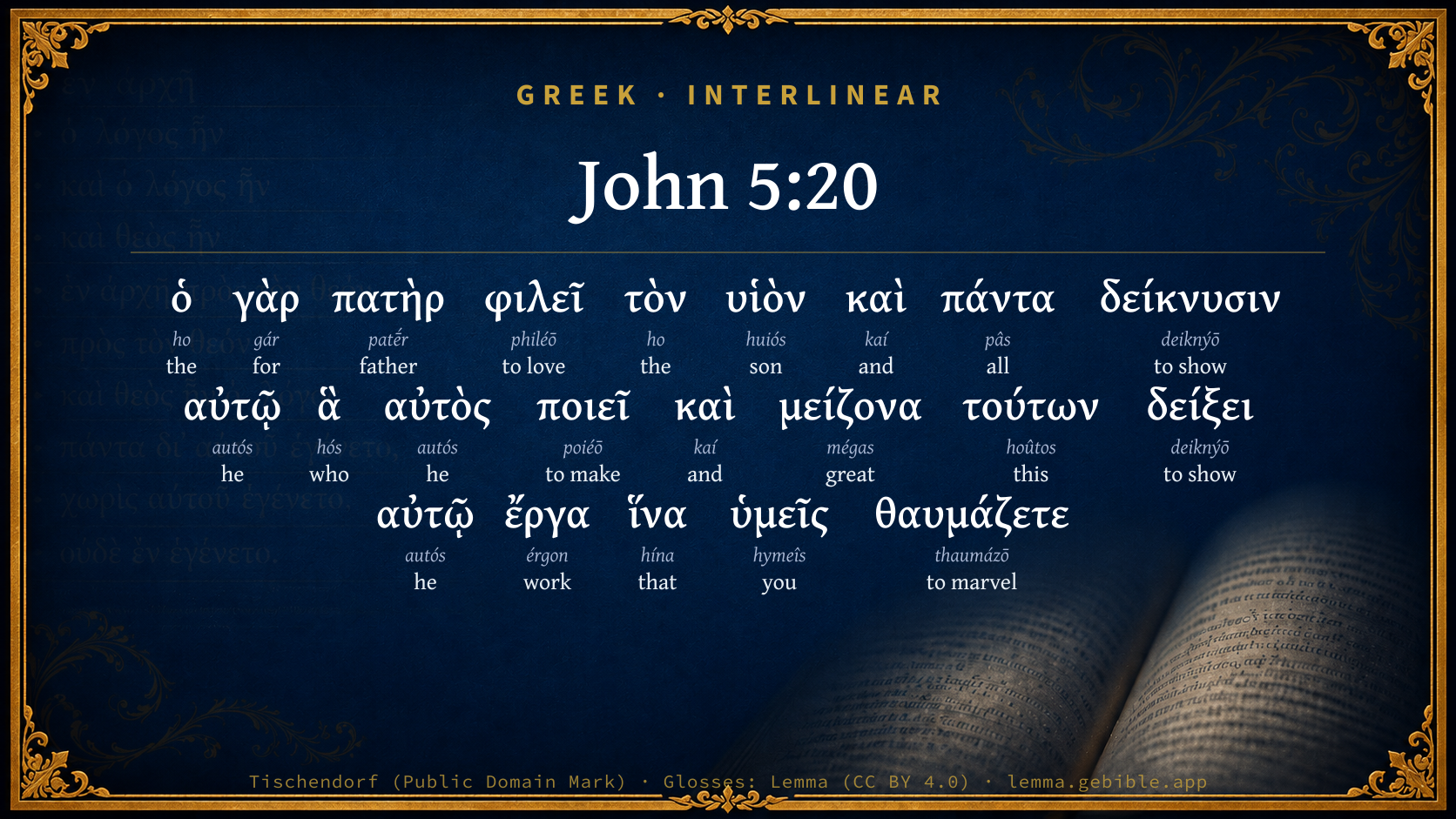
Greek (Tischendorf 8th ed.) John 5:20 appears in the Greek New Testament. The text above is from the Tischendorf 8th edition. Each word links to its Strong’s number and a concise gloss. Click any word for its full Thayer’s Greek Lexicon entry.
Download image
Cite this verse

John 5:20 (World English Bible). Public Domain. Lemma interlinear Bible study tool, https://lemma.gebible.app/v/john/5/20.

Show BibTeX & RIS
BibTeX
RIS
English Translation
For the Father has affection for the Son, and shows him all things that he himself does. He will show him greater works than these, that you may marvel.
World English Bible · Public Domain
Download a study sheet

One document with this verse’s original text, its word-by-word gloss line, the meaning frame, cross-references with their text, attributed commentary, and full source and license credits — printable, and it pastes into notes with its structure intact.

This verse Autodidact and up

Study sheet (.html) Plain text (.txt)

A passage Seminary Student

Up to 50 verses in one chapter. A passage sheet keeps up to 6 commentary sources and 12 cross-references per verse, in the order this page ranks them, and says so on the sheet whenever that leaves anything out. Ask for a single verse and you get the Autodidact verse sheet above.

Everything on this page stays free to read, with no account — the sheet is a download of what is already on screen, not access to it.

Want to remove ads? Support Godless Engineer
Compare translations 3

The same verse in 3 English versions, stacked beneath the original-language interlinear above. Click any original word for its lexicon entry.

Each is an independent rendering of the whole verse — the interlinear is not word-aligned to these translations.

Highlighted words mark where these versions differ — a whole-verse word diff, not a word-by-word alignment.

  • World English Bible Public Domain
    For the Father has affection for the Son, and shows him all things that he himself does. He will show him greater works than these, that you may marvel.
  • King James Version Public Domain
    For the Father loveth the Son, and sheweth him all things that himself doeth: and he will shew him greater works than these, that ye may marvel.
  • unfoldingWord Literal Text CC BY-SA 4.0
    For the Father loves the Son and he shows him everything that he himself does, and he will show him greater works than these so that you might be amazed.

unfoldingWord Literal Text — © unfoldingWord, licensed CC BY-SA 4.0. Word-aligned USFM3 via Door43 (git.door43.org/unfoldingWord/en_ult).

Versions to compare (up to 4)

3 of 4 selected

Show all 19 translations

Every available English version of this verse, each an independent rendering of the whole verse.

  • World English Bible Public Domain
    For the Father has affection for the Son, and shows him all things that he himself does. He will show him greater works than these, that you may marvel.
  • Berean Standard Bible Public Domain
    The Father loves the Son and shows Him all He does. And to your amazement, He will show Him even greater works than these.
  • Majority Standard Bible Public Domain
    The Father loves the Son and shows Him all He does. And to your amazement, He will show Him even greater works than these.
  • King James Version Public Domain
    For the Father loveth the Son, and sheweth him all things that himself doeth: and he will shew him greater works than these, that ye may marvel.
  • American Standard Version (1901) Public Domain
    For the Father loveth the Son, and showeth him all things that himself doeth: and greater works than these will he show him, that ye may marvel.
  • Revised Version (1885) Public Domain
    For the Father loveth the Son, and sheweth him all things that himself doeth: and greater works than these will he shew him, that ye may marvel.
  • Geneva Bible (1599) Public Domain
    For the Father loueth the Sonne, and sheweth him all things, whatsoeuer he himselfe doeth, and he will shewe him greater workes then these, that ye should marueile.
  • Douay-Rheims (1899) Public Domain
    For the Father loveth the Son, and sheweth him all things which himself doth: and greater works than these will he shew him, that you may wonder.
  • Young's Literal Translation Public Domain
    for the Father doth love the Son, and doth shew to him all things that He himself doth; and greater works than these He will shew him, that ye may wonder.
  • Literal Standard Version CC BY-SA 4.0
    for the Father cherishes the Son, and shows to Him all things that He Himself does; and greater works than these He will show Him, that you may wonder.
  • Unlocked Literal Bible CC BY-SA 4.0
    For the Father loves the Son and he shows him everything that he himself does, and he will show him greater things than these so that you will be amazed.
  • unfoldingWord Literal Text CC BY-SA 4.0
    For the Father loves the Son and he shows him everything that he himself does, and he will show him greater works than these so that you might be amazed.
  • Darby Bible Public Domain
    For the Father loves the Son and shews him all things which he himself does; and he will shew him greater works than these, that ye may wonder.
  • World Messianic Bible Public Domain
    For the Father has affection for the Son, and shows him all things that he himself does. He will show him greater works than these, that you may marvel.
  • Webster's Bible Public Domain
    For the Father loveth the Son, and showeth him all things that himself doeth: and he will show him greater works than these, that ye may marvel.
  • Free Bible Version CC BY-SA 4.0
    For the Father loves the Son, and reveals to him everything he does; and the Father will show to him even more incredible things that will completely amaze you.
  • Bible in Basic English Public Domain
    For the Father has love for the Son and lets him see everything which he does: and he will let him see greater works than these so that you may be full of wonder.
  • Text-Critical English NT CC BY 4.0
    For the Father loves the Son and shows him all that he himself does. And he will show him greater works than these, so that you will be amazed.
  • Tyndale New Testament (1534) Public Domain
    For the father loveth the sonne and sheweth him all thinges whatsoever he him selfe doeth. And he will shewe him greter workes then these because the shoulde marvayle.

Literal Standard Version (2020), Covenant Press — licensed CC BY-SA 4.0. Text via the HelloAO Bible API (eBible.org). Unlocked Literal Bible (unfoldingWord) — licensed CC BY-SA 4.0. Text via the HelloAO Bible API (eBible.org). unfoldingWord Literal Text — © unfoldingWord, licensed CC BY-SA 4.0. Word-aligned USFM3 via Door43 (git.door43.org/unfoldingWord/en_ult). Free Bible Version, Dr. Jonathan Gallagher — licensed CC BY-SA 4.0. Text via the HelloAO Bible API (eBible.org).

Word by word

More ways to search: Search by grammar → Find every occurrence → Compare this word →

Practice this passage: Drill this verse → Learn its vocabulary →

φιλεῖ
philéō
G5368
“to love”
Verb, Present, Active, Indicative, 3rd person, Singular
Part of Speech
Verb
Tense
Present
Voice
Active
Mood
Indicative
Person
3rd person
Number
Singular
Full Thayer's Definition

Origin: from G5384

TDNT: 10:54,1

1. to love a. to approve of b. to like c. sanction d. to treat affectionately or kindly, to welcome, befriend 2. to show signs of love a. to kiss 3. to be fond of doing a. be wont, use to do
  1. ὁ ho G3588 “the” Article, Nominative, Singular, Masculine
  2. γὰρ gár G1063 “for” Conjunction
  3. πατὴρ patḗr G3962 “father” Noun, Nominative, Singular, Masculine
  4. τὸν ho G3588 “the” Article, Accusative, Singular, Masculine
  5. υἱὸν huiós G5207 “son” Noun, Accusative, Singular, Masculine
  6. καὶ kaí G2532 “and” Conjunction
  7. πάντα pâs G3956 “all” Adjective, Accusative, Plural, Neuter
  8. δείκνυσιν deiknýō G1166 “to show” Verb, Present, Active, Indicative, 3rd person, Singular
  9. αὐτῷ autós G846 “he” Personal pronoun, Dative, Singular, Masculine
  10. ἃ hós G3739 “who” Relative pronoun, Accusative, Plural, Neuter
  11. αὐτὸς autós G846 “he” Personal pronoun, Nominative, Singular, Masculine
  12. ποιεῖ poiéō G4160 “to make” Verb, Present, Active, Indicative, 3rd person, Singular
  13. καὶ kaí G2532 “and” Conjunction
  14. μείζονα mégas G3173 “great” Adjective, Accusative, Plural, Neuter, Comparative
  15. τούτων hoûtos G3778 “this” Demonstrative pronoun, Genitive, Plural, Neuter
  16. δείξει deiknýō G1166 “to show” Verb, Future, Active, Indicative, 3rd person, Singular
  17. αὐτῷ autós G846 “he” Personal pronoun, Dative, Singular, Masculine
  18. ἔργα érgon G2041 “work” Noun, Accusative, Plural, Neuter
  19. ἵνα hína G2443 “that” Conjunction
  20. ὑμεῖς hymeîs G5210 “you” Personal pronoun, 2nd person, Nominative, Plural
  21. θαυμάζετε thaumázō G2296 “to marvel” Verb, Present, Active, Indicative, 2nd person, Plural

About this verse

These counts appear in no published source. They are computed here, from the morphology-tagged text and Lemma’s own curated glosses. What Lemma adds →

22
words
17
distinct lemmas
Gospels
section

Notable vocabulary

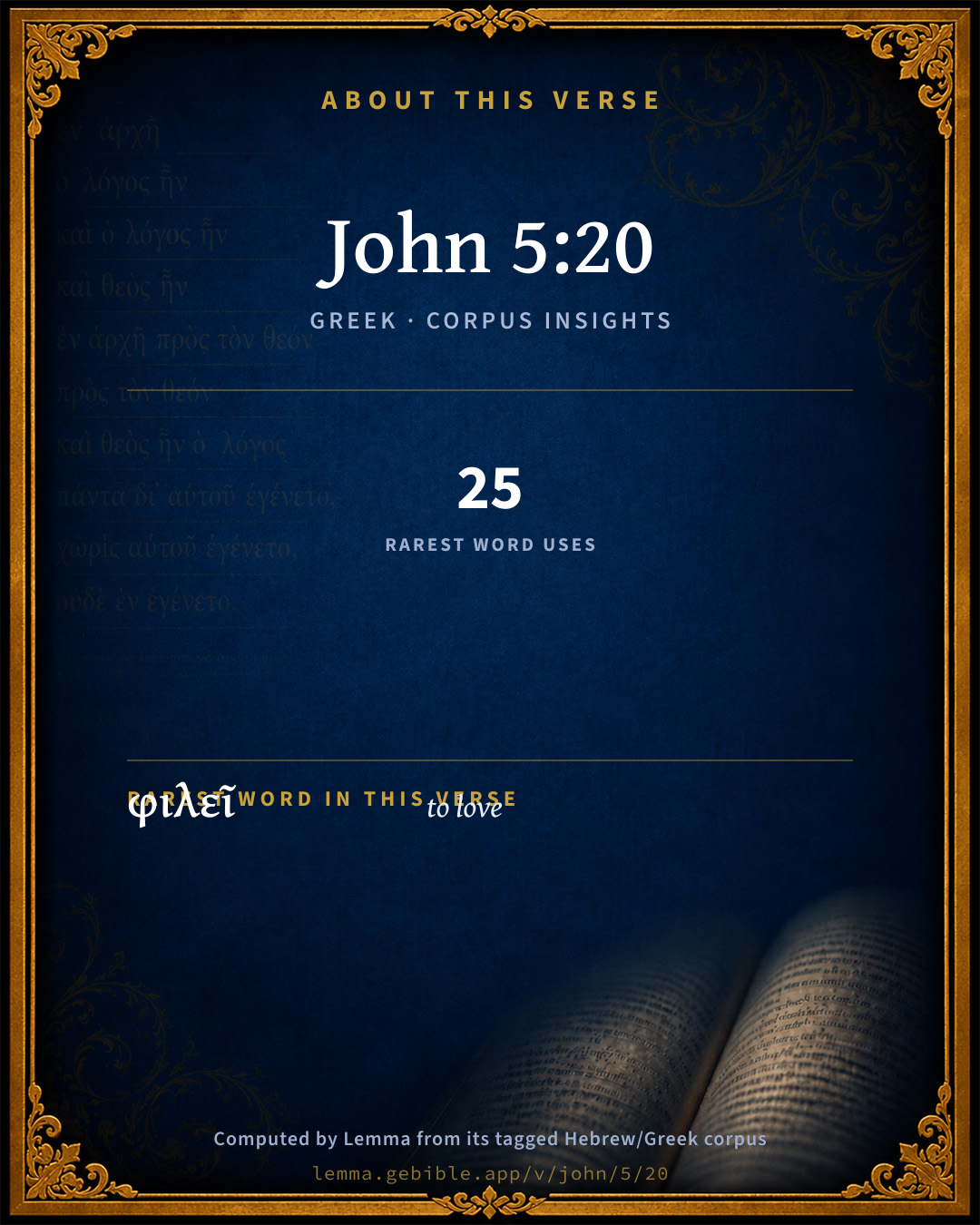
The rarest word here is φιλεῖ to love G5368 — appearing just 25 times in the whole Greek New Testament.

Shared distinctive vocabulary

φιλεῖ to love G5368 occurs in 21 verses of the Greek New Testament. Also found in:

Repetition

Words recur within this verse:

  • δείκνυσιν to show G1166 ×2
  • αὐτῷ he G846 ×3
  • ὁ the G3588 ×2
  • καὶ and G2532 ×2

Cross-references

16

Topical passages linked to John 5:20 in the Treasury of Scripture Knowledge — connected by theme and wording, ordered by reader-vote popularity; previews shown in the World English Bible.

  • John 3:35 The Father loves the Son, and has given all things into his hand.
  • Matthew 3:17 Behold, a voice out of the heavens said, "This is my beloved Son, with whom I am well pleased."
  • Proverbs 8:22–31 "Yahweh possessed me in the beginning of his work, Before his deeds of old.
  • John 15:15 No longer do I call you servants, for the servant doesn't know what his lord does. But I have called you friends, for everything that I heard from my Father, I have made known to you.
  • John 17:26 I made known to them your name, and will make it known; that the love with which you loved me may be in them, and I in them."
  • 2 Peter 1:17 For he received from God the Father honor and glory, when the voice came to him from the Majestic Glory, "This is my beloved Son, in whom I am well pleased."
  • Matthew 11:27 All things have been delivered to me by my Father. No one knows the Son, except the Father; neither does anyone know the Father, except the Son, and he to whom the Son desires to reveal him.
  • Matthew 17:5 While he was still speaking, behold, a bright cloud overshadowed them. Behold, a voice came out of the cloud, saying, "This is my beloved Son, in whom I am well pleased. Listen to him."
  • Luke 10:22 Turning to the disciples, he said, "All things have been delivered to me by my Father. No one knows who the Son is, except the Father, and who the Father is, except the Son, and he to whomever the Son desires to reveal him."
  • John 1:18 No one has seen God at any time. The one and only Son, who is in the bosom of the Father, he has declared him.
  • John 5:21 For as the Father raises the dead and gives them life, even so the Son also gives life to whom he desires.
  • John 5:25 Most assuredly, I tell you, the hour comes, and now is, when the dead will hear the Son of God's voice; and those who hear will live.
  • John 5:29 and will come out; those who have done good, to the resurrection of life; and those who have done evil, to the resurrection of judgment.
  • John 10:32 Jesus answered them, "I have shown you many good works from my Father. For which of those works do you stone me?"
  • John 12:45–47 He who sees me sees him who sent me.
  • John 14:12 Most assuredly I tell you, he who believes in me, the works that I do, he will do also; and greater works than these will he do; because I am going to my Father.

Cross-references courtesy of OpenBible.info (CC BY 4.0).

Commentary

Notes on John 5:20 from classic Christian and Jewish commentators (each source and its license shown beneath its notes). The classic Christian expositions comment on the surrounding passage and are grouped to its opening verse, so a note may address several verses; the Jewish commentaries on the Tanakh (Rashi and others) are per-verse, so they appear only where the commentator wrote on this verse.

Lemma curates 59 commentaries, every one of them public domain or Creative Commons licensed, each selected and text-cleaned for this edition rather than reprinted as found. About our sources →

Bengel's Gnomon

Johann Albrecht Bengel

Joh 5:20. Φιλεῖ) He who loves, hides nothing [from the object of his love].—δείκνυσιν, showeth) in heaven. Comp. βλέπῃ, seeth, Joh 5:19. He showeth that [the Son] may do so also. This showing is the part of intimate unity. They compare with this the passage of the Psa 45:5, Thy right hand shall SHOW [Engl. Vers., Joh 5:4, teach] thee wonderful [terrible] things.—αὐτός) Himself.—δείξει) shall show, by doing them. The Father at once showeth and doeth, and the Son seeth and doeth; not at different times.—ἔργα, works) Jesus more often calls them works than signs, because in His own eyes they were not miracles.—ἵνα) even to that degree that.—ὑμεῖς, ye) who now hate, will honour with admiration and belief. This effect was wrought especially at the resurrection of Lazarus [Joh 11:43; Joh 11:45, Many of the Jews, which had seen the things that Jesus did, believed on Him].

Bengel's Gnomon of the New Testament — English translation (T&T Clark, Edinburgh, 1860) — public domain. Text from a community e-Sword module.

Meyer's Critical & Exegetical Commentary

Heinrich August Wilhelm Meyer

Joh_5:20. Moral necessity in God for the aforesaid ἃ γὰρ ἂν ἐκεῖνος, etc. Comp. Joh_3:35.

γὰρ refers to the whole of what follows down to ποιεῖ, of which καὶ μείζονα, etc., gives the result.

φιλεῖ] qui amat, nil celat, Bengel. The distinction between this and ἀγαπᾷ (which D., Origen, Chrysostom here read), diligit (see Tittmann, Synon. p. 50), is to be retained even in John, though he uses both to denote the same relationship, but with varying definiteness of representation. Comp. Joh_3:35, Joh_21:15. Φιλεῖν is always the proper affection of love. Comp. Joh_11:3; Joh_11:36, Joh_16:27, Joh_20:2, et al. But this love has its basis in the metaphysical and eternal relation of the Father to the Son, as His μονογενὴς υἱός (Joh_1:14; Joh_1:18), and does not first begin in time. Comp. Luthardt.

πάντα δείκνυσιν] He shows Him all, permits Him to see in immediate self-revelation all that He Himself doeth, that the Son also may do these things after the pattern of the Father. Description of the inner and essential intimacy of the Father with the Son, according to which, and indeed by virtue of His love to the Son, He makes all His own working an object of intuition to the Son for His like working (comp. Joh_5:17),the humanly conditioned continuation of what He had seen in His pre-human existence, Joh_3:11, Joh_6:46.[207]

καὶ μείζονα, κ.τ.λ.] a new sentence, and an advance in the discourse, the theme of all that follows down to Joh_5:30 : and greater works than these (the healings of the sick spoken of) will He show Him; He will give Him His example to do them also.

ἵνα] the divine purpose of this,not in the sense of ὥστε (Baeumlein).

ὑμεῖς] ye unbelievers. Jesus does not say πιστεύητε; He means the surprise of shame, viz. at the sight[208] of His works.

[207] This intimate relationship is to be regarded as one of uninterrupted continuity, and not to be limited merely to occasional crises in the life of Jesus (Gess, Pers. Chr. p. 237), of which there is not the slightest indication in Johns Gospel. Comp. Joh_1:51. This very continuous consciousness depends upon the continuance of the Logos consciousness (Joh_8:29, Joh_8:59, Joh_17:5, Joh_16:32),a view which is to be maintained against Weizsäcker, who introduces even visions (evang. Gesch. p. 435) in explanation of this passage, in the face of the known history of Jesus.

[208] For the astonishment connected with the θεᾶσθαι is implied in the context. See Nägelsbach, z. llias, p. 200, ed. 3.

Meyer — Critical and Exegetical Commentary on the New Testament — English translation by Peter Christie, edited by Frederick Crombie (T&T Clark, 1880) — public domain. Text from a community e-Sword module.

Expositor's Greek Testament

ed. W. Robertson Nicoll

Joh 5:20 . And the Son is enabled to see what the Father does, because He loves the Son and shows Him all that He Himself does. The Father is not passive in the matter, merely allowing Jesus to discover what He can of the Father’s will; but the Father δείκνυσιν , shows Him, inwardly and in response to His own readiness to perceive, not mechanically but spiritually, all that He does; πάντα apparently without limitation, for ποιεῖ is habitual present as φιλεῖ in previous clause, and cannot be restricted to the things God was then doing in the case of the impotent man. Besides, a merely human sonship scarcely satisfies the absolute ὁ πατήρ and ὁ υἱός of this passage. καὶ μείζονα … θαυμάζητε , the Father through the Son will do greater works than the healing of the impotent man; cf. 14:12; “that ye may marvel”; this seems an inadequate motive, but Joh 5:23 explains it. In the following passage, spiritual quickening is meant in Joh 5:21-27 , while in Joh 5:28-29 , it is the bodily resurrection that is in view.

The Expositor's Greek Testament, edited by W. Robertson Nicoll (1897–1910) — public domain. Text from a community e-Sword module.

Jamieson, Fausset & Brown

Robert Jamieson, A. R. Fausset & David Brown

Father loveth . . . and showeth him all, &c.--As love has no concealments, so it results from the perfect fellowship and mutual endearment of the Father and the Son (see on Joh 1:1; Joh 1:18), whose interests are one, even as their nature, that the Father communicates to the Son all His counsels, and what has been thus shown to the Son is by Him executed in His mediatorial character. "With the Father, doing is willing; it is only the Son who acts in Time" [ALFORD]. Three things here are clear: (1) The personal distinctions in the Godhead. (2) Unity of action among the Persons results from unity of nature. (3) Their oneness of interest is no unconscious or involuntary thing, but a thing of glorious consciousness, will, and love, of which the Persons themselves are the proper Objects.

show him greater things, &c.--referring to what He goes on to mention (Joh 5:21-31), comprised in two great words, LIFE and JUDGMENT, which STIER beautifully calls God's Regalia. Yet these, Christ says, the Father and He do in common.

Jamieson, Fausset & Brown — Commentary Critical and Explanatory on the Whole Bible (1871) — public domain (CC PDM 1.0). Text via the HelloAO Bible API.

Adam Clarke's Commentary

Verse 20. Greater works than these] Two of these he immediately mentions: Raising the dead, Joh 5:21. And judging the world, Joh 5:22.

That ye may marvel.] Or, So as to make you wonder. Our Lord sometimes speaks of himself as God, and sometimes as the ambassador of God. As he had a human and Divine nature, this distinction was essentially necessary. Many errors have originated from want of attention to this circumstance.

Adam Clarke's Commentary on the Bible (1810–1826) — public domain. Text from a community e-Sword/MySword module.

John Calvin's Commentaries

20. For the Father loveth the Son. Every body sees how harsh and far-fetched is the exposition of this passage which is given by the Fathers. “God,” they say, “loves himself in the Son.” But this statement applies beautifully to Christ as clothed with flesh, that he is beloved by the Father. What is more, we know that it is by this excellent title that he is distinguished both from angels and from men, This is my beloved Son, (Matthew 3:17.) For we know that Christ was chosen, that the whole love of God might dwell in him, and might flow from him to us as from a full fountain. Christ is loved by the Father, as he is the Head of the Church. He shows that this love is the cause why the Father does all things by his hand. For when he says that the Father SHOWTH to him this word must be understood to denote communication, as if he had said, “As the Father hath given to me his heart, so he hath poured out his power on me, that the Divine glory may shine in my works, and — what is more — that men may seek nothing Divine but what they find in me.” And, indeed, out of Christ it will be in vain to seek the power of God.

He will show him greater works than these. By these words he means that the miracle, which he had performed in curing the man, was not the greatest of the works enjoined on him by the Father; for he had only given in it a slight taste of that grace of which he is properly both minister and Author; namely, to restore life to the world.

That you may wonder. By adding these words, he indirectly charges them with ingratitude in despising so illustrious a demonstration of the power of God; as if he had said, “Though you are dull and stupid, yet the works which God shall afterwards perform by me will draw you, however reluctantly, into admiration.” Yet this appears not to have been fulfilled, for we know that seeing, they saw not; as Isaiah also says that the reprobate are blind amidst the light of God. I reply, Christ did not now speak of their disposition, but only threw out a suggestion as to the splendor of the demonstration which he would soon afterwards give that he was the Son of God.

John Calvin's Commentaries (1540-1563) — public domain. Text from the Calvin Translation Society English edition (1840s-50s) via the Christian Classics Ethereal Library (ccel.org). Calvin's coverage is partial (roughly two-thirds of the Bible); uncommented books and verses are honest gaps, never fabricated. The 19th-century editor's footnotes and remarks are omitted so the notes are faithfully Calvin's own voice.

Ellicott's Commentary for English Readers

(20) For the Father loveth the Son.—Do men deny His divinity? God is His Father. There is, therefore, oneness of essence. The unity of His work with God’s work has for its basis the Eternal Love, which showeth to the Son all that the Father doeth. As the relation of Son implies moral inability to do anything apart from the Father, so the relation of Father implies moral necessity to impart all to the Son.

Greater works than these.—The works which He had done could only be explained by the unity of His work with that of the Father; but in the development of His own human nature and His mediatorial work, there will be shown to Him, and He will show to man by doing them in their midst, works of which these are but as the first signs. The “ye” is emphatic, and the word “marvel” should also be noticed. “Ye who seek to kill Me shall yourselves see works which, against your will, shall be wonders to you; but against your will they cannot be signs. Ye will marvel, but ye will not believe!”

A Bible Commentary for English Readers, edited by Charles John Ellicott (1878–1897) — public domain. Text from a community e-Sword module.

The Cambridge Bible for Schools and Colleges

gen. ed. J. J. S. Perowne

20. For the Father loveth the Son] Moral necessity for the Son’s doing what the Father does. The Father’s love for the Son compels Him to make known all His works to Him; the Son’s relation to the Father compels Him to do what the Father does. The Son continues on earth what He had seen in heaven before the Incarnation.

he will shew him, &c.] Or, Greater works than these will He shew Him. ‘The Father will give the Son an example of greater works than these healings, the Son will do the like, and ye unbelievers will be shamed into admiration.’ He does not say that they will believe. ‘Works’ is a favourite term with S. John to express the details of Christ’s work of redemption. Comp. Joh_5:36, Joh_9:4, Joh_10:25; Joh_10:32; Joh_10:37, Joh_14:11-12, Joh_15:24.

The Cambridge Bible for Schools and Colleges (gen. ed. J. J. S. Perowne; Cambridge University Press, 1878–1918) — public domain. Text from a community e-Sword module.

John Gill's Exposition

For the Father loveth the Son,.... As being his Son, his image, the brightness of his glory, and the express image of his person; as being of the same nature, and having the same perfections, and so equal to him; See Gill on Joh 3:35;

and showeth him all things that himself doth; not as if he was ignorant of them, since he lies in the bosom of his Father, is the wisdom of God, is the omniscient God, that knows all things; not only all things in men, but all things in God, even the deep things of God: but this is said of the Father, as consulting with him, communicating his designs to him, as his equal; doing nothing without him, as he never did in the works of nature, or of grace: he drew the plan of peace, reconciliation, and salvation in him; he made the worlds by him; and he does nothing in the government of the world without him; and indeed he shows him all things he does, by doing all things; and by him he shows himself, and his works, to men:

and he will show him greater works than these, or he will do greater works by him than these: either than the works of creation; namely, the redemption of the elect, the justification of their persons by his righteousness, and pardon of their sins through his blood, and the regeneration and conversion of them by his Spirit and grace; either of which is a greater work than the making of the world: or greater than he has done under the Old Testament dispensation; than the redeeming of Israel out of Egypt, leading them through the wilderness, and settling them in the land of Canaan; giving them the law, the statutes, and ordinances of God, and working miracles among them: for the redemption of God's people, by Christ, from sin, Satan, the world, the law, death, and hell, the publishing of the Gospel, the effusion of the Spirit, and setting up of the Gospel dispensation, are greater works than these; and more and greater miracles were wrought by Christ than by Moses, or any prophet under the former dispensation. Though rather the sense is, that greater miracles would be shown, and done by Christ, than these he had now done, in curing a man of his disorder, who had had it eight and thirty years, and bidding him take up his bed and walk; such as raising Jairus's daughter to life, when dead, and the widow of Naim's son, when he was carrying to the grave, and Lazarus, when he had been dead four days:

that ye may marvel; this was not properly the end of these greater works shown to, and done by Christ, which were to prove his divine sonship, his proper deity, his true Messiahship, to confirm the faith of his followers in him, and for the glory of God; but this eventually followed upon them: some wondered at them, and believed in him; and others were amazed at them, and confounded by them.

John Gill's Exposition of the Whole Bible (1746–1763) — public domain (CC PDM 1.0). Text via the HelloAO Bible API.

Trapp's Complete Commentary

John Trapp

20 For the Father loveth the Son, and sheweth him all things that himself doeth: and he will shew him greater works than these, that ye may marvel.

Ver. 20. For the Father loveth the Son] This noteth that eternal power of doing miracles that is in Christ. As that which follows, "He will show him greater works," &c., is to be referred to the declaration of that his power.

That ye may wonder] Though ye believe not; for such was the hardness of their hearts grown; as neither ministry, misery, miracle, nor mercy could possibly mollify. "Behold, ye despisers, and wonder, and perish," Act 13:41.

John Trapp, A Commentary or Exposition upon All the Books of the Old and New Testament (1647–1656) — public domain. Text from a community e-Sword module.

Albert Barnes' Notes on the Bible

The Father loveth the Son - This authority he traces to the love which the Father has for him - that special, ineffable, infinite love which God has for his only-begotten Son, feebly and dimly illustrated by the love which an earthly parent has for an only child.

Showeth him - Makes him acquainted with. Conceals nothing from him. From apostles, prophets, and philosophers no small part of the doings of God are concealed. From the “Son” nothing is. And as God shows him “all” that he does, he must be possessed of omniscience, for to no finite mind could be imparted a knowledge of “all” the works of God.

Will show him - Will appoint and direct him to do greater works than these.

Greater works than these - Than healing the impotent man, and commanding him to carry his bed on the Sabbath day. The greater works to which he refers are those which he proceeds to specify - he will raise the dead and judge the world, etc.

May marvel - May wonder, or be amazed.

Albert Barnes' Notes on the Bible (1834–1885) — public domain. Text from a community e-Sword/MySword module.

Haydock's Catholic Bible Commentary

Greater works than these will he (the Father) shew him, &c. These words may also, with Maldonatus be expounded of Christ, as man; but the ancient interpreters understand them of Christ, as God, in this sense, that the Father, and the Son, or the Father by the Son, will shew greater miracles hereafter done by Christ, that more persons may admire and believe. (Witham)

George Leo Haydock (1774–1849), Haydock's Catholic Family Bible and Commentary, 1859 edition — public domain. Excludes Psalms (Douay-Rheims chapter numbering differs from Protestant) and Deuterocanonical books (Catholic canon only).

Matthew Poole's English Annotations

For the Father loveth the Son; both as his Son by eternal generation, Mat 3:17, and also as the Messiah sent by him into the world, to finish the work the Father had given him to do: and look, as a father will make his son acquainted with all that he doth; and not only so, but communicates all his power and skill to his son, so far as he can: so the Father communicates all his power to the Son, working all things in him, and by him; and he will in and by him work greater things than this, healing this poor man; he will by him raise the dead, &c.

That ye may marvel: Christ knew that they would not believe, and all the effect that his miracles had upon the generality of the Jews, was but causing in them a stupefaction, amazement, and admiration, as Joh 11:47; whereas it was their duty, not only to marvel, but to have believed also, without which their admiration did but cause that they had no cloak for their sin.

Matthew Poole's English Annotations on the Holy Bible (1683–1685) — public domain. Text from a community e-Sword/MySword module.

Whedon's Commentary on the Bible

Daniel D. Whedon

20. Father loveth the Son—Love is, as it were, the cement by and in which the Trinity is Unity.

Showeth him—The consciousness of the Son knows the works, and he reveals them, to the marvel of men.

Daniel D. Whedon (gen. ed.), Commentary on the Old and New Testaments (1874–1909) — public domain. Text from a community e-Sword module.

The Pulpit Commentary

For the Lord introduces a reason, states a fact, which is calculated to make this vision of the Father"s activity apprehensible to his hearersthe Father loveth (filei expresses strong personal, natural affection, amat rather than the agapa or diligit of many other passages. See notes, Joh_21:15 and Joh_3:35) the Son, and he loveth him to such an extent that he showeth him, making it therefore possible for him "to seeall things that himself doeth. The Son has been from eternity and is now, notwithstanding his incarnate lowliness, the continuous Spectator of all the Father"s doing in all hearts and lives, in all places of his dominion. "O righteous Father, the world hath not known thee: but I have known thee." So stupendous a claim was never exceeded or transcended. "All things that himself doeth," shown and visible to One walking this world. The mind either rebels against or succumbs before such sublime and all-embracing knowledge. No neutrality is possible. If these were his words, then there is justification for the generalizations of the prologue.

Vers. 20b-29. (b) The greater works.

And greater works than these works of healing will he show him. Here the term erga is used for the first time in this Gospel. It becomes the recognized phrase by which Christ describes what the world regards as "signs and wonders," "miracles" of power or grace; but it actually connotes the simple activity of God, the normal operation of his hand. Greater manifestations than physical quickening or revival namely, the mighty changes of thought and life, the gifts of grace and peace, eternal life itself, are evermore proceeding. The Father will so show them that the Son will see and do them, and so bring them by revelation to your consciousness that ye may marvel. Christ will not say here that ye may believe, but that ye may look on confounded and astonished. This was the first effect of Christ"s work Christ"s revelation of the Father"s heart, Christ"s demonstration of the Father"s nearness and character. Westcott quotes the apocryphal saying of our Lord preserved by Clement of Alexandria, "Str.," 2:9. 45, "He that wonders shall reign, and he that reigns shall rest." The wonders of grace will never be exhausted. New combinations, new transformations, new discoveries, new insight into the eternal love, will be effected by him whom God hath sent, whom the Father hath sanctified and sent into the world (but see ver. 28).

The Pulpit Commentary (1880–1919), ed. H.D.M. Spence-Jones & Joseph S. Exell — public domain. Text from a community e-Sword module.

John Wesley's Explanatory Notes

The Father showeth him all things that himself doth - A proof of the most intimate unity. And he will show him - By doing them. At the same time (not at different times) the Father showeth and doth, and the Son seeth and doth. Greater works - Jesus oftener terms them works, than signs or wonders, because they were not wonders in his eyes. Ye will marvel - So they did, when he raised Lazarus.

John Wesley, Explanatory Notes Upon the Whole Bible (1754–1765) — public domain. Text via the GEBible commentary corpus.

Burkitt's Expository Notes on the New Testament

William Burkitt

The second argument which our Saviour produces to prove his unity in nature, and equality in operation with the Father, is drawn from that special love which the Father beareth to the Son: which inclines him to communicate all things to him by a divine and ineffable communication.

Learn hence, 1. That God the Father loved Jesus Christ his Son, with an essential, natural, and necessary love, as being the substantial image of himself, and the splendor and brightness of his glory. The Father loveth the Son: that is, with an essential, eternal and ineffable love.

2. That the Father’s love to Christ was communicative; his essence and nature, his wisdom an power for operation, to the Son; The Father sheweth the Son all things that himself doth: namely, by a divine, inconceivable, and unspeakable communication.

William Burkitt's Expository Notes on the New Testament (1700–1703) — public domain. Text from a community e-Sword module.

Cambridge Greek Testament for Schools and Colleges

20. ὁ γὰρ π. Moral necessity for the Son’s doing what the Father does. The Father’s love for the Son compels Him to make known all His works to Him; the Son’s relation to the Father compels Him to do what the Father does. The Son continues on earth what He had seen in heaven before the Incarnation.

φιλεῖ. Some good authorities read ἀγαπᾷ (perhaps from Joh 3:35), but φιλεῖ is right. Φιλεῖν (amare) denotes affection resulting from personal relationship; ἀγαπᾷν (diligere) denotes affection resulting from deliberate choice: see on Joh 11:5, Joh 21:15.

μείζονα τ. Greater works than these will He shew Him. ‘The Father will give the Son an example of greater works than these healings, the Son will do the like, and ye unbelievers will be shamed into admiration.’ He does not say that they will believe. ‘Works’ is a favourite term with S. John to express the details of Christ’s work of redemption, much as ῥήματα in relation to λόγος (see on Joh 3:34). Comp. Joh 5:36, Joh 9:4, Joh 10:25; Joh 10:32; Joh 10:37, Joh 14:11-12, Joh 15:24. Of these passages, Joh 14:12 is analogous to this, shewing that what the Father does for the Son, the Son does for those who believe on Him.

Cambridge Greek Testament for Schools and Colleges (Cambridge University Press, 1896; 21 vols, various authors incl. Carr, Maclear, Plummer, Farrar, Lumby, Moule, M. R. James, Simcox) — public domain. Text from a community e-Sword module.

Alford’s Greek Testament

Henry Alford

20.] For (this last is ensured by the fact, that) the Father loves the Son, and shews to Him (in this the Lord sets forth to us the unfolding of the will and purposes of the Father to (Mar 13:32: Act 1:7) and by Him, in His Mediatorial office) all things which He Himself does (all the purposes of His secret counsel;—for with the Father, doing is willing; it is only the Son who acts in time); and this manifestation will go on increasing in majesty, that the wonder which now is excited in you by these works may be brought out to its full measure (in the acceptation or rejection of the Son of God—wonder leading naturally to the τιμή of ver. 23).

Henry Alford, The Greek Testament (1849–1861) — public domain. Text from a community e-Sword module.

International Critical Commentary

20. Vv. 20-29 form a section by themselves. They deal with the secrets of the Divine Life, and unfold in some degree the relation of the Son to the Father, thus providing an explanation of, or commentary on, the mystic words of v. 17, “My Father worketh hitherto, and I work,” and of v. 19, “The Son can do nothing of Himself.” As at other points in the Gospel (see on 3:16), it is impracticable to distinguish precisely the evangelist’s own commentary from the words which he ascribes to Jesus. The formula “Verily, verily, I say unto you,” which precedes vv. 19, 24, 25, always introduces words of Jesus Himself, and this must be the intention here. And vv. 28, 29, seem also to be placed in His mouth. But the use of ὥσπερ γάρ at the beginning of v. 21 and again at v. 26 (ὥσπερ does not appear again in Jn.) suggests that vv. 21-23 and vv. 26, 27, may be comments of the evangelist on the sayings of Jesus introduced by ἀμὴν ἀμήν in vv. 19, 24, 25. This is like Jn.’s use of γάρ elsewhere (see on 3:16).1 It will be observed that the third person is employed throughout in vv. 21-23, 26, 27. We do not return to the first person until v. 30, where the opening words are the words of v. 19.

It is possible that the sayings of vv. 24, 25 and 28, 29 belong to some discourse different from that which was addressed to the Jewish cavillers about work on the Sabbath day; but the argument of this section (vv. 20-29) is quite consecutive (see on v. 28).

ὁ γὰρ πατὴρ φιλεῖ τὸν υἱόν. D reads ἀγαπᾷ from 3:35 (where see note). “The Father loves the Son, and so exhibits to Him the things which He Himself does.” φιλεῖν expresses more than the intimacy of friendship; it is here equivalent to ἀγαπᾶν (see on 3:35 and 21:17), and expresses the mystery of the Divine Love, of the Father for the Son. This is so complete and unreserved that all the Father’s works are displayed, as they are being wrought, to the Son. No reference is made to any limitation of the Incarnate Son’s knowledge of the future, such as is indicated in Mar 13:32; the statement is that the Son has complete cognizance of all that the Father does in the present.

καὶ μείζονα τούτων δείξει αὐτῷ ἔργα, “and greater works than these (sc. healing miracles such as the cure of the impotent man, which had disquieted the Jews so much) shall He show Him.” In the following verses, these “greater works” are specified, viz. that of raising the dead, and that of judging mankind.

The miracles of Christ are described in Mat 11:2 as His ἔργα, and Jn. applies this description to them frequently (5:36, 7:3, 21, 10:25, 32, 38, 14:12, 15:24), as he does to the “works”of God (4:34, 6:28, 9:3, 17:4; cf. Psa 95:9). For God there is no distinction in kind between “natural” and “supernatural” works. And the works of Christ are actually the works of God: ὁ πατὴρ ἐν ἐμοὶ μένων ποιεῖ τὰ ἔργα αὐτοῦ (14:10). See on 7:21.

ἵνα ὑμεῖς θαυμάζητε. ὐμεῖς is emphatic, “you, incredulous Jews.” The healing miracles did not so much arouse their wonder, as their jealous indignation (there is no hint that the cure of the impotent man caused any wonder); but the “greater works” of raising the dead, and of judgment, could not fail to make them marvel. Such astonishment may pass into admiration, and thence into faith (cf. Act 4:13).

Later on, it is promised to the faithful disciple that, in the power of Christ’s Risen Life, he too should do “greater things” than those which had attended the Lord’s public ministry: μείζονα τούτων ποιήσει. But this is not in contemplation here. See note on 14:12.

International Critical Commentary — older volumes (1896–1929), various authors — public domain. Text from a community e-Sword module.

Vincent's Word Studies in the New Testament

Marvin R. Vincent

Loveth [φιλει] . To love is expressed by two words in the New Testament, filew and ajgapaw. Agapaw indicates a reasoning, discriminating attachment, founded in the conviction that its object is worthy of esteem, or entitled to it on account of benefits bestowed. Filew represents a warmer, more instinctive sentiment, more closely allied to feeling, and implying more passion. Hence ajgapaw is represented by the Latin diligo, the fundamental idea of which is selection, the deliberate choice of one out of a number, on sufficient grounds, as an object of regard. Thus filew emphasizes the affectional element of love, and ajgapaw the intelligent element. Socrates, in Xenophon's "Memorabilia," advises his friend Aristarchus to alleviate the necessities of his dependents by furnishing means to set them at work. Aristarchus having acted upon his advice, Xenophon says that the women in his employ loved [εφιλουν] him as their protector, while he in turn loved [ηγαπα] them because they were of use to him (" Memorabilia, "2 7, §12). Jesus ' sentiment toward Martha and Mary is described by hjgapa, Joh 11:5. Men are bidden to love [αγαπαν] God (Mt 22:37; 1Co 8:3); never filein, since love to God implies an intelligent discernment of His attributes and not merely an affectionate sentiment. Both elements are combined in the Father 's love for the Son (Mt 3:17; Joh 3:35; Joh 4:20). Agaph is used throughout the panegyric of love in 1 Corinthians 13, and an examination of that chapter will show how large a part the discriminating element plays in the Apostle 's conception of love. The noun agaph nowhere appears in classical writings. As Trench remarks, it" is a word born within the bosom of revealed religion. "'Eraw, in which the idea of sensual passion predominates, is nowhere used in the New Testament. Trench has some interesting remarks on its tendency toward a higher set of associations in the Platonic writings (" Synonyms," p. 42).

Greater works will He show Him. As Jesus does whatever He sees the Father do (ver. 19), the showing of greater works will be the signal for Jesus to do them. On works, as a characteristic word in John, see on 4 47.

Ye may marvel. The ye is emphatic [υμεις] and is addressed to those who questioned His authority, whose wonder would therefore be that of astonishment rather than of admiring faith, but might lead to faith. Plato says, "Wonder is the feeling of a philosopher, and philosophy begins in wonder" (" Theaetetus, "105); and Clement of Alexandria, cited by Westcott," He that wonders shall reign, and he that reigns shall rest. " Compare Act 4:13.

Marvin R. Vincent, Word Studies in the New Testament (1887–1900) — public domain. Text from a community e-Sword/MySword module.

Godet's Commentaries

Frédéric Louis Godet

Ver. 20. The relation of the Father to the Son: For the Father loveth the Son, and showeth him all things that he himself doeth, and he will show him greater works than these, that ye may marvel.”

The co-operation of the Son in the divine work rests (for) upon the infinite love of the Father, which conceals nothing from the Son. The term φιλεῖν expresses tenderness (to cherish), and suits perfectly the intimacy of the relation here described. It was otherwise in Joh 3:35, where the word ἀγαπᾶν, which indicates the love of approbation and, in some sort, of admiration (ἄγαμαι), was found; because the question there was of the communication of omnipotence. The showing of the Father corresponds to the seeing of the Son (Joh 5:19), and is, at once, its condition and consequence; the condition: for the Father unveils His work to the Son, to the end that He may be able to know it and co-operate in it; the consequence: for it is this constant and faithful co-operation of the Son which causes this revelation incessantly to renew itself.

But the initiation and co-operation of the Son in the Father’s work are subjected to a law of progress, as is suitable to the truly human state of this latter. This is what the end of the verse expresses: And he will show him greater works than these. The expression: whatsoever things, in Joh 5:19, gave a hint already of that gradual extension of the domain of the works which the Father entrusts to the Son. Reussthinks that the question is of two different kinds of works, those of the Father appertaining to the outward domain, and those of the Son to the spiritual domain, and that the term greater refers to the superiority of the second to the first. But the bodily resurrection is also the work of the Son (Joh 5:28-29), and Jesus could not, in any case, say that the Son’s works are greater than the Father’s. The word ὁμοίως, in like manner, would suffice to refute this explanation. Τούτων, than these, evidently refers to the healing of the impotent man and to the miracles of the same sort which Jesus had performed and of which the Jews were then witnesses. This is only the beginning. In proportion as the work of Jesus grows in extent and force, the Father’s work will pass more completely into it; and thus will the saying of Isaiah be realized: “The pleasure of the Lord shall prosper in His hand.” The word will showdeclares that the Father will give Him at once the signal and the power to accomplish these greater and still greater works. Comp. Rev 1:1 : “the revelation which the Father gave to Him.”

The words which close the verse: to the end that ye may marvel, are carefully weighed. Jesus refrains from saying: to the end that ye may believe. He knows too well to whom He is speaking at this moment. The question here, as Weiss says, is of a surprise of confusion. We might paraphrase thus: “And then there will truly be something at which you may be astonished.” The Jews opened their eyes widely as they saw an impotent man healed: How will it be when they shall one day, at the word of this same Jesus, see mankind recovering spiritual, and even corporeal life! One cure astonishes them: What will they say of a Pentecost and a resurrection of the dead! This somewhat disdainful manner of speaking of miracles would be strange enough on the part of an evangelist who was in the whole course of his narrative playing the part of an inventor of miracles.— ῞Ινα, in order that, expresses not only a result (ὥστε), but a purpose. This astonishment is willed by God; for it is from it that the conversion of Israel will issue at the end of time. In view of the wonders produced by the Gospel among mankind, Israel will finally render to the Son that homage, equal to what it renders to the Father, of which Joh 5:23 speaks.

These two verses are one of the most remarkable passages of the New Testament in the Christological point of view. De Wette finds in the expression, of Himself (Joh 5:19), an exclusive and scarcely clear reference to thehuman side of the person of Jesus; for, after all, if Jesus is the Logos, His will is as divine as that of the Father, and there can be no contrast between the one and the other, as the expression, of Himself, would imply. This defect in logic is found, according to his view, again in the words of Joh 16:13, where this same expression, of Himself, is hypothetically applied to the Holy Spirit. According to Lucke, it is only a popular way of presenting the human appearance of Jesus, excluding the divine element. Reuss (t. II., pp. 438ff.) brings out in this passage heresy upon heresy, if the Logos theory, as it has been presented in the Prologue, is taken as the norm of the Johannean thought. According to him, indeed, God is conceived, in the Prologue, as a purely abstract being, who does not act in space and time except through the intermediation of the Logos, who is perfectly equal to the Father, “the essence of God reproduced, so to speak, a second time and by itself.” According to our passage, on the contrary, the Father does a work for Himself (ἃ αὐτὸς ποιεῖ), which He reveals to the Son, and in which He gives Him a share, which is entirely contradictory. According to this latter view indeed, the Father acts directly in the world without making use of the Logos, and the Son is relatively to the Father in a condition of subordination, which is incompatible with “the equality of the two divine persons” taught in the Prologue.

The judgment of Lucke and de Wette undoubtedly strikes against the conception of the person of Jesus which is called orthodox, but not that of the New Testament and of John in particular. John does not know this Jesus, now divine, now human, to which the traditional exegesis has recourse. He knows a Logos who, once deprived of the divine state, entered fully into the human state, and, after having been revealed to Himself at the baptism as a divine subject, continued His human development, and only through the ascension recovered the divine state. By His human existence and His earthly activity, He realized in the form of becoming, the same filial relation which He realized in His divine existence in the form of being. This is the reason why all the terms employed by Jesus—the showing of the Father, the seeing of the Son, the expressions “cannot” and “of Himself”—apply to the different phases of His divine and human existence, to each one according to its nature and its measure. To understand the “of Himself,” in our passage and Joh 16:13, it is only necessary to take in earnest, as the Scripture does, the distinction of persons in the divine being; if each one of them has His own life, from which He may draw at will, there is no inconsequence between the passages cited.

As to the judgment of Reuss, the idea, which he finds in the Prologue, of an abstract divinity, purely transcendental and without any possible relation to the world, is not that of John; it is only that of Philo. On the contrary, God is, in the Prologue, a Father full of love both for His Son (Joh 5:18) and for the children whom He Himself begets by communicating to them His own life (ἐκ θεοῦ ἐγεννηθησαν, were begotten of God, Joh 5:13). He can thus act directly in the world and, consequently, associate His Son, made man, in His work on the earth. Joh 5:19-20 are in contradiction to the theory of Philo, but not to the conception of the evangelist. It is exactly the same with regard to the subordination of the Son. The true thought of the Prologue is exactly that of our two verses, 19, 20; the dependence, and free dependence, of the Son (ἧν πρὸς τὸν θεόν, Joh 5:1). This conception of the Logos undoubtedly, also, contradicts that of Philo, a fact which only proves one thing: that it is an error to make the evangelist the disciple of that strange philosopher, while he is simply the disciple of Jesus Christ. (Introd., pp. 127ff.)

If we wish to form a lively idea of the relation of the work of Jesus to that of the Father, as it is presented here, the best way is to enter ourselves into a similar relation to the Lord Jesus Christ. We shall then have this experience: that the more the faithful servant heartily participates in the work of his Master, the more also does the latter give him understanding in respect to the totality and the details, and the more does He make him capable of realizing it. The agent grows with the work, as the work grows with the agent. The following are well-known examples of each of the two things: Oberlin, his eyes fixed upon Christ as Christ had His eyes fixed upon the Father, discerning the point which the divine work has reached among the inhabitants of Ban-de-la-Roche and what the continuation of this work demands; John Bost, contemplating so many sufferings unrelieved on the soil of France; Felix Neff, shocked at the sight of the deserted Churches of the High Alps; Wilberforce, feeling the chains of his enslaved brethren weigh upon his heart; Antoine Court, weeping over the ruins of the Reformed Church of France; Zinzendorf, finding himself suddenly in the presence of the persecuted Moravian emigrants who arrive in troops in his own lands...; in all these cases, the faithful workman applies his ear to the heart of his Master, discerns its beating, and then, rising up, acts. Christ’s work, that work which He wishes to do, passes then, in a certain portion of it, into the hands of His servant. Thus it is, no doubt, that Christ gradually entered into possession of the divine work, even till it became His own in its totality (Joh 3:35). And having come to this point He gradually gives His own a part in it, who become the free sharers in His working, and He makes real to them that promise which is not without analogy to the saying which we are explaining: “Verily, verily, I say unto you, that he who believeth in me, he also shall do the works which I do; he shall do even greater works than these (μείζονα τούτων), because I go to my Father” (Joh 14:12).

Jesus has just spoken of works, greater than His present miracles, which He will one day accomplish at the signal of His Father. He now explains what these works are; they are the resurrection and the judgment of mankind, Joh 5:21-29. This difficult passage has been very differently understood. I. Several Fathers, Tertullian, Chrysostom, later Erasmus, Grotius, Bengel, finally in recent times Schott, Kuinoel, Hengstenberg, etc., have applied the whole of the passage (except Joh 5:24) to the resurrection of the dead, in the strict sense, and to the last judgment. II. A diametrically opposite interpretation was held already by the Gnostics, then, among the moderns, by Ammon, Schweizer, B. Crusius,—it is that which refers the whole passage, even Joh 5:28-29, to the spiritual resurrection and the moral judgment which the Gospel effects; (see also Reuss, in some sort). III. Finally, a third group of interpreters unite these two views in this sense, that they refer Joh 5:21-27 to the moral action of the Gospel, and Joh 5:28-29 to the resurrection of the dead in the proper sense. These are, Calvin, Lampe, and most of the moderns, Lucke, Tholuck, Meyer, de Wette, etc. IV. By taking account, with greatest care, of the shades of expression, we arrive at the opinion that the true progress of ideas is the following: In a first cycle, the thought of Joh 5:17 has been quite summarily developed (Joh 5:19-20). Then, the works of the Father which the Son is to accomplish are precisely stated in a second cycle (Joh 5:21-23); those of making alive and judging. Finally, in a third cycle (Joh 5:24-29) the thought makes a final advance, which brings it to its end, in the sense that Joh 5:24-27 apply to the resurrection and the spiritual judgment, and Joh 5:27-29 to the final judgment and the resurrection of the dead. This last view is, as it seems to me, nearly that of several modern commentators, such as Luthardt, Weiss and Keil.

Frédéric Louis Godet — Commentaries on Luke, John, Romans, and 1 Corinthians — English translation (T&T Clark, Edinburgh, 1870s–1890s) — public domain. Text from a community e-Sword module.

Lesson kit

Teaching starters — assembled from the data on this page, not authored interpretation. Every prompt links to the verse data it draws on. Edit before teaching.

John, in the Gospels, opens this verse with 22 words (17 distinct Greek lemmas). Its most distinctive word is philéō (“to love”). A historical commentator’s framing appears above. Read the whole chapter for the surrounding context.

Discussion questions

  1. How does “to love” (philéō) shape what this verse is saying?
  2. Matthew 6:5 shares the word «to love» with this verse. How do the two illuminate each other?
  3. “to show” occurs 2× in this one verse. What is the effect of the repetition?
  4. These translations render this verse differently; the difference is in the English rendering, not the original. What questions does that raise?
  5. Reading how Bengel's Gnomon and Meyer's Critical & Exegetical Commentary read this verse, where do the two commentators agree and where do they part?

Things to notice

Reading settings

Reading text

Shown beneath each verse's original-language words.

Old Testament
Old Testament edition

Read the OT as the Masoretic Hebrew (MT) or the Greek Septuagint (LXX).

English shown for the Greek Septuagint (in the Hebrew ↔ Greek comparison).

Comparing translations? Open the Compare panel on any verse page to stack up to four side by side.