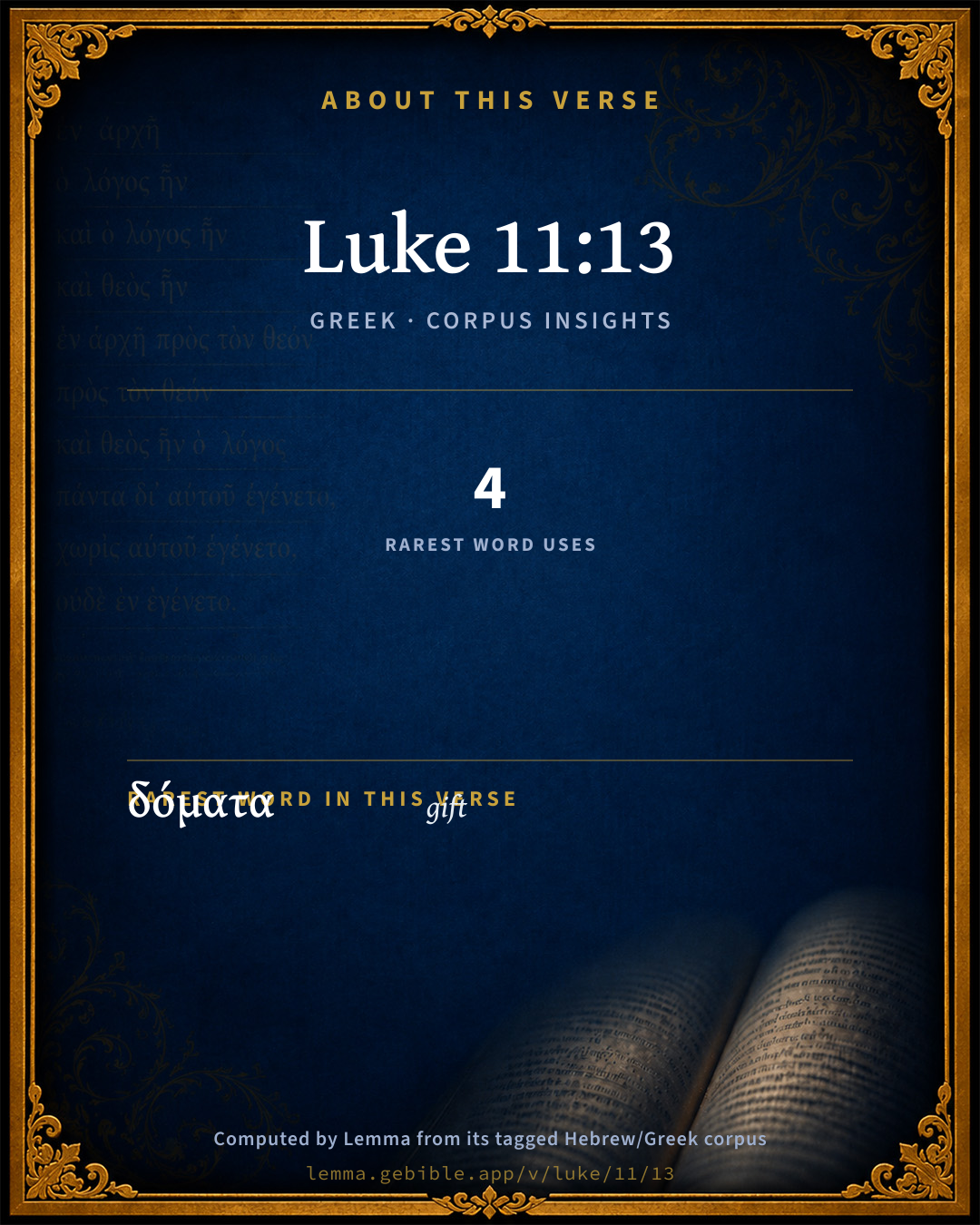
Luke 11:13

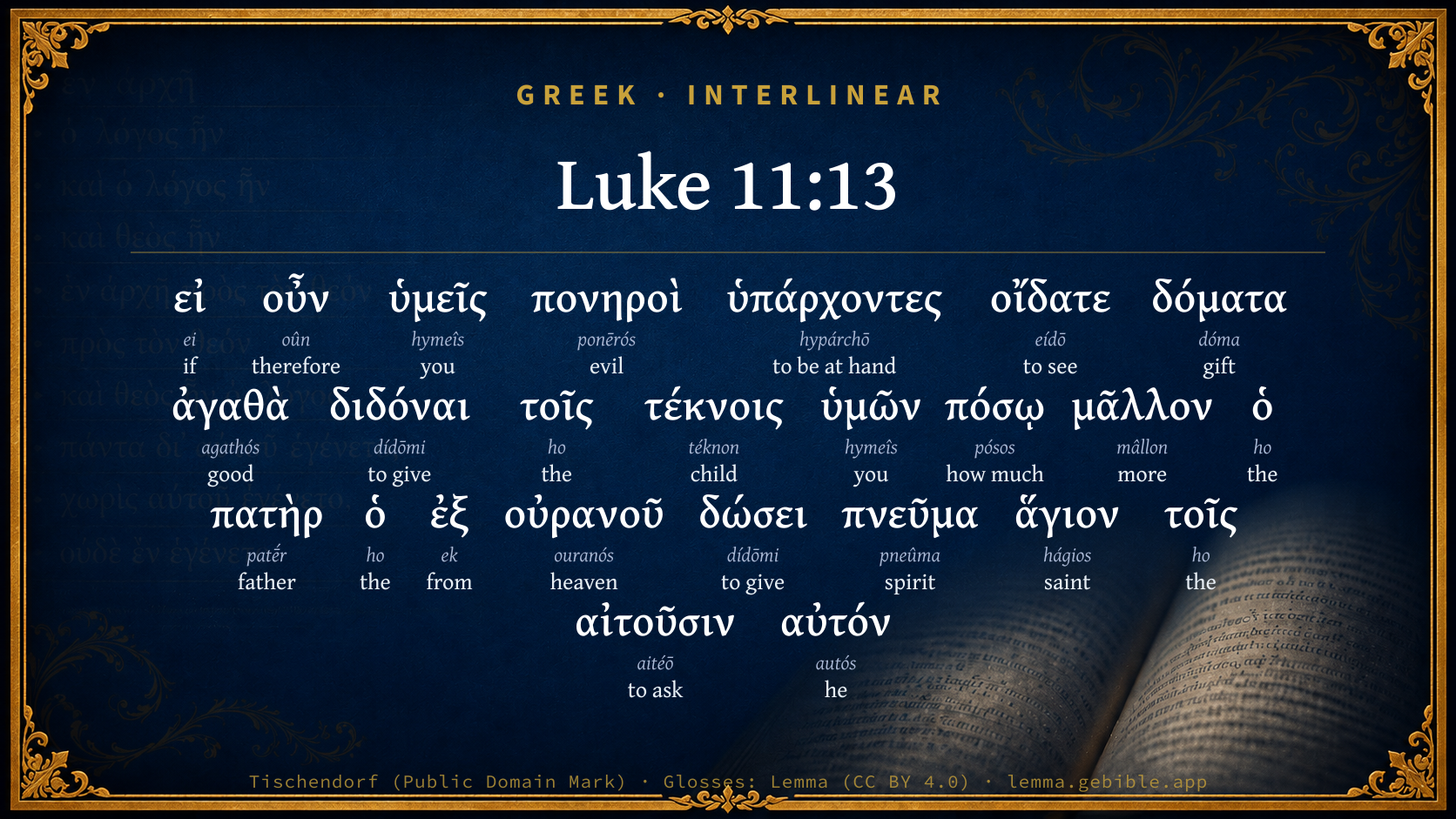
Greek (Tischendorf 8th ed.) Luke 11:13 appears in the Greek New Testament. The text above is from the Tischendorf 8th edition. Each word links to its Strong’s number and a concise gloss. Click any word for its full Thayer’s Greek Lexicon entry.
Download image
Cite this verse

Luke 11:13 (World English Bible). Public Domain. Lemma interlinear Bible study tool, https://lemma.gebible.app/v/luke/11/13.

Show BibTeX & RIS
BibTeX
RIS
English Translation
If you then, being evil, know how to give good gifts to your children, how much more will your heavenly Father give the Holy Spirit to those who ask him?"
World English Bible · Public Domain
Download a study sheet

One document with this verse’s original text, its word-by-word gloss line, the meaning frame, cross-references with their text, attributed commentary, and full source and license credits — printable, and it pastes into notes with its structure intact.

This verse Autodidact and up

Study sheet (.html) Plain text (.txt)

A passage Seminary Student

Up to 50 verses in one chapter. A passage sheet keeps up to 6 commentary sources and 12 cross-references per verse, in the order this page ranks them, and says so on the sheet whenever that leaves anything out. Ask for a single verse and you get the Autodidact verse sheet above.

Everything on this page stays free to read, with no account — the sheet is a download of what is already on screen, not access to it.

Want to remove ads? Support Godless Engineer
Compare translations 3

The same verse in 3 English versions, stacked beneath the original-language interlinear above. Click any original word for its lexicon entry.

Each is an independent rendering of the whole verse — the interlinear is not word-aligned to these translations.

Highlighted words mark where these versions differ — a whole-verse word diff, not a word-by-word alignment.

  • World English Bible Public Domain
    If you then, being evil, know how to give good gifts to your children, how much more will your heavenly Father give the Holy Spirit to those who ask him?"
  • King James Version Public Domain
    If ye then, being evil, know how to give good gifts unto your children: how much more shall your heavenly Father give the Holy Spirit to them that ask him?
  • unfoldingWord Literal Text CC BY-SA 4.0
    Therefore, if you being evil know to give good gifts to your children, how much more will the Father from heaven give the Holy Spirit to the ones asking him?”

unfoldingWord Literal Text — © unfoldingWord, licensed CC BY-SA 4.0. Word-aligned USFM3 via Door43 (git.door43.org/unfoldingWord/en_ult).

Versions to compare (up to 4)

3 of 4 selected

Show all 19 translations

Every available English version of this verse, each an independent rendering of the whole verse.

  • World English Bible Public Domain
    If you then, being evil, know how to give good gifts to your children, how much more will your heavenly Father give the Holy Spirit to those who ask him?"
  • Berean Standard Bible Public Domain
    So if you who are evil know how to give good gifts to your children, how much more will your Father in heaven give the Holy Spirit to those who ask Him!”
  • Majority Standard Bible Public Domain
    So if you who are evil know how to give good gifts to your children, how much more will your Father in heaven give the Holy Spirit to those who ask Him!”
  • King James Version Public Domain
    If ye then, being evil, know how to give good gifts unto your children: how much more shall your heavenly Father give the Holy Spirit to them that ask him?
  • American Standard Version (1901) Public Domain
    If ye then, being evil, know how to give good gifts unto your children, how much more shall `your' heavenly Father give the Holy Spirit to them that ask him?
  • Revised Version (1885) Public Domain
    If ye then, being evil, know how to give good gifts unto your children, how much more shall your heavenly Father give the Holy Spirit to them that ask him?
  • Geneva Bible (1599) Public Domain
    If yee then which are euill, can giue good giftes vnto your children, howe much more shall your heauenly Father giue the holy Ghost to them, that desire him?
  • Douay-Rheims (1899) Public Domain
    If you then, being evil, know how to give good gifts to your children, how much more will your Father from heaven give the good Spirit to them that ask him?
  • Young's Literal Translation Public Domain
    If, then, ye, being evil, have known good gifts to be giving to your children, how much more shall the Father who is from heaven give the Holy Spirit to those asking Him!'
  • Literal Standard Version CC BY-SA 4.0
    If, then, you, being evil, have known to be giving good gifts to your children, how much more will the Father who is from Heaven give the Holy Spirit to those asking Him!”
  • Unlocked Literal Bible CC BY-SA 4.0
    Therefore, if you who are evil know how to give good gifts to your children, how much more will your Father from heaven give the Holy Spirit to those who ask him?”
  • unfoldingWord Literal Text CC BY-SA 4.0
    Therefore, if you being evil know to give good gifts to your children, how much more will the Father from heaven give the Holy Spirit to the ones asking him?”
  • Darby Bible Public Domain
    If therefore *ye*, being evil, know how to give good gifts to your children, how much rather shall the Father who is of heaven give [the] Holy Spirit to them that ask him?
  • World Messianic Bible Public Domain
    If you then, being evil, know how to give good gifts to your children, how much more will your heavenly Father give the Holy Spirit to those who ask him?”
  • Webster's Bible Public Domain
    If ye then, being evil, know how to give good gifts to your children: how much more will your heavenly Father give the Holy Spirit to them that ask him?
  • Free Bible Version CC BY-SA 4.0
    So if you, even though you are evil, still know to give good gifts to your children, how much more will the heavenly Father give the Holy Spirit to those who ask him?”
  • Bible in Basic English Public Domain
    If, then, you who are evil are able to give good things to your children, how much more will your Father in heaven give the Holy Spirit to those who make request to him?
  • Text-Critical English NT CC BY 4.0
    If you then, being evil, know how to give good gifts to your children, how much more will your heavenly Father give the Holy Spirit to those who ask him!”
  • Tyndale New Testament (1534) Public Domain
    Yf ye then which are evyll canne geve good giftes vnto youre chyldren how moche more shall the father of heaven geve an holy sprete to them that desyre it of him?

Literal Standard Version (2020), Covenant Press — licensed CC BY-SA 4.0. Text via the HelloAO Bible API (eBible.org). Unlocked Literal Bible (unfoldingWord) — licensed CC BY-SA 4.0. Text via the HelloAO Bible API (eBible.org). unfoldingWord Literal Text — © unfoldingWord, licensed CC BY-SA 4.0. Word-aligned USFM3 via Door43 (git.door43.org/unfoldingWord/en_ult). Free Bible Version, Dr. Jonathan Gallagher — licensed CC BY-SA 4.0. Text via the HelloAO Bible API (eBible.org).

Word by word

More ways to search: Search by grammar → Find every occurrence → Compare this word →

Practice this passage: Drill this verse → Learn its vocabulary →

δόματα
dóma
G1390
“gift”
Noun, Accusative, Plural, Neuter
Part of Speech
Noun
Case
Accusative
Number
Plural
Gender
Neuter
Full Thayer's Definition

Origin: from the base of G1325

TDNT: None

1. a gift
  1. εἰ ei G1487 “if” Conditional
  2. οὖν oûn G3767 “therefore” Conjunction
  3. ὑμεῖς hymeîs G5210 “you” Personal pronoun, 2nd person, Nominative, Plural
  4. πονηροὶ ponērós G4190 “evil” Adjective, Nominative, Plural, Masculine
  5. ὑπάρχοντες hypárchō G5225 “to be at hand” Verb, Present, Active, Participle, Nominative, Plural, Masculine
  6. οἴδατε eídō G1492 “to see” Verb, Perfect, Active, Indicative, 2nd person, Plural
  7. ἀγαθὰ agathós G18 “good” Adjective, Accusative, Plural, Neuter
  8. διδόναι dídōmi G1325 “to give” Verb, Present, Active, Infinitive
  9. τοῖς ho G3588 “the” Article, Dative, Plural, Neuter
  10. τέκνοις téknon G5043 “child” Noun, Dative, Plural, Neuter
  11. ὑμῶν hymeîs G5210 “you” Personal pronoun, 2nd person, Genitive, Plural
  12. πόσῳ pósos G4214 “how much” Correlative/interrogative pronoun, Dative, Singular, Neuter
  13. μᾶλλον mâllon G3123 “more” Adverb
  14. ὁ ho G3588 “the” Article, Nominative, Singular, Masculine
  15. πατὴρ patḗr G3962 “father” Noun, Nominative, Singular, Masculine
  16. ὁ ho G3588 “the” Article, Nominative, Singular, Masculine
  17. ἐξ ek G1537 “from” Preposition
  18. οὐρανοῦ ouranós G3772 “heaven” Noun, Genitive, Singular, Masculine
  19. δώσει dídōmi G1325 “to give” Verb, Future, Active, Indicative, 3rd person, Singular
  20. πνεῦμα pneûma G4151 “spirit” Noun, Accusative, Singular, Neuter
  21. ἅγιον hágios G40 “saint” Adjective, Accusative, Singular, Neuter
  22. τοῖς ho G3588 “the” Article, Dative, Plural, Masculine
  23. αἰτοῦσιν aitéō G154 “to ask” Verb, Present, Active, Participle, Dative, Plural, Masculine
  24. αὐτόν autós G846 “he” Personal pronoun, Accusative, Singular, Masculine

About this verse

These counts appear in no published source. They are computed here, from the morphology-tagged text and Lemma’s own curated glosses. What Lemma adds →

25
words
20
distinct lemmas
Gospels
section

Notable vocabulary

The rarest word here is δόματα gift G1390 — appearing just 4 times in the whole Greek New Testament.

Shared distinctive vocabulary

δόματα gift G1390 occurs in 4 verses of the Greek New Testament. Also found in:

Repetition

Words recur within this verse:

  • διδόναι to give G1325 ×2
  • τοῖς the G3588 ×4
  • ὑμεῖς you G5210 ×2

Cross-references

28

Topical passages linked to Luke 11:13 in the Treasury of Scripture Knowledge — connected by theme and wording, ordered by reader-vote popularity; previews shown in the World English Bible.

  • Matthew 7:11 If you then, being evil, know how to give good gifts to your children, how much more will your Father who is in heaven give good things to those who ask him!
  • Isaiah 44:3–4 For I will pour water on him who is thirsty, and streams on the dry ground; I will pour my Spirit on your seed, and my blessing on your offspring:
  • Romans 8:32 He who didn't spare his own Son, but delivered him up for us all, how would he not also with him freely give us all things?
  • John 4:10 Jesus answered her, "If you knew the gift of God, and who it is who says to you, 'Give me a drink,' you would have asked him, and he would have given you living water."
  • Proverbs 1:23 Turn at my reproof. Behold, I will pour out my spirit on you. I will make known my words to you.
  • Acts 2:38 Peter said to them, "Repent, and be baptized, everyone of you, in the name of Jesus Christ for the forgiveness of sins, and you will receive the gift of the Holy Spirit.
  • John 7:37–39 Now on the last and greatest day of the feast, Jesus stood and cried out, "If anyone is thirsty, let him come to me and drink!
  • Joel 2:28 "It will happen afterward, that I will pour out my Spirit on all flesh; And your sons and your daughters will prophesy. Your old men will dream dreams. Your young men will see visions.
  • Ezekiel 36:27 I will put my Spirit within you, and cause you to walk in my statutes, and you shall keep my ordinances, and do them.
  • Isaiah 49:15 Can a woman forget her sucking child, that she should not have compassion on the son of her womb? yes, these may forget, yet I will not forget you.
  • Matthew 6:14 "For if you forgive men their trespasses, your heavenly Father will also forgive you.
  • John 3:5–6 Jesus answered, "Most assuredly I tell you, unless one is born of water and spirit, he can't enter into the Kingdom of God!
  • Romans 5:9–10 Much more then, being now justified by his blood, we will be saved from God's wrath through him.
  • Matthew 6:32 For the Gentiles seek after all these things, for your heavenly Father knows that you need all these things.
  • Psalms 51:5 Behold, I was brought forth in iniquity. In sin my mother conceived me.
  • Luke 11:2 He said to them, "When you pray, say, 'Our Father in heaven, May your name be kept holy. May your Kingdom come. May your will be done on Earth, as it is in heaven.
  • Luke 15:30–32 But when this, your son, came, who has devoured your living with prostitutes, you killed the fattened calf for him.'
  • 2 Corinthians 3:9–11 For if the service of condemnation has glory, the service of righteousness exceeds much more in glory.
  • Matthew 5:16 Even so, let your light shine before men; that they may see your good works, and glorify your Father who is in heaven.
  • Matthew 5:45 that you may be children of your Father who is in heaven. For he makes his sun to rise on the evil and the good, and sends rain on the just and the unjust.
  • Romans 7:18 For I know that in me, that is, in my flesh, dwells no good thing. For desire is present with me, but I don't find it doing that which is good.
  • Hebrews 12:9–10 Furthermore, we had the fathers of our flesh to chasten us, and we paid them respect. Shall we not much rather be in subjection to the Father of spirits, and live?
  • Matthew 6:30 But if God so clothes the grass of the field, which today exists, and tomorrow is thrown into the oven, won't he much more clothe you, you of little faith?
  • Romans 5:17 For if by the trespass of the one, death reigned through the one; so much more will those who receive the abundance of grace and of the gift of righteousness reign in life through the one, Jesus Christ.
  • Genesis 8:21 Yahweh smelled the sweet savor. Yahweh said in his heart, "I will not again curse the ground any more for man's sake, because the imagination of man's heart is evil from his youth; neither will I ever again strike everything living, as I have done.
  • Job 15:14–16 What is man, that he should be clean? He who is born of a woman, that he should be righteous?
  • Genesis 6:5–6 Yahweh saw that the wickedness of man was great in the earth, and that every imagination of the thoughts of his heart was only evil continually.
  • Titus 3:3 For we were also once foolish, disobedient, deceived, serving various lusts and pleasures, living in malice and envy, hateful, and hating one another.

Cross-references courtesy of OpenBible.info (CC BY 4.0).

Commentary

Notes on Luke 11:13 from classic Christian and Jewish commentators (each source and its license shown beneath its notes). The classic Christian expositions comment on the surrounding passage and are grouped to its opening verse, so a note may address several verses; the Jewish commentaries on the Tanakh (Rashi and others) are per-verse, so they appear only where the commentator wrote on this verse.

Lemma curates 59 commentaries, every one of them public domain or Creative Commons licensed, each selected and text-cleaned for this edition rather than reprinted as found. About our sources →

The Biblical Illustrator

Joseph S. Exell

Luk_11:13

How much more shall your heavenly Father give the Holy Spirit

The gift of the Holy Spirit

I.

WHAT IS MEANT BY THE HOLY SPIRIT.

1. He is a person, and may be grieved.

2. He intercedes for believers.

3. He guides, hears, speaks, and shows things to come.

4. He is a Divine person, and truly God.

(1) Sin against Him is unpardonable.

(2) Lying to Him is lying to God.

(3) Temples of the Holy Ghost are temples of God.

5. The Holy Ghost is enjoyed by all believers.

(1) Proved from the apostles declaration (Rom_8:9).

(2) Evident from our Lords promise (Joh_7:37-39).

(3) And from the method of communicating salvation (Tit_3:5-6).

II. FOR WHAT PURPOSE THE HOLY GHOST IS GIVEN.

1. As a Spirit of penitence and prayer.

2. As a Spirit of power.

3. As a Spirit of consolation.

4. As a Spirit of purity.

5. As a Spirit of wisdom.

6. As a Spirit of fruitfulness.

III. THE MANNER OF ASKING FOR THE HOLY SPIRIT.

1. They must ask in sincerity.

2. They must ask evangelically.

3. Ask importunately.

4. Ask in faith.

IV. THE WORDS OF OUR TEXT ARE ENCOURAGING TO HOPE. If ye then, being evil, know how to give good gifts unto your children, how much more shall your heavenly Father give the Holy Spirit to them that ask Him.

1. Here we notice that mankind are evil. Yet, they know how to give good gifts unto their children.

2. God is His peoples Father.

(1) He is their heavenly Father.

(2) Covenant Father.

(3) Good.

(4) Wise.

(5) Gracious. (T. B. Baker.)

The efficacy of prayer for obtaining the Holy Spirit

The force of which argument depends upon a double comparison, of the quality of the persons giving, and of the nature of the gift.

I. I shall show what is comprehended in this gift of the Holy Spirit, and how great a blessing and benefit it is. St. Matthew expresseth this somewhat differently: How much more shall your Father which is in heaven give good things to them that ask Him? (Mat_7:11). Which, compared with the expression here in St. Luke, doth intimate to us, that the Spirit of God is the chief of blessings, or rather the sum of all good things.

II. We shall in the next place consider what kind of asking, in order to the obtaining of this great blessing, is here required by our Saviour, when He says, God will give His Holy Spirit to them that ask Him. It must have these three qualifications:

1. It must be hearty and sincere, in opposition to formal and hypocritical asking.

2. It must be earnest and fervent, and importunate, in opposition to cold, and faint, and careless asking.

3. It must be in faith, and a confident assurance that God will hear us, in opposition to doubting and distrust.

III. To confirm and illustrate the truth of this proposition, that God is very ready to give the Holy Spirit to them that ask Him.

1. From Gods free promise and declaration. And besides that here in the text, I might produce several others, but I shall mention only one, which is very plain and express, and conceived in terms as large and universal as can well be devised (Jam_1:5).

2. From the comparison here used.

It is a plain and undeniable argument, fitted to all capacities, because it proceeds upon two suppositions which every man must acknowledge to be true.

1. That earthly parents have generally such a natural affection for their children, as does strongly incline them to give them such good things as are necessary and convenient for them, and which will not suffer them, instead of good things, to give them such things as either are no wise useful, or any wise hurtful to them. This is a matter of common, and certain, and sensible experience, which no man can deny.

2. The other supposition, which is as evident in reason as the former is in experience, is this: that God is better than men, and that there is infinitely more goodness in Him than in the best man in the world; because goodness in its most exalted degree and highest perfection is essential to that notion which all men have of God; and this being a common principle, in which men are universally agreed, no man can gainsay it.

But, for the farther illustration of this argument, we will consider a little more particularly the terms of the comparison which our Saviour here useth; our earthly and our heavenly Father; temporal and spiritual good things.

1. Our earthly and our heavenly Father; in which terms the givers are compared together. Now there are three considerations in a giver, which makes him capable of being bountiful, and dispose him to it.

(1) That he have where withal to be liberal, and can part with it without damage and prejudice to himself.

(2) That he be good-natured, and have a mind to give.

(3) That he be related to those to whom he gives, and be concerned in their welfare. Now all these considerations are more eminently in God, and with far greater advantage, than in any father upon earth.

2. Let us compare likewise temporal and spiritual good things; in which terms you have the gifts compared together. So that the whole force of the argument comes to this: that if we believe that earthly parents have any good inclinations towards their children, and are willing to bestow upon them the necessaries of life, we have much more reason to believe that God our heavenly Father is much more ready to give His Holy Spirit to them that ask Him; whether we consider the quality of the giver, or the nature of the gift.

Application:

1. This is a matter of great encouragement to us under the sense of our own weakness and impotency.

2. Let us earnestly beg of God His Holy Spirit, seeing it is so necessary to us, and God is so ready to bestow this best of gifts upon us.

3. Let us take heed of grieving the Spirit of God, and provoking Him to withdraw Himself from us.

4. Gods readiness to afford the grace and assistance of His Holy Spirit to us, to enable us to the performance of our duty, and the obedience of His laws, makes all wilful sin and disobedience inexcusable. (Archbishop Tillotson.)

Right replies to right requests

In this chapter there is an evident progress. It opens by the disciples asking the Lord to teach them to pray. To that He gave a full and sufficient reply; He prepared them an outline of what complete prayer should be. Then the chapter proceeds a little further to answer a question: we are shown how to pray, but will God really answer us? Is prayer only meant to do good to the suppliant? Does it end with the benefit which it works in us, or does it really affect the heart of God? The answer is given by our Lord with great clearness. We have a parable to show that as importunity does evidently affect men, so importunity will also gain an answer from God, that He will be pleased to give us what we need if we do but know how, with incessant earnestness, to come again and again to Him in prayer. We are assured that asking is attended with receiving, that seeking is attended with finding, that knocking will lead to opening, that it is not a vain thing to pray. The truth here taught is not that God will refuse us evil things if in our mistake we ask for them; that is a truth, but it is not alluded to here; the one statement of this verse is, that prayers for good things will be answered, and that they will not be answered with gifts wearing the mere appearance of good, but with the actual good things desired. That simple thought I shall endeavour to enlarge upon in this mornings discourse.

I. RIGHT PRAYERS, RIGHT ANSWERS. The child asks bread, his father does not give him a stone. We shall have when we pray for needful things, the really needful things themselves, not the imitation of them, but the actual blessings. And if our faith grows a little stronger, and having obtained bread we ask for fish, not absolutely a necessary, but a comfort and a relish; if we make bold to ask for spiritual comforts, consoling gifts and ennobling graces, something over and above what is absolutely needful to save us, our heavenly Father will not mock us by giving us superficial comforts which might be injurious as a serpent; He will give us so much of comfort as we can bear; and it shall be pure, holy, healthy comfort. And if, gathering more confidence still, we ask for an egg, which I take it was in Christs day a rarer luxury, we shall not be deluded by its counterfeit. That is our first point--prayer for good things meets a good answer.

II. Then the question will arise in every heart: It seems then that I have only to ascertain that my prayer is for a really good thing, and I shall have it? Just so, and hence, secondly, THE PRAYER FOR THE BEST THING IS SUREST OF AN ANSWER, for, saith the text, How much more shall your heavenly Father give the Holy Spirit to them that ask Him?

1. There is no doubt about the Holy Spirit being a good thing; when we therefore ask for Him, for His Divine presence and influence, we may rest assured that God will give it. Make that our first point under this head--God will give the Holy Spirit to them that ask for Him.

2. From the connection in which the text stands, I gather the following remark, namely, that it will truly be the Holy Spirit. Go back again to that first thought. The child asks bread, and does not get a stone; you ask the Holy Spirit, and you shall receive the Holy Spirit.

3. But it appears plainly enough from the text that this Holy Spirit is to be given in answer to prayer. He will give you the real Spirit: no enthusiasm that might mislead you, no fanaticism that might injure you, no self-conceit that might become like a deadly scorpion to you, but His own gentle, truthful, infallible, Holy Spirit He will give to them that ask Him.

III. Now for our last point. THE BEST OF PRAYERS, WHICH IS SURE TO BE HEARD, IS ALSO A MOST COMPREHENSIVE ONE. Turn to the parallel passage in the gospel of Matthew (Mat_7:11). Now what does our text say, How much more shall your heavenly Father give the Holy Spirit to them that ask Him? Is it not clear then that the Holy Spirit is the equivalent for good things, and that, in fact, when the Lord gives us the Holy Spirit He gives us all good things? What a comprehensive prayer then is the prayer for the Spirit of God. (C. H. Spurgeon.)

The good gift

I. THE FACT HERE TAKEN FOR GRANTED--that earthly parents, though evil, know how to give good gifts unto their children. It is not said that parents know how to choose always what is best for their children. Neither would our Lord assert that parental affection is never overpowered by other principles. Long misbehaviour has sometimes induced a father to disinherit his son. Such, and so strong, is natural affection: a principle, necessary indeed for the preservation of the species; and so deeply implanted by our all-wise Creator, that it still survives the wreck of everything else that once was good in man.

II. THE DOCTRINE, FOR THE ILLUSTRATION OF WHICH THIS FACT IS ALLUDED TO. The doctrine is, that your heavenly Father is much more likely to give the Holy Spirit to them that ask Him. Now, by following up the comparison which our Lord makes in the text, we shall see abundant reason for concluding, that God is not only as affectionate, but infinitely more so, than any human benefactor. For I may ask, in the first place, with Moses--

1. Is not He thy Father, that hath bought thee? hath He not made thee and established thee? Has not Creation made you His children? and did He make you to destroy you? But you think of your sins! You do well; but think also of the unfathomable mines of love, which those sins have brought to light.

2. What can this heavenly Father bestow on His children more worthy the name of a good gift than His Holy Spirit? He has given His Son; yet even that gift avails us not, till the Spirit be added.

3. Is the spiritual bounty of our heavenly Father limited, like the affection of earthly parents, to those who can prove that they are His children? No--it is far more wide and expansive. It is offered to all that are Hischildren by Creation; without stopping to consider whether they are such by regeneration or no. For here again our Lord makes a change in His language. It is not--How much more shall your heavenly Father give the Holy Spirit to His children; but--to them that ask Him. (J. Jowett, M. D.)

The best gift

I. The Holy Spirit is spoken of, in the text, as the best gift which God in His rich bounty can bestow on man. And, if we consider who the Holy Spirit is, and what He does for those who truly believe in Christ, we need not wonder that our Lord should thus speak of this unspeakable gift. He is our Guide, our Comforter, our Sanctifier.

II. It is a plain and easy way which God has appointed for us, to obtain this precious gift: He will give His Holy Spirit to them that ask Him. We are told in everything by prayer to let our requests be made known mite God. (E. Blencowe, M. A.)

The gift of the Holy Spirit

I. OUR PRIVILEGE as the followers of Christ.

1. What is meant by the Holy Spirit.

2. The Holy Ghost is enjoyed by all real Christians.

3. For what purposes He is received by them.

(1) As a Spirit of penitence and prayer.

(2) As a Spirit of power.

(3) As a Spirit of comfort.

(4) As a Spirit of purity.

(5) As a Spirit of wisdom.

(6) As a Spirit of fruitfulness.

II. OUR DUTY. To ask as God requires.

1. Sincerely.

2. Evangelically.

3. Importunately.

4. Believingly.

III. These words also ENCOURAGE OUR HOPE. Application:

1. Recollect your privilege with suitable acts of piety. Such as--self-examination. Do you enjoy this gift as a Spirit of penitence, &c. (2Co_12:5). Humiliation: on account of your enjoying no more of it Jam_4:2; Jam_4:8-10). Holy care: to cherish and improve what Divine influence you enjoy. By obeying Christ (Rev_3:2); and imitating St. Paul (Php_3:13-14).

2. Recollect your duty with perseverance in it (Col_4:2).

3. Recollect your encouragement with steadfast hope--of receiving the Holy Spirit in all His influences; as a Spirit of prayer, penitence, power, &c. (Theological Sketch-book.)

The availability of the Holy Spirit

For every moral virtue, for the first germ of spiritual life, for growth, development, usefulness and increase we are dependent on the Holy Spirit. The great want of the times.

I. Is THE HOLY SPIRIT AVAILABLE? Can His presence be secured? Surely.

1. If we consider the character of God, His universal beneficence, His desire to make His sentient and intelligent creatures happy, we need have no doubt.

2. This argument gains force in the light of Gods great love in giving His Son for the reclamation of His lost race. If willing to make the greater sacrifice, will He not be willing to make the less?

3. Our argument as to the availability of the Holy Spirit becomes absolutely conclusive when we consider that He is the promised and special gift both of the Father and of the Son.

II. HOW SHALL WE CONSCIOUSLY REALIZE THE PRESENCE OF THE HOLY SPIRIT?

1. Common interest and sympathy, and united prayer.

2. Avoidance of all known sins.

3. A sense of need, of dependence, of meekness, of unworthiness, of penitence, and an earnest heart-cry for help. (S. D. Burchard, D. D.)

The gift of the Spirit

Four central principles underlie this passage--in fact, underlie the Bible and all religion in the world.

1. Man has a capacity for God as truly as the stomach for food. God is as imperative a necessity to our spiritual nature as is bread for the body.

2. Man has a distinct need of God impressed upon him. The body is disquiet, if food be withheld. The soul is restless without God.

3. The Fatherhood of God is a pledge and guarantee that these deepest yearnings of mans nature will be gratified. A judicious parent prefers for his son character rather than fame, genius, or wealth. God also desires, above all things, our sanctification.

4. God gives the Holy Spirit to the eager, ardent, persistent, importunate soul. Do you really want it? Honestly and earnestly asking, you shall receive. You must long for the Holy Spirit more than the hungry and thirsty long for food and water; more anxiously than the storm-tossed sailor longs for the port. With this spirit you may be sure of an answer, and as much more sure as God is better than the best human parent. (H. L.Thompson.)

How God feels towards mankind

Here is what the Redeemer says to you, and me; and all: If you want to know how God feels towards you, and how ready God is to give you everything that is really good: here is something to go by. You know how much you would do for your children: you know how anxious you are to care for them in every way. You know how a father will work, and how a mother will watch, all for the good of their little ones. You know how much of the work that is done by men in this world, and how much of the care that is felt, is not for themselves at all, but for their children: all for them. After the dream of fame is past--after ambition is outgrown--the man toils on as steadfastly and earnestly as in his most hopeful and most aspiring days, that he may provide for his little ones; that he may see them in comfort and happiness; that he may push them on (as he trusts and prays) to be far better and happier than ever he was himself. The human heart is always the same: you do that now, my friends; and so you may be sure that people did that long ago, in the days when Christ was here. Well, says Christ you know all that. You know all that, says His blessed voice: and now hear Me and believe Me when I tell you, that the great Father above is just like that; only a thousand-fold better. If even you, sinful and evil, would wear your fingers to the bone, would lose your rest, would cut off every selfish indulgence, that you might see your childrens wants supplied, that you might see the little things happy and good--then take this blessed truth to your heart, that in all you feel toward your children, you have a faint and far reflection of how the great God above feels toward you. He feels for us just like that: cares for us, loves us, wishes us well, works for us. (A. K. H. Boyd, D. D.)

Prayer for the Spirit answered

1. Our privilege here exhibited.

2. Our duty prescribed.

3. our hope encouraged. (Anon.)

Gods care for His children far greater than mans

Let us now consider the truth that God differs from an earthly father by being far kinder, wiser, and better. O brethren, there is an immense deal suggested by that how much more! It would be an unspeakable comfort to us--it would be a glorious and comfortable truth--that God was just as willing to give us all we need as you kind-hearted people are to give what is needful to your little child. I think I know men and women who have hearts so good and kind; who are so ready to do what they can to make their own children happy, or to add to the happiness of any little child; that I should feel safe enough and sure enough in going, sinful, weary, to Almighty God, to ask for His mercy and His Blessed Spirit, even if I knew no more than this, that I should find such a welcome at His throne of grace as these good men and women would give to any suffering, helpless child, even if it were not their own. But how much more! What a silent reference to an inconceivable depth of love and pity in the heart of God! It is as if Christ had said to those whom He addressed, You cannot understand the difference--words cannot explain the difference--here is the kind of thing, in yourselves; but in God how much more! Yet not a different kind of thing--the same kind of feeling you bear towards your children--only heightened up to a pitch you can never know.

1. God knows what is good for us, as no human parent can know what is good for his child. With the kindest intentions, we all know how injudicious parents often are; how often they err on the side of over-severity or of over-tenderness; how completely they sometimes mistake what is to conduce to the true good or happiness of their children; indeed it is not too much to say that a very great proportion of all the sorrow that is in this world arises from the mismanagement of parents in youth, or from the consequences of that mismanagement in after years. Now God knows us; knows what we are, and what we can do; knows what we are fit for, and how things affect us; knows all our peculiarities of temperament and disposition. He knows what we really need; He knows when to give us what we wish, and when to deny it; He knows how to make all things work together for good to such as love Him.

2. Another point in which appears the superiority of the great Father to whom Christ points us above all earthly parents, is His power. He is able to do all He wishes. He has all power to give us all good things; to help and save. You know how different it is with us; how well we often know what we should like to do for our children, to make them wise and good and happy; yet how very little we can do.

3. Then God is always kind. There are unnatural parents--let us hope, very few. There are people who repel their childrens confidence; who from mistaken principle or from a bad heart do all they can to make their children miserable; who point out with pride in the misery of a child, that things have come just as they said they would; who so act as to make us wonder that a trace of natural affection should be left in their childrens heart. I shall not dwell on a subject so miserable, save to remind you that our heavenly Father has anticipated such a case--Can a woman forget her sucking child, that she should not have compassion on the son of her womb? Yea, they may forget, yet will I not forget thee!

4. And now the last matter I shall name, as to which our heavenly Father excels the best earthly one, is that He is always near. Always within hearing; always within reach; never leaving, never forsaking; Father of the fatherless, Friend of the friendless; yea, When father and mother forsake me, then the Lord will take me up! O Father of mercies, remember this word unto Thy servants, upon which Thou hast caused us to hope! (A. K. H. Boyd, D. D.)

The gift of the Spirit

Cotton Mather, whose endeavours as a parent were highly blessed, says: Let my prayers for my children be daily, with constancy. Yea, by name let me mention each one of them every day before the Lord. I would importunately beg for all suitable blessings to be bestowed on them; that God would give them grace and give them glory, and withhold no good thing from them; that God would smile on their education and give His good angels charge over them and keep them from evil, that it may not grieve them; that when their father and mother forsake them, the Lord may take them up. With importunity I would plead that promise on their behalf: The heavenly Father will give the Holy Spirit to them that ask Him, Oh, happy children, if by asking I may obtain the Holy Spirit for them! which every natural man, every man who lets himself alone and lives practically without God, apart from Christ, in the world, has in him a dumb spirit, and can only lose that spirit under the healing touch of Christ.

1. I might speak--but it would not affect or be true of all who hear me--of that calamity, that curse, which we designate as a bad temper. Has any one here present a bad temper? Have you not been reminded sometimes, in that experience, of the dumb spirit spoken of in the text? That sullen silence; that overcast brow; that gloomy, morose, most irritating reserve; that gathering, threatening, overhanging cloud of dull, dark, speechless displeasure, by which a long evening has been rendered miserable, and upon which night and sleep have come without mitigation and without relief; that obstinate nursing and cherishing of an untold grudge, which wakens again in the morning to its last nights sullenness, and seems almost to pride itself upon its tenacity and its perseverence; was not this indeed an example of possession by a dumb spirit?

2. Mark that man--his name indeed is Legion--who lives what is called an entirely preoccupied and self-engrossed life; who has his business and follows it, has his interests and pursues them, has even his pleasures and enjoys them, but in all these has in reality no partner and no associate; looks to himself as to all that most intimately touches him, and himself only; excludes from his true confidence alike friend and brother, alike child and wife; gives out in social converse the merest superficialities of his thoughts, and in domestic intercourse the veriest dregs and refuse of his being; locks up in his own bosom the affections which God gave him for blessing, pro-supposes selfishness in others because he feels it in himself, and will trust no other soul with that confidence which he knows could have no reception and no reciprocity in his own.

3. It is made in Scripture both the duty and also the test of a Christian, that his speech be not only innocent, but beneficial; not only kind and frank, but consistent also and edifying. Now, if this be so, by what name can we designate that use of speech which altogether overlooks or refuses this high object? Let us all look back, my brethren, this morning upon our past employment of the gift of language. What shall we say of it? Is not the review most disheartening? To whom can we point as having been benefited by our possession of this marvellous thing? Nay--for effects are Gods, not ours--when did we ever set ourselves seriously to do good by our conversation. Is it not true, alas! that as to any value, any worth, contained in the gift of speech, we might as well have been bereft of it. In the judgment of Him who heareth as well as seeth in secret, the spirit which has possessed us has been no better than a dumb spirit.

4. It has been so towards man. We have done no good with our speech. And how has it been towards God? The text stands in immediate connection with a passage of Holy Scripture about prayer. Strong encouragement has been given to our halting, failing faith, in reference to the duty of seeking God in prayer. A form of prayer has been given, in answer to the request of the disciples, Lord, teach us to pray; and words have been added, which show beyond all question that it is not in God but in ourselves that the work of prayer is straitened. Then follows immediately the brief narrative of the text: Jesus was casting out a devil, and it was dumb. If the possession of the evil one makes us dumb (as to all that is valuable) towards man, so also does it towards God. (Dean Vaughan.)

Dumb

Look at the Greek word here translated dumb; for, if it be considered that the mind of God is in any way breathed forth to us through the words of Scripture, those words will bear a careful investigation into their meaning. That Greek word means, in its first use, blunt, obtuse; and so a blunted or lamed man in tongue. Mark here, then, the first lesson enshrined in the little word. The power of speech was in that tongue, but that power was not presently available. The machinery of articulation was perfect, had once been used, but an intruding hand had grasped the driving-wheel, and the machinery was still. The power was there, I say, yet it was held in suspense; it needed some third stronger power to drive out the intruder and set moving the smoothly-going wheel again. Yet mark, what direction would the power take when the unloosed tongue told forth the thoughts within? Would the tongue burst forth into the direct ravings of impotent blasphemy, or speak praise from out of a convinced heart? It depended upon this, whether the intruding spirit within initiated the movement, or whether God again evoked the dormant power. Which should it be? (Canon Wilberforce.)

The downward course

I can never forget a picture I once saw of Satan tempting Judas to betray his Master, a picture in which the painter had pourtrayed the face of the tempter as a hideous caricature of the tempted; as if the man, if only he could suddenly turn round and look over his shoulder, would be able to see in the face and the form of Satan what he himself would one day become if he gave way to temptation, and threw in his lot with devils. The painter had caught the lesson, I believe, that this miracle teaches. Are we alive to it? It is well sometimes to view ones self from the outside as well as from the inside--to climb a hill, as it were, and thence look down at yourself; just as we look at some great cathedral from a neighbouring hill, and from that elevation see a wholly different aspect from that which we gain by merely looking at it from the inside. Look, then, my brethren, very briefly at some of the causes which induce this terrible change, and at the remedies which God provides. The change is threefold: a blunted tongue, a defective hearing, a dulled mind--all these are implied in that one Greek word. A tongue that cannot speak to God, an ear that cannot hear His word, a mind too dull to receive Him--how do these come to you? How is it that the dumb spirit broods so heavily over many now? Brethren, it is because there is a great deception still kept up by the father of lies, because he finds an ally in our breasts in that infection of nature which doth remain; yea, in them that are regenerate. There is much outside business in religion in the present day; there is much need for those who are thus busy to ask themselves, Is my heart silencing or silent towards God? There is nowadays much outside conformity to the Cross of Christ; there is surely much need for the conformers to ascertain whether their hearts and their lives are telling the story that their lips so often repeat. I speak to those who are struggling, however feebly; who are praying, however dumbly; who are turning to God, however uncertainly. Mark then, first, the silencing process employed by Satan, whereby he quenches the answering power of the spirit to the drawings of God. First, it is a gradual process--a slight impeding of the freedom of action--a little poison of sin which gently impedes the circulation of the spiritual life. So surely as the unused muscle or the long-bandaged limb loses strength, so does the impeded soul lose its power of communing with God. A neglected faculty becomes a withering faculty. A religion that becomes mechanical stops of itself. The power of faith towards God unused, unexercised, dwindles, decays, perishes, till at last one sometimes hears on a death-bed that awful self-pronounced sentence:--I cannot pray--I have forgotten how: I cannot believe--it is so long since I thought of God. Again, all indulgence of tastes that lead us from God weakens the spiritual apprehension and warps the understanding, or there comes the loss of the power of all sound judgment which we see so remarkably in sinners. The old words of Solomon are fulfilled. They err who devise evil. They look upon all questions of morality from their own standpoints which is an ever-lowering point. They now see no harm in that which would have once shocked them--no sin in that which once would have appalled them. They are satisfied; and satisfaction with a low moral standard is one of the surest signs of a dumb spirit. They have no gratitude to God, and inability to thank our God is an unfailing symptom of a silenced tongue. And if so, brethren, in conclusion, what is the cure? The old heathen philosophy honestly confessed that it could find no cure. Plato, said Socrates (we read), perhaps the gods can forgive deliberate sin, but I do not see how. In the life and death of Christ the Saviour the mystery is solved, and the cure is made plain. The difficulty in this case is that the deaf cannot hear the words of Christ, the dumb cannot pray to Him, the blunted spirit cannot lift itself up towards Him. And yet, O my brethren, there is one sense that can be used even in the most extreme cases. Look once more at Christ as He is about to work the miracle of which I have spoken this evening. Mark how He has caught the mute appealing look in the eye of the voiceless man, as he turns instinctively to Christ for protection from the fearsome dweller within, from the tenant over whom he has long lost the power of control or the possibility of ejection. We, my brethren, can look up to Christ even when our spirits are most dull, even when our prayers are most heavy, even when the whole soul seems weighed down, oppressed, silenced by the sin in our nature. We can look up to Him when He began to struggle for the mastery with the bad habit of a lifetime, with the coldness of years, with the carelessness of a long duration. We can bring ourselves before Him (Oh, be His name ever blessed for it!), relying on His pregnant words of faithful promise. Him that cometh to Me I will in no wise cast out. If there be the will to be set free Christ will know it. He knows all the Buffering, for the pangs that affect the member reach ever to the Head. By virtue of the mysterious sympathy which binds us to the incarnate God He knows it; but, my brethren, as you are wrestling with your sin Christ your God knows it. He only wants you to place yourself completely under His charge; He only asks you to obey His every direction, and He will complete the cure in His own good time. He can do it, He can make this dumb spirit eloquent with praise; He can make this deaf ear thrill with the sweetest sound; He can make this obtuse spirit quick and attentive to the Word of God; He can set us once more free, so that we may understand by how much things Divine transcend things earthly; He can set us free, so that with St. Augustine we may understand that it is because God has created the human soul for Himself that that soul cannot rest until it finds its boundless rest in the bosom of God; set us free, so that with St. Bernard we may understand that men remain unconverted simply because they remain ignorant of the character of God, picturing Him to themselves as being like themselves. He can bid the untied tongue now confess the sin, and as the full confession wells up from out of the depths of a penitent heart, he does obliterate the guilt. (Canon Wilberforce.)

A dumb devil east out

A friend in London, who speaks now with a voice as clear as a bell, and preaches a full salvation, spoke to me in great trouble some years after his conversion. You know i am such a fool; I am afraid to speak. The other day you called on some one to pray, and I shivered down to my shoes, I was so afraid you would ask me. I could not have prayed if you had paid me for it. This dumb devil was in full possession of him. He understood everything; you could not teach him much. I said, You have a dumb devil. Do you believe the Lord Jesus can cast him out? Yes, I believe He can. Yes, the devil himself believes that, but do you believe He will? I am afraid. I am very glad of it; now let us kneel down and see whether the Lord will cast out the dumb devil. We were in a railway carriage together alone. We knelt down in the carriage and prayed. He could scarcely hear my voice for the noise; I think that Wag an encouragement to him. I went on praying to the Lord to loose the string of his tongue that he might speak plainly for the glory of God. He said, Amen. Thank God, I said, the dumb devil is going. I began to pray again. He said, Lord, answer prayer. Amen, I said. Hallelujah! the devil is going, and sure enough he began to pray for himself. I began to praise, and he was praising too. The train stopped, but we did not know anything about it; we went on praying and praising. The collector came to the door and said Tickets, but we never stopped: we continued to praise God. Oh, we were happy! The guard shut the door and went away; he thought we were two madmen, I suppose! Oh, I wish there were more of such mad people. This man had got his liberty, and, glory be to God, he has used it since then. (W. Haslam.)

How devils may be expelled

In Charles Kingsleys Life there is a story of a madman who declared that the devil had got hold of him, and would not let him sleep. The surgeon, says Kingsley, came to me and said, As I cannot cure the mans mind by making his liver act, you must make his liver act by curing his mind. So I went to the patient and agreed with him fully that the devil was in him. And I will tell you, I said, why he is. It is because you have been a scoundrel. But if you will lead a new and honest life you may snap your finger at the devil. The devil left him presently, and the man was cured. So resolution may expel the devil of worry, even after the nerves are more or less broken. (T. M. Coan, M. D.)

Third Sunday in Lent

And as this miracle indicated the true nature of Christs mission and appointments, it was at the same time a complete demonstration of His capacity and fitness for the work. And yet, it very differently affected different classes of witnesses.

1. There were some whom it greatly amazed. It came to pass, when the devil was gone out, the dumb spake, and the people wondered. These were the commoner class of persons who saw what was accomplished. Common people with common sense are the worlds best jury in nearly every case submitted to human arbitrament. Gods truth is never fruitless.

2. A second class of persons who witnessed this miracle consisted of certain rebellious spirits, who were ready to grasp at any absurdity, and to commit themselves to any sort of inconsistency and self-contradiction, rather than admit that Jesus was the Christ.

3. There was a third class, however, who assumed an attitude of feigned modesty in the case, who were scarcely less reprehensible. They would not say whether the miracle was of God or of the devil, but assumed to be earnest inquirers, quite ready to believe if only the Saviour would show them some sign from heaven. And very good and commendable did they evidently consider themselves in the attitude which they thus assumed. To them it was quite extreme and harsh to ascribe Christs miracles to the devil. They would not be guilty of such daring opposition, or commit themselves to such ultraism. No, no; they would be moderate and reasonable in their course. True, they could not yet regard the question as sufficiently cleared up for decided action. Things were a little too inchoate and indistinct as yet. They wished to have them freer from embarrassment and objection before they moved. A great deal of bitter feeling and controversy existed, and they did not wish to be prematurely mixed up with it. They would therefore hold their decision in suspense, and wait for further developments, meanwhile siding a little with both parties, consenting with the worst, yet keeping up a fair show in favour of Christ and the truth. But the Lord knew their thoughts, tore off the painted mask, and gave them to understand exactly where their pretended neutrality placed them. He that is not with Me is against Me: and he that gathereth not with Me scattereth abroad. The justice of this sentence is manifest. The evidence before these people was ample.

4. But there was yet another class represented among the witnesses of this miracle. As He spake these things, a certain woman of the company lifted up her voice, and said unto Him, Blessed is the womb that bare Thee, and the paps which Thou hast sucked. She spake as a mother, and she spake well and truly. Her feeling toward Christ was of a very different sort from that which so basely aspersed Him, or so hypocritically put Him aside under cover of pious friendship. She had seen the miracle, and was moved with reverence and admiration by it. Quite too fleshly and sentimental were this womans thoughts and emotions. Though well enough as far as they went, they did not penetrate to the true blessedness in Jesus, or to the right conditions on which its enjoyment rests. She did not rise to that evangelism which makes His truth in our hearts a far sublimer thing than to have our blood in His veins. And it is just here that the religion of many falls short. They have great admiration for Christ, the excellence of His spirit, the beauty of His teachings, and the beneficence of His works. And it is well as far as it goes; but it is not religion. It is a mere earthly sentimentalism which fails of any saving effect. From this subject, then, let us learn the true glory and office of Jesus. He comes to us as verily the messenger and Christ of God. He comes to us with the great power of the heavens. In Him the potencies of the eternal kingdom are brought near to us. And it is all for our liberation from the thraldom and disabilities which Satan has inflicted upon us. He comes to us to open our blind eyes; to unstop our deaf ears; to loose our tied tongues; and to set us free. He comes to cast out of us the unclean and disabling spirit. From this subject let us also be admonished of the dangers that beset us of making our high privileges of none effect. The sublimest demonstrations of Christs power and grace were the occasion of the deeper damnation to the Scribes and Pharisees; and we have in us the same sort of depraved hearts which they had. And, above all, let us learn from this subject what our great duty under the gospel is. It is not given by mere inference, but in plain and positive words, by the Saviour Himself. It is, to hear the Word of God, and keep it. (J. A.Seiss, D. D.)

The Biblical Illustrator, edited by Joseph S. Exell (c. 1880s–1900s) — public domain. Text from a community e-Sword module.

Joseph Benson's Commentary

Luk 11:13. If ye then, being evil — If ye, who are, at least, comparatively evil, and perhaps inclined to a penurious and morose temper, yet know how to give good gifts to your children — And find your hearts disposed to relieve their returning necessities, by a variety of daily provisions; — if earthly parents, though evil, be yet so kind; if they, though weak, be yet so knowing, that they give with discretion, give what is best, in the best manner and time; much more shall your heavenly Father — Who has wrought these dispositions in you, and who infinitely excels the fathers of our flesh, as in power, so also in wisdom and goodness, be ready to bestow every necessary good, and even to give the best and most excellent gift of all, his Holy Spirit, to them that sincerely and earnestly ask him; a gift, inclusive of, or followed by, all the good things we ought to pray for; more than which, with its effects and consequences, we do not need, to make us wise, holy, happy, and useful; the Holy Spirit being the source of spiritual life to and in us here, and the earnest of eternal life hereafter; a gift which, therefore, it concerns us all earnestly, constantly, and perseveringly to pray for. Observe well, then, reader, both that it is our indispensable duty to ask this gift, and that we have all possible encouragement to believe that, if we ask aright, we shall not ask in vain. For as certainly as God’s power enables him, so certainly does his goodness incline him, and his promise bind him, to give it, and that to all those that ask as they are here directed.

Joseph Benson's Commentary on the Old and New Testaments (1811–1818) — public domain. Text from a community e-Sword module.

Scofield Reference Notes

C. I. Scofield

give

It is evident that none of the disciples, with the possible exception of Mary of Bethany, asked for the Spirit in the faith of this promise. It was a new and staggering thing to a Jew that, in advance of the fulfilment of Joe 2:28; Joe 2:29 all might receive the Spirit. Mary alone of the disciples understood Christ’s repeated declaration concerning His own death and resurrection Joh 12:3-7. Save Mary, not one of the disciples but Peter, and he only in the great confession Mat 16:16 manifested a spark of spiritual intelligence till after the resurrection of Christ and the impartation of the Spirit; Joh 20:22; Act 2:1-4. To go back to the promise of Luk 11:13, is to forget Pentecost, and to ignore the truth that now every believer has the indwelling Spirit; Rom 8:9; Rom 8:15; 1Co 6:19; Gal 4:6; 1Jn 2:20; 1Jn 2:27. (See Scofield "Act 2:4")

The Scofield Reference Bible (1917 edition), notes by C. I. Scofield — public domain. Text from a community e-Sword module.

Tyndale Open Study Notes

Tyndale Open Resources

11:13 give the Holy Spirit: Matthew’s parallel (Matt 7:11) reads “give good gifts.” The Holy Spirit is the greatest gift for believers, providing guidance, power, and the seal of salvation. Luke gives special prominence to the work of the Holy Spirit in Luke and Acts.

Tyndale Open Study Notes — © Tyndale Open Resources, licensed CC BY-SA 4.0. Text via the HelloAO Bible API.

Bengel's Gnomon

Johann Albrecht Bengel

Luk 11:13. [Πόσῳ μᾶλλον, how much more) Since the readiness in freely giving is so great on the part of GOD: how great, I ask, must be thought to be the torpor which lurks beneath on the part of men, even though offering prayer, seeing that so few things are obtained by prayer!—V. g.]—ὁ Πατὴρ ὁ ἐξ οὐρανοῦ, the Father who is of heaven) who is supremely good.—Πνεῦμα Ἅγιον,[107] the Holy Spirit) the best of all good gifts, and with it all things: ch. Luk 24:49. The Holy Spirit is a spirit good and joyous: τὸ Πνεῦμά σου τὸ ἀγαθόν, Psa 143:10, in LXX. It is the Holy Spirit Himself that works in man the first beginning of the desire for Himself. He is moreover more necessary to the soul than food is to the body.

[107] The Germ. Vers. prefers the reading ἀγαθὸν, which is considered an inferior reading in the margin of both Editions.—E. B. AB and Rec. Text read πνεῦμα ἅγιον. Dbcd (datum), Orig. 1,213c; 3,650d. read ἀγαθὸν δόμα. L and Vulg. read πνεῦμα ἀγαθόν. The ἀλαθὸν and δόμα have both probably crept in here, through the harmonies, from Mat 7:11.—ED. and TRANSL.

Bengel's Gnomon of the New Testament — English translation (T&T Clark, Edinburgh, 1860) — public domain. Text from a community e-Sword module.

Expositor's Greek Testament

ed. W. Robertson Nicoll

Luk 11:13 . ὁ π . ὁ ἐξ οὐρανοῦ , this epithet is attached to πατὴρ here though not in the Lord’s Prayer. Πνεῦμα Ἅγιον instead of Mt.’s ἀγαθὰ . The Holy Spirit is mentioned here as the summum donum , and the supreme object of desire for all true disciples. In some forms of the Lord’s Prayer (Marcion, Greg. Nys.) a petition for the gift of the Holy Spirit took the place of the first or second petition.

The Expositor's Greek Testament, edited by W. Robertson Nicoll (1897–1910) — public domain. Text from a community e-Sword module.

Jamieson, Fausset & Brown

Robert Jamieson, A. R. Fausset & David Brown

the Holy Spirit--in Matthew (Mat 7:11), "good gifts"; the former, the Gift of gifts descending on the Church through Christ, and comprehending the latter.

Jamieson, Fausset & Brown — Commentary Critical and Explanatory on the Whole Bible (1871) — public domain (CC PDM 1.0). Text via the HelloAO Bible API.

Adam Clarke's Commentary

Verse 13. The Holy Spirit] Or, as several MSS. have it, πνευμα αγαθον, the good spirit. See Clarke on Mt 7:11.

Adam Clarke's Commentary on the Bible (1810–1826) — public domain. Text from a community e-Sword/MySword module.

Ellicott's Commentary for English Readers

(13) How much more shall your heavenly Father . . .?—We note a change here also, the one highest gift of the “Holy Spirit” taking the place of the wider and less definite “good things” in Mat_7:11. The variation is significant, as belonging to a later stage of our Lord’s teaching, and especially as spoken probably to some of the Seventy, who were thus taught to ask boldly for the Spirit which was to make them in very deed a company of prophets. (See Note on Luk_10:1.)

A Bible Commentary for English Readers, edited by Charles John Ellicott (1878–1897) — public domain. Text from a community e-Sword module.

The Cambridge Bible for Schools and Colleges

gen. ed. J. J. S. Perowne

13. give the Holy Spirit] St Matthew has the much more general expression “good things” (Luk_7:11). The Good Father will give to His children neither what is deadly, nor what is unfit for food.

The Cambridge Bible for Schools and Colleges (gen. ed. J. J. S. Perowne; Cambridge University Press, 1878–1918) — public domain. Text from a community e-Sword module.

John Gill's Exposition

And he was casting out a devil,.... At a certain time, either the same that is recorded in Mat 9:32 or in Mat 12:22 for both of them were attended with the same effect upon the people, and with the same calumny of the Pharisees, mentioned here:

and it was dumb. The Ethiopic version reads, "deaf and dumb"; that is, the devil, which possessed the man, made him both deaf and dumb; if the same as in Mat 12:22 he was blind, as well as dumb:

and it came to pass, when the devil was gone out; of the man possessed by him, by the command of Christ:

the dumb spake; as other men did, and as he had done before; the cause being removed, the effect ceased:

and the people wondered; at the power of Christ, and concluded that he must be the Messiah, the son of David.

John Gill's Exposition of the Whole Bible (1746–1763) — public domain (CC PDM 1.0). Text via the HelloAO Bible API.

Trapp's Complete Commentary

John Trapp

13 If ye then, being evil, know how to give good gifts unto your children: how much more shall your heavenly Father give the Holy Spirit to them that ask him?

Ver. 13. See Mat 7:9-11.

John Trapp, A Commentary or Exposition upon All the Books of the Old and New Testament (1647–1656) — public domain. Text from a community e-Sword module.

Whedon's Commentary on the Bible

Daniel D. Whedon

13. Being evil—The whole argument of the parable to which these remarks are appended, assumes that the good which man in his evil nature will do from his small human motives, will be munificently paralleled and surpassed by God, from holy and divine motives.

Daniel D. Whedon (gen. ed.), Commentary on the Old and New Testaments (1874–1909) — public domain. Text from a community e-Sword module.

The Pulpit Commentary

How much more shall your heavenly Father give the Holy Spirit to them that ask him? In St. Matthew we find the last portion of this teaching related as having taken place at a much earlier period of the Lord"s ministry. It is more than probable that much of Jesus Christ"s general instruction was repeated on more than one occasion. There is an important difference between the words reported by the two evangelists. St. Matthew, instead of the "Holy Spirit," has the more general expression, "good things." In both accounts, however, is the Master"s assurance that prayer, if persisted in, would ever be heard and granted, and there is the all-important limitation that the thing prayed for must be something" good" in the eyes of the heavenly Father. How many requests are made by us, poor, shortsighted, often selfish men, which, if granted, would be harmful rather than a blessing to the asker! Here the Lord, the Reader of hearts, having taken notice of some of the deep earnest longings, perhaps scarcely crystallized into prayer, of his own disciples, of a John or a James, pictures the case of one who deserves a special deepening of the spiritual life, and prays some prayer for the presence of the Holy Spirit. Such a prayer, says Christ, must be granted.

The Pulpit Commentary (1880–1919), ed. H.D.M. Spence-Jones & Joseph S. Exell — public domain. Text from a community e-Sword module.

John Wesley's Explanatory Notes

How much more shall your heavenly Father - How beautiful is the gradation! A friend: a father: God! Give the Holy Spirit - The best of gifts, and that which includes every good gift.

John Wesley, Explanatory Notes Upon the Whole Bible (1754–1765) — public domain. Text via the GEBible commentary corpus.

Cambridge Greek Testament for Schools and Colleges

13. πονηροὶ ὑπάρχοντες. Whose whole condition is evil. The verb is stronger than if ὄντες had been used, but Bengel presses the word too much when he calls it “illustre testimonium de peccato originali.”

οἴδατε. It is the tendency of Hellenistic Greek as of all later forms of language to substitute regular for irregular forms; but οἴδαμεν, οἴδατε, and even οἴδασι, are found in Aristophanes, Xenophon, &c. See Veitch, Greek Verbs, p. 189.

ὁ ἐξ οὐρανοῦ. Your Father in heaven will give you from heaven. Comp. ἀποτάξασθαι τοῖς εἰς τὸν οἶκόν μου Luk 9:61. For other instances of this attraction by constructio praegnans see Col 4:16 τὴν ἐκ Λαοδικείας ἐπιστολήν, Winer p. 784.

δώσει πνεῦμα ἅγιον. St Matthew has the much more general expression δόματα ἀγαθά (Luk 7:11). The Good Father will give to His children neither what is deadly, nor what is unfit for food, but the best of all gifts, Himself. When, in the legend, the Vision said to St Thomas Aquinas “Bene scripsisti de me, Thoma; qualem mercedem tibi dabo?”—the noble answer was “non aliam nisi Te, Domine.”

EXCURSUS IV

ON THE MEANING OF ΕΠΙΟΥΣΙΟΝ IN Luk 11:3

After the very learned and elaborate examination to which the word has been subjected by Bishop Lightfoot, On Revision 195–234, and Dr McClellan, New Testament 632–647, it will be sufficient here to touch on their conclusions.

This word was so rare that even learned Greek Fathers like Origen considered that it had been invented by the Evangelists and were uncertain as to its meaning. It is even still a dispute whether it has a temporal or a qualitative meaning, i.e. whether it means

i. bread for the day, in one of the subordinate senses of α. continual or β. future:—or

ii. for our subsistence, whether α. physical, or β. spiritual:—or again (giving to ἐπὶ the sense of ‘upon,’ i.e. ‘in addition to’) whether it meant

iii. beyond other substances, implying either α. ‘supersubstantial,’ i.e. preeminent, or β. consubstantial.

The meanings suggested under iii. may be at once dismissed as the artificial ‘afterthoughts of theology.’

The decision depends partly on the etymology. It has been thought that the word may be derived from ἐπὶ and ἰέναι, or from ἐπὶ and οὐσία.

It seems however an insuperable objection to the latter etymology that the word is ἐπιούσιος not ἐπούσιος; and with the etymology fall the meanings suggested under ii., i.e. bread for our physical, or spiritual, subsistence.

If then the word be derived from ἐπὶ and ἰέναι it comes either from ὁ ἐπιὼν χρόνος or ἡ ἐπιοῦσα ἡμέρα. In either case it would mean ‘bread for the coming day,’ i.e. for to-morrow, or for to-day; and Bishop Lightfoot brings some evidence to shew that this was the sense accepted by the Church till the more mystical sense was supported by Origen. He sums up his essay by the words “Thus the familiar rendering ‘daily’ which has prevailed uninterruptedly in the Western Church from the beginning is a fairly adequate representation of the original; nor indeed does the English language furnish any one word which would answer the purpose so well” (p. 234). On the other hand Dr McClellan, as the result of another exhaustive criticism, decides on the meaning “proper to the future world,” and would render it “needful,” an interpretation which he argues that “etymology, original tradition, sense and context unite in establishing” (p. 646). He would therefore take it in the sense of “Give us day by day our bread of Life Eternal.”

May we not however suppose that our Lord mentally referred to Pro 30:8, “Feed me with food convenient for me,” LXX[431] σύνταξον δέ μοι τὰ δέοντα καὶ τὰ αὐτάρκη? If so the simpler and more obvious meaning is to be preferred.

[431] LXX. Septuagint.

But I may observe in conclusion that practically the difference is nothing: for—in uttering the prayer—whichever sense the Christian may attach to the adjective he will certainly include the spiritual sense in using the word “bread” (Joh 6:51).

Cambridge Greek Testament for Schools and Colleges (Cambridge University Press, 1896; 21 vols, various authors incl. Carr, Maclear, Plummer, Farrar, Lumby, Moule, M. R. James, Simcox) — public domain. Text from a community e-Sword module.

International Critical Commentary

13. πονηροὶ ὑπάρχοντες. “Being evil from the first, evil already”: much stronger than ὄντες (Mt.). Illustre testimonium de peccato originali (Beng.). See on 8:41 and 23:50.

δόματα Mat 7:11; Eph 4:8; Php 4:17. The word is very freq. in LXX, where it represents ten different Hebrew words.

ὁ ἐξ οὐρανοῦ. Pregnant construction for ὁ ἐν οὐράνῳ ἐξ οὐρανοῦ δώσει: comp. 9:61; Col 4:16. Win. 66:6, P. 784. With the assurance here given comp. αἰτείτω παρὰ τοῦ διδόντος Θεοῦ πᾶσιν ἁπλῶς καὶ μὴ ὀνειδίζοντος (Jas 1:5). The change from ἐπιδώσει to δώσει in both Lk. and Mt. is noteworthy: the idea of “handing over” would here be out of place.

πνεῦμα ἅγιον. See on 1:15. Mt has ἀγαθά: One of the latest maintainers of the theory that Lk. is strongly influenced by Ebionism, remarks on this difference between Mt. and Lk., “From this important deviation in Luke’s version of this passage we learn that the course of thought is from the material to the spiritual: temporal mercies, even daily bread, are transcended altogether. … This is one of the most important passages in Luke that can be cited in support of an Ebionite source, for much of his Gospel.” This may well be correct: in which case the total amount of support is not strong.

D and some other authorities have ἀγαθὸν δόμα here. Hence various conflations: πνεῦμα ἀγαθόν (L8), bonum donum spiritus sancti (Aeth.). From bonum datum (b c d ff2 i l r), bona data (a2.) spiritum bonum (Vulg.), spiritum bonum datum (E), etc. Assimilation to the first half of the verse is the source of corruption. Syr-Sin. has “good things.”

International Critical Commentary — older volumes (1896–1929), various authors — public domain. Text from a community e-Sword module.

Vincent's Word Studies in the New Testament

Marvin R. Vincent

Being [υπαρχοντες] . See on Jas 2:15.

Heavenly Father. Lit., the Father, he who is from Heaven.

14, 15, 17 - 23. Compare Mt 12:22 - 37.

Marvin R. Vincent, Word Studies in the New Testament (1887–1900) — public domain. Text from a community e-Sword/MySword module.

Lesson kit

Teaching starters — assembled from the data on this page, not authored interpretation. Every prompt links to the verse data it draws on. Edit before teaching.

Luke, in the Gospels, opens this verse with 25 words (20 distinct Greek lemmas). Its most distinctive word is dóma (“gift”). A historical commentator’s framing appears above. Read the whole chapter for the surrounding context.

Discussion questions

  1. What does “gift” (dóma) contribute to the verse as a whole?
  2. How does Matthew 7:11, which shares the word «gift», read alongside this verse?
  3. What does the repetition of “to give” (2× in this one verse) do in this verse?
  4. The translations on this page render this verse differently — a whole-verse word diff, not a word-by-word alignment. What might account for the different wordings?
  5. Compare how The Biblical Illustrator and Joseph Benson's Commentary read this verse. Where do they agree or differ?

Things to notice

Reading settings

Reading text

Shown beneath each verse's original-language words.

Old Testament
Old Testament edition

Read the OT as the Masoretic Hebrew (MT) or the Greek Septuagint (LXX).

English shown for the Greek Septuagint (in the Hebrew ↔ Greek comparison).

Comparing translations? Open the Compare panel on any verse page to stack up to four side by side.