John 5:36

Greek (Tischendorf 8th ed.) John 5:36 appears in the Greek New Testament. The text above is from the Tischendorf 8th edition. Each word links to its Strong’s number and a concise gloss. Click any word for its full Thayer’s Greek Lexicon entry.
Download image
Cite this verse

John 5:36 (World English Bible). Public Domain. Lemma interlinear Bible study tool, https://lemma.gebible.app/v/john/5/36.

Show BibTeX & RIS
BibTeX
RIS
English Translation
But the testimony which I have is greater than that of John, for the works which the Father gave me to accomplish, the very works that I do, testify about me, that the Father has sent me.
World English Bible · Public Domain
Download a study sheet

One document with this verse’s original text, its word-by-word gloss line, the meaning frame, cross-references with their text, attributed commentary, and full source and license credits — printable, and it pastes into notes with its structure intact.

This verse Autodidact and up

Study sheet (.html) Plain text (.txt)

A passage Seminary Student

Up to 50 verses in one chapter. A passage sheet keeps up to 6 commentary sources and 12 cross-references per verse, in the order this page ranks them, and says so on the sheet whenever that leaves anything out. Ask for a single verse and you get the Autodidact verse sheet above.

Everything on this page stays free to read, with no account — the sheet is a download of what is already on screen, not access to it.

Want to remove ads? Support Godless Engineer
Compare translations 3

The same verse in 3 English versions, stacked beneath the original-language interlinear above. Click any original word for its lexicon entry.

Each is an independent rendering of the whole verse — the interlinear is not word-aligned to these translations.

Highlighted words mark where these versions differ — a whole-verse word diff, not a word-by-word alignment.

  • World English Bible Public Domain
    But the testimony which I have is greater than that of John, for the works which the Father gave me to accomplish, the very works that I do, testify about me, that the Father has sent me.
  • King James Version Public Domain
    But I have greater witness than that of John: for the works which the Father hath given me to finish, the same works that I do, bear witness of me, that the Father hath sent me.
  • unfoldingWord Literal Text CC BY-SA 4.0
    But I have the testimony that is greater than that of John: for the works that the Father has given me so that I would accomplish them—the very works that I do—testify about me that the Father has sent me.

unfoldingWord Literal Text — © unfoldingWord, licensed CC BY-SA 4.0. Word-aligned USFM3 via Door43 (git.door43.org/unfoldingWord/en_ult).

Versions to compare (up to 4)

3 of 4 selected

Show all 19 translations

Every available English version of this verse, each an independent rendering of the whole verse.

  • World English Bible Public Domain
    But the testimony which I have is greater than that of John, for the works which the Father gave me to accomplish, the very works that I do, testify about me, that the Father has sent me.
  • Berean Standard Bible Public Domain
    But I have testimony more substantial than that of John. For the works that the Father has given Me to accomplish—the very works I am doing—testify about Me that the Father has sent Me.
  • Majority Standard Bible Public Domain
    But I have testimony more substantial than that of John. For the works that the Father has given Me to accomplish—the very works I am doing—testify about Me that the Father has sent Me.
  • King James Version Public Domain
    But I have greater witness than that of John: for the works which the Father hath given me to finish, the same works that I do, bear witness of me, that the Father hath sent me.
  • American Standard Version (1901) Public Domain
    But the witness which I have is greater than `that of' John; for the works which the Father hath given me to accomplish, the very works that I do, bear witness of me, that the Father hath sent me.
  • Revised Version (1885) Public Domain
    But the witness which I have is greater than that of John: for the works which the Father hath given me to accomplish, the very works that I do, bear witness of me, that the Father hath sent me.
  • Geneva Bible (1599) Public Domain
    But I haue greater witnesse then the witnesse of Iohn: for the workes which the Father hath giuen me to finish, the same workes that I doe, beare witnesse of me, that the Father sent me.
  • Douay-Rheims (1899) Public Domain
    But I have a greater testimony than that of John: for the works which the Father hath given me to perfect; the works themselves, which I do, give testimony of me, that the Father hath sent me.
  • Young's Literal Translation Public Domain
    `But I have the testimony greater than John's, for the works that the Father gave me, that I might finish them, the works themselves that I do, they testify concerning me, that the Father hath sent me.
  • Literal Standard Version CC BY-SA 4.0
    But I have the testimony greater than John’s, for the works that the Father gave Me, that I might finish them, the works themselves that I do, they testify concerning Me, that the Father has sent Me.
  • Unlocked Literal Bible CC BY-SA 4.0
    Yet the testimony that I have is greater than that of John, for the works that the Father has given me to accomplish, the very works that I do, testify about me that the Father has sent me.
  • unfoldingWord Literal Text CC BY-SA 4.0
    But I have the testimony that is greater than that of John: for the works that the Father has given me so that I would accomplish them—the very works that I do—testify about me that the Father has sent me.
  • Darby Bible Public Domain
    But I have the witness [that is] greater than [that] of John; for the works which the Father has given me that I should complete them, the works themselves which I do, bear witness concerning me that the Father has sent me.
  • World Messianic Bible Public Domain
    But the testimony which I have is greater than that of Yochanan; for the works which the Father gave me to accomplish, the very works that I do, testify about me, that the Father has sent me.
  • Webster's Bible Public Domain
    But I have greater testimony than that of John: for the works which the Father hath given me to finish, the same works that I do, bear testimony concerning me, that the Father hath sent me.
  • Free Bible Version CC BY-SA 4.0
    But the evidence I'm giving is greater than John's. For I am doing the work that the Father gave me to do,
  • Bible in Basic English Public Domain
    But the witness which I have is greater than that of John: the work which the Father has given me to do, the very work which I am now doing, is a witness that the Father has sent me.
  • Text-Critical English NT CC BY 4.0
    But I have testimony greater than John's. For the works that the Father has given me to accomplish, the very works that I am doing, testify that the Father has sent me.
  • Tyndale New Testament (1534) Public Domain
    But I have greater witnes then the witnes of Iohn. For the workes which the father hath geve me to fynisshe: the same workes which I do beare witnes of me that the father sent me.

Literal Standard Version (2020), Covenant Press — licensed CC BY-SA 4.0. Text via the HelloAO Bible API (eBible.org). Unlocked Literal Bible (unfoldingWord) — licensed CC BY-SA 4.0. Text via the HelloAO Bible API (eBible.org). unfoldingWord Literal Text — © unfoldingWord, licensed CC BY-SA 4.0. Word-aligned USFM3 via Door43 (git.door43.org/unfoldingWord/en_ult). Free Bible Version, Dr. Jonathan Gallagher — licensed CC BY-SA 4.0. Text via the HelloAO Bible API (eBible.org).

Word by word

More ways to search: Search by grammar → Find every occurrence → Compare this word →

Practice this passage: Drill this verse → Learn its vocabulary →

τελειώσω
teleióō
G5048
“to perfect”
Verb, Aorist, Active, Subjunctive, 1st person, Singular
Part of Speech
Verb
Tense
Aorist
Voice
Active
Mood
Subjunctive
Person
1st person
Number
Singular
Full Thayer's Definition

Origin: from G5046

TDNT: 09:19,1

1. to make perfect, complete a. to carry through completely, to accomplish, finish, bring to an end 2. to complete (perfect) a. add what is yet wanting in order to render a thing full b. to be found perfect 3. to bring to the end (goal) proposed 4. to accomplish a. bring to a close or fulfilment by event 1. of the prophecies of the scriptures
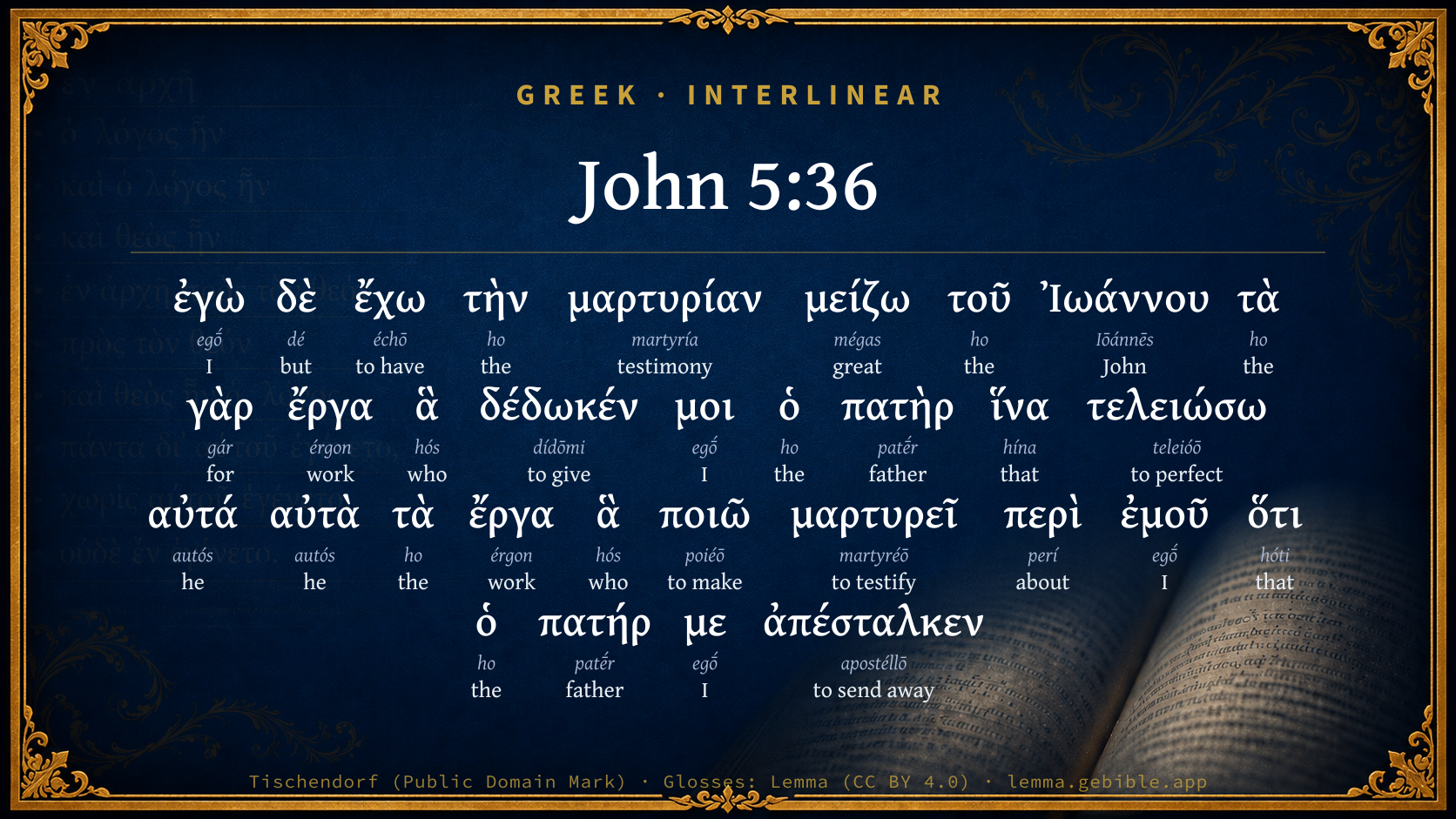
  1. ἐγὼ egṓ G1473 “I” Personal pronoun, 1st person, Nominative, Singular
  2. δὲ dé G1161 “but” Conjunction
  3. ἔχω échō G2192 “to have” Verb, Present, Active, Indicative, 1st person, Singular
  4. τὴν ho G3588 “the” Article, Accusative, Singular, Feminine
  5. μαρτυρίαν martyría G3141 “testimony” Noun, Accusative, Singular, Feminine
  6. μείζω mégas G3173 “great” Adjective, Accusative, Singular, Feminine, Comparative
  7. τοῦ ho G3588 “the” Article, Genitive, Singular, Masculine
  8. Ἰωάννου Iōánnēs G2491 “John” Noun, Genitive, Singular, Masculine
  9. τὰ ho G3588 “the” Article, Nominative, Plural, Neuter
  10. γὰρ gár G1063 “for” Conjunction
  11. ἔργα érgon G2041 “work” Noun, Nominative, Plural, Neuter
  12. ἃ hós G3739 “who” Relative pronoun, Accusative, Plural, Neuter
  13. δέδωκέν dídōmi G1325 “to give” Verb, Perfect, Active, Indicative, 3rd person, Singular
  14. μοι egṓ G1473 “I” Personal pronoun, 1st person, Dative, Singular
  15. ὁ ho G3588 “the” Article, Nominative, Singular, Masculine
  16. πατὴρ patḗr G3962 “father” Noun, Nominative, Singular, Masculine
  17. ἵνα hína G2443 “that” Conjunction
  18. αὐτά autós G846 “he” Personal pronoun, Accusative, Plural, Neuter
  19. αὐτὰ autós G846 “he” Personal pronoun, Nominative, Plural, Neuter
  20. τὰ ho G3588 “the” Article, Nominative, Plural, Neuter
  21. ἔργα érgon G2041 “work” Noun, Nominative, Plural, Neuter
  22. ἃ hós G3739 “who” Relative pronoun, Accusative, Plural, Neuter
  23. ποιῶ poiéō G4160 “to make” Verb, Present, Active, Indicative, 1st person, Singular
  24. μαρτυρεῖ martyréō G3140 “to testify” Verb, Present, Active, Indicative, 3rd person, Singular
  25. περὶ perí G4012 “about” Preposition
  26. ἐμοῦ egṓ G1473 “I” Personal pronoun, 1st person, Genitive, Singular
  27. ὅτι hóti G3754 “that” Conjunction
  28. ὁ ho G3588 “the” Article, Nominative, Singular, Masculine
  29. πατήρ patḗr G3962 “father” Noun, Nominative, Singular, Masculine
  30. με egṓ G1473 “I” Personal pronoun, 1st person, Accusative, Singular
  31. ἀπέσταλκεν apostéllō G649 “to send away” Verb, Perfect, Active, Indicative, 3rd person, Singular

About this verse

These counts appear in no published source. They are computed here, from the morphology-tagged text and Lemma’s own curated glosses. What Lemma adds →

32
words
20
distinct lemmas
Gospels
section

Notable vocabulary

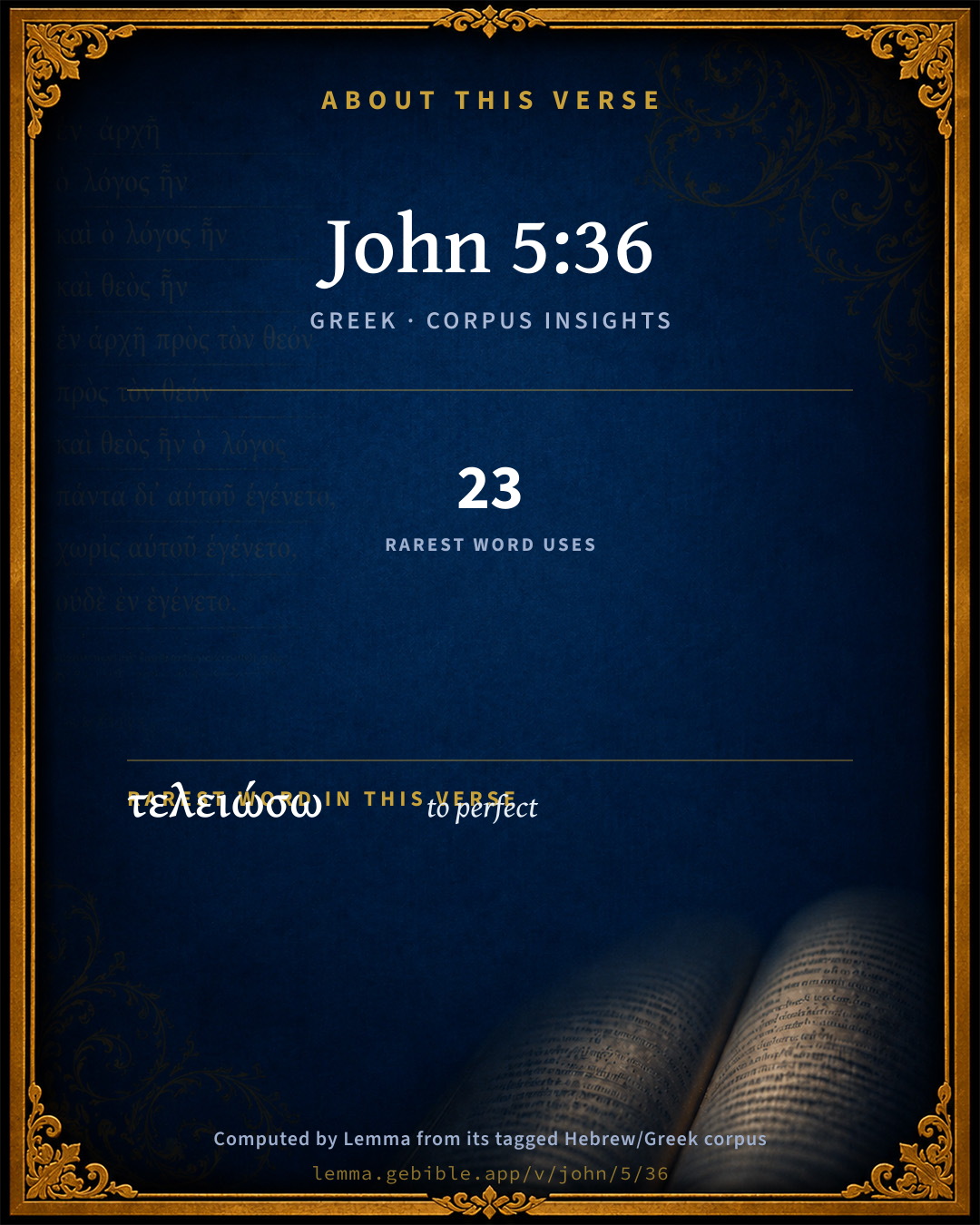
The rarest word here is τελειώσω to perfect G5048 — appearing just 23 times in the whole Greek New Testament.

Shared distinctive vocabulary

τελειώσω to perfect G5048 occurs in 23 verses of the Greek New Testament. Also found in:

Repetition

Words recur within this verse:

Cross-references

16

Topical passages linked to John 5:36 in the Treasury of Scripture Knowledge — connected by theme and wording, ordered by reader-vote popularity; previews shown in the World English Bible.

  • John 10:25 Jesus answered them, "I told you, and you don't believe. The works that I do in my Father's name, these testify about me.
  • John 2:23 Now when he was in Jerusalem at the Passover, during the feast, many believed in his name, observing his signs which he did.
  • John 10:37–38 If I don't do the works of my Father, don't believe me.
  • John 15:24 If I hadn't done among them the works which no one else did, they wouldn't have had sin. But now have they seen and also hated both me and my Father.
  • John 9:30–33 The man answered them, "How amazing! You don't know where he comes from, yet he opened my eyes.
  • 1 John 5:9 If we receive the witness of men, the witness of God is greater; for this is God's testimony which he has testified concerning his Son.
  • John 3:2 The same came to him by night, and said to him, "Rabbi, we know that you are a teacher come from God, for no one can do these signs that you do, unless God is with him."
  • Matthew 11:4 Jesus answered them, "Go and tell John the things which you hear and see:
  • John 3:17 For God didn't send his Son into the world to judge the world, but that the world should be saved through him.
  • John 14:10–11 Don't you believe that I am in the Father, and the Father in me? The words that I tell you, I speak not from myself; but the Father who lives in me does his works.
  • Acts 2:22 "Men of Israel, hear these words! Jesus of Nazareth, a man approved by God to you by mighty works and wonders and signs which God did by him in the midst of you, even as you yourselves know,
  • 1 John 5:11–12 The testimony is this, that God gave to us eternal life, and this life is in his Son.
  • John 4:34 Jesus said to them, "My food is to do the will of him who sent me, and to accomplish his work.
  • John 5:32 It is another who testifies about me. I know that the testimony which he testifies about me is true.
  • John 11:37 Some of them said, "Couldn't this man, who opened the eyes of him who was blind, have also kept this man from dying?"
  • John 17:4 I glorified you on the earth. I have accomplished the work which you have given me to do.

Cross-references courtesy of OpenBible.info (CC BY 4.0).

Commentary

Notes on John 5:36 from classic Christian and Jewish commentators (each source and its license shown beneath its notes). The classic Christian expositions comment on the surrounding passage and are grouped to its opening verse, so a note may address several verses; the Jewish commentaries on the Tanakh (Rashi and others) are per-verse, so they appear only where the commentator wrote on this verse.

Lemma curates 59 commentaries, every one of them public domain or Creative Commons licensed, each selected and text-cleaned for this edition rather than reprinted as found. About our sources →

Joseph Benson's Commentary

Joh 5:36-38. But I have greater witness than that of John — The testimony of one who has infinitely greater authority and power than he; for the works which the Father hath given me to finish — The miracles which he hath commissioned me to perform; bear witness of me — In a manner most convincing to every unprejudiced mind; that the Father hath sent me — As his Ambassador to men, with full authority to reveal his will. And the Father himself hath borne witness of me — And that in the most public manner, namely, at my baptism. Ye have neither heard his voice, &c. — As if he had said, I speak not of my supposed father, Joseph. Ye are utter strangers to him of whom I speak. Or, You show yourselves to be as ignorant of him as men are of a person they never either saw or heard. Bishop Pearce considers the clause as a parenthesis, and thinks the sense, in connection with what precedes and follows, is, “Not that my Father ever appeared visibly, or spake audibly to any of you; but he did it by the mouths of his prophets.” To their testimony, however, he had lately added his own voice from heaven. But the sense in which Dr. Whitby takes the words, seems to connect them more naturally with the preceding verse: thus, “Nor are you to expect that the Father should testify of me otherwise than by his works, for that which was granted to your fathers belongs not to you, namely, to see his glory and hear his voice out of the midst of the fire. And have not his word abiding in you — You do not show a due regard even to those sacred oracles, which you acknowledge to be divine; either you do not cordially believe them, or they have not that influence upon your spirit and conduct which, in all reason, they ought to have.” The scriptures of the Old Testament, if they had understood, believed, and laid them to heart as they ought to have done, would, doubtless, have disposed them to receive Christ. But this revelation of the divine will was not in them. It was among them, in their country, in their hands, but not in their hearts; they beheld it with their eyes, and it sounded in their ears; but it did not rule in their souls. But how did it appear that they had not the word of God abiding in them? it appeared by their not believing and receiving him whom God had sent. There was so much said in the Old Testament concerning Christ, to direct people when and where to look for him, and so to facilitate the discovery of him, that if they had duly considered those things, they could not have avoided the conviction that Jesus was the Christ, and that he was sent of God; so that their not believing in him, and receiving his doctrine, was a certain sign that the word of God did not abide in them. Observe, reader, 1st, The indwelling of the Word and Spirit, or grace of God in us, is best tried and known by the effects which it produces: particularly by our receiving whom and what he sends, the messengers, the commands, the threatenings, the promises, the providences, which he sends; and especially Christ whom he has sent. 2d, If his word abide in us, if we converse with it by frequent meditation, consult it upon every occasion, and conform to it in our conversation, we shall then readily receive the testimony of the Father concerning Christ, and therefore shall believe in and receive him in all the characters and offices which he sustains, and in which he is offered to us in the gospel.

Joseph Benson's Commentary on the Old and New Testaments (1811–1818) — public domain. Text from a community e-Sword module.

Tyndale Open Study Notes

Tyndale Open Resources

5:36 Jesus’ third witness, his teachings and miracles, were signs that unveiled his true identity and pointed to the Father who sent him.

Tyndale Open Study Notes — © Tyndale Open Resources, licensed CC BY-SA 4.0. Text via the HelloAO Bible API.

Bengel's Gnomon

Johann Albrecht Bengel

Joh 5:36. Μείζω τοῦ Ἰωάννου) Greater, than that witness, which John gave me. The lamp does not lend light to the sun, when once he has arisen.—τελειώσω, that I should finish) that I should do, even to the τέλος, end.—αὐτὰ τὰ ἔργα, these very works) A suitable and emphatic repetition.

Bengel's Gnomon of the New Testament — English translation (T&T Clark, Edinburgh, 1860) — public domain. Text from a community e-Sword module.

Meyer's Critical & Exegetical Commentary

Heinrich August Wilhelm Meyer

Joh_5:36. Ἐγὼ δὲ] Formal antithesis to ὑμεῖς in Joh_5:35, and referring back to the ἐγὼ δὲ of Joh_5:34.

I have the witness which is greater (not the greater witness; see kühner, II. § 493. 1) than John, τοῦ Ἰωάννου in the sense of τῆς τοῦ Ἰωάν., according to a well-known comparatio compendiaria.[220] See on Mat_5:20. On μείζω, i.e. of weightier evidence, comp. Isoc. Archid. § John 32: μαρτυρίαν μείζω καὶ σαφεστέραν.

τὰ ἔργα] not simply the miracles strictly so called, but the Messianic works generally, the several acts of the Messiahs entire work, the ἔργον of Jesus (Joh_4:34, Joh_17:4). Ἔργα are always deeds, not word and teachings (word and work are distinct conceptions, not only in Scripture, but elsewhere likewise; see Lobeck, Paralip. pp. 64, 65; Ellendt, Lex. Soph. I. p. 672; Pflugk, adEur. Hec. 373); but what the word of Jesus effected, spiritual quickening (Joh_5:20), separation, enlightenment, and so on, and in like manner the resurrection of the dead and judgment (Joh_5:28-29), are included in the ἔργα, and constitute His ἔργον as a whole. When miracles properly so called are designated by the more general term ἔργα, it is indicated in the context, as in Joh_3:2, Joh_7:3; Joh_7:21, and often.

ἔδωκε] hath given, expressing the divine appointment, and bestowment of power. Comp. Homer, Il. ε. 428: οὔ τοι, τέκνον ἐμόν, δέδοται πολεμήϊα ἔργα. Comp. v. 727.

ἵνα τελ. αὐτὰ] Intention of the Father in committing to Him the works: He was to accomplish them (comp. Joh_4:34, Joh_17:4), not to leave them undone or only partially accomplished, but fully to carry out the entire task which the works divinely entrusted to Him involved for the attainment of the goal of Messianic salvation.

αὐτὰ τὰ ἔργα] those very works, emphatic repetition (Kühner, II. § 632), where, moreover, the homoeoteleuton (the recurrence of the ὰ five times running) must not be regarded as a dissonance (Lobeck, Paralip. p. 53).

ἃ ἐγὼ ποιῶ] ἐγώ with august self-consciousness. As to how they witness, see Joh_14:11.

[220] The reading adopted by Lachmann, μείζων (A. B. F. G. M. Δ., Cursives), is nothing else than an error of transcription.

Meyer — Critical and Exegetical Commentary on the New Testament — English translation by Peter Christie, edited by Frederick Crombie (T&T Clark, 1880) — public domain. Text from a community e-Sword module.

Expositor's Greek Testament

ed. W. Robertson Nicoll

Joh 5:36 . ἐγὼ δὲ “But I” in contrast to the ὑμεῖς of Joh 5:33 , ἔχω τὴν μαρτυρίαν μείζω , “have the witness which is greater,” i.e. , of greater weight as evidence than that of John. τὰ γὰρ ἔργα … ἀπέσταλκε , “the works which the Father ἔδωκε [or as modern editors read δέδωκεν ] to Him” comprise all that He was commissioned to do, but with a more special reference to His miracles. Lücke well says, “He who looked at the miracles as separate and individual displays of supernatural power and did not view the entire manifestation of Christ in its solidarity, was bound to find the miracles without significance and the latter incomprehensible”. The ἔργα are cited as evidence, chaps. Joh 10:25 ; Joh 10:38 , and Joh 14:11 ; evidence as here to the fact that the Father had sent Him.

The Expositor's Greek Testament, edited by W. Robertson Nicoll (1897–1910) — public domain. Text from a community e-Sword module.

Jamieson, Fausset & Brown

Robert Jamieson, A. R. Fausset & David Brown

I have greater witness--rather, "The witness which I have is greater."

the works . . . bear witness of me--not simply as miracles nor even as a miracle of mercy, but these miracles, as He did them, with a will and a power, a majesty and a grace manifestly His own.

Jamieson, Fausset & Brown — Commentary Critical and Explanatory on the Whole Bible (1871) — public domain (CC PDM 1.0). Text via the HelloAO Bible API.

Adam Clarke's Commentary

Verse 36. But I have greater witness] However decisive the judgment of such a man as John may be, who was the lamp of Israel, a miracle of grace, filled with the spirit of Elijah, and more than any prophet, because he pointed out, not the Messiah who was to come, but the Messiah who was already come: nevertheless, I am not obliged to depend on his testimony alone; for I have a greater one, that of Him whom you acknowledge to be your God. And how do I prove that this God bears testimony to me? By my works: these miracles, which attest my mission, and prove by themselves that nothing less than unlimited power and boundless love could ever produce them. By my word only, I have perfectly and instantly healed a man who was diseased thirty and eight years. Ye see the miracle-the man is before you whole and sound. Why then do ye not believe in my mission, that ye may embrace my doctrine, and be saved?

Adam Clarke's Commentary on the Bible (1810–1826) — public domain. Text from a community e-Sword/MySword module.

John Calvin's Commentaries

36. But I have greater testimony than that of John. After having showed that, in the person of John, the Jews had wickedly corrupted the gift of God, he now repeats a second time what he had said, that he has no need of the testimony of man, as if he had not enough of himself; although, perceiving that they held his person in contempt, he sent them to his Father, according to his custom.

For the works which the Father hath given me to do. He holds out to view two things, by which he was proved to be the Son of God. “My Father,” says he, “attests by miracles that I am his Son; and before I came into the world, he gave abundant testimony to me in the sacred writings.” Let us always remember what object he has in view. He wishes to be recognized as the Messiah promised by God, that he may be heard, and, therefore, he maintains that he is now manifested to be such a person as Scripture describes him. It may be asked, Are miracles sufficient to prove this; for similar miracles had been already performed by the Prophets? I reply, those miracles which God performed by the agency of the Prophets did not go beyond the purpose for which they were intended, namely, to show that they were the ministers of God, because they could in no other way obtain the authority due to their office. But God intended to exalt his Son more highly, and this purpose of God ought to be regarded by us as the design of miracles. Therefore, if the Jews had not been prejudiced by malice and voluntarily shut their eyes, Christ might easily have proved to them by his miracles who and what he was.

John Calvin's Commentaries (1540-1563) — public domain. Text from the Calvin Translation Society English edition (1840s-50s) via the Christian Classics Ethereal Library (ccel.org). Calvin's coverage is partial (roughly two-thirds of the Bible); uncommented books and verses are honest gaps, never fabricated. The 19th-century editor's footnotes and remarks are omitted so the notes are faithfully Calvin's own voice.

Ellicott's Commentary for English Readers

(36) For “hath given Me” read, with the better MSS., gave Me. The pronouns in “But I have” and in “that I do,” are emphatic.

In this verse He returns to the thought of Joh_5:32. The parenthesis in Joh_5:33-35 show that John was not the other there spoken of, and this verse shows that the special form of witness which He referred to was that of the works, which works He was then doing, and the voice of which they ought to have heard.

These “works” are not confined to what we speak of as miracles, but include the several parts of His Messianic work, which it was His food to finish (Joh_4:34), and which He speaks of as finished (Joh_17:4; see Note there). There is a special reference here to the power to quicken and authority to judge, in Joh_5:21-22.

A Bible Commentary for English Readers, edited by Charles John Ellicott (1878–1897) — public domain. Text from a community e-Sword module.

The Cambridge Bible for Schools and Colleges

gen. ed. J. J. S. Perowne

36. I have greater witness than that of John] Better, I have the witness which is greater than John; or, the witness which I have is greater than John, viz. the works which as the Messiah I have been commissioned to do. Among these works would be raising the spiritually dead to life, judging unbelievers, as well as miracles: certainly not miracles only; Joh_4:48, Joh_10:38.

to finish] Literally, in order that I may accomplish; comp. Joh_17:4. This was God’s purpose. See on Joh_4:34; Joh_4:47, Joh_9:3. S. John is very fond of the construction ‘in order that,’ especially of the Divine purpose.

36–40. The Father’s testimony is evident, (a) in the works assigned to Me, (b) in the revelation which ye do not receive.

The Cambridge Bible for Schools and Colleges (gen. ed. J. J. S. Perowne; Cambridge University Press, 1878–1918) — public domain. Text from a community e-Sword module.

John Gill's Exposition

But I have greater witness than that of John,.... The Vulgate Latin, and Ethiopic versions read, "greater than John", but wrongly; for the testimonies of Christ's works, and of his Father, are not compared with John himself, but with his testimony; and the sense is, that Christ had a greater witness than the witness of John; and so it is expressed in the Persic version: and his meaning is, that he had no need to insist upon John's testimony; he had other, and greater witnesses to produce:

for the works which the Father hath given me to finish; such as the preaching of the Gospel, the fulfilling of the law, and the redemption of his people; all which were appointed by his Father, and given him to do, and which he completely finished. The whole Gospel came, and was published by Jesus Christ, and the law was entirely fulfilled by him; and the work of man's salvation was finished by him, and these bear witness to the truth of his deity, and divine sonship; for none but the Son of God could have done these things. The Ethiopic version reads in the singular number, "this work which my Father hath given me", &c. and if it was a single work that is referred to, the work of redemption bids fair to be it. But, these works include not only what Christ did on earth, in his state of humiliation, but what he has done since, and will do; which his Father has given him to finish, and he has finished, or will finish them; such as the resurrection of himself from the dead, the effusion of the gifts and graces of the Spirit, the spreading and succeeding his Gospel in the world, the conversion of his redeemed ones, the gathering in the fulness of the Gentiles, and the conversion of the Jews, the destruction of antichrist, the resurrection of all the dead, and the judgment of the whole world. Though more especially his miracles are here intended, and which, and not his mediatorial works, were demonstrations and proofs to men of his divine sonship; see Mat 14:33;

the same works that I do, bear witness of me, that the Father hath sent me; and that he was in the Father, and the Father in him; or that they were one in nature, and equal in power and glory, Joh 10:30.

John Gill's Exposition of the Whole Bible (1746–1763) — public domain (CC PDM 1.0). Text via the HelloAO Bible API.

Trapp's Complete Commentary

John Trapp

36 But I have greater witness than that of John: for the works which the Father hath given me to finish, the same works that I do, bear witness of me, that the Father hath sent me.

Ver. 36. The works which the Father hath given me] Lo, Christ accounts his work a gift. So Joh 17:4.

The works that I do, bear witness] Let our works likewise speak for us, Mat 5:16, as they did for the primitive Christians; of whom Athenagoras (their ambassador to the emperor) boldly saith, Ουδεις χριστιανος πονηρος ει μη υποκρινηται τον λογον. No Christian is evil mannered unless it be such as dissemble themselves to be Christians. And Justin Martyr confesseth of himself, that beholding the piety of Christians’ life and constancy in death, he gathered that it was the true religion that they professed. Non aliunde noscibiles quam de emendatione vitiorum, saith Tertullian of the Christians of his time. And Chrysostom speaketh of some in his days, whose lives were angelic, they so walked up to their principles.

John Trapp, A Commentary or Exposition upon All the Books of the Old and New Testament (1647–1656) — public domain. Text from a community e-Sword module.

Albert Barnes' Notes on the Bible

Greater witness - Stronger, more decisive evidence.

The works - The miracles - healing the sick and raising the dead.

Hath given me - Hath committed to me, or appointed me to do. Certain things he intrusted in his hands to accomplish.

To finish - To do or to perform until the task is completed. The word is applied to the “termination” of anything, as we say a task is “ended” or a work is completed. So Jesus said, when he expired, It is “finished” Joh 19:30. From this it appears that Jesus came to “accomplish” a certain work; and hence we see the reason why he so often guarded his life and sought his safety until the task was fully completed. These works or miracles bore witness of him; that is, they showed that he was sent from God, because none but God could perform them, and because God would not give such power to any whose life and doctrines he did not approve. They were more decisive proof than the testimony of John, because:

John worked no miracles, Joh 10:41. It was possible that a man might be deceived or be an impostor. It was not possible for God to deceive. The miracles which Jesus performed were such as no human being could work, and no angel. He that could raise the dead must have all power, and he who commissioned Jesus, therefore, must be God.

Albert Barnes' Notes on the Bible (1834–1885) — public domain. Text from a community e-Sword/MySword module.

Matthew Poole's English Annotations

But I have greater witness than that of John; not than that of my Father, mentioned Joh 5:31,32, but

than that of John, last mentioned; nor doth he say a truer, but a greater witness. The works which the Father hath given me to finish; the works which his Father sent him to do, his fulfilling of the law, his publication of the gospel, the miracles which he wrought, were all of them works which his Father had given him to finish. Christ often appeals to the works which he had done, as sufficiently testifying of him, Joh 10:25,37,38; 14:10,11; 15:24. And it is plain, that the people looked upon them as a great testimony, Joh 3:2; 9:32,33. The Jews avoided the force of this testimony impudently, some of them saying that he did them by the help of the devil, Mat 12:24; others pretending (more lately) that the Messiah was to work no miracles; but that is expressly contrary to what we have, Joh 7:31, and is doubtless a device of later years. But it is a greater question, how the miracles of Christ

bear witness of him; and whether they were only a probable, or a certain and infallible, testimony of his Deity. Those that think them an infallible testimony, say:

1. That he did works which none else did, Joh 15:24.

2. That he did them by his own power; There went virtue out of him, and healed them all, Luk 6:19.

3. That they were done in confirmation of the doctrine to that purpose which he preached, which God would not have confirmed by miracles, had not he been sent of God to work such things.

Those that think they were not a certain and infallible testimony, say,

1. That the prophets and apostles also wrought miracles.

2. That our Saviour tells his apostles, they should do greater works than he had done.

3. That the doing of them from his own power, was a thing could not be known to others; so could be no testimony to them.

But our Saviour did not only himself raise the dead, cast out devils, and work other miracles; but he gave others also a power to do it; which argued an original power in himself; and is more than we read of any prophets or apostles; who, though they wrought such miraculous operations, yet having not that power originally in and from themselves, could not communicate it to others.

Matthew Poole's English Annotations on the Holy Bible (1683–1685) — public domain. Text from a community e-Sword/MySword module.

Whedon's Commentary on the Bible

Daniel D. Whedon

36. Greater witness—John’s testimony was indeed divine; it furnished a strong personal argument from their own past concessions; but it was only preparatory and subordinate.

Works… I do—These were higher, closer, and more conclusive than John’s announcements.

Father hath given me— This working testimony is God’s testimony given to him.

The same works—Miracles are, in their place, not only a demonstration of Christ, but they were held by himself to be such a demonstration. If Christ performed supernatural works, he uttered supernatural truth, and his religion is true.

Daniel D. Whedon (gen. ed.), Commentary on the Old and New Testaments (1874–1909) — public domain. Text from a community e-Sword module.

The Pulpit Commentary

(g) The witness of the works. But the witness which I have is greater than that of John. The testimony of John was memorable and uoteworthy in many respects. If the people had accepted it, they would have admitted the Divine authority of One who was "mightier" than John. The synoptic Gospels show that Jesus made a similar appeal to the conscience of his critics on a later occasion. (Mat_21:25, and parallels) Though John"s baptism was "from heaven," and though John"s testimony was "great," yet that which accompanied the ministry of Jesus was "greater" still. The words of John were not merely John"s words, or they would have been valueless. Moreover, "the testimony that I have" is in itself convincing; it has a Divine, self-evidencing force, which, added to my word, confirms and establishes my claim. The proof or illustration of this is as follows: For the works which the Father hath given me that I should bring them to completion, the very works, which I am doing, bear witness concerning me, that the Father hath sent me. The works of Christ are his normal activities the deeds which express the nature and compass of his will, and indicate the qualities of his Person. They would be terata and yaumata , should any other perform such things or live on such a platform of exalted activity. They are his "works." This term is often used for the special manifestations of his alliance with the supernatural, Divine realm. (Joh 7:3Jn_1:9:3Jn_1:10:25, Joh_10:32, etc.; Joh_14:10:15:24) They are in their fulness and summation the ergon of the Lord. (Joh_4:34 Joh_17:4) They are, moreover, "given" to him to "do" or to "finish." This idea is frequently expressed. "All things are given into his, (Joh_3:35) all judgment is given him to execute. (Joh_5:22, Joh_5:27) The Father hath given him self-existence. (ver. 26; cf. Joh_17:2, Joh_17:6, Joh_17:9, Joh_17:12, 24 18:9) It is impossible to dissociate these "works "from those great miracles which ought to command assent to his claims, even if, alas! his bare words are not sufficiently convincing. John"s Gospel makes numerous references to these proofs of the Divine commission, these illustrations as well as evidences of his right to speak. But the "works" are not limited to the miraculous healings, to multiplication of breed and wine, and resurrection from the dead. The whole of his work, from his baptism and temptation to his own resurrection from the dead, was his ergon . This was made up of all the self-revelation of his life, of all his consecration and sympathy, of all his character, of all the resuscitation of dead souls, of all the joy he was pouring into broken hearts, and all the life he was evoking in moribund humanity. "These works that I am doing bear witness concerning me, that the Father hath sent me." They are of such a character that he confidently declares about them that they proclaim his Divine commission. The entire work, reaching special expression in certain typical acts and deeds, was greater than the verbal testimony which John bare to his mission. All that John said was true, but Christ"s "works" prove it.

The witness bearing works of Jesus.

I THOSE TO WHOM THE TESTIMONY WAS OFFERED. Jesus had done two things which exceedingly shocked and horrified the Jews of Jerusalem. On the sabbath day he had healed an impotent man, and told him to take up his bed and walk. He had also said that God was his Father, making himself equal with God. The words, the deeds, and the appearance of Jesus seemed contradictory to those who would not wait to look under the surface, but judged everything by their own traditions and prejudices. And when Jesus was confronted by all this prejudice and narrow-mindedness, all he could do was to go on with his work and his witness bearing. Not for himself he needed to fear anything, but he did fear for those who were blind to his claims. The hearts of men had got so hardened and their minds so twisted, that the true was reckoned to be the false, and the right to be the wrong. It did no harm to Jesus that he should be called sabbath breaker and blasphemer, but; it did great harm to those falsely calling him so. Hence he tries, quietly and patiently, to get them to examine into the evidence for his claims. Jesus never wanted people to take his bare word. He knew that false Christs would go out into the world, and therefore he would furnish ample and comforting evidence that he was the true Christ. Somehow or other, there were immense difficulties in the way of people receiving Jesus as the Christ of God. But they were not difficulties that Jesus made. Jesus is on our side against the difficulties. The works of Jesus, going on from day to day, gradually mounted up to a body of testimony, on which the faith of a sincere heart could build as on a foundation of rock.

II THE WITNESS BEARING WORKS. John was a witness, but Jesus had greater witness than that of John. Jesus did not speak in any way depreciatory of John. The best of men may not be the best of witnesses. John told people where to look. He fixed their attention on Jesus, and they were then to watch what Jesus would do. From our own observation of Jesus we know far more than ever John could have told. us. The deeds of Jesus speak with unsurpassed power and tenderness to those who are disposed to listen. There they lie in their simple beauty and depth of suggestion, waiting till we look at them and search into them and put them together, investigating to their very depths, so that whatever witness bearing power is in them may be brought out to the full. What men say about Jesus is all very well in its way, but what we can see Jesus himself doing is far better. He means that we should, as it were, see him with our own eyes.

III OUR RESPONSIBILITY BEFORE THIS WITNESS BEARING. We may neglect to examine into these witnesses, but that does not prove them unworthy of our closest study. Jesus knows his own. What you are disinclined to look at just now, you may be eager to search into by and by. Thousands pooh the reality and possibility of the works of Jesus, measuring the possible and the impossible by their little experience. Supposing what happened to Martha and Mary happened to them, and one of their dearest was raised from the dead, where would their incredulity be then? Those Jews who so savagely charged Jesus with breaking the sabbath must surely have been men whose own persons and dearest friends had been untouched by suffering. We are responsible, too, for examining into all the works of Jesus works in the spiritual sphere as much as in the natural; works like the conversion of Saul of Tarsus as much as the resurrection of Lazarus. It is indeed a great responsibility to be face to face with the testimonies from more than eighteen centuries of Pentecostal power. Y.

The Pulpit Commentary (1880–1919), ed. H.D.M. Spence-Jones & Joseph S. Exell — public domain. Text from a community e-Sword module.

Kretzmann's Popular Commentary

Paul E. Kretzmann

The witness of the Father:

v. 36. But I have greater witness than that of John; for the works which the Father hath given Me to finish, the same works that I do bear witness of Me that the Father hath sent Me.

v. 37. And the Father Himself which hath sent Me hath borne witness of Me. Ye have neither heard His voice at any time nor seen His shape.

v. 38. And ye have not His Word abiding in you; for whom He hath sent, Him ye believe not.

The testimony of John was valuable for their sakes only; Jesus did not need the witness of men. He could appeal to testimony greater than John’s. For all the works which He was performing had been given Him by the Father to carry out in just that way; all the miracles of Jesus served a definite purpose. Through them God Himself bore witness to Him that He was the Son of God. If He had been a deceiver and cheat, God would not have given Him the power to perform such wonderful deeds. No one that saw His miracles and judged them with an unbiased, open mind, could deny His divine mission. All His works were evidence of greater weight than John’s. The entire appearance of Jesus and the manifestation of His glory called out loudly in testimony of His divine mission. And in addition to this testimony, undeniable, unassailable, there was the witness of the Father’s voice, through the writings of the prophets. God did not appear to the Jews in a visible manifestation; they did not hear His voice, they did not see His form. And yet, there was the evidence contained in the Word of the Old Testament, so clear and unmistakable that there could be no doubt as to its correctness. In spite of all that, however, His Word had found no abiding place in their hearts; they did not accept the testimony of God Himself. For the reception accorded to the delegate of God, to the Son of God Himself, is a proof of the fact that the Word of God does not abide in them. If they actually believed God in the witnesses of the Old Testament, as they professed to, they would receive His great Minister, the Prophet to whom Moses pointed. It is the essence of unbelief that people refuse the Word of God an abiding place in their heart, that they simulate religion in their lives, but have no true religion in their hearts.

Paul E. Kretzmann, Popular Commentary of the Bible (1921–1924) — public domain. Text from a community e-Sword module.

Burkitt's Expository Notes on the New Testament

William Burkitt

The third testimony produced by Christ, to evidence and prove himself to be the promised Messias, and Saviour of the world, tis that of his miracles; which, by an omnipotent power, as God, he was enabled to work. Christ’s miracles were speaking testimonies of his unity with the Father, and of the divinity of his person. Not so the miracles of his apostles; for he wrought his miracles in his own name, and by his own power and authority: but the apostles expressly declared the contrary, Why look ye stedfastly on us, as if we by our own power had made this man whole? His name, through faith in his name, hath made this man strong. Act 3:12; Act 3:16

Learn hence, That the testimony of Christ’s own works, his miracles wrought in his own name, and by his own authority and power, is a clearer confirmation of his godhead, office, and doctrine, than the best of men’s testimonies; yea, than John Baptist’s own testimony, That he saw the Spirit descending on him.

William Burkitt's Expository Notes on the New Testament (1700–1703) — public domain. Text from a community e-Sword module.

The People's New Testament

B. W. Johnson

36–38. I have greater witness. His works given of the Father, the Father's voice at baptism, and the Scriptures, which are the Father's word.

Have not his word abiding in you. If they had they would believe upon him of whom that word did speak.

B. W. Johnson's The People's New Testament with Notes (1889–1891) — public domain. Electronic text from the Christian Classics Ethereal Library (CCEL) ThML edition.

unfoldingWord translationNotes

Door43 World Missions Community

the works that the Father has given me to accomplish ... that the Father has sent me

God the Father has sent God the Son, Jesus, to earth. Jesus completes what the Father gives him to do.

The Father who sent me has himself testified

The reflexive pronoun "himself" emphasizes that it is the Father, not someone less important, who has testified. (See: Reflexive Pronouns)

Father

This is an important title for God. (See: Translating Son and Father)

the very works that I do, testify about me

Here Jesus says that the miracles "testify" or "tell the people" about him. AT: "What I do shows the people that God has sent me" (See: Personification)

You do not have his word remaining in you, for you are not believing in the one whom he has sent

"You do not believe in the one he has sent. That is how I know that you do not have his word remaining in you"

You do not have his word remaining in you

Jesus speaks of people living according to God's word as if they were houses and God's word were a person that lived in houses. AT: "You do not live according to his word" or "You do not obey his word"

his word

"the message he spoke to you"

translationWords

testimony

God the Father

voice

word

believe

unfoldingWord translationNotes — © Distant Shores Media and the Door43 World Missions Community, licensed CC BY-SA 4.0. Source: git.door43.org/Door43/en_tn.

Cambridge Greek Testament for Schools and Colleges

36–40. The Father’s testimony is evident, (a) in the works assigned to Me, (b) in the revelation which ye do not receive.

36. μείζων (ABEGMA) is to be preferred to μείζω (א), δέδωκεν (אBL) to ἔδωκε (AD), which has been influenced by Joh 5:26-27.

36. ἐγὼ δὲ ἔχω. I have the witness which is greater than John; or, the witness which I have is greater than John, viz. the works (see on Joh 5:20) which as the Messiah I have been commissioned to do. Among these works would be raising the spiritually dead to life, judging unbelievers, as well as miracles: certainly not miracles only; Joh 7:3, Joh 10:38. See on Joh 3:35.

ἵνα τελ. Literally, in order that I may accomplish; comp. Joh 17:4. This was God’s purpose. See on Joh 4:34; Joh 4:47, Joh 9:3. S. John is very fond of constructions with ἵνα, especially of the Divine purpose.

Cambridge Greek Testament for Schools and Colleges (Cambridge University Press, 1896; 21 vols, various authors incl. Carr, Maclear, Plummer, Farrar, Lumby, Moule, M. R. James, Simcox) — public domain. Text from a community e-Sword module.

Alford’s Greek Testament

Henry Alford

36. ἔχω τὴν μ. μείζων] Literally, I have my witness greater (μείζων being probably a solœcism like πλήρης in ch. 1:14, a nominative in concord with an accusative).… του Ἰωάννου, not [perhaps], ‘than that of John;’—but, than John himself. John was a testimony.

τὰ γὰρ ἔργα, not His miracles alone, although those principally; but the whole of His life and course of action, full as it was of holiness, in which, and as forming harmonious parts of which, His miracles were testimonies of His divine mission. His greatest work (ch. 6:29) was the awakening of faith, the ζωοποιεῖν of which we have heard before, to which the miracles were but as means to an end.

ἃ δέδωκεν.… ἵνα τελ.] See ch. 17:4 and note.

αὐτὰ τὰ ἔργα ἃ ποιῶ] The repetition is to shew that His life and working was an exact fulfilment of the Father’s will. The works which the Father hath given Me to do, those very works which I am doing, …

Henry Alford, The Greek Testament (1849–1861) — public domain. Text from a community e-Sword module.

International Critical Commentary

36. But Jesus does not rest His claims on the witness of the Baptist (cf. v. 34). ἐγὼ δὲ ἔχω τὴν μαρτυρίαν μείζω (this is the true reading, μείζων of ABW being due to misunderstanding) τοῦ Ἰωάνου, “but I (ἐγώ being emphatic) have witness greater than that of John”; cf. vv. 32, 37, 1Jn 5:9. The works which He did were witness that His mission was from God.

For this conception of the ἔργα of Jesus as His “witness,” see 10:25; and cf. Mat 11:4, Luk 7:22, where He bade John’s disciples report His works of healing to their master as sufficient proof of His Messiahship. Faith which is generated by the witness of such “works” is not faith in its highest form (cf. 10:38, 14:11; and see 2:23), but to reject their witness is sinful (15:24). Cf. also 3:2.

For the ἔργα of the Son, see on v. 20 above. They are described here as “the works which the Father has given me (see on 3:35) to accomplish.” And at 17:4 Jesus is represented as claiming that He had accomplished them, the words used being almost the same as in this verse, τὸ ἔργον τελειώσας ὂ δέδωκάς μοι ἵνα ποιήσω.

For δέδωκεν (אBLΓNW) the rec. with ADΔΘ has ἔδωκεν.

With ἵνα τελειώσω cf. 4:34.

αὐτὰ τὰ ἔργα ἃ ποιῶ μαρτυρεῖ περὶ ἐμοῦ. The repetition of αὐτὰ τὰ ἔργα is conversational. Cf., for similar words, 10:25, 14:11. The thing which is established by these ἔργα is that Jesus had been “sent” by the Father, ὅτι ὁ πατήρ με ἀπέσταλκεν. This is His claim throughout. See on 3:17 for this conception both in Jn. and in the Synoptists; and cf. 11:42.

International Critical Commentary — older volumes (1896–1929), various authors — public domain. Text from a community e-Sword module.

Vincent's Word Studies in the New Testament

Marvin R. Vincent

Greater witness [την μαρτυριαν μειζω] . The article, omitted in A. V., has the force of my, as in ver. 34. Rev., the witness which I have is greater.

Hath given. See on ver. 22.

To finish [ινα τελειωσω] . Literally, in order that I should accomplish. Rev., accomplish. See on 4 34.

The same works [αυτα τα εργα] . Rev., more correctly, the very works.

Marvin R. Vincent, Word Studies in the New Testament (1887–1900) — public domain. Text from a community e-Sword/MySword module.

Godet's Commentaries

Frédéric Louis Godet

Ver. 36. “But I have the witness which is greater than [that of] John: for the works which the Father hath given me to accomplish, these very works that I do bear witness of me, that the Father hath sent me.”

The passage relating to John the Baptist was only a remark thrown in in a passing way, an argument ad hominem; Jesus now develops the fact announced at first, Joh 5:32 : the testimony of the Father. The ἐγώ, I, is like that of Joh 5:34, the antithesis of you, Joh 5:33; it completes the preceding by adding the affirmation to the negation. For the article the, see on Joh 5:34 : the absolute witness, the only one to which I wish to appeal here.

The absence of the article before μείζω is explained thus: “the true testimony, which is a testimony greater than.” In the genitive τοῦ᾿Ιωάννου, of John, is ordinarily found the abbreviated form of comparison: “greater thanthat of John.” May it not be explained more literally: “greater than John,” that is to say, than John testifying in my favor: John identified with his testimony. Meyer, Weiss, Keil, Reuss, etc., understand by the ἔργα, the works of which Jesus speaks, His whole activity in general, and not only His miracles. Weiss alleges for this meaning the whole passage Joh 5:20-27 on the spiritual resurrection of humanity. But the spiritual works of Jesus do not come under the perception of the senses; in order to believe them, they must have been experienced; they are not, therefore, a testimony for the unbeliever. Moreover, at the moment when Jesus was speaking, they were still to come.

Finally, we must not forget the starting-point of this whole discourse, which is a miracle properly so called. Jesus certainly alludes to the healing of the impotent man and to all the similar works which He is accomplishing every day. Meyer concedes this explanation in the passages Joh 7:3; Joh 7:21 and elsewhere; but the context demands it here as well as there. The miracles are designated, on the one side, as gifts of the Father to Jesus; on the other, as works of Jesus Himself. And it is, in fact, by this double right, that they are a testimony of God. If the Son did them by His own force, they would not be a declaration of God on His behalf; and if God performed them directly, without passing through the Son as an organ, the latter could not derive from them a personal legitimation.—We may hesitate between the readings ἔδωκε and δέδωκε, both of which are compatible with the following ἵνα τελειώσω . The object of this verbhath given is: the works; God makes a gift to Jesus of His miracles. Then this object is developed by these words: (literally) that I may accomplish them. For these miracles are not given to Him in the form of works done, but of works to be done. This is brought out forcibly by the repetition of the subject in the words: these very works which I (ἐγώ) do. The expression give in order that includes both permission and power. As it is from this double character of the miracle, as a gift of God and a work of Jesus, that the testimony results, it is necessary to keep in the text the word ἐγώ, I, before ποιῶ, which is rejected by some Alexandrian authorities, and which well sets forth the second of these two characteristics. But this testimony of the miracles is still indirect, as compared with another which is altogether personal (Joh 5:37):

Frédéric Louis Godet — Commentaries on Luke, John, Romans, and 1 Corinthians — English translation (T&T Clark, Edinburgh, 1870s–1890s) — public domain. Text from a community e-Sword module.

Lesson kit

Teaching starters — assembled from the data on this page, not authored interpretation. Every prompt links to the verse data it draws on. Edit before teaching.

John, in the Gospels, opens this verse with 32 words (20 distinct Greek lemmas). Its most distinctive word is teleióō (“to perfect”). A historical commentator’s framing appears above. Read the whole chapter for the surrounding context.

Discussion questions

  1. The word teleióō carries the sense “to perfect.” How does it shape the verse?
  2. How does Luke 2:43, which shares the word «to perfect», read alongside this verse?
  3. What does the repetition of “work” (2× in this one verse) do in this verse?
  4. These translations render this verse differently; the difference is in the English rendering, not the original. What questions does that raise?
  5. Compare how Joseph Benson's Commentary and Tyndale Open Study Notes read this verse. Where do they agree or differ?

Things to notice

Reading settings

Reading text

Shown beneath each verse's original-language words.

Old Testament
Old Testament edition

Read the OT as the Masoretic Hebrew (MT) or the Greek Septuagint (LXX).

English shown for the Greek Septuagint (in the Hebrew ↔ Greek comparison).

Comparing translations? Open the Compare panel on any verse page to stack up to four side by side.