Matthew 18:10

Greek (Tischendorf 8th ed.) Matthew 18:10 appears in the Greek New Testament. The text above is from the Tischendorf 8th edition. Each word links to its Strong’s number and a concise gloss. Click any word for its full Thayer’s Greek Lexicon entry.
Download image
Cite this verse

Matthew 18:10 (World English Bible). Public Domain. Lemma interlinear Bible study tool, https://lemma.gebible.app/v/matthew/18/10.

Show BibTeX & RIS
BibTeX
RIS
English Translation
See that you don't despise one of these little ones, for I tell you that in heaven their angels always see the face of my Father who is in heaven.
World English Bible · Public Domain
Download a study sheet

One document with this verse’s original text, its word-by-word gloss line, the meaning frame, cross-references with their text, attributed commentary, and full source and license credits — printable, and it pastes into notes with its structure intact.

This verse Autodidact and up

Study sheet (.html) Plain text (.txt)

A passage Seminary Student

Up to 50 verses in one chapter. A passage sheet keeps up to 6 commentary sources and 12 cross-references per verse, in the order this page ranks them, and says so on the sheet whenever that leaves anything out. Ask for a single verse and you get the Autodidact verse sheet above.

Everything on this page stays free to read, with no account — the sheet is a download of what is already on screen, not access to it.

Want to remove ads? Support Godless Engineer
Compare translations 3

The same verse in 3 English versions, stacked beneath the original-language interlinear above. Click any original word for its lexicon entry.

Each is an independent rendering of the whole verse — the interlinear is not word-aligned to these translations.

Highlighted words mark where these versions differ — a whole-verse word diff, not a word-by-word alignment.

  • World English Bible Public Domain
    See that you don't despise one of these little ones, for I tell you that in heaven their angels always see the face of my Father who is in heaven.
  • King James Version Public Domain
    Take heed that ye despise not one of these little ones; for I say unto you, That in heaven their angels do always behold the face of my Father which is in heaven.
  • unfoldingWord Literal Text CC BY-SA 4.0
    See that you would not despise one of these little ones. For I say to you that in heaven their angels always look on the face of my Father in the heavens.

unfoldingWord Literal Text — © unfoldingWord, licensed CC BY-SA 4.0. Word-aligned USFM3 via Door43 (git.door43.org/unfoldingWord/en_ult).

Versions to compare (up to 4)

3 of 4 selected

Show all 19 translations

Every available English version of this verse, each an independent rendering of the whole verse.

  • World English Bible Public Domain
    See that you don't despise one of these little ones, for I tell you that in heaven their angels always see the face of my Father who is in heaven.
  • Berean Standard Bible Public Domain
    See that you do not look down on any of these little ones. For I tell you that their angels in heaven always see the face of My Father in heaven.
  • Majority Standard Bible Public Domain
    See that you do not look down on any of these little ones. For I tell you that their angels in heaven always see the face of My Father in heaven.
  • King James Version Public Domain
    Take heed that ye despise not one of these little ones; for I say unto you, That in heaven their angels do always behold the face of my Father which is in heaven.
  • American Standard Version (1901) Public Domain
    See that ye despise not one of these little ones; for I say unto you, that in heaven their angels do always behold the face of my Father who is in heaven.
  • Revised Version (1885) Public Domain
    See that ye despise not one of these little ones; for I say unto you, that in heaven their angels do always behold the face of my Father which is in heaven.
  • Geneva Bible (1599) Public Domain
    See that ye despise not one of these litle ones: for I say vnto you, that in heauen their Angels alwayes behold the face of my Father which is in heauen.
  • Douay-Rheims (1899) Public Domain
    See that you despise not one of these little ones: for I say to you, that their angels in heaven always see the face of my Father who is in heaven.
  • Young's Literal Translation Public Domain
    `Beware! -- ye may not despise one of these little ones, for I say to you, that their messengers in the heavens do always behold the face of my Father who is in the heavens,
  • Literal Standard Version CC BY-SA 4.0
    Beware! You may not despise one of these little ones, for I say to you that their messengers in the heavens always behold the face of My Father who is in the heavens,
  • Unlocked Literal Bible CC BY-SA 4.0
    See that you do not despise any of these little ones. For I say to you that in heaven their angels always look on the face of my Father who is in heaven.
  • unfoldingWord Literal Text CC BY-SA 4.0
    See that you would not despise one of these little ones. For I say to you that in heaven their angels always look on the face of my Father in the heavens.
  • Darby Bible Public Domain
    See that ye do not despise one of these little ones; for I say unto you that their angels in [the] heavens continually behold the face of my Father who is in [the] heavens.
  • World Messianic Bible Public Domain
    See that you don’t despise one of these little ones, for I tell you that in heaven their angels always see the face of my Father who is in heaven.
  • Webster's Bible Public Domain
    Take heed that ye despise not one of these little ones: for I say to you, that in heaven their angels do always behold the face of my Father who is in heaven.
  • Free Bible Version CC BY-SA 4.0
    Make sure you don't look down on these little ones. I tell you that in heaven their angels are always with my heavenly Father.
  • Bible in Basic English Public Domain
    Let it not seem to you that one of these little ones is of no value; for I say to you that in heaven their angels see at all times the face of my Father in heaven.
  • Text-Critical English NT CC BY 4.0
    “Be careful not to despise one of these little ones, for I tell you that their angels in heaven continually see the face of my Father in heaven.
  • Tyndale New Testament (1534) Public Domain
    Se that ye despise not one of these litelons. For I saye vnto you that in heven their angels alwayes behold the face of my father which is in heven.

Literal Standard Version (2020), Covenant Press — licensed CC BY-SA 4.0. Text via the HelloAO Bible API (eBible.org). Unlocked Literal Bible (unfoldingWord) — licensed CC BY-SA 4.0. Text via the HelloAO Bible API (eBible.org). unfoldingWord Literal Text — © unfoldingWord, licensed CC BY-SA 4.0. Word-aligned USFM3 via Door43 (git.door43.org/unfoldingWord/en_ult). Free Bible Version, Dr. Jonathan Gallagher — licensed CC BY-SA 4.0. Text via the HelloAO Bible API (eBible.org).

Word by word

More ways to search: Search by grammar → Find every occurrence → Compare this word →

Practice this passage: Drill this verse → Learn its vocabulary →

καταφρονήσητε
kataphronéō
G2706
“to despise”
Verb, Aorist, Active, Subjunctive, 2nd person, Plural
Part of Speech
Verb
Tense
Aorist
Voice
Active
Mood
Subjunctive
Person
2nd person
Number
Plural
Full Thayer's Definition

Origin: from G2596 and G5426

TDNT: 13:31,4

1. to contemn, despise, disdain, think little or nothing of
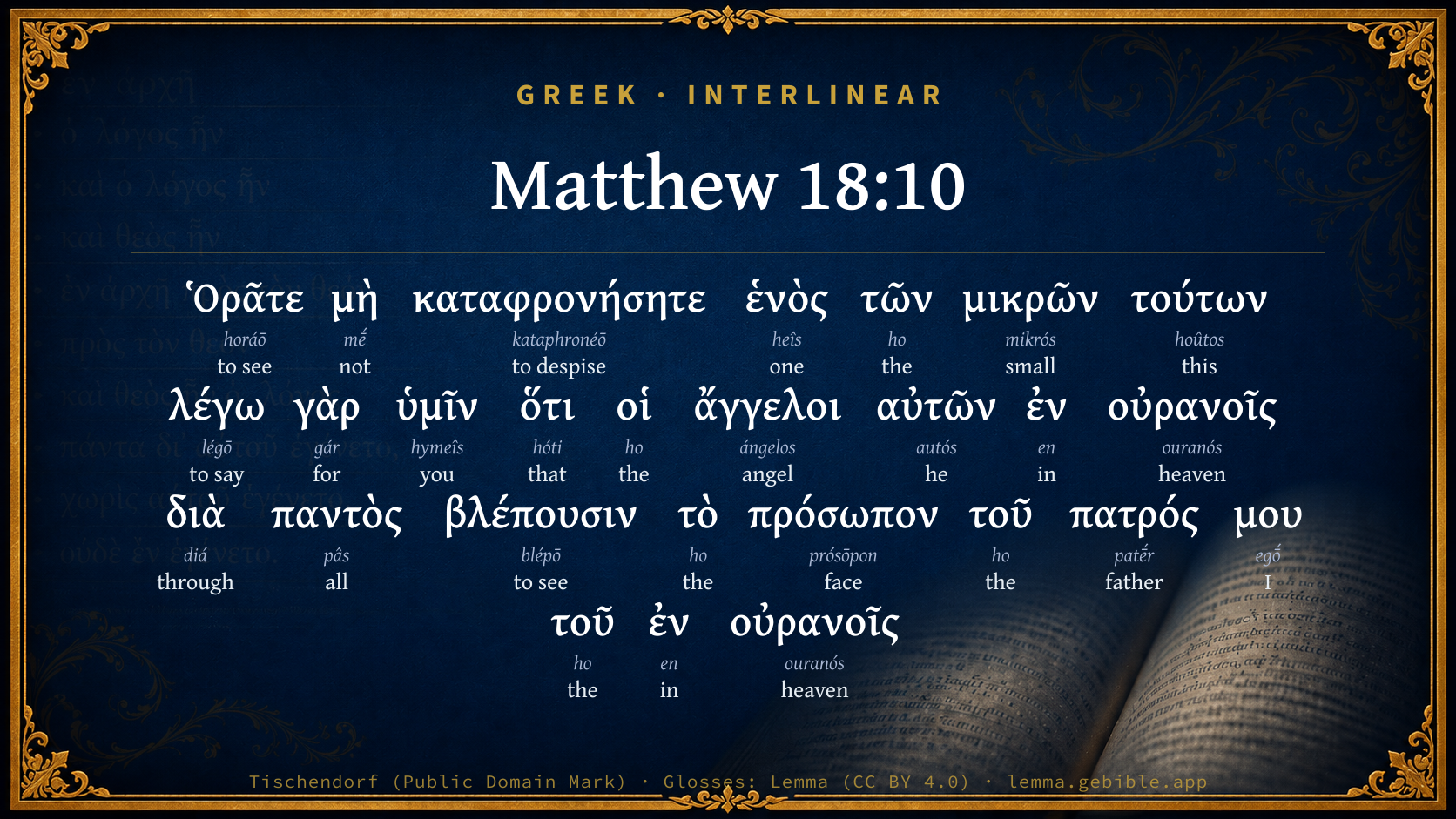
  1. Ὁρᾶτε horáō G3708 “to see” Verb, Present, Active, Imperative, 2nd person, Plural
  2. μὴ mḗ G3361 “not” Particle, Negative
  3. ἑνὸς heîs G1520 “one” Adjective, Genitive, Singular, Neuter
  4. τῶν ho G3588 “the” Article, Genitive, Plural, Neuter
  5. μικρῶν mikrós G3398 “small” Adjective, Genitive, Plural, Neuter
  6. τούτων hoûtos G3778 “this” Demonstrative pronoun, Genitive, Plural, Neuter
  7. λέγω légō G3004 “to say” Verb, Present, Active, Indicative, 1st person, Singular
  8. γὰρ gár G1063 “for” Conjunction
  9. ὑμῖν hymeîs G5210 “you” Personal pronoun, 2nd person, Dative, Plural
  10. ὅτι hóti G3754 “that” Conjunction
  11. οἱ ho G3588 “the” Article, Nominative, Plural, Masculine
  12. ἄγγελοι ángelos G32 “angel” Noun, Nominative, Plural, Masculine
  13. αὐτῶν autós G846 “he” Personal pronoun, Genitive, Plural, Neuter
  14. ἐν en G1722 “in” Preposition
  15. οὐρανοῖς ouranós G3772 “heaven” Noun, Dative, Plural, Masculine
  16. διὰ diá G1223 “through” Preposition
  17. παντὸς pâs G3956 “all” Adjective, Genitive, Singular, Neuter
  18. βλέπουσιν blépō G991 “to see” Verb, Present, Active, Indicative, 3rd person, Plural
  19. τὸ ho G3588 “the” Article, Accusative, Singular, Neuter
  20. πρόσωπον prósōpon G4383 “face” Noun, Accusative, Singular, Neuter
  21. τοῦ ho G3588 “the” Article, Genitive, Singular, Masculine
  22. πατρός patḗr G3962 “father” Noun, Genitive, Singular, Masculine
  23. μου egṓ G1473 “I” Personal pronoun, 1st person, Genitive, Singular
  24. τοῦ ho G3588 “the” Article, Genitive, Singular, Masculine
  25. ἐν en G1722 “in” Preposition
  26. οὐρανοῖς ouranós G3772 “heaven” Noun, Dative, Plural, Masculine

About this verse

These counts appear in no published source. They are computed here, from the morphology-tagged text and Lemma’s own curated glosses. What Lemma adds →

27
words
21
distinct lemmas
Gospels
section

Notable vocabulary

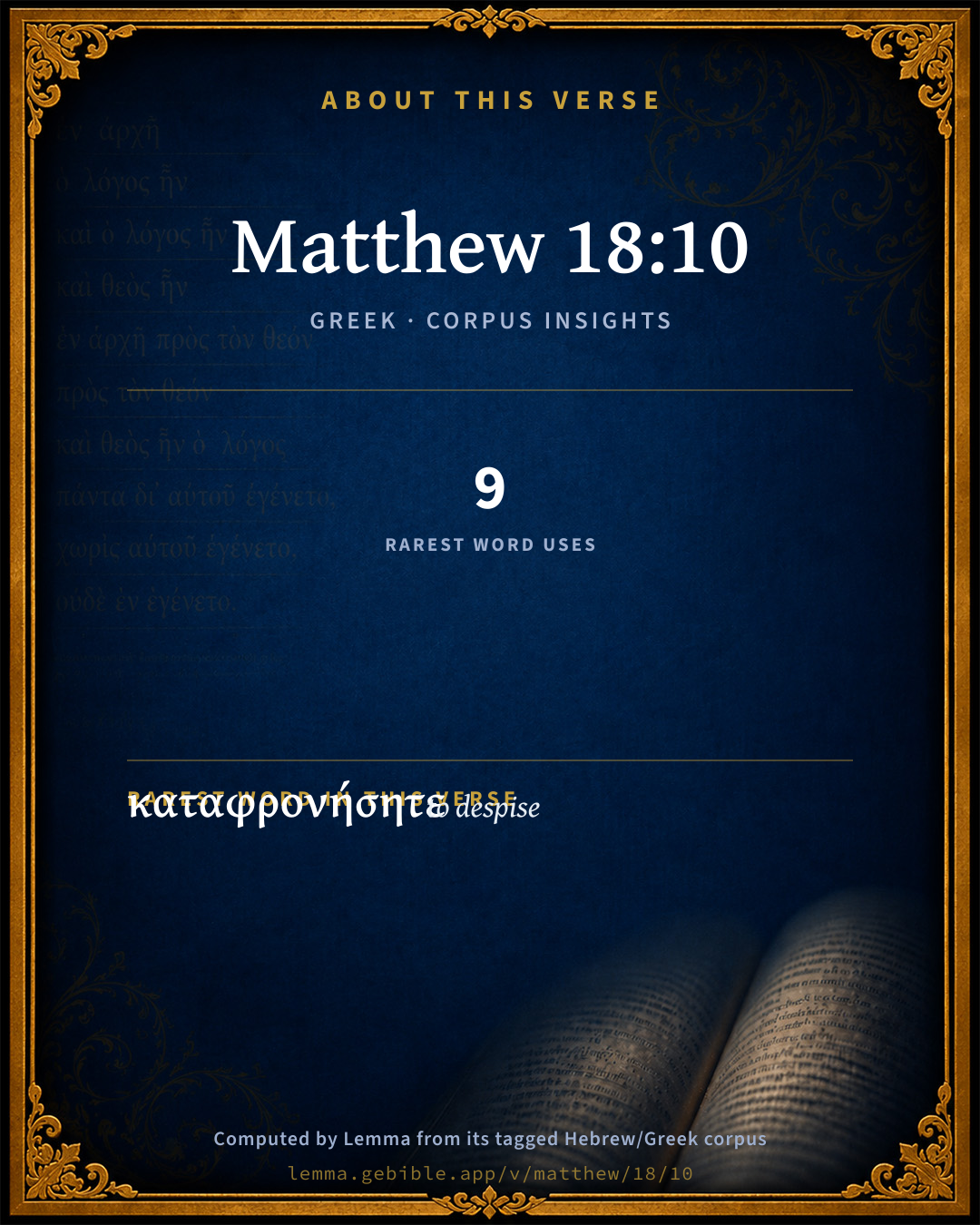
The rarest word here is καταφρονήσητε to despise G2706 — appearing just 9 times in the whole Greek New Testament.

Shared distinctive vocabulary

καταφρονήσητε to despise G2706 occurs in 9 verses of the Greek New Testament. Also found in:

Repetition

Words recur within this verse:

  • οὐρανοῖς heaven G3772 ×2
  • τῶν the G3588 ×5
  • ἐν in G1722 ×2

Cross-references

32

Topical passages linked to Matthew 18:10 in the Treasury of Scripture Knowledge — connected by theme and wording, ordered by reader-vote popularity; previews shown in the World English Bible.

  • Psalms 91:11 For he will give his angels charge over you, To guard you in all your ways.
  • Psalms 34:7 The angel of Yahweh encamps round about those who fear him, And delivers them.
  • Hebrews 1:14 Aren't they all ministering spirits, sent out to do service for the sake of those who will inherit salvation?
  • Luke 16:22 It happened that the beggar died, and that he was carried away by the angels to Abraham's bosom. The rich man also died, and was buried.
  • 2 Kings 6:16–17 He answered, Don't be afraid; for those who are with us are more than those who are with them.
  • Acts 12:7–11 And behold, an angel of the Lord stood by him, and a light shone in the cell. He struck Peter on the side, and woke him up, saying, "Stand up quickly!" His chains fell off from his hands.
  • Matthew 1:20 But when he thought about these things, behold, an angel of the Lord appeared to him in a dream, saying, "Joseph, son of David, don't be afraid to take to yourself Mary, your wife, for that which is conceived in her is of the Holy Spirit.
  • Matthew 18:6 but whoever causes one of these little ones who believe in me to stumble, it would be better for him that a huge millstone should be hung around his neck, and that he should be sunk in the depths of the sea.
  • Matthew 18:14 Even so it is not the will of your Father who is in heaven that one of these little ones should perish.
  • Genesis 32:1–2 Jacob went on his way, and the angels of God met him.
  • Matthew 24:31 He will send out his angels with a great sound of a trumpet, and they will gather together his chosen ones from the four winds, from one end of the sky to the other.
  • Matthew 2:13 Now when they had departed, behold, an angel of the Lord appeared to Joseph in a dream, saying, "Arise and take the young child and his mother, and flee into Egypt, and stay there until I tell you, for Herod will seek the young child to destroy him."
  • Luke 1:19 The angel answered him, "I am Gabriel, who stands in the presence of God. I was sent to speak to you, and to bring you this good news.
  • Acts 12:15 They said to her, "You are crazy!" But she insisted that it was so. They said, "It is his angel."
  • 1 Corinthians 16:11 Therefore let no one despise him. But set him forward on his journey in peace, that he may come to me; for I expect him with the brothers.
  • Matthew 2:19 But when Herod was dead, behold, an angel of the Lord appeared in a dream to Joseph in Egypt, saying,
  • Romans 14:21 It is good to not eat meat, drink wine, nor do anything by which your brother stumbles, is offended, or is made weak.
  • 1 Corinthians 8:8–13 But food will not commend us to God. For neither, if we don't eat, are we the worse; nor, if we eat, are we the better.
  • 1 Corinthians 11:22 What, don't you have houses to eat and to drink in? Or do you despise God's assembly, and put them to shame who don't have? What shall I tell you? Shall I praise you? In this I don't praise you.
  • 1 Thessalonians 4:8 Therefore he who rejects doesn't reject man, but God, who has also given his Holy Spirit to you.
  • Psalms 17:15 As for me, I shall see your face in righteousness; I shall be satisfied, when I awake, with seeing your form.
  • Acts 10:3 At about the ninth hour of the day, he clearly saw in a vision an angel of God coming to him, and saying to him, "Cornelius!"
  • Acts 27:23 For there stood by me this night an angel, belonging to the God whose I am and whom I serve,
  • Romans 14:1–3 Now receive one who is weak in faith, but not for disputes over opinions.
  • Romans 14:13–15 Therefore let's not judge one another any more, but judge this rather, that no man put a stumbling block in his brother's way, or an occasion for falling.
  • Acts 12:23 Immediately an angel of the Lord struck him, because he didn't give God the glory, and he was eaten by worms and died.
  • Romans 14:10 But you, why do you judge your brother? Or you again, why do you despise your brother? For we will all stand before the judgment seat of Christ.
  • 1 Kings 22:19 [Micaiah] said, Therefore hear you the word of Yahweh: I saw Yahweh sitting on his throne, and all the host of heaven standing by him on his right hand and on his left.
  • Psalms 15:4 In whose eyes a vile man is despised, But who honors those who fear Yahweh; He who keeps an oath even when it hurts, and doesn't change;
  • Zechariah 4:10 Indeed, who despises the day of small things? For these seven shall rejoice, and shall see the plumb line in the hand of Zerubbabel. These are the eyes of Yahweh, which run back and forth through the whole earth."
  • Acts 5:19 But an angel of the Lord opened the prison doors by night, and brought them out, and said,
  • 2 Corinthians 10:10 For, "His letters," they say, "are weighty and strong, but his bodily presence is weak, and his speech is despised."

Cross-references courtesy of OpenBible.info (CC BY 4.0).

Commentary

Notes on Matthew 18:10 from classic Christian and Jewish commentators (each source and its license shown beneath its notes). The classic Christian expositions comment on the surrounding passage and are grouped to its opening verse, so a note may address several verses; the Jewish commentaries on the Tanakh (Rashi and others) are per-verse, so they appear only where the commentator wrote on this verse.

Lemma curates 59 commentaries, every one of them public domain or Creative Commons licensed, each selected and text-cleaned for this edition rather than reprinted as found. About our sources →

The Biblical Illustrator

Joseph S. Exell

Mat_18:10

Take heed that ye despise not one of these little ones.

Contempt

Look at the sources of contempt; and what are its correctives.

I. The sources of contempt.

1. Want of knowledge will produce contempt. You could not despise the smallest and meanest in Gods great universe if only you had a true and enlarged conception of what that universe is. God watches over all; how can we treat with contempt the meanest object of His care.

2. Want of wisdom produces contempt. I cannot imagine it being said it is hardly true that enlarged knowledge diminishes contempt. As we grow older we find out the weaknesses of those we were taught to reverence. But no wisdom lies in that. A wise man newt despises; he reads beneath the surface. There is an angel behind the meanest form.

3. Want of reverence produces contempt.

II. The remedy. Sympathy is the antidote to contempt, as love is the restorative of all the ills of the universe. This shows that in the meanest men there are splendid possibilities, (Bishop Carpenter, D. D.)

Contempt for the little impossible, when regarded as part of a great whole

And just as surely as a crushed finger is understood and felt by the thrill and ache in the brain, so the wounded one here, or the little one injured and offended and despised here, is not simply a thing isolated from the rest of Gods universe, but one bound with it in the whole relationship and web of life so intimately connected, that its grief and its sorrow and its wound is felt right away up there, where God sits enthroned. As He gives us that conception of life, so He says it it impossible now you should despise. Let a larger knowledge of being enter rote your thoughts, and then you will see all creation is interlocked and interlaced in such a way that to understand one is to understand the whole; that there is no creature, however mean, that is outside the range of Divine superintendence and Divine knowledge, Their angels do always behold the face of My Father which is in heaven. (Bishop Carpenter, D. D.)

Contempt banished by insight

A wise man never despises. See one moment. Unwise men are ready to despise because they do not understand, or think out the meaning of little things. But the man of wisdom sees there is nothing in the world, however mean, that cannot have a real significance, and that just as you can see that the universe is one so you may see in a single thing the whole universe reflected. Here is the man who will not despise. Other men have been looking day by day at the same thing, but they have not had the wisdom to read beneath the surface. To them this is merely a bit of broken crystal; but the eyes of the man of wisdom look underneath the fractured morsels and see the law of form. This is but a swinging lamp in the eye of the world; but this man sees in it the angel of the law of movement. There again is only a falling stone, and yet he, with his keen eye, shall read beneath it the law of order in the universe. Surely, it is true, where great wisdom exists there is an inclination to banish contempt, for contempt hinders the growth of knowledge. (Bishop Carpenter, D. D.)

Contempt ignoble

The man who is above all these things looks with profound disdain upon the toys of the little children around him. Do you think he is nobler at that moment when he says he is above all these things, than that other who stoops from out of his range of knowledge to help the little child with the broken toy? There is a contrast of character. The one has knowledge and conceit, which is always twin brother to contempt, and the other has the sympathy and the reverence, and these are linked in their kinship together. Or it takes the form in another mans nature of that determination to view himself as exempt from the laws which govern other men. Other men are studious, other men are prayerful, and other men watch their characters and examine themselves. He says, I never could do that sort of thing. There is the spirit of contempt for that which is the help of others. But is it a great thing to hold ourselves above our fellows, or is it not the very teaching of Jesus Christ that the noblest thing for man is to recognize that he is man and that his best manliness is in submitting himself to those laws and orders which are needful for the education and discipline of man? It is always Satans method to say, Ye shall be as gods; and it drops in well with our conceit, and it ministers to our contempt. (Bishop Carpenter, D. D.)

The Nemesis of contempt

There comes a time when we esteem ourselves so great and others so little, we get into a habit of a nil admirari, and we never think it noble or great to show pleasure or admiration at anything. And thus it happens that a human being, born into Gods world with all the rich glories of creation falling thick and fast in light and form and colour about him, stands there where thousands and tens of thousands of men, poets, painters, orators, and historians, have stood and gazed upon that world, with its growth and beauty, with admiration aghast, and he sees nothing to admire in it. What a miserable distortion of humanity! What a miserable falling back into a vain and irretrievable egotism, because he has allowed the spirit of contempt to get hold of him! (Bishop Carpenter, D. D.)

The dullest life has angelic light behind it

Is it not true also in regard to human life? Over all the dark angel of contempt hovers. But is there not, if we look wisely at human life, a marvellous display of real angelic force? Mark this life you will be disposed to despise. Who can find anything of angel ministers and poetry in that of a mere labourer of the fields, whose to-day is just like yesterday-rising early, ploughing, casting in the seed, reaping, and with an ignorant and dull brain following the plough, and pursuing the field labour from day to day, no other thought leaping up in his mind but a moody anticipation of next years harvest. Yet, if you look aright, there is a light as of an angels presence behind such a life as that. This is one of Gods ministers. Is it nothing to stand before the face of the great Creator and receive from His hand, as the disciples did of old, the bread to be distributed to the sons of men? Behind the most prosaic life there is an angel form for those who look through it. Take the dull round of the man of medicine. With its weariness there grows upon him the feeling that life is nothing but a monotonous round of visits-fruitless visits if he has to minister to the miserable hypochondriac-and then follows despair that his life is a useless one. Yet behind it there is the light of the angels wing, for when he is present that poor hypochondriac has her powers and energies strengthened to excite themselves against the weakness of her nature. His is the soothing hand that restores to the tired nerves their power. Yes, the dullest life, the hardest existence, the most monotonous career, has an angel of light behind it. (Bishop Carpenter, D. D.)

Guardian angels

The offices of the guardian angels are-

1. To avert dangers both of the body and the soul.

2. To illuminate and instruct those committed to their charge, and to urge them to good works.

3. To restrain the devil, that he may not suggest wicked thoughts, or furnish occasions for sin.

4. To offer to God the prayers of him whom He guards.

5. To pray for him.

6. To correct him if he sin.

7. To stand by him at the hour of death, to comfort and assist him in his last struggle.

8. After death to convey the soul to Paradise. (Lapide.)

I. How great is the dignity of souls, that they have angels for their guardians.

II. How great is the condescension of God, that He assigns to us such guides.

III. How great is the humility and love of the angels, who do not disdain these offices, but delight in them. (Lapide.)

The guardian angels of nature

The knowledge of nature is a conception which has broadened our thoughts and ensured our convictions. And in proportion as this is true, does not the thought rush upon us that this great creation, with its law, and system, and organization, becomes ministerial in its aspect? Everything ministers to another. Our angels are not vanished, but our conception of angel ministers is enlarged. We need not to wait for some angelic beings as guardian angels to direct our steps and hold us up in their hands. Now every law and every force becomes Gods angel. The flame that leaps up from our hearths, the wind that beats in our face, and star that shines in the sky, these are Gods angels as much as ever were the guardian around us. The flowers that dispelled their fragrance in our faces, the great blue sky, and the cheery breezes, all these excited our admiration and stimulated our reverence. (Bp. Carpenter.)

Training the little ones

Ministry of angels to Christian children. Practical lessons.

I. Beware lest you put stumbling-blocks is their WAY. It is impossible to say how early the real moral and spiritual character begins to form itself-long before we can externally trace what is going on. Flowing from this is the great blessedness of being allowed to deal with such creatures. Workers together with God. The great danger that you should do your work badly through any fault of yours. The nurse who lets the child drop and gets crippled for life never forgives herself. But what if they should become spiritual cripples!

II. He guards against doing this. Knowing what the treasure is that is committed to you. Not a class, but souls, for whom Christ died, etc. This idea, once laid hold of, settles all difficulties about what should be taught. Deal with them separately. (S. Wilberforce, D. D.)

Value of a little child

Louis IX., king of France, was found instructing a poor kitchen boy, and, being asked why he did so, replied, The meanest person hath a soul as precious as my own, and bought with the same blood of Christ. Despising the little ones:-Anniversary address to parents. We all need this text and its kindly warning, for we are all in danger of despising the little ones. See how-

I. By undervaluing the influence they can exert. Especially on a mother. On a home. In saving men from vice.

II. BY underestimating the care and help they need if they are to grow up good.

III. By misunderstanding the peculiarities of the little ones.

IV. By cherishing the notion that they must be big before they can really love and serve Christ. (R. Tuck, B. A.)

What value Christ sets on every man

1. Think of His words, and you will see that Jesus isolates each of us, setting us man by man apart: despise not one; if one of them be gone astray. He who counts our hairs, much more counts us.

2. Jesus measures the worth of each human being by Gods special and separate care of him. Feebleness commends us to His care; much more does sin. He has more pity even for the lost, more than for the little ones. He seeks them.

3. Such teaching from the lips of Jesus was a new thing in the world, and wrought a revolution. How cheap men held human life till Jesus taught the equal worth of manhood.

4. It deserves special notice in what way it is that the teaching of Jesus has cut the roots from that self-valuing or self-praising which has always led men to undervalue and despise others. There are two ways in which to correct the boastful mans estimate. I may seek to sober his conceit by showing him mans littleness at his best. Christ did not lower the dignity of human nature; He came to cure contempt for the little and lost by making us think more. He came to put our self-esteem on its true footing; not on what is accidental or peculiar to one man, but on what is common to the race. In such an atmosphere as Christ lived in pride dies.

5. Let me show you one or two of these inward prerogatives which assert your personal value in Gods reckoning to be as great as any other mans.

(1) From each one of us God claims a separate responsibility. We have each a moral constitution of our own, as recognizable as the features of our face.

(2) From the moment of birth God subjects each person to a separate course of training.

(3) That God is Father as well as Judge to all, and permits each soul ready access to Him.

(4) Perhaps you say, can a man be of value to God after his soul is ruined. Gods love is indestructible by human sin-He came to save sinners.

(5) Let us embrace in a hopeful charity the worst of our fellow men. (J. O. Dykes, D. D.)

Self-respect inspired by the view of a common manhood

I pray you note how at one stroke Jesus has thus annihilated our pride and heightened our self-respect. Pride lives on the petty pre-eminences which here for a little lift one mortal an inch or two higher than another; an extra handful of gold, a better education, a longer pedigree, a title, a serener, and less tempted life. Among the ups and downs of society these look mighty things, as straws and leaves look large to emmets eyes, and they fill the foolish hearts of men with vain conceit and unbrotherly scorn. From the height from which God and His Son Jesus survey this human world, such paltry degrees of more and less dwindle into insignificance, and are lost in the broad, equal level of a common manhood. (J. O. Dykes, D. D.)

Self-respect inspired by the Divine culture of men

Next, from the moment of birth, God subjects each person to a separate course of training. Men never appear before Gods sight clustered in crowds; never like the countless pines which on the lower ranges of the Alps stand undistinguishable, row behind row, in thickset serried masses like a host; but like the singled vines of the vineyard, each of which the husbandman knows and tends with a care that is all its own. To each of you He has ordained your own career, with its early influences, domestic or educational, its companionships, its experiences, its trials, duties, losses, labours. All through your life He is moulding it to suit both what He made you to begin with and what He means you to become at last; so that from your deathbed you look back along a life history, wholly your own and not anothers, the match of which no mortal man ever lived through before. (J. O. Dykes, D. D.)

Despising the little ones

I. A strict prohibition, and that ushered in with a severe charge by way of caveat (Take heed!).

1. Whom Christ means by these little ones.

2. What it is to despise them.

II. A solemn reason given for the prohibition; and this reason backed with our Saviours own authority and sacred Word. Those little ones have angels for their guardians and attendants, and those angels none of the lower form, but the most eminent favourites, who continually stand in Gods presence, and do always behold His face. (Adam Littleton.)

The Biblical Illustrator, edited by Joseph S. Exell (c. 1880s–1900s) — public domain. Text from a community e-Sword module.

Joseph Benson's Commentary

Mat 18:10-11. See that ye despise not one of these little ones — As if they were beneath your notice. Be careful to receive, and not to offend, the very weakest believer in Christ: for, as inconsiderable as some of these may appear to you, the very angels of God have a peculiar charge over them: even those of the highest order, who continually appear at the throne of the Most High. Jerome, and many others of the ancient fathers, considered this as an argument that each pious man has his particular guardian angel: but it may be justly questioned whether this is the meaning of the passage. It seems more probable the sense is, that the angels, who sometimes attend the little ones spoken of, at other times stand in God’s immediate presence; and consequently that different angels are at different times employed in this kind office. The general sense is plain: that the highest angels do not disdain, on proper occasions, to perform services of protection and friendship for the meanest Christian. And as all the angels are ministering spirits, sent forth occasionally, at least, to minister to the heirs of salvation, they may in general be properly called their angels. The expression, They behold the face of my Father, alludes to the custom of earthly courts, where the great men, those who are highest in office and favour, are most frequently in the prince’s palace and presence, and perhaps daily converse with him. The meaning, therefore, of the passage is, that the chief angels are employed in taking care of the saints; and our Lord’s reasoning is both strong and beautiful when on this account he cautions us against despising them. “O what men are they,” says Baxter, “that read and preach this, and yet not only despise them, but first ignorantly or maliciously slander them, and then by this justify their persecuting and destroying them.” But, “what a comfort to the meanest true Christian is it, that angels, who always see God’s face in glory, have charge of them!” For the Son of man is come to save that which was lost — As if he had said, Another, and yet a stronger reason for your not despising them is, that I myself came into the world to save them: and I, who came to save them, will require it at your hands, if you wrong or persecute them, or hinder them in the way of their salvation.

Joseph Benson's Commentary on the Old and New Testaments (1811–1818) — public domain. Text from a community e-Sword module.

Whedon's Commentary on the Bible

Daniel D. Whedon

PARABLE OF THE LOST SHEEP, Mat_18:10-14.

10. One of these little ones — Those whom my grace has made to be as little children. Despise — Undervalue them. Esteem it to be a small matter to destroy their souls. Their angels — Of the existence of angels the Bible furnishes abundant proof. See note on Mat_1:20. That these angels, as messengers of God, do minister to his people, Paul expressly affirms, by asking: “Are they not all ministering spirits, sent forth to minister for them who shall be heirs of salvation?” Heb_1:14. And so the Psalmist says: “The angel of the Lord encampeth round about them that fear him.” Psa_34:7. That individual Christians have particular angels is clearly implied by the words of Peter’s friends: “It is his angel.” Act_12:15. And so the little ones here mentioned have “their angels.” These angels are said to behold the face of God. This, if not taken from the fact that the prime ministers and favourites of kings are familiar with the face of their royal masters, as having free access to them, is at least an analogous fact. So in Est_1:14 : “Next unto king Ahasuerus were the seven princes of Persia and Media, which saw the king’s face.” And so in Luk_1:19 : “I am Gabriel that stand in the presence of God.” The doctrine is, then, that of every humble Christian the angel is God’s favourite and presence-angel. A glorious reason why we should not despise them! We presume not to say how far this is figure, and how far it is literal fact. That angels did often, by special mission, minister visibly to the saints of the Old Testament and the New, is matter of sacred history. That their salvation, through Christ, is matter of interest to angels we are told in 1Pe_1:12. Still the idea that every Christian’s special angel enjoys the direct view of the Divine Being, as a special favourite in heaven, may be rather more safely viewed as a beautiful symbol borrowed from earthly courts. It may represent that favour which the merits of Christ procure for the redeemed before God. Christ is as a host of angels in their behalf, before the face of God.

The idea of Mr. Watson, that a person’s angel is his disembodied spirit, seems not well founded. The friends of Peter (Act_12:15) imagined the person at the gate to be his angel, from the popular notion that a man’s guardian angel or genius in person resembled himself.

Daniel D. Whedon (gen. ed.), Commentary on the Old and New Testaments (1874–1909) — public domain. Text from a community e-Sword module.

Godbey's Commentary on the New Testament

William B. Godbey

CHAPTER 34

GUARDIAN ANGELS

Mat 18:10. “See that you do not look with contempt on one of these little ones; for I say unto you, Their angels, in the heavens, do always behold the face of My Father who is in the heavens.” Here our Lord warns us against our prevailing predilection to undervalue infancy, both natural and spiritual. All the children born in the membership of an organized Church are so neglected spiritually, and encompassed with temptation, that they, at least clandestinely and inadvertently, become sinners before we are aware, thus incurring an awful responsibility; meanwhile, spiritual infants are left in a cold, worldly Church, speedily to freeze to death. A babe may be born in an icehouse, but it will soon imbibe cold enough to put it in its coffin. Our Savior here seeks to augment our appreciation of infants, both natural and spiritual, by reminding us of the honor conferred on their guardian angels in heaven, being permitted to occupy a place so prominent and near the throne as always to behold the face of the Father.

This affirmation clearly recognizes the existence and utility of the guardian angels.

Here we have heaven in the plural number, including innumerable celestial worlds. There is no doubt but the angels are infinitely more numerous than the entire human race; while we are assured that they take a great interest in humanity, having been present, and doubtless cooperative, in creation; deeply sympathetic in the fall, so as to make heaven resound with weeping; infinitely joyous in the redemptive scheme, keeping the firmament bright with the splendor of their wings, as they fly from heaven to earth, et vice versa, on missions of love and mercy; constantly cooperative with Moses and the prophets, the saints and martyrs, of all bygone ages; sweeping down from heaven, and singing their triumphant anthems over the shepherds tented on the fields of Bethlehem, unutterably delighted to proclaim to the world the Incarnate Savior. Doubtless we all have our guardian angels, who comfort us amid earth’s woes, and shield us from a thousand perils. As you look back, I trow, you can see hairbreadth escapes from death, and perhaps spiritual calamities worse than death. I assure you, I can witness to instances not a few where I could pertinently say with David, “There is but one step between me and death.” During a storm on the Mediterranean Sea, last December, perhaps injudiciously endeavoring to walk the deck, I was thrown among the machinery, striking my eyebrow on an iron, bringing gushing blood; an eighth of an inch farther would evidently have broken the skull. Do you realize your own guardian angels about you? I do. Methinks the ancient philosopher, walking in the light of nature and the Holy Ghost, having never seen the Bible, which is a constant heavenly sunburst on you and me, certainly did realize the presence of the guardian angels when he said, “I am least lonesome when alone, and busiest when unemployed.”

William B. Godbey, Commentary on the New Testament (1896–1900) — public domain. Text from a community e-Sword module.

Tyndale Open Study Notes

Tyndale Open Resources

18:10 Don’t look down on them, either by refusing to receive them (18:5-6) or by refusing to give pastoral care when needed (18:12-14; see 19:13-15). • their angels: See 4:5-7; Heb 1:14.

Tyndale Open Study Notes — © Tyndale Open Resources, licensed CC BY-SA 4.0. Text via the HelloAO Bible API.

Bengel's Gnomon

Johann Albrecht Bengel

Mat 18:10. Μὴ καταφρονήσατε do not despise) They appear to have done so from Mat 18:1-2. The adult frequently exhibit pride towards “little ones” by whose appearance they are reminded of their origin: whence it comes to pass, that they hold them of no account, and pay them no reverence.[813] He despises them who corrupts or neglects to edify them.—οἱ ἄγγελοι, the angels) whom you ought not to offend, but imitate, in this very care for the “little ones.”—αὐτῶν, of them) The angels take care of the “little ones,” both in body and soul; and so much the more, the less that they are able to protect themselves. Grown-up men have also their guardian angels. but vet they are in some sort left more to themselves.—βλέπουσι, see) as attendants. And this concerns not only the dignity, but also the safety of the “little ones.” Their function is twofold; see Heb 1:14.—τὸ πρόσωπον, the face) See Exo 33:14-20, and Num 6:25-26.

[813] See Gnomon on Mat 18:6. voc. σκανδαλίσῃ, and footnote.—(I. B.)

Bengel's Gnomon of the New Testament — English translation (T&T Clark, Edinburgh, 1860) — public domain. Text from a community e-Sword module.

Meyer's Critical & Exegetical Commentary

Heinrich August Wilhelm Meyer

Mat_18:10. Jesus now proceeds with His cautions, which had been interrupted by the parenthetical exhortation in Mat_18:7-9. The belief that every individual has a guardian angel (see Tobit 5.; comp. in general, Schmidt in Ilgens Denkschr. I. p. 24ff.)which is a post-Babylonian development of the Old Testament view, that God exercised His care over His people through angelic instrumentalityis here confirmed by Jesus (Act_12:15),a point which is to be simply admitted, but not to be explained symbolically, neither by an as it were (Bleek), as though it were intended merely to represent the great value of the little ones in the sight of God (de Wette), nor as referring to human guardians, who are supposed to occupy a position of pre-eminent bliss in heaven (Paulus).

ἐν οὐρ. διὰ παντὸς βλέπουσι, κ.τ.λ.] inasmuch as they are ever in immediate proximity to Gods glory in heaven, and therefore belong to the highest order of angels. This is not merely a way of expressing the great importance of the μικροί, but a proof which, from λέγω ὑμῖν and τοῦ πατρός μου, receives all the weight of an emphatic testimony; while the mode of representation (comp. מלאבי פנים of the Rabbinical writers, Schoettgens note on this passage) is borrowed from the court arrangements of Oriental kings, whose most confidential servants are called הָרֹאֵי פְּנֵי הַמֶּלֶךְ, 2Ki_25:19; 1Ki_10:8; Tob_12:15; Luk_1:19.

Meyer — Critical and Exegetical Commentary on the New Testament — English translation by Peter Christie, edited by Frederick Crombie (T&T Clark, 1880) — public domain. Text from a community e-Sword module.

Expositor's Greek Testament

ed. W. Robertson Nicoll

Mat 18:10-14 . Still the subject is the child as the ideal representative of the insignificant, apt to be despised by the ambitious. From this point onwards Mt. goes pretty much his own way, giving logia of Jesus in general sympathy with the preceding discourse, serving the purpose of moral discipline for disciples aspiring to places of distinction.

Mat 18:10 . ὁρᾶτε μὴ καταφ .: μὴ with the subj. in an object clause after a verb meaning to take heed; common N. T. usage; vide Mat 24:4 ; Act 13:40 , etc. ἑνὸς , one , again. λέγω γὰρ : something solemn to be said. οἱ ἄγγελοι αὐτῶν , etc. In general abstract language, the truth Jesus solemnly declares is that God, His Father, takes a special interest in the little ones in all senses of the word. This truth is expressed in terms of the current Jewish belief in guardian angels. In the later books of O. T. (Daniel), there are guardian angels of nations ; the extension of the privilege to individuals was a further development. Christ’s words are not to be taken as a dogmatic endorsement of this post-exilian belief exemplified in the story of Tobit (chap. 5). The same remark applies to the passages in which the law is spoken of as given through angelic mediation (Act 7:53 ; Gal 3:19 ; Heb 2:2 ). The λέγω γὰρ does not mean “this belief is true,” but “the idea it embodies, God’s special care for the little, is true”. This is an important text for Christ’s doctrine of the Fatherhood. It teaches that, contrary to the spirit of the world, which values only the great , the Father-God cares specially for that which is apt to be despised. βλέπουσι τ . πρ . In Eastern courts it is the confidential servants who see the face of the king. The figure is not to be pressed to the extent of making God like an Eastern despot.

The Expositor's Greek Testament, edited by W. Robertson Nicoll (1897–1910) — public domain. Text from a community e-Sword module.

Geneva Bible (1599)

Geneva Bible translators

The weaker that a man is, the greater care we ought to have of his salvation, as God teacheth us by his own example.

Geneva Bible (1599) marginal notes — public domain. Text via Bolls.life.

Adam Clarke's Commentary

Verse 10. One of these little ones] One of my simple, loving, humble disciples.

Their angels - always behold] Our Lord here not only alludes to, but, in my opinion, establishes the notion received by almost all nations, viz. That every person has a guardian angel; and that these have always access to God, to receive orders relative to the management of their charge. See Ps 34:8; Heb 1:14.

Always behold the face] Hence, among the Jews, the angels were styled מלכי פנים, malakey panim, angels of the face, and Michael is said to be סר הפנים, sar ha-panim the prince of the face. This is an allusion to the privilege granted by eastern monarchs to their chief favourites; a privilege which others were never permitted to enjoy. The seven princes of Media and Persia, who were the chief favourites and privy-counsellors of Ahasuerus, are said to see the king's face. Es 1:14; see also 2Kg 25:19, and Jer 51:25. Our Lord's words give us to understand that humble-hearted, child-like disciples, are objects of his peculiar care, and constant attention. The clause, εν ουρανοις, in the heavens, is wanting in several MSS., versions, and fathers.

Adam Clarke's Commentary on the Bible (1810–1826) — public domain. Text from a community e-Sword/MySword module.

Ellicott's Commentary for English Readers

(10) Take heed that ye despise not.—The words remind us of what we are apt to forget in the wider range of the preceding verses. The child was still there, perhaps still folded in the arms of Jesus, still the object of His care, even while He spake of the wider offences that “must needs come” upon the world at large. Looking to the frequency with which our Lord’s words were addressed to the thoughts of His hearers, it seems likely that the faces of some at least of the disciples betrayed, as they looked on the child, some touch of half-contemptuous wonder, that called for this prompt rebuke. The words have, however, as interpreted by what follows, a wider range, and include among the “little ones,” the child-like as well as children—all, indeed, whom Christ came to save.

In heaven their angels.—The words distinctly recognise the belief in guardian angels, entrusted each with a definite and special work. That guardianship is asserted in general terms in Psa_34:7; Psa_91:11, Heb_1:14, and elsewhere. What is added to the general fact here is, that those who have the guardianship of the little ones assigned to them are among the most noble of the heavenly host, and are as the angels of the Presence, who, like Gabriel, stand before the face of God, and rejoice in the beatific vision (Luk_1:19). The words “I say unto you” clothe what follows with the character of a new truth, as they do the like utterances of Luk_15:7; Luk_15:10. Whatever difficulties may connect themselves with the whole range of questions connected with the ministry of angels, they lie outside the work of the interpreter. There can be no question that our Lord adopts as His own the belief in the reality of that ministry, and this at a time when the Sadducees, as a leading sect, were calling it in question (Act_23:8). The words are indirectly important as a witness to the fact that the Lord Jesus, while He proclaimed the universal Fatherhood of God as it had never been proclaimed before, also (almost, as it were, unconsciously, and when the assertion of the claim was not in view) claims a sonship nearer and higher than could have been claimed by any child of man.

A Bible Commentary for English Readers, edited by Charles John Ellicott (1878–1897) — public domain. Text from a community e-Sword module.

The Cambridge Bible for Schools and Colleges

gen. ed. J. J. S. Perowne

10–14. Christ’s care for His Little Ones illustrated by a Parable. Luk_15:3-7

After a brief digression (Mat_18:7-9), Christ’s love for His young disciples again breaks out in words. Let no one despise them. They have unseen friends in the court of heaven, who are ever in the presence of the King himself. There, at any rate, they are not despised. It was for them especially that the Son of Man came to earth.

The Cambridge Bible for Schools and Colleges (gen. ed. J. J. S. Perowne; Cambridge University Press, 1878–1918) — public domain. Text from a community e-Sword module.

John Gill's Exposition

For the Son of man is come to seek that which was lost. This is another, and stronger reason, why these little ones should not be despised; because Christ, who is here meant by the Son of man, came into this world to save these persons; who were lost in Adam, and had destroyed themselves by their transgressions, and carries great force in it: for if God had so great a regard to these little ones, as to send his Son to obtain eternal salvation for them, when they were in a miserable and perishing condition; and Christ had so much love for them, as to come into this world, and endure the sorrows, sufferings, and death itself for them, who were not only little, but lost; and that to obtain righteousness and life for them, and save them with an everlasting salvation; then they must, and ought to be, far above the contempt of all mortals; and the utmost care should be taken not to despise, grieve, offend, and injure them in any form or shape whatever; see Rom 14:15. Beza observes, that this whole verse is left out in some Greek copies, but it stands in others, and in all the Oriental versions, and in Munster's Hebrew Gospel; nor can it be omitted; the following parable, which is an exemplification of it, requires it.

. Beza observes, that this whole verse is left out in some Greek copies, but it stands in others, and in all the Oriental versions, and in Munster's Hebrew Gospel; nor can it be omitted; the following parable, which is an exemplification of it, requires it.

Matthew 18:12

mat 18:12

mat 18:12

mat 18:12How think ye,.... Or, as the Arabic, "what do you think?" what is your opinion of this matter? what is your sense of it? how does it appear to you? It is a Talmudic way of speaking, the same with "what do you think?" what is your judgment? So the Rabbins, after they have discussed a point among themselves, ask (k), , "what is our opinion?" or what do we think upon the whole? Christ here appeals to his disciples, makes them judges themselves in this matter, and illustrates it by a familiar instance of a man's seeking and finding his lost sheep, and rejoicing at it.

If a man have an hundred sheep; who is the proprietor of them; not the hireling, who has them under his care, and whose the sheep are not; but the owner of them, to whom they belong, and who must be thought to be most concerned for anyone of them that should go astray: a hundred sheep seem to be the number of a flock; at least flocks of sheep used to be divided into hundreds. In a Maronite's will, a field is thus bequeathed (l);

"the north part of it to such an one, and with it , "a hundred sheep", and a hundred vessels; and the south part of it to such an one, and with it , "a hundred sheep", and a hundred vessels; and he died, and the wise men confirmed his words, or his will.''

Such a supposition, or putting such a case as this, is very proper and pertinent.

And one of them be gone astray; which sheep are very prone to; see Psa 119:176;

doth he not leave the ninety and nine, which are not gone astray, in the place where they are; it is usual so to do:

and goeth into the mountains; alluding to the mountains of Israel, where were pastures for sheep, Eze 34:13 and whither sheep are apt to wander, and go from mountain to mountain, Jer 50:6, and therefore these were proper places to go after them, and seek for them in: but the Vulgate Latin version joins the words "in" or "on the mountains", to the preceding clause, and reads,

doth he not leave the ninety and nine in the mountains; and so read all the Oriental versions, Syriac, Arabic, Ethiopic, and Persic; and in the same manner Theophylact;

and seeketh that which is gone astray? This is usual with men: no man that has a flock of sheep, and though but one strays from it, but takes this method. This parable now may be considered, either as an illustration of the Son of man's coming into this world, to seek, and to save his lost sheep, mentioned in the preceding verse; even the lost sheep of the house of Israel, the little ones that believed in him, who were despised by the Jews. And then by the "ninety and nine", we are not to understand the angels; who never went astray, never sinned, but kept their first estate, whom Christ left in the highest heavens, on the holy mountains of eternity, when he became incarnate, and came down on earth to redeem mankind: for these never go by the name of sheep; nor are they of the same nature and kind with the one that strays, and is sought out; nor is their number, with respect to men, as ninety nine to one; at least it cannot be ascertained; nor were they left by Christ, when he came on earth; for a multitude descended at his birth, and sung glory to God. Nor are the saints in heaven intended, whose state is safe; since it cannot be said of them, as in the following verse, that they went not astray; for they went astray like lost sheep, as others, and were looked up, sought out, and saved by Christ as others; but rather, by them, are meant the body of the Jewish nation, the far greater part of them, the Scribes and Pharisees, who rejected the Messiah, and despised those that believed in him: these were in sheep's clothing, of the flock of the house of Israel, of the Jewish fold; and with respect to the remnant among them, according to the election of grace, were as ninety nine to one: these were left by Christ, and taken no notice of by him, in comparison of the little ones, the lost sheep of the house of Israel he came to save: these he left on the mountains, on the barren pastures of Mount Sinai, feeding on their own works and services; or rather, he went into the mountains, or came leaping and skipping over them, Sol 2:8, encountering with, and surmounting all difficulties that lay in the way of the salvation of his people; such as appearing in the likeness of sinful flesh, bearing, and carrying the griefs and sorrows of his people, obeying the law, satisfying justice, bearing their sins, and undergoing an accursed death, in order to obtain the salvation of his chosen ones, designed by the one sheep "that was gone astray"; who strayed from God, from his law, the rule of their walk, out of his way, into the ways of sin, which are of their own choosing and approving: or, the intention of this parable is, to set forth the great regard God has to persons ever so mean, that believe in Christ, whom he would not have stumbled and offended, and takes special care of them, that they shall not perish; even as the proprietor of a flock of sheep is more concerned for one straying one, than for the other ninety nine that remain.

(k) T. Bab. Sanhedrim, fol. 88. 2. (l) T. Bab. Bava Bathra, fol. 156. 2.

John Gill's Exposition of the Whole Bible (1746–1763) — public domain (CC PDM 1.0). Text via the HelloAO Bible API.

Trapp's Complete Commentary

John Trapp

10 Take heed that ye despise not one of these little ones; for I say unto you, That in heaven their angels do always behold the face of my Father which is in heaven.

Ver. 10. Take heed that ye despise not, &c.] Gr. Look to it if you do, a foul mischief is towards you. {a} Look to it as you tender your own safety here or salvation hereafter. Cast not the least contempt upon Christ’s little ones. As little as they are, they have a great Champion, Isa 37:22-23, and so many angels to right them and fight for them, that a man had better anger all the witches in the world than one of these little ones. I tell you, some great ones have been fain to humble themselves, and to lick the very dust of their feet sometimes, that they might be reconciled to them, Isa 60:14. If Cain do but lower upon Abel, God will arraign him for it, Gen 4:6. Why is thy countenance cast down? Why dost look so doggedly? If Miriam do but mutter against Moses, God will spit in her face, Num 12:14: and if Aaron had not made the more haste to make his peace by repentance, he also had tasted of the same sauce.

Their angels do always behold the face] Angels in the Syriac are named אפנים of the face, because it is their office and honour to look always on God’s face. They are sent about God’s messages to this earth, yet are never out of their heaven, never out of the vision of their Maker. No more are godly men, when busied in their callings. And howsoever slighted in the world, yet angels are sent forth for their safeguard and service, Heb 1:14, yea, for the accomplishment of all designs for the saints’ good, they stand alway looking God full in the face, to receive commandments.

{a} ορατε Districte praecipientis verbum.

John Trapp, A Commentary or Exposition upon All the Books of the Old and New Testament (1647–1656) — public domain. Text from a community e-Sword module.

Albert Barnes' Notes on the Bible

Take heed that ye despise not one of these little ones. ... - That is, one who has become like a little child, or a Christian.

For I say unto you ... - Jesus then proceeds to state the reason why we should not despise his feeblest and obscurest follower. That reason is drawn from the care which God exercises over them. The first instance of that care is, that “in heaven their angels do always behold his face.” He does not mean, I suppose, to state that every good man has his guardian angel, as many of the Jews believed; but that the angels were, in general, the guards of his followers, and aided them and watched over them. See the notes at Heb 1:14.

Do always behold the face of God - This is taken from the practice of earthly courts. To be admitted to the presence of a king; to be allowed to see his face continually; to have free access to him at all times, was deemed a mark of special favor 1Ki 10:8; Est 1:14, and was esteemed a security for his protection. So, says our Saviour, we should not despise the obscurest Christian, for he is ministered to by the highest and noblest of beings by beings who are always enjoying the favor and friendship of God.

Albert Barnes' Notes on the Bible (1834–1885) — public domain. Text from a community e-Sword/MySword module.

Haydock's Catholic Bible Commentary

Their angels. The Jews also believed that men had their good angels, or angels appointed to be their guardians. See Genesis xlviii. 16. (Witham) --- Observe the dignity of the humble and little, whom the world despises. They have angels constantly pleading their cause in the divine presence. They are now weak and unable to defend themselves, but they have their advocates in heaven, accusing those who offer them any injury or scandal. It is evident from many parts of Scripture, that angels are appointed guardians of kingdoms, countries, cities, and even individuals, Exodus xxiii. Daniel x. Apocalypse xii. & alibi. The angel of the Lord shall encamp round about them that fear him, and he shall deliver them. (Psalm xxxiii.) St. Jerome does not hesitate to affirm that every man has an angel assigned him at his birth, which he confirms from Chap. xii, of Acts, where it is related that the girl thought she saw Peter’s angel. The thing is so plain, that Calvin, dares not deny it, and yet he will needs doubt of it. (Lib. i. Inst, chap. xiv. sect. 7.) Origen thinks that only the just have their guardian angels, and these only at their baptism. The opinion of St. Augustine is universal in the Catholic Church. "I esteem it, O my God, an inestimable benefit, that thou hast granted me an angel to guide me from the moment of my birth, to my death." (De dilig. Deo. Medit. chap. xii.) How much are we indebted to the Providence of God, for extending itself also to the wicked. They likewise have their angels, without whose assistance they would fall into many more grievous sins, and the evil spirits would have more power over them. Let us then with gratitude remember our dignity, and fear to commit any thing in their presence, which may make them grieve and withdraw from us their protection and assistance.

George Leo Haydock (1774–1849), Haydock's Catholic Family Bible and Commentary, 1859 edition — public domain. Excludes Psalms (Douay-Rheims chapter numbering differs from Protestant) and Deuterocanonical books (Catholic canon only).

Matthew Poole's English Annotations

Our Saviour having before declared how dear believing souls are unto him, though their quality or parts be not like others’, here he gives the world a further charge not to despise, that is, not to contemn or neglect them, because God the heavenly Father hath such a care of them, so as he hath given his angels a charge over them, Psa 34:7; 91:11; Heb 1:14; which

angels (saith he) do always behold the face of my Father which is in heaven, that is, are always ministering before him, and ready to execute his will and pleasure; so as the argument is not only drawn from the indecency and undutifulness that such despising must import, but also from the danger of it. Your heavenly Father so loveth these little ones, that he hath given his angels a special charge concerning them; and these angels being continually in the Lord’s presence, are ready both to make report how they are used in the world, and likewise having commission from God to execute his vengeance upon those who neglect, despise, or affront those that he hath taken into such a special protection. Here is no ground in this text for their notion, who fancy that every particular child of God hath his proper angel to attend him. Our Saviour doth not say their several and respective angels, but their angels; and if all the angels be ministering spirits, for the good of God’s elect, Heb 1:14, I see no great reason to contend for a particular angel for every individual amongst them. But be that as it will, the opinion hath no patronage from this text.

Matthew Poole's English Annotations on the Holy Bible (1683–1685) — public domain. Text from a community e-Sword/MySword module.

The Pulpit Commentary

From this verse to the end of the chapter we find no parallel in the other evangelists. The Saviour here returns to the subject of children, whether literally or metaphorically so called, and proclaims the high appreciation which is their due. Take heed (orate , see) that ye despise not one (enov) of these little ones. God"s care is minute; it extends to each individual of the class. The contempt denounced might arise in various ways and from various considerations. The advanced believer might despise children as hot competent to enter into covenant with God or fit to receive Church privileges, whereas circumcision under the old dispensation and infant baptism under the gospel afford a very different view. Again, to say or do unseemly things in the presence of children is a mode of" despising" which may prove a deadly offence. Or the contempt may be on the side of the ambitious and self-seeking, who cannot understand the simple and childlike spirit which seeketh not its own. The Lord gives two proofs of the high consideration due to his little ones. The first proof is that which follows; the second is given in vers. 11-14. Their angels. Not "their spirits after death," as some commentators erroneously interpret (for the term "angel" is not so used, and Christ speaks in the present tense, do always behold), but the angels especially appointed to watch and protect them their guardian angels. This doctrine (which, as of very solemn import, the Lord introduces with his usual formula, I say unto you), that each soul has assigned to it by God a special angel is grounded on this, and supported by many other passages of Scripture. (comp. Heb_1:14 Psa_34:7 Psa_91:11 Luk_15:7, Luk_15:10) It has been questioned how angels can be said to succour us on earth, while in heaven they are always looking on the face of the Father. The difficulty has been answered, among others, by St. Gregory, who writes, "They never so go forth apart from the vision of God, as to be deprived of the joys of interior contemplation. They are both sent from him, and stand by him too, since both in that they are circumscribed, they go forth, and in this that they are also entirely present, they never go away. Thus they at the same time always behold the Father"s face, and yet come to us; because they both go forth to us in a spiritual presence, and yet keep themselves there, whence they had gone out, by virtue of interior contemplation" ("Moral.," 2:3). It is probable that the highest order of angels is here signified, such as among the Jews was called, "the angels of the presence, or of the face." To behold the king"s face means, in Eastern parlance, to be admitted to his immediate presence to enjoy his special favour and confidence. (see 2Ki_25:19 Est_1:14 Jer_52:25) It is to these supreme beings, who draw their knowledge and love directly from Almighty God, and receive their commands from his mouth, that the tender lambs of Christ"s flock are committed. This fact demonstrates their dignity and the great heinousness of setting a stumbling block in their way.

Vers. 10-14. Warning for the contemptuous.

The "little ones" here are childlike followers of Christ (cf. ver. 6). Reference to the infants to whom humble Christians are likened is not excluded. The infant seed of the faithful are of the family of Jesus. Neither the disciple nor the infant must be despised.

I THEY ARE THE REVERSE OF DESPICABLE WHO ARE THE SPECIAL CHARGE OF HOLY ANGELS.

1. The universe is dual, having material and spiritual complements.

(1) Matter has characteristic properties. The properties of spirit are no less characteristic and distinct.

(2) Between the complements subsist mutual relations and interactions. The conflicts of the moral and invisible are propagated outward into the physical and visible. So contrariwise.

2. In this system holy angels have special relations to good men.

(1) Angels have a commission of guardianship. (cf. Psa_34:7 Psa_91:11 Heb_1:14) Probably they see the countenance of the Father in the countenance of the children. Note: Evil angels sustain corresponding relations to bad men.

(2) The ancient notion may have countenance here, viz. that each individual has a peculiar guardian angel. Corresponding to the holy guardian is the "familiar spirit" of the wicked.

3. They cannot with impunity be despised whose guardians are so influential.

(1) Special favourites only, according to Oriental custom, came into a monarch"s presence. (cf. 1Ki_10:8 1Ki_12:6 Est_1:14 Psa_103:21 Jer_2:15 RAPC Tob 12:15 Luk_1:19)

(2) It is perilous to be at enmity with those who are so attended. "Angels that excel in strength." The stronger angels have charge of the weaker saints. Those who would not offend the holy angels should imitate them in their care of little ones.

II THEY ARE THE REVERSE OF DESPICABLE WHO ENJOY THE SPECIAL FAVOUR OF GOD.

1. Those who have the angels of God for their angels have the God of angels for their God. This honour is superlative.

2. Some interpret the angels" of the little ones" to be the disembodied spirits of the sailors, which do always behold the face of the Father which is in heaven.

(1) They argue that guardian angels cannot" always" be "in heaven" and yet ministering to their charge on earth.

(2) What the disciples in John Mark"s prayer meeting thought to be Peter"s spirit, they called "his angel". (Act_12:15)

(3) The reason why we should not despise the little ones, viz. that their angels see God, reminds us that the pure in heart alone can see God.

(4) In this view the" angels of God," in whose presence" there is joy over one sinner that repenteth", (Luk_15:10) will be "the spirits of just men made perfect." For the context in Luke shows that this is a parallel case.

3. Those whose disembodied spirits would be honoured with the vision of God cannot be despised with impunity.

(1) The little ones of Christ are despised by corrupting them. By failing to edify them. They are despised when innocency and simplicity are treated as weaknesses.

(2) Those guilty of despising them will encounter the resistance of the will of God. "It is not the will," etc.. (cf. ver. 14; Eze_18:23) If there be joy in heaven for the finding of one of the little ones turned out of the way, there is wrath in heaven for the offending of them.

(3) "As God wilt be displeased with the enemies of his Church if they wrong any of the members of it, so he is displeased with the great ones of the Church if they despise the little ones" (Henry).

III THEY ARE THE REVERSE OF DESPICABLE WHO ARE THE SPECIAL SOLICITUDE OF CHRIST. In the parable of the sheep we have:

1. The flock.

(1) Holy angels are included in its unity. (cf. Heb_12:22) These are by some accounted to be the "ninety and nine who went not astray.

(2) The ministration of angels is founded on the mediation of Christ. This is expressed in the words, "For the Son of man," etc., relegated, however, to the margin in the Revised Version. So in the vision of Jacob"s ladder. (cf. Gen_28:12Jo Gen 1:51) Through Christ the holy angels are reconciled to us.

(3) The ninety and nine who went not astray may be such as the scribes and Pharisees of the better sort; not the hypocrites, but those who, like the elder brother, never left their Father"s house those whose respect for the Law kept them from committing gross offences.

2. The wanderer.

(1) The sheep sees better herbage at a distance, and wanders after it; then discovers more yet farther off; wanders by degrees further and further; mistakes the way back, and is lost in the wilderness. So the soul wanders from pleasure to pleasure, and gets lost.

(2) Now the sheep is exposed to the dangers of the lion or the wolf, the ditch or the precipice, and is in wretchedness and terror.

3. The Shepherd.

(1) He cares for those in the fold. They have his care in the provision of food, as well as shelter and protection. We should sympathize with Christ in striving to keep his sheep. (see Rom_14:15 1Co_8:11, 1Co_8:12) As he is the great Shepherd, having many sheep, so is he the good Shepherd, knowing each lamb.

(2) He cares especially for the wanderer. It is the shepherd"s duty to look more particularly after the stray sheep than after those abiding in the fold. Jesus, who came to save a world, makes special efforts to save even one. The whole flock suffers when one sheep wanders.

(3) "if so be that he find it." The finding of a sinner is a contingent event. Grace is not irresistible. Yet the wanderer should know that the Shepherd is very near him. Are we as anxiously seeking Jesus as he is seeking us?

(4) The tender sheep is not driven, but carried by Christ. "And when he hath found it, he layeth it on his shoulders". (see Luk_15:5) He carries us and our sins.

(5) Jesus rejoices over the conversion of a sinner, as a shepherd over a recovered sheep; as a woman over a recovered piece of silver; as a father over a recovered son. The rejoicing affects heaven as well as the Church on earth. It is natural to feel uncommon joy at the fortunate accomplishment of an unexpected event.

4. The enemy. Those who would injure the sheep of Christ are special objects of his displeasure.

(1) The nations that injured Israel of old were severely reckoned with.

(2) The antichristian nations who persecuted his people are doomed to a fearful retribution.

(3) Every contemptuous son of pride will be confronted at the judgment of the last day. J.A.M.

Despising the little ones.

We may well assume that our Lord included in his term "little ones," both children and childlike disciples. "Looking to the frequency with which our Lord"s words were addressed to the thoughts of his hearers, it seems likely that the faces of some at least of the disciples betrayed, as they looked on the child, some touch of half-contemptuous wonder, that called for this prompt rebuke." Limiting the reference of the expression to the children, we may notice some of the ways in which we may come to despise them.

I WE MAY UNDERESTIMATE THEIR VARIED INFLUENCE FOR GOOD. It is a small, almost silent, influence; one that cannot be put in common earth scales and measured, or laid out on a bank counter and checked. Man is interested in big things and noisy things; but the really great forces are pervasive gravitation and silent light.

1. The child exerts a high moral and educational influence on its father and mother. Every child is a Divine testing of parental character; and may be a Divine culture of it.

2. The child is a moral power in a home. Illustrate from times of strain and sorrow.

3. The child often proves to be a minister of Christ in a neighbourhood. Illustrate from Norman McLeod"s "Wee Davie;" or the more recent clever tale entitled "Bootle"s Baby.

II WE MAY FAIL TO RECOGNIZE WHAT TRAINING THEM DOES FOR US. No man who is resolutely set upon soul culture will ever make the mistake of "despising the little ones." Think of the self-restraints which training children demands. Think of the examples that must be set. Think of the practical wisdom that must be gained. Think of the perseverance that may be called for. Many a man and many a woman have been ennobled by having family life and claims grow up around them.

III WE MAY, ONLY TOO EASILY, DO INJUSTICE TO THE LITTLE ONES. If we "despise them" we shall fail to observe or meet their peculiarities. We shall repress their strange thoughts and questionings. We shall overestimate their failings. We shall be out of sympathy with their play. Injustice to the little ones means spoiling the chances of their manhood and womanhood. It is bad if the despising takes the form of "neglect;" it is far worse if it is "moral hindering.

IV WE MAY PUT OFF, UNTIL THE BY AND BY THAT NEVER COMES, THE INFLUENCE ON THE CHILDREN WHICH IS THE NEED OF THEIR CHILD TIME. That kind of despising the little ones is perhaps one of the grave sins of the family life of the day. R.T.

The Pulpit Commentary (1880–1919), ed. H.D.M. Spence-Jones & Joseph S. Exell — public domain. Text from a community e-Sword module.

John Wesley's Explanatory Notes

See that ye despise not one of these little ones - As if they were beneath your notice. Be careful to receive and not to offend, the very weakest believer in Christ: for as inconsiderable as some of these may appear to thee, the very angels of God have a peculiar charge over them: even those of the highest order, who continually appear at the throne of the Most High. To behold the face of God seems to signify the waiting near his throne; and to be an allusion to the office of chief ministers in earthly courts, who daily converse with their princes.

John Wesley, Explanatory Notes Upon the Whole Bible (1754–1765) — public domain. Text via the GEBible commentary corpus.

Scofield Reference Notes

C. I. Scofield

angels

(See Scofield "Heb 1:4").

The Scofield Reference Bible (1917 edition), notes by C. I. Scofield — public domain. Text from a community e-Sword module.

Kretzmann's Popular Commentary

Paul E. Kretzmann

Warning against arrogance:

v. 10. Take heed that ye despise not one of these little ones; for I say unto you, That in heaven their angels do always behold the face of My Father which is in heaven.

v. 11. For the Son of Man is come to save that which was lost.

The meek and lowly, including the children, are again His theme. See to it, He says, make it your business to watch, that you do not look down upon so much as one of these lowly, whose faith in Me is so simple, but sincere. The humbler the disciple, the surer his discipleship, the higher the value which God, the heavenly Father, places upon it. There are special angels delegated for their service, angels that are confirmed in the glory of heaven, that stand before God always, in the indescribable bliss of seeing His face. Note: There are good spirits, angels that continually taste the glories of heaven, that are confirmed in their possession of heaven. And these angels are delegated to the service of them that are God’s, especially of those that are lowly and humble, like children in their faith. This fact ought to be taught to the children from their earliest childhood. "Thus I should train a child from his earliest youth that I say to him: Dear child, thou hast thine own angel; when thou prayest in the morning and in the evening, that angel will be with thee, will sit by thy bed, has on a white garment, will nurse thee, will rock and protect thee that the Evil One, the devil, cannot come to thee. Also, when thou cheerfully sayest the Benedicite and the Gratias at the table, thy angel will be with thee at the table, serve thee, protect and watch that no evil strike thee, and that the food will agree well with thee. If one would picture this to the children, they would learn from their youth and become used to it that the angels are with them; and that would serve not only for this purpose that the children will rely upon the protection of the angels, but also that they would become chaste and learn to dread the evil when they are alone, that they would think: Though our parents are not with us, yet the angels are there; they look upon us, that the Evil Spirit may show us no malice. This may be a childish sermon, but still good and necessary; and so necessary and also childish that it serves also us adults; for the angels are not only with the children, but also with us older people. " So highly does God value the children and the childlike in faith, so emphatically does He warn against contempt of them, which is sure to lead to offense of them. "Thus we let these words be a simple discourse, for we also are children and believers, if we remain in that, and then it is all the better. But if we be tempted with false doctrine, then it is said: Take heed that ye despise not one of these little ones; for know ye that they belong to Me, therefore be sure not to despise them; as though He would say: Take heed, ye preachers, parents, that ye do your share that the children learn to pray, believe, and know Christ. For that is your office, ye should educate these children for Me, I entrust them to you. " A final statement to bring home this truth: Everything that is lost, all people in the whole world that have incurred eternal damnation, none excepted, are embraced in His earnest intention and purpose of salvation. The desolate ruins of the fall of Adam are the place which the Redeemer visits with special love, for out of the ruins He wants to build for Himself a holy temple, out of living stones which have been made whole by the blood of His atonement.

Paul E. Kretzmann, Popular Commentary of the Bible (1921–1924) — public domain. Text from a community e-Sword module.

Burkitt's Expository Notes on the New Testament

William Burkitt

Observe here, 1. A cautionary direction given by Christ to the men of the world concerning his members; Take heed that ye do not offend one of my little ones; that is, that ye do not undervalue and neglect, much less injure and afflict, them.

2. A reason assigned, Because their angels being constantly and immediately in the presence of God, are perpetually ready to execute his will, by revenging any wrongs and injuries done unto his friends and children.

Learn, 1. What is the office and employment of the glorious angels; namely, to be the immediate attendants upon the royal person of the supreme King and Sovereign of the world.

Learn hence, 2. In what esteem good men are with God, and what a mighty regard he has for the meanest of his children, that he commits the care and preservation of them to the holy angels, who are nearest to him, and in highest favour and honour with him.

It is St. Jerome’s note upon this place, That great is the dignity of these little ones, seeing every one of them from his birth hath an angel delegated to preserve him. But though others think that the opinion of a tutelary angel, or of one particular angel’s having the custody of one particular saint, as his continual charge, has not a sufficient foundation in the holy scriptures! yet all the angels in heaven are ministering spirits unto them; and though they do not always attend upon their person (for they stand before the face of God) yet it is to to receive his commands, either to help them in their exigencies, or punish those that injure them.

William Burkitt's Expository Notes on the New Testament (1700–1703) — public domain. Text from a community e-Sword module.

The People's New Testament

B. W. Johnson

10. Despise not one of these little ones. Not merely one of the children, but those saints whom the world regards as insignificant and unimportant. “To despise” is, literally, “to look down upon,” and hence, to neglect. This forbids all caste in the church. In heaven their angels do always behold the face of my Father. The doctrine of guardian angels is emphatically taught in the Scriptures. See 2 Kings 19:31; Ps. 91:11; Heb. 1:13; Acts 27:23. Who can afford to despise the children who have representatives right at the throne of God?

B. W. Johnson's The People's New Testament with Notes (1889–1891) — public domain. Electronic text from the Christian Classics Ethereal Library (CCEL) ThML edition.

unfoldingWord translationNotes

Door43 World Missions Community

See that

"Be careful that" or "Be sure that"

you do not despise any of these little ones

"you do not think of these little ones as being unimportant." This can be stated in positive form. AT: "you show respect to these little ones"

For I say to you

This add emphasis to what Jesus says next.

that in heaven their angels always look on the face of my Father who is in heaven

Jewish teachers taught that only the most important angels could be in God's presence. Jesus means that the most important angels speak to God about these little ones. (See: Assumed Knowledge and Implicit Information)

always look on the face of my Father

This is an idiom that means they are in God's presence. AT: "are always close to my Father" or "are always in the presence of my Father" (See: Idiom)

my Father

This is an important title for God that describes the relationship between God and Jesus. (See: Translating Son and Father)

translationWords

heaven

angel

God the Father

unfoldingWord translationNotes — © Distant Shores Media and the Door43 World Missions Community, licensed CC BY-SA 4.0. Source: git.door43.org/Door43/en_tn.

Cambridge Greek Testament for Schools and Colleges

10–14. CHRIST’S CARE FOR HIS LITTLE ONES ILLUSTRATED BY A PARABLE

Luk 15:3-7.

After a brief digression (Mat 18:7-9), Christ’s love for His young disciples again breaks out in words. Let no one despise them. They have unseen friends in the court of heaven, who are ever in the presence of the King himself. There, at any rate, they are not despised. It was for them especially that the Son of Man came to earth.

10. οἱ ἄγγελοι αὐτῶν. In these words our Lord sanctions the Jewish belief in guardian angels. Cp. Act 12:15, ὁ ἄγγελός ἐστιν αὐτοῦ, and Heb 1:14, οὐχὶ πάντες εἰσὶν λειτουργικὰ πνεύματα εἰς διακονίαν ἀποστελλόμενα διὰ τοὺς μέλλοντας κληρονομεῖν σωτηρίαν; The reserve with which the doctrine is dwelt upon in the N.T. is in contrast with the general extravagance of Oriental belief on the subject.

βλέπουσιν τὸ πρόσωπον τοῦ πατρός μου. The image is drawn from the court of an Eastern king, where the favoured courtiers enjoy the right of constant approach to the royal presence; cp. Est 1:14, ‘Which saw the king’s face and which sat the first in the kingdom.’

Cambridge Greek Testament for Schools and Colleges (Cambridge University Press, 1896; 21 vols, various authors incl. Carr, Maclear, Plummer, Farrar, Lumby, Moule, M. R. James, Simcox) — public domain. Text from a community e-Sword module.

Alford’s Greek Testament

Henry Alford

10.] Hitherto our text has been parallel with that of Mar_9; from this, Matthew stands alone.

The warning against contempt of these little ones must not be taken as only implying ‘maxima debetur puero reverentia’ ( xiv. 47), nor indeed as relating exclusively, or even principally, to children. We must remember with what the discourse began—a contention who should be greatest among them: and the μικροί are those who are the furthest from these ‘greatest,’ the humble and new-born babes of the spiritual kingdom. And καταφρονήσητε must be understood of that kind of contempt which ambition for superiority would induce for those who are by weakness or humility incapacitated for such a strife. There is no doubt that children are included in the word μικροί, as they are always classed with the humble and simple-minded, and their character held up for our imitation.

The little children in the outward status of the Church are in fact the only disciples who are sure to be that in reality, which their Baptism has put upon them, and so exactly answer to the wider meaning here conveyed by the term: and those who would in afterlife enter into the kingdom must turn back, and become as these little children—as they were when they had just received the new life in Baptism. The whole discourse is in deep and constant reference to the covenant with infants, which was to be made and ratified by an ordinance, in the Kingdom of Heaven, just as then.

On the reason assigned in the latter part of this verse (λέγω γὰρ κ.τ.λ.), there have been many opinions; some of which (e.g. that given by Webster and Wilkinson, ‘ἄγγελοι, their spirits after death:’ a meaning which the word never bore,—see Suicer sub voce,—and one respecting which our Lord never could have spoken in the present tense, with διὰ παντός) have been broached merely to evade the plain sense of the words, which is—that to individuals (whether invariably, or under what circumstances of minor detail, we are not informed) certain angels are allotted as their especial attendants and guardians. We know elsewhere from the Scriptures, both of the Old and New Testament (Psa 34:7; Psa 91:11: Heb 1:14 .), that the angels do minister about the children of God: and what should forbid that in this service, a prescribed order and appointed duty should regulate their ministrations? Nay, is it not analogically certain that such would be the case? But this saying of our Lord assures us that such is the case, and that those angels whose honour is high before God are entrusted with the charge of the humble and meek,—the children in age and the children in grace.

The phrase λέγω γὰρ ὑμῖν, or λέγω ὑμῖν, as in Luk 15:7, Luk 15:10, is an introduction to a revelation of some previously unknown fact in the spiritual world.

Stier has some very beautiful remarks on the guardian angels, and on the present general neglect of the doctrine of angelic tutelage, which has been doubtless a reaction from the idolatrous angel-worship of the Church of Rome (see Act 12:15: Dan 12:1: in the former case we have an individual, in the latter a national, guardianship).

βλέπουσιν τὸ πρόσωπον κ.τ.λ., i.e. are in high honour before God; not perhaps especially so, but the meaning may be, ‘for they have angelic guardians, who always,’ &c. See Tobit 12:15.

[

Henry Alford, The Greek Testament (1849–1861) — public domain. Text from a community e-Sword module.

International Critical Commentary

10. Take heed, do not despise one of these little ones; for I say to you, That their angels in heaven always see the face of My Father who is in heaven.] The editor adds a saying which clearly has reference to children, not to adult Christians of childlike faith, and is an additional proof that in v. 6 he still had literal children in mind. The τῶν μικρῶν τούτων of v. 6 and of this verse probably suggested the insertion of this saying here. See note on v. 7.—βλεπουσι τὸ πρόσωπον] Cf. 1 K 10:8, 2 K 25:19, To 12:15. The “seeing the face” means that they stand in the immediate presence of God. The verse gives an additional reason for reverencing the Christlike qualities of children; cf. v. 6.

(L)

10. τῶν μικρῶν τούτων] D b c ff 1 2 g1 2 S2, add τῶν πιστευόντων εἰς ἐμέ, to assimilate to v. 6. The words are very unsuitable here.

International Critical Commentary — older volumes (1896–1929), various authors — public domain. Text from a community e-Sword module.

Lesson kit

Teaching starters — assembled from the data on this page, not authored interpretation. Every prompt links to the verse data it draws on. Edit before teaching.

Matthew, in the Gospels, opens this verse with 27 words (21 distinct Greek lemmas). Its most distinctive word is kataphronéō (“to despise”). A historical commentator’s framing appears above. Read the whole chapter for the surrounding context.

Discussion questions

  1. The word kataphronéō carries the sense “to despise.” How does it shape the verse?
  2. Matthew 6:24 shares the word «to despise» with this verse. How do the two illuminate each other?
  3. “heaven” occurs 2× in this one verse. What is the effect of the repetition?
  4. These translations render this verse differently; the difference is in the English rendering, not the original. What questions does that raise?
  5. Reading how The Biblical Illustrator and Joseph Benson's Commentary read this verse, where do the two commentators agree and where do they part?

Things to notice

Reading settings

Reading text

Shown beneath each verse's original-language words.

Old Testament
Old Testament edition

Read the OT as the Masoretic Hebrew (MT) or the Greek Septuagint (LXX).

English shown for the Greek Septuagint (in the Hebrew ↔ Greek comparison).

Comparing translations? Open the Compare panel on any verse page to stack up to four side by side.