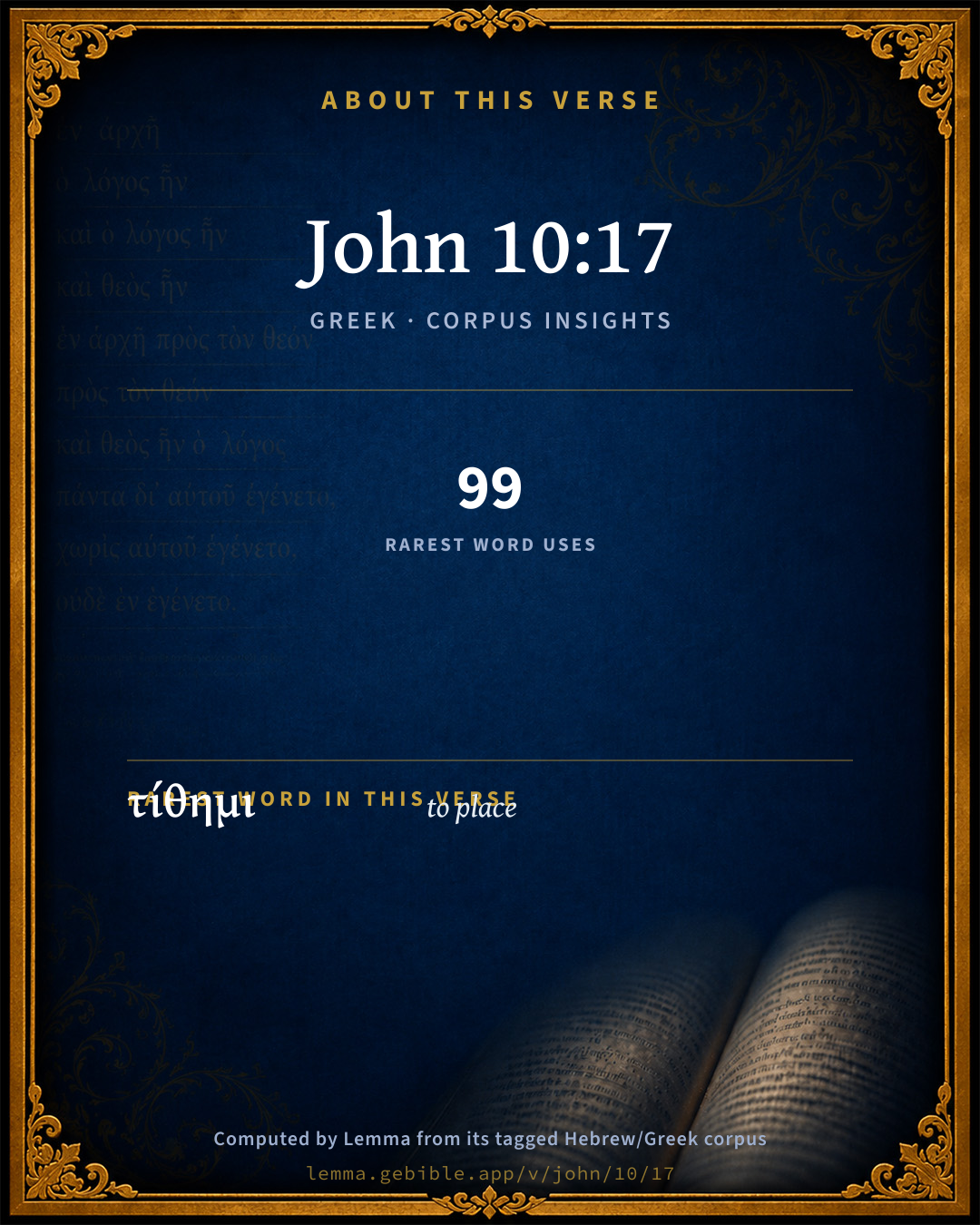
John 10:17

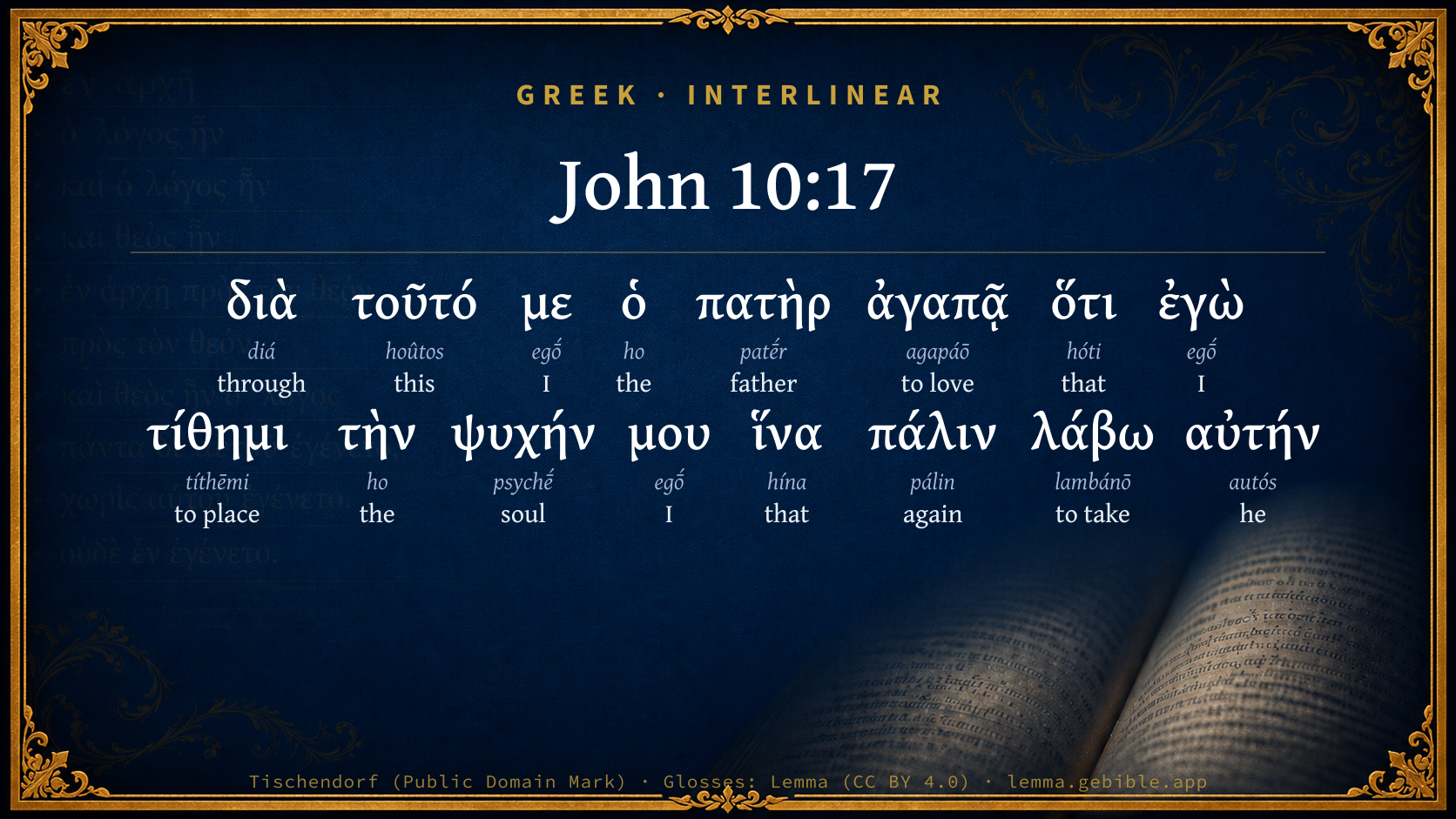
Greek (Tischendorf 8th ed.) John 10:17 appears in the Greek New Testament. The text above is from the Tischendorf 8th edition. Each word links to its Strong’s number and a concise gloss. Click any word for its full Thayer’s Greek Lexicon entry.
Download image
Cite this verse

John 10:17 (World English Bible). Public Domain. Lemma interlinear Bible study tool, https://lemma.gebible.app/v/john/10/17.

Show BibTeX & RIS
BibTeX
RIS
English Translation
Therefore the Father loves me, because I lay down my life, that I may take it again.
World English Bible · Public Domain
Download a study sheet

One document with this verse’s original text, its word-by-word gloss line, the meaning frame, cross-references with their text, attributed commentary, and full source and license credits — printable, and it pastes into notes with its structure intact.

This verse Autodidact and up

Study sheet (.html) Plain text (.txt)

A passage Seminary Student

Up to 50 verses in one chapter. A passage sheet keeps up to 6 commentary sources and 12 cross-references per verse, in the order this page ranks them, and says so on the sheet whenever that leaves anything out. Ask for a single verse and you get the Autodidact verse sheet above.

Everything on this page stays free to read, with no account — the sheet is a download of what is already on screen, not access to it.

Want to remove ads? Support Godless Engineer
Compare translations 3

The same verse in 3 English versions, stacked beneath the original-language interlinear above. Click any original word for its lexicon entry.

Each is an independent rendering of the whole verse — the interlinear is not word-aligned to these translations.

Highlighted words mark where these versions differ — a whole-verse word diff, not a word-by-word alignment.

  • World English Bible Public Domain
    Therefore the Father loves me, because I lay down my life, that I may take it again.
  • King James Version Public Domain
    Therefore doth my Father love me, because I lay down my life, that I might take it again.
  • unfoldingWord Literal Text CC BY-SA 4.0
    Because of this the Father loves me, because I lay down my life so that I might take it up again.

unfoldingWord Literal Text — © unfoldingWord, licensed CC BY-SA 4.0. Word-aligned USFM3 via Door43 (git.door43.org/unfoldingWord/en_ult).

Versions to compare (up to 4)

3 of 4 selected

Show all 19 translations

Every available English version of this verse, each an independent rendering of the whole verse.

  • World English Bible Public Domain
    Therefore the Father loves me, because I lay down my life, that I may take it again.
  • Berean Standard Bible Public Domain
    The reason the Father loves Me is that I lay down My life in order to take it up again.
  • Majority Standard Bible Public Domain
    The reason My Father loves Me is that I lay down My life in order to take it up again.
  • King James Version Public Domain
    Therefore doth my Father love me, because I lay down my life, that I might take it again.
  • American Standard Version (1901) Public Domain
    Therefore doth the Father love me, because I lay down my life, that I may take it again.
  • Revised Version (1885) Public Domain
    Therefore doth the Father love me, because I lay down my life, that I may take it again.
  • Geneva Bible (1599) Public Domain
    Therefore doeth my Father loue me, because I lay downe my life, that I might take it againe.
  • Douay-Rheims (1899) Public Domain
    Therefore doth the Father love me: because I lay down my life, that I may take it again.
  • Young's Literal Translation Public Domain
    `Because of this doth the Father love me, because I lay down my life, that again I may take it;
  • Literal Standard Version CC BY-SA 4.0
    Because of this the Father loves Me, because I lay down My life, that again I may take it;
  • Unlocked Literal Bible CC BY-SA 4.0
    This is why the Father loves me: I lay down my life so that I may take it again.
  • unfoldingWord Literal Text CC BY-SA 4.0
    Because of this the Father loves me, because I lay down my life so that I might take it up again.
  • Darby Bible Public Domain
    On this account the Father loves me, because I lay down my life that I may take it again.
  • World Messianic Bible Public Domain
    Therefore the Father loves me, because I lay down my life, that I may take it again.
  • Webster's Bible Public Domain
    Therefore doth my Father love me, because I lay down my life, that I may take it again.
  • Free Bible Version CC BY-SA 4.0
    This is why the Father loves me, because I lay down my life so I may take it up again.
  • Bible in Basic English Public Domain
    For this reason am I loved by the Father, because I give up my life so that I may take it again.
  • Text-Critical English NT CC BY 4.0
    This is why the Father loves me, because I lay down my life so that I may take it up again.
  • Tyndale New Testament (1534) Public Domain
    Therfore doth my father love me because I put my lyfe from me that I myght take it agayne.

Literal Standard Version (2020), Covenant Press — licensed CC BY-SA 4.0. Text via the HelloAO Bible API (eBible.org). Unlocked Literal Bible (unfoldingWord) — licensed CC BY-SA 4.0. Text via the HelloAO Bible API (eBible.org). unfoldingWord Literal Text — © unfoldingWord, licensed CC BY-SA 4.0. Word-aligned USFM3 via Door43 (git.door43.org/unfoldingWord/en_ult). Free Bible Version, Dr. Jonathan Gallagher — licensed CC BY-SA 4.0. Text via the HelloAO Bible API (eBible.org).

Word by word

More ways to search: Search by grammar → Find every occurrence → Compare this word →

Practice this passage: Drill this verse → Learn its vocabulary →

τίθημι
títhēmi
G5087
“to place”
Verb, Present, Active, Indicative, 1st person, Singular
Part of Speech
Verb
Tense
Present
Voice
Active
Mood
Indicative
Person
1st person
Number
Singular
Full Thayer's Definition

Origin: a prolonged form of a primary theo theh'-o (which is used only as alternate in certain tenses)

TDNT: 10:32,1

1. to set, put, place a. to place or lay b. to put down, lay down 1. to bend down 2. to lay off or aside, to wear or carry no longer 3. to lay by, lay aside money c. to set on (serve) something to eat or drink d. to set forth, something to be explained by discourse 2. to make a. to make (or set) for one's self or for one's use 3. to set, fix establish a. to set forth b. to establish, ordain
  1. διὰ diá G1223 “through” Preposition
  2. τοῦτό hoûtos G3778 “this” Demonstrative pronoun, Accusative, Singular, Neuter
  3. με egṓ G1473 “I” Personal pronoun, 1st person, Accusative, Singular
  4. ὁ ho G3588 “the” Article, Nominative, Singular, Masculine
  5. πατὴρ patḗr G3962 “father” Noun, Nominative, Singular, Masculine
  6. ἀγαπᾷ agapáō G25 “to love” Verb, Present, Active, Indicative, 3rd person, Singular
  7. ὅτι hóti G3754 “that” Conjunction
  8. ἐγὼ egṓ G1473 “I” Personal pronoun, 1st person, Nominative, Singular
  9. τὴν ho G3588 “the” Article, Accusative, Singular, Feminine
  10. ψυχήν psychḗ G5590 “soul” Noun, Accusative, Singular, Feminine
  11. μου egṓ G1473 “I” Personal pronoun, 1st person, Genitive, Singular
  12. ἵνα hína G2443 “that” Conjunction
  13. πάλιν pálin G3825 “again” Adverb
  14. λάβω lambánō G2983 “to take” Verb, Aorist, Active, Subjunctive, 1st person, Singular
  15. αὐτήν autós G846 “he” Personal pronoun, Accusative, Singular, Feminine

About this verse

These counts appear in no published source. They are computed here, from the morphology-tagged text and Lemma’s own curated glosses. What Lemma adds →

16
words
13
distinct lemmas
Gospels
section

Repetition

Words recur within this verse:

Cross-references

11

Topical passages linked to John 10:17 in the Treasury of Scripture Knowledge — connected by theme and wording, ordered by reader-vote popularity; previews shown in the World English Bible.

  • John 10:18 No one takes it away from me, but I lay it down by myself. I have power to lay it down, and I have power to take it again. I received this commandment from my Father."
  • John 10:15 even as the Father knows me, and I know the Father. I lay down my life for the sheep.
  • John 10:11 I am the good shepherd. The good shepherd lays down his life for the sheep.
  • Hebrews 2:9 But we see him who has been made a little lower than the angels, Jesus, because of the suffering of death crowned with glory and honor, that by the grace of God he should taste of death for everyone.
  • Isaiah 53:7–12 He was oppressed, yet when he was afflicted he didn't open his mouth; as a lamb that is led to the slaughter, and as a sheep that before its shearers is mute, so he didn't open his mouth.
  • John 15:9–10 Even as the Father has loved me, I also have loved you. Remain in my love.
  • John 17:4–5 I glorified you on the earth. I have accomplished the work which you have given me to do.
  • Isaiah 42:1 Behold, my servant, whom I uphold; my chosen, in whom my soul delights: I have put my Spirit on him; he will bring forth justice to the Gentiles.
  • John 17:24–26 Father, I desire that they also whom you have given me be with me where I am, that they may see my glory, which you have given me, for you loved me before the foundation of the world.
  • Isaiah 42:21 It pleased Yahweh, for his righteousness' sake, to magnify the law, and make it honorable.
  • John 3:25 There arose therefore a questioning on the part of John's disciples with some Jews about purification.

Cross-references courtesy of OpenBible.info (CC BY 4.0).

Commentary

Notes on John 10:17 from classic Christian and Jewish commentators (each source and its license shown beneath its notes). The classic Christian expositions comment on the surrounding passage and are grouped to its opening verse, so a note may address several verses; the Jewish commentaries on the Tanakh (Rashi and others) are per-verse, so they appear only where the commentator wrote on this verse.

Lemma curates 59 commentaries, every one of them public domain or Creative Commons licensed, each selected and text-cleaned for this edition rather than reprinted as found. About our sources →

Bengel's Gnomon

Johann Albrecht Bengel

Joh 10:17. Ἀγαπᾷ) loveth Me, and lovingly enjoins this on Me,—lovingly as it were persuades Me, and I, although I must lay down My life, remain sure of His love; for I lay it down, that I may take it up again: moreover the Father, in love to Me, gives Me the sheep as my peculiar portion; because I keep His commandment concerning the laying down of My life; Joh 10:18, “No man taketh it from Me, but I lay it down of Myself. I have power to lay it down, and I have power to take it again. This commandment have I received of My Father.” Love is intimated as coming over and above [supervenient. Coming as an extraneous addition]. The love of the Father is to be kept in sight, in the passion of Christ, not only towards us, but also towards Christ: we are not to look merely to His avenging severity [stern justice].

Bengel's Gnomon of the New Testament — English translation (T&T Clark, Edinburgh, 1860) — public domain. Text from a community e-Sword module.

Meyer's Critical & Exegetical Commentary

Heinrich August Wilhelm Meyer

Joh_10:17-18. Christs self-delineation as the Good Shepherd is finished. Jesus now further bears testimony to that which filled His heart, while setting forth this great vocation, which was only to be fulfilled by dying and rising again, namely, the love of His Father, which rests upon Him just because of that which He has declared concerning Himself as the good shepherd.

διὰ τοῦτο … ὅτι] is to be taken as in all the passages where it occurs in John (Joh_5:16; Joh_5:18, Joh_8:47, Joh_12:18; Joh_12:39; 1Jn_3:1): thereforebecause, namely, διὰ τοῦτο referring to what had preceded, and ὅτι introducing a more precise explication of διὰ τοῦτο. The sense consequently is: therefore, because of this my relationship as Shepherd, of which I have spoken down to Joh_10:16, my Father loves me, because, namely, I (ἐγώ; no other does so or can do so) lay down my life, in order to take it again. Note in particular: (1) The explanation ὅτι … μου is pragmatically correct, because it is just the readiness to sacrifice His life which is the main characteristic of the good shepherd (Joh_10:11; Joh_10:15). (2) ἵνα πάλ. λάβω αὐτήν do not belong to ἀγαπ., but express the intention or design of τίθ. τ. ψ. μου (not merely its result, as Theodore of Mopsuestia, Euth. Zigabenus, Grotius, and many suppose; or its condition, as Calvin, De Wette, and several others maintain); for the ground of the love of God lies not merely in the sacrifice considered by itself, but in the fact that the Good Shepherd, when He gives up His life, is resolved to take it again, in order that He may continue to fulfil His pastoral office till the final goal is reached, when all mankind shall constitute His flock. Indeed, only on the condition of His taking His life again, could He fulfil the office of Shepherd unto the final completion contemplated in the divine decree, and referred to in Joh_10:16. For this reason, also, ἵνα cannot be regarded as introducing the divine intention (Tholuck), because the ground of the Fathers love must lie in the volition of Jesus,which volition, it is true, corresponds to the Fathers will, though this is not here expressly declared, but first in Joh_10:18.

Joh_10:18. It must be, however, not an unwilling, but a voluntary self-sacrifice, if it is to form the ground of the love of the Father to Him; hence the words οὐδεὶς … ἀπʼ ἐμαυτοῦ (mea ipsius sponte). Nor must He proceed to effect this voluntary sacrifice of His own authority; but must receive a warrant thereto, as also for that which He had in view in so doing, viz. the resumption of His life; hence the words: ἐξουσίαν … λαβεῖν αὐτήν. Nay, more; even this very thing which He purposed to do, namely, the surrender and resumption of His life, must have come to Him as a commission from God; hence the expression: ταύτην τ. ἐντολὴν … πατρός μου, in which ταύτην (this and not something different) is emphatic, and τὴν ἐντολὴν is correlate to the idea of ἐξουσία, as this latter is grounded in the divine mandate. Notice further: (1) The ἐξουσία, the power conferred (so also in Joh_19:10 f., not power generally), lies in the relation of subordination to God, of whom the Son is the commissioned representative, and to whom He submits Himself voluntarily, i.e. from no compulsion exerted by a power outside of Himself, but with self-determined obedience to the Father (Joh_14:30 f.; Mat_26:53). Equality of nature (Olshausen) is the presupposition of this moral harmony. (2) The view which pervades the New Testament, that Christ did not raise Himself from the dead, but was raised by the Father, is not affected by this passage, inasmuch as the taking again of His life, for which the divine-human Christ had received authorization, implies the giving again of the life, to wit, the re-awakening activity of the Father. This giving again on the part of God, by which Christ becomes ζωοποιηθεὶς πνεύματι (see 1Pe_3:19, and Huther on the passage), and that ἐξουσία, which Christ receives from God, are the two factors of the resurrectionthe former being the causa efficiens, whilst the latter, the ἐξουσία of Christ, is the causa apprehendens. Compare Constitutiones Apostol. 5. 7. 8 : ἑαυτὸν προστάγματι τοῦ πατρὸς διὰ τριῶν ἡμερῶν ἀνεγείρας.(3) ταύτην τὴν ἐντολ. embraces the aforementioned twofold ἐξουσία; justly so, inasmuch as the authorization to die and to rise again was only formally divided according to its two aspects. Chrysostom and several others erroneously refer ταύτην to the dying alone.

Meyer — Critical and Exegetical Commentary on the New Testament — English translation by Peter Christie, edited by Frederick Crombie (T&T Clark, 1880) — public domain. Text from a community e-Sword module.

Expositor's Greek Testament

ed. W. Robertson Nicoll

Joh 10:17 . At this point the exposition of the functions of the good shepherd terminates; but as a note or appendix Jesus adds διὰ τοῦτο , “on this account,” i.e. , because I lay down my life for the sheep (Joh 10:15 and following clause) does my Father love me. The expressed ἐγώ serves to bring out the spontaneity of the surrender. And this free sacrifice or death is justified by the object, ἵνα πάλιν λάβω αὐτήν . He dies, not to remain in death and so leave the sheep defenceless, but to live again, to resume life in pursuance of the object for which He had given it. The freedom of the sacrifice is proved by His taking His life again. He was not compelled to die.

The Expositor's Greek Testament, edited by W. Robertson Nicoll (1897–1910) — public domain. Text from a community e-Sword module.

Geneva Bible (1599)

Geneva Bible translators

Christ is by the decree of the Father, the only true shepherd of the true Church, for he willingly gave his life for his sheep, and by his own power rose again to life.

He speaketh in the time that now is because Christ’s whole life was as it were a perpetual death.

Geneva Bible (1599) marginal notes — public domain. Text via Bolls.life.

Jamieson, Fausset & Brown

Robert Jamieson, A. R. Fausset & David Brown

Therefore doth my Father love me, because I lay down my life, &c.--As the highest act of the Son's love to the Father was the laying down of His life for the sheep at His "commandment," so the Father's love to Him as His incarnate Son reaches its consummation, and finds its highest justification, in that sublimest and most affecting of all acts.

that I might take it again--His resurrection-life being indispensable to the accomplishment of the fruit of His death.

Jamieson, Fausset & Brown — Commentary Critical and Explanatory on the Whole Bible (1871) — public domain (CC PDM 1.0). Text via the HelloAO Bible API.

Adam Clarke's Commentary

Verse 17. Therefore doth my Father love me] As I shall be shortly crucified by you, do not imagine that I am abandoned by my heavenly Father, and therefore fall thus into your hands. The Father loveth me particularly on this account, because I am going to lay down my life for the life of the world. Again, do not suppose that I shall be put to death by your rulers, because I have not strength to resist them. I LAY DOWN my life voluntarily and cheerfully; no one can take it away from me, see Joh 10:18; and I shall give you the fullest proof of my supreme power by raising, in three days, that very crucified, wounded body from the grave.

Adam Clarke's Commentary on the Bible (1810–1826) — public domain. Text from a community e-Sword/MySword module.

John Calvin's Commentaries

17. On this account the Father loveth me. There is, indeed, another and a higher reason why the Father loveth the Son; for it was not in vain that a voice was heard from heaven,

This is my beloved Son, in whom the good-pleasure of God dwells, (Matthew 3:17; 17:5.)

But as he was made man on our account, and as the Father delighted in him, in order that he might reconcile us to himself, we need not wonder if he declares it to be the reason why the Father loveth him, that our salvation is dearer to him than his own life. This is a wonderful commendation of the goodness of God to us, and ought justly to arouse our whole souls into rapturous admiration, that not only does God extend to us the love which is due to the only-begotten Son, but he refers it to us as the final cause. And indeed there was no necessity that Christ should take upon him our flesh, in which he was beloved, but that it might be the pledge of the mercy of his Father in redeeming us.

That I may take it again. As the disciples might be deeply grieved on account of what they had heard about the death of Christ, and as their faith might even be greatly shaken, he comforts them by the hope of his resurrection, which would speedily take place; as if he said, that he would not die on the condition of being swallowed up by death, but in order that he might soon rise again as a conqueror. And even at the present day, we ought to contemplate the death of Christ, so as to remember, at the same time, the glory of his resurrection. Thus, we know that he is life, because, in his contest with death, he obtained a splendid victory, and achieved a noble triumph.

John Calvin's Commentaries (1540-1563) — public domain. Text from the Calvin Translation Society English edition (1840s-50s) via the Christian Classics Ethereal Library (ccel.org). Calvin's coverage is partial (roughly two-thirds of the Bible); uncommented books and verses are honest gaps, never fabricated. The 19th-century editor's footnotes and remarks are omitted so the notes are faithfully Calvin's own voice.

Ellicott's Commentary for English Readers

(17) Therefore doth my Father love me . . . For the meaning of this difficult verse, comp. Notes on Joh_5:17 et seq., and on Php_2:8-9. The thought is that in the relation between the Father and the human nature of Christ, the reason of the Father’s love is based upon the self-devotion of the Son. He who so loved the world that he gave His only-begotten Son to die for it, loves the Son who of His own will gives Himself to die. It is, if we might presume so to speak, as though the salvation of mankind had called forth a new relation of love between the Father and the Son.

That I might take it again.—This is given as part of the reason of the Father’s love; and the words admit of no other construction. At first sight they seem to us paradoxical, beyond and against common feeling. In acts of sacrifice, the fact that that which is lost will be certainly regained, seems to us to take away all value from the act; but here the fact that Christ will lay down His life, is stated to be in order that He may take it again; and this is the foundation of the Father’s love! The key to the meaning is in the truth that for Christ the taking again of human life is itself a further sacrifice, and that this is necessary for the completion of the Great Shepherd’s work. The scattered sheep during the whole of the world’s existence are to be gathered in by Him whose continued union with human nature makes Him at once the Shepherd who gives His life for the sheep, and the Door by whom we ever have access to the Father.

A Bible Commentary for English Readers, edited by Charles John Ellicott (1878–1897) — public domain. Text from a community e-Sword module.

The Cambridge Bible for Schools and Colleges

gen. ed. J. J. S. Perowne

17. Therefore] Better, On this account, or, For this cause (Joh_12:18; Joh_12:27). See on Joh_7:22 and Joh_8:47, and comp. Joh_5:16; Joh_5:18, Joh_6:65. The Father’s love for the incarnate Son is intensified by the self-sacrifice of the Son.

that I might take it again] literally, in order that I may take it again. This clause is closely connected with the preceding one: ‘that’ depends upon ‘because.’ Only because Christ was to take His human life again was His death such as the Father could have approved. Had the Son returned to heaven at the Crucifixion leaving His humanity on the Cross, the salvation of mankind would not have been won, the sentence of death would not have been reversed, we should be ‘yet in our sins’ (1Co_15:17). Morever, in that case He would have ceased to be the Good Shepherd: He would have become like the hireling, casting aside his duty before it was completed. The office of the True Shepherd is not finished until all mankind become His flock; and this work continues from the Resurrection to the Day of Judgment.

The Cambridge Bible for Schools and Colleges (gen. ed. J. J. S. Perowne; Cambridge University Press, 1878–1918) — public domain. Text from a community e-Sword module.

John Gill's Exposition

Therefore doth my Father love me,.... Christ was the object of his Father's love from all eternity, and was loved by him on various accounts; first and chiefly, as his own Son, of the same nature with him, equal to him; and also as Mediator, engaging for, and on the behalf of his chosen people; and likewise as he was clothed with their nature, and even in his state of humiliation; and not only as subject to his ordinances, and obedient to his will, and doing what was pleasing in his sight, but likewise as suffering in their room and stead, and he loved him on this account; the bruising of him was a pleasure to him, not for the sake of that itself, but because hereby his counsels and decrees were accomplished, his covenant fulfilled, and the salvation of his people obtained: hence it follows here,

because I lay down my life; that is, for the sheep; to ransom them from sin and Satan, the law, its curse and condemnation, and from death and hell, wrath, ruin and destruction: and the laying down his life on this account, was not only well pleasing to his Father, but likewise was done, with the following view; or at least this was the event of it,

that I might take it again; as he did, by raising himself from the dead, by which he was declared to be the Son of God; and to have made full satisfaction to divine justice, for the sins of his people, and therefore rose again for their, justification; and to be the victorious conqueror over death, having now abolished it, and having in his hands the keys of it, the power over that, and the grave: and which life he took up again, by his divine power, and as the surety of his people, to use it for their good; by ascending to his God and theirs, entering into heaven as their forerunner, appearing in the presence of God for them, as their advocate, and ever living to make intercession for them.

John Gill's Exposition of the Whole Bible (1746–1763) — public domain (CC PDM 1.0). Text via the HelloAO Bible API.

Trapp's Complete Commentary

John Trapp

17 Therefore doth my Father love me, because I lay down my life, that I might take it again.

Ver. 17. Therefore doth my Father love me, because] This "because" is nota consecutionis, non causae, know from its consequences not from it cause, saith Beza.

I lay down my life] I do it even now; for he suffered many a little death all his life long, and at length the cursed death of the cross.

That I might take it again] For Christ’s being life essential, swallows up death in victory, as the fire swallows up the fuel, as Moses’ serpent swallowed up the sorcerers’ serpents, &c.

John Trapp, A Commentary or Exposition upon All the Books of the Old and New Testament (1647–1656) — public domain. Text from a community e-Sword module.

Albert Barnes' Notes on the Bible

I lay down my life - I give myself to die for my people, in Jewish and pagan lands. I offer myself a sacrifice to show the willingness of my Father to save them; to provide an atonement, and thus to open the way for their salvation. This proves that the salvation of man was an object dear to God, and that it was a source of special gratification to him that his Son was willing to lay down his life to accomplish his great purposes of benevolence.

That I might take it again - Be raised up from the dead, and glorified, and still carry on the work of redemption. See this same sentiment sublimely expressed in Phi 2:5-11.

Albert Barnes' Notes on the Bible (1834–1885) — public domain. Text from a community e-Sword/MySword module.

Haydock's Catholic Bible Commentary

Therefore doth the Father love me, because I lay down my life, &c. Christ here speaketh of himself, as made man for the redemption of mankind: or rather, as he was our Redeemer, both God and man: for he laid down his life, and died as man, and had power to take it up again, as God. Yet the command of laying it down, he as man received from the Father: thus as man, he was obedient to him even to the death on the cross. See Philippians ii. 8. (Witham)

George Leo Haydock (1774–1849), Haydock's Catholic Family Bible and Commentary, 1859 edition — public domain. Excludes Psalms (Douay-Rheims chapter numbering differs from Protestant) and Deuterocanonical books (Catholic canon only).

Matthew Poole's English Annotations

Christ here asserts two things.

1. That he was about to lay down his life, and should now very shortly lay it down; but yet so as he should take it again; that is, rise again from the dead; death should not have dominion over him: by which he comforteth his disciples concerning his death, declaring,

a) That he was a freewill offering, as he further openeth it in the next verse.

b) That he should not perish in the grave, but rise again from the dead.

2. That therefore the Father loved him; for:

a) By this means he declared himself with power to be the Son of God, and the Father could not but love his Son. And:

b) By this means also he humbled himself, and became obedient unto death, even the death of the cross, Phi 2:8.

So as that the Father had many reasons to love the Son; and amongst others, this obedience of his to death, even the accursed death upon the cross, to fulfil his Father’s will, for the redemption and salvation of the sons of men, was not the least: and by this also he commendeth his Father’s love to those that are his sheep, in that his Father loveth him with the more exceeding love, for laying down his life, to purchase their redemption and salvation.

Matthew Poole's English Annotations on the Holy Bible (1683–1685) — public domain. Text from a community e-Sword/MySword module.

Whedon's Commentary on the Bible

Daniel D. Whedon

17. Therefore doth my Father love me—The Son was given from love to man, in spite of God’s love for Him, to the end that God should love him therefor. The whole is grounded in the primitive love of the Father.

That I might take it again—So that the dying man might conquer a resurrection. And to the sight of men the death and resurrection process might be made visible in a representative case.

Daniel D. Whedon (gen. ed.), Commentary on the Old and New Testaments (1874–1909) — public domain. Text from a community e-Sword module.

The Pulpit Commentary

Therefore doth the Father love me, because I lay down my life, that I may take it again. The dia touto points to the whole of the previous statement, and oti to a more complete exposition of the precise point in it on which the Divine Father"s love (agaph) rests. The "I" and "me" refer to the incarnate Son, i.e. to the Divine-human Personality of the Lord Jesus Christ. The Father loveth me, because, not merely that I lay down my life, for such might be the consequence of helplessness in the presence of victorious and desperate foes. The love which merely "laid down life" would be a Buddha-like self-sacrifice, producing certain moral effects upon the minds of the onlookers, and revealing a large and loving sense of the need of others. Yet in such expression of his sacrificial love he would have relinquished his undertaking. There would have been no more that he could do for his flock, this Shepherd-functions would, in the consummating act, cease, he would be a beautiful Memory, not a living Energy; a glorious Example, not the Author of eternal salvation. He would cease to be the great Shepherd of the sheep. Now the Father"s love contemplated more than this, viz. the Lord"s own purpose to take up again that life which he was prepared voluntarily to lay down for the sheep. Thus he would indeed die, that he might be more of a Shepherd to them than he had ever been before. How otherwise would he personally bring the other sheep into his flock, or be known of them, as the Father was known by him? Christ declares that after his death he would still exercise royal rights, be as much a Divine-human Personality as ever. Christ, as a sinless Man, the sinless One, might indeed, after the victory over the tempter in the wilderness, or from the Mount of Transfiguration, have returned to the spiritual world without accomplishing an exodus on Golgotha, but he chose, he willed, to lay down his life. Having done this much, he might have joined the great majority, and been their Head and Chief, and left his work to be commented on by others. But such a consummation would have fallen far short of the true and sufficing object of the Father"s love. Christ declares that the very end of his death was his resurrection from death. In retaking his life, he is able to continue, on perfectly different terms, the shepherding of his people he becomes in the highest sense, the great Shepherd, the good Shepherd, the archetypal, and the veritable Shepherd of the flock of God.

Vers. 17, 18. The death of Christ.

I IT INVOLVES THE GREATEST SACRIFICE.

1. It was a sacrifice of life. "I lay down my life." It was his own life, and not that of another. Thousands of lives are sacrificed during war by the existing government; but these are the lives of others, and not their own. But the death of Christ involved the sacrifice of his own life. It was personal.

2. It was a sacrifice of the most precious life. Every life is very precious that of the flower or that of the animal; but human life is more precious still. Personally considered, every human life is equally precious; but relatively, some lives are more precious than others. The life of the general is thus more precious than that of the common soldier. But of all the lives that have graced this world, the life of Christ was the most precious and valuable.

(1) It was so in itself. What makes man"s life more precious than that of the animal, but its being the vehicle of a higher intelligence, and immortal and responsible spirit which makes him at once to belong to a higher order of being? The life of Christ was really human, but it was perfect and sinless. This, together with its mysterious union with the Divine nature, made him to stand alone a new and a higher order of being. He was Divine and yet human, human and yet Divine, which made his life infinitely valuable in itself.

(2) It was so in relation to this world. To this world how useful was such a life! What blessings of intelligence, revelation, holy example, spiritual communications, and of Divine benevolence it was calculated to bestow! The short time he was permitted to live proves this.

(3) It was so to the whole universe. The value of such a life was not confined to this world, but extended to the utmost regions of the Divine empire. Heaven was in close and constant communication with him during his earthly life, and he with it. How dear was he to the Father and all his holy family! How precious was his life! What a tax upon Divine affections was his death! Nature"s gloom on the occasion was but a faint shadow of heaven"s mourning. What a sacrifice!

3. It was a sacrifice involving the greatest sufferings.

(1) Think of the sinlessness of his nature. Sinfulness of nature habituates that nature to suffering. But Christ"s character was not only spotless, but his nature was sinless. Thus the very idea of death must be to him extremely repulsive, and its actual pangs beyond description painful.

(2) Think of the greatness of his nature. Little natures are capable of but very little pleasure or pain, but large natures are largely capable of both. The capacity of Christ for suffering is outside our experience and far beyond our comprehension.

(3) Think of the cruelty of his death. He suffered the death of crucifixion, with all its attendant shame, ignominy, pains, and agonies. All that infernal hatred could devise he had to suffer.

II HIS DEATH WAS PURELY SELF-SACRIFICING. To prove and illustrate this, consider the following things.

1. His life was absolutely his own. "My life." No other man can absolutely call his life his own. With the exception of Christ"s, every man"s life is borrowed; he is a tenant at will, and not from year to year, but from breath to breath. But Christ"s life was absolutely his own.

2. He had an absolute control over it. Not merely it was his own, but he could dispose of it as he wished. "No one taketh it from me.

(1) This was true with regard to all men. There was no power in Jerusalem, nor in Rome, nor in the whole world combined, that could take it from him.

(2) This was true with regard to the devil It is said that the devil had the power of death, and in a sense this was true. But it was not true with regard to Jesus; he was sinless, and he was almighty. He could say, "The prince of this world cometh," etc. He had neither a right to nor the power over the life of Christ.

(3) This was true with regard to the Father. In a true sense he is the absolute Proprietor of life; but this Jesus, as the Eternal Son, shared with him, and his incarnate life did not deprive him of this Divine prerogative. Even in that state it was given him to have life in himself. Thus the Father could not nor would not take it from him.

3. His death was purely voluntary.

(1) It was his own personal act. His life was absolutely his own, and he laid it down.

(2) It was the act of his free will and choice. There was no circumstantial and personal necessity, there was no coercion. Who on earth or in hell could coerce him? and who in heaven would? The self-sacrificing idea was purely voluntary and self-inspiring, and to carry it out cost him infinite condescension. He bad to become a man before he could have the power to lay down his life. He could not die in heaven; no one can die there, much less he who is the Life itself. But in human nature death to him was possible and right. It would be a small thing for a Being of infinite power and goodness to boast of his power and right to live; the great thing for him was to have the power to die. With becoming pride Jesus boasts of this. "I have power to lay it down." But all this was from his free and independent choice. "I lay it down of myself." In this, and in this alone with regard to the Father, he claims absolute independency of action, involving his perfect voluntariness the sweetest odor of the sacrifice.

(3) It was purely voluntary to the last. He could evade the cross, could come down from it, could live on it, and in spite of it and its agonies. "He bowed his head, gave up the ghost," etc.

4. His death wets purely vicarious. Every-man must die for himself. It is the debt of nature. But Christ had no debt of his own to pay. He came under the law of death to pay the debts of others, and. redeem them from the curse.

III HIS DEATH CALLED FORTH THE SPECIAL COMMENDATION OF THE FATHER. "Therefore doth," etc. For this:

1. As it was for the noblest purposes. "That I might take it again." These purposes were:

(1) The perfection of his own life. His mediatorial life was made perfect through sufferings. He attained a perfect life through death.

(2) The perfection of the lives of all believers in him. The lives of all believers are potentially perfect in his perfected and glorified life; for he died and triumphed, not for himself, but for others. "Because I live, ye shall live also." His life was more valuable when taken again than when laid down.

(3) These purposes were worthy of the sacrifice. There is adequate compensation. Even the precious life of Jesus was thus put out on good interest; there was no loss nor waste, but infinite gain. The gain of salvation to the world, the gain of unspeakable glory to the Divine throne. The purposes were well worthy of the Son and the Father.

2. As it was the fulfillment of Divine will.

(1) The salvation of the human race is a Divine idea, impulse, and plan.

(2) An infinite sacrifice was essential to carry this out. It was essential to satisfy the claims of Divine justice, law, and holiness, and also to satisfy human wants, and to remove sin and guilt and enmity. "Without the shedding of blood," etc., is a Divine sentiment, and it was ever echoed by the human conscience.

(3) The death of Christ fully met this requirement. In the sacrifice of Jesus, Divine love is satisfied and fulfilled. It finds a platform upon which to act, a channel through which to flow, and a suitable instrument by which to effect its grand purposes of mercy and salvation.

3. As it was a special act of obedience to the Divine will.

(1) His death was in obedience to a special expression of the Divine will. "This commandment have I," etc. This command was not arbitrary, but the eternal law of love. The principle of obedience in Christ is as old as the law of love in the Divine nature. But this self-sacrificing act was a special expression of it. And Jesus obeyed.

(2) It was in loving obedience to the Divine will. It was the obedience of love. There is no coercion in the command, there is no servility in the obedience. The command is the natural suggestion of love; the obedience is the natural response of love, the expression of loving sympathy sympathy of nature and purpose. The command was the expression of the Divine heart, and the law of obedience was in the heart of Jesus. It was the obedience of pure love.

(3) It was a practical and public manifestation of obedience to the Divine will. The Father needed no proof of the Son"s loving obedience. But the world, and perhaps the whole universe, needed this, and to them it was most important and beneficial. Christ gave a special proof and manifestation of this in his self-sacrificing death, which called forth a special expression of the Father"s commendation.

4. Jesus throughout was ever conscious of his Fathers approbation. This was felt:

(1) In his conscious power to lay down his life.

(2) In his conscious power to take it again. There is an inseparable connection between the two. He could not take it again without laying it down, and could not lay it down but in the certainty of taking it again. All have the power of laying down their lives, but not to take them again. Jesus had both the power of death and life, and the latter was the reward of his sell-sacrificing and loving obedience.

(3) In his conscious knowledge that the Father accepted and was pleased with his sacrifice. What can give us such pleasure and strength as to know that what we do is most gratifying to the chief object of our affection? Jesus felt that his sacrifice was accepted by his Father with infinite delight and gratitude. This was like a Divine sunbeam on his soul throughout the intense gloom of his humiliation and suffering.

LESSONS. We have here:

1. The highest example of pastoral fidelity and devotion.

2. The highest example of a noble and self-sacrificing life.

3. The highest example, of filial obedience.

4. The royal road to Gods special approbation. Follow the footsteps of Christ, in his self-sacrificing life, in his loving obedience; and this will result in our Father"s special commendation and love. B.T.

Vers. 17, 18. The dedicated life.

That the Father loved him Jesus was constantly asserting, and here we have the reason for that love.

I NOTICE THE GENERAL ELEMENT OF DEVOTION. Upon all self-sacrificing devotion the Father must look with a complacent eye. Because, if the spirit of devotion be in a man at all, the extent and the character of the devotion will depend upon the necessity and the claim. A few have become famous in history, not that they were more devoted than the many unnamed, but their devotion was shown on more memorable scenes. And when God looks upon his own children, from him who was peculiarly the Son of God downwards, this spirit of devotion in them is needful to give him pleasure. For behind this love of God toward his true children, there is love to the dying world, a love that can only be satisfied in proportion as that world receives eternal life. And if that world is to receive eternal life, it must be through the self-denying devotion of those who have received it already. Self-denying devotion is of the very essence of the new creature. And since Jesus stands at the very head of the new creation, we expect to find in him the noblest and most inspiring instance of this devotion.

II NOTICE THE ELEMENTS PECULIAR TO THE DEVOTION OF JESUS. The peculiar nature and mission of Jesus have to be considered. Jesus could do by his devotion what no ordinary human being could do. He laid down his life that he might take it again. His devotion would have been useless but for this ability to take up again what had been laid down. If he had simply laid his life down, and that had been the end of it, he would have done no more than thousands had done already and thousands have done since, Natural lives have been freely given up that other natural lives might be preserved. Oftener still perhaps they have been risked. But when Jesus laid down his life, the peculiarity lay here, that he did not preserve any other natural life by doing so. Nay more, he who laid down his life made it necessary for others to lay down their lives in turn. Jesus laid down his life to make manifest the reality of eternal life. It had to be made plain that Jesus did really lay down his life. We may talk of laying down our lives, but that is in spirit rather than reality, for our lives are not ours to lay down. Man"s natural life may be taken from him at any time. But Jesus evidently had a control over his life which we have not. Most important is that declaration, "No man taketh it from me;" and most important, too, is that other. declaration, "I have power or, "authority to lay it down." We need ever to recollect all that was voluntary, deliberate, foreseen, and intentional in the death of Jesus. On one side that death is the most concentrated illustration of human wickedness and corruption the world has ever seen. On the other side it is not so much an illustration as a development. Jesus shows us in himself a human possibility turned into reality. It had to be made very clear to him that he might lay his life down. And it has to be made very clear to us that there was nothing suicidal or despairing about this dedication. It was the free action of the wise Jesus, taking the path of duty and love. And let it not be said there was nothing difficult in this. As a matter of history, we know there was difficulty; let Gethsemane testify to that. We should need to have the nature of Jesus ourselves to comprehend whence all his difficulties and agonies arose. Y.

The Pulpit Commentary (1880–1919), ed. H.D.M. Spence-Jones & Joseph S. Exell — public domain. Text from a community e-Sword module.

John Wesley's Explanatory Notes

I lay down my life that I may take it again - I cheerfully die to expiate the sins of men, to the end I may rise again for their justification.

John Wesley, Explanatory Notes Upon the Whole Bible (1754–1765) — public domain. Text via the GEBible commentary corpus.

Kretzmann's Popular Commentary

Paul E. Kretzmann

The end of the discourse and its effect:

v. 17. Therefore doth My Father love Me, because I lay down My life, that I might take it again.

v. 18. No man taketh it from Me, but I lay it down of Myself. I have power to lay it down, and I have power to take it again. This commandment have I received of My Father.

v. 19. There was a division therefore again among the Jews for these sayings.

v. 20. And many of them said, He hath a devil, I and is mad; why hear ye Him?

v. 21. Others said, These are not the words of him that hath a devil. Can a devil open the eyes of the blind?

The chief proof and manifestation of the love of the Good Shepherd consists in this, that He lays down His life, His soul, as a ransom. The self-sacrifice of Jesus was altogether free and in no way forced upon Him. For that reason also did His Father love Him, because the Son was in such thorough accord with Him that He understood His will so completely and acted upon it so cheerfully. And in laying down His life, Jesus has a second object, namely, to take it again. To remain in death and So leave His sheep defenseless would render His entire ministry void. It was necessary for Christ to die, but just as necessary also for Him to arise again. As His sacrifice was free and voluntary, so His return to life must be a matter of His own power, of the deliberate use of His strength. The laying down of His life was not due to His yielding to His foes and their cunning; it was an act of His will. He had the power to give His life, to lay it down in death; but He had the power also to take it again. No other man could dream of having such power; every other person succumbs to death, but Jesus differs from all other men in this respect, because He is Himself true God. The fact of His voluntary death gave to His sacrifice its real worth and value; without such free will His sacrifice would have been in vain. And herein He agrees with His Father, whose command He has received and now carries out for the salvation of mankind.

The immediate effect of the entire discourse was that it caused a division among the Jews that were present. Many thought He was talking insane foolishness and that He was possessed of an evil spirit. That is the meanness, the devilish mind of the unbelievers, that they have nothing but mockery and blasphemy for the consoling, precious words of Christ concerning His shepherd’s love. But others took a more sensible view. The calm discourse of Jesus could hardly be put into the same category with the ravings of demoniacs. The devil is also able to perform seeming miracles, but never such as will benefit any person in body or soul. The miracle performed upon the blind man was of a nature to admit of only one explanation: divine interference. Thus there are always some people whose hearts accept the glorious truths of the Gospel and learn to trust in Jesus as their Savior.

Paul E. Kretzmann, Popular Commentary of the Bible (1921–1924) — public domain. Text from a community e-Sword module.

Burkitt's Expository Notes on the New Testament

William Burkitt

Hence note, 1. That Jesus Christ certainly foreknew his own death and resurrection.

2. That Christ was a volunteer in dying, He laid down his life, none could have taken it from him. ’Tis true, his death was a violent death, but a voluntary sacrifice; he died violently, but yet voluntarily: the hand of his enemies could never hurt him without his own consent.

3. That as Christ died voluntarily with respect to himself, so in a way of subjection to his Father’s command. This commandment have I received from my Father.

4. That this voluntary submission of Christ to die for us, was the ground of his Father’s love to him. Therefore doth my Father love me: because I lay down my life. Although the Father had many reasons to love the Son, yet none was stronger than this obedience of his to death, even the cursed death of the cross, for the redemption and salvation of lost sinners; therefore did the Father love him with a more exceeding love, because he laid down his life for his sheep.

William Burkitt's Expository Notes on the New Testament (1700–1703) — public domain. Text from a community e-Sword module.

unfoldingWord translationNotes

Door43 World Missions Community

Connecting Statement:

Jesus finishes speaking to the crowd.

This is why the Father loves me: I lay down my life

God's eternal plan was for God the Son to give his life to pay for the sins of humanity. Jesus' death on the cross reveals the intense love of the Son for the Father and of the Father for the Son.

Father

This is an important title for God. (See: Translating Son and Father)

loves

This kind of love comes from God and is focused on the good of others, even when it does not benefit oneself. This kind of love cares for others, no matter what they do.

I lay down my life so that I may take it again

This is a mild way for Jesus to say he will die and then will become alive again. AT: "I allow myself to die in order that I may bring myself back to life" (See: Euphemism)

I lay it down of myself

The reflexive pronoun "myself" is used here to emphasize that Jesus lays down his own life. No one takes it from him. AT: "I myself lay it down" (See: Reflexive Pronouns)

I have received this command from my Father

"This is what my Father has commanded me to do." The word "Father" is an important title for God. (See: Translating Son and Father)

translationWords

God the Father

love

authority

receive

command

unfoldingWord translationNotes — © Distant Shores Media and the Door43 World Missions Community, licensed CC BY-SA 4.0. Source: git.door43.org/Door43/en_tn.

Cambridge Greek Testament for Schools and Colleges

17. διὰ τοῦτο. For this cause: see on Joh 5:16, Joh 7:21. The Father’s love for the incarnate Son is intensified by the self-sacrifice of the Son, which was a προσφορὰ κ. θυσία τῷ θεῷ εἰς ὀσμὴν εὐωδίας (Eph 5:2).

ἵνα π. λάβω αὐ. In order that I may take it again. This clause is closely connected with the preceding one, ἵνα depending upon ὅτι κ.τ.λ. Christ died in order to rise again; and only because Christ was to take His human life again was His death such as the Father could have approved. Had the Son returned to heaven at the Crucifixion leaving His humanity on the Cross, the salvation of mankind would not have been won, the sentence of death would not have been reversed, we should be ‘yet in our sins’ (1Co 15:17). Moreover, in that case He would have ceased to be the Good Shepherd: He would have become like the hireling, casting aside his duty before it was completed. The office of the True Shepherd is not finished until all mankind become His flock; and this work continues from the Resurrection to the Day of Judgment.

Cambridge Greek Testament for Schools and Colleges (Cambridge University Press, 1896; 21 vols, various authors incl. Carr, Maclear, Plummer, Farrar, Lumby, Moule, M. R. James, Simcox) — public domain. Text from a community e-Sword module.

Alford’s Greek Testament

Henry Alford

17.] The λαλεῖν ἐν παροιμίαις is now over, and He speaks plainly,—My Father. In this wonderful verse lies the mystery of the love of the Father for the Son;—because the Son has condescended to the work of humiliation, and to earn the crown through the cross (see Php 2:8, Php 2:9, διό). The ἵνα here is strictly τελικόν,—in order that. “Without this purpose in view,” says Stier (iv. 504, edn. 2), “the Death of Christ would neither be lawful nor possible.”

Henry Alford, The Greek Testament (1849–1861) — public domain. Text from a community e-Sword module.

International Critical Commentary

17. διὰ τοῦτο … ὅτι. See on 5:16 for this favourite Johannine construction, διὰ τοῦτο referring to what follows. The meaning here is that God’s love for Jesus is drawn out by His voluntary sacrifice of His life in order that He may resume it after the Passion for the benefit of man. The same idea is found in Paul: “Wherefore God also highly exalted Him” (Php 2:9). See also Heb 2:9; and cf. Isa 53:12

με ὁ πατήρ. So אBDLΘ; the rec. has ὁ πατήρ με.

με ὁ πατήρ ἀγαπᾷ. Jn. generally uses ἀγαπᾶν of the mutual love of the Father and the Son (see on 3:16), but at 5:20 we find ὁ πατὴρ φιλεῖ τὸν υἱόν. See also on 3:35, 21:17, as to the alleged distinction in usage between ἀγαπᾶν and φιλεῖν, a distinction which is not observed in the Fourth Gospel.

ὅτι ἐγὼ τίθημι τὴν ψυχήν μου, sc. as a good shepherd does for his sheep (see on v. 11 for the phrase). The self-sacrificing love of Jesus for man draws out the love of the Father to Him. Love evokes love.

ἵνα πάλιν λάβω αὐτήν. ἵνα must be given its full telic force. It was in order that He might resume His Life, glorified through suffering, that Jesus submitted Himself to death. Death was the inevitable prelude to the power of His Resurrection Life. It was only after He had been “lifted up” on the cross that He could draw all men to Himself (12:32). The Spirit could not come until after the Passion (7:39, where see note). The purpose of the Passion was not only to exhibit His unselfish love; it was in order that He might resume His life, now enriched with quickening power as never before.

International Critical Commentary — older volumes (1896–1929), various authors — public domain. Text from a community e-Sword module.

Godet's Commentaries

Frédéric Louis Godet

Vv. 17, 18. “Therefore does my Father love me: because I give my life that I may take it again; 18 no one takes it away from me, but I give it of myself; I have power to give, and I have power to take it again: this commandment I received of my Father.”

Διὰ τοῦτο, for this reason, refers ordinarily in John to a previously expressed idea, but one which is about to be taken up and developed in the following clause, beginning with ὅτι (because). The same is the case here. It is because of His voluntary devotion to this great work (Joh 10:15-16) that His Father loves Him; that is to say, He adds, because He sacrifices His life to it, and this not in order absolutely to give it up, but with the express intention of recovering it, and thus of finishing the work of which He only makes a beginning here on the earth. No doubt, the Father eternally loves the Son; but, when once made man, the Son cannot be approved and loved by Him except on condition of perfectly realizing the new law of His existence, as Son of man. Now this law, which results for Him from the solidarity in which He is bound together with a fallen race, is that of saving it by the gift of His life; and the constant disposition of the Son to accept this obligation of love, is the object of the infinite satisfaction (of the ἀγαπᾷν) of the Father. It is in this sense that St. Paul calls the death of Jesus “an offering of a sweet smell” (Eph 5:2). The last words serve to complete the preceding idea: “because I give my life, and because I give it that I may take it again.” The self-devotion of the Son who consents to give His life is infinitely pleasing to the Father, but on one condition; that this gift be not the abandoning of humanity and of the work begun in it, which would be at the same time the forgetting of the glory of the Father. In other terms, the devotion to death would be of an evil sort if it had not for its end the return among men by means of the resurrection. As Luthardt with perfect correctness remarks: “Jesus must wish to resume His life again in order to continue, as glorified, His ministry of shepherd to the Church, especially to the Gentiles whom He has the mission to gather together (Eph 2:17).” The supreme end indicated in Joh 10:16 requires not only His death, but also His resurrection. It appears from the words: that I may take it again, that Jesus raises Himself from the dead.

And this is true, for if it is in the Father that the power lies which gives Him life, it is Himself who by His free will and His prayer calls upon His person the display of this power. Joh 10:18 is the emphatic reaffirmation of this character of freedom in the work of the Son, which alone makes it the object of the Father’s satisfaction. Hence the asyndeton. It is not through powerlessness that the shepherd will succumb to the hostile power; there will come a moment when He will Himself consent to His defeat (Joh 14:31). The word οὐδείς, no one, includes every creature; we may include in it God Himself, since if, in dying, the Son obeys the decree of the Father, He yet does it freely; God neither imposes on Him death nor resurrection. The words ἐξουσίαν ἔχω, I have the power (the competency, the authority), are repeated with a marked emphasis; Jesus had no obligation to die, not only because, not having sinned, He had the right to keep His holy life, but also because, even at the last moment, He could have asked for twelve legions of angels, who would have wrested Him from the hands of His enemies. In the same way, in giving up His life, it depended on Himself to demand it again or not to reclaim it. As Luthardt says: “In these two acts, the action of the Son comes before the action of the Father.” The last words: I have received this commandment, are ordinarily referred to the commandment to die and rise again which had been given to Him by the Father. But would not such an idea tend to weaken all that Jesus had just developed? The true movement of the passage is the affirming of the full independence of the Lord. This is the reason why it seems to me that it is better to apply the term τὴν ἐντολήν,this command, to the commission with which Jesus has come to the earth and which gives Him the right to make free use of His own person, to die and to revive at will. The tenor of this commission, when the Father sent Him, was this: “Thou canst die or not die, rise again or not rise again, according to the free aspirations of thy love.” Jesus calls it a command in order to cover with the veil of humility this incomparable prerogative.

Frédéric Louis Godet — Commentaries on Luke, John, Romans, and 1 Corinthians — English translation (T&T Clark, Edinburgh, 1870s–1890s) — public domain. Text from a community e-Sword module.

Lesson kit

Teaching starters — assembled from the data on this page, not authored interpretation. Every prompt links to the verse data it draws on. Edit before teaching.

John, in the Gospels, opens this verse with 16 words (13 distinct Greek lemmas). Its most distinctive word is títhēmi (“to place”). A historical commentator’s framing appears above. Read the whole chapter for the surrounding context.

Discussion questions

  1. How does “to place” (títhēmi) shape what this verse is saying?
  2. John 10:18 shares this passage’s theme. How do the two illuminate each other?
  3. “I” occurs 3× in this one verse. What is the effect of the repetition?
  4. These translations render this verse differently; the difference is in the English rendering, not the original. What questions does that raise?
  5. Reading how Bengel's Gnomon and Meyer's Critical & Exegetical Commentary read this verse, where do the two commentators agree and where do they part?

Things to notice

Reading settings

Reading text

Shown beneath each verse's original-language words.

Old Testament
Old Testament edition

Read the OT as the Masoretic Hebrew (MT) or the Greek Septuagint (LXX).

English shown for the Greek Septuagint (in the Hebrew ↔ Greek comparison).

Comparing translations? Open the Compare panel on any verse page to stack up to four side by side.