

Luke 6:23
Greek (Tischendorf 8th ed.) Luke 6:23 appears in the Greek New Testament. The text above is from the Tischendorf 8th edition. Each word links to its Strong’s number and a concise gloss. Click any word for its full Thayer’s Greek Lexicon entry.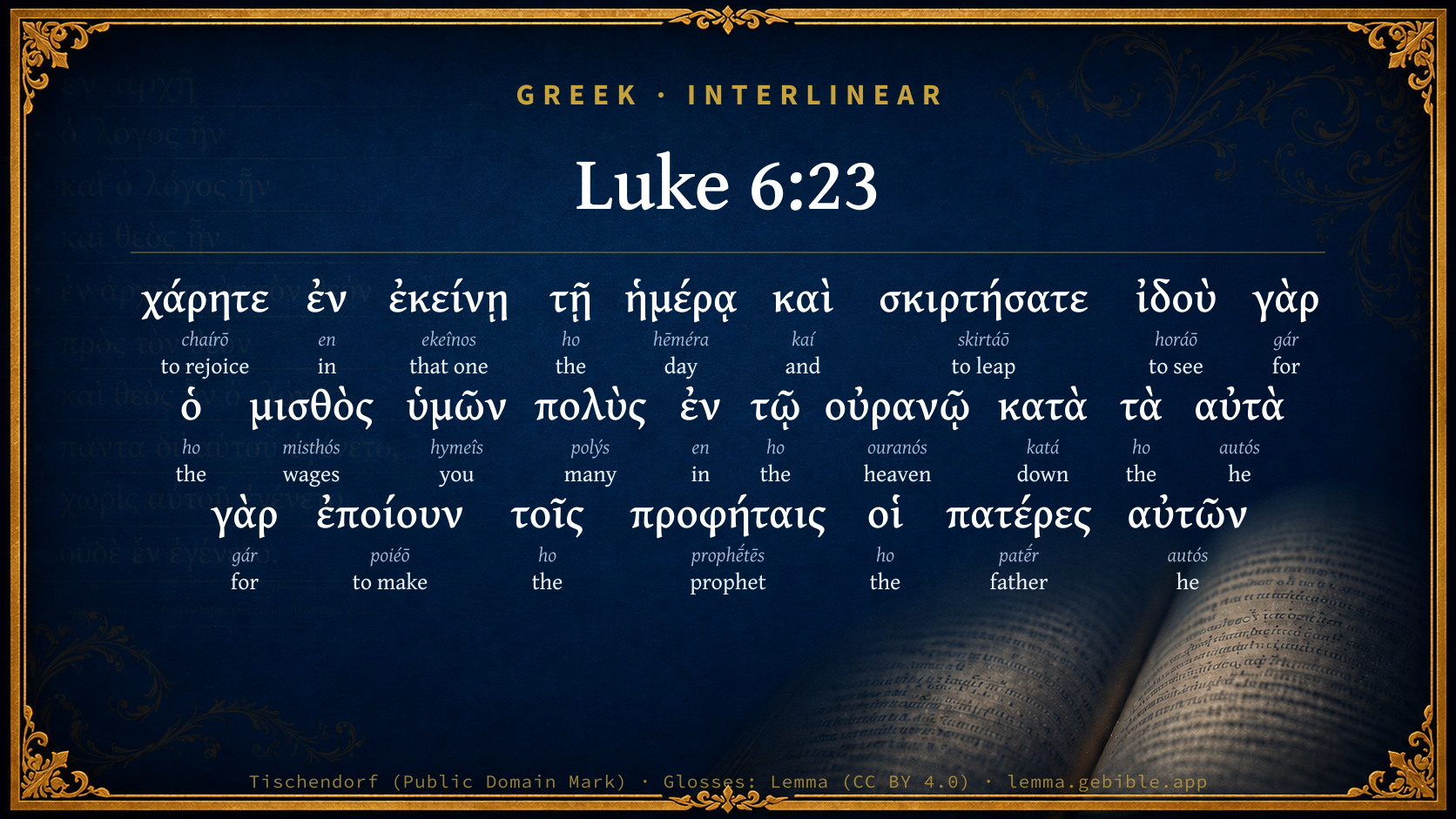
Rejoice in that day, and leap for joy, for behold, your reward is great in heaven, for their fathers did the same thing to the prophets.
Download a study sheet
One document with this verse’s original text, its word-by-word gloss line, the meaning frame, cross-references with their text, attributed commentary, and full source and license credits — printable, and it pastes into notes with its structure intact.
This verse Autodidact and up
A passage Seminary Student
Up to 50 verses in one chapter. A passage sheet keeps up to 6 commentary sources and 12 cross-references per verse, in the order this page ranks them, and says so on the sheet whenever that leaves anything out. Ask for a single verse and you get the Autodidact verse sheet above.
Everything on this page stays free to read, with no account — the sheet is a download of what is already on screen, not access to it.
Compare translations 3
The same verse in 3 English versions, stacked beneath the original-language interlinear above. Click any original word for its lexicon entry.
Each is an independent rendering of the whole verse — the interlinear is not word-aligned to these translations.
Highlighted words mark where these versions differ — a whole-verse word diff, not a word-by-word alignment.
-
World English Bible Public Domain
Rejoice in that day, and leap for joy, for behold, your reward is great in heaven, for their fathers did the same thing to the prophets.
-
King James Version Public Domain
Rejoice ye in that day, and leap for joy: for, behold, your reward is great in heaven: for in the like manner did their fathers unto the prophets.
-
unfoldingWord Literal Text CC BY-SA 4.0
Rejoice in that day and leap for joy, for behold, your reward great in heaven. For their fathers did according to the same things to the prophets.
unfoldingWord Literal Text — © unfoldingWord, licensed CC BY-SA 4.0. Word-aligned USFM3 via Door43 (git.door43.org/unfoldingWord/en_ult).
Show all 19 translations
Every available English version of this verse, each an independent rendering of the whole verse.
-
World English Bible Public Domain
Rejoice in that day, and leap for joy, for behold, your reward is great in heaven, for their fathers did the same thing to the prophets.
-
Berean Standard Bible Public Domain
Rejoice in that day and leap for joy, because great is your reward in heaven. For their fathers treated the prophets in the same way.
-
Majority Standard Bible Public Domain
Rejoice in that day and leap for joy, because great is your reward in heaven. For their fathers treated the prophets in the same way.
-
King James Version Public Domain
Rejoice ye in that day, and leap for joy: for, behold, your reward is great in heaven: for in the like manner did their fathers unto the prophets.
-
American Standard Version (1901) Public Domain
Rejoice in that day, and leap `for joy': for behold, your reward is great in heaven; for in the same manner did their fathers unto the prophets.
-
Revised Version (1885) Public Domain
Rejoice in that day, and leap for joy: for behold, your reward is great in heaven: for in the same manner did their fathers unto the prophets.
-
Geneva Bible (1599) Public Domain
Reioyce ye in that day, and be glad: for beholde, your reward is great in heauen: for after this maner their fathers did to the Prophets.
-
Douay-Rheims (1899) Public Domain
Be glad in that day and rejoice; for behold, your reward is great in heaven. For according to these things did their fathers to the prophets.
-
Young's Literal Translation Public Domain
rejoice in that day, and leap, for lo, your reward `is' great in the heaven, for according to these things were their fathers doing to the prophets.
-
Literal Standard Version CC BY-SA 4.0
rejoice in that day, and leap, for behold, your reward [is] great in Heaven, for according to these things were their fathers doing to the prophets.
-
Unlocked Literal Bible CC BY-SA 4.0
Rejoice in that day and leap for joy, because you will surely have a great reward in heaven, for their ancestors treated the prophets in the same way.
-
unfoldingWord Literal Text CC BY-SA 4.0
Rejoice in that day and leap for joy, for behold, your reward great in heaven. For their fathers did according to the same things to the prophets.
-
Darby Bible Public Domain
rejoice in that day and leap for joy, for behold, your reward is great in the heaven, for after this manner did their fathers act toward the prophets.
-
World Messianic Bible Public Domain
Rejoice in that day and leap for joy, for behold, your reward is great in heaven, for their fathers did the same thing to the prophets.
-
Webster's Bible Public Domain
Rejoice ye in that day, and leap for joy: for behold, your reward is great in heaven: for in the like manner did their fathers to the prophets.
-
Free Bible Version CC BY-SA 4.0
When that day comes, be happy. Jump for joy, for great is your reward in heaven. Don't forget their forefathers mistreated the prophets just like this.
-
Bible in Basic English Public Domain
Be glad in that day, and be lifted up for joy, for your reward in heaven will be great: for their fathers did these same things to the prophets.
-
Text-Critical English NT CC BY 4.0
Rejoice in that day and leap for joy, for behold, great is your reward in heaven, for their fathers treated the prophets in the same way.
-
Tyndale New Testament (1534) Public Domain
Reioyse ye then and be gladde: for beholde youre rewarde is greate in heven. After this manner their fathers entreated the Prophetes.
Literal Standard Version (2020), Covenant Press — licensed CC BY-SA 4.0. Text via the HelloAO Bible API (eBible.org). Unlocked Literal Bible (unfoldingWord) — licensed CC BY-SA 4.0. Text via the HelloAO Bible API (eBible.org). unfoldingWord Literal Text — © unfoldingWord, licensed CC BY-SA 4.0. Word-aligned USFM3 via Door43 (git.door43.org/unfoldingWord/en_ult). Free Bible Version, Dr. Jonathan Gallagher — licensed CC BY-SA 4.0. Text via the HelloAO Bible API (eBible.org).
Word by word
More ways to search: Search by grammar → Find every occurrence → Compare this word →
Practice this passage: Drill this verse → Learn its vocabulary →
- Appears 3× in the Greek New Testament
- First appears at Luke 1:41
- Part of Speech
- Verb
- Tense
- Aorist
- Voice
- Active
- Mood
- Imperative
- Person
- 2nd person
- Number
- Plural
Full Thayer's Definition
- χάρητε chaírō G5463 “to rejoice” Verb, Aorist, Passive deponent, Imperative, 2nd person, Plural
- ἐν en G1722 “in” Preposition
- ἐκείνῃ ekeînos G1565 “that one” Demonstrative pronoun, Dative, Singular, Feminine
- τῇ ho G3588 “the” Article, Dative, Singular, Feminine
- ἡμέρᾳ hēméra G2250 “day” Noun, Dative, Singular, Feminine
- καὶ kaí G2532 “and” Conjunction
- σκιρτήσατε skirtáō G4640 “to leap” Verb, Aorist, Active, Imperative, 2nd person, Plural
- ἰδοὺ horáō G3708 “to see” Verb, Aorist, Middle, Imperative, 2nd person, Singular
- γὰρ gár G1063 “for” Conjunction
- ὁ ho G3588 “the” Article, Nominative, Singular, Masculine
- μισθὸς misthós G3408 “wages” Noun, Nominative, Singular, Masculine
- ὑμῶν hymeîs G5210 “you” Personal pronoun, 2nd person, Genitive, Plural
- πολὺς polýs G4183 “many” Adjective, Nominative, Singular, Masculine
- ἐν en G1722 “in” Preposition
- τῷ ho G3588 “the” Article, Dative, Singular, Masculine
- οὐρανῷ ouranós G3772 “heaven” Noun, Dative, Singular, Masculine
- κατὰ katá G2596 “down” Preposition
- τὰ ho G3588 “the” Article, Accusative, Plural, Neuter
- αὐτὰ autós G846 “he” Personal pronoun, Accusative, Plural, Neuter
- γὰρ gár G1063 “for” Conjunction
- ἐποίουν poiéō G4160 “to make” Verb, Imperfect, Active, Indicative, 3rd person, Plural
- τοῖς ho G3588 “the” Article, Dative, Plural, Masculine
- προφήταις prophḗtēs G4396 “prophet” Noun, Dative, Plural, Masculine
- οἱ ho G3588 “the” Article, Nominative, Plural, Masculine
- πατέρες patḗr G3962 “father” Noun, Nominative, Plural, Masculine
- αὐτῶν autós G846 “he” Personal pronoun, Genitive, Plural, Masculine
About this verse
These counts appear in no published source. They are computed here, from the morphology-tagged text and Lemma’s own curated glosses. What Lemma adds →
- 26
- words
- 18
- distinct lemmas
- Gospels
- section
Cross-references
43Topical passages linked to Luke 6:23 in the Treasury of Scripture Knowledge — connected by theme and wording, ordered by reader-vote popularity; previews shown in the World English Bible.
- Matthew 5:12 Rejoice, and be exceedingly glad, for great is your reward in heaven. For that is how they persecuted the prophets who were before you.
- Acts 5:41 They therefore departed from the presence of the council, rejoicing that they were counted worthy to suffer dishonor for Jesus' name.
- Revelation 21:7 He who overcomes, I will give him these things. I will be his God, and he will be my son.
- Revelation 3:5 He who overcomes will be arrayed in white garments, and I will in no way blot his name out of the book of life, and I will confess his name before my Father, and before his angels.
- Revelation 3:12 He who overcomes, I will make him a pillar in the temple of my God, and he will go out from there no more. I will write on him the name of my God, and the name of the city of my God, the new Jerusalem, which comes down out of heaven from my God, and my own new name.
- 2 Chronicles 36:16 but they mocked the messengers of God, and despised his words, and scoffed at his prophets, until the wrath of Yahweh arose against his people, until there was no remedy.
- Acts 3:8 Leaping up, he stood, and began to walk. He entered with them into the temple, walking, leaping, and praising God.
- James 1:2 Count it all joy, my brothers, when you fall into various temptations,
- Revelation 2:10–11 Don't be afraid of the things which you are about to suffer. Behold, the devil is about to throw some of you into prison, that you may be tested; and you will have oppression for ten days. Be faithful to death, and I will give you the crown of life.
- Revelation 2:26 He who overcomes, and he who keeps my works to the end, to him I will give authority over the nations.
- 2 Samuel 6:16 It was so, as the ark of Yahweh came into the city of David, that Michal the daughter of Saul looked out at the window, and saw king David leaping and dancing before Yahweh; and she despised him in her heart.
- Nehemiah 9:26 Nevertheless they were disobedient, and rebelled against you, and cast your law behind their back, and killed your prophets that testified against them to turn them again to you, and they committed awful blasphemies.
- 2 Timothy 4:7–8 I have fought the good fight. I have finished the course. I have kept the faith.
- Hebrews 11:6 Without faith it is impossible to be well pleasing to him, for he who comes to God must believe that he exists, and that he is a rewarder of those who seek him.
- 1 Peter 4:13 But because you are partakers of Christ's sufferings, rejoice; that at the revelation of his glory also you may rejoice with exceeding joy.
- Revelation 2:7 He who has an ear, let him hear what the Spirit says to the assemblies. To him who overcomes I will give to eat of the tree of life, which is in the Paradise of my God.
- Revelation 2:17 He who has an ear, let him hear what the Spirit says to the assemblies. To him who overcomes, to him I will give of the hidden manna, and I will give him a white stone, and on the stone a new name written, which no one knows but he who receives it.
- 1 Kings 18:4 for it was so, when Jezebel cut off the prophets of Yahweh, that Obadiah took one hundred prophets, and hid them by fifty in a cave, and fed them with bread and water.)
- 1 Kings 19:2 Then Jezebel send a messenger to Elijah, saying, So let the gods do to me, and more also, if I don't make your life as the life of one of them by tomorrow about this time.
- 1 Kings 19:10 He said, I have been very jealous for Yahweh, the God of hosts; for the children of Israel have forsaken your covenant, thrown down your altars, and slain your prophets with the sword: and I, even I only, am left; and they seek my life, to take it away.
- 1 Kings 19:14 He said, I have been very jealous for Yahweh, the God of hosts; for the children of Israel have forsaken your covenant, thrown down your altars, and slain your prophets with the sword; and I, even I only, am left; and they seek my life, to take it away.
- 1 Kings 21:20 Ahab said to Elijah, Have you found me, my enemy? He answered, I have found you, because you have sold yourself to do that which is evil in the sight of Yahweh.
- 1 Kings 22:8 The king of Israel said to Jehoshaphat, there is yet one man by whom we may inquire of Yahweh, Micaiah the son of Imlah: but I hate him; for he does not prophesy good concerning me, but evil. Jehoshaphat said, "Don't let the king say so."
- 1 Kings 22:27 and say, Thus says the king, Put this fellow in the prison, and feed him with bread of affliction and with water of affliction, until I come in peace.
- 2 Kings 6:31 Then he said, God do so to me, and more also, if the head of Elisha the son of Shaphat shall stand on him this day.
- Isaiah 35:6 Then shall the lame man leap as a hart, and the tongue of the mute shall sing; for in the wilderness shall waters break out, and streams in the desert.
- Jeremiah 2:30 In vain have I struck your children; they received no correction: your own sword has devoured your prophets, like a destroying lion.
- Matthew 6:1–2 "Be careful that you don't do your charitable giving before men, to be seen by them, or else you have no reward from your Father who is in heaven.
- Matthew 21:35–36 The farmers took his servants, beat one, killed another, and stoned another.
- Matthew 23:31–37 Therefore you testify to yourselves that you are children of those who killed the prophets.
- Luke 1:41 It happened, when Elizabeth heard Mary's greeting, that the baby leaped in her womb, and Elizabeth was filled with the Holy Spirit.
- Luke 1:44 For behold, when the voice of your greeting came into my ears, the baby leaped in my womb for joy!
- Luke 6:35 But love your enemies, and do good, and lend, expecting nothing back; and your reward will be great, and you will be children of the Most High; for he is kind toward the unthankful and evil.
- Acts 7:51–52 "You stiff-necked and uncircumcised in heart and ears, you always resist the Holy Spirit! As your fathers did, so you do.
- Acts 14:10 said with a loud voice, "Stand upright on your feet!" He leaped up and walked.
- Romans 5:3 Not only this, but we also rejoice in our sufferings, knowing that suffering works perseverance;
- 2 Corinthians 12:10 Therefore I take pleasure in weaknesses, in injuries, in necessities, in persecutions, in distresses, for Christ's sake. For when I am weak, then am I strong.
- Colossians 1:24 Now I rejoice in my sufferings for your sake, and fill up on my part that which is lacking of the afflictions of Christ in my flesh for his body's sake, which is the assembly;
- 1 Thessalonians 2:14–15 For you, brothers, became imitators of the assemblies of God which are in Judea in Christ Jesus; for you also suffered the same things from your own countrymen, even as they did from the Jews;
- 2 Thessalonians 1:5–7 This is an obvious sign of the righteous judgment of God, to the end that you may be counted worthy of the Kingdom of God, for which you also suffer.
- 2 Timothy 2:12 If we endure, We will also reign with him. If we deny him, He also will deny us.
- Hebrews 11:26 accounting the reproach of Christ greater riches than the treasures of Egypt; for he looked to the reward.
- Hebrews 11:32–39 What more shall I say? For the time would fail me if I told of Gideon, Barak, Samson, Jephthah, David, Samuel, and the prophets;
Cross-references courtesy of OpenBible.info (CC BY 4.0).
Where the printed editions differ
1 variantPlaces in this verse where the major printed Greek editions disagree on the wording in a way that affects the translation — a comparison of editions, not a manuscript-by-manuscript collation. The editions are the modern critical texts (Nestlé-Aland 28/27, SBL, Westcott-Hort, Tregelles, Tyndale House) and the traditional texts behind the KJV (the Textus Receptus and the Byzantine/Majority text). It is not a claim about which reading is original.
-
Editions differ
τὰ
“the [things]”
In NA28NA27TynSBLWHTregTR»1Byz»1 Not in TRByz
Textual data: Translators Amalgamated Greek New Testament (STEPBible TAGNT) · CC BY 4.0.
Lesson kit
Teaching starters — assembled from the data on this page, not authored interpretation. Every prompt links to the verse data it draws on. Edit before teaching.
Luke, in the Gospels, opens this verse with 26 words (18 distinct Greek lemmas). Its most distinctive word is skirtáō (“to leap”). A historical commentator’s framing appears above. Read the whole chapter for the surrounding context.
Discussion questions
- What does “to leap” (skirtáō) contribute to the verse as a whole?
- Luke 1:41 shares the word «to leap» with this verse. How do the two illuminate each other?
- “the” occurs 6× in this one verse. What is the effect of the repetition?
- The translations on this page render this verse differently — a whole-verse word diff, not a word-by-word alignment. What might account for the different wordings?
- Reading how Tyndale Open Study Notes and Bengel's Gnomon read this verse, where do the two commentators agree and where do they part?
Things to notice
- These translations choose different wording for 6 words in this verse.
- “the” occurs 6× in this single verse.
- 18 distinct Greek lemmas span 26 words in this verse.
Commentary
Notes on Luke 6:23 from classic Christian and Jewish commentators (each source and its license shown beneath its notes). The classic Christian expositions comment on the surrounding passage and are grouped to its opening verse, so a note may address several verses; the Jewish commentaries on the Tanakh (Rashi and others) are per-verse, so they appear only where the commentator wrote on this verse.
Lemma curates 59 commentaries, every one of them public domain or Creative Commons licensed, each selected and text-cleaned for this edition rather than reprinted as found. About our sources →
Tyndale Open Study Notes
Tyndale Open Resources
Tyndale Open Study Notes — © Tyndale Open Resources, licensed CC BY-SA 4.0. Text via the HelloAO Bible API.
Bengel's Gnomon
Johann Albrecht Bengel
Bengel's Gnomon of the New Testament — English translation (T&T Clark, Edinburgh, 1860) — public domain. Text from a community e-Sword module.
Meyer's Critical & Exegetical Commentary
Heinrich August Wilhelm Meyer
Meyer — Critical and Exegetical Commentary on the New Testament — English translation by Peter Christie, edited by Frederick Crombie (T&T Clark, 1880) — public domain. Text from a community e-Sword module.
Expositor's Greek Testament
ed. W. Robertson Nicoll
The Expositor's Greek Testament, edited by W. Robertson Nicoll (1897–1910) — public domain. Text from a community e-Sword module.
Geneva Bible (1599)
Geneva Bible translators
Geneva Bible (1599) marginal notes — public domain. Text via Bolls.life.
Jamieson, Fausset & Brown
Robert Jamieson, A. R. Fausset & David Brown
Jamieson, Fausset & Brown — Commentary Critical and Explanatory on the Whole Bible (1871) — public domain (CC PDM 1.0). Text via the HelloAO Bible API.
Adam Clarke's Commentary
Adam Clarke's Commentary on the Bible (1810–1826) — public domain. Text from a community e-Sword/MySword module.
Ellicott's Commentary for English Readers
A Bible Commentary for English Readers, edited by Charles John Ellicott (1878–1897) — public domain. Text from a community e-Sword module.
The Cambridge Bible for Schools and Colleges
gen. ed. J. J. S. Perowne
The Cambridge Bible for Schools and Colleges (gen. ed. J. J. S. Perowne; Cambridge University Press, 1878–1918) — public domain. Text from a community e-Sword module.
John Gill's Exposition
John Gill's Exposition of the Whole Bible (1746–1763) — public domain (CC PDM 1.0). Text via the HelloAO Bible API.
Trapp's Complete Commentary
John Trapp
John Trapp, A Commentary or Exposition upon All the Books of the Old and New Testament (1647–1656) — public domain. Text from a community e-Sword module.
The Pulpit Commentary
The Pulpit Commentary (1880–1919), ed. H.D.M. Spence-Jones & Joseph S. Exell — public domain. Text from a community e-Sword module.
Cambridge Greek Testament for Schools and Colleges
Cambridge Greek Testament for Schools and Colleges (Cambridge University Press, 1896; 21 vols, various authors incl. Carr, Maclear, Plummer, Farrar, Lumby, Moule, M. R. James, Simcox) — public domain. Text from a community e-Sword module.
Alford’s Greek Testament
Henry Alford
Henry Alford, The Greek Testament (1849–1861) — public domain. Text from a community e-Sword module.
International Critical Commentary
International Critical Commentary — older volumes (1896–1929), various authors — public domain. Text from a community e-Sword module.
Vincent's Word Studies in the New Testament
Marvin R. Vincent
Marvin R. Vincent, Word Studies in the New Testament (1887–1900) — public domain. Text from a community e-Sword/MySword module.