

Luke 16:27
Greek (Tischendorf 8th ed.) Luke 16:27 appears in the Greek New Testament. The text above is from the Tischendorf 8th edition. Each word links to its Strong’s number and a concise gloss. Click any word for its full Thayer’s Greek Lexicon entry.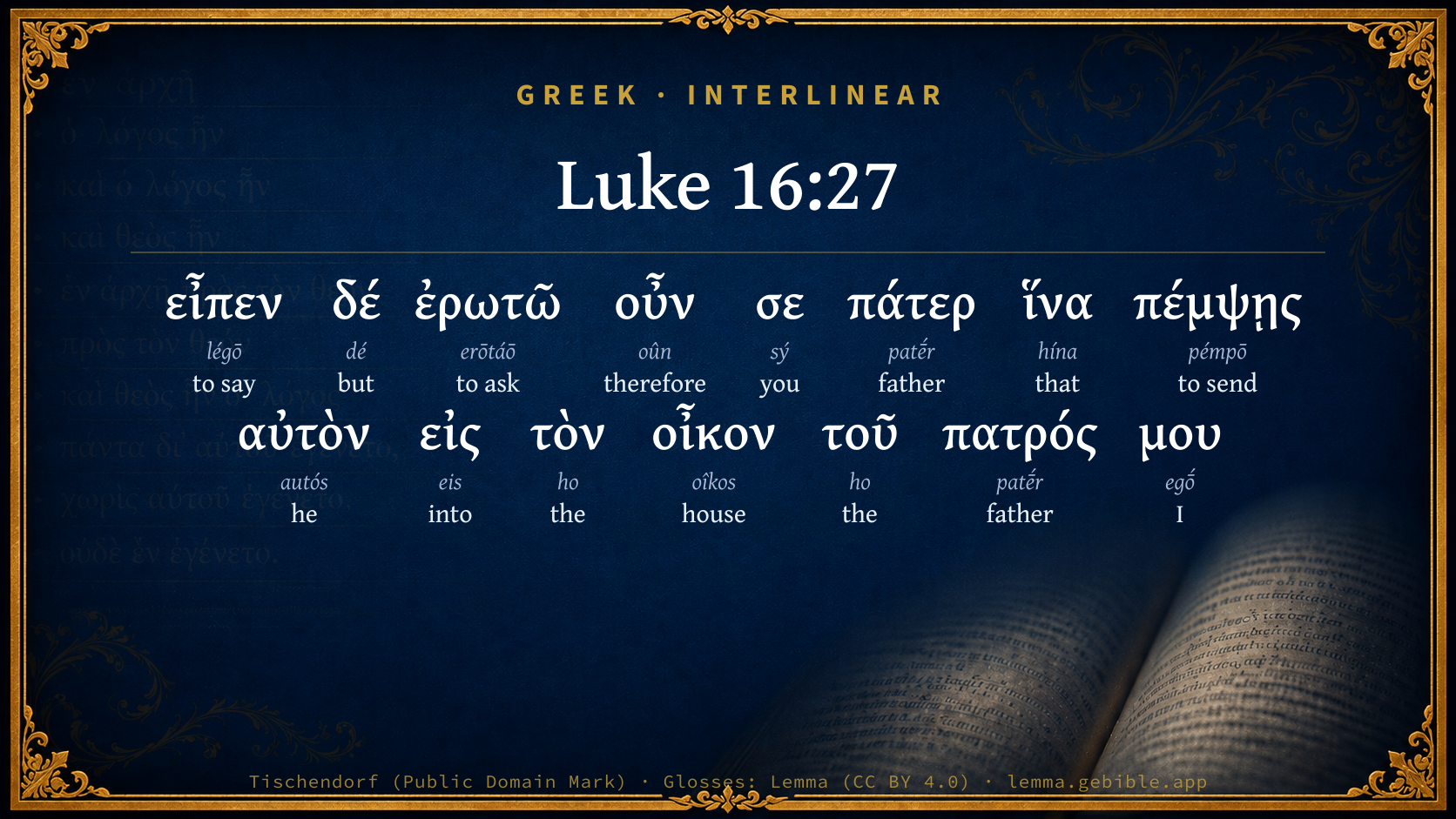
"He said, 'I ask you therefore, father, that you would send him to my father's house;
Download a study sheet
One document with this verse’s original text, its word-by-word gloss line, the meaning frame, cross-references with their text, attributed commentary, and full source and license credits — printable, and it pastes into notes with its structure intact.
This verse Autodidact and up
A passage Seminary Student
Up to 50 verses in one chapter. A passage sheet keeps up to 6 commentary sources and 12 cross-references per verse, in the order this page ranks them, and says so on the sheet whenever that leaves anything out. Ask for a single verse and you get the Autodidact verse sheet above.
Everything on this page stays free to read, with no account — the sheet is a download of what is already on screen, not access to it.
Compare translations 3
The same verse in 3 English versions, stacked beneath the original-language interlinear above. Click any original word for its lexicon entry.
Each is an independent rendering of the whole verse — the interlinear is not word-aligned to these translations.
Highlighted words mark where these versions differ — a whole-verse word diff, not a word-by-word alignment.
-
World English Bible Public Domain
"He said, 'I ask you therefore, father, that you would send him to my father's house;
-
King James Version Public Domain
Then he said, I pray thee therefore, father, that thou wouldest send him to my father's house:
-
unfoldingWord Literal Text CC BY-SA 4.0
Then he said, ‘I beg you then, Father, that you would send him to the house of my father—
unfoldingWord Literal Text — © unfoldingWord, licensed CC BY-SA 4.0. Word-aligned USFM3 via Door43 (git.door43.org/unfoldingWord/en_ult).
Show all 19 translations
Every available English version of this verse, each an independent rendering of the whole verse.
-
World English Bible Public Domain
"He said, 'I ask you therefore, father, that you would send him to my father's house;
-
Berean Standard Bible Public Domain
‘Then I beg you, father,’ he said, ‘send Lazarus to my father’s house,
-
Majority Standard Bible Public Domain
‘Then I beg you, father,’ he said, ‘send Lazarus to my father’s house,
-
King James Version Public Domain
Then he said, I pray thee therefore, father, that thou wouldest send him to my father's house:
-
American Standard Version (1901) Public Domain
And he said, I pray thee therefore, father, that thou wouldest send him to my father's house;
-
Revised Version (1885) Public Domain
And he said, I pray thee therefore, father, that thou wouldest send him to my father’s house;
-
Geneva Bible (1599) Public Domain
Then he said, I pray thee therfore, father, that thou wouldest sende him to my fathers house,
-
Douay-Rheims (1899) Public Domain
And he said: Then, father, I beseech thee, that thou wouldst send him to my father's house, for I have five brethren,
-
Young's Literal Translation Public Domain
`And he said, I pray thee, then, father, that thou mayest send him to the house of my father,
-
Literal Standard Version CC BY-SA 4.0
And he said, I ask, then, father, that you may send him to the house of my father,
-
Unlocked Literal Bible CC BY-SA 4.0
The rich man said, 'I beg you, Father Abraham, that you would send him to my father's house—
-
unfoldingWord Literal Text CC BY-SA 4.0
Then he said, ‘I beg you then, Father, that you would send him to the house of my father—
-
Darby Bible Public Domain
And he said, I beseech thee then, father, that thou wouldest send him to the house of my father,
-
World Messianic Bible Public Domain
“He said, ‘I ask you therefore, father, that you would send him to my father’s house—
-
Webster's Bible Public Domain
Then he said, I pray thee therefore, father, that thou wouldst send him to my father's house:
-
Free Bible Version CC BY-SA 4.0
The rich man said, ‘Then Father, I beg you, please send him to my father's house.
-
Bible in Basic English Public Domain
And he said, Father, it is my request that you will send him to my father's house;
-
Text-Critical English NT CC BY 4.0
The rich man said, ‘Then I beg yoʋ, father, to send Lazarus to my father's house,
-
Tyndale New Testament (1534) Public Domain
Then he sayd: I praye the therfore father send him to my fathers housse.
Literal Standard Version (2020), Covenant Press — licensed CC BY-SA 4.0. Text via the HelloAO Bible API (eBible.org). Unlocked Literal Bible (unfoldingWord) — licensed CC BY-SA 4.0. Text via the HelloAO Bible API (eBible.org). unfoldingWord Literal Text — © unfoldingWord, licensed CC BY-SA 4.0. Word-aligned USFM3 via Door43 (git.door43.org/unfoldingWord/en_ult). Free Bible Version, Dr. Jonathan Gallagher — licensed CC BY-SA 4.0. Text via the HelloAO Bible API (eBible.org).
Word by word
More ways to search: Search by grammar → Find every occurrence → Compare this word →
Practice this passage: Drill this verse → Learn its vocabulary →
- Appears 64× in the Greek New Testament
- First appears at Matthew 15:23
- Part of Speech
- Verb
- Tense
- Present
- Voice
- Active
- Mood
- Indicative
- Person
- 1st person
- Number
- Singular
Full Thayer's Definition
- εἶπεν légō G3004 “to say” Verb, Aorist, Active, Indicative, 3rd person, Singular
- δέ dé G1161 “but” Conjunction
- ἐρωτῶ erōtáō G2065 “to ask” Verb, Present, Active, Indicative, 1st person, Singular
- οὖν oûn G3767 “therefore” Conjunction
- σε sý G4771 “you” Personal pronoun, 2nd person, Accusative, Singular
- πάτερ patḗr G3962 “father” Noun, Vocative, Singular, Masculine
- ἵνα hína G2443 “that” Conjunction
- πέμψῃς pémpō G3992 “to send” Verb, Aorist, Active, Subjunctive, 2nd person, Singular
- αὐτὸν autós G846 “he” Personal pronoun, Accusative, Singular, Masculine
- εἰς eis G1519 “into” Preposition
- τὸν ho G3588 “the” Article, Accusative, Singular, Masculine
- οἶκον oîkos G3624 “house” Noun, Accusative, Singular, Masculine
- τοῦ ho G3588 “the” Article, Genitive, Singular, Masculine
- πατρός patḗr G3962 “father” Noun, Genitive, Singular, Masculine
- μου egṓ G1473 “I” Personal pronoun, 1st person, Genitive, Singular
About this verse
These counts appear in no published source. They are computed here, from the morphology-tagged text and Lemma’s own curated glosses. What Lemma adds →
- 15
- words
- 13
- distinct lemmas
- Gospels
- section
Lesson kit
Teaching starters — assembled from the data on this page, not authored interpretation. Every prompt links to the verse data it draws on. Edit before teaching.
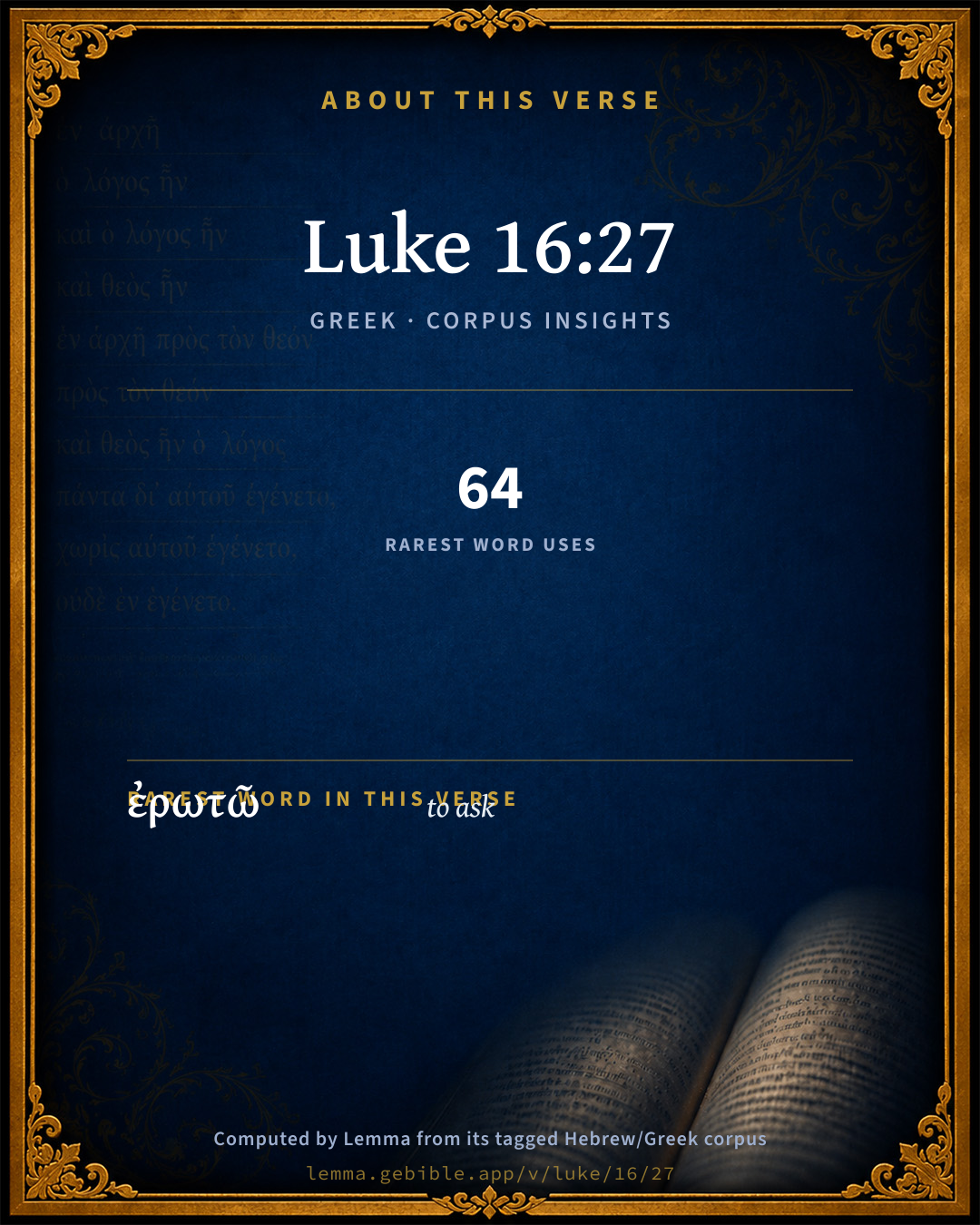
Luke, in the Gospels, opens this verse with 15 words (13 distinct Greek lemmas). Its most distinctive word is erōtáō (“to ask”). A historical commentator’s framing appears above. Read the whole chapter for the surrounding context.
Discussion questions
- The word erōtáō carries the sense “to ask.” How does it shape the verse?
- What does the repetition of “father” (2× in this one verse) do in this verse?
- These translations render this verse differently. What is at stake in choosing one wording over another?
- Compare how Meyer's Critical & Exegetical Commentary and Expositor's Greek Testament read this verse. Where do they agree or differ?
Things to notice
- These translations choose different wording for 8 words in this verse.
- “father” occurs 2× in this single verse.
- 13 distinct Greek lemmas span 15 words in this verse.
Commentary
Notes on Luke 16:27 from classic Christian and Jewish commentators (each source and its license shown beneath its notes). The classic Christian expositions comment on the surrounding passage and are grouped to its opening verse, so a note may address several verses; the Jewish commentaries on the Tanakh (Rashi and others) are per-verse, so they appear only where the commentator wrote on this verse.
Lemma curates 59 commentaries, every one of them public domain or Creative Commons licensed, each selected and text-cleaned for this edition rather than reprinted as found. About our sources →
Meyer's Critical & Exegetical Commentary
Heinrich August Wilhelm Meyer
Meyer — Critical and Exegetical Commentary on the New Testament — English translation by Peter Christie, edited by Frederick Crombie (T&T Clark, 1880) — public domain. Text from a community e-Sword module.
Expositor's Greek Testament
ed. W. Robertson Nicoll
The Expositor's Greek Testament, edited by W. Robertson Nicoll (1897–1910) — public domain. Text from a community e-Sword module.
Godet's Commentaries
Frédéric Louis Godet
Frédéric Louis Godet — Commentaries on Luke, John, Romans, and 1 Corinthians — English translation (T&T Clark, Edinburgh, 1870s–1890s) — public domain. Text from a community e-Sword module.
Geneva Bible (1599)
Geneva Bible translators
Geneva Bible (1599) marginal notes — public domain. Text via Bolls.life.
Jamieson, Fausset & Brown
Robert Jamieson, A. R. Fausset & David Brown
Jamieson, Fausset & Brown — Commentary Critical and Explanatory on the Whole Bible (1871) — public domain (CC PDM 1.0). Text via the HelloAO Bible API.
Ellicott's Commentary for English Readers
A Bible Commentary for English Readers, edited by Charles John Ellicott (1878–1897) — public domain. Text from a community e-Sword module.
The Cambridge Bible for Schools and Colleges
gen. ed. J. J. S. Perowne
The Cambridge Bible for Schools and Colleges (gen. ed. J. J. S. Perowne; Cambridge University Press, 1878–1918) — public domain. Text from a community e-Sword module.
John Gill's Exposition
John Gill's Exposition of the Whole Bible (1746–1763) — public domain (CC PDM 1.0). Text via the HelloAO Bible API.
Trapp's Complete Commentary
John Trapp
John Trapp, A Commentary or Exposition upon All the Books of the Old and New Testament (1647–1656) — public domain. Text from a community e-Sword module.
Albert Barnes' Notes on the Bible
Albert Barnes' Notes on the Bible (1834–1885) — public domain. Text from a community e-Sword/MySword module.
Haydock's Catholic Bible Commentary
George Leo Haydock (1774–1849), Haydock's Catholic Family Bible and Commentary, 1859 edition — public domain. Excludes Psalms (Douay-Rheims chapter numbering differs from Protestant) and Deuterocanonical books (Catholic canon only).
Matthew Poole's English Annotations
Matthew Poole's English Annotations on the Holy Bible (1683–1685) — public domain. Text from a community e-Sword/MySword module.
The Pulpit Commentary
The Pulpit Commentary (1880–1919), ed. H.D.M. Spence-Jones & Joseph S. Exell — public domain. Text from a community e-Sword module.
Kretzmann's Popular Commentary
Paul E. Kretzmann
Paul E. Kretzmann, Popular Commentary of the Bible (1921–1924) — public domain. Text from a community e-Sword module.
Burkitt's Expository Notes on the New Testament
William Burkitt
William Burkitt's Expository Notes on the New Testament (1700–1703) — public domain. Text from a community e-Sword module.
The People's New Testament
B. W. Johnson
B. W. Johnson's The People's New Testament with Notes (1889–1891) — public domain. Electronic text from the Christian Classics Ethereal Library (CCEL) ThML edition.
unfoldingWord translationNotes
Door43 World Missions Community
unfoldingWord translationNotes — © Distant Shores Media and the Door43 World Missions Community, licensed CC BY-SA 4.0. Source: git.door43.org/Door43/en_tn.
Cambridge Greek Testament for Schools and Colleges
Cambridge Greek Testament for Schools and Colleges (Cambridge University Press, 1896; 21 vols, various authors incl. Carr, Maclear, Plummer, Farrar, Lumby, Moule, M. R. James, Simcox) — public domain. Text from a community e-Sword module.
Alford’s Greek Testament
Henry Alford
Henry Alford, The Greek Testament (1849–1861) — public domain. Text from a community e-Sword module.
International Critical Commentary
International Critical Commentary — older volumes (1896–1929), various authors — public domain. Text from a community e-Sword module.
Vincent's Word Studies in the New Testament
Marvin R. Vincent
Marvin R. Vincent, Word Studies in the New Testament (1887–1900) — public domain. Text from a community e-Sword/MySword module.