John 14:23

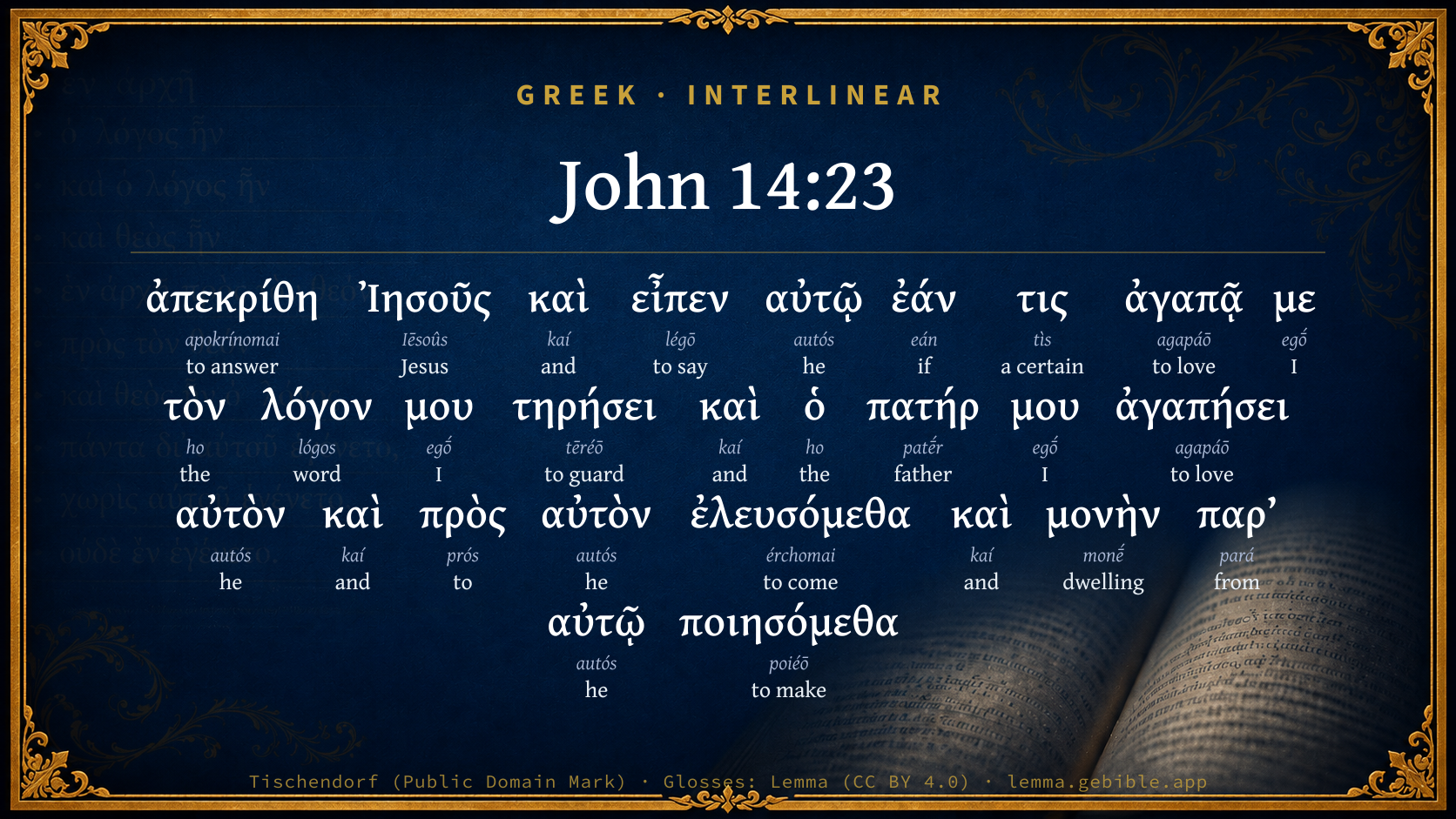
Greek (Tischendorf 8th ed.) John 14:23 appears in the Greek New Testament. The text above is from the Tischendorf 8th edition. Each word links to its Strong’s number and a concise gloss. Click any word for its full Thayer’s Greek Lexicon entry.
Download image
Cite this verse

John 14:23 (World English Bible). Public Domain. Lemma interlinear Bible study tool, https://lemma.gebible.app/v/john/14/23.

Show BibTeX & RIS
BibTeX
RIS
English Translation
Jesus answered him, "If a man loves me, he will keep my word. My Father will love him, and we will come to him, and make our home with him.
World English Bible · Public Domain
Download a study sheet

One document with this verse’s original text, its word-by-word gloss line, the meaning frame, cross-references with their text, attributed commentary, and full source and license credits — printable, and it pastes into notes with its structure intact.

This verse Autodidact and up

Study sheet (.html) Plain text (.txt)

A passage Seminary Student

Up to 50 verses in one chapter. A passage sheet keeps up to 6 commentary sources and 12 cross-references per verse, in the order this page ranks them, and says so on the sheet whenever that leaves anything out. Ask for a single verse and you get the Autodidact verse sheet above.

Everything on this page stays free to read, with no account — the sheet is a download of what is already on screen, not access to it.

Want to remove ads? Support Godless Engineer
Compare translations 3

The same verse in 3 English versions, stacked beneath the original-language interlinear above. Click any original word for its lexicon entry.

Each is an independent rendering of the whole verse — the interlinear is not word-aligned to these translations.

Highlighted words mark where these versions differ — a whole-verse word diff, not a word-by-word alignment.

  • World English Bible Public Domain
    Jesus answered him, "If a man loves me, he will keep my word. My Father will love him, and we will come to him, and make our home with him.
  • King James Version Public Domain
    Jesus answered and said unto him, If a man love me, he will keep my words: and my Father will love him, and we will come unto him, and make our abode with him.
  • unfoldingWord Literal Text CC BY-SA 4.0
    Jesus answered and said to him, “If anyone loves me, he will keep my word. And my Father will love him, and we will come to him, and we will make a dwelling place with him.

unfoldingWord Literal Text — © unfoldingWord, licensed CC BY-SA 4.0. Word-aligned USFM3 via Door43 (git.door43.org/unfoldingWord/en_ult).

Versions to compare (up to 4)

3 of 4 selected

Show all 19 translations

Every available English version of this verse, each an independent rendering of the whole verse.

  • World English Bible Public Domain
    Jesus answered him, "If a man loves me, he will keep my word. My Father will love him, and we will come to him, and make our home with him.
  • Berean Standard Bible Public Domain
    Jesus replied, “If anyone loves Me, he will keep My word. My Father will love him, and We will come to him and make Our home with him.
  • Majority Standard Bible Public Domain
    Jesus replied, “If anyone loves Me, he will keep My word. My Father will love him, and We will come to him and make Our home with him.
  • King James Version Public Domain
    Jesus answered and said unto him, If a man love me, he will keep my words: and my Father will love him, and we will come unto him, and make our abode with him.
  • American Standard Version (1901) Public Domain
    Jesus answered and said unto him, If a man love me, he will keep my word: and my Father will love him, and we will come unto him, and make our abode with him.
  • Revised Version (1885) Public Domain
    Jesus answered and said unto him, If a man love me, he will keep my word: and my Father will love him, and we will come unto him, and make our abode with him.
  • Geneva Bible (1599) Public Domain
    Iesus answered, and sayd vnto him, If any man loue me, he will keepe my worde, and my Father will loue him, and we wil come vnto him, and wil dwell with him.
  • Douay-Rheims (1899) Public Domain
    Jesus answered, and said to him: If any one love me, he will keep my word, and my Father will love him, and we will come to him, and will make our abode with him.
  • Young's Literal Translation Public Domain
    Jesus answered and said to him, `If any one may love me, my word he will keep, and my Father will love him, and unto him we will come, and abode with him we will make;
  • Literal Standard Version CC BY-SA 4.0
    Jesus answered and said to him, “If anyone may love Me, he will keep My word, and My Father will love him, and We will come to him, and We will make [an] abode with him;
  • Unlocked Literal Bible CC BY-SA 4.0
    Jesus answered and said to him, “If anyone loves me, he will keep my word. My Father will love him, and we will come to him and we will make our home with him.
  • unfoldingWord Literal Text CC BY-SA 4.0
    Jesus answered and said to him, “If anyone loves me, he will keep my word. And my Father will love him, and we will come to him, and we will make a dwelling place with him.
  • Darby Bible Public Domain
    Jesus answered and said to him, If any one love me, he will keep my word, and my Father will love him, and we will come to him and make our abode with him.
  • World Messianic Bible Public Domain
    Yeshua answered him, “If a man loves me, he will keep my word. My Father will love him, and we will come to him and make our home with him.
  • Webster's Bible Public Domain
    Jesus answered and said to him, If a man loveth me, he will keep my words: and my Father will love him, and we will come to him, and make our abode with him.
  • Free Bible Version CC BY-SA 4.0
    Jesus replied, “Those who love me will do as I say. My Father will love them, and we will come and make our home with them.
  • Bible in Basic English Public Domain
    Jesus said to him in answer, If anyone has love for me, he will keep my words: and he will be dear to my Father; and we will come to him and make our living-place with him.
  • Text-Critical English NT CC BY 4.0
    Jesus answered him, “If anyone loves me, he will keep my word. My Father will love him, and we will come to him and make our home with him.
  • Tyndale New Testament (1534) Public Domain
    Iesus answered and sayde vnto him: yf a man love me and wyll kepe my sayinges my father also will love him and we will come vnto him and will dwelle with him.

Literal Standard Version (2020), Covenant Press — licensed CC BY-SA 4.0. Text via the HelloAO Bible API (eBible.org). Unlocked Literal Bible (unfoldingWord) — licensed CC BY-SA 4.0. Text via the HelloAO Bible API (eBible.org). unfoldingWord Literal Text — © unfoldingWord, licensed CC BY-SA 4.0. Word-aligned USFM3 via Door43 (git.door43.org/unfoldingWord/en_ult). Free Bible Version, Dr. Jonathan Gallagher — licensed CC BY-SA 4.0. Text via the HelloAO Bible API (eBible.org).

Word by word

More ways to search: Search by grammar → Find every occurrence → Compare this word →

Practice this passage: Drill this verse → Learn its vocabulary →

μονὴν
monḗ
G3438
“dwelling”
Noun, Accusative, Singular, Feminine
Part of Speech
Noun
Case
Accusative
Number
Singular
Gender
Feminine
Full Thayer's Definition

Origin: from G3306

TDNT: 13:39,6

1. a staying, abiding, dwelling, abode 2. to make an (one's) abode 3. metaph. of the God the Holy Spirit indwelling believers
  1. ἀπεκρίθη apokrínomai G611 “to answer” Verb, Aorist, Middle deponent, Indicative, 3rd person, Singular
  2. Ἰησοῦς Iēsoûs G2424 “Jesus” Noun, Nominative, Singular, Masculine
  3. καὶ kaí G2532 “and” Conjunction
  4. εἶπεν légō G3004 “to say” Verb, Aorist, Active, Indicative, 3rd person, Singular
  5. αὐτῷ autós G846 “he” Personal pronoun, Dative, Singular, Masculine
  6. ἐάν eán G1437 “if” Conditional
  7. τις tìs G5100 “a certain” Indefinite pronoun, Nominative, Singular, Masculine
  8. ἀγαπᾷ agapáō G25 “to love” Verb, Present, Active, Subjunctive, 3rd person, Singular
  9. με egṓ G1473 “I” Personal pronoun, 1st person, Accusative, Singular
  10. τὸν ho G3588 “the” Article, Accusative, Singular, Masculine
  11. λόγον lógos G3056 “word” Noun, Accusative, Singular, Masculine
  12. μου egṓ G1473 “I” Personal pronoun, 1st person, Genitive, Singular
  13. τηρήσει tēréō G5083 “to guard” Verb, Future, Active, Indicative, 3rd person, Singular
  14. καὶ kaí G2532 “and” Conjunction
  15. ὁ ho G3588 “the” Article, Nominative, Singular, Masculine
  16. πατήρ patḗr G3962 “father” Noun, Nominative, Singular, Masculine
  17. μου egṓ G1473 “I” Personal pronoun, 1st person, Genitive, Singular
  18. ἀγαπήσει agapáō G25 “to love” Verb, Future, Active, Indicative, 3rd person, Singular
  19. αὐτὸν autós G846 “he” Personal pronoun, Accusative, Singular, Masculine
  20. καὶ kaí G2532 “and” Conjunction
  21. πρὸς prós G4314 “to” Preposition
  22. αὐτὸν autós G846 “he” Personal pronoun, Accusative, Singular, Masculine
  23. ἐλευσόμεθα érchomai G2064 “to come” Verb, Future, Middle deponent, Indicative, 1st person, Plural
  24. καὶ kaí G2532 “and” Conjunction
  25. παρ’ pará G3844 “from” Preposition
  26. αὐτῷ autós G846 “he” Personal pronoun, Dative, Singular, Masculine
  27. ποιησόμεθα poiéō G4160 “to make” Verb, Future, Middle deponent, Indicative, 1st person, Plural

About this verse

These counts appear in no published source. They are computed here, from the morphology-tagged text and Lemma’s own curated glosses. What Lemma adds →

28
words
18
distinct lemmas
Gospels
section

Notable vocabulary

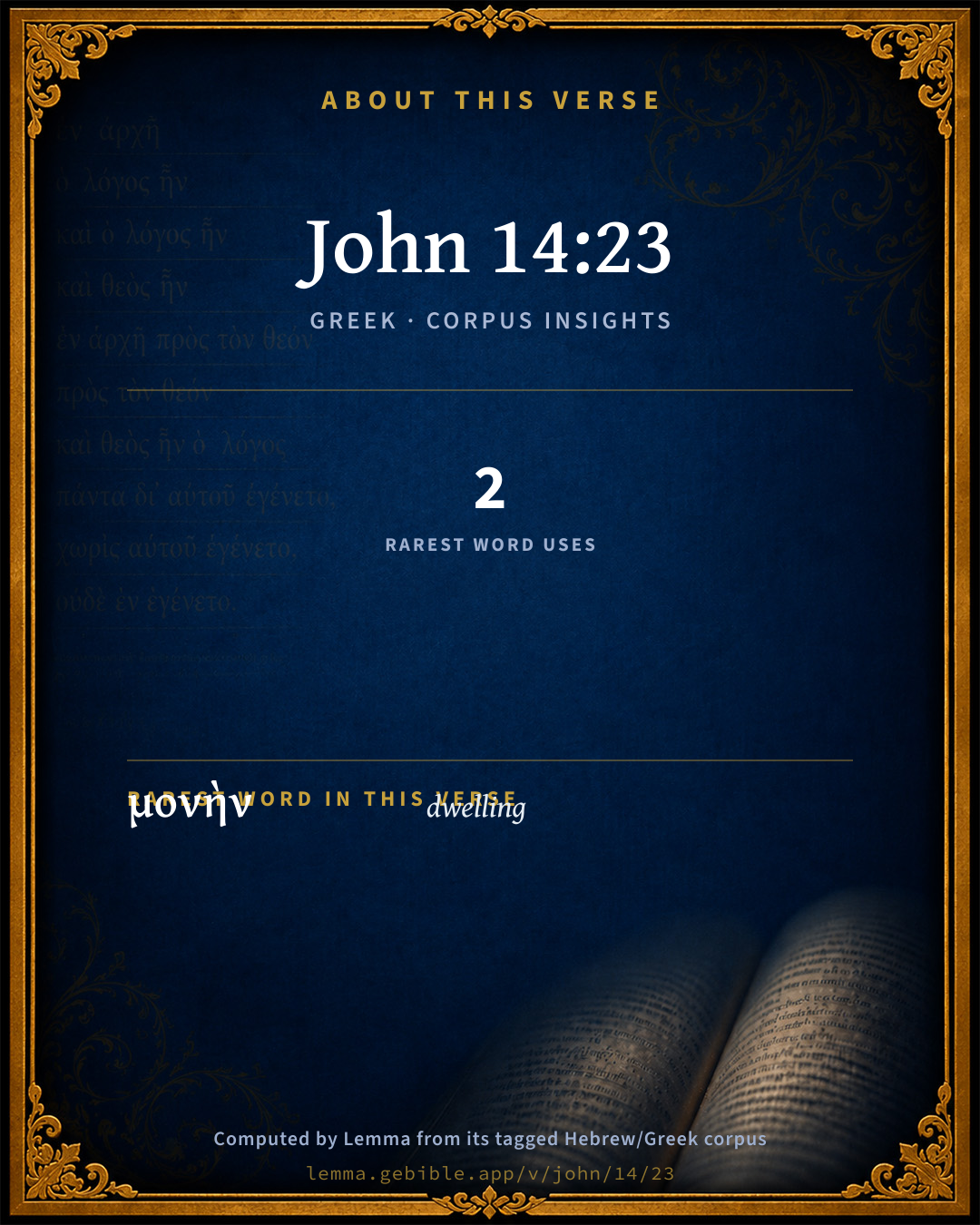
The rarest word here is μονὴν dwelling G3438 — appearing just 2 times in the whole Greek New Testament.

Shared distinctive vocabulary

μονὴν dwelling G3438 occurs in 2 verses of the Greek New Testament. Also found in:

Repetition

Words recur within this verse:

  • ἀγαπᾷ to love G25 ×2
  • καὶ and G2532 ×4
  • αὐτῷ he G846 ×4
  • με I G1473 ×3
  • τὸν the G3588 ×2

Cross-references

20

Topical passages linked to John 14:23 in the Treasury of Scripture Knowledge — connected by theme and wording, ordered by reader-vote popularity; previews shown in the World English Bible.

  • John 14:21 One who has my commandments, and keeps them, that person is one who loves me. One who loves me will be loved by my Father, and I will love him, and will reveal myself to him."
  • John 14:15 If you love me, keep my commandments.
  • Revelation 3:20–21 Behold, I stand at the door and knock. If anyone hears my voice and opens the door, then I will come in to him, and will dine with him, and he with me.
  • 1 John 4:15–16 Whoever confesses that Jesus is the Son of God, God remains in him, and he in God.
  • 1 John 2:24 Therefore, as for you, let that remain in you which you heard from the beginning. If that which you heard from the beginning remains in you, you also will remain in the Son, and in the Father.
  • 1 John 4:4 You are of God, little children, and have overcome them; because greater is he who is in you than he who is in the world.
  • 2 Corinthians 6:16 What agreement has a temple of God with idols? For you are a temple of the living God. Even as God said, "I will dwell in them, and walk in them; and I will be their God, and they will be my people."
  • John 10:30 I and the Father are one."
  • Isaiah 57:15 For thus says the high and lofty One who inhabits eternity, whose name is Holy: I dwell in the high and holy place, with him also who is of a contrite and humble spirit, to revive the spirit of the humble, and to revive the heart of the contrite.
  • Psalms 91:1 He who dwells in the secret place of the Most High Will rest in the shadow of the Almighty.
  • John 5:17–19 But Jesus answered them, "My Father is still working, so I am working, too."
  • John 6:56 He who eats my flesh and drinks my blood lives in me, and I in him.
  • Romans 8:9–11 But you are not in the flesh but in the Spirit, if it is so that the Spirit of God dwells in you. But if any man doesn't have the Spirit of Christ, he is not his.
  • John 14:17 the Spirit of truth, whom the world can't receive; for it doesn't see him, neither knows him. You know him, for he lives with you, and will be in you.
  • Revelation 7:15–17 Therefore they are before the throne of God, they serve him day and night in his temple. He who sits on the throne will spread his tent over them.
  • Revelation 21:22 I saw no temple in it, for the Lord God, the Almighty, and the Lamb, are its temple.
  • Genesis 1:26 God said, "Let us make man in our image, after our likeness: and let them have dominion over the fish of the sea, and over the birds of the sky, and over the cattle, and over all the earth, and over every creeping thing that creeps on the earth."
  • Genesis 11:7 Come, let's go down, and there confuse their language, that they may not understand one another's speech."
  • Psalms 90:1 Lord, you have been our dwelling place for all generations.
  • Revelation 22:3 There will be no curse any more. The throne of God and of the Lamb will be in it, and his servants serve him.

Cross-references courtesy of OpenBible.info (CC BY 4.0).

Commentary

Notes on John 14:23 from classic Christian and Jewish commentators (each source and its license shown beneath its notes). The classic Christian expositions comment on the surrounding passage and are grouped to its opening verse, so a note may address several verses; the Jewish commentaries on the Tanakh (Rashi and others) are per-verse, so they appear only where the commentator wrote on this verse.

Lemma curates 59 commentaries, every one of them public domain or Creative Commons licensed, each selected and text-cleaned for this edition rather than reprinted as found. About our sources →

Tyndale Open Study Notes

Tyndale Open Resources

14:23-24 Jesus answered Judas’s question, explaining that his coming would be a profound spiritual revelation beyond the world’s grasp. • Jesus’ coming would occur in three experiences: his resurrection, the coming of the Spirit, and his second coming. When he comes in the Spirit, he and the Father will reside within believers, making a home with each of them (see study note on 14:2).

Tyndale Open Study Notes — © Tyndale Open Resources, licensed CC BY-SA 4.0. Text via the HelloAO Bible API.

Bengel's Gnomon

Johann Albrecht Bengel

Joh 14:23. Τὸν λόγον μου, My word) [Not as Engl. Vers., words]. The word is represented as one (Singular) in this verse, in reference to believers, who keep it whole: in Joh 14:24 (τοὺς λόγους μου) more words than one (Plural) are mentioned, in reference to unbelievers, who rend them in sunder: “keepeth not My words.” Comp. ch. Joh 15:12, note [“This is My commandment (ἡ ἐντολὴ), That ye love one another.” He had previously used the Plural, commandments. All of them are comprised in the one, love]; and 1Jn 2:4-5, “He that keepeth not His commandments (Plur.), etc.; but whoso keepeth His word” (Sing.), etc.—τηρήσει, he will keep) Keeping His commandments is put before love in Joh 14:21, “He that hath My commandments and keepeth them, he it is that loveth Me:” now love is put before keeping His word. Love, in a certain respect, and that a primary one, goes before keeping of the commandments; see Joh 14:15, “If ye love Me, keep My commandments;” but in a certain respect it also follows, since by keeping of the commandments love the more in proportion increases, and acquires new vigour. Therefore to keep His word is a middle term between the love towards Jesus Christ, and the love of the Father towards him who loves Jesus Christ.—ἐλευσόμεθα, We will come) I and the Father. The Singular number ἐμφανίσω, I will manifest, advances onward to the Plural, we will come.—μονὴν, abode) See the correlative to this in Joh 14:2, μοναἰ, mansions.[352] Comp. Rev 3:20, at the end, “I will come into him, and sup with him, and he with Me.”—μονὴν ποιήσομεν, We will make our lasting abode [mansion]) Either the architect or the inhabitant is said to make an abode (mansion): but in this place it is restricted to the inhabitants (the indwelling Father and Son). This is a very sublime view. It is therefore cut short at Joh 14:25.

[352] He now makes His mansion (lasting abode) with believers: and they hereafter shall have their mansions with Him: ver. 2, 23.—E. and T.

Bengel's Gnomon of the New Testament — English translation (T&T Clark, Edinburgh, 1860) — public domain. Text from a community e-Sword module.

Meyer's Critical & Exegetical Commentary

Heinrich August Wilhelm Meyer

Joh_14:23-24. Jesus repeatsand that was sufficient for the removal of such a misunderstandingsubstantially, yet now at once placing love as the principal matter in the immediate foreground, the condition to which His self-revelation, Joh_14:22, is attached, by more closely defining it according to its divine and blessed manner of existence; and shows from this, and from the antithesis added in Joh_14:24, that the κόσμοςthis κόσμος which hates Him and is disobedient to Himis quite incapable of receiving that self-revelation. The more precise explanation, πρὸς αὐτ. ἐλευσόμ. κ. μονὴν παρʼ αὐτῷ ποιησόμεθα, is intended to make this very incapacity still more distinctly and deeply felt. At the foundation of the expression lies the theocratic idea, realized in this spiritual fellowship, of the dwelling of God amongst His people (Exo_25:8; Exo_29:45; Lev_26:11-12; Eze_37:26 ff.), with which also the later representation of the dwelling of the Shekinah with the pious (Danz in Meuschen, N. T. ex Talm. ill. p. 701 ff.) is connected. This representation, however, is not to be assumed here, since Jesus means an invisible presence. In the plural of communion, ἐλευσόμεθα is the clear expression of the divine-human consciousness, Joh_10:30.

On the genuinely Greek expression μονὴν ποιεῖν, see Kypke, I. p. 404. The Middle (see critical notes): we will make to ourselves.

παρʼ αὐτῷ] The unio mystica, into which God and Christ enter with man by means of the Paraclete,[155] is presented in the sensuous form of the taking up an abode with Him (comp. Joh_14:17; Joh_14:25), i.e. in His dwelling (comp. Joh_1:40, Act_21:8, et al.), under His roof. They come, like wanderers from their heavenly home (Joh_14:2), and lodge with Him, will be daily His guests, yea, house and table companions, Luther.

The λόγοι, discourses, are the individual parts of the collective λόγος, and the ἐντολαί are the preceptive parts of the same, and form, therefore, a more special conception than the λόγοι.

καὶ ὁ λόγος ὃν ἀκούετε, κ.τ.λ.] andfrom this you may infer how unfitted such a man is to experience that visitationthe word which ye hear (now, still!), etc. Comp. Joh_7:16, Joh_8:28, Joh_12:49-50, Joh_3:34. He therefore rejects God Himself. The second person (ἀκούετε) is individualizing (not to be limited to what was said in Joh_14:23-24, as Godet takes it), and makes the expression at the close of this portion of the address more lively.

[155] Not: in the divine elevation above space and time (Weiss, Lehrbegr. p. 276), which introduces here a speculative idea which is very remote from the meaning.

Meyer — Critical and Exegetical Commentary on the New Testament — English translation by Peter Christie, edited by Frederick Crombie (T&T Clark, 1880) — public domain. Text from a community e-Sword module.

Expositor's Greek Testament

ed. W. Robertson Nicoll

Joh 14:23 . To this Jesus replies ἐάν τις … ποιήσομεν . The answer explains that the manifestation, being spiritual, must be individual and to those spiritually prepared. “It contemplates not a public discovery of power, but a sort of domestic visitation of love.” Bernard, πρὸς αὐτὸν ἐλευσόμεθα , “to him we will come”; Jesus without scruple unites Himself with the Father. μονὴν … ποιησόμεθα , a classical expression see Thuc., i. 131, μονὴν … ποιούμενος . “We will make our abode with him, will be daily his guests, yea, house and table companions.” Luther in Meyer, μονή is here used in a sense different from that of Joh 14:2 , where it means a place to abide in.

The Expositor's Greek Testament, edited by W. Robertson Nicoll (1897–1910) — public domain. Text from a community e-Sword module.

Godet's Commentaries

Frédéric Louis Godet

Vv. 23, 24. “Jesus answered and said to him, If any one loves me, he will keep my word; and my Father will love him and we will come to him, and make our abode with him. 24. He who does not love me, does not keep my words; and the word which you hear is not mine, but the Father’s who sent me.”

Jesus continues His discourse, as if He had not heard the question of Judas; for the first part of Joh 14:23 is only the reproduction of Joh 14:21 developed and stated with greater precision. And yet He answers the question proposed, by more energetically reaffirming the promise, as well as the moral condition which had called forth the objection; comp. the same mode of replying in Luk 12:41 ff. To love Jesus, to keep His word, to be loved by the Father,—these are the conditions on which the promised revelation will be made (Joh 14:23); now the world does not fulfil them; it is animated by dispositions of an opposite character (Joh 14:24).

As to the conditions and nature of this revelation, Jesus develops them grandly. The revelation of Himself which He will give to the believer will be nothing less than His own dwelling in his soul, and this will be one with the dwelling of God Himself within him. How can we think here only of the appearances of the Risen One, or even of temporary aid granted to the disciples by the glorified Lord in the work of their ministry? It is incomprehensible how Weiss can persist in such an interpretation to the very end.

Here, as in Joh 10:30, Jesus sayswe in speaking of God and Himself; this expression, if it is not blasphemous or absurd, implies the consciousness of His essential union with God. The conception of the kingdom of God which we find here is not foreign to the Synoptics; comp. Luk 17:20 : “The kingdom of God comes not with observation; it is within you” (ἐντὸς ὑμῶν); and Mat 28:18-20. A very similar figure is found in Rev 3:20 : “If any one opens the door, I will enter in to him, and will sup with him, and he with me.”

Joh 14:2 proves that the term μονή, dwelling, can designate not only an inn, but the permanent domicile (see Passow). This expression perhaps places the idea of this verse in connection with that of Joh 14:2. Here on earth, it is God who makes His abode with the believer; in heaven, it will be the believer who will make his abode with God. The first of these facts (Joh 14:23) prepares for the second (Joh 14:3).

Weiss rests upon the παῤ αὐτῷ, properly near him, to support the view that the question is not of an inward dwelling. The unio mystica between Christ and the believer, must have been designated, according to him, by ἐν αὐτῷ, in him. But the preposition παρά, with, is necessarily introduced by reason of the figure of a dwelling (μονὴν ποιεῖν) and cannot in any way serve to determine the mode of this union. And it follows from the terms ἐμφανίζειν and πρὸς αὐτόν, as from the parallel Rev 3:20, that this mode is internal and spiritual.

Vv. 23 justified the to us in the question of Judas; Joh 14:24 answers to: and not to the world. Between the two clauses of Joh 14:24, this idea must be understood: “It is not a small thing to reject my teaching; and indeed (καί) it is the teaching of God Himself” (Joh 12:49, etc.). Conclusion understood: “How, with such a disposition, hostile to the word both of the Son and the Father, could one be fit to become their abode!” Comp. what was said of the world in Joh 14:15; Joh 14:17.

Thus have the reasons for encouragement presented by the Lord been gradually raised one upon another: “You shall have a place secured for you with me in the Father’s house....Through me, the way, you cannot fail to reach the end....Already here on earth, you have seen the Father....You shall be able to continue my work on the earth....Another divine support will give you strength for it....In this inward support, it is I myself who will join you again....The Father Himself will with me come to dwell with you....” Is there not here what may justify the: Let not your heart be troubled (Joh 14:1)? The following passage, which closes this first outpouring, returns to its starting-point, in that it even makes the Be not troubled, a Rejoice.

Frédéric Louis Godet — Commentaries on Luke, John, Romans, and 1 Corinthians — English translation (T&T Clark, Edinburgh, 1870s–1890s) — public domain. Text from a community e-Sword module.

Jamieson, Fausset & Brown

Robert Jamieson, A. R. Fausset & David Brown

we will come and make our abode with him--Astonishing statement! In the Father's "coming" He "refers to the revelation of Him as a Father to the soul, which does not take place till the Spirit comes into the heart, teaching it to cry, Abba, Father" [OLSHAUSEN]. The "abode" means a permanent, eternal stay! (Compare Lev 26:11-12; Eze 37:26-27; Co2 6:16; and contrast Jer 14:8).

Jamieson, Fausset & Brown — Commentary Critical and Explanatory on the Whole Bible (1871) — public domain (CC PDM 1.0). Text via the HelloAO Bible API.

Adam Clarke's Commentary

Verse 23. If a man] Not only my present disciples, but all those who shall believe on me through their word, or that of their successors:

Love me] Receive me as his Saviour, and get the love of God shed abroad in his heart by the Holy Ghost:

He will keep my words] Observe all my sayings, and have his affections and conduct regulated by my Spirit and doctrine:

My Father will love him] Call him his child; support, defend, and preserve him as such.

And we will come unto him] God the Father, through his Son, will continue to pour out his choicest blessings upon his head and upon his heart:

And make our abode with him.] Will make his heart our temple, where God, the Father, Son, and Spirit, shall rest, receive homage, and dwell to eternity. Thus will I manifest myself to the believing, loving, obedient disciple, and not to the world, who will not receive the Spirit of the truth.

Adam Clarke's Commentary on the Bible (1810–1826) — public domain. Text from a community e-Sword/MySword module.

John Calvin's Commentaries

23. And my Father will love him. We have already explained that the love of God to us is not placed in the second rank, as if it came after our piety as the cause of that love, but that believers may be fully convinced that the obedience which they render to the Gospel is pleasing to God, and that they may continually expect from him fresh additions of gifts.

And we will come to him who loveth me; that is, he will feel that the grace of God dwelleth in him, and will every day receive additions to the gifts of God. He therefore speaks, not of that eternal love with which he loved us, before we were born, and even before the world was created, but since the time when he seals it on our hearts by making us partakers of his adoption. Nor does he even mean the first illumination, but those degrees of faith by which believers must continually advance, according to that saying,

Whosoever hath it shall be given to him, (Matthew 13:12.)

The Papists; therefore are wrong in inferring from this passage that there are two kinds of love with which we love God. They falsely maintain that we naturally love God, before he regenerates us by his Spirit, and even that by this preparation we merit the grace of regeneration; as if Scripture did not everywhere teach, and as if experience also did not loudly proclaim, that we are altogether alienated from God, and that we are infected and filled with hatred of him, until he change our hearts. We must therefore keep in view the design of Christ, that he and the Father will come, to confirm believers, in uninterrupted confidence in his grace.

John Calvin's Commentaries (1540-1563) — public domain. Text from the Calvin Translation Society English edition (1840s-50s) via the Christian Classics Ethereal Library (ccel.org). Calvin's coverage is partial (roughly two-thirds of the Bible); uncommented books and verses are honest gaps, never fabricated. The 19th-century editor's footnotes and remarks are omitted so the notes are faithfully Calvin's own voice.

Ellicott's Commentary for English Readers

(23) If a man love me, he will keep my words.—Our Lord repeats the condition necessary on the part of man in order that the manifestation of God to him may be possible. This is an answer to the question of Judas, the world in its unbelief and rejection of Christ’s words, and without the spirit of love, could not receive this manifestation.

We will come unto him, and make our abode with him.—For the plural, comp. Note on Joh_10:30. For the word “abode,” comp. Note on Joh_14:2. The thought of God as dwelling in the sanctuary and among the people was familiar to the disciples from the Old Testament Scriptures (see, e.g., Exo_25:8; Exo_29:45; Lev_26:11-12; Eze_37:26), and the thought of the spiritual temple in the heart of man was not unknown to contemporary writers. Philo has a remarkable parallel in his treatise, De Cherubim, p. 124, “Since therefore He (God) thus invisibly enters into the region of the soul, let us prepare that place, in the best way the case admits of, to be an abode worthy of God; for if we do not, He, without our being aware of it, will quit us and migrate to some other habitation which shall appear to Him to be more excellently provided” (Bohn’s ed., vol. i., p. 199. See the whole of chap. 29). Schöttgen, in his note, quotes from a Rabbinical writer who says, “Blessed is the man who strives daily to make himself approved unto God, and prepares himself to receive the divine guest.” (Comp. 1Co_3:16; 1Co_6:19; and Rev_3:20.)

A Bible Commentary for English Readers, edited by Charles John Ellicott (1878–1897) — public domain. Text from a community e-Sword module.

The Cambridge Bible for Schools and Colleges

gen. ed. J. J. S. Perowne

23. Judas] Excluding the genealogies of Christ we have six persons of this name in the N.T.

23. Jesus answered] The answer is given, as so often in our Lord’s replies, not directly, but by repeating and developing the statement which elicited the question. Comp. Joh_3:5-8, Joh_4:14, Joh_6:44-51; Joh_6:53-58, &c. The condition of receiving the revelation is loving obedience; those who have it not cannot receive it. This shews that the revelation cannot be universal, cannot be shared by those who hate and disobey (Joh_15:18).

my words] Rather, My word; the Gospel in its entirety.

we will come] For the use of the plural comp. Joh_10:30.

abode] See on Joh_14:2. The thought of God dwelling among His people was familiar to every Jew (Exo_25:8; Exo_29:45; Zec_2:10; &c.). This is a thought far beyond that,—God dwelling in the heart of the individual; and later Jewish philosophy had attained to this also. But the united indwelling of the Father and the Son by means of the Spirit is purely Christian.

In these two verses (23, 24) the changes ‘words’ … ‘sayings’ … ‘word’ give a wrong impression: they should run—‘word’ … ‘words’ … ‘word.’ In the Greek we have the same substantive, twice n the singular and once in the plural.

The Cambridge Bible for Schools and Colleges (gen. ed. J. J. S. Perowne; Cambridge University Press, 1878–1918) — public domain. Text from a community e-Sword module.

John Gill's Exposition

Jesus answered and said unto him,.... This answer is returned, and these words are spoken, for the further confirmation and explanation of what was before said:

if a man love me, he will keep my words; by his "words" are meant not his doctrines, but his ordinances; the same with his commandments, Joh 14:21, which he has said, ordered, and commanded to be observed, and which are observed by such who truly love him, and that from a principle of love to him, and with a view to his glory: and for the encouragement of such persons as before, he says,

and my Father will love him: which is to be understood not of the love of the Father, as in his own heart, which is not taken up in time, but was in him from all eternity; nor of the first discovery of it to his people, but of greater manifestations of it to them, and a quicker sense of it in their hearts, and also of some other effects of it, to be enjoyed by them in an higher manner; such as larger measures of grace, more communion with him here, and eternal honour and glory hereafter:

and we will come unto him: I who am now going away, and my Father to whom I am going, and the Holy Spirit, the Comforter, I have promised to pray for: hence a proof of a plurality of persons in the Godhead, of a trinity of persons, of there being neither more nor fewer than three; since neither more nor less can be collected from the context; and of their distinct personality, or it could not be said with any propriety, "we" each of us "will come unto him"; not locally and visibly, but spiritually, by affording our gracious and comfortable presence, the continuance of which is promised next:

and make our abode with him; which denotes habitation; for the saints are the dwelling places or temples of the living God, Father, Son, and Spirit; and the constancy and perpetuity of their residence in them, not as a wayfaring man, but always, though this may not be always discerned by believers; and is a wonderful instance of the grace and condescension of God to dwell on earth with sinful men; and a far greater one it is, than if the most mighty potentate on earth should take up his abode in a poor despicable cottage with the meanest of his subjects.

John Gill's Exposition of the Whole Bible (1746–1763) — public domain (CC PDM 1.0). Text via the HelloAO Bible API.

Trapp's Complete Commentary

John Trapp

23 Jesus answered and said unto him, If a man love me, he will keep my words: and my Father will love him, and we will come unto him, and make our abode with him.

Ver. 23. Jesus answered and said unto him] Our Saviour, passing by that frivolous question, proceedeth in his discourse. Some follies are best confuted by silence. One having made a long and idle discourse before Aristotle, concluded it thus: I doubt I have been too tedious unto you, Sir Philosopher, with my many words. In good sooth, said Aristotle, you have not been tedious to me, for I gave no heed to anything you said. (Plutarch, de Garrulitate.)

John Trapp, A Commentary or Exposition upon All the Books of the Old and New Testament (1647–1656) — public domain. Text from a community e-Sword module.

Albert Barnes' Notes on the Bible

Will keep my words - See Joh 14:15.

We will come to him - We will come to him with the manifestation of pardon, peace of conscience, and joy in the Holy Spirit. It means that God will manifest himself to the soul as a Father and Friend; that Jesus will manifest himself as a Saviour; that is, that there will be shed abroad in the heart just views and proper feelings toward God and Christ. The Christian will rejoice in the perfections of God and of Christ, and will delight to contemplate the glories of a present Saviour. The condition of a sinner is represented as one who has gone astray from God, and from whom God has withdrawn, Psa 58:3; Pro 28:10; Eze 14:11. He is alienated from God, Eph 2:12; Isa 1:4; Eph 4:18; Col 1:21. Religion is represented as God returning to the soul, and manifesting himself as reconciled through Jesus Christ, 2Co 5:18; Col 1:21.

Make our abode - This is a figurative expression implying that God and Christ would manifest themselves in no temporary way, but that it would be the privilege of Christians to enjoy their presence continually. They would take up their residence in the heart as their dwelling-place, as a temple fit for their abode. See 1Co 3:16; “Ye are the temple of God;” 1Co 6:19; “Your body is the temple of the Holy Ghost;” 2Co 6:16; “Ye are the temple of the living God.” This does not mean that there is any personal union between Christians and God - that there is any special indwelling of the essence of God in us for God is essentially present in all places in the same way; but it is a figurative mode of speaking, denoting that the Christian is under the influence of God; that he rejoices in his presence, and that he has the views, the feelings, the joys which God produces in a redeemed soul, and with which he is pleased.

Albert Barnes' Notes on the Bible (1834–1885) — public domain. Text from a community e-Sword/MySword module.

Matthew Poole's English Annotations

If any man love Christ, he will keep Christ’s words; that is, he will study and endeavour to keep the commandments of Christ; for if nothing evidenced a true love to Christ but a perfect obedience to his will, none could comfort himself from his obedience, or conclude his love to Christ from it; but he that loveth Christ, will make it his business to be obedient to him in those things first he hath commanded, and are within his power.

And my Father will love him; and my Father will manifest his love to him in further dispensations of his grace; for it cannot be understood of God’s eternal love, nor yet of his love in justification and regeneration; for till the man or woman be justified and regenerated, he will never study and endeavour obedience to the will of God. This love of God is the cause, not the effect of our obedience; but love in this verse must be expounded by manifesting in the former verse; and this is certain, that the manifestations of Divine love to our souls depend upon our walking with God. This is also meant by God the Father and Christ’s coming to those that love him, and keep his commandments; viz. a coming in the sweet influences of Divine grace, suited to the soul’s various necessities: nay, our Lord promises, not only his and his Father’s coming to, but their making an abode with such as love him, and keep his commandments. Here the abiding of the First and Second Person in the Trinity with believers; the abiding of the Third Person with them is also promised, Joh 14:16; which all make that presence of God with them, so often promised to them in holy writ. Thus our Saviour answereth one part of what Judas said, How is it that thou wilt manifest thyself to us? Because, saith our Saviour, you love me, and keep my words: for though no love, no works of ours, foreseen or seen, be the cause of eternal love, or the first grace; yet it is so much a cause of further grace, especially in the sensible manifestations of it, that no soul must expect it that doth not love Christ, and keep his words. He also further gives them a reason, as to the second thing he asked, why he did not manifest himself to the world?

Matthew Poole's English Annotations on the Holy Bible (1683–1685) — public domain. Text from a community e-Sword/MySword module.

Whedon's Commentary on the Bible

Daniel D. Whedon

23. If—Upon this mighty if it depends whether Christ manifests himself as our Saviour or not.

My Father… we… him—The Father, Son, and Spirit, will in spirit come into union with the believer’s spirit. And can any one imagine that the believer will be forever unconscious of his spiritual guests, and incapable of realizing the actuality of their communion? On the contrary, Jesus says of the Spirit, Joh_14:17, Ye know him; and of his own spirit, Joh_14:19, Ye see me; and declares, Joh_14:21, I will manifest myself. All this affirms that the believer may enjoy a conscious communion with Christ and God.

Daniel D. Whedon (gen. ed.), Commentary on the Old and New Testaments (1874–1909) — public domain. Text from a community e-Sword module.

The Pulpit Commentary

Jesus answered and said to him, If a man, let him be whosoever he may, love me there is the germ and root of all he will keep my Word (logon). In Ver. 21 we see the complementary statement, "He that has and keeps my commandments loves me;" here, "He that loves me keeps my Word." In Ver. 21 obedience proves inward love, and may indicate to the world the fact of the Father"s love and my own response. Here our Lord is laying down the principle of relation the law of close intimacy, the conditions of higher knowledge. The keeping of the Word is a certain consequence of holy love. And my Father will love him. So far Christ has only reiterated the great statement of Ver. 21, but instead of saying, "I will love him, and manifest myself," he added, We will come the Father and Ito him, and take up our abode, make for ourselves a resting-place in his dwelling (par autw); cf. the analogous and wonderful parallel in Rev_3:20. There is a clear utterance of Divine self-consciousness. It is worthy of note that such an expression as this sounds a profounder depth of that consciousness than any phrase (logov) already delivered. Apart from the stupendous corroborative facts elsewhere on record, this seems, to mere human experience, either awfully true or infinitely blasphemous. The Father add g will come together in the power of the Spirit, and we will dwell within the loving and obedient soul. This phrase suggests the mystical union of the Divine Personality with that of those who have entered into spiritual relation with Christ through love and obedience.

Fidelity rewarded.

Christ"s manifestation in the body, in the earthly life was one thing; his manifestation after his departure to the Father was quite a different thing. This change, or rather development of the Divine plan, was difficult even for the apostles to understand. Observe how simply and yet how fully, in answer to Jude"s perplexed and anxious query, the Lord explains the condition and the method of his own manifestation of himself in the approaching spiritual dispensation.

I FIDELITY TO CHRIST IS THE CONDITION OF THE DIVINE MANIFESTATION. This fidelity is both emotional and practical; it is displayed in the heart and in the life.

1. Love is the inward principle and motive. The personal nature of the Christian life is here strikingly exhibited. "If a man love me language this which bring the individual believer close to the living Christ. What a rebuke to all merely sacerdotal and ecclesiastical views of religion! If a man be spiritually enlightened and quickened, he will love Christ; both because Christ is in his own character and ministry deserving of the purest, strongest love our nature can offer, and also because "he first loved us because his goodness found its highest expression in devotion and in sacrifice.

2. Obedience is the evidence of love. Law and love do not always seem to harmonize; yet human relationships furnish examples of their combination. Obedience here takes the form of keeping the Master"s word. This involves our

(1) becoming acquainted and familiar with his Word;

(2) retaining his Word in memory and often recalling it;

(3) reverencing his Word as in itself authoritative, and as in many ways binding especially upon us;

(4) obeying cheerfully and constantly the Word which is believed to be authoritative and Divine. The Christian"s love is not sentimentality; it is a feeling which prompts to that obedience which, the relation of the Christian to Christ being considered, is the proper fruit of grateful affection.

II THE DIVINE MANIFESTATION TO THE FAITHFUL TAKES THE FORMS OF LOVE AND FELLOWSHIP. It must not be forgotten that the love and kindness of God are presumed as preceding and as accounting for the dispositions and purposes above described. But whilst the Divine pity is the cause of the Christian"s newness of heart and life, it is also true that the dispositions and habits which become the Christian are the condition of the enjoyment of those amazing privileges which Jesus here describes.

1. There is, then, a sense in which the Father"s love is the reward of the affectionate obedience of Christ"s people. The filial dutifulness and affection are approved, and the approval is manifested by the tender affection of the paternal heart.

2. In addition to, and indeed in proof of, this display of Divine love, there is assured Divine fellowship and indwelling. How different is this representation from the imaginations of human fancy, the expectations of human reason! Yet it is in the highest degree honorable to God, and it tends to inspire and to elevate man. The Christian welcomes his Maker, his Savior, as his Guest and Friend. T.

The Pulpit Commentary (1880–1919), ed. H.D.M. Spence-Jones & Joseph S. Exell — public domain. Text from a community e-Sword module.

John Wesley's Explanatory Notes

Jesus answered - Because ye love and obey me, and they do not, therefore I will reveal myself to you, and not to them. My Father will love him - The more any man loves and obeys, the more God will love him. And we will come to him, and make our abode with him - Which implies such a large manifestation of the Divine presence and love, that the former in justification is as nothing in comparison of it.

John Wesley, Explanatory Notes Upon the Whole Bible (1754–1765) — public domain. Text via the GEBible commentary corpus.

Burkitt's Expository Notes on the New Testament

William Burkitt

Observe here, How our Saviour still goes on to direct and encourage his disciples to evidence the sincerity of their love to his person, but the universality of their obedience to his commands; and tells them how great their advantage would be by so doing.

For first, The Father would love them; that is, manifest his favour to them in farther dispensations of grace and comfort.

Learn thence, That all the manifestations of divine love to the souls of believers, depend upon their close walking with God in the paths of holiness and strict obedience.

Secondly, We will make our abode with him. He shall have Father and Son’s company. An illusion to a parent that has many children; he will be sure to live with them that are most dutiful to him, and most observant of him. The expression of making their abode with us, denotes that sweet and intimate fellowship which shall be betwixt God and us, and the perpetuity and constancy of it at all times; till we are taken up by him into heaven, he will make his abode with us, by the indwelling presence of his Holy Spirit, the graces and comforts whereof shall abide with us for ever.

William Burkitt's Expository Notes on the New Testament (1700–1703) — public domain. Text from a community e-Sword module.

unfoldingWord translationNotes

Door43 World Missions Community

Connecting Statement:

Jesus responds to Judas (not Iscariot).

If anyone loves me, he will keep my word

"The one who loves me will do what I have told him to do"

loves

This kind of love comes from God and focuses on the good of others, even when it does not benefit oneself. This kind of love cares for others, no matter what they do.

My Father

This is an important title for God. (See: Translating Son and Father)

we will come to him and we will make our home with him

The Father and the Son will share life with those who obey what Jesus commands. AT: "we will come to live with him, and will have a personal relationship with him" (See: Assumed Knowledge and Implicit Information)

The word that you hear is not from me but from the Father who sent me

"The things I have told you are not things that I have decided to say on my own"

The word

"The message"

that you hear

Here when Jesus says "you" he is speaking to all of his disciples.

translationWords

love

God the Father

unfoldingWord translationNotes — © Distant Shores Media and the Door43 World Missions Community, licensed CC BY-SA 4.0. Source: git.door43.org/Door43/en_tn.

Cambridge Greek Testament for Schools and Colleges

23. ποιησόμεθα (אBLX) for ποιήσομεν (A). The middle of ποιεῖν is comparatively rare in N.T., but here it is appropriate; Winer, p. 320.

23. ἀπεκρίθη. The answer is given, as so often in our Lord’s replies, not directly, but by repeating and developing the statement which elicited the question. Comp. Joh 3:5-8, Joh 4:14, Joh 6:44-51; Joh 6:53-58, &c. The condition of receiving the revelation is loving obedience; those who have it not cannot receive it. This shews that the revelation cannot be universal, cannot be shared by those who hate and disobey (Joh 15:18).

ἐλευσόμεθα. For the plural comp. Joh 10:30; it is a distinct claim to Divinity: for μονήν see on Joh 14:2. The thought of God dwelling among His people was familiar to every Jew (Exo 25:8; Exo 29:45; Zec 2:10; &c.). There is a thought far beyond that,—God dwelling in the heart of the individual; and later Jewish philosophy had attained to this also. But the united indwelling of the Father and the Son by means of the Spirit is purely Christian.

Cambridge Greek Testament for Schools and Colleges (Cambridge University Press, 1896; 21 vols, various authors incl. Carr, Maclear, Plummer, Farrar, Lumby, Moule, M. R. James, Simcox) — public domain. Text from a community e-Sword module.

International Critical Commentary

23. ἀπεκρ. Ἰησοῦς καὶ κτλ. The rec. inserts ὁ before Ἰησοῦς, but om. אABDLWΓΔΘ: see on 1:29.

ἐάν τις ἀγαπᾷ με κτλ. The answer of Jesus to Jude is indirect, and begins by repeating what He had said before v. 15 (cf. v. 21) as to the necessity of obedience for a true disciple.

τὸν λόγον μου τηρήσει. For τὰς ἐντολάς of v. 21, the specific commandments of Jesus, is substituted here τὸν λόγον, the message of Jesus as a whole. For the phrase τὸν λόγον τηρεῖν, see on 8:51, 17:6. Jn., as has been pointed out before, is fond of changing slightly the form of a great saying, when he repeats it (see on 3:17).

καὶ ὁ πατήρ μου ἀγαπήσει αὐτόν. Cf. 17:23. This must be taken to mean something more than the fundamental Johannine doctrine that “God loved the world” (3:16), although this tremendous fact is prior to, and at the root of, every special manifestation of God’s love to individual disciples.

καὶ πρὸς αὐτὸν ἐλευσόμεθα. Here the singular ἔρχομαι πρὸς ὑμᾶς (v. 18) is replaced by the plural ἐλευσόμεθα, marking the claim of equality with the Father which is prominent throughout the Fourth Gospel. Cf. 10:30 ἕν ἐσμεν. In both passages the reference is to that Divine Advent in the disciple’s heart which is mediated by the Spirit. Cf. Rev 3:20 εἰσελεύσομαι πρὸς αὐτόν.

καὶ μονὴν παρʼ αὐτῷ ποιησόμεθα. The Spirit παρʼ ὑμῖν μένει (v. 17), and the same must be true of the Father and the Son. “In the coming of the Spirit, the Son too was to come; in the coming of the Son, also the Father.”1 In v. 2 (where see note) the μοναί where man shall dwell with God in the future are promised; here we have the promise of a greater thing, the dwelling of God with man in the present. The main thought associated with the sanctuary in the Pentateuch was that there Yahweh dwelt with His people (Exo 25:8, Exo 29:45, Lev 26:11, Lev 26:12; cf. 2Co 6:16); but the indwelling promised here is associated with no special sanctuary or holy place. It is a Presence, real although invisible, in the disciple’s heart (Mat 28:20): the peculiar benediction of the kingdom which does not come “by observation” (Luk 17:20). So Jn. writes later of the disciple who “keeps His commandments,” that Christ “abides in him,” adding “this we know by the Spirit which He gave us” (1Jn 3:24; cf. 1Jn 4:13).

ποιησόμεθα. So אBLW fam. 13; but AΘ have ποιήσομεν μονὴν ποιούμενος occurs in Thucydides (i. 131), the phrase being good classical Greek.

International Critical Commentary — older volumes (1896–1929), various authors — public domain. Text from a community e-Sword module.

Vincent's Word Studies in the New Testament

Marvin R. Vincent

My word [λογον μου] . The entire gospel message, as distinguished from its separate parts or commandments.

We will come. Compare Joh 10:30; Rev 3:20.

Abode [μονην] . See on ver. 2. Compare 1Jo 2:24; 1Jo 5:15.

Marvin R. Vincent, Word Studies in the New Testament (1887–1900) — public domain. Text from a community e-Sword/MySword module.

Lesson kit

Teaching starters — assembled from the data on this page, not authored interpretation. Every prompt links to the verse data it draws on. Edit before teaching.

John, in the Gospels, opens this verse with 28 words (18 distinct Greek lemmas). Its most distinctive word is monḗ (“dwelling”). A historical commentator’s framing appears above. Read the whole chapter for the surrounding context.

Discussion questions

  1. The word monḗ carries the sense “dwelling.” How does it shape the verse?
  2. How does John 14:2, which shares the word «dwelling», read alongside this verse?
  3. What does the repetition of “to love” (2× in this one verse) do in this verse?
  4. These translations render this verse differently. What is at stake in choosing one wording over another?
  5. Compare how Tyndale Open Study Notes and Bengel's Gnomon read this verse. Where do they agree or differ?

Things to notice

Reading settings

Reading text

Shown beneath each verse's original-language words.

Old Testament
Old Testament edition

Read the OT as the Masoretic Hebrew (MT) or the Greek Septuagint (LXX).

English shown for the Greek Septuagint (in the Hebrew ↔ Greek comparison).

Comparing translations? Open the Compare panel on any verse page to stack up to four side by side.