John 8:39

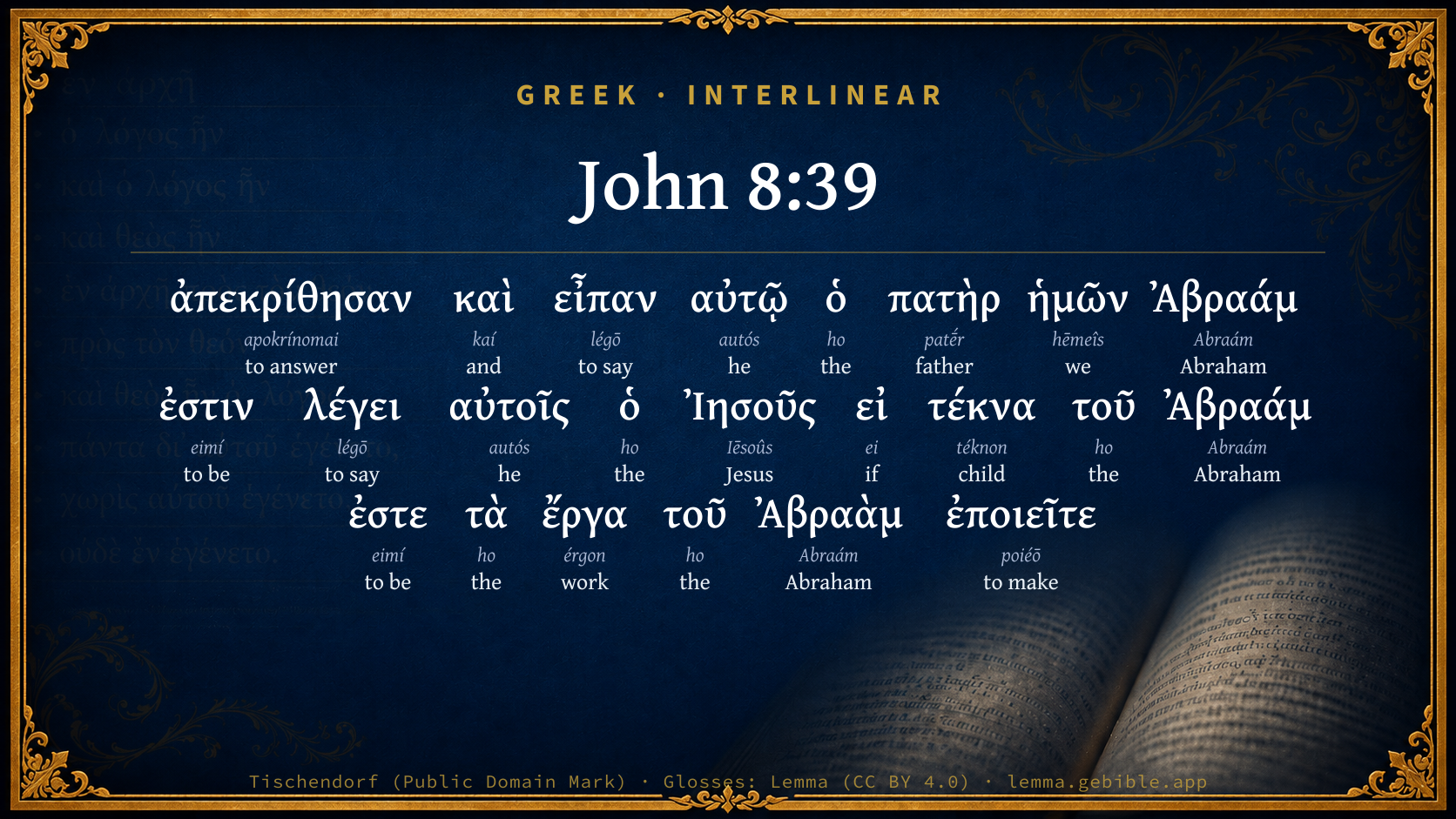
Greek (Tischendorf 8th ed.) John 8:39 appears in the Greek New Testament. The text above is from the Tischendorf 8th edition. Each word links to its Strong’s number and a concise gloss. Click any word for its full Thayer’s Greek Lexicon entry.
Download image
Cite this verse

John 8:39 (World English Bible). Public Domain. Lemma interlinear Bible study tool, https://lemma.gebible.app/v/john/8/39.

Show BibTeX & RIS
BibTeX
RIS
English Translation
They answered him, "Our father is Abraham." Jesus said to them, "If you were Abraham's children, you would do the works of Abraham.
World English Bible · Public Domain
Download a study sheet

One document with this verse’s original text, its word-by-word gloss line, the meaning frame, cross-references with their text, attributed commentary, and full source and license credits — printable, and it pastes into notes with its structure intact.

This verse Autodidact and up

Study sheet (.html) Plain text (.txt)

A passage Seminary Student

Up to 50 verses in one chapter. A passage sheet keeps up to 6 commentary sources and 12 cross-references per verse, in the order this page ranks them, and says so on the sheet whenever that leaves anything out. Ask for a single verse and you get the Autodidact verse sheet above.

Everything on this page stays free to read, with no account — the sheet is a download of what is already on screen, not access to it.

Want to remove ads? Support Godless Engineer
Compare translations 3

The same verse in 3 English versions, stacked beneath the original-language interlinear above. Click any original word for its lexicon entry.

Each is an independent rendering of the whole verse — the interlinear is not word-aligned to these translations.

Highlighted words mark where these versions differ — a whole-verse word diff, not a word-by-word alignment.

  • World English Bible Public Domain
    They answered him, "Our father is Abraham." Jesus said to them, "If you were Abraham's children, you would do the works of Abraham.
  • King James Version Public Domain
    They answered and said unto him, Abraham is our father. Jesus saith unto them, If ye were Abraham's children, ye would do the works of Abraham.
  • unfoldingWord Literal Text CC BY-SA 4.0
    They answered and said to him, “Our father is Abraham.” Jesus says to them, “If you were children of Abraham, you would do the works of Abraham.

unfoldingWord Literal Text — © unfoldingWord, licensed CC BY-SA 4.0. Word-aligned USFM3 via Door43 (git.door43.org/unfoldingWord/en_ult).

Versions to compare (up to 4)

3 of 4 selected

Show all 19 translations

Every available English version of this verse, each an independent rendering of the whole verse.

  • World English Bible Public Domain
    They answered him, "Our father is Abraham." Jesus said to them, "If you were Abraham's children, you would do the works of Abraham.
  • Berean Standard Bible Public Domain
    “Abraham is our father,” they replied. “If you were children of Abraham,” said Jesus, “you would do the works of Abraham.
  • Majority Standard Bible Public Domain
    “Abraham is our father,” they replied. “If you were children of Abraham,” said Jesus, “you would do the works of Abraham.
  • King James Version Public Domain
    They answered and said unto him, Abraham is our father. Jesus saith unto them, If ye were Abraham's children, ye would do the works of Abraham.
  • American Standard Version (1901) Public Domain
    They answered and said unto him, Our father is Abraham. Jesus saith unto them, If ye were Abraham's children, ye would do the works of Abraham.
  • Revised Version (1885) Public Domain
    They answered and said unto him, Our father is Abraham. Jesus saith unto them, If ye were Abraham’s children, ye would do the works of Abraham.
  • Geneva Bible (1599) Public Domain
    They answered, and saide vnto him, Abraham is our father. Iesus said vnto them, If ye were Abrahams children, ye woulde doe the workes of Abraham.
  • Douay-Rheims (1899) Public Domain
    They answered, and said to him: Abraham is our father. Jesus saith to them: If you be the children of Abraham, do the works of Abraham.
  • Young's Literal Translation Public Domain
    They answered and said to him, `Our father is Abraham;' Jesus saith to them, `If children of Abraham ye were, the works of Abraham ye were doing;
  • Literal Standard Version CC BY-SA 4.0
    They answered and said to Him, “Our father is Abraham”; Jesus says to them, “If you were children of Abraham, the works of Abraham you were doing;
  • Unlocked Literal Bible CC BY-SA 4.0
    They answered and said to him, “Our father is Abraham.” Jesus said to them, “If you were Abraham's children, you would do the works of Abraham.
  • unfoldingWord Literal Text CC BY-SA 4.0
    They answered and said to him, “Our father is Abraham.” Jesus says to them, “If you were children of Abraham, you would do the works of Abraham.
  • Darby Bible Public Domain
    They answered and said to him, Abraham is our father. Jesus says to them, If ye were Abraham's children, ye would do the works of Abraham;
  • World Messianic Bible Public Domain
    They answered him, “Our father is Abraham.” Yeshua said to them, “If you were Abraham’s children, you would do the works of Abraham.
  • Webster's Bible Public Domain
    They answered and said to him, Abraham is our father. Jesus saith to them, If ye were Abraham's children, ye would do the works of Abraham.
  • Free Bible Version CC BY-SA 4.0
    “Abraham is our father,” they answered. “If you really were children of Abraham, you'd do what Abraham did,” Jesus told them.
  • Bible in Basic English Public Domain
    In answer they said to him, Our father is Abraham. Jesus said to them, If you were Abraham's children you would do what Abraham did.
  • Text-Critical English NT CC BY 4.0
    They answered him, “Our father is Abraham.” Jesus said to them, “If you were children of Abraham, you would be doing the works of Abraham.
  • Tyndale New Testament (1534) Public Domain
    But now ye goo about to kyll me a man that have tolde you the truthe which I have herde of god: this dyd not Abraham.

Literal Standard Version (2020), Covenant Press — licensed CC BY-SA 4.0. Text via the HelloAO Bible API (eBible.org). Unlocked Literal Bible (unfoldingWord) — licensed CC BY-SA 4.0. Text via the HelloAO Bible API (eBible.org). unfoldingWord Literal Text — © unfoldingWord, licensed CC BY-SA 4.0. Word-aligned USFM3 via Door43 (git.door43.org/unfoldingWord/en_ult). Free Bible Version, Dr. Jonathan Gallagher — licensed CC BY-SA 4.0. Text via the HelloAO Bible API (eBible.org).

Word by word

More ways to search: Search by grammar → Find every occurrence → Compare this word →

Practice this passage: Drill this verse → Learn its vocabulary →

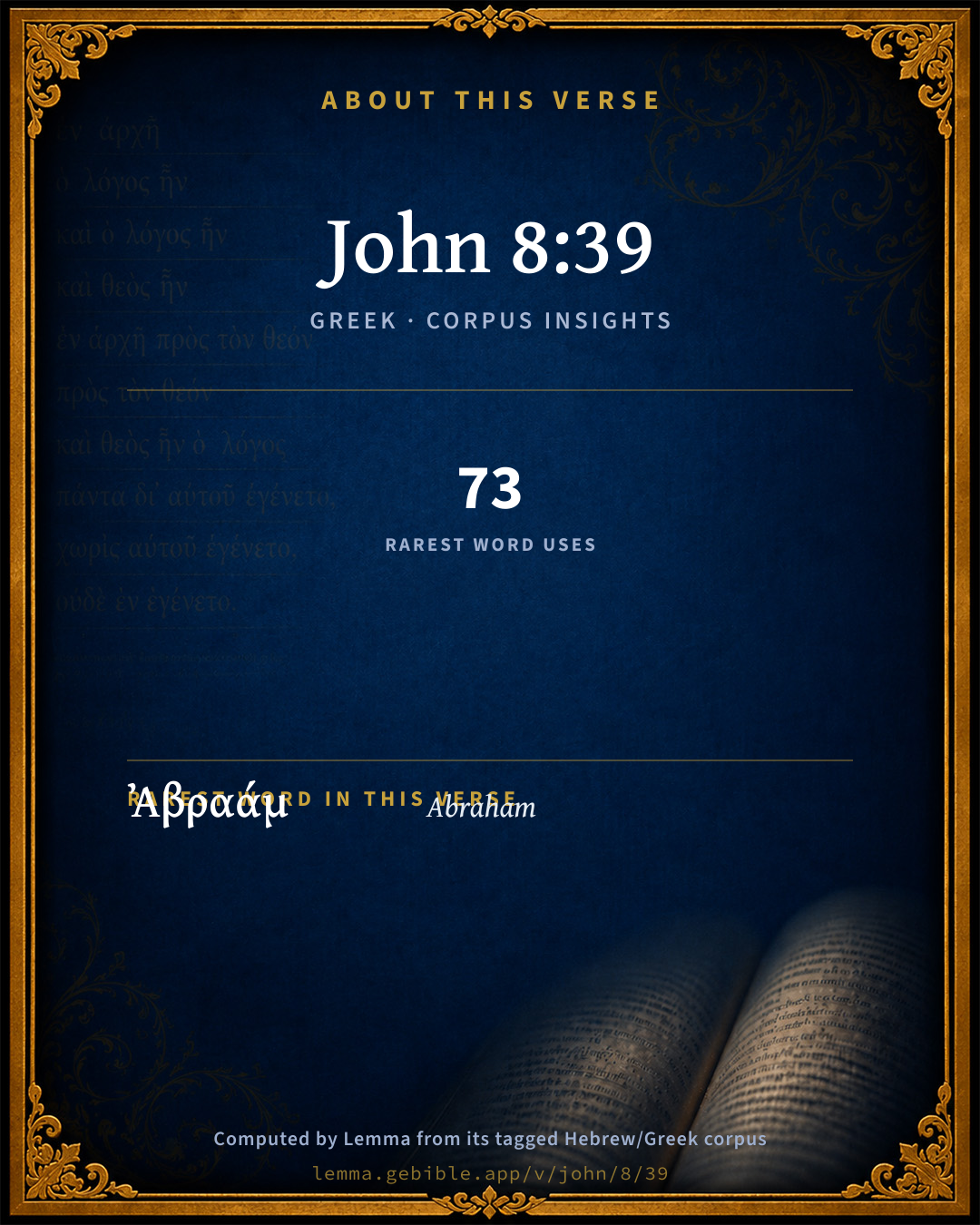
Ἀβραάμ
Abraám
G11
“Abraham”
Noun, Proper, indeclinable
Part of Speech
Noun · Proper, indeclinable
Full Thayer's Definition

Origin: of hebrew origin H85

TDNT: 01:08,2

Abraham = "father of a multitude" 1. the son of Terah and the founder of the Jewish nation
  1. ἀπεκρίθησαν apokrínomai G611 “to answer” Verb, Aorist, Middle deponent, Indicative, 3rd person, Plural
  2. καὶ kaí G2532 “and” Conjunction
  3. εἶπαν légō G3004 “to say” Verb, Aorist, Active, Indicative, 3rd person, Plural
  4. αὐτῷ autós G846 “he” Personal pronoun, Dative, Singular, Masculine
  5. ὁ ho G3588 “the” Article, Nominative, Singular, Masculine
  6. πατὴρ patḗr G3962 “father” Noun, Nominative, Singular, Masculine
  7. ἡμῶν hēmeîs G2249 “we” Personal pronoun, 1st person, Genitive, Plural
  8. ἐστιν eimí G1510 “to be” Verb, Present, Active, Indicative, 3rd person, Singular
  9. λέγει légō G3004 “to say” Verb, Present, Active, Indicative, 3rd person, Singular
  10. αὐτοῖς autós G846 “he” Personal pronoun, Dative, Plural, Masculine
  11. ὁ ho G3588 “the” Article, Nominative, Singular, Masculine
  12. Ἰησοῦς Iēsoûs G2424 “Jesus” Noun, Nominative, Singular, Masculine
  13. εἰ ei G1487 “if” Conditional
  14. τέκνα téknon G5043 “child” Noun, Nominative, Plural, Neuter
  15. τοῦ ho G3588 “the” Article, Genitive, Singular, Masculine
  16. Ἀβραάμ Abraám G11 “Abraham” Noun, Proper, indeclinable
  17. ἐστε eimí G1510 “to be” Verb, Present, Active, Indicative, 2nd person, Plural
  18. τὰ ho G3588 “the” Article, Accusative, Plural, Neuter
  19. ἔργα érgon G2041 “work” Noun, Accusative, Plural, Neuter
  20. τοῦ ho G3588 “the” Article, Genitive, Singular, Masculine
  21. Ἀβραὰμ Abraám G11 “Abraham” Noun, Proper, indeclinable
  22. ἐποιεῖτε poiéō G4160 “to make” Verb, Imperfect, Active, Indicative, 2nd person, Plural

About this verse

These counts appear in no published source. They are computed here, from the morphology-tagged text and Lemma’s own curated glosses. What Lemma adds →

23
words
14
distinct lemmas
Gospels
section

Repetition

Words recur within this verse:

  • Ἀβραάμ Abraham G11 ×3
  • εἶπαν to say G3004 ×2
  • ἐστιν to be G1510 ×2
  • ὁ the G3588 ×5
  • αὐτῷ he G846 ×2

Cross-references

10

Topical passages linked to John 8:39 in the Treasury of Scripture Knowledge — connected by theme and wording, ordered by reader-vote popularity; previews shown in the World English Bible.

  • Galatians 3:7 Know therefore that those who are of faith, the same are children of Abraham.
  • John 8:37 I know that you are Abraham's seed, yet you seek to kill me, because my word finds no place in you.
  • Romans 9:7 Neither, because they are Abraham's seed, are they all children. But, "In Isaac will your seed be called."
  • Romans 2:28–29 For he is not a Jew who is one outwardly, neither is that circumcision which is outward in the flesh;
  • Matthew 3:9 Don't think to yourselves, 'We have Abraham for our father,' for I tell you that God is able to raise up children to Abraham from these stones.
  • Matthew 5:45 that you may be children of your Father who is in heaven. For he makes his sun to rise on the evil and the good, and sends rain on the just and the unjust.
  • Romans 4:12 The father of circumcision to those who not only are of the circumcision, but who also walk in the steps of that faith of our father Abraham, which he had in uncircumcision.
  • Romans 4:16 For this cause it is of faith, that it may be according to grace, to the end that the promise may be sure to all the seed, not to that only which is of the law, but to that also which is of the faith of Abraham, who is the father of us all.
  • Galatians 3:29 If you are Christ's, then you are Abraham's seed and heirs according to promise.
  • James 2:22–24 You see that faith worked with his works, and by works faith was perfected;

Cross-references courtesy of OpenBible.info (CC BY 4.0).

Commentary

Notes on John 8:39 from classic Christian and Jewish commentators (each source and its license shown beneath its notes). The classic Christian expositions comment on the surrounding passage and are grouped to its opening verse, so a note may address several verses; the Jewish commentaries on the Tanakh (Rashi and others) are per-verse, so they appear only where the commentator wrote on this verse.

Lemma curates 59 commentaries, every one of them public domain or Creative Commons licensed, each selected and text-cleaned for this edition rather than reprinted as found. About our sources →

Bengel's Gnomon

Johann Albrecht Bengel

Joh 8:39. Ἀβραάμ, Abraham) They attempt to defend what they had said, Joh 8:33, “We be Abraham’s seed.” They feel that Jesus is speaking concerning another father of theirs.—ἐποιεῖτε) ἄν is understood, as at Joh 9:33 [εἰ μὴ ἦν οὗτος παρὰ τοῦ Θεοῦ, οὐκ ἠδύνατο ποιεῖν οὐδέν.]

Bengel's Gnomon of the New Testament — English translation (T&T Clark, Edinburgh, 1860) — public domain. Text from a community e-Sword module.

Meyer's Critical & Exegetical Commentary

Heinrich August Wilhelm Meyer

Joh_8:39-40. The Jews observe that He means another father than Abraham.

Jesus proves to them from their non-Abrahamic mode of action that they are no children of Abraham.

τέκνα and ἔργα are correlates; the former is used in an ethical sense, so that here (comp. Joh_8:37) a distinction is drawn, as in Rom_9:8, between the fleshly σπέρμα and the moral τέκνα.

In the reading ἐστε (see the critical notes) there is a change in the view of the relationship, as in Luk_17:5 f. See remarks on the passage. On the non-employment of ἄν, see Buttmann in Studien u. Kritiken for 1858, p. 485, and his Neutest. Gramm. p. 195 [E. T. p. 224].

νῦν δέ] but under such circumstances, nunc autem.

ἄνθρωπον in reference to παρὰ τ. θεοῦ. The λελάληκα following in the first person is regular; see Buttm. Neut. Gramm. p. 241 [E. T. p. 396].

τοῦτο] seek to take the life of a man who speaks the truth which he has heard of Godthat Abraham did not do![24] The words are far from referring to Abrahams conduct towards the angel of the Lord, Genesis 18 (Hengstenberg, after Lampe); nor is such a reference involved in Joh_8:56.

παρὰ τοῦ θεοῦ] when I was in my pre-human state, ΠΑΡᾺ Τῷ ΠΑΤΡΊ ΜΟΥ, Joh_8:38. To this view ἌΝΘΡΩΠΟΝ is not opposed (Beyschlag), for Jesus must needs describe Himself in this general human manner, if there were to be congruity between the category of His self-description and the example of Abraham.

[24] The expression is a Litotes (From the like of this the God-fearing spirit of the patriarch was far removed), but all the more fitted to put them to shame.

Meyer — Critical and Exegetical Commentary on the New Testament — English translation by Peter Christie, edited by Frederick Crombie (T&T Clark, 1880) — public domain. Text from a community e-Sword module.

Expositor's Greek Testament

ed. W. Robertson Nicoll

Joh 8:39 . To this ambiguous but ominous utterance the Jews reply: Ὁ πατὴρ ἡμῶν Ἀβραάμ ἐστι , thereby meaning to clear themselves of the suspicion of having learned anything evil from their father. To which Jesus retorts: Εἰ τέκνα … ἐποιεῖτε ἄν . “If ye were Abraham’s children ye would do the works of Abraham”; according to the law of Joh 8:38 . If their origin could be wholly traced to Abraham, then their conduct would resemble his. νῦν δὲ … ἐποίησεν . “But now as the fact really is you seek to kill me; and this has not only the guilt of an ordinary murder, but your hostility is roused against me because I have spoken to you the truth I heard from God. It is murder based upon hostility to God. This is very different from the conduct of Abraham.” ἄνθρωπον seems to be used simply as we might use “person” a person who: certainly, as Lampe says, it is used “sine praejudicio deitatis”. Bengel thinks it anticipates ἀνθρωπόκτονος in Joh 8:44 , and Westcott says it “stands in contrast with of God … and at the same time suggests the idea of human sympathy, which He might claim from them ( a man ), as opposed to the murderous spirit of the power of evil”.

The Expositor's Greek Testament, edited by W. Robertson Nicoll (1897–1910) — public domain. Text from a community e-Sword module.

Jamieson, Fausset & Brown

Robert Jamieson, A. R. Fausset & David Brown

If ye were Abraham's children, ye would do the works of Abraham--He had just said He "knew they were Abraham's children," that is, according to the flesh; but the children of his faith and holiness they were not, but the reverse.

Jamieson, Fausset & Brown — Commentary Critical and Explanatory on the Whole Bible (1871) — public domain (CC PDM 1.0). Text via the HelloAO Bible API.

Adam Clarke's Commentary

Verse 39. If ye were Abraham's children] Griesbach reads εστε, ye are, instead of ητε, ye were, on the authority of BDL, Vulgate, four copies of the Itala; Origen and Augustin.

Ye would do the works of Abraham.] As the son has the nature of his father in him, and naturally imitates him, so, if ye were the children of Abraham, ye would imitate him in his faith, obedience, and uprightness; but this ye do not, for ye seek to kill me-ye are watching for an opportunity to destroy me, merely because I tell you the truth: Abraham never did any thing like this; therefore, you have no spiritual relationship to him.

Adam Clarke's Commentary on the Bible (1810–1826) — public domain. Text from a community e-Sword/MySword module.

John Calvin's Commentaries

39. Abraham is our father. This altercation shows plainly enough how haughtily and fiercely they despised all Christ’s reproofs. What they continually claim and vaunt of is, that they are Abraham’s children; by which they do not simply mean that they are the lineal descendants of Abraham, but that they are a holy race, the heritage of God, and the children of God. And yet they rely on nothing but the confidence of the flesh. But carnal descent, without faith, is nothing more than a false pretense. We now understand what it was that so greatly blinded them, so that they treated Christ with disdain, though armed with deadly thunder. Thus the word of God, which might move stones, is ridiculed in the present day by Papists, as if it were a fable, and fiercely persecuted by fire and sword; and for no other reason but that they rely on their false title of “the Church,” and hope that they will be able to deceive both God and man. In short, as soon as hypocrites have procured some plausible covering, they oppose God with hardened obstinacy, as if he could not penetrate into their hearts.

If you were the children of Abraham, you would do the works of Abraham. Christ now distinguishes more plainly between the bastard and degenerate children of Abraham, and the true and lawful children; for he refuses to give the very name to all who do not resemble Abraham True, it frequently happens that children do not resemble, in their conduct, the parents from whom they are sprung; but here Christ does not argue about carnal descent, but only affirms that they who do not retain by faith the grace of adoption are not reckoned among the children of Abraham before God. For since God promised to the seed of Abraham that he would be their God, saying,

I will establish my covenant between me and thee, and thy seed after thee, in their generations, for an everlasting covenant, to be a God unto thee, and to thy seed after thee, (Genesis 17:7,)

all unbelievers, by rejecting this promise, excluded themselves from the family of Abraham.

The state of the question therefore is this: Ought they to be accounted Abraham’s children who reject the blessing offered to them in the word, so that, notwithstanding of this, they shall be a holy nation, the heritage of God, and a royal priesthood? (Exodus 19:6; Joel 3:2.) Christ denies this, and justly; for they who are the children of the promise must be born again by the Spirit, and all who desire to obtain a place in the kingdom of God ought to be new creatures. Carnal descent from Abraham was not indeed useless, and of no value, provided that the truth were added to it. For election dwells in the seed of Abraham, but it is free, so that all whom God sanctifies by his Spirit are accounted heirs of life.

John Calvin's Commentaries (1540-1563) — public domain. Text from the Calvin Translation Society English edition (1840s-50s) via the Christian Classics Ethereal Library (ccel.org). Calvin's coverage is partial (roughly two-thirds of the Bible); uncommented books and verses are honest gaps, never fabricated. The 19th-century editor's footnotes and remarks are omitted so the notes are faithfully Calvin's own voice.

Ellicott's Commentary for English Readers

(39) They answered and said unto him, Abraham is our father.—They feel the meaning which has not yet been expressed (comp. Joh_8:44), and claim the descent from Abraham which He has already allowed (Joh_8:37).

If ye were Abraham’s children, ye would do the works of Abraham.—Almost all the better MSS. read, “If ye are,” for “If ye were.” This must mean, “If ye are Abraham’s children—but the supposition is excluded, for ye would do the works of Abraham, and this is opposed to fact.” They are the physical seed of the patriarch, but they are not the ethical children, for the true child would bear the moral impress of the father which would be seen in his works. The thought of the previous verse is again present here.

The distinction between “seed” and “children” is another instance of an idea which meets us in this section, and was developed in the writings of St. Paul. (Comp. Rom_9:7 et seq.)

A Bible Commentary for English Readers, edited by Charles John Ellicott (1878–1897) — public domain. Text from a community e-Sword module.

The Cambridge Bible for Schools and Colleges

gen. ed. J. J. S. Perowne

39. Abraham is our father] They see that He means some other father than Abraham; possibly they suspect His full meaning, soon to be expressed (Joh_8:44).

If ye were Abraham’s children] The true reading seems to be, if ye are Abraham’s children, which has been altered to ‘if ye were,’ so as to run more smoothly with the second clause. But the reading of the second verb is also doubtful, and perhaps we should read, do (imper.) the works of Abraham.

The Cambridge Bible for Schools and Colleges (gen. ed. J. J. S. Perowne; Cambridge University Press, 1878–1918) — public domain. Text from a community e-Sword module.

John Gill's Exposition

Jesus said unto them, if God were your Father,.... By adoption; and this was discovered by the grace of regeneration; or in other words, if they had been born of God,

ye would love me; for in regeneration love to Christ is always implanted: it is a fruit of the Spirit, which always comes along with the superabounding grace of God in conversion; whoever are begotten again, according to abundant mercy, love an unseen Jesus; and where there is no love to Christ, there can be no regeneration: such persons are not born again; nor is God their Father, at least manifestatively:

for I proceeded forth; and came from God; the former of these phrases is observed by many learned men to be used by the Septuagint, of a proper natural birth, as in Gen 15:4; and here designs the eternal generation of Christ, as the Son of God, being the only begotten of the Father, and the Son of the Father in truth and love; and the other is to be understood of his mission from him, as Mediator:

neither came I of myself; or did not take the office to himself, without being called unto it, and invested with it, by his Father:

but he sent me; not by force, or against the will of Christ, or by change of place, but by assumption of nature; he sent him at the time agreed upon, in human nature, to obtain eternal redemption for his people: and upon both these accounts Christ is to be loved by all regenerate persons, or who have God for their Father; both on account of his being the Son of God, of the same nature and essence with him, see Jo1 5:1; and on account of his mission into this world, as Mediator, since he was sent, and came to be the Saviour of lost sinners.

John Gill's Exposition of the Whole Bible (1746–1763) — public domain (CC PDM 1.0). Text via the HelloAO Bible API.

Trapp's Complete Commentary

John Trapp

39 They answered and said unto him, Abraham is our father. Jesus saith unto them, If ye were Abraham’s children, ye would do the works of Abraham.

Ver. 39. Abraham is our father] But it ill appeareth by your practice. Degenerate plants ye are, and such as shame your father, as much as Augustus’ three children did him, whom he usually called his tres vomicas, tria carcinomata, three botches and carbuncles.

John Trapp, A Commentary or Exposition upon All the Books of the Old and New Testament (1647–1656) — public domain. Text from a community e-Sword module.

Albert Barnes' Notes on the Bible

Abraham is our father - We are descended from Abraham. Of this the Jews boasted much, as being descended from such an illustrious man. See the notes at Mat 3:9. As Jesus did not expressly say who he meant Joh 8:38 when he said they did the works of their father, they obstinately persisted in pretending not to understand him, as if they had said, “We acknowledge no other father but Abraham, and to charge us with being the offspring of another is slander and calumny.”

If ye were Abraham’s children - The words “sons” and “children” are often used to denote those who imitate another or who have his spirit. See the notes at Mat 1:1. Here it means, “if you were worthy to be called the children of Abraham, or if you had his spirit.”

Albert Barnes' Notes on the Bible (1834–1885) — public domain. Text from a community e-Sword/MySword module.

Haydock's Catholic Bible Commentary

Not only faith but good works make men children of Abraham. See James, chap. ii.

George Leo Haydock (1774–1849), Haydock's Catholic Family Bible and Commentary, 1859 edition — public domain. Excludes Psalms (Douay-Rheims chapter numbering differs from Protestant) and Deuterocanonical books (Catholic canon only).

Matthew Poole's English Annotations

Abraham is our Father; this was their continual boast, as may be learned from Mat 3:9; glorying in their birth privilege, Abraham being the father of the whole Jewish nation; and in their church privilege, Abraham being the head of the Jewish church, and he to whom the promises were made. But Christ taketh them off this glorying, by reminding them, that the blood of Abraham running in their veins would be of little significance to them, so long as they did not walk in Abraham’s steps. Men are truly to be accounted the children of those, not from whom they are naturally descended, but whose steps they walk in, and whom they imitate in their conversations.

Matthew Poole's English Annotations on the Holy Bible (1683–1685) — public domain. Text from a community e-Sword/MySword module.

Whedon's Commentary on the Bible

Daniel D. Whedon

39. Abraham’s children—That they desired the death of Abraham’s truest son and actual Lord, is proof that they are not in soul true sons of Abraham.

Daniel D. Whedon (gen. ed.), Commentary on the Old and New Testaments (1874–1909) — public domain. Text from a community e-Sword module.

The Pulpit Commentary

They answered and said. If the second interpretation be accepted, then, irritated by the suggestion that "the Father" whose properties and claims he saw and revealed to them was different from "the father" whose nature and ways they "heard" and practised, and counting, moreover, on the concession of the fact that they were Abraham"s "seed," they cried, Our father is Abraham; we are spiritually, ethically, related to him, and if we are doing that which we have heard from our father, then we can claim that all we are doing is along the lines of our Abrahamic dignity. But if ver. 38 be regarded as a final expostulation, according to the first of the interpretations of poieite , then the Jews merely disclosed their determination to misapprehend the plain words of the Divine Lord, and when he was reminding them of the Father, of their Father, they at once stood back upon their hereditary pride, and declared that they were doing the works of their great ancestor. Jesus saith to them, If ye areAbraham"s children, as you say for the position of "children" is involved in the idea and claim of spiritual Fatherhood which ye boast then, with such spiritual and ethical relations as these, ye would do the works of Abraham works of faith; you would be open to the access of spiritual revelations with childlike simplicity; you would have accepted the heavenly voice; you would have known whence it came; you would have resembled him in his moral sensitiveness, in his gentle loving kindness, in his victorious faith; but

The Pulpit Commentary (1880–1919), ed. H.D.M. Spence-Jones & Joseph S. Exell — public domain. Text from a community e-Sword module.

Kretzmann's Popular Commentary

Paul E. Kretzmann

The difference between earthly and spiritual parenthood:

v. 39. They answered and said unto Him, Abraham is our father. Jesus saith unto them, If ye were Abraham’s children, ye would do the works of Abraham.

v. 40. But now ye seek to kill Me, a man that hath told you the truth, which I have heard of God; this did not Abraham.

v. 41. Ye do the deeds of your father. Then said they to Him, We be not born of fornication; we have one Father, even God.

Whether the Jews would not or could not understand the words of Jesus is not apparent. But they sullenly, doggedly repeat their statement that Abraham was their father, their ancestor, assuming that this fact must cover a multitude of defections. To this Jesus objects by saying that they must do the works of Abraham, if they are children of Abraham in truth, that is, in the spiritual sense. They have none of the characteristics, none of the spiritual nature of Abraham, else they would show this nature in such deeds as would be in conformity with the spirit of Abraham. In seeking to kill Jesus, against whom they could bring no real charge, they showed a decided difference from Abraham. The Jews now began to notice that He was ascribing a different parentage to them and became highly incensed. They were not born of an adulterous union, they protest; they were not guilty of idolatry and the practices that go with idolatry; they belonged to the people of Israel in truth; they believed in one Father, in God Himself, and had nothing in common with idols. Their zeal was commendable, but it did not. strike the point under discussion.

Paul E. Kretzmann, Popular Commentary of the Bible (1921–1924) — public domain. Text from a community e-Sword module.

unfoldingWord translationNotes

Door43 World Missions Community

father

forefather

Abraham did not do this

"Abraham never tried to kill anyone who told him the true revelation from God"

You do the works of your father

Jesus implies that their father is the devil. AT: "No! You are doing the things that your real father did" (See: Assumed Knowledge and Implicit Information)

We were not born in sexual immorality

Here the Jewish leaders imply that Jesus does not know who his real father is. AT: "We do not know about you, but we are not illegitimate children" or "We were all born from proper marriages" (See: Assumed Knowledge and Implicit Information)

we have one Father: God

Here the Jewish leaders claim God as their spiritual Father. This is an important title for God. (See: Translating Son and Father)

translationWords

ancestor

Abraham

true

sexual immorality

God

unfoldingWord translationNotes — © Distant Shores Media and the Door43 World Missions Community, licensed CC BY-SA 4.0. Source: git.door43.org/Door43/en_tn.

Cambridge Greek Testament for Schools and Colleges

39. ἐστε (אBDLT) for ἦτε (C). Omit ἄν after ἐποιεῖτε.

39. Ἀβρ. ἐστε. They see that He means some other father than Abraham; but they hold fast to their descent.

εἰ … ἐστε. If ye are children of Abraham: ἐστέ has been altered to ἦτε in some MSS. to bring the protasis into harmony with the supposed apodosis ἐποιεῖτε or ἐποιεῖτε ἄν. But the true reading is probably ποιεῖτε, either imperative or indicative: ‘If ye are children of Abraham, do the works of Abraham,’ or ‘ye do the works of Abraham;’ and these they manifestly did not do, and therefore could not be his children. Authorities are much divided between ἐστέ and ἦτε, ποιεῖτε and ἐποιεῖτε or ἐποιεῖτε ἄν.

Cambridge Greek Testament for Schools and Colleges (Cambridge University Press, 1896; 21 vols, various authors incl. Carr, Maclear, Plummer, Farrar, Lumby, Moule, M. R. James, Simcox) — public domain. Text from a community e-Sword module.

International Critical Commentary

39. ὁ πατὴρ ἡμῶν Ἀβραάμ ἐστιν, “Our father is Abraham.” They repeat what they have said before (v. 33). It was true, in so far as their physical pedigree was concerned; but Jesus tells them that they are not true sons of Abraham if their conduct is unlike his. His reply is almost in the words used by Paul οὐδʼ ὅτι εἰσὶν σπέρμα Ἀβραάμ, πάντες τέκνα (Rom 9:7). He had admitted (v. 37) that they were σπέρμα Ἀβραάμ, but this natural descent did not, by itself, guarantee all the privileges which belong to the τέκνα who are Abraham’s true heirs (cf. Gal 3:7, Gal 3:9).

εἰ τέκνα τοῦ Ἀβραάμ ἐστε, τὰ ἔργα τοῦ Ἀβραὰμ ποιεῖτε. “If you are Abraham’s children, do Abraham’s works,” ποιεῖτε being imperative.

ποιεῖτε, although only read by B, is probably the true reading,1 and should be rendered in the imperative mood, with Syr. sin. ἐποιεῖτε ἄν (W omits ἄν) is read by אcCLNW; but this requires the rec. ἦτε instead of ἐστέ in the first clause, while ἐστέ is read by אBDLT.

International Critical Commentary — older volumes (1896–1929), various authors — public domain. Text from a community e-Sword module.

Vincent's Word Studies in the New Testament

Marvin R. Vincent

Children [τεκνα] . See on 1 12.

Marvin R. Vincent, Word Studies in the New Testament (1887–1900) — public domain. Text from a community e-Sword/MySword module.

Godet's Commentaries

Frédéric Louis Godet

Vv. 39-41a. “They answered and said to him, Our father is Abraham. Jesus said to them, If you were Abraham’s children, you would do the works of Abraham. 40. But now you seek to kill me, a man who has told you the truth which I have heard from God; Abraham did not do this. 41 a. You do the works of your father.”

The Jews feel themselves insulted by the insinuation of Joh 8:38; they affirm more energetically, and with a feeling of wounded dignity, their descent from Abraham. Jesus takes up again His answer in Joh 8:37 and develops it. In this domain, He says, there is no real paternal relationship where there is opposition in conduct.

The Alexandrian reading: If you are...you would do, can be defended only by supposing a decided grammatical anomaly. John would at first lay down the fact as real (you are), to deny it afterwards in the second clause (you would do). In any case this explanation is preferable to that of Origen and Augustine, to which Weiss inclines, accepting the reading of B, “If you are... do then!” But Jesus is not exhorting, He is proving. This Alexandrian reading seems to be the result of an arbitrary correction. The verb of the principal clause ἐποιεῖτε ἄν, you would do, was first changed into the imperative ποιεῖτε, do, and after this it was necessary to transform the ἦτε (if you were) into ἐστε (if you are). Abraham was distinguished for an absolute docility to the divine truth (Genesis 12, 22), and by a respectful love for those who were the organs of it in his presence (Genesis 16, 18); what a contrast to the conduct of his descendants according to the flesh! Observe the gradation (Joh 8:40): 1. To kill a Man 1:2. A man who is an organ of the truth; 3. Of the truth which comes from God. Their moral descent from Abraham being thus set aside, the result is this: “You have therefore another father, the one whose will you do and whose works you practice, as I do those of my Father.”

Frédéric Louis Godet — Commentaries on Luke, John, Romans, and 1 Corinthians — English translation (T&T Clark, Edinburgh, 1870s–1890s) — public domain. Text from a community e-Sword module.

Lesson kit

Teaching starters — assembled from the data on this page, not authored interpretation. Every prompt links to the verse data it draws on. Edit before teaching.

John, in the Gospels, opens this verse with 23 words (14 distinct Greek lemmas). Its most distinctive word is Abraám (“Abraham”). A historical commentator’s framing appears above. Read the whole chapter for the surrounding context.

Discussion questions

  1. How does “Abraham” (Abraám) shape what this verse is saying?
  2. How does Galatians 3:7, which shares this passage’s theme, read alongside this verse?
  3. What does the repetition of “Abraham” (3× in this one verse) do in this verse?
  4. The translations on this page render this verse differently — a whole-verse word diff, not a word-by-word alignment. What might account for the different wordings?
  5. Compare how Bengel's Gnomon and Meyer's Critical & Exegetical Commentary read this verse. Where do they agree or differ?

Things to notice

  • These translations choose different wording for 3 words in this verse.
  • “Abraham” occurs 3× in this single verse.
  • 14 distinct Greek lemmas span 23 words in this verse.

Reading settings

Reading text

Shown beneath each verse's original-language words.

Old Testament
Old Testament edition

Read the OT as the Masoretic Hebrew (MT) or the Greek Septuagint (LXX).

English shown for the Greek Septuagint (in the Hebrew ↔ Greek comparison).

Comparing translations? Open the Compare panel on any verse page to stack up to four side by side.