John 6:57

Greek (Tischendorf 8th ed.) John 6:57 appears in the Greek New Testament. The text above is from the Tischendorf 8th edition. Each word links to its Strong’s number and a concise gloss. Click any word for its full Thayer’s Greek Lexicon entry.
Download image
Cite this verse

John 6:57 (World English Bible). Public Domain. Lemma interlinear Bible study tool, https://lemma.gebible.app/v/john/6/57.

Show BibTeX & RIS
BibTeX
RIS
English Translation
As the living Father sent me, and I live because of the Father; so he who feeds on me, he will also live because of me.
World English Bible · Public Domain
Download a study sheet

One document with this verse’s original text, its word-by-word gloss line, the meaning frame, cross-references with their text, attributed commentary, and full source and license credits — printable, and it pastes into notes with its structure intact.

This verse Autodidact and up

Study sheet (.html) Plain text (.txt)

A passage Seminary Student

Up to 50 verses in one chapter. A passage sheet keeps up to 6 commentary sources and 12 cross-references per verse, in the order this page ranks them, and says so on the sheet whenever that leaves anything out. Ask for a single verse and you get the Autodidact verse sheet above.

Everything on this page stays free to read, with no account — the sheet is a download of what is already on screen, not access to it.

Want to remove ads? Support Godless Engineer
Compare translations 3

The same verse in 3 English versions, stacked beneath the original-language interlinear above. Click any original word for its lexicon entry.

Each is an independent rendering of the whole verse — the interlinear is not word-aligned to these translations.

Highlighted words mark where these versions differ — a whole-verse word diff, not a word-by-word alignment.

  • World English Bible Public Domain
    As the living Father sent me, and I live because of the Father; so he who feeds on me, he will also live because of me.
  • King James Version Public Domain
    As the living Father hath sent me, and I live by the Father: so he that eateth me, even he shall live by me.
  • unfoldingWord Literal Text CC BY-SA 4.0
    Just as the living Father sent me, and I live because of the Father, so the one eating me, he will also live because of me.

unfoldingWord Literal Text — © unfoldingWord, licensed CC BY-SA 4.0. Word-aligned USFM3 via Door43 (git.door43.org/unfoldingWord/en_ult).

Versions to compare (up to 4)

3 of 4 selected

Show all 19 translations

Every available English version of this verse, each an independent rendering of the whole verse.

  • World English Bible Public Domain
    As the living Father sent me, and I live because of the Father; so he who feeds on me, he will also live because of me.
  • Berean Standard Bible Public Domain
    Just as the living Father sent Me and I live because of the Father, so also the one who feeds on Me will live because of Me.
  • Majority Standard Bible Public Domain
    Just as the living Father sent Me and I live because of the Father, so also the one who feeds on Me will live because of Me.
  • King James Version Public Domain
    As the living Father hath sent me, and I live by the Father: so he that eateth me, even he shall live by me.
  • American Standard Version (1901) Public Domain
    As the living Father sent me, and I live because of the Father; so he that eateth me, he also shall live because of me.
  • Revised Version (1885) Public Domain
    As the living Father sent me, and I live because of the Father; so he that eateth me, he also shall live because of me.
  • Geneva Bible (1599) Public Domain
    As that liuing Father hath sent me, so liue I by the Father, and he that eateth me, euen he shall liue by me.
  • Douay-Rheims (1899) Public Domain
    He that eateth my flesh, and drinketh my blood, abideth in me, and I in him.
  • Young's Literal Translation Public Domain
    `According as the living Father sent me, and I live because of the Father, he also who is eating me, even that one shall live because of me;
  • Literal Standard Version CC BY-SA 4.0
    According as the living Father sent Me, and I live because of the Father, he also who is eating Me, even that one will live because of Me;
  • Unlocked Literal Bible CC BY-SA 4.0
    As the living Father sent me, and as I live because of the Father, so he who eats me, he will also live because of me.
  • unfoldingWord Literal Text CC BY-SA 4.0
    Just as the living Father sent me, and I live because of the Father, so the one eating me, he will also live because of me.
  • Darby Bible Public Domain
    As the living Father has sent me and I live on account of the Father, *he* also who eats me shall live also on account of me.
  • World Messianic Bible Public Domain
    As the living Father sent me, and I live because of the Father, so he who feeds on me will also live because of me.
  • Webster's Bible Public Domain
    As the living Father hath sent me, and I live by the Father: so he that eateth me, even he shall live by me.
  • Free Bible Version CC BY-SA 4.0
    Just as the life-giving Father sent me and I live because of the Father, so anyone who feeds on me will live because of me.
  • Bible in Basic English Public Domain
    As the living Father has sent me, and I have life because of the Father, even so he who takes me for his food will have life because of me.
  • Text-Critical English NT CC BY 4.0
    Just as the living Father sent me, and I live because of the Father, so whoever feeds on me will also live because of me.
  • Tyndale New Testament (1534) Public Domain
    As the lyvinge father hath sent me even so lyve I by my father: and he that eateth me shall live by me.

Literal Standard Version (2020), Covenant Press — licensed CC BY-SA 4.0. Text via the HelloAO Bible API (eBible.org). Unlocked Literal Bible (unfoldingWord) — licensed CC BY-SA 4.0. Text via the HelloAO Bible API (eBible.org). unfoldingWord Literal Text — © unfoldingWord, licensed CC BY-SA 4.0. Word-aligned USFM3 via Door43 (git.door43.org/unfoldingWord/en_ult). Free Bible Version, Dr. Jonathan Gallagher — licensed CC BY-SA 4.0. Text via the HelloAO Bible API (eBible.org).

Word by word

More ways to search: Search by grammar → Find every occurrence → Compare this word →

Practice this passage: Drill this verse → Learn its vocabulary →

τρώγων
trṓgō
G5176
“to chew”
Verb, Present, Active, Participle, Nominative, Singular, Masculine
Part of Speech
Verb
Tense
Present
Voice
Active
Mood
Participle
Case
Nominative
Number
Singular
Gender
Masculine
Full Thayer's Definition

Origin: probably strengthened from a collateral form of the base of G5134 and G5147 through the idea of corrosion or wear, or perhaps rather of a base of G5167 and G5149 through the idea of a crunching sound

TDNT: 11:56,1

1. to gnaw, crunch, chew raw vegetables or fruits (as nuts, almonds) a. of animals feeding b. of men 2. to eat
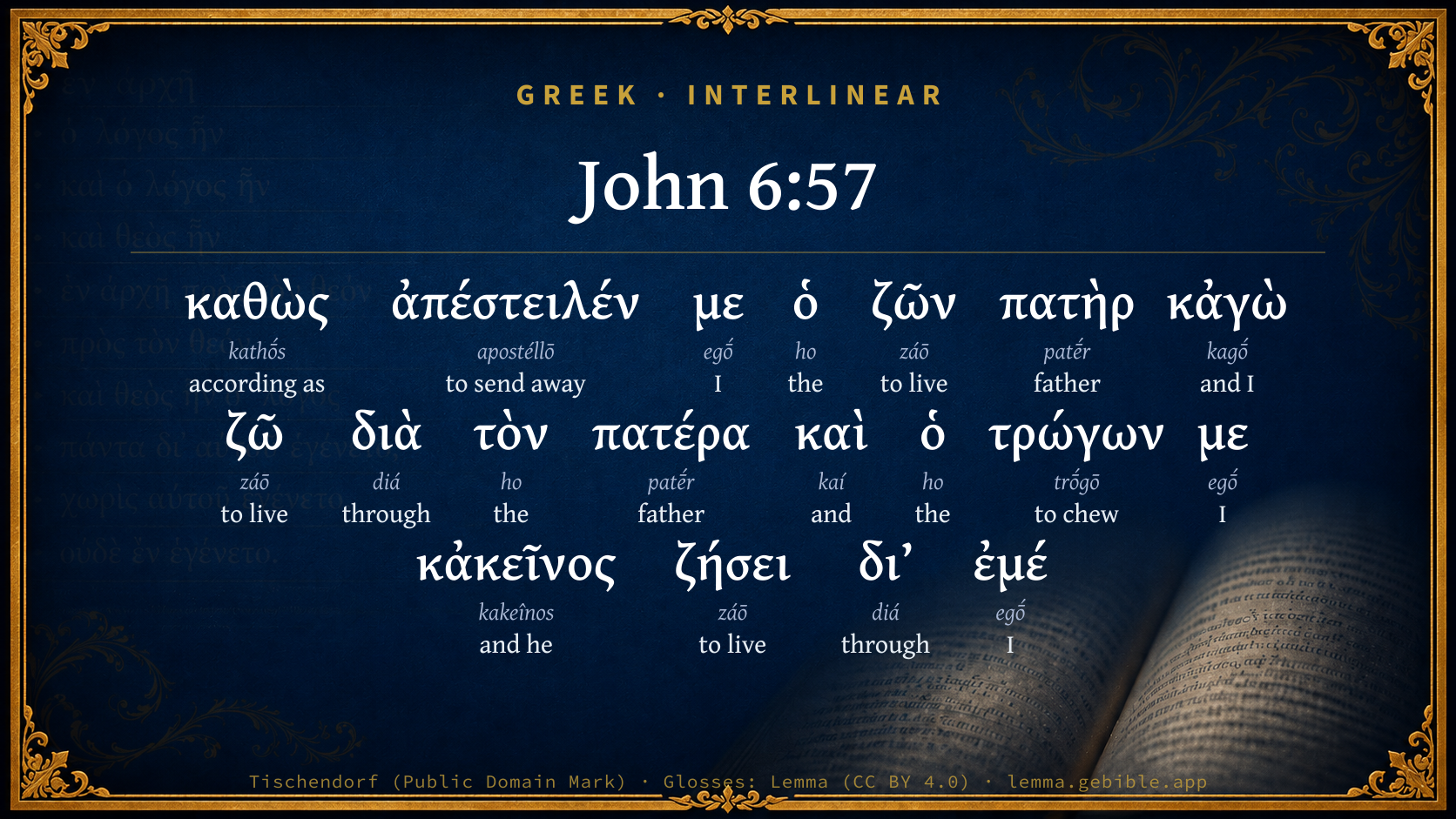
  1. καθὼς kathṓs G2531 “according as” Adverb
  2. ἀπέστειλέν apostéllō G649 “to send away” Verb, Aorist, Active, Indicative, 3rd person, Singular
  3. με egṓ G1473 “I” Personal pronoun, 1st person, Accusative, Singular
  4. ὁ ho G3588 “the” Article, Nominative, Singular, Masculine
  5. ζῶν záō G2198 “to live” Verb, Present, Active, Participle, Nominative, Singular, Masculine
  6. πατὴρ patḗr G3962 “father” Noun, Nominative, Singular, Masculine
  7. κἀγὼ kagṓ G2504 “and I” Personal pronoun, 1st person, Nominative, Singular, Aramaic form
  8. ζῶ záō G2198 “to live” Verb, Present, Active, Indicative, 1st person, Singular
  9. διὰ diá G1223 “through” Preposition
  10. τὸν ho G3588 “the” Article, Accusative, Singular, Masculine
  11. πατέρα patḗr G3962 “father” Noun, Accusative, Singular, Masculine
  12. καὶ kaí G2532 “and” Conjunction
  13. ὁ ho G3588 “the” Article, Nominative, Singular, Masculine
  14. με egṓ G1473 “I” Personal pronoun, 1st person, Accusative, Singular
  15. κἀκεῖνος kakeînos G2548 “and he” Demonstrative pronoun, Nominative, Singular, Masculine, Aramaic form
  16. ζήσει záō G2198 “to live” Verb, Future, Active, Indicative, 3rd person, Singular
  17. δι’ diá G1223 “through” Preposition
  18. ἐμέ egṓ G1473 “I” Personal pronoun, 1st person, Accusative, Singular

About this verse

These counts appear in no published source. They are computed here, from the morphology-tagged text and Lemma’s own curated glosses. What Lemma adds →

19
words
11
distinct lemmas
Gospels
section

Notable vocabulary

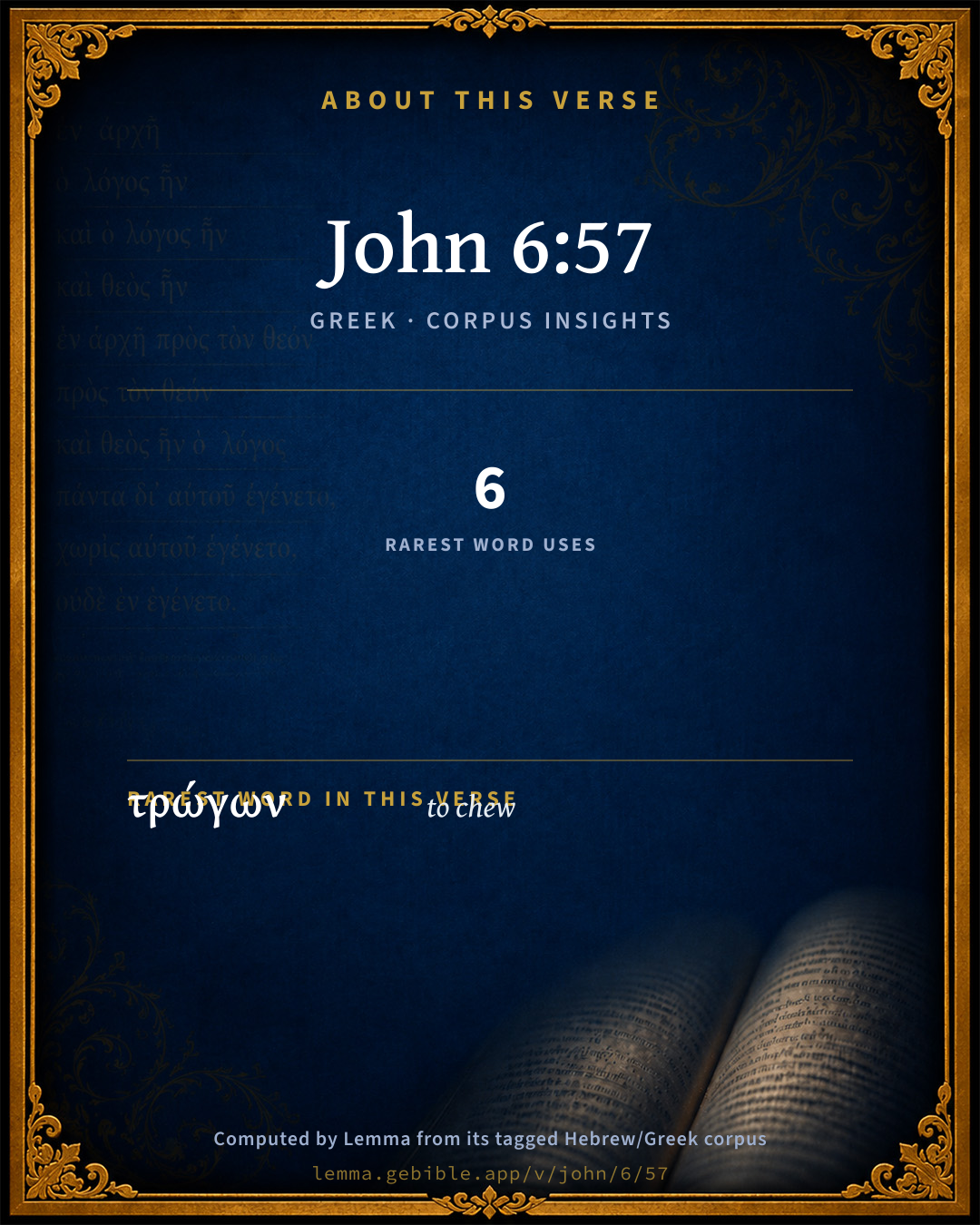
The rarest word here is τρώγων to chew G5176 — appearing just 6 times in the whole Greek New Testament.

Shared distinctive vocabulary

τρώγων to chew G5176 occurs in 6 verses of the Greek New Testament. Also found in:

Repetition

Words recur within this verse:

Cross-references

16

Topical passages linked to John 6:57 in the Treasury of Scripture Knowledge — connected by theme and wording, ordered by reader-vote popularity; previews shown in the World English Bible.

  • John 5:26 For as the Father has life in himself, even so he gave to the Son also to have life in himself.
  • Galatians 2:20 I have been crucified with Christ, and it is no longer I that live, but Christ living in me. That life which I now live in the flesh, I live by faith in the Son of God, who loved me, and gave himself up for me.
  • John 17:21 that they may all be one; even as you, Father, are in me, and I in you, that they also may be one in us; that the world may believe that you sent me.
  • Psalms 18:46 Yahweh lives; and blessed be my rock. Exalted be the God of my salvation,
  • Jeremiah 10:10 But Yahweh is the true God; he is the living God, and an everlasting King: at his wrath the earth trembles, and the nations are not able to abide his indignation.
  • John 3:17 For God didn't send his Son into the world to judge the world, but that the world should be saved through him.
  • Colossians 3:3–4 For you died, and your life is hidden with Christ in God.
  • Matthew 16:16 Simon Peter answered, "You are the Christ, the Son of the living God."
  • John 11:25–26 Jesus said to her, "I am the resurrection and the life. He who believes in me, though he die, yet will he live.
  • John 14:6 Jesus said to him, "I am the way, the truth, and the life. No one comes to the Father, except through me.
  • John 14:19 Yet a little while, and the world will see me no more; but you will see me. Because I live, you will live also.
  • 1 Corinthians 15:22 For as in Adam all die, so also in Christ all will be made alive.
  • 2 Corinthians 13:4 For he was crucified through weakness, yet he lives through the power of God. For we also are weak in him, but we will live with him through the power of God toward you.
  • 1 Thessalonians 1:9 For they themselves report concerning us what kind of a reception we had from you; and how you turned to God from idols, to serve a living and true God,
  • 1 John 4:9 By this was God's love revealed in us, that God has sent his one and only Son into the world that we might live through him.
  • Hebrews 9:14 how much more will the blood of Christ, who through the eternal Spirit offered himself without blemish to God, cleanse your conscience from dead works to serve the living God?

Cross-references courtesy of OpenBible.info (CC BY 4.0).

Commentary

Notes on John 6:57 from classic Christian and Jewish commentators (each source and its license shown beneath its notes). The classic Christian expositions comment on the surrounding passage and are grouped to its opening verse, so a note may address several verses; the Jewish commentaries on the Tanakh (Rashi and others) are per-verse, so they appear only where the commentator wrote on this verse.

Lemma curates 59 commentaries, every one of them public domain or Creative Commons licensed, each selected and text-cleaned for this edition rather than reprinted as found. About our sources →

Bengel's Gnomon

Johann Albrecht Bengel

Joh 6:57. Ἀπέστειλέ με, hath sent Me) To this is to be referred the [corresponding clause in the Apodosis] καὶ ὁ τρώγων με, so also he who eateth Me, through faith. The meat of Jesus was to do the will of Him by whom He was sent, ch. Joh 4:34; the meat of the believer is, to eat Christ, and to feed on Him, by the will of the Father.—κἀγώ, and I) The as has its Apodosis in that clause, so also He who eateth Me.—διὰ τὸν Πατέρα, on account of the Father [Engl. Vers. ‘by,’ not so correctly]) For I am in the Father.—καί) So also.—ὁ τρώγων με) He who eateth Me, who live [ζῶ]; [this he does] through faith: Joh 6:29, “This is the work of God, that ye believe on Him whom He hath sent;” 35, “He that cometh to Me shall never hunger, and he that believeth on Me,” etc.; 40, 64. In this point of view, inasmuch as the Father hath sent His Son, we eat His flesh and believe in Him.

Bengel's Gnomon of the New Testament — English translation (T&T Clark, Edinburgh, 1860) — public domain. Text from a community e-Sword module.

Cambridge Greek Testament for Schools and Colleges

57. ζήσει for ζήσεται. The future of ζάω occurs 20 times in N.T. In 6 quotations from LXX. ζήσομαι is used: 4 times in S. John (Joh 5:25, Joh 6:57-58, Joh 14:19) ζήσω is used; so also probably in Joh 6:51. ζήσεται occurs Joh 11:25.

57. Not a mere repetition, but an enlargement. In S. John there are no mere repetitions; the thought is always recut or reset, and frequently with additions. The result of this close union is perfect life, proceeding as from the Father to the Son, so from the Son to all believers. For καθὼς … καὶ … comp. Joh 13:15, 1Jn 2:6; 1Jn 4:17.

ὁ ζῶν πατήρ. The absolutely Living One, the Fount of all life. The expression occurs here only. Comp. Mat 16:16; 2Co 6:16; Heb 7:25.

διὰ τὸν π.… δι’ ἐμέ. Because of the Father, because the Father is the Living One (Joh 5:26); because of Me, because he thus derives life from Me. ‘By the Father … by Me’ would require the genitive.

ὁ τρ. με. Instead of the Flesh and Blood we have Christ Himself: the two modes of partaking are merged in one, the more appropriate of the two being retained.

κἀκεῖνος. He also. The retrospective pronoun repeats and emphasizes the subject: Joh 14:12 (where again it immediately follows the subject), Joh 1:18; Joh 1:33, Joh 5:11; Joh 5:39, Joh 9:37, Joh 10:1, Joh 12:48, Joh 14:21; Joh 14:26, Joh 15:26.

Cambridge Greek Testament for Schools and Colleges (Cambridge University Press, 1896; 21 vols, various authors incl. Carr, Maclear, Plummer, Farrar, Lumby, Moule, M. R. James, Simcox) — public domain. Text from a community e-Sword module.

Geneva Bible (1599)

Geneva Bible translators

In that that Christ is man, he receiveth that power which quickeneth and giveth life to them that are his, of his Father: and he addeth this word (That) to make a difference between him and all other fathers.

Christ his meaning is, that though he be man, yet his flesh can give life, not of the own nature, but because that flesh of his liveth by the Father, that is to say, death suck and draw out of the Father, that power which it hath to give life.

Geneva Bible (1599) marginal notes — public domain. Text via Bolls.life.

Jamieson, Fausset & Brown

Robert Jamieson, A. R. Fausset & David Brown

As the living Father hath sent me--to communicate His own life.

and I live by the Father--literally, "because of the Father"; My life and His being one, but Mine that of a Son, whose it is to be "of the Father." (See Joh 1:18; Joh 5:26).

he that eateth me, . . . shall live by me--literally, "because of Me." So that though one spiritual life with Him, "the Head of every man is Christ, as the head of Christ is God" (Co1 11:3; Co1 3:23).

Jamieson, Fausset & Brown — Commentary Critical and Explanatory on the Whole Bible (1871) — public domain (CC PDM 1.0). Text via the HelloAO Bible API.

Adam Clarke's Commentary

Verse 57. So he that eateth me, even he shall live by me.] From which we learn that the union between Christ and his followers shall be similar to that which subsists between God and Christ.

Adam Clarke's Commentary on the Bible (1810–1826) — public domain. Text from a community e-Sword/MySword module.

John Calvin's Commentaries

57. As the living Father hath sent me. Hitherto Christ has explained the manner in which we must become partakers of life. He now comes to speak of the principal cause, for the first source of life is in the Father. But he meets an objection, for it might be thought that he took away from God what belonged to him, when he made himself the cause of life. He makes himself, therefore, to be the Author of life, in such a manner, as to acknowledge that there was another who gave him what he administers to others.

Let us observe, that this discourse also is accommodated to the capacity of those to whom Christ was speaking; for it is only with respect to his flesh that he compares himself to the Father. For though the Father is the beginning of life, yet the eternal Word himself is strictly life But the eternal Divinity of Christ is not the present subject; for he exhibits himself such as he was manifested to the world, clothed with our flesh.

I also live on account of the Father. This does not apply to his Divinity simply, nor does it apply to his human nature simply and by itself, but it is a description of the Son of God manifested in the flesh. Besides, we know that it is not unusual with Christ to ascribe to the Father every thing Divine which he had in himself. It must be observed, however, that he points out here three degrees of life. In the first rank is the living Father, who is the source, but remote and hidden. Next follows the Son, who is exhibited to us as an open fountain, and by whom life flows to us. The third is, the life which we draw from him. We now perceive what is stated to amount to this, that God the Father, in whom life dwells, is at a great distance from us, and that Christ, placed between us, is the second cause of life, in order that what would otherwise be concealed in God may proceed from him to us.

John Calvin's Commentaries (1540-1563) — public domain. Text from the Calvin Translation Society English edition (1840s-50s) via the Christian Classics Ethereal Library (ccel.org). Calvin's coverage is partial (roughly two-thirds of the Bible); uncommented books and verses are honest gaps, never fabricated. The 19th-century editor's footnotes and remarks are omitted so the notes are faithfully Calvin's own voice.

Ellicott's Commentary for English Readers

(57) I live by the Father . . . he shall live by me.—The preposition “by” here is ambiguous, and it is better, therefore, to render the words, I live by reason of the Father . . . he shall live by reason of Me. For the thought of the Father as the original source of life, and as giving this principle of life to the Son, comp. Note on Joh_5:26. He that taketh the Son into his own being, in like manner receives this principle of life from Him.

A Bible Commentary for English Readers, edited by Charles John Ellicott (1878–1897) — public domain. Text from a community e-Sword module.

The Cambridge Bible for Schools and Colleges

gen. ed. J. J. S. Perowne

57. Not a mere repetition of the previous statement but an enlargement of it. The result of this close union is perfect life, proceeding as from the Father to the Son, so in like manner from the Son to all believers.

the living Father] The absolutely Living One, the Fount of all life, in whom is no element of death. The expression occurs nowhere else. Comp. Mat_16:16; 2Co_6:16; Heb_7:25. For ‘hath sent’ read sent.

By the Father] Better because of the Father, i.e. because the Father is the Living One. Similarly, ‘by Me’ should be because of Me, i.e. because he thus derives life from Me.

he that eateth me] Instead of the Flesh and Blood we have Christ Himself; the two modes of partaking are merged in one, the more appropriate of the two being retained.

even he] Or, he also.

The Cambridge Bible for Schools and Colleges (gen. ed. J. J. S. Perowne; Cambridge University Press, 1878–1918) — public domain. Text from a community e-Sword module.

John Gill's Exposition

These things said he in the synagogue,.... Openly and publicly, in the place of divine worship, where the Jews resorted for that purpose:

as he taught in Capernaum; his own city, and where there was a synagogue, into which he often went and taught his doctrines, and wrought miracles; see Mat 3:13.

John Gill's Exposition of the Whole Bible (1746–1763) — public domain (CC PDM 1.0). Text via the HelloAO Bible API.

Trapp's Complete Commentary

John Trapp

57 As the living Father hath sent me, and I live by the Father: so he that eateth me, even he shall live by me.

Ver. 57. So he that eateth me, liveth by me] All out of Christ then, though they seem to have the only life of it (as Nabal, 1Sa 30:6; "Thus shall ye say to him that liveth"), yet in true account they are no better than living carcases, walking sepulchres, of themselves. Christ is the only principle and Prince of life; and his people only are heirs together of the grace of life, 1Pe 3:7.

John Trapp, A Commentary or Exposition upon All the Books of the Old and New Testament (1647–1656) — public domain. Text from a community e-Sword module.

Albert Barnes' Notes on the Bible

I live by the Father - See the notes at Joh 5:26.

Albert Barnes' Notes on the Bible (1834–1885) — public domain. Text from a community e-Sword/MySword module.

Matthew Poole's English Annotations

God is often in holy writ called the living God, not only because he hath life in himself, but because he is the fountain of life to all his creatures. Christ here declareth his Father to be the living Father upon the latter account, as he is the author and fountain of all life.

And I live by the Father, saith he. Some translate it for the Father; as indeed the preposition δια, joined with an accusative case, (as it is here), doth most ordinarily signify; but not always, either in profane authors, or in the dialect of Scripture, as Mar 2:4; Mar 12:24; Joh 4:41,42. It seemeth here (as in those texts) to denote not so much the final as the efficient cause; and so better translated by, than for the Father: for Christ in this text seems to be giving his hearers an account how he came to be living bread; and to be in a capacity of giving life to the world. Saith he, I live by the Father, who by an eternal generation hath communicated to me all that life which is in him; and hath also communicated to me a quickening power, as I am Mediator, and sent by the Father into the world, to give life unto the world. Now look, as I have life in myself from him who is the fountain of life, so, according to the Father’s ordination, he that eateth me, that is, by a true faith receives and closes with me, as Mediator, he shall live by me both spiritually and eternally.

Matthew Poole's English Annotations on the Holy Bible (1683–1685) — public domain. Text from a community e-Sword/MySword module.

The Pulpit Commentary

Here is the grandest assertion of all. Christ began by speaking of himself as the Bread of God, as the life-giving Bread, as the living Bread of human souls. He made it then clear that he was this by reason of his Divine humanity given for the life of the world. He added to this that he was specially to be appropriated and accepted as a sacrifice, as the death sacrifice, involved in his giving his flesh for the life of the world. The power conferred by his death in life and life in death for man, enabled him to institute eternal life-giving relations between himself and those who entirely accept and make their own this central reality. And now, to meet the nascent objection as to the unique grandeur of his position, he adds: As the living Father sent me. The phrase, "living Father," occurs nowhere else. (cf. "righteous Father," Joh_17:25; "holy Father," Joh_17:11; "the living God," Mat_16:16 2Co_6:16 Heb_10:31; and above all, Joh_5:26, "As the Father hath life in himself, so he gave also to the Son to have life in himself Christ is speaking of the human position he assumed before them as sent by the Father who has life in himself, who is more than all his laws or all his works. Not merely as the Word, but as the Word of the living Father made flesh, he stands before them. And I live because of the Father. "Because he lives, I live; my life is guaranteed by his." This is the premise, the platform on which he now stands (dia tora must not be confounded with per Patrem, or dia tou Patrov , as M"Leod Campbell, who, in his interesting discussion on "Christ the Bread of Life," made this expression equivalent to the means and condition of the Saviour"s life). From this premiss the Lord argues a corresponding relation of the believer to himself: So he that eateth me, he also shall live because of me. The points of comparison are:

(1) The Father"s life-imparting relation to Christ, and Christ"s life-imparting relation to the believer. In both cases the life of one is the guarantee of the life of the other.

(2) The sending of Christ by the Father, correlated with the eating of Christ by the believer.

(3) The peculiar relation of the believer to Christ. "He that eateth me" gathers up and really comprehends all that has gone before. It is, then, possible for the believer not only to share in the Divine humanity by his faith, and also in the fulness and significance of iris (blood) death, but to have full possession of his Divine personality. "He that eateth me shall live because of me". (cf. "Because I live, ye shall live also," Joh_14:19) This is the vindication of the previous verse, and the climax of the argument.

The Pulpit Commentary (1880–1919), ed. H.D.M. Spence-Jones & Joseph S. Exell — public domain. Text from a community e-Sword module.

John Wesley's Explanatory Notes

I live by the Father - Being one with him. He shall live by me -Being one with me. Amazing union!

John Wesley, Explanatory Notes Upon the Whole Bible (1754–1765) — public domain. Text via the GEBible commentary corpus.

The People's New Testament

B. W. Johnson

57. The living Father. Who is the fountain of all life.

B. W. Johnson's The People's New Testament with Notes (1889–1891) — public domain. Electronic text from the Christian Classics Ethereal Library (CCEL) ThML edition.

unfoldingWord translationNotes

Door43 World Missions Community

so he who eats me

"the one who trusts in me"

living Father

Possible meanings are 1) "the Father who gives life" or 2) "the Father who is alive."

Father

This is an important title for God. (See: Translating Son and Father)

This is the bread that has come down from heaven

The "bread" is a metaphor for Jesus, who has come from heaven. AT: "I am like bread that has come from heaven" (See: Metaphor)

He who eats this bread

This is a metaphor. Those who trust in Jesus for their spiritual life are like those who rely on physical bread or food for their physical lives. AT: "Whoever trusts in me" (See: Metaphor)

the fathers

"the forefathers" or "the ancestors"

Jesus said these things in the synagogue ... in Capernaum

Here John gives background information about when this event happened. (See: Background Information)

translationWords

God the Father

heaven

ancestor

synagogue

Capernaum

unfoldingWord translationNotes — © Distant Shores Media and the Door43 World Missions Community, licensed CC BY-SA 4.0. Source: git.door43.org/Door43/en_tn.

Alford’s Greek Testament

Henry Alford

57.] The same expanded further—see ch. 5:26. The two branches of the feeding on Christ are now united under the general expression, τρώγων με.

διὰ expresses the efficient cause. The Father is the Fountain of all Life: the Son lives in and by the Father: and all created being generally, lives (in the lower sense) in and by Him; but he that eateth Him shall (eternally and in the highest sense) live by Him.

Ver. 58 forms the solemn conclusion of the discourse, referring back to the Bread with which it began and to its difference from the perishable food which they had extolled:—and setting forth the infinite superiority of its effects over those of that sustenance.

οὗτός ἐστιν, such is.

καταβάς,—past, now: because He has clearly identified it with Himself.

καθώς must = τοιοῦτος, ὅν: if ὑμῶν τὸ μάννα (see digest) is to stand, the construction must be filled up οὐ καθὼς τὸ μ. ὃ ἔφ. κ.τ.λ.

Henry Alford, The Greek Testament (1849–1861) — public domain. Text from a community e-Sword module.

International Critical Commentary

57. For ἀπέστειλεν, D has ἀπέσταλκε (Cf. 20:21, 1Jn 4:9); the aor. marks a definite moment, viz. that of the Incarnation. For the “sending” of Jesus by the Father, see on 3:17.

καθὼς is a favourite conjunction with Jn. The constr. καθὼς … κἀγώ, which we find here, cannot always be interpreted in the same way. Thus at 15:9, 17:18 and 20:21 we must render, “As the Father loved (or sent) me, so I loved (or send) you.” On the other hand, at 17:21 καθὼς … κἀγώ plainly stands for “As Thou, Father, art in me, and I in Thee.” In the present verse, the sequence of thought requires the latter interpretation, viz. “As the Living Father hath sent me, and I live because of the Father,” then it follows that “he that eateth me shall live because of me.” See further on 10:15.

The form of the principal sentence καθὼς ἀπέστειλέν με … καὶ ὁ τρώγων κτλ. must also be observed. It appears again 13:15, 33, 1Jn 2:6, 1Jn 4:17, of the comparison between the life of the Incarnate Christ and that of believers. It is not καθὼς . . οὓτως, for the comparison or parallelism can never be exact or complete; it is καθὼς … καί, “As Christ … so (in a sense) even those who are His.” See on 17:18.

ὁ ζῶν πατήρ is a phrase unique in the N.T.; but cf. ὁ πατὴρ ἔχει ζωὴν ἐν ἑαυτῷ (5:26, where see note). “The living God” is a title found both in O.T. and N.T., e.g. Deu 5:26, Mat 16:16, Act 14:15, 2Co 6:16.

The meaning of this passage is, then, as follows: As the Father, who is the Fount of Life, has sent Christ on earth, and as Christ’s life is derived from and dependent on the Divine Life, so the believer who “eats” Christ, that is, who is in continual communion with Him, assimilates His life and thus lives in dependence on Him. διὰ τοῦ πατρός would mean that the Father was the Agent; but διὰ τὸν πατέρα signifies that He is the spring and source of the Life of the Son.

διά with the accusative may mean either (1) for the sake of …, or (2) thanks to … For (1) Wetstein quotes διʼ ὑμᾶς μόνους ζῆν ἐθέλω, ” “I wish to live for your sakes,” sc. to do you favours (Dio Cassius, lxxvii. iii. 2); and Abbott (Diat. 2705) adds several examples from Epictetus, e.g. ἔξελθε διὰ τὰ παιδία, “escape for the sake of the children” (Epict. iv. i. 163).This use of διά will not suit the context here. That the Life of Christ was διὰ τὸν πατέρα, “for the Father’s sake,” sc. to do His Will, is true (cf. 4:34), but the argument requires the conception that the Life of Christ is derived from and due to the Life of God. (2) For this sense of διά, Abbott (Diat. 2297b) quotes Plutarch, Vit. Alex. § 8: Alexander said he owed life to his father, but good life to Aristotle διʼ ἐκεῖνον μὲν ζῶν, διὰ τοῦτον δὲ καλῶς ζῶν. This is a close parallel to the use of διά in the present passage. Christ lives, διὰ τὸν πατέρα, “thanks to the Father,” as sharing the Father’s Life;1 and believers live διʼ αὐτόν, “thanks to Him.” The meaning, then, of ἐκεῖνος ζήσει διʼ ἐμέ is, practically, the same as that of the related passage 1Jn 4:9 τὸν υἱὸν αὐτοῦ τὸν μονογενῆ ἀπέσταλκεν ὁ θεὸς εἰς τὸν κόσμον, ἵνα ζήσωμεν διʼ αὐτοῦ, where διά takes the genitive. See on 15:3.

Godet’s comment brings out the general sense excellently: “As the infinite life of nature can only be appropriated by man so far as it is concentrated in a fruit or a morsel of bread; so the divine life is only put within our reach so far as it is incarnate in the Son of Man. It is thus that He is to us all the

Bread of Life. But as we have to appropriate and assimilate bread to obtain life through it; so also must we incorporate the Person of the Son of Man by an inward act of faith, which is the way of spiritual manducation. By thus feeding on Him who lived by God, we live by God Himself and henceforth actually live as Jesus does.”

καὶ ὁ τρώγων με …, “even so, he who eateth me.” The metaphor of eating Christ’s “Flesh and Blood” is dropped; it is the feeding on Himself, the communion with His Person, that is the essential thing.

For τρώγων, D has λαμβάνων; cf. v. 56.

For ζήσει (אBC2LTNΘ), the rec. has ζήσεται with ΓΔ (cf. v. 51).

κἀκεῖνος ζήσει διʼ ἐμέ. The life promised here is that ζωὴ αἰώνιος which begins in the present; the parallel saying of 14:19 ὅτι ἐγὼ ζῶ καὶ ὑμεῖς ζήσεσθε, has special reference to the future. See on 11:25, and cf. Introd., p. clxi.

International Critical Commentary — older volumes (1896–1929), various authors — public domain. Text from a community e-Sword module.

Vincent's Word Studies in the New Testament

Marvin R. Vincent

The living Father [ο ζων πατηρ] . A phrase found nowhere else in the New Testament. On living and live, see Joh 1:4.

By the Father [δια τον πατερα] . Wrong. Render, because of, as Rev. Because the Father is the living One. So, because of me, instead of by me.

Marvin R. Vincent, Word Studies in the New Testament (1887–1900) — public domain. Text from a community e-Sword/MySword module.

Godet's Commentaries

Frédéric Louis Godet

Ver. 57. To be in communion with Jesus is to live, because Jesus has access Himself to the highest source of life, namely, God. “Life passes from the Son to the believer, as it passes from the Father to the Son,” (Weiss). This second transmission is at once the model (καθώς, as) and the principle (καί, also) of the first. The principal clause does not begin, as Chrysostom thought, with the words κἀγὼ ζῶ, I also live, but with καὶ ὀ τρώγων, also he who eats me.

There are two parallel declarations: the first, bearing on the relation between God and Jesus, the second, on the relation between Jesus and the believer; each one containing two clauses: the one relating to Him who gives; the other to him who receives. Jesus is a messenger of God, fulfilling a mission here on earth; He who has given it to Him is the living Father, ὁ ζῶν πατήρ, the author, the primordial and absolute source of life; it is in communion with this Father that Jesus, His Son and messenger, derives unceasingly, during His earthly existence, the life, light and strength which are necessary to fulfill His mission. “I live by the Father.” The word ζῶ, I live, does not indicate merely the fact of existence; it is at once the physical and moral life, with all their different manifestations. Every time that He acts or speaks, Jesus seeks in God what is necessary for Him for this end and receives it. It is not exact to render διὰ (with the accusative) as we have been obliged to do, by the preposition by (per patrem).

Jesus did not express Himself in this way (διά with the genitive) because He did not wish to say merely that God was the force by means of which He worked. But, on the other hand, it would be still more inexact to translate: because of the Father (propter patrem; Lange, Westcott), in the sense of: with a view to the service or the glory of the Father. For the preposition διά with the accusative signifies, not with a view to (the purpose), but because of (the cause). Jesus means to say that, as sent by the Father, He unceasingly has from God the moral cause of His activity.

It is in the Father that He finds the source and norm of each one of His movements, from Him that He gets the vital principle of His being. The Father, in sending the Son, has secured to Him this unique relation, and the Son continues sedulously faithful to it (Joh 6:17). Thus it happens that the life of the Father is perfectly reproduced on earth: Jesus is God lived in a human life. From this results the fact described in the second part of the verse. Grammatically speaking, this second part forms but one proposition. But, logically, the first member indicating the subject: “He who eats me,” corresponds with the first proposition of the preceding declaration: “As the Father sent me;” and in the same way the predicate: “He also shall live by me,” corresponds with the second member of the first proposition: “And as I live by the Father.” The relation which Jesus sustains to the Father has its reflection, as it were, in that which the believer sustains to Jesus, and is for the believer the secret of life. The first καί, also, corresponds with the καθώς, as, of the beginning of the verse: it is the sign of the principal proposition. It takes the place of a οὕτως, so, which was avoided because the analogy between the two relations was still not complete. For the first relation is more than the model: it is the principle, the moral reason of the second.

The latter, while being analogous to the first, exists only in virtue of the other. The second καί before the pronoun makes the subject prominent: ἐκεῖνος, he also. The believer, by feeding on Jesus, finds in Him the same source and guaranty of life as that which Jesus Himself finds in His relation to the Father. Δἰ ἐμέ, not strictly by me or for me, but because of me, the norm and source of his life. In each act which he performs, the believer seeks in Christ his model and his strength, as Christ does with relation to the Father; and it is thus that the life of Christ and consequently that of the Father Himself become his. A thought of unfathomable depth is contained in this saying: Jesus only has direct access to the Father, the supreme source. The life which He derives from Him, humanly elaborated and reproduced in His person, becomes thus accessible to men. As the infinite life of nature becomes capable of appropriation by man only so far as it is concentrated in a fruit or a piece of bread, so the divine life is only brought within our reach so far as it is incarnated in the Son of man.

It is thus that He is for us the bread of life. Only, as we must take the piece of bread and assimilate it to ourselves in order to obtain physical life by its means, we must, also, in order to have the higher life, incorporate into ourselves the person of the Son of man by the inward act of faith, which is the mode of spiritual manducation. By eating Him, who lives by God, we possess the life of God. The living Father lives in One, but in this One He gives Himself to all. This is not metaphysics; it is the most practical morals, as every believer well knows. Jesus therefore reveals here at once the secret of His own life and of that of His followers. Here is the mystery of salvation, which St. Paul describes as “the summing up of all things in one” (Eph 1:10). The Lord sought thus to make clear to the Jews what appeared to them incredible: that one man could be for all others the source of life. The formula here given by Christ is of course that of His earthly life; that of His divine life was given in Joh 6:26. It follows from these words that no other even miraculous food can give life.

Frédéric Louis Godet — Commentaries on Luke, John, Romans, and 1 Corinthians — English translation (T&T Clark, Edinburgh, 1870s–1890s) — public domain. Text from a community e-Sword module.

Lesson kit

Teaching starters — assembled from the data on this page, not authored interpretation. Every prompt links to the verse data it draws on. Edit before teaching.

John, in the Gospels, opens this verse with 19 words (11 distinct Greek lemmas). Its most distinctive word is trṓgō (“to chew”). A historical commentator’s framing appears above. Read the whole chapter for the surrounding context.

Discussion questions

  1. What does “to chew” (trṓgō) contribute to the verse as a whole?
  2. How does Matthew 24:38, which shares the word «to chew», read alongside this verse?
  3. What does the repetition of “to live” (3× in this one verse) do in this verse?
  4. These translations render this verse differently; the difference is in the English rendering, not the original. What questions does that raise?
  5. Compare how Bengel's Gnomon and Cambridge Greek Testament for Schools and Colleges read this verse. Where do they agree or differ?

Things to notice

Reading settings

Reading text

Shown beneath each verse's original-language words.

Old Testament
Old Testament edition

Read the OT as the Masoretic Hebrew (MT) or the Greek Septuagint (LXX).

English shown for the Greek Septuagint (in the Hebrew ↔ Greek comparison).

Comparing translations? Open the Compare panel on any verse page to stack up to four side by side.