Matthew 26:53

Greek (Tischendorf 8th ed.) Matthew 26:53 appears in the Greek New Testament. The text above is from the Tischendorf 8th edition. Each word links to its Strong’s number and a concise gloss. Click any word for its full Thayer’s Greek Lexicon entry.
Download image
Cite this verse

Matthew 26:53 (World English Bible). Public Domain. Lemma interlinear Bible study tool, https://lemma.gebible.app/v/matthew/26/53.

Show BibTeX & RIS
BibTeX
RIS
English Translation
Or do you think that I couldn't ask my Father, and he would even now send me more than twelve legions of angels?
World English Bible · Public Domain
Highlights
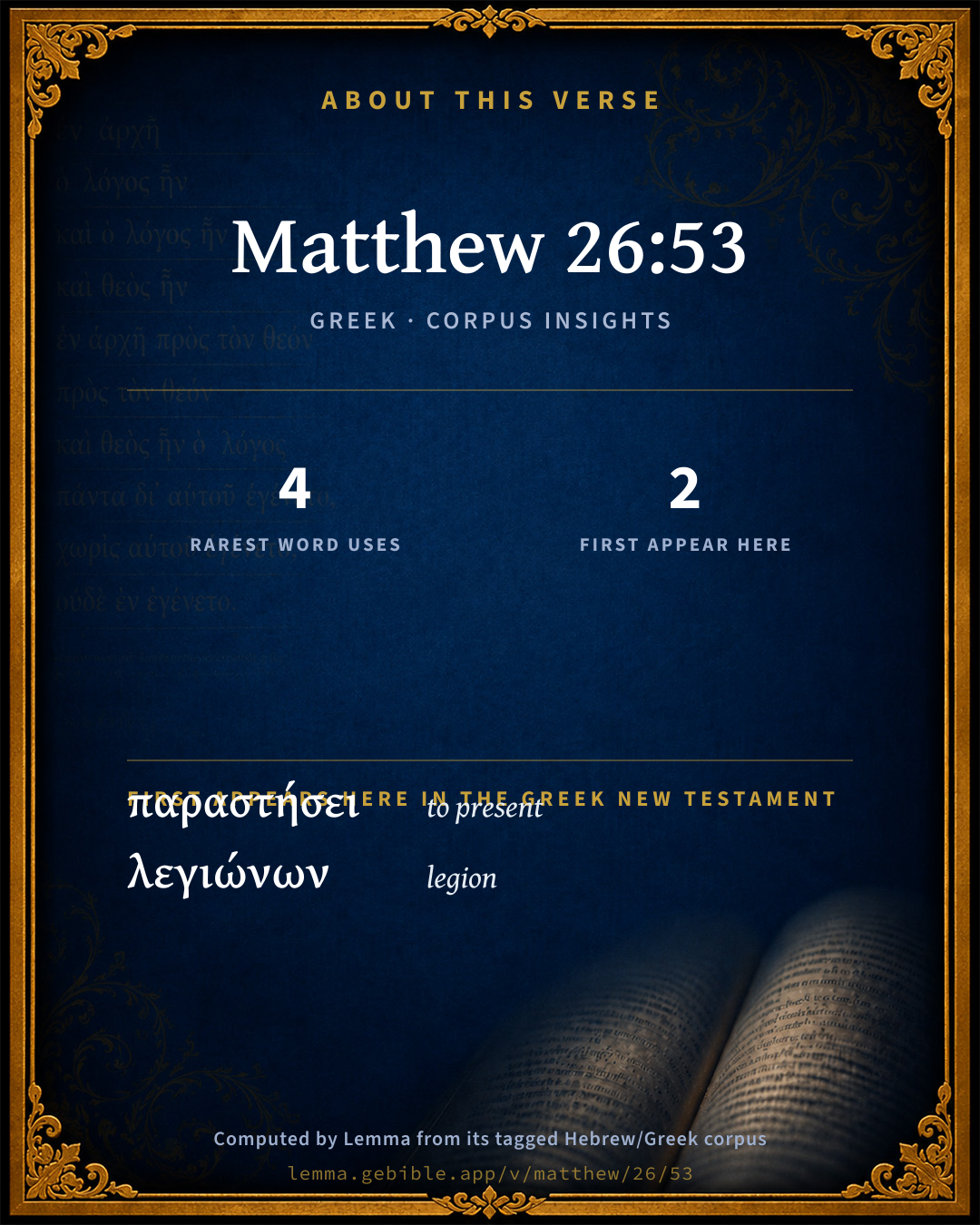
  • 2 first appearances in the Greek New Testament
Full analysis ↓
Download a study sheet

One document with this verse’s original text, its word-by-word gloss line, the meaning frame, cross-references with their text, attributed commentary, and full source and license credits — printable, and it pastes into notes with its structure intact.

This verse Autodidact and up

Study sheet (.html) Plain text (.txt)

A passage Seminary Student

Up to 50 verses in one chapter. A passage sheet keeps up to 6 commentary sources and 12 cross-references per verse, in the order this page ranks them, and says so on the sheet whenever that leaves anything out. Ask for a single verse and you get the Autodidact verse sheet above.

Everything on this page stays free to read, with no account — the sheet is a download of what is already on screen, not access to it.

Want to remove ads? Support Godless Engineer
Compare translations 3

The same verse in 3 English versions, stacked beneath the original-language interlinear above. Click any original word for its lexicon entry.

Each is an independent rendering of the whole verse — the interlinear is not word-aligned to these translations.

Highlighted words mark where these versions differ — a whole-verse word diff, not a word-by-word alignment.

  • World English Bible Public Domain
    Or do you think that I couldn't ask my Father, and he would even now send me more than twelve legions of angels?
  • King James Version Public Domain
    Thinkest thou that I cannot now pray to my Father, and he shall presently give me more than twelve legions of angels?
  • unfoldingWord Literal Text CC BY-SA 4.0
    Or do you think that I am not able to beg my Father, and he will provide me now with more than 12 legions of angels?

unfoldingWord Literal Text — © unfoldingWord, licensed CC BY-SA 4.0. Word-aligned USFM3 via Door43 (git.door43.org/unfoldingWord/en_ult).

Versions to compare (up to 4)

3 of 4 selected

Show all 19 translations

Every available English version of this verse, each an independent rendering of the whole verse.

  • World English Bible Public Domain
    Or do you think that I couldn't ask my Father, and he would even now send me more than twelve legions of angels?
  • Berean Standard Bible Public Domain
    Are you not aware that I can call on My Father, and He will at once put at My disposal more than twelve legions of angels?
  • Majority Standard Bible Public Domain
    Are you not aware that I can call on My Father right now, and He will at once put at My disposal more than twelve legions of angels?
  • King James Version Public Domain
    Thinkest thou that I cannot now pray to my Father, and he shall presently give me more than twelve legions of angels?
  • American Standard Version (1901) Public Domain
    Or thinkest thou that I cannot beseech my Father, and he shall even now send me more than twelve legions of angels?
  • Revised Version (1885) Public Domain
    Or thinkest thou that I cannot beseech my Father, and he shall even now send me more than twelve legions of angels?
  • Geneva Bible (1599) Public Domain
    Either thinkest thou, that I can not now pray to my Father, and he will giue me moe then twelue legions of Angels?
  • Douay-Rheims (1899) Public Domain
    Thinkest thou that I cannot ask my Father, and he will give me presently more than twelve legions of angels?
  • Young's Literal Translation Public Domain
    dost thou think that I am not able now to call upon my Father, and He will place beside me more than twelve legions of messengers?
  • Literal Standard Version CC BY-SA 4.0
    do you think that I am not able now to call on My Father, and He will place beside Me more than twelve legions of messengers?
  • Unlocked Literal Bible CC BY-SA 4.0
    Do you think that I could not call upon my Father, and he would send me more than twelve legions of angels?
  • unfoldingWord Literal Text CC BY-SA 4.0
    Or do you think that I am not able to beg my Father, and he will provide me now with more than 12 legions of angels?
  • Darby Bible Public Domain
    Or thinkest thou that I cannot now call upon my Father, and he will furnish me more than twelve legions of angels?
  • World Messianic Bible Public Domain
    Or do you think that I couldn’t ask my Father, and he would even now send me more than twelve legions of angels?
  • Webster's Bible Public Domain
    Thinkest thou that I cannot now pray to my Father, and he will presently give me more than twelve legions of angels?
  • Free Bible Version CC BY-SA 4.0
    Don't you think I could ask my Father, and he'd immediately send more than twelve legions of angels?
  • Bible in Basic English Public Domain
    Does it not seem possible to you that if I make request to my Father he will even now send me an army of angels?
  • Text-Critical English NT CC BY 4.0
    Or do yoʋ think that I cannot call on my Father right now, and he will provide me with more than twelve legions of angels?
  • Tyndale New Testament (1534) Public Domain
    Ether thinkest thou that I cannot now praye to my father and he shall geve me moo then.xii. legions of angelles?

Literal Standard Version (2020), Covenant Press — licensed CC BY-SA 4.0. Text via the HelloAO Bible API (eBible.org). Unlocked Literal Bible (unfoldingWord) — licensed CC BY-SA 4.0. Text via the HelloAO Bible API (eBible.org). unfoldingWord Literal Text — © unfoldingWord, licensed CC BY-SA 4.0. Word-aligned USFM3 via Door43 (git.door43.org/unfoldingWord/en_ult). Free Bible Version, Dr. Jonathan Gallagher — licensed CC BY-SA 4.0. Text via the HelloAO Bible API (eBible.org).

Word by word

More ways to search: Search by grammar → Find every occurrence → Compare this word →

Practice this passage: Drill this verse → Learn its vocabulary →

λεγιώνων
legeṓn
G3003
“legion”
Noun, Genitive, Plural, Feminine
Part of Speech
Noun
Case
Genitive
Number
Plural
Gender
Feminine
Full Thayer's Definition

Origin: of Latin origin

TDNT: 05:08,5

1. a legion, a body of soldiers whose number differed at different times, and in the time of Augustus seems to have consisted of 6826 men (i.e. 6100 foot soldiers, and 726 horsemen)
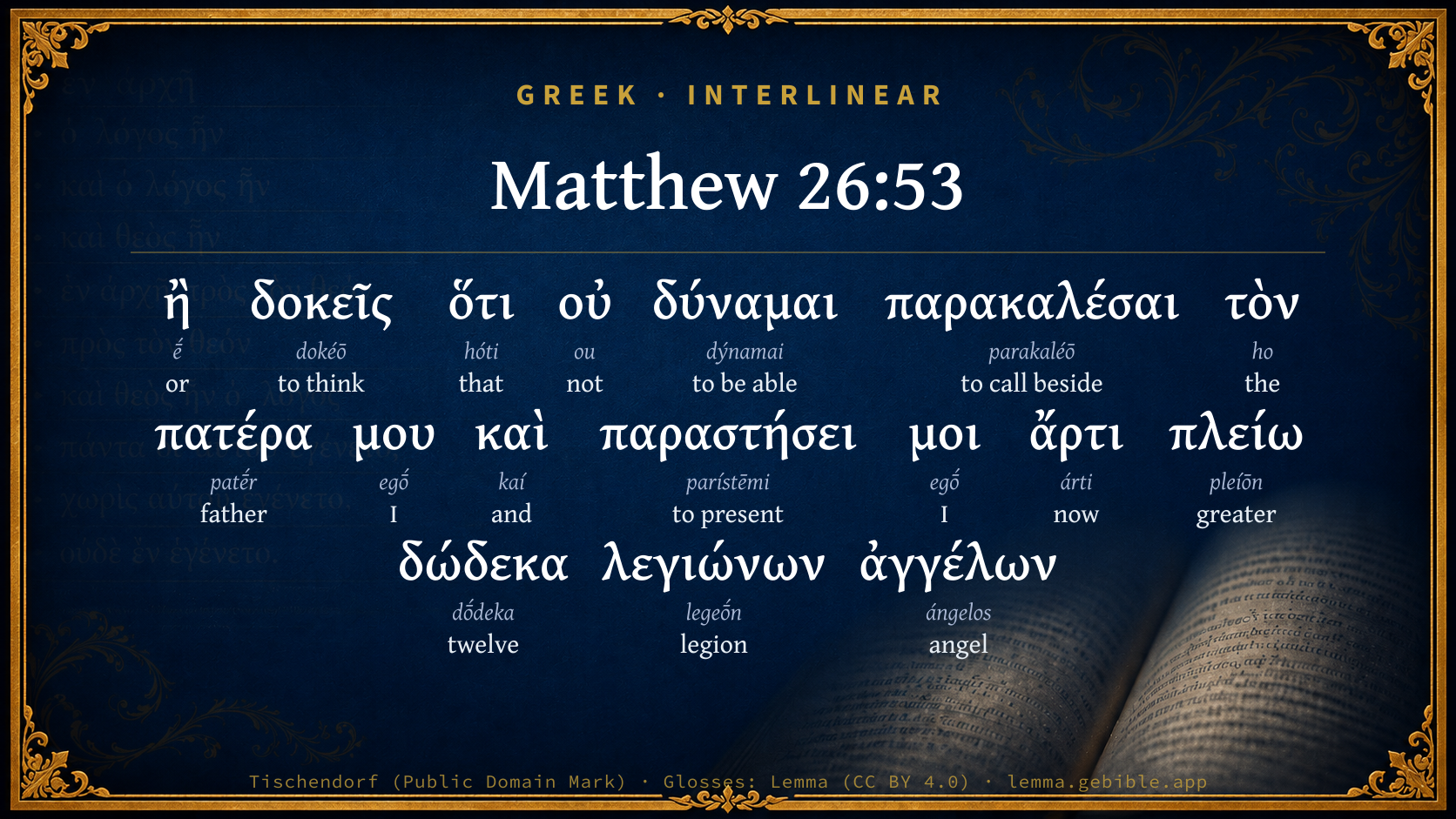
  1. ἢ ḗ G2228 “or” Particle
  2. δοκεῖς dokéō G1380 “to think” Verb, Present, Active, Indicative, 2nd person, Singular
  3. ὅτι hóti G3754 “that” Conjunction
  4. οὐ ou G3756 “not” Particle, Negative
  5. δύναμαι dýnamai G1410 “to be able” Verb, Present, Middle or Passive deponent, Indicative, 1st person, Singular
  6. παρακαλέσαι parakaléō G3870 “to call beside” Verb, Aorist, Active, Infinitive
  7. τὸν ho G3588 “the” Article, Accusative, Singular, Masculine
  8. πατέρα patḗr G3962 “father” Noun, Accusative, Singular, Masculine
  9. μου egṓ G1473 “I” Personal pronoun, 1st person, Genitive, Singular
  10. καὶ kaí G2532 “and” Conjunction
  11. παραστήσει parístēmi G3936 “to present” Verb, Future, Active, Indicative, 3rd person, Singular
  12. μοι egṓ G1473 “I” Personal pronoun, 1st person, Dative, Singular
  13. ἄρτι árti G737 “now” Adverb
  14. πλείω pleíōn G4119 “greater” Adjective, Accusative, Plural, Neuter, Comparative
  15. δώδεκα dṓdeka G1427 “twelve” Adjective, Numeral (indeclinable)
  16. ἀγγέλων ángelos G32 “angel” Noun, Genitive, Plural, Masculine

About this verse

These counts appear in no published source. They are computed here, from the morphology-tagged text and Lemma’s own curated glosses. What Lemma adds →

17
words
16
distinct lemmas
Gospels
section

Notable vocabulary

The rarest word here is λεγιώνων legion G3003 — appearing just 4 times in the whole Greek New Testament.

First appearance in Scripture

These words make their first canonical appearance in the Greek New Testament here:

  • παραστήσει to present G3936
  • λεγιώνων legion G3003

Shared distinctive vocabulary

λεγιώνων legion G3003 occurs in 4 verses of the Greek New Testament. Also found in:

Repetition

A word recurs within this verse:

Cross-references

8

Topical passages linked to Matthew 26:53 in the Treasury of Scripture Knowledge — connected by theme and wording, ordered by reader-vote popularity; previews shown in the World English Bible.

  • 2 Kings 6:17 Elisha prayed, and said, Yahweh, Please open his eyes, that he may see. Yahweh opened the eyes of the young man; and he saw: and, behold, the mountain was full of horses and chariots of fire round about Elisha.
  • Matthew 4:11 Then the devil left him, and behold, angels came and ministered to him.
  • Daniel 7:10 A fiery stream issued and came forth from before him: thousands of thousands ministered to him, and ten thousand times ten thousand stood before him: the judgment was set, and the books were opened.
  • Luke 8:30 Jesus asked him, "What is your name?" He said, "Legion," for many demons had entered into him.
  • Matthew 25:31 "But when the Son of Man comes in his glory, and all the holy angels with him, then he will sit on the throne of his glory.
  • 2 Thessalonians 1:7 and to give relief to you that are afflicted with us, when the Lord Jesus is revealed from heaven with his mighty angels in flaming fire,
  • Jude 1:14 About these also Enoch, the seventh from Adam, prophesied, saying, "Behold, the Lord came with ten thousands of his holy ones,
  • Matthew 10:1–2 He called to himself his twelve disciples, and gave them authority over unclean spirits, to cast them out, and to heal every disease and every sickness.

Cross-references courtesy of OpenBible.info (CC BY 4.0).

Commentary

Notes on Matthew 26:53 from classic Christian and Jewish commentators (each source and its license shown beneath its notes). The classic Christian expositions comment on the surrounding passage and are grouped to its opening verse, so a note may address several verses; the Jewish commentaries on the Tanakh (Rashi and others) are per-verse, so they appear only where the commentator wrote on this verse.

Lemma curates 59 commentaries, every one of them public domain or Creative Commons licensed, each selected and text-cleaned for this edition rather than reprinted as found. About our sources →

The Biblical Illustrator

Joseph S. Exell

Mat_26:53

Thinkest thou that I cannot now pray to My Father?

War opposed to the precepts and spirit of Christianity

Show that war is opposed to the spirit of Christianity.

I. Offer such reasons as prove this.

1. The toleration of war under the New Testament dispensation is contrary to what Christianity was expected to be by the prophet who foretold the coming of the Messiah, and by the Church of the Jews, to whom they were sent (Isa_9:6; Zec_9:9-10).

2. The advent of the Saviour was attended with revelations, which indicated peace. The angels sang of peace on earth.

3. The doctrine which Christ taught condemns war (Mat_5:3-9, etc.)

4. The example of Christ teaches the same truth. His life was unresisting.

5. War originates in a passion which Christianity condemns.

6. It can only be carried on by the use of those means which Christianity must condemn.

`II. Answers objections.

1. It is said that war was allowable under the Old Testament dispensation, that therefore it cannot be wrong in the abstract.

2. It is said that the predictions of the New Testament foretell wars in the course of Christianity through the world.

3. It is said that the civil magistrate shall not bear the sword in vain.

4. It is said that to argue in favour of these principles is a proof of cowardice and imbecility.

5. What will be the consequences if men act in this way?

III. Make a few reflections.

1. It calls for a close examination of the subject.

2. It is the duty of parents to be careful in training up their children.

3. I would urge that no professor of Christianity should think of bearing arms. (N. M. Harry.)

The willing surrender

Let this mind be in you which was also in Christ Jesus. The glory of Christ is in His willing surrender of that which belonged to Him, and which He might have always had and enjoyed. The multitude whom the chief priests had sent was arresting Jesus. Then one of His disciples drew the sword. Jesus bade him put his sword into its place again. He tells His eager followers that if He wants He can protect Himself. Thinkest thou, etc. The helpless prisoner looked up and saw the air thick with angels hurrying to His relief. A word from Him and they would have been His warriors. He had the power, but would not use it. The nobleness of this surrender of Jesus; no man becomes really noble who has not its repetition in himself. To give up some precious thing which is legitimately yours; to shut your eyes upon visions of glory, or safety, or luxury, which you might make your own without blame, that is one of the marks of nobleness. The man who is taking all that he has a right to take in life is always touched with a shade of baseness. Let us study the nobleness of voluntary surrender.

I. We want to feel how definite and distinct it is. There are base imitations of it. There are two kinds of renunciation of things which have this origin in unworthy motives.

1. The first is the renunciation which comes from idleness or lack of spirit. There will always be people who might be rich, learned, famous, who despise these things simply because of the trouble they involve. The surrender they make is a loss not a gain; it has nothing in common with the Divine relinquishment of Jesus.

2. The second of the two base forms of voluntary surrender is what we may call the ascetic form. It includes the renunciation of legitimate enjoyments, that we may be chastened by disappointment. Now turn back to Jesus. When He said, I will not call the angels, it was no pusillanimous submitting to His fate; nor was it any unnatural submitting of Himself to suffering that He might be cultivated and purified, or that the release from suffering when it came might be more sweet. It was the quiet surrender of what was His, because He could not have it and yet do His work and save the world. No man in this world has a right to all his rights. Here is really the key to the question of voluntary abstinence from certain innocent indulgences for the sake of others. Voluntariness lies at the root of it all. We talk of the glory of resignation to the inevitable; but the true glory is in resignation to the inevitable. To stand unchained, with perfect power to go away, and so standing to let the fire creep up to the heart-that is the truer heroism. Christ knew what it was to gain the life He lost, to have the thing that He surrendered. When He refused to call the angels to His help, the strength which was the meaning of the angels was surely entering into Him, and making Him ready for the battle which He was just about to fight. (P. Brooks, D. D.)

Self-surrender under the influence of a higher purpose

When a man who might be rich deliberately gives up the chance of wealth that he may be a scholar, men whose object in life is wealth, and who know that he has the same power to get wealth which they have if he should give himself to its pursuit, must honour him and feel the influence of his renunciation. It is not laziness, for he goes to work harder than any of them. It is not asceticism, for he has no foolish sweeping abuse of wealth with which to insult his fellow-mens intelligence, It is not incapacity, for he is as bright as the brightest. It is simply the power of a higher purpose. It is the calm, manly, uncomplaining choice to do this greater thing, and to surrender whatever would hinder the doing of it most faithfully and well. The man goes off into his study, and thinks that nobody sees him-indeed, does not think for a moment whether anybody is seeing him or not; but his life and such lives as his are the salt of the society in which they live. (P. Brooks, D. D.)

The Biblical Illustrator, edited by Joseph S. Exell (c. 1880s–1900s) — public domain. Text from a community e-Sword module.

Tyndale Open Study Notes

Tyndale Open Resources

26:53 thousands (literally twelve legions): Jesus used Roman military language (a legion consisted of approximately 6,000 soldiers) to describe the aid he could receive from God. Jesus was not a helpless victim; he permitted his own arrest.

Tyndale Open Study Notes — © Tyndale Open Resources, licensed CC BY-SA 4.0. Text via the HelloAO Bible API.

Bengel's Gnomon

Johann Albrecht Bengel

Mat 26:53. Ἄρτι, now) Even now.—τὸν Πατέρα Μου, My Father) Jesus even, when He is just about to drink the cup, retains that filial disposition which He had previously and always towards the Father; see Mat 26:42.—πλείους ἤ δώδεκα λεγεῶας, more than twelve legions) A legion consisted of six thousand; twelve legions therefore of seventy-two thousand. A legion is contrasted with each of the twelve apostles; a thousand angels with each of the seventy disciples. The angels are divided into their numbers and ranks.

Bengel's Gnomon of the New Testament — English translation (T&T Clark, Edinburgh, 1860) — public domain. Text from a community e-Sword module.

Meyer's Critical & Exegetical Commentary

Heinrich August Wilhelm Meyer

Mat_26:53. Ἤ] or, in case this should not be sufficient to induce thee to thrust back thy sword.

ἄρτι] this instant. See on Gal_1:10.

The interrogation does not extend merely as far as μου, in which case it would lose much of its significance, while the language would be rendered too abrupt, but on to ἀγγέλων; yet not as though καί (for that, ὅτι) introduced a broken construction, but thus: Thinkest thou that I am not able … and He will (not) place at my side, etc.? so that I can thus dispense entirely with thy protection! The force of the negative runs through the whole sentence.

πλείω δώδεκα λεγεώνας ἀγγέλων (see the critical remarks) is a genuine Attic usage, according to which it is permissible to have the neuter πλεῖον or πλείω without a change of construction, or even without inserting ἤ. Lobeck, ad Phryn. p. 410 f.; Stallbaum, ad Plat. Apol. p. 17 D; Kühner, II. 2, p. 847. The number twelve corresponds to the number of the apostles, because of these only one had shown a disposition to defend him.

Meyer — Critical and Exegetical Commentary on the New Testament — English translation by Peter Christie, edited by Frederick Crombie (T&T Clark, 1880) — public domain. Text from a community e-Sword module.

Expositor's Greek Testament

ed. W. Robertson Nicoll

Mat 26:53 gives another reason for not using the sword: if it were God’s will that His Son should be rescued it could be done in a different way. he way suggested is described in military language, the verbs παρακαλεῖν and παριστάναι being both used in classics in connection with military matters, and the word λεγεῶνας suggesting the battalions of the Roman army. δώδεκα , twelve legions, one for each of the twelve disciples. πλείω , even more than that vast number, Divine resources boundless. The free play of imagination displayed in this conception of a great army of angels evinces the elasticity of Christ’s spirit and His perfect self-possession at a critical moment.

The Expositor's Greek Testament, edited by W. Robertson Nicoll (1897–1910) — public domain. Text from a community e-Sword module.

Geneva Bible (1599)

Geneva Bible translators

Christ was taken, because he was willing to be taken.

Geneva Bible (1599) marginal notes — public domain. Text via Bolls.life.

Adam Clarke's Commentary

Verse 53. More than twelve legions of angels?] As if he had said, Instead of you twelve, one of whom is a traitor, my Father can give me more than twelve legions of angels to defend me. A legion, at different times, contained different numbers; 4,200, 5,000, and frequently 6,000 men; and from this saying, taking the latter number, which is the common rate, may we not - safely believe that the angels of God amount to more than 72,000?

Adam Clarke's Commentary on the Bible (1810–1826) — public domain. Text from a community e-Sword/MySword module.

Ellicott's Commentary for English Readers

(53) Thinkest thou that I cannot now pray . . .?—There is a strange and suggestive blending of the possible and the impossible in these words. Could He have brought Himself to utter that prayer, it would have been answered. But He could not so pray unless He knew it to be in harmony with His Father’s will, and He had been taught, in that hour of agony, that it was not in harmony, and therefore He would not utter it.

Presently.—The modern English reader needs to be reminded once more that the word means immediately, without a moment’s delay.

Twelve legions.—The number is probably suggested by that of the Apostles. Not twelve weak men, one a traitor and the others timorous, but twelve legions of the armies of the Lord of Hosts. Note the Roman word appearing here, as in Mar_5:9; Mar_5:15, as the representative of warlike might.

A Bible Commentary for English Readers, edited by Charles John Ellicott (1878–1897) — public domain. Text from a community e-Sword module.

The Cambridge Bible for Schools and Colleges

gen. ed. J. J. S. Perowne

53. presently] = “immediately”; see ch. Mat_21:19.

twelve legions of angels] It is characteristic of this gospel that the authority and kingly majesty of Jesus should be suggested at a moment when every hope seemed to have perished.

legions] In contrast to the small company of Roman soldiers.

The Cambridge Bible for Schools and Colleges (gen. ed. J. J. S. Perowne; Cambridge University Press, 1878–1918) — public domain. Text from a community e-Sword module.

John Gill's Exposition

But how then shall the Scriptures be fulfilled,.... That is, should Christ make such a request to his Father, and he should grant it, and an host of angels should be sent to rescue him, and he should be rescued by them; how then should the Scriptures, which speak of Christ's being taken, and led as a lamb to the slaughter, and of his various sufferings, and the circumstances of them, have their accomplishment? "declaring", as the Arabic version supplies, or as the Ethiopic version, "which say",

that thus it must be; that the Messiah must be apprehended, and suffer, and die. The several parts of the sufferings of the Messiah are foretold in the writings of the Old Testament; the spirit of Christ, in the prophets, testified before hand of them; as that he should be reproached and despised of men, Psa 22:6, be spit upon, smote, and buffeted, Isa 1:5, be put to death, Psa 22:15, and that the death of the cross,

Psa 22:15, and be buried, Isa 53:9, and also the several circumstances of his sufferings, which led on to them, or attended them; as the selling him for thirty pieces of silver,

Zac 11:12, the betraying him by one of his familiar friends,

Psa 41:9, the seizing and apprehending him, and which is particularly referred to here, Isa 53:7, his disciples forsaking him, Zac 13:7, and even his God and Father, Psa 22:1, his suffering between two thieves, Isa 53:12, the parting of his garments, and casting lots on his vesture, Psa 22:18, the giving him gall and vinegar when on the cross, Psa 69:21, and not breaking any of his bones, Psa 34:20, yea, the Scriptures not only declared, that these things should be; but the necessity of them also, that they must be; because of the purposes and decrees of God, which are eternal, immutable, and unfrustrable; for as God had determined on his salvation of his people by Christ, and that through his sufferings and death, these were determined by him also, even the time, nature, manner, and circumstances of them; and which the Scriptures declare, and therefore must be likewise; and because of the covenant of grace, which is sure, unalterable, and unchangeable; in which Christ agreed to assume human nature, to obey, suffer, and die in it, and so do his Father's will, which was to bear the penalty of the law, and undergo the sufferings of death, and which therefore must be, or Christ's faithfulness fail. Moreover, on account of the law and justice of God, which required his bearing the curse, as well as fulfilling the precept of the law: and especially on account of the salvation of his people, which could not be effected without them, they must be. Christ, in these words, discovers a very great concern for the fulfilling of Scripture; and that because it is the word of God, which must not be broken; and because throughout it he is spoken of, in the volume of it, it is written of him, to do the will of God; even in the law of Moses, and in the Prophets, and in the Psalms: and besides, he was the minister of the circumcision, to confirm the promises made unto the fathers; and even agreeably to them, and upon the foundation of them, he had himself predicted his own sufferings: and as those were to be the rule of the faith and practice of his people in all ages, he was concerned for their accomplishment in every point; and which may teach us to value the Scriptures, and to be confident of the fulfilment of them in things yet future.

John Gill's Exposition of the Whole Bible (1746–1763) — public domain (CC PDM 1.0). Text via the HelloAO Bible API.

Trapp's Complete Commentary

John Trapp

53 Thinkest thou that I cannot now pray to my Father, and he shall presently give me more than twelve legions of angels?

Ver. 53. Thinkest thou that I cannot pray] q.d. Need I be beholden to thee for help? Luther very boldly told his patron and protector, the elector of Saxony, that he, by his prayers, gained him more help and safeguard than he received from him; and that this cause of Christ needeth not the help of man to carry it on, but the power of God, set to work by the prayer of faith. {a} And this way, saith he, I will undertake to secure your highness’s soul, body, and estate, engaged in the cause of the gospel, from whatsoever danger or disaster, Sive id credat C. V. sive non credat, whether your highness believe me herein or not.

More than twelve legions] A legion is judged to be six thousand foot and seven hundred horse. And this great army of angels is by prayer despatched from heaven in an instant. Are we then in any imminent danger? send up to heaven for help by prayer, and God will send from heaven and help us. We need not help ourselves by seeking private revenge, as Peter here, or using sinister shifts, as David, Psa 34:1, for in the same Psalm men are exhorted to ensue peace and pass by private wrongs; because the "angels of the Lord encamp round about them that fear him, and deliver them."

{a} Iudico Celsitud. Vest. plus a me praesidii et tutelae habituram esse, quam mihi praestare. Huic causae nullus gladius consulere aut opem ferre potest, &c. Luth. epist,

John Trapp, A Commentary or Exposition upon All the Books of the Old and New Testament (1647–1656) — public domain. Text from a community e-Sword module.

Haydock's Catholic Bible Commentary

More than twelve legions of angels. A legion was computed about 6,000. (Witham) --- These would amount to 72,000; but our Lord means no more than a great number.

George Leo Haydock (1774–1849), Haydock's Catholic Family Bible and Commentary, 1859 edition — public domain. Excludes Psalms (Douay-Rheims chapter numbering differs from Protestant) and Deuterocanonical books (Catholic canon only).

Whedon's Commentary on the Bible

Daniel D. Whedon

53. Thinkest thou — Addressed to Peter to show him that there was no place for, because no need of, a human sword. How contemptible to suppose that He needs thy sword, at whose prayer legions of angels would troop from the skies.

Twelve legions — A legion to each apostle, naming the official number notwithstanding the defection of Judas.

Daniel D. Whedon (gen. ed.), Commentary on the Old and New Testaments (1874–1909) — public domain. Text from a community e-Sword module.

The Pulpit Commentary

Thinkest thou that I cannot now (arti) pray to (parakalesai , beseech) my Father? Jesus proceeds to show that he needs not Peter"s puny assistance. H dokeiv ; An putas? Or thinkest thou? The particle, neglected by the Authorized Version, marks the transition to a new motive. The verb parakalein has the special meaning of "to summon with authority," "to call upon as an ally." Peter needed still to learn the lesson of Christ"s Divinity, his oneness with the Father; and this is furnished by the right interpretation of this word, which was not, as our version seems to make it, the cry of an inferior to one mightier than himself, but the summons of an equal to his great Ally in heaven. So Jesus virtually says, "Have I not power through my own Godhead to summon my Father to support me?" (Sewell, "Microscope of the New Testament"). Shall presently give me (parasthsei moi arti ). The Authorized Version seems to have read arti twice, "now... presently." The manuscripts show it only once, but vary its position. It most probably belongs to the first clause. The verb rendered "give" has a more pregnant meaning. It is a military term meaning "to place by the side," "to post on one"s flank." Hence the Lord implies that at a word the serried ranks of angels would range themselves at his side, true flank comrades, to defend and support him. Twelve legions of angels. Not a dozen weak men. He employs the Roman term "legion" with intention. He had been arrested by a cohort, (Joh_18:3, Joh_18:12, speira) the tenth part of the legion, which numbered six thousand men; he could, it he chose, call to his aid twelve times six thousand angels, who would deliver their Lord from his enemies. If there was to be an appeal to force, which Peter"s rash assault suggested, what could withstand his angelic allies, the heavenly hosts, infinitely more numerous, better disciplined, more effectively officered, prompt and happy to do the will of the great Commander?

The Pulpit Commentary (1880–1919), ed. H.D.M. Spence-Jones & Joseph S. Exell — public domain. Text from a community e-Sword module.

John Wesley's Explanatory Notes

He will presently give me more than twelve legions of angels - The least of whom, it is probable, could overturn the earth and destroy all the inhabitants of it.

John Wesley, Explanatory Notes Upon the Whole Bible (1754–1765) — public domain. Text via the GEBible commentary corpus.

Scofield Reference Notes

C. I. Scofield

angels

(See Scofield "Heb 1:4").

The Scofield Reference Bible (1917 edition), notes by C. I. Scofield — public domain. Text from a community e-Sword module.

The People's New Testament

B. W. Johnson

53, 54. Or thinkest thou not? etc. The Lord needed no human defenders, had it been the Divine purpose that he should not die. More than twelve legions of angels? A Roman legion contained from six thousand men upwards. The idea here is a mighty host. He and his eleven faithful apostles are twelve. There is more than a legion for each one of them. He could have evaded the enemies had he chosen; the angels would have come to his rescue, if he had willed it, but he gave himself unto death.

B. W. Johnson's The People's New Testament with Notes (1889–1891) — public domain. Electronic text from the Christian Classics Ethereal Library (CCEL) ThML edition.

Cambridge Greek Testament for Schools and Colleges

53. ἄρτι placed after παραστήσει μοι on the evidence of אBL against the other important uncials, in which it precedes παρακαλέσαι. The omission of ἢ before δώδεκα gives the classical idiom. Here AC and a large majority of MSS. retain ἢ against אBDL.

53. δοκεῖς ὅτι οὐ δύναμαι … καὶ παραστήσει. The form of the sentence is Aramaic, the real subject of the whole sentence being ὁ πατήρ: a regular Greek construction would express the thought of παρακαλέσαι by a participle or by a conditional clause. But though the form is irregular it throws into emphasis the certainty that the prayer would be granted. ‘Can I not summon my Father to my aid as an ally in my extremity, and swiftly He will draw up by my side twelve legions of angels against the single maniple of the Roman guard.’ παρακαλεῖν and παριστάναι are both military terms: cp. Hdt. XVII. 158, ἐτολμήσατε ἐμὲ σύμμαχον παρακαλέοντες ἐλθεῖν, advocantes socium, ‘Summoning me to be your ally.’ For παριστάναι cp. Polyb. III. 72. 9, τοὺς ἱππεῖς διελὼν ἐφʼ ἑκάτερον παρέστησε τὸ κέρας, ‘posted them,’ &c., and Hdt. VIII. 80, ἔδεε γὰρ ὅτε οὐκ ἑκόντες ἔθελον ἐς μάχην κατίστασθαι, ἀέκοντας παραστήσασθαι. For the omission of ἢ after πλείω, the usual Attic construction, cp. Plato, Apol. Socr., p. 17, ἔτη γεγονὼς πλείω ἑβδομήκοντα. So also in Latin, ‘plus septima ducitur æstas,’ Verg. Georg. IV. 207. For the neuter pl. πλείω (instead of πλεῖον), standing independent of the construction, see Lob. Phryn, p. 410, where several instances are given of constructive laxity in the case of numerals, e.g. οὐσίᾳ πλεῖον ἢ δέκα ταλάντων, Dem. c. Aphob. II. 341; ὑπὲρ τετρακισχίλιοι ὄντες, Joseph. Ant. XVIII. 1. 871. But none of the instances there given precisely meet this case.

δώδεκα λεγεῶνας κ.τ.λ. It is characteristic of this gospel that the authority and kingly majesty of Jesus should be suggested at a moment when every hope seemed to have perished.

λεγεῶνας. One of the few Latin words in this gospel, perhaps used with a special reason, as in the case of κῆνσον (ch. Mat 22:17). Here probably the intention was to preserve the very term used by Jesus. The word might be suggested by the sight of the maniple (σπεῖρα) of the Roman soldiers; see note above.

Cambridge Greek Testament for Schools and Colleges (Cambridge University Press, 1896; 21 vols, various authors incl. Carr, Maclear, Plummer, Farrar, Lumby, Moule, M. R. James, Simcox) — public domain. Text from a community e-Sword module.

Alford’s Greek Testament

Henry Alford

53.] The Majesty of our Lord, and His Patience are both shewn here.

πλείω δώδ. is a strictly Attic idiom, the neuter πλεῖον or πλείω, and the unchanged construction omitting the ἤ. So Plato, Legg. vi. p. 759, ἔτη μὴ ἔλαττον ἑξήκοντα γεγονώς: Paus. x. 57. 295, οἱ ἄνθρωποι πλέον ἡμίσεις ἁλιεῖς εἰσι. See the matter discussed, and more examples given, in Phryn. Lobeck, p. 410.

δώδεκα—not perhaps so much from the number of the Apostles, who were now οἱ ἕνδεκα, but from that of the then company, viz. the Lord and the eleven.

λεγεῶνας—because they were Roman soldiers who were taking Him. The complement of the legion was about 6000 men. The power, implied in δοκεῖς ὅτι οὐ δύναμαι, shews the entire and continued free self-resignation of the Lord throughout—and carries on the same truth as He expressed Joh 10:18.

Henry Alford, The Greek Testament (1849–1861) — public domain. Text from a community e-Sword module.

Vincent's Word Studies in the New Testament

Marvin R. Vincent

Twelve legions of angels. Compare the story of Elisha at Dothan (2Ki 6:17).

Marvin R. Vincent, Word Studies in the New Testament (1887–1900) — public domain. Text from a community e-Sword/MySword module.

Lesson kit

Teaching starters — assembled from the data on this page, not authored interpretation. Every prompt links to the verse data it draws on. Edit before teaching.

Matthew, in the Gospels, opens this verse with 17 words (16 distinct Greek lemmas). Its most distinctive word is legeṓn (“legion”). A historical commentator’s framing appears above. Read the whole chapter for the surrounding context.

Discussion questions

  1. The word legeṓn carries the sense “legion.” How does it shape the verse?
  2. 2 words here appear for the first time in Scripture. What is being introduced at this debut?
  3. Mark 5:9 shares the word «legion» with this verse. How do the two illuminate each other?
  4. “I” occurs 2× in this one verse. What is the effect of the repetition?
  5. These translations render this verse differently; the difference is in the English rendering, not the original. What questions does that raise?
  6. Reading how The Biblical Illustrator and Tyndale Open Study Notes read this verse, where do the two commentators agree and where do they part?

Things to notice

  • 2 words make their first canonical appearance in Scripture here.
  • These translations choose different wording for 21 words in this verse.
  • “I” occurs 2× in this single verse.
  • 16 distinct Greek lemmas span 17 words in this verse.

Reading settings

Reading text

Shown beneath each verse's original-language words.

Old Testament
Old Testament edition

Read the OT as the Masoretic Hebrew (MT) or the Greek Septuagint (LXX).

English shown for the Greek Septuagint (in the Hebrew ↔ Greek comparison).

Comparing translations? Open the Compare panel on any verse page to stack up to four side by side.