Luke 10:22

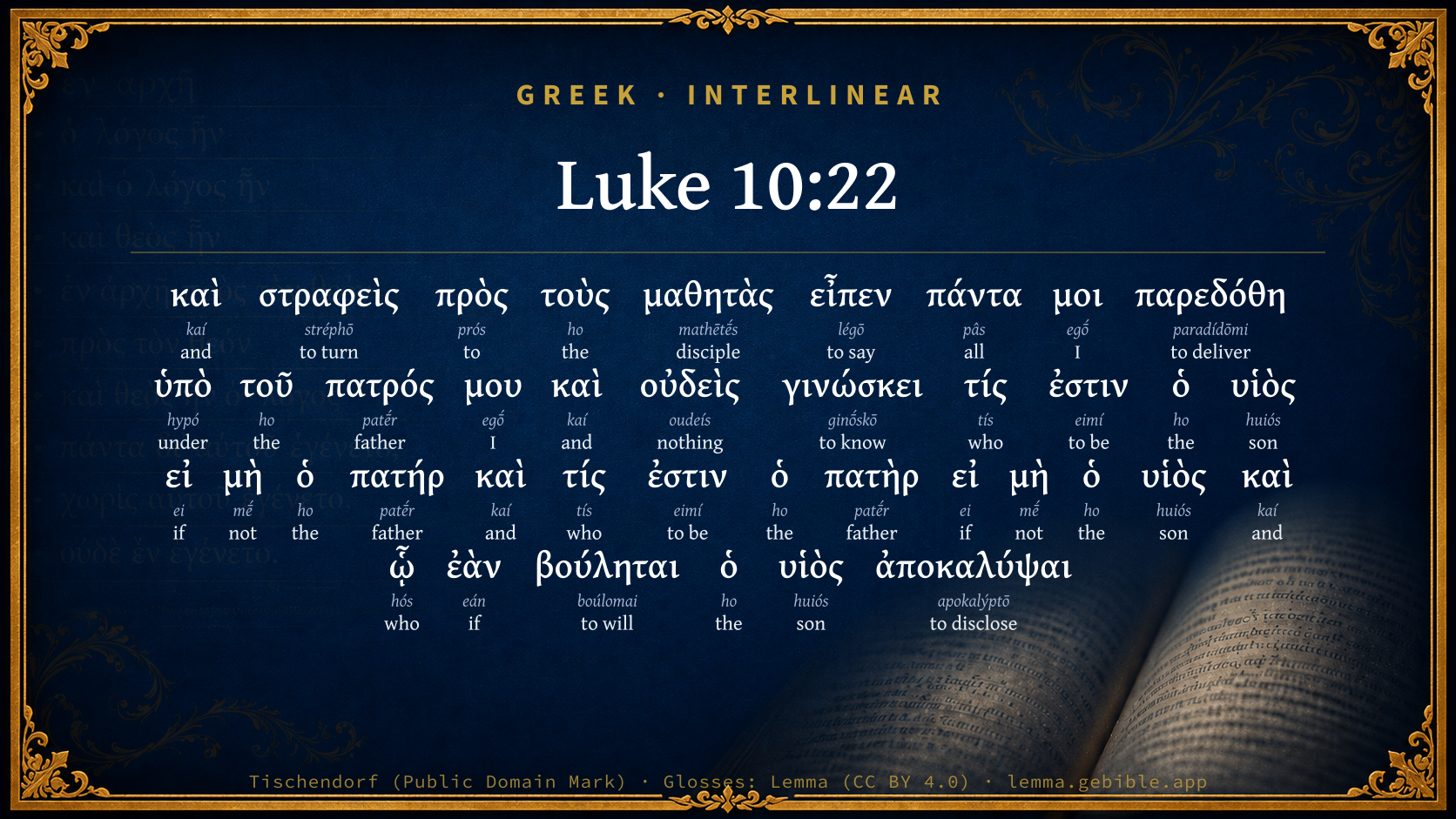
Greek (Tischendorf 8th ed.) Luke 10:22 appears in the Greek New Testament. The text above is from the Tischendorf 8th edition. Each word links to its Strong’s number and a concise gloss. Click any word for its full Thayer’s Greek Lexicon entry.
Download image
Cite this verse

Luke 10:22 (World English Bible). Public Domain. Lemma interlinear Bible study tool, https://lemma.gebible.app/v/luke/10/22.

Show BibTeX & RIS
BibTeX
RIS
English Translation
Turning to the disciples, he said, "All things have been delivered to me by my Father. No one knows who the Son is, except the Father, and who the Father is, except the Son, and he to whomever the Son desires to reveal him."
World English Bible · Public Domain
Download a study sheet

One document with this verse’s original text, its word-by-word gloss line, the meaning frame, cross-references with their text, attributed commentary, and full source and license credits — printable, and it pastes into notes with its structure intact.

This verse Autodidact and up

Study sheet (.html) Plain text (.txt)

A passage Seminary Student

Up to 50 verses in one chapter. A passage sheet keeps up to 6 commentary sources and 12 cross-references per verse, in the order this page ranks them, and says so on the sheet whenever that leaves anything out. Ask for a single verse and you get the Autodidact verse sheet above.

Everything on this page stays free to read, with no account — the sheet is a download of what is already on screen, not access to it.

Want to remove ads? Support Godless Engineer
Compare translations 3

The same verse in 3 English versions, stacked beneath the original-language interlinear above. Click any original word for its lexicon entry.

Each is an independent rendering of the whole verse — the interlinear is not word-aligned to these translations.

Highlighted words mark where these versions differ — a whole-verse word diff, not a word-by-word alignment.

  • World English Bible Public Domain
    Turning to the disciples, he said, "All things have been delivered to me by my Father. No one knows who the Son is, except the Father, and who the Father is, except the Son, and he to whomever the Son desires to reveal him."
  • King James Version Public Domain
    All things are delivered to me of my Father: and no man knoweth who the Son is, but the Father; and who the Father is, but the Son, and he to whom the Son will reveal him.
  • unfoldingWord Literal Text CC BY-SA 4.0
    All things have been handed over to me by my Father, and no one knows who the Son is except the Father, and who the Father is except the Son, and to whomever the Son desires to reveal him.”

unfoldingWord Literal Text — © unfoldingWord, licensed CC BY-SA 4.0. Word-aligned USFM3 via Door43 (git.door43.org/unfoldingWord/en_ult).

Versions to compare (up to 4)

3 of 4 selected

Show all 19 translations

Every available English version of this verse, each an independent rendering of the whole verse.

  • World English Bible Public Domain
    Turning to the disciples, he said, "All things have been delivered to me by my Father. No one knows who the Son is, except the Father, and who the Father is, except the Son, and he to whomever the Son desires to reveal him."
  • Berean Standard Bible Public Domain
    All things have been entrusted to Me by My Father. No one knows who the Son is except the Father, and no one knows who the Father is except the Son and those to whom the Son chooses to reveal Him.”
  • Majority Standard Bible Public Domain
    And turning to the disciples, He said, “All things have been entrusted to Me by My Father. No one knows who the Son is except the Father, and no one knows who the Father is except the Son and those to whom the Son chooses to reveal Him.”
  • King James Version Public Domain
    All things are delivered to me of my Father: and no man knoweth who the Son is, but the Father; and who the Father is, but the Son, and he to whom the Son will reveal him.
  • American Standard Version (1901) Public Domain
    All things have been delivered unto me of my Father: and no one knoweth who the Son is, save the Father; and who the Father is, save the Son, and he to whomsoever the Son willeth to reveal `him'.
  • Revised Version (1885) Public Domain
    All things have been delivered unto me of my Father: and no one knoweth who the Son is, save the Father; and who the Father is, save the Son, and he to whomsoever the Son willeth to reveal him.
  • Geneva Bible (1599) Public Domain
    All things are giuen me of my Father: and no man knoweth who the Sonne is, but the Father: neither who the Father is, saue the Sonne, and he to whom the Sonne will reueile him.
  • Douay-Rheims (1899) Public Domain
    All things are delivered to me by my Father; and no one knoweth who the Son is, but the Father; and who the Father is, but the Son, and to whom the Son will reveal him.
  • Young's Literal Translation Public Domain
    `All things were delivered up to me by my Father, and no one doth know who the Son is, except the Father, and who the Father is, except the Son, and he to whom the Son may wish to reveal `Him'.'
  • Literal Standard Version CC BY-SA 4.0
    All things were delivered up to Me by My Father, and no one knows who the Son is, except the Father, and who the Father is, except the Son, and he to whom the Son may resolve to reveal [Him].”
  • Unlocked Literal Bible CC BY-SA 4.0
    “All things have been entrusted to me from my Father, and no one knows who the Son is except the Father, and no one knows who the Father is except the Son and those to whom the Son chooses to reveal him.”
  • unfoldingWord Literal Text CC BY-SA 4.0
    All things have been handed over to me by my Father, and no one knows who the Son is except the Father, and who the Father is except the Son, and to whomever the Son desires to reveal him.”
  • Darby Bible Public Domain
    All things have been delivered to me by my Father, and no one knows who the Son is but the Father, and who the Father is but the Son, and he to whomsoever the Son is pleased to reveal [him].
  • World Messianic Bible Public Domain
    Turning to the disciples, he said, “All things have been delivered to me by my Father. No one knows who the Son is, except the Father, and who the Father is, except the Son, and he to whomever the Son desires to reveal him.”
  • Webster's Bible Public Domain
    All things are delivered to me by my Father: and no man knoweth who the Son is, but the Father; and who the Father is, but the Son, and he to whom the Son will reveal him.
  • Free Bible Version CC BY-SA 4.0
    My Father has handed over everything to me. No one understands the Son except the Father, and no one understands the Father except the Son, and those to whom the Son chooses to reveal him.”
  • Bible in Basic English Public Domain
    All things have been given to me by my Father: and no one has knowledge of the Son, but only the Father: and of the Father, but only the Son, and he to whom the Son will make it clear.
  • Text-Critical English NT CC BY 4.0
    Then he turned to the disciples and said, “All things have been delivered to me by my Father. No one knows who the Son is except the Father, and no one knows who the Father is except the Son, and anyone to whom the Son chooses to reveal him.”
  • Tyndale New Testament (1534) Public Domain
    All thinges are geven me of my father. And no man knoweth who the sonne is but the father: nether who the father is save the sonne and he to who the sonne wyll shewe him.

Literal Standard Version (2020), Covenant Press — licensed CC BY-SA 4.0. Text via the HelloAO Bible API (eBible.org). Unlocked Literal Bible (unfoldingWord) — licensed CC BY-SA 4.0. Text via the HelloAO Bible API (eBible.org). unfoldingWord Literal Text — © unfoldingWord, licensed CC BY-SA 4.0. Word-aligned USFM3 via Door43 (git.door43.org/unfoldingWord/en_ult). Free Bible Version, Dr. Jonathan Gallagher — licensed CC BY-SA 4.0. Text via the HelloAO Bible API (eBible.org).

Word by word

More ways to search: Search by grammar → Find every occurrence → Compare this word →

Practice this passage: Drill this verse → Learn its vocabulary →

στραφεὶς
stréphō
G4762
“to turn”
Verb, Aorist, Passive, Participle, Nominative, Singular, Masculine
Part of Speech
Verb
Tense
Aorist
Voice
Passive
Mood
Participle
Case
Nominative
Number
Singular
Gender
Masculine
Full Thayer's Definition

Origin: strengthened from the base of G5157

TDNT: 18:54,1

1. to turn, turn around 2. to turn one's self (i.e. to turn the back to one a. of one who no longer cares for another) b. metaph. to turn one's self from one's course of conduct, i.e. to change one's mind
  1. καὶ kaí G2532 “and” Conjunction
  2. πρὸς prós G4314 “to” Preposition
  3. τοὺς ho G3588 “the” Article, Accusative, Plural, Masculine
  4. μαθητὰς mathētḗs G3101 “disciple” Noun, Accusative, Plural, Masculine
  5. εἶπεν légō G3004 “to say” Verb, Aorist, Active, Indicative, 3rd person, Singular
  6. πάντα pâs G3956 “all” Adjective, Accusative, Plural, Neuter
  7. μοι egṓ G1473 “I” Personal pronoun, 1st person, Dative, Singular
  8. παρεδόθη paradídōmi G3860 “to deliver” Verb, Aorist, Passive, Indicative, 3rd person, Singular
  9. ὑπὸ hypó G5259 “under” Preposition
  10. τοῦ ho G3588 “the” Article, Genitive, Singular, Masculine
  11. πατρός patḗr G3962 “father” Noun, Genitive, Singular, Masculine
  12. μου egṓ G1473 “I” Personal pronoun, 1st person, Genitive, Singular
  13. καὶ kaí G2532 “and” Conjunction
  14. οὐδεὶς oudeís G3762 “nothing” Adjective, Nominative, Singular, Masculine, Negative
  15. γινώσκει ginṓskō G1097 “to know” Verb, Present, Active, Indicative, 3rd person, Singular
  16. τίς tís G5101 “who” Interrogative pronoun, Nominative, Singular, Masculine
  17. ἐστιν eimí G1510 “to be” Verb, Present, Active, Indicative, 3rd person, Singular
  18. ὁ ho G3588 “the” Article, Nominative, Singular, Masculine
  19. υἱὸς huiós G5207 “son” Noun, Nominative, Singular, Masculine
  20. εἰ ei G1487 “if” Conditional
  21. μὴ mḗ G3361 “not” Particle, Negative
  22. ὁ ho G3588 “the” Article, Nominative, Singular, Masculine
  23. πατήρ patḗr G3962 “father” Noun, Nominative, Singular, Masculine
  24. καὶ kaí G2532 “and” Conjunction
  25. τίς tís G5101 “who” Interrogative pronoun, Nominative, Singular, Masculine
  26. ἐστιν eimí G1510 “to be” Verb, Present, Active, Indicative, 3rd person, Singular
  27. ὁ ho G3588 “the” Article, Nominative, Singular, Masculine
  28. πατὴρ patḗr G3962 “father” Noun, Nominative, Singular, Masculine
  29. εἰ ei G1487 “if” Conditional
  30. μὴ mḗ G3361 “not” Particle, Negative
  31. ὁ ho G3588 “the” Article, Nominative, Singular, Masculine
  32. υἱὸς huiós G5207 “son” Noun, Nominative, Singular, Masculine
  33. καὶ kaí G2532 “and” Conjunction
  34. ᾧ hós G3739 “who” Relative pronoun, Dative, Singular, Masculine
  35. ἐὰν eán G1437 “if” Conditional
  36. βούληται boúlomai G1014 “to will” Verb, Present, Middle or Passive deponent, Subjunctive, 3rd person, Singular
  37. ὁ ho G3588 “the” Article, Nominative, Singular, Masculine
  38. υἱὸς huiós G5207 “son” Noun, Nominative, Singular, Masculine
  39. ἀποκαλύψαι apokalýptō G601 “to disclose” Verb, Aorist, Active, Infinitive

About this verse

These counts appear in no published source. They are computed here, from the morphology-tagged text and Lemma’s own curated glosses. What Lemma adds →

40
words
22
distinct lemmas
Gospels
section

Notable vocabulary

The rarest word here is στραφεὶς to turn G4762 — appearing just 22 times in the whole Greek New Testament.

Shared distinctive vocabulary

στραφεὶς to turn G4762 occurs in 22 verses of the Greek New Testament. Also found in:

Repetition

Words recur within this verse:

Cross-references

19

Topical passages linked to Luke 10:22 in the Treasury of Scripture Knowledge — connected by theme and wording, ordered by reader-vote popularity; previews shown in the World English Bible.

  • Matthew 11:27 All things have been delivered to me by my Father. No one knows the Son, except the Father; neither does anyone know the Father, except the Son, and he to whom the Son desires to reveal him.
  • John 1:18 No one has seen God at any time. The one and only Son, who is in the bosom of the Father, he has declared him.
  • John 6:44–46 No one can come to me unless the Father who sent me draws him, and I will raise him up in the last day.
  • John 10:15 even as the Father knows me, and I know the Father. I lay down my life for the sheep.
  • John 17:26 I made known to them your name, and will make it known; that the love with which you loved me may be in them, and I in them."
  • 2 Corinthians 4:6 seeing it is God who said, "Light will shine out of darkness," who has shone in our hearts, to give the light of the knowledge of the glory of God in the face of Jesus Christ.
  • Matthew 28:18 Jesus came to them and spoke to them, saying, "All authority has been given to me in heaven and on earth.
  • 2 John 1:9 Whoever transgresses and doesn't remain in the teaching of Christ, doesn't have God. He who remains in the teaching, the same has both the Father and the Son.
  • John 17:2 even as you gave him authority over all flesh, he will give eternal life to all whom you have given him.
  • 1 John 5:20 We know that the Son of God has come, and has given us an understanding, that we know him who is true, and we are in him who is true, in his Son Jesus Christ. This is the true God, and eternal life.
  • John 13:3 Jesus, knowing that the Father had given all things into his hands, and that he came forth from God, and was going to God,
  • Philippians 2:9–11 Therefore God also highly exalted him, and gave to him the name which is above every name;
  • John 3:35 The Father loves the Son, and has given all things into his hand.
  • John 5:22–27 For the Father judges no one, but he has given all judgment to the Son,
  • Ephesians 1:21 far above all rule, and authority, and power, and dominion, and every name that is named, not only in this age, but also in that which is to come.
  • John 17:5 Now, Father, glorify me with your own self with the glory which I had with you before the world existed.
  • John 17:10 All things that are mine are yours, and yours are mine, and I am glorified in them.
  • 1 Corinthians 15:24 Then the end comes, when he will deliver up the Kingdom to God, even the Father; when he will have abolished all rule and all authority and power.
  • Hebrews 2:8 You have put all things in subjection under his feet." For in that he subjected all things to him, he left nothing that is not subject to him. But now we don't see all things subjected to him, yet.

Cross-references courtesy of OpenBible.info (CC BY 4.0).

Where the printed editions differ

1 variant

Places in this verse where the major printed Greek editions disagree on the wording in a way that affects the translation — a comparison of editions, not a manuscript-by-manuscript collation. The editions are the modern critical texts (Nestlé-Aland 28/27, SBL, Westcott-Hort, Tregelles, Tyndale House) and the traditional texts behind the KJV (the Textus Receptus and the Byzantine/Majority text). It is not a claim about which reading is original.

  1. Extra text
    καὶ στραφείς πρός τούς μαθητάς εἶπεν

    “and having turned to <the> disciples said”

    In TRByz Not in NA28NA27TynSBLWHTreg

    καὶ στραφείς πρός τούς μαθητάς εἶπεν (kai strapheis pros tous mathētas eipen) 'and having turned to disciples said' is only in traditional manuscripts (TR+Byz)

Textual data: Translators Amalgamated Greek New Testament (STEPBible TAGNT) · CC BY 4.0.

Commentary

Notes on Luke 10:22 from classic Christian and Jewish commentators (each source and its license shown beneath its notes). The classic Christian expositions comment on the surrounding passage and are grouped to its opening verse, so a note may address several verses; the Jewish commentaries on the Tanakh (Rashi and others) are per-verse, so they appear only where the commentator wrote on this verse.

Lemma curates 59 commentaries, every one of them public domain or Creative Commons licensed, each selected and text-cleaned for this edition rather than reprinted as found. About our sources →

Tyndale Open Study Notes

Tyndale Open Resources

10:22 The Father and the Son share an intimate relationship. Jesus came to earth to reveal the Father to a lost world (see John 1:1-18).

Tyndale Open Study Notes — © Tyndale Open Resources, licensed CC BY-SA 4.0. Text via the HelloAO Bible API.

Bengel's Gnomon

Johann Albrecht Bengel

Luk 10:22. Τίς) who, and how great and good.

Bengel's Gnomon of the New Testament — English translation (T&T Clark, Edinburgh, 1860) — public domain. Text from a community e-Sword module.

Expositor's Greek Testament

ed. W. Robertson Nicoll

Luk 10:22 . This part of the devotional utterance, setting forth Christ’s faith in the purpose of His Father and the intimate fellowship subsisting between Father and Son, appears in some texts of Lk. as a declaration made to the disciples ( στραφεὶς πρὸς τ . μ . α ., T. R.). The gesture implies that a solemn statement is to be made. τίς ἐστιν ὁ υἱὸς , ὁ πατήρ : to know who the Son or the Father is = knowing the Son and the Father. The idea in Lk. is the same as in Mt., though the expression is different.

The Expositor's Greek Testament, edited by W. Robertson Nicoll (1897–1910) — public domain. Text from a community e-Sword module.

Godet's Commentaries

Frédéric Louis Godet

Ver. 22. The words, And He turned Him unto His disciples, which are read here by several Mjj., are in vain defended by Tischendorf and Meyer. They are not authentic. How indeed could we understand this στραφείς, having turned Himself? Turned, Meyer explains, turned from His Father, to whom He has been praying, towards men. But would the phrase turn Himself back be suitable in this sense? We have here a gloss occasioned by the κατ᾿ ἰδίαν, privately, of Luk 10:23. The wish has been to establish a difference between this first revelation, made to the disciples in general (Luk 10:22), and the following, more special still, addressed to some of them only (Luk 10:23). Here we have one of the rare instances in which the T. R. (which rejects the words) differs from the third edition of Steph.

The joyful outburst of Luk 10:21 is carried on without interruption into Luk 10:22; only the first impression of adoration gives way to calm meditation. The experience through which Jesus has just passed has transported Him, as it were, into the bosom of His Father. He plunges into it, and His words become an echo of the joys of His eternal generation.

As in the passage which precedes (Luk 10:21), and in that which follows (22b), it is only knowledge which is spoken of, the words, “All things are delivered to me of my Father,” are often taken as referring to the possession and communication of religious truths, of the knowledge of God. But the work accomplished by the disciples, on occasion of which Jesus uttered those sayings, was not merely a work of teaching—there was necessarily involved in it a display of force. To overturn the throne of Satan on the earth, and to put in its place the kingdom of God, was a mission demanding a power of action. But this power was closely connected with the knowledge of God. To know God means to be initiated into His plan; means to think with Him, and consequently to will as He does. Now, to will with God, and to be self-consecrated to Him as an instrument in His service, is the secret of participation in His omnipotence. “The education of souls,” Gess rightly observes, “is the greatest of the works of Omnipotence.” Everything in the universe, accordingly, should be subordinate to it. There is a strong resemblance between this saying of Jesus and that of John the Baptist (Joh 3:35): “The Father loveth the Son, and hath given all things into His hand,”—a declaration which is immediately connected with the other relative to the teaching of Jesus: “He whom God hath sent speaketh the words of God.”

The gift denoted by the aor. παρεδόθη, are delivered to me, is the subject of an eternal decree; but it is realized progressively in time, like everything which is subject to the conditions of human development. The chief periods in its realization are these three: The coming of Jesus into the world, His entrance upon His Messianic ministry, and His restoration to His divine state. Such are the steps by which the new Master took the place of the old (Luk 4:6), and was raised to Omnipotence. “Delivered,” Gess well observes, “either for salvation or for judgment.” The καί, and, which connects the two parts of the verse, may be thus paraphrased: and that, because...The future conquest of the world by Jesus and His disciples rests on the relation which He sustains to God, and with which He identifies His people. The perfect knowledge of God is, in the end, the sceptre of the universe.

Here there is a remarkable difference in compiling between Luke and Matthew: οὐδεὶς ἐπγινώσκει, no one recognises, or discerns, says Matthew. To the idea of knowing, this επι (to put the finger upon) has the effect of adding the idea of confirming experimentally. The knowledge in question is one de visu. Luke uses the simple verb γινώσκειν, to know, which is weaker and less precise; but he makes up for this deficiency in the notion of the verb by amplifying its regimen, “What is the Father..., what is the Son;” that is to say, all that God is as a Father to the man who has the happiness of knowing Him as a son, and all that the name son includes for the man who has the happiness of hearing it pronounced by the mouth of the Father,—all that the Father and Son are the one to the other. Perhaps Matthew’s form of expression is a shade more intellectual or didactic; that of Luke rather moves in the sphere of feeling. How should we explain the two forms, each of which is evidently independent of the other? Jesus must have employed in Aramaic the verb יָדַע, H3359, to know.Now יָדַע, H3359 is construed either with the accusative or with one of the two prepositions בְּ, in, or עַל, upon. The construction with one or other of these prepositions adds something to the notion of the verb. For example, שָׁמַע, H9048, to hear; שָׁמַעלְ, to listen; שָׁמַעבְּ, to listen with acquiescence of heart. There is a similar difference of meaning between יָדַע, H3359 and יָדַע בְּor יָדַעעַל,—a difference analogous to that between the two expressions, rem cognoscere and cognoscere de re, to know a thing and to know of a thing. Thus, in the passage in Job 37:16, where יָדַע, H3359 is construed with עַל, upon, the sense is not, “Knowest thou balancings of the clouds?”

Job could not but have known the fact which falls under our eyes,—but “understandest thou the...?” Now if we suppose that Jesus used the verb יָדַע, H3359 with one of the prepositions בְּor לְ, the two Greek forms may be explained as two different attempts to render the entire fulness of the Aramaic expression; that of Matthew strengthening the notion of the simple verb by the preposition ἐπί (re cognise) (which would correspond more literally with יָדַעעַל); that of Luke, by giving greater fulness to the idea of the object, by means of the paraphrase τίς ἐστιν, what is.

A remarkable example, Luk 9:3, has already shown how differences of matter and form in the reproduction of the words of Jesus by our evangelists are sometimes explained with the utmost ease by going back to the Hebrew or Aramaic text. What a proof of the authenticity of those discourses! What a proof also of the independence of our several Greek Digests!

That exclusive knowledge which the Father and Son have of one another is evidently not the cause of their paternal and filial relation; on the contrary, it is the effect of it. Jesus is not the Son because He alone perfectly knows the Father, and is fully known only by Him; but He knows Him and is known by Him in this way only because He is the Son. In like manner, God is not the Father because He alone knows the Son, and is known only by Him; but this double knowledge is the effect of that paternal relation which He sustains to the Son.

The article before the two substantives serves to raise this unique relation above the relative temporal order of things, and to put it in the sphere of the absolute, in the very essence of the two Beings. God did not become Father at an hour marked on some earthly dial. If He is a Father to certain beings born in time, it is because He is the Father absolutely,—that is to say, in relation to a Being who is not born in time, and who is toward Him the Son as absolutely. Such is the explanation of the difficult verse, Eph 3:15. Mark, who has not the passage, gives another wherein the term the Son is used in the same absolute sense, Luk 13:32: “But of that day and that hour knoweth no man, no, not the angels which are in heaven, neither the Son, but the Father.” After words like these, we cannot admit any radical difference between the Jesus of the Synoptics and that of John. The existence of the Son belonging to the essence of the Father, the pre-existence of the one is implied in the eternity of the other.

Immediate knowledge of the Father is the exclusive privilege of the Son. But it becomes the portion of believers as soon as He initiates them into the contents of His filial consciousness, and consents to share it with them. By this participation in the consciousness of the Son (the work of the Holy Spirit), the believer in his turn attains to the intuitive knowledge of the Father. Comp. Joh 1:18; Joh 14:6; Joh 17:26. With Gess, we ought to remark the importance of the priority given to the knowledge of the Son by the Father over that of the Father by the Son. Were the order inverted, the gift of all things, the παραδίδοναι, would have appeared to rest on the religious instruction which Jesus had been giving to men. The actual order makes it the consequence of the unsearchable relation between Jesus and the Father, in virtue of which He can be to souls everything that the Father Himself is to them.

This passage (Luk 10:21-22) is placed by Matthew, chap. 11, after the denunciation pronounced on the Galilean cities, and immediately following on the deputation of John the Baptist. We cannot comprehend those of our critics, Gess included, who prefer this situation to that of Luke. Gess thinks that the disciples (Luk 10:21) are contrasted with the unbelieving Galilean cities. But the whole passage refers to the disciples as instruments in God’s work; and Jesus contrasts them not with the ignorant Galileans, but with the wise of Jerusalem. See Matthew even, Luk 10:25. As to the following sentence, Luk 10:22, Gess thinks that he can paraphrase it thus: “No man, not even John the Baptist, knoweth the Son...,” in order thus to connect it with the account of the forerunner’s embassy, which forms the preceding context in Matthew. But in relation to the preceding verse the word no man alludes not to John, but to the wise and learned of Jerusalem, who pretended that they alone had the knowledge of God (Luk 11:52). It is not difficult, then, to perceive the superiority of Luke’s context; and we may prove here, as everywhere else, the process of concatenation, in virtue of which we find different elements united together in Mat 11:7-30 by a simple association of ideas in the mind of the compiler.

With the last words of Luk 10:22, and he to whom the Son will reveal Him, the thought of Jesus reverts to His disciples who surround Him, and in whom there is produced at this very time the beginning of the promised illumination. He now addresses Himself to them. The meditation of Luk 10:22 is the transition between the adoration of Luk 10:21 and the congratulation which follows.

Frédéric Louis Godet — Commentaries on Luke, John, Romans, and 1 Corinthians — English translation (T&T Clark, Edinburgh, 1870s–1890s) — public domain. Text from a community e-Sword module.

Geneva Bible (1599)

Geneva Bible translators

Whosoever seeketh the Father without the Son, wandereth out of the way.

Geneva Bible (1599) marginal notes — public domain. Text via Bolls.life.

Adam Clarke's Commentary

Verse 22. The Codex Alexandrinus, several other very ancient MSS., and some ancient versions, as well as the margin of our own, begin this verse with, And turning to his disciples, he said. But as this clause begins Lu 10:23, it is not likely that it was originally in both. Griesbach has left these words out of the text, and Professor WHITE says, Certissime delenda, "These words should most assuredly be erased."

Ver. 22. All things are delivered to me] See Clarke on Mt 11:27.

Adam Clarke's Commentary on the Bible (1810–1826) — public domain. Text from a community e-Sword/MySword module.

Ellicott's Commentary for English Readers

(22) All things are delivered to me.—The marginal reading, which prefixes “And turning to His disciples” to this verse instead of the next, can hardly be regarded as more than a transcriber’s error.

A Bible Commentary for English Readers, edited by Charles John Ellicott (1878–1897) — public domain. Text from a community e-Sword module.

The Cambridge Bible for Schools and Colleges

gen. ed. J. J. S. Perowne

22. All things are delivered to me of my Father] Rather, were delivered to me by, cf. Luk_20:14. This entire verse is one of those in which the teaching of the Synoptists (Mat_28:18) comes into nearest resemblance to that of St John, which abounds in such passages (Joh_1:18; Joh_3:35; Joh_5:26-27; Joh_6:44; Joh_6:46; Joh_14:6-9; Joh_17:1-2; 1Jn_5:20). In the same way we find this view assumed in St Paul’s earlier Epistles (e.g. 1Co_15:24; 1Co_15:27), and magnificently developed in the Epistles of the Captivity (Php_2:9; Eph_1:21-22).

The Cambridge Bible for Schools and Colleges (gen. ed. J. J. S. Perowne; Cambridge University Press, 1878–1918) — public domain. Text from a community e-Sword module.

John Gill's Exposition

All things are delivered to me of my Father,.... In some ancient copies, and in the Syriac, Persic, and Ethiopic versions, before these words, are read, "and turning to his disciples he said, all things", &c.

and no man knoweth who the Son is; what is his name, his nature, his perfections and glory; and how he is the Son of God, his only begotten Son:

but the Father; who begat him, and whose own, and proper Son he is:

and who the Father is; what are his perfections, purposes, grace, greatness, mind, and will:

but the Son; who is of him, and lay in his bosom:

and he to whom the Son will reveal him: in himself, by his Spirit; See Gill on Mat 11:27.

John Gill's Exposition of the Whole Bible (1746–1763) — public domain (CC PDM 1.0). Text via the HelloAO Bible API.

Trapp's Complete Commentary

John Trapp

22 All things are delivered to me of my Father: and no man knoweth who the Son is, but the Father; and who the Father is, but the Son, and he to whom the Son will reveal him.

Ver. 22. See Mat 28:18; Joh 3:35.

John Trapp, A Commentary or Exposition upon All the Books of the Old and New Testament (1647–1656) — public domain. Text from a community e-Sword module.

Whedon's Commentary on the Bible

Daniel D. Whedon

22. All things—Thus far the face of Jesus has been toward the face of the Seventy—the babes for whose faith he has been thanking his Father; but now, as indicated by the words turning to his disciples, (which, though omitted from the English translation, are admitted by the best editions of the Greek Testament,) he so turns as to address the disciples in connection with the Seventy; and then, at Luk_10:23, he so completely turns around and from the Seventy as to address the disciples privately; that is, separately.

This present verse expresses the divine correspondence between Father and Son which had been implied by the thanksgiving of the previous verse. See notes on Mat_11:25-27.

Daniel D. Whedon (gen. ed.), Commentary on the Old and New Testaments (1874–1909) — public domain. Text from a community e-Sword module.

The Pulpit Commentary

All things are delivered to me of my Father. These words, spoken late in the public ministry, evidently refer to the Almighty power possessed and frequently exercised by the incarnate Son of God. During the days of his humiliation, Jesus Christ exercised the power of Creator, Lord of the elements, Lord of the secrets of health and disease, Lord of life and death. Dean Mansel, comparing this statement, recorded both by SS. Matthew and Luke, with the language of St. John, remarks "that there is no substantial difference between the different evangelists in their views of our Lord"s Person and nature, and that the Gospel of St. John, far from being the representative of a later theology, does but more fully expound what is implicitly contained in the earliest of the Gospels." St. Matthew (Mat_11:28-30) here gives us that sublime invitation of the Master"s to the weary and heavy-laden. In the consciousness of his possession of all power, Jesus, with infinite compassion, offers to the great army of sufferers that rest which he alone can give.

The Pulpit Commentary (1880–1919), ed. H.D.M. Spence-Jones & Joseph S. Exell — public domain. Text from a community e-Sword module.

John Wesley's Explanatory Notes

Who the Son is - Essentially one with the Father: who the Father is - How great, how wise, how good!

John Wesley, Explanatory Notes Upon the Whole Bible (1754–1765) — public domain. Text via the GEBible commentary corpus.

unfoldingWord translationNotes

Door43 World Missions Community

All things have been entrusted to me from my Father

This can be stated in active form. AT: "My Father has handed everything over to me" (See: Active or Passive)

Father ... Son

These are important titles that describe the relationship between God and Jesus. (See: Translating Son and Father)

knows who the Son is

The word that is translated as "knows" means to know from personal experience. God the Father knows Jesus in this way.

the Son

Jesus is referring to himself in the third person. (See: First, Second, or Third Person)

except the Father

This means only the Father knows who the Son is.

knows who the Father is

The word that is translated as "knows" means to know from personal experience. Jesus knows God his Father in this way.

except the Son

This means only the Son knows who the Father is.

those to whom the Son chooses to reveal him

"whoever the Son desires to show the Father to"

translationWords

God the Father

Son of God

reveal

unfoldingWord translationNotes — © Distant Shores Media and the Door43 World Missions Community, licensed CC BY-SA 4.0. Source: git.door43.org/Door43/en_tn.

Cambridge Greek Testament for Schools and Colleges

22. καὶ στραφεὶς πρὸς τοὺς μαθητὰς εἶπεν. אBDL, Vulg[219] &c. They were perhaps omitted in some MSS. because of Luk 5:23.

[219] Vulg. Vulgate.

22. πάντα μοι … παρεδόθη ὑπό. ‘Were delivered to me by,’ cf. Luk 20:14. This entire verse is one of those in which the teaching of the Synoptists (Mat 28:18) comes into nearest resemblance to that of St John, which abounds in such passages (Joh 1:18; Joh 3:35; Joh 5:26-27; Joh 6:44; Joh 6:46; Joh 14:6-9; Joh 17:1-2; 1Jn 5:20). In the same way we find this view assumed in St Paul’s earlier Epistles (e.g. 1Co 15:24; 1Co 15:27), and magnificently developed in the Epistles of the Captivity (Php 2:9; Eph 1:21-22).

γινώσκει. Lit. ‘recogniseth.’ The various reading adopted by Marcion—ἔγνω—is as ancient as Justin Martyr, the Clementines, &c.

τίς ἐστιν ὁ υἱὸς … τίς ἐστιν ὁ πατὴρ. The periphrasis seems to express the same as the ἐπιγινώσκει, ‘fully knows,’ of St Matt., and both may be (as Godet suggests) modes of representing the Aramaic idiom ידע על.

Cambridge Greek Testament for Schools and Colleges (Cambridge University Press, 1896; 21 vols, various authors incl. Carr, Maclear, Plummer, Farrar, Lumby, Moule, M. R. James, Simcox) — public domain. Text from a community e-Sword module.

International Critical Commentary

22. The importance of this verse, which is also in Mt. (11:27), has long been recognized. It is impossible upon any principles of criticism to question its genuineness, or its right to be regarded as among the earliest materials made use of by the Evangelists. And it contains the whole of the Christology of the Fourth Gospel. It is like “an aerolite from the Johannean heaven” (Hose, Gesch. Jesu, p. 527), and for that very reason causes perplexity to those who deny the solidarity between the Johannean heaven and the Synoptic earth. It should be compared with the following passages: Joh 3:35, Joh 3:6:46, Joh 3:8:19, Joh 3:10:15, Joh 3:30, Joh 3:14:9, Joh 3:16:15, Joh 3:17:6, Joh 3:10.Joh 3:1

The introductory insertion, καὶ στραφεὶς πρὸς τοὺς μαθητὰς εἶπεν (A C) is one of the few points in which the TR. (which with א B D L M Ξ omits the words) differs from the third edition of Steph.

22. Πάντα μοι παρεδόθη . The πάντα seems primarily to refer to the revealing and concealing. Christ has full power in, executing the Divine decrees. But it is arbitrary to confine the πάντα to the potestas revelandi.

γινώσκει τίς ἐστιν ὁ υἱός . “Comes to know what His nature is, His counsel, His will.” Mt. has ἐπιγινέσκει τὸν υἱόν, where the compound verb covers what is here expressed by the τίς. Both might be translations of the same Aramaic.

On purely subjective grounds Keim contends for the Marcionite reading ἔγνω, which is certainly as old as Justin (Apol. i. 63), although he has γινώσκει, Try. c. Even Meyer thinks that ἔγνω may be original. But the evidence against it is overwhelming.

Syr-Sin. makes the two clauses interrogative: “Who knoweth the Son, except the Father? and who knoweth the Father, except the Son?”

βούληται … ἀποκαλύψαι . “Willing to reveal” (RV.); “will reveal” (AV.), is the simple future. There is a similar weakening of βούλεσθαι in AV. Act 18:15, and of θέλειν, 14:14. See small print on 9:24.

International Critical Commentary — older volumes (1896–1929), various authors — public domain. Text from a community e-Sword module.

Vincent's Word Studies in the New Testament

Marvin R. Vincent

Are delivered [παρεδοζη] . See on Mt 11:27.

Marvin R. Vincent, Word Studies in the New Testament (1887–1900) — public domain. Text from a community e-Sword/MySword module.

Lesson kit

Teaching starters — assembled from the data on this page, not authored interpretation. Every prompt links to the verse data it draws on. Edit before teaching.

Luke, in the Gospels, opens this verse with 40 words (22 distinct Greek lemmas). Its most distinctive word is stréphō (“to turn”). A historical commentator’s framing appears above. Read the whole chapter for the surrounding context.

Discussion questions

  1. How does “to turn” (stréphō) shape what this verse is saying?
  2. Matthew 5:39 shares the word «to turn» with this verse. How do the two illuminate each other?
  3. “father” occurs 3× in this one verse. What is the effect of the repetition?
  4. The translations on this page render this verse differently — a whole-verse word diff, not a word-by-word alignment. What might account for the different wordings?
  5. Reading how Tyndale Open Study Notes and Bengel's Gnomon read this verse, where do the two commentators agree and where do they part?

Things to notice

Reading settings

Reading text

Shown beneath each verse's original-language words.

Old Testament
Old Testament edition

Read the OT as the Masoretic Hebrew (MT) or the Greek Septuagint (LXX).

English shown for the Greek Septuagint (in the Hebrew ↔ Greek comparison).

Comparing translations? Open the Compare panel on any verse page to stack up to four side by side.