Luke 1:32

Greek (Tischendorf 8th ed.) Luke 1:32 appears in the Greek New Testament. The text above is from the Tischendorf 8th edition. Each word links to its Strong’s number and a concise gloss. Click any word for its full Thayer’s Greek Lexicon entry.
Download image
Cite this verse

Luke 1:32 (World English Bible). Public Domain. Lemma interlinear Bible study tool, https://lemma.gebible.app/v/luke/1/32.

Show BibTeX & RIS
BibTeX
RIS
English Translation
He will be great, and will be called the Son of the Most High. The Lord God will give him the throne of his father, David,
World English Bible · Public Domain
Download a study sheet

One document with this verse’s original text, its word-by-word gloss line, the meaning frame, cross-references with their text, attributed commentary, and full source and license credits — printable, and it pastes into notes with its structure intact.

This verse Autodidact and up

Study sheet (.html) Plain text (.txt)

A passage Seminary Student

Up to 50 verses in one chapter. A passage sheet keeps up to 6 commentary sources and 12 cross-references per verse, in the order this page ranks them, and says so on the sheet whenever that leaves anything out. Ask for a single verse and you get the Autodidact verse sheet above.

Everything on this page stays free to read, with no account — the sheet is a download of what is already on screen, not access to it.

Want to remove ads? Support Godless Engineer
Compare translations 3

The same verse in 3 English versions, stacked beneath the original-language interlinear above. Click any original word for its lexicon entry.

Each is an independent rendering of the whole verse — the interlinear is not word-aligned to these translations.

Highlighted words mark where these versions differ — a whole-verse word diff, not a word-by-word alignment.

  • World English Bible Public Domain
    He will be great, and will be called the Son of the Most High. The Lord God will give him the throne of his father, David,
  • King James Version Public Domain
    He shall be great, and shall be called the Son of the Highest: and the Lord God shall give unto him the throne of his father David:
  • unfoldingWord Literal Text CC BY-SA 4.0
    He will be great and will be called the Son of the Most High, and the Lord God will give to him the throne of his father David.

unfoldingWord Literal Text — © unfoldingWord, licensed CC BY-SA 4.0. Word-aligned USFM3 via Door43 (git.door43.org/unfoldingWord/en_ult).

Versions to compare (up to 4)

3 of 4 selected

Show all 19 translations

Every available English version of this verse, each an independent rendering of the whole verse.

  • World English Bible Public Domain
    He will be great, and will be called the Son of the Most High. The Lord God will give him the throne of his father, David,
  • Berean Standard Bible Public Domain
    He will be great and will be called the Son of the Most High. The Lord God will give Him the throne of His father David,
  • Majority Standard Bible Public Domain
    He will be great and will be called the Son of the Most High. The Lord God will give Him the throne of His father David,
  • King James Version Public Domain
    He shall be great, and shall be called the Son of the Highest: and the Lord God shall give unto him the throne of his father David:
  • American Standard Version (1901) Public Domain
    He shall be great, and shall be called the Son of the Most High: and the Lord God shall give unto him the throne of his father David:
  • Revised Version (1885) Public Domain
    He shall be great, and shall be called the Son of the Most High: and the Lord God shall give unto him the throne of his father David:
  • Geneva Bible (1599) Public Domain
    He shall be great, and shall be called the Sonne of the most High, and the Lord God shall giue vnto him the throne of his father Dauid.
  • Douay-Rheims (1899) Public Domain
    He shall be great, and shall be called the Son of the most High; and the Lord God shall give unto him the throne of David his father; and he shall reign in the house of Jacob for ever.
  • Young's Literal Translation Public Domain
    he shall be great, and Son of the Highest he shall be called, and the Lord God shall give him the throne of David his father,
  • Literal Standard Version CC BY-SA 4.0
    He will be great, and He will be called Son of the Highest, and the LORD God will give Him the throne of His father David,
  • Unlocked Literal Bible CC BY-SA 4.0
    He will be great and will be called the Son of the Most High. The Lord God will give him the throne of his ancestor David.
  • unfoldingWord Literal Text CC BY-SA 4.0
    He will be great and will be called the Son of the Most High, and the Lord God will give to him the throne of his father David.
  • Darby Bible Public Domain
    *He* shall be great, and shall be called Son of [the] Highest; and [the] Lord God shall give him the throne of David his father;
  • World Messianic Bible Public Domain
    He will be great and will be called the Son of the Most High. The Lord God will give him the throne of his father David,
  • Webster's Bible Public Domain
    He will be great, and will be called the Son of the Highest; and the Lord God will give to him the throne of his father David.
  • Free Bible Version CC BY-SA 4.0
    He will be very great, and he will be called the Son of the Most High. The Lord God will give him the throne of David his father,
  • Bible in Basic English Public Domain
    He will be great, and will be named the Son of the Most High: and the Lord God will give him the kingdom of David, his father:
  • Text-Critical English NT CC BY 4.0
    He will be great and will be called the Son of the Most High, and the Lord God will give him the throne of his father David.
  • Tyndale New Testament (1534) Public Domain
    He shalbe greate and shalbe called the sonne of the hyest. And the lorde God shall geve vnto him the seate of his father David

Literal Standard Version (2020), Covenant Press — licensed CC BY-SA 4.0. Text via the HelloAO Bible API (eBible.org). Unlocked Literal Bible (unfoldingWord) — licensed CC BY-SA 4.0. Text via the HelloAO Bible API (eBible.org). unfoldingWord Literal Text — © unfoldingWord, licensed CC BY-SA 4.0. Word-aligned USFM3 via Door43 (git.door43.org/unfoldingWord/en_ult). Free Bible Version, Dr. Jonathan Gallagher — licensed CC BY-SA 4.0. Text via the HelloAO Bible API (eBible.org).

Word by word

More ways to search: Search by grammar → Find every occurrence → Compare this word →

Practice this passage: Drill this verse → Learn its vocabulary →

ὑψίστου
hýpsistos
G5310
“highest”
Adjective, Genitive, Singular, Masculine, Superlative
Part of Speech
Adjective
Case
Genitive
Number
Singular
Gender
Masculine
Degree
Superlative
Full Thayer's Definition

Origin: superlative from the base of G5311

TDNT: 18:14,1

1. highest, most high a. of place: the highest regions b. of rank: the most high God
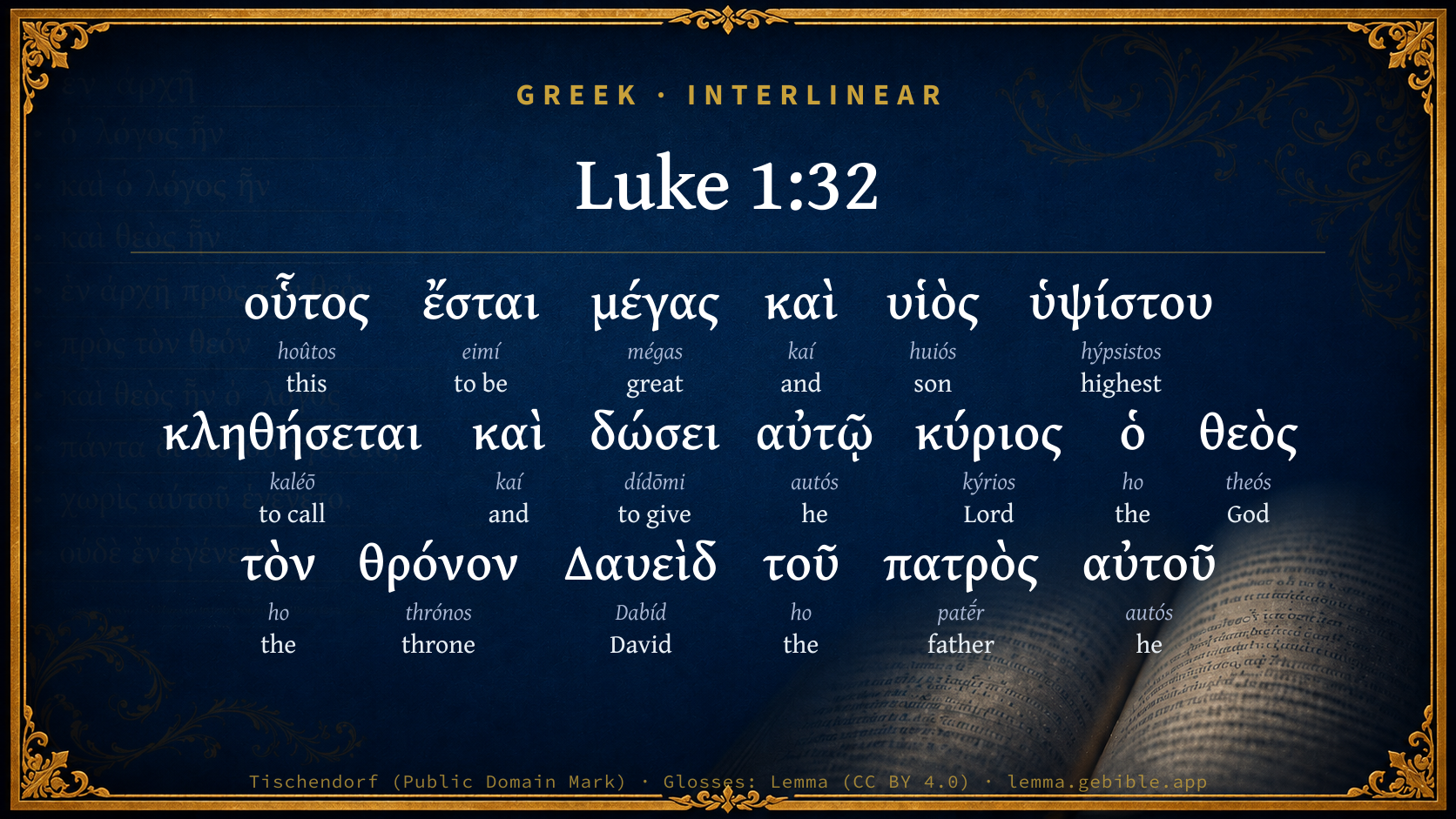
  1. οὗτος hoûtos G3778 “this” Demonstrative pronoun, Nominative, Singular, Masculine
  2. ἔσται eimí G1510 “to be” Verb, Future, Middle deponent, Indicative, 3rd person, Singular
  3. μέγας mégas G3173 “great” Adjective, Nominative, Singular, Masculine
  4. καὶ kaí G2532 “and” Conjunction
  5. υἱὸς huiós G5207 “son” Noun, Nominative, Singular, Masculine
  6. κληθήσεται kaléō G2564 “to call” Verb, Future, Passive, Indicative, 3rd person, Singular
  7. καὶ kaí G2532 “and” Conjunction
  8. δώσει dídōmi G1325 “to give” Verb, Future, Active, Indicative, 3rd person, Singular
  9. αὐτῷ autós G846 “he” Personal pronoun, Dative, Singular, Masculine
  10. κύριος kýrios G2962 “Lord” Noun, Nominative, Singular, Masculine
  11. ὁ ho G3588 “the” Article, Nominative, Singular, Masculine
  12. θεὸς theós G2316 “God” Noun, Nominative, Singular, Masculine
  13. τὸν ho G3588 “the” Article, Accusative, Singular, Masculine
  14. θρόνον thrónos G2362 “throne” Noun, Accusative, Singular, Masculine
  15. Δαυεὶδ Dabíd G1138 “David” Noun, Proper, indeclinable
  16. τοῦ ho G3588 “the” Article, Genitive, Singular, Masculine
  17. πατρὸς patḗr G3962 “father” Noun, Genitive, Singular, Masculine
  18. αὐτοῦ autós G846 “he” Personal pronoun, Genitive, Singular, Masculine

About this verse

These counts appear in no published source. They are computed here, from the morphology-tagged text and Lemma’s own curated glosses. What Lemma adds →

19
words
15
distinct lemmas
Gospels
section

Notable vocabulary

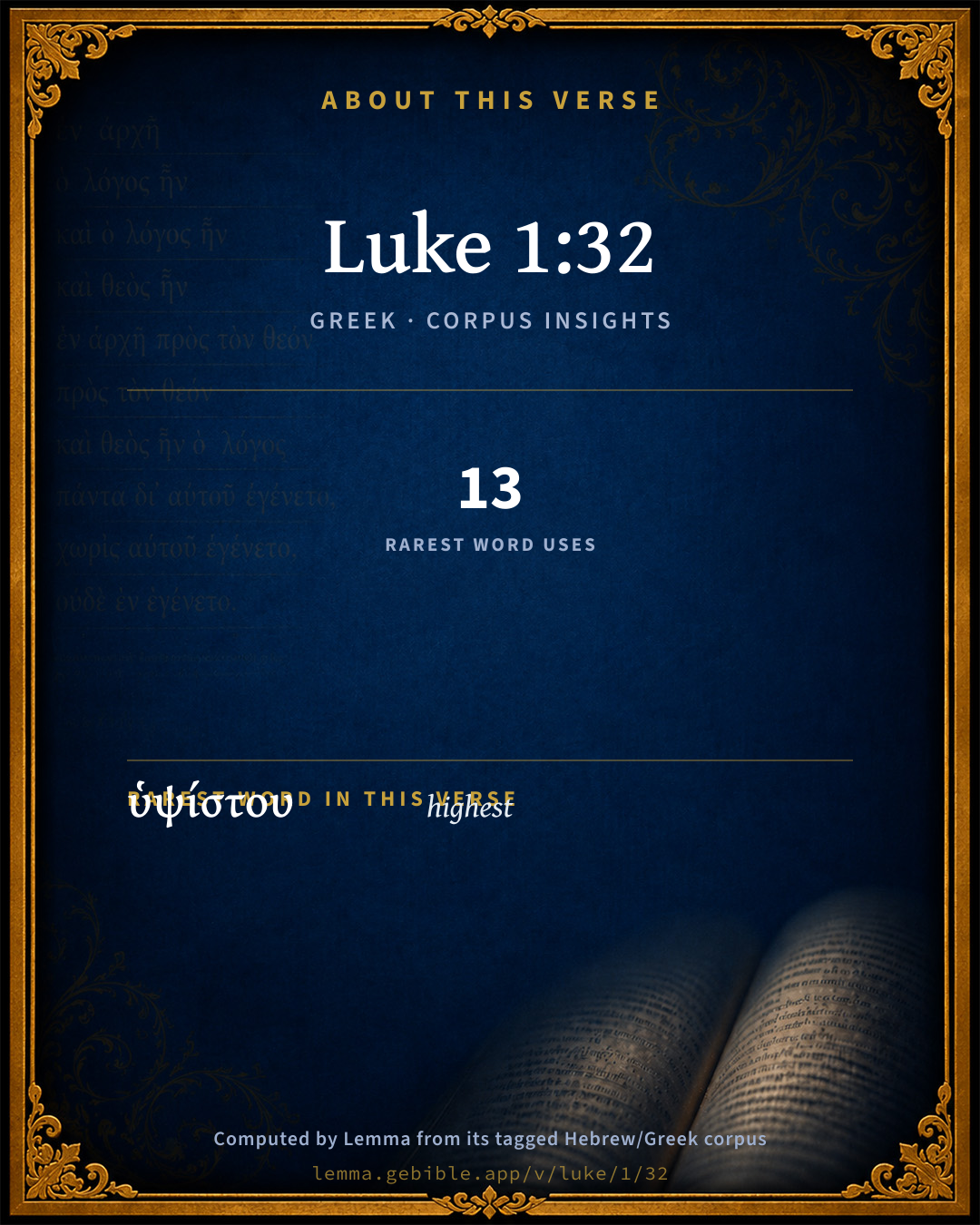
The rarest word here is ὑψίστου highest G5310 — appearing just 13 times in the whole Greek New Testament.

Shared distinctive vocabulary

ὑψίστου highest G5310 occurs in 13 verses of the Greek New Testament. Also found in:

Repetition

Words recur within this verse:

Cross-references

35

Topical passages linked to Luke 1:32 in the Treasury of Scripture Knowledge — connected by theme and wording, ordered by reader-vote popularity; previews shown in the World English Bible.

  • Isaiah 9:6–7 For to us a child is born, to us a son is given; and the government shall be on his shoulder: and his name shall be called Wonderful, Counselor, Mighty God, Everlasting Father, Prince of Peace.
  • Isaiah 16:5 A throne shall be established in loving kindness; and one shall sit thereon in truth, in the tent of David, judging, and seeking justice, and swift to do righteousness.
  • 2 Samuel 7:11–13 and [as] from the day that I commanded judges to be over my people Israel; and I will cause you to rest from all your enemies. Moreover Yahweh tells you that Yahweh will make you a house.
  • Luke 1:35 The angel answered her, "The Holy Spirit will come on you, and the power of the Most High will overshadow you. Therefore also the holy one who is born from you will be called the Son of God.
  • Psalms 132:11 Yahweh has sworn to David in truth. He will not turn from it: "I will set the fruit of your body on your throne.
  • Matthew 28:18 Jesus came to them and spoke to them, saying, "All authority has been given to me in heaven and on earth.
  • Mark 5:7 and crying out with a loud voice, he said, "What have I to do with you, Jesus, you Son of the Most High God? I adjure you by God, don't torment me."
  • Hebrews 1:2–8 has at the end of these days spoken to us by his Son, whom he appointed heir of all things, through whom also he made the worlds.
  • Luke 1:76 And you, child, will be called a prophet of the Most High, For you will go before the face of the Lord to make ready his ways,
  • Revelation 3:7 "To the angel of the assembly in Philadelphia write: "He who is holy, he who is true, he who has the key of David, he who opens and no one can shut, and who shuts and no one opens, says these things:
  • 2 Samuel 7:16 Your house and your kingdom shall be made sure for ever before you: your throne shall be established forever.
  • John 5:21–29 For as the Father raises the dead and gives them life, even so the Son also gives life to whom he desires.
  • Acts 2:30 Therefore, being a prophet, and knowing that God had sworn with an oath to him that of the fruit of his body, according to the flesh, he would raise up the Christ to sit on his throne,
  • Romans 1:4 who was declared to be the Son of God with power, according to the Spirit of holiness, by the resurrection from the dead, Jesus Christ our Lord,
  • Ephesians 1:20–23 which he worked in Christ, when he raised him from the dead, and made him to sit at his right hand in the heavenly places,
  • Philippians 2:9–11 Therefore God also highly exalted him, and gave to him the name which is above every name;
  • Jeremiah 23:5–6 Behold, the days come, says Yahweh, that I will raise to David a righteous Branch, and he shall reign as king and deal wisely, and shall execute justice and righteousness in the land.
  • Jeremiah 33:15–17 In those days, and at that time, will I cause a Branch of righteousness to grow up to David; and he shall execute justice and righteousness in the land.
  • Matthew 1:1 The book of the generation of Jesus Christ, the son of David, the son of Abraham.
  • Ezekiel 17:22–24 Thus says the Lord Yahweh: I will also take of the lofty top of the cedar, and will set it; I will crop off from the topmost of its young twigs a tender one, and I will plant it on a high and lofty mountain:
  • Ezekiel 34:23–24 I will set up one shepherd over them, and he shall feed them, even my servant David; he shall feed them, and he shall be their shepherd.
  • Ezekiel 37:24–25 My servant David shall be king over them; and they all shall have one shepherd: they shall also walk in my ordinances, and observe my statutes, and do them.
  • Mark 14:61 But he stayed quiet, and answered nothing. Again the high priest asked him, "Are you the Christ, the Son of the Blessed?"
  • John 6:69 We have come to believe and know that you are the Christ, the Son of the living God."
  • John 12:34 The multitude answered him, "We have heard out of the law that the Christ remains forever. How do you say, 'The Son of Man must be lifted up?' Who is this Son of Man?"
  • Acts 2:36 "Let all the house of Israel therefore know assuredly that God has made him both Lord and Christ, this Jesus whom you crucified."
  • Acts 16:17 Following Paul and us, she cried out, "These men are servants of the Most High God, who proclaim to us the way of salvation!"
  • Amos 9:11–12 In that day I will raise up the tent of David who is fallen, and close up its breaches, and I will raise up its ruins, and I will build it as in the days of old;
  • Matthew 3:11 I indeed baptize you in water for repentance, but he who comes after me is mightier than I, whose shoes I am not worthy to carry. He will baptize you in the Holy Spirit.
  • John 3:35–36 The Father loves the Son, and has given all things into his hand.
  • Acts 7:48 However, the Most High doesn't dwell in temples made with hands, as the prophet says,
  • Luke 1:15 For he will be great in the sight of the Lord, and he will drink no wine nor strong drink. He will be filled with the Holy Spirit, even from his mother's womb.
  • Luke 3:16 John answered them all, "I indeed baptize you with water, but he comes who is mightier than I, the latchet of whose sandals I am not worthy to loosen. He will baptize you in the Holy Spirit and fire,
  • Luke 6:35 But love your enemies, and do good, and lend, expecting nothing back; and your reward will be great, and you will be children of the Most High; for he is kind toward the unthankful and evil.
  • Matthew 12:42 The queen of the south will rise up in the judgment with this generation, and will condemn it, for she came from the ends of the earth to hear the wisdom of Solomon; and behold, someone greater than Solomon is here.

Cross-references courtesy of OpenBible.info (CC BY 4.0).

Commentary

Notes on Luke 1:32 from classic Christian and Jewish commentators (each source and its license shown beneath its notes). The classic Christian expositions comment on the surrounding passage and are grouped to its opening verse, so a note may address several verses; the Jewish commentaries on the Tanakh (Rashi and others) are per-verse, so they appear only where the commentator wrote on this verse.

Lemma curates 59 commentaries, every one of them public domain or Creative Commons licensed, each selected and text-cleaned for this edition rather than reprinted as found. About our sources →

The Biblical Illustrator

Joseph S. Exell

Luk_1:32

He shall be great, and shall be called the Son of the Highest

The greatness of Jesus

The title of Great is one which the wisdom of this world recognizes, though I am not sure that it always gives the title fairly.

We have Alexander the Great, Charles the Great, Frederick the Great, and so on. The epithet has usually been applied to those whose great powers have been manifested chiefly in the subjugation of their fellows to their own will. This kind of manifestation is the most conspicuous, it involves the most open exercise of power, and is most mixed up with the gratification of human ambition, and pride, and vanity; but, undoubtedly, those who have most permanently and extensively influenced their fellows, have been those whose conquests have been in the regions of thought, in things spiritual--the founders of religions, the authors of philosophies, the great discoverers, the great teachers. A man like Alexander has ceased for centuries to be a living power in the world; but the great founder of Buddhism, e.g., is still affecting the daily lives and habits of something like a quarter of the whole population of the world. A great captain is like a brilliant meteor, but the author of a new thought, or a new system of thought, is like a fixed star.

I. THINK OF CHRISTS GREATNESS AS A MAN. Estimate in any just way the influence produced upon the worlds history by His life and deeds; can there be any doubt that He is the greatest man who ever lived? Whose life has been the most like a seed in this world, rising up with the irresistible power of growth, and bringing forth fruit after its kind? Whose religious teaching has been practically most potent in subduing to itself the highest intellects the human race has produced? In the most tattered rags of humanity, Jesus Christ stands forth so conspicuously as the King of men, that there are few, who do not, in Some form or another, bow the knee before Him.

II. CHRISTS GREATNESS AS GOD. It is the light of Divine majesty and condescension shining through the rags of humanity, that makes the whole history intelligible. He shall be great! nay, He is great in the midst of the humiliation of the Cross itself. That humiliation was self-sought, and only adds emphasis to the declaration and promise of the text.

III. CHRISTS GREATNESS IS TO INCREASE. He is great now. But He is to be greater still--not absolutely, but relatively--in the magnitude of His Kingdom and the universality of His sway.

IV. ALL MAY PROMOTE THE GREATNESS OF CHRIST. This is the noblest aim of man. Men are willing enough to make themselves great, to get themselves on in the world, to promote their own interests, wealth, glory, and within reasonable limits it is right that this should be so but the privilege of the believer is to transfer his zeal for promoting his own greatness to the promotion of the greatness of Christ. (Bishop Harvey Goodwin.)

The grandeur of Christ

This subject far transcends all utterance. Jesus is such a One that no oratory can ever reach the height of His glory, and the simplest words are best suited to a subject so sublime. Fine words would be but tawdry things to hang beside the unspeakably glorious Lord. I can say no more than that He is great. If I could tell forth His greatness with choral symphonies of cherubin, yet should I fail to reach the height of this great argument. I will be content if I can touch the hem of the garment of His greatness.

I. HE IS GREAT FROM MANY POINTS OF VIEW. I might have said, from every point of view; but that is too large a truth to be surveyed at one sitting Mind would fall us, life would fall us, time would fail us; eternity and perfection will alone suffice for that boundless meditation. But from the points of view to which I would conduct you for a moment, the Lord Jesus Christ is emphatically great.

1. In the perfection of His nature. Peerless and incomparable; Divine, and therefore unique. He is all that God is; and He is all that man is as God created him. As truly God as if He were not man; and as truly man as if He were not God.

2. In the grandeur of His offices. He comes to rebuild the old wastes, and to restore the fallen temple of humanity. To accomplish this He came to be our Priest, our Prophet, and our King; in each office glorious beyond compare. He came to be our Saviour, our Sacrifice, our Substitute, our Surety, our Head, our Friend, our Lord, our Life, our All. He is the Standard-bearer among ten thousand. Who is like unto Him in all eternity?

3. In the splendour of His achievements. He is no holder of a sinecure; He claims to have finished the work which His Father gave Him to do. Is it not proven that He is great? Conquerors are great, and He is the greatest of them. Deliverers are great; and He is the greatest of them. Liberators are great, and He is the greatest of them. Saviours are great, and tie is the greatest of them. They that multiply the joys are men truly great, and what shall I say of Him who has bestowed everlasting joy upon His people, and entailed it upon them by a covenant of salt for ever and ever?

4. In the prevalence of his merits. He has such merit with God that He deserves of the Most High whatsoever He wills to ask; and He asks for His people that they shall have every blessing needful for eternal life and perfection.

5. In the number of His saved ones.

6. In the estimation of His people.

7. In the glory of heaven.

8. On the throne of the Father.

II. He shall be great, and He is so, for HE DEALS WITH GREAT THINGS.

1. It was a great ruin He came to restore, great sin that He came to do away, great pardon that He came to bestow.

2. He has great supplies to meet our great wants.

3. He is a Christ of great preparations. He is engaged before the throne, today, in preparing a great heaven for His people; it will be made up of great deliverance, great peace, great rest, great joy, great victory, great discovery, great fellowship, great rapture, great glory.

III. HIS GREATNESS WILL SOON APPEAR. It now lies under a cloud to mens bleak eyes. They still belittle Him with their vague and vain thoughts; but it shall not always be so. (C. H. Spurgeon.)

The greatness of Christ

The Saviour of men, and the example for all, must be the isolated one, the unparalleled Man in human history. He must be both like us and unlike us--like us in so far as His human nature is concerned: He must be born, He must increase in stature, be in subjection to His parents, and be subject to all the ordinary conditions of human nature as it develops itself from infancy to manhood. In all this He is like us--for otherwise He could not be our pattern and our Saviour. Then, again,He must be unlike us, or how could He be that One whom we are to imitate, and of whose fulness we must all partake? Christ as a Man was unlike all other men. He alone of all great men is the unparalleled One of all history; and the conviction of this truth suggests that more than man is here--more than a great and unparalleled man: it is none other than the Sonof the Highest. (Bishop Martensen.)

The Incarnation

The plan of salvation is likened unto a vine which has fallen down from the boughs of an oak. It lies prone upon the ground; it crawls in the dust, and all its tendrils and claspers, which were formed to hold it in the lofty place from which it had fallen, are twined around the weed and the bramble, and, having no strength to raise itself, it lies fruitless and corrupting, tied down to the base things of the earth. Now, how shall the vine arise from its fallen condition? But one way is possible for the vine to rise again to the place from whence it had fallen. The bough of the lofty oak must be let down, or some communication must be formed connected with the top of the oak and at the same time with the earth. Then, when the bough of the oak was let down to the place where the vine lay, its tender claspers might fasten upon it, and, thus supported, it might raise itself up, and bloom, and bear fruit again in the lofty place from whence it fell. So with man: his affections had fallen from God, and were fastened to the base things of earth. Jesus Christ came down, and by His humanity stood upon the earth, and by His divinity raised His hands and united Himself with the Deity of the Everlasting Father: thus the fallen affections of man may fasten upon Him, and twine around Him, until they again ascend to the bosom of the Godhead, from whence they fell. (Watts.)

The higher life

In one of his essays upon the phenomena of nature, Bacon tells of a mountain so high that no storm ever disturbs its air. Its climate knows little vicissitude. The clouds cannot float so high. The sunshine is constant by day, and the night comes late and the morning comes soon. So peaceful is that summit that a traveller having written some words in the white ashes of his camp fire, found the words still there after a score of years had passed. What an Elysian field is that I far above tornado and lightning shafts, and the miasma of the marsh and the battlefields of men. A fable in part, but an emblem of those heights where dwell those mortals who have reached the widest and deepest education and affections and the purest ethics. As in classifying physical beauty we feel constrained to make distinctions between a violet and an oak, or between a cascade with its murmur and mist, and a cathedral with its spire and arches, and between a trailing vine and a range of mountains, and must change our words with the change of feeling in the soul, and to the rose say beautiful, to the oak grand, pretty to the violet, and sublime to the mountain, so we must divide into many parts the attractiveness of humanity, and must confess some to be witty, some pretty, some beautiful, some learned, and then when already the heart is full of admiration it perceives one more class rising above all other grades of mortality--those morally and mentally great. In this grouping all ages may meet. The infinite love of the Creator is in nothing more manifested than in this, that He has made this moral height accessible to all. Not all can be rich, beautiful, witty, young; but all can climb upward to the higher life. It is not the mere privilege of all, but the pressing duty of all. The heights are large, and voices full of mercy and of alarm are bidding those in the valley to go up higher. God is represented as being in the holy mountains, and thither He expects His children to come. The heights are everywhere. They are seen in each profession and pursuit. There are merchants who grovel in the mire and whose gains stand for fraud, and there are merchants whose wealth tells of the industry, and growth, and welfare of the people. There are lawyers low and high--lawyers who are always upon the side of criminals, and concerning whose health and presence criminals are said to make inquiry before they plan a new crime; other lawyers, to whom men repair for help when they feel that their cause is just, and the points of law and equity must be placed clearly before jury or bench. There are writers low, and writers who are lofty. The former are witty and verbose in the defamation of character and in detailing the sins of society--these are the remains of human coarseness that are being slowly but steadily eliminated from all written thought, and therefore in greater multitude appear the writers of the pure school whose editorials, or essays, or books, or poems come into all homes as welcome as the beams of the morning sun … Said one of the greatest poets: On every height there lies repose. This peace is not found elsewhere. It is not a sleep, not an easy existence of inaction, but a repose that comes from the sublimity of the landscape, and from the matchless purity of the air. It is not to be wondered at that the human mind, while sitting in the long past ages at the loom of thought, wove for the Deity such an attribute as The Highest. And it is not robe wondered at, that when Christ came with His faultless words and deeds, with His boundless friendship and upper forms of thought, the admiring world felt that He was a Son of the Highest--figures of speech which should be taken up afresh by our far-off age. We have read in the ocean and in the storm and in the stupendous size of the universe, that the Creator has power. We have seen in the marvellous laws of mind and material that He has wisdom. We read the Divine love in the entire pageant of life, animal and rational, and we read the Divine eternity in the awful age of the universe, which drinks up millions of years as the sun dries up dewdrops; but we have omitted to ]earn from the high in thought, and industry, and art, from their eternal beauty and repose, that God is also The Highest. Far above the sun, far above the suns to us unseen, is enthroned the worlds God--the God of all worlds--on a height undreamed of by mortals. His mansions are there. Compared with this summit, the mount in the poetic philosophy of Lord Bacon sinks down and becomes a part of times vale of tears. God is on the heights, and all those minds in this lower world which love the higher life arc steadily walking up the slope of this range, hidden now perhaps by mist, but covered with light beyond the clouds. (David Swing.)

Forgotten great ones

What a roll of greatness should we have were there tables of marble, or brass, or gold in which were engraven the names of those who in all times and places have attempted to attain mental and spiritual excellence. It is a sad thought that what is called history is only a page from a vast, grand, but lost, volume. Violence and reckless ambition impressed into service all the chroniclers of the past, and that kind of greatness we see in Christ was not often asked to sit for its picture, It was too high for the surrounding kings and their hosts of sycophants. It would require a whole London of Westminster Abbeys to hold the urns of the noble ones whose very names are forgotten. The loss is great to the present, for many minds see a preponderance of evil in our age, and are not sure that our world was planned by benevolence, to which desponding minds an adequate conception of the continuous glory of man would be a welcome inspiration. There has been a succession of minds on the heights, and these have signalled to each other in all the years of man upon our globe. What ones are visible, are only a few wanderers from the mighty herd. Solon and Moses studied at the Egyptian Heliopolis indeed, but of the many thousands of men always studying there, it cannot be possible that the honours were all borne away by a Hebrew and a Greek. At that educational centre, thousands and tens of thousands came and tarried and went while centuries passed along. It must be that the few names that have come to us are only types of a great army which was scattered over the prolific East. Aspasia was not the only intellectual powerful woman of the age of Pericles. She was the one brought into the foreground by her alliance with a powerful king; others having her education and her beauty and power lived and died in a fame that could not cross the gulf of many centuries. Nor was Cleopatra the only Greco-Egyptian woman who could speak and write in all the tongues of the Mediterranean coast, but she was one made historic by the accidents of crowns and vices, leaving us to assume that there were other women, many who equalled her in learning, and passed far above her in all higher worth. Thus history is only a page out of a lost volume. As those who dig in the sands of the Swiss lakes, or in the deserted cave-homes of man and beast, or who explore the ruins of Mycenae, toss out a few implements or a few carved bones or a few jewels worn once by beauty, so history casts up out of the vast sepulchre where the ages sleep traces only of an absent world. (David Swing.)

Jesus not a fabrication

We can learn, says Theodore Parker, but few facts about Jesus. But measure Him by the shadow He has cast into the world, and by the light He has shed upon it, and shall we be told, that such a man never lived--that the whole story is a lie? Suppose that Plato and Newton never lived, that their story is a lie; but who did their works, and thought their thoughts? It takes a Newton to forge a Newton. What man could have fabricated a Jesus? None but a Jesus.

Christ the ideal representative of humanity

It is no use to say that Christ, as exhibited in the Gospels, is not historical, and that we know not how much of what is admirable is superadded by the tradition of the followers. Who among His disciples, or among their proselytes, was capable of inventing the sayings ascribed to Jesus, or of imagining the life and character revealed in the Gospels? Certainly not the fishermen of Galilee; as certainly not St. Paul, whose character and idiosyncrasies were of a totally different sort; still less the early Christian writers, in whom nothing is more evident than that the good which was in them was all derived from the higher source. About the life and sayings of Jesus there is a stamp of personal originality combined with profundity of insight, which, if we abandon the idle expectation of finding scientific precision where something very different was aimed at, must place the Prophet of Nazareth, even in the estimation of those who have no belief in His inspiration, in the very first rank of the men of sublime genius of whom our species can boast. When this pre-eminent genius is combined with the qualities of probably the greatest moral reformer and martyr to that mission who ever existed upon earth, religion cannot be said to have made a bad choice in pitching on this man as the ideal representative and guide of humanity; nor even now would it be easy, even for an unbeliever, to find a better translation of the rule of virtue from the abstract in the concrete than to endeavour so to live that Christ would approve our life. (John Stuart Mill.)

Divine humanity realized in Christ

Dr. Philip Schaff mentions the testimony of Dr. De Wette, one of the ablest and most learned sceptical critics of Germany. After all his brilliant scepticism Dr. De Wette wrote, a few months before his death: I know that in no other name can salvation be found than in the name of Jesus Christ, the Crucified; and there is nothing loftier for mankind than the Divine humanity realized in Him, and the kingdom of God planted by Him.

The Biblical Illustrator, edited by Joseph S. Exell (c. 1880s–1900s) — public domain. Text from a community e-Sword module.

Tyndale Open Study Notes

Tyndale Open Resources

1:32-33 These verses echo God’s covenant with David (2 Sam 7:11-16), the foundational promise of the coming Messiah (see also Isa 9:6-7; 11:1-5; Jer 23:5-6; 33:15-16; Ezek 37:24-25).

Tyndale Open Study Notes — © Tyndale Open Resources, licensed CC BY-SA 4.0. Text via the HelloAO Bible API.

Bengel's Gnomon

Johann Albrecht Bengel

Luk 1:32. οὗτος, He) The Messiah is clearly described, even as at Luk 1:68, etc., and ch. Luk 2:30, etc.—μέγας, great) The greatness of John, described at Luk 1:15, is far exceeded by the greatness of Jesus, described here. [See Luk 1:33, and comp. Dan 2:35; Eph 4:10.—V. g.]—Υἱὸς Ὑψίστου κληθήσεται, He shall be called the Son of the Highest) Jesus, even in a point of view distinct from His Divine nature, and from His personal union with God the Father, is, in a sense transcendentally above all angels and men, the Son of the Highest, on account of the extraordinary nature [rationem, principle of His conception and nativity.—τὸν θρόνον Δαυὶδ τοῦ πατρὸς αὐτοῦ, the throne of David His father) Christ was promised to the fathers, especially to Abraham, as the Seed. He was promised by Moses, a prophet, as the Prophet. He was promised to David, a king, as the King. Even the temporal kingdom of Israel belonged to Jesus Christ by hereditary right. Massecheth Sanhedrin, ch 4, says, that Jesus is nearest to the kingdom, קרוב למלכות.

Bengel's Gnomon of the New Testament — English translation (T&T Clark, Edinburgh, 1860) — public domain. Text from a community e-Sword module.

Meyer's Critical & Exegetical Commentary

Heinrich August Wilhelm Meyer

Luk_1:32 f. Μέγας] Comp. Luk_1:15. And what greatness belonged to this promised One, appears from what is said in the sequel of His future!

υἱὸς ὑψίστου κληθήσ.] Description of His recognition as Messiah, as whom the angel still more definitely designates Him by καὶ δώσει κ.τ.λ. The name Son of God is not explained in a metaphysical reference until Luk_1:35.

τὸν θρόνον Δαυ. τοῦ πατρ. αὐτοῦ] i.e. the royal throne of the Messianic kingdom, which is the antitypical consummation of the kingdom of David (Ps. 132:11, 110), as regards which, however, in the sense of the angel, which excludes the bodily paternity of Joseph, David can be meant as ὁ πατὴρ αὐτοῦ only according to the national theocratic relation of the Messiah as Davids son, just as the historical notion of the Messiah was once given. The mode in which Luke (and Matthew) conceived of the Davidic descent is plain from the genealogical table of ch. 3, according to which the genealogy passed by way of Joseph as foster-father.

εἰς τοὺς αἰῶνας] from Isa_9:6; Dan_7:13 f. The conception of an everlasting Messianic kingdom (according to Psa_110:4) is also expressed in Joh_12:34; comp. the Rabbins in Bertholdt, Christol. p. 156. The house of Jacob is not to be idealized (Olshausen, Bleek, and others: of the spiritual Israel); but the conception of the kingdom in our passage is Jewish-national, which, however, does not exclude the dominion over the Gentiles according to the prophetic prediction (quasi per accessionem, Grotius).

βασιλ. ἐπί] as Luk_19:14; Rom_5:14.

Meyer — Critical and Exegetical Commentary on the New Testament — English translation by Peter Christie, edited by Frederick Crombie (T&T Clark, 1880) — public domain. Text from a community e-Sword module.

Expositor's Greek Testament

ed. W. Robertson Nicoll

Luk 1:32 foreshadows the future of the child. μέγας , applied also to John, Luk 1:15 . κληθήσεται , shall be called = shall be. τὸν θρόνον Δ . τ . πατρὸς α .: the Messiah is here conceived in the spirit of Jewish expectation: a son of David, and destined to restore his kingdom.

The Expositor's Greek Testament, edited by W. Robertson Nicoll (1897–1910) — public domain. Text from a community e-Sword module.

Geneva Bible (1599)

Geneva Bible translators

He shall be declared so to be, for he was the Son of God from everlasting, but was made manifest in the flesh in his time.

Geneva Bible (1599) marginal notes — public domain. Text via Bolls.life.

Jamieson, Fausset & Brown

Robert Jamieson, A. R. Fausset & David Brown

This is but an echo of the sublime prediction in Isa 9:6-7.

Jamieson, Fausset & Brown — Commentary Critical and Explanatory on the Whole Bible (1871) — public domain (CC PDM 1.0). Text via the HelloAO Bible API.

Adam Clarke's Commentary

Verse 32. He shall be great] Behold the greatness of the man Christ Jesus:

1st. Because that human nature that should be born of the virgin was to be united with the Divine nature.

2dly. In consequence of this, that human nature should be called in a peculiar sense the SON of the most high God; because God would produce it in her womb without the intervention of man.

3dly. He shall be the everlasting Head and Sovereign of his Church.

4thly. His government and kingdom shall be eternal. Revolutions may destroy the kingdoms of the earth, but the powers and gates of hell and death shall never be able to destroy or injure the kingdom of Christ. His is the only dominion that shall never have an end. The angel seems here to refer to Isa 9:7; Isa 16:5; Jer 23:5; Da 2:44; Da 7:14. All which prophecies speak of the glory, extent, and perpetuity of the evangelical kingdom. The kingdom of grace and the kingdom of glory form the endless government of Christ.

Adam Clarke's Commentary on the Bible (1810–1826) — public domain. Text from a community e-Sword/MySword module.

Ellicott's Commentary for English Readers

(32) Shall be called the Son of the Highest.—It is noticeable that this name applied to our Lord by the angel, appears afterwards as uttered by the demoniacs (Mar_5:7). On the history of the name, see Note on Mar_5:7.

The throne of his father David.—The words seem at first to suggest the thought that the Virgin was of the house of David, and that the title to the throne was thus derived through her. This may have been so (see Note on Luk_3:23-38), and the intermarriage which had taken place in olden times between the house of Aaron and that of David (Exo_6:23; 2Ki_11:2) show that this might be quite consistent with the relationship to Elizabeth mentioned in Luk_1:36. On the other hand, it must be remembered that the genealogies, both in St. Matthew and St. Luke, appear, at first sight, to give the lineage of Joseph only, and therefore that, if this were, as many have believed, the Evangelist’s point of view, our Lord, notwithstanding the supernatural birth, was thought of as inheriting from him. The form of the promise, which might well lead to the expectation of a revived kingdom of Israel after the manner of that of David, takes its place among the most memorable instances of prophecies that have been fulfilled in quite another fashion than those who first heard them could have imagined possible. That the Evangelist who recorded it held that it was fulfilled in the Kingdom of Heaven, the spiritual sovereignty of the Christ, is shown by the fact that he records it in the same Gospel as that which tells of the Crucifixion and Ascension.

A Bible Commentary for English Readers, edited by Charles John Ellicott (1878–1897) — public domain. Text from a community e-Sword module.

The Cambridge Bible for Schools and Colleges

gen. ed. J. J. S. Perowne

32. shall be called] i. e. shall be. The best comment on this verse is furnished by the passages of Scripture in which we find the same prophecy (Mic_5:4; 2Sa_7:12; Isa_9:6-7; Isa_11:1; Isa_11:10; Isa_16:5; Jer_23:5; Jer_30:9; Eze_34:24; Hos_3:5; Psa_132:11) and its fulfilment (Php_2:9-11; Rev_22:16).

the throne of his father David] according to Psa_132:11.

The Cambridge Bible for Schools and Colleges (gen. ed. J. J. S. Perowne; Cambridge University Press, 1878–1918) — public domain. Text from a community e-Sword module.

John Gill's Exposition

He shall be great,.... In his person, as God-man; this child born, and Son given, being the angel of the great counsel, the mighty God, and everlasting Father; Isa 9:6 which is here referred to; and in his offices, in his prophetic office, being that great and famous prophet Moses spoke of, mighty in word and deed, in his doctrine and miracles; in his priestly office, being a great high priest, both in the oblation of himself, and in his prevalent intercession; and in his kingly office, being the King of kings, and Lord of Lords; and in the whole of his office, as Mediator, being a great Saviour, the author of a great salvation for great sinners; in which is greatly displayed the glory of all the divine perfections: great also in his works, the miracles that he wrought, as proofs of his Deity and Messiahship, the work of redemption, the resurrection of himself from the dead, and of all men at the last day; and in the glory he is now possessed of in human nature, at the Father's right hand, where he is highly exalted above all principality and power:

and shall be called the Son of the Highest; that is, of God, of whose names is "the Most High"; see Gen 14:18 not by creation, as angels and men, nor by adoption, as saints, nor by office, as magistrates, are called "the children of the Most High", Psa 82:6 but by nature, being the eternal Son of God; of the same nature with him, and equal to him: for he was not now to begin to be the Son of God, he was so before, even from all eternity; but the sense is, that he should now be known, owned, and acknowledged to be the Son of God, being as such manifested in human nature, and should be proved to be so by the works he wrought, and declared to be the Son of God with power by his resurrection from the dead:

and the Lord God shall give unto him the throne of his father David. Christ, as God, is the Son of God, as man, the son of David; a name often given to the Messiah, and by which he was well known among the Jews; and as Christ descended from him as man, in a literal sense, he had a right to the throne of his father David; and the Jews themselves say, that he was , "nearly allied to the kingdom" (w): but here it intends not his throne, in a literal, but in a figurative sense; for as David was a type of the Messiah in his kingly office, hence the Messiah is called "David their king", Hos 3:5 so his throne was typical of the Messiah's throne and kingdom; which is not of this world, but is in his church, and is set up in the hearts of his people, where he reigns by his Spirit and grace; and this is a throne and kingdom "given" by the Lord God. The kingdom of nature and providence he has by right of nature, as the Son of the Highest; the kingdom of grace, or the mediatorial kingdom, the kingdom of priests, or royal priesthood, is a delegated one; his Father has set him as king over his holy hill of Zion; and he is accountable for his government to him, and will one day deliver it up complete and perfect,

(w) T. Bab. Sanhedrin, fol. 43. 1.

John Gill's Exposition of the Whole Bible (1746–1763) — public domain (CC PDM 1.0). Text via the HelloAO Bible API.

Trapp's Complete Commentary

John Trapp

32 He shall be great, and shall be called the Son of the Highest: and the Lord God shall give unto him the throne of his father David:

Ver. 32. Son of the Highest] Answerable to the Hebrew Elion, whence ηλιος for the sun, cuius antiquissima veneratio, saith Beza, whom the ancients deify.

John Trapp, A Commentary or Exposition upon All the Books of the Old and New Testament (1647–1656) — public domain. Text from a community e-Sword module.

Albert Barnes' Notes on the Bible

He shall be great - There is undoubted reference in this passage to Isa 9:6-7. By his being “great” is meant he shall be distinguished or illustrious; great in power, in wisdom, in dominion on earth and in heaven.

Shall be called - This is the same as to say he “shall be” the Son, etc. The Hebrews often used this form of speech. See Mat 21:13.

The Highest - God, who is infinitely exalted; called the Highest, because He is exalted over all his creatures on earth and in heaven. See Mar 5:7.

The throne - The kingdom; or shall appoint him as the lineal successor of David in the kingdom.

His father David - David is called his father because Jesus was lineally descended from him. See Mat 1:1. The promise to David was, that there should “not fail” a man to sit on his throne, or that his throne should be perpetual 1Ki 2:4; 1Ki 8:25; 1Ki 9:5; 2Ch 6:16, and the promise was fulfilled by exalting Jesus to be a Prince and a Saviour, and the perpetual King of his people.

Albert Barnes' Notes on the Bible (1834–1885) — public domain. Text from a community e-Sword/MySword module.

Haydock's Catholic Bible Commentary

He ... shall be called; i.e. according to the style of the Scriptures, he shall truly be the Son of God. (Witham)

George Leo Haydock (1774–1849), Haydock's Catholic Family Bible and Commentary, 1859 edition — public domain. Excludes Psalms (Douay-Rheims chapter numbering differs from Protestant) and Deuterocanonical books (Catholic canon only).

Whedon's Commentary on the Bible

Daniel D. Whedon

32. Throne of his father David—See note on Mat_1:20. The throne of the theocracy, or ancient kingdom of God. The Jewish nation, as a chosen people of God, constituted this theocracy during the Mosaic dispensation. On the throne of this theocracy David was a representative king. When the Jewish race ceased to be the theocracy by the taking of the kingdom of God from them, that kingdom was established on a new basis, by which every man, Jew or Gentile, was admitted to form part of that kingdom by faith. On the throne of that theocracy sits Jesus, the eternal successor of David.

Daniel D. Whedon (gen. ed.), Commentary on the Old and New Testaments (1874–1909) — public domain. Text from a community e-Sword module.

The Pulpit Commentary

The Son of the Highest. It is singular that this title, given by the angel to the yet unborn child, was the one given to the Redeemer by the evil spirit in the case of the poor possessed. (see Mar_5:7) Is this the title, or one of the titles, by which our Master is known in that greater world beyond our knowledge? The throne of his father David; clearly indicating that Mary herself was of royal lineage, although this is nowhere definitely stated. (see Psa_132:11) These words of the angel are as yet unfulfilled. They clearly speak of a restoration of Israel, still, as far as we can see, very distant. Nearly nineteen centuries have passed since Gabriel spoke of a restored throne of David, of a kingdom in Jacob to which should come no end. The people, through all the changing fortune of empires, have been indeed strangely kept distinct and separate, ready for the mighty change; but the eventful hour still tarries. It has been well observed how St. Luke"s report of the angel"s words here could never have been a forgery as one school of critics asserts of the second century. Would any writer in the second century, after the failure of Jesus among the Jews was well known, when the fall of Jerusalem had already taken place, have made an angel prophesy what is expressed here?

The Pulpit Commentary (1880–1919), ed. H.D.M. Spence-Jones & Joseph S. Exell — public domain. Text from a community e-Sword module.

John Wesley's Explanatory Notes

He shall be called the Son of the Highest - In this respect also: and that in a more eminent sense than any, either man or angel, can be called so. The Lord shall give him the throne of his father David - That is, the spiritual kingdom, of which David's was a type.

John Wesley, Explanatory Notes Upon the Whole Bible (1754–1765) — public domain. Text via the GEBible commentary corpus.

Godbey's Commentary on the New Testament

William B. Godbey

THE KINGDOM OF CHRIST

32-34. “He shall be called Great and the Son of the Highest; the Lord God shall give unto Him the throne of His father David, and of His kingdom there shall be no end.” I see no possibility of satisfying these plain and unequivocal affirmations of inspired truth by a simple reference to His spiritual kingdom, which was a glorious verity before David was born, and will be forever. One line of Biblical exegetes spiritualize all the literal Scriptures, while their opponents literalize all, the tendency being to materialistic infidelity, and that of the fornier into a dreamy Utopianism, doing away with the material, universe, and running into the vagaries of idealism. While David’s throne was a temporal reality, visible, tangible, and actual, it was not his own, as he was merely the executive of the theocracy — a man after God’s own heart, because he did God’s will. (Act 13:22.) Therefore we are bound to conclude that David’s great Son and Successor will restore the theocracy of which David was the executive, extended over, not only this world, but, as it already prevails, over all other worlds, and reign forever. The magnitude of the Divine attributes, administration, grace, and glory is so incomprehensible by human intellect as to superinduce a constant liability on our part to run into the heresy of minification. Good Lord deliver us! Let us take the Word as we find it, if it decapitates all of our idols!

William B. Godbey, Commentary on the New Testament (1896–1900) — public domain. Text from a community e-Sword module.

Cambridge Greek Testament for Schools and Colleges

32. κληθήσεται. i.e. shall be. The best comment on this verse is furnished by the passages of Scripture in which we find the same prophecy (Mic 4:7; Mic 5:4; 2Sa 7:12; Isa 9:6-7; Isa 11:1; Isa 11:10; Isa 16:5; Jer 23:5; Jer 30:9; Eze 34:24; Dan 7:14; Hos 3:5; Psa 132:11) and its fulfilment (Php 2:9-11; Rev 22:16).

ὑψίστου. Without the article (anarthrous), as in Luk 6:35, being here a synonym of θεός.

τὸν θρόνον Δαυεὶδ τοῦ πατρὸς αὐτοῦ, according to Psa 132:11.

Cambridge Greek Testament for Schools and Colleges (Cambridge University Press, 1896; 21 vols, various authors incl. Carr, Maclear, Plummer, Farrar, Lumby, Moule, M. R. James, Simcox) — public domain. Text from a community e-Sword module.

Alford’s Greek Testament

Henry Alford

32. Δαυεὶδ τοῦ π. αὐτ.] This announcement makes it almost certain (but see note above) that Mary also was of the house of David. No astonishment is expressed by her at this part of the statement, and yet, from the nature of her question, it is clear that she did not explain it by supposing Joseph to be the destined father of her child. See 2Sa 7:13: Psa 89:3, Psa 89:4: Isa 9:7: Jer 33:15.

34,

Henry Alford, The Greek Testament (1849–1861) — public domain. Text from a community e-Sword module.

International Critical Commentary

32. οὗτος ἔσται μέγας. As in ver. 15, this is forthwith explained; and the greatness of Jesus is very different from the greatness of John. The title υἱὸς γ̔ψίστου expresses some very close relation between Jesus and Jehovah, but not the Divine Sonship in the Trinity; comp. 6:35. On the same principle as Θεός and Κύριος Ὕψιστος is anarthrous : there can be only one Highest (Ecclus. 7:15, 27:26, 19:17, 24:2, 23, 29:11, etc.). The κληθήσεται is not a mere substitute for ἔσται: He not only shall be the Son of God, but shall be recognized as such. In the Acta Pauls et Theclæ we have Μακάριοι οἱ σαβόντες Ἰησοῦ Χριστοῦ, ὅτι αὐτοὶ υἱοὶ ὑψίστου κληθήσονται (Tischendorf, p. 239). For τὸν θρόνον Δαυείδ Comp. 2Sa 7:12, 2Sa 7:13; Isa 9:6, Isa 9:7, Isa 9:16:5.

Δαυείδ τοῦ πατρὸς αὐτοῦ. This is thought to imply the Davidic descent of Mary; but the inference is not quite certain. Jesus was the heir of Joseph, as both genealogies imply. Comp. Psa 132:11; Hos 3:5. There is abundant evidence of the belief that the Messiah would spring from David: Mar 12:35, Mar 12:10:47, Mar 12:11:10; Luk 18:38, Luk 18:20:41; Luk_4 Ezra 12:32 (Syr. Arab. Arm.); Ps. Sol. 17:23, 24; Talmud and Targums. See on Rom 1:3.

International Critical Commentary — older volumes (1896–1929), various authors — public domain. Text from a community e-Sword module.

Lesson kit

Teaching starters — assembled from the data on this page, not authored interpretation. Every prompt links to the verse data it draws on. Edit before teaching.

Luke, in the Gospels, opens this verse with 19 words (15 distinct Greek lemmas). Its most distinctive word is hýpsistos (“highest”). A historical commentator’s framing appears above. Read the whole chapter for the surrounding context.

Discussion questions

  1. What does “highest” (hýpsistos) contribute to the verse as a whole?
  2. How does Matthew 21:9, which shares the word «highest», read alongside this verse?
  3. What does the repetition of “the” (3× in this one verse) do in this verse?
  4. The translations on this page render this verse differently — a whole-verse word diff, not a word-by-word alignment. What might account for the different wordings?
  5. Compare how The Biblical Illustrator and Tyndale Open Study Notes read this verse. Where do they agree or differ?

Things to notice

Reading settings

Reading text

Shown beneath each verse's original-language words.

Old Testament
Old Testament edition

Read the OT as the Masoretic Hebrew (MT) or the Greek Septuagint (LXX).

English shown for the Greek Septuagint (in the Hebrew ↔ Greek comparison).

Comparing translations? Open the Compare panel on any verse page to stack up to four side by side.