
Matthew 6:4

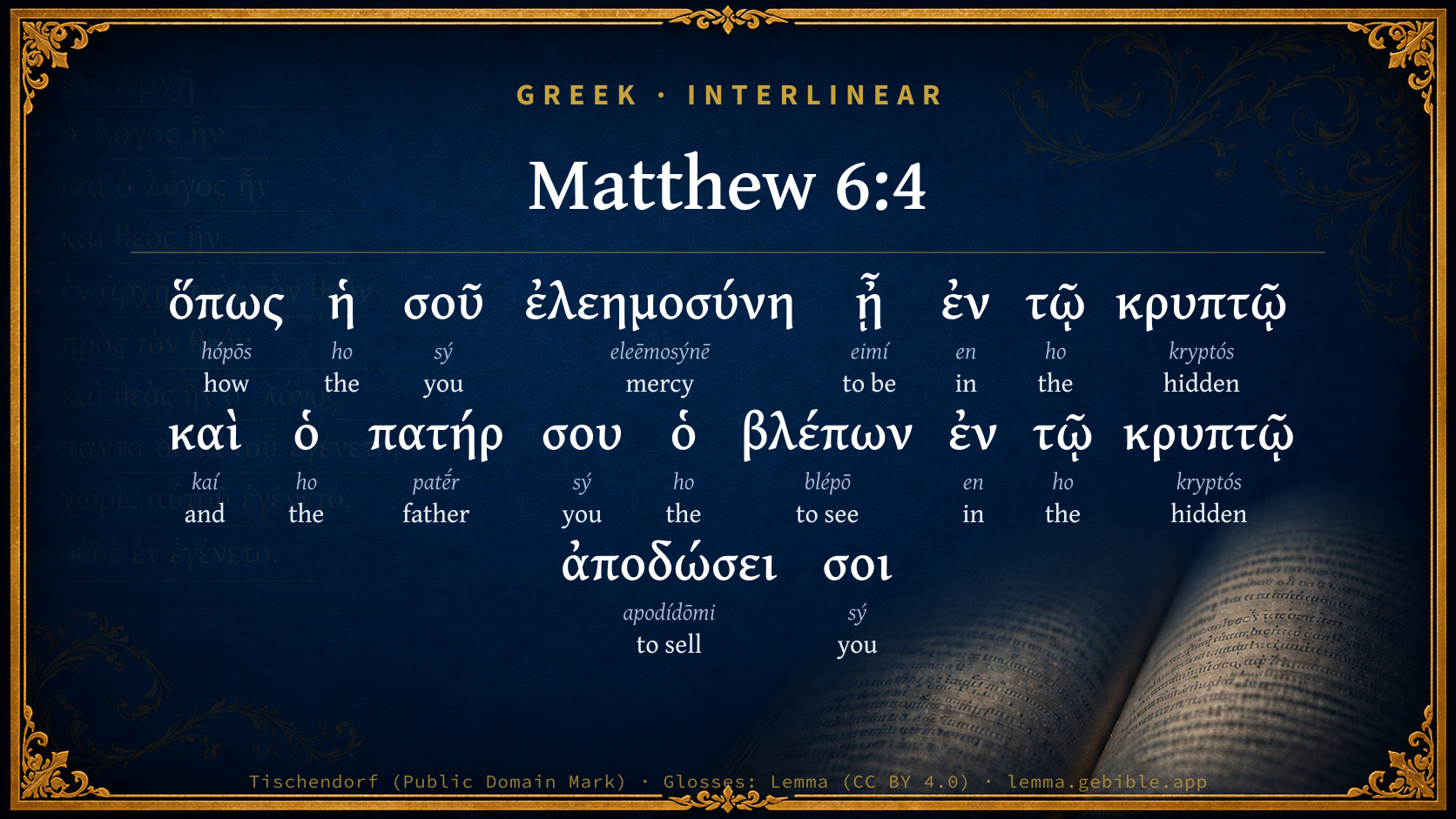
Greek (Tischendorf 8th ed.) Matthew 6:4 appears in the Greek New Testament. The text above is from the Tischendorf 8th edition. Each word links to its Strong’s number and a concise gloss. Click any word for its full Thayer’s Greek Lexicon entry.
Download image
Cite this verse

Matthew 6:4 (World English Bible). Public Domain. Lemma interlinear Bible study tool, https://lemma.gebible.app/v/matthew/6/4.

Show BibTeX & RIS
BibTeX
RIS
English Translation
so that your merciful deeds may be in secret, then your Father who sees in secret will reward you openly.
World English Bible · Public Domain
Highlights
  • 1 first appearance in the Greek New Testament
Full analysis ↓
Download a study sheet

One document with this verse’s original text, its word-by-word gloss line, the meaning frame, cross-references with their text, attributed commentary, and full source and license credits — printable, and it pastes into notes with its structure intact.

This verse Autodidact and up

Study sheet (.html) Plain text (.txt)

A passage Seminary Student

Up to 50 verses in one chapter. A passage sheet keeps up to 6 commentary sources and 12 cross-references per verse, in the order this page ranks them, and says so on the sheet whenever that leaves anything out. Ask for a single verse and you get the Autodidact verse sheet above.

Everything on this page stays free to read, with no account — the sheet is a download of what is already on screen, not access to it.

Want to remove ads? Support Godless Engineer
Compare translations 3

The same verse in 3 English versions, stacked beneath the original-language interlinear above. Click any original word for its lexicon entry.

Each is an independent rendering of the whole verse — the interlinear is not word-aligned to these translations.

Highlighted words mark where these versions differ — a whole-verse word diff, not a word-by-word alignment.

  • World English Bible Public Domain
    so that your merciful deeds may be in secret, then your Father who sees in secret will reward you openly.
  • King James Version Public Domain
    That thine alms may be in secret: and thy Father which seeth in secret himself shall reward thee openly.
  • unfoldingWord Literal Text CC BY-SA 4.0
    so that your alms may be in secret, and your Father seeing in secret will reward you.

unfoldingWord Literal Text — © unfoldingWord, licensed CC BY-SA 4.0. Word-aligned USFM3 via Door43 (git.door43.org/unfoldingWord/en_ult).

Versions to compare (up to 4)

3 of 4 selected

Show all 19 translations

Every available English version of this verse, each an independent rendering of the whole verse.

  • World English Bible Public Domain
    so that your merciful deeds may be in secret, then your Father who sees in secret will reward you openly.
  • Berean Standard Bible Public Domain
    so that your giving may be in secret. And your Father, who sees what is done in secret, will reward you.
  • Majority Standard Bible Public Domain
    so that your giving may be in secret. And your Father, who sees what is done in secret, will Himself reward you openly.
  • King James Version Public Domain
    That thine alms may be in secret: and thy Father which seeth in secret himself shall reward thee openly.
  • American Standard Version (1901) Public Domain
    that thine alms may be in secret: and thy Father who seeth in secret shall recompense thee.
  • Revised Version (1885) Public Domain
    that thine alms may be in secret: and thy Father which seeth in secret shall recompense thee.
  • Geneva Bible (1599) Public Domain
    That thine almes may be in secret, and thy Father that seeth in secret, hee will rewarde thee openly.
  • Douay-Rheims (1899) Public Domain
    That thy alms may be in secret, and thy Father who seeth in secret will repay thee.
  • Young's Literal Translation Public Domain
    that thy kindness may be in secret, and thy Father who is seeing in secret Himself shall reward thee manifestly.
  • Literal Standard Version CC BY-SA 4.0
    that your kindness may be in secret, and your Father who is seeing in secret will reward you Himself.
  • Unlocked Literal Bible CC BY-SA 4.0
    so that your gift may be given in secret. Then your Father who sees in secret will reward you.
  • unfoldingWord Literal Text CC BY-SA 4.0
    so that your alms may be in secret, and your Father seeing in secret will reward you.
  • Darby Bible Public Domain
    so that thine alms may be in secret, and thy Father who sees in secret will render [it] to thee.
  • World Messianic Bible Public Domain
    so that your merciful deeds may be in secret, then your Father who sees in secret will reward you openly.
  • Webster's Bible Public Domain
    That thy alms may be in secret; and thy Father who seeth in secret, himself will reward thee openly.
  • Free Bible Version CC BY-SA 4.0
    That way what you give will be in secret, and your Father who sees what happens in secret will reward you.
  • Bible in Basic English Public Domain
    So that your giving may be in secret; and your Father, who sees in secret, will give you your reward.
  • Text-Critical English NT CC BY 4.0
    so that yoʋr giving may be in secret. Then yoʋr Father who sees in secret will himself reward yoʋ openly.
  • Tyndale New Testament (1534) Public Domain
    that thine almes may be secret: and thy father which seith in secret shall rewarde ye openly.

Literal Standard Version (2020), Covenant Press — licensed CC BY-SA 4.0. Text via the HelloAO Bible API (eBible.org). Unlocked Literal Bible (unfoldingWord) — licensed CC BY-SA 4.0. Text via the HelloAO Bible API (eBible.org). unfoldingWord Literal Text — © unfoldingWord, licensed CC BY-SA 4.0. Word-aligned USFM3 via Door43 (git.door43.org/unfoldingWord/en_ult). Free Bible Version, Dr. Jonathan Gallagher — licensed CC BY-SA 4.0. Text via the HelloAO Bible API (eBible.org).

Word by word

More ways to search: Search by grammar → Find every occurrence → Compare this word →

Practice this passage: Drill this verse → Learn its vocabulary →

ἐλεημοσύνη
eleēmosýnē
G1654
“mercy”
Noun, Nominative, Singular, Feminine
Part of Speech
Noun
Case
Nominative
Number
Singular
Gender
Feminine
Full Thayer's Definition

Origin: from G1656

TDNT: 10:05,2

1. mercy, pity a. esp. as exhibited in giving alms, charity 2. the benefaction itself, a donation to the poor, alms
  1. ὅπως hópōs G3704 “how” Adverb
  2. ἡ ho G3588 “the” Article, Nominative, Singular, Feminine
  3. σοῦ sý G4771 “you” Personal pronoun, 2nd person, Genitive, Singular
  4. ᾖ eimí G1510 “to be” Verb, Present, Active, Subjunctive, 3rd person, Singular
  5. ἐν en G1722 “in” Preposition
  6. τῷ ho G3588 “the” Article, Dative, Singular, Neuter
  7. κρυπτῷ kryptós G2927 “hidden” Adjective, Dative, Singular, Neuter
  8. καὶ kaí G2532 “and” Conjunction
  9. ὁ ho G3588 “the” Article, Nominative, Singular, Masculine
  10. πατήρ patḗr G3962 “father” Noun, Nominative, Singular, Masculine
  11. σου sý G4771 “you” Personal pronoun, 2nd person, Genitive, Singular
  12. ὁ ho G3588 “the” Article, Nominative, Singular, Masculine
  13. βλέπων blépō G991 “to see” Verb, Present, Active, Participle, Nominative, Singular, Masculine
  14. ἐν en G1722 “in” Preposition
  15. τῷ ho G3588 “the” Article, Dative, Singular, Neuter
  16. κρυπτῷ kryptós G2927 “hidden” Adjective, Dative, Singular, Neuter
  17. ἀποδώσει apodídōmi G591 “to sell” Verb, Future, Active, Indicative, 3rd person, Singular
  18. σοι sý G4771 “you” Personal pronoun, 2nd person, Dative, Singular

About this verse

These counts appear in no published source. They are computed here, from the morphology-tagged text and Lemma’s own curated glosses. What Lemma adds →

19
words
11
distinct lemmas
Gospels
section

Notable vocabulary

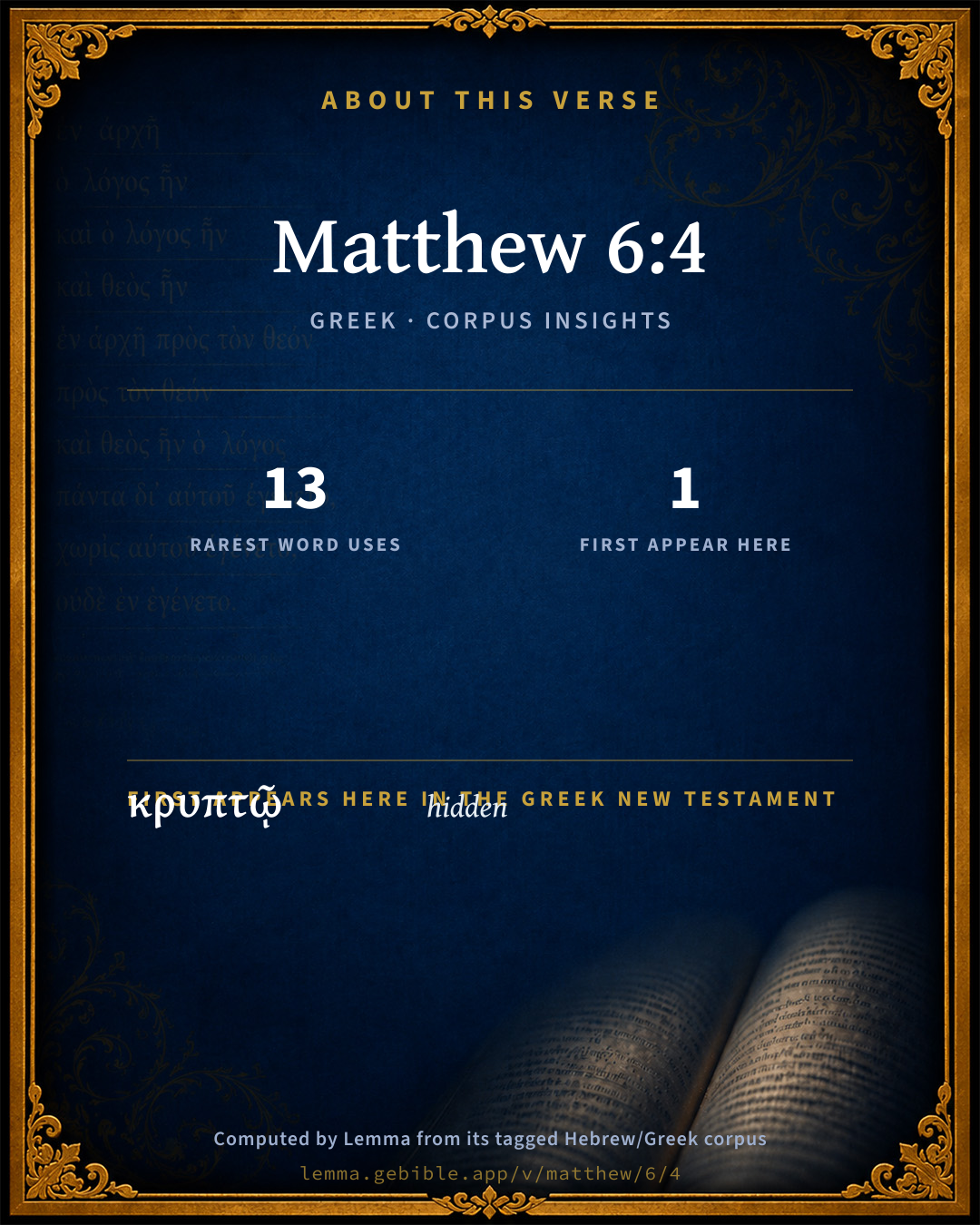
The rarest word here is ἐλεημοσύνη mercy G1654 — appearing just 13 times in the whole Greek New Testament.

First appearance in Scripture

This word makes its first canonical appearance in the Greek New Testament here:

  • κρυπτῷ hidden G2927

Shared distinctive vocabulary

ἐλεημοσύνη mercy G1654 occurs in 13 verses of the Greek New Testament. Also found in:
Repetition

Words recur within this verse:

Cross-references

17

Topical passages linked to Matthew 6:4 in the Treasury of Scripture Knowledge — connected by theme and wording, ordered by reader-vote popularity; previews shown in the World English Bible.

  • Matthew 6:18 so that you are not seen by men to be fasting, but by your Father who is in secret, and your Father, who sees in secret, will reward you.
  • Matthew 6:6 But you, when you pray, enter into your inner chamber, and having shut your door, pray to your Father who is in secret, and your Father who sees in secret will reward you openly.
  • Jeremiah 17:10 I, Yahweh, search the mind, I try the heart, even to give every man according to his ways, according to the fruit of his doings.
  • Luke 14:14 and you will be blessed, because they don't have the resources to repay you. For you will be repaid in the resurrection of the righteous."
  • Psalms 44:21 Won't God search this out? For he knows the secrets of the heart.
  • Matthew 25:34–40 Then the King will tell those on his right hand, 'Come, blessed of my Father, inherit the Kingdom prepared for you from the foundation of the world;
  • Jeremiah 23:24 Can any hide himself in secret places so that I shall not see him? says Yahweh. Don't I fill heaven and earth? says Yahweh.
  • Luke 8:17 For nothing is hidden, that will not be revealed; nor anything secret, that will not be known and come to light.
  • 1 Samuel 2:30 Therefore Yahweh, the God of Israel, says, I said indeed that your house, and the house of your father, should walk before me forever: but now Yahweh says, Be it far from me; for those who honor me I will honor, and those who despise me shall be lightly esteemed.
  • Psalms 139:1–3 Yahweh, you have searched me, And you know me.
  • Matthew 10:42 Whoever gives one of these little ones just a cup of cold water to drink in the name of a disciple, most assuredly I tell you he will in no way lose his reward."
  • Psalms 139:12 Even the darkness doesn't hide from you, But the night shines as the day. The darkness is like light to you.
  • 1 Corinthians 4:5 Therefore judge nothing before the time, until the Lord comes, who will both bring to light the hidden things of darkness, and reveal the counsels of the hearts. Then each man will get his praise from God.
  • Hebrews 4:13 There is no creature that is hidden from his sight, but all things are naked and laid open before the eyes of him with whom we have to do.
  • Jude 1:24 Now to him who is able to keep them from stumbling, and to present you faultless before the presence of his glory in great joy,
  • Psalms 17:3 You have proved my heart; you have visited me in the night; You have tried me, and found nothing; I have resolved that my mouth shall not disobey.
  • Revelation 2:23 I will kill her children with Death, and all the assemblies will know that I am he who searches the minds and hearts. I will give to each one of you according to your deeds.

Cross-references courtesy of OpenBible.info (CC BY 4.0).

Where the printed editions differ

1 variant

Places in this verse where the major printed Greek editions disagree on the wording in a way that affects the translation — a comparison of editions, not a manuscript-by-manuscript collation. The editions are the modern critical texts (Nestlé-Aland 28/27, SBL, Westcott-Hort, Tregelles, Tyndale House) and the traditional texts behind the KJV (the Textus Receptus and the Byzantine/Majority text). It is not a claim about which reading is original.

  1. Extra text
    ἐν τῷ φανερῷ.

    “in <the> public.”

    In TRByz Not in NA28NA27TynSBLWHTreg

    ἐν τῷ φανερῷ.¶ (en tō phanerō) 'in public.' is only in traditional manuscripts (TR+Byz)

Textual data: Translators Amalgamated Greek New Testament (STEPBible TAGNT) · CC BY 4.0.

Commentary

Notes on Matthew 6:4 from classic Christian and Jewish commentators (each source and its license shown beneath its notes). The classic Christian expositions comment on the surrounding passage and are grouped to its opening verse, so a note may address several verses; the Jewish commentaries on the Tanakh (Rashi and others) are per-verse, so they appear only where the commentator wrote on this verse.

Lemma curates 59 commentaries, every one of them public domain or Creative Commons licensed, each selected and text-cleaned for this edition rather than reprinted as found. About our sources →

Tyndale Open Study Notes

Tyndale Open Resources

6:4 your Father . . . will reward you: Both now and at the final judgment at the end of history (25:31-46).

Tyndale Open Study Notes — © Tyndale Open Resources, licensed CC BY-SA 4.0. Text via the HelloAO Bible API.

Bengel's Gnomon

Johann Albrecht Bengel

Mat 6:4. Ἐν τῷ κρυπτῷ, in secret) The godly shine, but shine in secret.—ὁ Πατήρ σου, thy Father) John Despagne observes, that to employ the possessive pronoun of the first person singular, and say, “MY Father,” is the exclusive privilege of the Only Begotten; but “THY Father” is said to the faithful also; FATHER, or OUR Father,” by the faithful; see Joh 20:17.—ἐν τῷ κρυπτῷ, in secret) He is Himself in secret, and performs His works in secret, and approves most those things which are done in secret. The whole essential being of things,[249] has its existence in secret.—ἀποδώσει, shall reward) This word, without the addition of Αὐτὸς (Himself), expresses a reward awarded by God and not man. This reward is sure: see Mat 6:1. The Αὐτὸς (Himself), appears to have been inserted here, and the ἐν τῷ φανερῲ (openly) in Mat 6:4; Mat 6:6; Mat 6:18, from a fear that the words might have otherwise been rendered, “Thy Father, who seeth that, shall reward thee in secret.”[250]

[249] In the original, “Pii lucent sed latent.”—(I. B.)

[250] Rec. Text has αὐτὸς with D. But BLZabc Vulg. Memph. Versions, and Cyprian omit it. So also ἐν τῷ φανερῷ added in Rec. Text with abc, is omitted in BDZ Vulg. Memph. Versions.—ED.

Bengel's Gnomon of the New Testament — English translation (T&T Clark, Edinburgh, 1860) — public domain. Text from a community e-Sword module.

Meyer's Critical & Exegetical Commentary

Heinrich August Wilhelm Meyer

Mat_6:4. Ὁ βλέπων ἐν τῷ κρυπτῷ] who sees, i.e. knows what goes on in secret, where He is equally present. Grotius and Kuinoel arbitrarily take the words to be equivalent to τὰ ἐν τῷ κρ.

αὐτὸς ἀποδώσει σοι] He Himself will reward you, that is, at the Messianic judgment (i.e. ἐν τῷ φανερῷ, 2Co_5:10); αὐτός forms a contrast to the human rewards, which the hypocrites, with their ostentatious ways of acting, managed to secure in the shape of applause from their fellow-men, Mat_6:2.

Meyer — Critical and Exegetical Commentary on the New Testament — English translation by Peter Christie, edited by Frederick Crombie (T&T Clark, 1880) — public domain. Text from a community e-Sword module.

Jamieson, Fausset & Brown

Robert Jamieson, A. R. Fausset & David Brown

That thine alms may be in secret, and thy Father which seeth in secret himself shall reward thee openly--The word "Himself" appears to be an unauthorized addition to the text, which the sense no doubt suggested. (See Ti1 5:25; Rom 2:16; Co1 4:5).

Prayer (Mat 6:5-6).

Jamieson, Fausset & Brown — Commentary Critical and Explanatory on the Whole Bible (1871) — public domain (CC PDM 1.0). Text via the HelloAO Bible API.

Adam Clarke's Commentary

Verse 4. Which seeth in secret] We should ever remember that the eye of the Lord is upon us, and that he sees not only the act, but also every motive that led to it.

Shall reward thee openly.] Will give thee the fullest proofs of his acceptance of thy work of faith, and labour of love, by increasing that substance which, for his sake, thou sharest with the poor; and will manifest his approbation in thy own heart, by the witness of his Spirit.

Adam Clarke's Commentary on the Bible (1810–1826) — public domain. Text from a community e-Sword/MySword module.

Ellicott's Commentary for English Readers

(4) That thine alms may be in secret.—Here again we have a principle rather than a rule. Publicity may be a duty, especially in public work. But this—gifts for schools, hospitals, and the like—is hardly contemplated in the word “alms,” which refers rather to acts of mercy, to cases of individual suffering. Ostentation in those acts is what our Lord especially condemns.

Thy Father which seeth in secret.—The attribute which we call the Omniscience of God is commonly dwelt on as calculated to inspire a just fear of the All-seeing One. He sees, we say, the evil deeds that are done in secret. Here it is brought before us as an encouragement and ground of hope. Do we feel isolated, not understood, not appreciated? He sees in secret and will reward.

Shall reward thee openly.—A curious instance of an early attempt to improve on our Lord’s teaching. The adverb “openly” is not found in the best MSS., and is now omitted by most editors. It would seem either as if a false rhetorical taste desired a more complete antithesis, or that the craving for public acknowledgment in the presence of men and angels asserted itself even here, and led men to add to the words of the divine Teacher. It need hardly be said that the addition weakens and lowers the force of the truth asserted. It is not necessarily in this way, “openly,” that God rewards His servants, nor do the words point only to the reward of the last great day. The reward is at once immediate, and, it may be, secret—the hidden manna, the joy with which a stranger doth not intermeddle, and which no man taketh from us.

A Bible Commentary for English Readers, edited by Charles John Ellicott (1878–1897) — public domain. Text from a community e-Sword module.

The Cambridge Bible for Schools and Colleges

gen. ed. J. J. S. Perowne

4. himself] God, not man, will reward.

The Cambridge Bible for Schools and Colleges (gen. ed. J. J. S. Perowne; Cambridge University Press, 1878–1918) — public domain. Text from a community e-Sword module.

John Gill's Exposition

That thine alms may be in secret,.... May be done in secret, and be kept a secret. The allusion seems to be to the secret chamber, where money was brought privately for the relief of the poor.

"There were two chambers in the sanctuary, the one was , "the chamber of secrets", and the other the chamber of vessels: the chamber of secrets was that into which pious persons put "in secret", and the poor children of good men were maintained out of it privately (q).''

The Jews say many things in favour of doing alms privately.

"Greater, (say they (r),) is he that gives alms in secret, than Moses our master.''

They tell us (s), that

"R. Jannai seeing a certain man give Zuz (a piece of money) to a poor man publicly, said unto him, it would have been better, if thou hadst not have given him anything, than to have given him in this manner.''

This was the practice of the ancient religious Jews, to give their alms privately; but the Scribes and Pharisees had brought that practice into disuse, and which our Lord labours to restore; adding, for encouragement,

and thy Father, which seeth in secret; beholds all secret actions, and knows the secret springs of actions,

himself shall reward thee openly; in the great day of account, before angels and men, when all secret things shall be brought to light, and every good man have praise of God. This duty, of giving alms to the poor, is mentioned by Christ before prayer to God; it may be for this reason, because it was usual to give alms before prayer.

"The great, or famous men, among the wise men, used to give a Prutah (a small piece of money) to a poor man before every prayer, and after that they prayed; as it is said, "I shall behold thy face in righteousness" (t).''

(q) Misn. Shekalim, c. 5. sect. 6. Mainnon. Hilch. Eracin, c. 2. sect. 12. (r) T. Bab. Bava Bathra, fol. 9. 2. (s) T. Bab. Chagiga, fol. 5. 1. (t) Maimon. Hilch. Mattanot Anayin, c. 10. sect. 15.

John Gill's Exposition of the Whole Bible (1746–1763) — public domain (CC PDM 1.0). Text via the HelloAO Bible API.

Trapp's Complete Commentary

John Trapp

4 That thine alms may be in secret: and thy Father which seeth in secret himself shall reward thee openly.

Ver. 4. Thy Father that seeth in secret] And best accepteth of secret service. Son 2:14; "O thou that art in the clefts of the rocks, let me see thy face, let me hear thy voice," &c. {a} He is all eye (πανοφθαλμος), he searcheth the hearts and trieth the reins, those most abstruse and remotest parts of the body, seats of lust: and as he is himself a Spirit, so he loveth to be served like himself, "in spirit and in truth." He sets his eyes upon such, as the word here signifieth, he looketh wishedly, fixedly, steadily; he seeth through and through our secret services, not to find faults in them (for so he may soon do not a few, but those he winks at, where the heart is upright), but to reward them, as a liberal pay-master, "rich to all that call upon him," or do him any other business. {b} "Who is there even among you that shut the door for nought; that kindleth fire upon mine altar for nought?" Mal 1:10; that gives a cup of cold water, and hath not his reward? David would not serve God on free cost, but was he not paid for his pains, and had his cost in again with usury ere the sun went down? Let him but resolve to confess his sins, and God (or ere he can do it) forgiveth him the iniquity of his sin, that in it that did most gall and grieve him, Psa 32:5. Let him but purpose to build God a house, God promiseth thereupon (for his good intentions) to build David a house for ever. So little is there lost by anything that is done or suffered for God. He sends away his servants (that do his work many times, and the world never the wiser) as Boaz did Ruth, with their bosom full of blessings; as David did Mephibosheth, with a royal revenue; as Solomon did the Queen of Sheba, with all the desire of her heart; as Caleb did his daughter Achsa, with upper and nether springs; or as once he did Moses from the mount, with his face shining. He shone bright, but knew not of it; yea, he hides his glorified face with a veil, and had more glory by his veil than by his face. How far are those spirits from this, which care only to be seen! and slighting God’s secret approbation, wish only to dazzle others’ eyes with admiration, not caring for unknown riches! Our Saviour (besides the veil of his humanity) says, "See ye tell no man." It is enough for him that he can say to his Father, "I have glorified thee on earth: I have finished the work that thou gavest me to do," Joh 17:4. His work he accounts a gift; his wages he looks for in another world, Mat 6:5. He was content his "treasures of wisdom should be hidden," Col 2:3. And shall we fret ourselves, when our pittances of piety and charity are not admired? Is it not enough for us that we shall appear with him in glory, and then be rewarded openly? Col 3:3.

Shall reward thee openly] Ay, but when? at the resurrection of the just, Luk 14:14; at that great assize and general assembly he will make honourable mention, in the hearing of angels and men, of all the good deeds of his children; how they have fed the hungry, clothed the naked, &c., that which they had utterly forgotten; not so much as once mentioning their misdoings, Matt. xxv. Yea, he shall take them to heaven with him, where the poor man’s hands have built him a house beforehand, and they shall receive him into everlasting habitations. But what shall he do in the mean while? "feed on faith" (as some read that text, Psa 37:3), live upon reversions. {c} Yea, but while the grass grows the steed starves. But so cannot a merciful man, for he shall have mercy, Mat 5:7; such a mercy as rejoiceth against judgment. Yea, he that can tender mercy to God, may challenge it from God by virtue of his promise; as David doth, "Preserve me, O God, for I am merciful," Psa 86:2. Mercy he shall obtain, 1. In his soul, which shall be like a watered garden, fresh and flourishing. For "the liberal soul shall be made fat; and he that watereth shall be watered himself," Pro 11:25. The spirits of wealth distilled in good works comfort the conscience. 2. So they do the body, too, when sick and languishing, Psa 41:2-3. Mercy is the best cordial, a pillow of repose, a present remedy, Pro 11:17. For if thou draw out thy soul to the hungry, thy health shall spring forth speedily, Isa 58:8; Isa 58:10. 3. For his name: the liberal are renowned in the earth, as Abraham, that free hearted housekeeper, no penny father; and Obadiah, that hid and fed the prophets by fifty in a cave. Zaccheus and Cornelius, Gaius and Onesiphorus, how precious are their names! how sweet their remembrance! Who honours not the memorial of Mary for her spikenard, and of Dorcas for her coats and garments? Act 9:39. Whereas "the vile person shall no more be called liberal" (in Christ’s kingdom), nor Nabal, Nadib, "the churl bountiful," Isa 32:5; Isa 4:1-6. For his estate: the most gainful art is almsgiving, saith Chrysostom. The poor man’s bosom and the orphan’s mouth are the surest chest, saith another. Whatsoever we scatter to the poor, we gather for ourselves, saith a third. {d} What we give to the poor, we lend to the Lord, who accounts himself both gratified and engaged thereby, Pro 19:17. Neither will he fail to bless the liberal man’s stock and store, Deu 15:10, so that his righteousness and his riches together shall endure for ever, Psa 112:3; Psa 5:1-12. Lastly, his seed shall be mighty upon earth, Psa 112:2. The son of such a tenant that paid his rent duly, shall not be put out of his farm, Psa 37:26. And that proverb is proven false by common experience, "Happy is that son whose father goeth to the devil;" for ill-gotten goods usually come to nothing; the third heir seldom enjoyeth them, {e} unless it be here and there one, that by repentance breaketh off, and healeth his father’s sin by mercifulness to the poor, that the property may be altered, and so his tranquillity lengthened. Oh, therefore, that rich men would be "rich in good works, ready to distribute, willing to communicate" (ευμεταδοτους), 1Ti 6:18-19 (which was a piece of praise used to be ascribed to the ancient kings of Egypt). This, this were the way to "lay up for themselves a sure foundation;" yea, to "lay fast hold on eternal life;" when those that withhold their very crumbs shall not obtain a drop with Dives , whom to vex and upbraid, Lazarus was laid in the bosom of liberal Abraham. Artaxerxes Longimanus quod manum haberet alteram longiorem, addere, dictitabat, esse magis regium, quam detrahere. (Plutarch.)

{a} Deus theatrum suum habet in latebris. Bucer.

{b} Thales interrogatus, num lateret Deos homo iniuste agens, respondit, Ne cogitans quidem. Βλεπειν παρα το βαλλειν ωπας, ab adieciendo oculos. Beza.

{c} Non igitur est dispendium eleemosyna sub conscientia Dei data, sed maximum compendium et praeclarissima negotiatio. Musculus. Domum in coelis manus pauperum aedificat. Chrysostom, Pascere fide. Junius.

{d} Eleemosgna ars omnium quae studiosissima. Chrysostom. Manus pauperum gazophylacium Christi. Quicquid pauperibus spargimus nobis colligimus.

{e} De male quae sitis vix gaudet tertius haeres. Horace.

John Trapp, A Commentary or Exposition upon All the Books of the Old and New Testament (1647–1656) — public domain. Text from a community e-Sword module.

Haydock's Catholic Bible Commentary

This repaying or rewarding of good works, so often mentioned here by Jesus Christ, clearly evinces that good works are meritorious, and that we may do them with a view to a reward, as David did, propter retributionem. (Haydock)

George Leo Haydock (1774–1849), Haydock's Catholic Family Bible and Commentary, 1859 edition — public domain. Excludes Psalms (Douay-Rheims chapter numbering differs from Protestant) and Deuterocanonical books (Catholic canon only).

Whedon's Commentary on the Bible

Daniel D. Whedon

4. In secret — Literally in the secret place. God seeth that secret place, and shall reward thee in the open place. Thy good deeds were covered; thy reward shall be before assembled worlds. Shall reward thee — The great principle of reward for good works done with the pure eye to God alone, seems almost forgotten. The fear of claiming merit for our good works and deeds of righteousness for God, has become extreme. Yet evangelically, and by the great condescension of God, a merit, at least a rewardableness, is attributed to deeds of goodness, performed from a right heart, for God. The dollar, nay, the cent, given for Christ from a love for Christ, is an investment which he will repay with an eternal interest.

Daniel D. Whedon (gen. ed.), Commentary on the Old and New Testaments (1874–1909) — public domain. Text from a community e-Sword module.

The Pulpit Commentary

And thy Father which seeth in secret (comp. ver. 6, note). Himself. Revised "Version omits, with the manuscripts. Shall reward thee; Revised Version, shall recompense thee (apodwsei soi). Shall give to thee in full measure corresponding to the contents of that which is really due. (cf. Isa_65:6, Isa_65:7) When this" recompense" shall be given is not stated. If, as is probable, our Lord is thinking of the" reward" of ver. 1 and Mat_5:12, it would naturally be given at the judgment-day.

Openly. Revised Version omits, with the manuscripts; similarly vers. 6, 18. The interpolation was probably made not only because of the contrast suggested by "in secret," but also to indicate more precisely the time when God would do this.

Hypocrite prayers.

Properly, the hypocrite is simply the "actor;" but the word has come to mean "one who acts a part with a view to deceive others, and get undeserved praise for himself." Standing at prayer was usual. Praying in the synagogues was usual. Praying in the streets, if you happen to be in the streets when the prayer-call sounds, is quite usual in the Mohammedan East of to-day. Our Lord does not reprove these things. Our Lord referred to a bad custom of his day. Men went into the synagogues, and stood apart as if absorbed in prayer, while secretly they were glancing round to see the impression which their superior devotion was making. "Prayer standing is the characteristic of the Jews to this day; and though not often to be seen on the streets in the East, is frequent on shipboard.

I TEST THE CASE SUPPOSED BY THE PROPER OBJECT OF PRAYER, Here is a man who prays so as to draw attention to himself prays for the sake of getting men"s admiration of his praying. Now, is that the proper aim to set before us in praying? Does it matter what our fellowmen may think of us? We ought to pray simply to gain God"s help and blessing. Prayer should be the expression of conscious need; it should be the utterance of fervent desire; it should be wholly concerned with the need, and with God, from whom the supply of the need is sought. "Men heed thee not: men praise thee not. The Master praises; what are men?

II TEST THE CASE SUPPOSED BY THE PROPER SPIRIT OF PRAYER. Prayer is uttered dependence. Prayer is supplication. It is precisely the feeling of dissatisfaction with self which inspires us to pray. And anything like self-exhibition is altogether foreign to prayer. A man must be satisfied with himself who confidently makes an exhibition of himself; and such a man wants nothing, and has nothing to pray for. In illustration of this point, reference may be made to the subtle peril which lies in emotional moods. There is a pride in religious feelings, which gets expression in beautiful prayers; and when pride is at the heart of them they cease to be prayers at all. There is much danger of insincerity in extempore public prayers, which must fail to be real prayers if they are "addressed to an audience," and intended to be admired by them rather than heard and answered by God. R.T.

The Pulpit Commentary (1880–1919), ed. H.D.M. Spence-Jones & Joseph S. Exell — public domain. Text from a community e-Sword module.

Cambridge Greek Testament for Schools and Colleges

4. αὐτός omitted before ἀποδώσει, (אBL and others) its presence emphasises the reward.

ἐν τῷ φανερῷ inserted in textus receptus after ἀποδώσει σοι, a rhetorical gloss arising from a search after antithesis. For the real antithesis see note.

4. The restored reading in this verse (see above crit. notes) gives the real antithesis which lies in the contrast between reward by God and reward by man, not between secret act and open reward. The repeated ἐν τῷ κρυπτῷ links together the thoughts of the secret act and of the eye that sees things secret.

Cambridge Greek Testament for Schools and Colleges (Cambridge University Press, 1896; 21 vols, various authors incl. Carr, Maclear, Plummer, Farrar, Lumby, Moule, M. R. James, Simcox) — public domain. Text from a community e-Sword module.

Alford’s Greek Testament

Henry Alford

4. ὁ βλ. ἐν τῷ κρυπτῷ] Not to be rendered as if it were τὰ (or σε) ἐν τῷ κρ., or εἰς τὸ κρυπτόν, but as the Eng. Vers., seeth in secret: as we say, in the dark; ἐν introducing the element, or sphere, in which.

Henry Alford, The Greek Testament (1849–1861) — public domain. Text from a community e-Sword module.

International Critical Commentary

4. That thy alms may be (done) in secret: and thy Father who sees what is secret shall recompense thee openly.] Cf. Bab. Bathra 9b “He who does alms in secret is greater than Moses our teacher.”

ὁ βαλέπων ἐν τῷ κρυπτῷ] Cf. Sotah 9a “She does it in secret; but the who sits in the secret place, the Most High, looks upon her.”

4. ἁποδώσει σοι] Add ἐν τῷ φανερῷ, E K al S1 a b c f g1 h q. The agreement of the Old Syriac and the Old Latin proves the reading to be an ancient one. And such antithesis is in the style of Mt. Cf. Intro. p. xxxi. If it is genuine here, its occurrence, in some authorities, in vv. 6 and 18 is accounted for as an assimilation to this passage.

International Critical Commentary — older volumes (1896–1929), various authors — public domain. Text from a community e-Sword module.

Lesson kit

Teaching starters — assembled from the data on this page, not authored interpretation. Every prompt links to the verse data it draws on. Edit before teaching.

Matthew, in the Gospels, opens this verse with 19 words (11 distinct Greek lemmas). Its most distinctive word is eleēmosýnē (“mercy”). A historical commentator’s framing appears above. Read the whole chapter for the surrounding context.

Discussion questions

  1. What does “mercy” (eleēmosýnē) contribute to the verse as a whole?
  2. The word “hidden” first appears here in Scripture. What is being introduced at this debut?
  3. Matthew 6:2 shares the word «mercy» with this verse. How do the two illuminate each other?
  4. “hidden” occurs 2× in this one verse. What is the effect of the repetition?
  5. The translations on this page render this verse differently — a whole-verse word diff, not a word-by-word alignment. What might account for the different wordings?
  6. Reading how Tyndale Open Study Notes and Bengel's Gnomon read this verse, where do the two commentators agree and where do they part?

Things to notice

  • 1 word makes its first canonical appearance in Scripture here.
  • These translations choose different wording for 13 words in this verse.
  • “hidden” occurs 2× in this single verse.
  • 11 distinct Greek lemmas span 19 words in this verse.

Reading settings

Reading text

Shown beneath each verse's original-language words.

Old Testament
Old Testament edition

Read the OT as the Masoretic Hebrew (MT) or the Greek Septuagint (LXX).

English shown for the Greek Septuagint (in the Hebrew ↔ Greek comparison).

Comparing translations? Open the Compare panel on any verse page to stack up to four side by side.