John 1:18

Greek (Tischendorf 8th ed.) John 1:18 appears in the Greek New Testament. The text above is from the Tischendorf 8th edition. Each word links to its Strong’s number and a concise gloss. Click any word for its full Thayer’s Greek Lexicon entry.
Download image
Cite this verse

John 1:18 (World English Bible). Public Domain. Lemma interlinear Bible study tool, https://lemma.gebible.app/v/john/1/18.

Show BibTeX & RIS
BibTeX
RIS
English Translation
No one has seen God at any time. The one and only Son, who is in the bosom of the Father, he has declared him.
World English Bible · Public Domain
Download a study sheet

One document with this verse’s original text, its word-by-word gloss line, the meaning frame, cross-references with their text, attributed commentary, and full source and license credits — printable, and it pastes into notes with its structure intact.

This verse Autodidact and up

Study sheet (.html) Plain text (.txt)

A passage Seminary Student

Up to 50 verses in one chapter. A passage sheet keeps up to 6 commentary sources and 12 cross-references per verse, in the order this page ranks them, and says so on the sheet whenever that leaves anything out. Ask for a single verse and you get the Autodidact verse sheet above.

Everything on this page stays free to read, with no account — the sheet is a download of what is already on screen, not access to it.

Want to remove ads? Support Godless Engineer
Compare translations 3

The same verse in 3 English versions, stacked beneath the original-language interlinear above. Click any original word for its lexicon entry.

Each is an independent rendering of the whole verse — the interlinear is not word-aligned to these translations.

Highlighted words mark where these versions differ — a whole-verse word diff, not a word-by-word alignment.

  • World English Bible Public Domain
    No one has seen God at any time. The one and only Son, who is in the bosom of the Father, he has declared him.
  • King James Version Public Domain
    No man hath seen God at any time, the only begotten Son, which is in the bosom of the Father, he hath declared him.
  • unfoldingWord Literal Text CC BY-SA 4.0
    No one has seen God at any time. The One and Only God, the one being in the bosom of the Father, that one has made known.

unfoldingWord Literal Text — © unfoldingWord, licensed CC BY-SA 4.0. Word-aligned USFM3 via Door43 (git.door43.org/unfoldingWord/en_ult).

Versions to compare (up to 4)

3 of 4 selected

Show all 19 translations

Every available English version of this verse, each an independent rendering of the whole verse.

  • World English Bible Public Domain
    No one has seen God at any time. The one and only Son, who is in the bosom of the Father, he has declared him.
  • Berean Standard Bible Public Domain
    No one has ever seen God, but the one and only Son, who is Himself God and is at the Father’s side, has made Him known.
  • Majority Standard Bible Public Domain
    No one has ever seen God, but the one and only Son, who is at the Father’s side, has made Him known.
  • King James Version Public Domain
    No man hath seen God at any time, the only begotten Son, which is in the bosom of the Father, he hath declared him.
  • American Standard Version (1901) Public Domain
    No man hath seen God at any time; the only begotten Son, who is in the bosom of the Father, he hath declared `him'.
  • Revised Version (1885) Public Domain
    No man hath seen God at any time; the only begotten Son, which is in the bosom of the Father, he hath declared him.
  • Geneva Bible (1599) Public Domain
    No man hath seene God at any time: that onely begotten Sonne, which is in the bosome of the Father, he hath declared him.
  • Douay-Rheims (1899) Public Domain
    No man hath seen God at any time: the only begotten Son who is in the bosom of the Father, he hath declared him.
  • Young's Literal Translation Public Domain
    God no one hath ever seen; the only begotten Son, who is on the bosom of the Father -- he did declare.
  • Literal Standard Version CC BY-SA 4.0
    No one has ever seen God; the only begotten God who is on the bosom of the Father—He has expounded [Him].
  • Unlocked Literal Bible CC BY-SA 4.0
    No one has seen God at any time. The one and only God, who is at the side of the Father, he has made him known.
  • unfoldingWord Literal Text CC BY-SA 4.0
    No one has seen God at any time. The One and Only God, the one being in the bosom of the Father, that one has made known.
  • Darby Bible Public Domain
    No one has seen God at any time; the only-begotten Son, who is in the bosom of the Father, *he* hath declared [him].
  • World Messianic Bible Public Domain
    No one has seen God at any time. The only born Son, who is in the bosom of the Father, has declared him.
  • Webster's Bible Public Domain
    No man hath seen God at any time; the only begotten Son, who is in the bosom of the Father, he hath declared him.
  • Free Bible Version CC BY-SA 4.0
    While no one has ever seen God, God the one and only, who is close beside the Father, has shown us what God is like.
  • Bible in Basic English Public Domain
    No man has seen God at any time; the only Son, who is on the breast of the Father, he has made clear what God is.
  • Text-Critical English NT CC BY 4.0
    No one has ever seen God, but the one and only Son, who is at the Father's side, has made him known.
  • Tyndale New Testament (1534) Public Domain
    No man hath sene God at eny tyme. The only begotte sonne which is in the bosome of the father he hath declared him.

Literal Standard Version (2020), Covenant Press — licensed CC BY-SA 4.0. Text via the HelloAO Bible API (eBible.org). Unlocked Literal Bible (unfoldingWord) — licensed CC BY-SA 4.0. Text via the HelloAO Bible API (eBible.org). unfoldingWord Literal Text — © unfoldingWord, licensed CC BY-SA 4.0. Word-aligned USFM3 via Door43 (git.door43.org/unfoldingWord/en_ult). Free Bible Version, Dr. Jonathan Gallagher — licensed CC BY-SA 4.0. Text via the HelloAO Bible API (eBible.org).

Word by word

More ways to search: Search by grammar → Find every occurrence → Compare this word →

Practice this passage: Drill this verse → Learn its vocabulary →

πώποτε
pṓpote
G4455
“ever”
Adverb
Part of Speech
Adverb
Full Thayer's Definition

Origin: from G4452 and G4218

TDNT: None

1. ever, at any time
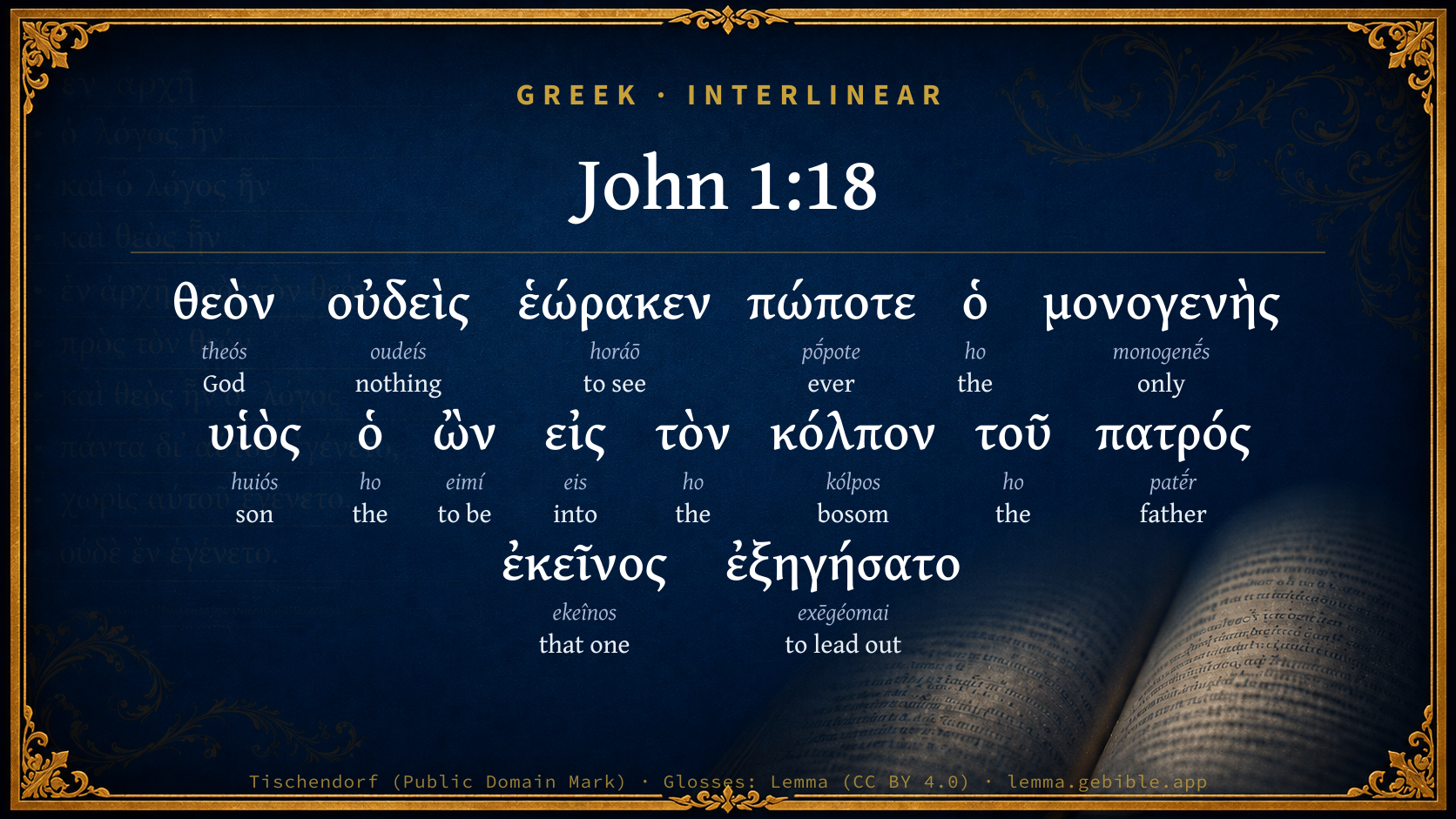
  1. θεὸν theós G2316 “God” Noun, Accusative, Singular, Masculine
  2. οὐδεὶς oudeís G3762 “nothing” Adjective, Nominative, Singular, Masculine, Negative
  3. ἑώρακεν horáō G3708 “to see” Verb, Perfect, Active, Indicative, 3rd person, Singular, Attic form
  4. ὁ ho G3588 “the” Article, Nominative, Singular, Masculine
  5. μονογενὴς monogenḗs G3439 “only” Adjective, Nominative, Singular, Masculine
  6. υἱὸς huiós G5207 “son” Noun, Nominative, Singular, Masculine
  7. ὁ ho G3588 “the” Article, Nominative, Singular, Masculine
  8. ὢν eimí G1510 “to be” Verb, Present, Active, Participle, Nominative, Singular, Masculine
  9. εἰς eis G1519 “into” Preposition
  10. τὸν ho G3588 “the” Article, Accusative, Singular, Masculine
  11. κόλπον kólpos G2859 “bosom” Noun, Accusative, Singular, Masculine
  12. τοῦ ho G3588 “the” Article, Genitive, Singular, Masculine
  13. πατρός patḗr G3962 “father” Noun, Genitive, Singular, Masculine
  14. ἐκεῖνος ekeînos G1565 “that one” Demonstrative pronoun, Nominative, Singular, Masculine
  15. ἐξηγήσατο exēgéomai G1834 “to lead out” Verb, Aorist, Middle deponent, Indicative, 3rd person, Singular

About this verse

These counts appear in no published source. They are computed here, from the morphology-tagged text and Lemma’s own curated glosses. What Lemma adds →

16
words
13
distinct lemmas
Gospels
section

Notable vocabulary

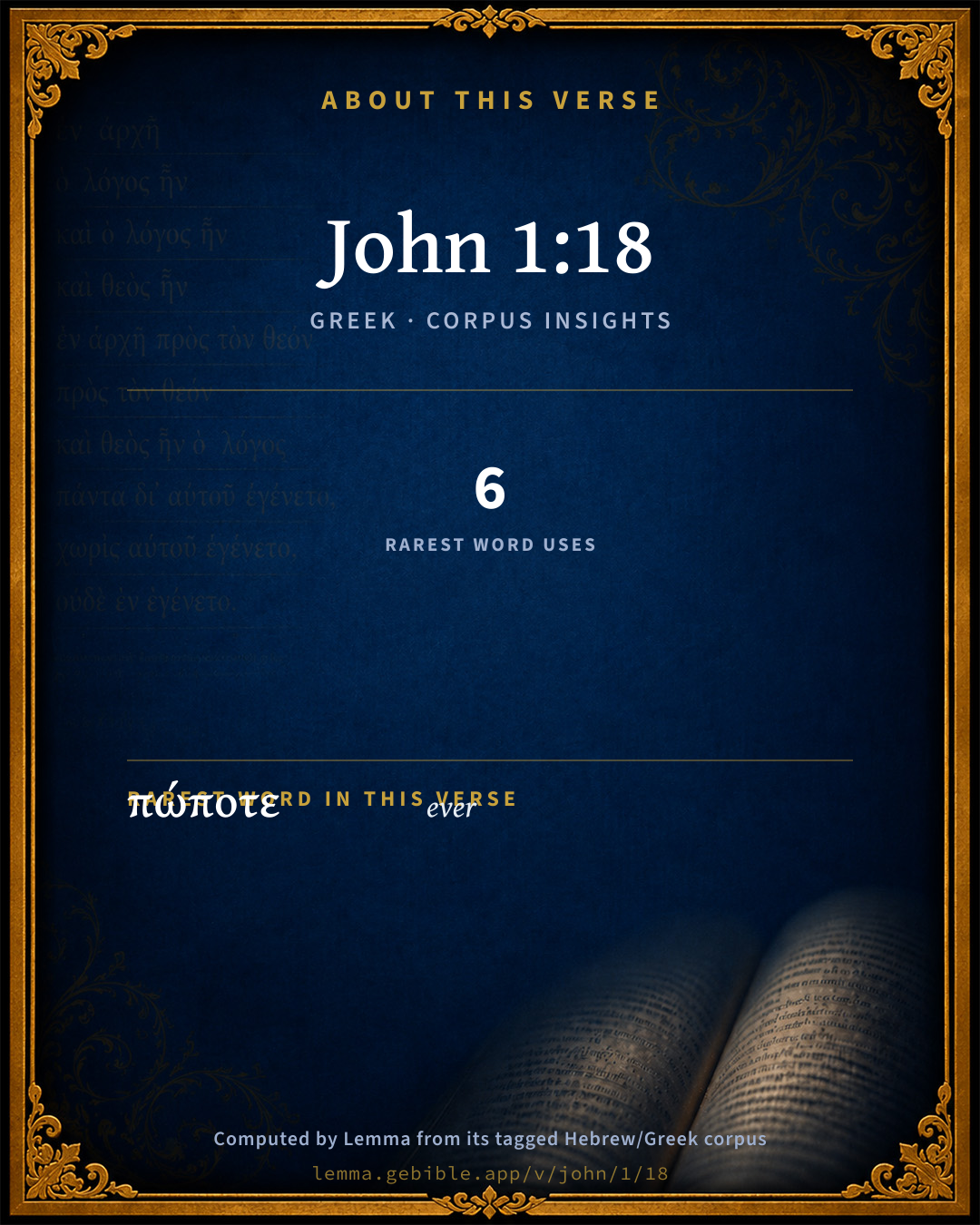
The rarest word here is πώποτε ever G4455 — appearing just 6 times in the whole Greek New Testament.

Shared distinctive vocabulary

πώποτε ever G4455 occurs in 6 verses of the Greek New Testament. Also found in:

Repetition

A word recurs within this verse:

Cross-references

37

Topical passages linked to John 1:18 in the Treasury of Scripture Knowledge — connected by theme and wording, ordered by reader-vote popularity; previews shown in the World English Bible.

  • Colossians 1:15 who is the image of the invisible God, the firstborn of all creation.
  • John 6:46 Not that anyone has seen the Father, except he who is from God. He has seen the Father.
  • Matthew 11:27 All things have been delivered to me by my Father. No one knows the Son, except the Father; neither does anyone know the Father, except the Son, and he to whom the Son desires to reveal him.
  • Luke 10:22 Turning to the disciples, he said, "All things have been delivered to me by my Father. No one knows who the Son is, except the Father, and who the Father is, except the Son, and he to whomever the Son desires to reveal him."
  • 1 John 4:12 No one has seen God at any time. If we love one another, God remains in us, and his love has been perfected in us.
  • 1 Timothy 6:16 who alone has immortality, dwelling in unapproachable light; whom no man has seen, nor can see: to whom be honor and eternal power. Amen.
  • 1 John 4:9 By this was God's love revealed in us, that God has sent his one and only Son into the world that we might live through him.
  • Exodus 33:18–23 He said, "Please show me your glory."
  • 1 John 4:20 If a man says, "I love God," and hates his brother, he is a liar; for he who doesn't love his brother whom he has seen, how can he love God whom he has not seen?
  • 1 John 5:20 We know that the Son of God has come, and has given us an understanding, that we know him who is true, and we are in him who is true, in his Son Jesus Christ. This is the true God, and eternal life.
  • John 17:26 I made known to them your name, and will make it known; that the love with which you loved me may be in them, and I in them."
  • John 1:14 The Word became flesh, and lived among us. We saw his glory, such glory as of the one and only Son of the Father, full of grace and truth.
  • John 14:9 Jesus said to him, "Have I been with you such a long time, and do you not know me, Philip? He who has seen me has seen the Father. How do you say, 'Show us the Father?'
  • John 17:6 I revealed your name to the people whom you have given me out of the world. They were yours, and you have given them to me. They have kept your word.
  • Deuteronomy 4:12 Yahweh spoke to you out of the midst of the fire: you heard the voice of words, but you saw no form; only [you heard] a voice.
  • Numbers 12:8 with him will I speak mouth to mouth, even manifestly, and not in dark speeches; and the form of Yahweh shall he see: why then were you not afraid to speak against my servant, against Moses?
  • Exodus 23:21 Pay attention to him, and listen to his voice. Don't provoke him, for he will not pardon your disobedience, for my name is in him.
  • Exodus 34:5–7 Yahweh descended in the cloud, and stood with him there, and proclaimed the name of Yahweh.
  • Isaiah 6:1–3 In the year that king Uzziah died, I saw the Lord sitting on a throne, high and lifted up; and his train filled the temple.
  • John 12:41 Isaiah said these things when he saw his glory, and spoke of him.
  • 1 Timothy 1:17 Now to the King eternal, immortal, invisible, to God who alone is wise, be honor and glory forever and ever. Amen.
  • Genesis 16:13 She called the name of Yahweh who spoke to her, "You are a God who sees," for she said, "Have I even stayed alive after seeing him?"
  • Genesis 32:28–30 He said, "Your name will no longer be called 'Jacob,' but, 'Israel,' for you have fought with God and with men, and have prevailed."
  • Joshua 5:13–6:2 It happened, when Joshua was by Jericho, that he lifted up his eyes and looked, and, behold, there stood a man over against him with his sword drawn in his hand: and Joshua went to him, and said to him, Are you for us, or for our adversaries?
  • Ezekiel 1:26–28 Above the expanse that was over their heads was the likeness of a throne, as the appearance of a sapphire stone; and on the likeness of the throne was a likeness as the appearance of a man on it above.
  • Exodus 3:4–6 When Yahweh saw that he turned aside to see, God called to him out of the midst of the bush, and said, "Moses! Moses!" He said, "Here I am."
  • Judges 6:12–26 The angel of Yahweh appeared to him, and said to him, Yahweh is with you, you mighty man of valor.
  • Genesis 48:15–16 He blessed Joseph, and said, "The God before whom my fathers Abraham and Isaac did walk, the God who has fed me all my life long to this day,
  • Judges 13:20–23 For it happened, when the flame went up toward the sky from off the altar, that the angel of Yahweh ascended in the flame of the altar: and Manoah and his wife looked on; and they fell on their faces to the ground.
  • Proverbs 8:30 Then I was the craftsman by his side. I was a delight day by day, Always rejoicing before him,
  • Isaiah 40:11 He will feed his flock like a shepherd, he will gather the lambs in his arm, and carry them in his bosom, [and] will gently lead those who have their young.
  • Lamentations 2:12 They tell their mothers, Where is grain and wine? When they swoon as the wounded in the streets of the city, When their soul is poured out into their mothers' bosom.
  • Luke 16:22–23 It happened that the beggar died, and that he was carried away by the angels to Abraham's bosom. The rich man also died, and was buried.
  • Genesis 18:33 Yahweh went his way, as soon as he had finished communing with Abraham, and Abraham returned to his place.
  • Hosea 12:3–5 In the womb he took his brother by the heel; And in his manhood he had power with God.
  • John 3:16–18 For God so loved the world, that he gave his one and only Son, that whoever believes in him should not perish, but have eternal life.
  • John 13:23 One of his disciples, whom Jesus loved, was at the table, leaning against Jesus' breast.

Cross-references courtesy of OpenBible.info (CC BY 4.0).

Where the printed editions differ

1 variant

Places in this verse where the major printed Greek editions disagree on the wording in a way that affects the translation — a comparison of editions, not a manuscript-by-manuscript collation. The editions are the modern critical texts (Nestlé-Aland 28/27, SBL, Westcott-Hort, Tregelles, Tyndale House) and the traditional texts behind the KJV (the Textus Receptus and the Byzantine/Majority text). It is not a claim about which reading is original.

  1. Different wording
    θεὸς

    “God”

    In NA28NA27SBLWHTreg Not in TynTRByz

    υἱός (huios) 'son' occurs in traditional manuscripts (Tyn+TR+Byz) instead of θεὸς (theos) 'God' in older manuscripts (NA28+NA27+SBL+WH+Treg)

Textual data: Translators Amalgamated Greek New Testament (STEPBible TAGNT) · CC BY 4.0.

Commentary

Notes on John 1:18 from classic Christian and Jewish commentators (each source and its license shown beneath its notes). The classic Christian expositions comment on the surrounding passage and are grouped to its opening verse, so a note may address several verses; the Jewish commentaries on the Tanakh (Rashi and others) are per-verse, so they appear only where the commentator wrote on this verse.

Lemma curates 59 commentaries, every one of them public domain or Creative Commons licensed, each selected and text-cleaned for this edition rather than reprinted as found. About our sources →

The Biblical Illustrator

Joseph S. Exell

Joh_1:18

No man hath seen God

The limitations of human vision

Some men have seen much, for all have not the same power of vision.

Some have seen much more than others with

I. THE NATURAL EYE. They have travelled far and near; seen wonders upon the deep and on the mountains, and the marvels of creation living and lifeless--but no man hath seen God.

II. THE INTELLECTUAL EYE.

1. The eye of science. They can invade worlds of truth which are veiled and shut to souls of lesser power; ascend into the heavens and see the harmony which rules all the movements of those gleaming worlds, descend into the deeps of the earth and of the ages which have measured out its history, and read the records which are there inscribed. They can see something of the unity which pervades the whole universe; that all sciences are but chapters in one great illuminated book, or are but notes in one sublime and never-ceasing song--but they have not seen God.

2. Some men have the poets eye which can glance from heaven to earth, from earth to heaven, and detect behind what is natural and changeful the truths which are typified, and which abide for ever--but even they have not seen God.

III. THE MORAL EYE. Patriarchs, prophets, apostles beheld wonderful visions. Some of them were favoured with glimpses and manifestations and tokens of His presence, and so impressive and overpowering were these that they felt as if they had seen God, but even they were no exception to the rule that no man hath seen God at any time. (E. Mellor, D. D.)

The invisible and revealed God

I. THE INVISIBLE GOD.

1. We are invisible to each another; nay, to ourselves. There is a veil between our spirit and another that, while our words and looks may serve to indicate what is passing within, they cannot unveil the indwelling soul. And so utterly can the soul tyrannize over the house in which it dwells, that it can compel it to illuminate its windows with festive joy when all is woe within, or compel it to darken them when all within is mirth and revelry. And if we cannot see man, much less can we see God.

2. There is no law that God has impressed on nature that we can see. Form and colour we can see, and that things move, but not the pervading life nor the gravitation which holds them together in their orbits.

3. The material universe is but a faint indication of Gods greatness, nor does it seem possible for even omnipotence to embody itself in matter. We might imagine the sun robbed of its beams, and heaven, earth, and sea combining to surrender whatever of beauty or grandeur they contain, still the result would be miserably insufficient to portray the glory of the invisible God.

4. The mind is baffled in its attempt to grasp the fundamental mystery. The loftiest conception we have is that of infinity. And yet this is a mere negation, and must be affirmed of each separate attribute as well as the totality of Gods being.

5. Without the guidance of revelation no one has ever reached any fair conception of the unity, spirituality, and moral character of God. Though day unto day has been uttering speech, and night unto night showing knowledge, the mass of the rude and unlearned have everywhere, divided the empire of the universe among gods many and lords many. And as to the philosophers, such of them as have been able to emancipate themselves from gross polytheism, have either guessed at the truth that there is one God, and have contented themselves with a cold deduction of reason, or they have merged God and nature in one, thus destroying His personality in Pantheism. The world never by wisdom knew God. And were we to close the Book of Revelation in a few generations we should relapse into a heathenism as absolute as that of Greece and Rome.

6. And as for the supposed teachings of natural religion, they are but flashes from the revealed Word. We are astonished that any eye can miss the Divine monogram written large in the heavens, small in the flower. But we do not search nature for the invisible, we take the idea with us.

II. THE DECLARED GOD. Christ has revealed the Father in three ways which meet and satisfy these corresponding necessities in man.

1. The incarnation, e.g., of the spiritual in the bodily meets that necessity which feels how impossible it is to grasp the purely spiritual. We do not feel happy at the thought of what is both infinite and invisible. Who has not felt at times the all but intolerable oppression that comes upon the spirit when one has stood in the shadow of Alpine mountains! We are bewildered by the unmanageable vastness of the conception of an all-prevailing God. We long for something that we can more effectually compass. We wish to pray; are heavy laden and sad; but infinitude is too grand for us in such hours, and we long for a friend who can take our hand and say, Fear not I am with thee. But God, the great and glorious mystery, has been manifest in the flesh. As He had to reveal Himself to man, He found no better medium than man, the form with which we were most familiar, and of which we should be least afraid.

2. By His character and life Christ declares to us the moral character of God. There is much in God which humanity, even in its highest and purest type, is inadequate to represent. The medium is tarnished and dimmed so that the heavenly light cannot shine through it, or only brokenly. Once only has humanity formed a medium through which, in its unmingled brightness and beauty, the moral character of God might pour its beams. To learn the mural character of God we must learn it in Christ; its holiness, its tenderness, its mercy for the sinful.

3. Christ has declared to us the Fatherly character of God. God we are told is love. This He is in Himself, and this He has been pre-eminently to us. We need more than words, and then, when we receive but words from those who might give us more real help, we learn bitterly that all friends are not true. Now there is no better test of love than the test of endurance and suffering, but Divine love has made for us the highest sacrifice, for God so loved the world, etc. (E. Mellor, D. D.)

Invisible things

There are even material agents in existence around us so subtle as to elude the cognisance of the senses. There are powers in nature whose ever-present influence we perceive, yet which themselves are never directly discerned. The varied forms and colours of material objects around us the eye can detect, but not the latent electricity that pervades them. The masses and motions of the planetary bodies are appreciable by the sight; but the keenest organs of sense cannot see gravitation, cannot detect that mysterious power, as it flies through space, binding orb to orb. And if thus on the confines, so to speak, of the material and spiritual worlds, there are agents impalpable to sense, much more, when we pass those limits, do we enter into a region where bodily organs fail us, and a vision and faculty far more divine is needed, Who has seen thought What eye has ever rested on that mysterious essence which we designate mind, soul, spirit? If it be that spiritual intelligences surround us, if millions of spiritual beings walk the earth both when we wake and sleep, yet, as they pass hither and thither on their heavenly ministries, does the faintest sign of the presence of these glorious beings ever flash on the dull sense of man? Nay, are we not dwellers in a world of embodied spirits, holding continual intercourse with them, witnessing constantly the proofs of their existence and the effects of their activity: yet has one human spirit ever become visible to another? No l it is but the forms of spirit that are visible to sense. We see in the busy world around us the mere houses of souls. In this sense, then, God is now and ever must be invisible. If even a finite spirit cannot be seen by the bodily eye, how much less the infinite spirit? (J. Caird, D. D.)

The invisibility of God

We are much in the condition of children for whom their father has built a magnificent house, and stored it with all needful provisions, and ornamented it with the most exquisite decorations, a house which the more it is examined the more it reveals forethought and arrangement, startling its inmates constantly with unexpected anticipation for their comfort and happiness. But their father, for some reason or other, is concealed from their view. Now every house is builded by some man, but He that built all things is God. We dwell in His house. Its roof declares His handiwork. Its chambers are garnished with a wondrous glory. Its table is supplied day by day with food convenient for us. The house is renewed year by year. But the Hand which accomplishes it all is unseen. We sometimes long to get behind the intercepting veil. We would fain see the Great Worker at His work, see the arm of power, gaze on the fountain of fight, rise above and through all phenomena, leave the fleeting behind us, and stand in the presence of the changeless. But no man hath seen God at any time, and what is more, no man can see God and five. (E. Mellor, D. D.)

God invisible to sense

Could we entertain for a moment the supposition of God condescending to contrive some resplendent form, some radiant shape of superhuman majesty and loveliness, by which to convey to man a conception of His spiritual glory, we might conceive the universe to be searched in vain for the materials of such a production. We might give the rein to fancy, and imagine the sun robbed of its glory and the stars of their splendours, and heaven, earth, sea, skies, all the myriad worlds in space, combining to surrender whatever of beauty or grandeur they contain; still would the result be miserably insufficient to portray the unapproachable glory of the invisible Being of God. These are but parts of His ways; how little a portion is heard of Him! but the thunder of His power who can understand? (J. Caird, D. D.)

The incomprehensibility of God

In the Greek legend she who desired to see the deity in his splendour is instantly reduced to ashes. In the Hindoo mythology when Brahma, the supreme, shoots down a pillar of light between the two contending deities, Siva and Vishnu, one deity wings his way upwards for a thousand years with the speed of lightning, but cannot reach its summit; the other wings his way downwards with the speed of lightning for a thousand years yet cannot find its base. Christian theology has felt this no less clearly that God in His own Being is incomprehensible. There is a picture of the vision of St. Augustine, who, when he was writing a treatise on the Trinity, saw a child trying to empty the ocean with a shell into a little hole in the sand. What art thou doing? asked the saint. I am trying to empty the sea with this shell into this hole, answered the child. But that is impossible, said Augustine. Not more impossible, O Augustine, than for thee in thy treatise to explain the mystery of the Trinity. (Archdeacon Farrar.)

As regards God, our soundest knowledge is to know that we know Him, and our safest eloquence concerning Him is silence, when we confess without confession that His glory is inexplicable, His greatness above our capacity or reach. (Hooker.)

The only-begotten Son

The only-begotten Son

This only-begotten Son is the same Person who, in the previous portion of the chapter, is designated the Word, and of whom it is said in language of which it is impossible for us to mistake the reference, He was made flesh and dwelt among us, and so dwelling among men there was beheld in Him the glory of the only begotten of the Father, full of grace and truth. The Person, then, who is thus named is none other than He who was more familiarly known as the Lord Jesus Christ.

I. Briefly, then, let me try to unfold to you THE IMPORT OF THIS GREAT NAME--the Son, the only-begotten Son of God. There is a previous inquiry to which I may, in a very few words, refer. What is the reference of the text--it being ascertained that it refers to the Lord Jesus Christ? Does it refer to Him as Divine, or simply as Mediator between God and man? It is evident to my own mind that the Scriptures give the name Son to the second Person of the Godhead, as a Person of the Godhead, and that it belongs to Him as Divine, and that, apart altogether from His becoming incarnate and doing work for the salvation of sinners, He is the only-begotten Son in the bosom of the Father. Further, there is nothing in the name itself that makes it inapplicable to the Divine Person. It is quite true that, as applied to man, it does include those ideas of derivation of beings, which are totally inconsistent with the notion of eternal existence; but when we find figures of any sort applied to God, we must strain them no further than is consistent with a notion of His Divinity. Yet farther: if this name be not descriptive of a Divine relation, then the name Father also is not descriptive of a Divine relation. And if you take it away, then have we no manifestation of the first Person of the Godhead by any personally distinctive name whatever. As, therefore, you say the Father is a name belonging to the first Person of the Godhead as Divine, so is the Son. We must take notice, in an introductory way, of the expression only. This name, whatever be its import, belongs to Christ as it belongs to no one else. There is but one Son of God in the sense of my text. You do not need to go far back into the previous context to find that there are others who in a certain sense are the sons of God.

II. We now proceed to notice SOME OF THE THOUGHTS SUGGESTED BY THIS INCOMMUNICABLE TITLE.

1. I think that instead of suggesting to us, when wisely interpreted, something inconsistent with Divinity, this title in its sole and incommunicable preeminence suggests the very idea of Divinity. Indeed that is the very first thought I find in it--sameness of nature with the Father. The Son of man is not angelic; the Son of man is man. And so when you speak of Him in the full and true and proper sense, the Son of God is God. Nay, so far may you carry this principle that you cannot describe a creature as the son or child of God without his being, as far as a creature may be, partaker of the Divine nature. It was because there was something of it in him that Adam was called the son of God. But in the full sense, in which it belongs to no other, it is true only of Jesus Christ that He is God.

2. Then there is second thought. There is resemblance in character. The Son of God resembles the Father, and the resemblance in this Divine nature is so perfect as to come to identity. He that hath seen Me hath seen the Father.

3. Then, thirdly, these words Father and Son suggest intimacy of fellowship. The Father showeth the Son all things that He Himself doeth!

4. But perhaps the most prominent of all ideas connected with the title is intensity of mutual Divine affection. The Father loveth the Son.

5. There is another idea which is brought out also in Scripture, namely, community of interests. All that belongs to the Father belongs to the Son.

6. But I should be omitting one thought of great importance if I did not say that the title Son, as applied to the second Person in the Trinity, does, after all, indicate a certain distinction. The Father is not personally the Son, nor the Son the Father. And now for one or two particular inferences from what I have been unfolding in this somewhat dry and formal manner. And first--if these things be so--oh, what love is that of the Father towards sinful men? The second inference is this--I wish I could bring it out as it presents itself, in its attractive phase, to my own mind. If the Saviour be Gods beloved Son--His only Son--the object of infinite, unfathomable, everlasting delight--what an argument the sinner has when he goes to God for pardon, love, and all spiritual blessings! What a plea does God put in the sinners mouth, when He says to the sinner, Ask of Me for My Sons sake. But there is another side to this argument. If the Saviour be

Gods only Son, what becomes of those that will not know Him--of those who dishonour and reject Him? (J. Edmund, D. D.)

He hath declared Him

Christ; the revelation of the invisible God

The obvious import of these words is, not that Jesus Christ has told or taught us verbally who and what God is, but that in His own person and life He is the silent inarticulate manifestation of God to the world. A child may declare or describe to you the appearance and character of his father; a pupil may tell you of his teacher; an author may give an account of himself in his book; but there may be in each of these cases an involuntary and indirect description, much more clear and emphatic than the direct one. For in his writings, the author, especially if he be an earnest writer, unconsciously portrays himself, so that we may know as much of the heart and soul of a favourite author by familiarity with his books as if we had lived for years in personal intercourse with him. So the pupil has caught the revered masters manner; or the child bears, not only in his person, but in his temper, habits, sentiments, prevailing tone of thought and feeling, a strong family-likeness to the parent; and though there may be much in the father which, from inferiority of talents or attainments, the character of the child may be inadequate to represent, yet, according to his measure, he may convey to us a better idea of what the father is than by any express and formal description of him we could attain. Now, so it is in the case before us. Jesus manifests the Father by His person, by His life and character, and especially by His sufferings and death. (J. Caird, D. D.)

The unseen God made visible in Christ

In looking at the sun through a telescope, if we use unstained glass the eye will be burned to the socket, and we shall see nothing; but if we employ a coloured medium, we can examine it with safety. So no man can see God and live. But if we contemplate Him through Christ, that is, if we come to Him through the medium of humanity, we behold Him without being destroyed, nay, the sight of Him thus imparts salvation to us; for we behold His glory as that of the only begotten, and lo! it is full of grace and truth. (W. M. Taylor, D. D.)

Christs relation to the Great Father

I. He is the NEAREST RELATION to the Great Father. The phrase onlybegotten which occurs only here and Joh_1:14; Joh_3:16; Joh_3:18; 1Jn_4:9, implies an essential relation perfectly unique as appears

1. From the interpretation which the Jews put upon it (chap. 5:18).

2. From the extraordinary manifestation of Divine love which the sacred writers saw in His mission.

3. From several events of His history

(1) His miraculous conception;

(2) His persistent self-assertion;

(3) His wondrous miracles;

(4) His atoning death;

(5) His resurrection and ascension.

II. He is TENDEREST IN AFFECTION to the Great Father.

1. In His preincarnate life (Pro_8:30).

2. In prophecy (Isa_42:1).

3. At His baptism.

4. At His transfiguration (2Pe_1:17-18).

5. In the Epistles (Col_1:13). From this we learn

(1) That God loves; He is not mere infinite Intellectuality; He is infinite Sensibility too;

(2) Christ is the highest object of His love. That love is not the love of pity, of gratitude, but of infinite complacency.

III. He is the MOST ACCURATE IN THE KNOWLEDGE of the Great Father.

1. He alone is intellectually qualified to know God. The highest created being only knows God in some of His aspects; Christ knows Him in all, in His being.

2. He alone is morally qualified to know God. He alone is

(1) Sufficiently pure: only the pure in heart can see God;

(2) Sufficiently powerful: Moses, Isaiah, John could not stand a slight manifestation.

IV. He is THE MOST COMPLETE REVELATION of the Great Father Mat_11:27). He is the Logos, the only word which can express the Divine heart. He has revealed

1. Gods Being: a Spirit, etc.

2. His relation: a Father. If Christ is the correct revelation of God

(1) All other revelations must be tested by His.

(2) Much that is prevalent in religious society must be repudiated as un-Christ-like.

(3) Christ alone must be held as the Master of seals. (D. Thomas, D. D.)

A Blessed Evangel

Concerning

I. THE CHARACTER OF GOD, Who is

1. Not an abstraction, but a Person.

2. Not a Supreme Intelligence merely, but an infinite Heart.

3. Not a Divinity enthroned in the serene altitudes of His measureless perfections, but a Father interested in the affairs and providing help for the necessities of His children, yea, coming near them in the person of His Son.

II. THE DESTINY OF MAN.

1. By establishing the inherent dignity of human nature, since it was capable of union with Divine.

2. By revealing its lofty possibilities when so allied.

3. And so discovering that man must have a future not bounded by time. The first prediction of this was mans creation (Lev_1:27), the second the Incarnator (Heb_2:14).

III. THE SUBSTANCE OF THE GOSPEL which is announced to be grace and truth, without which the nature of God could not be revealed nor the destiny of man attained. Lessons:

1. Do we believe in the Incarnation? Our answer discloses the inner quality of our souls (1Jn_4:2-3).

2. Have we accepted the gospel it brings? This also is heart searching, character revealing, destiny fixing inquiry (Joh_3:33; Joh_3:36; 1Jn_5:10).

3. Can we confirm from personal experience these truths? If so our faith will be invincible against modern doubt. (T. Whitelaw, D. D.)

The Revealer of God

Jesus Christ declared

I. THE UNITY OF GOD. By this we do not understand that this truth was absolutely unknown before His advent, but that it received new importance and fresh vitality in the religion He established.

1. There is but one God--a very vital truth. Whence came it? From nature? Let us ask the pupils of nature, the numerous nations of antiquity. How many gods are there? There are gods many, not that nature taught polytheism, but her pupils learnt it in her school. The mildest departure from the monotheistic faith was that of Persia and the adjoining countries. Their populations looked around, and beheld, as we behold, the presence of light and darkness, of good and evil. These two powers were in perpetual antagonism. How did they account for them? By the adoption of a creed in which there were two gods, Ormuzd and Ahriman, a god of good and a god of evil.

2. Turn from nature to philosophy. Philosophy and idolatry were attached twins. The capital of the one was the centre of the other (Act_17:16). There were a few there who dared to ridicule the graven images; but what had they to offer instead? Nothing. The alternative lay between polytheism and atheism. One here and there gave utterance to lofty truths about God. But to their thinking the existence of inferior deities was not inconsistent with that of the Lord of all. Socrates on his deathbed ordered a fowl to be sacrificed on his behalf to the god AEsculapius. Besides, the idea of one God, supreme among the many, was counteracted in its influence by the absurd notion that in proportion to His greatness was He removed from the ordinary affairs of mankind.

3. This truth, absent from every other, is prominent in the literature of the Hebrews. The Jewish creed teaches it, but its Author is God.

4. This Old Testament truth Christ appropriated, and made it the cardinal doctrine of the new religion. He amplified it and gave it a vitality it never had before. Its novelty on Christs lips consist in its representation that God is near man and interested in his concerns. Judaism showed men a great God, but he was distant. Paganism showed them a near god, but he was small. In Christianity, however, we see the great God of the Jews without being far, and the near god of the Greek without being small.

II. THE SPIRITUALITY OF GOD. Not that this was totally unknown to the ancient leaders of thought, but that it received from Christ a new impulse, power, and application.

1. That God is a Spirit is a thought than which there is none more familiar to the modern mind. Whence came it? From nature? Decidedly not. Matter does not give the idea of spirit; it cannot give an idea which is not in it.

2. Whence then came it? We are conscious of mind, a substance essentially different from matter; but the most influential modern school denies that mind is different from matter, being only the natural result of the happy organisation of matter. And this was practically the doctrine of ancient stoicism, whose God was refined matter.

3. Let us turn to the Hebrew Scriptures, where we find very Spiritual views of God; but the ideas in the Jewish mind were low and carnal. Hence the proneness of the nation to idolatry, which is materialism of the grossest kind.

4. At this crisis Jesus Christ makes His appearance on the arena of history, and proclaims, with an emphasis and a fulness of meaning before unknown, God is a Spirit, etc. This declaration overwhelms us with its simplicity, purity, and grandeur.

III. THE GOODNESS OF GOD.

1. The prominent idea of the god of nature is power. But the idea of bare power would create dismay rather than trust. God is mighty, but I have offended Him. Will He forgive? Nature cannot say?

2. The main excellence of the god of philosophy is wisdom; but such a god can make no appeal to the heart of humanity.

3. Christ declares that God is love: His love and His essence are so interwoven that the cessation of the one would be the destruction of the other. Being always in His bosom, the Lord Jesus knows perfectly the contents of Gods heart; and in His life, death, and ministry that heart is unfolded to the world. (J. Cynddylan Jones, D. D.)

God unfolding Himself to man

(Childrens Sermon):--The ancients tell a story of one who tried to storm the heavens, but was defeated, and had to bear the heavens as a punishment on his shoulders. He was called Atlas, from which we get the name for a collection of maps. Our religion rests upon the one great doctrine of God. How are we to know Him? We cant see Him. But seeing the Queen would not make her known to us; but

1. If the Queen were to send us a picture painted by herself we should know her knowledge, skill, and love of beauty.

2. If she were to send a kind letter we should know her better.

3. If she sent a daughter exactly like herself we should know her best. In these three ways God has revealed Himself to us.

1. The world is a great picture painted by God. Visit a factory and you see order everywhere, which shows that the man who built and arranged such a place had an orderly mind. So there is order; and wisdom, power, beauty and goodness as well, which tells us something of God.

2. The Bible is Gods letter which tells us of Gods heart, which nature does not; and what He thinks of us and would have us be and do.

3. Jesus Christ is Gods Son, and if we want to know exactly what God is like we must study Jesus. If we want to know how He treats sinners and little children, we must find out how Jesus treated them. (Joseph Dawson.)

Christ the declarer of the Father

I. CHRISTS PERSONAL MINISTRY.

1. Its contents

(1) Gods nature, perfections, authority, and government;

(2) The eternal councils of His will for the salvation of lost sinners;

(3) The wonders of His love in sending His only-begotten Son into the world.

2. Its manner

(1) Unique and authoritative;

(2) Gentle and tender;

(3) Complete;

(4) Zealous;

(5) Courageous;

(6) Unanswerable;

(7) Commanding.

3. Its credentials

(1) The fulfilment of types and prophecies;

(2) His life;

(3) The purity of His doctrine;

(4) His miracles.

II. His PROPHETIC OFFICE more extensively considered

1. Before the Incarnation.

2. During His earthly life.

3. After His ascension

(1) By the ministry of inspired man;

(2) By the ministry of uninspired men, pastors, teachers, officers of the Church; calling them, inclining their hearts to the work, giving them opportunities for engaging in it;

(3) By internal illumination, removing the veil from mens heart, and quickening their apprehensions by His Spirit.

III. THE USE.

1. To show the excellence and necessity of Christs teachings.

2. To warn against the danger of refusing to hear the Divine Teacher.

3. To encourage us to attend to His teachings. (Dr. Guyse.)

Christ the perfect revelation of God

Perfections that are set before us in mere epithets have no significance but that which we give them by thinking them out. But perfections lived, embodied physically, and acted before the senses, under social conditions, have quite another grade of meaning. How much, then, does it signify when God comes out from nature, out of all abstraction and abstractive epithets, to be acted personally in just those glorious and Divine passivities that we have least discerned in Him and scarcely dare impute to Him. By what other method can He meet us, then, so entirely new and superior to all past revelations, as to come into our world history in the human form; that organ most eloquent in its passivity, because it is at once most expressive and closest to our feeling? (H. Bushnell, D. D.)

God only to be seen in Christ Jesus

A man cannot behold the sun in the eclipse, it so dazzleth his eyes. What doth he then? He sets down a basin of water, and seeth the image of the sun shadowed in the water. So, seeing we cannot behold the infinite God, nor comprehend Him, we must, then, cast the eyes of our faith upon His image, Christ Jesus. When we look into a clear glass, it casteth no shadow to us; but put steel upon the back, then it casteth a reflex, and showeth the face in the glass. So, when we cannot see God Himself, we must put the manhood of our Lord Jesus Christ as it were a back to His Godhead, and then we shall have a comfortable reflex of His glory. (J. Spencer.)

God revealed in Christ

We use many words to declare our minds, thereby showing the incoherency of our thoughts and the faultiness of the vehicle in which we convey them. The more powerful the mind, the fewer and clearer the words it uses to disclose itself; and the higher and more inspirational the mood, the more condensed and significant the language. Every extraordinary genius reveals itself, not by the multiplicity of its sentences, but by one or two words struck off the anvil at the moment of white heat. Every illustrious man is characterised by one or two sentences. Know thyself! therein you see the whole mind and philosophy of Socrates. God revealed Himself once in Christ the Word. (J. Cynddylan Jones, D. D.)

Christianity says with simplicity, No man hath seen God, except God.Ó That is a saying of profound meaning. (Napoleon Buonaparte.)

The Biblical Illustrator, edited by Joseph S. Exell (c. 1880s–1900s) — public domain. Text from a community e-Sword module.

Joseph Benson's Commentary

Joh 1:18. No man hath seen God at any time — Nor, indeed, can see him as he is, an incorporeal, and, therefore, an invisible Being: but the only- begotten Son, &c. — John, having spoken of the incarnation, now calls Christ by this name, and no more terms him the Word, in all his book; who is in the bosom of the Father — And ever favoured with the most endearing and intimate converse with him. The expression denotes the highest unity, and the most perfect knowledge. He hath declared him — Hath revealed him in a much clearer and fuller manner than he was made known before, and that by such discoveries of his nature, attributes, and will, as have the most powerful tendency to render us holy and happy. The following particulars are evidently implied in this passage: 1st, That, as the nature of God is spiritual, he is invisible to our bodily eyes. He is a Being whose essence no man hath seen or can see, (1Ti 1:17; 1Ti 6:16,) though Moses and others frequently heard his voice, and saw the bright cloud and external glory, that was a symbol of his presence. 2d, That the revelation, which God made of himself under the Old Testament dispensation, was very inferior to that which he has made by Christ; and what was seen and known of him before Christ’s incarnation was little, in comparison with what may now be seen and known; life and immortality being now brought to light in a far higher degree than they were then. And, 3d, That neither Moses, nor any of the Old Testament prophets, were so well qualified to make God and his will known to mankind, as our Lord Jesus Christ was. They never saw, nor perfectly knew the Divine Being, and his eternal counsels, and therefore could not make a full discovery thereof to men. The only person who ever enjoyed this privilege was the only-begotten Son of God, the Word, which was in the beginning with him, or, as it is here expressed, was, and is, in the bosom of the Father: that is, always was, and is the object of his tenderest, yea, of his infinite affection, complacency, and delight, and the intimate partner of his counsels. And this circumstance recommends Christ’s holy religion to us unspeakably before any others; that it was founded by one that had seen God, or that had clear and perfect knowledge of him, and of his mind and will, which no other person ever had, or could have.

Joseph Benson's Commentary on the Old and New Testaments (1811–1818) — public domain. Text from a community e-Sword module.

Tyndale Open Study Notes

Tyndale Open Resources

1:18 Moses was denied his desire to see God directly (Exod 33:18-20). Only Jesus has seen the Father, so he alone completely knows him and can tell us about him (John 3:32-35; 14:9-10). • But the unique One, who is himself God: The Son, who sees the Father, is himself God—not simply a messenger who knows something about God. John explicitly affirms Christ’s deity. Jesus shares the substance of God’s being.

Tyndale Open Study Notes — © Tyndale Open Resources, licensed CC BY-SA 4.0. Text via the HelloAO Bible API.

Bengel's Gnomon

Johann Albrecht Bengel

Joh 1:18. Θεόν, God) Whom grace and truth exhibit as love [in essence].—οὐδείς, no one) not even Moses, much less those earlier than the time of Moses, nor Jacob, nor Isaiah, nor Ezekiel: not even the angels saw Him in such manner as the Son. See the note on Rom 16:25, etc. [The revelation of the mystery, which was kept secret since the world began].—εὥρακε, hath seen) no one hath seen: no one hath declared [God]: The Son hath seen, the Son hath declared, [God] ch. Joh 3:32 [What He hath seen and heard, that He testifieth].—ὁ ὤν, who was) Comp. Joh 5:1, and still more, Joh 6:62 [What and if ye shall see the Son of man ascend up, where He was before?]; 1Jn 1:2 [That eternal life which was with the Father, and has been manifested unto us]. So ὤν for was, ch. Joh 9:25 [whereas I was blind, now I see; τυφλὸς ὤν]: So Heb. יונק, who sucked, Song Son 8:1. εἰς τὸν κόλπον, in the bosom) ch. Joh 6:46 [Not that any man hath seen the Father, save He which is of God, He hath seen the Father]. Pro 8:30 [Then I was by Him as one brought up with Him, I was daily His delight, rejoicing always before Him]. Zec 13:7 “My shepherd, and the man that is my fellow, saith the Lord of Hosts.” The bosom here is divine, paternal, fruitful, mild, secret, spiritual. Men are said to be in the loins, who are about to be born: they are in the bosom, who have been born. The Son was in the bosom of the Father; because He was never not-born. The highest degree of unity, and the most intimate knowledge are signified by immediate sight [the seeing God face to face].—εκεῖνος [That Being] He) An epithet of excellency and distance [implying the vast interval that separates Him above all others].—ἐξηγήσατο, hath explained [declared God]) both by His words and by the sight of Himself [as God manifest in the flesh].

Bengel's Gnomon of the New Testament — English translation (T&T Clark, Edinburgh, 1860) — public domain. Text from a community e-Sword module.

Meyer's Critical & Exegetical Commentary

Heinrich August Wilhelm Meyer

Joh_1:18 furnishes an explanation of what had just been said, that ἡ ἀλήθεια διὰ Ἰ. Χ. ἐγένετο;[107] for that there was required direct knowledge of God, the result of experience, which His only-begotten Son alone possessed.

οὐδείς] no man, not even Moses. Besides is no doctor, master, or preacher, than the only Teacher, Christ, who is in the Godhead inwardly, Luther; comp. Mat_11:27.

ἙΏΡΑΚΕ] has seen, beheld (comp. Joh_3:11), of the intuition of Gods essence (Exo_33:20), to the exclusion of visions, theophanies, and the like. Comp. 1Jn_4:12; also Rom_1:20; Col_1:15; 1Ti_1:17. Agreeably to the context, the reference is to the direct vision of Gods essential glory, which no man could have (Ex. l.c.), but which Christ possessed in His pre-human condition as λόγος (comp. Joh_6:46), and possesses again ever since His exaltation.

Ὁ ὮΝ ΕἸς ΤῸΝ ΚΟΛΠ. ΤΟῦ ΠΑΤΡΌς] As ἘΞΉΓΗΣ. refers to the state on earth of the Only-begotten, ὠν consequently, taken as an imperfect, cannot refer to the pre-human state (against Luthardt, Gess, pp. 123, 236, and others); yet it cannot coincide with ἐξήγη. in respect of time (Beyschlag), because the ΕἾΝΑΙ ΕἸς ΤῸΝ ΚΟΛ. Τ. Π. was not true of Christ during His earthly life (comp. especially Joh_1:51).[108] The right explanation therefore is, that John, when he wrote ὁ ὦν εἰς τ. κ. τ π., expressed himself from his own present standing-point, and conceived of Christ as in His state of exaltation, as having returned to the bosom of the Father, and therefore into the state of the εἶναι πρὸς τὸν θεόν. So Hofmann, Schriftbew. I. 120, II. 23; Weiss, Lehrbegr. 239. Thus also must we explain the statement of direction towards, εἰς τὸν κόλπ., which would be otherwise without any explanation (Mar_2:1; Mar_13:16; Luk_11:7); so that we recognise in εἰς as the prominent element the idea of having arrived at (Ellendt, Lex. Soph. I. p. 537; Jacobs, ad Anthol. XIII. p. 71; Buttm. N. T. Gr. p. 286 [E. T. p. 333]), not the notion of leaning upon (Godet, after Winer, Lücke, Tholuck, Maier, Gess, and most others), nor of moving towards, which is warranted neither by the simple ὦν (in favour of which such analogies as in aurem dormire are inappropriate) nor by εἰς, instead of which πρὸς (Hom. Il. vi. 467) or ἐπί with the accusative ought rather to bo expected.[109] This forced interpretation of εἰς would never have been attempted, had not ὮΝ been construed as a timeless Present, expressing an inherent relation, and in this sense applied (Lücke, Tholuck, De Wette, Lange, Brückner, Hengstenberg, Philippi, and most expositors) also to the earthly condition of the Son; comp. Beyschlag, pp. 100, 150. So far as the thing itself is concerned, the εἶναι εἰς τὸν κόλπ. does not differ from the ΕἾΝΑΙ ΠΡῸς ΤῸΝ ΘΕΌΝ of Joh_1:1; only it expresses the fullest fellowship with God, not before the incarnation, but after the exaltation, and at the same time exhibits the relation of love under a sensuous form (κόλπον); not derived, however, from the custom (Joh_13:23) of reclining at table (thus usually, but not appropriately in respect of fellowship with God), but rather from the analogy of a fathers embrace (Luk_16:22). In its pragmatic bearing, ὁ ὦν is the historical seal of the ἐξηγήσατο; but we must not explain it, with Hilgenfeld, from the Gnostic idea of the ΠΛΉΡΩΜΑ.

ἘΚΕῖΝΟς] strongly emphatic, and pointing heavenwards.[110]

ἐξηγήσατο] namely, the substance of His intuition of God; comp. Joh_8:38. The word is the usual one for denoting the exposition, interpretation of divine things, and intuitions. Plato, Pol. iv. p. 427 C; Schneid. Theag. p. 131; Xen. Cyr. viii. 3. 11; Soph. El. 417; comp. the ἐξηγηταί in Athens: Ruhnken, ad Tim. p. 109 ff.; Hermann, gottesd. Alterth. § 1, 12. It does not occur elsewhere in John, and hence a special reference in its selection here is all the more to be presumed, the more strikingly appropriate it is to the context (against Lücke, Maier, Godet). Comp. LXX. Lev_14:57.

[107] Not including any explanation of ἡ χάρις also (Luthardt), because ἑώρακε and ἐξηγήσατο answer only to the conception of the truth in which the vision of God is interpreted.

[108] Hence we must not say, with Brückner, comp. Tholuck and Hengstenberg, that a relation of the μονογενής is portrayed which was neither interrupted nor modified by the incarnation. The communion of the Incarnate One with God remained, He in God, and God in Him, but not in the same manner metaphysically as before His incarnation and after His exaltation. He while on earth was still in heaven (Joh_3:13), yet not de facto, but de jure, because heaven was His home, His ancestral seat.

[109] Philippis objections (Glaubens. IV. 1, p. 409 f.) to my rendering are quite baseless. For an explanation of the ὦν εἰς τὸν κόλπ. which occurs to every unprejudiced expositor as coming directly from the words themselves cannot be arbitrary. And it is not contrary to the connection, as both Godet and Beyschlag hold, because what the words, as usually interpreted, say, is already contained in the ὁ μονογενής υἱός, whereupon ὁὦν, κ. τ. λ. sets forth the exaltation of the Only-begottenjust as in ὁ μονογ· υἱός were given the ground and source of the ἐξηγήσατοas the infallible confirmation hereof. This also against Gess, p. 124. My interpretation is quite as compatible with earnest dealing in regard to the deity of Christ (Hengstenberg) as the usual one, while both are open to abuse. Besides, we have nothing at all to do here with the earnestness referred to, but simply with the correctness or incorrectness of the interpretation. Further, I have not through fear of spiritualism (as Beyschlag imagines) deviated from the usual meaning, which would quite agree with Joh_3:13.

[110] As with Homer (see Nitzsch, p. 37, note 1), so in the N. T. John pre-eminently requires not merely to be read, but to be spoken. His work is the epic among the Gospels.

Note.

The Prologue, which we must not with Reuss restrict to Joh_1:1-5, is not A History of the Logos, describing Him down to Joh_1:13 as He was before His incarnation, and from Joh_1:14 ff. as incarnate (Olshausen). Against this it is decisive that Joh_1:6-13 already refer to the period of His human existence, and that, in particular, the sonship of believers, Joh_1:12-13, cannot be understood in any other than a specifically Christian sense. For this reason, too, we must not adopt the division of Ewald: (1) The pre-mundane history of the Logos, Joh_1:1-3; (2) The history of His first purely spiritual working up to the time of His incarnation, Joh_1:4-13; (3) The history of His human manifestation and ministry, Joh_1:14-18. John is intent rather on securing, in grand and condensed outline, a profound comprehensive view of the nature and work of the Logos; which latter, the work, was in respect of the world creative, in respect of mankind illuminative (the Light). As this working of the Logos was historical, the description must necessarily also bear an historical character; not in such a way, however, that a formal history was to be given, first of the λόγος ἄσαρκος (which could not have been given), and then of the λόγος ἔνσαρκος (which forms the substance of the Gospel itself), but in such a way that the whole forms a historical picture, in which we see, in the world which came into existence by the creative power of the Logos, His light shining before, after, and by means of His incarnation. This at the same time tells against Hilgenfeld, p. 60 ff., according to whom, in the Prologue, the Gnosis of the absolute religion, from its immediate foundation to its highest perfection, runs through the series of its historical interventions. According to Köstlin, p. 102 ff., there is a brief triple description of all Christianity from the beginning onwards to the present; and this, too, (1) from the standing-point of God and His relation to the world, Joh_1:1-8; then (2) from the relations of the Logos to mankind; Joh_1:9-13; and lastly, (3) in the individual, Joh_1:14-18, by which the end returns to the beginning, Joh_1:1. But a triple beginning (which Kaeuffer too assumes in the Sächs. Stud. 1844, p. 103 ff.) is neither formally hinted at nor really made: for, in Joh_1:9, ὁ λόγος is not the subject ἦν, and this ἦν must, agreeably to the context, refer to the time of the Baptist, while Köstlins construction and explanation of ἦν

ἐρχόμενον is quite untenable; and because in the last part, from Joh_1:14 onwards, the antithesis between receiving and not receiving, so essential in the first two parts, does not at all recur again. The simple explanation, in harmony with the text, is as follows: The Prologue consists of three parts,namely, (1) John gives a description (a) of the primeval existence of the Logos, Joh_1:1-2, and (b) of His creative work, Joh_1:3 (with the addition of the first part of Joh_1:4, which is the transition to what follows). Next, (2) he represents Him in whom was life as the Light of mankind, Joh_1:4 ff., and this indeed (a) as He once had been, when still without the antithesis of darkness, Joh_1:4, and (b) as He was in this antithesis, Joh_1:5. This shining in the darkness is continuous (hence φαίνει, Joh_1:5), and the tragic opposition occasioned thereby now unfolds itself before our eyes onwards to Joh_1:13, in the following manner: Though John came forward and testified of the Light, not being himself the Light, but a witness of the Light (Joh_1:6-8),though He, the true Light, was already existing (Joh_1:9),though He was in the world, and the world was made by Him, still men acknowledged Him not; though He came to His own, His own received Him not (Joh_1:10-11); whereas those who did receive Him obtained from Him power to become the spiritual sons of God (Joh_1:12-13). Lastly, (3) this blessedness of believers, due to the Logos who had historically come, now constrains the apostle to make still more prominent the mode and fashion in which He was manifested in history (His incarnation), and had revealed His glory, Joh_1:14-18. Thus the Prologue certainly does not (against Baur) lift the historical out of its own proper soil, and transfer it to the sphere of metaphysics, but rather unveils its metaphysical side, which was essentially contained in and connected with it, as existing prior to its manifestation, and in the light of this its metaphysical connection sums it up according to its essence and antithesis, its actual development and the proof of its historical truth being furnished by the subsequent detailed narrative in the Gospel. We may distinguish the three parts thus: (1) The premundane existence and creative work of the Logos, Joh_1:1-4 a; (2) His work as the Light of men, and the opposition to this, Joh_1:4-13; (3) The revelation of His glory which took place through the incarnation, Joh_1:14-18. Or, in the briefest way: the Logos (1) as the creator; (2) as the source of light; (3) as the manifestation of the God-man. This third part shows us the Incarnate One again, Joh_1:18, where as ἄσαρκος He was in the beginning

ὁ ὦν εἰς τ. κόλπ. τοῦ πατρός; and the cycle is complete.

Meyer — Critical and Exegetical Commentary on the New Testament — English translation by Peter Christie, edited by Frederick Crombie (T&T Clark, 1880) — public domain. Text from a community e-Sword module.

Expositor's Greek Testament

ed. W. Robertson Nicoll

Joh 1:18 . θεὸν οὐδεὶς ἑώρακεν … ἐξηγήσατο . This statement, “God no one has ever seen,” is probably suggested by the words διὰ Ἰησοῦ χριστοῦ . The reality and the grace of God we have seen through Jesus Christ, but why not directly? Because God, the Divine essence, the Godhead, no one has ever seen. No man has had immediate knowledge of God: if we have knowledge of God it is through Christ.

A further description is given of the Only Begotten intended to disclose His qualification for revealing the Father in the words ὁ ὢν εἰς τὸν κόλπον τοῦ πατρός . Meyer supposes that John is now expressing himself from his own present standing point, and is conceiving of Christ as in His state of exaltation, as having returned to the bosom of the Father. But in this case the description would not be relevant. John adds this designation to ground the revealing work which Christ accomplished while on earth ( ἐξηγήσατο , aorist, referring to that work), to prove His qualification for it. It must therefore include His condition previous to incarnation. ὁ ὤν is therefore a timeless present and εἰς is used, as in Mar 13:16 , Act 8:40 , etc., for ἐν . εἰς τὸν κόλπον , whether taken from friends reclining at a feast or from a father’s embrace, denotes perfect intimacy. Thus qualified, ἐκεῖνος ἐξηγήσατο “He” emphatic, He thus equipped, “has interpreted” what? See Joh 8:32 ; or simply, as implied in the preceding negative clause, “God”. The Scholiast on Soph., Ajax , 320, says, ἐξήγησις ἐπὶ θείων , ἑρμηνεία ἐπὶ τῶν τυχόντων , Wetstein.

The Expositor's Greek Testament, edited by W. Robertson Nicoll (1897–1910) — public domain. Text from a community e-Sword module.

International Critical Commentary

18. θεὸν οὐδεὶς ἑώρακεν πώποτε. That God is invisible to the bodily eye was a fundamental principle of Judaism (Exo 33:20, Deu 4:12). The Son of Sirach asks, τίς ἑόρακεν αὐτὸν καὶ ἐκδιηγήσεται; (Ecclus. 43:31), to which Jn. supplies the answer here (cf. ἐξηγήσατο at the end of the verse). Philo, as a good Jew, has the same doctrine. God is ἀόρατος (de post. Caini, 5), even though Moses in a sense may be called θεόπτης (de mut. nom. 2), and the name “Israel” means uir uidens deum (see on 1:51 below).1 ἀόρατος is applied to God in like manner, Col 1:15, 1Ti 1:17.1Ti 1:2

The doctrine that God is invisible is not, indeed, peculiar to Hebrew thought; cf. the verse from the Orphic literature quoted by Clement Alex. (Strom. v. 12):

οὐδέ τις αὐτὸν

εἰσοράᾳ θνητῶν, αὐτὸς δέ γε πάντας ὁρᾶται.

μονογενής, Θεός ὁ ὢν εἰς τὸν κόλπον τοῦ Πάτρος,

But we incline to a Hebrew origin for the Prologue, rather than a Greek.

Jn. is specially insistent on the doctrine that God is invisible. Cf. 5:37, οὔτε εἶδος αὐτοῦ ἑωράκατε, and (a passage closely parallel to 1:18) 6:46, οὐχ ὅτι τὸν πατέρα ἑώρακέν τις, εἰ μὴ ὁ ὢν παρὰ τοῦ θεοῦ. οὗτος ἑώρακεν τὸν πατέρα. See note on 14:7, and cf. 1Jn 4:12, 1Jn 4:20.

In the Greek Bible πώποτε always occurs with a negative. Jn. has it again 5:37, 6:35, 8:33, 1Jn 4:12; cf. also Luk 19:30.

μονογενὴς θεός. This is the reading of אBC*L 33 (the best of the cursives), Peshitta, Clem. Alex., Origen, Epiphanius, etc., while the rec. ὁ μονογενὴς υἱός is found in all other uncials (D is lacking from v. 16 to 3:26) and cursives, the Latin vss. and Syr. cur. (Syr. sin. is lacking here) Chrysostom and the Latin Fathers generally. An exhaustive examination of the textual evidence was made by Hort,1 and his conclusion that the true reading is μονογενὴς θεός has been generally accepted. There can be no doubt that the evidence of MSS., versions, and Fathers is overwhelmingly on this side.

μονογενὴς occurs again in Jn. only at 1:14, 3:16, 18, 1Jn 4:9, and in the last three instances in connexion with υἱός, so that the tendency of scribes would be to replace the more difficult θεός here by the more familiar υἱός, as they have done; while there would be no temptation to replace υἱός by θεός. μονογενὴς θεός2 was an expression adopted by Arius and Eunomius as freely as by the orthodox Catholics, so that its occurrence in a Gospel text would hardly have been used for polemical purposes by either party. It is an expression unfamiliar to the modern ear, and is therefore hard of acceptance by any to whom the cadence “only begotten Son” seems inevitable. However, it is probable—although the patristic testimony does not altogether favour this view—that μονογενής is not to be taken as an adjective qualifying θεός, but that μονογενής, θεός, ὁ ὢν εἰς τὸν κόλπον τοῦ πατρός are three distinct designations of Him who is the Exegete or Interpreter of the Father (cf. Abbott, Diat. 1938).

That the Word is θεός (not ὁ θεός) has already been stated without qualification in v. 1. In v. 14 His glory is said to be like the glory which a μονογενής. receives from his father, which prepares the way for giving Him the title of μονογενής. This title suggests that relation of Christ to God, as the Son to the Father, which has not yet been mentioned, but which is prominent in the Fourth Gospel. And, finally (as is also suggested by μονογενής, see on v. 14 above), this relation is one of eternal love. The Word may be described as ὁ ὢν εἰς τὸν κόλπον τοῦ πατρός.

We translate, therefore:

“God hath no man seen at any time:

The Only-Begotten, who is God, who dwells in the Father’s bosom,

This is He who revealed God.”

θεὸν οὐδεὶς κτλ. Jn. generally begins such a sentence with οὐδείς but here θεόν is put first for special emphasis; cf. 3:32, 13:28, 15:13, 16:22, where similarly οὐδείς is not put in the forefront.

εἰς τὸν κόλπον. “The wife of one’s bosom” is a phrase, used in many languages, for “beloved wife.” Cf. Num 11:12, Deu 13:6. The metaphor is even applied to friendship between man and man; e.g. Cicero (ad Fam. Ep. xvi. 4, 3), “Cicero meus quid aget? iste uero sit in sinu semper et complexu meo,” and Plutarch, Cato minor, 33 fin., Γαβίνιον Αὖλον, ἐκ τῶν Πομπηΐου κόλπων ἄνθρωπον.

Hence ὁ ὢν εἰς τὸν κόλπον τοῦ πατρός expresses the intimate relationship of love between the Son and the Father; the Word shares in the secrets of Deity. ὤν stands for eternal being (cf. 8:58 and Rev 1:4); it is the relation between Son and Father prior to the Incarnation, that is in the writer’s thought.

εἰς τὸν κόλπον, without a verb of motion, occurs elsewhere neither in the Greek Bible nor in Greek literature generally (Abbott, Diat. 2712), the more usual constr. being ἐν τῷ κόλπῳ (as at 13:23, which does not, however, help us). It is possible that εἰς is used here in the same sense as ἐν (cf. 19:13), as it often is in Mk.;1 on the other hand, ὢν εἰς τὸν κόλπον τοῦ πατρός recalls ὁ λόγος ἦν πρὸς τὸν θεόν (v. 1), where πρός may carry a sense of direction (see note in loc.).

Ignatius has a phrase which may be reminiscent of v. 18, viz. Ἰησοῦν Χριστὸν τὸν ἀφʼ ἑνὸς πατρὸς προελθόντα καὶ εἰς ἕνα ὄντα καὶ χωρήσαντα (Magn. 7); see on 13:3.

For ὁ ὢν εἰς τὸν κόλπον τοῦ πάτρος, Harris2 appositely quotes Spenser’s Hymn to Heavenly Beauty:

“There in His bosome Sapience doth sit,

the soueraine dearling of the Deitie,”

where Spenser seemingly identifies the σοφία of the Sapiential Books of the O.T. with the λόγος of the N.T.

ἐκεῖνος ἐξηγήσατο. For ἐκεῖνος, see on v. 8; here it is very emphatic: “It is He who interpreted (the Father).” The object of ἐξηγήσατο is not stated, but it is not doubtful. It was God as Father that He who was “in the bosom of the Father” revealed to men. The aorist indicates a particular period in time, i.e. that of the life of Christ on earth.

ἐξηγεῖσθαι is used elsewhere in the N.T. by Lk. alone (Luk 24:35, Act 10:8, Act 10:15:12, Act 10:14, Act 10:21:19), and in the sense of “to rehearse,” for the benefit of others, words or incidents of sacred significance. It is the verb technically used in Greek literature of a declaration or exposition of Divine mysteries (see Wetstein for many examples). Thus, in Job 28:27 it is said that God “declared” (ἐξηγήσατο) wisdom, which was otherwise hidden from man; and the official interpreters of dreams in Gen 41:8, Gen 41:24 are called ἐξηγηταί.

Here we have the climax of the Prologue. The significance of the doctrine of the Logos is expressed in two words, ἐκεῖνος ἐξηγήσατο, “It is He who interpreted the Father.” In v. 17 it has been affirmed that “the truth came through Jesus Christ,” and the highest form of truth is the knowledge of God. This He declared with a precision which could only be exhibited by One whose dwelling was “in the bosom of the Father.” “What He hath seen and heard, of that He beareth witness” (3:32). Cf. Mat 11:27, Luk 10:22.

The last words of the Prologue (v. 18) set out briefly the theme of the Gospel which is to follow. It is the ἐξήγησις or Exhibition to the world of God in Christ.1

PART I. (1:19-4:54 AND 6)

The Baptist’s Witness as to the Coming One (1:19-28)

International Critical Commentary — older volumes (1896–1929), various authors — public domain. Text from a community e-Sword module.

Godet's Commentaries

Frédéric Louis Godet

Ver. 18. “No one has ever seen God; the only-begotten Son, who is in the bosom of the Father, he has revealed him to us.”

The absence of a particle between Joh 1:17-18 is the proof of a very intimate relation of thought or feeling between the two. The second becomes thus, as it were, an energetic reaffirmation of the preceding. And in fact, what is this truth born for the earth in the person of Jesus Christ, according to Joh 1:17, if it is not the perfect revelation of God described in Joh 1:18?

The true knowledge of God is not the result of philosophical investigation; our reason can seize only some isolated rays of the divine revelation shed abroad in nature and in conscience. It does not succeed in making of them a whole, because it cannot ascend to the living focus from which they emanate. The theocratic revelations themselves, which were granted to the saints of the Old Covenant, contained only an approximate manifestation of the divine being, as the Lord caused Moses to understand, at the very moment when He was about to make him behold something of His glory: “Thou shalt see my back; but my face shall not be seen” (Exo 33:23). This central and living knowledge of God which is the only true knowledge, and which has as its symbol sight, was not possessed by any man, either within or outside of the theocracy, not even by Moses.

The word God is placed at the beginning, although it is the object, because it is the principal idea. One can know everything else, not God! The perfect ἑώρακε, has seen, denotes a result, rather than an act, which would be indicated by the aorist: “No one is in possession of the sight of God, and consequently no one can speak of Him de visu.” The full truth does not exist on earth before or outside of Jesus Christ; it truly came through Him. The Alexandrian reading God only-begotten, μονογενὴς θεός, or, according to א, the (ὁ) only-begotten God, long since abandoned, has found in Hort a learned and sagacious defender, who has gained the assent of two such scholars as Harnack and Weiss. The received reading has been defended, with at least equal erudition and skill, by the American eritic, Ezra Abbot, in an article in the Bibliotheca Sacra, Oct., 1861, and in a more recent essay in the Unitarian Review, 1875. The result of these studies with reference to the external testimonies, is:

1. That the two readings must have already co-existed in the second century. It is probable that both of the two are found already in Irenaeus. The received reading was read in the Itala and by Tertullian; the other, that of the Alexandrian authorities, by Clement of Alex.;

2. That the latter is found only in the Egyptian documents (Fathers, versions and manuscripts), and that the documents of all other countries present the received reading; thus for the West, the Itala, Tertullian and all the Latin Fathers without exception,—the only exception which has been cited, that of Hilary, is only apparent, as Abbot proves:—in Syria and Palestine, the ancient Syriac translation of Cureton, Eusebius, Chrysostom, Theodoret, etc.; and, what is more surprising, in Egypt Athanasius himself, the most inflexible defender of the divinity of Christ.

Does it not seem to follow from this, that the Alexandrian reading is due to a purely local influence, which goes back even to the second century? As to internal reasons, as favoring the Alexandrian reading, stress may be laid upon its unique and wholly strange character; for it is said to be more improbable that it should be replaced by the received reading, which has a more simple and common character, than that the contrary could have taken place. But it may also be asked whether a reading which does not find its counterpart in any writing of the New Testament, and in any passage of John himself, does not become by reason of this fact very suspicious. To account for its rejection it is enough that an explanation be given as to how it may have originated and been introduced, and Abbot does this by reminding us how early readings like the following were originated: the Logos-God, which is found in the second century in Melito and Clement of Alexandria, and the epithet θεοτόκος, mother of God, given to Mary. Hence, readings like these: the body of God, instead of the body of Jesus, Joh 19:40, in A; or all were waiting for God, instead of all were waiting for Him (Jesus), Luk 8:40, in; or the Church of God which He purchased with His own blood, instead of the Church of the Lord, etc. (Act 20:28), in א and B. It is curious that it is precisely these same two MSS., which especially support the reading God, instead of Son, in our passage. It would be difficult, on the other hand, to explain the dogmatic reason which could have substituted here the word Son forGod. The Arians themselves, as Abbot has well shown, had no interest in this change; for they were able to make use of the Alexandrian reading to prove that the word God could be taken in a weakened sense, and designate a divine being of second rank, inferior to the Father; it was for them the best means of getting rid of the word God applied to the Word in Joh 1:1.

So Athanasius himself does not hesitate to use the received reading; as for ourselves, we cannot hesitate. The absence of any parallel to the Alexandrian reading and its very pronounced doctrinal savor seem to us, independently of external criticism, sufficient reasons for rejecting it. It is true that Hort and Weiss urge against the received reading the article ὁ, the, before the title only-begotten Son, for the reason that Jesus, not having been yet called by this name in the Prologue, could not be thus designated with the definite article. This objection falls to the ground through the true explanation of Joh 1:14, where the words only-begotten Son cannot denote an only-begotten Son in general, as Weiss will have it, and can only be applied to the Word made flesh. Moreover, even without this preceding expression, no reader, when reading the words: “The only-begotten Son has revealed him to us” could for an instant doubt concerning whom John meant to speak.

The character of complete revelator ascribed here to Jesus is explained by His intimate and personal relation with God Himself, such as is described in the following words: who is in the bosom of the Father. The participle ὁ ὤν, who is, is connected in a very close logical relation with the following verb: He has revealed. As Baumlein says, it is equivalent to ὅτι ὤν, inasmuch as He is; thereupon rests His competency to reveal.

The figure which John employs might be derived from the position of two nearest guests at a banquet (Joh 13:23); but it seems rather to be borrowed from the position of a son seated on his father’s knees and resting on his bosom. It is the emblem of a complete opening of the heart; he who occupies this place in relation to God must know the most secret thoughts of the Father and His inmost will. The word κόλπος, bosom, would by itself prove that the mystery of the Son’s existence is a matter, not of metaphysics, but of love, comp. Joh 17:24 : “Thou didst love me before the foundation of the world.” The omission of the words ὁ ὤν in א is a negligence condemned by all the other MSS. Must we, withHofmann, Luthardt and Weiss, refer the words: “who is in the bosom of the Father” to the present glorified condition of Jesus? But the heavenly state which Jesus now enjoys cannot explain how He was able to reveal the Father perfectly while He was on the earth. We must then, in that case, refer the revealing act of Jesus to the sending of the Holy Spirit on the day of Pentecost, which is implied by nothing in the text. Or is John thinking especially of the divine condition of the Logos before His coming to the earth? But that would be to say, that the knowledge of God which Jesus communicated to men was drawn from the recollections of His anterior existence. We cannot admit this. In fact, everything which Jesus revealed on earth concerning God passed through His human consciousness (see on Joh 3:13, Joh 6:46). I agree, therefore, in opinion rather with Lucke, that this present participle ὁ ὤν, who is, refers to the permanent relation of the Son to the Father through all the stages of His divine, human and divine-human existence. He ever presses anew with an equal intimacy into the bosom of the Father, who reveals Himself to Him in a manner suitable to His position and His work at every moment. The form εἰς κόλπον, instead of ἐν κόλπῳ (the prep. of motion, instead of that of rest), expresses precisely this active and living relation. The bosom of the Father is not a place, but a life; one is there only in virtue of a continual moral act.

If John substitutes εἰς here for πρός of Joh 1:1, this arises simply from the difference between the object κόλπος, the bosom, which denotes a thing, and the object θεόν, God, which designated a person. The word τοῦ πατρός, of the Father, is not merely a paraphrase of the name of God; this term is chosen in order to make the essential contents of the revelation brought by the Son understood. He manifested God as Father, and for this He did not need to give speculative teaching; it was enough for Him to show Himself as Son. To show in Himself the Son, was the simplest means of showing in God the Father. Thus, by His filial relation with God, Jesus has initiated earth into the most profound secret of heaven, a secret which the angels themselves perchance did not yet sound completely. Outside of this revelation of the divine character, every idea which man forms of God is incomplete or imaginary—in a certain measure, an idol, as John says (1Jn 5:20).

The pronoun ἐκεῖνος, he, has here, as ordinarily in John, a pregnant and even exclusive sense: “he and he alone!” It is impossible to explain the use of this pronoun, as Weiss would do, by the contrast with a nearer subject, which would be the Father Himself. The employment of the word ἐξηγεῖσθαι to explain, to make known, is often explained by the technical use of it which was made by the Greeks, with whom it denoted the explanation of divine things by men charged with this office, the ἐξηγηταί . The simplicity of John’s style hardly harmonizes with this comparison, which, besides, is not necessary in order to the explanation of the word. The apostle uses it absolutely, without giving it any complement. It is to the act, rather than its object, that he desires to draw attention, as in the first clause of Joh 1:16 (we have received): “He has declared; really declared!” Every one understands what is the object of this teaching: God first, then in Him all the rest. To reveal God, is to unveil everything.

With this 18th verse we evidently come back to the starting-point of the Prologue, to the idea of Joh 1:1. Through faith in Christ as only-begotten Son, the believer finds again access to that eternal Word from whom sin (the darkness, Joh 1:5) had held him apart. He obtains anew, in the form of grace and truth (Joh 1:16-18), those treasures of life and light, which the Word has spread abroad in the world (Joh 1:4). Sin’s work is vanquished; the communion with heaven is re-established. God is possessed, is known; the destiny of man begins again to be realized. The infinite dwells in the finite and acts through it; the abyss is filled up.

At the same time, these last words of the Prologue form, as Keil says, the transition to the narrative which is about to begin. How did Jesus Christ reveal the Father? This is what the story to which the apostle passes from Joh 1:19 onward is to relate.

General Considerations on the Prologue.

I. The Plan.

Three thoughts sum up this remarkable passage and determine its progress: The Logos (Joh 1:1-4); the Logosunrecognized (Joh 1:5-11); the Logos received (Joh 1:12-18). Between the first and second subjects Joh 1:5 forms the transition, in the same manner as Joh 1:12-13 form that between the second and third. Finally, the last verses of the Prologue bring back the mind of the reader to the first words of the passage.

This plan seems to us the only one which is harmony with the apostle’s thought. We shall convince ourselves of this by recognizing, in the sequel of this study, the fact that the entire narrative is founded upon the three factors which have been indicated and that its phases are determined by the appearance, and the successive preponderance of these three essential elements of the history.

II. The Intention of the Prologue.

There are three very different ways of viewing this subject.

I. The Tubingen School think that the author proposed to himself to acclimate in the Church the doctrine of the Logos. Finding that speculative idea in the systems of his time, he wished to build the bridge between the Church and the reigning philosophy. And as, in his whole narrative, he had no other aim except to realize this design by illustrating this dominant idea of the Logos, by means of certain acts and discourses more fictitious than real, he did not hesitate to inscribe at the beginning of his book the great thought which forms its synthesis—namely, that of an eternal being intermediate between the infinite God and the finite world.

If it is so, it must be acknowledged that the theorem of the Logos is the end of the work, and that the person of Jesus is nothing more than the means. Is this, indeed, the meaning of this Prologue? Who can think, in comparing Joh 1:1 and Joh 1:14, that the second of these verses is there for the sake of the first, and not the reverse? No; the author does not wish to take us on a metaphysical walk in the depths of Divinity, in order to discover there the being called Logos; he wishes to make us feel all the grandeur and all the value of the person and work of Jesus Christ, by showing us in this historical personage the manifestation of the divine Logos. It is not the fact of the incarnation (Joh 1:14) which is at the service of the thesis of the Logos (Joh 1:1); it is this thesis which prepares the way for the account of this capital fact of human history. By nothing is the opposition between the speculative intention which Baur ascribes to the Prologue (as to the whole Gospel) and the real aim of this passage, better indicated, than by the explanation which that scholar is obliged to give of Joh 1:14. To that verse, which is the centre of the whole passage, Baur gives an altogether subordinate place. John does not mean that the Logos becomes incarnate, but simply that He is made visible by a kind of theophany. This fact, according to Baur, has no value for the accomplishing of salvation; it serves only to make us perceive more clearly all its sweetness. This explanation is sufficient to show the contradiction between the thought of the Tubingen professor and that of the evangelist.

II. Reuss avoids such an exaggeration; he understands that the historical person of Jesus is the end and that the theory of the Logos can, in any case, be only a means. The author, in possession of the Gospel faith, seeks to give a rational account to himself of his new belief, and for this purpose he undertakes to draw, outside of the Gospel, from the contemporary philosophy an idea capable of becoming for him the key of Jesus’ history, and of raising his faith and that of his readers to the full height of religious speculation. Our Prologue is the initiation of the Church into the true Gnosis. This is also the result of Lucke’s study. To explain the Prologue thus, whether one wills it or not, is to give up the authenticity of the entire work. For it is impossible to ascribe to an apostle of Jesus such an amalgam of contemporary metaphysics with the conception of the person of his Master. So the author of this explanation has ended, after much hesitation, by placing himself in the number of the adversaries of the authenticity. By a fatality he was obliged to come to this point. There was, indeed, for the Apostle John, if he was really desirous to deposit in a written work the theory of the Logos, which had thrown a clear light for him upon his own faith, a simple means of establishing for the Church this new view. It was that of setting it before the Church in an epistle; there was no need of using for this purpose the means— very equivocal in a moral point of view—of a Gospel narrative.

Reuss regards the procedure which he attributes to the author as unconscious on his part and, consequently, as innocent. But the fact that the author all along avoids putting the word Logos into the mouth of Jesus, clearly proves that he acted with reflection, and that he had the consciousness of not having this name from the lips of Him to whom he applied it. As to the innocence of this matter, history has passed judgment, and its judgment is severe. History says, indeed, that among all the writings of the New Testament, the Gospel of John and particularly the Prologue have especially contributed to establish in the Church Jesus-worship, that is to say—from the standpoint of those who think after this manner—a remnant of paganism. Julian the Apostate could well say: “This John who declared that the Word was made flesh must be regarded as the source of all the evil.” This is the result of John’s speculative desires; he has thrown into the Gospel the leaven of idolatry, corrupted the worship in spirit and truth, and even troubled at its source the purity of the Christian life, for eighteen centuries. Only at the present day does the Church awake from this long infatuation of which he was the author, and return to a sound mind. Thus so far as he is concerned has the Master’s promise been verified: “He who heareth you, heareth me!”

When we penetrate the thought of the Prologue we see clearly that the doctrine of the Logos is not to the author’s mind superimposed upon his faith, but that it forms the foundation and essence of it. If Jewish unbelief with regard to Jesus was something so monstrous, it is because He was not only the Messiah, but the Word who had come into the midst of His own. If the faith of the Church is so great a privilege for itself, it is because, by uniting it with Jesus, it puts the Church again in communication with the divine source of life and light, with the Word Himself. This Logos-idea, then, belongs to the essence of John’s faith; it is no longer for him a means, as Reuss claims, but an end, as Baur would have it.

III. This idea was simply a result. It was evolved for John from the sum of his reflections on the person of Jesus. He himself describes to us in Joh 1:14 the way in which this work was accomplished in him. The Son of God was revealed to him in the person of Jesus through the glory full of grace and truth which distinguished this man from every other man; and he inscribed this discovery at the beginning of his narrative, in order that he might make the reader understand the decisive importance of the history, which was about to pass under his eyes; here is not one of those events which we leave after having read it, that we may pass on to another: “These things have been written, that you may believe, and that believing you may have life” (Joh 20:31). The question in this history is of eternal life and death; to accept, is to live; to reject, is to perish. This is the nota bene by which John opens his narrative and guides the reader.

But why employ so singular a term as Logos?

III. The Idea and Term Logos.

We have here to study three questions: 1. Whence did the evangelist derive the notion of the Logos? 2. What is the origin of this term? 3. What is the reason of its use? Having discussed these questions in the Introduction (pp. 173-181), we will notice here only that which has a special relation to the exegetical study which we are about to undertake.

1. First of all we establish a fact: namely, that the Prologue only sums up the thoughts contained in the testimony which Christ bears to Himself in the fourth Gospel. Weiss mentions two principal points in which the Prologue seems to him to go beyond the testimony of Christ: 1. The notion of the Word by which John expresses the pre-historic existence of Christ; 2. The function of creator which is ascribed to Him (Joh 1:3).

Let us for a moment lay aside the term Logos, to which we will return. The creative function is naturally connected with the fact of the eternal existence of the Logos in God. He who could say to God: “Thou didst love me before the creation of the world,” certainly did not remain a stranger to the act by which God brought the world out of nothing. How is it possible not to apply here the words of Joh 5:17 : “As the Father...I also work,” and Joh 5:19-20 : “The Father showeth the Son all that he doeth...,” and: “Whatsoever things the Father doeth, these doeth the Son in like manner.” Add the words of Gen 1:26 : “Let us make man in our image,” to which John certainly alludes in the second clause of Joh 1:1 of the Prologue. All the other affirmations of this passage rest equally on the discourses and facts related in the Gospel; comp. Joh 1:4 : “In Him was life ...,” with Joh 5:26 : “As the Father hath life in himself, so hath he given to the Son to have life in himself;” Joh 1:9 : “There was the true light,” with Joh 8:12 and Joh 9:5 : “I am the light of the world...He that followeth me shall have the light of life;” Joh 1:7 : “John came to bear witness,” with Joh 1:34 :

“And I have seen, and have borne witness that this is the Son of God,” and Joh 1:33 : “Ye have sent unto John, and he hath borne witness to the truth;” what is said of the presence and activity of the Logos in the world in general (Joh 1:10), and in the theocracy in particular (to His home, His own, Joh 1:11), previous to His incarnation, with what Jesus declares in chap. 10 of the Shepherd’s voice which is immediately recognized by His sheep, and this not only by those who are already in the fold of the Old Covenant (Joh 1:3), but also by those who are not of that fold (Joh 1:16), or what is said of the children of God scattered throughout the whole world (Joh 11:52); the opposition made in the Prologue (Joh 1:13) between the fleshly birth and the divine begetting, with the word of Jesus to Nicodemus (Joh 3:6): “That which is born of the flesh is flesh; that which is born of the Spirit is spirit;” the notion of Christ’s real humanity, so earnestly affirmed in the Prologue (Joh 1:14), with the perfectly human character of the person and affections of the Saviour in the whole Johannean narrative; He is exhausted by fatigue (Joh 4:6); He thirsts (Joh 4:7); He weeps over a friend (Joh 11:35); He is moved, even troubled (Joh 11:33, Joh 12:27); on the other hand, His glory, full of grace and truth, His character as Son who has come from the Father (Joh 1:14-18), with His complete dependence (Joh 6:38 f.), His absolute docility (Joh 1:30, etc.), His perfect intimacy with the Father (Joh 1:20), the divinity of the works which it was given Him to accomplish, such as: to give life, to judge (Joh 1:21-22); the perfect assurance of being heard, whatsoever He might ask for (Joh 11:41-42); the adoration which He accepts (Joh 20:28); which He claims even as the equal of the Father (Joh 1:23); the testimony of John the Baptist quoted in Joh 1:15, with the subsequent narrative (Joh 1:27; Joh 1:30); the gift of the law, as a preparation for the Gospel (Joh 1:17), with what the Lord says of His relation to Moses and his writings (Joh 1:46-47); Joh 1:18, which closes the Prologue with the saying in Joh 6:46 : “Not that any one hath seen the Father, except He that is from the Father, He hath seen the Father;” the terms Son and only-begotten Son, finally, with the words of Jesus in Joh 6:40 : “This is the Father’s will, that He who beholds the Son ...;” Joh 3:16 : “God so loved the world, that He gave His only- begotten Son,” and Joh 3:18 : “Because he hath not believed on the name of the only-begotten Son of God.” It is clear: the Prologue is an edifice which is constructed wholly out of materials furnished by the words and the facts of Jesus’ history. It contains of what is peculiar to John only the idea and term Logos applied to His pre-existent state. It is certainly this term, used in the philosophical language of the time, which has led so many interpreters to transform the author of the Prologue into a disciple of Philo. We shall limit ourselves here to the mentioning of the essential differences which distinguish the God of Philo from the God of John, the Logos of the one from the Logos of the other. And it shall be judged whether the second was truly at the school of the first.

1. The word λόγος, in John, signifies, as in the whole Biblical text, word. In Philo, it signifies, as in the philosophical language of the Greeks, reason. This simple fact reveals a wholly different starting-point in the use which they make of the term.

2. In Philo, the existence of the Logos is a metaphysical theorem. God being conceived of as the absolutely indeterminate and impersonal being, there is an impassable gulf between Him and the material, finite, varied world which we behold. To fill this gulf, Philo needed an intermediate agent, a second God, brought nearer to the finite; this is the Logos, the half-personified divine reason. The existence of the Logos in John is not the result of such a metaphysical necessity. God is in John, as in all the Scriptures, Creator, Master, Father. He acts Himself in the world, He loves it, He gives His Son to it; we shall even see that it is He who serves as intermediate agent between men and the Son (Joh 6:37; Joh 6:44), which is just the opposite of Philo’s theory. In a word, in John everything in the relation of the Logos to God is a matter of liberty and of love, while with Philo everything is the result of a logical necessity. The one is the disciple of the Old Testament interpreted by means of Plato and Zeno; the other, of the same Old Testament explained by Jesus Christ.

3. The office of the Logos in Philo does not go beyond the divine facts of the creation and preservation of the world. He does not place this being in any relation with the Messiah and the Messianic kingdom. In John, on the contrary, the creating Logos is mentioned only in view of the redemption of which He is to be the agent; everything in the idea of this being tends towards His Messianic appearance.

4. To the view of Philo, as to that of Plato, the principle of evil is matter; the Jewish philosopher nowhere dreams, therefore, of making the Logos descend to earth, and that in a bodily form. In John, on the contrary, the supreme fact of history is this: “The Logos was made flesh,” and this is also the central word of the Prologue.

The two points of view, therefore, are entirely different, and are even in many respects the antipodes of each other. Nevertheless, we notice in Philo certain ideas, certain terms, which establish a relation between him and John. How are we to explain this fact?

The solution is easy: it is not difficult to find a common source. John and Philo were both Jews; both of them had been nourished by the Old Testament. Now three lines in that sacred book converge towards the notion of an intermediate being between God and the world. 1. The appearances of the Angel of the Lord (Maleach Jehovah), of that messenger of God, who acts as His agent in the sensible world, and who sometimes is distinguished from Jehovah, sometimes is identified with Him; comp. e.g., Gen 16:7 with Joh 1:13; again, Gen 32:28 with Hos 12:4-5. God says of this mysterious being, Exo 23:21 : “My name (my manifested essence) is in him.” According to the Old Testament (comp. particularly Zec 12:10, and Mal 3:1), this divine personage, after having been the agent of all the theophanies, is to consummate His office of mediator by fulfilling here on earth the function of Messiah. 2. The description of Wisdom, Pro 8:22-31; undoubtedly this representation of Wisdom in Proverbs appears to be only a poetic personification, while the Angel of the Lord is presented as a real personality.

3. The active part ascribed to the Word of the Lord. This part begins with the creation and continues in the prophetic revelations comp. Psa 107:20; Psa 147:15, and Isa 55:11, where the works accomplished by this divine messenger are described.

From the time of the Babylonish captivity, the Jewish doctors united these three modes of divine manifestation and activity in a single conception, that of the permanent agent of Jehovah in the sensible world, whom they designated by the name of Memra (Word) of Jehovah (מיממרא דיהוה). It cannot be certainly determined whether these Jewish learned men established a relation between this Word of the Lord and the person of the Messiah.

This idea of a divine being, organ of the works and the revelations of Jehovah in the sensible world could not, therefore, fail to have been known both by John and by Philo. This is the basis common to the two authors. But from this starting-point their paths diverge. John passing into the school of Jesus, the idea of the Word takes for him a historical significance, a concrete application. Hearing Jesus affirm that He is before Abraham; that the Father loved Him before the creation of the world,...he applies to Him this idea of the Word which in so many different ways strikes its roots into the soil of the Old Testament, while Philo, living at Alexandria, becomes there the disciple of the Greek philosophers, and seeks to interpret by means of their speculations and their formulas the religious ideas of the Jewish religion. We thus easily understand both what these two authors have in common, and what distinguishes them and even puts them in opposition to each other.

II. With respect to the term Word, frequently used, as it already was, in the Old Testament, then employed in a more theological sense by the Jewish doctors, it must have presented itself to the mind of John as very appropriate to designate the divine being in the person of his Master. What confirms the Palestinian, and by no means Alexandrian, origin of this term, is that it is used in the same sense in the Apocalypse, which is certainly by no means a product of Alexandrian wisdom; comp. Act 19:13: “And his name was the Word of God.” Philo, as he laid hold of this Jewish term Logos, in order to apply it to the metaphysical notion which he had borrowed from Greek philosophy, could not do so without also modifying its meaning and making it signify reason instead of word. This is what he did in general with regard to all the Biblical terms which his Jewish education had rendered familiar to him, such as archangel, son, high-priest, which he transferred to speculative notions according to the method by which he applied the word angels to the ideas of Plato.

We see, therefore: it is the same religion of the Old Testament, which, developed on one side in the direction of Christian realism, on the other in that of Platonic idealism, produced these two conceptions of John and of Philo, who differ even more in the central idea than they resemble each other in that which envelops it.

In applying to Jesus the name Word, John did not dream, therefore, of introducing into the Church the Alexandrian speculative theorem which had for him no importance. He wished to describe Jesus Christ as theabsolute revelation of God to the world, to bring back all divine revelations to Him as to their living centre, and to proclaim the matchless grandeur of His appearance in the midst of humanity.

III. But can the employment of this extraordinary term on his part have occurred without any allusion to the use which was made of it all about him in the regions where he composed his Gospel? It seems to me difficult to believe this. Asia Minor, particularly Ephesus, was then the centre of a syncretism in which all the religious and philosophical doctrines of Greece, Persia and Egypt met together. It has been proved that in all those systems the idea of an intermediate divine being between God and the world appears, the Oum of the Indians, the Hom of the Persians, the Logos of the Greeks, the Memar of the Jews. If such were the surroundings in the midst of which the fourth Gospel was composed, we easily understand what John wished to say to all those thinkers who were speculating on the relations between the infinite and the finite, namely: “That connecting link between God and man, which you are seeking in the region of the idea, we Christians possess in that of reality, in that of history; we have seen, heard, touched this celestial mediator. Listen and believe! And by receiving Him, you will possess, with us,grace upon grace.” In introducing this new term into the Christian language, therefore, John had the intention, asNeander thought, of opposing to the empty idealism on which the cultivated and unchristian persons around him were feeding, the life-giving realism of the Gospel history which he was proposing to set forth.

IV. The Truth and Importance of the Teaching of the Prologue Respecting the Person of Jesus Christ.

If the Prologue is the summary of the testimonies which Jesus bore to Himself in the course of His ministry, the teaching of John in this passage can no longer be regarded as the last term of a series of phases by means of which the Christological conception passed into the midst of the Church; it is at once the most normal and the richest expression of the consciousness which Jesus had of His own person. Renan is not indisposed to accept this result. Only in this estimation of Himself which Jesus allowed Himself to indulge, he sees the height of self-exaltation. But this explanation is incompatible with the moral character of Jesus. If He overrated Himself even to folly, how are we to understand that inward calm, that profound humility, that unalterably sound judgment, that so profoundly true appreciation of all the moral relations, whether between God and man, or between man and man, which Renan himself recognizes in Him? The kingdom of truth and holiness which has come from the appearance of Jesus is enough to set aside the suspicions of His modern biographer and to decide in the evangelist’s favor. The critic might limit himself to calling in question the historical accuracy of the discourses which John puts into the mouth of Jesus. But we think that we have demonstrated the full confidence which we are obliged to accord to them (Introd., pp. 93-134). They cannot be separated from the facts with which they are closely connected, and these facts are as well, not to say better, guaranteed than those of the Synoptics (Introd., pp. 68-93).

Reuss urges, as an objection, a contradiction between the Prologue, in which the perfect equality of the Father and Son (such as ecclesiastical orthodoxy professes) is taught, and the authentic words of Jesus in the Gospel, starting from the idea of the subordination of the Son. The exegesis of the Prologue has proved that this contradiction does not exist, since subordination is taught in the Prologue, as clearly as in the discourses. Let us recall the expressions: “he was with God,” Joh 1:1; “the only-begotten Son,” Joh 1:14; “who is in the bosom of the Father,” Joh 1:18; these expressions imply subordination as much as any saying related in the Gospel. Reuss’ mistake is that of wishing by all means to identify the conception of the Prologue with the Nicene formulas.

Baur does not believe in the possibility of reconciling the notion of the incarnation with that of the miraculous birth taught in the Synoptics. But if we take this expression, became flesh, seriously,—as Baur does not—the alleged contradiction is solved of itself. As in this case the subject of the Gospel hisory is not longer, as Baur claims, the Logos continuing in His divine state, but a true man, the fact of a real birth of this man, whether miraculous or natural, becomes a necessary condition of his human existence.

The most serious objection is derived from the difficulty of reconciling the pre-existence of Christ with His real humanity. Thus Lucke, while fully recognizing that there is something dangerous in the rejection of the pre- existence, thinks, nevertheless, that this dogma implies a difference of essence between the Saviour and His brethren, which seriously compromises both His character as Son of man, and His redemptive function. Weizsacker takes his position at the same point of view. He acknowledges that the communion of the Son with the Father is not simply moral; that Jesus did not gain His dignity as Son by His fidelity; but that it is, much rather, the presupposition of all that He did and said; that His moral fidelity maintained this original relation, but did not produce it; that, it is the unacquired condition of the consciousness which He had of Himself. On the other hand, he maintains that the superior knowledge which Christ possessed, could not be the continuation of that which He brought from above; for that origin would take away from it the progressive character, limited to the task of each moment, which we recognize in it and which makes it a truly human knowledge. And, as for the moral task of Jesus, it would also lose its truly human character; for where would be the moral conflict in the Son, if He still possessed here below that complete knowledge of the divine plan which He had had eternally in the presence of the Father? There are, therefore, in the fourth Gospel according to this critic, two Christs placed in juxtaposition: the one, truly man, as Jesus Himself teaches in harmony with the Synoptics; the other, divine and pre-existent—the Christ of John. In attempting to resolve this difficulty, we do not conceal from ourselves that we are entering upon one of the most difficult problems of theology. What we shall seek after, in the lines which follow, is not the reconciliation of Scripture with any orthodoxy whatever, but the agreement of Scripture with itself.

The Scriptures, while teaching the eternal existence of the Word, do not, by any means, teach the presence of the divine state and attributes in Jesus during the course of His earthly life. They teach, on the contrary, the complete renouncing by Jesus of that state, with a view to His entrance into the human state. The expression: the Word was made flesh (Joh 1:14), speaks of the divine subject only as reduced to the human state; it does not at all, therefore, suppose the two states, divine and human, as co-existent in Him. The impoverishment of Christ of which Paul speaks 2Co 8:9, and His voluntary emptying of Himself described in Php 2:6-7, have no meaning except as we see in this renunciation of the divine state and the entrance into the human mode of existence two facts which were coincident. The Gospel history confirms these declarations. Jesus does not on earth any longer possess the attributes which constitute the divine state. Omniscience He does not have. He Himself declares His ignorance on a particular point (Mar 13:32). In our Gospel, also, the expression: “When he heard that the Jews had cast him out...” (Joh 9:35), proves the same thing. In general, every question put by Him would have been only a pretence, if He had still possessed omniscience. He possessed a superior prophetic vision, undoubtedly (Joh 4:17-18); but this vision was not omniscience. And I do not think that the facts by any means confirm the opinion of Weizsacker, that John’s narrative ascribes to Jesus a knowledge which was a reminiscence of His heavenly knowledge. The exegesis will show that Jesus never enunciated anything whatsoever which did not pass through His human consciousness. No more does He possess omnipotence. For He prays and is heard (Joh 11:42); as for His miracles, it is the Father who works them on His behalf (Joh 1:36). He is equally bereft of omnipresence. He rejoices in His absence at the time of the sickness of Lazarus (Joh 11:15). His love, perfect as it is, is nevertheless not divine love. This is immutable; but who will maintain that Jesus in His cradle loved as He did at the age of twelve, and at the age of twelve, as He did on the cross? Relatively perfect, at each given moment, His love increased from day to day, both in intensity and with reference to voluntary self-sacrifice, and in extent and with reference to the circle which it embraced, at first His family, then His people, then the whole of mankind. It was a truly human love. For this reason, St. Paul says: “The grace of one man, Jesus Christ” (Rom 5:15). His holiness was, also, a human holiness; for it was realized at every moment only at the cost of a struggle, through renouncing lawful enjoyment and the victory over the no less lawful dread of pain (Joh 12:25; Joh 12:27; Joh 17:19 a.). This holiness is so human that it is to pass into us and become ours (Joh 17:19 b.). All these texts clearly prove that Jesus did not possess, while on earth, the attributes which constitute the divine state. And, indeed, how could He otherwise terminate His earthly career by asking back again the glory which He had before His incarnation (Joh 17:5)?

Can we conceive of such an emptying of Himself on the part of a divine being? Keil, while acknowledging that there is here a problem which has not yet been solved, thinks that the emptying of the divine attributes took place through the very fact of the entrance of the subject who possessed them into a more limited nature.Steinmeyer, likewise says: The very fact of the entrance into a material body had the effect of reducing to the condition of latency the qualities which befit an absolute personality. We might carry back to this idea the saying of Paul (Php 2:7): “He divested himself (emptied), having taken the form of a servant,” by making the act expressed in the participle having taken the antecedent and condition of that which is expressed by the finite verb: “he divested himself.” But we may also conceive of the act of voluntary divesting as preceding the entrance into the human state, and as being the condition of it. And it is rather to this idea, as it seems to me, that the passage in Philippians leads us. However this may be, Scripture does not, by any means, teach that He came to earth with His divine attributes—a fact which implies that He had renounced not only their use, but also their possession. Even the consciousness of His anterior existence as a divine subject would have been incompatible with the state of a true child and with a really human development. The word which He uttered at the age of twelve years (Luk 2:49) is alleged; but it simply expresses the feeling which Jesus had already at that age of being entirely devoted to the cause of God, as a well-disposed son is to the interests of his father. With a moral fidelity like His, and in the permanent enjoyment of a communion with God which sin did not impair, the child could call God His Father in a purely religious sense, and without resulting in a consciousness within Him of a divine pre-existence. Certainly the feeling of His redemptive mission must have developed itself from his early age, especially through the experience of the continual contrast between His moral purity and the sin by which He saw all those who surrounded Him affected, even the best of them such as Joseph and Mary. The only one in health in this caravan of sick persons with whom He made His journey, He must early have had a glimpse of His task as physician and have inwardly consecrated Himself wholly to it. But there is in the Gospel history not a word, not an act attributed to Jesus which leads us to suppose in the child or the youth the consciousness of His divine nature, and of His previous existence. It is to the apocryphal gospels that we must go to seek this contra- natural and antihuman Jesus. It was, if we mistake not, on the day of His baptism, when the moment arrived at which He was to begin to testify of Himself, of what He was for God and of what God was for Him and for the world, that God thought it fit to initiate Him into the mystery of His life as Son anterior to His earthly existence. This revelation was contained in the words: “Thou art my Son,” which could not refer only to His office as Messiah, since they were explained by the following words: “In thee I am well-pleased.” He recovered at that time that consciousness of Sonship which He had allowed to become extinguished in Him, as at night, as we surrender ourselves to sleep, we lose self-consciousness; and He was able from that moment to make the world understand the greatness of the gift which was made to it and of the love of which He was the object on God’s part.

The following, therefore, as it seems to me, are the constituent elements of this mysterious fact:

1. As man was created in the image of God and for the divine likeness, the Logos could, without derogation, descend even to the level of a human being and work out His development from that moment in truly human conditions.

2. Receptivity for the divine, aspiration towards the divine, being the distinctive feature of man among the other natural beings, the essential characteristic of the life of the Logos made man must be incessant and growing assimilation to the divine in all its forms.

3. This religious and moral capacity of the Logos having entered into human existence is not to be measured by that which each particular man possesses. Through the fact of His miraculous birth, He reproduces not the type of a determinate father, but that of the race itself which He represents a second time, as it had been represented the first time by the father of all mankind. In Him, therefore, is concentrated the aspiration of the whole race, the generic and absolute receptivity of humanity for the divine. Hence the incomparable character of this personality, to which all are forced to render homage.

4. Having arrived at the consciousness of His eternal relation to God, the Logos can only aspire to recover the divine state in harmony with the consciousness which He has of Himself; but, on the other hand, He is too closely connected with humanity to consent to break the bond which unites Him to it. There remains, therefore, only one thing: to raise humanity with Himself to His glory and thus to realize in it the highest thought of God, that which St. Paul calls “the purpose of the wisdom of God for our glory” (1Co 2:7), the elevation of man, first, to communion with Christ, and then, in Him, to the possession of the state of the Man-God. This is the accomplishment of the eternal destiny of believers, as St. Paul also states it in Rom 8:29-30.

The course of the development of the earthly life of Jesus is easily understood when we place ourselves at this point of view. By His birth as a member of the race, as Son of man, humanity finds itself replaced in Him at its normal starting-point; it is fitted to begin anew its development, which sin had perverted. Up to the age of thirty, Jesus accomplishes this task. He elevates humanity in His own person, by His perfect obedience and the constant sacrifice of Himself, from innocence to holiness. He is not yet conscious of Himself; perhaps, in the light of the Scriptures, He begins to have a presentiment of that which He is in relation to God. But the distinct consciousness of His dignity as Logos would not be compatible with the reality of His human development and with the accomplishment of the task assigned to this first period of His life. This task being once fulfilled, the conditions of His existence change. A new work opens for Him, and the consciousness of His dignity as well-beloved Son, far from being incompatible with the work which He has still to accomplish, becomes the indispensable foundation of it. Indeed, in order to bear witness of God as Father, He must necessarily know Himself as Son. The baptism is the decisive event which opens this new phase. Meeting the aspirations and presentiments of the heart of Jesus, the Father says to Him: “Thou art my Son.” Jesus knows Himself from this moment as the absolute object of the divine love. He can say now what He could not have said before: “Before Abraham was, I am.” This consciousness of His dignity as Son, the recompense for His previous fidelity accompanies Him everywhere from this hour. It forms the background of all His manifestations in acts and words (see Weizsacker’s fine passage, pp. 120, 121). Heaven is opened to Him and He testifies of what He sees there. The baptism, however, while giving to Jesus His consciousness of Sonship, did not give back to Him His state of Sonship, His form of God. There is still an immense disproportion between that which He knows Himself to be and that which He really is. Herein, especially, there is for Him the possibility of temptation: “If thou art the Son of God ...” Master of all, He disposes of nothing, and must at every moment address Himself with a believing and filial heart to the paternal heart of God. It is only through the resurrection and the exaltation which follows it, that His position is placed on the level of the consciousness which He has of Himself, and that He recovers the divine state. Henceforth, all the fullness of the divinity dwells in Him, and that humanly, and even, as Paul says, bodily (Col 2:9). Finally, ten days after His personal assumption into the divine glory, He begins from the day of Pentecost to admit believers to a participation in His state of sonship. He thus prepares the day on which, by His Parousia, He will consummate outwardly their participation in His glory, after having re-established in them the perfect holiness which was the basis of His own exaltation. Living images of the Logos from our creation, we shall then realize that type of divine-human existence which we at present behold in Him. Such was the divine plan, such was the last wish of Jesus Himself (Joh 17:24): “Father, I will that where I am, they also may be with me.”

The true formula of the incarnation, according to our Gospel, would, therefore, be the following: That filial communion with God which the Logos realized before His incarnation in the glorious and permanent form of the divine life, He has realized in Jesus since His incarnation in the humble and progressive form of human existence.

The school of Baur think that they discover an essential difference between John’s conception and that of Paul respecting this point. The latter could have seen in the pre-existent Christ only the prototypic man, but not a divine being. This view is rested upon 1Co 15:47 : “The first man, derived from the earth, is earthy; the secondman is from heaven.” But this conclusion, which is founded upon no other passage, has really no support in this one. The whole fifteenth chapter of First Corinthians has an eschatological bearing, for it treats of the resurrection of the body. The words cited, therefore, apply to the now glorified Christ, and not to the pre-existent Christ; this is also proved by the words which immediately follow: “As is the earthly (Adam), such are they also that are earthly (men in their present state): as is the heavenly (Christ), such are they also that are heavenly (the believers risen from the dead). For as we have borne the image of the earthly, we shall also bear the image of the heavenly.” Certainly, Paul does not mean to say that we shall bear the image of the pre-existent Christ, but that of the Christ as man raised from the dead and glorified. Even the term second (man) would be sufficient to prove this; since the pre-existent Christ would be the first Adam, the Adam Kadmon of Jewish theology. The idea which Baur finds in this passage is, moreover, incompatible with two other expressions of the same epistle, in which two divine functions, the creation of the universe and the leading of Israel through the wilderness, are ascribed to the pre-existent Christ (Joh 8:6 and Joh 10:4). These functions surpass the idea of a mere heavenly man.

When Paul calls Christ “the image of the invisible God,” “the first-born before every creature,” the one “in whom all things have been created and all things subsist” (Col 1:15-16), he says exactly what John says, when he calls Him the Word (the image of the invisible thought), and when he adds: “All things were made by Him, and nothing which has been made was made without Him.” The two terms, image and Word, express, under two different figures, the same notion: God affirming with an affirmation which is not a simple verbum volens, but a living person, all that He thinks, all that He wills, all that He loves that is most perfect, giving thus in this being the word of His thought, the reflection of His being, the end of His love, almost His realized ideal. Let us picture to ourselves an artist capable of giving life to the master- piece of his genius, and entering into personal relation with this child of his thought; such is the earthly representation of the relation between God and the Word. This word isdivine; for the highest affirmation of God cannot be less than God Himself. It is eternal; for God cannot have begun at any time to affirm Himself. It is single; for it is His absolute saying, the perfect enunciation of His being, consequently His primordial sovereign utterance, in which are included, in advance, all His particular sovereign utterances which will re-echo successively in time. It is, accordingly, this Word who, in his turn, will call forth all beings. They will be His free affirmation, as He is Himself that of God. He will display in the universe, under the forms of space and time, all the riches of the divine contents which God has eternally included in Him. The creation will be the poem of the Son to the glory of the Father.

This notion of the Word, as a creative principle, has the greatest importance as related to the conception of the universe. The universe rests thereby on an absolutely luminous basis, which secures its final perfection. Blind and eternal matter, fatal necessity, are banished from a world which is the work of the Word. The ideal essence of all things is absolutely protected by this view.

The notion of the person of Christ which is contained in the Prologue is of decisive importance for the Church.

If the supreme dignity ascribed to Jesus is denied Him, however worthy of admiration this Christ may be, humanity may and should always “look for another;” for the path of progress is unlimited. The gate thus remains open for one who comes afterward: “I am come in my Father’s name, and ye receive me not; another shall come in his own name, and him ye will receive” (Joh 1:43).

But if in Jesus the Word was really made flesh, there is no higher one to be looked for. The perfect revelation and communication of God are accomplished; eternal life has been realized in time; there is nothing further for every man but to accept and live, or to reject and perish.

We understand, therefore, why John has placed this preamble at the head of his narrative. Faith is not faith—that is to say, absolute, without reserve—except so far as it has for its object that beyond which it is impossible to go.

FIRST PART: FIRST MANIFESTATIONS OF THE WORD. BIRTH OF FAITH. FIRST SYMPTOMS OF UNBELIEF. 1:19-4:54

As compared with the two parts which are to follow, of which one specially traces out the development ofunbelief (v.-xii.), the other, that of faith (xiii.-xvii.), this First Part has a character which may be called neutral. It serves as the starting-point for the two others. It contains the first revelations of the object of faith and unbelief, of Jesus as Son of God. Jesus is declared to be the Messiah and Son of God by John the Baptist; a first group of disciples is formed about Him. His glory beams forth in some miraculous manifestations within the circle of His private life. Then He inaugurates His public ministry in the temple, at Jerusalem. But this attempt having failed, He limits Himself to teaching, while performing miracles and collecting about Himself adherents by means of baptism. Finally, observing that, even in this more modest form, His activity gives umbrage to the dominant party at Jerusalem, He withdraws into Galilee, after having sowed by the way the germs of faith in Samaria. This summary justifies the title which we give to this First Part, and the more general character which we ascribe to it as compared with those which follow.

The evangelist himself seems to have wished to divide it into two cycles by the distinctly marked correlation between the two remarks, Joh 2:11 and Joh 4:54, which are placed, one at the end of the story of the wedding at Cana:

“This was the beginning of Jesus’ miracles which took place at Cana in Galilee; and He manifested His glory, and His disciples believed on Him;” the other, which closes this whole Part, after the healing of the nobleman’s son, “Again, Jesus did this second miracle when He came from Judea into Galilee.” By the manifest correlation of these two sentences the evangelist calls attention to the fact that there were, in this first period of Jesus’ ministry, two sojournings in Judea, each of which terminated with a return to Galilee, and that both of these returns were alike marked by a miracle performed at Cana. This indication of the thought of the historian should be our guide. Accordingly, we divide this Part into two cycles—the one comprising the facts related Joh 1:19 to Joh 2:11; the other, the narratives Joh 2:12 to Joh 4:54. In the first, Jesus, introduced into His ministry by John the Baptist, fulfills it without as yet going out of the inner circle of His first disciples and His family. The second relates His first steps in His public ministry.

Frédéric Louis Godet — Commentaries on Luke, John, Romans, and 1 Corinthians — English translation (T&T Clark, Edinburgh, 1870s–1890s) — public domain. Text from a community e-Sword module.

Geneva Bible (1599)

Geneva Bible translators

Who is nearest to his Father, not only in respect of his love towards him, but by the bond of nature, and for that union or oneness that is between them, whereby the Father and the Son are one.

Revealed him, and showed him unto us, whereas before he was hid under the shadows of the Law, so that the quickness of the sight of our minds was not able to perceive him: for whosoever seeth him, seeth the Father also.

That true knowledge of God proceedeth only from Jesus Christ.

Geneva Bible (1599) marginal notes — public domain. Text via Bolls.life.

Jamieson, Fausset & Brown

Robert Jamieson, A. R. Fausset & David Brown

No man--"No one," in the widest sense.

hath seen God--by immediate gaze, or direct intuition.

in the bosom of the Father--A remarkable expression, used only here, presupposing the Son's conscious existence distinct from the Father, and expressing His immediate and most endeared access to, and absolute acquaintance with, Him.

he--emphatic; As if he should say, "He and He only hath declared Him," because He only can.

Jamieson, Fausset & Brown — Commentary Critical and Explanatory on the Whole Bible (1871) — public domain (CC PDM 1.0). Text via the HelloAO Bible API.

Adam Clarke's Commentary

Verse 18. No man hath seen God at any time] Moses and others heard his voice, and saw the cloud and the fire, which were the symbols of his presence; but such a manifestation of God as had now taken place, in the person of Jesus Christ, had never before been exhibited to the world. It is likely that the word seen, here, is put for known, as in Joh 3:32; 1Jo 3:2, 1Jo 3:6, and 3Jo 1:11; and this sense the latter clause of the verse seems to require:- No man, how highly soever favoured, hath fully known God, at any time, in any nation or age; the only begotten Son, (See Clarke on Joh 1:14,) who is in the bosom of the Father, who was intimately acquainted with all the counsels of the Most High, he hath declared him, εξηγησατο, hath announced the Divine oracles unto men; for in this sense the word is used by the best Greek writers. See Kypke in loco. 1095

Lying in the bosom, is spoken of in reference to the Asiatic custom of reclining while at meals; the person who was next the other was said to lie in his bosom; and he who had this place in reference to the master of the feast was supposed to share his peculiar regards, and so be in a state of the utmost favour and intimacy with him.

Adam Clarke's Commentary on the Bible (1810–1826) — public domain. Text from a community e-Sword/MySword module.

John Calvin's Commentaries

18. No man hath ever seen God. Most appropriately is this added to confirm the preceding statement; for the knowledge of God is the door by which we enter into the enjoyment of all blessings; and as it is by Christ alone that God makes himself known to us, hence too it follows that we ought to seek all things from Christ. This order of doctrine ought to be carefully observed. No remark appears to be more common than this, that each of us receives, according to the measure of his faith, what God offers to us; but there are few who think that we must bring the vessel of faith and of the knowledge of God with which we draw.

When he says that no man hath seen God, we must not understand him to refer to the outward perception of the bodily eye; for he means generally, that as God dwells in inaccessible light, (1 Timothy 6:16,) he cannot be known but in Christ, who is his lively image. This passage is usually explained thus that as the naked majesty of God is concealed within himself, he never could be comprehended, except so far as he revealed himself in Christ; and therefore that it was only in Christ that God was formerly known to the fathers. But I rather think that the Evangelist here abides by the comparison already stated, namely, how much better our condition is than that of the fathers, because God, who was formerly concealed in his secret glory, may now be said to have rendered himself visible; for certainly when Christ is called the lively image of God, (Hebrews 1:3,) this refers to the peculiar privilege of the New Testament. In like manner, the Evangelist describes, in this passage, something new and uncommon, when he says that the only-begotten Son, who was in the bosom of the Father, hath made known to us what was formerly concealed. He therefore magnifies the manifestation of God, which has been brought to us by the gospel, in which he distinguishes us from the fathers, and shows that we are superior to them; as also Paul explains more fully in the Third and Fourth chapters of the Second Epistle to the Corinthians. For he maintains that there is now no longer any veil, such as existed under the Law, but that God is openly beheld in the face of Christ.

If it be thought unreasonable that the fathers are deprived of the knowledge of God, who have the prophets daily going before them and holding out the torch, I reply, that what is ascribed to us is not simply or absolutely denied to them, but that a comparison is made between the less and the greater, as we say; because they had nothing more than little sparks of the true light, the full brightness of which daily shines around us. If it be objected, that at that time also God was seen face to face, (Genesis 32:30; Deuteronomy 34:10,) I maintain that that sight is not at all to be compared with ours; but as God was accustomed at that time to exhibit himself obscurely, and, as it were, from a distance, those to whom he was more clearly revealed say that they saw him face to face. They say so with reference to their own time; but they did not see God in any other way than wrapped up in many folds of figures and ceremonies. That vision which Moses obtained on the mountain was remarkable and more excellent than almost all the rest; and yet God expressly declares,

thou shalt not be able to see my face, only thou shalt see my back, (Exodus 33:23;)

by which metaphor he shows that the time for a full and clear revelation had not yet come. It must also be observed that, when the fathers wished to behold God, they always turned their eyes towards Christ. I do not only mean that they beheld God in his eternal Speech, but also that they attended, with their whole mind and with their whole heart, to the promised manifestation of Christ. For this reason we shall find that Christ afterwards said, Abraham saw my day, (John 8:56;) and that which is subordinate is not contradictory. It is therefore a fixed principle, that God, who was formerly invisible, hath now made himself visible in Christ.

When he says that the Son was in the bosom of the Father, the metaphor is borrowed from men, who are said to receive into their bosom those to whom they communicate all their secrets. The breast is the seat of counsel. He therefore shows that the Son was acquainted with the most hidden secrets of his Father, in order to inform us that we have the breast of God, as it were, laid open to us in the Gospel.

John Calvin's Commentaries (1540-1563) — public domain. Text from the Calvin Translation Society English edition (1840s-50s) via the Christian Classics Ethereal Library (ccel.org). Calvin's coverage is partial (roughly two-thirds of the Bible); uncommented books and verses are honest gaps, never fabricated. The 19th-century editor's footnotes and remarks are omitted so the notes are faithfully Calvin's own voice.

Ellicott's Commentary for English Readers

(18) No man hath seen God at any time.—The full knowledge of truth is one with the revelation of God, but no man has ever had this full knowledge. The primary reference is still to Moses (comp. Exo_33:20; Exo_33:23), but the words hold good of every attempt to bridge from the human stand-point the gulf between man and God. “The world by wisdom knew not God” (1Co_1:21), and systems which have resulted from attempts of the finite to grasp the Infinite are but as the vision of a dream or the wild fancy of a wandering mind.

The only begotten Son, which is in the bosom of the Father.—The oneness of essence and of existence is made prominent by a natural figure, as necessary in Him who is to reveal the nature of God. The “is in” is probably to be explained of the return to, and presence with the Father after the Ascension.

Some of the oldest MSS. and other authorities read here, “Only begotten God, which is in the bosom of the Father.” It will be convenient to group together the passages of this Gospel, where there are important various readings in one Note. See Excursus

B. Some Variations in the Text of St. John’s Gospel.

He hath declared him.—“He,” emphatically as distinct from all others, this being the chief office of the Word; declared, rather than “hath declared;” “Him” is not found in the original text, which means “He was interpreter,” “He was expositor.” The word was used technically of the interpretation of sacred rites and laws handed down by tradition. Plato, e.g., uses it of the Delphian Apollo, who is the “national expositor” (Rep. iv. 427). The verse is connected, by a likeness of Greek words too striking to be accidental, with the question of Jesus the son of Sirach asked some three centuries before, “Who hath seen Him that he might tell us?” (Sir_43:31). The answer to every such question, dimly thought or clearly asked, is that no man hath ever so known God as to be His interpreter; that the human conception of God as “terrible” and “great” and “marvellous” (Sir_43:29) is not that of His essential character; that the true conception is that of the loving Father in whose bosom is the only Son, and that this Son is the only true Word uttering to man the will and character and being of God.

A Bible Commentary for English Readers, edited by Charles John Ellicott (1878–1897) — public domain. Text from a community e-Sword module.

The Cambridge Bible for Schools and Colleges

gen. ed. J. J. S. Perowne

18. The Evangelist solemnly sums up the purpose of the Incarnation of the Logos—to be a visible revelation of the invisible God. It was in this way that ‘the truth came through Jesus Christ,’ for the truth cannot be fully known, while God is not fully revealed.

No man] Not even Moses. Until we see ‘face to face’ (1Co_13:12) our knowledge is only partial. Symbolical visions, such as Exo_24:10; Exo_33:23; 1Ki_19:13; Isa_6:1, do not transcend the limits of partial knowledge.

hath seen] With his bodily eyes.

at any time] Better, ever yet; ‘no one hath ever yet seen God;’ but some shall see Him hereafter.

the only begotten Son] The question of reading here is very interesting. Most MSS. and versions have ‘the only-begotten Son’ or ‘only-begotten Son.’ But the three oldest and best MSS. and two others of great value have ‘only-begotten God.’ The test of the value of a MS., or group of MSS., on any disputed point, is the extent to which it admits false readings on other points not disputed. Judged by this test the group of MSS. which read ‘only-begotten God’ is very strong; while the far larger group of MSS. which have ‘Son’ for ‘God’ is comparatively weak, for the same group of MSS. might be quoted in defence of a multitude of readings which no one would think of adopting. Again, the revised Syriac, which is among the minority of versions that support ‘God,’ is here of special weight, because it agrees with MSS. from which it usually differs. We conclude, therefore, that the very unusual expression ‘only-begotten God’ is the true reading, which has been changed to the usual ‘only-begotten Son,’ a change which in an old Greek MS. would involve the alteration of only a single letter. Both readings can be traced up to the second century, which again is evidence that the Gospel was written in the first century. Such differences take time to spread themselves widely. See on Joh_1:13 and Joh_9:35.

in the bosom] Literally, into the bosom, which may mean that the return to glory after the Ascension is meant. Comp. Mar_2:1; Mar_13:16; Luk_9:61. On the other hand the Greek for ‘which is’ points to a timeless relation.

hath declared] Better, declared, acted as His interpreter. The Greek word is used both in the LXX. and in classical authors of interpreting the Divine Will. On the emphatic use of ‘He’ here comp. Joh_1:33 and see on Joh_10:1. In the First Epistle this pronoun (ekeinos) is used specially for Christ; Joh_2:6, Joh_3:3; Joh_3:5; Joh_3:7; Joh_3:16, Joh_4:17.

In this prologue we notice what may be called a spiral movement. An idea comes to the front, like the strand of a rope, retires again, and reappears later on for development and further definition. Meanwhile another idea, like another strand, comes before us, and retires to reappear in like manner. Thus the Word is presented to us in Joh_1:1, is withdrawn, and again presented to us in Joh_1:14. The Creation comes next in Joh_1:3, disappears, and returns again in Joh_1:10. Then ‘the Light’ is introduced in Joh_1:5, withdrawn, and reproduced in Joh_1:10-11. Next the rejection of the Word is put before us in Joh_1:5, removed, and again put before us in Joh_1:10-11. Lastly, the testimony of John is mentioned in Joh_1:6-7, repeated in Joh_1:15, taken up again in Joh_1:19, and developed through the next two sections of the chapter.

We now enter upon the first main division of the Gospel, which extends to the end of chap. 12, the subject being Christ’s Ministry, or, His Revelation of Himself to the World, and that in three parts; the Testimony (Joh_1:19 to Joh_2:11), the Work (Joh_2:13 to Joh_11:57), and the Judgment (12). These parts will be subdivided as we reach them. 19–37 The Testimony of the Baptist (1) to the deputation from Jerusalem, (2) to the people, (3) to S. Andrew and S. John: 38–51 The Testimony of the Disciples: Joh_2:1-11 The Testimony of the First Sign.

The Cambridge Bible for Schools and Colleges (gen. ed. J. J. S. Perowne; Cambridge University Press, 1878–1918) — public domain. Text from a community e-Sword module.

John Gill's Exposition

No man hath seen God at any time,.... That is, God the Father, whose voice was never heard, nor his shape seen by angels or men; for though Jacob, Moses, the elders of Israel, Manoah, and his wife, are said to see God, and Job expected to see him with his bodily eyes, and the saints will see him as he is, in which will lie their great happiness; yet all seems to be understood of the second person, who frequently appeared to the Old Testament saints, in an human form, and will be seen by the saints in heaven, in his real human nature; or of God in and by him: for the essence of God is invisible, and not to be seen with the eyes of the body; nor indeed with the eyes of the understanding, so as to comprehend it; nor immediately, but through, and by certain means: God is seen in the works of creation and providence, in the promises, and in his ordinances; but above all, in Christ the brightness of his glory, and the express image of his person: this may chiefly intend here, man's not knowing any thing of God in a spiritual and saving way, but in and by Christ; since it follows,

the only begotten Son; the word that was with God in the beginning. The Jerusalem Targum on Gen 3:22 says almost the same of the word of the Lord, as here, where it introduces him saying,

"the word of the Lord God said, lo, the man whom I created, the only one in my world, even as I am, "the only one", (or, as the word is sometimes rendered, "the only begotten",) in the highest heavens.

And to the same purpose the Targum of Jonathan, and also Jarchi, on the same place. The Syriac version here renders it, "the only begotten, God which is in the bosom of the Father"; clearly showing, that he is the only begotten, as he is God: the phrase,

which is in the bosom of the Father, denotes unity of nature, and essence, in the Father and Son; their distinct personality; strong love, and affection between them; the Son's acquaintance with his Father's secrets; his being at that time, as the Son of God, in the bosom of his Father, when here on earth, as the son of man; and which qualified him to make the declaration of him:

he hath declared him. The Persic and Ethiopic versions further add, "to us"; he has clearly and fully declared his nature, perfections, purposes, promises, counsels, covenant, word, and works; his thoughts and schemes of grace; his love and favour to the sons of men; his mind and will concerning the salvation of his people: he has made, and delivered a fuller revelation of these things, than ever was yet; and to which no other revelation in the present state of things will be added. Somewhat like this the Jews (n) say of the Messiah,

"there is none that can declare the name of his Father, and that knows him; but this is hid from the eyes of the multitude, until he comes, "and he shall declare him".

He is come, and has declared him: so Philo speaks of the "Logos", or word, as the interpreter of the mind of God, and a teacher of men (o),

(n) R. Moses Haddarsan in Psal. 85. 11. apud Galatin. de Arcan, Cathol. ver. l. 8. c. 2. (o) De nominum mutat. p. 1047.

John Gill's Exposition of the Whole Bible (1746–1763) — public domain (CC PDM 1.0). Text via the HelloAO Bible API.

Trapp's Complete Commentary

John Trapp

18 No man hath seen God at any time; the only begotten Son, which is in the bosom of the Father, he hath declared him.

Ver. 18. The only begotten Son] In the year of grace 1520, Michael Servetus, a Spaniard, taught that there is no real generation or distinction in God, and was therefore worthily burnt at Geneva, in the year 1555. He would not recant; and yet feeling the fire, could not with patience endure it, but kept a hideous roaring till his life was exhausted, crying out to the beholders to dispatch him with a sword. (Bellarm. i.; de Christo, i.; Calvin Opusc.)

He hath, declared him] εξηγησατο. In a divine and extraordinary manner, as the word here used imports.

John Trapp, A Commentary or Exposition upon All the Books of the Old and New Testament (1647–1656) — public domain. Text from a community e-Sword module.

Albert Barnes' Notes on the Bible

No man hath seen God at any time - This declaration is probably made to show the superiority of the revelation of Jesus above that of any previous dispensation. It is said, therefore, that Jesus “had an intimate knowledge of God,” which neither Moses nor any of the ancient prophets had possessed. God is invisible: no human eyes have seen him; but Christ had a knowledge of God which might be expressed to our apprehension by saying that he saw him. He knew him intimately and completely, and was therefore fitted to make a fuller manifestation of him. See Joh 5:37; Joh 6:46; 1Jo 4:12; Exo 33:20; Joh 14:9. This passage is not meant to deny that men had witnessed “manifestations” of God, as when he appeared to Moses and the prophets (compare Num 12:8; Isa 6:1-13); but it is meant that no one has seen the essence of God, or has “fully known God.” The prophets delivered what they “heard” God speak; Jesus what he knew of God as his equal, and as understanding fully nature.

The only-begotten Son - See the notes at Joh 1:14. This verse shows John’s sense of the meaning of that phrase, as denoting an intimate and full knowledge of God.

In the bosom of the Father - This expression is taken from the custom among the Orientals of reclining at their meals. See the notes at Mat 23:6. It denotes intimacy, friendship, affection. Here it means that Jesus had a knowledge of God such as one friend has of another - knowledge of his character, designs, and nature which no other one possesses, and which renders him, therefore, qualified above all others to make him known.

Hath declared him - Hath fully revealed him or made him known. Compare Heb 1:1, Heb 1:4. This verse proves that Jesus had a knowledge of God above that which any of the ancient prophets had, and that the fullest revelations of his character are to be expected in the gospel. By his Word and Spirit he can enlighten and guide us, and lead us to the true knowledge of God; and there is no true and full knowledge of God which is not obtained through his Son. Compare Joh 14:6; 1Jo 2:22-23.

Albert Barnes' Notes on the Bible (1834–1885) — public domain. Text from a community e-Sword/MySword module.

Haydock's Catholic Bible Commentary

No man hath seen God. No mortal in this life by a perfect union and enjoyment of him. Nor can any creature perfectly comprehend his infinite greatness: none but his only begotten divine Son, who is in the bosom of his Father, not only by an union of grace, but by an union and unity of substance and nature; of which Christ said, (John xiv. 11.) I am in the Father, and the Father in me. (Witham)

George Leo Haydock (1774–1849), Haydock's Catholic Family Bible and Commentary, 1859 edition — public domain. Excludes Psalms (Douay-Rheims chapter numbering differs from Protestant) and Deuterocanonical books (Catholic canon only).

Matthew Poole's English Annotations

No man has seen God at any time; no man hath at any time seen the essence of God with his eyes, Joh 4:24; nor with the eyes of his mind understood the whole counsel and will of God, Mat 11:27; Rom 11:34. Moses indeed saw the image and representation of God, and had a more familiar converse with God than others; upon which account he is said to have talked with God face to face; Num 12:7,8, God saith he would speak unto him mouth to mouth, even apparently; but he tells us how in the same verse, and the similitude of the Lord shall he behold; and God, who had spoken to the same sense, Exo 33:11, saith, Joh 1:20, Thou canst not see my face; for there shall no man see me, and live. Now to whom he did not discover his face, he certainly did not discover all his secret counsels.

The only begotten Son, which is in the bosom of the Father; but he who is the only begotten and beloved Son, hath such an intimate communion with him in his nature, and such a free communication of all his counsels, as it may be said, he is continually in his bosom.

He hath declared him; hath declared him, not only as a prophet declareth the mind and will of God, but as the heavens declare the glory of God, and the firmament showeth his handy work, Psa 19:1; being the brightness of his Father’s glory, and the express image of his person, Heb 1:3. So as the Father can only be seen in the Son; nor is so full a revelation of the Father’s will to be expected from any, as from the Son.

Matthew Poole's English Annotations on the Holy Bible (1683–1685) — public domain. Text from a community e-Sword/MySword module.

Whedon's Commentary on the Bible

Daniel D. Whedon

18. No man hath seen God… Son hath declared him—The Evangelist winds up this exordium as he began it, with the declaration that the Son, like the Word, is the manifest God, revealing the God invisible and unknowable. In the 17th verse the Son gives, reveals, grace and truth; in the 18th he is the declarer or revealer of the infinite Unseen.

The only begotten—This begetting is as truly figurative as the utterance of the Word is figurative. Derivation and infinite wisdom are expressed in the latter; derivation and infinite power are expressed in the former.

Only begotten Son—Mr. Tregelles seems to have established the fact that the true reading is only begotten God. The passage thereby becomes a striking proof-text of the divinity of the Son.

In the bosom of the Father—As the Word was in the divine intellect before its incarnation, so the Son was in the love, the bosom, the heart of God, before his earthly birth. The Wordship and the Sonship are equally divine, before the creation and the First Advent, and eternal.

The prologue of the Gospel has now terminated, and the narrative proper commences at this point; to which point the forty days’ Temptation in the Wilderness is the last preceding event. Nor is there, as sceptical critics have pretended, the slightest difficulty in finding ample place for the Temptation at this point.

Daniel D. Whedon (gen. ed.), Commentary on the Old and New Testaments (1874–1909) — public domain. Text from a community e-Sword module.

The Pulpit Commentary

No one hath ever yet seen God. Many visions, theophanies, appearances, angelic splendours, in the desert, on the mountain, in the temple, by the river of Chebar, had been granted to the prophets of the Lord; but they have all fallen short of the direct intuition of God as God. Abraham, Israel, Moses, Manoah, David, Isaiah, Ezekiel, saw visions, local manifestations, anticipations of the Incarnation; but the apostle here takes the Lord"s own word for it, (Joh_5:37) and he elsewhere repeats it. (1Jn_4:12) These were but forerunners of the ultimate manifestation of the Logos. "The Glory of the Lord," "the Angel of the Lord," "the Word of the Lord," were not so revealed to patriarchs that they saw God as God. They saw him in the form of light, or of spiritual agency, or of human ministries; but in the deepest sense we must still wait for the purity of heart which will reveal to our weakened faculties the beatific vision. The only begotten Son or, (God only begotten)who is in (or, on) the bosom of the Father, he interpreted (him); became the satisfying Exposition, the Declarer, drawing forth from the depths of God all that it is possible that we shall see, know, or realize. This lofty assertion is augmented by the sublime intensification of the earlier phrase, "with God (pron)," by (eiv tolpon), "in or on the bosom of the Father;" i.e. in most intimate and loving fellowship with the Father as the only begotten. The relations of fatherhood and sonship within the substance of the Godhead give new life, warmth, realization, to the vaster, colder, more metaphysical, metaphenomenal relations of Yeov and Logov (cf. here Pro_8:30). Bengel here says, "In lumbis esse dicuntur qui nascentur homines, in sinu sunt qui nati sunt. In sinu Patris erat Filius, quia nunquam non-natus." In view of the contention of Meyer that the language here refers to no age long, eternal indwelling of the Logos with, or of the Son (God only begotten) on the bosom of, the Father, but to the exaltation of the Christ after his ascension, we can only refer to the present tense (o wn), which from the standpoint of the prologue does not transfer itself to the historical standpoint of the writer at the end of the first century. Lange thinks that the whole of this wonderful utterance is attributed by the evangelist to the Baptist; but the standing of the Baptist, lofty as it is in John"s Gospel, after the Baptist came into brief fellowship with the One who was before him, certainly falls short of this insight into his eternal Being. John the beloved disciple could thus speak of the revelation and interpretation of God which was made in the life, words, and death of the Only Begotten, from whose fulness he had received "grace for grace;" but in this verse he is speaking of the timeless condition, the eternal fellowship, of the Only Begotten with the Father, as justifying the fulness of the revelation made in his incarnation.

The prologue forms a key to the entire Gospel. It may have been written after the record of the central principles involved in the life work of Jesus had been completed. Every statement in it may be seen to be derived from the recorded words or acts of the Lord, the revelation of the Father in time, the unveiling of the eternal heart of him who made all things, and by one competent to speak of both eternities. The writer of the prologue speaks of himself as one of a group or society who had had ocular evidence of the perfection and glory of the manifestation. This fellowship of men had found themselves children of God, and in the possession of a life, a light, and a hope which were derived entirely from Jesus Christ, who is undoubtedly in a unique sense declared (though not formally defined) to be "the Word made flesh." In the subsequent narrative we find a graduated series of instructions on the powers of Christ and the opposition of the world to his self-manifestation. Thus (ch. 1) the testimony of the Baptist (made after his contact with Christ) to the Person and work of the Lord attributes to him, on prophetic authority, most stupendous functions those of baptizing with the Holy Spirit, and taking away the sin of the world. He does himself reveal the way to the Father. He is hailed as the "Christ," the "King of Israel," and as the link between heaven and earth, between the invisible and visible, the Divine and the human. (Joh_1:51) In Joh 2, with all its other suggestiveness, Christ displays his creative power, and (cf. Joh 6) his relation to the world of things, as well as his organic relation to the old covenant. In Joh 2 his "body" is the "temple" of God, where his Father dwelt, thus justifying the eskhnwsen of ver. 14. The pre-existence of Christ as a self-conscious personality in the very substance of Deity is asserted by himself in Joh_6:62 Joh 8:58 Joh_17:5, Joh_17:24. The fact that he is the Source of all life, (Joh_1:3) is involved in the teaching of the Gospel from end to end. Eternal life is ministered through him, to believers. (Joh_3:16, etc., Joh_3:36) He claims to have life in himself. (Joh_5:26) He is the "Bread of life" for starving humanity. (Joh_6:35, Joh_6:48) The words that he speaks are spirit and life. (Joh_6:63) In Joh_8:12 the fwv thv zwhv links the idea of life and light as they are shown to cohere in the prologue. In Joh_14:6 he declares himself to be "the Truth and the Life," thus sustaining the great generalization. By raising Lazarus he is portrayed as the Restorer of forfeited life, as well as the original Giver of life to men. (Joh_11:25) The ninth chapter records the symbolic event by which he proved himself to be the Sun of the spiritual universe, "the Light of the world". (cf. Joh_1:4 with Joh_8:12; cf. Joh_12:36, Joh_12:46) The whole history of the conflict with the people whom he came to save, with "his own," with the world power, and the death doom, is the material which is generalized in the solemn statements Joh_1:5-10.

The prologue says nothing in express words of Christ"s supernatural conception, of his death, or of his resurrection and eternal glory; yet these objective facts are woven through, and involved in, the entire context, for the incarnation of the Eternal Word is the historic basis of the apostle"s experience of such a life as that which he proceeds to sketch. The absolute antagonism of the darkness to the light, and the rejection of the light and life by the world, never had such exposition as that which the repudiation and crucifixion of the Son of God gave to them; while the eternal nature of the central life and being of him who, when incarnate, was thus resisted by unbelief renders the resurrection and ultimate and eternal glory a necessity of thought even to these who have not yet seen, but yet have believed.

The Divine Revealer.

We have here

I CHRIST AS THE REVEALER OF GOD. "He hath declared him.

1. He brought much that was known of God into a clearer light. In this respect his revelation

(1) was confirmative, confirming people in their notions of God as far as they were right.

(2) It was corrective correcting the false notions of heathenism and Judaism, so that the God of Christ is very different from and far superior to that of the heathen and even that of the Jews.

2. He revealed much that was new, which was not known before. Such as:

(1) The spirituality of God.

(2) His fatherhood.

(3) His gracious will to fallen humanity in the great scheme of redemption which Christ came, not only to reveal, but to work out in his Divine-human life and death.

(4) The way of access to and reconciliation with God.

(5) His spiritual reign in his people on earth, and they with and in him for over in heaven.

II CHRIST AS A PERFECT REVEALER OF GOD. "He hath declared him.

1. Perfect in the character of his knowledge.

(1) His knowledge was direct. Not borrowed or derived; but as the Son of God, and God himself, it was relationally direct and personally intuitive. He was not only the Channel, but the Fountain.

(2) His knowledge was absolute and exact. In this respect he was the truth itself. He could speak, not about something he had seen some time, but about what was actually present to him then; was not dependent upon memory and association, but on his present vision and personal consciousness.

(3) His knowledge was full, covering his subject in all its vastness and meaning, its fathomless depths, its dizzy heights, and boundless breadth.

2. Perfect in his revealing qualifications. In a perfect revealer of God to man there must be:

(1) Oneness of nature with both parties. Mere man or angel would be deficient. But Christ is perfectly qualified in this respect, being the Son of God and the Son of man, the Eternal Word which was God, but which "became flesh." An inferior mind cannot interpret a superior one. The bed of a brook cannot contain the Amazon. Christ being equal with God, and having assumed human nature, was in a position to reveal God perfectly to the human race; being God-Man, he could speak of God as man to men, in their nature and language.

(2) Intimate fellowship with both parties. Christ was in the bosom of the Father a position of the most intimate fellowship; and not merely "he became flesh," but also "dwelt among us," lived in the closest fellowship with the human family, and was most intimately acquainted with all their wants, weaknesses, peculiarities, and difficulties.

(3) Thorough sympathy with both parties. This Jesus pre-eminently possessed. Being "the only begotten Son in the bosom of the Father a position, not merely of the closest fellowship, but also of tenderest affection and mutual sympathy his heart and will were tenderly sympathetic with the heart of God, and with the saving purposes of his love with regard to the human family. And as the "Word made flesh," he was in tenderest sympathy with mankind with all their spiritual wants and aspirations; the faintest sigh for God would find in him a most ready and helpful response.

3. Perfect in his mode of revelation. Think of:

(1) Its clearness. It is clearly simple and simply clear, so that a child can understand it, and the blind almost see it. He would talk of God with the same ease and simplicity as he would talk of an object really present to him.

(2) Its suggestiveness. It stirs up the latent aspirations and powers of man to seek for and receive the knowledge of God.

(3) The prominence he gave to his subject. He declared God in all he said, kept him continually before the minds of his hearers; he kept himself in the background, and, as a Teacher, made himself of no reputation, that God his Father and our Father might be known.

(4) Its exemplification. He declared God, not only by precept, but by example. He used homely illustrations from nature, but found the homeliest illustration of God in his own Person and life, so that he could say, "He that hath seen me," etc. And he shirked not even from dying in order to declare God, so that in his tragic death on the cross we have the most striking and convincing illustration of the love of God to a guilty world.

4. Perfect in the scope of his revelation. "He declared God as much as God wished and man required. Less would not do; more would be unnecessary and perhaps injurious. While curiosity is not satisfied, the wants of faith are met; so that God can now be known, "which is life eternal.

III CHRIST AS THE ONLY PERFECT REVEALER OF GOD. "No man hath seen God," etc.

1. To declare God fully he must be seen. A full vision of him no man ever had, not even Moses, therefore could not fully declare him. Man"s knowledge of God at best is limited and imperfect, and therefore incapable of being the medium of the full and essential revelation of God to the world.

2. Christ alone saw God, and he is the only perfect Revealer of him. His position is unique, He stands alone, he occupied a position in relation to God which no other one could occupy Only Begotten," etc.

3. His revelation is infinitely valuable. Because:

(1) Supremely important. All knowledge is valuable, but, compared with the knowledge of God, every other knowledge fails into insignificance. Our eternal well being hangs upon it.

(2) Most reliable. It comes from the highest source, through the highest and most suitable medium, and in the most intelligible and convincing manner.

(3) It is most rare. It is a revelation which we could never get in any other way or from any other source a revelation which God alone could give, and could only give through his Son.

LESSONS.

1. We should hold Jesus in the highest esteem as the Revealer of God to us. No one else could reveal him as he did. We should magnify his grace in making known to us, at an infinite sacrifice, his Father"s character, will, and purposes.

2. The gospel is an absolute truth. For what is it but the Son"s revelation of the Father? what he had seen and heard and experienced of him, and been sent to declare: his gracious purposes of grace towards the fallen human family?

3. As such the gospel should be accepted in implicit faith and burning gratitude. To reject is the greatest sin, to receive is the most urgent duty. "It is a faithful saying, and worthy of all acceptation," etc. B.T.

The Pulpit Commentary (1880–1919), ed. H.D.M. Spence-Jones & Joseph S. Exell — public domain. Text from a community e-Sword module.

John Wesley's Explanatory Notes

No man hath seen God - With bodily eyes: yet believers see him with the eye of faith. Who is in the bosom of the Father - The expression denotes the highest unity, and the most intimate knowledge.

John Wesley, Explanatory Notes Upon the Whole Bible (1754–1765) — public domain. Text via the GEBible commentary corpus.

Scofield Reference Notes

C. I. Scofield

hath seen God

CF Gen 32:20; Exo 24:10; Exo 33:18; Jdg 6:22; Jdg 13:22; Rev 22:4. The divine essence, God, veiled in angelic form, and especially as incarnate in Jesus Christ, has been seen of men.; Gen 18:2; Gen 18:22; Joh 14:8; Joh 14:9.

declared Lit. led him forth, i.e. into full revelation. Joh 14:9.

The Scofield Reference Bible (1917 edition), notes by C. I. Scofield — public domain. Text from a community e-Sword module.

The People's New Testament

B. W. Johnson

18. No man hath seen God, with bodily eyes, but he was manifested as the Word, and at last the “only begotten Son hath declared him.” “He that hath seen me,” said Christ, “hath seen the Father. The Father is in me and I in him.”

B. W. Johnson's The People's New Testament with Notes (1889–1891) — public domain. Electronic text from the Christian Classics Ethereal Library (CCEL) ThML edition.

Cambridge Greek Testament for Schools and Colleges

18. μον. Θεός (אBC1L) for ὁ μον. υἱὸς (AX, the secondary uncials, and all cursives except 33). Thus no ancient Greek authority supports ὁ μον. υἱος, while μον. Θεός is supported by three great types, B, א, CL. The earliest authorities for ὁ μ. υἱός, Lat. vet. and Syr. vet., are somewhat given to insert interpretations as readings. The evidence of the Fathers is divided and complicated.

18. The Evangelist solemnly sums up the purpose of the Incarnation of the Logos,—to be a visible revelation of the invisible God. It was in this way that ‘the truth came through Jesus Christ,’ for the truth cannot be fully known while God is not fully revealed. Πάσῃ θνητῇ φύσει ἀθεώρητος, ἀπ’ αὐτῶν τῶν ἔργων θεωρεῖται ὁ Θεός (Aristotle).

οὐδείς. Not even Moses. Until we see πρόσωπον πρὸς πρόσωπον (1Co 13:12) our knowledge is only partial. Symbolical visions, such as Exo 24:10; Exo 33:23; 1Ki 19:13; Isa 6:1, do not transcend the limits of partial knowledge.

ἑώρακεν. Of actual sight. S. John uses no tense of ὁράω but the perfect either in the Gospel or Epistle: in Joh 6:2 the true reading is ἐθεώρουν.

μονογενὴς θεός. The question of reading here is of much interest. Most MSS. and versions read ὁ μονογενὴς υἱος or μον. υἱός. But the three oldest and best MSS. and two others of great value read μονογενὴς θεός. The test of the value of a MS., or group of MSS., on any disputed point, is the extent to which it admits false readings on other points not disputed. Judged by this test, the group of MSS. reading μονογενὴς θεός is very strong, while the far larger group of MSS. reading υἱός for θεός is comparatively weak, for the same group-might be quoted in favour of a multitude of readings which no one would think of defending. Again, the revised Syriac, which is among the minority of versions supporting θεός, is here of special weight, because it agrees with MSS. from which it usually differs. The inference is that the very unusual expression μονογενὴς θεός is the original one, which has been changed into the usual ὁ μονογενὴς υἱός (Joh 3:16; Joh 3:18; 1Jn 4:9); a change easily made, as ΘΣ (= ΘΕΟΣ) is very like ΥΣ (= ΥΙΟΣ). Both readings can be traced back to the second century, which again is evidence that the Gospel was written in the first century. Such differences take time to spread themselves so widely. See on Joh 1:13, Joh 3:6, and Joh 9:35.

ὁ ὢν εἰς τὸν κόλπον. The preposition of motion (comp. Joh 1:32-33; Joh 1:51) may point to Christ’s return to glory, after the Ascension. Comp. Mar 2:1; Mar 13:16; Luk 9:61. On the other hand ὤν seems to point to a timeless state; ‘Whose relation to the Father is eternally that of one admitted to the deepest intimacy and closest fellowship.’ But ὤν may be imperf. (‘who was’ rather than ‘who is’), as in Joh 5:13, Joh 11:31; Joh 11:49, Joh 21:11. Winer, pp. 429, 517.

ἐκεῖνος. S. John’s peculiar retrospective use, to recall and emphasize the main subject: see on Joh 1:8, and comp. Joh 1:33, Joh 5:11; Joh 5:37; Joh 5:39; Joh 5:43, Joh 6:57, Joh 9:37, Joh 12:48, Joh 14:12; Joh 14:21; Joh 14:26, Joh 15:26.

ἐξηγήσατο. Declared, not ‘hath declared.’ Only-begotten God as He is, He that is in the bosom of the Father, He interpreted (God), supplying an accusative from the beginning of the verse. Ἐξηγεῖσθαι is used both in the LXX. and in classical writers for interpreting the Divine Will.

In this Prologue we notice what may be called a spiral movement. An idea comes to the front, like the strand of a rope, retires again, and then reappears later on for development and further definition. Meanwhile another idea, like another strand, comes before us and retires to reappear in like manner. Thus the Logos is presented to us in Joh 1:1, is withdrawn, and again presented to us in Joh 1:14. The Creation passes next before us in Joh 1:3, to reappear in Joh 1:10. Then ‘the Light’ appears in Joh 1:4, and withdraws, to return Joh 1:8-9. Next the rejection of the Logos is introduced in Joh 1:5, and reproduced in in Joh 1:10-11. Lastly, the testimony of John is mentioned in Joh 1:6-7, repeated in Joh 1:15, taken up again in Joh 1:19 and developed through the next two sections of the chapter.

We now enter upon the first main division of the Gospel, which extends to the end of chap. 12, the subject being CHRIST’S MINISTRY, or, HIS REVELATION OF HIMSELF TO THE WORLD, and that in three parts; THE TESTIMONY (Joh 1:19 to Joh 2:11), THE WORK (Joh 2:13 to Joh 11:57), and THE JUDGMENT (12).

Cambridge Greek Testament for Schools and Colleges (Cambridge University Press, 1896; 21 vols, various authors incl. Carr, Maclear, Plummer, Farrar, Lumby, Moule, M. R. James, Simcox) — public domain. Text from a community e-Sword module.

Alford’s Greek Testament

Henry Alford

18.] The connexion is: ‘Moses could not give out of the πλήρωμα of grace and truth, for he had no immediate sight of God, and no man can have: there is but One who can ἐξηγεῖσθαι θεόν, the μονογενὴς υἱός, who is no mere man, but abides in the bosom of the Father.’

θεὸν οὐδ. ἑώρ. π.] The sight of God here meant, is not only bodily sight (though of that it is true, see Exo 33:20: 1Ti 6:16), but intuitive and infallible knowledge, which enables Him who has it to declare the nature and will of God: see ch. 3:11; 6:46; 14:7.

The Evangelist speaks in this verse in accordance with the sayings of the gnosis whose phraseology he has adopted: τίς ἑώρακεν αὐτὸν καὶ ἐκδιηγήσεται; Sir. 43:31.

ὁ μον. υἱός] As regards the reading μονογενὴς θεός, the authorities for and against it will be found in the digest. It seems to have arisen from a confusion of the contracted forms of writing, Υ and ΘC. The question, which reading to adopt, is one which, in the balance of authorities, must be provisionally decided by the consideration that as far as we can see, we should be introducing great harshness into the sentence, and a new and strange term into Scripture, by adopting θεός: a consequence which ought to have no weight whatever where authority is overpowering, but may fairly be weighed where this is not so. The “præstat procliviori ardua” finds in this case a legitimate limit.

ὁ ὢν εἰς τ. κόλπον] The expression must not be understood as referring to the custom of reclining ἐν τῷ κόλπῳ, as in ch. 13:23: for by this explanation confusion is introduced into the imagery, and the real depth of the truth hidden. The expression signifies, as Chrysostom observes, συγγένεια καὶ ἑνότης τῆς οὐσίας:—and is derived from the fond and intimate union of children and parents.

The present participle, as in ch. 3:13, is used to signify essential truth, without any particular regard to time.

On the use of εἰς, see reff. It is not ‘put for’ ἐν: indeed it would be well for the student to bear in mind as a general rule, that no word or expression is ever ‘put for’ another: words are the index of thoughts,—and where an unusual construction is found, it points to some reason in the mind of the writer for using it, which reason is lost in the ordinary shallow method of accounting for it by saying that it is ‘put for’ some other word. So here, εἰς τὸν κόλπον is not = ἐν τῷ κόλπῳ, but is a carrying on of the thought expressed in ver. 1, by πρὸς τὸν θεόν: it is a pregnant construction, involving in it the begetting of the Son and His being the λόγος of the Father,—His proceeding forth from God. It is a similar expression, on the side of His Unity with the Father, to εἰμὶ παρὰ τοῦ θεοῦ, on the side of His manifestation to men. We have similar expressions, uniting the verb of rest with the preposition of motion, in ἐς θρόνους ἕζοντο, Od. δ. 51; εἰς ἀνάγκην κείμεθʼ, Eur. Iph. . 624: see Kühner, Gr. Gr. § 622.

ἐκεῖνος] ‘He, and none else:’ an emphatic exclusive expression.

ἐξηγήσατο] declared, better than ‘hath declared,’ as E. V. ἐξηγέομαι, ἐξήγησις, and ἐξηγητής (Gen 41:8, Gen 41:24), are technical terms used of the declaration of divine matters. Wetstein has collected abundance of passages in illustration of this usage. See also Müller’s Eumenides, Excursus D, on the ἐξηγηταί. But Lücke (and I think rightly) believes it more in accordance with the simple style of John to take the word here in its ordinary, not its technical meaning.

The object to be supplied after the verb is most likely αὐτόν, i.e. τὸν θεόν. De Wette thinks this too definite, and supplies ‘that which He has seen,’ as in ch. 3:11. Lücke supplies τὴν χάριτα κ. ἀλ., as being ‘that which He has seen;’ but De Wette well observes that χάρις is more matter of revelation by act, than of ἐξήγησις. Euthymius’s explanation, ἐδίδαξεν ὅτι θεὸν οὐδεὶς ἑώρακε πώποτε, is certainly wrong. See Mat 11:27.

Henry Alford, The Greek Testament (1849–1861) — public domain. Text from a community e-Sword module.

Lesson kit

Teaching starters — assembled from the data on this page, not authored interpretation. Every prompt links to the verse data it draws on. Edit before teaching.

John, in the Gospels, opens this verse with 16 words (13 distinct Greek lemmas). Its most distinctive word is pṓpote (“ever”). A historical commentator’s framing appears above. Read the whole chapter for the surrounding context.

Discussion questions

  1. What does “ever” (pṓpote) contribute to the verse as a whole?
  2. How does Luke 19:30, which shares the word «ever», read alongside this verse?
  3. What does the repetition of “the” (4× in this one verse) do in this verse?
  4. These translations render this verse differently; the difference is in the English rendering, not the original. What questions does that raise?
  5. Compare how The Biblical Illustrator and Joseph Benson's Commentary read this verse. Where do they agree or differ?

Things to notice

Reading settings

Reading text

Shown beneath each verse's original-language words.

Old Testament
Old Testament edition

Read the OT as the Masoretic Hebrew (MT) or the Greek Septuagint (LXX).

English shown for the Greek Septuagint (in the Hebrew ↔ Greek comparison).

Comparing translations? Open the Compare panel on any verse page to stack up to four side by side.